







Abstract
In today’s competitive labor market, attracting and retaining talent is challenging, especially for public organizations facing aging workforces and declining interest in public service careers. To address this, organizations implement public employer branding strategies to attract and retain talent. Employees play a crucial role in promoting the organization’s employer brand, making it essential for public employers to encourage employees to display ambassadorship. Leadership practices can create an environment that fosters employee contributions to organizational success. This study, employing self-determination theory, explores how supervisors satisfying employees’ basic needs could foster ambassadorship. Surveys administered in a Belgian local government (Nemployees = 228; Nsupervisors = 41) revealed that social support indirectly related to ambassadorship via relatedness need satisfaction. Exploratory analyses showed some support for the moderating role of supervisor ambassadorship modeling in this relationship. Overall, social support emerges as a crucial leadership practice for fostering ambassadorship, explaining leadership’s role in employer branding within the public sector.
Keywords
Introduction
Public employees are crucial in representing the state, delivering services, and enhancing public organizations’ legitimacy (Jakobsen et al., 2023). However, public organizations face challenges in attracting and retaining talent (Cordes & Vogel, 2023; Weske et al., 2020) as they must replace a wave of retirees (Jakobsen et al., 2023; Linos, 2018) amid a shrinking labor market and declining trust in the public sector (Jakobsen et al., 2023). Unlike private organizations, public institutions often have fewer resources at their disposal (Keppeler, 2024), making it more difficult to compete for top talent. Thus, becoming an “employer of choice” is vital for public organizations’ HR and strategic goals (Weske et al., 2020).
Employer branding has emerged as an effective approach to become the “employer of choice.” Lievens (2007) defines employer branding as promoting a distinct and desirable image of the organization to internal and external audiences. Building an attractive and distinctive employer brand or image can ensure that talented employees enter and remain in the organization (Keppeler & Papenfuß, 2023; Van Hoye et al., 2022).
A pivotal aspect of a strong employer brand is its ability to empower employees to become employer brand ambassadors (Taku et al., 2022). Current employees play a crucial role in promoting the employer’s unique brand, both internally and externally. Through their interactions with colleagues, interns, and potential applicants, they significantly enhance the visibility of the employer brand (Heide & Simonsson, 2018). Moreover, employees often serve as credible sources, amplifying the impact of organizational messaging (Dineen et al., 2019). Both scholars and practitioners acknowledge the essential role of employees in shaping, co-creating, and promoting the employer brand (Heide & Simonsson, 2018).
This employee-driven promotion of the employer brand is particularly valuable for public organizations, which often face budget constraints for marketing and recruitment campaigns (Keppeler & Papenfuß, 2021). Unlike private companies with substantial resources, public organizations must rely on cost-effective strategies to enhance their attractiveness as employers. Leveraging both employer branding and employer brand ambassadors allows public organizations to strengthen their reputation and visibility without requiring significant financial investment.
In addition, public organizations must send convincing signals at the earliest state of recruitment, otherwise potential candidates may turn their attention to private-sector employers (Keppeler & Papenfuß, 2021). As current employees are perceived as credible (Van Hoye et al., 2016), relatable, and persuasive sources, they can help send this convincing signal and attract potential applicants. Moreover, public employees can play a crucial role in challenging negative stereotypes about the public sector, such as perceptions of inefficiency or a lack of innovation (Jakobsen & Homberg, 2025). By actively sharing their positive experiences and commitment to the public sector, they can help reshape these negative public perceptions among various stakeholders (e.g., citizens, potential recruits, and other key groups; Mau, 2019). This can significantly enhance the organization’s appeal, attracting not only skilled talent but also individuals who are genuinely motivated to contribute to public service and uphold its core values.
Recognizing this, it is essential to explore ways to motivate public employees to act as employer brand ambassadors. Leadership, particularly that of supervisors, is a critical factor that influences employee behavior and motivation. Moreover, effective leadership practices are known to impact discretionary efforts and overall engagement (Kaabomeir et al., 2022). However, research has yet to fully uncover the mechanisms through which leadership practices and support relate to these pro-social actions and efforts. Given the unique constraints of the public sector, exploring how leadership fosters employee ambassadorship can provide cost-effective, valuable insights into encouraging ambassadorship.
To address this research gap, we integrate self-determination theory (SDT) with leadership research as the missing link between leadership practices and employee ambassadorship. SDT posits that fulfilling three basic needs—competence, autonomy, and relatedness—is essential for driving employee engagement, job satisfaction, and discretionary behaviors (Baard et al., 2004; Deci et al., 2017). While extensive research has linked these needs to positive workplace outcomes, such as organizational citizenship behaviors and enhanced performance (Chen et al., 2015; Deci et al., 2017), it remains unclear how they specifically foster employees’ willingness to engage in ambassadorship. Moreover, the precise mechanisms through which leadership practices—such as developmental feedback, social support, and autonomy supports—satisfy these needs and, in turn, promote ambassadorship are not yet fully understood. Therefore, this study explores how leadership practices fulfill employees’ basic needs and encourage them to act as employer brand ambassadors.
Additionally, the role of supervisors as role models presents an important dimension for exploration. Supervisors who exemplify ambassadorship behaviors may influence their employees’ actions by clarifying expectations and setting behavioral standards (Bandura & Walters, 1977; Ogunfowora et al., 2021). This raises the question of how supervisors’ own ambassadorship behaviors impact the link between the fulfillment of employees’ basic needs and their engagement in ambassadorship. By investigating these dynamics, this paper aims to provide insights into how supervisory role modeling relates to need fulfillment and ambassadorship.
Consequently, the objective of this study is threefold. First, it aims to examine how supervisors can fulfill employees’ basic needs using SDT’s framework, identifying leadership practices that foster ambassadorship. Second, it investigates whether fulfilling these basic needs is the explaining mechanism between leadership practices and employee ambassadorship. Lastly, it explores how supervisors, as role models, can enhance employee ambassadorship by displaying ambassadorship themselves. Figure 1 illustrates our research model. By understanding how supervisors can encourage employee ambassadorship, public organizations can attract top talent, which can enhance the delivery of public services.
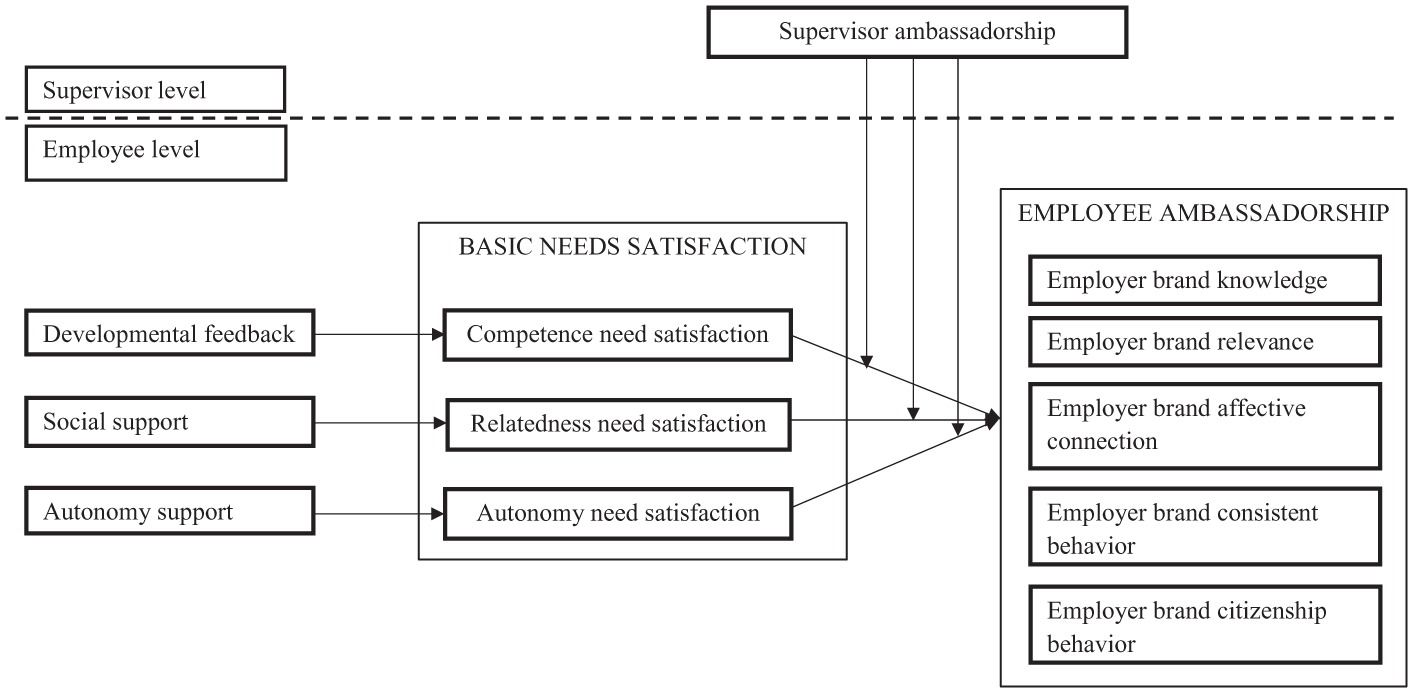
Graphical representation of the research model.
Theoretical Background
Employee Ambassadorship
To address the challenges public employers face in the labor market, the public sector can utilize employer branding as a strategy (Keppeler & Papenfuß, 2021). In a study conducted in the public sector, Lievens (2007) described employer branding as “the promotion of a clear view of what makes the organization different and desirable as an employer to internal and external audiences.” According to Ambler and Barrow (1996), this image can be described as “the package of functional, economic, and psychological benefits provided by employment, and identified with the employing company” (p. 187).
Over the last years, there has been increased recognition that employer branding is not a property described and controlled by the organization alone (Dineen et al., 2019; Jakobsen et al., 2023). Employees in the public sector, in particular, play a critical role in the organization’s employer brand, and their behavior and attitudes play an essential role in delivering the employer brand promise (Yuan et al., 2022). For example, in the context of public sector research, Ritz and Waldner (2011) emphasized the critical role of informal recommendations from family members and other individuals in influencing public sector employment. By serving as active communicators about the employer brand, employees create value in their interactions with stakeholders, which ultimately can aid in attracting new employees. Due to their wide reach and persuasive power, they can serve as a bridge connecting the organization’s employer brand with stakeholders. Employees can personify the employer brand in their interactions with stakeholders and display ambassadorship (Heide & Simonsson, 2018).
Moreover, employees, as ambassadors, play a crucial role in embodying and personifying the core values of the public sector, such as legitimacy, inclusivity, honesty, and fairness (Weske et al., 2020). By consistently demonstrating these values in their interactions with colleagues, citizens, and potential recruits, they not only enhance the public sector’s reputation but also help attract and retain the most suitable talent—individuals who share these values and are motivated to contribute meaningfully to public service. As a result, this ongoing promotion of the public organization’s values by employees helps attract and retain talent that aligns with the values of public service, strengthening the public sector’s mission and impact.
Furthermore, employees often yield more source credibility than communication directly stemming from the organization (Dineen et al., 2019). For example, positive word-of-mouth provided by employees—who are assumed to have a high level of expertise concerning the organization—is related to higher organizational attractiveness perceptions among job seekers (Ritz & Waldner, 2011). Due to their credibility and expertise, employees are in a unique position to challenge and reshape negative perceptions, such as those of laziness and inefficiency (Jakobsen & Homberg, 2025), held by external stakeholders. By actively sharing positive, counter-narratives, they play a crucial role in transforming public perceptions among key groups, including citizens, potential recruits, and other relevant stakeholders. This, in turn, can significantly enhance the attractiveness of the public organization. In conclusion, employees exert significant influence in shaping internal and external perceptions of the employer brand, thereby enhancing the visibility and impact of the employer brand both within and outside the organization (Taku et al., 2022).
Ensuring that employees display ambassadorship is a key outcome of an effective employer branding strategy, which serves as a mechanism for fostering employees to fulfill the external brand promise (Yuan et al., 2022). Rys et al. (2025) define employee ambassadorship as the favorable and constructive beliefs, attitudes, and actions of employees toward the organization’s employer brand. An effective employee ambassador should be well-acquainted with the employer brand and its communication. Additionally, they need to believe in its relevance to the organization and develop positive feelings toward it. Finally, their daily work behavior should align with the employer brand, and they should engage in positive (external) communication about the employer brand.
Based on literature and interviews with employees in the public and private sector, Rys et al. (2025) introduced a five-dimensional conceptualization of employee ambassadorship—comprising employer brand knowledge, employer brand relevance, employer brand affective connection, employer brand consistent behavior, and employer brand citizenship behavior. These five dimensions are connected and significantly impact various outcomes related to employee ambassadorship (e.g., word-of-mouth). Moreover, their study shows that it is possible to analyze each dimension individually or calculate an overall score to gain a comprehensive view. In our study, we will conduct both a general assessment and an exploratory analysis of each dimension separately to provide a detailed understanding of their contributions.
Self-Determination Theory and Basic Needs Satisfaction
SDT is a general theory of human motivation that has been used to investigate and predict human behavior in several domains, such as education, health, and organizations. This theory focuses on why people undertake certain actions and what motivates them to act in a particular way. Central to the SDT are the basic needs—competence, relatedness, and autonomy. These needs are innate and are essential for self-regulation and well-being (Deci & Ryan, 2000). The need for competence involves feeling effective and capable, which is supported when employees engage in challenging tasks and skill development (Deci et al., 2017). The need for relatedness centers on feeling connected with others, enhancing performance and resilience while reducing psychological issues (Reeve & Lee, 2018). The need for autonomy entails having the freedom to choose and regulate one’s activities without external pressure (Kaabomeir et al., 2022). Fulfillment of these needs is an essential prerequisite for well-being, motivation, and extra-role performance (Baard et al., 2004; Deci et al., 2017).
Research based on SDT demonstrated that satisfying the basic needs is associated with organizational citizenship behaviors, job satisfaction, and improved performance (Chen et al., 2015; Deci et al., 2017). When these needs are satisfied, individuals experience optimal motivation, well-being, and performance (Gagné et al., 2015). Moreover, they gain the motivational drive needed to internalize external values and norms, fostering self-determined motivation for related behaviors and efforts (Gagné & Deci, 2005; Rigby & Ryan, 2018). Building on this, perceived leadership practices can serve as an extrinsic source of motivation that, through the satisfaction of employees’ basic needs, becomes internalized. In the context of ambassadorship, this means that when leadership practices support autonomy, competence, and relatedness, employees are more likely to internalize organizational values and develop intrinsic motivation to display ambassadorship. Thus, we posit that leadership practices contribute to employee ambassadorship when employees experience competence, relatedness, and autonomy need satisfaction.
Need Satisfaction Through Leadership Practices
Extensive research highlights that need satisfaction is often facilitated by a supportive social context provided by immediate supervisors (Kaabomeir et al., 2022; Van Den Broeck et al., 2016). Supervisors are particularly well-positioned to create conditions that address employees’ basic needs for autonomy, competence, and relatedness (Williams et al., 2014). Need satisfaction can be achieved through a set of techniques, skills, and practices implemented by the immediate supervisor to effectively support employees’ basic needs (Cheon & Reeve, 2015; Kaabomeir et al., 2022; Ryan & Deci, 2017). These leadership practices can be categorized into three main groups: (1) practices supporting competence, (2) practices supporting relatedness, and (3) practices supporting autonomy (Kaabomeir et al., 2022; Reeve, 2018). We assert that employees’ perceptions of their supervisor’s actions and practices can create a social context that fosters need satisfaction and encourages ambassadorship. Furthermore, combining empirical findings on prosocial behavior (e.g., Chen et al., 2015), employee ambassadorship literature (Sakka & Ahammad, 2020; Stockman et al., 2020; Van Hoye, 2008, 2013; Yuan et al., 2022) with theoretical insights from SDT, we pose that need satisfaction is also important for promoting employee ambassadorship, thereby extending its relevance to a relatively underexplored domain.
Developmental Feedback
First, supervisors can foster competence by trusting employees’ abilities, removing obstacles to their success, offering non-judgmental feedback, and providing opportunities for skill development and problem-solving. Research has demonstrated that feedback effectively fosters competence by offering employees opportunities, support, and the ability to develop competencies independently (Su et al., 2019). Additionally, supervisors can provide this feedback. Therefore, we have integrated developmental feedback as a leadership practice to address competence need satisfaction.
Developmental feedback is the extent to which employees feel their supervisors provide valuable information that helps them learn, develop, and improve their job performance. It is future-oriented, emphasizing employees’ strengths and guiding their work, development, and learning, making them feel encouraged, recognized, and supported (Zhou, 2003). This feedback provides resources and work guidance (An et al., 2021), helping employees improve their knowledge and skills (Wang & Zhang, 2021), which enhances their sense of competence. Consequently, developmental feedback can enhance employees’ job competencies and simultaneously fulfill their competence requirements (An et al., 2021).
Therefore, we hypothesize that developmental feedback will be positively related to competence need satisfaction as developmental feedback provides resources, guidance, and challenging tasks aligned with employees’ job capabilities (An et al., 2021). Developmental feedback, which provides employees with valuable information and resources to enhance their job competencies, directly addresses this need.
Furthermore, we propose that competence need satisfaction will mediate the relationship between developmental feedback and employee ambassadorship, because developmental feedback can create a work environment that supports and validates competence need satisfaction (Slemp et al., 2018). When employees feel competent, they experience greater confidence and self-efficacy, which are essential for proactive actions such as employee ambassadorship (Van Woerkom & Meyers, 2015).
According to SDT, fulfilling the need for competence generates motivational energy that enhances well-being (Ryan & Deci, 2000) and promotes voluntary, prosocial efforts. Research has shown that prosocial efforts strongly depend on competence satisfaction (Messmann et al., 2022; Sedlářík et al., 2024). Moreover, employees who perceive that leadership practices support their competence are more likely to reciprocate through behaviors that contribute to organizational well-being and goal achievement (Chiniara & Bentein, 2016). Further, Stockman et al. (2020) found that referral requests framed to support employees’ sense of competence led to higher referral likelihood and quality among nurses, whereas offering a referral bonus had no significant effect. This aligns with SDT’s premise that individuals are motivated to support the growth of their organization when their needs are met (Sedlářík et al., 2024; Wörtler et al., 2020).
Thus, competence need satisfaction serves as a key mechanism explaining the link between developmental feedback and employee ambassadorship. Research indicates that when employees experience competence, they gain the motivational drive needed to internalize external values and norms, fostering self-determined motivation for related behaviors and efforts (Rigby & Ryan, 2018; Stockman et al., 2020; Van Hoye, 2008). So, when employees experience competence need satisfaction, they are more likely to engage in discretionary efforts that promote their organization. Based on this reasoning, we propose the following hypothesis:
Social Support
Secondly, to support relatedness, supervisors can create a supportive and empathetic work environment, fostering warm and meaningful interpersonal relationships even when employees do not meet desired outcomes (Parfyonova et al., 2019). Social support can enrich interpersonal interactions (Reeve, 2018). Therefore, we have included social support as a leadership practice to address relatedness need satisfaction.
Social support refers to the extent to which employees feel they receive emotional, instrumental, and informational assistance from their supervisor (Laird et al., 2016). Receiving social support strengthens interpersonal relationships and fosters feelings of respect, understanding, and connection. By seeking social support from supervisors, employees build meaningful relationships and feel connected to their supervisor and others in the workplace. Moreover, theory posed that positive social interactions and interpersonal relationships between supervisors and their employees are crucial for shaping motivation, extra-role behaviors, and positive attitudes (Deci et al., 2017).
As such, we expect that social support from supervisors will be associated with relatedness need satisfaction. By providing social support, supervisors create an intimate atmosphere among employees, empathizing with them, and providing a warm and intimate interpersonal relationship (Parfyonova et al., 2019). Social support aids employees in building meaningful relationships, fostering social connection, and creating a sense of belonging, which is inherent for the need for relatedness (Deci & Ryan, 2000).
Furthermore, we propose that relatedness need satisfaction will mediate the relationship between social support and employee ambassadorship, because social support can create a work environment that supports and validates relatedness need satisfaction (Veli Korkmaz et al., 2022). According to SDT, individuals are more likely to engage in prosocial efforts when they feel a sense of belonging or relatedness (Rosen et al., 2014). This aligns with Stockman et al.’s (2020) finding that referral requests framed to support employees’ sense of relatedness led to higher referral likelihood and quality. Employees who experience fairness and respect from colleagues and supervisors show greater motivation to contribute positively to their work environment (Chiniara & Bentein, 2016; Rosen et al., 2014; Rys et al., 2025). Furthermore, Sakka and Ahammad (2020) argued that strong interpersonal relationships facilitate the process of creating and sharing, enabling employees to exchange work-related information more effectively.
Moreover, satisfying relational needs supports the internalization of organizational values, which in turn fosters positive attitudes and behaviors toward the social context (Dysvik et al., 2013; Gagné & Deci, 2005; Messmann et al., 2022). Empirical studies have shown that high-quality relationships with supervisors are linked to increased discretionary efforts that benefit the organization (Farmer et al., 2015; Ilies et al., 2007).
So, fulfilling the need for relatedness is linked to positive work outcomes (Chen et al., 2015; Deci et al., 2017). When employees experience a sense of belonging at work, it strengthens their motivation and purpose, encouraging them to internalize external values and norms while reciprocating supportive workplace relationships (Hong et al., 2023). This, in turn, fosters self-determined motivation for related behaviors and efforts (Rigby & Ryan, 2018; Sakka & Ahammad, 2020; Stockman et al., 2020; Van Hoye, 2013). Therefore, when employees feel a strong sense of relatedness, they are more likely to engage in efforts that reflect their connection to and support the organization via employee ambassadorship. Based on this reasoning, the following hypothesis has been proposed:
Autonomy Support
Finally, supporting employees’ autonomy involves acknowledging their perspectives in decision-making, endorsing their ideas, offering rationales for requests, and minimizing undue pressures during task performance (Williams et al., 2014). Therefore, we have integrated autonomy support as a leadership practice to address autonomy need satisfaction.
Autonomy support refers to the degree to which employees perceive their supervisors’ actions or behaviors aimed at fostering a supportive and understanding climate within leader-worker relationships (Reeve, 2015). An autonomy supportive style generally involves supervisors acknowledging employees’ perspectives, encouraging self-initiation, offering opportunities for choice and input, communicating in an informational manner, and avoiding the use of rewards or sanctions to motivate behavior (Baard et al., 2004; Hardré & Reeve, 2009). A supervisor can support autonomy by providing opportunities for their employees to express their ideas and suggestions (Forner, 2019).
As such, we expect a relationship between autonomy support and autonomy need satisfaction. Creating an autonomy-supportive environment is thought to enhance employees’ sense of autonomy, enabling them to take initiative, exert control over their tasks and goals, and perceive themselves as the originators of their behavior (Baard et al., 2004). Moreover, employees feel they have choices and can make their own decisions, which may be associated with autonomy need satisfaction.
Furthermore, we propose that autonomy need satisfaction will mediate the relationship between autonomy support and employee ambassadorship, because autonomy support can create a work environment that supports and validates autonomy need satisfaction (Slemp et al., 2018). When employees feel their autonomy is valued by their organization, team, or supervisor, they gain a greater sense of mastery over their time and efforts, allowing them to engage more meaningfully in activities that align with their values (Gagné & Deci, 2005).
According to SDT, fulfilling the need for autonomy fosters intrinsic motivation and increases engagement in voluntary and prosocial behaviors and efforts (Gagné & Deci, 2005; Spreitzer, 1995), such as ambassadorship. Employees who experience autonomy satisfaction are more likely to develop a mindset of preserving and strengthening the growth and success of their social and organizational environment. This mindset translates into pro-organizational behaviors, benefiting both immediate social contexts (e.g., coworkers) and the broader organization (Chiniara & Bentein, 2016).
Research further supports this link, showing that perceived autonomy is positively related to teamwork-oriented behaviors (Chen et al., 2015), volunteerism (Gagné & Deci, 2005), and reduced controlling attitudes in professional interactions (Lynch et al., 2005). Furthermore, Stockman et al. (2020) demonstrated that autonomy-supportive referral requests, designed to fulfill employees’ basic need for autonomy, significantly increased nurses’ willingness to refer others and improved the quality of those referrals. Moreover, Yuan et al. (2022) showed that employee autonomy significantly enhances satisfaction and thereby strengthens employees’ willingness to act as employee brand ambassadors. Similarly, Soens and Claeys (2025) found that excessively restrictive policies on employees’ social media use can undermine perceived autonomy and, in turn, discourage engagement in online ambassadorship. So, when employees feel a sense of autonomy at work, they develop the motivational drive to internalize external values and norms, cultivating self-determined motivation for related behaviors and efforts (Rigby & Ryan, 2018).
As such, we expect autonomy need satisfaction to be positively associated with employee ambassadorship. Thus, fulfilling employees’ need for autonomy enhances their motivation to engage in ambassadorship, as autonomy satisfaction is linked to various positive work outcomes, including referral behavior (Chen et al., 2015; Deci et al., 2017; Stockman et al., 2020; Yuan et al., 2022). Based on this reasoning, we propose the following hypothesis:
Moderating Role of Supervisor Ambassadorship
In addition to creating an environment that supports need satisfaction to promote employee ambassadorship, supervisors can also serve as influential role models by encouraging ambassadorship through their own exemplary actions. While fulfilling an employee’s basic needs is crucial, the absence of clear expectations and goals can still impede employees’ ability to demonstrate ambassadorship effectively. By modeling desired behaviors, supervisors not only clarify what is expected but may also strengthen employee ambassadorship among employees high on need satisfaction.
Social learning theory (Bandura & Walters, 1977) suggests that employees learn behaviors and attitudes from observing others, particularly competent exemplars. In the workplace, supervisor often possess such qualities that makes them influential role models (Bandura & Walters, 1977). Moreover, they hold central roles within the organization, making their behaviors and attitudes highly visible to employees (Ogunfowora et al., 2021). A supervisor who acts as a role model can eliminate uncertainty by clearly demonstrating the desired behavior and expectations regarding employee ambassadorship. As such, drawing on the social learning theory, we argue that supervisors can strengthen employee ambassadorship through role modeling and by clarifying how to display ambassadorship among employees high on need satisfaction. When supervisors show ambassadorship, they demonstrate how to successfully embody the principles of ambassadorship to their employees. Therefore, through role modeling ambassadorship, supervisors enhance employees’ willingness of engaging in employee ambassadorship among employees high on need satisfaction. Therefore, following hypotheses were formed:
Method
Procedure
To test our hypotheses, we conducted a multilevel online survey in collaboration with a Belgian public organization responsible for municipal governance in a city of over 250,000 residents. The organization employs around 9,000 people across diverse roles, including healthcare, education, administration, and technical services.
Participants were recruited via an internal call from the HR department, inviting supervisors and their teams to join. Supervisors provided their email addresses and received a personalized survey link to share with their team members. Both supervisors and employees were assured of anonymity and reminders were sent to encourage participation.
The survey began with an informed consent form outlining the study’s purpose, data handling, and the option to withdraw at any time. Participants could also enter a lottery to win an e-commerce voucher by voluntarily providing their email address. For a more detailed explanation of the procedure, please refer to Supplemental material 1.
Sample
The organization comprised of approximately 6,000 employees and 788 supervisors, of whom 67% identified as female in both groups. An invitation was extended to all 788 supervisors of the organization, resulting in 93 supervisors starting the survey. Of these, 55 supervisors completed the survey entirely. However, we only included supervisors if at least 1 team member also completed the employee survey, resulting in a sample of 41 supervisors. The majority of included supervisors were female (84%), with the remaining 16% being male. Although this is in line with the female majority in the supervisor population (67%), females seem to be overrepresented in our supervisor sample. Regarding age, 25% were between 31 and 40 years, 47% were between 41 and 50 years, 26% were between 51 and 60 years, and 3% were over 60 years old. The average tenure was 16.32 years (SD = 10.54), with an average tenure as a supervisor of 10.41 years (SD = 8.87). Within the supervisor sample, 71% held a master’s degree, 22% held a bachelor’s degree from a university college, and 6% held a secondary high school diploma. Additionally, 2% were supervisors of a technical team and 98% were supervisors of an administrative team.
In total, we sampled data from 281 employees. However, instances where less than 70% of the survey was completed, where excluded from the dataset. After excluding 53 employee respondents, the final sample consisted of 228 employees from 41 teams. Team size in the final sample ranged from 1 to 17 employees, with an average team size of 5.56 members (SD = 3.26). Every department within the organization has been represented at least once. Among the employees, 68% were female and 32% male, closely reflecting the overall group composition, which consisted of 67% female and 33% male. Regarding age, 13% were between 18 and 30 years old, 25% within the 31 to 40 age brackets, 33% reported their age as being between 41 and 50 years old, 25% were between 51 and 60 years old, and 5% were over 60 years old. The mean tenure of the employees was 12.45 years (SD = 9.96). Furthermore, the duration of the relationship with the supervisor, indicating how long the employee has worked under a specific supervisor, was on average 4.23 years (SD = 4.36). 86% of the employees were administrative staff, 9% of the employees were nursing staff, and 5% were technical staff.
Employee Measures
Developmental Feedback
Developmental feedback was measured with the three-item scale of Zhou (2003; e.g., “While giving me feedback, my supervisor focuses on helping me to learn and improve.”). Items were rated on a seven-point Likert scale (1 = strongly disagree, 7 = strongly agree; α = .79).
Social Support
Social support was measured with the six-item scale of Eisenberger et al. (2002; e.g., “My supervisor really cares about my well-being.”). Items were rated on a five-point Likert scale (1 = strongly disagree, 5 = strongly agree; α = .89).
Autonomy Support
Autonomy support was assessed by Baard et al.’s (2004) six-item scale (e.g., “My supervisor tries to understand how I see things before suggesting a new way to do things.”). Items were rated on a seven-point Likert scale (1 = strongly disagree, 7 = strongly agree; α = .92).
Needs Satisfaction
Needs satisfaction were assessed by Chen et al.’s (2015) 12-item scale, using a 5-point Likert response scale (1 = completely false, 5 = completely true). Each need was measured with four items. An example item of need for competence is “At work, I feel I can successfully complete difficult tasks.” (α = .86). An example item for need for relatedness is “At work, I experience a warm feeling with the people I spend time with.” (α = .89). An item used to measure need for autonomy is “At work, I feel a sense of choice and freedom in the things I undertake.” (α = .85).
Employee Ambassadorship
We used Rys et al.’s (2025) 20-item scale to assess employees’ ambassadorship. The scale consists of five subscales, each measured with four items on a five-point Likert scale (1 = strongly disagree, 5 = strongly agree). Sample items are “I know what our employer brand stands for” (employer brand knowledge dimension; α = .81), “I believe that our employer brand helps to retain employees” (employer brand relevance dimension; α = .86), “I feel connected to our employer brand” (employer brand affective connection dimension; α = .82), “I fulfill my daily work in line with our employer brand” (employer brand consistent behavior dimension; α = .89), and “I would recommend my organization as an employer to others” (employer brand consistent behavior dimension; α = .79).
According to Rys et al. (2025), employee ambassadorship can be assessed either through its individual dimensions or as an overall higher-order factor. Given the focus of our study, we opted to use the overall score for evaluating employee ambassadorship (α = .90) to simplify the analysis and manage model complexity. The validity of this scale has been well established in prior research. They provided extensive evidence supporting its reliability and construct validity through exploratory and confirmatory factor analyses. We included the items and dimensions in the Supplemental materials (see Supplemental material 2 for the items and dimensions).
Supervisor Measures
Supervisor Ambassadorship
Supervisor ambassadorship was evaluated utilizing the same employee ambassadorship scale developed by Rys et al. (2025). Supervisors were requested to assess their ambassadorship using a 20-item scale comprising five dimensions. The Cronbach’s alpha coefficients for each dimension were as follows: .80 for Employer Brand Knowledge, .82 for Employer Brand Relevance, .82 for Employer Brand Affective Connection, .90 for Employer Brand Consistent Behavior, and .72 for Employer Brand Citizenship Behavior. The overall Cronbach’s alpha for supervisor ambassadorship was .89.
Control Variables
We measured four potential control variables, which may theoretically influence people’s propensity to become ambassadors for their employers: gender (0 = Male, 1 = Female; Chapman et al., 2005), tenure (in years; Becker, 2005; Xiong et al., 2013), extraversion (four item-scale by Donnellan et al., 2006 on a five-point scale from 1 = strongly disagree to 5 = strongly agree, α = .72; Bauer et al., 2006), and duration of the relationship with their supervisor (Chiniara & Bentein, 2016). To avoid losing power and due to convergence problems, we proceed in the analyses with only tenure as control variable (see Table 1).
Means, Standard Deviations, and Correlations for the Study Variables.
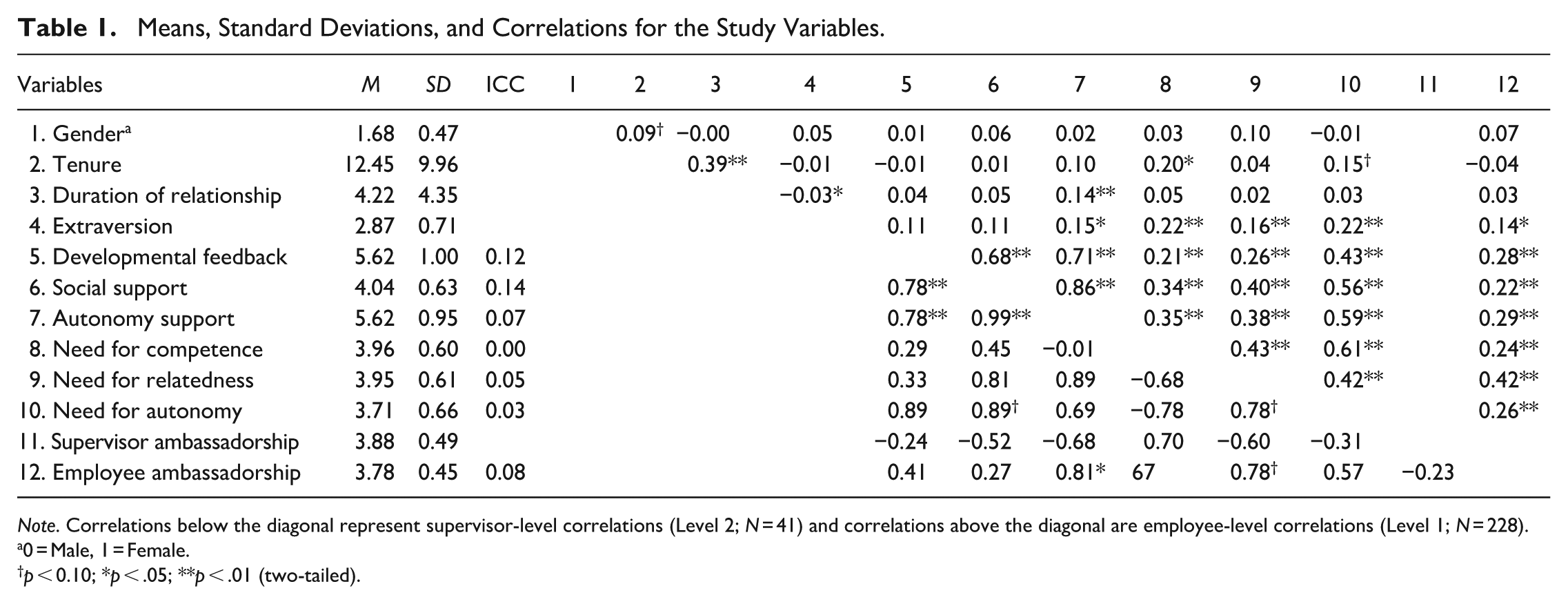
Note. Correlations below the diagonal represent supervisor-level correlations (Level 2; N = 41) and correlations above the diagonal are employee-level correlations (Level 1; N = 228).
0 = Male, 1 = Female.
p < 0.10; *p < .05; **p < .01 (two-tailed).
Common Method Bias
Considering that our employee-level data are cross-sectional, we implemented several strategies to minimize the potential impact of common method bias (CMB), as recommended by George and Pandey (2017). First, following the guidance of Podsakoff et al. (2012), we ensured psychological separation by organizing the measurement instruments into distinct sections. We also reduced the risk of social desirability bias by emphasizing respondent anonymity and rephrasing items to better align with the employee context and avoid ambiguity (Chang et al., 2010; Podsakoff et al., 2012). Furthermore, we conducted Harman’s one-factor test, which indicated that CMB is unlikely to affect our employee-level data (Chang et al., 2010). The one-factor model explained only 25% of the variance, which is well below the 50% threshold (Podsakoff & Organ, 1986). Regarding our cross-level interaction, CMB is less of a concern, as the moderator was measured among supervisors (George & Pandey, 2017)
Belgian Local Government Context
This study examines employees and supervisors within the Belgian local government, a sector distinguished by its unique institutional and organizational context. Local governments operate within a tightly regulated framework, characterized by limited financial resources and a well-defined hierarchical structure. Unlike the private sector, where financial incentives like bonuses are commonly used to drive motivation and engagement, public sector organizations, particularly local governments, rely on alternative strategies to attract talent.
The recruitment and hiring process within the Belgian local government is highly formalized and subject to strict regulations, ensuring that procedures are transparent and equitable. Candidates for positions are generally required to meet stringent criteria defined by sectoral agreements, with hiring processes that emphasize fairness, merit, and equal opportunity (Public Sector Experts, n.d.). Unlike the private sector, where flexibility in hiring may allow for quicker adjustments and discretionary decisions, the public sector’s recruitment process is more structured and procedural, aiming to guarantee that each candidate is assessed on a level playing field (Hondeghem & Steen, 2000). While this formalized approach can limit the flexibility typically seen in private sector hiring, it seeks to maintain consistent employment standards across all local government entities.
Data Analysis
In our study, we used multilevel path analysis with Mplus8 to assess our hypotheses (Muthén & Muthén, 2017), accounting for the hierarchical nature of our data with employees (Level 1) nested within supervisors or teams (Level 2). Our primary focus was on exploring the relationships among employee level variables, but our investigation also uncovered variability at the supervisor level within the variables measured among employees. Multilevel analysis dissects the observed variance of variables measured among employees into components attributed to both employees (Level 1) and teams (Level 2), producing latent variables to capture employee-level and team-level variances. Given our focus on the fixed portion of the model, we opted for ML estimation rather than robust ML estimation. While robust ML estimation provides more accurate standard error estimates for Level 2 random components, it has a tendency to overcorrect Level 1 standard errors (Maas & Hox, 2004). Furthermore, the variables used in the path analysis were computed as the average of their respective items, without parceling.
First, we calculated a two-level intercept-only model with a random intercept for employee ambassadorship. This model indicated that 92% of the variance in employee ambassadorship is explained by the employee level and 8% by the team level. Next, we tested a multilevel mediation model (Model 1) as outlined by Preacher et al. (2007), which combines a 1-1-1 mediation model (Krull & MacKinnon, 2001), with a random intercept only model. 1 In this model, pathways were estimated from the independent variables (developmental feedback, social support, and autonomy support) to the mediating variables (competence, relatedness, and autonomy need satisfaction), and the dependent variable (employee ambassadorship), while the basic needs were allowed to covary. Furthermore, the relationships between independent, mediating and dependent variables were modeled on the supervisor level as well.
Lastly, to address potential multicollinearity concerns, we conducted separate analyses for cross-level interactions, specifically testing the moderating role of supervisor ambassadorship in the relationships between employees’ need satisfaction and employee ambassadorship (Model 2; see Supplemental material 3 for more details). Employee-level variables were centered around the group mean, while the supervisor-level variable was centered around the grand mean (Enders & Tofighi, 2007). Employee ambassadorship, serving as the outcome measure, was not centered (cf. Binnewies et al., 2010).
Results
Means, standard deviations, and correlations are presented in Table 1. The fit of the estimated multilevel path model was acceptable (CFI = 0.901, RMSEA = 0.095).
Mediation Model (Model 1)
Supporting
Results of the Multilevel Mediation Model.
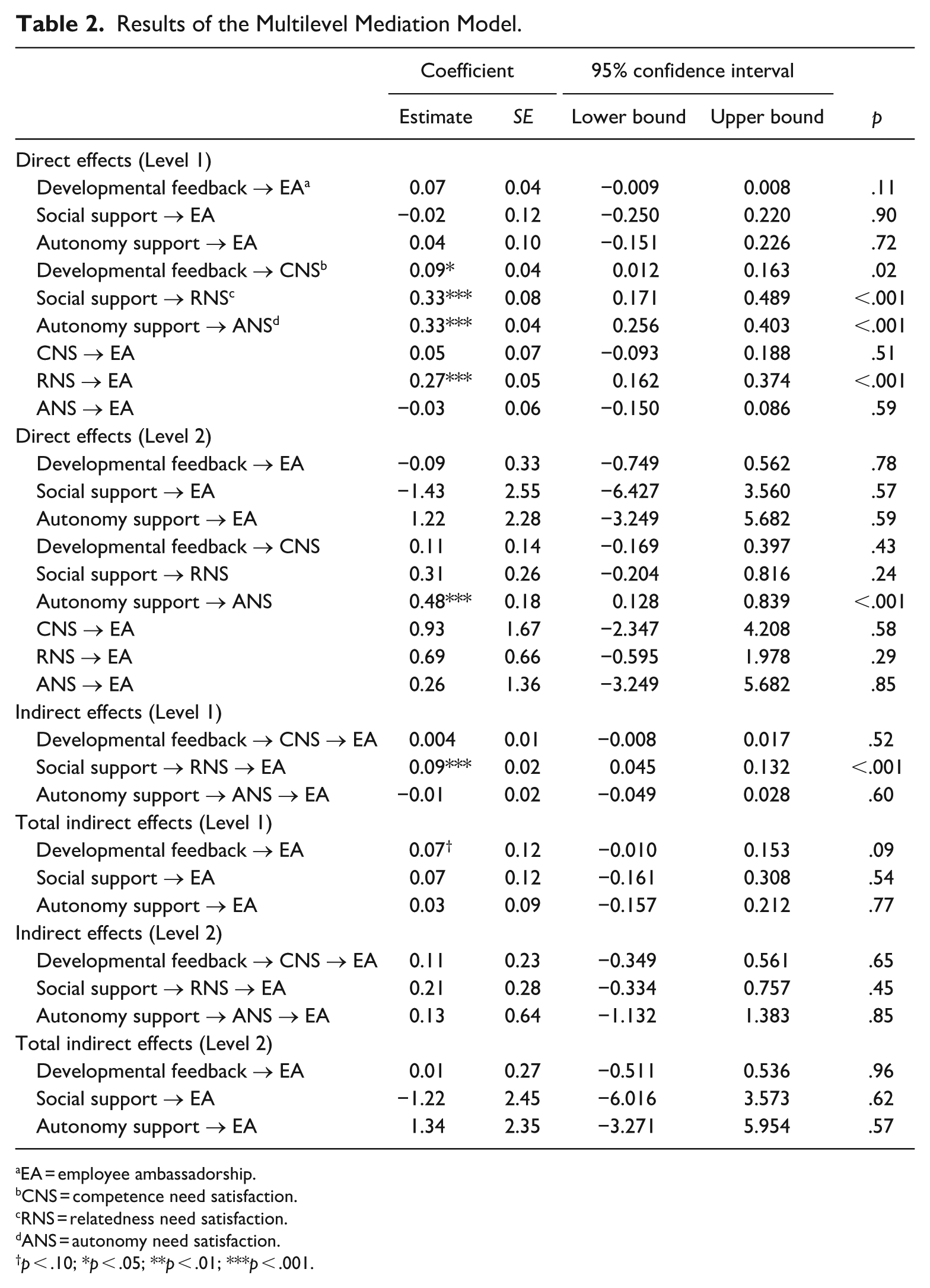
EA = employee ambassadorship.
CNS = competence need satisfaction.
RNS = relatedness need satisfaction.
ANS = autonomy need satisfaction.
p < .10; *p < .05; **p < .01; ***p < .001.
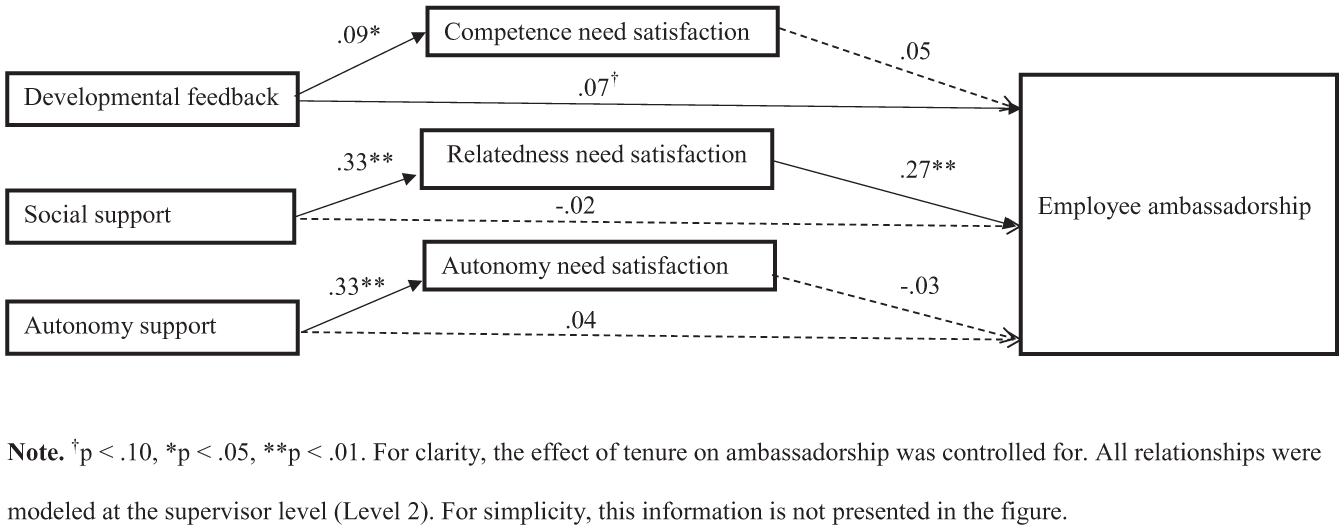
Graphical representation of the results (mediation model).
To examine how the three leadership practices jointly relate to need satisfaction, we conducted an additional analysis. Autonomy support, developmental feedback, and social support were combined into one construct: an autonomous work environment. This autonomous work environment was positively associated with all three basic needs and directly linked to employee ambassadorship. We also found a significant indirect effect through relatedness need satisfaction, indicating that the need for relatedness partially mediates the relationship between the autonomous work environment and employee ambassadorship. No significant indirect effects were found through competence or autonomy need satisfaction in this relationship (see Supplemental material 5, Figure S2).
Cross-Level Interaction Model (Model 2)
Exploratory Analyses for Separate Dimensions of Employee Ambassadorship
To better understand the five subdimensions of employee ambassadorship, we ran the mediation analyses (Model 1) for each subdimension of employee ambassadorship separately. The results were consistent with those for overall employee ambassadorship. Specifically, relatedness need satisfaction mediated the relationship between social support and each of the five subdimensions. However, no significant relationship was found for the other two mediating variables, competence and autonomy need satisfaction. For more details, please see Supplemental materials 6–10, Figures S3–S7.
Additionally, we explored whether each of these subdimensions of supervisor ambassadorship moderated the relationship between employees’ need satisfaction and the corresponding subdimension of employee ambassadorship. The results identified significant moderations, especially regarding relatedness need satisfaction (see Figure 3). Specifically, when subdimensions of supervisor ambassadorship—such as supervisor employer brand knowledge, supervisor employer brand relevance, and supervisor employer brand citizenship behavior—were high, the relationship between relatedness need satisfaction and its corresponding subdimension of employee ambassadorship was strengthened at the employee level. For a more detailed explanation, please refer to Supplemental materials 11 and 12.
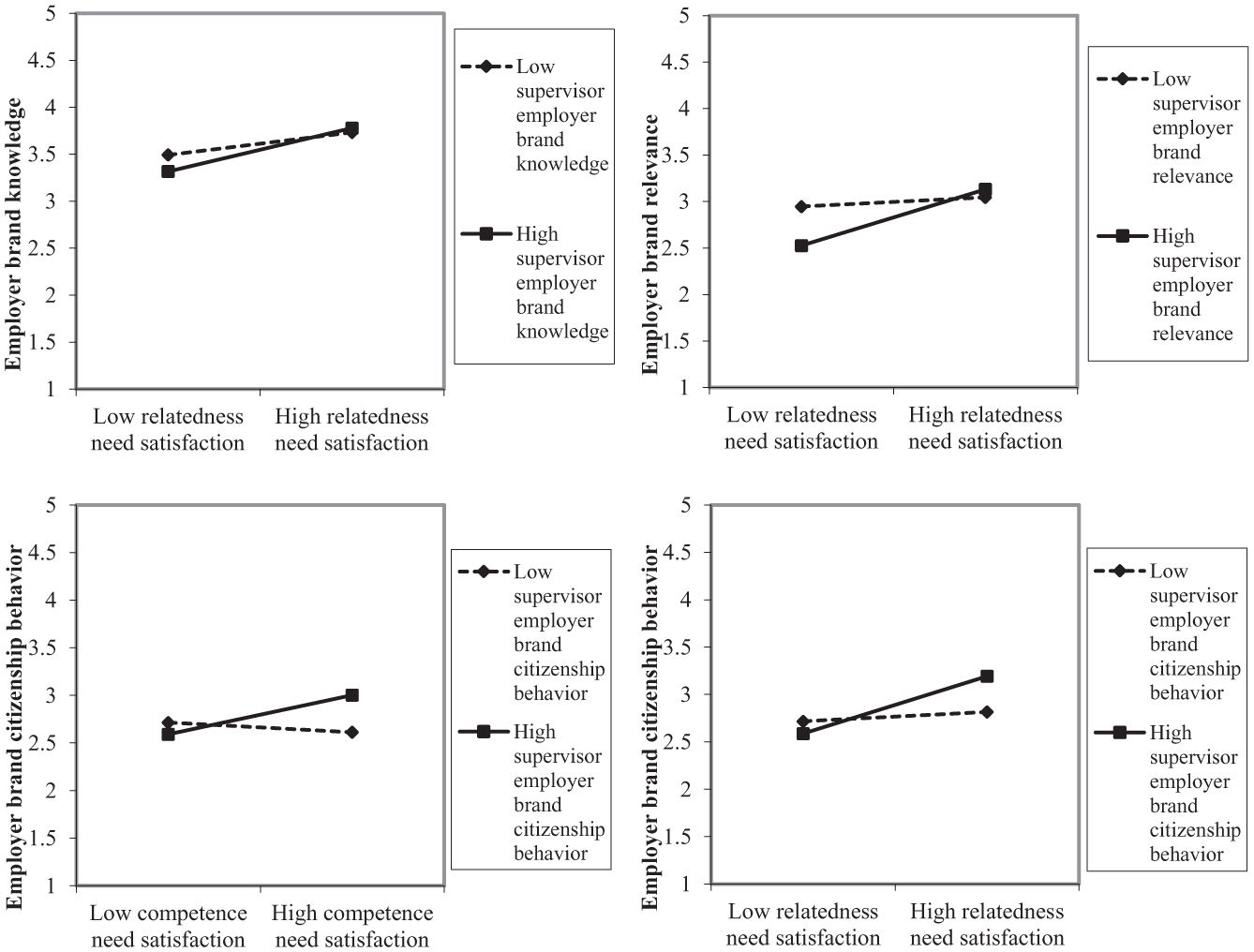
Graphical representation of the exploratory moderation analyses.
Discussion
Following SDT, the current study assessed how supervisors can enhance employee ambassadorship by creating a supportive environment that fulfills the basic needs of their team members (Deci & Ryan, 2000).
First, our study contributes to public sector recruitment, which has become an urgent issue in the public sector (Linos, 2018). Jakobsen et al. (2023) called for research into proactive strategies for labor market engagement. This study addresses this gap by exploring how supervisors can proactively foster employee ambassadorship, a strategy that enhances employer branding and attracts talent. By focusing on supervisors’ role in creating supportive contexts and role-modeling status, we provide insights into long-term hiring measures like talent management (Kravariti & Johnston, 2020) and employee recommendation systems, which are essential for sustainable talent attraction in the public sector (Ritz & Waldner, 2011). Moreover, fostering ambassadorship can help reshape public perceptions of government work, challenging stereotypes of inefficiency and lack of innovation (Jakobsen & Homberg, 2025). Employees who act as ambassadors can positively influence the public employer image, ultimately aiding in the recruitment of talent that values public service and its societal impact.
Secondly, we identified that the need for relatedness mediates the relationship between social support and employee ambassadorship. These results align with SDT, which posits that fulfilling employees’ need for relatedness encourages ambassadorship (Ryan & Deci, 2000; Weske & Schott, 2018). This can be attributed to the fundamental role of relatedness in shaping employees’ sense of belonging, acceptance, and connection within the organization (Deci & Ryan, 2000). This need is crucial for efforts such as ambassadorship, where employees not only perform their tasks but also go beyond their formal roles to contribute to the well-being of the organization. Employees who feel emotionally connected and have a sense of belonging are more motivated to engage in proactive behaviors and actions (Fernandez-Lores et al., 2016). According to SDT, relatedness is the most influential factor in driving extra-role behaviors and efforts like ambassadorship, as it instills a sense of meaning and mutual trust (Deci & Ryan, 2000). Employees who feel genuinely supported and appreciated within their work environment are more inclined to display ambassadorship.
Moreover, the results are consistent with suggestions from past public administration research that social support facilitates employees’ proactive attitudes and behaviors in the workplace (Audenaert et al., 2020). Our study contributes to SDT by applying its principles to ambassadorship, highlighting the importance of a supportive environment in fulfilling employees’ basic needs and ambassadorship (Chen et al., 2015; Deci et al., 2017; Vandenabeele, 2014).
Furthermore, this study contributes to the field of public administration by applying SDT to the context of local government employees. This study enhances our understanding of employee motivation, showing how fulfilling the need for relatedness drives discretionary efforts beyond formal roles to support organizational goals. This theoretical contribution suggests that public organizations, particularly in the Belgian local government context, can foster ambassadorship through non-financial means, which is especially valuable in settings where financial rewards are less common. The recruitment process in the Belgian local government is highly formalized and structured. This rigidity makes it challenging for the public sector to adopt private-sector recruitment tactics (Hondeghem & Steen, 2000). Therefore, fostering a sense of relatedness can still play a crucial role in strengthening employer branding and improving recruitment outcomes. This approach helps overcome these challenges by improving the appeal of the organization to potential candidates. Employee ambassadors’ enthusiasm, persuasion, and credibility are crucial in attracting candidates who truly align with the public employer’s mission. This approach does not compromise the fairness or transparency of recruitment but rather strengthens the overall recruitment strategy by ensuring that the right talent is drawn to the organization, based on shared values to public service.
Interestingly, while relatedness plays a crucial role in fostering ambassadorship, the need for competence and autonomy did not demonstrate the same effect. Although competence is a key driver of job performance and intrinsic motivation (e.g., Brien et al., 2012; Greguras & Diefendorff, 2009), it may be linked more to effectiveness within formal work tasks rather than discretionary efforts like ambassadorship. This aligns with prior research suggesting that competence need satisfaction is less reliant on social interactions and more dependent on internal resources, such as confidence in one’s skills and abilities (Chiniara & Bentein, 2016). As a result, competence may enhance task-related performance but does not necessarily extend to extra-role efforts aimed at supporting the organization.
Similarly, autonomy is a well-established predictor of intrinsic motivation and job engagement. Employees with high levels of autonomy are more motivated to perform their tasks in their preferred manner to take initiatives and to be creative, leading to increased performance at work (Chiniara & Bentein, 2016). Autonomy thus plays a role in work motivation, but without an emotional connection to the organization, it may be difficult to expect ambassadorship. Thus, while competence and autonomy are critical for motivation and performance, our findings suggest that relatedness is the key basic need driving employees to actively promote and support their employer.
In addition, this study highlights the important role of supervisors’ social support in the context of public employer branding. Previous studies have already highlighted the importance of leadership (Biswas & Suar, 2016; Boukis & Christodoulides, 2020) in employer branding. Our study extends this by examining how supervisors can actively shape the employer brand and encourage brand support among employees. Often, the important role of supervisors is described with regards to transferring the employer brand among employees (Biswas & Suar, 2016). However, literature has not yet addressed how supervisors can foster the employer brand and create a type of context that encourages the employer brand. This research bridges the gap between leadership and employer branding literature by highlighting the role of social support in shaping employee ambassadorship.
Lastly, we investigated the influence of supervisor ambassadorship as a moderating factor, enhancing our understanding of the role-modeling effects of supervisors within public administration. Based on social learning theory, we hypothesized that supervisors would act as role models and significantly affect how employees behave in the organization. However, multilevel analyses revealed no significant moderation effects. One possible reason is the use of supervisor-reported ambassadorship, which might not reflect how employees perceive their supervisors’ ambassadorship. Moreover, according to social learning theory (Bandura & Walters, 1977), the degree to which observers (i.e., employees) imitate certain behaviors of role models (i.e., supervisors) might depend on some individual characteristics and contingent factors (Cheng et al., 2019). These factors include the traits of the observers, the traits of the role models, and the nature of the relationship between them (Li & Sun, 2015), none of which were considered in this study. Despite these concerns, exploratory analyses revealed that when supervisors showed high levels of citizenship behaviors, the relationship between employee relatedness and employer brand citizenship behavior was stronger. This indicates that supervisors’ behaviors toward the employer brand does promote ambassadorship.
Limitations and Suggestions for Future Research
While the present study offers valuable insights, several limitations must be acknowledged. First, the reliance on self-report measures may have introduced CMB and social desirability bias. However, since many constructs in this study are subjective, they are best captured through reports from those directly involved. Additionally, not all hypothesized relationships were supported, and several correlations were low, suggesting that CMB is unlikely to undermine our conclusions. Research (e.g., Spector, 2006) has shown that using self-reports does not guarantee significant results, that potential biasing variables (e.g., negative affectivity) typically do not inflate correlations, and that mono-method correlations are not necessarily higher than multi-method correlations. Despite our efforts to ensure confidentiality and the results of Harman’s single-factor test, future studies should consider replicating our findings with alternative research designs and measures, such as observational data, to further assess employee ambassadorship and its relationship with need satisfaction and leadership practices.
Second, the correlational nature of our data limits causal inferences. Therefore, causality can only be assumed on theoretical rather than empirical grounds. Even though theory supports our proposed order, it will be possible that the causal chain, or part of it, also operates in the opposite direction. This suggests that while basic needs may influence ambassadorship, the reverse could also be true. Future studies could start to provide further insight into causality by conducting (field) experiments and/or employing longitudinal, full-panel designs, preferably with a substantial number of measurement waves (Taris & Kompier, 2003). Such designs would not only make it possible to obtain insight into the hypothesized causal processes connecting work characteristics with employee ambassadorship but would also allow for a more detailed examination of reversed and reciprocal causal processes.
Our research was also limited to a single Belgian local government institution, which may affect the generalizability of the findings. Furthermore, the supervisor sample was predominantly female, overrepresenting women compared to the broader supervisory population. Additionally, the sample lacked diversity in terms of roles, with a limited representation of technical staff and a majority of administrative employees. Therefore, future research should test more diverse organizational samples, including a gender distribution more oriented toward males and a greater representation of technical profiles, to better reflect the dynamics of organizations with different workforce compositions.
Moreover, to better capture psychological constructs, such as the basic needs, latent variables could be incorporated into a mediation model. This would require a significantly larger sample to ensure accurate parameter estimation and model stability. Future research should test these results in larger samples to assess broader applicability and, with sufficient sample sizes, explore Structural Equation Modeling (SEM) to enhance the robustness of mediation analyses and provide deeper insights into the underlying relationships.
In addition, future research could further explore the interactions between basic psychological needs in the workplace. While Gagné and Deci (2005) proposed that an autonomous work environment can satisfy all three needs, SDT does not assume a strictly linear relationship among them. Instead, relatedness, competence, and autonomy are believed to interact and mutually influence one another. Investigating these interactions empirically could provide deeper insights into how leadership practices foster need satisfaction and, in turn, influence work-related outcomes.
Furthermore, one promising direction is the relationship between Public Service Motivation (PSM) and employee ambassadorship. PSM refers to the motivation or the need that some individuals have “to do good for others and shape the well-being of society” (Perry & Hondeghem, 2008; p. 3). It refers to the motivation that people must contribute to society (Vandenabeele & Breaugh, 2024). Vandenabeele and Breaugh (2024) suggested that PSM is not only driven by individual values and socialization processes but is also linked to the satisfaction of basic needs, as proposed by SDT. Future research could examine if employees with high PSM are more inclined to engage in ambassadorship, as their intrinsic motivation aligns with the public organization’s mission and values, or if PSM lowers the threshold for employees to display ambassadorship, as suggested by SDT.
Another promising concept within SDT that warrants further exploration is beneficence (i.e., a basic need associated with an individual’s sense of making a meaningful contribution to others; Martela & Ryan, 2016). It captures the intrinsic satisfaction derived from positively impacting others and has been shown to predict behavior in prosocial contexts. Given that employee ambassadorship entails endorsing an organization and enhancing its reputation, beneficence may be a key motivational factor driving such efforts. Future research could examine whether beneficence acts as an additional catalyst for ambassadorship, particularly in public organizations where contributing to societal well-being is a core value.
Lastly, while we examined the moderating role of supervisor ambassadorship, other moderating variables, such as organizational culture or team dynamics, were not considered. It can be interesting that future research investigates additional factors that may influence ambassadorship.
Practical Implications
Our results point to several practical recommendations. Firstly, enhancing social support from supervisors is crucial. Supervisors play a key role in shaping the workplace environment and can significantly influence employees’ sense of relatedness and ambassadorship. By fostering supportive relationships, they can encourage employees to act as ambassadors for their organization.
Secondly, public organizations should prioritize leadership development to strengthen supervisors’ ability to address employees’ need for relatedness. Supervisors who build strong, positive relationships with their teams can significantly increase employees’ willingness to advocate for their organization. This can be achieved through training programs for supervisors that focus on interpersonal skills, empathy, and communication—essential elements for fostering a sense of connection and relatedness in the workplace.
Thirdly, public organizations can implement group meetings and networking events for employees. By creating structured opportunities for interaction, organizations can help employees build meaningful connections and relatedness, which reinforces their commitment to the organization and can increase their likelihood of engaging in ambassadorship.
In addition, supervisors should model positive employer brand citizenship behaviors to strengthen the employer brand and encourage employee ambassadorship. Providing training and concrete examples can help supervisors develop the skills needed to effectively promote the organization’s mission and values, setting a standard for employees to follow.
Furthermore, public organizations can leverage supervisors or colleagues as role models. By openly sharing how they display ambassadorship, they can not only strengthen employees’ sense of relatedness but also provide concrete guidance on how to engage in ambassadorship themselves.
Lastly, establishing platforms to showcase examples of ambassadorship and celebrate collective achievements resulting from these efforts can enhance employees’ sense of relatedness to the organization. At the same time, it provides them with practical guidance on how to engage in ambassadorship themselves.
Conclusion
In today’s competitive job market, attracting and retaining talent is challenging, particularly in the public sector. This study, based on SDT and social learning theory, examines how supervisors can enhance employee ambassadorship to strengthen the public employer brand. Results highlight that leadership practices, such as providing social support, are crucial for fostering ambassadorship by meeting employees’ needs. Although direct moderation effects were not observed, exploratory analyses offered insights into the role of supervisor attitudes and behaviors. Despite limitations, the study emphasizes the critical role of supervisors in promoting ambassadorship and suggests further research to explore these dynamics across various contexts.
Supplemental Material
sj-docx-1-rop-10.1177_0734371X251399926 – Supplemental material for Leadership Practices and Employee Ambassadorship: The Mediating Role of Basic Needs
Supplemental material, sj-docx-1-rop-10.1177_0734371X251399926 for Leadership Practices and Employee Ambassadorship: The Mediating Role of Basic Needs by Marthe Rys, Edwin A. J. van Hooft, Eveline Schollaert and Greet Van Hoye in Review of Public Personnel Administration
Footnotes
Acknowledgements
Not applicable.
Declaration of Conflicting Interests
The authors declared no potential conflicts of interest with respect to the research, authorship, and/or publication of this article.
Funding
The authors received no financial support for the research, authorship, and/or publication of this article.

Ethical Considerations
The data protection officers of Ghent University and the participating organization waived the need for ethics approval for this research. All participants provided digital consent before starting the online survey. We thoroughly explained the study to participants, ensuring that personal data would be processed exclusively by the research team at Ghent University. All responses were anonymized, meaning no individual identifiers were retained, and the organization only received a report with aggregated, anonymous data. Participation was entirely voluntary, with participants having the right to withdraw consent or request data deletion or correction at any time. Data will be stored for five years, with strict privacy protection measures in place. Participants were also informed of their rights and could contact the university or data protection authorities if necessary.
Consent to Participate and to Publish
We obtained digital consent from all participants involved in the study, granting permission for their data to be used for research and scientific publication.
Data Availability Statement
Due to the nature of the data and the conditions of the data collection process, the data used in this study is not open to the public. Restricted access to the data would require a specific arrangement with the authors.
Supplemental Material
Supplemental material for this article is available online.
Notes
Author Biographies
References
Supplementary Material
Please find the following supplemental material available below.
For Open Access articles published under a Creative Commons License, all supplemental material carries the same license as the article it is associated with.
For non-Open Access articles published, all supplemental material carries a non-exclusive license, and permission requests for re-use of supplemental material or any part of supplemental material shall be sent directly to the copyright owner as specified in the copyright notice associated with the article.
