






Abstract
This study employs a quasi-experimental pre–post research design, exploiting a political uprising in Bangladesh as an exogenous shock to examine its effects on the organizational behaviors of public servants. Drawing on a unique pre- and post-uprising survey, the study categorizes bureaucratic behaviors into situational and dispositional responses. The findings show that political instability primarily disrupts context-dependent organizational dynamics (situational), while core individual values (dispositional) remain comparatively stable. Situational behaviors, such as job satisfaction and inter-service relationships, decline significantly following the regime change due to heightened uncertainty, role ambiguity, and job insecurity. In contrast, dispositional behaviors, such as Public Service Motivation (PSM) and Organizational Citizenship Behavior (OCB), remain resilient, suggesting that deeply internalized values are less vulnerable to political disruptions. By distinguishing between situational and dispositional behaviors, the study contributes to understanding bureaucratic resilience during political crises and offers practical implications for public-sector human resource management following political upheaval.
Introduction
While political transitions have been widely studied in terms of institutional change, regime dynamics, and policy outcomes, much less attention has been given to how these transitions affect the attitudes, motivations, and day-to-day behaviors of the bureaucratic workforce. Our comprehensive search across multiple academic journal databases identified only two relevant studies. Jilke (2016) examined the effects of regime change (the event of German reunification in 1990) on public officials in Germany, finding that it triggered a significant “satisfaction shock,” resulting in reduced job satisfaction. Tabvuma et al. (2014) investigated the effects of political elections in the United Kingdom and found only weak impacts on job satisfaction. Notably, both studies are based on WEIRD (Western, Educated, Industrialized, Rich, and Democratic) countries and focus exclusively on a single dimension of work attitudes, job satisfaction, yielding diverse results that leave broader attitudinal and behavioral consequences largely unexplored. This also leaves a significant gap in understanding how these dynamics play out in developing countries, where political volatility and institutional constraints present distinct challenges. This gap is particularly striking given the transformative potential of regime shifts, whether through elections, uprisings, coups d’état, or authoritarian backsliding, for administrative systems and the behavior of public officials. Reflecting this scarcity of empirical inquiry, Tabvuma et al. (2014, p. 384) observed that the dynamic influence of external events on employees’ job satisfaction is “virtually nonexistent,” particularly in the public sector. This lack of empirical evidence persists to this day. Moreover, the existing research also overlooked how such political changes affect other important behavioral dimensions such as Public Service Motivation (PSM) and Organizational Citizenship Behavior (OCB).
The limited empirical research on the effects of regime change on public officials is surprising, given the intrinsic link between political leadership and bureaucratic behavior. Scopes for changes in public personnel after a regime change are often within a country’s formal processes, though the scope may vary. For example, in Japan, there are only 80 political appointments, whereas in the US, there are around 4,000 civil servants (see Suzuki, 2025). In some cases, it can even be higher, like 20,000 in Brazil (Bersch et al., 2023). Therefore, the formal scopes for change following political change can be significant in certain countries. In some countries, there are also informal practices for changes in the public sector after the change of power. In many countries, particularly in the developing countries, officials aligned with the outgoing regime may fear dismissal, reassignment to less influential roles, or the loss of institutional privileges (see Bizhan & Howes, 2026; Brassiolo et al., 2024; Grindle, 2012). Conversely, others may see regime change as an opportunity to advance their careers or gain new advantages. In merit-based bureaucracies with strong democratic traditions, such changes usually do not occur, or occur only on a limited scale at the top levels of the public service (see Grindle, 2012). However, there is growing evidence that even in democratic systems, regime change can have far-reaching consequences. A recent example is the U.S. public sector reform led by the Department of Government Efficiency (DOGE). Under the banner of ending the “tyranny of the bureaucracy” and reducing the taxpayer burden, over 2 million government employees were offered voluntary buyouts, and most programs run by USAID—America’s primary foreign aid agency—were eliminated (Clarke, 2025). Suzuki (2025) summarizes DOGE’s strategies into three: a deferred resignation program, a near-total hiring freeze, and widespread terminations that disregard individual performance and the importance of positions. These illustrate how regime change can substantially reshape the public sector, even within established democracies.
In recent years, regime change has become increasingly consequential in many countries, particularly when populist leaders come to power, triggering processes of democratic backsliding (Bauer, 2024). These transitions commonly involve the consolidation of executive authority, the erosion of bureaucratic autonomy, extensive personnel reshuffling, and the weakening of administrative institutions through budgetary constraints and information control (Suzuki, 2025). Bauer (2024) conceptualizes this pattern as administrative backsliding, a process in which public institutions are systematically weakened and evaluation criteria shift from professional competence to political loyalty, frequently resulting in politically motivated dismissals or transfers.
Research on organizational change, such as downsizing, public-sector reforms, and privatization, consistently demonstrates that job insecurity significantly affects work attitudes (Appelbaum et al., 1997; Bommer & Jalajas, 1999; Nelson et al., 2018; Wynen et al., 2020). Wynen et al. (2020), for instance, describe the effects of frequent reforms as “repetitive change injury” and examine their consequences for organizational behavior. Even those who survive such reform also face “survivor’s syndrome” and have lower job satisfaction, as today’s survivors can be tomorrow’s victims (Appelbaum et al., 1997). Importantly, not all external shocks produce negative outcomes. Van Ryzin’s (2014) study on the aftermath of 9/11 found that such a national crisis could positively influence job satisfaction in the public sector, highlighting the importance of context. Understanding the behavioral dynamics of public officials is crucial, as they are involved in all stages of the policy process—from formulation to implementation—and their actions can have significant implications for governance and national outcomes. Against this backdrop, our study seeks to contribute to the underexplored domain of how regime change shapes public employees’ organizational behavior. Though the regime change in our case is not a usual change through an election, it is a change of regime through an uprising.
In 2024, Bangladesh experienced a mass uprising that ultimately overthrew a government that had been in power for nearly 15 years. The event was completely unanticipated. It began as a small-scale student movement in the Dhaka University area, focused on reforming quota policies for access to public services. At the outset, it was not expected to evolve into a broader movement capable of bringing down the government. The government had been firmly in power for around 15 years and had dealt with far larger political movements. However, the protest gradually escalated into a broader movement that eventually demanded the government’s resignation (Tuhin, 2024). According to a UN report, the uprising resulted in approximately 1,400 deaths, thousands of injuries, and the arrest of around 11,700 individuals (The Dhaka Tribune, 2025). The main events unfolded between July 2 and August 5, 2024, culminating in the regime’s collapse (VOA, 2024).
This study leverages a rare empirical opportunity: a survey that began before the uprising and concluded after the regime’s fall. Although the survey was not originally designed to capture the effects of political upheaval, it focused on various behavioral aspects of Bangladeshi civil servants. The availability of pre- and post-uprising data created a quasi–experimental setting, enabling us to categorize and analyze the data accordingly. The uprising serves as an exogenous political shock that abruptly alters the administrative and organizational environment in which public servants operate. This setting provides an opportunity to examine in depth how political upheaval influences key dimensions of organizational behavior among civil servants. By comparing bureaucratic behaviors between the pre-uprising and post-uprising periods, the study approximates an experimental logic in which exposure to the political event serves as the “treatment.” Although participants were not randomly assigned to treatment and control groups—as would occur in a true experiment—the design still allows for systematic assessment of behavioral changes associated with the uprising. Specifically, the research investigates five critical behavioral outcomes (determined by the survey’s availability): job satisfaction, innovation intention, inter-service relationships, public service motivation (PSM), and organizational citizenship behavior (OCB). The central research question guiding this study is: How does a political uprising affect different dimensions of organizational behavior among civil servants?
Governance Structures and the Bangladesh Civil Service: An Overview
Bangladesh, a developing country in South Asia, operates as a unitary state and has followed a parliamentary system since 1991, following the fall of an autocratic regime in 1990 (Baxter, 1992). Between 1991 and 2008, the country experienced relatively credible elections and regular power transitions, largely facilitated by a “caretaker government” system. This arrangement involved the formation of a non-partisan interim administration tasked with overseeing elections—an institutional response to widespread political distrust regarding electoral neutrality (see Khan, 2017). During this period, with each change in power, there was also a change in key and top-level positions within the civil bureaucracy. In 2011, the caretaker system was abolished by the ruling government, and since then, Bangladesh has held two questionable elections under political leadership (see Anbarasan & Ng, 2024). During this period, the country slid into what the Varieties of Democracy (V-Dem) Institute labeled an “electoral autocracy” (The Daily Star, 2023).
At the same time, government-provided benefits for civil servants, particularly for those seen as instrumental in maintaining the regime, such as the police and BCS (Administration) cadre, increased significantly. For instance, Deputy Secretaries were granted interest-free car loans of BDT 3,000,000 (approximately USD 24,671) and monthly maintenance allowances of BDT 50,000 (approximately USD 411; see TBS, 2025a). Overall, the government significantly increased the salaries and other benefits for all public officials through the eighth National Pay Scale, implemented in 2015 (Imam, 2015). These privileges contributed to the growing appeal of public sector employment. As public jobs became more attractive and private-sector jobs remained limited and unstable, frustration grew among job seekers over the 55% quota in public recruitment, particularly the 30% reserved for freedom fighters and their descendants (Siddiqui, 2024). Many questioned the continued relevance of this policy more than 50 years after the independence war, especially its extension to grandchildren. This discontent eventually culminated in a mass uprising that toppled the government on August 5, 2024, after 15 years in power, leading to the formation of an interim government (Curtis, 2025).
Bangladesh’s public sector employs 1,443,518 officials against 1,916,519 sanctioned posts (Government of Bangladesh [GoB], 2024). Given a total population of approximately 175.7 million, public sector employees constitute about 0.82% of the population. Public officials are broadly classified into two groups: cadre and non-cadre. The cadre service comprises 26 distinct cadres, such as BCS (Administration) and BCS (Taxation), with a total authorized strength of 83,226 officers, based on data obtained by the authors from the Ministry of Public Administration (MOPA), the central human resource authority of the government. Cadre officers typically occupy senior and leadership positions across government organizations, making them the most influential segment of the civil service. Among these cadres, officials from BCS (Administration) generally become the head of a ministry as Secretary or Senior Secretary, except in the Foreign Service. All remaining public employees are classified as non-cadre officials.
Because cadre positions offer greater authority, prestige, and career advancement opportunities, they are generally preferred among job seekers. Preferences also vary within the cadre services themselves, with some cadres considered more desirable due to their power, social status, and access to both formal and informal benefits, including, in some cases, illegitimate ones. Among these, BCS (Administration) is widely regarded as one of the most preferred cadres, comprising approximately 6,491 officers (Table 1). Public sector positions are further organized into grades 1 through 20, with cadre officers typically entering at grade 9 and progressing upward through promotion. Recruitment for all cadre posts, as well as selected non-cadre positions, is conducted by the Bangladesh Public Service Commission (BPSC) through a centralized competitive examination and selection process (PSC, 2023). The interim government raised the maximum age limit for entry into public service from 30 to 32 years in 2024 under pressure from job seekers (The Daily Sun, 2024).
Cadre Strength of BCS (Administration) in Bangladesh.
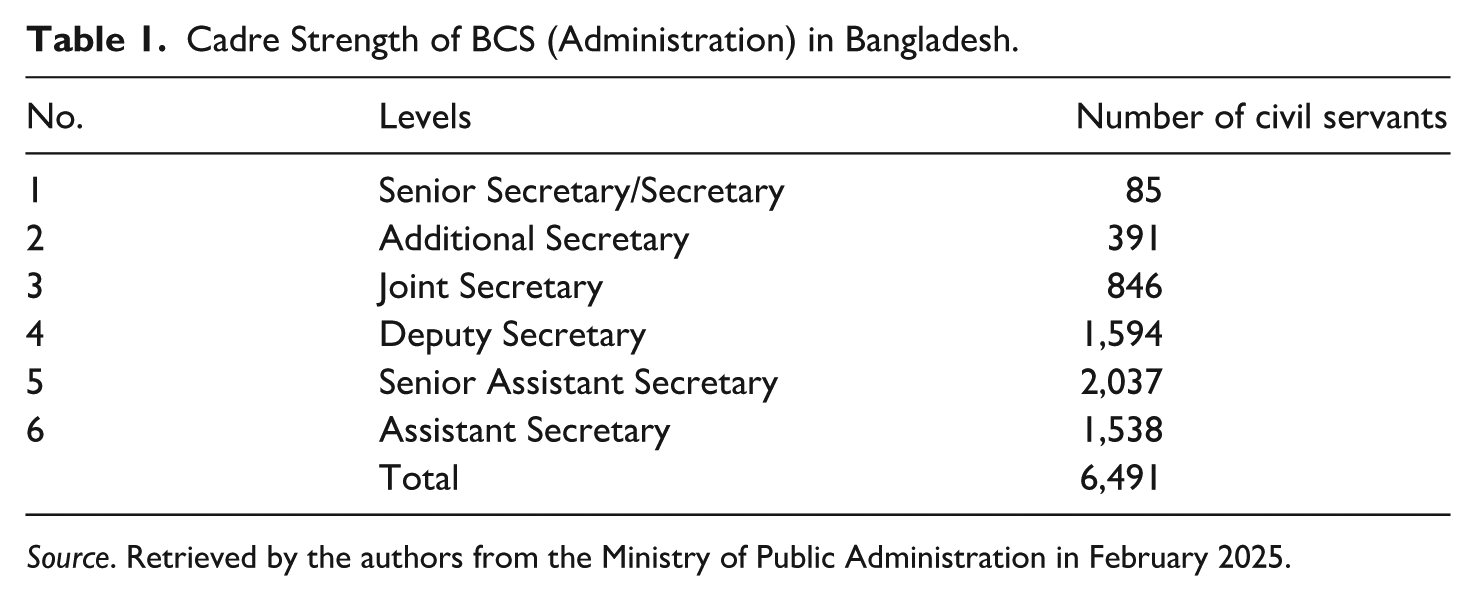
Source. Retrieved by the authors from the Ministry of Public Administration in February 2025.
Upon recruitment, cadre officials must complete a series of mandatory training programs and assessments to secure permanent status. This includes departmental (cadre-specific) training, foundation training (general civil service training), and departmental examinations. The Bangladesh Public Administration Training Centre (BPATC) serves as the main training institute for most cadre officials for foundation training, except for those in the health and education cadres, who receive training in other institutions. In addition to foundation training, BPATC offers specialized training courses for mid-level and senior officials to enhance their administrative and leadership capabilities. Currently, the retirement age for government officials in Bangladesh is 59.
Possible Effect of an Uprising on Organizational Behavior: A Theoretical and Empirical Exploration
A regime change, whether through a decisive election, revolution, uprising, or major coalition shift, constitutes a critical juncture that alters a nation’s governance equilibrium (Capoccia & Kelemen, 2007). Such transitions are often viewed as punctuating events that can disrupt path dependency by replacing established actors, rules, and norms with uncertainty and new political agendas (see True et al., 2007). Incoming regimes frequently portray the civil service as a pillar of the previous order, characterizing it as corrupt, inefficient, or repressive, while advancing their own ideology, priorities, and supportive networks within the bureaucracy. As a result, regime change is often accompanied by promises of reform, purges, or restructuring aimed at establishing a new equilibrium. For individual civil servants, this period can be highly uncertain, as loyalties are questioned, positions are threatened, and job security is undermined. In general, organizational restructuring is often considered a strong hindrance and is negatively related to well-being (Borst & Knies, 2023). Such political change-induced reform can be even more stressful. In this context, Punctuated Equilibrium Theory (PET) provides a broad framework for understanding how regime change produces abrupt disruptions in bureaucratic routines and civil service stability by breaking existing path dependencies and forcing rapid adaptation. To better explain the underlying mechanisms of these effects, however, Threat Rigidity Theory (TRT) is appeared to be more useful.
Threat Rigidity Theory (TRT) is a psychological and organizational theory that explains how individuals, groups, and organizations tend to respond to perceived threats or crises (see Muurlink et al., 2012; Staw et al., 1981; Van Hootegem et al., 2019). The theory posits that when organizations or individuals perceive a threat, they often react by becoming more rigid in their thinking and behavior. For an employee, job insecurity can be perceived as a threat, as it is associated with adverse psychological and professional outcomes (Van Hootegem et al., 2019). When a government changes abruptly, public servants, particularly those who were close to and benefited from the previous regime, may interpret this as a threatening, high-uncertainty event and may feel that their jobs, career trajectories, and institutional privileges are at risk. Such sudden regime changes can also generate role ambiguity and role uncertainty, leading to confusion among employees about their responsibilities and expectations. In such situations, civil servants may feel the need to recalibrate their roles; however, without clear directives, this is often difficult. They may become unsure about policy continuity and institutional arrangements. This uncertainty fosters anxiety and a diminished sense of control, leading to lower levels of job satisfaction. How such role ambiguity and role conflict can lead to emotional exhaustion is shown in a study in the Netherlands on COVID-19 (Bedford et al., 2022). Piotrowska (2024) identifies another channel through which job satisfaction may decline among politically aligned public employees: they may become demoralized when required to implement policies they disagree with.
Beyond politically affiliated officials, two additional groups can be identified. The first is a relatively neutral group that refrained from overt political alignment. Despite their neutrality, they may experience role ambiguity and uncertainty in a volatile environment, particularly given unclear policy directions. They may also fear wrongful victimization, as they could be labeled as loyalists of the previous regime.
The second group consists of officials who were marginalized under the previous regime on political grounds and were denied benefits such as promotions and better postings. Although they may view the transition as an opportunity for career revival, they may still remain anxious about the future. Their uncertainty stems from shifting political alignments, the unpredictability of which group will win the election and come to power after the interim government, and whether the incoming administration will accept them. In addition, within each group, there is competition to secure desirable positions and benefits, which often do not follow due process; they may require the right connections, demonstrated loyalty, or even corrupt payments. Collectively, these dynamics can generate stress across all bureaucratic segments, which may, in turn, negatively affect job satisfaction. A meta-analysis by Podsakoff et al. (2007) distinguishes between two types of stress: hindrance stress and challenge stress. Hindrance stress, comprising obstacles to personal growth such as role ambiguity and job insecurity, was found to have a negative correlation with both job satisfaction and organizational commitment. In contrast, challenge stress, related to workload, job demand, and responsibility, can have positive developmental outcomes. The situation in Bangladesh more closely resembles hindrance stress, characterized by role ambiguity and job insecurity. Based on these arguments and empirical evidence, we can have the following hypothesis:
According to Threat Rigidity Theory (TRT), when individuals perceive a threat, it can lead to a narrowing of attention and information processing, increased reliance on habitual or well-learned responses, and a general aversion to risk (Staw et al., 1981). These reactions aim to conserve psychological resources and minimize exposure to additional uncertainty. The conservation of resources theory also indicates a tendency to withdraw from risky and energy-consuming behaviors (see Kiazad et al., 2014). In the context of regime change through an uprising, public employees often face heightened uncertainty regarding institutional continuity, job security, administrative priorities, and the legitimacy of the new leadership. Most of these dynamics are also relevant in the case of Bangladeshi public sector employees following the political upheaval. TRT posits that under such conditions of uncertainty, individuals tend to avoid activities that are experimental, ambiguous, or outside the bounds of routine. Here, political change increases risk aversion, and the perceived instability it brings reduces public officials’ willingness to take initiative. Instead of encouraging innovation, such an environment may foster disinvolvement syndrome (see De Spiegelaere et al., 2014).
Innovation, by its nature, involves risk-taking, ambiguity, and the possibility of failure—traits that are typically suppressed in high-threat environments (see Brown & Osborne, 2013; Stewart-Weeks & Kastelle, 2015). As a result, public servants may become more conservative in their decision-making, opting for established methods rather than novel approaches, even when innovative solutions are required to address emerging public challenges. Using the TRT framework, Van Hootegem et al. (2019) also find that perceived threat impairs employees’ willingness to innovate. They found that job insecurity reduces innovation by decreasing concentration and increasing irritation. While the willingness to innovate is distinct from actual innovation, it is a necessary precondition for it. In our study, we focus only on innovation intention, as that data is available only. Drawing on this theoretical and empirical grounding, we propose the following hypothesis:
Threat Rigidity Theory (TRT) also suggests that perceived threats heighten intragroup cohesion while simultaneously weakening intergroup relationships (Staw et al., 1981). Reform initiatives introduced after political uprisings often redistribute authority, resources, and symbolic status within the public sector, which can trigger strong threat perceptions among civil servant groups. Under such conditions, groups are likely to engage in intense, zero-sum competition for prestige and institutional privileges. From a threat-rigidity perspective, these reforms constitute high-stakes environmental threats that provoke defensive and self-protective responses, including heightened boundary maintenance, inward orientation, and reduced cooperation across organizational units. Stephan and Renfro (2002) identified two basic types of threat: realistic threats, which include threats to in-group members’ different types of power, general welfare, and other tangible resources; and symbolic threats, such as loss of honor and the undermining of in-group members’ identity or self-esteem. During post-uprising reform processes, both types of threats may be activated among the different service groups in Bangladesh, as some groups feel their privileges and prestige are being curtailed, while others see an opportunity to increase their own.
Rather than fostering collaboration, uncertainty surrounding reform outcomes can encourage civil servants to prioritize the preservation and expansion of their own group’s influence, prestige, and access to resources. In this context, organizational identity becomes increasingly salient, amplifying intergroup distinctions and reinforcing competitive behavior. When reform initiatives challenge existing hierarchies or redistribute symbolic and material rewards, group identities may become contested, prompting status competition, jurisdictional protection, and reduction to cross-service coordination, even when such coordination is necessary for effective governance. As each group seeks to secure a larger share of the post-reform institutional order, mutual trust erodes, and shared purpose weakens, transforming colleagues from other services into perceived rivals. A psychological study reveals that intergroup threat fosters negative intergroup attitudes and behavior, and reduces out-group helping (Li & Zhao, 2012).
Similar conflicting dynamics are evident within the Bangladeshi public service following the post-uprising reform initiatives. These reforms encountered resistance from multiple civil servant groups, with objections frequently centered on perceived gains or losses in influence, authority, and resources. In some instances, service groups organized protests and participated in demonstrations to defend their institutional interests (The Financial Express, 2024). Such actions likely intensified intergroup tensions and further undermined inter-service cohesion. Taken together, these threat-induced and identity-driven dynamics suggest that political uprisings accompanied by reform initiatives can erode collaborative relationships across public sector organizations. Accordingly, the following hypothesis is proposed:
Public Service Motivation (PSM) and Organizational Citizenship Behavior (OCB) are two key organizational behaviors that are often considered value-driven (see S. Kim, 2006; Vandenabeele, 2014; Vogel & Kroll, 2016). Personality Trait Theory (McCrae & Costa, 1997) posits that traits such as conscientiousness (e.g., dutifulness, self-discipline) and agreeableness (e.g., altruism, sympathy) are stable across time and situations, providing the dispositional basis for prosocial behaviors such as OCB and PSM. Perry et al. (2010, p. 682) define PSM as “a particular form of altruism or prosocial motivation that is animated by specific dispositions and values arising from public institutions and missions.” This definition underscores that PSM reflects an internalized commitment to public values, civic duty, and social impact. These qualities can be relatively stable and resilient to external changes. A study in Germany examined whether PSM-related values among public employees are stable or dynamic and found that they are generally stable but tend to increase with age (Vogel & Kroll, 2016). Therefore, PSM values are unlikely to change as a result of the uprising, which lasted only about a month (see VOA, 2024). Apart from remaining stable, PSM may also follow two other trajectories: growth or decline.
An uprising may generate uncertainty and job insecurity, leading individuals to respond to perceived threats by withdrawing from pro-social behaviors. Pressure can reduce concern for others and increase self-focus (Yang et al., 2025), which in turn diminishes social orientation. Consistent with this logic, Yang et al. (2025) find that performance pressure reduces pro-environmental behavior, a form of behavior with broader social and communal implications. Conversely, individuals may perceive the uprising as an opportunity to reform the public sector, strengthen service to citizens, and consequently increase their pro-social engagement. An increase in PSM may help them to deal with the pressure as well. A study on US police indicates that PSM can help them during challenging periods and address burnout-related resignations (Hassan et al., 2026). We were unable to identify relevant literature that clearly supports any of these competing dynamics; therefore, empirically, it is not possible to determine which of the three trends, stability, increase, or decrease, prevails.
The same reasoning applies to organizational citizenship behavior (OCB), which reflects both individuals’ values and employees’ perceptions of normative expectations (Shim & Faerman, 2017). OCB is defined as voluntary individual behavior that is not formally required or directly rewarded, yet contributes to the effective functioning of the organization (S. Kim, 2006). Although discretionary, OCB often becomes habitual and is closely tied to an individual’s self-concept. In times of crisis or threat, individuals may reinforce such behaviors not only to support colleagues but also to reaffirm their identity and sense of purpose within the organization. As a result, public officials may maintain or even increase their OCB. Alternatively, individuals may reduce their OCB in response to perceived threats. But, social mindfulness is important for such OCB (Qin et al., 2026). Among these three possibilities, we choose to test the proposition that PSM and OCB decrease, as uprisings may generate uncertainty and job insecurity. In such situations, according to the conservation of resources theory, public employees may reduce energy-consuming behaviors such as PSM and OCB (see Kiazad et al., 2014). This leads to the following hypotheses:
Method
Data Collection
To test the hypotheses, this study relied on a survey of Bangladeshi civil servants conducted before and after the uprising. The survey was administered at the Bangladesh Public Administration Training Centre (BPATC) and the Bangladesh Civil Service Administration Academy (BCSAA). At BPATC, public officials from cadre services (excluding doctors and teachers) undergo mandatory foundational and advanced training programs, and at BCSAA, newly recruited BCS (Administration) officials receive a 5-month basic training in law and administration. At BPATC, the survey targeted participants of three key programs: the Foundation Training Course (FTC) for newly recruited civil servants (who typically participate after 6 months or more of service), the Advanced Course on Administration and Development (ACAD) for mid-level officials, and the Senior Staff Course (SSC) for higher-level officials.
With the help of officials from both institutions, an online questionnaire was distributed to participants in these training programs during the 2023 to 2024 period. The questionnaire was not distributed all at once; instead, it was shared separately with each training cohort throughout the year. The survey link was also shared with participants in two master’s programs attended by Bangladeshi public officials to increase the response rate, as the researchers have access to those two networks (around 250 civil servants). Ultimately, 1,081 valid responses were collected, offering valuable insights into various aspects of Bangladesh’s civil service. The majority of the data probably came from BPATC, as it had the highest number of training participants. However, since we do not collect information about the source, we cannot make any conclusive statements about it. It is essential to note that the majority of respondents were cadre officials, as these training programs are primarily designed for them. Non-cadre officials were largely absent from the sample, as they rarely participate in the targeted training programs.
Supplemental Appendix 4 presents descriptive statistics and balance test results for the key variables in the dataset, separated by uprising status (before and after the uprising). Overall, the table indicates that the sample characteristics are generally comparable across the two periods, providing a sound basis for subsequent analysis. The statistics for each variable allow for straightforward comparison between groups and help assess the balance of the sample. For instance, the gender distribution, coded as 0 for female and 1 for male, remains largely stable over time, with mean values of 0.74 before the uprising and 0.73 after. This suggests that approximately 74% of respondents were male before the uprising and 73% were male after, showing no significant shift in the gender composition. In contrast, noticeable variation appears in Service Type. The proportion of respondents in BCS Administration (coded as 1) increased from 31% before the uprising to 63% after, indicating a substantial change in personnel composition during the two periods. This may have happened due to the selection process of the training programs. For the training in both institutions, there are established administrative procedures. Typically, senior batches are nominated first, followed by junior batches. In some cases, the higher number is from BCS (Administration), and in others from BCS (Agriculture), as they constitute the two largest cadres.
Supplemental Appendix 5 presents the demographic breakdown of survey respondents by length of service, comparing those who responded before the uprising with those who responded after. Across both time periods, junior-level officials make up the majority of respondents. Among those who completed the survey before the uprising, 74.5% were junior-level officials, and their share is even higher among respondents who completed the survey after the uprising, at 83.3%. This suggests that later respondents were more likely to be officials with earlier careers. Both mid-level officials and senior-level officials represent a relatively small share of the sample in both periods. Despite such variations, we like to compare the data between the two times to generate valuable insights. To minimize potential biases, we control for available socio-demographic and service-related variables.
Measurement of the Variables
This study uses five dependent variables to capture the behavioral aspects of civil servants: job satisfaction, innovation intention, inter-service relationships, public service motivation (PSM), and organizational citizenship behavior (OCB). Job satisfaction is assessed with the question: “To what extent are you satisfied with your job?” Responses are recorded on an 11-point Likert scale ranging from 0 to 10, where 0 indicates “Not at all satisfied,” and 10 indicates “Very satisfied,” with higher scores reflecting greater satisfaction. While single-item measures are sometimes criticized, prior research suggests that they can be acceptable for assessing job satisfaction (Cantarelli et al., 2016). Similarly, innovation intention and inter-service relationships are measured on a 0 to 10 scale, with higher values indicating stronger intentions to innovate and stronger inter-service relationships, respectively. Detailed descriptions of all measures are provided in Supplemental Appendix 1.
PSM is measured using a modified version of the scale developed by Liu et al. (2015), which provides a more concise alternative to Perry’s (1996) original, longer instrument. The PSM scale includes four dimensions: Attraction to Public Policymaking, Commitment to Public Interest, Compassion, and Self-Sacrifice. Each dimension is assessed with three items, and higher scores indicate greater PSM in that domain. The details of the measurement and the indices’ reliability, assessed using Cronbach’s Alpha, are presented in Supplemental Appendix 3. These dimensions are analyzed separately rather than as an aggregated PSM measure, as the nature of the uprising’s effect may vary across them—an approach supported by prior research in other contexts (Giauque et al., 2012). OCB is measured using seven items adapted from Vigoda-Gadot and Beeri (2012) and Campbell (2015), with higher values indicating stronger organizational citizenship behavior. The Cronbach’s Alpha for this index is .741, indicating acceptable reliability. The detailed measurement items are provided in Supplemental Appendix 2.
The main independent variable in this study is “uprising.” We constructed a binary indicator to distinguish responses collected before and after the uprising (0 = before, 1 = after). We set July 5, 2024, as the cut-off date because the mass protest began immediately following a high court verdict on the public-sector quota system. This protest escalated into nationwide unrest and ultimately contributed to the government’s fall on August 5, 2024. Initially, we aimed to classify responses into three periods: before, during, and after the uprising. However, we received only eight responses between July 5 and August 5, 2024. Although we formally set this for July 5, we actually received our first response during this period on July 30. The extremely low response rate during this period is likely due to widespread internet disruptions caused by government-imposed shutdowns and heightened uncertainty among public officials. Given the insufficient sample size for a separate “during uprising” category, these eight responses were merged into the uprising-affected group, resulting in a two-category classification. We combine these periods because uncertainty about the uprising had already emerged by then, on July 30. The analysis also incorporates standard socio-economic and administrative control variables: age, gender, education, length of service, and service type.
Findings and Discussions
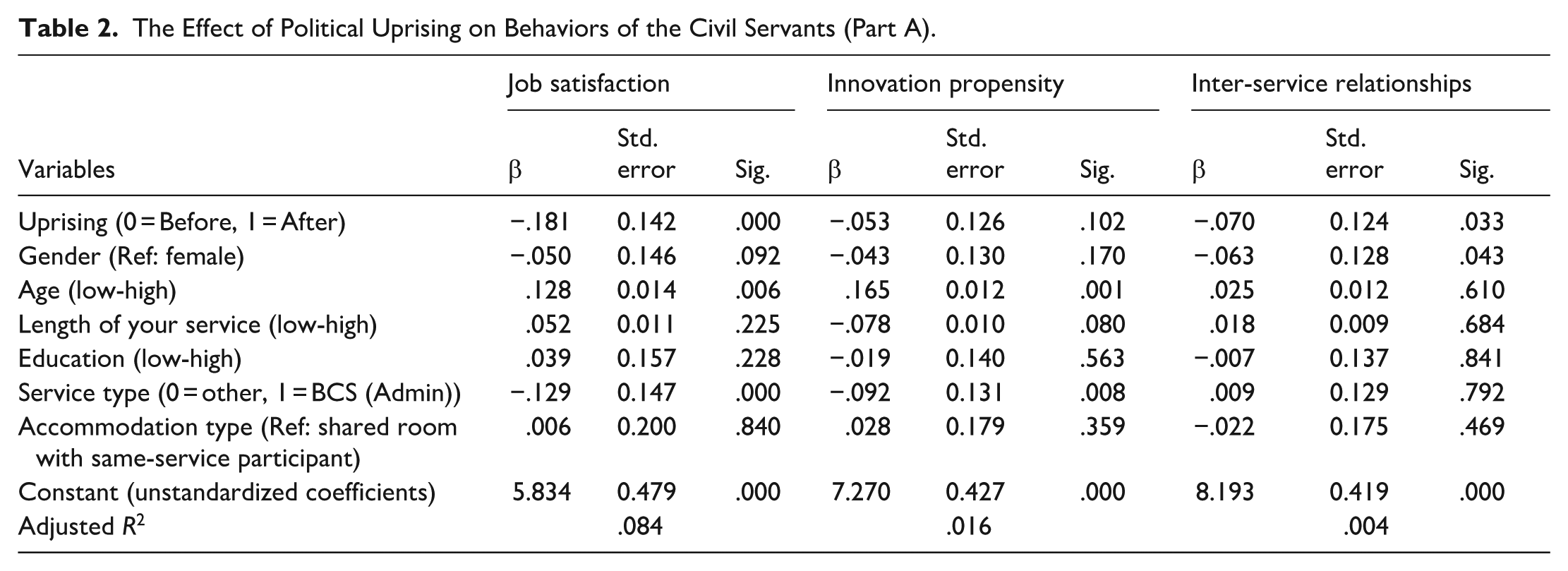
The regression analysis in Table 2 reveals that the political uprising had a significant negative effect on context-sensitive organizational behaviors, particularly job satisfaction and inter-service relationships among civil servants. Civil servants surveyed after the uprising reported significantly lower job satisfaction (β = −.181, p < .001), supporting our first hypothesis (H1). These findings are consistent with the existing literature, which shows that perceived threats undermine psychological safety, organizational commitment, and job satisfaction (see Podsakoff et al., 2007; Van Hootegem et al., 2019). The decline in job satisfaction is likely driven by heightened uncertainty, role ambiguity, role strain, and the potential political realignment of bureaucratic functions that often accompany regime change. Political instability fosters job insecurity, disrupts predictable career progression, and limits decision-making autonomy. Job insecurity can be understood in both global terms (i.e., general concern about job loss) and through a multidimensional lens that encompasses threats to employment, loss of valued job features (e.g., lucrative posting and other benefits), and a sense of powerlessness (Keim et al., 2014; Sverke & Hellgren, 2002). In post-uprising Bangladesh, while some civil servants face actual or potential job loss, others fear losing influence or key benefits associated with their roles.
The Effect of Political Uprising on Behaviors of the Civil Servants (Part A).
Following the regime change in Bangladesh, a significant number of government officials were either transferred, made OSD (Officer on Special Duty—effectively meaning sidelined with no actual responsibilities), or forced into retirement (Abdullah, 2025). For instance, in the aftermath of the political transition, 517 officers were placed on OSD. Of these, 121 belonged to the BCS (Administration) cadre and were reportedly removed for “administrative reasons” (Abdullah, 2025). Similarly, 82 officers from the police service were placed on OSD (Abdullah, 2025). Although these officials continued to receive salaries and benefits, they were not assigned any active duties. Even after the uprising, 187 police officers were reported absent from their duties (The Daily Star, 2025). As the process of OSD or the removal of public officials from public service on political grounds is not new in Bangladesh, public officials with overt political ties to the previous regime may also perceive the transition as a threat. Others may also fear victimization due to false allegations of political connections. In Bangladesh, the advancement of public officials’ careers often depended on political loyalty rather than merit, particularly in the promotion of senior bureaucrats. As the last regime remained in power for a longer period (around 15 years) with no sign of change, many officials publicly demonstrated ideological or familial ties to the ruling party to advance their careers and secure other benefits. These affiliations now leave them vulnerable under the new government. Such ties may be perceived as liabilities, creating heightened stress and concerns about job security, which can undermine job satisfaction. Newly recruited officials frequently leveraged political connections to secure recruitment, favorable postings, and rapid promotions. Senior officials, many of whom had joined the service before the regime came to power, also benefited by demonstrating political allegiance. Together, these concerns contribute to the observed decline in job satisfaction.
In a similar vein, inter-service relationships—reflecting collaboration and trust across different departments or cadres—also significantly deteriorated after the uprising (β = −.070, p = .033). This supports our third hypothesis (H3) and aligns with the Threat-Rigidity Theory (TRT), which suggests that under perceived threat, in-group cohesion tends to intensify while trust between groups weakens (Staw et al., 1981). A key factor contributing to the current decline in inter-service cohesion appears to be connected to government reform initiatives aimed at redistributing power and privileges among various services (see TBS, 2025b; The Financial Express, 2024). A particularly contentious issue emerged around the promotion structure at the Deputy Secretary level and beyond. Currently, 75% of these positions are occupied by officers from the BCS (Administration) cadre. The reform commission proposed a redistribution where 50% of such positions would be reserved for BCS (Administration), and the remaining 50% would be open to officers from the other 25 civil service cadres (The Financial Express, 2024).
This proposal generated widespread dissatisfaction among officials. The BCS (Administration) cadre opposed the reduction of its share, while other services demanded a merit-based, open competition system and rejected any continuation of quota-based allocations. These tensions escalated into protests and public opposition. Even BCS (Administration) officials and their association called for the resignation of the head of the reform commission (The Financial Express, 2024). Usually, BCS (Administration) officers become administrative heads of various ministries and government organizations and have greater power and influence over decision-making. Officials from other departments usually do not secure those leadership positions, even though they have worked for their organizations throughout their lives, a factor that has long contributed to their dissatisfaction. The uprising and the reform initiative intensified the debate: some actors see it as an opportunity to gain power, while others perceive it as a threat to their authority and prestige. These competing positions suggest growing fragmentation and a potential deterioration of inter-cadre relationships—an outcome consistent with the Threat-Rigidity Theory (TRT), which predicts that perceived threats can weaken broader organizational cohesion while reinforcing narrower group interests.
In the regression analysis, innovation intention did not differ significantly between the two time points. So, for this variable, we did not get support for the second hypothesis (H2). The finding contradicts the theoretical positions of the Conservation of Resources Theory, which posits that individuals tend to conserve energy and avoid unnecessary risks in threatening or resource-depleting environments (see Hobfoll, 1989; Hobfoll et al., 2018). In such contexts, stability is often prioritized over experimentation. Civil servants may be hesitant to take bold or unconventional initiatives during periods of political volatility. One possible explanation for our finding is that public officials’ innovation intention may originate from intrinsic motivation that is not influenced by short-term political shocks. Our finding is consistent with a study on innovation, which suggests that reform-led job insecurity can stimulate innovation in Spain (Fernández-Menéndez et al., 2020). Jeong et al. (2023) further explain that a crisis hinders innovation among individuals with a fixed mindset but stimulates innovation among those with a growth mindset.
Additionally, service type and age were important covariates. Administrative cadre (BCS Administration) officers consistently reported lower job satisfaction (β = −.129, p < .001) and lower innovation intention (β = −.092, p = .008) than their peers in other services. Although officials from this service generally enjoy certain privileges, it is unclear why they experience lower job satisfaction than others. One possible explanation is their exposure to the consequences of power shifts, which may lead to greater pressure or scrutiny during transitions. Conversely, age was positively associated with both job satisfaction (β = .128, p = .006) and innovation intention (β = .165, p = .001), suggesting that older, more experienced officers might be more psychologically resilient and confident in navigating volatile environments. Their resilience may stem from greater experience or from lower exposure to frontline crisis management. Another possibility is that officials who entered the service during the previous regime’s 15-year tenure fear being labeled loyalists of that regime and anticipate potential consequences. This concern is less likely to apply to many senior officials who joined before the regime came to power. Nonetheless, in both groups, there are individuals who benefited from political allegiances. With the change in power, they may now fear that these politically gained advantages could backfire. The loss of such entitlements, which may no longer be sustained under the new administration, could lead to a decrease in overall job satisfaction.
Table 3 indicates that the uprising had no statistically significant effect on all four dimensions of Public Service Motivation (PSM)—attraction to public policy-making, commitment to the public interest, compassion, and self-sacrifice—as well as on Organizational Citizenship Behavior (OCB). The non-significant coefficients and high p-values (e.g., PSM Compassion: β = .036, p = .274; OCB: β = .026, p = .412) reinforce the view that these behaviors are deeply rooted in personal values, rather than being shaped by short-term political dynamics. These findings on PSM and OCB do not support our hypotheses H4 and H5.
The Effect of Political Uprising on Behaviors of the Civil Servants (Part B).
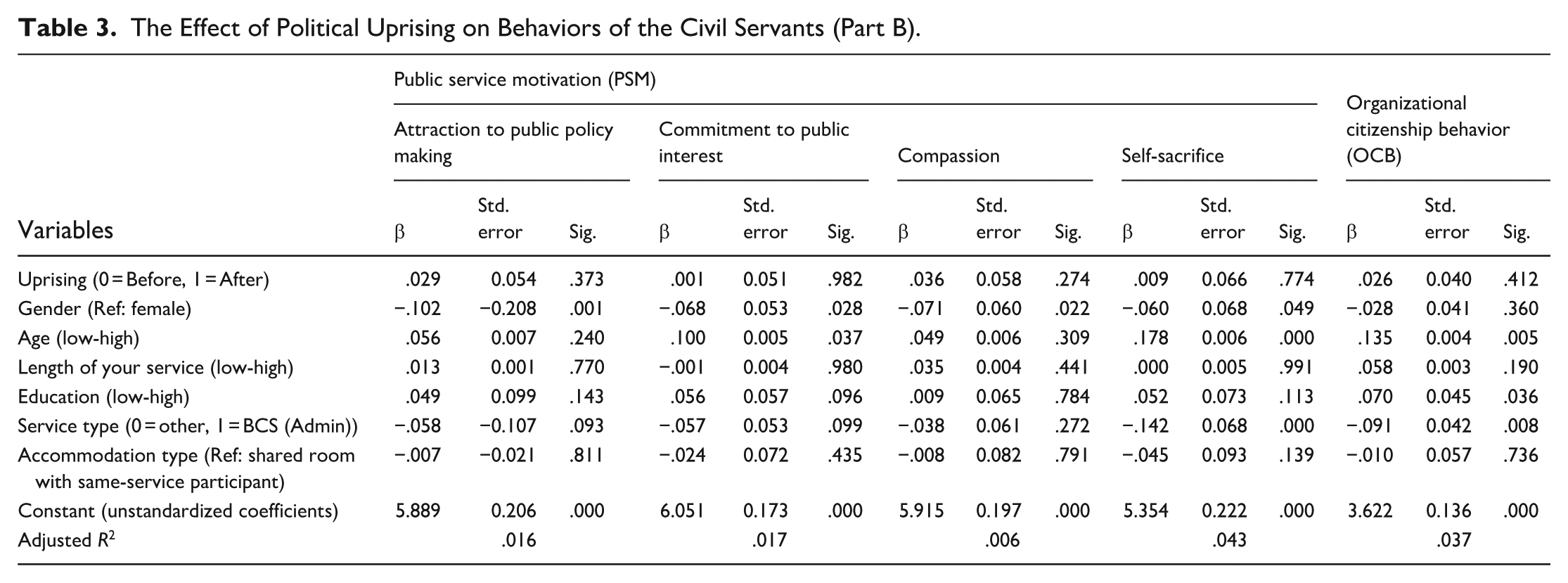
We find no statistically significant effect on PSM because it is guided by internalized values that remain stable even during external upheaval. Civil servants with public service values are likely to continue prioritizing altruistic goals and prosocial behaviors regardless of changes in political leadership. These findings support the “stability” hypothesis of PSM and align with the findings from Germany by Vogel and Kroll (2016). Similarly, Organizational Citizenship Behavior (OCB), which encompasses proactive efforts, helpfulness, and civic virtue, remains intact because it is driven by a deeper sense of responsibility toward the organization and its mission, rather than the immediate political context. The observed stability of OCB contrasts with prior job insecurity research, which reports both increases (Reisel et al., 2010) and decreases (see Reisel et al., 2010).
Demographic variables offer additional nuance. Female civil servants scored significantly higher on all prosocial PSM dimensions, suggesting gendered patterns in motivational orientations. Older civil servants also demonstrated significantly higher levels of self-sacrifice (β = .178, p < .001), commitment to public interest (β = .100, p = .037), and OCB (β = .135, p = .005). It may be because senior officials may be more committed to their service role, perhaps due to their accumulated experience and attachment to the organization. It may also reflect generational differences, with older employees being less cynical and more likely to hold traditional values (Moynihan & Pandey, 2007). Perry (1997) also found that older employees exhibit a higher commitment to the public interest. Interestingly, BCS (Administration) officers score significantly lower on self-sacrifice (β = −.142, p < .001) and organizational citizenship behavior (OCB) (β = −.091, p = .008). One possible explanation is that this cadre may attract a relatively higher proportion of self-interested individuals, given its greater power, prestige, and privileges. However, confirming this mechanism requires more in-depth investigation. It is also important to note that the post-uprising sample includes a higher proportion of respondents from BCS (Administration). Although we control for this variable, along with other covariates, in the analysis, such an imbalance may still influence the estimated outcomes. Therefore, these compositional differences should be considered when interpreting the results.
To address these concerns, we conducted a robustness check using Propensity Score Matching. The Propensity Score Matching procedure yielded 299 matched pairs, corresponding to a match rate of 76.9%. The matches were obtained within a caliper of 0.05, indicating a high degree of similarity between treated and control units (see Supplemental Appendix 7 for details). The balance test results for the matched sample are reported in Appendix 8. Regression analyses based on the matched sample corroborate the main findings: job satisfaction and inter-service relationships deteriorate, while other variables remain largely unchanged (see Supplemental Appendices 9 and 10 for further details).
Based on the findings of this study, we can develop a central argument that political uprisings primarily affect situation-sensitive behaviors (e.g., job satisfaction and collaboration) that are influenced by perceptions of organizational environment, political climate, and psychological safety. In contrast, value-driven behaviors, such as PSM and OCB, are resilient, suggesting they are grounded in stable, internalized motivations. Innovation intention may not always be value-driven, but in our case, those who expressed their intentions are likely intrinsically motivated to innovate to improve the system and help others, and this is probably why we did not see any statistically significant change in the regression. Therefore, we categorize it as dispositional. Thus, we can categorize the variables into two categories: situational and dispositional.
The term “situational behaviors” refers to actions and attitudes shaped by external forces, such as the political climate, leadership dynamics, or unexpected events (e.g., political uprisings). Situational behaviors are fluid and highly responsive to changes in the surrounding environment. Situational conditions can influence individuals to pursue or avoid certain actions, leading to variations in behavior (Meyer et al., 2010). In contrast, some behaviors are more stable and consistent over time, stemming from intrinsic factors such as personal values, norms, or personality traits. We refer to these as “dispositional behaviors.” Unlike situational behaviors, dispositional behaviors are less susceptible to external influence and tend to persist across varying contexts—even in turbulent political or organizational environments—because they are deeply rooted in the individual’s internal dispositions. Situational behaviors are like leaves in the wind—they respond to the weather, and dispositional behaviors are like the tree’s roots—they stay grounded, regardless of the storm.
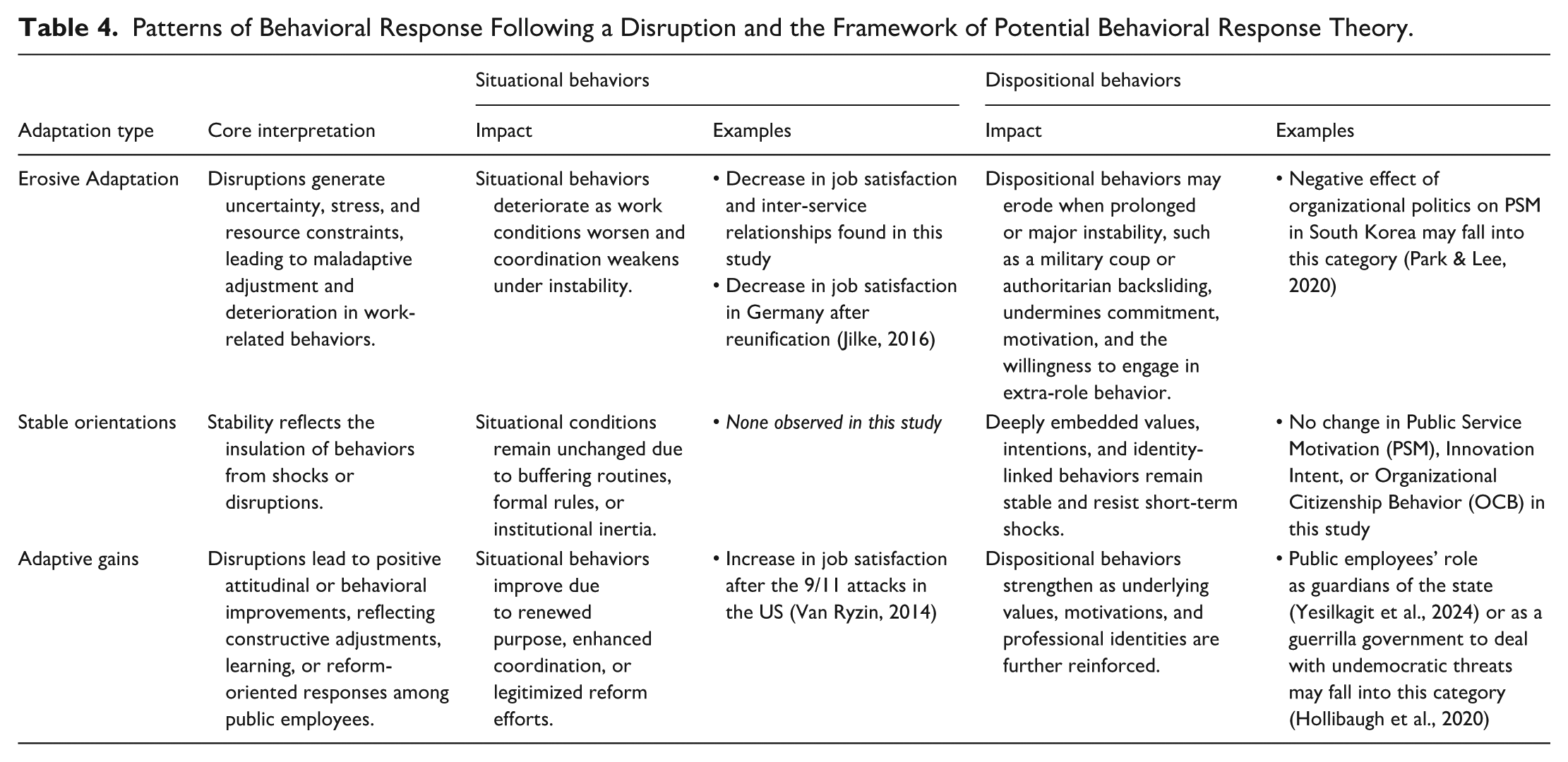
Based on the direction of change (improvement, stability, and decline), we can theoretically and empirically identify three types of adaptation for these two categories of variables. When situational variables and their values deteriorate in response to an event, it reflects a maladaptive adjustment to uncertainty, stress, or disruption and creates “Erosive Adaptation.” These changes indicate weakening of work-related conditions and relational dynamics. Situational variables are often the first to deteriorate as work conditions worsen; however, dispositional variables may also erode if prolonged or major instability, such as a military coup or authoritarian backsliding, undermines commitment, motivation, or the willingness to engage in extra-role behavior.
In this study, we observe only “stable orientations” in dispositional variables, which remain unchanged despite environmental disruptions. We do not find evidence of “adaptive gains,” in which a shock expands opportunity, enhances meaning, or legitimizes reform. Theoretically, under such conditions, situational variables (e.g., job satisfaction, inter-service relationships) may improve due to renewed purpose or coordination, while dispositional variables (e.g., PSM, OCB) may strengthen as values and identities are reaffirmed or reactivated. This is like “rally around the flag” in times of crisis or threat. For example, a study conducted after 9/11 identified an improvement in job satisfaction, a situational variable, which can be interpreted as an adaptive gain following a national crisis (Van Ryzin, 2014). Similarly, Yesilkagit et al. (2024) discuss the civil service’s role as a guardian of the state and protector of liberal democracy against evolving threats, a context in which dispositional factors may generate adaptive gains. Public employees’ “guerrilla government” behavior may also fall into this category (Hollibaugh et al., 2020).
Taken together, these patterns suggest that public employees’ behavioral responses can be understood as a framework for “Behavioral Response Theory.” This framework explains how disruption leads to heterogeneous outcomes, including improvement, decline, or stability, across both situational and dispositional dimensions. Although this study observes only a limited set of conditions, a broader range of contexts may reveal additional effects. A summary of the proposed framework is presented in Table 4. Although it needs to be empirically validated in different contexts to generalize further.
Patterns of Behavioral Response Following a Disruption and the Framework of Potential Behavioral Response Theory.
Conclusion
This study examines an underexplored domain of how regime change shapes the organizational behavior of public employees. By addressing this scarcity through a case triggered by an uprising in Bangladesh, it offers nuanced insights into the differential impact of political turbulence on workplace behavior. Drawing on a rare pre- and post-uprising survey, the study identifies behavioral response patterns and categorizes them into two types: situational and dispositional. This categorization advances both theoretical and empirical understanding of how public sector employees navigate periods of political instability. In combination with these behavioral categories and public employees’ adaptation types, namely erosive adaptation, stable orientations, and adaptive gains, the study also develops a framework for a potential “Behavioral Response Theory.”
The results of the study show that short-term political upheavals, such as the 2024 uprising in Bangladesh, significantly disrupt situational behaviors, particularly job satisfaction, and inter-service relationships. These disruptions appear to be driven by heightened uncertainty, perceived threats, and institutional restructuring, all of which erode psychological safety and intergroup cohesion. These patterns align with the predictions of Threat Rigidity Theory and align with the findings from Germany by Jilke (2016). In contrast, dispositional behaviors—such as Public Service Motivation (PSM) and Organizational Citizenship Behavior (OCB)—remained stable, underscoring the resilience of deeply internalized values. This continuity suggests that, even amid political turbulence, deeply rooted values can continue to guide prosocial behavior, which can provide a stable foundation for institutional functioning and recovery.
Future research should build on these findings by examining the long-term trajectories of organizational behaviors beyond the immediate aftermath of political crises. In particular, studies could explore the mechanisms that sustain and enhance dispositional motivations over time and identify institutional strategies to mitigate the adverse effects of political instability on bureaucratic functioning. Evidence from the German reunification suggests that it took approximately 3 years for job satisfaction levels to converge between East and West Germany (Jilke, 2016), highlighting the importance of longitudinal research. In the context of Bangladesh, it would be important to investigate whether the observed declines in situational behaviors are short-lived or persist over time. Moreover, comparative studies across diverse political contexts would enrich our understanding of how different forms of political change shape public sector workforce dynamics.
Although this study design resembles a quasi-experiment, it has several limitations. The regime change examined here represents an exceptional form of political transition that is not typical for a country. Future research should investigate more routine political changes, such as those occurring through regular electoral processes across diverse national contexts. Additionally, the variables used in this study were constrained by survey availability and were not specifically designed to capture the effects of regime change. For instance, Organizational Citizenship Behavior (OCB) can reflect both altruistic motives and impression management (Bolino, 1999). Differentiating between these dimensions could yield a more nuanced understanding of employee behavior under political stress.
The survey sample excluded a significant portion of public officials in Bangladesh, focusing only on cadre officials. While these officials play a central role in Bangladesh’s civil service, their experiences may not fully represent the broader bureaucratic landscape. Differences in the composition of the pre- and post-uprising samples, as well as imbalances in sample size during these two periods, may have influenced the results. Although we control for a range of variables to mitigate these effects, they may still affect the findings. In addition, unobserved factors, such as respondents’ political identification, may influence the results, as we lack measures for these variables. Despite these limitations, the study offers valuable insights into public sector organizational behavior during political upheaval. In addition to advancing theoretical understanding of how political uprisings shape workplace dynamics, the findings provide practical guidance for designing human resource (HR) policies. Specifically, organizations can leverage stable dispositional factors, such as Public Service Motivation (PSM), while mitigating disruptive situational factors by reducing role ambiguity and job insecurity to enhance organizational stability and effectiveness during political transitions.
Supplemental Material
sj-docx-1-rop-10.1177_0734371X261456288 – Supplemental material for Political Upheaval and Bureaucratic Behavior: Quasi-Experimental Evidence for Public Sector HRM
Supplemental material, sj-docx-1-rop-10.1177_0734371X261456288 for Political Upheaval and Bureaucratic Behavior: Quasi-Experimental Evidence for Public Sector HRM by Rizwan Khair and Hasan Muhammad Baniamin in Review of Public Personnel Administration
Footnotes
Declaration of Conflicting Interests
The authors declared no potential conflicts of interest with respect to the research, authorship, and/or publication of this article.
Funding
The authors received no financial support for the research, authorship, and/or publication of this article.

Data Availability Statement
Use of AI
As we are not native English speakers, we took the help of AI to correct our language.
Supplemental Material
Supplemental material for this article is available online.
Author Biographies
References
Supplementary Material
Please find the following supplemental material available below.
For Open Access articles published under a Creative Commons License, all supplemental material carries the same license as the article it is associated with.
For non-Open Access articles published, all supplemental material carries a non-exclusive license, and permission requests for re-use of supplemental material or any part of supplemental material shall be sent directly to the copyright owner as specified in the copyright notice associated with the article.
