






Abstract
The Sustainable Development Goals (SDGs) emphasize inclusive economic growth (SDG 8) and reduced inequalities (SDG 10), including equal employment opportunities for workers with disabilities (WWDs). Despite international and national efforts, WWDs still face barriers to labor market participation. Public sector organizations are expected to lead in inclusive HRM but often lag behind in employing WWDs, raising concerns about their ability to contribute to the SDGs. Using Social Exchange Theory and Self Determination Theory, we examine how three HR practices of training and development, workplace accommodations, and establishing clear expectations affect the employability of 313 WWDs in a Dutch public sector organization. Survey data were analyzed using confirmatory factor analysis and regression-based mediation analysis. Findings show that HR practices primarily impact employability mediated through basic psychological needs satisfaction, with limited direct effects. This study offers empirical insights on how inclusive HRM in the public sector can advance the SDGs.
Introduction
The United Nation’s Sustainable Development Goals (SDGs) call for action to promote inclusive and sustainable economic growth (SDG 8) and to reduce inequalities within and among countries (SDG 10). These goals emphasize that full and productive employment and decent work must be accessible to all, both explicitly addressing persons with disabilities (UN, 2015). However, despite global and national efforts, workers with disabilities (WWDs) continue to encounter systemic barriers to entering and remaining in the labor market (Hersugondo et al., 2025). Comparative data across Member States of the EU show that only 51.3% of WWDs are employed, compared to 75.6% of those without disabilities. The result is an employment gap between people with and without disabilities of 24.3% (European Disability Forum, 2023). Several European countries have implemented quota systems to promote the employment of workers with disabilities, although such systems are not universally adopted across Europe and differ considerably in their design and enforcement. However, despite this initiatives, progress remains limited and not a single country has made significant progress in reducing the disability employment gap over the last decade (European Commission, 2023).
Public sector organizations, as large-scale employers and organizations that strive for public value creation, have a particular responsibility to lead by example in promoting inclusive workplaces for WWDs. This aligns with growing public management research emphasizing that public organizations are increasingly expected to foster inclusive workplaces that support diverse employee groups and contribute to broader societal inclusion goals (van Luttervelt, 2026). This responsibility has become even more salient in light of contemporary debates surrounding diversity, equity, and inclusion (DEI) in public sector employment (Riccucci, 2025). However, evidence suggests that across Europe, and specifically in the Netherlands, public sector organizations lag behind in hiring and retaining WWDs (UWV, 2025; Østerud, 2020).
Human resource management (HRM) can play a key role in promoting the employment of WWDs, thereby ultimately in contributing to the realization of the SDGs. This goes beyond simply addressing recruitment and selection processes for hiring WWDs, since WWDs not only have greater problems in finding employment than ‘able-bodied’ workers, but notably also with keeping a job (Lysaght et al., 2012). Consequently, their employability, defined as their ability and willingness to obtain and retain work, is under threat. As WWDs are unable to rely solely on themselves to foster their employability (Audenaert et al., 2020), there is a critical role for the HRM domain to map and organize supportive human resource (HR) practices.
However, so far, the literature has not been informative enough on how to foster WWDs’ employability through HRM as the link between HRM and employability in general has not been adequately studied (Van Harten et al., 2020), let alone with particular attention for the circumstances of WWDs (Cavanagh et al., 2017). Similarly, disability studies have highlighted the structural disadvantages faced by WWDs but often have focused primarily on societal barriers and discrimination without adequately integrating the role of HRM and organizational practices beyond workplace accommodations (Beatty et al., 2019; Hoque et al., 2018). As a result, critical questions remain about which HR practices are effective in improving sustainable labor market participation for WWDs. This study aims to investigate the relationship between HR practices and WWDs’ employability in the public sector context.
In this study, we investigate the extent to which HR practices, as perceived by WWDs, contribute to their employability and the extent to which this relationship is mediated through satisfying basic psychological needs of WWDs. As such, the research question to be answered in this study is:
How can HR practices contribute to the employability of WWDs in the public sector context, and to what extent is this relationship mediated by the satisfaction of basic psychological needs?
This study addresses two key gaps in the existing literature. First, there is limited understanding of how employers can enhance WWDs’ employability through the use of certain HR practices (Cavanagh et al., 2017; Van Harten et al., 2020). More specifically, the underlying psychological processes that explain why HR practices can enhance WWDs employability remain largely unexplored in this context. Although Social Exchange Theory (SET) is a widely accepted theory used to explain the relationship between HRM and outcomes such as employability, such studies usually focus on ‘abled-bodied’ employees while disabilities are likely to influence how social exchanges are shaped. SET could prove useful in providing a theoretical understanding of HR outcomes for WWDs. While there is little attention in the HRM literature to how needs fulfillment can explain the HRM–employee outcomes relationship, some research does acknowledge the theoretical importance of fulfilling needs in explaining HRM outcomes, but lacks empirical evidence (Marescaux et al., 2013), especially in the case of minority workers (Li & Kung, 2024). By combining insights from both SET and Self Determination Theory (SDT), this study will contribute to a deeper theoretical understanding of the specific psychological mechanisms that can explain the relationship between HRM and employability, and at the same time advance our understanding of these theories in the context of WWDs.
Second, this research aims to bridge the gap between the HRM literature and disability studies and combine their respective insights to better understand how employers can boost WWDs’ employability. On the one hand, HRM studies predominantly focus on ‘able-bodied’ workers, often overlooking employee diversity and failing to include a disability-sensitive approach. This ignores the different needs of employee groups, including those of WWDs, and the different outcomes that HR practices may have for various categories of personnel (Schloemer-Jarvis et al., 2022). As a consequence, very little is known about outcomes of HR practices that are specifically relevant for WWDs despite this being one of the most pressing but unanswered research questions in the HRM field (Dwertmann, 2016; Szulc et al., 2021). The focus on the ‘able-bodied’ has been a long-time critique on the dominant HRM approaches, neglecting vulnerable workers. On the other hand, disability studies often fail to incorporate the role of HR practices, or at best focus on just one HR practice, usually workplace accommodations, and thereby neglecting the broad scope of HRM and opportunities employers have to include WWDs in their workforces (Beatty et al., 2019; Hoque et al., 2018).
Setting the Scene: Employment Situation of Workers with Disabilities in the Netherlands
The above research question is addressed using data from a study on Dutch workers with disabilities. Recent figures indicate that approximately 50% of disabled individuals in the Netherlands are employed (CBS, 2024). According to the Dutch Public Employment Services (UWV, 2024), this share is gradually increasing but remains substantially lower than the labor market participation rate of the general working population (82%). To promote the labor market participation of people with disabilities, the Dutch government has introduced the so-called Job Agreement. This policy commits employers to creating 125,000 additional jobs for people with disabilities between 2016 and 2026, with 25,000 of these jobs allocated to the public sector. Recent figures indicate that the targets are not being met; the public sector has achieved only half of the required jobs (Ministry of Social Affairs and Employment [Ministerie van Sociale Zaken en Werkgelegenheid], 2025). The Job Agreement specifically targets individuals who are unable to independently earn the statutory minimum wage but who have the capacity to work at a regular employer when appropriate support or accommodations are provided (Ministry of Social Affairs and Employment [Ministerie van Sociale Zaken en Werkgelegenheid], 2020). Employers hiring workers from this target group can receive various forms of support, such as wage subsidies or job coaching.
Theoretical Frameworks Utilized
Employability of Workers with Disabilities
The notion that employability is the indicator of a worker’s possibility to obtain and retain an attractive job has become dominant in employability research according to a recent review (van Harten et al., 2022). We further define this possibility as the extent to which a WWD feels able and willing to obtain and retain work. Feeling employable is an indicator of potential or possibility and seeing this potential helps individuals to survive in the labor market (van Harten et al., 2022). The concept’s combination of ability and willingness to work has proven valuable (Oude Hengel et al., 2012) and seems particularly useful given this study’s context. WWDs often experience failure and negative feedback while attempting to obtain and retain a job (Rose et al., 2005). Without the drive to keep trying to overcome these challenges, WWDs are at risk of losing their willingness to obtain and retain work, risking their sustainable labor market participation. However, employability studies predominantly focus on ‘able-bodied’ workers and adapt generic conceptualizations of employability while overlooking the circumstances of specific groups of employees (Audenaert et al., 2020). We therefore looked for a combination of employability concepts that better grasp the specific context of WWDs. First, we include occupational expertise as it is a demonstrated key indicator for the ability dimension of employability (van Harten et al., 2022). Yet, this concept concerns a somewhat narrow view on ability based on an ‘able-bodied’ worker norm. Since WWDs often have mental or physical health issues, it is relevant to consider whether they have the ability to deal with mental and physical demands of the job (van Bonsdorff et al., 2011). We therefore also include physical and mental work ability (Ilmarinen, 2009), next to occupational expertise. Second, the willingness dimension of employability often focuses on flexibility or developmental attitudes, because of ongoing job changes. When individuals view change as a challenge rather than a threat, this makes them more employable (Fugate & Kinicki, 2008). Although this is relevant for WWDs who often face uncertainty, they usually face major barriers to obtaining and retaining work and need a more fundamental drive to overcome these challenges; the motivation to work in the first place (Lindsay et al., 2018). Indeed, Fugate and Kinicki (2008) argue that in a context of sustained challenges or frustrations, work motivation is an important aspect of employability. We regard work motivation as ‘the energetic forces that initiate work-related behavior and determine its form, direction, intensity and duration’ (Pinder, 2008, p. 11).
How HRM Contributes to Employability
This study focuses on three specific HR practices that literature identifies as particularly relevant for WWDs: (1) setting clear expectations, (2) training and development, and (3) workplace accommodations. This selection is not exhaustive but grounded in theoretical and empirical insights regarding their practical value in supporting WWDs in the workplace. Clear expectations assist WWDs in understanding role requirements concretely, which is crucial given their often heightened need for clarity and structure (Parr et al., 2013). Training and development opportunities enable skill enhancement and confidence building, addressing tendencies among WWDs to underestimate their own competencies (Ali et al., 2011). Workplace accommodations are essential for removing barriers arising from mismatches between the individual and the work environment, thus enabling WWDs to maximize their potential (Konrad et al., 2013). Together, these practices provide a framework to nurture both the ability and willingness of WWDs to engage productively at work.
To understand how and why these practices contribute to employability, we use Vandenberg and Nelson’s (1999) framework of two explanatory paths. First, HR practices stimulate a greater use of workers’ skills and abilities, this is the cognitive path. Second, HR practices increase workers’ satisfaction and other affective reactions, this is the motivational path. Gould-Williams and Davies (2005) argue that high commitment HR practices are consistent with the underlying mechanism of SET and that this theory can be used to explain why high commitment practices strengthen these cognitive and motivational paths. The linkage between HR practices and employability can thus be framed through SET. In essence, the premise of SET is that social exchanges are ‘voluntary actions’ that may be initiated by an organization’s treatment of its employees with the expectation that this support will eventually be reciprocated. In general, if employees perceive their organization as valuing them and treating them fairly through their HR practices, they will reciprocate with ‘good deeds’ (Gould-Williams & Davies, 2005). Employees reciprocate perceptions of support as provided through amongst others HR practices, through their own commitment to the organization, and are thus likely to repay the organization by displaying positive work attitudes and behaviors (Gould-Williams & Davies, 2005). These positive work attitudes and behaviors may also include enhanced ability and motivation to work, and as such add to their employability (van Harten et al., 2016).
Building on this theoretical foundation, the following sections explain how the three HR practices contribute to WWDs’ employability by reinforcing both the cognitive and motivational paths outlined by SET. First, establishing clear expectations is crucial for WWDs as it helps them understand job requirements and recognize small work successes (Audenaert et al., 2020). Clear instructions from managers signal support, showing organizational commitment and fostering mutual trust (Meacham et al., 2017). This support enhances WWDs’ ability and motivation to perform, ultimately benefiting employability (Audenaert et al., 2020).
Second, training and development practices demonstrate the organization’s long-term investment in employees’ careers (Gong et al., 2010). WWDs value managerial support for such opportunities (Meacham et al., 2017). In return, employees engage in development activities, increasing skills and occupational expertise (Boxall & Macky, 2009). Training reduces work strain and supports physical and mental work ability (Dickinson & Wright, 2008). When employees feel seen as capable learners, their motivation and willingness to change (van Harten et al., 2016) can increase.
Third, accommodations such as adjustments to working hours or changes to the physical workspace provide WWDs with fair work opportunities and show organizational care (Paetzold et al., 2008). They improve human capital and talent utilization (Konrad et al., 2013) and human capital, linked to WWDs’ occupational expertise. Furthermore, accommodations such as teleworking arrangements can reduce impairment-related strain, such as pain and fatigue (Chandola & Rouxel, 2021; Lewis et al., 2026), potentially increasing WWD’s psychical and mental work ability. Perceived support through accommodations fosters workplace social exchange (Meacham et al., 2017). Based on the premise of reciprocity, the worker will be more willing to put effort into their work by increasing their work motivation (Ryan & Deci, 2000). Furthermore, this will trigger employees to seek out challenges at work, boosting their willingness to change (Gong et al., 2010; Gould-Williams & Davies, 2005).
Based on these arguments, we propose the following hypotheses:
The Mediating Role of Basic Psychological Needs Satisfaction (BPNS)
In addition to SET, SDT can also be used to further unravel the relationships between HR practices and employability. SDT is a theory explaining human motivation. It posits that when work fulfills the three basic psychological needs of autonomy, competence, and relatedness, people experience enhanced motivation, well-being, and personal growth (Ryan & Deci, 2000). Research also shows that this Basic Psychological Needs Satisfaction (BPNS) increases individuals’ employability (Gürbüz et al., 2022). First, employees have a need for autonomy: they want to experience ownership of their behavior and act with a sense of volition (Ryan & Deci, 2000). Next, there is a need for competence: an individual’s socially acquired cognitive expectancies of being able to successfully enact specific actions to reach a desired end state (Ryan & Deci, 2000). Finally, employees have a need for relatedness: satisfying the human desire for close and intimate relationships and achieving a sense of communion and belongingness (Ryan & Deci, 2000). The potential of HR practices to help satisfy one or more needs of WWDs is why basic BPNS is hypothesized to act as a mediating mechanism in the relationships between HR practices and employability.
Being provided with clear expectations has the potential to contribute to meeting WWDs’ need for autonomy. This might seem counterintuitive, nevertheless, WWDs tend to welcome such explicit and detailed work goals in order to feel successful in their work (Audenaert et al., 2020; Parr et al., 2013). As previously noted, explicitly set, detailed, and clear work goals allow WWDs to achieve small successes while working. As WWDs often experience challenges and failures in previous work experiences (Lindsay et al., 2018), they are likely to have been frustrated in attempting to satisfy their competence needs. By being able to achieve these smaller work successes, WWDs can experience enhanced self-efficacy and consequently, their need for competence is likely to be fulfilled (Audenaert et al., 2020). By setting clear expectations, managers can make employees feel supported in seeking to meet their needs. This contributes to a culture of inclusion where they ‘feel like everybody else and part of the team’ (Meacham et al., 2017, p. 1485) and, hence, can plausibly contribute to meeting WWDs’ need for relatedness.
Training and development practices can increase feelings of internal control and are therefore able to satisfy the need for autonomy (Gellatly et al., 2009). Ability-enhancing practices such as training and development furthermore support workers in developing general and specific skills, and have been argued to satisfy workers’ need for competence (Gürbüz et al., 2022), including in the context of WWDs (Audenaert et al., 2020). Offering training and development opportunities indicates to employees that they are valued, and that the organization is willing to invest in a long-term relationship with them (Suazo et al., 2009). Support from managers in accessing training and development opportunities makes employees feel valued and part of the team (Meacham et al., 2017). It also facilitates opportunities to engage in teamwork and interact with co-workers and mentors (Stone et al., 2009). As a result, training and development practices can fulfill WWDs’ need for relatedness.
Finally, accommodation practices are able to support WWDs’ needs in several ways. Providing workplace accommodations gives WWDs the sense that they have agency in how their work and working environment is structured, thereby contributing to meeting their need of autonomy (Varekamp & van Dijk, 2010). Workplace accommodations provide WWDs with the opportunity to maximize their working potential (Szulc, 2022) and in forms such as assistive technology can help WWDs to work faster and better and thereby help them to maximize their abilities (Williams et al., 2014). This in turn might contribute to meeting WWDs’ need for competence. Accommodation practices can contribute to WWDs’ need for relatedness, as accommodative practices lead to less perceived discrimination and increase inclusion in the workplace (Konrad et al., 2013).
Together, the identified HR practices are expected to help fulfill WWDs’ basic psychological needs. In turn, we further hypothesize that when WWDs’ needs for autonomy, competence, and relatedness are satisfied, this will boost WWDs’ employability. In terms of occupational expertise, the satisfaction of needs will allow WWDs to free up time and stimulate them to engage in learning and development activities (Van Den Broeck et al., 2010). Needs satisfaction is expected to boost WWDs’ physical and mental work ability by contributing to their coping with job demands and reducing their physical and mental health issues (Williams et al., 2014). In addition, needs satisfaction will contribute to more work motivation and furthermore, stimulate employees to explore experiences, change goals and behaviors, and equip WWDs to learn new skills and develop themselves (Gagné & Deci, 2005; Olafsen et al., 2018; van den Broeck et al., 2016), increasing their willingness to change. As such, we expect basic psychological needs satisfaction to mediate the relationships between HR practices and employability.
This results in the following hypotheses:
Research Methodology and Sample
Research Setting
The data come from a sample of WWDs employed by a Dutch governmental agency. Almost 10 years ago, the Dutch government and employers have made an agreement that obliges employers to create jobs for persons with disabilities. In line with this so-called Job Agreement, the large Dutch public service organization that employs more than 20,000 people has the ambition to employ at least 1.350 WWDs. At the time of data collection, 862 employees of this public organization were part of the target group stipulated by the Job Agreement. The organization serves as an interesting case for several reasons. First, the organization was actively involved in the implementation of the Job Agreement and therefore registered the WWDs belonging to the target group working in their organization. Second, the organization’s size allowed for access to a large sample of WWDs. Third, the case holds broader societal relevance. The Dutch public sector is lagging behind in reaching their targets as set out by the Job Agreement. This furthermore implies that the public sector is also not on track to meet the ambitions of the United Nations’ 2030 Agenda for Sustainable Development. In particular, the persistent underperformance of public sector organizations raises questions about their ability to contribute meaningfully to SDGs 8 and 10, both of which explicitly highlight the importance of equal access to employment for persons with disabilities. By investigating how this public organization is able to contribute to WWDs’ employability, this research is developing insights about what organizational resources contribute to WWDs’ employability that can serve as best principles guiding public organizations in how to offer sustainable jobs to WWDs.
The shaping of employment relationships and HRM in public sector organizations is different than private organizations. Vandenabeele et al. (2013), for example, show the relevance of the authorizing environment (both politics and stakeholders) on the HR value chain through public values and on the ultimate organizational goals. The shaping of WWDs’ employability in a public sector organization is affected by public norms and values plus attention for public value creation with the specific public sector organization as a role model for governmental policies (Job Agreement) as described above. And although the Job Agreement applies to both private and public sector organizations it has extra loading in a public sector organization such as the one used in this paper.
Participants and Procedures
Before the start of data collection, this research was approved by the Faculty Ethical Review Committee. The questionnaire was distributed in the autumn and winter of 2022 to all WWDs working at the governmental agency. To ensure the privacy of the WWDs, researchers did not receive contact information for these employees. The survey was distributed through job coaches employed by the governmental agency. 364 respondents started to complete the questionnaire, which resulted in a 42.2% response rate. This is notably high given the methodological challenges in sampling WWDs, for instance, issues such as visibility and disclosure of disability status in organizations or data protection issues that obstruct WWDs’ participation in research (Dwertmann, 2016). Ultimately, 51 respondents were removed from the sample because they did not fully complete the survey. The final sample thus consisted of 313 respondents. Of these, 45.7% indicated they were male, 42.5% female, with 11.9% not providing a gender. The average age was 38 years (SD 10.4). The average job tenure was short, with one-third having worked there for less than a year (M = 20 months, SD = 4 months). In terms of education, 7.9% had a low education level, 56.8% had medium-level education, and 35.3% had received high-level education. For privacy reasons, the public organization does not collect any aggregated personal data on employees with a disability status and therefore no conclusions can be drawn regarding the representativeness of the sample compared to the total population of WWDs in the public organization.
Accessibility of the survey was an important consideration given the diverse needs of the respondent population. The online survey platform included compatibility with screen readers and other accessibility features, enabling participation by respondents with visual impairments. In addition, job coaches were available to assist respondents who experienced difficulties understanding or completing the questionnaire, for example due to intellectual disabilities or literacy barriers. Respondents could request support from their job coach when filling out the survey if needed. These measures were intended to minimize participation barriers and support the inclusion of workers with different types of disabilities.
Measures
Where possible, validated instruments were used, preferably tested with people with disabilities. As many scales were developed for highly educated groups, adjustments were needed to suit our population of workers with autism and intellectual disabilities. To ensure items were explicit, clear, and concise (Parr & Hunter, 2014), unsuitable items were simplified. The questionnaire was pilot-tested with WWDs and job coaches, leading to minor revisions (e.g., removing unclear time references). This resulted in the following measures:
Employability
This concept consists of two dimensions: ability and willingness. To measure ability, two variables were used: occupational expertise and work ability. For occupational expertise, the five items of the occupational expertise short scale by Van der Heijden et al. (2018) were used with an example item being: ‘I am able to perform my work accurately and with few mistakes’. Work ability was assessed using two items from the Work Ability Index (WAI; Ilmarinen, 2007), one being: ‘To what extent are you able to deal with the physical demands of the job?’. Work motivation and willingness to change were used for the willingness dimension. Work motivation was measured using the six-item work motivation scale by Coursey and Vandenabeele (2012), an example item is: ‘At my job, I try to do my best because I like my job’. Willingness to change was measured using the five-item willingness-to-change scale by van Harten et al. (2016) including ‘I think it is important to participate in activities to develop myself (such as training or a course)’.
Basic Psychological Needs
These were measured using the six-item scale developed by Jensen and Bro (2018). The scale consists of two items for each need: autonomy (e.g., I can decide for myself how I do my job’), competence (e.g., I think I am good at my job), and relatedness (e.g., ‘I have a good connection with the people I work with’).
Perceived HR Practices
Establishing clear expectations was measured using the three-item scale developed by Audenaert et al. (2020). An example item is: ‘The results I need to achieve are explicitly defined’. The Training and development opportunities component was measured using a three-item scale based on the disability-inclusive HR practices scale developed and applied in a WWD context by Luu (2018) with an example item being: ‘My organization provides me with training which allows me to do my job better’. The Workplace accommodations element was measured using a six-item scale based on Chandola and Rouxel (2021).
For all items, respondents could indicate their agreement with the statements on a five-point Likert scale. Work motivation was later converted into a scale from −12 (controlled motivation) to +12 (autonomous motivation).
Control Measures
We included control variables for gender (dummy coded into three dummy variables: male, female, other/withheld), age, tenure (both were measured in years), education (dummy coded into three categories: low, middle, higher), and type of contract (dummy coded into three categories: permanent, temporary, secondment).
Analyses
First, the measurement model was tested using confirmatory factor analysis (CFA) in Mplus version 8.8. Given that the measurement model included many categorical variables that had skewed distributions (ceiling effects), the Weighted Least Squares Means and Variances adjusted (WLSMV) estimation method was used. This method does not assume normally distributed variables and is considered the best option for modeling categorical data (Brown, 2006). To test the measurement model, the comparative fit index (CFI), Tucker–Lewis index (TLI), and root mean square of approximation (RMSEA) are used to assess whether the model fits the data. CFI and TLI values above 0.90 are indicative of a good fit, and above 0.95 of an excellent fit. An RMSEA value below 0.10 indicates a good fit and below 0.08 an excellent fit (Hu & Bentler, 1999). In addition, construct reliability (CR) and Average Variance Extracted (AVE) were calculated. CR and AVE are valuable when performing a confirmatory factor analysis to assess the reliability (CR) and validity of the variables (AVE), thereby providing confidence in the quality of the measurement model.
In the second stage, SPSS 28.0.1.1 was used to provide descriptive statistics and provide a correlation analysis. To test the hypotheses, Hayes and Preacher’s (2014) macro for SPSS was used to verify the existence of direct and indirect links based on regressions and a non-parametric bootstrapping procedure. This method was preferred over structural equation modeling given the relatively large number of parameters for the sample size (the ratio of respondents to the number of estimated parameters was less than 20:1; Kline, 2011).
Results
Measurement Models
The total measurement model consisted of eight variables: the three HR practices, basic psychological needs satisfaction (using a second order construct of the three needs in line with La Guardia et al. (2000) and Chen et al. (2015), and the four dimensions of employability.
The total measurement model was tested and showed an excellent fit (RMSEA = 0.046, CFI = 0.948, TLI = 0.937). To check for Common-Method Variance (CMV), a Harman’s single factor test was performed. The resulting model had a significantly worse fit than the original measurement model (RMSEA = 0.128, CFI = 0.539, TLI = 0.512), indicating that CMV is unlikely to be an issue. Another alternative measurement model was also compared and showed significantly worse fits. A measurement model was tested, using single factors for (1) employability, (2) basic psychological needs satisfaction, and (3) perceived HR practices. This showed a significantly worse fit (RMSEA = 0.112, CFI = 0.648, TLI = 0.626). A CFA was performed in Mplus based on the total model and the results are presented in Table 1. As the table shows, all items significantly loaded on to the appropriate factor (loadings ≥ 0.46).
Confirmatory Factor Analysis for Each Variable.
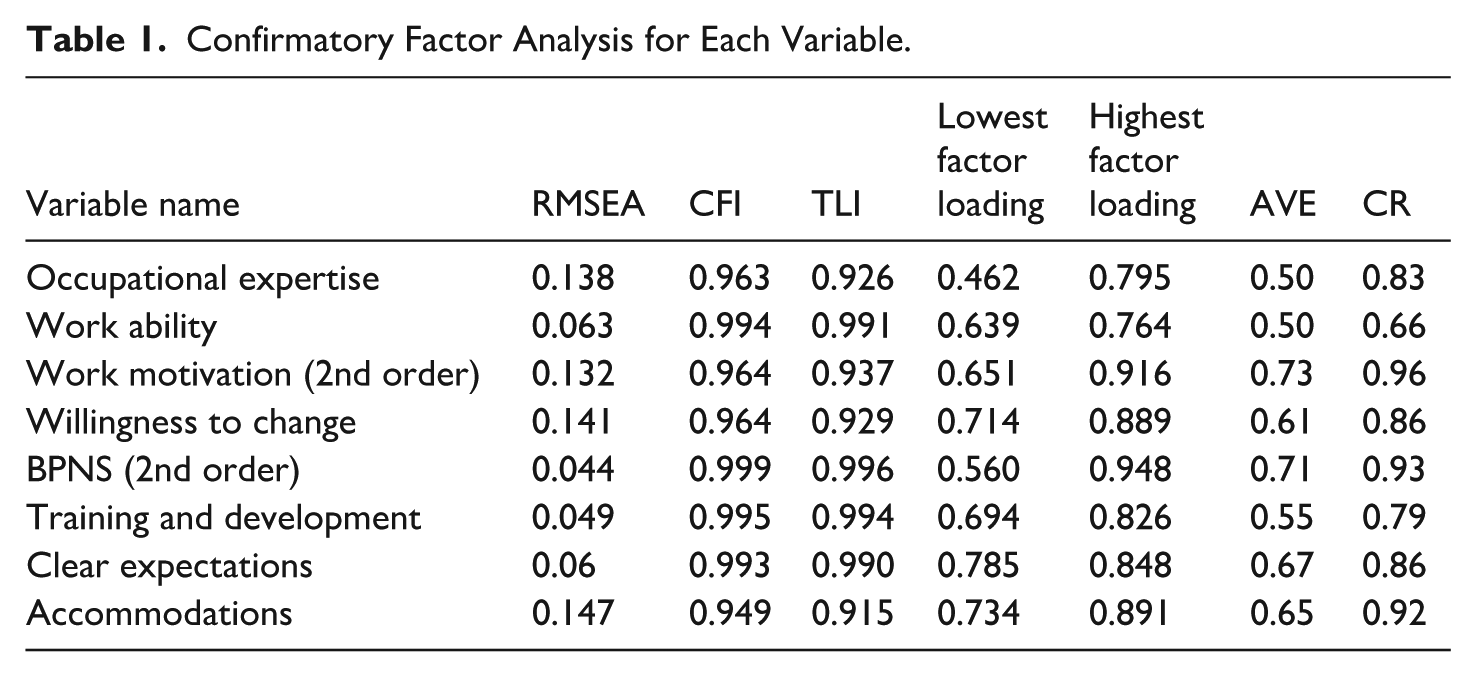
To assess the convergent validity, the Average Variance Abstracted (AVE) was calculated. The AVEs of all the constructs were ≥0.50, indicating that all the variables had a high validity. The construct reliabilities (CR) were all ≥0.6, further indicating a good reliability. One item was deleted from the willingness to change variable as this considerably increased its reliability.
Descriptive Statistics
The means, standard deviations, reliabilities, and correlations of this study’s variables are presented in Table 2.
Means, Standard Deviations, Reliabilities, and Correlations.
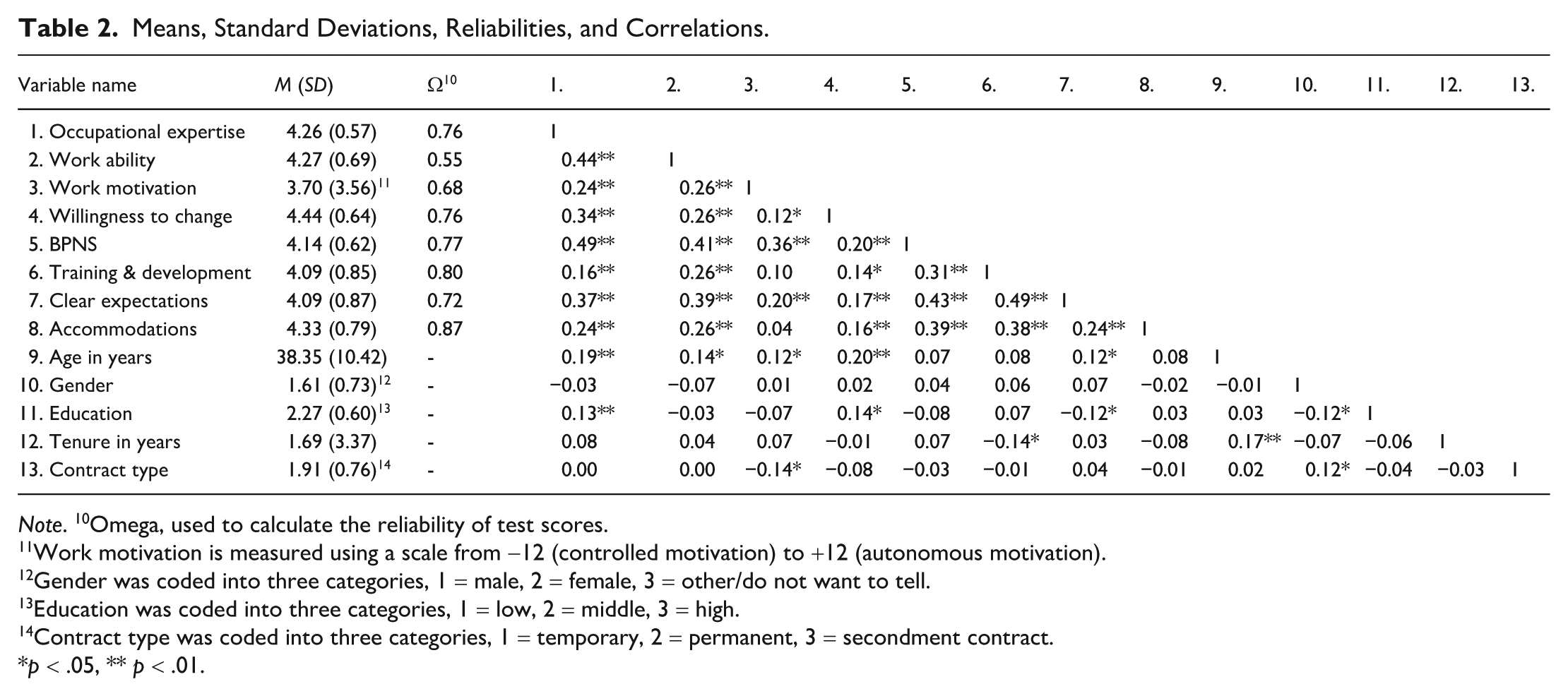
Note. 10Omega, used to calculate the reliability of test scores.
11Work motivation is measured using a scale from -12 (controlled motivation) to +12 (autonomous motivation).
12Gender was coded into three categories, 1 = male, 2 = female, 3 = other/do not want to tell.
13Education was coded into three categories, 1 = low, 2 = middle, 3 = high.
14Contract type was coded into three categories, 1 = temporary, 2 = permanent, 3 = secondment contract.
p < .05, ** p < .01.
Hypotheses Testing
To start, Hypotheses 1a, 1b, and 1c regarding the direct relationships between perceived HR practices and employability were tested. Age, gender, education, tenure, and contract type were included in the analysis as control variables. The results of the regression analysis regarding the direct effects of perceived HR practices on WWDs’ employability can be found in Table 3.
Mediation Effects. Controlled for Age, Gender, Education, Tenure, and Contract Type.
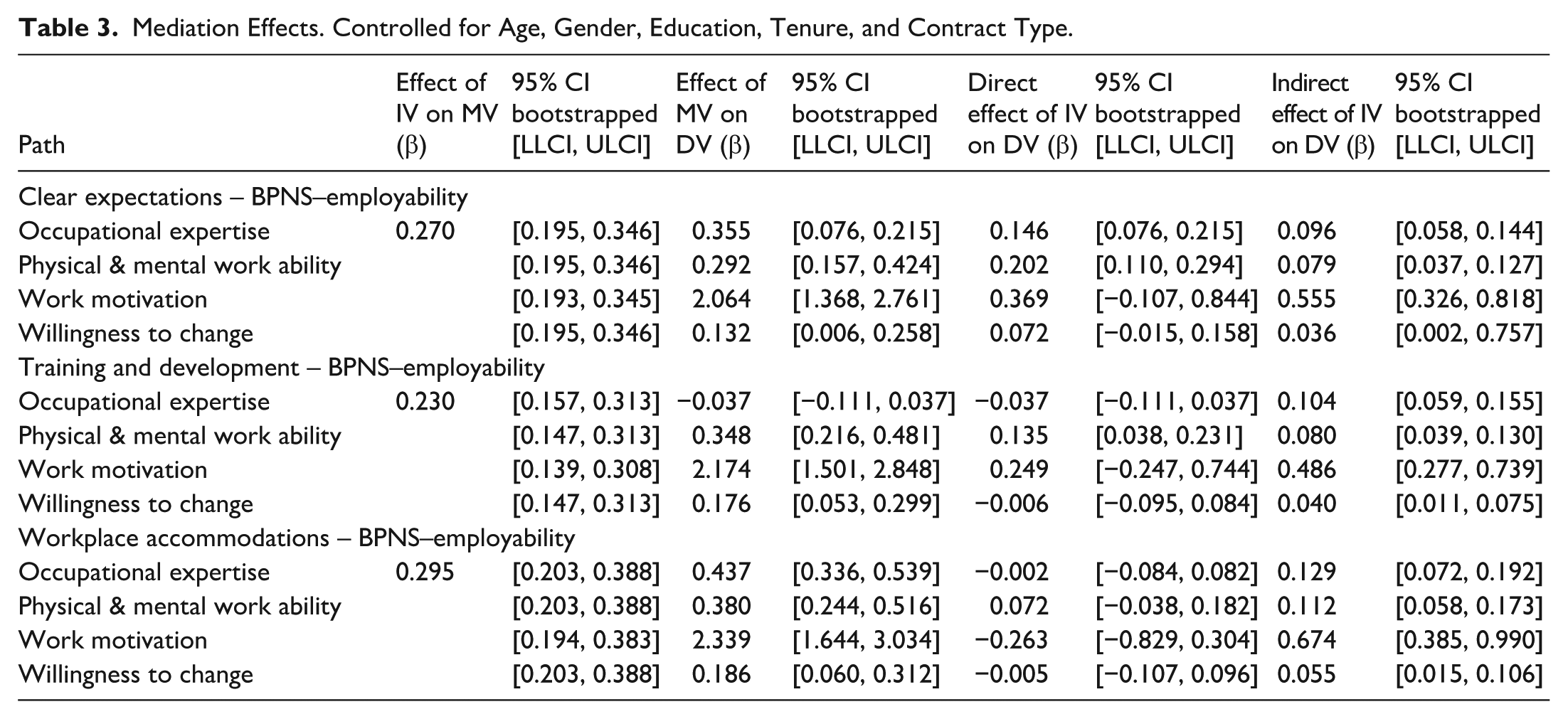
Establishing clear expectations had a significant effect on the employability variables of occupational expertise (β = .146, p < .05) and physical and mental work ability (β = .202, p < .05). However, clear expectations had no significant effect on WWDs’ work motivation (β = .369, p > .05) and willingness to change (β = .072, p > .05). Establishing clear expectations thus only enhanced the ‘ability’ variables of WWDs’ employability. As such, Hypothesis 1a is only partially supported.
Training and development practices only had a significant positive direct effect on WWDs’ physical and mental work ability (β = .135, p < .05). Training and development practices had no significant direct effect on the other three employability variables of occupational expertise (β = −.037, p > .05), work motivation (β = .249, p > .05), and willingness to change (β = −.072, p > .05). Thus, Hypothesis 1b is again only partially supported.
Workplace accommodations had no significant direct effects on any of the four employability variables: occupational expertise (β = −.002, p > .05), physical and mental work ability (β = .072, p > .05), work motivation (β = −.263, p > .05), and willingness to change (β = −.005, p > .05). Therefore, Hypothesis 1c is rejected.
Next, we hypothesized that the positive effect of the perceived HR practices is mediated by the satisfaction of basic psychological needs. Table 3 shows the results of the mediation analysis. Again, age, gender, education, tenure, and contract type were included in the analysis as control variables.
The relationships between clear expectations and all the employability variables are indeed mediated through basic psychological needs satisfaction. Results show significant indirect effects for occupational expertise (β = .096, p < .05), physical and mental work ability (β = .079, p < .05), work motivation, (β = .555, p < .05), and finally, willingness to change (β = .036, p < .05). As such, Hypothesis 2a is supported.
Next, the analysis shows that the relationships between training and development and WWDs’ employability variables are also significantly mediated by basic psychological needs satisfaction, showing significant indirect effects for occupational expertise (β = .104, p < .05), physical and mental work ability (β = .080, p < .05), work motivation (β = .486, p < .05), and willingness to change (β = .040, p < .05). Therefore, Hypothesis 2b is also supported.
Finally, the relationships between workplace accommodations and WWDs’ employability variables are again significantly mediated by basic psychological needs satisfaction. Results indicate significant indirect effects for the four dimensions of occupational expertise (β = .129, p < .05), physical and mental work ability (β = .112, p < .05), work motivation (β = .674, p < .05), and willingness to change (β = .055, p < .05). Thus, there is support for Hypothesis 2c.
Taken together, the control variables did not reveal any significant patterns that would help further interpret the results.
Discussion of Key Findings
This study contributes to understanding how HR practices, as perceived by WWDs, impact their employability. This study has tested the hypothesized relationships between three types of HR practices and WWDs’ employability. In addition, the extent to which these relationships are mediated by basic psychological needs satisfaction was examined.
The first main finding is that perceived HR practices have a positive effect on WWDs’ employability. However, the effect is limited and the HR practice of establishing clear expectations seems to be the main driver for this result. This HR practice significantly stimulates the work ability and expertise dimension of WWDs’ employability but was not significantly related to the willingness or motivation dimension. Training and development HR practices only had a significant effect on WWDs’ physical and mental work ability, and workplace accommodations had no significant direct effects on employability at all.
These results imply that HR practices predominantly stimulate a cognitive or ‘ability-related’ impact on WWDs’ employability rather than a direct attitudinal or motivational impact, as was expected based on Social Exchange Theory (SET). This finding contrasts with other research on the direct cognitive and motivational impacts of HRM on employee outcomes that predominantly sampled an ‘able-bodied’ population. Therefore, perhaps our results can be further understood by the context of WWDs. WWDs’ short job tenures (Villotti et al., 2017) or past negative experiences in the workplace (Schur et al., 2017) can create a sense of vulnerability, and as a result, WWDs may develop a sense of self-protection wherein they prioritize building their abilities over affective and motivational outcomes as a means of ensuring their competence and value in the workforce. Taken together, our findings underscore the need to move beyond a one-size-fits-all approach to HRM, as the HR practices employed and the mechanisms through which they influence employee outcomes seem to vary across contexts and employee populations. In particular, our study indicates that general mechanisms, such as those proposed by SET, manifest differently for WWDs. Boxall and Macky (2009) also criticize the domination of a direct motivational pathway in HR research. They propose that it is mainly the cognitive path that has the potential to directly contribute to skills and abilities utilization, while the motivational path makes more indirect contributions.
This links to our next main finding: when basic psychological needs satisfaction is regarded as a mediator in between the relationships of HR practices with WWDs’ employability, all relationships turned out to be significantly and positively related. This means that HR practices are important for stimulating WWDs’ employability through satisfying their basic psychological needs. In other words, basic psychological needs satisfaction is an important explanatory mechanism in the relationships of HR practices with WWDs’ employability. This is in line with other research that demonstrated the importance of basic psychological needs satisfaction for people with disabilities in a range of areas including quality of life, transitions from youth to adulthood, and academic engagement (Mumbardó-Adam et al., 2020). Further, needs satisfaction has been demonstrated to be a crucial condition for establishing decent work conditions for WWDs (Svicher & Di Fabio, 2021). Notably, based on the strengths and effects of the indirect mediation paths, workplace accommodations appear to be the most impactful HR practice in enhancing the employability of WWDs. This finding is in line with disability studies that conclude that workplace accommodations are able to address WWDs’ unique individual needs (e.g., Chandola & Rouxel, 2021). As such, they allow more equal access and opportunity for WWDs in the workplace and can be considered as one of the key HR practices for promoting WWDs’ job retention (Nevala et al., 2015). This study is among the first to examine workplace accommodations in comparison with other HR practices, thereby integrating critical insights from disability studies into the HRM literature.
Limitations of the Study
A limitation of this study is that it focused on a limited set of HR practices that were seen as relevant for WWDs’ employability. It is important to acknowledge that other HR practices might also influence WWDs’ employability, such as inclusive recruitment and selection, or practices designed to reduce stigmatization and discriminatory (Szulc et al., 2021), and that could be addressed by future research.
A further limitation is that disability was treated as a homogeneous construct. Disability is, however, a multifaceted phenomenon, and differences such as visible versus invisible or physical versus mental disabilities may shape WWDs’ perceptions of inclusive HR practices (Beatty et al., 2019). Moreover, we acknowledge that our data may be subject to bias and do not intent to generalize our findings to all individuals with disabilities. This is also why we use the term workers with disabilities, as our sample may include individuals with relatively milder disabilities compared to those who are unemployed. By aggregating potential differences in disability type, important variation may have been overlooked. Privacy considerations in the studied organization made further differentiation impossible, but future research could usefully examine how specific types of disabilities shape the effectiveness of HR practices in supporting employability.
Finally, this research is limited by the lack of information on which specific needs were met by the three HR practices and how these three needs separately contribute to WWDs’ employability variables. In line with previous research (La Guardia et al., 2000), basic psychological needs satisfaction was aggregated into a second-order construct. This was for two reasons: first, to enhance the comprehensibility of the analysis and provide a clearer framework for interpreting the results; and second, to minimize the strain on WWDs while completing the survey instrument by using short scales wherever possible. The short scale used to measure basic psychological needs satisfaction consisted of two items per need. However, creating separate need variables using two-item scales endangers the reliability of the measure. The overall findings provide important indications that the three basic needs potentially contribute in unique ways to WWDs’ outcomes. As such, future research would benefit from differentiating between the three needs as this would provide more information as to which needs of WWDs are fulfilled by which HR practices and what needs it is most important to satisfy to achieve the desired WWD outcomes.
Practical Implications for HRM Policy and Practice
Although this study was conducted within a single Dutch public sector organization, the findings offer insights that may inform public sector HRM more broadly. In addition these insights can be a source of inspiration for national disability employment policies and the global sustainable development agenda. Public sector organizations in Western democracies often operate within similar institutional environments characterized by formalized HR structures, strong regulatory frameworks, and a normative commitment to public value creation and equal employment opportunities. These shared institutional characteristics suggest that HR practices aimed at supporting workers with disabilities may function in comparable ways across public sector organizations. First, this study shows that public sector employers can contribute to the sustainable employment of people with disabilities by incorporating three types of HR practices: establishing clear expectations, providing training and development opportunities, and ensuring workplace accommodations. These HR practices can be useful for all employees and should not be automatically regarded as disability HRM. Nevertheless, due to the challenges that WWDs often face in the workplace such as physical or environmental barriers or stigma (Hersugondo et al., 2025), HR practitioners have the important task of uncovering and addressing potential limitations in their general HR practices that inadvertently exclude WWDs (Schloemer-Jarvis et al., 2022). Implementing HR practices that are especially disability inclusive will reflect and demonstrate the organizations’ commitment to tailoring HR practices to the needs of WWDs and to creating an ability-diverse workforce. More specifically, our first main finding highlights the importance of establishing clear expectations. HR practitioners can play a critical role by encouraging line managers to make work routines and performance outcomes explicit, as such expectations are often left implicit and presumed to be well understood. This may be particularly consequential for WWDs, many of whom have previously experienced distance from the labor market. Our second main finding suggests that HR practitioners can facilitate organization-wide workplace accommodations such as flexible work policies or noise-canceling workspaces, which are essential for WWDs yet difficult for individual line managers to implement effectively due to economies of scale.
Conclusions and Future Directions
This study investigates how HR practices influence the employability of workers with disabilities (WWDs) in the public sector. Focusing on the three practices of establishing clear expectations, training and development opportunities, and workplace accommodations, we demonstrate that HRM has a significant impact on WWDs’ employability, particularly when mediated by the satisfaction of basic psychological needs. These findings show that HRM is central in shaping inclusive employment outcomes for WWDs in public organizations.
The results provide important lessons for public sector HRM. While many public organizations in the Netherlands are still lagging behind in meeting disability employment targets, our findings illustrate that inclusive HR practices can effectively strengthen WWDs’ ability and willingness to participate in the labor market. This underscores the untapped potential of public sector HRM to act as a role model in fostering inclusive labor markets. By doing so, public organizations not only meet national employment objectives but also contribute directly to global sustainability goals. In particular, advancing the employability of WWDs supports SDG 8 (‘decent work and economic growth’) and SDG 10 (‘reduced inequalities’), which call for inclusive labor markets and equal access to decent work for all.
Overall, this study highlights how HRM in the public sector can serve as a crucial lever for sustainable development. By investing in disability-inclusive HR practices, public sector organizations can help close the disability employment gap and, in doing so, contribute to the realization of the 2030 Agenda.
Footnotes

Funding
The authors received no financial support for the research, authorship, and/or publication of this article.
Declaration of Conflicting Interests
The authors declared no potential conflicts of interest with respect to the research, authorship, and/or publication of this article.