






Abstract
When rules impose compliance burdens that outweigh their contribution to teachers’ objectives or values, they are experienced as red tape. Given red tape’s negative consequences, it is concerning that teachers worldwide report being confronted with high levels of red tape in their jobs. Drawing on Job Demands-Resources theory and Affective Events Theory, this study investigates the relationship between teachers’ red tape perceptions and physical complaints (e.g., neck pain and headaches). Specifically, we explore the mediating role of work-related anger in this relationship and investigate whether servant leadership moderates the negative effects of red tape. We collected time-lagged data from 717 teachers in Flemish schools. Structural Equation Modeling revealed a positive relationship between red tape and physical complaints, mediated by work-related anger. Furthermore, the results indicate that when teachers perceive their school leader as a servant leader, work-related anger is less affected by red tape, which indirectly reduces their physical complaints.
Introduction
Driven by intensifying demands for accountability and transparency, teachers’ daily work is increasingly structured by formal rules, regulations, and procedures (Hill & Plimmer, 2024; Li & George, 2025b, 2025c; Muylaert et al., 2025). When such administrative requirements impose compliance burdens that outweigh their contribution to teachers’ objectives or values, they are experienced as red tape (Bozeman, 2012). Governments continue to prioritize red tape reduction on their policy agendas (e.g., #CutRedTape in the U.S., South Africa’s Red Tape Reduction Unit; Li & George, 2025a, 2025b). Paradoxically, rule-based cultures appear to be thickening rather than loosening: street-level bureaucrats worldwide report high, and in many settings rising, levels of red tape (Hussain & Franken, 2025; Li & George, 2025a). This paradox is especially visible in education: despite a decade of political attention to teachers’ administrative burden (Muylaert, 2023), teachers report increasing levels of red tape (Fuenzalida et al., 2026; Jacobsen & Jakobsen, 2018; Li & George, 2025a, 2025c). In Flanders –the setting of the present study–, 83% of teachers report experiencing (very) high levels of red tape (Flemish Inspectorate of Education, 2023).
Red tape is considered a major threat to public organizations worldwide (Li & George, 2025c). This study builds on an expanding body of public sector research revealing that civil servants’ perceptions of red tape are negatively associated with numerous employee- and organizational-level outcomes (e.g., Blom et al., 2021; George et al., 2021; Li & George, 2025b). This study aims to investigate the relationship between teachers’ red tape perceptions and their physical complaints – an often overlooked yet important detrimental consequence of red tape (Lagios et al., 2023). Physical complaints refer to psychosomatic symptoms that represent bodily stress reactions (Terluin et al., 2004). Common symptoms include cardiac, respiratory, and digestive complaints, as well as generalized musculoskeletal pain (e.g., neck pain, headache, an upset stomach; Lim & Kim, 2016; Terluin et al., 2004). Although scholarly interest in red tape has grown, research on its mediators and moderators remains relatively limited, underscoring the need to identify both the mechanisms through which, and the boundary conditions under which, red tape affects employee outcomes (George et al., 2021; Li & George, 2025b). Accordingly, this study investigates the processes and contingencies that explain how and when red tape positively relates to teachers’ physical complaints.
Given the potential role of emotions in the “black box” of red tape’s impact on employees (Davis & Pandey, 2024; Hattke et al., 2020), we explore the underlying role of teachers’ work-related anger. Red tape’s emotional consequences have received little attention in past literature (George et al., 2021; Hattke et al., 2020). This is remarkable, as emotions play a crucial role in human life and influence various aspects of work (Hattke et al., 2020). They not only influence immediate feelings of pleasure or discomfort but also shape future well-being at work and long-term workplace outcomes (Baka et al., 2021). This study builds on the Job Demands-Resources (JD-R) theory (Bakker et al., 2023) and the Affective Events Theory (Rueff-Lopes et al., 2026; Weiss & Cropanzano, 1996), which state that emotions, such as work-related anger, are expected to mediate the relationship between job demands (i.e., red tape) and employee outcomes (i.e., physical complaints; Bakker & de Vries, 2021; Ostermeier et al., 2023; Qiang et al., 2025; Schaufeli & van Rhenen, 2006).
Although reducing red tape remains high on the political agenda in many countries, it continues to be deeply embedded in the structures of public organizations worldwide (George et al., 2021). Consequently, identifying ways to mitigate the negative effects of red tape on employee outcomes is crucial (Li & George, 2025a, 2025b). A promising lever in this regard is leadership. Leaders do not merely implement governmental regulations, they also interpret them and translate them into organizational practices. In particular, leaders may act as gatekeepers who buffer, filter, and modify external policy and administrative demands before they reach staff, thereby reducing the administrative burden placed on employees (Kelchtermans et al., 2011). Moreover, even when the rules and procedures that generate red tape cannot be altered, managerial behavior can still influence how employees perceive and respond to these requirements. By creating an environment in which employees are less sensitive to, and more accepting of, rules commonly labeled as red tape, leaders can shape both perceptions of red tape and its consequences (Campbell, 2017; Moynihan et al., 2012).
Among the various leadership approaches discussed in the literature, servant leadership appears particularly relevant in the context of red tape, as it represents a broader normative leadership approach rooted in service, stewardship, and follower development (Eva et al., 2019; Liden et al., 2015; van Dierendonck, 2011). Servant leaders are humble about their own achievements and prioritize the needs, growth, and well-being of their employees, while also emphasizing ethical responsibility and service to broader stakeholder groups (van Dierendonck, 2011). In public organizations such as schools, where professionals are required to balance formal accountability demands with moral commitments toward students and society, this leadership approach could be particularly valuable.
Building on the JD-R theory (Bakker et al., 2023), this study examines whether servant leadership, conceptualized as a job resource, moderates (i.e., buffers) the positive relationship between red tape and teachers’ work-related anger. We study servant leadership as a job resource because its emphasis on support, empathy, and meaning-making makes it particularly relevant in emotionally constraining environments such as those shaped by red tape. Moreover, public organizations are inherently grounded in service-oriented values such as stewardship, ethical responsibility, and responsiveness to multiple stakeholders (Crosby & Bryson, 2018). In line with public administration research on servant leadership (e.g., Awasthi & Walumbwa, 2022; Miao et al., 2014; Nguyen et al., 2023; Schwarz et al., 2016), public leaders are expected not only to support their employees but also to serve broader societal and community interests.
This study offers multiple contributions to theory and practice. First, its innovative focus on physical complaints adds depth to the red tape literature, as the link between red tape and physical health has often been overlooked (e.g., Lagios et al., 2023). Second, by focusing on work-related anger as an underlying mechanism, we answer calls for research to investigate the underlying role of emotions between red tape and employee outcomes (e.g., Davis & Pandey, 2024; Hattke et al., 2020). Moreover, our research also enriches the understanding of human resource management in public sector contexts, where red tape represents a defining organizational characteristic that generates distinct and often demanding people management challenges (e.g., Fuenzalida et al., 2026; Knies et al., 2024). Lastly, by examining the moderating role of servant leadership, our study sheds light on strategies to mitigate the adverse effects of red tape, contributing to the limited understanding of how to buffer red tape’s negative impact (e.g., Li & George, 2025a, 2025b).
Theory and Hypotheses
Red Tape Defined
Bozeman (2012) defined red tape as “rules, regulations, and procedures that remain in force and entail a compliance burden for designated stakeholders but whose contribution to stakeholders’ objectives or values is less than the compliance and implementation resources expended on the rule” (p. 257). According to this definition, two key characteristics define red tape. First, compliance burden refers to the time, effort, and other resources stakeholders must expend to comply with a rule (Bozeman, 2012; van loon, 2017). Second, lack of functionality concerns the (perceived) extent to which the rule contributes to stakeholders’ objectives or values (Bozeman, 2012; van loon, 2017).
This raises a crucial question: who determines whether a rule lacks a useful purpose? Following Bozeman (2012), a rule becomes red tape for an individual stakeholder when “the amount of benefit to the stakeholder’s values or objectives is less than the cost of the resources expended to comply with or to implement the rule” (p. 258). Thus, whether a rule is viewed as lacking a useful purpose stems from the subjective evaluation of individual stakeholders. For example, a rule may serve a clear regulatory function from a policy or leadership perspective, yet still be experienced as red tape by teachers when its purpose is unclear or misaligned with their daily activities. Moreover, these individual assessments are shaped not only by objective organizational factors and role perspectives but also by individuals’ subjective interpretations and experiences (Campbell et al., 2023; Fuenzalida et al., 2026). Personal traits, past experiences, and job responsibilities can lead some to view a rule as beneficial, while others perceive the same rule as red tape (Hill & Plimmer, 2024; Li & George, 2025b).
Red Tape in the (Flemish) Teaching Context
Studying red tape in the Flemish education system is highly relevant, as Flemish teachers report high levels of red tape (Flemish Inspectorate of Education, 2023). In addition, beyond red tape, public schools face a growing set of complex challenges, including high teacher workloads, teacher shortages, and declining student performance indicators (Farahmandpour & Voelkel, 2025; Gils et al., 2024; OECD, 2025a; White et al., 2025). These pressures are compounded by New Public Management reforms, which emphasize accountability, effectiveness, and efficiency (Muylaert, 2023). Additionally, in recent years, global debates about education have become more polarized, with growing skepticism toward science and the rise of populist movements (OECD, 2025b), developments that are particularly visible in countries like the United States. While the direct impact of these political shifts is more limited in Flanders, related pressures are still evident. In particular, cost-cutting measures, increased administrative and professional demands on teachers, and continuous reforms such as changes to pension arrangements have sparked dissatisfaction and anger, resulting in strikes and other collective actions. Together, these evolving expectations have substantially reshaped the daily work of teachers and school leaders, increasing instructional complexity and administrative workload (Davidovitz & Cohen, 2022; OECD, 2020). Developing a better understanding of how red tape negatively affects teachers’ well-being, and how job resources such as servant leadership can mitigate these effects, is thus essential.
This study focuses on teachers working in Flemish public elementary and secondary schools. Recent meta-analyses (Blom et al., 2021; George et al., 2021) show considerable variation in the effects of red tape across different outcomes among public servants (Fuenzalida et al., 2026). This heterogeneity cautions against generalizing earlier evidence of negative attitudinal responses to red tape to other domains, such as anger and physical complaints. To better capture the potential health-related consequences of red tape, empirical research within a single context is therefore warranted, as advocated by scholars in the field (Pandey, 2021).
Red Tape and Physical Complaints
The JD-R theory provides a valuable framework for understanding red tape’s negative consequences (Campbell et al., 2023; Hussain & Franken, 2025; Li & George, 2025a). Consequently, by building on this theory, we expect red tape to be positively related to teachers’ physical complaints. While each organization is unique and its jobs may vary in characteristics, the JD-R theory posits that all job characteristics can be categorized into two main groups: job demands and job resources (Bakker et al., 2023). Job demands refer to “the physical, psychological, social, or organizational aspects of the job that require sustained physical, cognitive, and/or emotional effort and are therefore associated with certain physiological and/or psychological costs” (Bakker et al., 2023, p. 33). Conversely, job resources are “the physical, psychological, social, or organizational aspects of the job that have motivating potential, that are functional in achieving work goals, that regulate the impact of job demands, and that stimulate learning and personal growth” (Bakker et al., 2023, p. 33). According to the JD-R theory, job demands and resources trigger two distinct processes (Bakker & Demerouti, 2024). Job resources instigate a motivational process, resulting in positive employee outcomes (Bakker et al., 2023). In contrast, job demands instigate a health impairment process, resulting in negative employee outcomes (Bakker et al., 2023; Borst et al., 2025).
Job demands can further be divided into two types: challenge demands and hindrance demands. Challenge demands are perceived as temporary difficulties that encourage employees to excel, whereas hindrance demands involve working conditions that place excessive or unwelcome restrictions, thereby obstructing employees’ goal achievement and diminishing their performance (Bakker et al., 2023; Quratulain & Khan, 2015). Red tape is considered a hindrance demand because it places excessive and unwelcome constraints on employees, obstructing their goal achievement, reducing performance, and causing irritations, inefficiencies, and delays (Cooke et al., 2019; Fuenzalida et al., 2026; Hussain & Franken, 2025; Li & George, 2025c). In contrast to challenge demands, which offer opportunities for growth, red tape drains employees’ energy without providing any positive outcomes (Cooke et al., 2019).
Teachers often view their profession as a calling and place high value on sustained, personal interactions with their students (Borst, 2018; Hansen & Pedersen, 2025). Survey evidence supports this orientation: according to the Teaching and Learning International Survey (TALIS), 90% of participating teachers chose the profession because they wished to contribute to society and positively influence the lives of children and young people (OECD, 2020). For many teachers, the relational and human dimensions of their work clearly outweigh its administrative components (Borst, 2018). Consequently, they may perceive time spent on administrative paperwork as time taken away from their core responsibilities, namely, educating students (Borst, 2018; Kools et al., 2020; Li & George, 2025a). This value incongruence makes teachers particularly vulnerable to the negative consequences of red tape, as bureaucratic tasks directly interfere with the core aspects of their prosocial and interactional work (Hussain & Franken, 2025; Li & George, 2025c).
Situations perceived as hindrance demands can lead to various physical strains, including psychosomatic symptoms (Bakker et al., 2023; Mackey & Perrewé, 2019; Schaufeli & van Rhenen, 2006). More specifically, the health impairment process describes how job demands negatively affect employees’ health by depleting their physical, emotional, and cognitive resources (Bakker & Demerouti, 2024). The increased effort and resulting energy depletion can result in job strain, exhaustion, and health problems (Bakker et al., 2023). Consequently, as a hindrance demand, red tape may trigger adverse physical arousal among teachers (Li & George, 2025c). This process unfolds gradually over time. For teachers, repeated exposure to tasks they consider red tape can drain their energy to such an extent that temporary fatigue develops into chronic exhaustion, potentially leading to health problems (Bakker & Demerouti, 2024; Muylaert, Decramer, & Audenaert, 2023). Hindrance job demands, such as red tape, are linked to somatic complaints because they interfere with employees’ ability to achieve work-related goals (Mackey & Perrewé, 2019). This obstruction can result in strain, which may manifest through bodily symptoms indicating disruptions in overall health (Mackey & Perrewé, 2019; Terluin et al., 2004).
In line with this reasoning, research by Lagios et al. (2023) revealed a positive relationship between red tape and psychosomatic strains (i.e., symptoms such as nausea and fatigue). Consequently, we hypothesize:
The Mediating Role of Work-Related Anger
Next, as emotions serve as a mediating mechanism between job characteristics –eliciting either positive or negative emotions– and employee well-being (Bakker & de Vries, 2021; Noja et al., 2024; Ostermeier et al., 2023; Qiang et al., 2025; Schaufeli & van Rhenen, 2006), we posit that work-related anger, as an emotional response, mediates the relationship between teachers’ red tape perceptions and their physical complaints.
When teachers continuously encounter hindrance demands, they are likely to experience negative emotional reactions, which can result in health-related problems over time (Baka, 2015; Bakker & de Vries, 2021; Balducci et al., 2011; Idris & Dollard, 2011; Ostermeier et al., 2023; Schaufeli & van Rhenen, 2006; van Katwyk et al., 2000). This phenomenon will be particularly evident when teachers use their personal resources and energy to manage chronic demands (Bakker & de Vries, 2021; Idris & Dollard, 2011). More specifically, hindrance demands such as red tape are likely to provoke anger, which in turn can lead to physical complaints (Hattke et al., 2020; Idris & Dollard, 2011; Quratulain & Khan, 2015; Schaufeli & van Rhenen, 2006). Affective Events Theory, developed by Weiss and Cropanzano (1996) further supports this perspective by suggesting that employees, including teachers, encounter various workplace events that elicit emotional responses (de la Nuez et al., 2023; Hattke et al., 2020; Rueff-Lopes et al., 2026). These affective experiences play a crucial role in shaping teachers’ attitudes and behaviors (de la Nuez et al., 2023; Rueff-Lopes et al., 2026).
First, regarding the red tape–anger argumentation: The workplace environment plays a significant role in triggering anger (Jaworek et al., 2020). From a JD-R theory perspective, red tape functions as an excessive and complex demand that jeopardizes teachers’ emotional resources, requires emotional effort, and elicits negative emotions (Borst et al., 2025; Fuenzalida et al., 2026; Qiang et al., 2025; Schaufeli & van Rhenen, 2006). Red tape restricts teachers’ decision-making, limits their ability to navigate situations effectively, prevents them from applying their skills and knowledge, and reduces both their autonomy and perceived impact on work outcomes (Blom et al., 2021; Fuenzalida et al., 2026; Hussain & Franken, 2025; Lagios et al., 2023; Muylaert et al., 2025; van loon, 2017). These factors can collectively contribute to work-related anger (Cheng et al., 2022; Idris & Dollard, 2011; Jaworek et al., 2020). As red tape imposes excessive constraints on teachers, it hinders their goal attainment, reduces performance, causes inefficiencies and delays, and leaves teachers feeling irritated and overwhelmed (Cooke et al., 2019; Jacobsen & Jakobsen, 2018; Li & George, 2025c; Qiang et al., 2025; Quratulain & Khan, 2015). In particular, by interfering with teachers’ core tasks (i.e., educating students) and consuming valuable time and resources, red tape can elicit negative emotions, such as anger (Cheng et al., 2022; Idris & Dollard, 2011; Qiang et al., 2025). As an additional argument, the experience of powerlessness is a key characteristic of red tape (Borst et al., 2025; George et al., 2021). Individuals with limited power are particularly prone to experiencing negative emotions, with anger being a predominant response (Hattke et al., 2020; Jaworek et al., 2020). Moreover, teaching as a profession requires substantial emotional investment, as teachers continuously engage in intensive interactions with students, making the work inherently emotionally demanding and draining (Eshuis et al., 2023; Smith et al., 2025). When such an emotionally taxing job is further compounded by administrative tasks perceived as red tape, it may exacerbate emotional strain and increase the likelihood of experiencing negative emotions such as anger (Hattke et al., 2020). In addition, when teachers encounter red tape in front of students, they may be required to suppress or mask the negative emotions it triggers, further depleting their already strained emotional resources and heightening the emotional demands of the profession (Fuenzalida et al., 2026; Smith et al., 2025).
Second, regarding the anger–physical complaints argumentation: Negative emotions not only cause immediate discomfort for teachers but also impact their future well-being (Baka et al., 2021). Compared to positive emotions, negative emotions are more easily remembered and exert stronger effects (Baka et al., 2021; Weiss & Cropanzano, 1996). Chronic exposure to negative emotions –especially high-arousal emotions like anger– has been linked to physiological responses that may over time contribute to physical health problems (Jenkins et al., 2023; van Katwyk et al., 2000). Persistent anger, in particular, can wear down the body by continuously overloading its regulatory systems (Begley, 1994; O'Riordan & Costello, 2024; Titova et al., 2022). More specifically, the frequent release of adrenaline due to chronic anger keeps the body almost constantly “on alert,” thereby straining its response capacity. This stress response involves activation of the sympathetic-adrenal medullary system, leading to physiological changes such as elevated heart rate, increased blood pressure, and enhanced catecholamine secretion (Meier et al., 2013; O'Riordan & Costello, 2024; Titova et al., 2022). Over time, these reactions can result in somatic complaints such as back pain, headaches, and gastrointestinal issues (Meier et al., 2013).
Consistent with our reasoning on the relationship between red tape and anger, Qiang et al. (2025) revealed a positive relationship between red tape and negative emotions. Moreover, Hattke et al. (2020) provided empirical evidence that red tape elicits anger. Their findings demonstrated this effect using physiological measures of emotions (i.e., facial coding, electrodermal activity, and heart rate) collected during a laboratory study. Next, supporting our reasoning on the link between anger and physical complaints, anger has been associated with various adverse cardiovascular health outcomes (e.g., O’Riordan & Costello, 2024; Titova et al., 2022). In addition, research shows that trait anger positively predicts psychological symptoms, including somatization (Özmen, 2023). Moreover, both anger suppression and the tendency to experience anger have been positively associated with somatic complaints (Kahnert et al., 2025; Liu et al., 2011). Finally, aligning with our mediation hypothesis, research has highlighted the mediating role of job-related negative emotions in the relationship between job demands and health complaints (Balducci et al., 2011; Noja et al., 2024; Schaufeli & van Rhenen, 2006). Consequently, we hypothesize:
The Moderating Role of Servant Leadership
In line with the JD-R theory, which posits that job resources can mitigate the negative consequences of job demands (Bakker et al., 2023), we argue that school leaders’ servant leadership behavior functions as a key job resource that can buffer the negative emotional outcomes of excessive job demands experienced by teachers, such as red tape (Borst et al., 2025; Schaufeli & van Rhenen, 2006; Yang et al., 2025).
Servant leadership is a leadership approach characterized by a set of follower-oriented behaviors that place followers’ needs and development above the leader’s self-interest, fostering community involvement, and encouraging personal and professional growth (Greenleaf, 1970; Liden et al., 2014, 2015, 2025). Although servant leadership has its conceptual roots in earlier work, the literature has substantially matured over the past two decades, with recent meta-analyses and theory-driven studies clarifying its behavioral components, mechanisms, and boundary conditions (Eva et al., 2019; Lee et al., 2020). Conceptually, servant leadership encompasses a rich set of behaviors, including empowerment, interpersonal acceptance, and stewardship (van Dierendonck & Nuijten, 2011).
Importantly, servant leadership holds particular relevance within public sector contexts, as public organizations are inherently rooted in service-oriented values and expectations regarding stewardship, ethical conduct, and responsiveness to a diverse set of stakeholders (Crosby & Bryson, 2018). Recent public management studies conceptualize servant leadership as well aligned with these public service values and demonstrate its relevance for public professionals’ attitudes, behaviors, and well-being (Bernards, 2023; Wu & Zhou, 2024), including health outcomes (Perrier et al., 2025). This conceptualization suggests that servant leadership functions as a more normative leadership approach in public organizations, which may help explain the relatively high average levels observed in public sector samples. Accordingly, despite elevated mean levels, variation in servant leadership remains meaningful for understanding public sector employees’ reactions to red tape.
We argue that school leaders’ servant leadership behaviors function as motivational job resources that help buffer the emotional strain teachers experience due to red tape. This aligns with literature conceptualizing servant leadership within the JD-R theory as a job resource that supports employees in coping with daily frustrations and restoring a sense of meaning at work (Eva et al., 2019; Hussain & Franken, 2025; Yang et al., 2025). As job resources, these behaviors replenish psychological energy, foster adaptive coping, and mitigate the emotional impact of job demands (Bakker et al., 2023; Bakker & Demerouti, 2017; Schaufeli & van Rhenen, 2006). In public education, teaching constitutes a profession in which professionals continuously interpret and enact formal rules while balancing professional norms and moral obligations toward students and society (Maynard-Moody & Musheno, 2022). In such contexts, servant leadership behaviors may be particularly relevant in buffering the emotional strain that arises when red tape conflicts with teachers’ professional values. Below we explain our reasoning in more detail.
First, servant leadership fosters a sense of control and self-efficacy through empowering behaviors, which enhances teachers’ autonomy, proactivity, and personal power (van Dierendonck, 2011), thereby counteracting the feelings of powerlessness associated with red tape (Borst et al., 2025; George et al., 2021). Empowerment enables teachers to experience psychological states of meaning, impact, self-determination, and competence in doing their job (Rahimi et al., 2024; Spreitzer, 1995), which is crucial to feel in control in demanding work environments (Audenaert et al., 2017). Red tape can divert attention from teachers’ core tasks, leading them to feel less effective in fulfilling their primary tasks and responsibilities (i.e., educating students; Kools et al., 2020; Li & George, 2025a). In such contexts, the servant leadership empowering behaviors are relevant to encourage teachers’ self-directed decision-making, which helps restore a sense of agency and meaning at work (Eva et al., 2019; Hussain & Franken, 2025; Langhof & Güldenberg, 2020), thus lowering the intensity of anger evoked by red tape.
Second, interpersonal acceptance –a core behavioral aspect of servant leadership–entails empathy, forgiveness, and the capacity to understand and acknowledge others’ emotional experiences without judgment (van Dierendonck, 2011). In emotionally demanding contexts such as navigating red tape (Davis & Pandey, 2024; Hattke et al., 2020), this leadership behavior supports a climate of psychological safety where teachers feel free to express frustration or anger without fear of negative consequences (Muylaert, Decramer, & Audenaert, 2023). School leaders who create space for emotional expression, rather than suppressing or pathologizing negative emotions, help normalize frustration and anger as valid responses to constrained environments (Kotsou et al., 2019). This non-judgmental stance facilitates emotional awareness and acceptance, which are foundational processes in effective emotion regulation (Kotsou et al., 2019; Trudel-Fitzgerald et al., 2024).
Finally, stewardship –a core behavioral aspect of servant leadership– reflects a deep moral commitment of the school leader to the school’s broader mission and long-term collective interests over personal gain (Hernandez, 2008; van Dierendonck, 2011). By acting as caretakers of institutional purpose, steward school leaders help teachers shift the focus from rigid compliance to shared values and meaningful contribution (Eva et al., 2019; Hussain & Franken, 2025; Muylaert, Decramer, & Audenaert, 2023). This shift in focus counters the demotivating and alienating effects of red tape, which can narrow teachers’ focus to tasks, rules, or personal frustration (Blom et al., 2021; George et al., 2021; Muylaert, Decramer, & Audenaert, 2023). Stewardship behaviors in school leaders’ servant leadership remind teachers of the broader organizational or societal mission they serve (van Dierendonck, 2011), and thereby reframe experienced red tape as a necessary aspect of a larger, more valuable purpose. In this way, the stewardship behavior of servant leadership reflects a moral commitment to the greater good and long-term value creation.
Building on the above argumentation, we propose that servant leadership buffers the positive relationship between red tape and work-related anger, and that a moderated mediation effect will also be present. Although, as discussed above, we outlined several behavioral facets of servant leadership to clarify how servant leaders may shape follower experiences, we empirically model servant leadership as a global, single-factor construct (Liden et al., 2015; see Measures section).
Materials and Methods
We adopted an explanatory research design to clarify how and when red tape contributes to teachers’ physical complaints. The study relied on a two-wave survey methodology. Data were collected from teachers working in Flemish (Belgium) elementary and secondary schools. All constructs were measured using validated self-report scales, and structural equation modeling (SEM) was employed to assess the measurement model and the hypothesized structural model, including mediation and moderation effects. The following subsections provide a detailed description of the participants, procedure, measures, and analytical strategy.
Participants and Procedure
We collected survey data from elementary and secondary school teachers in Flanders (Belgium), at two separate time points. In Flanders, elementary education targets children aged 2.5 to 12, while secondary education targets students aged 12 to 18 (Eurydice, 2024). The Flemish Government is responsible for organizing education (Flemish Parliament, 2025). Given that nearly all Flemish schools receive government subsidies, this study focuses on public schools (Onderwijskiezer, 2024). A total of 879 school leaders from elementary and secondary schools were contacted and invited to allow their schools to participate in our study. Ultimately, 82 schools (9.33%) agreed to take part. These schools employed an average of 65 teachers (range: 15–360; SD = 60) and had an average student population of 514 (range: 134–1,700; SD = 357). From these 82 schools, 1,463 teachers agreed to participate in the study and provided their email addresses to the research team. In total, two surveys were sent out and administered via the online survey platform Qualtrics. In November 2023, we sent out the first questionnaire, containing the independent variable (i.e., red tape), moderator (i.e., servant leadership), and mediator (i.e., work-related anger) to those 1,463 teachers. Of those 1,463 teachers, 934 teachers completed the first questionnaire (response rate: 63.84%). To those 934 teachers, a second survey containing the dependent variable (i.e., physical complaints) was sent out 2 weeks later, which was completed by 784 teachers (response rate: 83.94%). In total, 717 teachers from 81 schools provided information regarding all variables studied. Those 717 teachers were thus included in the analyses.
Perceptual survey data are appropriate for measuring the variables in this study, as they capture “private experiences” (Conway & Lance, 2010). However, this type of data is susceptible to Common Source Bias (CSB). When both independent and dependent variables are measured through self-reported data, CSB may occur. This type of bias is known to inflate the observed relationships between variables, potentially leading to biased findings (George & Pandey, 2017). To minimize this risk, several precautionary measures were implemented (Podsakoff et al., 2012). First, data were collected at two separate time points. Second, respondents were assured of the importance of their personal opinions, their voluntary participation, anonymity, and confidentiality. Third, only measurement scales with well-established psychometric properties were used (Aljuaid et al., 2022; Borst et al., 2019; Jaworek et al., 2020, 2021; Lagios et al., 2023; Liden et al., 2015; Li & George, 2025b; Terluin, 1996; Terluin et al., 2004; Vermeeren & van Geest, 2012). Finally, the presence of CSB was tested via a one-factor model (i.e., this provides an important indication of potential CSB issues in public administration research; George & Pandey, 2017).
The participating teachers had an average age of 41.20 years (SD = 11.07), and their average employment rate was 91.56% (SD = 15.37), with 80.89% holding a permanent contract. A permanent contract refers to an employment contract in which teachers enjoy strong employment protection, with termination generally only possible for legally defined reasons (e.g., serious misconduct) or through voluntary exit. On average, teachers had 16.52 years of experience in the profession (SD = 11.16), including 12.75 years (SD = 10.48) at their current school. Among the participants, 46.72% worked in elementary education, while 53.28% were employed in secondary education.
With regard to gender, 75.45% of the respondents were female and 24.55% were male. This distribution closely reflects the population of Flemish teachers (74.96% female, 25.04% male), reflecting the female-dominated nature of the teaching profession (Flemish Department of Education and Training, 2025). Independent-samples t-tests showed that female teachers did not significantly differ from male teachers in their perceptions of red tape (t(715) = 1.38, p > .05), work-related anger (t(715) = −0.91, p > .05), or servant leadership (t(715) = 0.33, p > .05). However, female teachers reported significantly higher levels of physical complaints (M = 7.96) than male teachers (M = 4.16; t(338.77) = −8.11, p < .001).
Independent-samples t-tests indicated that teachers who participated in both waves did not significantly differ from teachers who only participated at Time 1 in terms of their perceptions of red tape (t(942) = −0.76, p > .05), servant leadership (t(920) = −0.20, p > .05), and work-related anger (t(911) = −0.76, p > .05). Regarding the control variables, independent-samples t-tests indicated that teachers who participated in both survey waves did not significantly differ from those who participated only at Time 1 in terms of gender (t(131.79) = −1.33, p > .05) and employment rate (t(902) = −0.76, p > .05). However, teachers who completed both waves were slightly older (t(902) = −2.83, p < .01), more likely to have a permanent contract (t(117.78) = 2.77, p < .01), and more often worked in secondary education (t(214.82) = 3.52, p < .001) compared to those who only participated at Time 1.
Measures
All variables were measured at Time 1, except for physical complaints and job stress, which were measured at Time 2. All measures were assessed at the employee level. An overview of the items is presented in the appendix. The survey was administered in Dutch. Measures of red tape (Vermeeren & van Geest, 2012) and physical complaints (Terluin, 1996) were available in validated Dutch versions. For work-related anger and servant leadership, no validated Dutch versions were available. These scales were therefore translated from English into Dutch using a translation and back-translation procedure. One author translated the items into Dutch, after which another member of the research team, who had not seen the original English items, translated the Dutch version back into English. Any discrepancies between the back-translated items and the original versions were discussed and resolved by adapting the Dutch items where necessary.
Red Tape
Red tape was measured using a validated six-item Likert scale (1 = strongly disagree, 7 = strongly agree) developed by the Dutch government and previously used in research (e.g., Borst et al., 2019; Muylaert, Decramer, & Audenaert, 2023; Vermeeren & van Geest, 2012). Cronbach’s alpha was .84.
Work-Related Anger
Work-related anger was measured using Jaworek et al.’s (2020) four-item scale. Participants indicated how often they had felt the emotions described in the statements over the past 30 days on a scale from 1 (Never) to 7 (Always). Cronbach’s alpha was .85.
Physical Complaints
Physical complaints were measured using the 16-item somatization scale by Terluin (1996), which is part of the Dutch version of the four-dimensional Symptom Questionnaire (4DSQ). The respondents indicated the extent to which they experienced 16 symptoms (e.g., painful muscles, neck pain, headache, nausea, or an upset stomach) over the past few months on a Likert scale ranging from “Never” to “Always.” Following the original scale, each symptom was rated as absent (Never/Very rarely/Rarely = 0 points), doubtfully present (Sometimes = 1 point), or present at a clinically significant level (Often/Very often/Always = 2 points; Terluin, 1996; Terluin et al., 2004). Individual symptom scores (0–2) were summed, resulting in total scores ranging from 0 to 32. Although this trichotomized scoring system was originally developed for clinical settings, it is also well suited for occupational populations, including public sector employees (Terluin et al., 2004). Employing a Likert scale enables respondents to indicate subtle differences in the intensity of their symptoms, which is generally valued by participants. However, directly incorporating all response categories into the scoring would place considerable weight on the subjectively perceived severity of symptoms. Such severity judgments are not only influenced by actual health status, but also by individual response tendencies related to personality traits and situational factors (Terluin, 1996; Terluin et al., 2004). Some individuals consistently report symptoms in more extreme terms, whereas others tend to downplay their complaints, which may artificially inflate correlations in survey-based organizational research (Terluin et al., 2004). The trichotomized scoring approach addresses this concern by converting nuanced responses into a more conservative indicator that primarily reflects the number of physical complaints rather than their perceived intensity, thereby reducing the influence of individual response bias. This rationale is particularly relevant in non-clinical occupational research, as employees –or, in our case, teachers– may differ substantially in how strongly they report somatic symptom severity (Terluin et al., 2004). By relying on the trichotomized scoring method, the present study limits response bias while preserving meaningful variation in physical complaints (Terluin, 1996; Terluin et al., 2004). Previous research has demonstrated that the 4DSQ, including its trichotomized scoring procedure, is a valid and reliable self-report instrument for use in working populations (Terluin et al., 2004). In the present study, Cronbach’s alpha was .86.
Servant Leadership
To avoid potential biases from principals rating their own behavior and because not all teachers within the school might have the same experiences with their school principal, teachers individually rated their school principal’s servant leadership behavior. Servant leadership was measured using Liden et al.’s (2015) seven-item Likert scale (1 = strongly disagree, 7 = strongly agree; SL-7). As the SL-7 is a validated short form of the SL-28 and is specifically designed to capture servant leadership as a global, single-factor construct, we follow prior research and treat servant leadership as an overall leadership orientation in our analyses (Liden et al., 2015). One item was removed due to a low factor loading (λ < 0.50): “My school principal would not compromise ethical principles in order to achieve success.” Cronbach’s alpha was .87.
Control Variables
Based on past research, we identified and included control variables that could influence teachers’ work-related anger and physical complaints, such as age (e.g., Lagios et al., 2023), employment percentage (e.g., Baka, 2015), gender (e.g., Lagios et al., 2023), and whether the teacher has a temporary or permanent contract (e.g., Montes & Irving, 2008). Moreover, we controlled for the educational stage, as working in elementary versus secondary education may impact teachers’ physical health (OECD, 2020). Elementary teachers tend to be more physically active due to their broader range of responsibilities, including play, movement-based learning, and assisting children. In addition, they typically have closer contact with their students. As younger children tend to get sick more frequently than older ones, elementary school teachers may be more consistently exposed to germs and viruses, potentially making them more vulnerable to physical health complaints compared to teachers in secondary education. Furthermore, teaching is a stressful profession at both educational stages (Ostermeier et al., 2023). According to data from the Organization for Economic Cooperation and Development (OECD), 52% of teachers across OECD countries report excessive administrative work as a primary source of stress (OECD, 2025a). Given that job stress has been linked to adverse physical health outcomes (Jepson & Forrest, 2006), it was included as a control variable in this study. Job stress was measured using Motowidlo et al.’s (1986) four-item Likert scale (1 = strongly disagree, 7 = strongly agree). Cronbach’s alpha was .91.
Data Analysis
As depicted in Figure 1, the proposed model follows a moderated mediation structure. To test our hypotheses, we utilized structural equation modeling (SEM) via the lavaan package (version 0.6-19) in R (version 4.3.1; Rosseel, 2012). SEM enables the simultaneous estimation of measurement and structural components involving both latent constructs and observed variables (Rosseel, 2012). As we collected time-lagged data, only respondents with complete data were retained. Given that teachers were nested within schools, we accounted for the hierarchical structure of our data by using cluster-robust standard errors implemented in the lavaan package in R (Rosseel, 2017). The use of cluster-robust standard errors was applied to both the measurement models (i.e., CFAs) and the structural models (i.e., SEM analyzes). The MLR estimator was used, employing maximum likelihood estimation and a robust scaled test statistic (Rosseel et al., 2025).
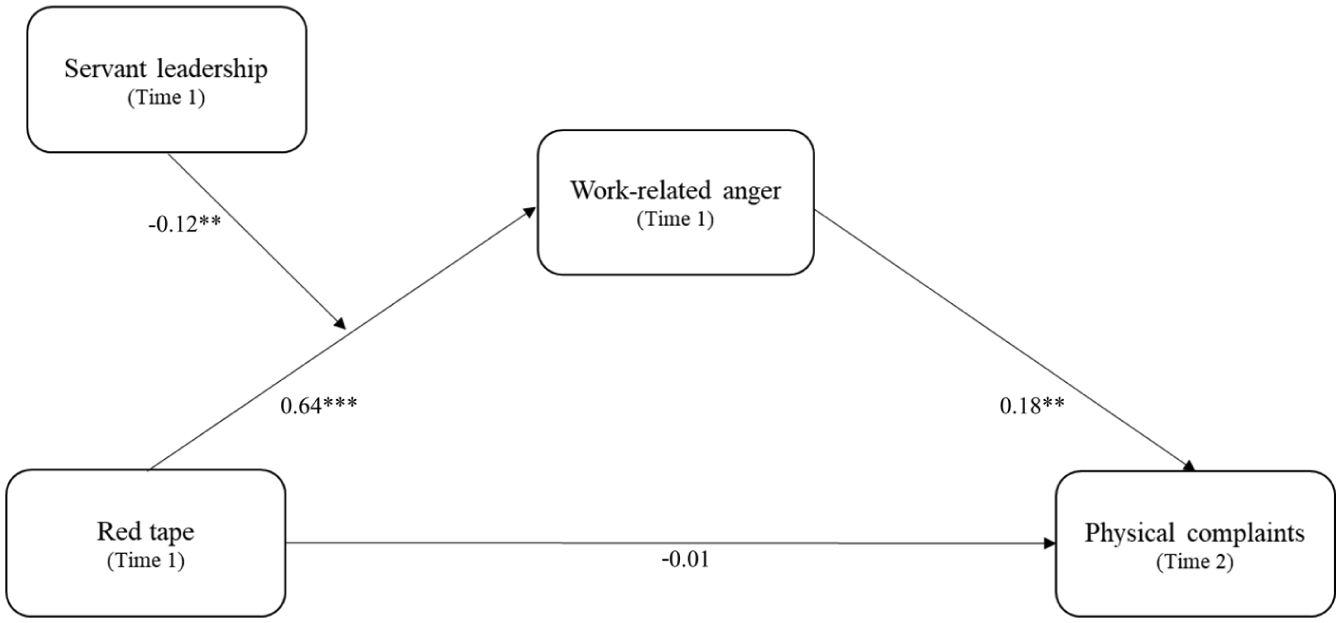
Results of the structural equation model of the conceptual model.
First, a confirmatory factor analysis (CFA) was conducted to assess the latent variable structure of the measurement model. During the CFA phase, factor loadings and modification indices were inspected, and model adjustments were made when theoretically justified. The results of these analyses are reported in the Preliminary Analyses section. Subsequently, the structural model was specified to examine the relationships between the variables. Model comparisons and evaluations were based on commonly used fit indices and their established thresholds (Hair et al., 2019), including the Comparative Fit Index (CFI), Tucker-Lewis Index (TLI), Root Mean Square Error of Approximation (RMSEA), and Standardized Root Mean Square Residual (SRMR). Control variables (i.e., gender, age, educational stage, contract type, employment percentage, and job stress) were included in the structural model. To assess the interaction effect of servant leadership on the relationship between red tape and work-related anger, the product indicator approach was applied. This involved creating a latent interaction term, constructed by computing the products of the matched paired mean-centered red tape and servant leadership items (Marsh et al., 2004). Bootstrapping was performed to evaluate the robustness of both the mediation and moderated mediation effects. Indirect effects were estimated using a 95% confidence interval, based on 10,000 bootstrap samples.
Results
Preliminary Analyses
Cronbach’s alpha values ranged from .84 to .91, confirming the internal reliability of the scales (Hair et al., 2019). To evaluate the fit of the measurement model, a CFA was conducted. The hypothesized model (including job stress) did not fit the data adequately (χ2 = 861.78, df = 183, CFI = 0.91, TLI = 0.90, RMSEA = 0.07, SRMR = 0.06; Hair et al., 2019). Inspection of factor loadings revealed that one item from the servant leadership scale (i.e., “My school leader would not compromise ethical principles in order to achieve success”) showed an insufficient loading (λ < 0.50) and was therefore removed (Hair et al., 2019; supplementary analyses including this item yielded similar results, indicating that its exclusion did not affect hypothesis testing). Nevertheless, even after excluding this item, the model fit remained inadequate (χ2 = 839.60, df = 164, CFI = 0.91, TLI = 0.89, RMSEA = 0.08, SRMR = 0.06).
Consistent with Vermeeren and van Geest (2012), red tape was modeled as a first-order construct. However, given the insufficient fit of the hypothesized model, two pairs of error terms within the red tape construct were allowed to correlate. According to Brown (2015), correlated error terms between items (i.e., indicators) of a latent construct are appropriate when these items share method variance, for example, due to highly similar wording or overlapping content. In such cases, covariance between error terms can reflect shared phrasing or conceptual redundancy, which can adversely impact model fit. To assess this possibility, we followed Brown’s (2015) recommendation to examine the modification indices from the CFA. The indices indicated covariance between items 1 and 2 of the red tape construct, and between items 4 and 5 of the red tape construct. Indeed, as also demonstrated in the questionnaire items of the red tape construct (see the Appendix), these pairs display content overlap as items 1 and 2 both emphasize the time-consuming nature of complying with rules and procedures, and items 4 and 5 both refer to how rules and procedures make it more difficult to perform one’s job effectively. Given this similarity in wording and content emphasis, shared method variance is theoretically plausible. Allowing their error terms to correlate is therefore methodologically justified (Brown, 2015). This adjusted model provided a better fit to the data: χ2 = 590.83, df = 162, CFI = 0.94, TLI = 0.93, RMSEA = 0.06, SRMR = 0.06. Average variance extracted ranged from 0.50 to 0.62. Overall, these results support the convergent and discriminant validity of the adjusted measurement model. The one-factor model demonstrated a significantly poorer fit (χ2 = 3828.26, df = 170, CFI = 0.50, TLI = 0.45, RMSEA = 0.18, SRMR = 0.14), indicating that influential CSB is unlikely. Finally, the structural model’s fit indices suggest that the moderated mediation model provides an acceptable representation of the data (χ2 = 1173.45, df = 436, CFI = 0.91, TLI = 0.90, RMSEA = 0.05, SRMR = 0.06).
Table 1 provides an overview of the means, standard deviations, and correlations. All correlations remain below |.80|, and the variance inflation factors range from 1.01 to 1.65, indicating no signs of multicollinearity (Kline, 2011).
Descriptive Statistics and Correlations (N = 717).
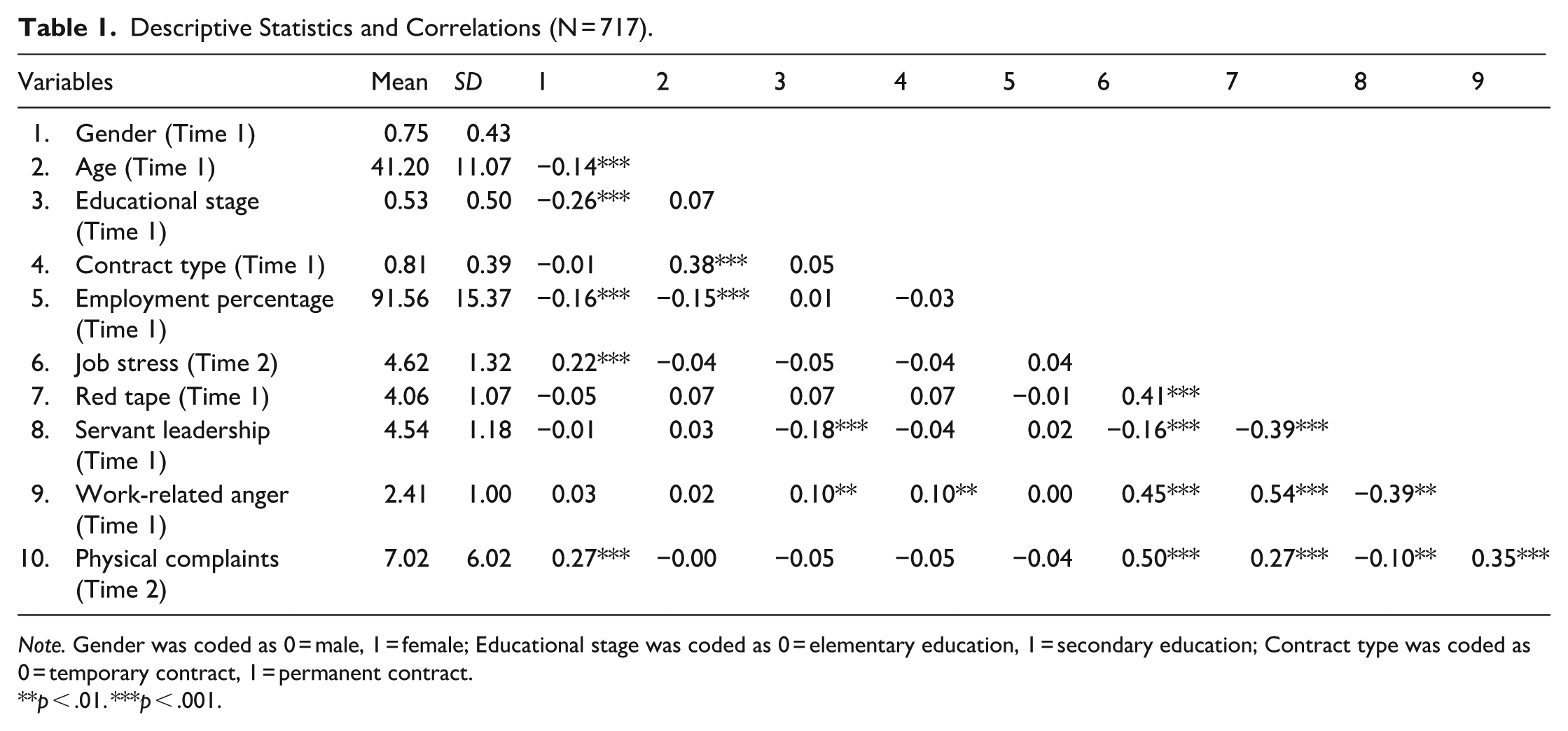
Note. Gender was coded as 0 = male, 1 = female; Educational stage was coded as 0 = elementary education, 1 = secondary education; Contract type was coded as 0 = temporary contract, 1 = permanent contract.
p < .01. ***p < .001.
Hypothesis Testing
Both the unstandardized and standardized coefficients of the structural model are reported in Table 2. The unstandardized coefficients (B) indicate the expected change in the outcome variable for a 1-unit change in the independent variable (Anderson et al., 2012). The standardized coefficients (β) express this relationship in standard deviation units, indicating the expected change in the standard deviation of the outcome variable for a one standard deviation change in the independent variable (Anderson et al., 2012). In this section, we report the standardized coefficients.
Regression Results for the Final Model.
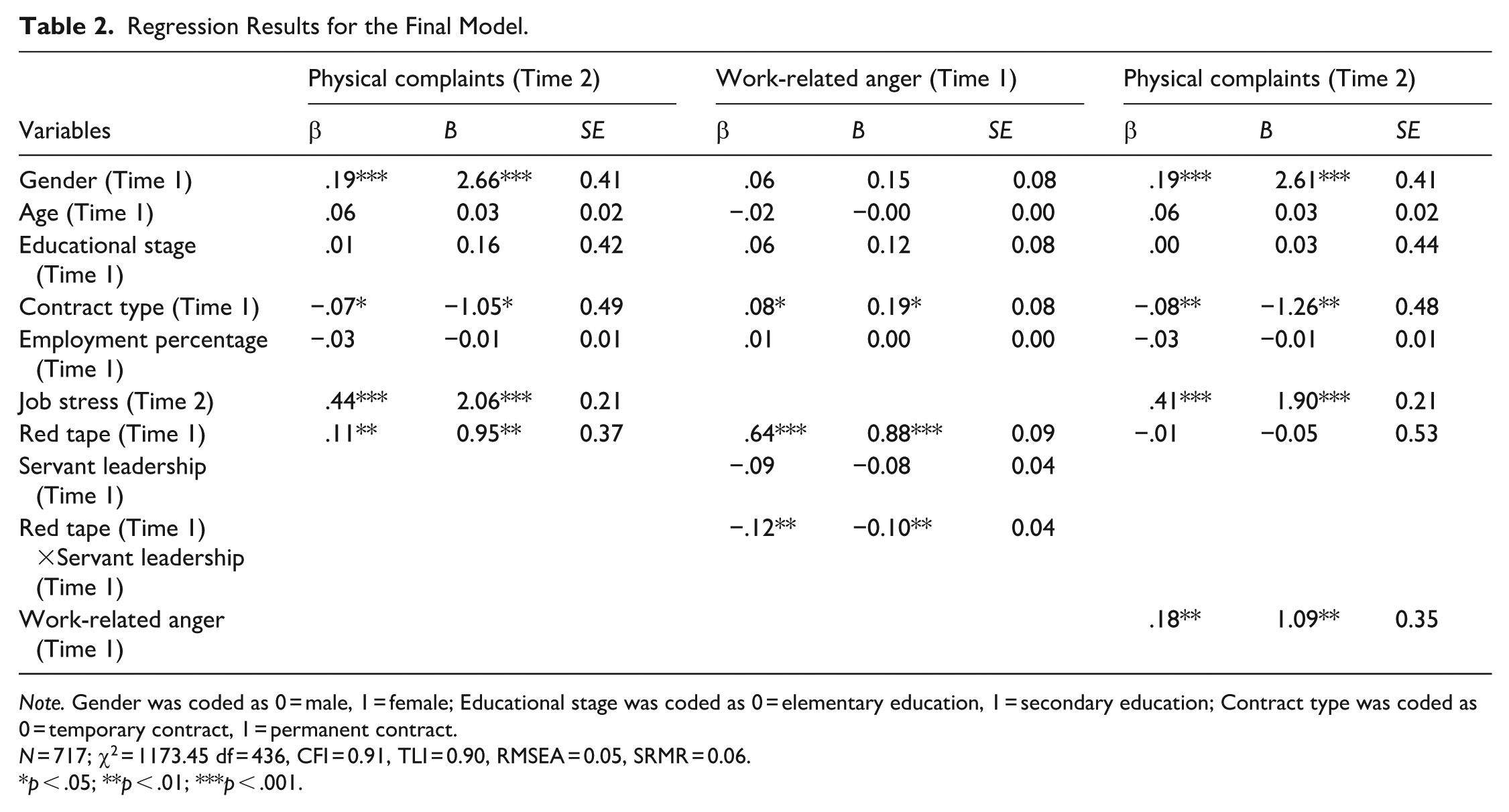
Note. Gender was coded as 0 = male, 1 = female; Educational stage was coded as 0 = elementary education, 1 = secondary education; Contract type was coded as 0 = temporary contract, 1 = permanent contract.
N = 717; χ2 = 1173.45 df = 436, CFI = 0.91, TLI = 0.90, RMSEA = 0.05, SRMR = 0.06.
p < .05; **p < .01; ***p < .001.
Female teachers report higher levels of physical complaints (β = .19, p < .001). Teachers with a permanent contract report lower levels of physical complaints (β = −.07, p < .05), but higher levels of work-related anger (β = .08, p < .05). Teachers experiencing higher stress levels report more physical complaints (β = .44, p < .001). Age, educational stage, and employment percentage are not significantly related to work-related anger and physical complaints.
Supporting Hypothesis 1, teachers’ red tape perceptions are positively associated with their physical complaints (β = .11, p < .01). This indicates that a one standard deviation increase in perceived red tape is associated with a 0.11 standard deviation increase in physical complaints. Consistent with Hypothesis 2a, red tape perceptions are also positively related to work-related anger (β = .64, p < .001). In turn, work-related anger is positively associated with physical complaints (β = .18, p < .01), endorsing Hypothesis 2b. Bootstrapping with 10,000 samples shows a significant positive indirect effect of red tape on physical complaints through work-related anger (β = .12; B = 0.96; 95% CI: 0.29, 1.64), confirming Hypothesis 2. When work-related anger is included as a mediator, the direct relationship between red tape and physical complaints becomes non-significant (β = −.01, p > .05), indicating full mediation.
Supporting Hypothesis 3, school leaders’ servant leadership behavior, as perceived by teachers, weakens the relationship between red tape perceptions and work-related anger (β = −.12, p < .01). Figure 2 visually represents this interaction, showing that the positive relationship between red tape and work-related anger is weaker among teachers who perceive their school leader as a servant leader. Finally, we tested for moderated mediation. Hypothesis 4 is confirmed, as bootstrapping with 10,000 samples reveals that the indirect effect of red tape on physical complaints via work-related anger varies depending on the level of servant leadership (β = .10; B = 0.85; 95% CI: 0.24, 1.46).
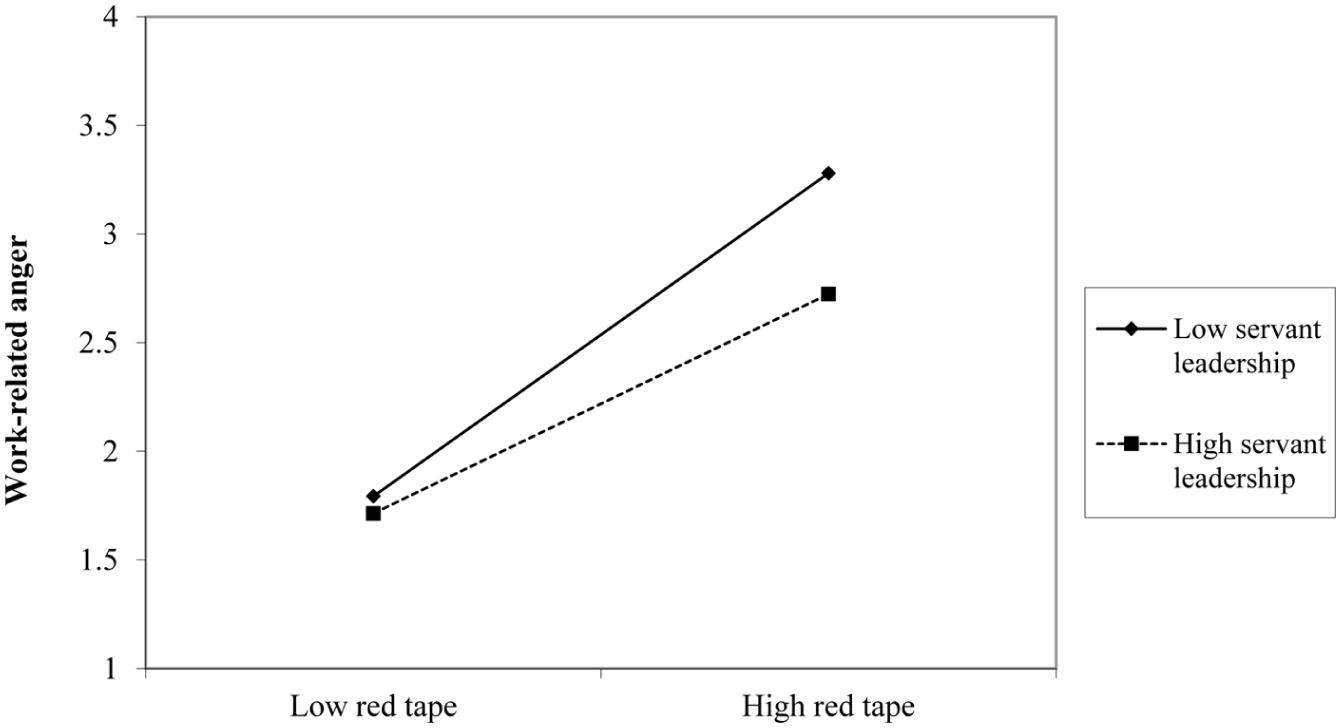
Interaction between red tape and servant leadership in predicting work-related anger.
Discussion
This article investigated the relationship between teachers’ red tape perceptions and their physical complaints. Our analysis provides empirical support for a positive relation between red tape and physical complaints. Specifically, when teachers face red tape in their jobs, they report higher levels of psychosomatic symptoms such as chest tightness, muscle pain, headaches, and upset stomachs. Our analysis further suggests that work-related anger serves as an underlying mechanism in this relationship. Teachers who encounter large amounts of red tape report that everything related to their work makes them angry (e.g., tasks assigned by their school leader make them furious). This work-related anger, in turn, is associated with higher levels of physical complaints. Additionally, we provide empirical evidence that when teachers perceive their school leader as a servant leader, their work-related anger is less affected by red tape, which indirectly benefits their physical health. For instance, when teachers believe that their school leader prioritizes teachers’ best interests over the school leader’s own interests, teachers experience lower levels of work-related anger when confronted with red tape.
As a first contribution, this study adds depth to the existing red tape literature by examining a largely overlooked consequence of red tape: its association with physical health complaints. While prior research has mainly focused on well-being indicators such as job satisfaction and work engagement (e.g., Blom et al., 2021), the link between red tape and physical health has received far less attention, with Lagios et al. (2023) being a notable exception. By focusing on physical complaints, this study provides an innovative perspective on the broader health implications of red tape. Understanding the antecedents of physical complaints is essential, as stress-related illnesses impose substantial personal, organizational, and societal costs (Nixon et al., 2011; Peltokorpi & Ramaswami, 2021; Timming et al., 2024). This urgency is particularly pronounced in the educational sector: in 2023, psychosocial disorders accounted for more than 40% of all sick-leave days among teachers in Flanders (Agency for Educational Services, 2025). Such figures illustrate how prolonged psychosocial strain translates into ill health, absenteeism, reduced job performance, and ultimately reduced educational quality (Bakker et al., 2023; Nixon et al., 2011; Timming et al., 2024). Given that physical symptoms can have severe consequences, including morbidity and mortality (Nixon et al., 2011), and considering the central role teachers’ health plays in sustaining classroom functioning and instructional quality, it is crucial to examine factors that contribute to teachers’ physical complaints. As teachers are central to high-quality education and the broader functioning of society (van Strydonck et al., 2025), protecting their health should be a key priority.
A key practical implication of our findings is that reducing red tape can help decrease teachers’ physical complaints. Since our results indicate that efforts to eliminate red tape are beneficial, we provide school leaders, policymakers, and public organizations in general with additional reasons to prioritize the red tape issue on the policy agenda. Existing rules should be critically assessed: if they are found to contribute to red tape perceptions, they should be eliminated or modified (Hussain & Franken, 2025; Li & George, 2025b; Qiang et al., 2025). However, even the most well-designed red tape reduction strategy will be ineffective if it focuses solely on the system and neglects the individual (Campbell et al., 2023; Pandey & Kingsley, 2000). This is because whether a rule is perceived as red tape is to a large extent subjective, and these perceptions matter because they shape individuals’ attitudes and behaviors (Fuenzalida et al., 2026; Pandey, 2021). Therefore, both the design and implementation of rules, as well as individuals’ perceptions of them, need to be carefully managed (Cooke et al., 2019; Pandey, 2021). In this regard, leadership plays a crucial role. For instance, Moynihan et al. (2012) show that transformational leadership can reduce perceived red tape indirectly by increasing goal clarity, strengthening political support for the organization, and improving the quality of communication. Building on this insight, clearly communicating the purpose and functionality of rules is essential (Borst et al., 2025; Campbell et al., 2023; Moynihan et al., 2012). When teachers understand the rationale behind a rule, they may no longer view it as red tape (Muylaert et al., 2025). Building on insights from the organizational development and change literature, an additional recommendation is to actively involve teachers in the design and refinement of rules and procedures (Kamarova et al., 2025; Stouten et al., 2018). Successful change does not primarily depend on rigidly following a predefined set of steps, but on understanding and supporting the psychological processes of those affected. In line with research on basic psychological needs, change efforts are more likely to succeed when teachers experience mastery (i.e., feeling competent and in control), meaning (i.e., understanding and valuing the rationale behind the procedure), and belongingness (i.e., feeling supported by colleagues and leaders). When one of these elements is lacking, new rules risk being only superficially accepted and may instead be perceived as red tape. By deliberately fostering the satisfaction of these needs, schools can increase the likelihood that teachers internalize new procedures and support them in a more sustainable and intrinsically motivated way (Kamarova et al., 2025).
As a second contribution, this article explores the underlying role of work-related anger in shaping the relationship between red tape and employee outcomes. While previous research has established that red tape perceptions are linked to negative consequences at both the employee and organizational levels, the underlying mechanisms driving these effects remain unclear (George et al., 2021; Li & George, 2025b). Despite red tape’s prominence in public administration literature, its emotional consequences have received little attention (Davis & Pandey, 2024; George et al., 2021; Hattke et al., 2020). Given the potential role of emotions in the “black box” of red tape’s impact on employees (Davis & Pandey, 2024; Hattke et al., 2020), this study identifies work-related anger as a crucial mechanism. Specifically, we demonstrate that teachers’ perceptions of red tape are positively associated with negative emotions (i.e., work-related anger), which, in turn, are related to teachers’ health outcomes (i.e., physical complaints). By highlighting the role of emotions as an underlying process, this study provides new insights into how teachers perceive and react to red tape.
The role of emotions in the workplace remains understudied, despite growing recognition that emotions provide important information about how employees perceive a situation (Hattke et al., 2020; Jaworek et al., 2020). This gap is particularly evident in the red tape literature, where empirical research on discrete emotions remains scarce (Hattke et al., 2020; Qiang et al., 2025). Responding to calls to examine how specific emotions mediate the relationship between red tape and employee outcomes, this study deepens our understanding of the affective mechanisms underlying this relationship (e.g., George et al., 2021; Hattke et al., 2020). In doing so, we also answer broader calls to unravel the psychological processes through which red tape affects individuals (Fuenzalida et al., 2026; Li & George, 2025c; Pandey, 2021). In addition, our study also contributes to the JD-R theory by providing empirical evidence that negative emotions act as a mediating mechanism linking job demands to detrimental employee outcomes, confirming the health impairment process (Bakker et al., 2023; Schaufeli & van Rhenen, 2006). These insights are particularly relevant in street-level bureaucratic contexts, where the emotional aspects of work have received limited research attention (Eshuis et al., 2023; Hsieh et al., 2019). This lack of attention is striking given that street-level bureaucrats, including teachers, perform emotionally demanding work (Eshuis et al., 2023; Hassan et al., 2026; Smith et al., 2025).
Teachers are increasingly burdened by tasks they perceive as red tape (Flemish Inspectorate of Education, 2023; Fuenzalida et al., 2026; Li & George, 2025a, 2025c). Understanding how such demands shape their emotional experiences is therefore essential. Beyond its theoretical contributions, this study offers practitioners clearer insights into how red tape produces its effects, providing a foundation for more informed recommendations and interventions (Li & George, 2025b; George et al., 2021). As our findings also show that work-related anger is associated with teachers’ physical complaints, this study underscores the need for schools to pay greater attention to teachers’ emotional experiences and to foster conditions that minimize the occurrence of negative emotions (Qiang et al., 2025).
As a third contribution, we provide evidence that school leaders’ servant leadership behavior can buffer the negative effects of teachers’ perceptions of red tape. These findings contribute to the broader discussion on leadership in the public sector. Crosby and Bryson (2018) argue that public leadership is fundamentally concerned with stewardship, ethical responsibility, and sustaining collective purpose in complex institutional environments. Accordingly, the servant leadership literature emphasizes that this approach should be understood as a distinct normative leadership approach centered on follower development, service to others, and stewardship (Eva et al., 2019; Lemoine et al., 2025). In public sector settings, servant leadership has been shown to strengthen trust, legitimacy, and public service motivation, particularly in highly bureaucratic organizations where professionals risk becoming disconnected from the broader societal purpose of their work (Miao et al., 2014; Nguyen et al., 2023; Schwarz et al., 2016). Our findings add to this logic by demonstrating that servant leadership shapes how teachers respond emotionally to red tape. Red tape can be perceived as conflicting with professional values and educational purpose. In such situations, servant leadership can help restore a sense of meaning, agency, and service to students and society, thereby buffering negative emotional reactions. Consistent with this perspective, our findings offer empirical support for the JD-R theory, which posits that job resources can alleviate the adverse consequences of hindering job demands (Bakker et al., 2023). Within this framework, we conceptualize servant leadership as a key job resource that mitigates the detrimental effects of red tape, which functions as a hindering demand.
Because schools often lack the authority to eliminate externally imposed regulations, teachers will inevitably encounter red tape (Moynihan et al., 2012; Walker & Brewer, 2009). Furthermore, removing all rules perceived as red tape is neither practical nor advisable (Scott & Pandey, 2005; Walker & Brewer, 2009), as some regulations –despite being seen as red tape– serve essential functions and cannot simply be eliminated (Cooke et al., 2019). Given this structural reality, eliminating teachers’ exposure to red tape is often not feasible, making it crucial to identify alternative ways to mitigate its negative consequences. In this regard, our study offers practitioners guidance on how they can effectively reduce the negative impact of red tape (Li & George, 2025b). Specifically, our findings demonstrate that fostering servant leadership among school leaders can function as a protective mechanism that attenuates the harmful effects of red tape. This insight is valuable because prior research has predominantly focused on documenting red tape’s detrimental consequences rather than exploring strategies to counteract them (Muylaert et al., 2022). Our results, therefore, highlight that schools –and public organizations more broadly– do have effective options to reduce the negative impact of red tape, particularly in contexts where modifying the rules themselves is not feasible.
This contribution is particularly relevant, as red tape remains a widespread challenge in public organizations around the world (Li & George, 2025c), and is especially prominent in the education sector (OECD, 2025a). Broader political and social developments, such as increasing polarization, skepticism toward science, and the rise of populist movements, further reinforce this trend (OECD, 2025b). These developments can shape how teachers understand and evaluate rules and procedures. In more polarized contexts, public debates often question the value of public institutions and professional expertise, portraying bureaucracy as inefficient or wasteful. Such narratives may heighten teachers’ skepticism toward new regulations and foster doubts about their purpose. Consequently, rules are more likely to be experienced as unnecessary or burdensome rather than professionally meaningful. Moreover, when policies strongly emphasize accountability or cost reduction, teachers may view them as instruments of control rather than as supportive measures to improve educational quality.
Since servant leadership has proven to be an important protective mechanism against the adverse effects of red tape, interventions aimed at strengthening school leaders’ servant leadership behavior could help teachers better cope with the presence of red tape. School leaders act as servant leaders when they prioritize their teachers’ best interests over their own, actively support their professional development, and foster a work environment in which teachers feel empowered to handle challenges in the way they deem most effective (Liden et al., 2015; van Dierendonck, 2011). In addition, school leaders who demonstrate servant leadership behaviors remain attentive to emerging workplace issues and create a culture of trust that enables teachers to approach them comfortably with both professional and personal concerns (Liden et al., 2015). Because these behaviors develop through ongoing, practice-based processes that strengthen leaders’ self-awareness, values, and other-orientation, early exposure to servant leadership principles –even before individuals assume managerial roles– can be beneficial, while continued development on the job remains essential (e.g., Urrila & Eva, 2024). By implementing such practices consistently, school leaders can help teachers cope more effectively with red tape in their work, making teachers’ work-related anger and physical complaints less likely to be exacerbated by the presence of red tape.
Beyond the implications for school leaders and policymakers, our findings also offer several insights for public HRM professionals. We emphasize the importance of emotions in the workplace, as work-related anger appears to function as a mechanism that links red tape to physical complaints. HR metrics could therefore place greater emphasis on monitoring negative work-related emotions. Such data could also be more systematically integrated into the organization’s well-being policies and practices. In addition, these monitoring systems may serve as preventive mechanisms by helping to identify and address issues before they develop into more severe physical complaints. The results also highlight the relevance of leadership development. Investing in servant leadership among public managers may help employees cope more effectively with red tape. In this regard, performance management systems may benefit from embedding servant leadership principles by explicitly valuing and incentivizing leadership behaviors focused on stewardship, employee development, and employee support.
Despite this article’s interesting findings, several limitations need to be addressed. Firstly, our time-lagged design does not allow for causal inferences. Although the theoretical frameworks used in this study provide a rationalization for the causal ordering of the variables in our research model (Bakker et al., 2023; Schaufeli & van Rhenen, 2006; Weiss & Cropanzano, 1996), each study variable was only measured once. Hence, the design of our study does not allow us to draw causal inferences. Therefore, it is important for future research to use a longitudinal design in which each study variable is measured at multiple time points. Such a design would allow researchers to examine changes in the variables over time and consequently draw causal conclusions about the effect of red tape on teachers’ physical complaints. Secondly, although (1) data were collected at two time points to mitigate CSB, (2) prior research indicates that interaction effects are not an artifact of CSB (George & Pandey, 2017), and (3) a meta-analysis on red tape provides empirical evidence that CSB is not a universal inflator of red tape effect sizes (George et al., 2021), the use of single-source, self-reported data means that CSB cannot be entirely eliminated. Future studies could address this limitation by employing multi-source data. Thirdly, the study focuses on teachers in Flanders, which may limit the generalizability of the findings. Replications in other organizational and geographical settings are needed to strengthen the external validity of the results. This limitation becomes especially important when considering that the teaching profession is strongly female-dominated, a characteristic it shares with other professions such as nursing. While female and male teachers did not differ in their perceptions of red tape, work-related anger, or servant leadership, female teachers did report higher levels of physical complaints. Although gender was included as a control variable in the structural model and all hypothesized relationships remained significant when controlling for gender, future research should examine whether the observed relationships generalize to less female-dominated occupations. This is particularly relevant given that the values underlying servant leadership tend to be more closely associated with feminine values and approaches to leadership, and prior research suggests that servant leadership may be more readily endorsed and effective in gendered contexts characterized by communal norms (Lemoine & Blum, 2021). Consequently, the buffering effects of servant leadership may be shaped by the gendered context of the profession. Fourthly, some measures required translation into Dutch. Although translation/back-translation procedures were used, subtle differences in meaning cannot be ruled out. Fifthly, it would be valuable for future research to include additional individual characteristics, such as pre-existing medical conditions and neurodiversity, to further disentangle the role of red tape, servant leadership, and work-related anger in teachers’ physical complaints. In addition, in line with recent calls to move beyond leadership styles and survey-based measures (e.g., Fischer et al., 2023), future research could also examine specific servant leadership behaviors (e.g., standing back, stewardship). Our study focuses on servant leadership as a theoretically meaningful leadership approach because its distinctive emphasis on stewardship, service to multiple stakeholders, and the breadth and depth of care for others differentiate it from more generic positive leadership constructs (Lemoine et al., 2025). In order to address recent critical leadership scholars who question the usefulness of studying leadership primarily through broad “styles” rather than more specific leader behaviors (Fischer et al., 2023), future research could study how specific servant leader behaviors are effective in reducing the negative effects of red tape. Focusing on specific servant leader behaviors can be relevant for offering practical guidance. Lastly, while this study focused on the effect of red tape, numerous other variables have been shown to influence teachers’ well-being. For example, studies by Nwoko et al. (2023) and Skinner et al. (2021) indicate that factors such as self-efficacy, autonomy, role conflict, and management practices also play a significant role. These factors may have affected our research model by functioning as potential mediating or moderating variables. Consequently, if some of these constructs had been included in our research model, they might have influenced the strength or significance of the relationships observed in this study.
Conclusion
This study reveals a positive association between teachers’ perceptions of red tape and their experience of work-related anger, which in turn is linked to increased physical complaints. These findings contribute to the growing body of research on the detrimental effects of red tape (Blom et al., 2021). By identifying work-related anger as an underlying mechanism, we respond to recent calls to explore the emotional pathways through which red tape influences employee outcomes (e.g., Hattke et al., 2020). This focus is particularly relevant in the teaching context, given that teaching is an emotionally demanding and draining profession (Smith et al., 2025). Despite ongoing efforts to reduce red tape, it remains pervasive in many schools and, more broadly, in public organizations, underscoring the need for strategies that can effectively mitigate its harmful effects (Li & George, 2025a, 2025b, 2025c). By examining the moderating role of school leaders’ servant leadership, we provide insight into strategies that can reduce the adverse effects of red tape. Our results indicate that when teachers view their school leader as a servant leader, the influence of red tape on their anger –and consequently on their physical complaints– is reduced. These findings suggest that interventions aimed at enhancing school leaders’ servant leadership behavior could be a valuable approach to help teachers cope with the emotional and physical toll of red tape.
Footnotes
Appendix
Acknowledgements
We would like to thank the 16 master’s students from the Faculty of Economics and Business Administration at Ghent University who, under the supervision of Adelien Decramer and Mieke Audenaert, started their master’s theses in the 2023-2024 academic year. Their support in gathering contact details of potential respondents greatly facilitated our data collection efforts. In the preparation of this manuscript, AI tools were used for language improvement.

Ethical Considerations
Ethical review and approval were not required for the study on human participants in accordance with the local legislation and institutional requirements.
Consent to Participate
The participants provided their written informed consent to participate in this study.
Funding
The authors disclosed receipt of the following financial support for the research, authorship, and/or publication of this article: This work was supported by the Special Research Fund of Ghent University under Grant BOF23/PDO/062.
Declaration of Conflicting Interests
The authors declared no potential conflicts of interest with respect to the research, authorship, and/or publication of this article.
Data Availability Statement
The data that support the findings of this study are available from the corresponding author, upon reasonable request*.