







Abstract
The effects of altitude and intersection angle on the flame spread behavior and pyrolysis front characteristics along corner walls were experimentally studied. The experiments were conducted using mock corners made of poly(methyl methacrylate) slabs with intersection angles varying from 60° to 120° at two altitudes of 29.8 and 3658.0 m. Measurements were taken for the upward and lateral flame spread rates, the flame heights, the flame heat flux to the fuel surface, and the mass loss rates of the tested slabs. An “M”-shaped pyrolysis front was observed for all the intersection angles examined at both altitudes. The upward flame spread rate increases with decreasing intersection angles while no obvious trend was found for lateral spread rate when the intersection angle is varied. The high altitude leads to a spread rate about half of that at the lower altitude both for upward and lateral spread irrespective of the intersection angle. The measured mass loss rates are significantly higher than twice of that over a flat vertical slab.
Introduction
It is quite frequent that the flames spread along combustible corner walls in building fires. In such a case, the radiation heat feedback is intensified and the air entrainment is severely inhibited by the adjacent walls, thus the flame spread behavior is expected to be different from that over a flat vertical slab.1,2 Williamson et al. 3 reported a complex “T” pattern as the characteristic flame shape in a room corner fire where the walls and/or the ceiling are combustible. Qian et al. 4 studied the flame spread behavior along poly(methyl methacrylate) (PMMA) corner walls and found that the pyrolysis front was always “M” shaped. To take into account of the different modes of flame spread encountered in a corner fire, Quintiere 5 proposed a prediction model in which the concurrent-flow upward flame spread and the opposed-flow lateral and downward flame spread were separately treated. Shih and Wu 6 studied the upward flame spread over thin cellulosic papers with different geometric arrangements including the corner configuration. Their results demonstrated the importance of the flame interactions on the spread rate.
A corner configuration would lead to a more rapid flame spread rate than that over a flat vertical slab due to the extra radiation heat feedback and the reduced air entrainment. 7 However, compared to flame spread over a flat fuel surface, little work has been conducted on the flame spread behavior along corner walls. Previous researches have mostly focused on the fire growth prediction,5,8–10 the thermal conditions characterization, 11 and so on, other than the intrinsic flame spread characteristics. Moreover, no work has been made on the corner fire spread at high altitudes, where the ambient pressure and the oxygen concentration are relatively low. The purpose of this research is to investigate the effects of intersection angle and altitude on the flame spread behavior along combustible corner walls. A set of experiments were conducted along PMMA-made corner walls with intersection angles varying from 60° to 120° in Hefei (with an altitude of 29.8 m) and Lhasa (with an altitude of 3658.0 m). The data obtained will also serve a wider scope of research on developing a prediction model of corner fire growth as an experimental basis.
Experiments
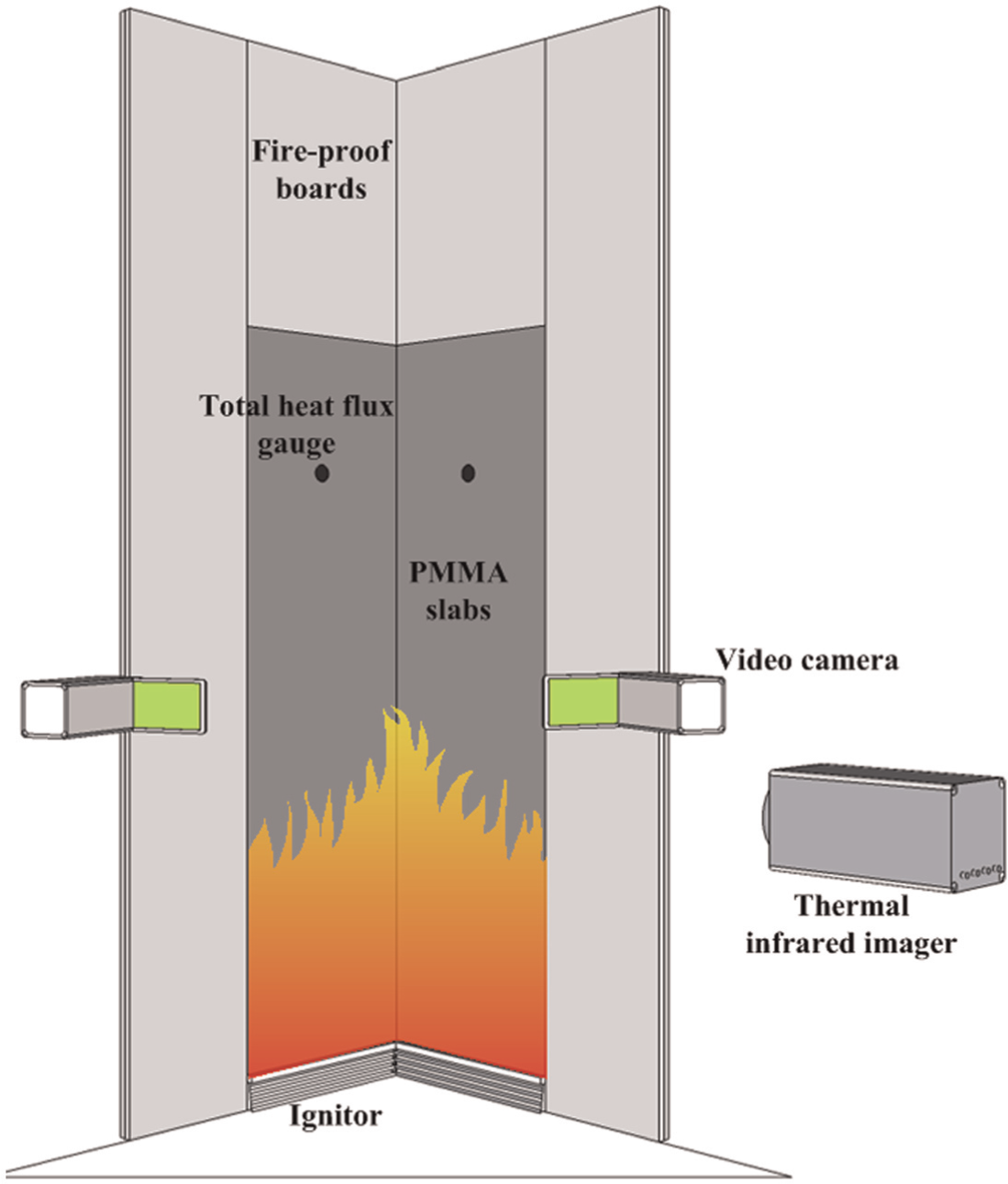
The experimental configuration is shown in Figure 1. Two PMMA slabs, which are 105 cm long, 30 cm wide and 1 cm thick, were used in the experiments. The PMMA slabs were insulated by 1-cm-thick fire-proof boards at the back surface and all four sides. Before fixed to the fire-proof boards, the tested slabs were wrapped in a single layer of aluminum foil, with the front surface exposed. The tested slabs and the fire-proof boards were set upright on an adjustable steel frame by which the intersection angle of the two slabs can be varied.
The experimental configuration.
A thermal infrared imager, placed in front of the test slabs, was used to record the slab surface temperature. The thermal infrared imaging technique has successfully been used to study flame spread over PMMA flat and color board corner walls by Arakawa et al. 12 The thermal infrared imager used in our experiments has a temperature measurement range of −20°C to 500°C and a working wavelength range of 8–14 µm. Two video cameras were used to record the flame spread process. Two water-cooled total heat flux gauges were used to measure the flame heat flux to the fuel surfaces. An electronic balance, placed underneath the test slabs, was used to measure the mass loss history during the experiments.
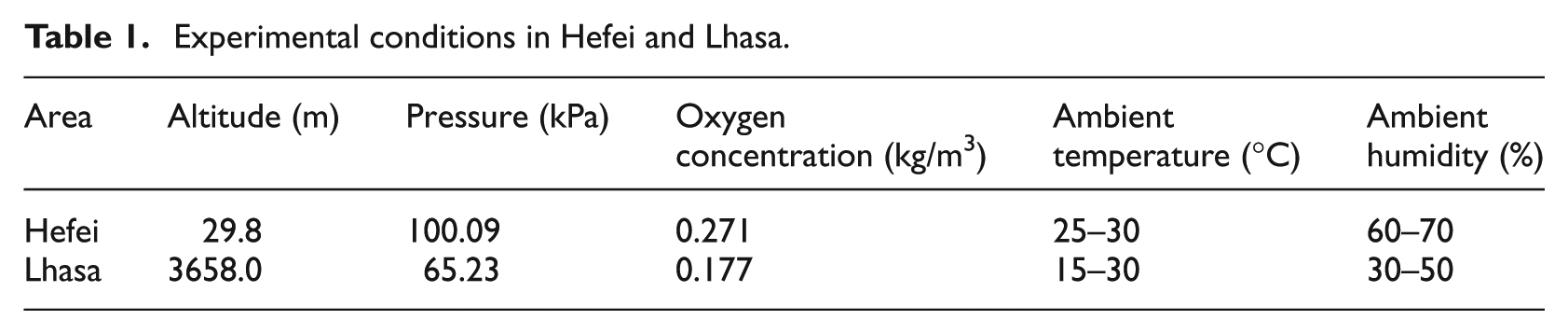
The tested slabs were ignited at the bottom using two streams of twisted cotton ropes with a length of 30 cm and a diameter of 1 cm. The cotton ropes were soaked in ethanol and each was placed in a 30 cm long × 1 cm wide × 1 cm deep steel tray. After the establishment of self-sustained flame, the steel trays were moved away. The experiments were conducted in buildings with large windless spaces both in Hefei and Lhasa to avoid the influence of potential ambient flow. The experimental conditions in the two areas are shown in Table 1. Five intersection angles were tested, that is, 60°, 75°, 90°, 105°, and 120°, at both altitudes. At least two tests were conducted for each intersection angle for the repeatability of the experiments.
Experimental conditions in Hefei and Lhasa.
The pyrolysis front location at a certain instant was determined according to the temporal surface temperature field recorded by the thermal infrared imager. The correspondence between the points on the thermal image and those on the real plane was calculated by a direct linear transformation (DLT) algorithm.13,14 The pyrolysis front position was determined using a temporal isotherm of 350°C. The flame heights were determined by calibrating the images recorded by the two video cameras with a reference scale. The mass loss rate of the tested slabs was calculated using the mass loss data recorded by the electronic balance.
Results and discussion
Observation
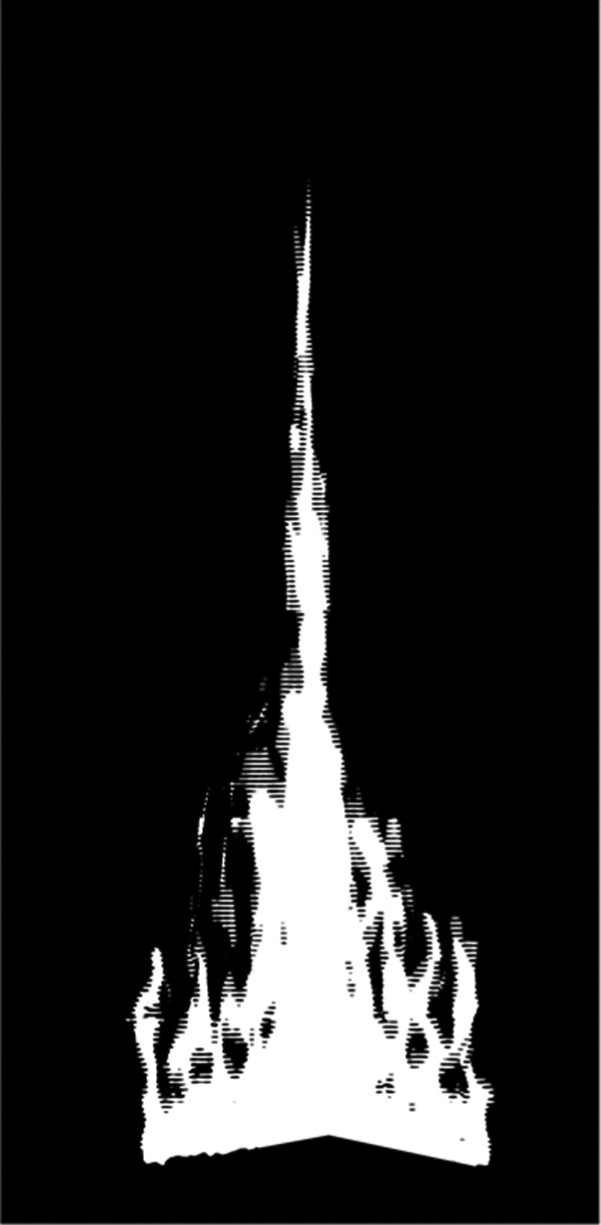
Figure 2 shows the binary image of the flame at 200 s after ignition on a 90° corner wall in Hefei. It can be seen that the flame height at the center region is much higher than that near the outer edge, which is caused by the increasing inhibition severity of air entrainment from the outer edge to the corner center. In other words, the combustible gas needs to rise significantly higher to entrain enough air to burn completely at the center. It took only about 210 s for the flame along the corner to reach the top of the fire-proof boards in Hefei, whereas at the outer edge, a time of 390 s was required when the intersection angle is 90°. This indicates that the flame can reach the ceiling within a very short time during a corner fire given that the wall materials are combustible. In case the ceiling material is also combustible, it would quickly be ignited, leading to a very dangerous situation in the fire room.
Binary image of the flame at 200 s after ignition on a 90° corner wall in Hefei.
Qian et al.
4
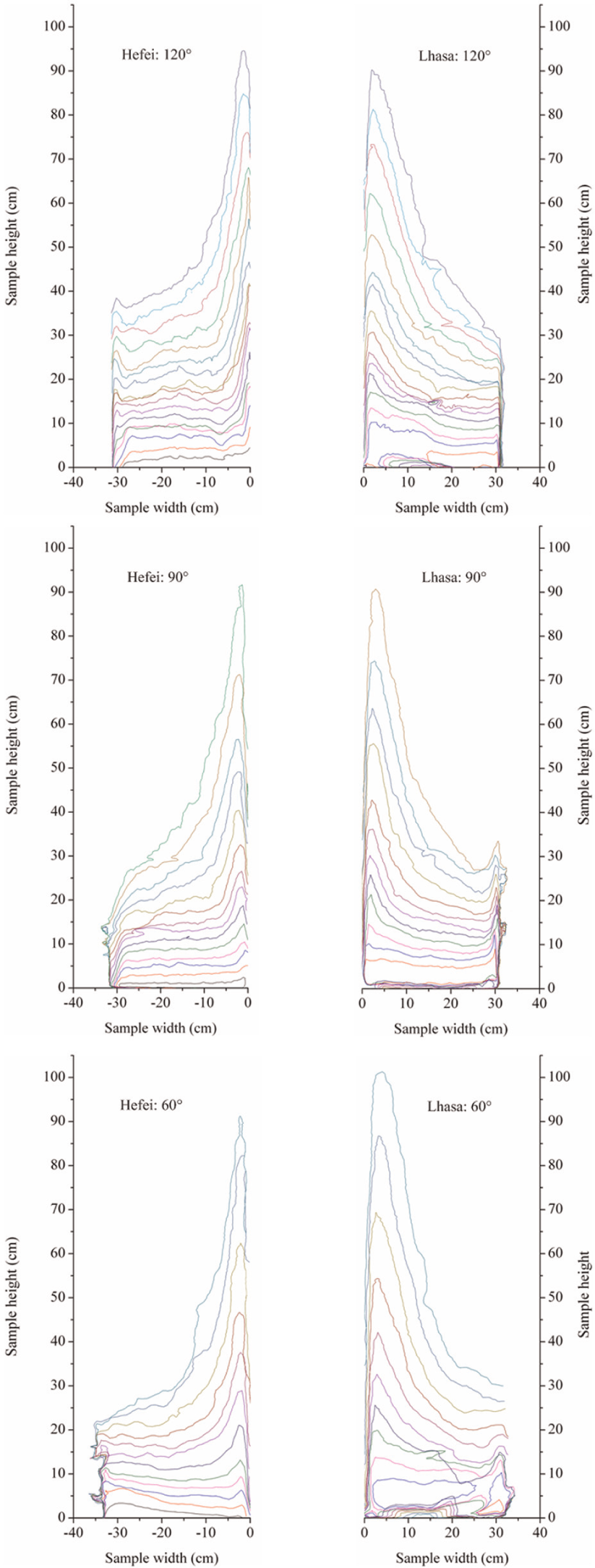
studied the flame spread behavior along PMMA vertical walls and found that the pyrolysis front was always “M” shaped. They observed that in fact there was no flame spread at the corner center and the maximum spread was at a position a few centimeters away from the centerline. A series of experiments were designed to investigate the possible mechanisms, and it was attributed to the flame displacement effect caused by a poor mixing of the pyrolysis products and the air at the corner center. A similar phenomenon was also observed in current experiments, that is, the pyrolysis front at the corner centerline and the corner outer-edge lags behind the maximum spread point, therefore the pyrolysis front on the two slabs forms an “M”-like front shape. In a 90° corner in Hefei, the maximum upward spread was at
Advancing of the pyrolysis front for different intersection angles with a time interval of 15 s in Hefei and 30 s in Lhasa between the adjacent fronts.
Examining the pyrolysis front shape for different intersection angles in Hefei and Lhasa, it can be seen that with decreasing intersection angles, the “M” shape becomes more evident, that is, the lag of the pyrolysis front at the corner centerline than at the maximum upward spread position becomes more serious. Moreover, for the same intersection angle, the “M” shape is more evident in Lhasa than in Hefei. These indicate that the cause of the “M”-shaped pyrolysis front is an insufficient supply of oxygen at the corner center. With decreasing intersection angles, it becomes more difficult for the oxygen to reach the center region of the corner due to the enhanced air entrainment inhibition. In Lhasa, the oxygen concentration is lower and the turbulence intensity is likely to decrease due to the reduction of buoyancy force caused by the low ambient pressure, which would lead to a less efficient mixing process of the pyrolysis products and the air.
Upward and lateral flame spread rates
The flame would spread both upwardly and horizontally in a corner fire. For the upward spread, the flame spreads in the same direction with the fire induced flow, whereas in the horizontal case, the flame spreads oppositely with the fire induced flow. Figure 4 shows the pyrolysis length varying with time for different intersection angles in Hefei and Lhasa. The pyrolysis lengths for flame spread over a flat vertical PMMA slab 15 are also included in this figure. It should be noted that a flat vertical wall can be regarded as “a special corner” with an intersection angle of 180°. It can be seen that the upward flame spread rate increases with decreasing intersection angles at both altitudes, and that the spread rates in the corner fire tests are significantly greater than those over a flat vertical slab. One reason leading to this result is that the flame tends to rise higher in corners with smaller intersection angles due to the enhanced air entrainment inhibition (refer to the “Flame height” section). Another reason is that the flame heat flux to the fuel surface increases with decreasing intersection angles and that the radiant heat feedback is greatly intensified in the “corner” case compared with the flat slab fire (refer to the “Flame heat flux to the fuel surface” section, Table 2). Figure 5 shows the upward flame spread rates as a function of the pyrolysis length for different intersection angles in Hefei and Lhasa. It is shown that the flame spread rates in Lhasa at the same pyrolysis length are about half of those in Hefei for all the intersection angles examined.
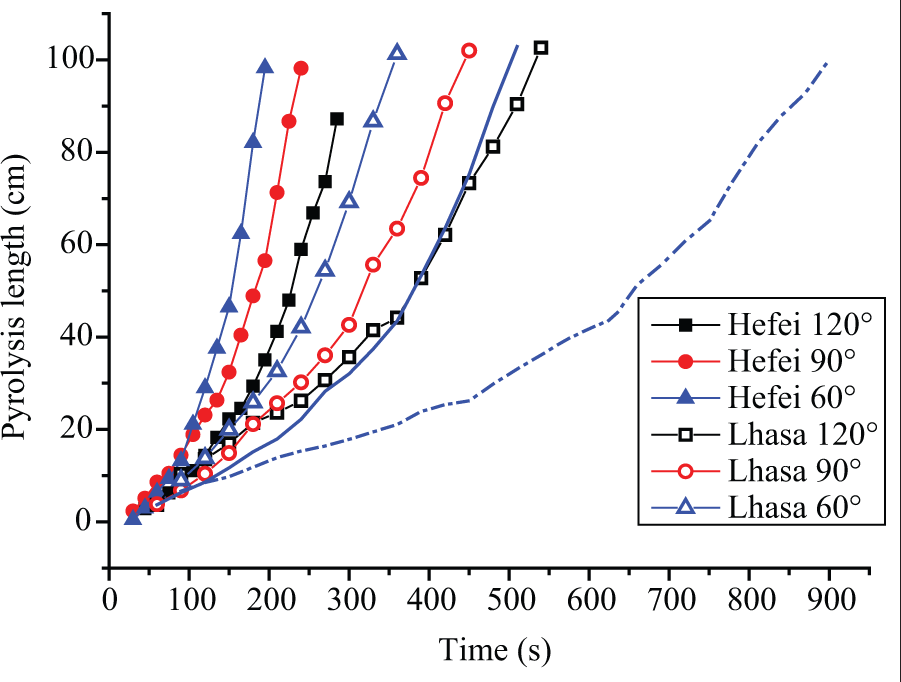
Pyrolysis length variation with time for different intersection angles; the solid and the dash–dot lines denote the pyrolysis lengths for flame spread over a flat vertical slab in Hefei and Lhasa, respectively.
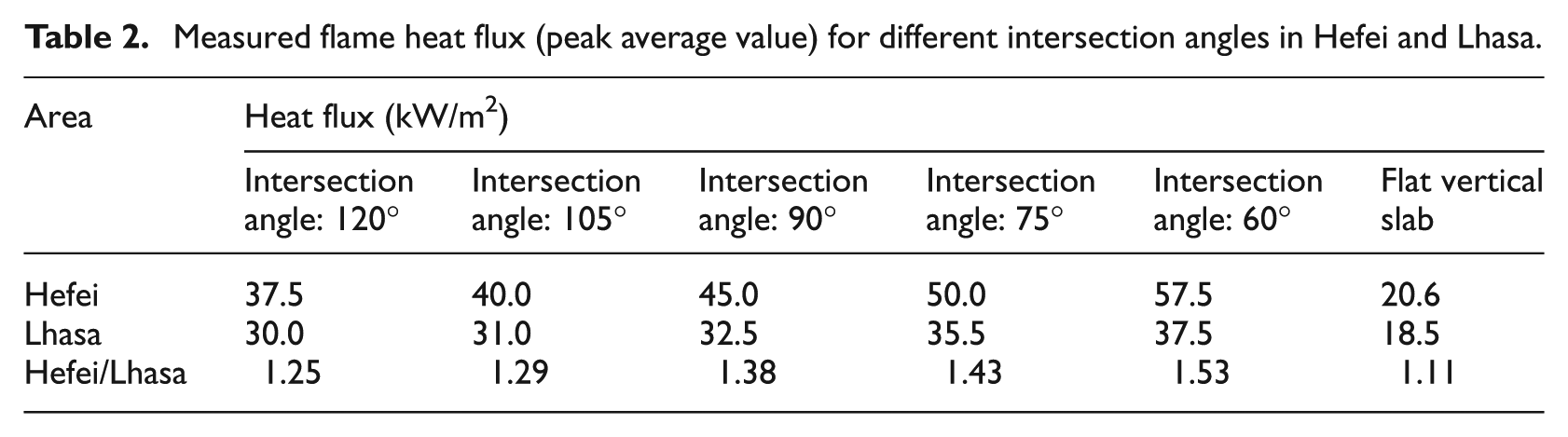
Measured flame heat flux (peak average value) for different intersection angles in Hefei and Lhasa.
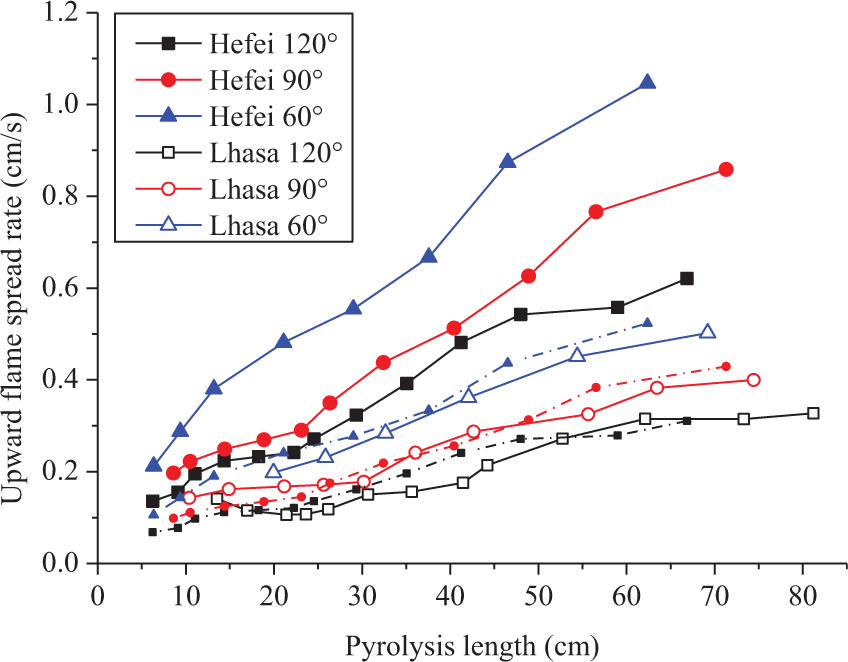
Upward flame spread rates for different intersection angles; the dash–dot lines denote half of the flame spread rates in Hefei.
The horizontal flame spread rate was determined according to the lateral movement of the pyrolysis front from the centerline to the outer edge after its tip has reached the top of the PMMA slab. It was found that the flame spreads nearly steadily in the horizontal direction. Figure 6 shows the average horizontal flame spread rates for different intersection angles in Hefei and Lhasa. No obvious trend was observed with varying intersection angles. This is reasonable as the velocity of the fire induced horizontal flow increases as the intersection angle decreases, which would lead to a decreasing opposed-flow horizontal flame spread rate.16,17
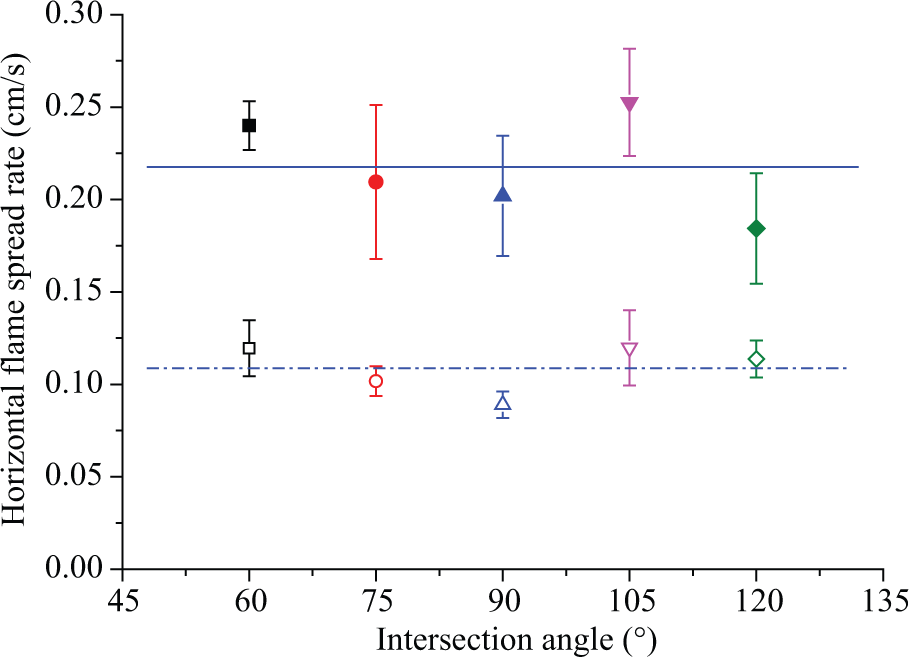
Horizontal flame spread rates for different intersection angles in Hefei (solid symbols) and Lhasa (open symbols); the solid and dash–dot lines mark the average values in Hefei and Lhasa, respectively.
It is interesting to note that the flame spread rates in Lhasa are all about half of those in Hefei, irrespective of the spread mode (concurrent-flow or opposed-flow) and the intersection angle (see Figures 5 and 6). It seems that the ratio of the flame spread rates in the two areas is nearly a constant no matter what spread direction is concerned. McAlevy and Magee
18
investigated the flame spread behavior over a variety of solid fuels in O2/inert environments with the ambient pressure ranging from 27.58 and 2861.34 kPa. They found that the flame spread velocity
Flame height
Figure 7 shows the flame height variation against pyrolysis length for different intersection angles in Hefei and Lhasa. Figure 8 shows the flame height as a function of the heat release rate. The heat release rate was calculated assuming an effective heat of combustion of 24.2 MJ/kg for PMMA,
19
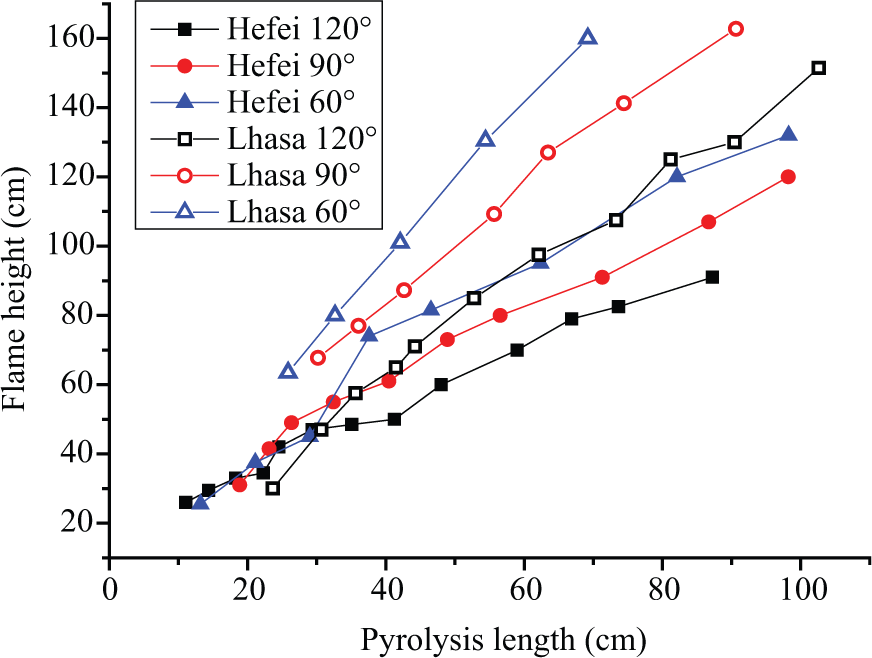
Flame height variation against pyrolysis length for different intersection angles.
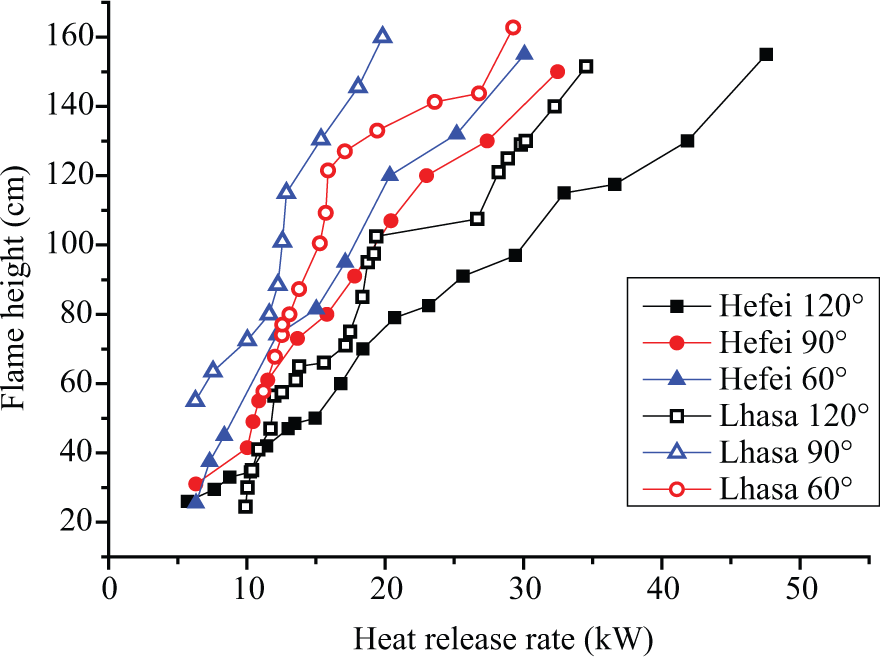
Flame height variation against heat release rate for different intersection angles.
Flame heat flux to the fuel surface
Table 2 lists the measured flame heat fluxes to the fuel surface (peak average value) for different intersection angles in Hefei and Lhasa. The measured flame heat fluxes in the flame spread experiments over the flat vertical slabs 15 are also included in this table for comparison. It can be seen that the flame heat fluxes in the corner fire tests are much higher than the ones in flat slab tests, which indicates that the radiant heat feedback is greatly intensified in corner fires. This would lead to faster flame spread rates and higher local burning rates in the burning region. With decreasing intersection angles from 120° to 60°, the flame heat flux increases from 30 to 37.5 kW/m2 in Lhasa, while it increases from 37.5 to 57.5 kW/m2 in Hefei. The flame heat fluxes are significantly lower in Lhasa than those in Hefei, which justifies the slower flame spread behavior in Lhasa.
Mass loss rate
Figure 9(a) and (b) shows the mass loss rates for different intersection angles in Hefei and Lhasa. The mass loss rates of a flat vertical slab 15 multiplied by two are also included in the figures. It can be seen that the mass loss rate increases with decreasing intersection angles in both areas. This is easy to understand since, as previously shown, the flame spreads more rapidly for smaller intersection angles, resulting in a larger burning area, and the flame heat flux to the fuel surface is higher, leading to a greater mass loss rate per unit burning area. Figure 9 also shows that the mass loss rates in the corner fire tests are much greater than twice of the ones for flame spread over a flat vertical slab. This demonstrates that a corner fire is a more hazardous scenario than a flat wall fire.
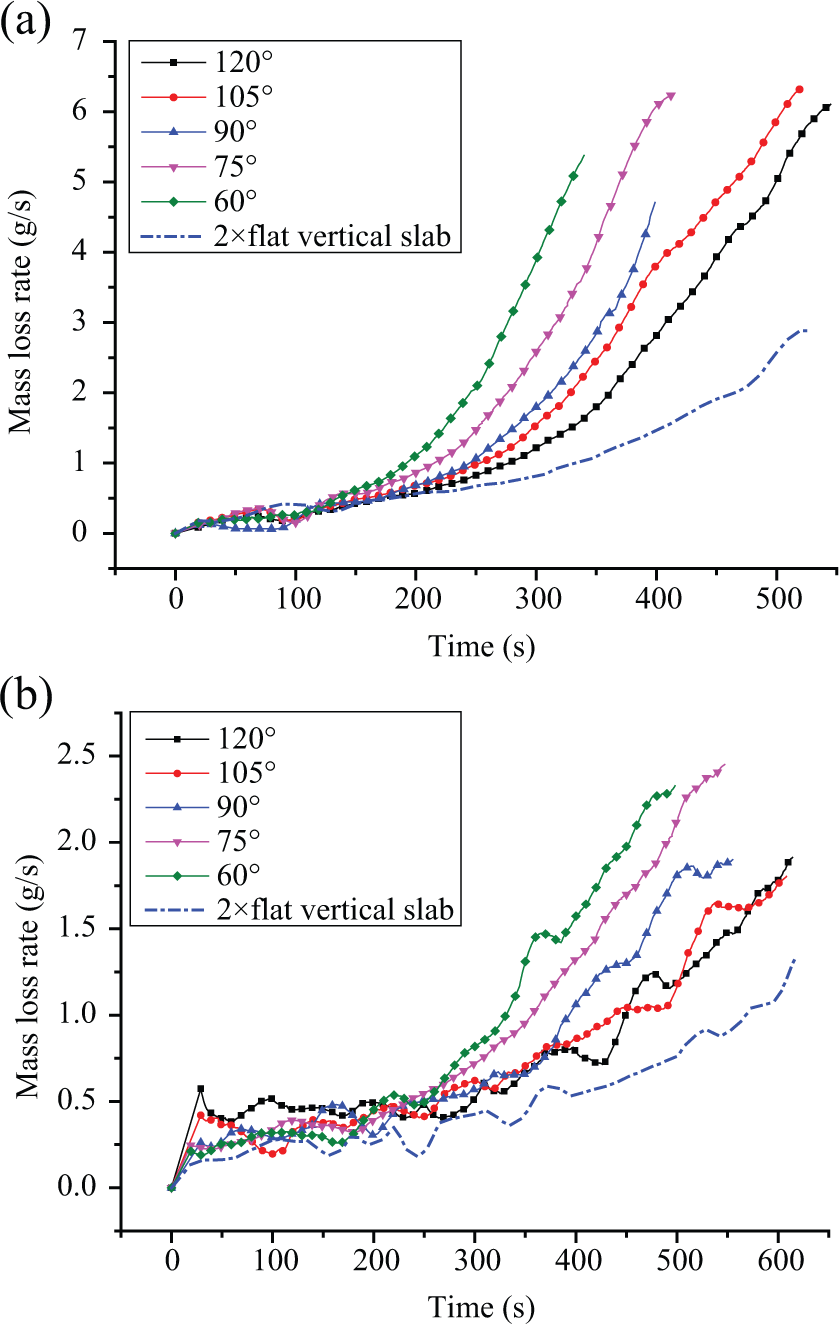
Mass loss rates of the tested samples for different intersection angles in (a) Hefei and (b) Lhasa.
Figure 10 shows the comparison of the mass loss rates for different intersection angles in Hefei and Lhasa. It can be seen that the mass loss rate is much smaller in Lhasa than that in Hefei for the same intersection angle. This is because of the slower spread rate and lower flame heat flux to the fuel surface at the higher altitude.
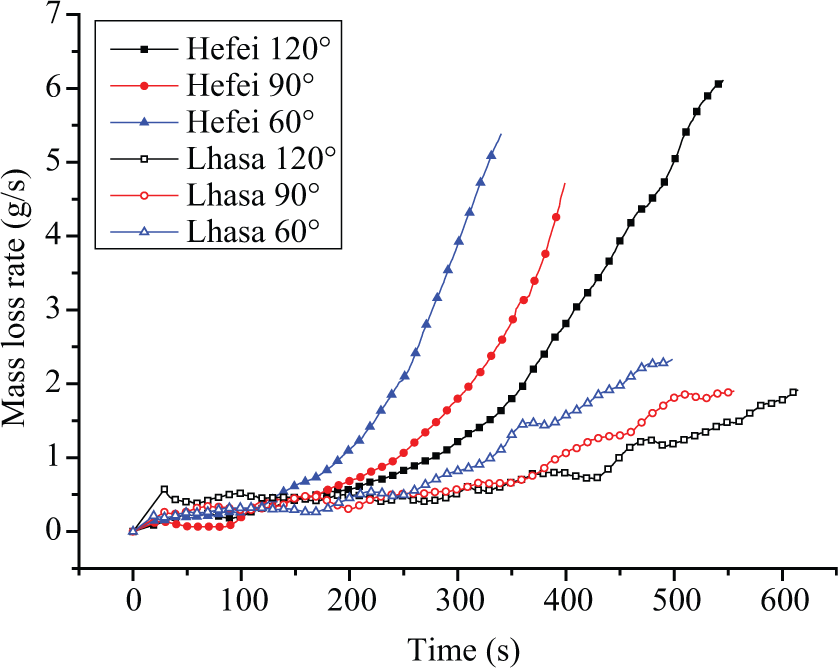
Comparison of mass loss rates for different intersection angles in Hefei and Lhasa.
Summary and conclusion
A set of flame spread experiments were conducted on PMMA-made corner walls with uncovered ceiling at two altitudes. The intersection angles were varied from 60° to 120°. It was found that
The flame height at the center of the corner is significantly greater than that near the outer edge of the corner. The pyrolysis front presents an “M”-like shape at all the intersection angles, which indicates that the maximum upward spread actually occurred at positions a few centimeters away from centerline of the corner. Moreover, the cause of the “M”-shaped pyrolysis front has been attributed to the insufficient supply of oxygen at the corner center.
The flame height, the upward flame spread rate, and the burning rate increase as the intersection angle decreases due to the air entrainment inhibition and radiant heat feedback intensification in the corner fires. The flame spreads nearly steadily in the lateral direction and no obvious trend was found for the lateral spread rates varying with the intersection angles.
The upward and lateral flame spread rates in Lhasa are about half of those in Hefei, irrespective of the intersection angle. The slower flame spread rate in Lhasa is caused by the lower flame heat flux to the fuel surface.
Footnotes
Declaration of conflicting interests
The authors declare that there is no conflict of interest.
Funding
This research was supported by National Natural Science Foundation of China (No. 51036007).