







Abstract
In using thin fire blankets to protect structures in wildfires, heat rejections by radiation (reflection and emission) are essential for good performance. By varying the radiative properties of the front and back surfaces of the blankets, this article offers an optimization study of several scenarios of incident heat flux including pure convection, pure radiation, and combinations of the two. Two types of blanket heat-blocking efficiencies are studied in the optimization scheme. An overall efficiency is defined as the amount of incident heat blocked to the total amount of incident heat in specified wildfire scenarios. An instantaneous heat-blocking efficiency is defined as the instantaneous heat flux blocked to the instantaneous incident total heat flux which provides good understanding of the physics of heat-blocking mechanisms of fire blanket under quasi-steady conditions. In addition to maximizing these heat-blocking efficiencies, there are other optimization objectives, including the minimization of the blanket backside temperature. A genetic algorithm is used for the multi-objective optimization schemes. For the transient heat incidence, the optimization for the entire time sequence is performed with the possibility of a change of blanket radiative properties during the fire sequence, accounting for changes to the fire-facing surface caused by the incident heat.
Keywords
Introduction
There is an interest in developing fire blankets to be used for the protection of structures from exterior fires, particularly in wildland/urban interface areas. This idea has been around at least since 1942, when Paul Wagner filed a patent for a “Conflagration Retardative Curtain.” 1 Wagner claimed the invention of a curtain to be draped over the roof and sides of a building near a fire. However, Wagner set the precedent for all future-related patents by noting that “no particular incombustible materials are claimed as part of this invention.” Since then, a series of other patents have been filed claiming the invention of various systems which protect a structure from an approaching fire with a fire resistant blanket or curtain.2–6 None of those inventors, however, has investigated the scientific details of how the fire blanket works. The responses of different materials have not been studied; even how to evaluate and to rate the effectiveness of the blankets has not been clearly defined.
Fire blankets for building structure protection(e.g. for a house) should be thin and light to be easily deployable and also be economical. Thin blankets, however, may not be effective as a heat conduction barrier since their small thermal inertia means that they achieve equilibrium conditions quickly. As discussed in previous works,7,8 a typical high-temperature resistant fabric material (aramid/fiberglass) with a thickness of 1 mm, for example, has a transient heat-up time of approximately 10 s. A house may need to be protected from a passing wildfire for tens of minutes including several minutes of intense heat flux. Because the blanket heat-up time is much shorter than the time scale of the incident heat input, the blanket thermal response can be approximately as a series of quasi-steady states, each with different incident heat flux level and type. In quasi-steady states, a fire blanket needs to reject heat by radiation. This is fundamentally different from the operation of thick fireman’s clothing where the useful period is mainly in the transient heat-up stage during which low heat conduction and large thermal inertia are the main heat-blocking mechanisms. 9
Laboratory testing of the quasi-steady performance of fabric samples for fire blankets has been carried out in a recent project supported by the Federal Emergency Management Agency (FEMA) within the US Department of Homeland Security.8,10–13 More than 50 single/double layered fabrics from four fiber material groups: aramid, fiberglass, amorphous silica, and pre-oxidized carbon were examined. Both a convective source (Meker burner, heat flux ∼83 kW/m2) and a radiative source (radiant cone, heat flux 21–83 kW/m2) were used. Some of the testing samples also had aluminum layers attached to the front and/or the back surfaces. This represents one practical way to vary the blanket radiative properties. Measured data typically include the heat-blocking efficiency (to be defined later) and the front and back temperatures of the blankets. In addition to the laboratory works, the field tests in prescribed burns were also conducted both in California and New Jersey.13–15
Modeling of the heat transfer processes in thin blankets under high incident heat flux was carried out in previous works.7,9 In addition to heat conduction, this one-dimensional model in Hsu et al. 7 includes a detailed radiation treatment by solving the radiation transfer equation that contains in-depth absorption, emission, and scattering. The computed results at the quasi-steady limit compared reasonably well with experimental data of fiberglass fabrics with two thicknesses and with different surface-layered aluminum treatment. This model is much more complicated than a previous model 9 for a thin blanket that has in-depth absorption but without emission, which is better suited for low-temperature applications. However, the model in Hsu et al. 7 assumes a gray participating media which is easier to solve than a spectrally resolved model developed previously for thermal insulation applications.16–18
Both the experimental and modeling studies point out the trend toward high heat-blocking efficiency: a high surface reflectivity for radiative heat incidence and a high surface emissivity for convective heat incidence. However, most incident heat from wildfires consists of a combination of radiation and convection. The conflicting requirements on radiative properties from the two heat transfer modes point out to the need for optimization. In addition to heat-blocking efficiency, the backside temperature is a quantity that may affect the ignition potential of the protected structure, so that it should be minimized. In many cases, properties which produce high-blocking efficiency and do not produce low back surface temperature, and vice versa. Thus, this becomes a multi (two)-objective optimization problem. 19 In multi-objective optimization, non-dominated solutions are sought, that is, a Pareto front. For the present two objectives (i.e. maximize heat block efficiency and minimize backside temperature), the non-dominated solutions are those where none of the solutions along the Pareto front are better than the other for both objectives. 19
Heat transfer model
Although a detailed heat transfer model for fire blanket has been formulated and solved in Hsu et al., 7 it needs quite a few radiative parameters that are not generally available for most materials. Consequently, for this optimization study, a simplified heat transfer model is adopted. This model contains the correct physics and also has been shown to be approximately correct quantitatively. 20 Details of the model are given below.
Model assumptions
The following assumptions are made as follows:
One-dimensional quasi-steady heat conduction within the blanket.
An average constant heat conduction coefficient.
Radiation interacts with the blanket only at the surfaces. There is no in-depth absorption, emission, and transmission.
Surface radiation is gray. Kirchhoff’s Law is valid.
Because the blanket has zero transmissivity, all incident thermal radiation is either reflected or absorbed. Kirchhoff’s Law states that the emissivity and absorptivity of a surface are equal. This, combined with the zero transmissivity assumption, meant that reflectivity (ρ) is one minus emissivity(ε). The surface absorptivity and reflectivity could then be expressed in terms of emissivity only in all relevant equations. Finally, it was assumed that the front and back surface emissivities could be controlled independently by adding surface coatings or thin layers to the blanket.
Model formulation
Figure 1 shows the setup for the heat transfer model. The incident heat is described as a quantity of incoming radiative and convective heat flux. A portion of the radiative flux is reflected, and the rest of the heat is absorbed at the front surface. Of the absorbed heat, some is emitted off of the front surface, and some is conducted through to the back surface. From the back surface, heat is transmitted to the structure either by convection or radiation. Already, it is seen that heat can be blocked from transmission to the structure by the reflection of incident radiant heat, or the re-emission of absorbed heat to the ambient.
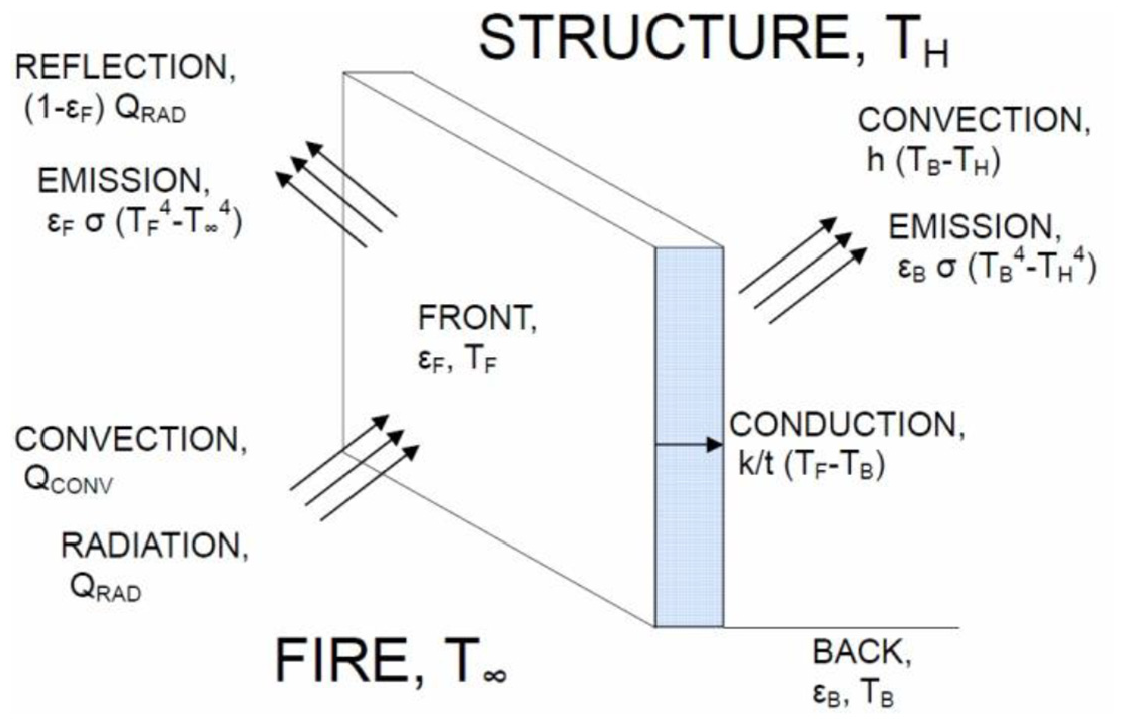
Setup for modeling heat transfer through a thin fire blanket with thickness t.
When the first law of thermodynamics is applied to a small control volume which contains the front surface but terminates in the interior of the blanket, the following equation is obtained

Since the transmissivity of the material was assumed to be zero and Kirchhoff’s Law was assumed to be valid

When this is substituted into equation (1), the following is obtained

Doing the same for a control volume which extends from the interior of the blanket beyond the back surface, the following equation is obtained

Equations (3) and (4) are the two governing equations for this one-dimensional quasi-steady-state model of heat transfer through a fire blanket. These two equations can be solved iteratively for the front surface temperature, TF, and the back surface temperature, TB. With these two temperatures determined, all quantities relating to the system can be found.
Heat-blocking efficiencies
The heat-blocking efficiency is a value which quantifies the effectiveness of a fire blanket. The quasi-steady or instantaneous heat-blocking efficiency is defined as the ratio of incident heat flux blocked from reaching the structure to the total amount of incident heat flux.7,8 This can be expressed as

Using the values relevant to the heat transfer model being used in this study, this heat-blocking efficiency may be expressed in several ways




Equation (6d) provides a clear physical interpretation of the quasi-steady (instantaneous) heat-blocking efficiency, as it shows explicitly the two modes of blocking heat in the numerator: reflection of radiation (first term) and re-emission of absorbed heat (second term).
For a time varying incident heat input such as in a wildfire, an overall or total heat-blocking efficiency is defined as total heat blocked to the total heat incident to the blanket over the entire fire exposure duration

where τi and τf are the times for initiating the heat input and the end of heat input, respectively. If the variation of the incident feat flux is slow comparing to the blanket thermal response time (the normal situation), then the time integration can be approximated by the summation of a succession of quasi-steady states as shown in the last term in equation (7).
Optimization scheme
Parameters varied
The requirements that the fire blanket material be lightweight, thin, and resistant to high-temperature and large-temperature gradients limit the choice of materials. For this reason, the thermal conductivity and the thickness of the material were left as input parameters to be determined by the availability of usable materials. The convective coefficient at the back surface of the fire blanket is entirely dependent upon the geometry of the space between the fire blanket and the structure and upon the temperature of the structure, and it was therefore left as an input parameter. This left the front and back surface emissivities as the two variables to be optimized, given the incident heat conditions, ambient temperature, and the temperature of the structure. Sensitivity of the optimized results to thermal conductivity and convective coefficient has been performed in Brent. 20
Two optimization studies were conducted. The first study optimized the front and back surface emissivities of a fire blanket exposed to quasi-steady incident heat conditions with two objective functions: high instantaneous heat-blocking efficiency and low back surface temperature. The second study optimized the overall heat-blocking efficiency and the peak back surface temperature with a time variant sequence of incident heat conditions.
In the second optimization study, two additional variables were added. It was considered that, once the front surface temperature exceeds some value, the front surface emissivity would change. The two additional variables were the front surface emissivity after that change and the front surface temperature which must be exceeded for that change to occur. This was done in response to the experimental observation that, when exposed to high fluxes of incident heat, aluminized coatings which are frequently applied to these fire blankets melt or otherwise fall away, leaving a darkened front surface with a different emissivity.7,10–13
Optimization algorithm
In order to find a population of non-dominated solutions, a Multi-Objective Genetic Algorithm (MOGA) was used. MOGAs are specific examples of evolutionary algorithms for optimization. Evolutionary algorithms generally share the same sequence of operations, which is depicted in Figure 2. First, a random population of potential solutions is initialized. Each member of this population is evaluated based on some fitness function. The fitness assigned to each member of the population is the input for the selection operator, which favors solutions with a high fitness and discourages weaker solutions from being passed onto the next generation. The crossover operator then takes the selected members of the population and switches some sets of their properties between pairs of them. This is an attempt to mimic biological reproduction, in which sections of genetic code between two “parents” are interchanged to produce “children.” After crossover, each member of the population is subjected to random mutation. At this point, the entire population is judged to be optimized or not, often by the number of iterations, and the process is repeated until the population satisfies this test.
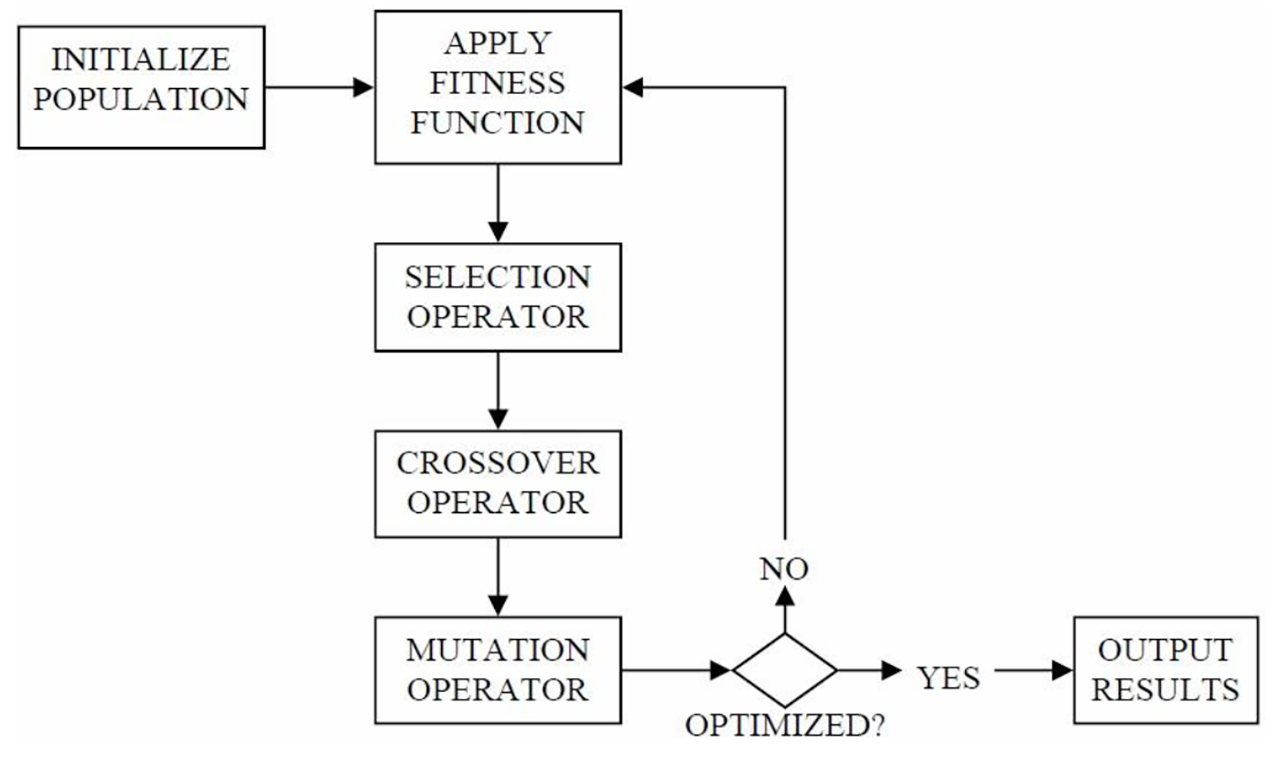
Flowchart depicting the sequence of operations in an evolutionary algorithm for optimization.
The fitness which is first assigned to a potential solution in an MOGA is based on the normalized number of times that that potential solution is dominated by other members of the population. 21 Thus, non-dominated members of the population have a fitness of one, and those dominated the most number of times have a fitness of zero. That fitness is then modified based on a niching function, which encourages a diverse set of solutions by punishing those whose properties are too similar. 19
The MOGA used in these studies then applied a Stochastic Universal Selection operator, 21 a Simulated Binary Crossover operator, 22 and a non-uniform mutation operator. 19
Results
Reflective and emissive schemes
It has already been seen that there are two methods of blocking incident heat from reaching the structure in steady-state conditions: reflection and emission. Intuitively, it can be claimed that if the incident heat is mostly radiative, the highest heat-blocking efficiency can be achieved by having a perfectly reflective front surface (εF = 0). Similarly, it can be claimed that if the incident heat is mostly convective, the highest heat-blocking efficiency can be achieved by having a perfectly emissive front surface (εF = 1).
Let a solution with a perfectly reflective front surface be called a “reflective scheme.” If εF = 0 is inserted into equation (6d), the following is obtained

It is clear that the heat-blocking efficiency in a reflective scheme depends only on the fraction of incident heat flux that is thermal radiation. This means that the back surface emissivity has no effect on the heat-blocking efficiency. It is clear from equation (4), however, that the back surface emissivity does have an effect on the back surface temperature. A perfectly emissive back surface (εB = 1) allows the heat flux which has been conducted through the blanket (heat that has not been blocked by reflection or emission at the front surface) to be transferred to the structure at the lowest temperature possible. For this reason, let the term “reflective scheme” be more specifically defined as having a perfectly reflective front surface (εF = 0) and a perfectly emissive back surface (εB = 1). Inserting these values into equations (3) and (4), it is possible to find the front and back surface temperatures for a reflective scheme

and

Let a solution with a perfectly emissive front surface be called an “emissive scheme.” If εF = 1 is inserted into equation (6d), the following is obtained

It can be seen that the heat-blocking efficiency of an emissive scheme is dependent upon the front surface temperature relative to the surroundings, and it is independent of the type of incident heat flux (only the total flux of incident heat matters). In equation (4), it can be seen that a higher back surface emissivity results in a lower back surface temperature, while a lower back surface emissivity results in a higher back surface temperature. The front surface temperature is tied to the back surface temperature through the rate of conduction through the blanket. Therefore, increasing the back surface emissivity results in a lower back surface temperature and a lower heat-blocking efficiency. This means that there are a series of emissive schemes with different back surface emissivities which represent a set of tradeoff solutions between high heat-blocking efficiency and low back surface temperatures. The two surface temperatures for an emissive scheme can be found by inserting εF = 1 into equations (3) and (4)


Constant (quasi-steady) incident heat input
Non-dominated solutions
In optimization, a dominated solution is inferior since an objective can be improved without reducing the other objective(s). Non-dominated solutions are the optimal ones on the Pareto front. 19 For the present two-objective optimization problem, the non-dominated solution (the Pareto front) is a curve.
The results of the first optimization study, in which the instantaneous heat-blocking efficiency and back surface temperature were optimized for a set of constant incident heat conditions. They confirm the behaviors of two above-mentioned optimal schemes. Figure 3 shows the four sets of non-dominated solutions, corresponding to four different values for the ratio
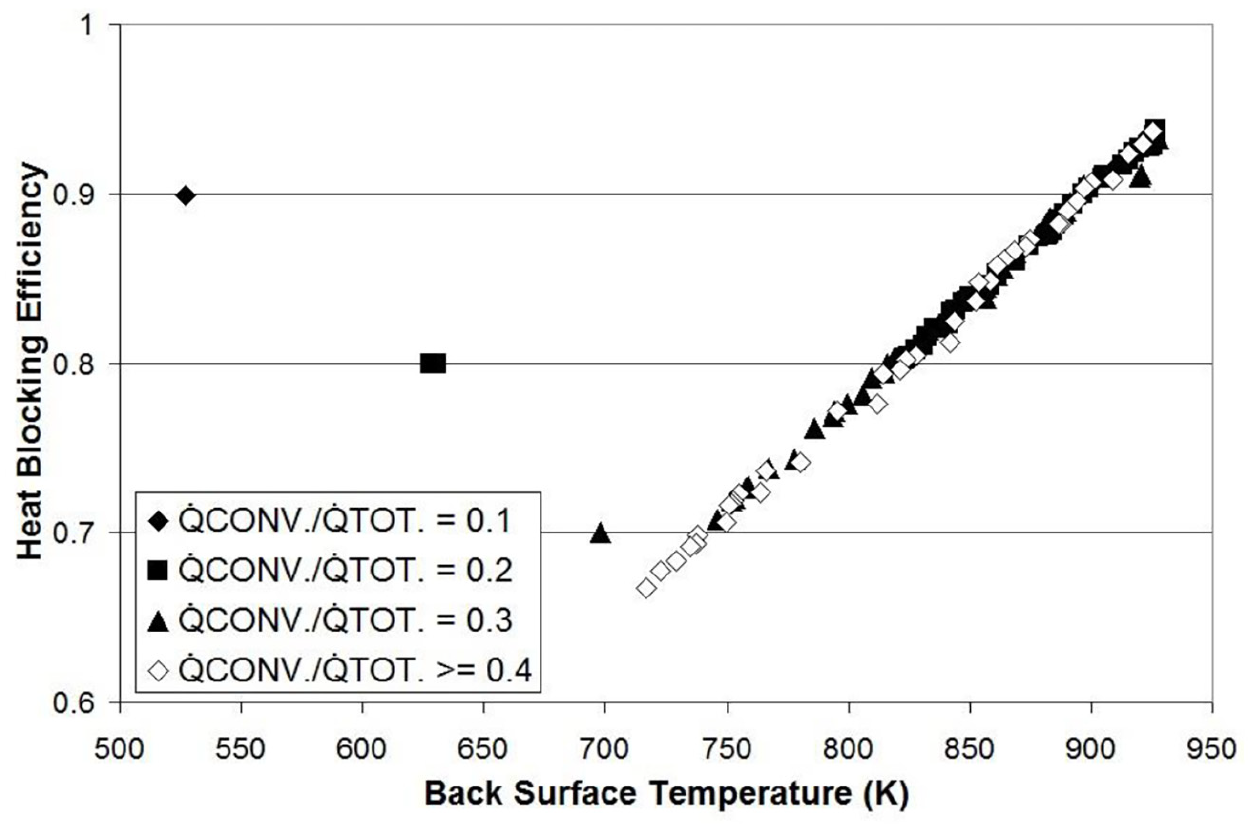
Non-dominated heat-blocking efficiencies and back surface temperatures,
Since each set of solutions is non-dominated, it shows the shape and location of the optimal front at each set of incident heat conditions. It can be seen that there is a set of tradeoff solutions which appears in the same location regardless of the ratio
It is seen in the figure that for
Because all the properties of all of the solutions on the optimal front are known and their performances can be calculated using equations (8)–(13), a continuous version of Figure 3 can be constructed. This is shown as Figure 4. It can be seen that there is a set of emissive schemes which are tradeoff solutions between high heat-blocking efficiency and low back surface temperature, and that this set of solutions offers the same performance independent of
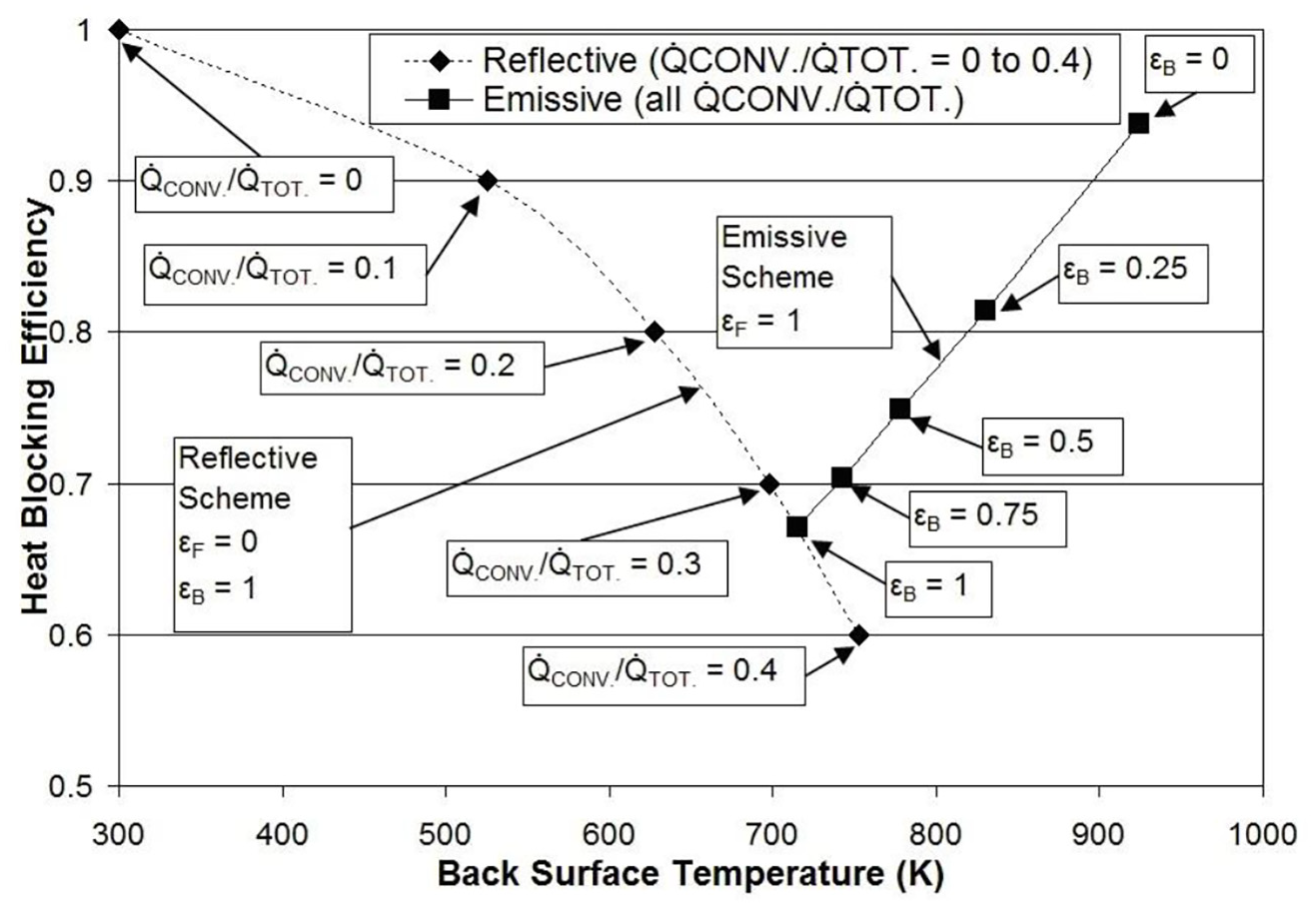
Reflective (dotted line) and emissive (solid line) optimal fronts,
By performing the same optimization with all of the same input parameters, but varying the total amount of incident heat flux, it was seen that the optimal front retains the same shape. Figure 5 shows the set of emissive tradeoff schemes and the trajectory along which the
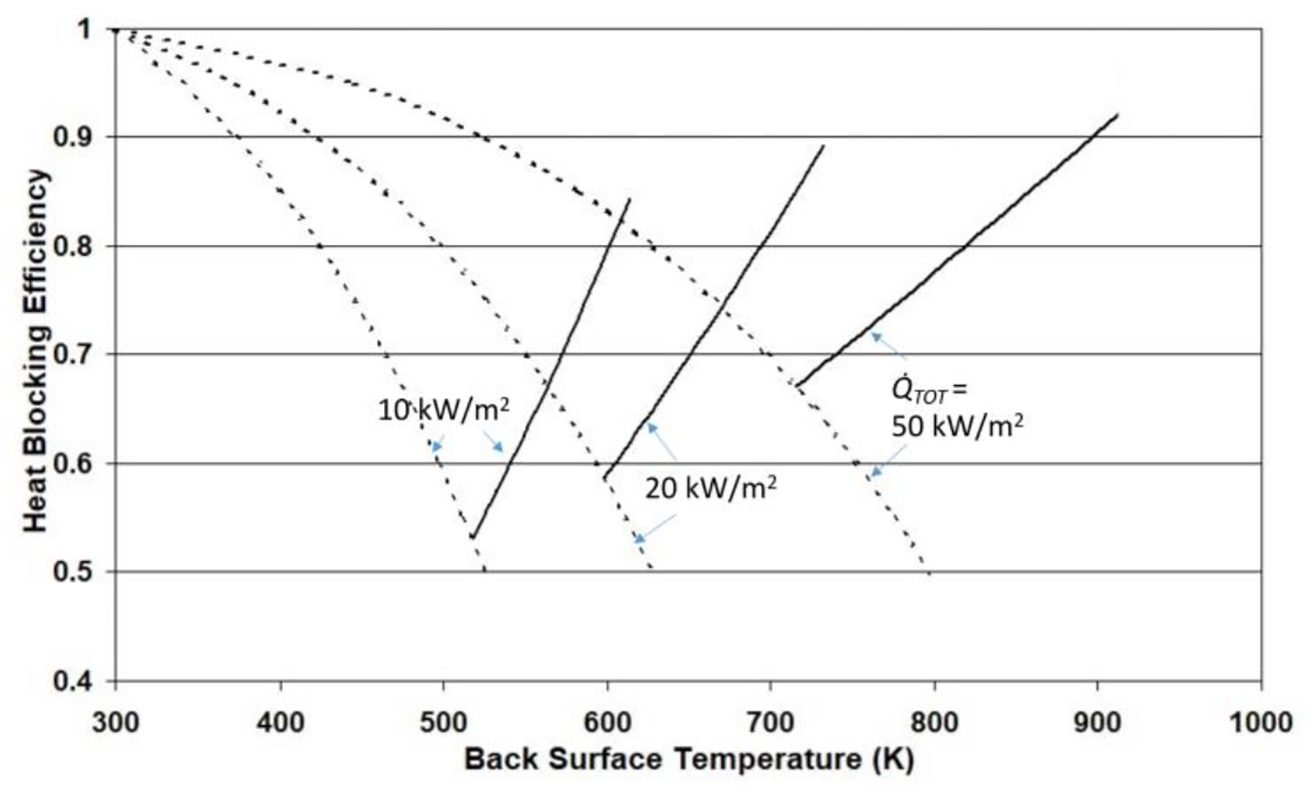
Reflective (dotted line) and emissive (solid line) optimal fronts for various amounts of total incident heat flux.
It is seen that if the incident heat is almost entirely radiation, the reflective scheme dominates the entire set of emissive tradeoff solutions. The threshold of “almost entirely radiation” is dependent upon the total flux of incident heat. The reflective scheme dominates all of the emissive tradeoff solutions at
For incident heat conditions in which
For incident heat conditions in which
Comparison with experimental results
To the knowledge of the author, the only published experimental data recording heat-blocking efficiencies and surface temperatures of fire blankets with a variety of configurations are contained in a study by Hsu et al. 7 In this bench-scale study, fiberglass fabric in one or two layers with aluminized surfaces in different configurations were studied. The various cases are described as follows:
Case 1: single layer, no aluminized surfaces.
Case 2: dingle layer, front surface aluminized.
Case 1’: double layer, no aluminized surfaces.
Case 2’: double layer, front surface of front layer aluminized.
Case 3’: double layer, back surface of back layer aluminized.
Case 4’: double layer, front surface of front layer, and back surface of back layer aluminized.
In order to compare any experimental results using these cases with the trends found in the present work, each case must be described in terms of the present model. It was assumed that a plain fiberglass surface had an emissivity between 0.5 and 0.9. It was further assumed that the aluminized surfaces had an emissivity less than 0.1. Hsu et al. 7 noted that at high temperature the aluminum would melt or otherwise disappear, leaving a darkened surface. 7 Therefore, the aluminized samples were assumed to have an emissivity close to the plain fiberglass surfaces if the surface temperature was very high (more than 900 K). Based on these estimates for emissivity, the various cases can be described in terms of reflective and emissive schemes:
Case 1: mid-range emissive scheme (εB∼0.5–0.8).
Case 2: reflective scheme (mid-range emissive scheme for high TF).
Case 1’: mid-range emissive scheme (εB∼0.5–0.8), lower k/t.
Case 2’: reflective scheme, lower k/t (mid-range emissive scheme for high TF).
Case 3’: upper-range emissive scheme (εB < 0.1).
Case 4’: neither scheme, both surfaces reflective (upper-range emissive scheme for high TF).
In Hsu et al., 7 these materials were each subjected to two types of incident heat flux: 83 kW/m2 of convection (using a Meker burner) and 83 kW/m2 of radiation (using a radiant cone). The resulting steady-state heat-blocking efficiencies and surface temperatures were recorded. These are presented in Figures 6 and 7, along with the respective optimal fronts. For comparison with the optimal fronts, it was assumed that h = 6.9 W/m2-K, TH = 300 K, and T∞ = 300 K. It was further assumed that k/t = 100 W/m2-K for the single layers, and that k/t = 30 W/m2-K for the double layers. The actual value of the average thermal conductivity of the material was not determined in Hsu et al., 7 as the width of the air gap between the two blankets was not known to a sufficient degree of accuracy. The authors of that article assumed that this gap of air was approximately 0.5 mm. 7
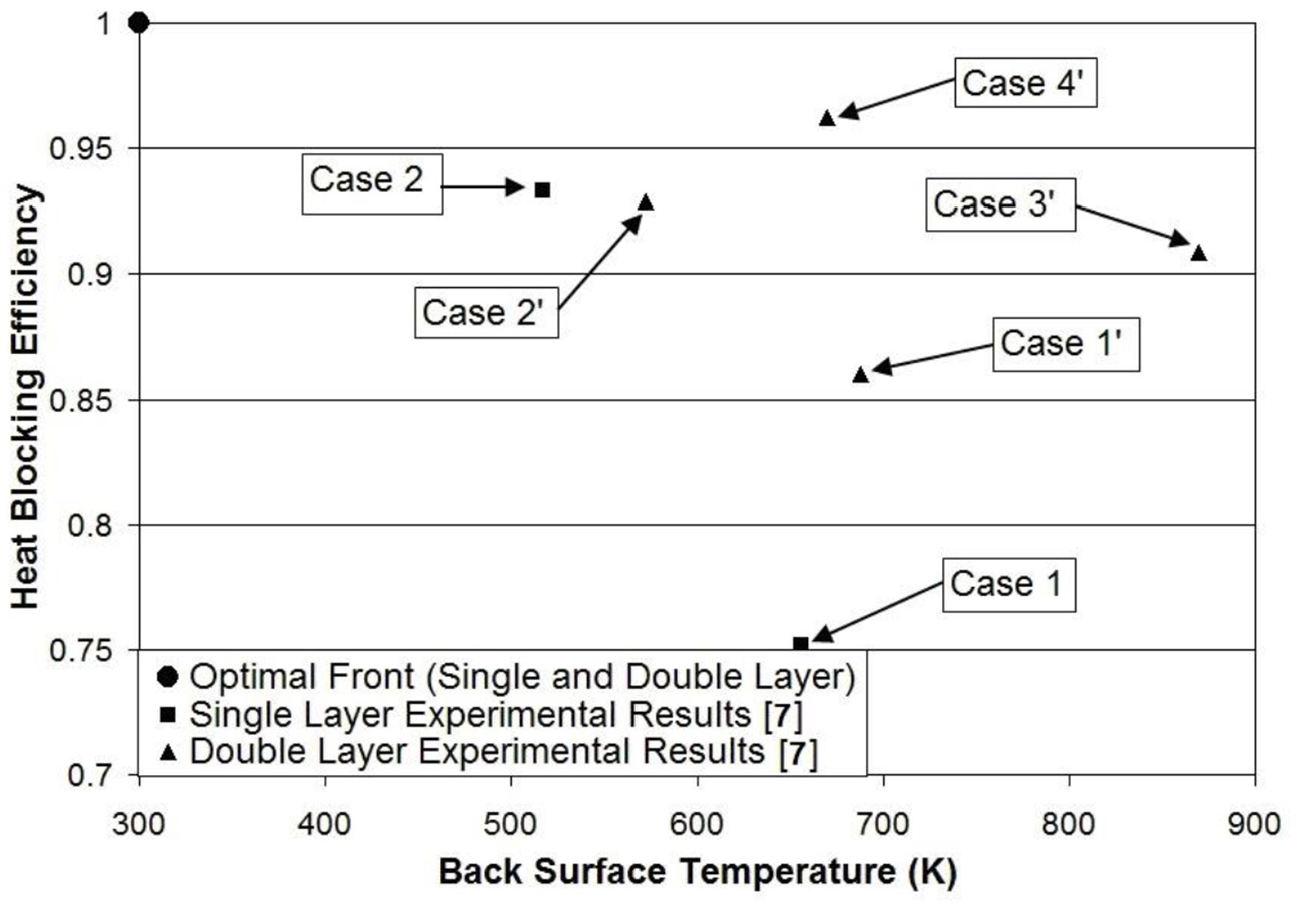
Experimental results of exposing the various cases to 83 kW/m2 of radiant heat flux, compared with the optimal front.
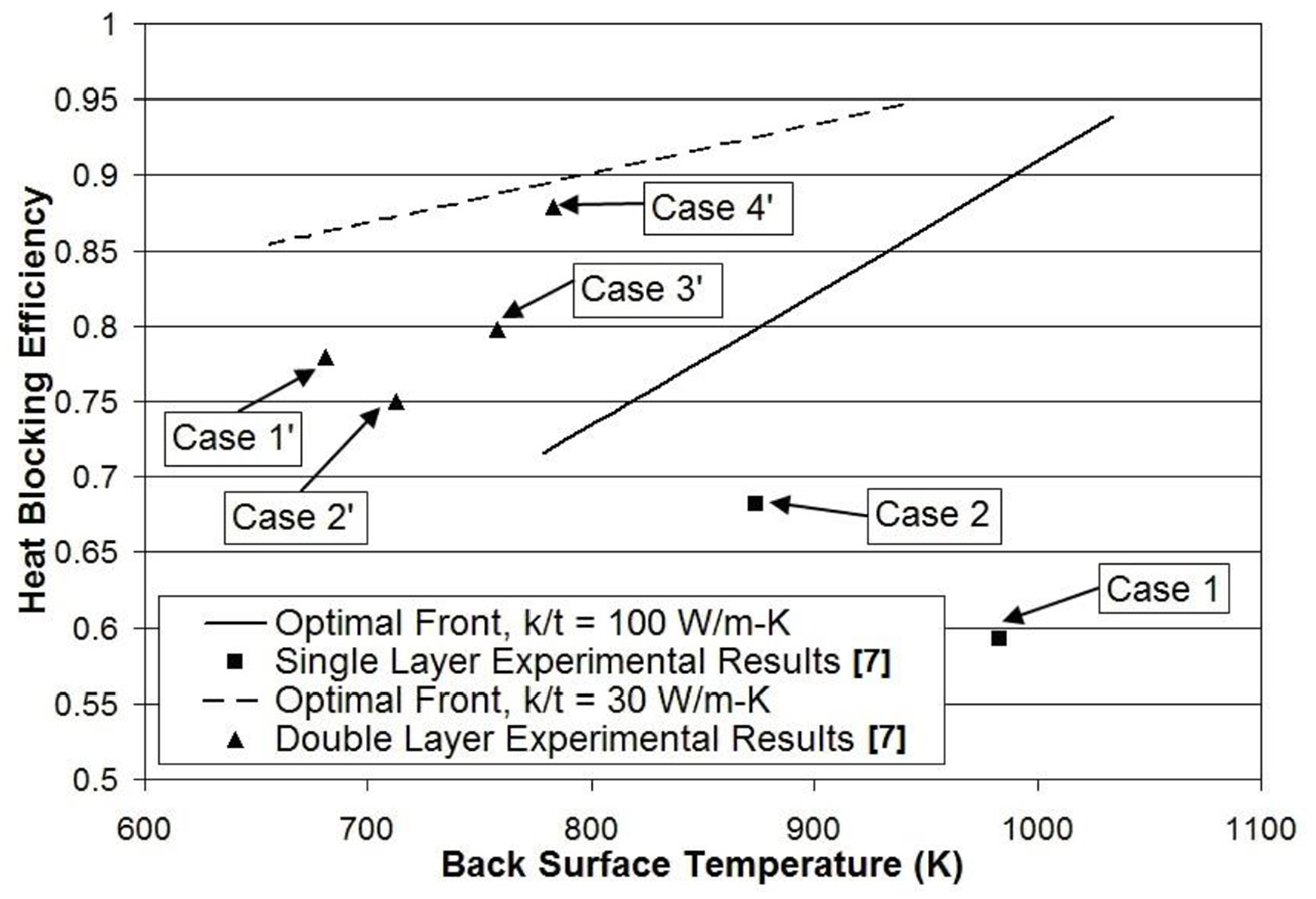
Experimental results of exposing the various cases to 83 kW/m2 of convective heat flux, compared with the optimal front.
When exposed to radiative incident heat flux, the three cases with aluminized front surfaces (2, 2’, and 4’) had the highest heat-blocking efficiencies. Cases 2 and 2’ were non-ideal but realistic approximations of the reflective scheme. Thus, they had the lowest back surface temperatures and very high heat-blocking efficiencies. Case 4’ was neither a reflective nor an emissive scheme. Its aluminized front surface gave it a heat-blocking efficiency in the range of the reflective scheme and of Cases 2 and 2’, but its aluminized back surface drove up the back surface temperature into the range of Cases 1, 1’, and 3’. Cases 1, 1’, and 3’ represented non-ideal but realistic approximations of different emissive schemes. No emissive solutions appeared on the optimal front because the incident heat was entirely radiative. Therefore, it was not surprising that Cases 1, 1’, and 3’ were dominated by the solutions approximating the reflective scheme (Cases 2 and 2’).
When exposed to 83 kW/m2 of convective incident heat flux from the Meker burner, the front surface temperatures were high enough to cause the aluminized front surfaces in Cases 2, 2’, and 4’ to become emissive (by melting or peeling away). Because of these high temperatures, both Cases 1 and 2 were non-ideal emissive schemes which fell behind the optimal front comprised of emissive tradeoff solutions. A different optimal front was used for comparison with the double layer configurations, since the value of k/t was significantly lower for those configurations. It was seen that the two double layer configurations with an aluminized back surface (Cases 3’ and 4’) had higher heat-blocking efficiencies and higher back surface temperatures than those without an aluminized back surface (Cases 1’ and 2’). This agrees with the results found in the double-objective optimization study, in which emissive schemes with various back surface emissivities represented tradeoff solutions in high heat-blocking efficiency and low back surface temperature.
Hsu et al. 7 noted in their study that of the three types of data collected (heat-blocking efficiency, front surface temperature, and back surface temperature), the heat-blocking efficiency data were most reliable. With large heat fluxes and temperature gradients, the temperature data collected by thermocouples became dependent upon contact pressure and position. Nonetheless, the experimental data presented in Hsu et al. 7 support the conclusions drawn in this study.
Time variant incident heat inputs
The goal of this second study was to demonstrate that the quasi-steady-state model developed earlier could be used to optimize a fire blanket with time variant incident heat conditions. Real wildland fires differ among different areas, and the author was not aware of any published, detailed data describing the amounts of radiative and convective heat flux produced by a wildland fire as functions of time. For illustrative purpose, a 10-min long sequence of incident heat conditions was constructed based on a normal distribution with μ = 300 s and σ = 100 s, as described in equation (14) and shown in Figure 8. This distribution was chosen to provide an easily scalable sequence of heat input sequences, both in time (τ) and in peak heat flux

The first and last portions of the sequence consisted of entirely radiative incident heat flux, while a center section was consisted of entirely convective incident heat flux. QCONV/QTOT. was about 0.484 (note that these are Q and not
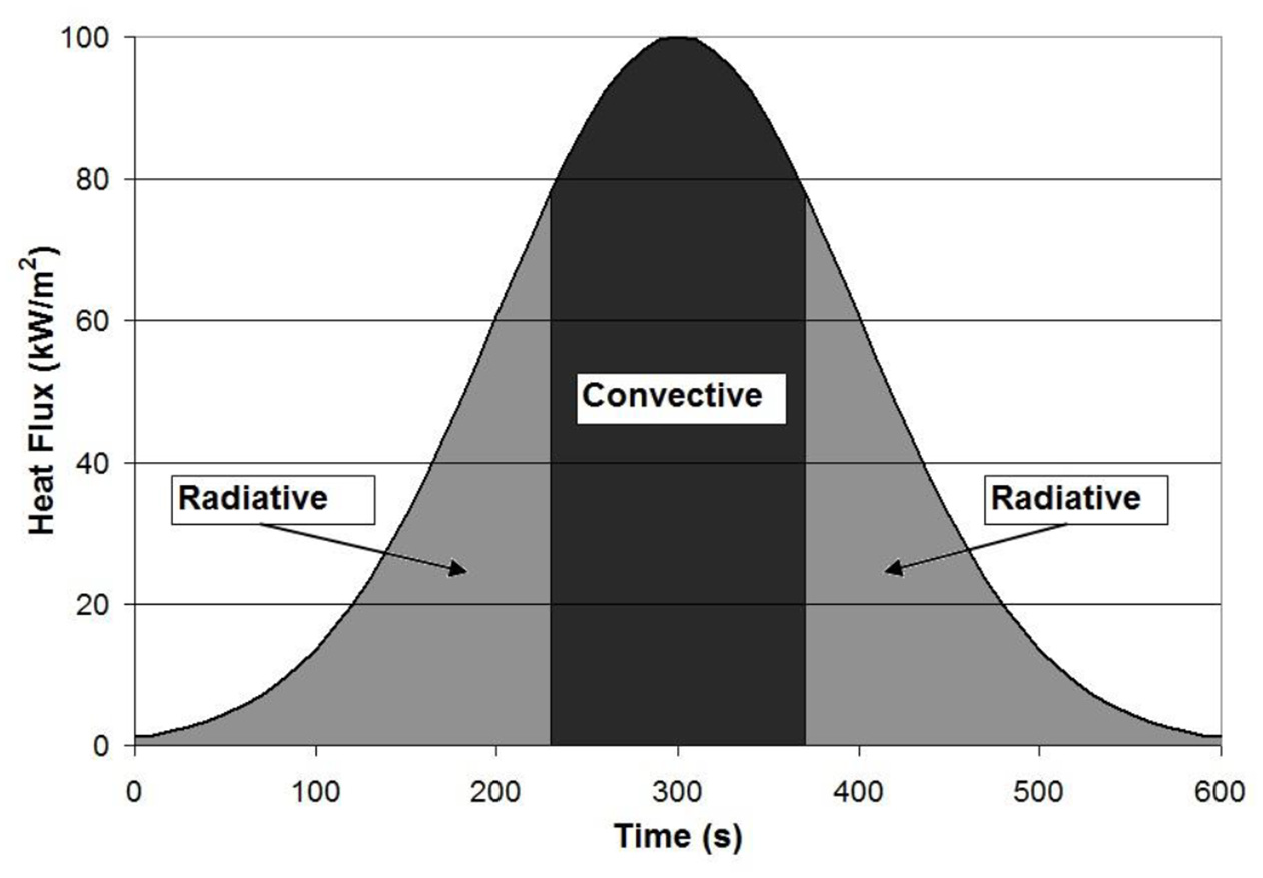
Sequence of incident heat conditions.
Using k/t = 100 W/m2-K, h = 5 W/m2 K (for the back surface), TH = 300 K, and T∞ = 300 K, the two surface emissivities were optimized for a fire blanket exposed to the sequence of incident heat conditions shown. As stated before, it has been noted in several studies that, when exposed to large incident heat fluxes, aluminized front layers tend to melt or otherwise fall away, leaving a darkened front surface with a different emissivity.7,8,10–13 In response to this, the same optimization was repeated with two additional variables: the temperature which must be exceeded at the front surface for the front surface emissivity to change, and the front surface emissivity after that change. The non-dominated solutions resulting from both optimizations are shown in Figure 9.
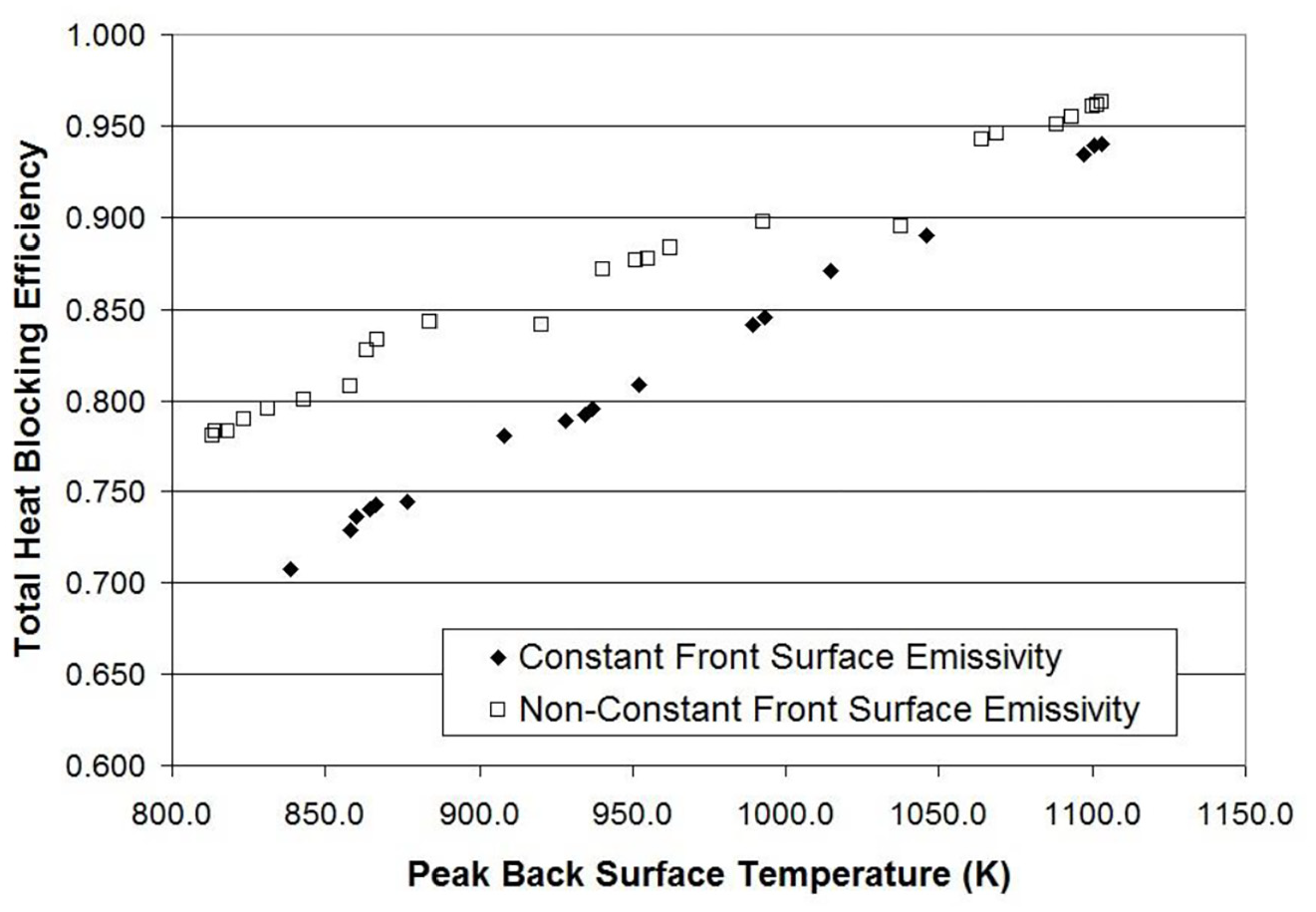
Non-dominated solutions for the sequence of incident heat conditions shown in Figure 8.
The non-dominated solutions resulting from the first optimization, with constant front surface emissivities, were all emissive schemes. Each had a front surface emissivity near one, and a range of back surface emissivities were found across the range of non-dominated solutions. The non-dominated solutions resulting from the second optimization, in which the front surface emissivity was allowed to change, were somewhat different. Initially, each non-dominated solution had a reflective front surface, and a range of back surface emissivities. The temperature at which the front surface emissivity changed ranged from 662.7 to 1300.0 K, and in each case that temperature was exceeded at the front surface. Once this occurred, the front surface emissivity in each non-dominated solution changed so that the front surface became emissive.
It can be seen that allowing the front surface emissivity to change produced a set of solutions which performed better than those found using a constant front surface emissivity. Because the sequence of incident heat conditions was such that the ideal set of surface emissivities was not the same in each instant, allowing one of those emissivities to change once allowed an improvement in performance.
Concluding remarks
An optimization study on the performance of thin fire blankets has been carried out. There are two optimization objectives: maximizing the heat block efficiency and minimizing the blanket backside temperature. The blanket radiative properties to be optimized are the blanket front and backsides emissivity (or reflectivity). Like other multi-objective optimization studies, optimal fronts were obtained. They are functions of blanket radiative properties and the type of heat source input (radiative, convective, or a combination of both). In addition to the insight obtained from a steady heat input analysis, an example that mimics real wildland fire scenario is given when the heat inputs are time varying both in strength and types. Some of the essential findings are summarized as follows:
There are two optimal schemes for blocking incident heat from reaching a structure in quasi-steady-state conditions: reflective and emissive.
The optimal front in high heat-blocking efficiency and low back surface temperature when a fire blanket is exposed to a constant set of incident heat conditions consists of a reflective scheme which dominates all, some, or none of a set of emissive tradeoff solutions.
This optimal front can be found based on the known properties of the two optimal schemes.
When the constant set of incident heat conditions is replaced with a time variant sequence of incident heat conditions, the optimal front is qualitatively similar to that found for a constant set of incident heat conditions.
The performance of a fire blanket can be improved by allowing the front surface emissivity to change once some value for the front surface temperature has been exceeded. This may create a “smart” fire blanket. The nature of smartness can be either passive such as the case with aluminum coating which melt away at high temperature or be actively controlled in possible future designs.
The numerical computation and its comparison with the bench-scale experiment data have a peak incident heat flux up to 100 kW/m2. A question arises: will fire blanket be effective if the heat flux reaches 200–300 kW/m2 as reported in some real wildfires? We do not have any test data in this range. If the incident flux is mostly radiative, a highly reflective blanket can theoretically be effective. But a convective heat flux of this magnitude may require a blanket surface temperature too high to be practical. We want to mention that several fire blankets have been field tested in prescribed fires. 14 In these tests, the measured peak heat flux was only around 20 kW/m2. The covered wooden structure was fully protected. The measured blanket temperatures compared well with model prediction in Hsu et al. 7 assuming 70% radiation and 30% convection incidence fluxes.
Footnotes
Appendix 1
Acknowledgements
The authors thank Professor Fumi Takahashi, Professor Sheng-Yen Hsu, and Dr Sandra Olson for their input on our fire blanket research and to the late Dr Meng-Sing Liou for introducing us to the multi-objective optimization schemes.
Declaration of conflicting interests
The author(s) declared no potential conflicts of interest with respect to the research, authorship, and/or publication of this article.
Funding
The author(s) disclosed receipt of the following financial support for the research, authorship, and/or publication of this article: This research was partially supported by the US Department of Homeland Security, the Federal Emergency Management Agency (FEMA), Assistance to Firefighters Grant Program, and Fire Prevention and Safety Grant (no. EMW-2007-FP-02677) with Dr Dave Evens as the grant technical monitor.
