






Abstract
A comparison scheme is proposed to extinguish non-uniform fire scenes and continuously uniform fire scenes using a helicopter’s bucket fire-extinguishing device to spray extinguishing agent. Pure water, and Class AB, gel, and Class A extinguishing agents were added to the bucket fire-extinguishing device to spray 4-layer, 6-layer, and 12-layer wood crib fires. It was discovered that the depth (the distance from the top of the wood crib) of effective cooling and prevention of temperature recovery by extinguishing agents was 0.36 m and that the cooling performance of the extinguishing agents in sequence from high to low was Class A extinguishing agent > gel extinguishing agent > Class AB extinguishing agent > pure water. Their capacity to prevent temperature recovery in the wood crib fires in sequence from high to low was gel extinguishing agent > Class A extinguishing agent > Class AB extinguishing agent > pure water. A device has been developed that can add extinguishing agent to the helicopter bucket efficiently, and its application on-site during the 2020–2021 Spring Festival and other events showed that it can quickly extinguish small-area wildfires near electrical transmission lines to reduce line trips due to wildfire.
Introduction
Forest fires occur frequently all over the world and have destroyed natural resources and power grids, natural gas pipelines, and other public facilities in forests and steppes.1–4 For example, in 2017–2020, wide-ranging wildfires occurred every year in California, USA and other regions, causing power outages that affected hundreds of thousands of people. More than 70,000 wildfires occur every year in China. The 1000-kV Changxingdao–Nanmen Line (Changnan Line), the ±800-kV Chuxiong Line, and other ultra-high voltage (UHV) transmission lines have experienced many outages due to tripping caused by wildfires. From January to March 2012, the main transmission lines of 220 kV and above in the Yunnan Power Grid tripped 156 times due to wildfires. 5 During the Spring Festival of 2013, 18 transmission lines of 220 kV and above tripped due to wildfires in the Hunan power grid in only one day. Statistics of tripping events due to wildfires show that wildfires near transmission lines cause the lines to trip within 0.5–1.5 h. However, because a transmission line is long and narrow and may have many wildfires nearby, an extensive area must be monitored and controlled, and the requirement for emergency timeliness is extremely tight. The United States, China, and other countries have carried out research on prevention and control technologies such as prediction, monitoring, and extinguishing of wildfires near power transmission lines.1,6–8 Lu et al. 6 investigated the effect of water mist on the development of a long-gap discharge and provided guidance for the safe application of water mists to extinguish wildfires near high voltage transmission lines. Trakas and Hatziargyriou 8 proposed a stochastic mixed integer programming with quadratic constraints to increase the resiliency of a distribution system threatened by wildfire. The existing anti-wildfire system for power grids has the following problems: (1) ground-based fire trucks, pneumatic extinguishers, and other manpower-intensive firefighting equipment have difficulty covering fire scenes at high altitude and have low extinguishing efficiency for wildfires; besides, there is a personal safety risk when forest fires spread quickly and (2) during periods of high wildfire incidence in China, such as the Qingming Festival and Spring Festival, many family members travel from the cities to the countryside to worship their ancestors, causing country roads to become badly blocked; therefore, it can take up to several hours for ground firefighting equipment to drive along the highway to reach the fire scene, and the transmission lines may have tripped and gone into outage upon their arrival.
Helicopters are a major type of equipment for extinguishing forest fires because they can overcome terrain restrictions, and fire fighters have no direct contact with the fire scene and can thus remain safe. Water can be dropped from helicopters directly onto the fire to reduce fire intensity, on unburned fuels to wet them, or on the boundary between fire and fuels for a combined effect, which allows firefighting by humans on the ground. 9 Helicopters can also completely extinguish flames when extremely effective fire suppression means are used, especially during the early stages of fire 10 growth. The United States, Canada, and other countries have configured many helicopters to suppress forest fires.11–14 Forest fire suppression with helicopters started late in China, but developed very quickly. When using helicopters to suppress forest fires, even though the helicopter has sprayed the extinguishing agent precisely onto the fire scene, it still cannot extinguish wildfires efficiently. Sometimes, even after extinguishing agent has been added, it still fails to achieve the expected effect of rapid firefighting, and even after open flames have been extinguished, they can still re-ignite. Therefore, it is of great analytical significance to study the water amount and distribution of the helicopter’s extinguishing agent and the effect of the water amount on suppressing forest fires. At present, many international studies have addressed the water amount and the distribution of extinguishing agent sprayed on the ground by helicopters;15–17 however, there are a few studies on firefighting conditions at fire scenes after extinguishing agent has been sprayed. The literature on wildland fire suppression was classified according to whether aircrafts were used for spraying fire-extinguishing agents. The typical studies using aircraft for firefighting are described in the research studies.18–20 Solarz and Jordan 18 stipulated the density per unit area of extinguishing agent necessary for different strengths of fire and different types of combustibles; for example, for California mixed chaparral, the required density per unit area of extinguishing agent is >6 gal/100 sq. ft (2.44 mm/m2). Konishi et al. 19 used a helicopter to extinguish simulated fires in solid wooden houses and provided useful data for operational planning of fire suppression by helicopters. Then, laboratory studies on the suppression of wood crib fires are described in the research studies.21–24 Noaki et al. 21 characterized the maximum value of heat release rate of wood cribs using wood cribs and varying water application rates, and then the critical water delivered density for extinction was calculated.
Therefore, the main purpose of this study was to carry out fire-extinguishing tests of helicopter bucket spraying of extinguishing agent, to study the depth of extinguishing agent necessary for extinguishing fire scenes with different thicknesses of combustibles, and to analyze the factors that determine the depth of extinguishing agent necessary for fire suppression. Second, this study aimed to examine the use of various chemical extinguishing agents for fire suppression, to compare the influence of different extinguishing agents on firefighting efficiency when delivered by helicopter, and to analyze the fire suppression mechanism in combination with the chemical components of the extinguishing agent.
This article consists of the following sections: section “Introduction” provides an overview, section “Test program” describes the fire-extinguishing test program using helicopters, section “Fire-extinguishing tests” discusses the fire-extinguishing test data and phenomena, section “Discussion and analysis” provides an interpretation of data and presents the mechanism of the phenomena, section “Application” describes an application based on the test results, and section “Summary” serves as a summary.
Test program
Test combustibles
Wood cribs are often used for various tests requiring repeatable combustion temperatures, such as fire-extinguisher performance (ANSI/UL 711).25,26 The temperature of a wood crib fire can reach a quasi-steady-state condition fast and continue to burn until almost full consumption of the fuel, which cannot be guaranteed using vegetation. 27 Each crib was made of 1A wooden strips 40 mm × 40 mm × 500 mm in size, as stipulated in GB4351.1-2005 Portable Fire Extinguishers. Pinus massoniana Lamb., a species of pine, was selected as the raw material of the wood strips. One hundred wooden strips were weighed randomly and found to weigh between 0.404 and 0.415 kg/wooden strip after 6 months of natural drying; the weight variation did not exceed 3%, which met the requirement for repeatability of fire scenes.
Three types of wood crib were constructed. The first type was a 6-layer wood crib, in which six wooden strips were laid out at equal intervals on each layer and each adjacent layer was arranged at 90 degrees to those above and below it, for a total of 36 wooden strips. Any two intersecting wooden strips were fixed with nails, and the fuel density was 59 kg/m2. The second type was a 12-layer wood crib, in which six wooden strips were laid out at equal intervals on each layer and each adjacent layer was arranged at 90 degrees to those above and below it, for a total of 72 wooden strips. Any two intersecting wooden strips were fixed with nails, and the fuel density was 118 kg/m2. The third type was a 4-layer wood crib, in which six wooden strips were laid out at equal intervals on each layer and each adjacent layers was arranged at 90 degrees to those above and below it, for a total of 24 wooden strips. Any two intersecting wooden strips were fixed with nails, and the fuel density was 39 kg/m2.
The wood crib combustibles were placed on an iron mesh support 1200 mm × 1200 mm × 250 mm in size; the ground under the wood crib combustibles was laid out with square fuel-oil basins 700 mm × 700 mm × 100 mm in size. Two liters of blue high-octane Avgas 100# aviation gasoline was used in this study as the ignition fuel.
Fire scene layout and measurement scheme
This study adopted two fire scene layout schemes: “non-uniform fire scenes” and “continuously uniform fire scenes,” as shown in Table 1. Because temperature is a distinct feature of a wood crib fire, this article mainly focuses on changes in temperature of wood crib fires at different heights during combustion of wood cribs and firefighting by helicopter. The tests used K-type thermocouples, the diameter of each thermocouple was 3 mm, the probe was bare, and the response time was 1 s. The uncertainty in the temperature of the Type-K thermocouple wire is given by the manufacturer as ±2.2 °C with a 95% confidence interval. The expanded uncertainty in the thermocouple temperature change from 0 to 1250 °C is 1.5% and that in the change from −200 to 0 °C is 4.0%, with a coverage factor of 2, which corresponds to a confidence interval of 95%. The thermocouple readings manifest the effect of the extinguishing agent on fire temperature. Pitot tubes were arranged on the site of the helicopter fire-extinguishing tests to measure plume and entrainment at fire scenes. However, because the fast-moving helicopter rotor generated turbulent flow, the plume and entrainment speeds at fire scenes were relatively high, making it impossible to capture real-time accurate measurements of the whole-process plume and entrainment speeds; therefore, the data from the pitot tubes were not analyzed in this article. Three cameras were laid out and used during the test, two of which were vertical to the fire scene, of which one, the short-focus camera (Camera #1), was used to capture whether the extinguishing agent achieved full coverage of the wood crib fire in both front and rear directions, and the second, the long-focus camera (Camera #2), was used to capture the number of wooden strip layers showing open flame after extinguishing agent was sprayed onto them. A third camera (Camera #3) was placed parallel to the fire scene and was used to capture whether the extinguishing agent sprayed from the helicopter achieved full coverage of the wood cribs in the left and right directions.
Summary of test conditions.

Non-uniform fire scenes
“Non-uniform fire scenes” referred to a set of four 6-layer wood cribs (Crib#1 fire scene), a set of four 12-layer wood cribs (Crib#2 fire scene), and four 4-layer wood cribs (Crib#3 fire scene). These scenes were used to observe the cooling, extinguishing, and re-ignition conditions of the same helicopter fire-extinguishing device on Crib#1, Crib#2, and Crib#3 fire scenes after firefighting was carried out by helicopter at the same height and speed under the same spraying conditions. The main purpose was to obtain the number of wood crib layers influenced by the extinguishing agent sprayed from the helicopter fire-extinguishing device (i.e. the influence depth of the extinguishing agent).
In the non-uniform fire scenes, Crib#1 and Crib#2 were at a separation distance of 2.4 m, whereas Crib#3 and Crib#2 were at a separation distance of 3.6 m, as shown in Figure 1. Corresponding locations with arrangements of thermocouple arrays were Array#1, Array#2, and Array#3, as marked in Figure 1. The arrangement of thermocouple arrays is as shown in Table 2, where the zero-reference plane for height is the ground. Inside the wood cribs (the area of the wood cribs not directly exposed to extinguishing agent sprayed from the helicopter), thermocouples were arranged in a relatively dense pattern, with one thermocouple every two layers, at a height difference of 0.08 m (the height of two layers of wooden strips), as shown in Figure 2.
Layout plan of thermocouples on non-uniform fire scenes.

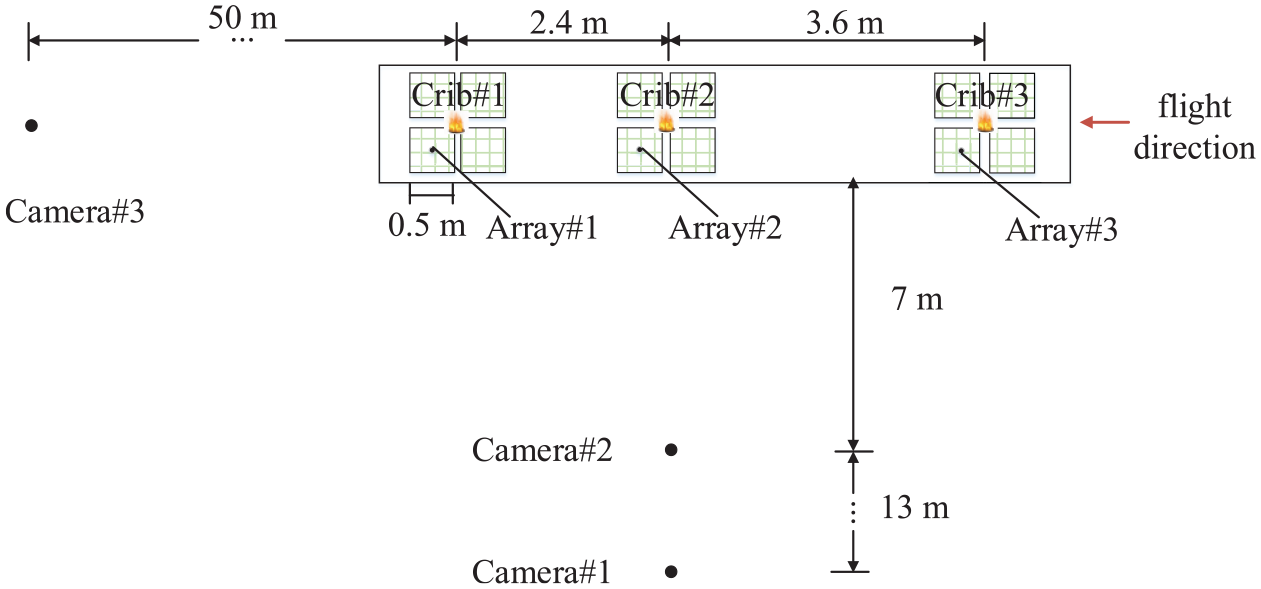
Schematic diagram of layout and temperature measurement of “non-uniform fire scenes” (top view).
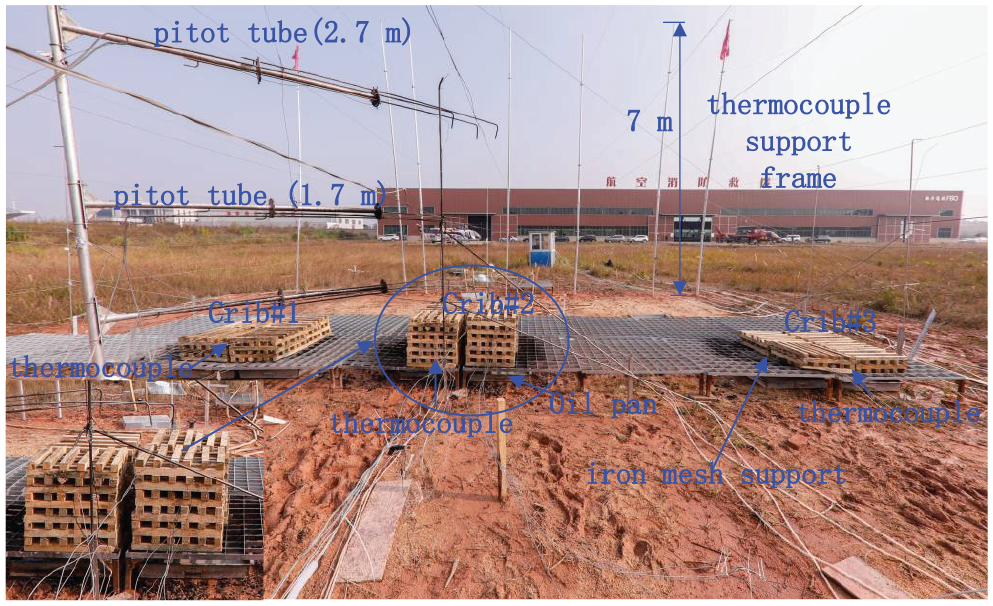
Photograph of layout and temperature measurement on “non-uniform fire scenes” (side view).
To avoid mutual interference between the fire scenes, which might cause misjudgment of their temperature, extinguishing, and re-ignition, three thermocouples were set at 0.6 m outside the Crib#2 fire scene; the average temperature measured was less than 200 °C. This showed that the Crib#1 fire scene at 2.4 m from the Crib#2 fire scene and the Crib#3 fire scene at 3.6 m from the Crib#2 fire scene were basically not influenced by other fire scenes.
Continuously uniform fire scenes
“Continuously uniform fire scenes” referred to an arrangement of 16 rows of wood cribs with two standard 6-layer wood cribs per row (Crib#4 fire scene; as shown in Figure 3) for the purpose of comparing the overall effect of different extinguishing agents on continuous fire scenes, and thus comparing their fire-extinguishing performance. The main purpose of these scenes was to carry out a direct comparison of the fire-extinguishing effect of the extinguishing agents.
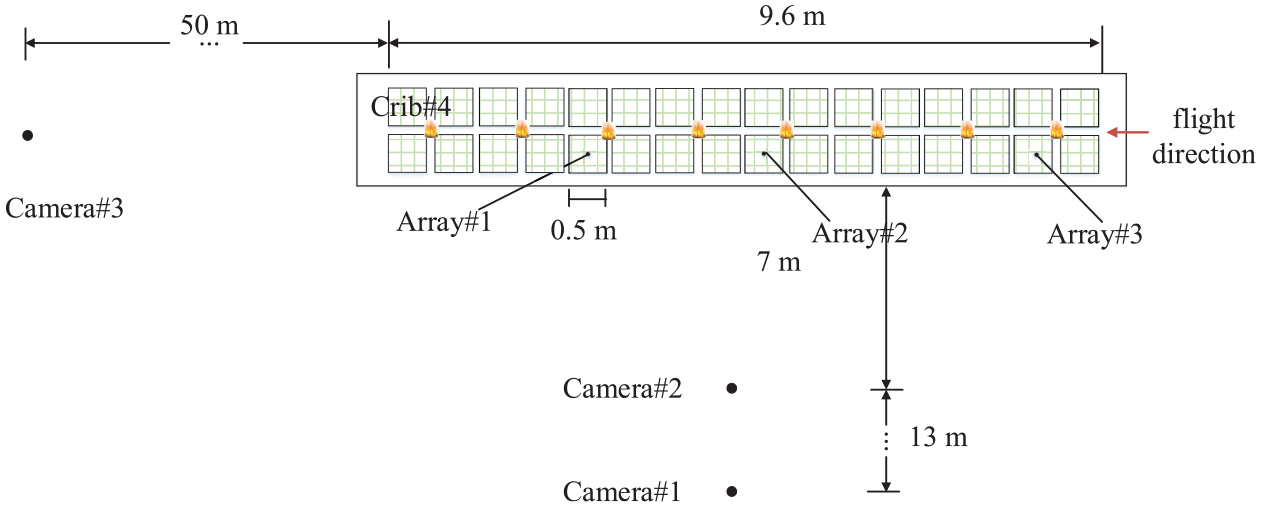
Schematic diagram of layout and temperature measurement on the continuously uniform fire scenes (top view).
On the continuously uniform fire scenes, the positions of the thermocouple arrays were consistent with those on the non-uniform fire scenes. Because on the non-uniform fire scenes, the number of layers of wood cribs on the 12-layer wood crib fire scene (Crib#2) was reduced from 12 to 6, the five internal thermocouples in Array#2 were reduced to 4, as shown in Table 3.
Layout plan of thermocouples on the continuously uniform fire scenes.

Helicopter fire-extinguishing device
In order to reduce the influence of fire-extinguishing equipment to the fire-extinguishing test results, the real H125 helicopter was used as the carrier for spraying extinguishing agent; it has an external load-bearing capacity of 1400 kg and can work under high temperatures and complex environments. The bucket fire-extinguishing system uses an automatic device, as shown in Figure 4. The top and bottom diameters of the bucket are 1100 and 670 mm, respectively. The length of bucket is 1300 mm. The water outlet of the bucket is a trumpet shape with a narrow upper end and a wide lower end. The diameter of the circular section at the upper end is 150 mm, the diameter of the circular section at the lower end is 380 mm, and the height of the water outlet is 180 mm. The bucket can load 800 kg of extinguishing agent. In this study, the helicopter was loaded with 660 kg of extinguishing agent for each fire-extinguishing run, and water delivery takes 7 s.
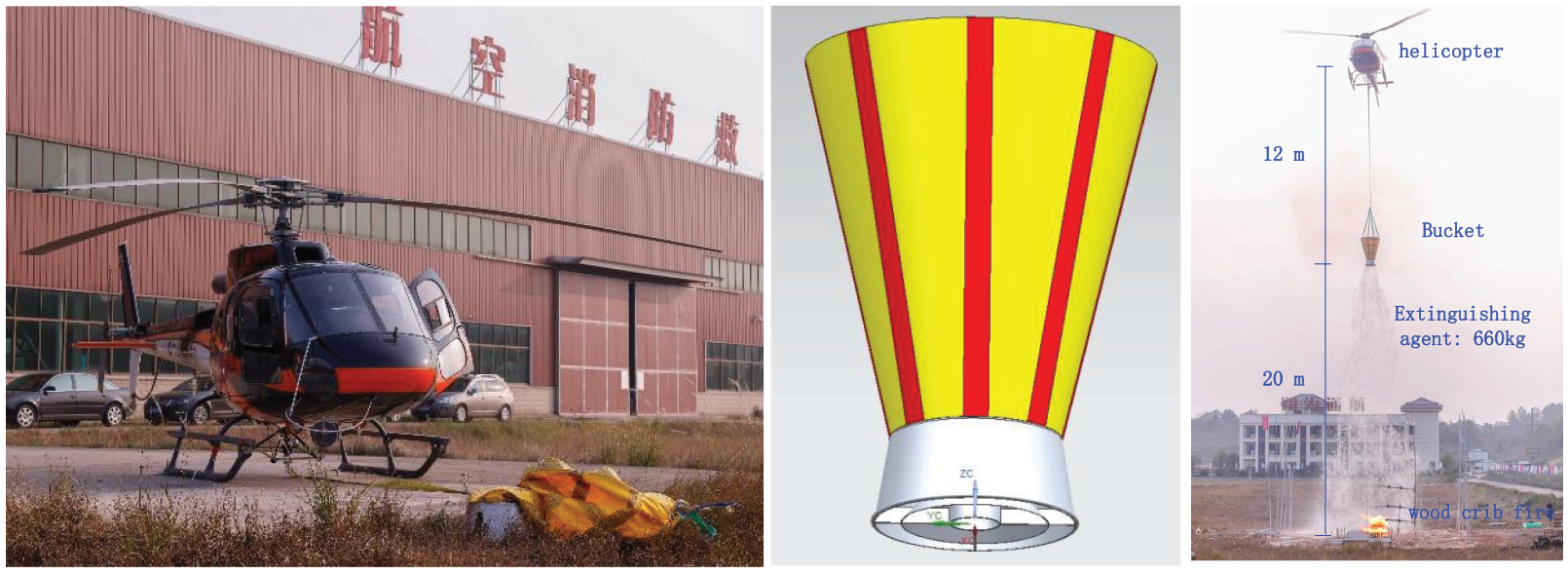
Helicopter and its supporting automatic bucket fire-extinguishing device, with the flight parameters for spraying the extinguishing agent. First subgraph shows the helicopter; second subgraph shows the schematic diagram of bucket; third subgraph shows the flight parameters for fire extinguishing.
Fire-extinguishing condition scheme
In this study, pure water (Agent#1), Class AB extinguishing agent (Agent#2), gel extinguishing agent (Agent#3), and Class A extinguishing agent (Agent#4) were selected as the fire-extinguishing media to compare the fire-extinguishing performance of helicopter delivery, as well as anti-re-ignition performance. The formulas and descriptions of the various fire-extinguishing media are shown in Table 4. The fire-extinguishing principle of Class AB extinguishing agent is to generate large amount of foam to cover the surface of the combustibles. The fire-extinguishing principle of Class A extinguishing agent is to generate NH3 and other gases for oxygen insulation and cooling. 28 The fire-extinguishing principle of the gel extinguishing agent is to form a gel coverage layer on the surface of the combustibles to isolate them from oxygen, thus achieving the purpose of extinguishing fire.
Components of extinguishing agents.

Agent distribution spray from the helicopter bucket
For the helicopter fire-extinguishing device, a flight altitude of 32 m (the sling was 12 m long, and the bucket was 20 m away from the ground) and a flight speed of 20 km/h were selected as the fire-extinguishing parameters. Agent containers were placed under the helicopter flight route to receive extinguishing agent sprayed from high altitude. The fire-extinguishing agent receiving container was a circular basin with a radius of 175 mm and a height of 150 mm. The area of a single container for receiving the extinguishing agent was 0.09616 m2. The quantity of extinguishing agent received by each container was weighed, and the Agent#1 depth per unit area was calculated in combination with the projected container area. Thus, the distribution of the depth of extinguishing agent was obtained, as shown in Figure 5. The depth of the extinguishing agent in the spray area was further quantified, and the distribution of the depth of extinguishing agent (0–5.0 mm) was divided into five categories at a step length of 1.0 mm. Figure 5 shows that the distribution of the extinguishing agent from the helicopter took on an oval form, with wide front and middle parts and a narrow tail part. The depth of extinguishing agent tended to increase gradually and then drop off gradually both vertically and parallel to the flight direction. The reason for this might be that in the vertical direction, when the bucket valve has just opened, the quantity of extinguishing agent is sufficient, and the flow at the outlet is large due to the high pressure caused by the effect of gravity on the extinguishing agent at the outlet; hence, the extinguishing agent in the head end of the spray area is relatively deep. However, as the amount of extinguishing agent in the bucket drops, the flow at the outlet drops gradually, leading to a shallower depth of extinguishing agent in the tail end of the spray area. The depth distribution of the extinguishing agent was not continuous. At a flight speed of 20 km/h and a spraying height of 32 m, the extinguishing agent had a maximum depth of 5.78 mm. Similar distributions can be also found when using other agents (gel, foam, and gum-thickened retardant). 29
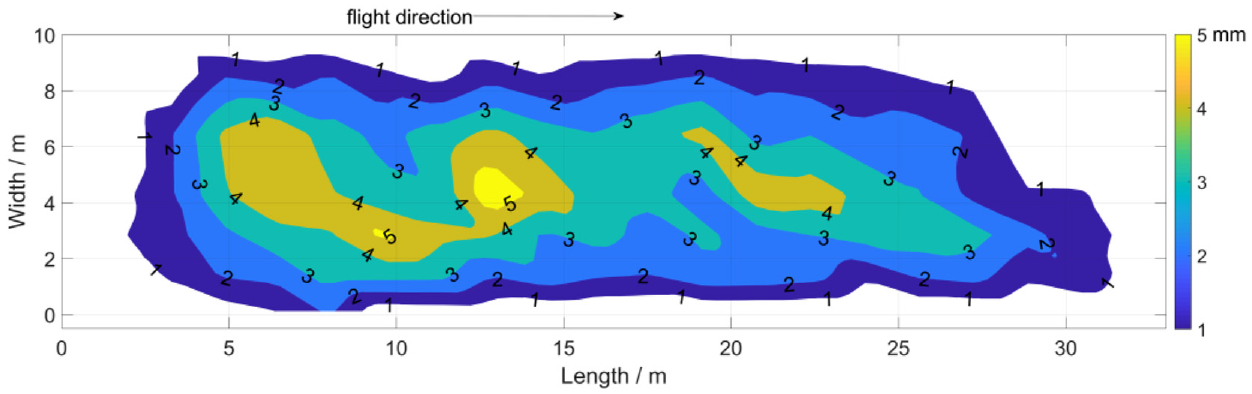
Distribution of fire-extinguishing agent by helicopter spray at 20 km/h flight speed and 32 m height.
Fire-extinguishing tests
Fire-extinguishing performance comparison of non-uniform fire scenes
First, a test in which the wood cribs were set to combustion without any fire extinguishing was carried out, for the purposes of determining the pre-combustion time for the fire-extinguishing spray helicopter for the first time, determining the combustion time of the wood cribs, and calculating the spray times of the fire-extinguishing bucket during combustion. Figure 6 shows the temperature curve of the wood cribs on non-uniform fire scenes. The temperature curves collected by the thermocouples revealed that, after fire was set to ignite the oil pan, the 100# aviation gasoline in the oil pan and the wood cribs started to burn violently, releasing gigantic amounts of energy, and the temperature curves increased rapidly and reached their peak at around 90 s. At around 115 s into the test, because the ignition fuels in the oil pan were used up, the measured temperatures of the thermocouples at all heights dropped, and the wood crib entered the phase of free combustion. Relatively stable combustion continued for about 180 s, during which the combustion of the wood cribs was characterized by relative temperature stability. The temperature curves of the Crib#1 and Crib#3 wood crib fires remained in the stable combustion phase from 250 to 900 s, after which the combustion entered an attenuation phase; the temperature curve of the Crib#2 wood crib fire remained in the stable combustion phase from 300 to 1000 s, with the maximum temperature maintained at around 1000 °C, after which combustion entered an attenuation phase, and the measured temperatures at the thermocouples dropped slowly. After 1300 s into the test, a few wooden strips fell off due to loss of support upon carbonization, causing the wood cribs to lose their original form. Therefore, it was determined that the time for the helicopter to spray the first bucket of extinguishing agent should be 330 s, the interval for spraying the extinguishing agent should be 210 s, seven buckets of extinguishing agent should be sprayed onto each fire scene, and the total time consumed should be about 1590 s.
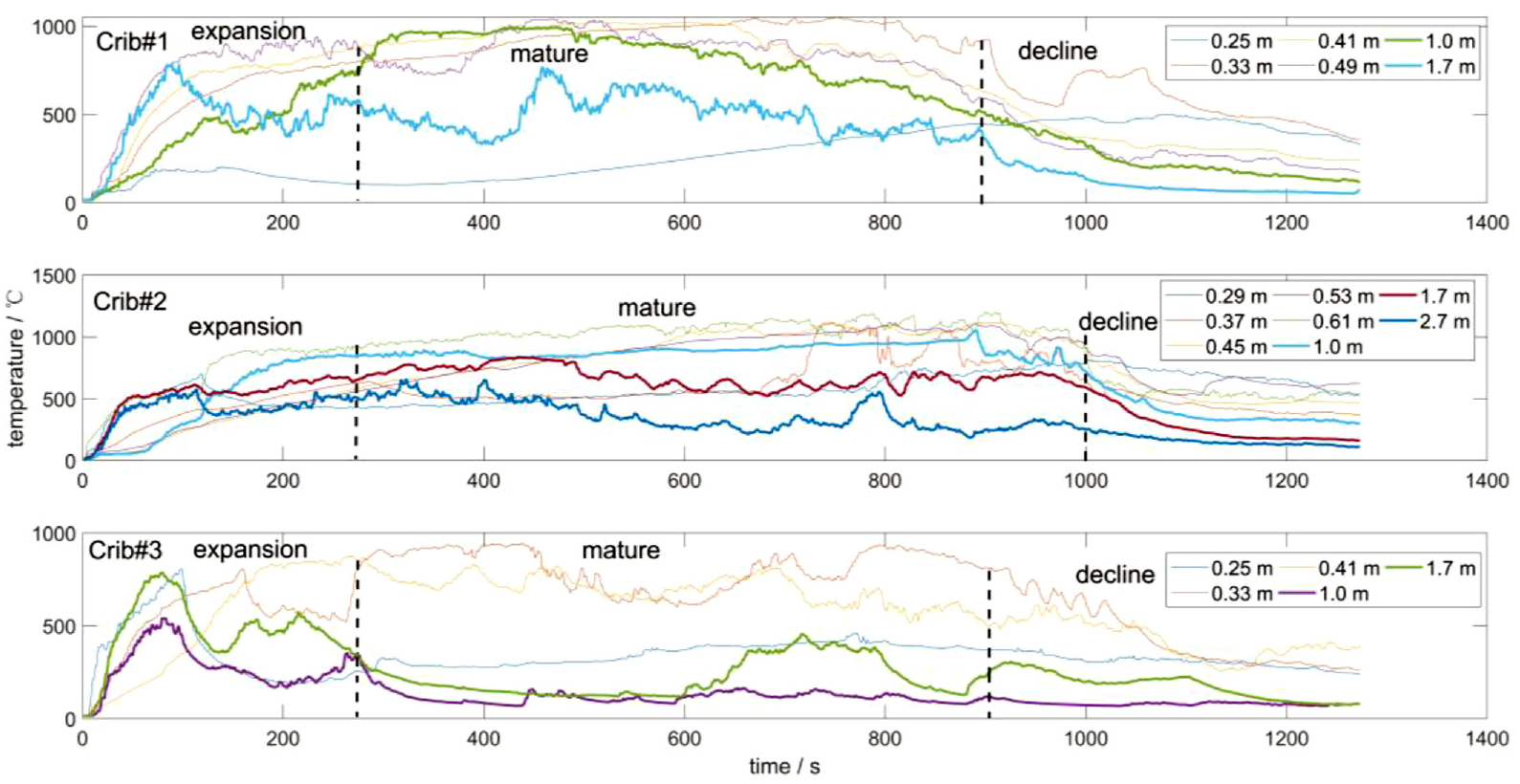
Temperatures of wood crib thermocouples in non-uniform fire without any fire-extinguishing measures. Height of thermocouples: values of the legend, top right of each figure, ground as zero-reference plane. Thick lines show thermocouples above wood cribs; thin lines show thermocouples inside wood cribs.
Because the spraying of extinguishing agent by helicopter is influenced by the wind field, flight crew control, and many other factors, it is difficult to guarantee exact and consistent spraying status. To create an intuitive description of the extinguishing agent’s coverage of the wood crib fire when the helicopter sprays extinguishing agent, overlapping subgraphs between the extinguishing agent and the non-uniform fire scenes Crib#1, Crib#2, Crib#3, and the continuously uniform fire scene Crib#4 were added. To see the fire scenes and the track of the extinguishing agent clearly, the area around the wood cribs was expanded by approximating the coverage area of the extinguishing agent by an oval. When extinguishing fire on non-uniform fire scenes, the wood crib fire of each water agent coverage overlapping subgraph is represented by Crib#3, Crib#2, and Crib#1 from top to bottom, and when extinguishing fire on the continuously uniform fire scenes, the location of each water agent coverage overlapping subgraph is Array#3, Array#2, and Array#1 of Crib#4 from top to bottom. The second subgraph before each spraying of extinguishing agent, the third subgraph during spraying, and the fourth subgraph of the fire scenes after spraying of extinguishing agent are shown. In particular, the fourth subgraph illustrates the height of open flame after the extinguishing agent sprayed from the helicopter reached the fire scene, shows the effective depth of the extinguishing agent, and reveals re-ignition conditions in the wood crib fire.
As for the temperature curve diagram, the time required by the extinguishing agent to reach the fire scenes is marked by the symbol with an arrowhead on the tail end of a straight line. If the extinguishing agent was sprayed exactly onto the fire scene, then the symbol is solid black; otherwise, the symbol is solid blue. The curve with line width of 0.5 (thin lines) represents the temperatures collected by the thermocouples inside the wood cribs (Crib#1 wood cribs had thermocouples at heights less than 0.49 m, Crib#2 wood cribs had thermocouples at heights less than 0.73 m, and Crib#3 wood cribs had thermocouples at heights less than 0.41 m). The curve with line width of 2.0 (thick lines) represents the temperatures collected by the thermocouples above the wood cribs (Crib#1 wood cribs had thermocouples at heights greater than 0.49 m, Crib#2 wood cribs at heights greater than 0.73 m, and Crib#3 wood cribs at heights greater than 0.41 m).
Generally, the dose of extinguishing agent that was needed to extinguish the wood crib fire completely was used as an index to represent the fire-extinguishing efficiency of each extinguishing agent. However, in this test, pure water (Agent#1), Class AB extinguishing agent (Agent#2), and gel extinguishing agent (Agent#3) failed to extinguish (stopping both flame and smoldering) the wood crib fires. In addition, the helicopter sprayed large amounts of extinguishing agents, and the heavy weight of the extinguishing agent and the quick spraying speed may have made it easier for the wood cribs to collapse. If a wood crib fire failed to be completely extinguished before collapse, then it was concluded that the fire had not been extinguished. Therefore, to manifest the influence of the extinguishing agent on fire-extinguishing performance, average temperature drop magnitude (°C) and average temperature recovery slope (°C/s) (including first a temperature drop and then a rise) caused by the fire-extinguishing sorties (as shown in Tables 5 and 6) were used to manifest the influence of the extinguishing agent on wood crib combustion. The sorties included were those that accurately covered the wood crib fire and sprayed onto the fire before the wood crib collapsed. Sorties that made the wood cribs collapse due to spraying of extinguishing agent or those that achieved complete extinguishing of the wood crib fire were excluded.
Fire-extinguishing sortie calculated index values for non-uniform fire scenes.

Fire-extinguishing sortie calculated index values for continuously uniform fire scenes.

Pure water (Agent#1)
Figure 7 shows the combustion condition of fire scenes in the model that used Agent#1 extinguishing agent from the helicopter bucket to extinguish a non-uniform wood crib fire. Because the wood cribs had collapsed after spraying of the fourth bucket of extinguishing agent, the seventh bucket of Agent#1 extinguishing agent was not sprayed. The Crib#1 and Crib#3 wood crib fire scenes were completely extinguished after spraying of the fourth bucket of Agent#1 extinguishing agent, and the Crib#2 fire scene collapsed after spraying of the fourth bucket of Agent#1 extinguishing agent. Therefore, only the fire-extinguishing process of the first, second, and third buckets of extinguishing agent was considered when calculating the temperature drop and temperature recovery indices. The average temperature drops of Crib#2 wood cribs at heights of 0.29, 0.37, 0.45, 0.53, and 0.61 m were 144, 174, 206, 220, and 430 °C, respectively. This showed that Agent#1 extinguishing agent had a direct effect on the bottom of the 12-layer wood cribs, but that the cooling effect was not as good. The average time intervals required for the minimum temperature to recover to a stable value in the Crib#2 wood cribs after spraying of fire-extinguishing agent at heights of 0.29, 0.37, 0.45, 0.53, and 0.61 m were 18.6, 64.3, 31.6, 52, and 69.3 s, respectively, which were much shorter than the time interval of 210 s before the next helicopter spraying of extinguishing agent. This showed that the fire scene would have recovered to its pre-fire-extinguishing status before the helicopter arrived to carry out the next round of fire extinguishing. Mean temperature recovery rates were 30.0, 5.76, 7.03, 7.01, and 12.6 °C/s, respectively, which might be explained by the relatively poor cooling effect of the Agent#1 extinguishing agent, and the presence of much open flame inside the wood crib after spraying of the extinguishing agent, and the rapid recovery of the wood crib fires under the high-temperature effect of open flame (Figure 8).
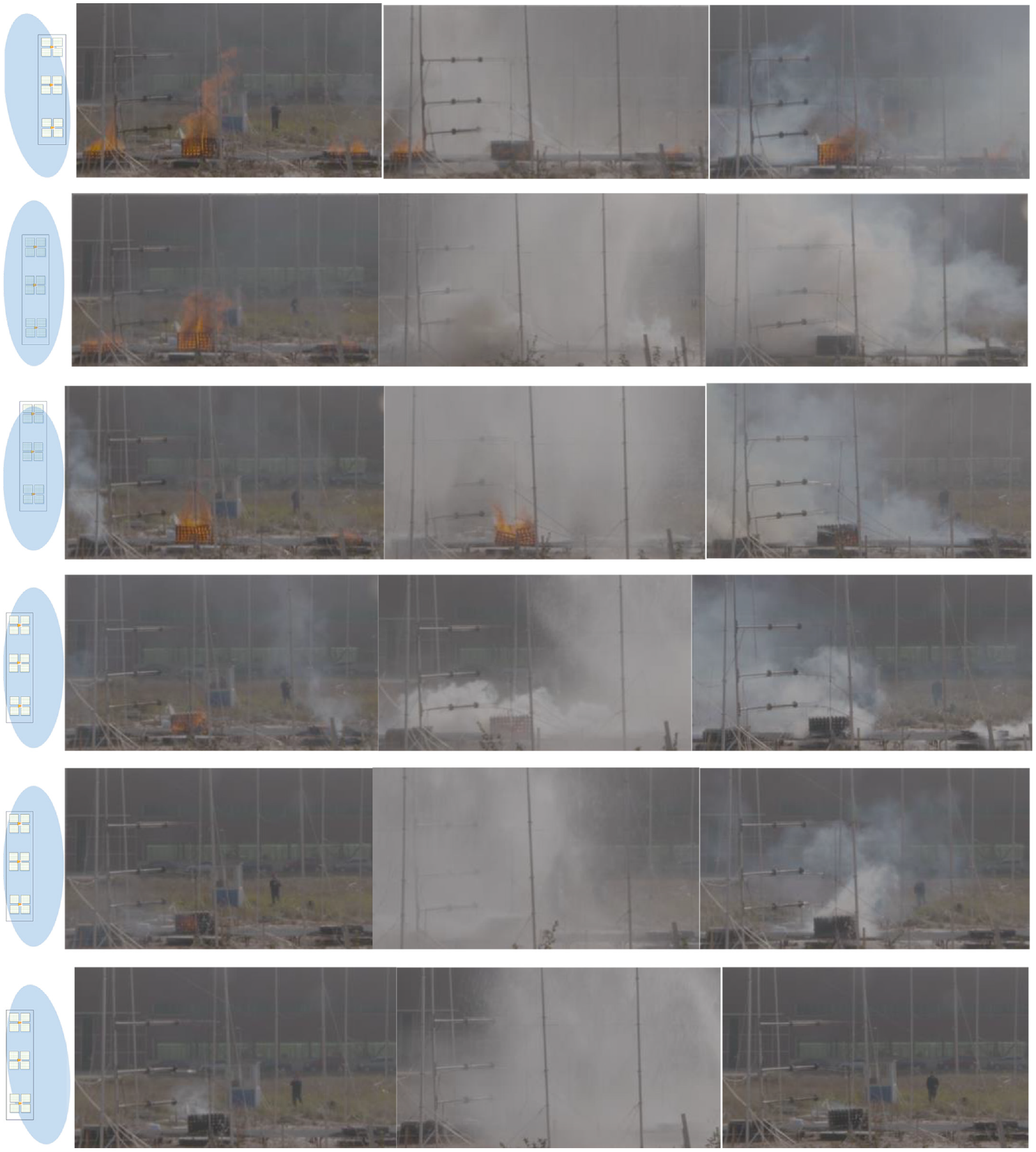
Combustion conditions of fire scenes in the model when using Agent#1 from the helicopter to extinguish non-uniform wood crib fires. Six buckets of extinguishing agent; each row of four subgraphs represents a bucket firefighting process. First subgraph shows overlapping of agent and the fire scenes, Crib#3, Crib#2, and Crib#1 from top to bottom. Second subgraph shows before spraying. Third subgraph shows during spraying. Fourth subgraph shows after spraying.
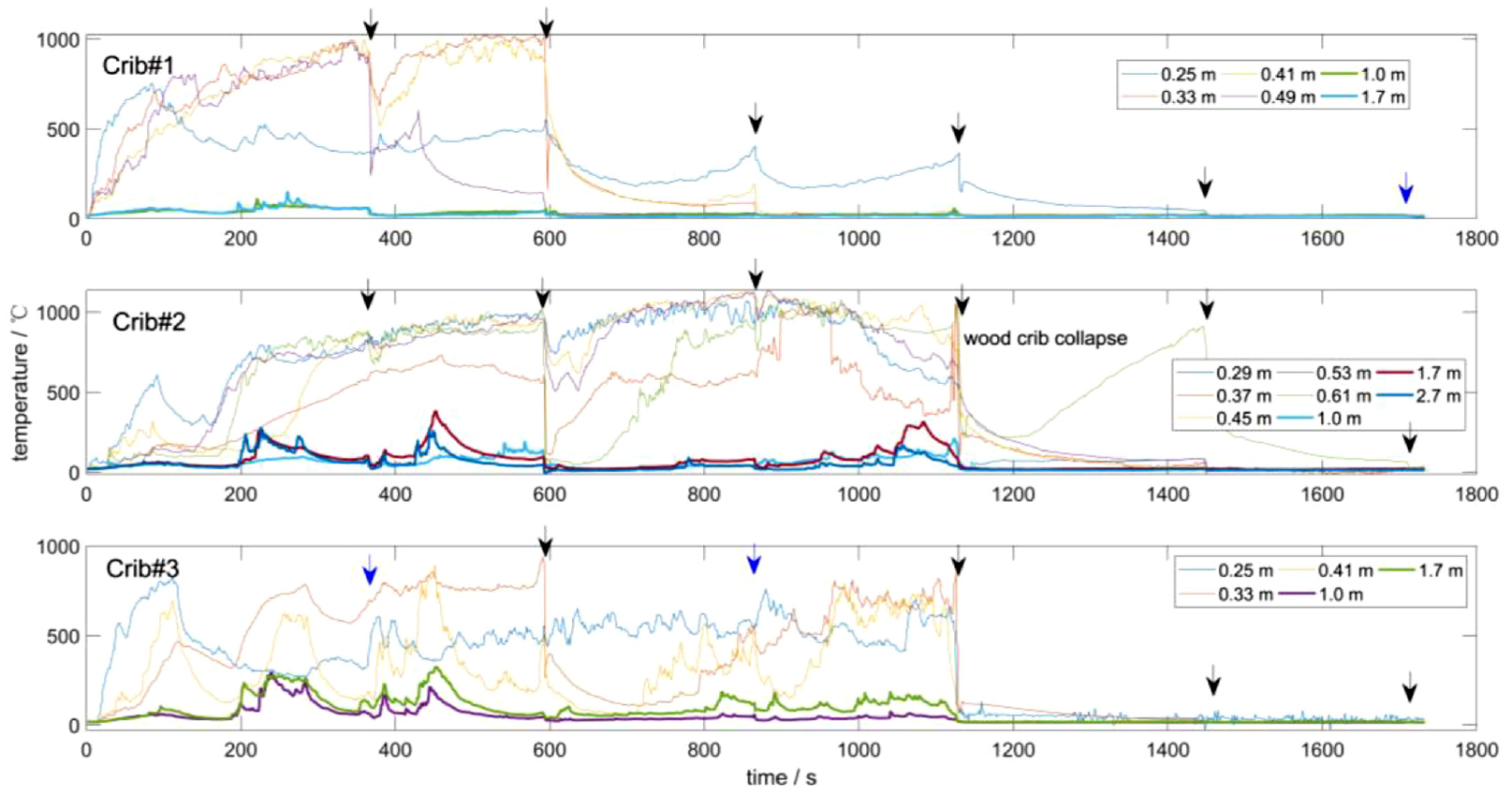
Temperature change curve in the model when using Agent#1 from the helicopter to extinguish non-uniform wood crib fires. Height of thermocouples: values of the legend, top right of each figure, ground as zero-reference plane. Black arrows show direct attack; blue arrows show indirect attack. Thick lines show thermocouples above wood cribs; thin lines show thermocouples inside wood cribs.
Class AB extinguishing agent (Agent#2)
Figure 9 shows the combustion condition of the fire scenes in the model when using the Agent#2 extinguishing agent from the helicopter to extinguish non-uniform wood crib fires. While adding extinguishing agent and flying, the helicopter rotors generated high wind, and the extinguishing agent became foamy and dissipated, meaning that the quantity of extinguishing agent applied was less than with other extinguishing agents. In addition, its coverage area during fire-extinguishing operations was wider than that of the Agent#1, Agent#3, and Agent#4 extinguishing agents, leading to a smaller depth of extinguishing agent per unit area.
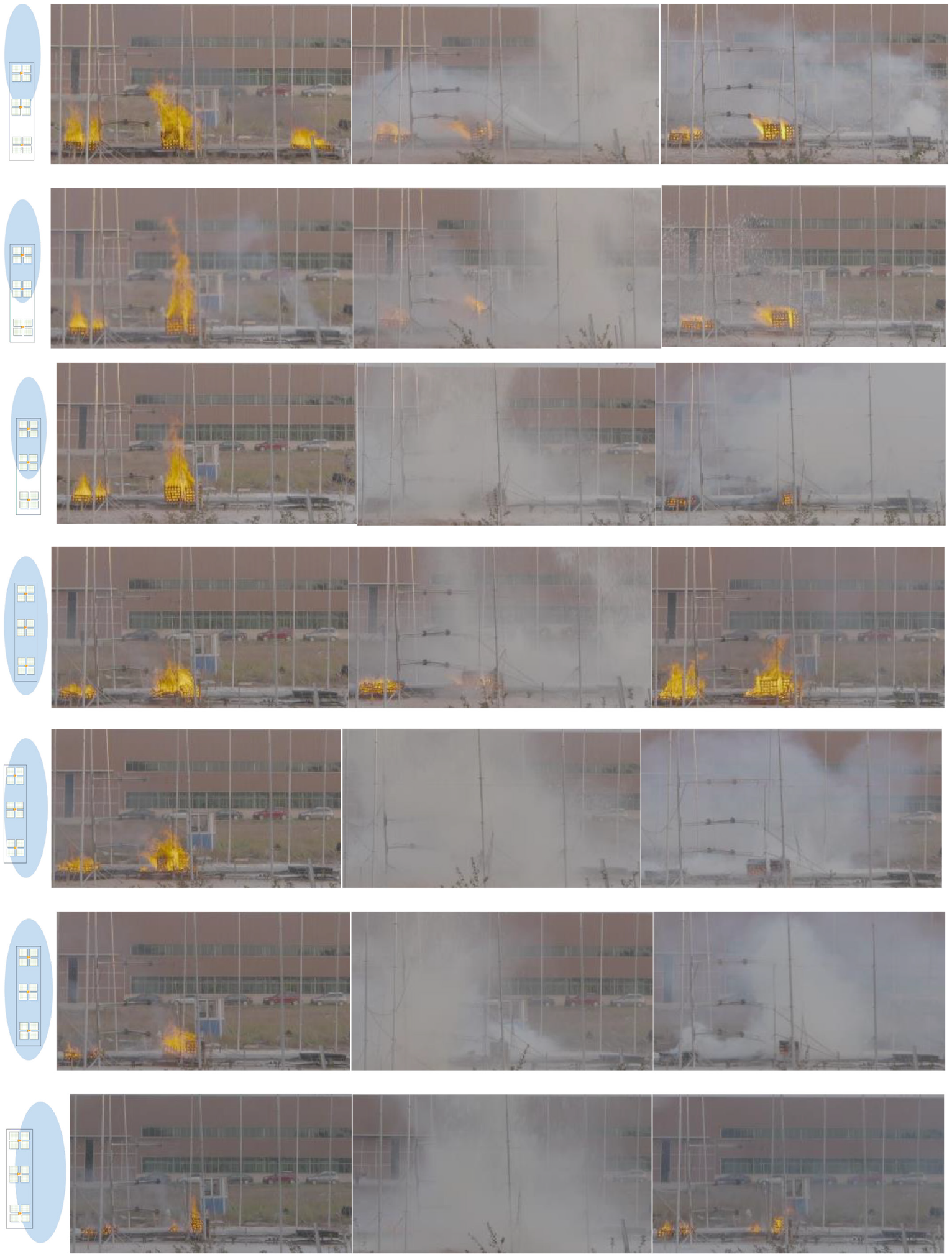
Combustion condition of the fire scenes in the model when using Agent#2 extinguishing agent from the helicopter to extinguish non-uniform wood crib fires. Seven buckets of extinguishing agent were used, and each row of four subgraphs represents a bucket firefighting process. First subgraph shows overlapping of agent and the fire scenes, Crib#3, Crib#2, and Crib#1 from top to bottom. Second subgraph shows before spraying. Third subgraph shows during spraying. Fourth subgraph shows after spraying.
The temperature curve in Figure 10 reveals that when spraying the 4-layer wood cribs, the fire was extinguished in a single operation without re-ignition. The fire-extinguishing video shows that the first bucket of extinguishing agent did not cover the Crib#2 fire scene and that the Crib#2 fire scene collapsed after spraying of the sixth bucket of Agent#2 extinguishing agent; therefore, only the second, third, fourth, and fifth buckets of extinguishing agent were considered when calculating the temperature drop and temperature recovery indices. The average temperature drops of the Crib#2 wood cribs at heights of 0.29, 0.37, 0.45, 0.53, and 0.61 m were 294, 378, 301, 450, and 375 °C, respectively. This showed that the Agent#2 extinguishing agent had a direct effect on the bottom of the 12-layer wood cribs and that the cooling effect was better than that of the Agent#1 extinguishing agent. The average time intervals required for the minimum temperature to recover to a stable value in the Crib#2 wood cribs after spraying of fire-extinguishing agent at heights of 0.29, 0.37, 0.45, 0.53, and 0.61 m were 32.5, 55, 38.8, 98.3, and 46.7 s, respectively. These intervals were much shorter than the time interval of 210 s before the next helicopter spraying of extinguishing agent, showing that the fire scene would have recovered to its pre-fire-extinguishing status before the helicopter arrived to carry out the next round of fire extinguishing. The mean temperature recovery rates were 4.29, 5.13, 2.81, 4.67, and 8.88 °C/s, respectively. These rates were lower than with the Agent#1 extinguishing agent, which might have been due to the general anti-re-ignition effect of the Agent#2 extinguishing agent.

Temperature change curve in the model when using Agent#2 extinguishing agent from the helicopter to extinguish non-uniform wood crib fires. Height of thermocouples: values of the legend, top right of each figure, ground as zero-reference plane. Black arrows show direct attack; blue arrows show indirect attack. Thick lines show thermocouples above wood cribs; thin lines show thermocouples inside wood cribs.
Gel extinguishing agent (Agent#3)
Figure 11 shows the combustion condition of the fire scenes in the model when using the Agent#3 extinguishing agent from the helicopter to extinguish non-uniform wood crib fires. The Crib#1 wood crib fire scene was completely extinguished after spraying of the fourth bucket of Agent#3 extinguishing agent, the Crib#3 wood crib fire scene was completely extinguished after spraying of the first bucket of Agent#3 extinguishing agent, the Crib#2 fire scene collapsed after spraying of the sixth bucket of Agent#1 extinguishing agent, and the fifth bucket of Agent#3 extinguishing agent failed to cover the fire scene. Therefore, only the first, second, third, and fourth buckets of extinguishing agent were considered when calculating the temperature drop and temperature recovery indices. The average time intervals required for the minimum temperature to recover to a stable value in the Crib#2 wood cribs after spraying of fire-extinguishing agent at heights of 0.29, 0.37, 0.45, 0.53, and 0.61 m were 122, 55.6, 136.7, 112, and 121.2 s, respectively. These values were relatively close to the time interval of 210 s before the next helicopter spraying of extinguishing agent, especially because the temperature recovery time of the wood crib surfaces where the Agent#3 extinguishing agent adhered was greater than 180 s. The average temperature recovery rates were 1.85, 7.39, 0.96, 3.02, and 2.88 °C/s, respectively, mainly because the Agent#3 extinguishing agent had a structural protection effect (Figure 12).

Combustion condition of fire scenes in the model when using Agent#3 extinguishing agent from the helicopter to extinguish non-uniform wood crib fires. Seven buckets of extinguishing agent were used; each row of four subgraphs represents a bucket firefighting process. First subgraph shows overlapping of agent and the fire scenes, Crib#3, Crib#2, and Crib#1 from top to bottom. Second subgraph shows before spraying. Third subgraph shows during spraying. Fourth subgraph shows after spraying.

Temperature change curve in the model when using Agent#3 extinguishing agent from the helicopter to extinguish non-uniform wood crib fires. Height of thermocouples: values of the legend, top right of each figure, ground as zero-reference plane. Black arrows show direct attack; blue arrows show indirect attack. Thick lines show thermocouples above wood cribs; thin lines show thermocouples inside wood cribs.
When using gel for fire extinguishing, it was evident that the temperatures collected by the thermocouples were highly relevant. For example, for the thermocouple at a height of 0.29 m on the Crib#2 fire scene, the temperature drop magnitude after spraying of the extinguishing agent was 871 °C, and the temperature recovery rate was 2.26 °C/s, whereas the temperature drop magnitudes after the second and third buckets were only 145.7 and 87 °C, respectively, and the temperature recovery rates were 0.60 and 2.68 °C/s, respectively. For the thermocouple at a height of 0.45 m on the Crib#2 fire scene, the temperature drop magnitude after spraying of extinguishing agent was 774.6 °C, and the temperature recovery rate was 0.43 °C/s, but the temperature drop magnitudes after the second and third buckets were only 104 and 101.8 °C, respectively, and the temperature recovery rates were 0.97 and 1.47 °C/s, respectively. For the thermocouple at a height of 0.37 m on the Crib#2 fire scene, the temperature drop magnitude after spraying of the extinguishing agent was 209.6 °C, and the temperature recovery rate was 5.80 °C/s, but the temperature drop magnitudes after the second and third buckets were only 310.7 and 378.5 °C, respectively, and the temperature recovery rates were 5.73 and 10.92 °C/s, respectively. It was speculated by the author that these significant differences were observed because the wood cribs near the thermocouples at heights of 0.29 and 0.45 m were in direct contact with and covered by the gel extinguishing agent, which had a structural protection effect. Therefore, the temperatures collected by the thermocouples recovered slowly, causing a small temperature drop when the helicopter next sprayed the extinguishing agent. However, the wood cribs near the thermocouples at a height of 0.37 m experienced little distribution of gel extinguishing agent, which failed to provide structural protection and flame-retardant effect, and therefore recovery was quick.
Moreover, the author observed that when gel extinguishing agent was used, the temperature drop lasted a long time, mainly because the gel has great viscosity and slides slowly downward. Therefore, as the gel extinguishing agent moved from the top to the bottom of the wood cribs, it could have had a continuous cooling and flame-retardant effect at the bottom of the fire scene. This could have led to the temperature drop magnitudes in Crib#2 wood cribs at heights of 0.29, 0.37, 0.45, 0.53, and 0.61 m of 369, 300, 326, 400, and 484 °C, respectively.
Class A extinguishing agent (Agent#4)
Figure 13 shows the combustion condition of fire scenes in the model when using Agent#4 extinguishing agent from the helicopter to extinguish a non-uniform wood crib fire. The Crib#1 wood crib fire scene was completely extinguished after spraying the first bucket of Agent#4 extinguishing agent, the Crib#3 wood crib fire scene was completely extinguished after spraying the third bucket of Agent#4 extinguishing agent, the Crib#2 fire scene was extinguished after spraying the fifth bucket of Agent#4 extinguishing agent, and the first, second, and fourth buckets of the extinguishing agent failed to be well sprayed onto the wood cribs, but were still considered. Therefore, fire extinguishing with the first, second, third, and fourth buckets of extinguishing agent was considered when calculating the indices. The average temperature drops of the Crib#2 wood cribs at heights of 0.29, 0.37, 0.45, 0.53, and 0.61 m were 369, 418, 339, 446, and 632 °C, respectively. This showed that Class A extinguishing agent had a good cooling effect and could have a direct effect on the bottom of the wood crib fire. The average temperature recovery slopes at corresponding heights were 3.58, 1.8, 2.53, 2.65, and 5.12 °C/s, respectively, which might have been attributable to the good cooling effect of the extinguishing agent, which caused the temperature to recover slowly. The temperature recovery slopes of the Crib#3 wood cribs at heights of 0.25, 0.33, and 0.41 m were generally less than those of Crib#2, and the temperature recovery time was as long as 210 s. When the temperature recovery rates of the Crib#3 and Crib#2 wood cribs upon spraying of the Class A extinguishing agent (Agent#4) were compared, it was apparent that the temperature recovery time of Crib#3 after spraying the first and second buckets of Agent#4 extinguishing agent exceeded 210 s, from which it can be concluded that the thicker the combustibles, the faster will be the temperature recovery rate (Figure 14).

Combustion condition of fire scenes in the model when using Agent#4 extinguishing agent from the helicopter to extinguish non-uniform wood crib fires. Seven buckets of extinguishing agent were used; each row of four subgraphs represents a bucket firefighting process. First subgraph shows overlapping of agent and the fire scenes, Crib#3, Crib#2, and Crib#1 from top to bottom. Second subgraph shows before spraying. Third subgraph shows during spraying. Fourth subgraph shows after spraying.

Temperature change curve in the model when using Agent#4 extinguishing agent from the helicopter to extinguish non-uniform wood crib fires. Height of thermocouples: values of the legend, top right of each figure, ground as zero-reference plane. Black arrows show direct attack; blue arrows show indirect attack. Thick lines show thermocouples above wood cribs; thin lines show thermocouples inside wood cribs.
Fire-extinguishing performance comparison of continuously uniform fire scenes
Because the Agent#1, Agent#2, Agent#3, and Agent#4 extinguishing agents could extinguish 4-layer wood crib fires of wooden strips, and to better capture the difference in fire-extinguishing performance of the extinguishing agents, a wood crib fire of six layers of wooden strips was selected as the fire-extinguishing target for continuously uniform fire scenes.
Pure water
Figure 15 shows the combustion condition of fire scenes in the model when using Agent#1 extinguishing agent from the helicopter to extinguish a continuously uniform wood crib fire. The test data show that when using pure water to extinguish a 6-layer wood crib fire, the average temperature drops at heights of 0.25, 0.37, and 0.41 m were 350, 339, and 457 °C, respectively, and the average temperature recovery slopes were 2.97, 3.12, and 4.29 °C/s, respectively. Five buckets of water were required to extinguish the fires, especially for some fire scenes between Array#2 and Array#3. Because there was relatively less water in the front and rear ends of the spray pattern, the fire scenes failed to be extinguished rapidly, and the first through fourth buckets of pure water generated large amounts of white vapor upon spraying. After each spraying of the extinguishing agent, the temperature dropped rapidly and then increased slowly, showing that the water could reach the location of the thermocouple at the bottom, at a height of 0.25 m, where it could play a role (the corresponding depth of combustible material was 0.24 m). However, for some fire scenes between Array#1 and Array#2, the first bucket of pure water cooled the fire scene to below 200 °C (Figure 16).

Combustion condition of fire scenes in the model of using Agent#1 extinguishing agent from helicopter to extinguish a continuously uniform wood crib fire. Six buckets of extinguishing agent were used; each row of four subgraphs represents a bucket firefighting process. First subgraph shows overlapping of agent and the fire scenes, Array#3, Array#2, and Array#1 of Crib#4 from top to bottom. Second subgraph shows before spraying, Array#3, Array#2, and Array#1 of Crib#4 from right to left. Third subgraph shows during spraying, Array#3, Array#2, and Array#1 of Crib#4 from right to left. Fourth subgraph shows after spraying, Array#3, Array#2, and Array#1 of Crib#4 from right to left.

Temperature change curve in the model using Agent#1 extinguishing agent from the helicopter to extinguish a continuously uniform wood crib fire. Height of thermocouples: values of the legend, top right of each figure, ground as zero-reference plane. Black arrows show direct attack; blue arrows show indirect attack. Thick lines show thermocouples above wood cribs; thin lines show thermocouples inside wood cribs.
Class A extinguishing agent
Figure 17 shows the combustion condition of the fire scenes in the model when using Agent#4 extinguishing agent from a helicopter to extinguish a continuously uniform wood crib fire. The test data show that, when using Agent#4 extinguishing agent to extinguish a 6-layer wood crib fire, the average temperature drops at heights of 0.25, 0.37, and 0.41 m were 622, 845, and 822 °C, respectively. Only two buckets of water were required to extinguish the fire, and after the first bucket of extinguishing agent was sprayed, the temperature of the wood crib fire dropped throughout the crib to less than 400 °C, without open flame, and continued to drop steadily. When the second bucket of extinguishing agent was sprayed onto the wood crib, there was no white vapor, and the author even deemed that only one bucket of extinguishing agent was enough to extinguish such a continuously uniform fire (Figure 18).

Combustion condition of the fire scenes in the model when using Agent#4 extinguishing agent from a helicopter to extinguish a continuously uniform wood crib fire. Two buckets of extinguishing agent were used; each row of four subgraphs represents a bucket firefighting process. First subgraph shows overlapping of agent and the fire scenes, Array#3, Array#2, and Array#1 of Crib#4 from top to bottom. Second subgraph shows before spraying, Array#3, Array#2, and Array#1 of Crib#4 from right to left. Third subgraph shows during spraying, Array#3, Array#2, and Array#1 of Crib#4 from right to left. Fourth subgraph shows after spraying, Array#3, Array#2, and Array#1 of Crib#4 from right to left.

Temperature change curve in the model when using Agent#4 extinguishing agent from a helicopter to extinguish a continuously uniform wood crib fire. Height of thermocouples: values of the legend, top right of each figure, ground as zero-reference plane. Black arrows show direct attack; blue arrows show indirect attack. Thick lines show thermocouples above wood cribs; thin lines show thermocouples inside wood cribs.
Discussion and analysis
A summary of the indices of average temperature drop magnitude and average temperature recovery slope is provided in Tables 7 and 8.
Fire-extinguishing performance index summary for non-uniform wood crib fire scenes.

Fire-extinguishing performance index summary of Crib#4 on the continuously uniform wood crib fire scenes.

On the whole, with a flight altitude of 32 m and a flight speed of 20 km/h with 660 kg extinguishing agent, when using the helicopter to extinguish the wood crib fire, the temperature recovery rate at a height of 0.29 m was generally higher than at heights of 0.37 and 0.45 m, and the height of 0.37 m experienced obvious cooling, but slow temperature recovery rate. Therefore, the effective depth of extinguishing agent was 0.36 m, which was the height difference between 0.37 m and the top height of Crib#2 (0.73 m).
The above figures and curves have shown that the extinguishing agents had different effects on combustibles with different thicknesses. In the 4-layer wood cribs, the extinguishing agent could penetrate into the bottom layer from the first layer on the top. Therefore, when the extinguishing agent sprayed from the helicopter arrived at the wood cribs, the five thermocouples in the TC#3 group were cooled down very rapidly to less than 400 °C (the ignition point of wood is 200–290 °C). Pure water, gel extinguishing agent, Class A extinguishing agent, and Class AB extinguishing agent could all extinguish 4-layer wildfires rapidly. In the 6-layer wood crib fire, the extinguishing agent could not penetrate into the bottom layer directly, and therefore pure water and Class AB extinguishing agents had difficulty in extinguishing a 6-layer wood crib fire all at once, but once the helicopter had sprayed the extinguishing agent, the five thermocouples in the TC#3 group were cooled down very rapidly to less than 400 °C (the ignition point of wood is 200–290 °C).
Looking at specific types of extinguishing agents, pure water (Agent#1) was an efficient natural extinguishing agent, but it failed to extinguish the 12-layer Crib#2 wood crib fire rapidly. Moreover, the Agent#1 extinguishing agent had only a fire-extinguishing function, but could not retard the flame, and therefore temperature recovery was quick. Class AB (Agent#2) extinguishing agent had a sparse distribution per unit area because the extinguishing agent had poor wind resistance, but a wider distribution area than Agent#1, Agent#3, and Agent#4. The tests showed that the Agent#2 extinguishing agent had a better fire-extinguishing capacity and anti-temperature recovery capacity than the pure water (Agent#1) extinguishing agent. The reason for this might have been that first, Agent#2 generated copious foam, which could block off oxygen and heat transmission within a certain time; second, it included surface-active ingredients and strong mobility and could penetrate into the lower surface and internal portions of the wood cribs. Gel (Agent#3) extinguishing agent had good water absorption capacity, but poor mobility, which gave it a high water-utilization rate. One of its principles of operation was that superabsorbent particles absorbed water (hundreds of times their own weight) in a physio-chemical process called hydration, in which millions of tiny superabsorbent particles became water-filled “bubbles” that stacked on top of each other, which greatly enhanced the heat protection performance of the extinguishing agent. Another purpose of this was to prevent the extinguishing agent from vaporizing in the overheated air above the wood crib fire and being carried away by the high-temperature smoke plume and gas. The adhesive property of gel (Agent#3) extinguishing agent slowed down evaporation, thus enabling more products to reach the fire source by means of hot air. 30 When using gel extinguishing agent for spraying by helicopter, decisions should be made based on two aspects: the amount of extinguishing agent must be sufficient for complete fire extinguishing, and when fire scenes are burning at peak intensity (such as the 12-layer wood crib fire in full combustion), if the gel (Agent#3) extinguishing agent fails to cover all combustion points, its fire-extinguishing performance will be relatively poor. When the amount of extinguishing agent was more than that required for fire extinguishing (i.e. at a low-intensity fire scene such as the 4-layer wood crib fire), the agent could form gels on the surfaces of the wooden strips to wrap them, thus preventing the combustibles from re-igniting. As an efficient extinguishing agent with flame-retardant and fire-extinguishing capacity, Class A (Agent#4) extinguishing agent also showed a relatively good effect in fire extinguishing by helicopter. The main reasons were as follows: first, it absorbed 48 kJ/mol more than pure water at the time of (NH4)2CO3 decomposition and evaporated the water for quick cooling, second, it generated NH3, CO2, and other inert gases to isolate the fire from oxygen, and third, the phosphoric, metaphosphoric, and polymetaphosphoric acids produced in the chemical reactions reacted with carbonaceous compounds, generating a dense flame-retardant coating over the surface of the combustible materials, effectively delaying re-ignition, and reducing fire intensity after re-ignition.31,32
According to the analysis in Konishi et al., 19 making operation plans for fire suppression involves choosing the size of helicopters, their helibucket volume, and flight conditions such as airspeed, flight altitude, and water drop intervals for firefighting. When the helicopter model, fire-extinguishing equipment, and time interval (the number of helicopters) were kept constant, the efficiency of the extinguishing agent was also a key factor for fire extinguishing. This is shown in Figure 19, where ΔTi refers to the temperature drop of extinguishing agent i, ki refers to the temperature recovery rate of extinguishing agent i, Tmat refers to the temperature at which the combustible was in stable combustion, and Tign refers to the ignition point of the combustible. The Extinguishant A had a small temperature drop and a rapid temperature recovery rate, meaning that it could recover to Tmat before the arrival of the next round of fire extinguishing. The Extinguishant B had an excellent temperature drop magnitude and a slow temperature recovery rate, meaning that the next round of fire extinguishing arrived before the temperature recovered to Tmat. Measures to improve the effectiveness of on-site forest fire suppression include improving the cooling efficiency of the helicopter fire-extinguishing device, increasing the temperature difference before and after fire extinguishing, forming structural protection for combustibles, reducing the temperature recovery rate of fire scenes, lengthening the re-ignition time of fire scenes, and shortening the time interval between fire-extinguishing sorties.

Temperature changes in wood crib fires under the same firefighting conditions.
Application
Tens of tripping accidents occur on transmission lines due to forest fires in the Hunan area every year. However, wildfires near electrical transmission lines are often at high altitude and in complex terrain, and it is hard for ground-based fire-extinguishing devices to reach them. Small-area fires near transmission lines can also result in line trips; therefore, light helicopter fire-extinguishing devices can be used for rapid fire extinguishing in such areas. For different vegetation types, different bucket fire-extinguishing devices and fire-extinguishing strategies can be used.10,11,33 For example, the vegetation in northern Hunan Province is mainly couch grasses and bushes, and bucket fire-extinguishing devices with a relatively wide spraying area can be used, or the flight altitude and speed of the helicopter fire-extinguishing devices can be increased. In contrast, in central and southern Hunan Province, mainly ladder combustibles like trees and shrubs are present; in this case, bucket fire-extinguishing devices should be concentrated in a small area, and extinguishing agents should be used.
To increase the efficiency of helicopters in extinguishing electrical transmission line wildfires, the appropriate amount of extinguishing agent should be added; the better the extinguishing agent’s performance, the more quickly wildfires will be extinguished. If using Class AB extinguishing agent to extinguish wildfires, it is not suitable to add extinguishing agent by means of premixing, but instant mixing should rather be used to reduce consumption. To conveniently provide a helicopter fire-extinguishing device with extinguishing agent, a two-way automatic addition method for extinguishing agent has been proposed.
The bucket is a helicopter fire-extinguishing device generally used around the world. Existing helicopter buckets all use pure water for fire extinguishing, but pure water has very high evaporation capacity and can easily allow re-ignition, and its fire-extinguishing efficiency is extremely low.
To address the problem that the flying distance can be shortened due to the heavy weight and large volume of the extinguishing agent, a two-way flow structure was designed (Figure 20) expressing the following principles:
The bucket obtains water from a natural water source, and the water pump in the bucket pumps the natural water into the extinguishing-agent part of the integrated tank in the helicopter belly through the liquid return pipe.
A mixing system in the extinguishing-agent tank is started to effectively mix the raw materials of the extinguishing agent and the natural water.
The water pump installed in the integrated tank pumps the well-mixed extinguishing agent into the bucket through the downward flow pipe.

Principle of fire-extinguishing agent addition.
Regarding the leakage risk of extinguishing agent, a 2-layer leak-proof structure was designed (Figure 21), where the internal layer was the extinguishing-agent tank and the external layer was the integrated tank, which could bear 5 MPa hydraulic pressure without leakage, and all pipes and interfaces were encapsulated inside. As for the external extinguishing-agent addition device, this device switched water and extinguishing agent by means of the water inlet and water outlet connections. A moisture alarm was installed inside the integrated tank, and once leakage was detected in the extinguishing-agent tank, it could activate sound and light alarms automatically and shut down power to the water pump system.

Structure of fire-extinguishing agent addition device.
On this basis, the extinguishing-agent addition device in the helicopter does not need to carry liquid water, but only light solid raw materials, greatly reducing load and volume for the helicopter. For example, when the weight ratio between solid raw extinguishing agent and water is 1:5, then the load requirement in the helicopter for extinguishing agent in this scheme is only one-sixth that in a conventional scheme that directly adds water to the extinguishing agent. At the time of fire extinguishing, the ratio between water and liquid extinguishing agent is 3%, and the loaded weight of solid extinguishing agent is 90 kg. With the technical scheme proposed in this article, six K32 helicopters can be provided with 3 tons of mixed agent for fire extinguishing, or 18 H125 helicopters with 800 kg for fire extinguishing.
An extinguishing-agent adding device for a helicopter with strong generality was developed 34 and is shown in Figure 22. Fire-extinguishing tests and on-site application showed that, in combination with Agent#4 extinguishing agent, fire-extinguishing efficiency was greatly improved.
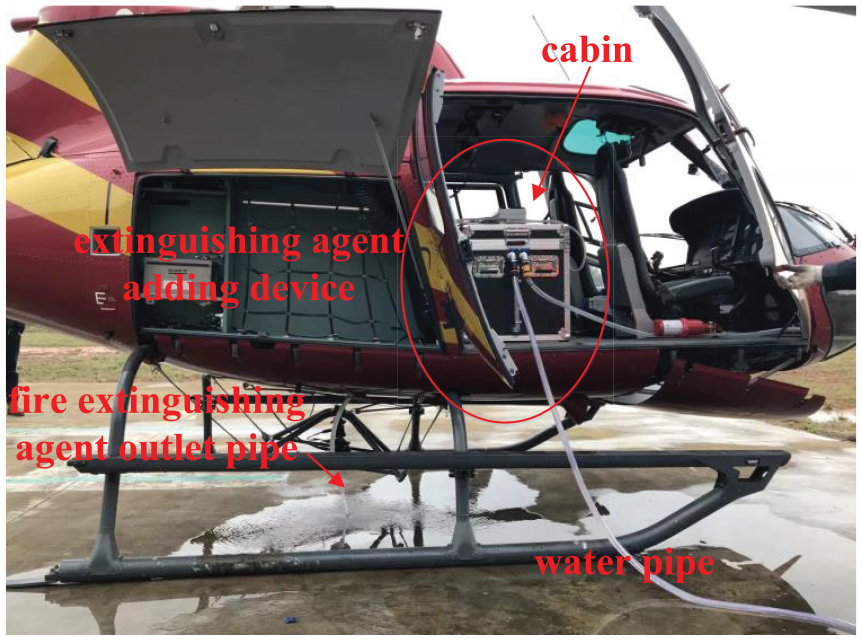
Installation diagram of automatic extinguishing-agent addition device for helicopter bucket.
Based on the conclusions of this article, during the Spring Festival and Qingming Festival of 2021, an accurate allocation of helicopters in Lengshuijiang City, Loudi, Hunan, and Ningyuan Counties was created. In Yongzhou, wildfires were discovered in a timely fashion, and 11 wildfires were extinguished by helicopter, with an average time of only 20 min from wildfire discovery to extinguishing. As shown in Table 9, safe and quick fire extinguishing, as well as zero transmission line trips due to wildfires during the Spring Festival, has again been realized. In particular, at 15:20 on 14 February, a helicopter discovered a wildfire along the 500-kV Jinmin Line II #42–#44 in Lengshuijiang City during a patrol inspection, with the area of the fire scene being about 600 m2. There were dense couch grasses, shrubs, and other ladder combustibles alongside, and the wildfire spreads quickly down the transmission line corridor. The helicopter took water from the surrounding reservoir and extinguished the wildfire completely with eight buckets of Agent#4 extinguishing agent, as shown in Figures 23 and 24, for a fire-extinguishing time of 44 mins. Clearly, the tripping risk of important lines in the Hunan power grid due to wildfires has been almost reduced.
Helicopter firefighting during the Spring Festival in 2021.


Wildfire fighting on the 500-kV Jinmin Line #42–#44 by helicopter.

Wildfire monitoring and fighting on the 500-kV Jinmin Line #42–#44 by helicopter.
Summary
An H125 helicopter was used in this study to carry out fire-extinguishing tests with 660 kg of different types of extinguishing agent, and the degree of effectiveness of different extinguishing agents on wood crib fires was observed. The following conclusions were drawn:
For wood crib fires in stable combustion, the effective depth of a single spraying of extinguishing agent was 0.36 m; combustibles deeper than 0.36 m required multiple helicopters loads of extinguishing agent for cooling and fire extinguishing.
With average temperature drop magnitude and average temperature recovery rate slope after spraying extinguishing agent on wood crib fire scenes as the indices, the efficiency of the extinguishing agents was assessed. The assessment results were that in terms of temperature drop magnitude, Class A extinguishing agent > gel extinguishing agent > Class AB extinguishing agent > pure water, whereas in terms of temperature recovery rate, gel extinguishing agent > Class A extinguishing agent > Class AB extinguishing agent > pure water.
An automatic helicopter bucket extinguishing-agent addition method was proposed to add Class A extinguishing agent to H125 helicopters to be used to extinguish wildfires near transmission lines in Yongzhou, Hengyang, and other regions of Hunan Province, which has greatly improved on-site extinguishing efficiency for wildfires.
In this study, only one gel agent was used; the impact of wind generated by the helicopter and external cross-winds on the distribution of agent has not been studied. This method can be studied more thoroughly in future experiments.
Footnotes
Acknowledgements

Author contributions
J.L. conceived and designed the paper. L.H. and J.L. contributed to the data collection. T.Z. carried out the test and analyzed the data. T.Z. and C.W. wrote the paper.
Declaration of conflicting interests
The author(s) declared no potential conflicts of interest with respect to the research, authorship, and/or publication of this article.
Funding
The author(s) disclosed receipt of the following financial support for the research, authorship, and/or publication of this article: This work was supported by the National Key Research and Development Plan (no. 2016YFC0800104).