







Abstract
This article conducts a dialogue and creates a new synthesis between two of the most influential ontological discourses in the field of sociology: assemblage theory and critical realism. The former proposes a focus on difference, fluidity, and process, the latter a focus on stability and structure. Drawing on and assessing the work of Deleuze, DeLanda, and Bhaskar, we argue that social ontology must overcome the tendency to bifurcate between these two poles and instead develop an ontology more suited to explaining complex social phenomena by accommodating elements of both traditions. Going beyond DeLanda’s recent work, we argue that a concept of causal types must be used alongside a typology of structures to give us an ontology that can sustain sociology’s need for both formation stories and causation stories. We illustrate the necessity and value of our proposed synthesis by discussing MacKenzie’s recent empirical analysis of a high-frequency trading firm.
Social ontologies are systematic accounts of what kinds of phenomena are to be found in the social world and, in relatively abstract or general terms, how they operate. One of the challenges facing any social theorizing that takes ontology as its task is accounting for the inherent and irreducible heterogeneity of social objects (Little 2016). Social science necessarily deals simultaneously with agents, structures, relations, processes, and various other social dynamics. Successive theoretical positions have tried to resolve this problem of ontological complexity by bracketing or collapsing the heterogeneity of the social in one way or another through taking a certain element to be more basic than others; agents, structures, or relations, for example, become the fundamental quanta of social reality, and other elements are redefined accordingly. Historically, this produces a pendulum swing in social theory between alternate resolutions of the problem of heterogeneity and complexity; a certain account becomes fashionable and dominant while others fall out of favor and retreat into the shadows only to be rediscovered later and rise to prominence again. As a result, the favored elements in the ontologies secreted in social theory tend to oscillate in multiple dimensions: between structures and actors, objects and process, materiality and culture, and relations and autonomous essences.
This article focuses on one of these dimensions: the tension between object-focused and process-focused ontologies. This is not to say the other dimensions are unimportant: Their significance is widely discussed in the literature, and indeed we have contributed to those debates ourselves (e.g., Elder-Vass 2010, 2012, 2017; Rutzou 2017). But the object/process divide is less frequently addressed in the mainstream sociological theory literature even though the tension between these two poles is of fundamental importance to understanding the social world.
On the one hand, ontologies of fluidity have stressed the contingency and dynamism of the social world, typically seeing the world as composed of processes rather than objects or structures and often neglecting the need to explain the stabilities of social reproduction (Abbott 2016; Bennett 2010; Coole and Frost 2010; Deleuze and Guattari 1983, 1988). On the other hand, structure-oriented ontologies tend to portray the world as composed of persistent forms, definite boundaries, essences, and consistent causal capacities at the expense of the more chaotic and dynamic aspects of the social world (Bhaskar 1975; Bryant 2011; Harman 2016). This is not to say that either tradition ignores social change or cases of social stability or that either is incapable of explaining social change or stability. Rather, the distinction is that process-oriented ontologies tend to explain social outcomes as being produced by process and theorize structural forces as unstable products of fleeting interactions, whereas structure-oriented ontologies tend to explain social outcomes as being produced by relatively stable structures and see process as secondary.
In response to this problem, we stage an encounter between what we consider to be the most developed and coherent enunciations of the process and structure approaches to social ontology—assemblage theory (DeLanda 2006, 2016; Deleuze and Guattari 1983, 1986, 1988) and critical realism (Archer 1995; Bhaskar 1975, 1979; Elder-Vass 2010). Assemblage theory is a process-oriented ontology driven by what we call the problematic of origins, which forefronts explanations of how things come to be the way they are. Critical realism, by contrast, is a structure-oriented ontology driven by the problematic of causal power, which forefronts explanations of how things have the capacity to influence the world. By comparing, criticizing, reformulating, and elaborating elements of both traditions, we seek to construct a more open and flexible synthesis and one that can address both of these problematics.
The productivity of such an engagement is not a novel idea. Bryant (2011), Coole and Frost (2010), DeLanda (2006, 2011, 2016), and Harman (2016) have either engaged with or indicated their influence by the work of Roy Bhaskar, and on the side of critical realism, Decoteau (2018), Elder-Vass (2008, 2015), Little (2016), and Rutzou (2017) have argued for the need for a productive engagement between these traditions as a means of developing more suitable ontological models for social theory. This practice of making such connections between related but in some respects conflicting schools of thought should be familiar to sociological theorists through examples such as Sewell’s (1992) productive confrontation of the work of Giddens and Bourdieu. Yet, despite these connections having been drawn, a fully coherent engagement and synthesis between assemblage theory and critical realism that unfolds their points of convergence and divergence and demonstrates the benefits a conjunction between them might bring has been lacking. Manuel DeLanda has made the largest steps toward bringing these traditions together, but we argue that his work is hampered by a failure to embrace the realist concept of causal types. Arguing from a broadly critical realist position, but one that is open to the merits of assemblage theory, we advocate a synthesis between the two that combines Bhaskar’s account of stratification, real causal powers and generative mechanisms, the concepts of assemblage, strata and territorialization in the work of Deleuze and Guattari, and DeLanda’s notion of parameters. The result of this encounter, we believe, is an ontology better able to account for the complex and dynamic processes of change and stability within social phenomena.
The place of ontology has always been controversial in social science, but perhaps the most important function of ontology for social researchers is that it directs focus toward some ways of thinking about the phenomena they study and away from others. As a framework for study, ontology can perform both a sensitizing and a regulating role, providing a systematic framework for avoiding improvised, implicit, incoherent, or logically irresponsible hypotheses. Although ontology is often equated with a priori theorizing, this need not be the case. We argue that social ontologies can be evaluated against an empirical criterion: They should encompass all phenomena identified by good empirical studies. This process may seem circular insofar as social research is influenced by ontology and ontology is judged by the findings of social research. Our view, however, is that empirical studies can break out of this circularity when they identify phenomena that challenge their presumptive ontology, secreting either explicit or implicit challenges to the ontology that guided them in their results (Elder-Vass 2007). An example from assemblage theory is Latour’s (2013) introduction of values and institutions in An Inquiry into the Modes of Existence, despite his earlier having dismissed social or cultural structures as black boxes to be eliminated by opening them (Latour 2005). On the critical realist side, we could count, from our own work, the addition of complexes of practices to explain the ontology of economic form in Profit and Gift in the Digital Economy (Elder-Vass 2016). We can therefore judge ontologies against substantive research at the same time as we assess substantive research against ontological criteria. Where discrepancies arise, there can be no a priori presumption as to which is in error, but a discrepancy at least indicates that further work is required. Where there is harmony, both the research and the ontology are corroborated and mutually supported.
On this basis, we argue that a great deal of explanatory work in the social sciences needs an ontological framework like that proposed here, particularly given that the vast majority of social phenomena are produced in circumstances where relatively stable familiar social objects interact with far more dynamic and transient objects. It would be a vast undertaking to validate this claim by reference to the entire body of social research, but we aim to make a small beginning by validating our model against a single high-quality empirical study—Donald MacKenzie’s (2017) recent case study concerning high-frequency stock trading. Mackenzie’s study reveals and depends on both types of phenomena. This provides the base from which we introduce and evaluate assemblage theory and contemporary critical realism. We then move onto questions of synthesis by exploring the work of DeLanda, presenting our own synthesis of the positions, and finally illustrating the value of our solution by returning to Mackenzie’s (2017) empirical study for corroboration.
One further note: Both assemblage theory and critical realism are general or philosophical ontologies that aim to encompass both the natural and the social. Although we favor social examples, many arguments from Deleuze and Guattari (hereafter D&G) and Bhaskar are intended to apply to both. For this reason, we will use nonsocial examples where the original authors did so or where such examples illustrate a point more clearly while recognizing the limitations of such examples. Furthermore, both ontologies recognize material objects as part of the “social” world, problematizing the natural/social distinction and arguing for a fundamental unity across ontological realms (see Latour 1993).
Fluidity and stability in practice
In thinking through the problem of ontological heterogeneity, MacKenzie’s (2017) detailed historical account of Automated Trading Desk (ATD), a high-frequency stock-trading firm, offers a fitting illustration of the need for new and better ontological models. ATD was founded in 1989 by two partners who employed two programmers to write software that could predict stock prices and place automated trades. Over the early years of the firm, it underwent various changes, such as switching from a business model oriented toward supplying services to other trading firms to becoming a trading firm itself and converting the programmers into stockholders (and thus compensating them with stock) during a period when the firm was unable to pay their wages. This is not untypical; many small firms go through similar changes, modifying their form, their objectives, and in the majority of cases, collapsing entirely. Here we have different and competing social structures coming into being from scratch, then undergoing structural fluidity as they seek to adapt to their environment until (with luck and judgment) they are able to stabilize—temporarily, at least—in a viable form. At any one point, the firm has a certain form, and it may exercise causal influence arising from that form, but during the stages of its development, that form is often dynamic and unstable.
This sort of case poses a challenge to ontologies that stress the endurance of objects and structures, such as critical realism. 1 As Hirschman and Reed (2014) argued, critical realists (and many other sociologists) tend to develop explanations that deal with relations between existing objects or structures, but this needs to be supplemented with “formation stories” that account for how objects get formed in the first place. 2 As they point out, the assemblages approach is more focused on origins, which encourages us to think of the new and evolving firm in more fluid terms. This is not to say that critical realism entirely neglects origins. Margaret Archer, in particular, has argued that social ontology needs to incorporate history. Her concept of the morphogenetic cycle—in which actions are influenced by the structural context that in turn leads to either processes of reproduction or transformation of that context—is one type of formation story (Archer 1995:154-61). In principle, Archer’s concept is able to deal with discontinuous change, but realist applications typically assume that a reasonably stabilized structure exists already such that it can be incrementally changed rather than conceiving of structures as inherently heterogeneous, fluid, unstable, or yet to exist.
If developmental processes need to be built into social ontology, as assemblage theory implies, these processes must be understood relationally rather than linearly. It is impossible to make sense of ATD’s history without recognizing the enormous influence of other related structures, including the New York Stock Exchange (NYSE), which had existed for almost 200 years when ATD was founded and which had stabilized as an organization and a set of practices regulating much of the stock trading in the United States. An important part of ATD’s story was the work it had to do to fit into or work around the far more stable preexisting structure of the NYSE and its effects. That is not to say the NYSE was completely unchanging—in fact, ATD was one of the players whose actions influenced those changes—but nor is it true that ATD itself was completely fluid, even in its early phases. ATD had significant continuity in location, personnel, legal form, and general objectives. Still, in an important sense, ATD’s story is a story of interaction between relatively fluid and relatively stable social structures. These relatively stable structures constitute a challenge to assemblage theory, with its tendency to class all social phenomena as ephemeral and fluid in accounting for their contingent history.
The formation story of ATD, in other words, depends on elements of both stability and fluidity. On the one hand, ATD’s entire business was premised on the possibility of exploiting new forms of technology, which themselves changed radically over the course of MacKenzie’s (2017) narrative, generating and closing down opportunities in unprecedently short periods of time. On the other hand, the institution of trading shares of joint stock companies on an exchange and many aspects of the legal framework for doing so (although by no means all) were relatively stable across the study period, and it was in response to these stable forms that the new technology evolved. The institutions of joint stock companies and stock trading also contribute to the widespread recurrence of such companies, and indeed of stock exchanges as organizational structures, providing a context that massively increases the stability of such structures. These institutions are also central, however, to causation and formation stories of companies like ATD, explaining their development and capacity to trade stock.
No doubt a study of a different case would show different elements of fluidity and stability across different contexts, and the balance between the two would likely differ significantly from case to case. But MacKenzie’s (2017) study and the ontological questions it raises are already more than sufficient to demonstrate that ontology must find room for thinking both fluidity and stability and both formation and ongoing causation to understand the complexity of such phenomena. With this in mind, we now turn to the alternative ontological approaches to assemblages before returning to ATD as a yardstick of these alternative approaches.
Assemblage theory: Deleuze and Guattari
Deleuze and Guattari were pioneers in theorizing assemblages as a means of rethinking ontology by focusing on difference. Ontology is defined in their work not by reference to static forms, hierarchies, or essences but by multiplicities, processes, and flows. Objects, entities, properties, even Being itself is constituted by difference and heterogeneity, multiplicity, rupture, diverse and diffuse relations, linkages, mutations, processes, individuals, and becomings (Deleuze and Guattari 1988:5f). Within this ontological context, the concept of assemblage challenges and critiques traditional accounts of structure, totality, and causation by reconstructing an ontology around continuous variation, hybrid phenomena, dynamic change, growth, discontinuity, and contingency (Deleuze and Guattari 1987:97-100) while providing a means to theorize and understand the relational interactions of component parts and wholes by attending to the way different things come and are held together, that is, assembled.
Writing about assemblages, let alone trying to synthesize the theory with another tradition such as critical realism, presents a number of challenges. Assemblage theory, particularly in the case of D&G, explicitly attempts to avoid standard and familiar images; instead, it attempts to structure an entirely new philosophical perspective. This proverbial assault on their vocabulary intentionally leaves the reader somewhat disoriented. Although there is a consistency and coherency to the underlying thought, their writings are designed to defy summary and render systematicity near impossible (Massumi 1996). Even the word assemblage carries within itself a fundamental ambiguity: As an attempt to translate the original French agencement, it refers to both the action of fitting together a set of components and the result of such an action (DeLanda 2016:9). As a consequence, the word itself encompasses aspects of both process and structure with connotations that include “dispose, arrange, combine, unite, compose, constitute . . . connect, order” (extracted from a longer list in Law 2004:167 n. 37).
For D&G, assemblages and other systems should not be thought of as unities but rather as compositions, defined by difference. Assemblages are not structures but rather “living” arrangements, unsettled and mobile by nature, rather than fixed or hierarchical. Instead of having a stable form or an essence that indicates an underlying unity or homogeneity, an assemblage is characterized by an unstable set of interior and exterior relations between parts and wholes. Assemblages are open and heterogeneous systems; they are diffuse networks that connect different components into complex ensembles that resemble “rhizomes” (Deleuze and Guattari 1988). Universities, for example, are by no means stable or even stably bounded social objects as they morph in response to changes in the political and economic environment. For instance, universities have recently been shedding functions to private contractors that used to be considered core to their identities (Bacevic 2019).
As clusters of independent but interrelated parts, assemblages encompass the interactions between different types of social things, ranging from material forms (persons, bodies, and things; Deleuze and Guattari 1983), practices (action, activities, agencies; Deleuze and Sacher-Masoch 1991), knowledge (epistemes, scientific statements, concepts, discourse; Deleuze 2014), social organizations (capital, culture, politics, bureaucracies, institutions, and organizations; Deleuze and Guattari 1983, 1988), and forms of expression (gestures, words, music, affect, desire; Deleuze and Guattari 1986, 1988). Assemblages operate as the intersection and conjunction—the coalescence—of these different components; They are mobile armies of multiplicities characterized by varied interactions and changing liaisons. Assemblages resist all accounts that would ascribe them—or the phenomena they generate—to one true source or uniting principle (May 1997:177). Rather, Deleuze suggests, with his characteristic metaphorical flair, “the assemblage’s only unity is that of a co-functioning: it is a symbiosis, a ‘sympathy.’ It is never filiations which are important, but alliances, alloys; these are not successions, lines of descent, but contagions, epidemics, the wind” (Deleuze and Parnet 2002:69).
Where concepts such as structure or systems in social science lend themselves to explanations of how social life is shaped into recurring and consistent forms, assemblages resist this logic. There is no possibility of reduction to some basic or underlying property or mechanism—such as the Oedipal complex, capitalism, culture, or nation-state—that can explain (or explain away) heterogeneity by reference to an underlying unified whole. Indeed, at the heart of assemblage theory is a critique of the reductionism inherent to traditional forms of totalizing analysis, from psychoanalysis to linguistics to Marxism. Taking psychoanalysis, linguistics, and Marxism as examples, each posit either a primordial and universal mechanism (the Oedipus complex), generative structure (Chomsky’s grammaticality; Levi Strauss’s binaries), or internal relationship (capitalism, worker-owner) that governs and explains the whole and forms the basis for systematic scientific thought. In contrast, D&G are quick to emphasize the inherent heterogeneity of the whole. Against Marxism, for example, D&G paint capitalism as schizophrenic rather than homogenous (and therefore “paranoiac”); they return to and radicalize the language of the Communist Manifesto, where capitalism is described as the uninterrupted disturbance in which “all fixed, fast-frozen relations, with their train of ancient and venerable prejudices and opinions, are swept away” and “all that is solid melts into air” (Marx and Engels 2000:248). In contrast to totalizing forms of explanation, the language of assemblage draws attention to the manner in which different things tend to become integrated and entangled and yet still remain decentered in their “core”; parts that are independent of each other function together (for a time anyway), providing a degree of both contingency and recurrence (Deleuze and Guattari 1986:37). For D&G, ontology is a complex interplay between heterogeneity and homogeneity, dynamism and recurrence, but heterogeneity and dynamism always seem to have the upper hand.
Structure and Depth in Deleuze and Guattari
The appeal of assemblage theory lies in its emphasis on processes and particularities. It provides ontological warrant and a conceptual framework for writing complex and nonlinear formation stories, which avoid generating unifying narratives. However, it also presents a number of issues. For many commentators, the focus on relations, change, contingency, and difference go too far, to the point at which D&G’s radical project melts everything into air (or perhaps “the wind”), resulting in an ineffable and diffuse ontology in which everything turns to smoke the moment we try to grasp hold of it (Norrie 2009:192-212). But a closer reading of D&G also reveals elements of structure, strata, stability, and depth. In D&G, assemblages are defined along two dimensions: one horizontal and the other vertical. On the horizontal axis, entities are composed of “a machinic assemblage of bodies, of actions and passions . . . [and] collective assemblage[s] of enunciation, of acts and statements,” what we might think of as their parts (Deleuze and Guattari 1988:88). The second (and often neglected) dimension is a vertical axis concerned with the operations that stabilize and make “coherent” (territorialize) or destabilize and make “incoherent” (deterritorialize) structures, entities, and phenomena, giving rise to different forms of strata and stratification (e.g., codings, symbols, hierarchies, power, and genealogies). These two dimensions define the tension inherent to assemblages as wholes that exist in a state between stability and instability: stable insofar as the existence of certain forces is able to maintain the cohesion of the whole, unstable insofar as these forces are contingent. Indeed, it is characteristic of D&G’s work to portray things as stable and dynamic to different degrees.
Strata are viewed as levels, populated with relatively stable objects composed of parts that themselves are drawn from the populations of substrata (Deleuze and Guattari 1988:79-80). Because of this, strata can be grouped, and Deleuze and Guattari (1988:584) suggests three groupings: “physico-chemical, organic, and anthropomorphic” (i.e., cultural), all of which are highly suggestive of the sort of level structure common in realist ontologies (Deleuze and Guattari 1988:67-70; Elder-Vass 2010). Strata are built on substrata, using the materials provided by the substratum, and forming them into elements and compounds as a result of the operation of abstract machines, sometimes referred to as diagrams (Deleuze 1988:34, 39).
The concept of an abstract machine is somewhat obscure, but it provides a potentially instructive set of parallels with critical realism. 3 Abstract machines do not exist as concrete realities that can be isolated from the form they take; rather, they bring together diverse assemblages under a particular regime or order (May 2005:141). One difficulty in defining the abstract machine is situating its relation to the machine. A machine is, loosely speaking, a kind of pattern or driver of the possibilities that a given assemblage faces for productive interaction with other assemblages, particularly interactions that lead to its own further development. If a machine is a pattern/driver of possibilities for a given assemblage, then an abstract machine would seem to be an equivalent pattern/driver for a wider set of assemblages. For example, Deleuze (1988:34) interprets Foucault’s (1991:205) concept of panopticism as a diagram or abstract machine in the sense that it is a general pattern of the use of architecture to provide optical possibilities of surveillance that can help mold human behavior; this pattern is found across a wide range of institutional buildings, not just the prisons that provided the initial model for the concept.
A more profound difficulty is the ontological status of abstract machines. They are “[a]bstract, singular, and creative, here and now, real yet nonconcrete, actual yet non-effectuated” (Deleuze and Guattari 1988:594). D&G situated abstract machines in the virtual, a concept drawn from Bergson that refers to an ontological domain that is real without being strictly actual but is nevertheless somehow enveloped in the actual (DeLanda and Harman 2017:60). If we take the actual as referring to things and events that exist in the ordinary material sense, the real but not actual generally refers (in both Bhaskar and Deleuze) to features of the world that are not instantiated in actual things. DeLanda gives the example of dispositions of things that are not currently manifested, such as the power a knife has to cut, when it is not actually cutting anything, but this is drawn from Bhaskar’s scheme, not D&G’s (DeLanda and Harman 2017:68; see Bhaskar 1978:252). Similarly, “[a]bstract machines operate within concrete assemblages” (Deleuze and Guattari 1988:593) and so are in a sense enfolded within actual things. Indeed, this is the only kind of existence D&G allow them: “There is no abstract machine, or machines, in the sense of a Platonic idea, transcendent, universal, eternal” (p. 593).
Even by D&G’s standards, the ontology of abstract machines and diagrams is extraordinarily obscure. They are ascribed the status of being virtual, yet they always exist as features of actual assemblages, leaving it unclear just what it means for them to be virtual. They are described sometimes merely as patterns but at other times as having causal influence: In his book on Foucault, Deleuze (1988:35–36, emphasis added) claims that diagrams are “continually churning up matter and functions in a way likely to create change,” that they make history and act “as a non-unifying immanent cause,” but he then immediately draws back to say “the abstract machine is like the cause of the concrete assemblages that execute its relations.”
It is unclear, however, how these patterns could be causal, or if they are not, in what respect they are “like” causation. Perhaps the clearest explanation can be derived from the example D&G give of DNA, although some interpolation is required to fill in the gaps. An organism’s DNA is made up of repeating nucleotides organized in specific sequences or patterns. DNA provides a series of instructions that influence and restrict the development of the larger organism (formation story) and the behaviors of the resulting assemblage (causation story) by enabling some developmental paths and excluding others. Although this seems to express the force of abstract machines, the analogy is troublesome. First, it is not the pattern as such that shapes the development of the organism but the material instantiation of the pattern, the structure of DNA itself. It is thus unclear what role the pattern is supposed to be playing, although there is a hint that it defines the alternative possibilities for the assemblage (Deleuze 1988:37). This leaves the ontological status of these patterns extremely unclear. How is an abstract machine in any sense ontologically distinct from the many strings of similar DNA found in a particular organism or the many strings of somewhat less similar DNA found in multiple organisms of the same species? The consequence of this ambiguity seems to be that causation and formation stories unhelpfully blur together by emphasizing patterns as a means of avoiding ontological questions. We will argue that these issues are resolved much more satisfactorily in critical realism with its emphasis on causal mechanisms.
Critical realism
Despite many differences in orientation, a surprisingly fruitful dialogue can be had between D&G and critical realism (CR) (Bryant 2011; DeLanda 2006, 2011, 2016; Little 2016; Rutzou 2017). Although it is tempting for realists to reject outright D&G’s outrageously heterogeneous ontology, there are some important resonances between the two, particularly when it comes to the emphasis on complexity and causal overdetermination (Rutzou 2017). Both philosophies are concerned with the concrete analysis of concrete situations and focus on how diverse elements interact to produce a given outcome. Both are grounded in a rejection of causal laws. Both try to avoid reductionism and emphasize the necessity of a “dialectical” and “relational” approach to social ontology. Both stake their claims on an ontology of open systems. Yet, centrally, CR and D&G diverge on the issue of how structures should be defined and understood.
The central gesture of CR is to assert depth structures: levels of reality that are stable and exist out of phase with the often chaotic empirical surface. Roy Bhaskar, the leading advocate of the philosophy of critical realism, articulates this differentiation and stratification by reference to an ontological distinction between levels of the empirical (experiences), the actual (which includes all events, whether they are experienced or not), and the real (which includes the actual but also causal mechanisms that are not currently instantiated in the actual; Bhaskar 1975:56).
Bhaskar himself is a little unclear on the relation between structures and mechanisms, so we rely here on our own developments of his work. Structures, for us, are objects (broadly construed) in the natural and social worlds with causal powers that are emergent in the sense that they are not possessed by the parts of the structure, even collectively, unless and until they are organized into a structure of this type (Elder-Vass 2010:16-23). Queues, for example, have the power to serialize access to a resource, but the people who are the parts of a queue at a given moment would not have this power if they were not organized as a queue. Objects have their powers and properties by virtue of generative mechanisms, which in the simplest cases can be seen as processes of interaction between the parts of an object that produce its causal powers. Queues function because the people in them stand in order of arrival and move forward in the same order, without which it would cease to be a queue and become something like a mob. This account of structure and mechanisms is further complicated in that structures may exist at different depths and may vary in their powers and properties accordingly. The power of queues depends on their internal structure and processes, but those processes in turn depend on the participants being positioned in a larger normative system that conditions them to follow those processes (Elder-Vass 2010:146-8).
Perhaps the key to making sense of this ontology is the relationship between actual structures and mechanisms on the one hand and those that Bhaskar thinks of as real but not actual on the other. Actual objects or structures exist in the ordinary sense of the word—as material things, or at least based in material substrates—and events are changes in such things, so they also belong in the realm of the actual. Causal powers are actualized in such objects as a product of generative mechanisms that are actualized in interactions between their parts. Hence there is a sense in which structures, powers, and mechanisms all appear within the domain that Bhaskar calls the actual. In also placing these in the nonactual element of the domain of the real, Bhaskar is asserting that something important about generative mechanisms is not captured in their actualizations. This can be expressed most clearly as a counterfactual: If an object was to exist that was composed of certain types of parts organized into certain types of relations with each other, then its parts could interact in a certain way to generate a certain causal power. This counterfactual may be true irrespective of whether any such objects exist in the actual domain. It is real but not actual (Elder-Vass 2010:45-6). The argument also entails a commitment to causal types: Multiple actual objects may fit the counterfactual by virtue of possessing similar parts and relational structures, and any actual object that fits the counterfactual will have the related mechanisms and powers (Elder-Vass 2012:125-31).
In Bhaskar, such structures critically depend on their relations and interactions; all the more so in the social world (Rutzou 2017). Through those relations, causal powers can be exercised as various structures influence, interact, and interfere with one another, resulting in mechanisms being “triggered,” “actualized,” or “realized” in different ways. In open systems, that is, outside the laboratory and comprising the vast majority of the world, the operation of these mechanisms cannot be understood as a closed equation of isolated events and regularities of the kind that positivist social scientists sought. Instead, they are seen as a series of constellations and conjunctions, “impure forms” in which different structures and mechanisms interact to produce novel and emergent results (Steinmetz 2004:388). Because of this, different levels of structure, different mechanisms, and different powers can operate concurrently without being manifest, let alone empirically measurable; they may, in fact, only be known through their effects and in highly context-sensitive ways (Bhaskar 1978:252). They may sometimes produce partial regularities in the social world, but these depend on the contingent reproduction of relatively similar configurations of causal forces that do not obstruct the mechanism producing the regularity.
Following this, CR emphasizes that causation needs to be understood “in the wild,” that is, in heterogeneous and complex open systems (Little 2016; Steinmetz 2004). Yet this still depends on situating causation within a depth ontology. Indeed, the goal of the critical realist is to penetrate and uncover the deeper, hidden, mediated, and not immediately perceptible networks of tendencies, relations, and mechanisms of nature that operate behind and govern events rather than remaining at the shallow surface of experience, appearance, and regularity. Critical realist causal explanations seek to identify actualized mechanisms and then—implicitly at least—to abstract from them to the real but not actual “structures” that constitute their conditions of possibility and are realized in different counterfactuals.
There are echoes here of D&G’s abstract machines, not least in the sense that Bhaskar (1978:46, 56, 119, 252n) explicitly locates causal powers in the real but not actual. Actual things, for critical realists, do have causal powers, but there is also an aspect of causal power that is real beyond any instantiation in actual things. It may be true, for example, that a certain DNA sequence (suitably located in an embryological context) would have a tendency to produce a certain sort of organism, and the truth or falsity of such a claim is independent of whether such a DNA sequence actually is instantiated in an organism—or ever has been (Elder-Vass 2010:46). Still, despite the difference in principle, in practice, the two accounts converge: The DNA sequence, for critical realists too, can only bring about these results when it is instantiated in an actual organism. We argue, however, that Bhaskar’s account is more powerful. It eliminates the ontological puzzle created by calling abstract machines virtual yet insisting they are only present in the actual, by locating generative mechanisms both in the actual, where they have actual effects, and in a different form in the real but not actual, where they stand as potentials of all members of a given causal type.
Critical realism’s account of causation not only resembles that of assemblage theory but also provides an important corrective. CR offers a robust theory of causation that promises an explanation of both the contingency and recurrence of phenomena in the natural and social world and clarifies the relationship between actual and virtual that remains ambiguous within assemblage theory. However, the relationship between causation, diversity, and dynamism within CR remains relatively undertheorized, and as a consequence, expositions of CR tend to fall back on models that emphasize homogeneity. In contrast with D&G’s orientation to the biological and the social, causation is often filtered through the lens of natural science in general and often chemistry and physics in particular. The result is that its theory and models of causation emphasize mechanisms requiring “things” or “structures” to be of consistent and stable types. This creates ambiguity as to whether the CR account of causation is committed to an ontology of essences and kinds (DeLanda 2002; Rutzou 2017). If we were to think of ontology as a spectrum, CR tends toward a structure-oriented ontology grounded in forms of unity, whereas assemblage theory advocates for a process-oriented ontology characterized by forms of difference.
DeLanda’s solution
Although these ontologies of fluidity and stability, of formation and causation, are often seen as antithetical, there is another possibility: Each describes important aspects of reality, all of which ought to be included in a fuller ontology. DeLanda is one of the few realist assemblage theorists, and he recognizes the need for an ontology that has room not only for the uniqueness and contingency of fleeting things and causal configurations but also for the existence of systematic similarities between the features and causal capacities of things, some of which are persistent or stable (DeLanda and Harman 2017:20). His work, and particularly his recent book Assemblage Theory (2016), can in part be seen as an attempt to address this challenge. As a self-proclaimed realist (DeLanda 2016:138), who also sees Deleuze as a realist (DeLanda 2002:4), his orientation to these problems has a great deal in common with ours. However, there is a sense in which the “contrast space” of DeLanda’s (2002:164–65) (and Deleuze’s) ontology remains very different from critical realism’s. Whereas their ontologies are primarily responses to the problematic of origins (How do things come to be the way they are?), critical realism’s is a response to the problematic of causal power (How can things have causal influence?), and this has a significant effect on their content as well as their orientation. One tends to produce formation stories, the other causation stories (cf. Hirschman and Reed 2014).
The first part of DeLanda’s solution lies in his adaptation of Deleuze’s concept of assemblages. Like Deleuze (he claims), but unlike some other assemblage theorists such as Latour (Elder-Vass 2015), he sees assemblages as contingent but persisting historical individuals with part-whole structures. Deleuze’s assemblage theory, he argues, “was meant to apply to a wide variety of wholes constructed from heterogeneous parts. Entities ranging from atoms and molecules to biological organisms, species and ecosystems may be usefully treated as assemblages and therefore as entities that are products of historical processes” (DeLanda 2006:3). On this account, assemblages are hierarchically structured entities composed of other assemblages (DeLanda 2006:3)—another parallel with critical realism as we understand it (e.g., Elder-Vass 2010:19).
Unlike Deleuze, but like critical realists, DeLanda also invokes the concept of emergence to explain the properties of assemblages (DeLanda and Harman 2017:23). Emergent properties are “the properties of a whole caused by the interactions between its parts,” and if a whole has such properties, they cannot be reduced to properties of the parts (DeLanda 2016:9). 4 Such properties depend on the properties of the parts, but they can also act back on the parts (DeLanda 2016:71). Given that assemblages are composed of other smaller assemblages and that this is a recursive or nested structure, this means properties emerge at many different levels (DeLanda 2002:171).
Many Deleuzeans, and even Deleuze himself, emphasize the inherently fluid and transient aspects of assemblages. But as we have seen, Deleuze also makes space in his ontology for strata, which DeLanda (2016:8, 23) interprets as more stable substances or structures that form the environment in which assemblages develop and operate. DeLanda (2016:3), however, argues in Assemblage Theory for “a different version of the concept of assemblage, a concept with knobs that can be set to different values to yield either strata or assemblages (in the original sense).” DeLanda’s assemblages, in other words, range across a continuum in which the more stable things that Deleuze calls strata form one end of a scale and the most transient and unstable assemblages the other (although the continuum is perhaps multidimensional). 5
The position of an assemblage in a range like this, by comparison with other assemblages, can be (vaguely) ordered, and this ordering is described by what DeLanda calls a parameter. In common usage, a parameter is a variable (usually quantitative) that describes or specifies a characteristic or state of a system. D&G gesture toward this idea with the concept of coefficients, but they devoted no more than a few sentences to the concept, which DeLanda has developed much further (Deleuze and Guattari 1988:595). For illustration, imagine we have a scale from 0 to 10, where a higher value corresponds to a more permanent assemblage. We might assign a parameter value of 3 to ATD in its early stages or a mob in front of a parliament building, and a parameter value of 7 to the New York Stock Exchange or the parliament building itself. These numeric values are arbitrary, but they correspond to a real feature: ATD really is less permanent than the NYSE, and a mob really is more transient than a queue or a building. DeLanda (2016:56-7) uses the concept of parameter in a variety of ways, but the core version is of different individual assemblages forming a population in which differences between individuals correspond to different parameter settings.
In principle, there may be many different parameters, but DeLanda picks out two in particular, drawn from D&G’s work. The first is the degree of territorialization 6 or deterritorialization of the assemblage. Territorializing processes “stabilize the identity of an assemblage, by increasing its degree of internal homogeneity or the degree of sharpness of its boundaries,” and they may include processes in which “an assemblage homogenises its own components” (DeLanda 2016:12, 22). The second parameter is coding, which “refers to the role played by special expressive components in an assemblage in fixing the identity of a whole” (DeLanda 2016:22). Here, DeLanda gives language and chromosomes as examples. A community, for example, may be territorialized by developing normative conformity among its members and a hostile attitude to outsiders, and this could be supported by linguistic coding processes (DeLanda 2016:22). Both territorialization and coding are what we will call regulatory processes or mechanisms, meaning they tend to stabilize assemblages in particular forms and thus explain their persistence over time. An assemblage with high values of the territorialization and coding parameters would therefore tend to be a more stable and persistent entity.
DeLanda’s parameters thus provide a way of making sense of both relatively stable or persistent entities and relatively unstable or fluid assemblages within a single ontology. But he also seeks to address the possibility of recurrence of similar entities. Here he uses the concepts of multiplicity and diagram from D&G’s work and the concept of attractors from complexity theory, which he connects to Deleuze’s use of the concept of singularities (DeLanda 2002:14, 179). For DeLanda (2016:122), a multiplicity, also referred to as a diagram, is “the structure of a possibility space.” We may think of it, perhaps, as a field of possible assemblages with related structures (there is thus some doubt as to whether he uses diagram to mean abstract machine, as Deleuze sometimes does). A multiplicity is not, however, an actual set of historically individuated assemblages. Multiplicities, like abstract machines, are virtual (Roffe 2010). Deleuze (2014:272) tells us that “the reality of the virtual is structure,” and DeLanda reads this to mean each point in the possibility space is a different possible structure for an assemblage. Any actual assemblage represents an actualization or individuation of a point within a multiplicity, but many other points in it may remain unindividuated. Notional points that fall outside all multiplicities, by contrast, could never be individuated.
DeLanda (2002:38), like Deleuze as he understands him, 7 refuses to allow types of assemblage into his ontology, and as a consequence, he seeks to minimize talk of resemblances between different assemblages. Nevertheless, DeLanda (2002:39) acknowledges that resemblances may occur, although this always “depends on contingent historical details of the process of individuation.” The concept of multiplicity positions recurrence and resemblance as what occurs when two or more assemblages individuate the same or nearby points in the same multiplicity (or perhaps in distinct but congruent multiplicities). So far, this appears to leave recurrence and resemblance as nothing more than unlikely historical accidents, but DeLanda (2016:142) also invokes the concept of attractors: An attractor is a point in a possibility space that states tend to converge on. If an attractor, or multiple attractors, exists in a possibility space, then historical processes of individuation will tend to produce assemblages that take the corresponding form, and we thus have a way of making sense of systematic recurrence of similar assemblages.
Evaluating DeLanda’s solution
We may take DeLanda’s work, and in particular his concepts of parameter, multiplicity, and attractor, as a potential solution to the problem posed in this article: the need for an ontology that can encompass both transience and stability, both difference and recurrence. As such, it has both strengths and weaknesses.
Its first strength is simply that DeLanda recognizes the need for such an ontology, in contrast with thinkers in the assemblage theory tradition like Latour and his fellow actor-network theorists, who treat stability as an unusual, temporary, and somewhat unimportant achievement in a world “filled with currents, eddies, flows, vortices, unpredictable changes, storms, and with moments of lull and calm and recurrence” (Law 2004:7). Like critical realists, DeLanda is a realist about persistent entities with continuing capacities that emerge from relatively stable features of their structures. Yet DeLanda is also a realist about less stable and less patterned assemblages, and he provides us with an ontology that recognizes both kinds of structure.
Its second strength is that while recognizing both stability and fluidity, he avoids a dualistic solution that seeks to divide the world into two distinct stable and fluid sectors. Some assemblages are more stable than others, but he explicitly rejects the move of seeing all assemblages as irretrievably transient and all members of some other class—strata, perhaps—as persistent and structured. Instead, his continuum clearly aligns with our experience of the world. Queues are more transient than market stalls, which are more transient than nation-states, for example. By placing all things or assemblages on a scale, the concept of parameters provides a route into seeing the distinction between stability and transience as itself a fluid and graduated relation rather than a binary one.
A third strength is that the concept of parameters provides a relatively accessible way of describing this relation. It is easy to imagine assemblages as a class of objects, for example, that differ in their degree of transience. “Degree of transience” could be used as a parameter on the concept of assemblage, which allows us to apply the concept equally to queues, market stalls, and states while still recognizing other differences between them.
Yet, there are also significant weaknesses in DeLanda’s approach. From a critical realist perspective, the most striking is his uncompromising rejection of the need for types, classes, or kinds in a realist ontology (DeLanda 2002:38). This creates substantial problems. As we have seen, although he accepts there are resemblances between different assemblages, DeLanda (2002:38–39) argues that “resemblances and identities must be treated as mere results of deeper physical processes, and not as fundamental categories on which to base an ontology.” This is symptomatic of the orientation of his work to the problematic of origins and the corresponding contrast space: Both Deleuze and DeLanda (2002:6) contrast their work with a genetic notion of essences as productive of the forms of things. They are of course right that types cannot generate instances of the type, but this does not entail that we do not need types for other purposes in a realist ontology. As Harman (2008:373) points out in discussing DeLanda’s work, it is not clear “why priority needs to be given to genetic process over fully formed individuals.” Genetic processes and formation stories are important, but ontology is also concerned with the properties/capacities that objects have once they have been formed: questions highlighted in the problematic of causal power and causation stories. These divergent problematics are a significant driver of the tendency of the field to bifurcate into structure-oriented or process-oriented ontologies.
The challenge is that we need an ontology that is responsive to both of these problematics. This requires us to recognize that individuals, for all their uniqueness, can also be instances of a type. DeLanda (2016:6) insists that “all assemblages should be considered unique historical entities, singular in their individuality, not as particular members of a general category.” But this is a false opposition: Unique historical entities can also be members of a general category—each of us, for example, is both a unique individual and a person. Each of us has idiosyncratic properties, characteristics, and dynamics but also characteristics we share with other people more generally. Recognizing this tension is important because we need to recognize the existence of certain general categories if we are to make sense of causality. As Bhaskar (1975:13, 33, 50) argues, we could not make sense of experimental science if the causal powers revealed by entities in the laboratory were not also shared by other entities of the same type outside the laboratory. Nor would mass manufacturing of technological products make any sense if we could not rely on each well-made instance of a product to behave like all the others. What we need is less a grand rejection of general categories and more a means to theorize generalities while recognizing they are realized in idiosyncratic forms.
For a fuller example, consider a case discussed by Latour (1999:2) in which a group of scientists concluded that a tropical forest was able to advance into the adjacent grassland because the earthworms in the forest soil were transporting the nutrient-rich soil of the forest into the sandy substrate of the grassland via their feces. Although every earthworm is at some level unique, the argument rests on the assumption that earthworms share a number of structural features and hence they are all able to burrow in the earth, consume organic material, process it in “their particularly voracious digestive tracts” (Latour 1999:66), and excrete it at a different location. In DeLanda’s terms, we might say that all earthworms individuate similar points in a multiplicity—in a sense, the multiplicity is his equivalent to a causal type. However, this leaves out some of the most important characteristics of causal types: They occur when individuals share a specific aspect of structure that leads them to share certain emergent causal powers; this helps to make it possible for us to recognize, explain, and exploit such powers; and doing so requires that we identify the specific shared structural features and mechanisms that confer similar powers on entities that are instances of the type. 8 Abstract machines and multiplicities seem to be developed to honor assemblage theory’s insistence, driven by its orientation to the problematic of origins, on rejecting categories of any sort—while in practice reinstating something vaguely equivalent (but less clear and less coherent) through the back door. Like Harman (2008:381–82) what we “would most miss in a DeLandian universe is an adequate theory of causal relations.”
What is missing when we exclude causal types is the transposability 9 of causal explanation, upon which most if not all explanation rests. Without types, the finding that one earthworm moves soil cannot be applied to other earthworms to generate macro explanations of earthworms’ effects on subsoil; without types, the finding that a rising stock price attracts one investor cannot be applied to other investors or other stocks. Without types, the causal explanation of every event would have to be developed from scratch as we would be unable to import causal explanations developed in other cases to help with the current explanation. Regardless of their official ontology, in practice, all causal explanations draw on types in this way.
Our other considerations relate to some of the ways in which DeLanda uses the concept of parameters and the specific parameters on which he focuses. The ontological status of parameters is not as clear in DeLanda’s book as it might be. In discussing the example of an animal (as an assemblage), DeLanda (2016:56) suggests temperature could be “a parameter quantifying the temperature of the animal’s environment.” If it is reasonable to generalize from this case, then two conclusions seem to follow. The first is that his parameters are descriptive of individual assemblages rather than of types or classes of assemblage since the temperature parameter can take different values for different animals on different occasions. The second is that parameters relate to actual external causal influences that affect the assemblage concerned and thus elements in each assemblage’s causal history. The first conclusion is fully consistent with the broader orientation of his ontology, but the second is more surprising. We would expect parameters to describe structural characteristics of the assemblage rather than external causal influences, and DeLanda’s broader work recognizes that such characteristics are significant, so perhaps the most plausible conclusion is that DeLanda intends both.
The first conclusion seems to limit the usefulness of the parameter concept by ruling out the possibility that types of assemblage could also have parameters: Queues in general, for example, might be considered less territorialized or less coded than states, just as digital economies might currently be considered less regulated than more traditional economies. The conclusion that parameters refer only to external causal factors would also be problematic in that it ascribes difference to differing external influence (reflecting the problematic of origins) at the expense of seeing it also as a matter of differing internal structure (reflecting the problematic of causal power). From the perspective of understanding the causal capacities of objects, including social objects, we need to recognize that those capacities depend synchronically on the actual structure of the object and only indirectly on the diachronic causal history that brought that structure about (cf. Harman 2008:373). Indeed, objects that share the same structure can share the same causal capacities even if they have quite different causal histories. Variation in structure can thus be more significant than variation in causal history when we are examining similarities and differences in the causal capacities of objects.
Finally, we need to put the specific parameters DeLanda discusses in a wider perspective. In the earlier example, DeLanda describes temperature as a parameter, but much more of his discussion focuses on territorialization and coding. We would like to see further discussion of their generality, their specific form, and whether the scheme might benefit from other more general or more specific parameters. Coding, in particular, seems of limited generality. Language clearly plays a role in stabilizing and structuring most, or perhaps even all, social entities but not in stabilizing or structuring nonsocial entities—such as clouds, birds, rivers, and hydrogen atoms. Chromosomes, of course, do play a role in stabilizing and structuring birds, but it is hard to see why we should consider them “expressive components” (DeLanda 2016:22)—this framing anthropomorphizes a very different kind of mechanism. It might make more sense to separate these two and define “the extent to which a structure is stabilized by language” and “the extent to which a structure is stabilized by chromosomes” as two different parameters—but ultimately, this strategy would produce a huge number of different parameters. At this point, the logic of parameterization seems less useful than the logic of regulatory mechanisms: mechanisms that tend to stabilize structures/assemblages.
Some assemblages are stabilized, for example, by linguistically coded sets of norms, whereas others are stabilized by molecular bonds, others by nuts and bolts, and so on ad infinitum. What would it mean to say that there is a parameter for every assemblage that expresses “the extent to which it is held together by nuts and bolts,” another that expresses “the extent to which it is held together by linguistically coded norms,” and so on? It is not generally a matter of degree whether a particular type of assemblage is held together by a particular mechanism; most of these parameters could only take the value 1 or 0. We thus find it more useful to say that many different mechanisms are involved in stabilizing assemblages and that different assemblages are stabilized by different sets of mechanisms.
Toward a synthesis
We propose that a version of DeLanda’s concept of parameters can be repositioned in an ontological framework that draws more heavily on critical realism but combines it with insights from DeLanda and Deleuze. Doing so will provide us with an ontology better able to accommodate both transience and stability, heterogeneity and homogeneity, difference and recurrence. This will allow us to generate richer causation stories alongside formation stories.
We begin by distinguishing different types of assemblage, summarized in Table 1. First, the term is sometimes used (notably by actor-network theorists) to refer to unique configurations of forces that come together to produce a given event. Let us call this a conjunctural assemblage. Critical realism has a fairly close analogue of this concept, in which such configurations are invoked to explain actual causation: Any given event is taken to be caused by a highly contingent configuration of interacting causal powers. Second, according to DeLanda, Deleuze uses the term primarily to refer to transient and unstable wholes that differ from conjunctural assemblages by being distinct from their environments. Let us call these ephemeral assemblages. This is the area critical realism tends to neglect or even dismiss. Third, DeLanda also uses the term to refer to relatively stable wholes that may have a tendency to recur in similar forms. Let us call these persistent assemblages. These correspond roughly to Deleuze’s strata and to critical realism’s entities or things.
Types of Assemblages and Where to Find Them.
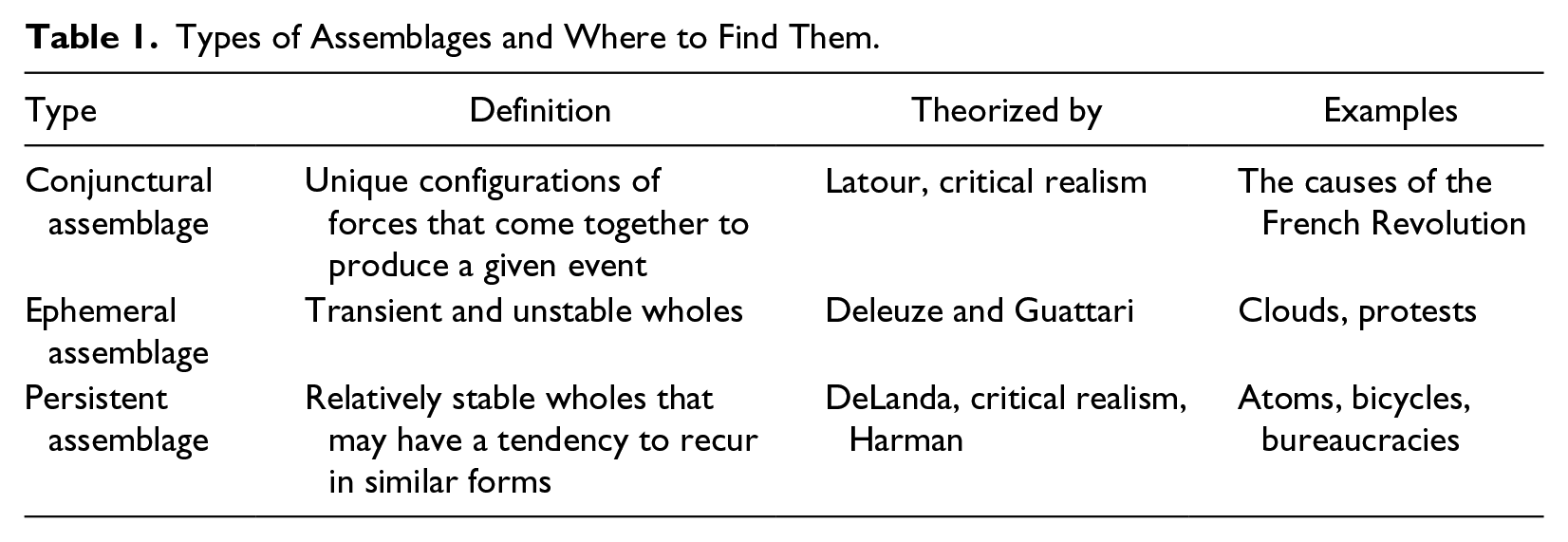
Critical realism focuses on the first and third types and tends to assume they can be sharply distinguished from each other. Assemblage theory before DeLanda tended to use some mix of the first two. DeLanda opens up the possibility of synthesis by adding the third into the mix. A productive synthesis depends, however, on recognition that the three types tend to shade into each other in practice: Many cases fall ambiguously between them by mixing elements of more than one at the same time. DeLanda’s parameters accommodate the shading between ephemeral and persistent assemblages. 10
Assemblage theory has paid considerable attention to the problem of how ephemeral assemblages come to be what they are, even if only transiently, but it has paid less attention to why some forms of persistent assemblage tend to recur. DeLanda’s concepts of parameters and attractors mark an important step forward, but to make further progress, we need to attend to the part played by specific regulatory mechanisms in stabilizing assemblages. The concept of a parameter is useful as a way of describing partial regularities at the level of structures, but an explanatory social science needs to look beneath these patterns and examine how they are produced. For a critical realist, this means we need to examine the regulatory mechanisms that produce or stabilize the structures (as well as the generative mechanisms that produce their causal powers, which tend to be neglected in assemblage theory).
Such mechanisms, as we have seen, are highly varied, yet certain types of components are more easily stabilized by certain types of mechanisms and yield certain types of wholes as a consequence. Nuts and bolts cannot stabilize atoms into molecular wholes, but they can stabilize bicycle wheels and frames into bicycles. Once assembled, bicycles have certain causal capacities that flow from the form in which their parts have been assembled and the resulting generative mechanisms. Likewise, recruitment and training mechanisms can manage a turnover of individuals within organizations to sustain their structure. These regulatory mechanisms stabilize structures that in turn have generative mechanisms producing causal powers. For example, they imbue certain individuals with capacities that depend on their position within the structure (e.g., the capacity to hire and fire). These mechanisms will be idiosyncratic in some respects, but the same or analogous mechanisms can be found operating across different contexts, creating similar effects, and forming the bases for the identification of typical features.
We need, in other words, to add types to DeLanda’s ontology: We need to recognize that some things are instances of more abstract types, and they may therefore have particular causal capacities characteristic of instances of the type. Thinkers in the assemblage theory tradition are often extremely wary of the concept of type. However, we believe this wariness derives in part from having too crude a concept of type due to an understandable reaction to the historical abuse of the term. We advocate what may be thought of as loose types, characterized by three features: (1) An entity is not completely defined by being an instance of a type, so individuals remain unique. All trade unions, for example, are different from each other, but this does not prevent them from being instances of the type trade union. (2) Type boundaries may be fuzzy, so individuals may be positioned ambiguously with respect to them. Is a bicycle still a bicycle, for example, when it has a stabilizer wheel added to it? How far must it change to become a tricycle? Is a bureaucracy still a bureaucracy if it adopts a flat organization while serving a similar function as a more traditional hierarchical model? (3) Because of (1), objects can be members of multiple different types, both nested and crosscutting. A soccer club is also a sports club (a nested type) and may also be a public limited company (a crosscutting type) and have features of each. 11
We can abstract further still. DeLanda’s use of the concept of attractors represents an attempt to do so. An attractor is a state that other relevantly similar states tend to converge toward. DeLanda uses the concept in his own account of how persistent assemblages come to be stabilized: The basic idea is that some assemblages of parts tend to converge on a particular configuration, and these tendencies stabilize the assemblage in the configuration concerned. The concept of attractor, however, is a descriptive concept that may be mistaken for an explanatory concept. Attractors are features of possibility spaces, which are descriptive of what outcomes would occur in what circumstances, and the directions of movement between different circumstances/outcomes, but they say nothing about how those outcomes or directions of movement are produced, as DeLanda (2002:178-9) partially acknowledges. We therefore prefer to say that assemblages in a particular structural range have a tendency to persist and recur (TPAR). Such a tendency is always the product of regulatory mechanisms, and as we have seen, these mechanisms vary depending on the type of assemblage and may be offset to varying degrees by deregulatory mechanisms (Elder-Vass 2010:33-8). Nevertheless, the TPAR summarizes the strength of such mechanisms for any given type of assemblage, and thus we see it as a parameter in DeLanda’s sense. Because of its generality, we see it as a more useful parameter than those that describe the strength (or presence/absence) of a specific mechanism.
The TPAR of an individual assemblage is significant, but the concept also has a more general application. If there is a tendency for parts of a certain type to stabilize in a particular configuration, this will not only tend to stabilize an individual assemblage, but it will also tend to produce recurrence of similar assemblages. These regulatory forces, then, explain not only the existence of persistent assemblages but also the tendency for types of assemblage to be recurrently or regularly instantiated by different individuals. We stress again, however, that these regulatory forces may be different from, or at most a subset of, the generative mechanisms that produce the causal powers of an assemblage. The former contribute to the causal history of an assemblage, whereas the latter are the structural basis of its capacity at any one time to influence the world.
Finally, let us make clear the implication of labeling this as a tendency. In critical realism, causal powers are thought of as tendencies—rather than law-like—because their realization is always contingent and in particular is conditional on the circumstances of any particular event. Consider the traditional nuclear family, consisting of a male and a female parent and one or more children brought up by them. This has been a fairly stable and recurrent form in many social contexts over the past few hundred years, and we might therefore consider it to have a high TPAR. Yet historically, in other social contexts, extended families were the norm and nuclear families were not, and recent developments have raised the TPAR of nuclear families with same-sex parents. Clearly, stabilization of family forms depends on the internal structure of such families and on the wider social/cultural context. This perhaps leads us back in the direction of something like DeLanda’s distinction between territorialization and coding, reframed as internal and external influences on the stabilization of a form.
Discussion
With this in mind, it is useful to distinguish between two kinds of ontological fluidity/stability, one relating to conjunctures—the sets of causal forces present or influential on particular occasions—and one relating to structures—the forms of distinct identifiable objects or things. Any plausible ontology must recognize both fluidity and stability of both conjunctures and structures. Table 2 summarizes how all four combinations appear in the ontologies discussed here.
Fluidity and Stability in Three Ontologies.
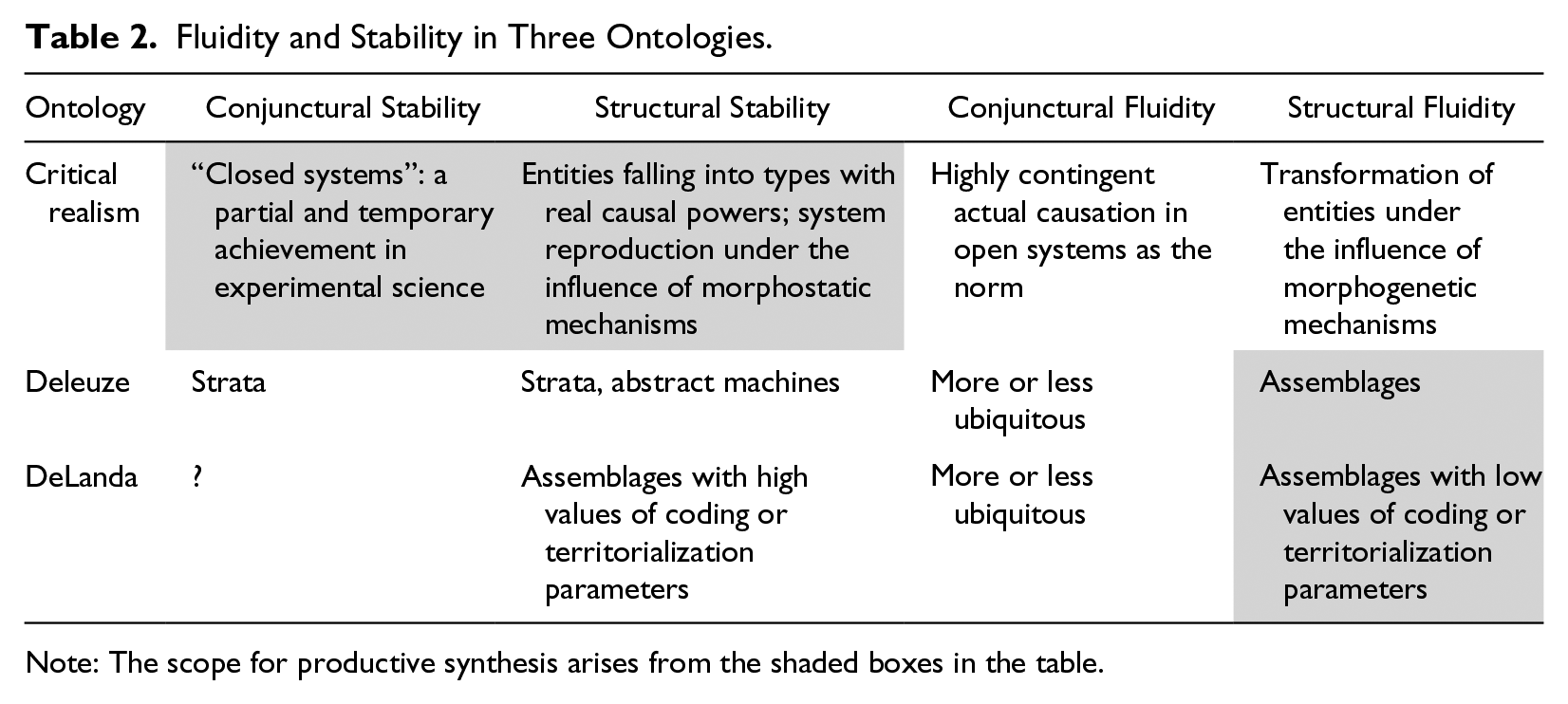
Note: The scope for productive synthesis arises from the shaded boxes in the table.
The scope for productive synthesis arises from the shaded boxes in the table. Critical realism has conceptual tools for dealing with stabilization and causation that Deleuzians lack. And DeLanda and Deleuze provided a means for thinking about structural fluidity that goes beyond CR’s rather structured approach.
We can illustrate some of the messages of this article by returning to MacKenzie’s (2017) empirical study of Automated Trading Desk. (The illustration is summarized in Table 3.) As we argued previously, the early history of ATD—a firm in motion, repeatedly transforming itself radically until it found a successful niche—demonstrates the need for an ontology that can accommodate structural fluidity. Drawing on DeLanda’s approach, we could see this as a case of an assemblage converging on an attractor—a locally stable form. Once the firm takes form and starts to adapt under the influence of its founders’ agency, it fits Archer’s (1995) morphogenetic model. 12 In the earliest phases, however, when it is still in the process of formation, this is a less natural fit. In contrast, the assemblages approach allows us to theorize the evolving situation more clearly as new structures come into being.
Fluidity and Stability in an Empirical Case.
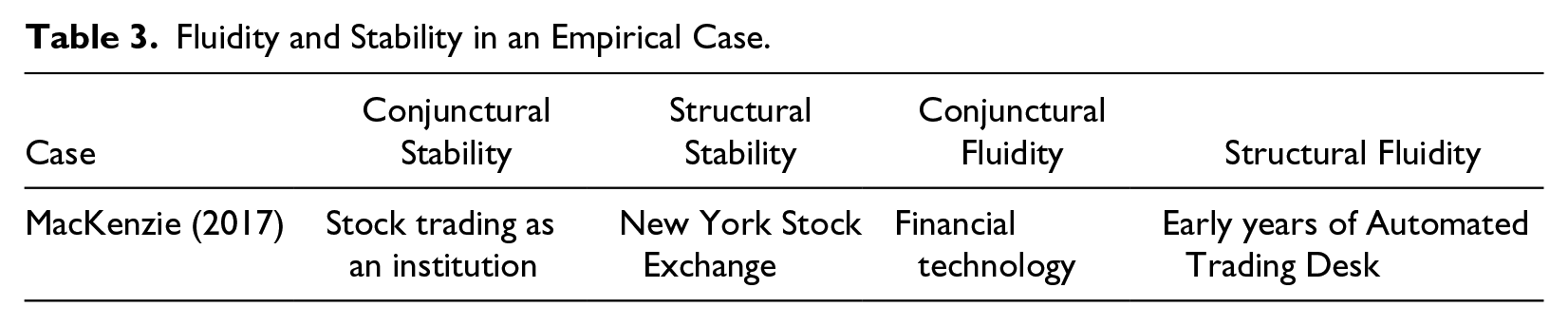
On the other hand, Mackenzie’s (2017) story also includes clear cases of long-term structural stability, notably the NYSE, whose existence and practices played a major role in the developments he describes—not only in terms of ATD’s formation stories but also in terms of the causation stories to be told (e.g., causal explanations of stock trading). Neither the NYSE nor ATD, however, are pure examples of stability or fluidity; even within the confines of MacKenzie’s case, the NYSE experienced incremental change, and through most periods of the narrative, there were significant elements of continuity in ATD. As we stressed earlier, ATD’s story is the story of interaction between relatively fluid and relatively stable social structures, combining features of each.
In the terms proposed here, ATD had a relatively low TPAR, although one that increased as it approached a more viable business model. The NYSE, in contrast, had a much higher TPAR, and it is hard to see how an institution like the NYSE could be accommodated in an ontology of pure fluidity, such as is found in some readings of Deleuze.
As we pointed out earlier, this is also a story of stability and fluidity in the conjunctural context. On the side of fluidity, the technologies available to be enrolled in trading systems changed unprecedently rapidly during this period. On the side of stability, the practice of stock trading and its broader institutional framework were relatively stable, and from a structural perspective, these new forms of technology evolved in response to this stability. The persistence of these institutions also enabled profuse recurrence of the objects they supported—stocks, public joint-stock companies, and stock exchanges—which tended to stabilize their forms in turn.
No explanation of stock trading would be complete that did not recognize that these stocks and companies themselves are instances of types with common causal properties. Let us consider stocks or shares. 13 A share is a socially constructed, institutionally secured tradable financial instrument that generally entitles the holder to claim a share of the distributed profits of the corresponding firm and to vote in its general meetings. Firms like ATD trade in shares of public limited companies, which have the added feature of being freely tradable on public stock exchanges. Many thousands of public firms have issued shares, and each may have issued many thousands or indeed millions of shares, but for ATD, all that really matters about shares is that they can be traded on a public exchange. Shares are therefore a causal type: They all have certain properties in common that enable a company like ATD to trade them through a standardized computer system. Those systems rely on the fact that in certain respects, all shares behave in the same way. Stock trading as it is conducted by ATD would, in our view, be incomprehensible if we were to adhere to DeLanda’s failure to recognize causal types.
DeLanda might argue that it is the institution of stock trading that accords shares their similar causal powers, but we argue that this still entails recognizing shares as a causal type. Of course, the ontology of social objects like shares is more complex than that of relatively simply material objects like earthworms. The causal powers of earthworms are a product of their material composition and structure and the mechanisms that rely on these. By contrast, the causal powers of shares depend on their social positioning, as Lawson (2016) argued for the parallel case of money. Bhaskar (1993:49) puts the point more abstractly, using the concept of intrastructuration, which refers to cases where causal powers produced by a higher structure are effectuated by or in effect delegated to subsidiary parts of the structure (see also Elder-Vass 2010:26-8). But the fact that the powers of shares devolve from higher-level structures does not alter the fact that they all share similar powers that are the product of the same mechanism, which depends on their sharing the same material prerequisites and the structural position that builds institutional properties on these “brute facts” (Searle 1995). This makes them all members of the same causal type, as we understand the term.
We argue, therefore, that Mackenzie’s (2017) study provides support not only for the general need for an ontology that can accommodate fluidity and stability and formation stories and causation stories but also for our proposed synthesis as an improvement on Deleuze, Latour, DeLanda, and earlier formulations of critical realism. The key to arriving at such a synthesis is to avoid metaphysical dogmatism about the degree of stabilization of entities and conjunctures in general and about the degree of homogenization of entities. Instead, it requires recognizing that these are ontological issues that need to be resolved empirically rather than a priori and any ontology must be able to accommodate this. The role of the ontologist here is to accept that both more and less stable or homogeneous forms can be real and provide the conceptual tools to allow both to be theorized, often within one and the same empirical explanation.
Conclusion
Good social research requires a social ontology that is both internally coherent and consistent with our experience of the world, including the evidence revealed by research. Just as many ontologists take a relaxed attitude to empirical research that allows them to cherry pick illustrations in service of the theory, many researchers take a relaxed attitude to ontology, allowing them to cherry pick concepts from different traditions. But where ontology is merely implicit, it risks inadvertent incoherence and logical irresponsibility. Where it is explicit let alone dogmatic, it risks discouraging or excluding attention to important aspects of social reality—as, for example, does Latour’s (2005) explicit marginalization, verging on exclusion, of discussion of social structure (see Elder-Vass 2008). This article focused on the exclusions or marginalizations lurking in the assemblage theory and critical realist traditions of social ontology and how we might resolve them.
Those exclusions, we suggest, are at least in part a product of the different problematics to which the two traditions have been addressed: The assemblage theory tradition can be seen as a response to the problematic of origins (How do things come to be the way they are?), whereas critical realism is a response to the problematic of causal power (How can things have causal influence?). The former problematic directs attention to cases of phenomena not yet formed and in the process of formation and thus invites an ontology of fluidity. The latter directs attention to cases in which already existing objects interact with each other and thus invites an ontology of stability.
A full ontology must address both of these problematics, and there are signs of recognition in both traditions of their respective absences. The notions of strata, attractors, and abstract machines at least recognize—but fail to resolve—the characteristic absences of D&G’s assemblage theory: its relative neglect of stable and recurrent structures and its failure to recognize causal types. Archer’s morphogenetic cycle provides critical realism with a means to analyze structural change, yet it does not resolve the lack of attention to unique, heterogeneous, and highly unstable objects in critical realism.
An adequate social ontology must find solutions to both of these absences, and like DeLanda, we believe the Deleuzean tradition and the realist tradition can be synthesized productively to deliver such an ontology. DeLanda’s move, however, opens an important conversation rather than concluding it with a completely adequate solution. This article offers two main improvements. First, we argue that the concept of parameter should be reshaped to reflect the core issue as we understand it: the graduated distinction between entities with strong stabilizing forces and those with weaker ones. Second, contrary to DeLanda, we argue that social ontology requires a notion of causal types for two important reasons. First, many entities do fall into types with similar causal properties arising from their similar structures, and many phenomena cannot be adequately explained without recognizing this. Second and more fundamentally, causal explanation in general rests on the transposability of explanation between cases in which similar causes operate, and this transposability depends on the presence in those cases of objects with similar powers arising from similarities in their composition and structure. Accordingly, formation stories are necessarily interwoven with causation stories.
As our reading of Mackenzie’s study of high-frequency trading suggests, explanatory social science needs such an ontology: Social phenomena are often, usually, or perhaps always the product of interactions between relatively stable objects that fall into consistent causal types and other far more heterogeneous, unstable, and sometimes ephemeral objects. Adopting such an ontology could provide the basis for causation stories in conjunction with formation stories. If this article encourages scholars influenced by assemblage theory to pay attention to the stable forces as well as the unstable, researchers influenced by critical realism to take account of the ephemeral as well as the established, and sociologists in general to attend to the potentials of both relatively stable and relatively dynamic causal forces, it will have achieved our objective.
Footnotes
Acknowledgements
Timothy Rutzou would like to thank the Templeton Foundation, and Dave Elder-Vass the Independent Social Research Foundation, for their financial support. We are grateful to the anonymous reviewers for their extremely helpful comments and suggestions.