






Abstract
With renewed interest in Marxism, class is back on the intellectual agenda. But so too is the familiar charge of “class reductionism.” This charge conflates two distinct claims regarding what we term the structural and political primacy of class. Structural primacy refers to the determinant role of class in social explanation, whereas political primacy refers to its centrality in radical politics. Crossing these distinct claims, we identify four possible positions on the primacy of class. Here, we focus on the two that affirm the structural primacy of class. What we call “class abstractionism,” which presumes to derive the political primacy of class from an account of its structural primacy, ultimately relies on an abstract conception of class that effectively presupposes its political primacy. In contrast, a more adequate account of structural primacy—what we call “class dynamism”—requires us to abandon the presupposition of class’s necessary political primacy.
Recent years have seen a significant increase in interest in socialism. But as class returns to the political and intellectual agenda, so too have some familiar criticisms of Marxism gained renewed traction. In particular, today’s advocates for class analysis and socialist politics have found themselves accused of Marxism’s supposed cardinal sin: “class reductionism.” Although class reductionism clearly suggests some form of prioritization of class over other forms of social difference, what does it mean precisely? Polemical in nature, there is very little analytic clarity on what exactly the charge entails, with the result that the theoretical and political debate over the significance of class often remains frustratingly confused, as both critics and proponents of class reductionism continue to talk past one another.
Our aim in this article is to clarify what is meant by class reductionism in a way that redefines the stakes in the debate over the significance of class. We do so by analytically distinguishing two different claims, what we term the structural primacy of class and the political primacy of class, which are typically conflated under the label “class reductionism.” The structural primacy of class is a claim regarding the unique and fundamental role class structure plays in determining sociohistorical phenomena. The political primacy of class refers to arguments for the priority of class subjectivity in political mobilization. Such arguments are typically rooted in an analysis of the unique structural features of class, yet they are prescriptive and pitched primarily at the level of political practice and discourse.
Differentiating between claims of class’s structural and political primacy generates a typology of four analytically distinct positions in the debate over class reductionism. A first opposition pits a rejection of class primacy on both structural and political grounds, a position we call “class relativism,” against an affirmation of class primacy on both grounds, a position we call (for reasons we will elaborate) “class abstractionism.” The debate over class reductionism typically revolves around this axis of opposition, but we do not assume there is a necessary link between the structural and political primacy of class. Our conceptual distinction thus reveals two more possible positions: a rejection of the structural primacy of class combined with an affirmation of its political primacy, a position we call “class constructivism,” and an affirmation of the structural primacy of class that nonetheless rejects its necessary political primacy, a position we call (again for reasons we elaborate later) “class dynamism.”
Our aim is not to establish the primacy of class along the structural or political dimensions but simply to suggest that the political primacy of class does not necessarily follow from an account of its structural primacy. In that sense, we see this article as a contribution within Marxism. Marxism, as we understand it, is minimally defined by a commitment to some version of the structural primacy of class. However, it is commonly assumed that this entails a commitment to its political primacy in the development of socialist politics. To assess this supposed relationship between the structural and political primacy of class, we focus on the positions of class abstractionism and class dynamism, which both affirm the structural primacy of class, albeit in different ways, while diverging on the question of its political primacy. We interrogate the arguments developed by Vivek Chibber (2022a) in The Class Matrix: Social Theory after the Cultural Turn as a recent exemplar of class abstractionism. In the book, Chibber seeks to defend a structural class analysis against the cultural turn while rejecting some of the more untenable assumptions of “orthodox” Marxism. We find, however, that his analysis reproduces a key weakness of this tradition: Rather than deriving the political primacy of class from an account of class structure, class structure is conceived only at a high level of abstraction and in a way that effectively presupposes the political primacy of class. In other words, it is the (abstract) conception of the class structure that follows from an assumption of class’s political primacy. As such, Chibber offers an unsatisfying theory of class formation that, by fixing in advance its form and content and reducing it to a collective action problem, elides all the crucial questions of political subject formation and socialist politics.
The problem with class abstractionism thus lies in its poor specification of the structural primacy of class, which, rather than providing theoretical warrant for its political primacy, is instead a function of a prior assumption of political primacy. We propose an alternative specification of the structural primacy of class, which we call class dynamism. Specifically, we argue that class is structurally unique and fundamental because of its developmental dynamics, which generate increased differentiation—not homogenization—within the working class. Defined in this way, the structural primacy of class does not necessarily entail its own political primacy. Indeed, when grasped at a conjunctural and not simply abstract level, the dynamism of the class structure reinforces or activates nonclass social structures and subjectivities, which in turn can become central to conjunctural processes of class formation.
What Is Class Reductionism?
The term “class reductionism” is pejorative—few Marxists would use it to describe themselves. Many would point out that far from being exclusively concerned with “class” in a narrow sense, Marxists have often been at the forefront of historical struggles against other forms of social domination, such as racism, patriarchy, and imperialism. Still, this disavowal does not necessarily amount to a refutation—it is perfectly consistent to be concerned with various forms of domination while believing them to be, in some meaningful sense, subordinate to class domination. The problem is not the disingenuousness of Marxists who reject the charge but, rather, the ambiguity of the charge itself. Indeed, class reductionism has become something of a folk concept, with more polemical than analytic value. In this section, we attempt to analytically clarify the meaning of class reductionism in terms that both Marxists and their critics might accept.
At its most literal, class reductionism refers to the view that various social phenomena, especially other forms of social domination, are ultimately reducible to economic phenomena related to class. Take the famous metaphor of base and superstructure and the notion that the political or cultural forms of the superstructure merely reflect or express the mode of production that is their base. Such a simple view of the relationship between base and superstructure, usually associated with orthodox Marxism, has in fact long been out of fashion among Marxists, among whom criticisms of “vulgar” Marxism and “economism” have been commonplace for decades (e.g., Williams 1973). Indeed, even on its own terms, the base/superstructure metaphor only implies that political and cultural forms are built atop a foundation set by the economic mode of production, not that these are reducible to this foundation in the sense of being reflections or expressions of it.
At least since Althusser’s (1969) pioneering contributions, Marxists have sought to present a more complex picture of the relations of determination that tie base and superstructure together. For Althusser, the various “levels” of a social formation—the economic, the political, the ideological—overdetermine one another in a way that is explicitly nonreductionist. Moreover, levels other than the economic can be “dominant” within a given social formation. Nonetheless, Althusser maintained that the economic remained “determinant in the last instance,” and the “dominance” of a given level was itself ultimately assigned by the economic mode of production. The coherence of Althusser’s oft-maligned formulation need not detain us here; what matters for our purposes is that it more aptly specifies what is at issue with class reductionism. The charge, insofar as it is directed against Marxism, is not really about reduction per se in the outmoded sense of reflection or expression but is about the more basic claim that class structure is unique and fundamental relative to the social structure as a whole. For example, Wright, Levine, and Sober (1992) concede that variation in noneconomic phenomena is irreducible to class but nevertheless posit a “causal asymmetry” in which class structure determines the limits within which noneconomic forces exercise their determination. The precise way this is conceived can vary, but both Marxists and their detractors can agree it is hard to imagine a Marxist not holding to some version of the causally asymmetrical character of class structure. We can thus clarify some of the ambiguity surrounding the charge of class reductionism by specifying that it refers to a belief in the structural primacy of class in sociohistorical analysis. Class structure, in other words, is not just one among many principles of social differentiation but has meaningful causal priority over these other forms of differentiation due to its unique structural features. A key theoretical task is in showing what these features have primacy in explaining.
This structural dimension does not exhaust the charge of class reductionism—there is also usually a political dimension to it. Marxists are frequently accused of unduly privileging class not just in sociohistorical analysis but also in political action, and indeed, many Marxists have affirmed the view that class is in some sense more politically important than other subjective bases of mobilization. This is perhaps obviously the case when the outcome of interest is the development of a politics of socialist transformation. At issue here is the political primacy of class as the privileged subject of radical, and especially socialist, politics. It is a commonplace understanding among Marxists that Marx’s contribution to socialist thought was to tether it to the workers’ movement as the agent of socialist transformation. Nonetheless, it is equally clear that socialism, as a doctrine, is not simply an ideological reflection of the workers’ movement. Socialism, after all, remains an irreducibly political movement, which, through a conscious transformation of social structure, aims at subordinating “the blind processes of second nature . . . to the will of humanity” (Riley 2022:39). 1 Class consciousness and a socialist political consciousness, or what we might call class formation at the economic level and class formation at the political level, respectively, should thus not be conflated, and indeed, much of Marxist theorizing has been a reflection on the politically mediated relationship between the two. What we call the political primacy of class, then, refers not to a general claim of the political significance of class, which all Marxists would agree to, but rather to a particular way of understanding the relationship between class formation and socialist politics. Specifically, it refers to the claim that such a politics must in the first instance be pitched in class terms to be effective. Although most Marxists would justify claims of political primacy in terms of the unique structural features of class, this need not be the case, as we will show. What defines claims regarding the political primacy of class is simply the view that the subjective basis for radical politics should a priori be defined in terms of class. Or, to put it differently, class interpellations form the immediate and exclusive basis for the development of any effective socialist politics.
This political dimension of class reductionism is typically conflated with the structural dimension by critics of class reductionism, regardless of their sympathy for Marxism more generally. Thus, for example, in The Wages of Whiteness, David Roediger (1991:7), one of the foremost critics of class reductionism from within the Marxist tradition, bemoans how Barbara Fields’s (1990) insight—that “race” as an ideology is socially and historically constructed in a way that class is not—is “often boiled down to the notion that class (or ‘the economic’) is more real, more fundamental, more basic or more important than race, both in political terms and in terms of historical analysis.” The question, which Roediger largely elides, is whether rejecting the primacy of class “in political terms” also means rejecting its primacy “in terms of historical analysis” or if, in fact, these are not distinct problems. 2
The charge of class reductionism thus covers at least two distinct claims: one about the structural primacy of class in sociohistorical analysis and another about the political primacy of class in the development of radical socialist politics. That these are often conflated is not just an effect of ambiguity produced by subsuming them under the single label of “class reductionism” but is also attributable to the assumption that the structural and political claims entail one another. For critics of class reductionism, criticism of the political primacy of class often stands in for criticism of claims of its structural primacy. For many defending the primacy of class, its political primacy is assumed by virtue of its structural primacy. Yet making an analytic distinction between the structural and political primacy of class suggests that formally speaking, the two claims can exist in various combinations. Indeed, crossing the two claims generates a 2 × 2 table yielding four separate cells (Figure 1). In the top-left cell, both the structural and political primacy of class are rejected; in the bottom-right cell, both are affirmed. This diagonal axis of opposition represents the terms in which the debate over class reductionism is usually presented. However, breaking down class reductionism into its component parts reveals the possibility of two more categories: a top-right cell in which structural primacy is denied but political primacy affirmed and a bottom-left cell in which structural primacy is affirmed but political primacy denied.
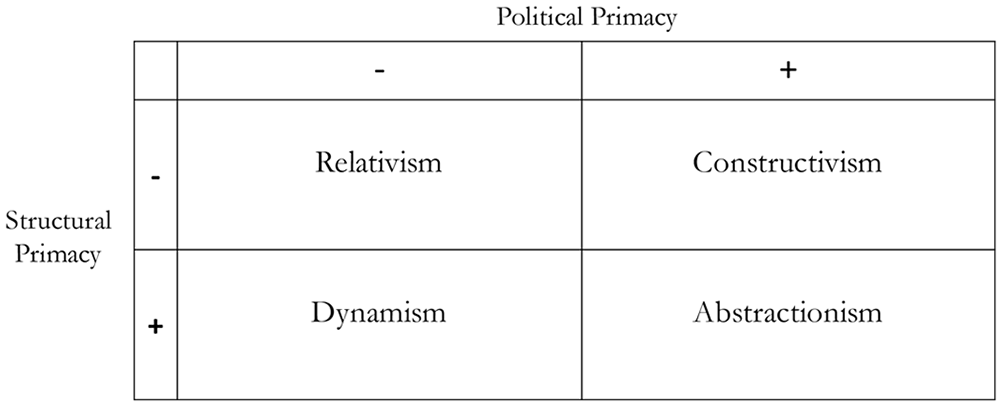
Primary of class.
The formal possibilities generated by distinguishing between structural and political primacy are not mere analytic fictions. Each cell of the table in Figure 1 can be elaborated with substantive theories. What all theories classifiable in the top-left cell have in common is the underlying notion that class is neither unique nor fundamental relative to other forms of social difference in terms of its structural powers of determination and its political efficacy. As such, we call this cell “class relativism.” This cell encompasses a wide range of non-Marxist theories that, despite their differences, all reject any special ontological or political status for class. Thus, it includes various theories according to which class is only one of many axes of differentiation or principles of social closure governing the distribution of material and symbolic resources and culturalist theories (e.g., Sewell 2005; Somers 1992) that insist on the equally culturally constituted nature of all social structures, class included. The main point here is that class has no structural privilege, either because it is only one social structure among others, all of which work in analogous ways, or because structure as such cannot be said to exist prior to its cultural mediation, meaning the class structure only exists in and through interpretive processes of subject formation and meaning-making that precede it analytically. The implication of these arguments, often tacit, is that class, robbed of its structural privilege, also loses its political privilege.
Class relativism is perhaps best exemplified by the framework of intersectionality (Collins 1990, 2015, 2019) or the paradigm of “classism” (hooks 2000), both of which tend to conceptualize class relations in analogous terms to other relations of power. But it is also exemplified by Bourdieu’s (1987) neo-Weberian theorization of class. Against Marxism’s supposed “substantialist” bias, Bourdieu argues that what exists from a “scientific standpoint” is not a particular class structure but, rather, a multidimensional “social space” structured by the distribution of various forms of capital. Classes, then, are symbolic constructs that translate common conditions and experiences into subjective affinities, but because these are a function of proximity within a “social space” in which all axes of differentiation (i.e., forms of capital) are in principle a factor, “class” loses its economic specificity and instead becomes a generic term for subjective group formation. 3 Economic capital may be a more or less salient factor in structuring the social space in a given context, but for Bourdieu, there is nothing structurally distinct or fundamental about it relative to other forms of capital such that it is theoretically rather than contingently more determinant of class. 4
A rejection of the political primacy of class, however, need not follow from a rejection of its structural primacy. The top-right cell in Figure 1 includes fewer obvious examples, but it is also a logically coherent position. Class-based political discourses can be justified in terms of their efficacy without making any assumptions about the distinct determinative power of class structure. Class, for example, might be considered a more effective discursive basis for political mobilization because its quasi-universalist connotations crosscut other social differences, even if it is denied that such economic interpellations are any more structurally determined than competing interpellations. In other words, the arguments within this cell share the constructivist premise that class is in the first instance a discursive construct but grant political privilege to this construct in radical politics. As such, we label this cell “class constructivism.” Such arguments could be made in a discourse-theoretic vein drawing on the work of Laclau and Mouffe (1985; see also Laclau 2005; Mouffe 2018), for example, in the various forms of left-populism they have inspired that attempt to discursively polarize the political field around relatively indeterminate but resonant economic categories such as “the people” versus “the elite” or “the 99%” versus “the 1%.” Such categories refer to economic inequalities, but their open-ended and inclusive character is meant to overcome the limitations of political interpellations based on traditional, structurally defined class categories. Indeed, populism more generally can be defined as a kind of free-floating class discourse that refuses any anchoring in structural determinations.
We are left with the bottom two cells of Figure 1—what we call class abstractionism (bottom right) and class dynamism (bottom left). These two positions are the focus of the rest of the article. The bottom-right cell, which is characterized by the claim that the structural primacy of class necessarily entails the political primacy of class, is familiar—it is the position traditionally associated with Marxism and the typical target of critiques of class reductionism. For both critics and defenders of the primacy of class, the twin claims of structural and political primacy are tightly bound together, with claims regarding the political primacy of class thought to follow from claims of its structural primacy. As we suggested, however, these two claims are not identical. In the next section, we evaluate recent Marxist arguments that ground political primacy in an account of structural primacy. We find that such attempts are unsuccessful and ultimately posit an untenable conception of structural primacy, with the result that they unwittingly rely on nonstructural arguments to support the political primacy of class. However, this is not an argument for rejecting the structural primacy of class. Instead, in the final section of this article, we show that a proper specification of the structural primacy of class does not necessarily entail its political primacy, thereby outlining the final cell of the 2 × 2 table.
Class Abstractionism
If critics of class reductionism tend to conflate claims of structural and political primacy, it is because the most familiar theoretical expression of the primacy of class—what we loosely refer to as orthodox Marxism—explicitly claims to ground the political primacy of class in its structural features. This is also true of more recent “neo-orthodox” Marxism, which shares with its orthodox forebears the belief that the political primacy of class is entailed by the unique properties of the class structure itself. 5 The basic argument is that because the capitalist social order is dependent on the working class—which makes up a majority of the population—in a way that is not true of other social groups, the working class occupies a politically strategic structural location. In this section, we argue that this belief relies on an abstract conception of class that, rather than deriving the political primacy of class from an account of its structural primacy, effectively presupposes such political primacy. We suggest that this move, characteristic of the bottom-right cell in our 2 × 2 table, is better described as class abstractionism than class reductionism.
Orthodox Marxism is characterized by a particular understanding of the relationship between the structural dynamics of capitalism and socialist politics. The developmental logic of capitalism not only generates the objective basis of its own transcendence in the form of an irreconcilable contradiction between the forces and relations of production, but it also generates the subjective basis of this transcendence in the form of a self-conscious working class aware of its historical interest in overthrowing capitalism. Socialist parties play an important role in consolidating and expressing such class consciousness at the political level, but the shift from a class “in itself” (i.e., class structure) to a class “for itself” (i.e., class formation) is ultimately rooted in the homogenizing pressures of this developmental logic. 6
What defines orthodox Marxism, especially as it was elaborated by central figures in the socialist movement like Karl Kautsky (1909), is the quasi-naturalistic way it conceived of the growing political consciousness and cohesiveness of the proletariat as emerging from and reflecting its economic growth and homogenization. 7 Orthodox Marxism assumes that political class formation, in the sense of the constitution of a collective political subject self-consciously mobilized on the basis of its class interest in transcending capitalism, directly expresses class structure. That is, orthodox Marxism tends to assume that structural classes appear at the level of politics in an immediate way. The task of socialism is to organize the working class politically, and thus the development of a specifically socialist consciousness remains politically mediated, but class formation itself, in the sense of the constitution of class subjects, is presumed to occur without such political mediation. Because it treats class formation as a natural and necessary process entailed by the class structure of capitalism, Kautskyism represents the strong version of grounding the political primacy of class in the structural primacy of class. The political primacy of class not only expresses its structural primacy; it does so more or less spontaneously.
Classical Marxism has recently seen a revival of interest. What might be called neo-orthodox, or what Riley (2022) calls “late Kautskyist,” Marxism is arguably the most vital and influential current of Marxist thought today. While jettisoning the more obviously reductive assumptions of orthodox Marxism, this current has mounted a vigorous defense of the primacy of class, to the point where some have, albeit with tongue in cheek, embraced the label of class reductionism (e.g., Calnitsky and Billeaux Martinez 2023). Within this current, Chibber stands out for the lucidity of his defense of both the structural and political primacy of class.
Chibber’s (2022a) recent book, The Class Matrix, represents a sophisticated example of neo-orthodox Marxism, and we thus engage with it at length to evaluate whether this revision of orthodox Marxism provides a convincing account of the primacy of class. 8 In this book, Chibber seeks to “rescue” class from the cultural turn by reaffirming the primacy of class structure over culture. 9 In doing so, he elaborates a theory of capitalist reproduction and class formation built around four core theses, which we name in the following.
The first, what we call the “class difference thesis,” posits that class structure has primacy of determination over nonclass social structures because it alone directly governs people’s material well-being and therefore their material interests. Typically for a Marxist, Chibber defines class in structural terms as discrete locations within a system of production that determine access to the social product and thereby the means of subsistence. Defined in this way, class is distinct from other forms of social difference because it uniquely determines “the rules for what actors have to do to reproduce themselves,” as Chibber (2017:34) puts it in an earlier article. “The peculiarity of class,” Chibber (2022a:17, emphasis added) claims, “resides in the fact that it is the only social relation that directly governs the material well-being of its participants.” For this reason, the determination exercised by the class structure operates at a distinct and more fundamental level relative to other forms of social difference. Whereas conformity to nonclass social roles (e.g., those attached to various identity categories such as gender, race, sexuality) depends on contingent cultural processes and is enforced through agent-imposed sanctions, the class structure is unique in exercising its compulsion automatically and impersonally because actors’ material reproduction directly depends on conformity to class roles in a way that is not true for nonclass social roles (Chibber 2022a:29–37). 10
The second thesis, what we call the “negative selectivity thesis,” posits that class structure determines culture in the sense of selecting against incompatible cultural forms. Although Chibber defends the determinant role of class structure over culture, he rejects the orthodox Marxist reduction of culture to a simple expression of the class structure and concedes that a range of contingent cultural forms may exist within a given structural context. Nonetheless, he argues that class structure retains primacy over cultural forms because the structural imperatives of class ultimately select against incompatible cultural forms in a way that sets definite limits to cultural heterogeneity. 11 Chibber’s innovation is to grant a measure of contingency to culture—a fact that accounts for capitalism’s ability to thrive in varied cultural contexts—while still insisting on the ultimate causal primacy of class structure in defining the parameters of this contingency.
The third thesis, what we call the “capitalist reproduction thesis,” posits that the reproduction of capitalism is secured not through added cultural factors such as ideology or hegemony but through the immanent workings of the capitalist class structure itself. For Chibber (2022a:106), the risk/reward matrix of the capitalist class structure leads workers under normal circumstances to “accept their location in the class structure because they see no other viable option.” Workers see no other viable option not because they are blind to their own domination—indeed, Chibber explicitly counterposes “resignation” to “consent”—but because the class structure itself imposes heavy costs on collective action and thereby incentivizes individual accommodation. Workers choose individualized strategies “not because they fail to recognize their interests, as theories of false consciousness or cultural hegemony would have it, but because they accurately perceive the risk/cost matrix associated with collective action” (Chibber 2022a:155). 12 This is another area where Chibber diverges from more reductive versions of orthodox Marxism. Whereas these predicted that class formation, that is, the constitution of a collectively mobilized class subject, would emerge quasi-naturalistically from the class structure and whereas subsequent Marxists tended to explain the failure of this prediction in largely cultural terms, Chibber argues that the incentive structure of capitalism itself—what he calls the “class matrix”—is the primary barrier to class formation.
If the capitalist class structure does not predict class consciousness and collective action, but rather individual accommodation and resignation, then what can overcome this built-in conservatism? Chibber offers a voluntaristic and quasi-culturalist answer to this question with what we call his “class formation thesis,” which posits that class formation occurs when workers’ meaning orientations change from individualistic to solidaristic through the cultural work of organizers. If class remains the privileged subjective basis for radical politics, as Chibber (2022b) argues elsewhere, and if class consciousness is inhibited by the class structure, then it follows that radical politics depends on the cultivation of class-cultural forms that can override this structure. Indeed, Chibber argues that the problem of class formation can only be solved by creating cultures of solidarity that help workers build a sense of shared purpose with each other as workers in a way that overcomes structural imperatives. 13 But if class formation depends on the cultural and political mediation of unions and parties, Chibber (2022a:74–75) nonetheless insists that the contours of this mediation are set by the structure: Class formation “requires an ongoing process of cultural intervention, but its effectiveness is conditional on aligning it with workers’ material interests. . . . [It] runs along grooves firmly set by the class structure.” In other words, class formation is culturally contingent, but the form of collective action as class formation is structurally given.
Despite being frequently accused of class reductionism, Chibber thus rejects and improves the more reductive elements of orthodox Marxism. Nonetheless, his account reproduces a critical weakness in orthodox Marxism’s theorization of the primacy of class. The way Chibber conceptualizes the structural primacy of class implies its political primacy. But as orthodox Marxism did before, Chibber effectively presupposes the political primacy of class and backfills the conceptualization of class structure in a way that justifies its premise but ultimately mis-specifies the structural primacy of class. Chibber’s neo-orthodox account still hinges on an unduly abstract conception of the class structure that belies its materialist pretensions. This, we argue, is the real problem, shared by orthodox and neo-orthodox Marxism alike, with attempts to ground the political primacy of class in its structural primacy, a problem that has less to do with reductionism than with what we call abstractionism.
Chibber’s account reproduces the central problems of class abstractionism.” For example, the presumption of class’s political primacy leads him to theorize class structure and its primacy in setting material interests in an arbitrary way. Throughout his analysis, in a move we call “horizontal conflation,” Chibber conflates class structure with structure as such, thus confusing arguments for the causal primacy of structure over culture with arguments for the causal primacy of class structure over other social structures. This is apparent in how his argument unfolds: Although framed initially as a theory of how structure relates to culture, “structure” is quickly conflated with class structure and “culture” with cultural meanings as they pertain to class such that the ensuing analysis ends up being about the relative causal power of structure versus culture in terms of class. This is justified by the dubious claim that the “only” social relation that “directly governs” the material well-being of its participants is class (i.e., the class difference thesis). 14 Tellingly, where Therborn (1980) spoke of a broader “material matrix” of structural sanctions and affirmations in his theory of ideological subjection-qualification, Chibber reduces this to a simple discussion of the “class matrix.”
Because of this horizontal conflation, Chibber’s account has little to say about how the process of class formation relates to cross-cutting or competing nonclass political identifications. Class determination stands in for structural determination as such, and class mobilization stands in for political mobilization as such. Chibber’s account is decidedly economistic, defining class consciousness in terms of realizing workers’ corporate interests but saying little about how economic conflicts are translated at the level of politics. Class formation is thus reduced to a collective action problem with a binary outcome: individual resignation or collective action along predetermined class-structural lines. Everything not directly pertaining to class structure in the way Chibber defines it falls out of sight. How various structurally determined interests might be articulated into a common project of social transformation does not enter the framework. In other words, the theory does not account for the specifically political dimension of socialism. By conflating class structure with structure as such and class mobilization with collective action as such and by providing an account of class formation that reduces it to a collective action problem, Chibber effectively presupposes the political primacy of class rather than deriving it from a theory of its structural primacy. 15
The problem with class abstractionism extends to how the class structure itself is conceptualized—an issue we term “vertical conflation.” Chibber defines class structure only in its simplest and most abstract determination at the level of the mode of production—that is, the division between owners of means of production and owners of labor-power—and ignores its existence at multiple levels of abstraction. 16 The matrix of material interests in which workers are embedded is defined not just by their location in capitalist relations of production but also by their structural location at, for example, the industry, firm, and occupation levels. Class formation is therefore not just about how individuals grasp their economic interests in collective terms but also about what forms of economic collectivity become salient to them. The class structure does not provide a singular mold that class formation simply fills, nor does class formation simply proceed along “grooves firmly set” (Chibber 2022a:75); its existence at multiple scales allows for a variety of class formations at the economic level beyond the binary between individual resignation and collective action. By defining class structure only at its most abstract level and conflating this with the class structure as such, Chibber’s account sidesteps another central question of class formation: Why and how do workers act collectively as workers across craft, industrial, sectoral, national, and other economic divisions? Here again, Chibber does not actually derive the political primacy of class from his structural analysis. Instead, a particular conception of class formation is presupposed at the outset as the only possible form of collective action, and he constructs the class structure in such a way that precludes consideration of alternative forms of economic collective action.
The problems with Chibber’s defense of the primacy of class, we suggest, are the problems of class abstractionism more generally. Both orthodox and neo-orthodox Marxism rely on the framework of class abstractionism, that is, the substitution of a class structure conceived exclusively at an abstract level for the concretely overdetermined social structure as it exists at multiple scales. What neo-orthodox shares with orthodox Marxism is the pretension to justify the political primacy of class, that is, the notion that class subjects are a priori the necessary subjects of radical politics, in terms of its structural primacy at this abstract level. This pretension, however, amounts to little more than a prejudice: In practice, the political primacy of class is simply presupposed, and class structure is defined in such a way that confirms this premise. Class abstractionism dodges any consideration of how class formation relates to other forms of collective identification and action at the political level. Class structure is conceptualized in the image of a class formation whose form is already assumed, and the question of structural determination is reduced to a binary outcome in which all that matters is whether or not this image is realized. In the rest of the article, we consider what consequences a more satisfactory account of the structural primacy of class might have for thinking about its political primacy.
Class Dynamism
In this section, we aim to show that a plausible alternative to class abstractionism exists within a Marxist framework. We argued in the previous section that class abstractionism posits an abstract conception of the class structure that, in bracketing off alternative structural determinations at both the economic and noneconomic levels, effectively presupposes the political primacy of class in a way that sidesteps crucial questions of class formation. The problem, in other words, lies in how class abstractionism tailors its account of the structural primacy of class to fit the presumption of its political primacy rather than deriving the latter from the former. However, we need not abandon the structural primacy of class to overcome the shortcomings of class abstractionism. Indeed, we argue that an alternative account of the structural primacy of class leads us to the lower-left quadrant of our 2 × 2 table: class dynamism. In this account, the class structure is uniquely and fundamentally determinant in a meaningful sense, but what makes it distinct relative to other structures does not necessarily entail the primacy of class at a political level. In short, a Marxist framework that affirms the foundational role of capitalism and class relations need not conclude class subjectivities are the immediate or exclusive basis for the development of socialist politics.
Our argument rests on three theses. The “class differentiation thesis” argues that what makes class structure causally unique and fundamental is not that the static constraints it lays down generate actors’ basic interest set but is, rather, its developmental dynamism within capitalist social relations. The structural primacy of class is not due to it alone governing people’s material well-being, as other social structures do as well, but is based on it being endogenously dynamic such that it generates differentiation of interests within and between class and nonclass groups. Next, the “conjunctural class structure thesis” argues that class has explanatory salience across multiple levels of abstraction on the vertical dimension and that the lower levels are most crucial for understanding class formation because they bring into view the segmentations and divisions within the working class in particular historical conjunctures, which are the concrete conditions under which class formation occurs. Finally, the “multiple subjectivities thesis” argues that dynamic changes in the class structure generate cultural changes, not solely at the level of class culture but also along the horizontal dimension of nonclass subjectivities. If nonclass structures are also encoded with cultural meanings about what people do to realize their basic interests, capitalism’s dynamics disrupt and change these meanings. There is, in other words, a material basis for multiple collective formations, both class and nonclass.
Because the class structure operates at multiple levels of abstraction, the structural primacy of class does not necessarily entail its political primacy, in the sense of making the abstract category of “worker” the immediate and exclusive subjective basis for class formation specifically and socialist politics more broadly. On the contrary, under certain conditions, ratcheting up class struggle on the vertical dimension, that is, scaling up class struggle beyond a segment of the working class in a single workplace to the level of politics, may require the mobilization of people on the basis of nonclass subjectivities if those subjectivities are most salient conjuncturally. Building cultures of solidarity is indeed essential to class formation. But given a working class that is already highly differentiated, it is forms of solidarity that cut across differentiations within the working class, on both the vertical and horizontal levels, that are the building blocks for class formation that can move from the economic to the political.
Class Differentiation Thesis
In theorizing class formation, we need concepts that account for variation in class structure across space and time to understand the various constraints people face and how these changing constraints bear on their subjectivities (Wright 1997:18). Here, it is necessary to abandon the static understanding of class structure posited by class abstractionism and develop an alternative account of what is distinct about class structure. We argue that what makes class unique is not the fact of it alone governing people’s material well-being, given that this is true of a wide range of structural locations (e.g., citizenship, gender, race, ethnicity), but rather that class in capitalism is the only structure containing an endogenous mechanism (i.e., capitalist market competition) that imparts a dynamic developmental logic—uneven growth and differentiation.
Class abstractionism relies on a particular form of causal asymmetry to explain the interrelationship between class structure, culture, and class formation. Wright and colleagues (1992:146) call this a “contextual asymmetry,” in which class structure “determines the conditions under which other causes generate their effects.” Chibber’s account of asymmetry is based principally on structural limits and contingent selections. For class abstractionism, class structure imposes limits on the generation of cultural codes and negatively selects out codes that are not functionally compatible with it; contingencies select the particular codes within those limits. Culture is thus the site of dynamism, whereas class structure represents a static constraint. 17
What Wright and colleagues (1992:165) term “dynamic asymmetry”—that is, when dynamic and synchronic factors interact—represents a stronger argument for causal asymmetry than “contextual asymmetry.” Class structure is fundamental to the generation of interests in its dynamic differentiation of those interests, not because class structure alone determines them. 18 Class structure contains an internal engine of change that pushes its relation with nonclass structures along certain developmental trajectories. In particular, patterns of economic development are generated by capitalist competition and relations of exploitation. Such dynamism is the source of productivity chasing technical change, the global spread of capitalism, the concentration of capital, the elaboration of a complex division of labor creating new class fractions, and periodic crises and breakdowns due to falling rates of profit and crises of overaccumulation (Eidlin and McCarthy 2021). In what follows, we first make the case for the developmental dynamism of class itself as an alternative to the neo-orthodox account of its structural primacy in the determination of interests. Then, we consider possible dynamic asymmetries with nonclass social structures.
Capitalism is defined by a unique set of what Brenner (2007:58) calls “social-property relations.” Brenner construes social-property relations as a triad of relations: between wage-earners, between capitalists, and between wage-earners and capitalists. Broadly speaking, these social-property relations set what he calls the “rules of reproduction” for different classes and their fractions. Capitalism’s endogenous mechanism for dynamism, articulated here at a necessarily high level of abstraction, is the net effect of classes and class fractions pursuing their strategies for reproduction within these rules.
Capitalism’s endogenous dynamism tends to generate interest heterogeneity through class differentiation, not convergence through class homogenization as the neo-orthodox view presumes. Botwinick (1993) elegantly demonstrates that the dynamics of competition across the three sets of relations identified by Brenner do not lead to interest convergence among workers at the high level of abstraction implied by class abstractionism but instead generate differentiation in the conditions of production across and within sectors for both firms and workers. 19 This differentiation is marked by increased complexity across many scales, from the labor regime on the shop floor, as Burawoy (1985) and other industrial ethnographers have demonstrated, to the global accumulation model. Capitalism’s endogenous dynamic thus produces a core contradiction: uneven development. 20
How might we conceptualize how this dynamic process of class differentiation interacts with other social structures? Wright and colleagues (1992) offer an illustrative example with respect to the relationship between class and gender. Both class and gender relations determine what people need to do to reproduce themselves, yet they diverge in an important way. Capitalist class structure contains its own endogenous mechanism of differentiation, but, Wright and colleagues suggest, no analogous mechanism in gender relations imparts a particular developmental logic to such relations (see also Brenner and Ramas 1984; Gimenez 2018:75). 21 This endogenous mechanism, which we argue leads to differentiation, appears unique to the capitalist class structure.
Consider capitalist dynamism with respect to racialization (McCarthy 2016). Hall (2019:217), for example, writes of racialization as a fundamentally historical process: “[I]n specific social formations, racism as an ideological configuration has been reconstructed by the dominant class relations, and thoroughly reworked.” This is the meaning of his famous formulation of race being “the modality in which class is lived” (p. 215). Racism, according to Hall, is “one of the dominant means of ideological representation through which white fractions come to ‘live’ their relations to other fractions, and through them to capital itself” (p. 215). In other words, class relations can be “structured by race” depending on the conjuncture, in the sense that the internal divisions within the working class that are produced by the dynamics of differentiation and uneven development may become racialized structures in themselves.
Whereas class abstractionism relies on an abstract and static conception of the class structure to make its case for the political primacy of class, it is the dynamic differentiation of the capitalist class structure that makes relevant nonclass interpellations for class formation and socialist politics. Capitalist dynamism generates differentiations among workers, which in turn may take on nonclass meanings. This dynamic makes clear that nonclass subjectivities are often very much rooted in real material interests. As Silver (2003:177) notes, “insecure human beings (including workers), have good reason to insist on the salience of non-class boundaries and borders (e.g., race, citizenship, gender) as a way of making claims for privileged protection from the maelstrom.” 22 In other words, the developmental dynamic of the capitalist class structure potentially activates and intensifies the salience of nonclass subjectivities through the processes of class differentiation.
Conjunctural Class Structure Thesis
To understand differentiation within the working class, it is necessary to conceptualize class at a lower level of abstraction than simply the mode of production. Levels of abstraction, sometimes called ladders of generality or kind orderings, concern the formation of concepts in social theory. Concepts, such as “worker,” are a crucial building block of social theory because they are the basic “data containers” that we fill with our experiences and observations. All concepts have a hierarchical structure organized along a level of generality or abstraction, with an overarching concept at the highest level and subconcepts nested into each other (Collier, Laporte, and Seawright 2008). Increasing abstraction is the theoretical act of removing details upward along a vertical dimension (Swedberg 2014:65).
Conceptually, we can distinguish between three broad levels of abstraction when talking about class: mode of production, social formation, and conjuncture. 23 Whereas most Marxist theorizing has historically focused on the “abstract-formal” level of the mode of production, in which the class structure is polarized between owners of the means of production and sellers of labor-power, Wright (1985) argues that this is not the only or even the best level of abstraction to theorize class structure, let alone collective action along class lines. Such an abstract, polarized structural starting point provides a weak theoretical footing for understanding key developments in class dynamics in the twentieth century, such as increased differentiation and the emergence of the new middle classes. 24 Class structure defined at the level of the mode of production is relevant for setting the basic contours of class struggle, but a theory of class formation requires accounting for class-relevant segmentations among wage-earners.
To understand the formation of class subjects across different class fractions, it is therefore necessary to theorize class structure at the level of a social formation, where the class structure includes additional classes (e.g., peasants, landlords) who are part of noncapitalist modes of production or other class fractions (agriculture, technology monopolies, professionals, and managers) that the polarized model elides. Furthermore, to explain why class formation takes the form of concrete class organizations, we must lower the level of abstraction still further to the conjuncture, where institutional variability in class relations at particular workplaces or variable forms of labor market segmentation within the working class enter as salient determinations (Wright 1985:9).
Chibber (2022a:128) refers to this as a “criticism from heterogeneity.” With respect to the issue of vertical conflation we raised earlier, Chibber concedes that “capitalism as an economic system can be organized along very different lines, with highly variable combinations of occupational and production patterns. These variations in its organization, in turn, generate highly divergent conditions for social and economic reproduction for its incumbents” (p. 136). However, he renders this heterogeneity as merely occurring within limits set by class structure abstractly conceived. Insofar as they are relevant, he delimits them to a different “zone of causal determination” than that with which his theory is concerned.
In contrast to what class abstractionism assumes, class heterogeneity at a lower level of abstraction is central to a theory of class formation. As Wright (1985:9) correctly states, “It is hard to see how a definition of the working class as all wage-earners could provide a satisfactory structural basis for explaining class formation, class consciousness, and class struggle.” Elsewhere, Wright warns that the appropriate level of abstraction depends on the question being asked. Wright (1989:348) argues that the simple two-class map is appropriate for understanding “epochal differences” and “broad comparisons” between feudal and capitalist class structures; but, he warns, “if one wanted to attempt a nuanced examination of the effects of a location in a class structure on individual consciousness and action,” it would “be desirable to introduce the full range of complexities that structure the class interests of individuals in time and place.”
In other words, a theory relying exclusively on an abstract conception of the class structure is ill-suited to explaining the complexities involved in the process of class formation. There is no good reason to suggest, for instance, that blue-collar workers in the postindustrial towns of the global north will see their interests naturally and spontaneously aligned with poor surplus workers in the urban centers of their own states, let alone the global South, more than with the managers and owners of the firms they work for. Similarly, even though they are wage-earners, managers, almost by definition, are more aligned with firm owners than with the workers they manage. With respect to understanding the concrete process of class formation, the category of wage-earner is therefore consistent with a wide range of roles with cross-cutting interests, each of which may be the basis of collective identification and action. 25
One solution to the problem of class abstractionism is to eliminate the concept of class structure entirely, conceding to Thompson’s (1966:11) point that in any given moment there are only a “multitude of people” with a “multitude of experiences.” Class in this view is not a structure, “it is a happening” (Thompson 1966:939). We instead follow Wright (1985:129), who argued that class structure “remains the structural foundation for class formation,” but “it is only through the specific historical analysis of given societies that it is possible to explain what kind of formation is built upon that foundation.”
To understand variability in class formation, we need a finer grained understanding of particular class locations. Yet to move from the abstract to the concrete, it is necessary to introduce more historical determinations into the analysis (Wright 1989:278). To account for the variable plausible formations, it is important to consider interests beyond those determined by relations of exploitation abstractly conceived. Workers’ material interests are shaped at the conjunctural level of abstraction by myriad factors.
Take, for example, what Wright (1997:20–23) says about differentiation in terms of authority and skill. Authority concerns the role of domination in social relations. The wage-earning class is not characterized by a single shared degree of autonomy and authority, in or out of the workplace. Instead, from the shop floor to the home, there is substantial differentiation among wage-earners with respect to their subjection to domination. Skills concern both credentialed forms of “opportunity hoarding” and real differentials in work knowledge and capacity that differentiate among wage-earners (Tilly 1999). High-demand skills that are hard to acquire generate higher wages in labor markets. And jobs that require a significant degree of knowledge of the labor process can come with more autonomy than those that are easier to monitor.
Within the class of wage-earners, differentiation of authority and skills thus generates a wide variety of concrete interests that are rendered invisible at a high level of abstraction. These interests are not necessarily diametrically opposed, but they do entail real contradictions when set against the interests of a class abstractly conceived. Indeed, they constitute a political problem for any process of class formation that moves up the vertical dimension from economic to political class formation because such a process of interest aggregation necessarily requires transcending these contradictions if it is to be successful. 26
In a different register, Wolpe (1988:51) puts the issue plainly with respect to the racial divisions of apartheid: Classes . . . are constituted not as unified social forces, but as patchworks or segments which are differentiated and divided on a variety of bases and by varied processes. It is true that a more or less extensive unity [class formation] may be brought about politically through articulation, within common discourse, of special interests which are lined to the common property which defines classes. But, and this is the fundamental point, that unity is not given by concepts of labour-power and capital, it is constituted concretely through practices, discourses and organizations. One might say that class unity, when it occurs, is a conjunctural phenomenon.
In short, class formation is never simply a question of filling a mold cast by the class structure at its most abstract level; the constitution of a class-political subject necessarily involves a labor of articulation across groups differentiated at the levels of the social formation and conjuncture. In other words, what is at stake in the process of class formation is precisely the shape of this mold. The political primacy of class cannot simply be presumed on the basis of an abstract conception of the class structure because the conjunctural determination of this structure, even at an economic level, cannot simply be bracketed off.
Multiple Subjectivities Thesis
A consideration of how workers’ subjectivities are dynamically transformed by capitalist development belies the notion that the structural primacy of class necessarily entails its political primacy. For example, if we follow industrial ethnographers into the process of production, it becomes clear that capitalism’s dynamism there does not simply lay down static constraints but is instead a source of transformation of workers’ lived experiences (Burawoy 1989:62). The scholarship on factory regimes demonstrates that gender, skill, race, and citizenship all influence how managers seek to control workers and how those workers, in turn, draw on their experiences to act collectively as workers (Bank Muñoz 2008; Lee 1998; McKay 2006).
But production is crucial for another reason not fully explored by Burawoy and others—capitalism’s dynamism lays the subjective foundations for collective action along class lines on the vertical dimension as well as along other lines on the horizontal dimension. If we accept that what makes class structure unique is its dynamism in generating interest differentiation—and not, as Chibber suggests, the fact of it alone directly governing people’s material well-being—then we can understand causal asymmetry in terms of a developmental asymmetry between a dynamic class structure and synchronic nonclass structures, instead of the asymmetry posited by class abstractionism between a static class structure and a contingent class culture. Understood in these terms, the concept of causal asymmetry provides a better materialist explanation for changes in people’s subjective orientations. At the conjunctural level, capitalist societies are characterized by dynamic asymmetries between class structures and other structures of social difference, such as race, gender, and citizenship.
Therborn’s (1980) framework for investigating ideology historically and concretely is particularly useful for illustrating how dynamic asymmetries bear on the process of class formation. Therborn aims to explain the formation/transformation of ideology, or the medium through which people “make their history as conscious actors” (p. 3). In his view, ideological subject orientations involve a recognition of what exists, what is good, and what is possible. For Therborn, changes in such subject orientations do not result from contingent processes of meaning-making within static limits but are instead the product of contradictory interpellations rooted in both class and nonclass structural changes. In this respect, Therborn’s (1980:33) original concept of the “material matrix,” which encompasses nonclass social structures and interests, is much more expansive than Chibber’s concept of the “class matrix.”
As discussed previously, class abstractionism effectively presupposes the significance of class in its theorization of the relationship between structure, culture, and group formation, thereby eliding crucial questions of how these relate to nonclass structural and cultural forms. This poses a problem if nonclass structural and cultural forms also bear on the process of class formation itself. In Therborn’s (1980) formulation, individuals acquire subject-orientations related to their social roles through a process he terms “subjection-qualification.” That is, individuals filling particular social roles are both subjected to the norms and expectations associated with their roles and qualified to actively perform them within particular contexts. Role-specific subject-orientations are formed and reformed through affirmations and sanctions that operate on discursive and nondiscursive levels. 27
Changes in social structures—class and nonclass structures—either reproduce or transform the set of affirmations and sanctions at play at any moment. Such changes can be gradual, as with slow and almost unnoticed demographic shifts, or rapid, as in the sudden fall of a ruling regime, but either case has implications for radical politics. Ideologies, Therborn (1980:125) writes, “not only cement systems of power; they may also cause them to crumble and set them drifting like sandbanks, still there though not in the same place and shape.” Sudden shifts between acquiescence and revolt are collective processes “largely governed by openings and closures in the existing power matrix of affirmations and sanctions—openings and closures that may be quite insignificant at first but then may rapidly become decisive, through the collective dynamics of counter-power or powerlessness” (Therborn 1980:75).
Because it incorporates a fuller range of structural determinations, Therborn’s “material matrix” of affirmations and sanctions provides a more complex, yet ultimately more adequate, starting point for theorizing class formation than does Chibber’s “class matrix.” In Therborn’s analysis, individuals hold contradictory subject-orientations because they occupy multiple, contradictory structural locations, class and nonclass alike. One does not simply navigate the world as a worker with a singular set of class meanings determined by one’s position in the relations of production; rather, a worker has multiple subject-orientations determined by class and other structures at different scales. A subjective basis for collective action emerges when the total material matrix of affirmations and sanctions changes in such a way that some potential solidaristic meaning orientations become more salient than others.
For Therborn, the material matrix is determined by both class and nonclass structures, but he is less clear about whether class determinations hold some form of primacy, as one might expect a Marxist to claim. However, the theory of dynamic asymmetry introduced earlier, by making the distinction between a dynamic class structure and synchronic nonclass structures, posits the structural primacy of class in driving interest differentiation while still accounting for the role of nonclass structures in determining the material matrix within which possible participants in a class formation are located. We need not take a strong position on the exact character of the articulation of class and nonclass structures, just that they are articulated in ways that generate substantive subjective differences and hence variable grounds for collective political identification and action. 28
Class Solidarity without Political Primacy
What does the framework of class dynamism mean for the relationship between the structural and political primacy of class? Orthodox Marxism, old and new, presumes that the political primacy of class is entailed by its structural primacy. However, as we argued, its account of structural primacy already effectively presupposes political primacy. But if we locate the structural primacy of class in its dynamism, rather than in the presumption that it alone governs people’s material well-being, then it does not follow that abstract class interpellations necessarily have primacy in the process of class formation at a political level. When workers are organized into unions, parties, or other political associations, they may be mobilized on the basis of a variety of (layered and sometimes contradictory) subjective identifications. They may be interpellated as workers, but rarely are they interpellated exclusively as workers in the abstract. Indeed, at a conjunctural level, they may also be interpellated as families, believers, citizens, immigrants, members of racial groups, members of age cohorts, and so on.
Segmentation within the working class, which generates differentiation in interests along both the horizontal and vertical dimensions, is a fundamental materialist barrier to class formation that class abstractionism fails to address. Class abstractionism only theorizes the relationship between class structure and class culture fixed at a high level of abstraction. However, members of the working class will have subjective orientations that implicate a range of understandings that do not simply boil down to the position of wage-earner (Therborn 1980:54).
Class formation is also a classification struggle over the imposition of class as the primary principle of collective identification and action. This is all the more relevant as class formation ascends the vertical dimension and widens to include more segments of the working class. To put it another way, class formation is not just about consolidating preexisting economic groups on a corporate basis, as is assumed by the reduction of class formation to a collective action problem with a binary outcome. Instead, class formation in Marxist social theory is about the constitution of a political subject oriented toward socialist politics. As Przeworski (1977) pointed out, class struggle is a struggle over the existence and salience of class before it is a struggle between classes. But class formation is not merely an additive exercise made possible by altering the risk/reward matrix for participation, that is, the class matrix. The class matrix may shed some light in explaining the conditions necessary for collective action on the shopfloor given a relatively homogeneous workforce, but it has much less to offer in terms of explaining the process of class formation at a broader, political level. The basic dilemma in widening formations on the vertical dimension of class is that because the dynamism of class structure differentiates the working class through combined and uneven development, the starting point is a working class that is today already segmented not simply in terms of its material situation related to exploitation, authority, and skills but also, precisely because of this material differentiation, in terms of nonclass subjective attachments.
Offe and Wiesenthal (1980:78–79) pose the problem as such: The logic of collective action of the relatively powerless differs from that of the relatively powerful in that the former implies a paradox absent from the latter—the paradox that interests can only be met to the extent that they are partly redefined. Therefore, the organizations [of the relatively powerless must always] simultaneously express and define the interests of their members.
That this requires a culture of solidarity is well understood even within the terms of what we call class abstractionism, but it takes on a particular meaning when understood in relation to the dynamics of structural differentiation that define capitalism. Because workers are differentiated along both economic and noneconomic lines across various levels of abstraction, their shared interests are not self-evident but need to be worked out through a dialogic process. Solidarity, in other words, cannot be presupposed.
That solidarity must be forged because otherwise people tend toward individualized resignation is recognized by Chibber, but at stake in class formation is not just the fact of solidarity but also its form. Class formation does not boil down to a collective action problem with fixed players. If we consider class formation as a conjunctural process and not just a binary outcome, it becomes clear there is no way around the problem of articulating the different segments of the working class into a common political project (see De Leon, Desai, and Tuğal 2009; Eidlin 2016). Indeed, class formation does not occur in a vacuum; it does not find workers fully atomized and devoid of collective attachments as if resignation and consent were mutually exclusive. Moreover, the problem of class formation cannot be solved by discursive fiat, that is, by simply affirming the political primacy of an abstract concept of class. These other solidarities that make up the texture of workers’ lived experience are the raw materials upon which class formation must work, a fact that follows precisely from the fundamental dynamics of the class structure itself.
By simply positing the political primacy of class as the subjective basis for collective action, as if this were given by the class structure, class abstractionism therefore puts the cart before the horse. The dynamism of the capitalist class structure instead poses political primacy as a conjunctural problem. Class formation is not reducible to the aggregation of individuals inserted into a singular abstract structure but necessarily works itself up from a conjuncture, starting from the subjective bonds that people have already built through various concrete relations (Gould 1995:18). Counterposing individual resignation to collective action as if that were the central problem of class formation is, far from being materialist, a fiction.
Through an exploration of the final position in the debate about the significance of class, what we term class dynamism, we conclude that a proper appreciation of the structural primacy of class does not necessarily entail its political primacy. Instead, political primacy is better understood as a problem solved conjuncturally, not prescriptively. One should not assume that class formation requires mobilizing people exclusively through an appeal to their class subjectivities. Indeed, political class formation might also require mobilizing people on alternative bases that they find more immediately salient if a collective socialist subject is to be forged from the complex determinations of contemporary capitalism.
Footnotes
Acknowledgements
The authors thank Michael Burawoy, David Calnitsky, Charmaine Chua, Daniel Aldana Cohen, Barry Eidlin, Nancy Folbre, Brittany Friedman, Jeff Goodwin, Kevan Harris, Ricardo Jacobs, Stephanie Mudge, Christopher Muller, Matt Nichter, Seth Prins, Pete Ramand, Dylan Riley, Grant Silva, Michael Wert, and participants in the University of Southern California’s Sociology Colloquium, University of California-Irvine’s Sociology Colloquium, University of California-Santa Barbara’s Blum Center on Poverty Inequality and Democracy, University of California-Los Angeles’s Seminar for Comparative Social Analysis, and the University of Chicago’s History and Theory of Capitalism Workshop for feedback on earlier drafts.
