







Abstract
The article pursues three main objectives. First, I review and clarify the core philosophical foundations of Pierre Bourdieu’s theory of practice and Patricia H. Collins’s intersectional theory. Second, I examine the proximity of these two epistemological frameworks by comparing them with concrete references and practical examples. Finally, I investigate the synergistic possibilities of integrating the two political theories, highlighting conceptual and methodological gaps that further integration could address. This comparative analysis provides the groundwork for effectively developing an intersectional theory of practice.
The aim of this article is threefold. First, I seek to review and clarify the key philosophical ideas underlying Pierre Bourdieu’s theory of practice and Patricia H. Collins’s intersectionality. Through a brief genealogy of these ideas, I contextualize concepts such as “embodied knowledge,” “structure,” “identity,” “class,” “privilege,” and “capital,” which are often obscured by the complexity of the debates they generate. Second, I demonstrate the proximity of these two epistemological stances by comparing them with concrete references and practical examples. Third, I emphasize the synergistic potential of these political theories while identifying gaps that could be addressed through theoretical and methodological integration. In this way, I lay the groundwork for developing an effective intersectional theory of practice.
The discussion draws from a range of Bourdieu’s works while primarily focusing on Collins’s (2000) Black Feminist Thought and Collins and Bilge’s (2020) Intersectionality. Bourdieu worked on a wide array of topics, developing his theory of practice through diverse approaches, whereas Collins’s work involves a reflective process centered on similar themes but with a more focused scope, particularly on Black feminist thought and intersectional theory.
I begin by examining the influence of phenomenology on both authors, focusing on the concepts of embodied being and taken-for-granted knowledge. I then review how Bourdieu and Collins connect embodied experience with social structure through structuralist ideas. I identify the influence of Marx’s and Weber’s political theories on both bodies of work. I then discuss the synergies and potential advancements offered by a comparative analysis of these theories, especially in integrating the concepts of identity, privilege, capital, and class within and beyond specific social fields. Finally, I conclude with two examples illustrating this theoretical integration.
A Shared Phenomenological Notion of Embodied Being
Phenomenology in Bourdieu
Heidegger’s critique of the classical schism between object and subject, through the notion of being-in-the-world (In-der-Welt-sein), is crucial to understanding Bourdieu’s epistemological stance. For Heidegger, all consciousness is a consciousness of something; all Being is in relation to something. Otherwise, without temporal, spatial, and emotional coordinates, Being vanishes into the abstract—what Heidegger ([1927] 1962) calls the “ontical,” as opposed to the “ontological.” In this sense, it is not only that relationships configure the world of human beings but also that human beings are, in the ontological sense, their relationships. Subjectivity cannot be detached from the experiential process of subject-object interactions.
A cognate aspect of being in the world is the notion of having the world ready to hand (Zuhandenheit). In the Heideggerian sense, this means the everyday experience of our physical and social environments is mostly prereflexive. By dwelling in the world without further rationalizations of it, we continuously produce and reproduce its multiple meanings. The moment we pause to reflect on these meanings, they lose their phenomenological existence. Heidegger calls this way of perceiving reality, as a theoretical object, temporarily alienated from the automatic processes of daily life, Vorhandenheit, or present at hand. The differentiation between Zuhandenheit and Vorhandenheit permeates Bourdieu’s oeuvre and can be identified in his distinction between dogma and doxa.
Dogma, as a synonym for what Bourdieu (1991) would later call “orthodoxy,” represents knowledge present at hand: rules, laws, and conventions explicitly known within social groups. In contrast, doxa, or heterodoxies, embodies knowledge ready to hand; it is the common sense that emerges implicitly in any given social situation. Bourdieu (1997:204) warns against conflating the two given that doxa—inscribed in what people articulate, the language they use, their self-presentation, and so forth—can lack coherence or even be deceptive when divorced from the “urgencies of practical life.” As part of the economy of practice, we tend to overlook why we do the things we do.
Bourdieu was also influenced by Merleau-Ponty’s phenomenological conceptualization of the body and his critique of dualisms to the mind/body problem. As Merleau-Ponty argued, the brain and the mind are inseparable from but not reducible to each other. States of mind cannot be reduced to brain chemistry or to behavior because both reflect a multiplicity of situational conditions. For Merleau-Ponty ([1945] 2002), the body serves as an extension of the brain through the central nervous system, and therefore, body and mind should be understood as two facets of the same whole: the body-mind continuum. 1 He reminded us that all knowledge is built on bodily experiences, such as gauging distances, interpreting facial expressions, and discerning and normalizing sounds, smells, and shapes. Merleau-Ponty theorized embodied knowledge as a distinct body of knowledge, a form of postural and gestural intelligence inseparable from what is purely psychological or the res cogitas. Bourdieu translated the idea of the body-mind continuum into sociological terms by framing Being as a socially embodied phenomenon: the “habitus.”
The concept of habitus has been discussed at length in other works (Bourdieu 2008; Bourdieu and Wacquant 1992). Here, I only reiterate that Bourdieu’s (2008:86) habitus is not only the subjective expression of social experience but also a potential producer of new social experiences and subjectivities: “structured structures predisposed to function as structuring structures.” This idea of embodied Being as simultaneously internal and external, subjective and objective, and a producer and a product of socialization is also key to intersectional theory.
Phenomenology in Collins’s intersectionality
Intersectionality, broadly conceived, refers to “how race, class, gender, sexuality, the body, and nation, among other vectors of difference, come together simultaneously to produce social identities and experiences in the social world, ranging from privilege to oppression” (Yep 2016:86). Collins’s conceptualization of intersectionality is informed by the philosophical ideas previously discussed, although her engagement with Husserl, Heidegger, and Merleau-Ponty may not be as explicit as Bourdieu’s. Her work contributes to the critical philosophy of race developed in the twentieth century (Alcoff 2023), strongly influenced by a tradition of “feminist phenomenology” (Stoller 2017). Specifically, Collins focuses on how Black feminist thinkers developed complex political ideas through personal and collective experience. This approach entails “acknowledging not only how African-American women outside of academia have long functioned as intellectuals by representing the interests of Black women as a group, but how this continues to be the case” (Collins 2000:16). Collins developed a theory of Black women’s practices from which translatable processes and principles, such as the dynamics of power, oppression, resistance, and agency, can be inferred.
In the same way that habitus represents the embodied synthesis of the social world, Collins (1986) postulates that agents internalize social experience in the form of “standpoints.” Social positionality shapes subjectivity through emotions, cognitive attunement, language, self-conceptions, and cosmologies or beliefs. In turn, standpoints engender social worlds through collective performative action. This poietic process, Collins (2000:35) stresses, tends to occur primarily in a, tacit, ready-to-hand manner:
The commonplace, taken-for-granted knowledge shared by African-American women growing from our everyday thoughts and actions constitutes a first and most fundamental level of knowledge. The ideas that Black women share with one another on an informal, daily basis about topics such as how to style our hair, characteristics of “good” Black men, strategies for dealing with White folks, and skills of how to “get over” provide the foundations for this taken-for-granted knowledge.
Collins (2000:259) shares Bourdieu’s analytic distinction between doxic and dogmatic knowledge—“knowledge located in the body and the space it occupies and the other passing beyond”—but she emphasizes everyday behavior as the primary source of alternative epistemologies, including new forms of sociological knowledge. This focus on the value of heterodoxies, lived experience, and subjectivity links Collins’s intersectional thought to the long-standing phenomenological tradition.
For Collins, the importance of incorporating the voices of individuals affected by various axes of discrimination into sociological analysis lies in the contrasting shadows their embodied experiences cast in the (meta)field of power relations. Put differently, because the world is often constructed in the image of those who control the material and symbolic means of production of bodies, spaces, institutions, and systems of knowledge, a key method for exposing the self-perpetuating nature of normative power is to triangulate the subjectivity of those at its margins—what Collins terms the analysis of “special standpoints.” Collins’s stance on phenomenology is inherently political—she underscores the context dependency of political identities. It is not only that multiple axes of domination interweave but also that they synergize with positions of privilege, generating novel forms of social differentiation.
Embodied Experience and Social Structure
Structuralism in Bourdieu
Bourdieu recognized that phenomenology, as a theoretical approach to experience, does not delve into the conditions of possibility that make the ontological precondition itself possible. Put differently, phenomenology alone cannot comprehend the social and material factors that allow the world to appear to us as ready to hand (Bourdieu 2008). If the meanings of the world are continuously shaped by subjective experience, how can these meanings persist over extended periods of time? Why do these meanings not constantly shift in response to individuals’ myriad experiences? This is where Bourdieu turned to the Durkheimian tradition and the concept of the collective (un)conscious.
Drawing from Durkheim’s social functionalism, structuralism presented an effective method for examining social expectations and patterns without resorting to transcendent essences or biological reductionism. Simply put, to maintain predictability, stability, and cohesion, humans are evolutionarily hardwired to encode their experiences into cultural realms that map and perpetuate the social order (e.g., kinship, ritual, myth, religion, law). Lévi-Strauss’s (1987) application of semiotics to cultural anthropology was central in highlighting the contingency of symbolic meanings. The true significance of a symbol can only emerge in the network of mutual oppositions, lacking inherent connection to the sensible experience itself. For instance, just as the color red is signified through negative terms (e.g., not green, not orange, not blue), independent of the phoneme used to express the “idea of redness,” the cultural meaning of the white dress worn by a bride (i.e., signifying purity, chastity, or the creation of new social ties) is equally an arbitrary sign that only becomes “filled with meaning” when contrasted with oppositional symbols (e.g., the black attire associated with funerals, loss, and the potential disintegration of social bonds; Lévi-Strauss 1987).
Bourdieu understood it is only due to the strong correspondence between the symbolic order and embodied experience that the illusion of a self-evident world is possible. The fact that embodied knowledge finds an almost perfect correspondence with the world of objects, spaces, and practices hides a simple truth: This order could have been otherwise. In Culture and Communication, Leach (1976:53) presents several examples of how universal physiological characteristics (e.g., muscle contraction, body symmetry, the internality and externality of organs and limbs) serve as the logical structure of symbolic classifications:
Built into such codings is an awareness of the symmetries and asymmetries of the human body and of topographical space. My left hand is both like and unlike my right hand; the “fixed” north/south axis of the external world is both like and unlike the “shifting” east/west axis which provides the pathway of the heavenly bodies.
Verdier’s fieldwork with elderly women in the rural village of Minot, France, provides another example of this process of natural symbolization: the translation of the symbolic order into the natural order and vice versa. As she explains, in Minot, women’s menstrual cycle is associated with the harvesting season. Through direct analogy, menstruation is transposed to the processes of birthing, ripening, and fermentation of crops. As a result, menstruating women avoid wine and salted food and refrain from entering pantries and cellars because they fear contaminating ferments with their own physical state of fermentation (Douglas 1996:15).
The symbolic connection between the menses and contamination is as common as it is variable across cultures worldwide (Buckley and Gottlieb 1988). Yet the process of formation of these natural symbols remains constant: (1) definition through patterns of continuity/discontinuity and opposition (i.e., moon cycles, seasons, menstruating vs. nonmenstruating bodies), (2) transposition of these patterns into objects and spaces (i.e., fermented food, spaces of food conservation, architectural design), and (3) dehistoricization of the arbitrary connection, that is, naturalization of the symbolic analogy as taken-for-granted knowledge or common sense.
Structuralism in Collins’s thought
In criticizing the oversimplification of binary thinking, Collins (2000:70) explains how the historical process of othering Black women in the United States has historically been tethered to oppositional categories, such as White/Black, male/female, reason/emotion, culture/nature, and fact/opinion: “In such thinking, difference is defined in oppositional terms. One part is not simply different from its counterpart; it is inherently opposed to its ‘other.’” This is evident in a series of entrenched stereotypes, such as “the mammy,” “the matriarch,” and “the passionate woman.” In contrast to the White woman, the Black woman is portrayed as more sexually driven, more passionate, closer to the realm of nature, and consequently, more alien to culture and rationality. These forms of exoticization are “designed to make racism, sexism, poverty, and other forms of social injustice appear to be natural, normal, and inevitable parts of everyday life” (Collins 2000:69).
Aligning with Bourdieu’s interpretation of classic structuralism, Collins’s concept of intersectionality underscores the connection between symbolic and material structures. For instance, during the era of legalized slavery, the uniforms worn by Black domestic servants were an integral part of the symbolic stratification of bodies, further reinforced by their restriction to low-status spaces, such as kitchens or barns. Collins (2000:62) argues that although this may appear to reflect a bygone era, the labor currently performed by poor Black women in the United States often involves occupying spaces and performing tasks that closely parallel those associated with domestic service: “During prior eras, domestic service was confined to private households. In contrast, contemporary cooking, cleaning, nursing, and child care have been routinized and decentralized in an array of fast-food restaurants, cleaning services, day-care centers, and service establishments. Black women perform similar work, but in different settings.”
The type of intersectionality Collins advocates is primarily structural, emphasizing the reification of power relations through discourses, institutions, and policies at symbolic and practical levels. In this sense, her concept of intersectionality diverges from classical structuralism by focusing not only on symbolic differentiation but also on the power relationships that such divisions reinforce and perpetuate, shifting the emphasis from difference to inequality (Collins and Bilge 2020).
A Common Framework of Political Theory
Bourdieu’s Weberian Reading of Marx
Social worlds are like games: They are constituted by players in competition and collaboration, in-game tokens of value, and rules of the game. This is the basic political ontology Bourdieu extracted from Marx and Weber. According to Marx ([1867] 1976:171), the primary drive for human collaboration and competition is the reproduction of life through labor, a fundamental biological necessity and, more relevant, the creative source of new “social functions.” Here, labor stands as the unique force that enables the alteration of the natural order, wherein humans serve as both producers and products. The rules of the game develop from the specific relations of production that prevail in a given society, creating situations where surplus production can be accumulated by a minority group. For Marx, history is a story of the struggles for control of the means of production.
At its core, Bourdieu’s work aligns with Marx. This alignment is primarily due to a shared perspective on the agonistic nature of social life. For both theorists, the rules of the game originate from tensions in the relations of production, even if, as I will discuss, Bourdieu’s notion of production is broader than that of Marx.
Bourdieu also parallels Marx in adopting an economistic perspective of consciousness, that is, consciousness as accumulative. Our “amount of awareness” toward the world is significantly informed by the position we occupy in the relations of production. For instance, following Bourdieu, discussing environmental awareness in a vacuum lacks coherence unless agents are contextualized in the web of social relationships that generates their “awareness” in the first place. This is evidenced, for instance, by the disparity between middle- and upper-income households, which exhibit a greater propensity to recycle, utilize eco-friendly products, and adopt energy-efficient practices than do lower-income families. Yet as standards of living rise, one’s ecological footprint grows because of the tendencies of the middle classes to possess multiple vehicles, own larger residences, and consume more resources, such as water and gas (Harrel 2023).
Finally, Bourdieu’s (2000a:113) notion of capital aligns seamlessly with that of Marx, referring to a commodity that conceals its inherent arbitrariness by acting as a token of exchange value, thereby making its accumulation an end in itself:
The universality of the principle of economy . . . leads one to believe that all economies can be reduced to the logic of one economy: via universalization of the particular case, one reduces all economic logics, and in particular the logic of economies based on the lack of differentiation of economic, political and religious functions, to the altogether singular logic of the economic economy.
Here, Bourdieu is moving away from the purely material aspect of the “economic economy” by drawing on the sociology of religion of thinkers, such as Marx, Weber, and Mauss. Notably, Weber succeeded in incorporating the cultural variable into the sociological framework without losing sight of the central issue of power. He emphasized the importance of cosmologies in the development of social structures, stressing the impossibility of giving precedence to the material over the symbolic. Through his comparative analysis of various traditional societies, Weber ([1930] 1950) identified power relationships that were not merely based on material accumulation, highlighting other forms of authority, such as charismatic admiration and honor.
From his Weberian reading of Marx, Bourdieu concluded that social games involve not just one but multiple forms of capital, each corresponding to the diverse foci of social attention. Prestige and recognition often stem from acts of symbolic distinction, such as possessing a certain taste, educational background, or social network. Still, agents continue to pursue the accumulation of these nonmaterial tokens of value, the capitals, as if they were detached from the social relations that produced them, akin to Marx’s conception of fetishism.
Marx and Weber in Collins’s Intersectionality
Before Crenshaw’s (1991) formalization of the concept of intersectionality, the practice of analyzing power relationships through the lens of intersecting positions was already present in socialist discussions about class in territories under colonial rule. Consider, for instance, the work of He-Yin Zhen, a Chinese anarchist thinker, who in the early twentieth century defended the feminist struggle as a revolutionary process “not to be subordinated to struggles that advanced nationalist, ethnocentric, or capitalist modernization agendas” (Liu, Karl, and Ko 2013:7).
The expansion of what constitutes a class has been a central theme in the evolution of intersectional theory. Thinkers such as He-Yin Zhen, Itō Noe, and Selma James helped in dissolving the distinction between the material and the symbolic, linking the political with the personal, and rethinking class as a form of culture. James (2012:121) asserts: “[O]ur identity, our social roles, the way we are seen, appear to be disconnected from our capitalist functions. To be liberated from them (or through them) appears to be independent of our liberation from capitalist wage slavery. In my view, identity—caste—is the very substance of class.”
This shift from viewing class as the struggle for control over the means of material production to an intersectional conception that incorporates culture into the analysis has faced widespread criticism in academia, primarily for its alleged idealism and overemphasis on cultural dimensions (Collins and Bilge 2020:217). However, Collins’s proposition resembles Weber’s ([1930] 1950) argument in The Protestant Ethic and the Spirit of Capitalism and Bourdieu’s (2008) Theory of Practice, both of which assert that power cannot be entirely reduced to material necessity and functionality. Drawing on the collective experiences of Black women, Collins emphasizes that the means of symbolic production—such as discourses, representations, and systems of knowledge—are just as susceptible to appropriation by dominant groups as the material means of production. Through her examination of the historical evolution of Black women’s labor in the United States, from slavery to liberal democracy and from domestic service on plantations to urban labor market participation, Collins argues that the separation between symbolic and material stratification is neither meaningful nor possible. The symbolic devaluation of people of color, the control over Black women’s bodies, and the exploitation of their labor by the state are so intricately interconnected that one cannot fully comprehend one axe of domination without examining the multiple strands of oppression(s) that constitute the historical tapestry of power relationships in the United States.
Collins emphasizes that although systems of domination in different countries are structured differently through historically unique institutions, their outcomes in terms of exploitation are remarkably similar. Collins (2000:247) thus advocates for a “transversal politics” that offers the same universal application Marx intended with his concept of class struggle:
Conceptualizing identity as being inherently coalitional generates new directions for understanding the constitution of collective identities and fosters solidarity politics. Such linking of identity and coalition also resonates with intersectionality’s core idea of relationality. . . . Crenshaw uses intersectionality as a framework to conceptualize identity-based groups as de facto coalitions, “or at least coalitions waiting to be formed” so as to expand the possibilities for political organizing that attends to intersecting power differentials within the group. (Collins and Bilge 2020:227)
Synergies and Mutual Enhancements
Strategic Identities, Privilege, and Capitals
Collins’s (2000:114) conception of identity is analogous to Crenshaw’s: “[I]dentity is not the goal but rather the point of departure in the process of self-definition.” Both authors primarily use the term to refer to marginalized identities as “the source of social power and reconstruction” (Crenshaw 1991:1242), highlighting intragroup heterogeneity and contributing to the development of an effective “theory of oppression” (Cho, Crenshaw, and McCall 2013). Four key ideas sustain this notion of identity.
First, identities are socially constructed and utilized as tools to mobilize political struggle. This implies identities are not fixed realities but, rather, context-dependent social strategies. Second, identities are inherently coalitional, serving to broaden the definition of “freedom” and fostering intragroup and intergroup solidarity. Third, identities are simultaneously subjective and objective (i.e., intersubjective), encompassing both individual and collective dimensions. An identity is always relational in nature. Finally, identities hold transformative potential, functioning as mechanisms for reshaping the conditions that produce social worlds and fostering the emergence of new subjectivities (Collins and Bilge 2020:226–29).
This approach presents identity as performative, countering essentialist critiques often leveled against identity politics and intersectionality, and aligns with Bourdieu’s idea of social trajectory. However, Collins focuses almost exclusively on marginalized identities, leaving the concept of privilege somewhat ambiguous. Although Collins (2000:248) refers to race and gender as identifiable “groups,” she also discusses “variations within the group stemming from class, citizenship status, sexuality, and age.” This raises a crucial question: What constitutes a privileged identity? For example, does “being a legal citizen” or “being young” qualify as privileged identities? Should holding a higher education degree as a form of privilege also be considered an identity? The ambiguity surrounding the definition of nonmarginalized positionalities and their ontological status (e.g., “I am Black, gay, a woman, disabled”) makes identity inadvertently reinforce the trap of reification. As Tatli and Özbilgin (2012:187) emphasize, sociological subfields, such as diversity studies, often “equate diversity with oppressed groups, as if white heterosexual men do not have race, sexual orientation, or gender.”
Bourdieu, in contrast, would argue that to truly comprehend the differences between similarly situated agents (i.e., two racialized individuals who end up in significantly distinct social circumstances), one should not focus on their personal volition or group ascription but, rather, on historical access to diverse types of capital because the accumulation of one often leads to accessibility of the others. Capitals could be integrated into Morgan’s (1996:107) diagram of privilege, domination, and oppression by aligning the various identities she outlines with different types of social resources (see Figure 1). This would expand the framework of positionality beyond solely the oppressed, incorporating more explicit elements of change and contradiction. Ultimately, one may possess, accumulate, exchange, or lose capital, but one cannot be capital.
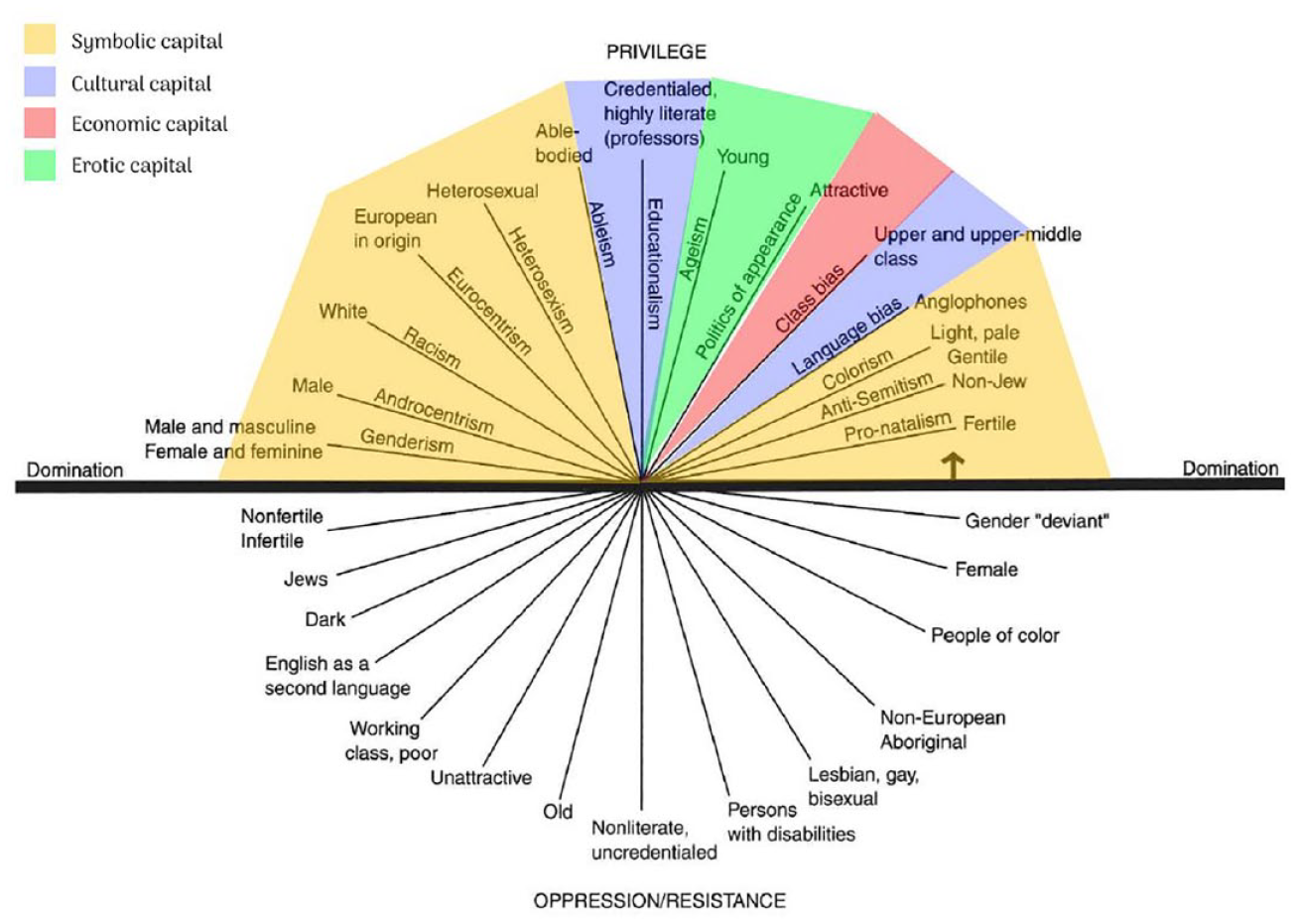
Morgan’s (1996) diagram of privilege/domination.
Bourdieu famously identified four primary forms of capital—material, social, cultural, and symbolic—although the repertoire remains open to further development. For example, Hakim’s (2010) compelling concept of “erotic capital”—the notion of aesthetic physicality and sexual appeal as an individual asset that can be converted into symbolic and economic resources—offers an important extension. Bourdieu’s theory acknowledges that in a world where global capitalism maintains hegemony over nonmarket economies (e.g., markets based on gift exchanges), materiality assumes a foundational role. The principle of economic capital influences all social domains, enabling the “transubstantiation” of other forms of resources into material capital and vice versa (Bourdieu 1986:241). This does not imply that material economies necessarily take precedence over nonmaterial resources; rather, it illustrates how the symbolic value or “aura” (Benjamin [1935] 1969) of an object or act often finds material translatability in a capitalist, market-oriented world. For instance, an invaluable piece of art may acquire a tangible monetary value through an auction.
Yet identifying marginalized identities remains important as a form of what Collins, citing Spivak (2012), calls “strategic essentialism” (Collins and Bilge 2020:227), an anti-essentialist perspective that uses imaginary yet real categories such as “culture,” “nation,” “race,” “gender,” and the like to shift the focus from the authorized voices of subalternity analysts (e.g., academics, policymakers, nongovernmental organizations) to the subaltern themselves without disregarding the importance of any of the two levels of knowledge production—scientific and lay knowledge, dogma and doxa, etic and emic—“It acknowledges that the arena of the subaltern’s persistent emergence into hegemony must always, and by definition, remain heterogeneous to the efforts of the disciplinary historian” (Spivak 2012:217).
Class-Like Cultures and Social Space
A pertinent critique of Bourdieu’s epistemological standpoint is that owing to the agonistic nature of the social arena, where everyone is competing with everyone else, the analytic and political strength of the concept of class diminishes. In line with the idea of diverse capitals, Bourdieu frames class as a multiplicity, or as different class relations, in the distinct spheres of production. For instance, individuals who possess high levels of cultural capital (e.g., linguistic or artistic abilities, a taste for certain cultural productions, advanced educational degrees, scientific knowledge) and more importantly, those who possess the means of production of cultural meanings (e.g., the linguists who define proper and improper uses of language, the artists and critics who differentiate between high and popular culture, the experts who distinguish scientific from nonscientific knowledge) also constitute a class “in paper,” as
sets of agents who, by virtue of the fact that they occupy similar positions in social space (that is, in the distribution of powers), are subject to similar conditions of existence and conditioning factors and, as a result, are endowed with similar dispositions which prompt them to develop similar practices. (Bourdieu 1987:6)
Seim and McCarthy (2023) note that this conceptualization of class departs from the central idea of exploitation: “Exploitation is what allows some classes to live off others.” Lovell (2004:49) raises a similar question regarding Bourdieu’s inability to render any class beyond the dominant classes, including Bourdieu’s inability to consider gender as a variable from which transversal class-type relations may emerge. This problem stems from Bourdieu’s self-confinement to a midrange theory where capitals are always bound to the limits of specific fields. Aside from his early works on Algeria (Bourdieu et al. 1964), Bourdieu tended to overlook transhistorical structures of exploitation. It was only in his late work, Masculine Domination, that Bourdieu (2000b) defied his own limits by examining the construction of the masculine/feminine symbolic schism, drawing examples from heterogeneous periods and places, such as ancient Greece, the Algerian Kabyle, Victorian England, and modern France.
This is where Collins’s intersectionality offers a more suitable framework for considering the local and the global simultaneously—what some authors call “glocality” (Moreno 2011). A glocal perspective on oppression refers to how domination is actually organized: “[R]egardless of the particular intersections involved, structural, disciplinary, hegemonic, and interpersonal domains of power reappear across quite different forms of oppression” (Collins 2000:18). This idea highlights that certain modes of symbolic dispossession are deeply sedimented. For instance, although the meaning and status associated with “being a woman” have varied across historical and cultural contexts (Reiter 1975), we inhabit a world dominated by states, institutions, and systems of knowledge that are grounded on the normative figure of the abled, heterosexual, cisgender man (Bailey, LaFrance, and Dovidio 2019; Carver 2022). Ubiquitous traits such as race, gender, and sexuality become a form of ground-zero symbolic dispossession from which global structures of exploitation build on.
Aligned with Collins’s framework, Angela Davis has been a prominent advocate for transnational intersectional thinking. For instance, Davis (2016) highlights the connection between police brutality against racialized people in the United States and the ethnic apartheid, now escalating into genocide, perpetrated by the Israeli government in Palestine. These seemingly disparate social contexts are linked by overarching global dynamics, including the same raison d’état, the so-called war on terrorism, middle-class centrism, and transnational economic exploitation (Davis 2016:5). As distinct as their contexts are, the type of exploitation that, for example, Chinese rural migrants endure in the boundaries of their own nation-state parallels that of migrants from countries such as Morocco, Pakistan, and Senegal in Spain (Carrasco-Carpio 2017; Ferrant, Pesando, and Nowacka 2014). These groups are bound by analogous negative symbolic coordinates; it is their embodied undervaluation that “allows for the extraction of surplus value, enabling capital accumulation” (Anagnost 2004:193).
Bourdieu (1987:6) is correct to define a class as an “analytical construct founded in reality.” Nonetheless, this reality can be observed beyond the confines of a particular national context or even beyond a specific field. Sedimented symbolic oppositions, such as female/male, migrant/nonmigrant, urban/rural, heterosexual/nonheterosexual, and abled/disabled, sustain the field-independent categories of otherness that function as virtual classes from which other normative groups directly or indirectly benefit. Regardless of ethnicity, men worldwide tend to benefit from the unpaid reproductive labor of women (Ferrant et al. 2014; Mayes and Koshy 2018). It is only when upper- and middle-class women accumulate certain levels of economic capital that they can transfer their exploitation onto working-class women of the Global South (Lobel 2003). Irrespective of gender differences, legal citizens tend to profit from the labor of nonregulated migrants (Diamond 2021; Fernández-García, Molinero-Gerbeau, and Sajir 2023). Regardless of class strata, heterosexual individuals tend to benefit from the family-oriented institutions of the state, which generate differential gaps in hiring processes (Ahmed, Andersson, and Hammarstedt 2013), income distribution (Yeung 2006), and legal rights (Johnson 2011). These are just a few examples of identifiable, if not class in the traditional sense, “class-like” transnational structures of exploitation, or “strategic identities.”
Two Examples
The Interdependence of Capitals in the U.S. Black Community and the Potentialities of Strategic Identities
The inability to understand the complexity of racism can lead to assumptions, for example, that there is an independent phenomenon we can call “Black-on-Black crime” that has nothing to do with racism. The development of new ways of thinking about racism requires us not only to understand economic, social, and ideological structures, but also collective psychic structures. One of the major examples of the violence of racism consists of the rearing of generations of Black people who have not learned how to imagine the future—who are not now in possession of the education and the imagination that allows them to envision the future. This is violence that leads to other forms of violence—violence against children, violence against partners, violence against friends . . . in our families and communities, we often unconsciously continue the work of larger forces of racism, assuming that this violence is individual and sui generis. (Davis 2016:89)
Whereas Bourdieu’s notion of habitus seeks to identify the “psychic structures” Davis (2016) is referring to, his concept of capital aims at systematizing the distribution of the aforementioned “larger forces.” Reading the case presented by Davis through the lens of the theory of practice allows us to see how all forms of capital interlock. In the United States, individuals of Black, Hispanic, and Indigenous descent are 3.5 times more likely to be shot by law enforcement officers than are White individuals (GBD 2019 Police Violence U.S. Subnational Collaborators 2021:1247). Phenotype serves as the basis of a “negative symbolic capital” (Bourdieu 2000c:241), manifesting as stereotypical associations with danger, crime, and untrustworthiness. This symbolic anemia complicates the prospects of securing employment and accessing better paid positions, resulting in a deficit of material resources (Rodgers 2019). The shortage of material means correlates with a lack of social connections that facilitate access to the job market (e.g., a tie to someone in a managerial position who could vouch for them). Thus, having little symbolic, material, and social capitals, the chances of obtaining a higher degree and climbing the social ladder via cultural capital decrease dramatically. One result of this nearly tautological circle is the inability of many marginalized individuals to imagine different futures for themselves; a form of symbolic poverty trap that confines the oppressed in the psychological limits of their own oppression.
Still, Bourdieu overlooked the performative aspect of Marx’s concept of class that intersectionality incorporated into the concept of identity. Identities are constructed to be identifiable. One approach to disrupting the self-fulfilling cycle of the field–capital relationship is to mobilize social energy through shared, strategic identities. Unlike capitals, the notion of a coherent and unified Black identity in the United States supports the formation of a Black community, which, in turn, facilitates transformation of the conditions of possibility of new Black subjectivities and the potential socialization of certain forms of capital (e.g., a Black employer who prioritizes hiring Black employees).
This example illustrates the interdependency of social resources and highlights their complexity, which renders them irreducible solely to identity—such as physical appearance, education, or social networks. At the same time, it shows that intersecting identities can also serve as frontier or liminal sites where various oppressions converge and become mutually intelligible. Uniquely embodied standpoints create entirely new spaces for political coalition, agency, and contestation.
Madeline Stuart’s Identity and the Strategic Mobilization of Capitals and Privilege
To exemplify the complexity of the intersectional framework, García-Santesmasas and Sanmiquel (2020) refer to the case of Australian top model Madeline Stuart, who was diagnosed with Down syndrome. The authors explain that Stuart is a wealthy, famous, White woman who has undergone a series of gender-related procedures to make her body as normative as possible. If we analyze Stuart’s case strictly through the lens of gender, we may conclude she is merely perpetuating gender stereotypes regarding women’s need to remain young, thin, and sexually appealing. Nonetheless, Stuart is not only a woman but also a disabled woman. Disabled women have historically been denied attributes that are at the core of the social construction of femininity: being objects of desire and being identified as potential mothers and caretakers. In this manner, the top model is not simply perpetuating gender stereotypes but resignifying them by presenting her disabled body as socially relevant and sexually desirable.
Stuart’s strategy involves leveraging one of the two intersecting axes of oppression that define her experience—specifically, her identity as a woman—in a stereotypical manner to counterbalance or mitigate the other—her identity as a disabled person. This approach results in a unique composite identity that resists reduction to either dimension alone. Here, “disabled woman” functions as a category that enables the nominalization of a special standpoint, revealing the contours of an arbitrary center or norm: the able-bodied man.
We can now complement the analysis by looking at Stuart’s positionality through a Bourdieusian lens. Although Stuart’s gender and disabled body provide negative symbolic capital, her skin color and other phenotypic markers fall in the normative standard of Whiteness. Access to material capital and consequently, the ability to translate material assets into social, cultural, and symbolic resources are crucial for understanding how individuals with seemingly similar identities (in this case, other disabled women) may occupy significantly different privileged positions compared to that of Madeline Stuart. Privilege is better understood here through the lens of capital distribution, including the synergies and counterbalances of different capitals, rather than through identities. Furthermore, when certain strategic identities are generally recognized as embodied sites of oppression, sociological analysis necessitates a phenomenological (re)insertion into specific social spaces where the relative value of capitals is revealed. Gender, disability, race, sexuality, class, and so on are phenomenologically defined in relation to whom, when, and for what purpose.
Conclusions
Throughout this article, I have presented the philosophical foundations that, in my view, underlie both the theory of practice and Collins’s intersectional theory. The first idea I explored is the phenomenological distinction between knowledge present at hand and knowledge ready to hand. In sociological terms, present-at-hand knowledge encompasses the rules, laws, and conventions explicitly articulated and recognized in social groups. In contrast, ready-to-hand knowledge refers to the common sense that emerges implicitly in everyday interactions. Bourdieu (1987:7) advocates for a clear analytic differentiation between the two; between the discourses that surround an action and the action itself, or as he puts it, between “the things of logic [and] the logic of things.”
A crucial point where the theory of practice and Collins’s intersectionality converge is in the conceptualization of the body as a synthesis of the objective world of things, spaces, and relationships and the subjective sphere of emotions, actions, and ideas. Collins’s (1986) concept of standpoint articulates the relationship between a specific position in the social world and the embodied experience this position produces: a type of positioned consciousness. Bourdieu’s habitus expresses a very similar idea but places additional emphasis on the autonomy of embodied knowledge. The structured nature of the habitus (e.g., posture, taste, emotion, cognitive attunement) not only mirrors and describes the social world but also prescribes it.
Following this approach, I explored another point of alignment between the two theoretical frameworks: the mechanisms by which embodied knowledge, in the form of dispositions and predispositions, relates to social structure. Although I examine the body through the lens of social categories, these categories are continually validated through their association with the body and the physical world—objects and spaces. This is the autogenerative mechanism by which social groups sustain themselves, operating under the illusion of being timeless and natural.
The close relationship between shared expectations of certain bodies and their association with the objective world conceals an inherent arbitrariness—the fact that in different historical and cultural contexts, these natural attributes could have been and often are differently signified. However, unveiling the sociogenesis of ideological constructs such as gender, race, nationality, sexuality, or (dis)ability is not sufficient because these fictions have very real effects that shape our social and physical realities. This is where Bourdieu’s theory of practice and Collins’s intersectionality slightly differ in their understanding of power and class.
Collins’s intersectionality suggests using marginalized identities as embodied indicators of symbolic stratifications. Regardless of the specific field, certain embodied symbols have historically been constructed through enduring global structures of domination and exploitation, including but not limited to colonization, Orientalism, state formation, capitalism, and North-South relations. In this vein, intersectional theory enables a more comparative approach that scales power at a glocal level—simultaneously global and local. This perspective enables interclass-type solidarities beyond the confines of particular fields or national boundaries. Intersecting identities have the potential to challenge the “gaze from nowhere,” the gaze “that mythically inscribes all the marked bodies, that makes the unmarked category claim the power to see and not be seen, to represent while escaping representation” (Haraway 1988:581). The theory of practice, in contrast, focuses on specific social resources and their distribution in concrete social fields, whether equitable or not. Bourdieu’s theoretical tools enrich intersectional analysis by emphasizing the phenomenological interplay among various forms of capital. These forms of capital are expressed through factors that extend beyond the concept of identity, such as income, social networks, education, cultural habits, and spatiality.
I have proposed integrating the strategic essentialism of identities with the dynamic and nuanced analysis offered by the concept of capital, linking each identity to a corresponding form of social resource (see Figure 1). At the analytic level, this approach enables the identification and engagement of specific marginalized groups in research, policymaking, and affirmative action while maintaining a focus on the complex interplay between oppression and privilege—the interaction between capitals.
Overall, I have shown that Bourdieu’s theory of practice and Collins’s intersectional theory complement each other greatly. There is significant epistemological and methodological potential in combining these two perspectives to provide a more comprehensive understanding of social phenomena. This approach not only enriches our scientific analyses but also paves the way for more effective interactions aimed at addressing systemic inequalities and promoting social justice.
Footnotes
Acknowledgements
I would like to express my gratitude to the GenTic research group at the Universitat Oberta de Catalunya for their thorough review of this article, and particularly to Susana Galan for her insightful comments and feedback.
