






Abstract
Bourdieu’s theory of the habitus explains class reproduction but undertheorizes social mobility. I address this by developing the conditions model of the habitus, which preserves the concept’s core features while challenging Bourdieu’s assumption that people in the same class share the same conditions and habitus. Using interviews from the National Study of Youth and Religion, I demonstrate that youth in the same class develop different habitus in different conditions. At the bottom of the class structure, youth raised in constraining conditions typically form a habitus oriented toward class reproduction, whereas those in less constraining conditions often form a habitus oriented toward upward mobility. At the top, youth raised in conditions free from constraint tend to develop a habitus geared toward class reproduction, and those in more constrained conditions develop a habitus oriented toward downward mobility. Thus, separating class from conditions illuminates how the habitus contributes to both reproduction and mobility.
Bourdieu’s model has no space for coherently understanding intra-class variation – in other words why some children from the dominated class are successful while others are not, and for that matter why some youth from the dominant class are unsuccessful.
Bourdieu’s theory of the habitus explains class reproduction but does little to explain upward and downward mobility. This is a problem because mobility regularly occurs. In the United States, about a third of sons of unskilled or service workers become lower- or upper-level professionals, and most sons of upper-level professionals do not become upper-level professionals themselves (Beller and Hout 2006). By education, over a quarter of children whose parents do not have a bachelor’s degree obtain one, and about a third of children of college-educated parents do not obtain a bachelor’s degree (Manzoni and Streib 2023). By income, almost 40 percent of youth born into the bottom quintile rise to the top three, and almost 40 percent of youth born into the top quintile fall into the bottom three (Chetty et al. 2014).
Bourdieu’s relative inattention to how the habitus facilitates social mobility is not only a problem for his own work but also for those who use it. Scholars using this approach replicate Bourdieu’s imbalance by explaining class reproduction while overlooking social mobility (Streib 2017). This issue is so pronounced that even Bourdieusian studies of upward mobility focus on how the habitus holds back those who experience it without also exploring how it might contribute to their rise (e.g., Osborne 2024; Reay 2021).
Clearly, Bourdieu’s concept of the habitus needs to be revised to account for both class reproduction and social mobility. In this article, I advance the conditions model of the habitus to do just that. This model retains the most powerful features of Bourdieu’s theory of the habitus: that it is rooted in childhood class position and conditions, reflects individuals’ objective probability of success, is durable and transposable, and connects structure and agency by treating goals and strategies as products of external circumstances rather than as freely chosen or easily changed. However, this model departs from Bourdieu by revising his view of class. Bourdieu defined classes as groups of people who share the same habitus and the same core conditions—that is, the same material circumstances, capital, and community messages (e.g., “That’s not for the likes of us”). Instead, the conditions model conceptualizes class in a way that avoids a tautology with the habitus and allows for within-class variation in childhood conditions.
These simple revisions are potent because they reveal how some youth develop a habitus oriented toward class reproduction while others develop a habitus oriented toward upward or downward mobility. Youth who grow up at the bottom of the class structure and in constraining conditions—without their material needs met, with little capital, and with a community that tells them not to aim too high—tend to develop a habitus oriented toward class reproduction, as Bourdieu predicted. But youth in the same class who grow up mostly or only in conditions relatively free from constraint—with their material needs met, higher levels of capital, and a community that encourages them to aim high—often develop a habitus oriented toward upward mobility. Similarly, as Bourdieu posited, youth raised at the top of the class structure and in conditions free from constraint typically develop a habitus aimed at maintaining their class position. However, some of their peers in the same class are raised in more constraining conditions and develop a habitus oriented toward downward mobility. In this way, class and conditions shape the habitus, but because individuals in the same class do not always grow up in the same conditions, some develop a habitus oriented toward class reproduction while others develop a habitus oriented toward upward or downward mobility.
The Habitus
There is no definitive definition of the habitus (Crossley 2013). However, researchers generally agree that the habitus is a system of durable and transposable goals, strategies, worldviews, tastes, and dispositions that stem from individuals’ childhood class position and respond to their objective probabilities of success (Bourdieu 1980, 1984; Bourdieu and Passeron 1977).
Although the habitus is broader, Bourdieu (1980:64) was particularly concerned with how the habitus organizes goals and strategies, or how the habitus “adjusts itself to a probable future which it anticipates and helps bring about.” To Bourdieu, this occurs as individuals’ durable and transposable goals and strategies unconsciously come to follow a rule that reflects their different opportunities. At the bottom of the class structure, youth lack the resources needed to get ahead, partly because institutions evaluate them against standards they are not given the resources to meet. Intuiting their blocked opportunities, these youth learn to accept or “make a virtue of necessity.” That is, they realize they have little chance of entering the institutions they need to pass through to reach the top of the class structure, form goals and strategies that revolve around opting out of these institutions, and sometimes claim that opting out is a better approach. At the top of the class structure, youth possess the resources needed to stay ahead, enabling them to meet standards that institutions set in their favor. Intuiting that many opportunities are open to them, they come to follow a different rule: They “distance themselves from necessity.” That is, these youth understand that they have the opportunity to meet these institutional expectations, draw on their considerable resources to set goals and develop strategies focused on opting into them, and assert that goals and strategies that require considerable resources are superior to those that require fewer. Thus, without intent, youths’ habitus not only reflects their childhood class position but also contributes to reproducing it. Youth raised at the bottom of the class structure remain there by learning to opt out of institutions that reward those who possess resources they were not given. Youth raised at the top of the class structure stay there by learning to opt into the same institutions.
Importantly, the habitus contributes to class reproduction, but the opportunities embedded in individuals’ class origin serve as the primary driver. Thus, while Bourdieu used the language of goals, strategies, making a virtue of necessity, and opting out, he nevertheless considered goals and strategies not as voluntary choices but as aspects of the habitus that involuntarily spring from individuals’ available opportunities. As one of his students put it: “[H]abitus operates as the ‘unchosen principle of all choices,’ guiding practices that assume the systematic character of strategies even though they are not the result of strategic intention” (Wacquant 2018:531).
Attempts at Linking the Habitus to Social Mobility
Bourdieu’s theory of the habitus explains class reproduction but does less to explain social mobility. Still, Bourdieu considered four ways the habitus relates to upward and downward mobility. First, he contended that the habitus is affected by social mobility (Bourdieu 1984, 2000b). For Bourdieu (1984), the habitus results from individuals’ current and past class positions. Accordingly, individuals’ habitus changes after they are upwardly or downwardly mobile, often resulting in a cleft habitus (Bourdieu 2000b). Considerable evidence supports this view (e.g., Friedman 2016; Lee and Kramer 2012). However, because this work treats the habitus as the product of social mobility and not also a driver, it cannot explain how some youth become oriented toward mobility.
At other times, Bourdieu viewed the habitus as changing prior to mobility and facilitating it. While Bourdieu maintained the habitus is formed through classed family socialization, he also suggested it can change through secondary socialization, especially that which occurs through schools. Some disadvantaged youth adopt the goals, strategies, worldviews, and dispositions their schools inculcate, even when these differ from those they learned at home (Bourdieu 2017; Wacquant 2014). The habitus can also change prior to mobility through concerted effort: Some disadvantaged youth are driven to change their habitus due to “projection, identification, transference, sublimation” (Bourdieu 2000a:165) or a drive to overcome their disadvantages (Bourdieu and Passeron 1979:25).
However, neither of these positions successfully explains how many youth develop a habitus oriented toward upward mobility. Secondary socialization most often changes the habitus when disadvantaged youth attend boarding, charter, and private schools that inculcate students into elite culture (Jack 2019; Khan 2011; Richards 2022). However, most disadvantaged youth do not attend these schools (Murnane et al. 2018), and the schools they typically attend often reinforce rather than change the habitus they developed at home (Nelson and Schutz 2007; Nunn 2014). Moreover, secondary socialization may not matter as much as Bourdieu assumed: The act of applying to elite schools suggests youths’ habitus became oriented toward upward mobility before they attended, not after. Likewise, Bourdieu’s notion that youth can change their habitus through concerted effort begs the question of why some youth try to change their habitus while others do not.
Bourdieu (1988) proposed a third way habitus relates to social mobility: through hysteresis, or when a field changes so significantly and quickly the habitus becomes misaligned with it. In these situations, actors continue to pursue the goals and strategies that previously facilitated reproduction; given the changed field, these goals and strategies now lead to downward mobility. This approach is especially useful for explaining downward mobility, but it only explains how the habitus fuels mobility when large, sudden, and rare shocks occur. This leaves more ordinary moves toward downward mobility unexplained. Hamilton and Armstrong (2021) make progress in this regard, arguing that downward mobility occurs when youths’ approaches to obtaining their desired class position are mismatched with their resources or the historical moment. However, Hamilton and Armstrong do not explain why some youth develop approaches that are mismatched with the moment and others do not, and so do not account for a large part of how the habitus matters for mobility.
Finally, Bourdieu suggested that some youths’ primary socialization gives them a habitus oriented toward mobility. According to Bourdieu (1984), the habitus is not only a result of an individual’s current and past class position but also their family’s class trajectory. Bourdieu (1984; Bourdieu and Passeron 1979) assumed the petite bourgeois grow up with parents who were formerly more disadvantaged and develop a habitus oriented toward continuing their parents’ upward trajectory. Bourdieu and Passeron (1979:26) also viewed one group as raised in circumstances in which they develop a habitus oriented toward upward mobility: disadvantaged youth with relatives who graduated from college, who then see themselves as able to do the same. To Bourdieu (1984), youths’ upward mobility goals can be realized in certain situations, particularly when they only need to acquire more of a type of capital they already possess, such as when the child of a teacher’s aide becomes a teacher. Yet while Bourdieu’s insight that some youth are raised in circumstances that orient them toward mobility is useful, his view of how this occurs is incomplete: He provided little evidence that the children of the petite bourgeoise are born to families on an upward trajectory, his brief remarks about college-educated relatives fall short of forming a theory, and it seems as though those born into circumstances that produce a habitus aimed at mobility only develop goals and strategies that point them up the class ladder and not also down.
Unsatisfied with Bourdieu’s explanations, other scholars have attempted to refashion the habitus to allow it to explain mobility. Lahire (1995, 2011) and Jaquet (2023) have made the most significant contributions in this regard. Each argued that the habitus is not simply a reflection of an individual’s class origin and social trajectory but that it stems from multiple sources. To Lahire, youth develop their habitus from school, the media, peers, leisure activities, and the family, among other venues. Each socialization source does not offer internally coherent, consistent, or across fields, homologous messages, and youth accept and reject their socialization haphazardly. Without socialization that is coherent, consistent, or fully accepted, youth internalize a variety of dispositions, not all of which reflect their class origin or direct them to remain in it.
Jaquet (2023) also views childhood socialization as providing orientations toward social mobility. To her, some disadvantaged youth aim for upward mobility due to their attachments to teachers, peers, or romantic interests from higher social classes. Youth are also motivated to leave their class due to the emotions it can evoke, such as shame, indignation, or injustice. For both Lahire (1995, 2011) and Jaquet, class is then not the only source of the habitus, and other sources lead some youth to develop a habitus oriented toward social mobility. However, for both authors, the socialization sources that lead individuals to develop a habitus oriented toward mobility are idiosyncratic, “a unique combination, a tangle of forms of determinism” (Jaquet 2023:176), or a mix of messages from family, peers, school, leisure activities, and media that are internalized in unpredictable ways (Lahire 2011). This leaves the theoretical landscape in an unsatisfying place: Bourdieu argues that systematic processes lead youth to develop a habitus oriented toward class reproduction, while his critics argue that unsystematic processes lead youth to develop a habitus oriented toward upward or downward mobility.
Empirical work has also shed light on the habitus. While much of this work focuses on how the mismatch between the habitus and institutional practices leads to class reproduction (Calarco 2018; Lareau 2011) or makes upward mobility taxing (Lee and Kramer 2012; Osborne 2024), other studies offer useful building blocks for the question at hand. Within-class variation in the habitus is well documented (Anderson 2000; Carter 2007; MacLeod 2008), and some of this variation arises from different levels of material security as well as real and perceived opportunities for upward mobility (MacLeod 2008; Mullainathan and Shafir 2013; Sanchez-Jánkowski 2008). Like Bourdieu’s critics, this work also suggests that different conditions shape the habitus. However, while useful, each study’s focus has been too narrow to provide a theory of how some youth develop a habitus aimed toward class reproduction while others develop a habitus oriented toward upward or downward mobility.
Social Mobility and the Conditions Model of the Habitus
Building a theory of the systematic ways youth develop a habitus oriented toward social mobility begins with understanding why Bourdieu’s theory did not. I argue that a key reason lies in Bourdieu’s (1987) definition of class. As Swartz (1997:154) summarized: “He defines social classes as any grouping of individuals sharing conditions of existence and their corresponding sets of dispositions.” 1 Such a definition has two problems. First, it creates a tautology: Classes are defined as groups of people who share the same dispositions, or the same habitus, and individuals develop the same habitus by growing up in the same class. This tautology explains why Bourdieu focuses so heavily on class reproduction. Using this definition, everyone in the same class develops the same habitus, which orients them toward the same class destination.
Second, Bourdieu’s definition of class assumes that people in the same class share the same childhood conditions. Three such conditions give rise to the habitus: material circumstances (whether youth can take for granted that their material needs will be met), capital (the cultural resources rewarded by the institutions that contribute to allocating class positions, with, in Bourdieu’s model, human capital being “irrevocably fused” with cultural capital [Lareau and Weininger 2003:580] and the economic resources—particularly income but also wealth—that when existing beyond contributing to material security, are used to meet gatekeepers’ standards and secure one’s class position),2,3 and community (the people who tell or show children what is “for the likes of us”; Bourdieu 1980, 1984, 2000a). 4 I call these “core conditions” due to their centrality in forming the habitus: Material conditions, cultural capital, and economic capital shape youths’ ability to meet gatekeepers’ expectations and therefore inform what goals and strategies follow from their objective life chances, and communities communicate what is achievable and desirable for people like them and therefore what goals and strategies they should adopt. According to Bourdieu’s definition of class, all youth in the same class grow up in the same conditions and therefore develop the same habitus oriented toward reproduction.
Recognizing this, the key to revising the habitus becomes clear: Class must not be conflated with the habitus or with core conditions. This is accomplished by following the lead of Bourdieusian scholars who deploy Weber’s ([1914] 1946) definition of class and its associated operationalizations: Classes are groups who share a common labor market situation as measured by working in the same broad occupational categories or possessing similar levels of educational attainment (Friedman and Laurison 2019; Jæger 2007; Lareau 2011). 5 This conceptualization of class clarifies that members of the same class do not necessarily share the same habitus or core conditions. Rather, parents’ occupation and education inform their material circumstances, capital, and community as well as those of their children, but because class is not defined by these factors, the association is imperfect. Indeed, using a Weberian conceptualizations of class, researchers find that within-class differences in parents’ challenges, supports, resource use, and resource transfers create substantial within-class variation in children’s material circumstances, capital, and community (Atkinson 2012; Breinholt 2024; Lahire 1995; Mallman 2017; Naudet 2018; Rodems and Shaefer 2019; Scherger and Savage 2010; Streib 2020).
This definition of class creates space to understand how some youth in the same class develop different habitus—some oriented toward class reproduction and others toward social mobility. Following Bourdieu, this occurs as core conditions shape the habitus in patterned ways. Core conditions that constrain youths’ ability to get ahead lead them to make a virtue of necessity or to at least accept that their life chances are shaped by these constraints. Core conditions relatively free from constraint allow youth to form goals and strategies that are distant from necessity, enabling them to act as if their life chances are not constrained by their conditions. What counts as a constraint depends on one’s class position, especially regarding capital. Youths’ sense of whether they are constrained by their capital is shaped by their own and others’ comparison of themselves to those around them—in a class-segregated society, to those in their class. As such, individuals at the top tend to feel constrained when they have less than their peers in the same class despite having more than most in their country, while those at the bottom tend to feel relatively unconstrained when they have more than their peers in their class despite having less than many in the country (Andersen and Jæger 2015; Crosnoe 2009; DiMaggio 1982; Parker et al. 2021).
Building on these insights, the conditions model of the habitus demonstrates how youth in the same class develop different habitus oriented toward different class destinations. Youth develop a habitus oriented toward class reproduction when they experience the circumstances Bourdieu described. That is, when youth at the bottom of the class structure only grow up in core conditions that constrain their chances of getting ahead, they typically develop a habitus that makes a virtue of necessity and become oriented toward class reproduction. Likewise, when youth at the top of the class structure only grow up in core conditions free from constraint, they typically develop a habitus oriented around distancing themselves from necessity and maintaining their position at the top of the class structure.
The conditions model of the habitus holds that youth at the bottom of the class structure develop a habitus oriented toward upward mobility in systematic ways, namely, when they grow up mostly or only in conditions relatively free from constraint. Developing this habitus often requires that youth grow up mostly or only in these conditions for two reasons. First, youth at the bottom need to believe they can and should move up; youth who believe they can but not that they should may work toward other goals, and youth who believe they should but not that they can may not see the point of trying. However, most core conditions alone communicate only one of these messages: material security that they can work toward goals beyond meeting their material needs; relatively high levels of cultural and economic capital that they can succeed in school, college, and then professional work; and communities that them they should aim for upward mobility (unless these communities comprise people who tell them they should move up and role models who show them they can, in which case, this condition is the rare one that accomplishes both). Second, internalizing that one can move up is often predicated on more than one condition being in place. Using economic capital to get ahead requires not needing to use it all to achieve material security, just as acquiring and deploying cultural capital is most feasible for youth who take their material security for granted. Therefore, with the potential exception of youth who grow up in communities that teach them they can and should move up, to internalize a habitus oriented toward upward mobility, youth typically need to grow up in three or more core conditions that are relatively free from constraint: at least two that communicate they can move up—material security and relatively high levels of at least one form of capital—and one, community, that suggests they should.
Likewise, the conditions model of the habitus contends that some youth at the top of the class structure develop a habitus oriented toward downward mobility, and this occurs systematically. Some youth at the top are raised in conditions that constrain their ability to stay ahead, form goals and strategies that make a virtue of their constraints, and become oriented toward downward mobility. Given that each core condition that constrains them changes their objective probabilities of remaining in their class, the more conditions that do so, the more likely they are to develop a habitus oriented toward downward mobility. However, there is an asymmetry in developing a habitus oriented toward downward versus upward mobility. Many conditions need to be in place to develop a habitus oriented toward upward mobility, but that is not the case for downward mobility. An orientation toward downward mobility develops when youth believe they can or should fall without both being necessary. This occurs as youth may learn to make a virtue of necessity when their constrained cultural capital, economic capital, or in rare cases, material circumstances lead them to believe they can fall, seeing it as difficult to prevent even if they do not believe they should fall, and youth who learn from their communities that they should fall face few barriers to believing they can. A single constraining condition also has the power to produce a habitus oriented toward downward mobility because being constrained by one condition is not predicated on being constrained by another; youth with little cultural or economic capital compared to others at the top experience the effects of these constraints even when their material circumstances do not also constrain them. Therefore, contrary to Bourdieu’s predictions, developing a habitus oriented toward downward mobility may occur somewhat frequently because it can emerge from only one constrained condition, even as it is more likely to occur the more that are in place.
In summary, the conditions model of the habitus provides a new understanding of how some youth develop a habitus oriented toward class reproduction while others develop a habitus oriented toward upward or downward mobility. This model builds on Bourdieu’s work and that of his critics while avoiding the mistakes of both. From Bourdieu, it draws from the idea that the habitus is a product of class and core conditions while changing his definition of class to distinguish it from the habitus and conditions. From his critics (Jaquet 2023; Lahire 1995, 2011), it draws on the idea that class and conditions are indeed separate and that each gives rise to the habitus while rejecting several of their views: that any condition has a powerful effect on the habitus rather than primarily Bourdieu’s core, that lessons from each condition are absorbed haphazardly rather than in conjunction, and thus that the development of a habitus oriented toward mobility occurs idiosyncratically rather than systematically. From the empirical studies described previously, the conditions model draws on the assumption that class and conditions are separate while rejecting the approach of examining one condition at a time. Doing so overlooks the fact that youth experience multiple conditions simultaneously and that the combination of these conditions matters for the habitus they develop.
Data and Methods
Data
I amend Bourdieu’s theory of the habitus using data from the National Study of Youth and Religion (NSYR). 6 The NSYR includes a panel interview study. The NSYR team selected interviewees using a quota sample from the NSYR’s nationally representative survey of youth and their parents. The panel includes four waves of interviews. The first occurred in 2003 when respondents were 13 to 18 years old. The same respondents were interviewed up to three more times until they were 23 to 29 years old. Additional respondents were added in Waves 3 and 4, with Wave 3 interviewees reinterviewed in Wave 4. The NSYR’s prospective, longitudinal panel of youth transitioning to adulthood makes it useful for studying trajectories of class reproduction and social mobility.
Using the NSYR and a Weberian definition of class, I operationalized class in terms of occupation and education. 7 For occupation, I used the National Statistics Socio-economic Classification (NS-SEC), which was constructed to map occupations onto class positions, with class defined by labor-market situation. Guided by Friedman and Laurison (2019), I categorize individuals in NS-SEC 1 and 2 as upper-middle class. This group consists of higher- and lower-level professionals and managers, such as doctors, engineers, and editors; I also include graduate students in this category. NS-SEC Categories 3, 4, and 5, comprising small employers, lower supervisory occupations, and technical occupations such as clerks, carpenters, and chefs, are considered middle-class. NS-SEC Categories 6 and 7, individuals in semiroutine and routine positions, such as assemblers, cleaners, and bartenders, are working-class. People in NS-SEC Category 8, the long-term unemployed, are lower class. I consider the upper class to be people who do not need to work for pay. No such respondents are in the sample, but I include them in the theory. I classify respondents’ class origin by their parent with the highest class position; I measure respondents’ adulthood class position as the highest between themselves and their spouse. For short, I sometimes refer to the “bottom” and “top” of the class structure. The bottom refers to the lower, working, and middle classes, and the top refers to the upper-middle and upper classes. Because class is comprised of multiple markers, including education, and because parents with misaligned occupations and educations put children in a complicated class position, I only include respondents at the bottom whose parents do not have bachelor’s degrees and respondents at the top who have at least one college-educated professional or managerial parent. The sample comprises the 206 respondents who meet these criteria and who participated in a Wave 4 interview.
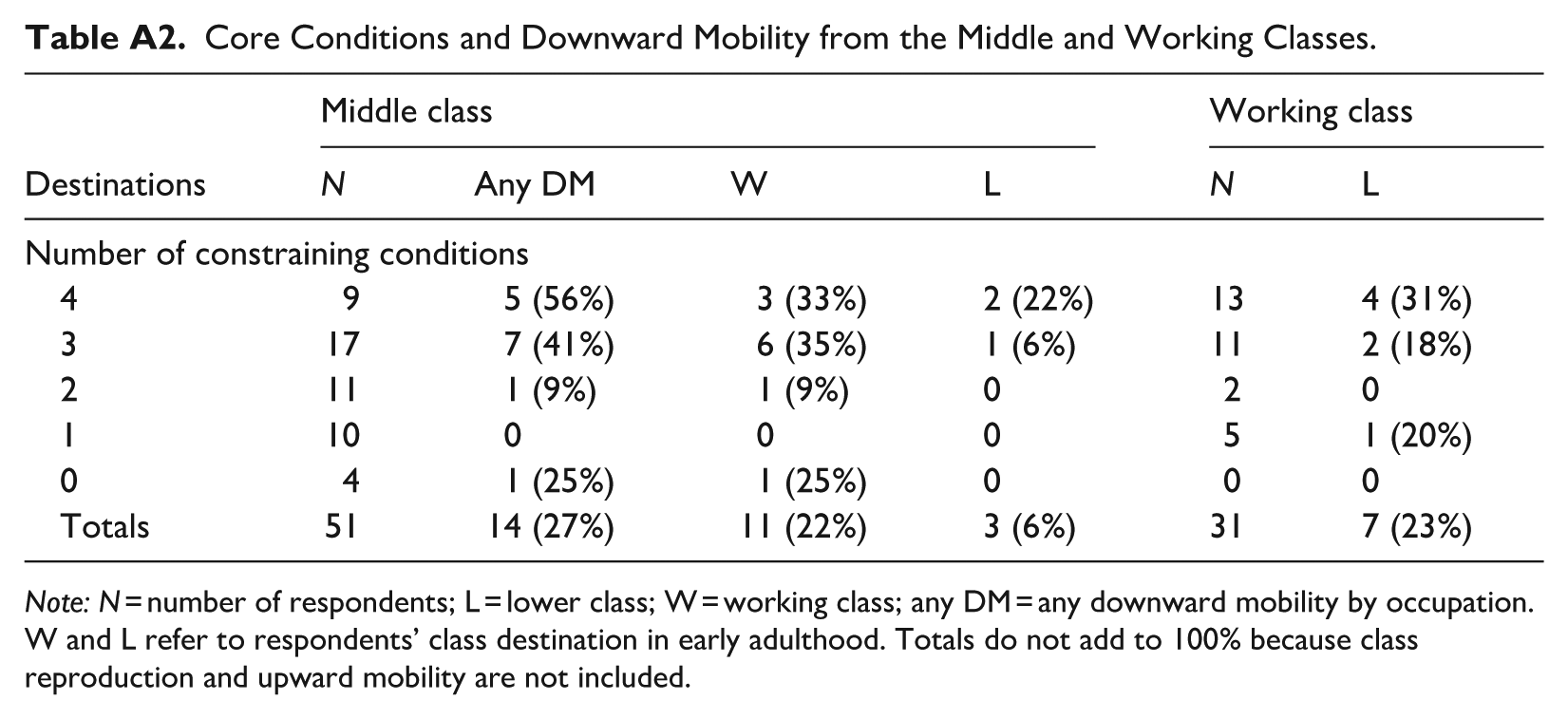
This view of class allows several possible meanings of a habitus oriented toward social mobility. I consider respondents to have a habitus toward upward mobility when they were raised at the bottom of the class structure and become oriented toward the top, and I consider respondents to possess a habitus oriented toward downward mobility when they were raised at the top and become oriented toward the bottom by either education, occupation, or both. I also measure respondents’ social mobility. Here, I report movements from the bottom to the top of the class structure, and vice versa, as well as moves within these categories. Tables 1 and 2 show the number of respondents from the bottom and the top of the class structure, their core conditions, and their mobility rates. Appendix Table A1 includes respondents’ demographics by race and gender, and Appendix Table A2 includes information on downward mobility from the middle and working classes.
Core Conditions and Upward Mobility from the Lower, Working, and Middle Classes.
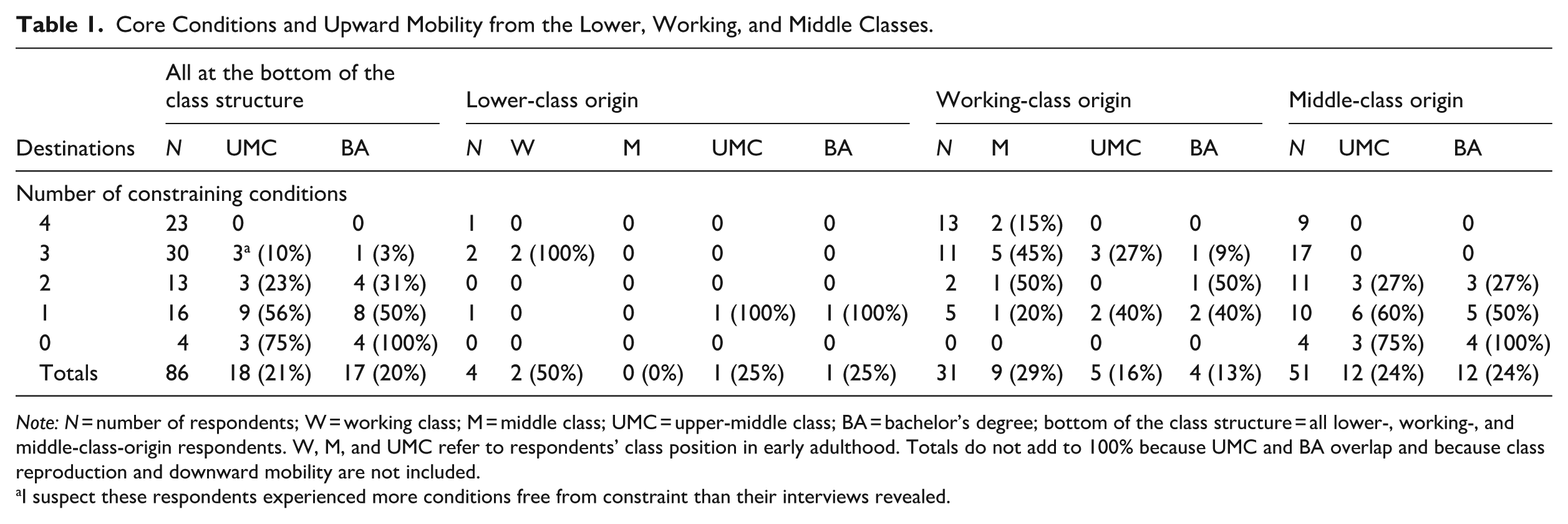
Note: N = number of respondents; W = working class; M = middle class; UMC = upper-middle class; BA = bachelor’s degree; bottom of the class structure = all lower-, working-, and middle-class-origin respondents. W, M, and UMC refer to respondents’ class position in early adulthood. Totals do not add to 100% because UMC and BA overlap and because class reproduction and downward mobility are not included.
I suspect these respondents experienced more conditions free from constraint than their interviews revealed.
Core Conditions and Downward Mobility from the Upper-Middle Class.
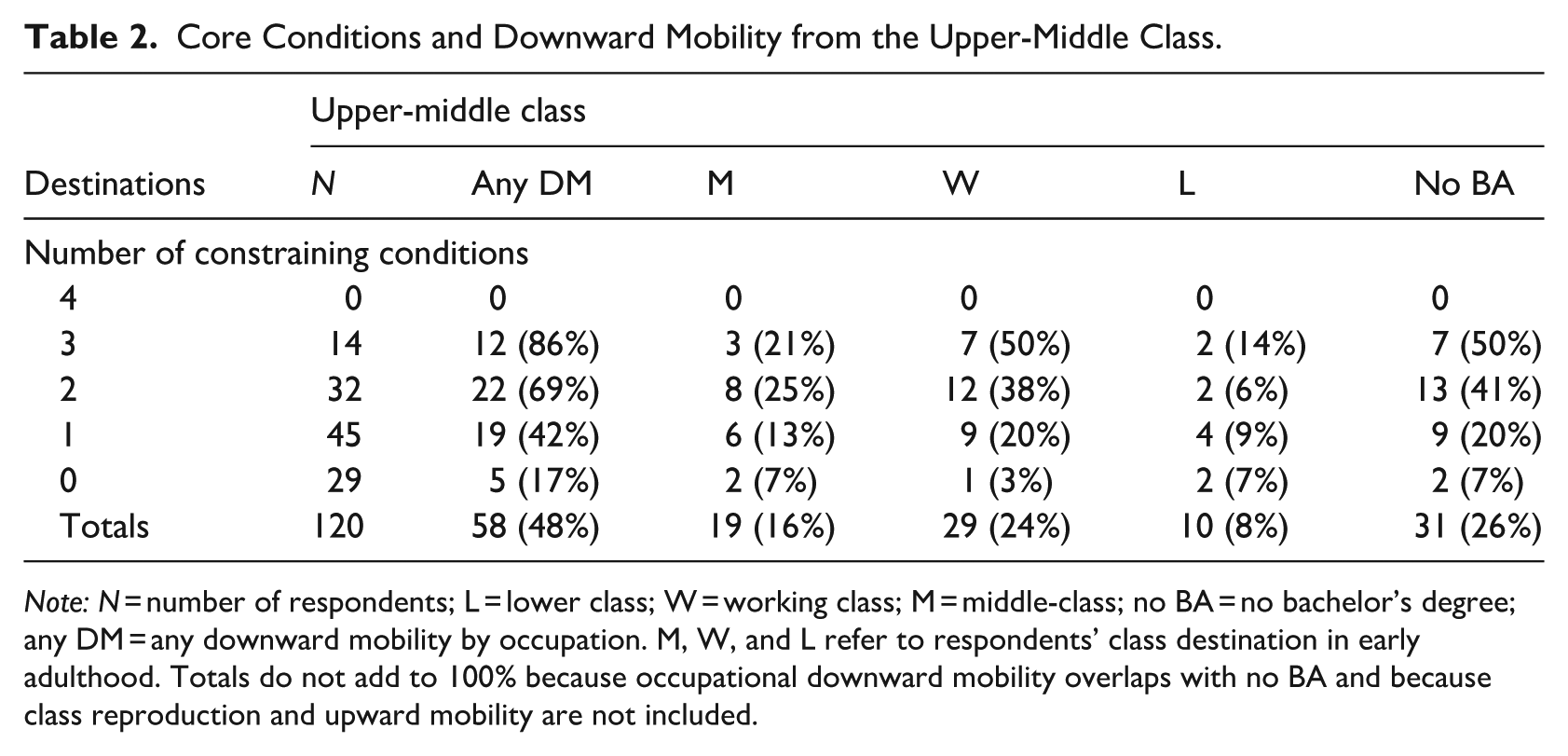
Note: N = number of respondents; L = lower class; W = working class; M = middle-class; no BA = no bachelor’s degree; any DM = any downward mobility by occupation. M, W, and L refer to respondents’ class destination in early adulthood. Totals do not add to 100% because occupational downward mobility overlaps with no BA and because class reproduction and upward mobility are not included.
A team of researchers, not including the author, conducted the interviews. Each interview was structured with similar questions asked across waves. The interview guide includes repeated questions about respondents’ core conditions, goals, and strategies. For instance, the guide asks: “What is a typical week in your life like?”; “What are some good and bad things about your life (as a teenager)?”; “How hard do your [parents] push you to do well in school?”; “Do you have any particularly positive or negative relationships with other adults (other than parents) in your life? [If yes] Who are they? How do you know them? How do they affect you?”; “How much do you care or not about doing well at school? Why or why not?”; “What are your future education plans?”; “What kind of career goals do you have?” As respondents answered these and other questions, they discussed their material circumstances, capital, and communities. Information on parents’ household income, educational attainment, and occupation comes from the parent survey.
Analysis
To capture respondents’ habitus, I focused on their durable and transposable goals and strategies. These aspects are commonly used to operationalize the habitus (Dumais 2002; Gaddis 2013). Moreover, they reflect how Bourdieu (1980:53) described the habitus: “systems of durable, transposable dispositions . . . [that] can be objectively adapted to their outcomes without presupposing a conscious aiming at ends or an express mastery of the operations necessary in order to attain them.”
Taking this approach, I defined respondents’ goals as future-oriented desires that respondents acted on. Following Bourdieu’s (2000a:221) observation that the most disadvantaged sometimes fantasize about their futures without treating these fantasies as attainable or acting on them, I treated hopes that were not pursued as aspirations. I classified strategies by whether respondents opted in or out of trying to meet institutions’ expectations. Dispositions are difficult to capture in interviews, and respondents said little about their tastes, so I did not analyze these aspects of the habitus. I also present cases of youth with durable habitus; the habitus can change (Bourdieu 2000a), but for most respondents, it remained steady over time.
I also examined respondents’ core conditions. I considered respondents to be living in conditions free from material constraint if they consistently took for granted that their parents would provide them with shelter, food, and safety. I considered respondents to be constrained by their material needs if they could not take this for granted at any point before they turned 18. Of course, material circumstances vary more at the bottom of the class structure than at the top (Rodems and Shaefer 2019). Nevertheless, material security plays a crucial role in shaping the habitus of youth at the top. Without it, they would struggle to set high goals, consider long time horizons, and opt into trying to meet institutional expectations (Mullainathan and Shafir 2013). That is, their habitus would be different.
To measure cultural and economic capital, I took into account research suggesting that youths’ goals and strategies are shaped by their capital relative to others around them—in the United States, mostly people in broadly similar social classes (Andersen and Jæger 2015; Parker et al. 2021). Doing so entailed using different measures for respondents in each class. I counted respondents at the bottom of the class structure as relatively free from cultural capital constraints when adults provided them with hands-on advice on succeeding in school, such as helping with homework, monitoring its completion, or advising them on where to apply to college. I excluded vague pieces of advice, such as the suggestion to try in school. I counted youth at the top of the class structure as relatively free of cultural capital constraints if they reported regularly discussing school, college, or professional work with a college-educated professional. All others were counted as having constrained levels of cultural capital for their class.
Regarding economic capital, I considered youth at the bottom of the class structure as being relatively free of economic constraints if their parents reported a household income in the top third of the distribution for such respondents. Youth at the top of the class structure are considered relatively constrained if their parents reported a household income in the bottom third of the distribution for such respondents or if their parents refused to contribute to their college costs.
Measuring community influences, I focused on the messages respondents received about who they should become. I marked youth at the bottom of the class structure as having a community that promoted upward mobility if they reported that someone had encouraged them to pursue a bachelor’s degree or professional job. I considered youth at the top of the class structure as part of communities open to downward mobility if someone encouraged them to pursue goals that did not include college or a professional career or if they were exposed to an option that seemed more appealing. To simplify the analysis, I coded conditions as either constraining or free from constraint, but in reality, the degree of each may inform the habitus youth develop.
I separately measured youths’ habitus and mobility trajectories because not all youth with a mobility-oriented habitus changed classes by early adulthood. The numbers reported on conditions, the habitus, and mobility should be considered indicative of patterns rather than nationally representative; attrition, missing data, and the fact that interviews were selected from a quota sample preclude generalizing from these numbers to the U.S. population.
Developing a Habitus Oriented Toward Reproduction or Mobility
Some respondents developed a habitus oriented toward class reproduction; others developed a habitus oriented toward upward or downward mobility. In the following sections, I provide examples of how this occurs. Respondents at the bottom of the class structure tended to develop a habitus oriented toward class reproduction when they grew up only or mostly in core conditions that constrained them; respondents at the top of the class structure tended to develop a habitus oriented toward reproduction when they grew up in only core conditions free from constraint. Interviewees at the bottom of the class structure more often developed a habitus oriented toward upward mobility when they grew up only or mostly in core conditions free from constraint, and interviewees at the top of the class structure tended to develop a habitus oriented toward downward mobility when one or, often, more core conditions constrained them.
Developing a Habitus Oriented Toward Class Reproduction
As Bourdieu predicted, when lower- and working-class youth grow up in core conditions that constrain their chances of getting ahead, they typically develop a habitus that makes a virtue of necessity and become oriented toward maintaining their current class position. This occurred for Liam, 8 a lower-class youth. As a child, his material needs often went unmet. His father did not provide them; he was barely part of Liam’s life. Liam’s mother did not consistently provide them either. She was incarcerated for child abuse; when she was home, she sometimes left Liam to hope an older friend would feed him. When Liam was a teenager, she dated a man who refused to live with Liam and told him to move out. Liam could not take for granted that he would have safety, food, or shelter.
Liam also did not grow up with the economic or cultural capital that schools, colleges, and professional workplaces reward. Liam lived in a low-cost region in the southern part of the country, but his mother earned less than $10,000 a year. 9 With only a high school degree, she had little cultural capital to pass down and did not teach Liam how to succeed in school. Liam also did not have a community that pushed him toward upward mobility. His community consisted of his family, his older friend who looked after him, other friends he said got him into trouble, and girlfriends, none of whom pushed him to leave his social class.
With core conditions that constrained his life chances, Liam developed a habitus centered on accepting and making a virtue of his limited opportunities. Reflecting what was probable given his class and conditions, he held low goals for his educational attainment. Asked as a teenager if there is “stuff that you definitely want to accomplish in life,” Liam replied: “Getting my GED.” At 19, he set a goal to earn his GED again. At 22, he held the same goal. At 27, he repeated: “I wanna finish getting my GED.” He also held relatively low occupational goals. At 17, he wanted to be an electrician or mechanic, but these ideas soon became aspirations rather than goals he actively pursued. At 19, he held onto these aspirations while pursuing lower goals; he focused on finding a fast-food job. At 22, he still dreamed of becoming an electrician or mechanic while aiming to acquire an entry-level position at Walmart. At 27, he was unemployed and held nonprofessional goals: “I don’t care if I’m frying fries over at McDonald’s, as long as I’m working.”
With his chances of upward mobility constrained by his class and core conditions, Liam opted out of institutions. Refusing what was denied to him, he opted out of high school, dropping out in ninth grade. Without opportunities that an arrest would prevent, he opted out of following the law; he was incarcerated for breaking windows, slashing tires, kicking mailboxes, and stealing bikes and then for alcohol intoxication and assaulting an officer. Without the cultural capital needed to navigate the workplace, he sometimes opted out of work, too, often quitting.
Throughout it all, Liam did what Bourdieu predicted: He made a virtue of necessity. 10 He framed his GED classes as better than high school: “[In my GED classes], in 3 hours, I do at least 30 problems in each subject. That right there ain’t as bad as me sitting at a school every day.” Asked at 27 what he valued most, he made a virtue of one of the few things he had, his life: “Right now, just living life itself.” He also made a virtue of necessity while reflecting on his experiences: “Going through the hard things makes you stronger, and somehow it all pans together and just makes you a better person.” Born into conditions in which his material needs often went unmet, he accepted that he would need to focus on meeting them. Asked what he ultimately wanted out of life, he said: “A roof over my head and food in my belly.”
Liam’s core conditions created steep barriers to upward mobility and a habitus that oriented him toward class reproduction. At age 27, he was on that path: he had a ninth-grade education and was unemployed. As Table 1 shows, just over a quarter of respondents at the bottom of the class ladder were raised in only constraining core conditions, and Liam’s outcomes were typical of this group: None entered adulthood with a professional or managerial job or a bachelor’s degree. Most had accepted that these jobs and degrees were not possible for them, and they did not hope to become college-educated professionals. Facing an array of barriers not of their making, they adapted their goals and strategies to their conditions and developed a habitus oriented toward class reproduction.
At the top of the class structure, respondents developed a habitus oriented toward class reproduction when they grew up only in core conditions free from constraint. Olivia, for example, an upper-middle-class girl, grew up with material security: “We’ve always had enough.” She inherited high levels of economic and cultural capital. Her parents’ earnings fell into the highest income bracket recorded by the study, and when she was young, her grandfather promised to pay her college tuition. Her parents were both graduate-school-educated professionals, and they both passed down cultural capital by regularly discussing school and college with her. Her community also encouraged her to become a college-educated professional. Her father encouraged her to attend his alma mater, an elite liberal arts college, and she grew up viewing both of her parents as professional role models. Her teachers also encouraged her to pursue a college degree, and her professors encouraged her to enter a professional career.
Olivia grew up only in core conditions that encouraged her to distance herself from necessity, and she did. She set goals beyond meeting her material necessities, which her capital allowed her to achieve, and her community encouraged: to become a college-educated professional. At 17, she aimed to complete a graduate degree and secure a professional position in education, business, or politics. At 19, she held similar goals. At 21, she remained devoted to becoming a college-educated professional: “I want to have a professional career. . . . It’s very important for me to succeed in my career.” At 27, when asked about her highest priorities, she pointed to becoming a college-educated professional: “I’d very much like to be a successful and productive, effective speech-language pathologist.”
Olivia used strategies that reflected her distance from necessity. Not needing to invest in meeting her material needs, worry that she did not have the capital required to succeed, or feel drawn away by community members who suggested she invest her efforts elsewhere, she opted into institutions that would keep her in the upper-middle class. At age 17, when asked what she was most enthusiastic about, she said school. She was proud to be smart, hardworking, and to usually earn As. At 19, she remained heavily invested in educational institutions: “I love school. . . . I love being able to learn anything. When I get the course catalog, it’s like a holiday.” At 21, she continued to invest in and do well in college: “I’ve always been really happy that I’ve been good academically.” At 27, she invested in graduate school, saying, “My program is a lot of work,” but “I love it, I just love it.” She opted into a track that would lead to professional work. At 21, she said of her research assistant position: “I feel like I’m a very useful person. I feel like I have a purpose, whether it’s doing coding or doing interviews. I feel like I have a reason for being there and serve everything really well.” At 27, she invested so much in work that it was her life purpose: “I’ve got a pretty strong purpose in life. I think I’ve also been lucky that I found speech pathology, which is something I just love.”
At 27, Olivia had reproduced her childhood class position. She was a college-educated educator on her way to becoming a graduate-school-educated speech pathologist. Her core conditions made it relatively easy for her to stay in her class, and each allowed her to distance herself from necessity by focusing on maintaining a position at the top of the class structure. Her pathway was common for upper-middle-class respondents who grew up in her conditions. As Table 2 shows, about a quarter of upper-middle-class respondents grew up only in core conditions free from constraint. Over 80 percent of this group became professionals or managers by early adulthood, and over 90 percent obtained at least a bachelor’s degree.
Developing a Habitus Oriented Toward Upward Mobility
Youth born at the bottom of the class structure tended to develop a habitus oriented toward upward mobility when they grew up mostly or only in core conditions relatively free from constraint. Fredrico, a lower-class youth, grew up this way; he was constrained by economic capital but relatively free from other core constraints. He grew up in what the interviewer called a “no frills structure” in a gang-filled part of an expensive coastal city that Fredrico called “the ghetto.” He lived with his single mother, who had some college experience but no degree. She did not work for pay; they got by on food stamps, her disability check, and favors from their extended family. Nevertheless, she provided him with material security. She repeatedly reminded him, “We have a place to live.” Indeed, he did not grow up worrying about whether they would be evicted, if the bills would be paid, or if he would need to work to feed himself and his mother.
Fredrico grew up with a community and cultural capital that posed relatively few constraints. His mother encouraged him to strive for upward mobility: “My mom always told me the goal is to get you through college.” His uncle, who lived nearby, encouraged him to become a computer programmer. Fredrico followed his advice: “I got into programming because my uncle was into it, and it was fun. So I guess that’s my purpose, just to be a good programmer.” Fredrico’s uncle also provided him with the cultural capital that facilitated meeting these goals. After giving Fredrico his first computer when he was 6, he taught him to code at 12. Later, he told Fredrico which additional programming languages to learn, how to prepare for a career as a computer programmer, and where to work. Fredrico’s guidance counselor also helped him, advising him not to attend a two-year college first, as he had planned, but to apply directly to a four-year university.
Without needing to tend to his material needs, with cultural capital that enabled him to succeed in school, and with a community that encouraged him to get ahead, Fredrico could aim for more than what was necessary, including moving up the class ladder. At 16, he said his goal was to “go to college and get a degree and try to make some money.” He added that he wanted to “get a four-year degree” and “find something with computers.” At 21, he held the same goal: to work as a college-educated computer scientist.
Building on the conditions that provided opportunities to meet his goals, he opted in to reach them. In high school, he studied and earned As and Bs. He invested enough in school to help others: “I usually help people, like I can help them with school.” After high school, he attended a local university while living at home. Building on the skills his uncle taught him, he opted into learning more. He participated in an undergraduate summer research experience, competed in robotics programs, programmed circuit boards in an electronics engineering club, and helped other students learn to code.
As a young adult, Frederico worked as a college-educated software developer and was close to completing his master’s degree. He had internalized what his external conditions conveyed—that he could do more than meet his necessities and that he could pursue the goals his mother and uncle set for him. With conditions that communicated he could and should be upwardly mobile, he became so.
Eve, a short, confident, girl with dark hair and glasses, had a similar trajectory. She grew up in the working class. She lived with her mother, who had an associate’s degree and did not work except for occasional childcare, and near her father, a cook without a college degree. Eve escaped several core constraints but not economic ones. Her household income was below $20,000 a year, and she lived in one of the nation’s most expensive cities. “Growing up, we were really poor,” Eve reflected as a young adult. “We just didn’t have money.”
Despite their limited economic capital, Eve’s parents consistently met her material needs. At age 15, Eve said of her mother, who received Section 8 housing and food stamps: “Mommy has food and shelter. . . . She has lots of food and plenty of shelter.” Eve’s father helped meet her material needs as well: “He’s always provided for us, always been a better father than most kids, like [kids] that actually have fathers that sleep at their house.” Her parents also provided her with some cultural capital. Eve’s father stopped by each evening to ask: “Are you done with your homework yet?” And while Eve described growing up around people in situations she wanted to avoid—“they’re in jail, they’re on drugs, they’re alcoholics, they have kids and they can’t provide for them”—her closest community members, her parents, encouraged her to take a different route: “I was told [by my parents] go to college, make something of yourself, own a home one day.”
With her material needs met, Eve could aim higher than meeting them. With some cultural capital from her parents, she believed she could succeed in school and college. With parents who encouraged her to climb the class ladder, she felt she should try. She formed goals to do so. At 15, she said: “[I hope] that I’m going to make something of myself, that I’m going to get a good job, that I’m going to be able to do things that my parents couldn’t do.” Asked how far she wanted to go in school, she replied, “as far as possible,” which, to her, included at least a four-year degree. At 17, she applied to three colleges. At 20, she was halfway through college with plans to graduate. Throughout these years, she aimed for professional jobs. Noting that her neighbor was a young, rich information technologist, Eve, at 15, aimed to become one as well. At 17, she applied to college, and upon enrolling, majored in information technology. At 20, she decided on a new professional goal: graphic design.
Throughout this time, Eve used strategies of opting in. At 15, she described herself as invested in school. She said of her friend group, “We’re the people that like school. And we like books and stuff.” She added, “I study a lot.” At 17, she continued to opt into school. She described a typical weekday: “Always eat breakfast, favorite meal, go to school, kill myself studying.” At 20, she opted into her courses:
I definitely learned a lot this semester. Basically, all my courses were [graphic design]. I love its huge variability, that it’s not just one field you have to work in. I could do anything. I can make anything from business cards and brochures, to magazine ads, to posters and editorial art and visual art, even sculptures and stuff. It’s all graphic design and I love that.
She saw her investments in school and college as a way to get ahead, even as she failed to recognize the conditions that allowed them: “I think it’s all effort because I think everyone has the ability to have some intelligence. My Fair Lady, if you’ve seen it, just because she was in the gutter, she could still learn to be a lady. It’s all in education and the effort you put into it.” With her habitus already formed, she continued to opt in during college, even after her landlord raised the rent, her dad stopped financially supporting her mother, and she, her brothers, and her mother were forced to spend several months living with relatives.
At age 25, Eve held a bachelor’s degree and worked as an office manager who also handled marketing and graphic design. Her habitus and trajectory and that of Fredrico’s were not unusual. Youth raised at the bottom of the class structure who grew up mostly or only in conditions relatively free from constraint tended to develop a habitus oriented toward upward mobility. By early adulthood, some in this group were still working toward this goal, but the majority had already achieved it (see Table 1).
Developing a Habitus Oriented Toward Downward Mobility
Most upper-middle-class youth grow up with their material needs met, but some grow up without high levels of cultural or economic capital for their class and/or without a community that uniformly encourages them to stay ahead. These constraints prompt them to accept or make a virtue of necessity or to find aspects of life in a lower social class appealing. These individuals then orient their goals and strategies toward downward mobility.
Seth grew up with low levels of cultural and economic capital for his class and without a community that uniformly encouraged him to stay in it. His father held a PhD and worked as a chemist, inventor, and entrepreneur. He often traveled for work, and when he was home, he did not talk to Seth often about school or work. Seth’s mother did not finish college or hold a professional job; she had limited academic and cultural knowledge to share with Seth, and he reported that she rarely discussed school or college with him. Because the parent with high levels of cultural capital did not transfer it, Seth received less than others in his class. In addition, while Seth’s parents provided for his material needs, their household income was low for those at the top. His father’s income allowed Seth to grow up in a modest split-level home, to support his living expenses through his 20s, and to believe his father would pay for his college education. At the same time, being in the bottom third of his class’s income bracket was not enough for Seth to avoid sharing a room with his brother or to feel they had a lot. As Seth put it, “We weren’t rich, but we had enough for a little extra.”
Seth’s community taught him that some goals are more important than becoming a college-educated professional. Seth’s father and uncles encouraged him to graduate from college and become a professional, but he also heard other messages. For a while, Seth believed his mother did not care if he went to college or what job he would work. Seth also grew up in a conservative religion, where he learned that faith, family, and the afterlife are more important than college and professional work.
Compared to others in his class, Seth was not given the necessary capital to meet the expectations of college and professional workplaces. Unable to compete with his peers, he held goals and used strategies centered on opting out of institutions that would not reward him. He attended college but left after less than a year; he stopped turning in his work, failed his courses, and repeatedly put off returning. He also opted out of professional work. Around age 20, he took a job as a store stocker, clerk, and cleaner and planned to stay there: “If I had been promoted . . . I would have been paid enough. I might have just considered that my career and stayed with it.” The store closed, and Seth started working as a call taker. Framing the $10/hour job as “cushy,” he said he might stay in it for years, too.
Seth used his religious community’s teachings as a basis to make a virtue of necessity. At 22, he said of failing out of college: “In the long run, it doesn’t matter because we’re all going to die and move on to whatever’s next.” At 28, he continued to accept what his limited capital made necessary: “As much as I do want to have a good job and be secure financially, it’s not my biggest priority because you lose all that when you move to the next life.” He found more virtue in activities that did not require, reward, or provide high levels of cultural or economic capital, saying: “Preaching the gospel is really more important than anything else.”
At age 28, Seth was a high school-educated call taker. As Table 2 shows, his trajectory was typical among upper-middle-class respondents who grew up with three core conditions that constrained their ability to stay ahead. Of these respondents, 86 percent experienced downward occupational mobility in early adulthood, and 50 percent experienced downward educational mobility. The more constraining the conditions in which they grew up were, the more likely respondents were to develop a habitus oriented toward downward mobility and to become downwardly mobile young adults.
Some upper-middle-class respondents developed a habitus oriented toward downward mobility when just one core condition constrained their ability to stay ahead. This occurred for Joe, whose father worked as an engineer and mother worked as a high school teacher; both held master’s degrees. Joe grew up with material security: “I have cars, food, parents, a nice house. Necessities and all that.” His family lived in a low cost of living Midwestern suburb and was in the study’s highest income bracket. Joe recognized their high income: “I feel extremely grateful to be born into a wealthier family.” His community pushed him to attend college, and his parents both insisted he earn a bachelor’s degree. However, Joe was not given the cultural capital to meet this goal. His parents fought often; he spent his childhood hiding from their fights rather than receiving their advice about school, college, and work. When his parents eventually separated, Joe lived with his father, who talked to him about their shared hobby while passing down little cultural capital. Joe also came to resent his mother, and so he ignored her when she tried to help him with school and college.
Possessing less cultural capital than others in his class, Joe was less likely than his peers to succeed in school. As such, he opted out to a certain degree. He did not aim for As, seeing lower grades as good enough. He said about high school: “I don’t want to be there,” and about school activities: “I don’t care about that kind of stuff.” Joe enrolled in a nonselective college; he had internalized his parents’ expectation that he attend, and he had their financial backing. Still holding less cultural capital than his peers, he was unlikely to be highly recognized in his courses and opted out of them. He shared,
I’m just not a very ambitious person. It’s not hard for me to go to class, but, like everyone else, I’d rather stay at home. Just clean, do whatever, anything but work or school. . . . I’d think like, “Yeah, one day I’m gonna get a degree.” [Then I’d] flip the channel.
He spent his days watching television, playing video games, sleeping, and using drugs. He dropped out, returned, left again, and then reenrolled. At 27, he did not have a college degree.
Without high levels of cultural capital, Joe’s chances of obtaining professional work were also limited. Recognizing this, he did not aim for a professional job. At 17, when asked about his future career, he replied that he simply wanted a job: “I don’t want to be sitting at home, as a failure.” At 21 and then again at 27, he set a goal to work in sales.
Throughout this time, Joe began to accept and then to make a virtue of necessity. At 21, he said of his likely future: “Having to work a job that you don’t necessarily want to work, and coming home to an apartment that’s average or, say, a house that’s average, and just waking up and doing the same thing over and over again. . . . Work hard basically just to survive.” At 27, he worked as a car oil changer. When asked about his purpose, he shared his new view that working for necessities was virtuous: “Try to provide for my [future] family, in the hope that we’ll have an offspring and that they’ll carry on our generation. . . . So my goal, my purpose in life, is to provide for them so that they’ll be able to enjoy life and keep mankind going.”
With one condition that constrained his chances of staying ahead, Joe’s chances of remaining in his social class were lower than those of his peers, and he developed a habitus that reflected and reinforced his greater likelihood of downward mobility. Joe’s trajectory was not unusual for his class and conditions. As Table 2 shows, over two in five upper-middle-class respondents who grew up in a single constraining core condition were downwardly mobile by occupation in early adulthood, and one in five were downwardly mobile by education. As Table 3 shows, youth who grew up at the top of the class structure in one constraining condition typically lacked high levels of cultural capital, like Joe. This constraining condition was most associated with developing a habitus oriented toward downward mobility and becoming so.
Detailed View of Constraining Conditions and Social Mobility.
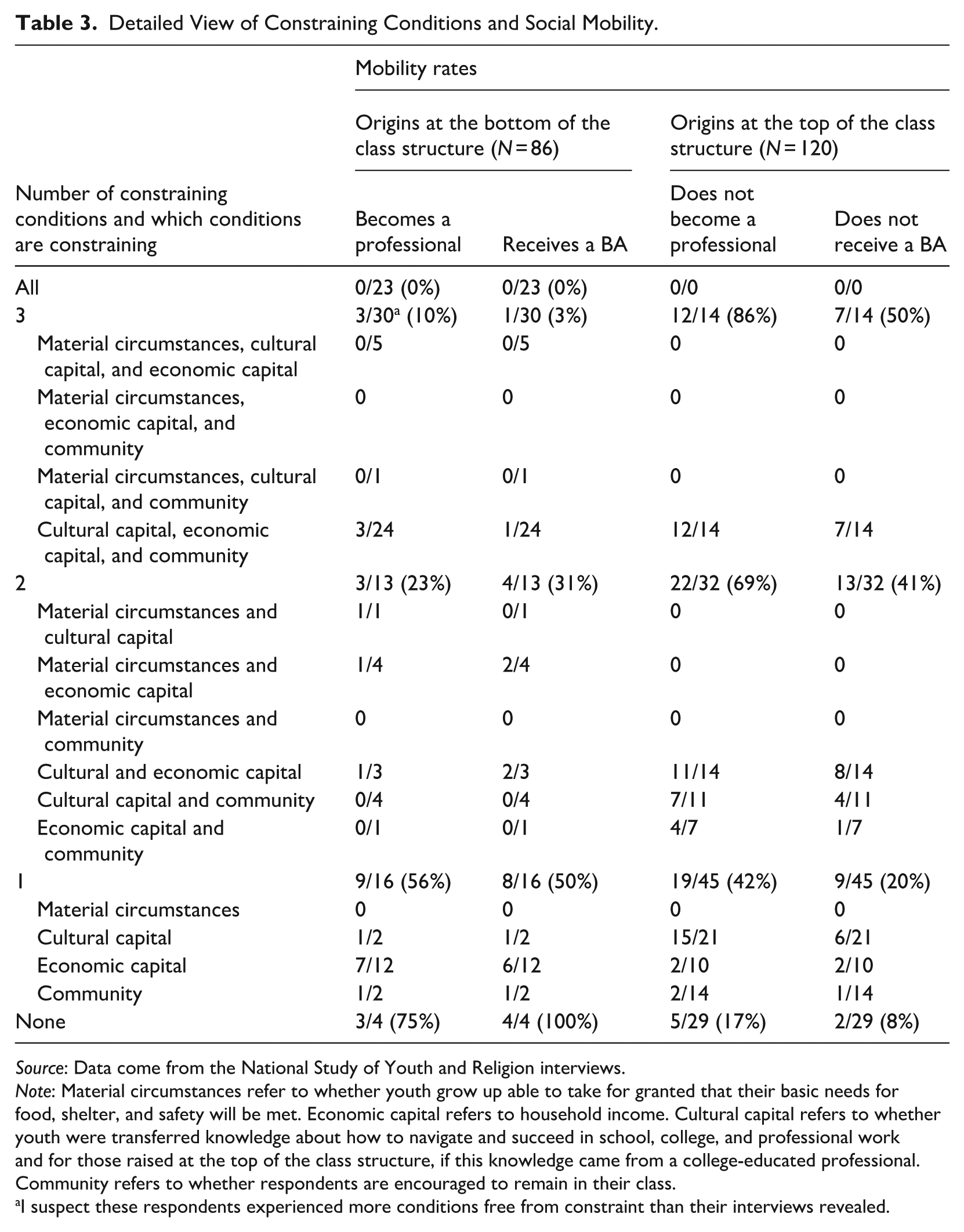
Source: Data come from the National Study of Youth and Religion interviews.
Note: Material circumstances refer to whether youth grow up able to take for granted that their basic needs for food, shelter, and safety will be met. Economic capital refers to household income. Cultural capital refers to whether youth were transferred knowledge about how to navigate and succeed in school, college, and professional work and for those raised at the top of the class structure, if this knowledge came from a college-educated professional. Community refers to whether respondents are encouraged to remain in their class.
I suspect these respondents experienced more conditions free from constraint than their interviews revealed.
Discussion
Summarizing critiques of the habitus, Friedman (2016:131) wrote: “The habitus is almost antithetical to social mobility.” In developing the conditions model of the habitus, I address this issue by arguing that within-class variation in youths’ conditions produce varied habitus. Those at the bottom of the class structure who grow up in constraining conditions have little chance of upward mobility, develop a habitus that makes a virtue of necessity, and orient themselves toward class reproduction. In contrast, those at the bottom of the class structure who grow up mostly or only in conditions relatively free from constraint have higher chances of upward mobility, develop a habitus that distances themselves from necessity, and more often orient themselves toward upward mobility. Likewise, those at the top who grow up only in conditions free from constraint have high odds of staying in their class, develop a habitus that distances themselves from necessity, and orient themselves toward staying there. Those at the top who grow up in more constrained conditions, however, have lower chances of remaining at the top, make a virtue of their likely path, and orient themselves toward downward mobility.
The conditions model of the habitus explains how some youth develop a habitus oriented toward class reproduction while others develop one oriented toward upward or downward mobility. This model maintains Bourdieu’s key insights: children’s class, material circumstances, capital, and community shape their habitus and their class trajectory; individuals’ goals and strategies spring from their objective probabilities of mobility; youths’ conditions prompt them to make a virtue of necessity or distance themselves from it; the match between youths’ goals and strategies and what institutions reward matters for mobility; and structure produces agency, which, in turn, produces class trajectories. The model also maintains Bourdieu’s point that the habitus directs youth toward the class position typically associated with their childhood conditions.
The conditions model of the habitus also maintains Bourdieu’s focus on class origin. Class relates to which core conditions youth are likely to experience, even if imperfectly. Class also inflects the meaning of each condition. For instance, lower-, working-, and middle-class youth with material security and high capital levels for their class typically have less of each than do upper-middle- and upper-class youth, which shapes the degree to which they distance themselves from necessity. For example, in data not shown, it is clear that Fredrico’s and Eve’s goals and strategies, while distant from necessity, were less distant than Olivia’s. Class origin also matters for respondents’ ability to meet the goals embedded in the habitus. Respondents with a habitus oriented toward upward mobility did not always meet their goals due to class-related factors, such as the need to help their families, early pregnancies, and for those who did not grow up in conditions free from all constraints, their remaining constraints. Even among socially mobile respondents, class origin shaped early adulthood destinations; given their family’s resources, many downwardly mobile respondents with upper-middle-class origins did not end up as poorly off as those who were born into and remained in the middle and working classes, and many upwardly mobile respondents did not attend colleges of the same prestige, enroll in graduate school as often, or benefit from family safety nets as much as those who were born at the top and remained there. Prior research also shows that the habitus shapes upwardly mobile individuals’ lives beyond orienting them toward a particular class, informing how comfortable they feel in their new class, how they navigate workplaces, and how they raise their children (Friedman and Laurison 2019; Streib 2015).
The conditions model is not contingent on the broad class groupings I deployed. In the classification system I used, Fredrico and Liam are each in the lower class because their single mothers experienced long-term unemployment and neither mother had a bachelor’s degree. More narrow classification systems may place the two in different classes because Fredrico’s mother had some college experience and Liam’s mother had only a high school degree. Likewise, in my classification system, Seth and Olivia are both upper-middle class because each has at least one college-educated professional parent. Narrower classification systems may place them in different classes because Seth has one such parent, whereas Olivia has two. However, the theory does not rely on these broad class categories. Rather, however one defines and groups the classes, so long as classes are distinguished from conditions and the habitus, the theoretical point remains: Variations in core conditions within a class produce different habitus oriented toward different class destinations. Indeed, whether Fredrico is classified as lower class or working class does not change the fact that his conditions contributed to a habitus oriented toward upward mobility, just as whether Seth is classified as upper-middle class or middle class does not change the fact that his conditions produced a habitus oriented toward downward mobility.
The conditions model also provides advantages over other approaches to studying habitus and mobility. In the conditions model, developing a habitus oriented toward upward and downward mobility occurs through ordinary mechanisms; it is not limited to rare moments of hysteresis, attendance at elite schools, or to those whose families are on upward trajectories. The conditions model also shows that habitus becomes oriented toward social mobility in systematic ways, not only idiosyncratically (Jaquet 2023; Lahire 1995, 2011). Moreover, the conditions model offers a more comprehensive understanding of how the habitus becomes oriented toward mobility than does empirical work that focuses on a single condition (e.g., Mullainathan and Shafir 2013).
The conditions model also has the benefit of explaining how the habitus contributes to class reproduction and social mobility not only within but also between racial and gender groups, an important feature given racial and gender differences in mobility rates (Ferrare 2016; Laurison, Dow, and Chernoff 2020). Each core condition is unequally accessible by race and gender: Racial discrimination shapes parents’ opportunities to meet their children’s material needs and to possess and pass down capital, and racial and gender discrimination shape parents’ opportunities to expose their children to people in particular communities (Ridgeway 2011; Thomas 2022). Community members also observe different opportunities for youth of each race and gender, which shapes how they encourage particular children and the resources they provide them (Ridgeway 2011; Yamamoto and Holloway 2010). Moreover, not everyone who grows up in the same core conditions and develops the same habitus shares the same chance of entering the same class; the barriers to achieving one’s goals vary by race and gender (Lang and Spitzer 2020). This model can help explain high rates of upward mobility among some immigrant groups as ethnic enclaves provide material security, cultural capital, and ideas of what is possible that contribute to a habitus aimed upward (Lee and Zhou 2015).
In a similar light, this new model of the habitus can incorporate changes in social policy, institutional practices, and the labor market. As policies expand or retract the safety net, labor markets add or subtract jobs, and schools change what they reward, youths’ material circumstances, capital, and community will also change, and so, too, will their habitus. At the same time, the new model of the habitus supports the old policy implications stemming from Bourdieu’s theory: Given that goals and strategies arise from class and conditions, efforts to change the former are unlikely to improve upward mobility rates unless the latter change first. In this way, the conditions model of the habitus, like Bourdieu’s, rejects the culture-of-poverty perspective that disadvantage persists primarily due to individuals’ poor choices rather than the circumstances individuals are born into and decisions made by the institutions that evaluate goals and strategies.
The conditions model of the habitus departs from Bourdieu’s theory in some ways as well. Bourdieu stressed class struggles, distinction-making processes, fields, and individuals’ movement through a multidimensional social space. The conditions model neither centers nor rejects these aspects of Bourdieu’s work but omits them to create a parsimonious theory aligned with widely used analyses of social mobility. 11 Moreover, whereas Bourdieu assumed that community members encourage class reproduction, the conditions model reminds us that communities can also encourage mobility. In addition, Bourdieu assumed that children share the same conditions as their parents; this study challenges this assumption by showing that parents do not transfer all their conditions to their children.
Future work can refine the conditions model. This model suggests it is usually a combination of conditions that produces a habitus oriented toward upward or downward mobility. Therefore, focusing on the number of conditions in place is often more fruitful than determining which one alone plays the largest role. That said, communities that provide youth with role models and clear expectations may have the power to point youth up the class ladder (though, of course, aiming upward is not the same as achieving it), and if the NSYR data are any indication, the relative lack of cultural capital may be particularly influential in pointing others down. Future research should explore whether these conditions are more influential than others. We also need to better understand how the timing, duration, and degree to which conditions are relatively free from constraint shape the habitus and if variation in these factors shapes whether youth aim for and invest in short- versus long-range mobility.
Finally, researchers should note the implications of the new model of the habitus. Researchers must move away from the Bourdieusian view that class is aligned with conditions and instead see class as related to but distinct from them. Scholars must also question the assumption that the presence of multiple conditions necessarily leads youth to internalize them in haphazard or contradictory ways. Instead, the combination of conditions gives youth clear signals about what is possible and probable and therefore what goals and strategies are reasonable. And most importantly, researchers must recognize that youth in the same class sometimes grow up in different core conditions and thus develop different habitus—some oriented toward class reproduction and others toward upward or downward mobility.
Footnotes
Appendix
Core Conditions and Downward Mobility from the Middle and Working Classes.
| Middle class | Working class | |||||
|---|---|---|---|---|---|---|
| Destinations | N | Any DM | W | L | N | L |
| Number of constraining conditions | ||||||
| 4 | 9 | 5 (56%) | 3 (33%) | 2 (22%) | 13 | 4 (31%) |
| 3 | 17 | 7 (41%) | 6 (35%) | 1 (6%) | 11 | 2 (18%) |
| 2 | 11 | 1 (9%) | 1 (9%) | 0 | 2 | 0 |
| 1 | 10 | 0 | 0 | 0 | 5 | 1 (20%) |
| 0 | 4 | 1 (25%) | 1 (25%) | 0 | 0 | 0 |
| Totals | 51 | 14 (27%) | 11 (22%) | 3 (6%) | 31 | 7 (23%) |
Note: N = number of respondents; L = lower class; W = working class; any DM = any downward mobility by occupation. W and L refer to respondents’ class destination in early adulthood. Totals do not add to 100% because class reproduction and upward mobility are not included.
Acknowledgements
I thank Christian Smith, Sara Skiles, and Lauren Valentino for providing the National Study of Youth and Religion data and occupational code. I thank Braulio Guemez, Ellen Lamont, Abi Ocobock, Monica Liu, Jaclyn Wong, and the Yale Center for Cultural Sociology for their feedback on the manuscript.

Funding
The author received no financial support for the research, authorship, and/or publication of this article.
Declaration of Conflicting Interests
The author declared no potential conflicts of interest with respect to the research, authorship, and/or publication of this article.