







Abstract
Upadana or a condition of attachment in Buddhism has been widely acknowledged among Buddhists as the root cause of suffering because it underlies human intention and action toward a perceived phenomenon. This article investigates whether the condition of attachment in Buddhism could contribute as an external variable in the Technology Acceptance Model. Participants were 498 students from a university in Southern Thailand. They responded to a 21-item self-report questionnaire on the six variables (perceived usefulness, perceived ease of use, attitude toward use, intention to use, attachment, and actual usage) of a proposed Dhammic Technology Acceptance Model. Results using structural equation modeling revealed that the Dhammic Technology Acceptance Model has a good model fit and that attachment has direct and indirect effects on the actual use of Facebook among students. Implications for theory and further research are discussed.
Introduction
User acceptance is defined as the prospective user’s predisposition toward using and implementation of a technology system (Agarwal, 2000; Swanson, 1988; Teo, 2011). To understand user’s acceptance of technology, researchers have developed various models and theories drawn from disciplines such as psychology, information systems, and sociology. Among these, the Technology Acceptance Model (TAM) is arguably the most cited in the literature (Venkatesh & Davis, 2000). Since Davis (1989) introduced the TAM, it has been widely used to predict user’s acceptance of information technology (Davis, Bagozzi, & Warshaw, 1989; Teo, Ursavas, & Bahcekapili, 2012). Built on the theory of reasoned action (Fishbein & Ajzen, 1975), which suggests that an individual’s behavior is initiated by his or her behavioral intention to carry out a specified behavior, the TAM was designed to explain an individual’s acceptance behaviors in information systems (Dishaw & Strong, 1999). Primarily, the TAM posits that users’ beliefs determine their attitudes toward the use of a system which in turn result in a formation of their behavioral intentions and subsequently, actual system use (Teo, 2012).
The beliefs in the TAM are perceived usefulness (PU) and perceived ease of use (PEU) which together influences the attitude toward use (ATU). Davis (1989) defined PU as “the degree to which a person believes that using a particular system would enhance his or her work productivity” while PEU as the “degree to which a person believes that using a particular system would be free of effort” (p. 320). Numerous studies using TAM have shown that both PU and PEU were significant determinants of technology acceptance and use (e.g., Malhotra & Galletta, 1999; Moon & Kim, 2001; Teo, 2009a; Teo & van Schaik, 2012). Notably, the TAM was found to be most robust in predicting behavioral intention or actual usage when the user has complete volitional control (Limayem, Hirt, & Chin, 2001; Rawstorne, Jayasuriya, & Caputi, 1998; Wang & Butler, 2007).
Despite the accolades accorded to TAM as a parsimonious and robust model for explaining user acceptance, two limitations have been raised by researchers. First, because the original model was intended to be general and parsimonious, it lacked an ability to identify antecedent variables that could influence PU and PEU (Park, 2010). Second, no model could fully explain human behavior. To address these limitations, this study extended the TAM by adding attachment as an external variable to explain the usage of a specific tool, Facebook.
Attachment as an External Variable
Upadana or a condition of attachment in Buddhism (Dhammananda, 2000; Goddard, 1938; Humphreys, 1997) was considered as an external variable to extend the TAM in this study. The Oxford Dictionary of Buddhism (Keown, 2004) defines Upadana as “clinging or grasping, which is an intensified form of craving.” It is a condition when our mind is bound or attached to a perceived phenomenon. This state of mind in Buddhism is consistent with attachment in psychology, which is related to an emotional bond a person shares with another (Ainsworth, Blehar, Waters, & Wall, 1978; Bowlby, 1970a, 1970b; Bretherton, 1992). Bowlby defined attachment as a construct that represents the emotional bond joining a person with another, not unlike that between the bond, tie, or enduring relationship between a young child and his mother (Ainsworth et al., 1978). While initial studies on attachment have been conducted within the field of psychology, recent years have seen attachment included as a construct in consumer research. For example, in marketing research, Thomson, MacInnis, and Park (2005) noted that attachment has been employed as a construct to denote an emotion that connects an individual to a specific object or brand (Liu & Karahanna, 2007; Park, MacInnis, Priester, Eisingerich, & Iacobucci, 2010).
The condition of attachment in Buddhism exists when a person’s mind is bound to a phenomenon. Any conceivable phenomenon can fulfill the condition of attachment. For example, a system engineer is attached to his views about how a system should be managed and implemented. It is this state of mind that underlies human justification of or reaction to a system. Moreover, a condition of attachment in Buddhism is situated between an intensified degree of attitude (or craving in Buddhism) and an intention (Jarupunphol & Thomborson, 2013). Because our mind is attached to a phenomenon, we are usually unaware, even when our behavior is heavily influenced by this state. As a result of the attachment, individuals engage in certainty maintenance, a condition where they attempt to maintain or ensure that the object to which they were attached remains unchanged, despite the reality that some phenomena are uncertain.
We argue that the above insights from Buddhism might be applied to understanding user acceptance of a technology. It is expected for individuals who have are attached to a particular technology to be emotional or disturbed when they experience aberrations in the technology that may take the form of a system upgrade, outage, or termination. Consequently, the condition of certainty maintenance is triggered in these individuals, which may alter their behavioral intentions associated with the use of a specific system. Because this condition is related with behaviors connected to maintain one’s certainty about and willingness to defend an attached object, it may impact on one’s beliefs and attitude toward its use. From the above discussion, the following hypotheses were proposed for this study and illustrated in Figure 1. (ITU = intention to use; ATU = attitude toward use; ATTACH = Attachment; PU = perceived usefulness; PEU = perceived ease of use; USE = actual usage)
Dhammic TAM. H1: ITU has an influence on the USE of Facebook. H2: ATU has an influence on the ITU Facebook. H3: ATU has an influence on the USE of Facebook. H4: ATU has an influence on the ATTACH to Facebook. H5: PU has an influence on the ITU Facebook. H6: PU has an influence on the ATU of Facebook. H7: PU has an influence on the ATTACH to Facebook. H8: PEU has an influence on the PU of Facebook. H9: PEU has an influence on the ATU of Facebook. H10: PEU has an influence on the USE of Facebook. H11: ATTACH has an influence on the ITU Facebook. H12: ATTACH has an influence on the USE of Facebook.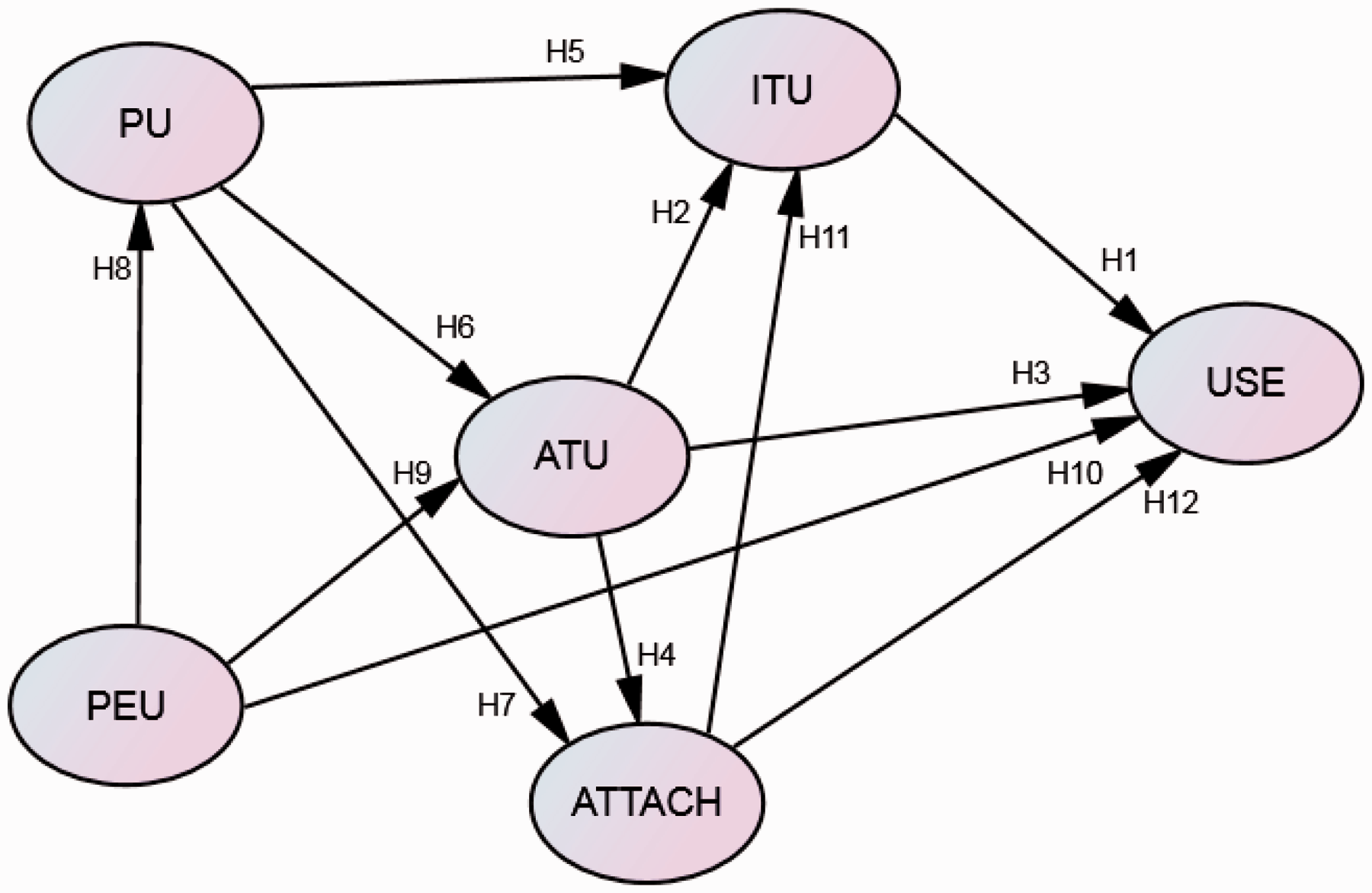
Purpose of This Study
This purpose of this study is to test the validity of the Dhammic Technology Acceptance Model (DTAM) to predict the usage of an existing technology by including an external variable, attachment, to the model. The technology chosen for this study is Facebook. Invented by Mark Zuckerberg and his colleagues at Harvard University and launched in February 2004, Facebook has become arguably the most popular social networking site in the world (Burcher, 2013; Cheung, Chui, & Lee, 2011) It is chosen for this study because we expect the study sample to be acquainted with Facebook (99.4%). The following questions will be answered by this study:
To what extend is the DTAM a valid model to predict Facebook usage among university students? What effect does attachment have on Facebook usage among university students?
Methodology
Participants and Procedure
A total of 498 students participated in this study. More than 99% of these reported that they were active users of Facebook. There were 313 (62.9%) female students and the majority (85.9%) of participants was between 18 and 24 years of age, followed by those who were between 25 and 34 years of age (10%). Most participants were at their third year of university study (50.6%), followed by 22.7% in year 1, 15.3% in year 2, and 11.4% in year 4.
Participants were recruited from a university situated at the South of Thailand and their primary language was Thai. They responded to a recruitment call that appeared on posters that were located around the university campus. The participants were informed that no compensation would be given to them and that their participation was voluntary. Besides providing information on their demographics, participants responded to a set of items that asked about their perceptions of Facebook using an online survey questionnaire. They were also assured that their responses would be kept anonymous and be known only to the researchers.
Measure
The measure used in this study was created by adapting and modifying the items that were used in previous TAM research to fit the Facebook context (e.g., Read, Robertson, & McQuilken, 2011; Teo, 2009b: Teo & van Schaik, 2012; Wong, Teo, & Russo, 2013). To ensure the quality of the questionnaire, we followed the criteria for questionnaire development (Brace, 2008; Bradburn, Sudman, & Wansink, 2004; Gillham, 2000). For example, all question items were written in a clear and simple manner for participants to understand and technical words were avoided. From this process, a list of 21 items was crafted: PU (four items), PEU (four items), attitude toward using Facebook (three items), ITU (three items), emotional attachment (five items), and Use of Facebook (two items). Each item was measured on a 7-point Likert scale, ranging from 1 (strongly disagree) to 7 (strongly agree).
As the questionnaire would be presented in the Thai language, the adapted items underwent a translation process. To ensure no loss of meaning and clarity in the items as a result of the translation process, the researcher consulted the professors who had demonstrated skills in the use of the English and Thai languages. Items that were flagged to be potentially confusing to the participants were scrutinized and rewritten. Where there were mismatches between the translations, the translators met to discuss the issues until a consensus was reached. This process continued until the researchers were satisfied that face validity had been achieved (Brislin, Lonner, & Thorndike, 1973; Whyte & Braun, 1968).
Data Analysis
Structural equation modeling (SEM) was used in this study. It is a comprehensive statistical approach for testing relations among hypothesized (observed and latent) variables (Hoyle, 2012; Kline, 2011; Teo, 2010). This approach has been widely used in the behavioral sciences, including psychometric design and measurements (Hox, 1998). Among the advantages of SEM over correlation and multiple regression are that SEM was able to (a) analyze a series of dependence relationships simultaneously (Hair, Black, Babin, & Anderson, 2010), (b) analyze relationships between latent and observed variables using multiple indicators, (c) model random errors in the observed variables thus providing more precise measurements, and (d) test hypotheses at the construct instead of item level (Hoyle, 2011). In this study, a covariance–variance matrix was analyzed with the maximum likelihood as the method for parameter estimation. Integral to the modeling process was the establishment of data normality, reliability, and validity. Using the two-step approach to SEM (Anderson & Gerbing, 1988), a measurement model (confirmatory factor analysis [CFA] model) was tested first to assess how well the observed indicators (questionnaire items) measure the unobserved (latent) variables. In the second step, the structural part of the SEM that specifies the relationships among the latent variables (exogenous and endogenous) was estimated.
Results
Descriptive Statistics
The mean values of all 21 items were all above the midpoint of 4.0, ranging from 4.23 to 5.96, indicating the responses to the items were generally positive. The standard deviations ranged from .91 to 1.60, indicating a fair spread of scores around the mean. The values of the skewness and kurtosis for all variables were between −1.35 and −.28, and −.37 and 3.36, respectively. As these values were within the recommended cutoffs of |3.0| and |8.0| for skewness and kurtosis, respectively, univariate normality in the data was assumed.
Test of the Measurement Model
Prior to testing the measurement model, the adequacy of the sample size should be ensured to avoid imprecise parameter estimates due to the lack of statistical power. Researchers recommend the use of the Hoelter’s critical N (Hoelter, 1983), which refers to the sample size for which one would accept the hypothesis that the proposed research model is correct at the .05 level of significance. The Hoelter’s critical N for the model in this study is 230 and, given that the sample size of this study was 498, it was deemed adequate for SEM. The use of the maximum likelihood estimation (MLE) procedure to assess the measurement model presupposed multivariate normality of the observed variables; hence, the Mardia’s normalized multivariate kurtosis value (Mardia, 1970) was examined. The Mardia’s coefficient for the data in this study was 192.57, which is lower than the value of 483 computed based on the formula p(p + 2) where p equals the number of observed variables in the model (Raykov & Marcoulides, 2008). On this basis, multivariate normality of the data in this study was assumed.
Results of the Confirmatory Factor Analysis.
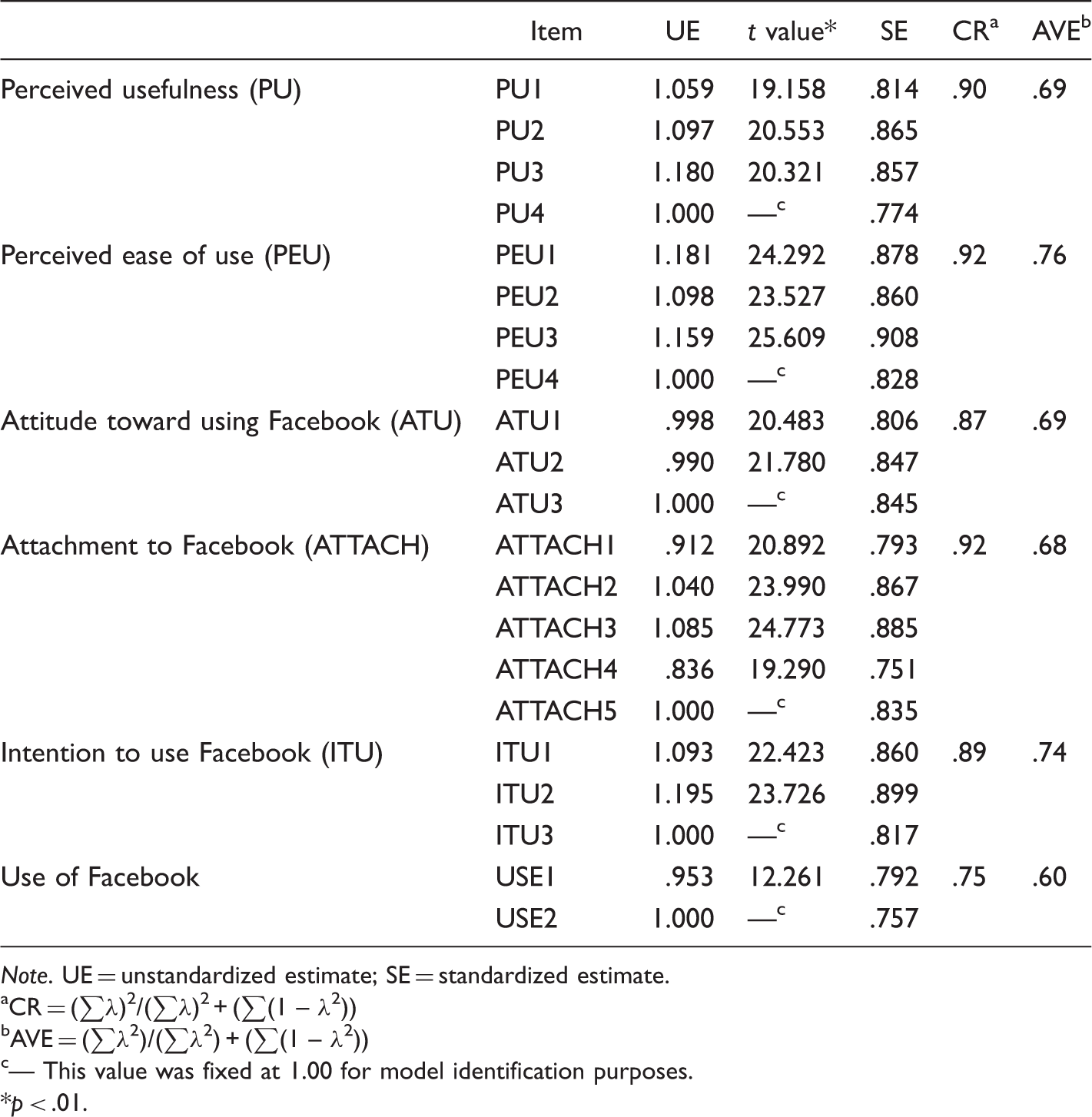
Note. UE = unstandardized estimate; SE = standardized estimate.
aCR = (∑λ)2/(∑λ)2 + (∑(1 – λ2))
bAVE = (∑λ2)/(∑λ2) + (∑(1 – λ2))
c— This value was fixed at 1.00 for model identification purposes.
*p < .01.
Researchers recommended using various categories of indices to assess for model fit in order to avoid erroneous interpretation. These include the χ2 and the ratio of the χ2 statistic to its degree of freedom, with a value of less than 3 indicating acceptable fit. Other goodness-of-fit indices included the Tucker–Lewis index (TLI), comparative fit index (CFI), root mean square error of approximation (RMSEA), and standardized root mean square residual (SRMR). Hu and Bentler (1999) proposed that TLI and CFI statistics greater than .95 represent a good model fit. As for RMSEA and SRMR, values with less than .06 and .08, respectively, are good. The test of the measurement model revealed that DTAM has a good fit to the sample data [χ2 = 444.75; χ2/df = 2.556; TLI = .958; CFI = .965; RMSEA = .056; SRMR = .036].
Analysis of the Structural Model and Hypothesis Testing
Hypothesis testing results.
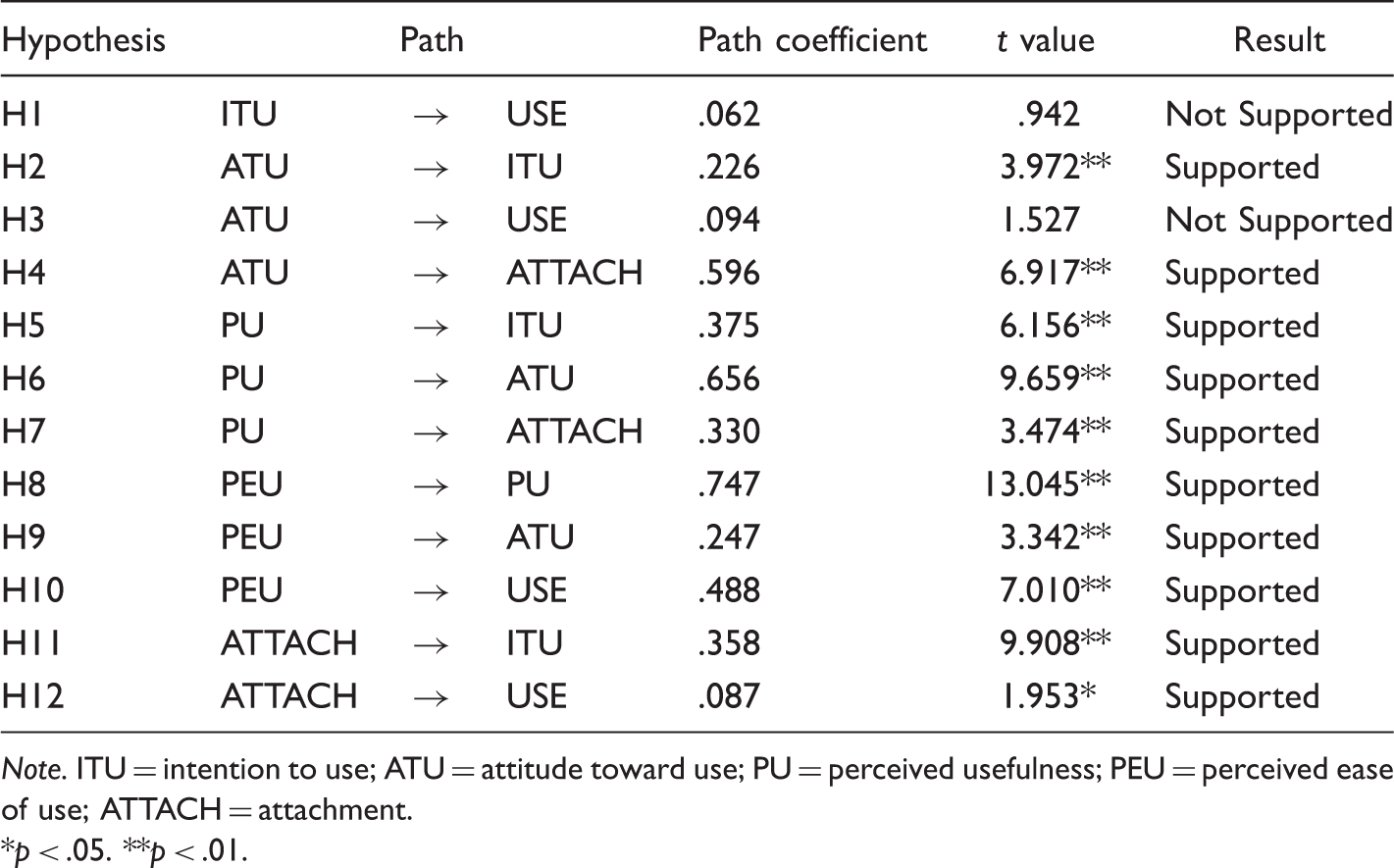
Note. ITU = intention to use; ATU = attitude toward use; PU = perceived usefulness; PEU = perceived ease of use; ATTACH = attachment.
*p < .05. **p < .01.
Discussion and Conclusion
This study aimed to test the validity of an extended TAM (DTAM) that included a condition of attachment (ATTACH) in Buddhism as an external variable and assess the effect of ATTACH on the USE among students. Using SEM, we found a good fit for the DTAM, indicating that, with the close match between the conceptualization of the model to the data collected in this study, the model has an adequate ability to explain USE. In addition, USE was predicted by its antecedents (PEU, ATU, intention to use (ITU), and ATTACH) at an extent of 42.6%. However, this was lower that of ITU, whose antecedents had explained 68% of its variations.
The results of the hypothesis testing indicated that 10 out of 12 hypotheses were supported. The relationship between ITU and USE (H1) was not supported, and this was consistent with the existing debates that question the adequacy of employing one’s intention as a proxy to represent actual use. For example, researchers are currently divided on whether an individual’s acceptance could be more precisely explained an individual’s ITU or the actual use of technology (Turner, Kitchenham, Brereton, Charters, & Budgen, 2010). In addition, ATU did not have a significant relationship with USE (H3) although the former had a significant influence on ITU (β = .226).
In considering the contributions of ATTACH as an external variable in the DTAM, we found that all hypotheses relating to ATTACH were supported (H4, H7, H11, H12). As a variable, ATTACH exerted direct and indirect influences on USE. There was a significant direct effect from ATTACH on USE although it was regarded as small at β = .226 (Cohen, 1992). Indirectly, ATTACH had an influence on USE through ITU and, to compute the indirect effect of ATTACH on USE, the product of the path coefficients for ATTACH → ITU and ITU → USE was obtained (.358 × .062 = .022). The total effect of ATTACH on USE was obtained by adding the former’s direct and indirect effects, giving a value of .248. From the DTAM, ATTACH also acted as an intervening variable for PU and ATU that had indirect effects on USE. ATU and PU had a medium (.596) and small (.330) effect on ATTACH, respectively. From the holistic perspective, ATTACH had contributed to explaining USE direct and indirect ways. Though its direct effect on USE was small, it acted as an intervening variable for others in the model to exert their influences. On this basis, it was reasonable to conclude that the TAM model had been enhanced by an extension through the inclusion of ATTACH as an external variable. In other words, the use of technology among students in this study could be affected by the extent to which they were attached to it.
In this study, Facebook was used as an innovation with which students have used and become attached to. It was possible that their attitudes and usage intentions have been shaped by their attachment to Facebook. When users encounter a technology they perceived to be more difficult to use than the one they have attached themselves to, they will experience mental perturbation. This is consistent with Roger’s (2003) notion of compatibility, which is defined as the extent to which an innovation is perceived by users to be consistent with their existing ideals, past experiences, and future needs. Consequently, the lack of compatibility would have a negative influence on an individual’s usage (McKenzie, 2001).
Contributions of This Study
This study contributes to existing literature by borrowing an insight from Buddhism to explore if the predictive prowess of the TAM would be enhanced with an external variable, attachment. In measuring the participants’ attachment toward Facebook, the items were crafted using the principle of certainty maintenance, a prominent trait of attachment. For example, participants were asked about their feelings when changes occurred to a system they were attached to, such as an update, outage, a crash, or termination. Second, the findings of this study validated the Dhammic framework in the context of technology acceptance. This was consistent with Jarupunphol and Thomborson (2013) who found that system project failures can be attributed to attachment as a state of mind. From the Dhammic framework, perceived qualities of a system was dependent on the physical properties of the system. The qualities of the system gave rise to the formation of an attitude toward using the system. From here, attachment was created in response to the varying intensity of the attitude, leading to a user’s ITU the system and, consequently, actual system use. The findings of this study confirm all relationships described in the Dhammic framework through the significant positive relationships shown in Table 2. Finally, this study demonstrated that attachment could be a viable construct that increase the predictive ability of the TAM, in response to criticism that its excessive reliance on PU and PEU in explaining acceptance has been too simplistic (Benbasat & Bakri, 2007).
Limitations of the Study and Further Research
This study has several limitations. First, data were collected in an academic institution in the south of Thailand and may not be representative of the student population in higher education in general. This situation places a limitation on the generalizability of the findings. Second, despite using different items to measure the concept of attachment in this study, the former should be subjected to further evaluations toward achieving greater validity and reliability in measurement. Third, while Facebook was a suitable tool in a study on user acceptance, it may not have been perceived of as an innovation (i.e., a new tool). This placed a limitation on measuring actual usage in this study, which could have accounted for the lack of a significant relationship between ITU and USE although both ITU and USE were significantly influenced by ATTACH. Future research could explore the impact of ATTACH within a model in the context of an innovation perceived to be new by the participants. Despite the prominent role played by ATU in acceptance studies (Teo, 2009b), this study found that ATU did not have a direct influence on USE. However, the influence of ATU on both ITU and USE was mediated by ATTACH (Figure 1). To contribute to theory building and model expansion, further studies could distinguish the possible roles (e.g., direct influence, moderator, mediator, etc.) that ATT and ATTACH could play in explaining technology acceptance.
Conclusion
The findings of this study provided evidence in support of the role played by attachment as an external variable to the TAM in explaining the acceptance of Facebook among university students. Given that teaching and learning will be impacted by technology in increasing intensity, the value of research on technology acceptance cannot be underestimated. This study provided a glimpse of the research possibilities that could be explored with a view to obtained greater insights into and understanding around issues that affect user’s ITU and actual technology usage—a mandate intensified by the growth of digital natives whose preferences for and use of technologies are constantly changing in tandem with new and emerging digital tools (Teo, 2013).
Footnotes
Appendix
Declaration of Conflicting Interests
The authors declared no potential conflicts of interest with respect to the research, authorship, and/or publication of this article.
Funding
The authors received no financial support for the research, authorship, and/or publication of this article.