







Abstract
Group identity is a critical component in developing effective classroom management. While there have been numerous studies on group identity, they have primarily focused on its effects on the physical classroom entity. Advances in information technology, however, have enabled the creation of virtual communities, which have become a vital channel of communication in classroom management, though there are few systematic collations that explore the effects of virtual communities on classroom management. This study integrates social capital theory and social exchange theory into an integrated research model that examines a Facebook-based virtual classroom community, with an emphasis on group identity formation during social capital exchange via computer-mediated communication. A total of 344 valid questionnaires were obtained and analyzed using structural equation modeling. The results of this study found that the fair and reciprocal exchange of social capital generates affective commitment and emotional support among members maintaining or enhancing the development of social network relations and facilitating the formation of group identity. Finally, this study’s theoretical and practical implications for classroom group management are presented.
Introduction
A classroom group is a unique social system formed through interpersonal relationships and interaction (Cekaite, 2013; Locke, Ishijima, Kasari, & London, 2010). Therefore, effective classroom management must use communication to facilitate the development of positive interpersonal interactions and social relationships that allow group identity to form so that students will recognize themselves as members of the classroom. This, in turn, creates a classroom social environment that fosters learning and growth (Patrick, Ryan, & Kaplan, 2007; Pinnow & Chval, 2015; Tess, 2013). Group identity is formed when multiple individuals self-identify themselves as members of a group, and members of this group interact with each other and are interdependent (Bouas & Arrow, 1996; Gruzd, Wellman, & Takhteyev, 2011; Whitmarsh & O’Neill, 2010). In the context of classroom management, group identity helps create classroom consensus, cohesion, and a sense of belonging.
However, advances in information technology (IT) and the ubiquitous use of social media have changed the way interpersonal relationships are formed and the way social interaction takes place. As a natural consequence, physical classroom groups have been extended to cyberspace, thereby forming virtual classroom communities. Computer-mediated communication (CMC) creates new possibilities for human interaction and communication, facilitating the development of social network relations, and the formation of social capital (Blanchard, 2007; Ellison, Steinfield, & Lampe, 2007; Ellison Lampe, Steinfield, & Vitak, 2014b; Field, 2005; Tomai et al., 2010; Williams, 2006).
CMC is quite dependent on IT, to create the social network structure in virtual communities (Ellison, Steinfield, & Lampe, 2011). Seibert, Kraimer, and Liden (2001) proposed that information is a type of social capital existing in the social structure, and as such, it can be exchanged through interpersonal interaction and trust. Members in a social network accumulate social capital through formal and informal network interactions to achieve personal goals (DeAndrea, Ellison, LaRose, Steinfield, & Fiore, 2012; Kira & Susan, 2011; Lin, 2001; Savage, Gayo-Cal, Warde, & Tampubolon, 2005; Son & Lin, 2008; Stam, Arzlanian, & Elfring, 2014). Depending on whether the ties formed through the network interactions are strong or weak, social capital in CMC can be classified as either bonding social capital or bridging social capital (Ahn, 2012; Ellison, Gray, Lampe, & Fiore, 2014a; Ellison et al., 2007, 2011; Williams, 2006). When members in the social network accumulate social capital through a fair and mutually beneficial exchange process, they create a foundation for affective commitment and emotional support among members; social exchange theory (SET; Blau, 1964; Homans, 1961) suggests that social interaction is a fair and mutually exchange activity, which is based on a trust relationship between the actors. This ultimately leads to the formation of group identity, which, among other advantages, is beneficial to the retention of group members (Bateman, Gray, & Butler, 2011; Bouas & Arrow, 1996; Morgan & Hunt, 1994; Putnam, 2000). Thus, this study aims to further investigate how, in an age when IT is ubiquitous, CMC affects the formation of social capital and group identity. Accordingly, the primary goal of the study is to integrate the concepts of social capital (Ellison et al., 2007, 2011; Putnam, 2000; Williams, 2006), and SET (Blau, 1964; Homans, 1961) to investigate the process in which CMC-facilitated social capital exchange helps form group identity in a Facebook (FB)-based virtual classroom community.
Social Capital Within the Virtual Community
Social capital is the aggregate of actual or potential resources and is embedded in a social network (Tomai et al., 2010; Williams, 2006). It is a form of wealth that is accumulated through lasting and stable networks of interactive relationships (such as friendships built on mutual norms, trust, and respect) and is a resource shared among members. Because it is a shared resource, individuals must accumulate social capital through formal or informal interactions to generate social resources that facilitate the achievement of personal goals (DeAndrea et al., 2012; Kira & Susan, 2011; Lin, 2001; Savage et al., 2005; Son & Lin, 2008; Stam et al., 2014). Therefore, social capital is a social resource that is accumulated and embedded in the network of the members’ relational contexts by individuals through formal and informal network interactions (Rostila, 2011).
Individuals or organizations interact and contact others to maintain some sort of social identity in social networks, which is beneficial for the acquisition of resources (Ellison et al., 2007, 2011; Lin, 2001; Sobel, 2002). The type of resources gained from this interaction depends on the individual’s or organization’s position in the social network, as well as the strength of social bonds. Therefore, the social capital generated by the virtual community through CMC can be classified as bonding social capital or bridging social capital, depending on whether members are bonded by strong or weak ties.
A social network with bonding features allows homogeneous individuals to form strong network ties. In addition, because of strong ties (e.g., family or close friends), individuals generate bonding social capital, which involves an emotional support (e.g., sympathetic listening and uncritical love; Ellison et al., 2007; Putnam, 2000; Williams, 2006). On the other hand, a social network with bridging features comprises loose social network structures with weak ties. As such, it is a social network that helps individuals break through social barriers to facilitate contact with heterogeneous individuals. Through this contact, the information exchanged among members is diversified and facilitates the formation of bridging social capital (Dixon, 2005). Most scholars (e.g., Ellison et al., 2011, 2014a; Ellison, Vitak, Gray, & Lampe, 2014b; Lin, 2001; Putnam, 2000; Williams, 2006) view the social network as the core element of social capital; bonding social capital emphasizes emotional benefits from close personal relationships (e.g., emotional support and physical succor); bridging social capital emphasizes the informational benefits (e.g., novel information from distant connections and broader worldviews) from heterogeneous individuals.
Classroom management encompasses establishing positive student–teacher relationships, creating supportive classroom climates, responding to students’ needs for emotional support, and sense of classroom belonging development (Faircloth & Hamm, 2011; Pianta & Hamre, 2009). To achieve these goals, social network sites (SNSs) such as Friendster, MySpace, and FB, allow college-aged students to articulate their social network relationships for social capital exchanges (Ellison et al., 2007, 2011). While many related researches have shown that benefits of social capital exchange in SNSs involve emotional support (Oh, Lauckner, Boehmer, Fewins-Bliss, & Li, 2013; Oh, Ozkaya, & LaRose, 2014), knowledge obtaining (Magnier, Yoshida, & Watanabe, 2010; Valenzuela, Park, & Kee, 2009), and relationship maintenance (Ellison et al., 2014b). Thus, the use of SNSs in an effective classroom management ultimately have a positive effect on emotional support satisfaction (Ellison et al., 2007; Putnam, 2000; Williams, 2006), and relationship commitment development (the willingness of a party to invent financial, physical, or relationship-based resources in a relationship maintenance; Morgan & Hunt, 1994; Zhao, Huo, Selen, & Yeung, 2011), which can lead to more positive group identity (e.g., the senses of belonging and emotional attachment) in a virtual classroom community.
This study focuses on FB-based virtual classroom communities, which can be regarded as interdependence of strong-tie networks (Wright, 2012). However, members of the community generate different types of social capital, depending on the members with whom they interact. For example, members of the community could generate both bonding social capital and bridging social capital.
Social Capital Exchange in the Virtual Community
SET advocates the rational relative benefits of measuring the mutual exchange patterns of behavior (Homans, 1961) in the actual process of exchange. Blau (1964) believes that social exchange is a voluntary return with a reciprocal nature of action, while the return is the reward. According to the different needs of individuals, the reward can be divided into internal rewards (e.g., love, emotion, admiration) and extrinsic rewards (e.g., money, physical labor). Unlike an economic exchange, social exchange is not governed by explicit rules, agreements, and guarantees (Xerri, 2012). Therefore, as the social exchange behavior in CMC is of a reciprocal nature because one is unsure of what the return will be, the generation and maintaining processes must rely on the commitment (Cheung, Chiu, & Lee, 2011) and trust (Tomai et al., 2010) among the members.
Commitments generated depend on trust (Guy, 2014; Kim, Flanagan, & Pykett, 2015). In the process of the social exchange, both sides should be committed to establishing an environment of trust with respect to the exchange relationship. That is, a lack of trust results in a reduction of commitment in the exchange relationship and also causes a long-term relationship between the parties to transform into a short-term trade relationship. Mayer, Davis, and Schoorman (1981) proposed that trust is the result of organizations or individuals accumulating and experiencing trust in the exchange process, thus contributing to the frequency of information sharing to achieve a certain degree of trust and relationship commitment. Relationship commitment refers to the members of the party’s belief that it is important to maintain a relationship with the other party, so they will all do their utmost to maintain the relationship. That is, the party believes that the relationship is worth maintaining, and the relationship will continue indefinitely (Morgan & Hunt, 1994; Zhao et al., 2011).
Relationship commitments can be subdivided into affective and calculative commitments (Bowden, 2009). The affective commitment causes an individual to regard himself as a part of the organization or group and assesses the value of the organization or group as his (Eisenberger et al., 2010). For example, Bateman et al. (2011) found that affective commitment is derived from the members who have developed a strong identification, involvement, and feeling of emotional attachment with a virtual community. The latter, the calculative commitment, causes an individual to rationally assess the value of maintaining the relationship with his organizations or groups (Morgan & Hunt, 1994; Sharma, Young, & Wilkinson, 2015). Thus, affective commitment is more emotional in nature, and calculative commitment is more rational in switching costs (Sashi, 2012).
Relationship commitment formed by the spontaneous behavior of individuals in a virtual community increases the members’ voluntary participation in the community. Accordingly, this type of commitment also affects whether an individual would continue membership in the virtual community (Ma & Chan, 2014; Wu, Chen, & Chung, 2010). Previous scholars adopted the commitment-trust theory (Morgan & Hunt, 1994) as the theoretical basis to explore the promise of e-commerce and trust (Li, Browne, & Wetherbe, 2006; Mukherjee & Nath, 2007). Yet, this study regarding the FB class of virtual community members is different from the e-commerce concept because a lack of money will affect trading behavior in an e-commerce environment (Brown & Duguid, 2001; Wenger & Snyder, 2000). This study focuses mainly on information exchange and emotional relationship fellowship. Therefore, through the exchange process of bridging social capital, class community members’ cumulative trust experience can promote both the frequency and diversity of information sharing or they can exchange affective commitment to maintain the virtual community’s weak ties. In addition, FB serves as a social lubricant, enabling users to easily communicate with one another and receive a degree of emotional support through the bridging social capital exchange over time (Ellison, Lampe, Steinfield, & Vitak, 2010; Ellison et al., 2011). Thus, the inferred assumptions of this study are as follows: H1: Bridging social capital positively affects the formation of affective commitment in the virtual classroom community. H2: Bridging social capital positively affects the formation of emotional support in the virtual classroom community.
With respect to bonding social capital, Putnam (2000) advocated that bonding social capital is constituted by strong ties among homogeneous individuals that then generate a higher sense of emotional support. Members of communities with bonding social capital express concern, compassion, understanding, caring, and companionship, and the supporters receive emotional comfort and encouragement (Colvin, Cullin, & Thomas, 2002; House, 1981; Robert & Angelo, 2001). In addition, as the bonding social capital accumulated by the strong ties includes more emotional support, it allows individuals to generate a sense of social belonging and to regard themselves as members of the class community (Ellison et al., 2007; Gangadharbatla, 2008; Tomai et al., 2010; Zywica & Danowski, 2008), thus contributing to the development of affective commitment. The inferred assumptions of this study are as follows: H3: Bonding social capital positively affects the development of the group’s affective commitment in the virtual class community. H4: Bonding social capital positively affects the development of group emotional support in the virtual class community.
Group Identity Formation in the Classroom Community
CMC members in the virtual community without nonverbal cues or synchronous communication (Hammick & Lee, 2014; Nguyen, Bin, & Campbell, 2012; Wang, Moon, Kwon, Evans, & Stefanone, 2010), communicate with each other because of trust based on the group identity (Gruzd et al., 2011; Whitmarsh & O’Neill, 2010). Bouas and Arrow (1996) proposed that group identity is the awareness of being part of the group through one’s self-identity as a member of the community and as a result of interactions and interdependence on each other. Therefore, the members of the virtual community establish a group identity and a sense of belonging on the interactive network platform (Blanchard, 2007). Members with a higher group identity have mutual trust and an enhanced exchange of social capital. The affective commitment awarded by the community reduces the community members’ sense of loss (Bateman et al., 2011; Sashi, 2012). Thus, the inferred assumptions are as follows: H5: Affective commitment positively affects the virtual classroom community as a result of the formation of group identity.
Social support is the basic personal need of members in the community (Thoits, 1986). Through CMC, members of the virtual community fulfil their social support needs (emotional, informational, instrumental, and evaluative social support) by supporting the community, thus constituting one of the main motivations for participating in the community (Cheung et al., 2011). For example, the virtual community provides an individual with timely, personal emotional support, and thereby enhances the person’s psychological well-being and generates emotional attachment, and a sense of belonging to the community (Bateman et al., 2011; Leimeister, Karin, Leimeister, & Krcmar, 2008). This study suggests that the members of the virtual community exchange bounding social capital using strong ties to generate a certain degree of emotional attachment to the group and a community group identity. The inferred assumptions are as follows: H6: Emotional support positively affects the formation of group identity in the virtual classroom community.
Method
Research Model
Putnam (2000) proposed that the two types of social capital (bonding social capital and bridging social capital) are present in the structure of social networks and constitute social networks that have bonding and bridging features that are formed through either strong or weak ties, respectively. Considering the concept of the SET (Blau, 1964; Homans, 1961), this study suggests that to satisfy internal rewards, members of the community generate a high level of affective commitment and emotional support through a reciprocal social capital exchange process that results in an attachment that comprises a sense of belonging to and emotional support from the group. Individuals then begin to regard themselves as members of the classroom community, thus facilitating the formation of group identity. On the basis of the research purposes and assumptions, the development of the research framework is shown in Figure 1.
The research model.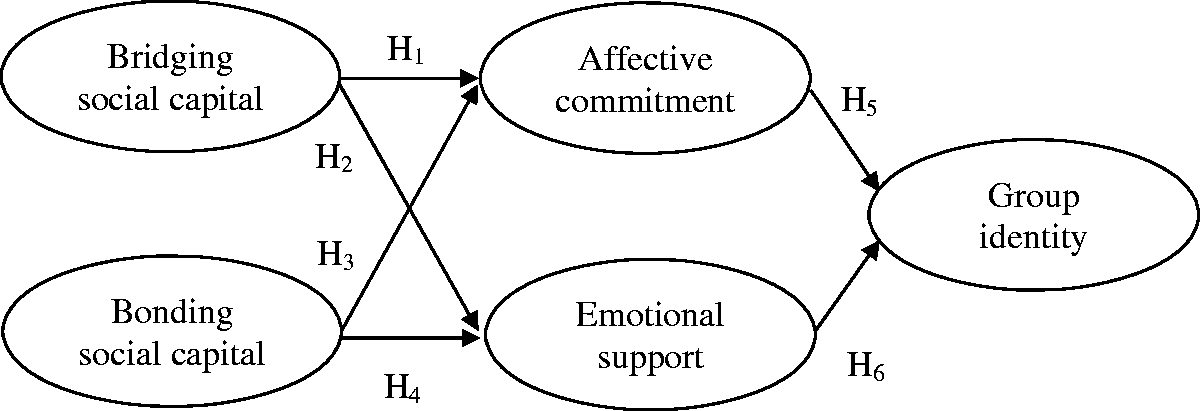
Measurement
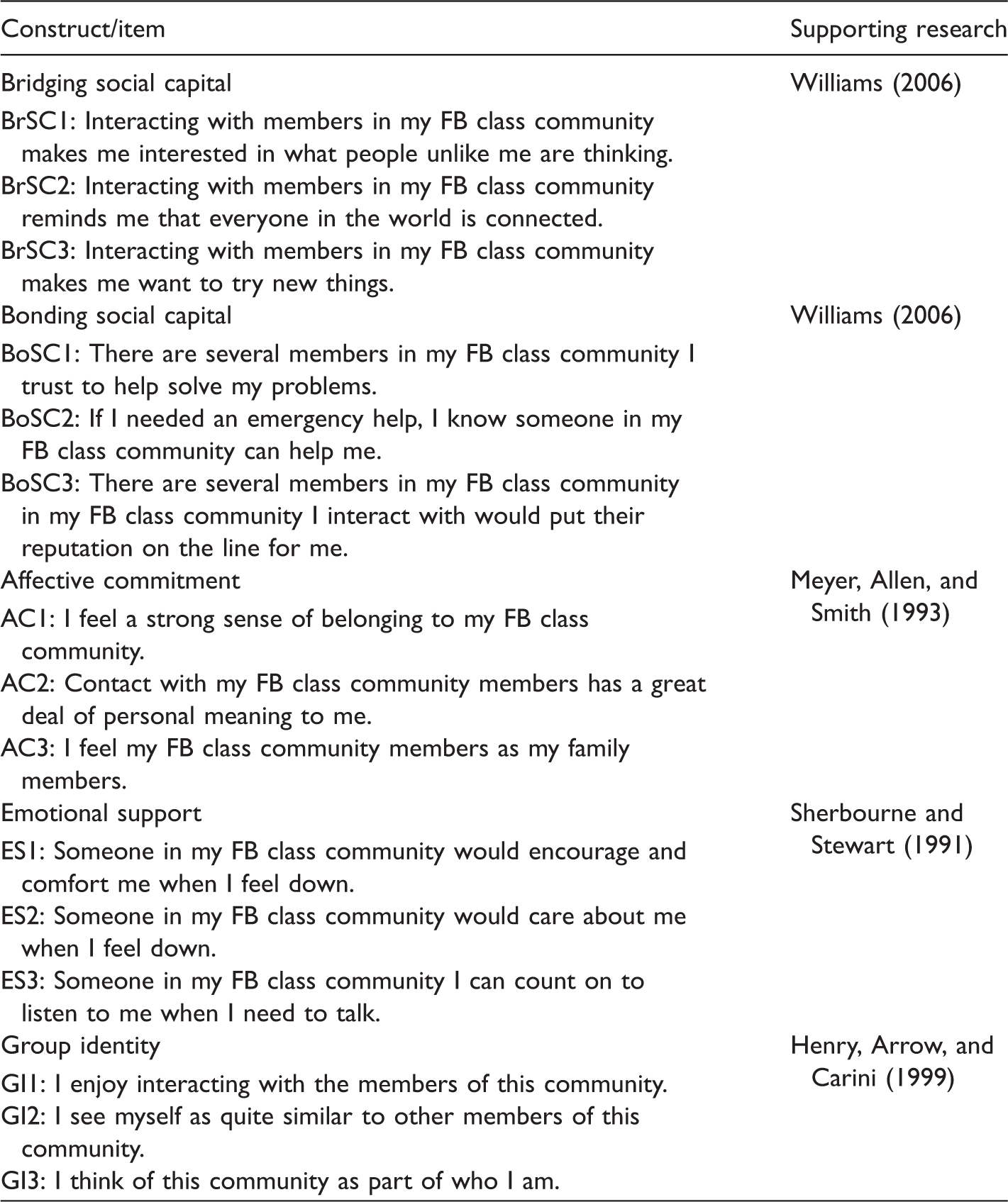
The questionnaire designed for this study contains a total of 15 items and consists of four parts: (a) social capital scale, (b) affective commitment scale, (c) emotional support scale, and (d) group identity scale. Each item was assessed using a 7-point Likert scale (1 = strongly disagree to 7 = strongly agree).
The social capital scale is based on Putnam’s (2000) concept of classifying social capital as bridging social capital and bonding social capital. Content of the scales used in this study also borrows ideas proposed by Williams (2006) in “Scales for Social Capital in an Online Era.”
The affective commitment scale is based on concepts of the SET (Blau, 1964; Homans, 1961) and commitment-trust theory (Morgan & Hunt, 1994). When bridging social capital is exchanged among members of the classroom community, trust experience accumulates and increases the frequency of information exchanges, as well as the diversity of the information exchanged. Members of the community then begin to build up affective commitment toward the community and maintain weak ties within the virtual community.
Study Construct Items.
Data Collection
According to Alexa.com, in April 2013, the number of Taiwan users using FB exceeded 6.84 million making it the most popular SNS in Taiwan (Alexa, 2013; CheckFacebook.com, 2013). For these reasons, this study used an internet survey to collect data from students at a technical college in eastern Taiwan. Stratified random sampling was used to select members of a virtual classroom community on FB. Subjects included freshmen, sophomores, juniors, and seniors.
The data collection process involved two stages. During the preliminary stage, we visited the Office of Research and Development and received permission from the college to conduct our survey. Twelve classes were selected from this college in which teachers chose FB as a classroom management tool and had been using FB for more than 6 months. The 12 classes included four freshman, four sophomore, two junior, and two senior classes.
During the data collection stage, we posted a short description of the study and a link to the survey on the student electronic announcement board as well as information regarding confidentiality and subject qualifications (a member of a FB classroom community for more than 6 months). In total, 395 questionnaires were disseminated and 344 valid questionnaires were retrieved, excluding the uncompleted questionnaires, resulting in a retrieval rate of 87%. The sample is balanced in terms of gender (57% female and 43% male) which included 142 freshmen (62 females, 80 males), 120 sophomores (44 females, 76 males), 42 juniors (30 females, 12 males), and 40 seniors (12 females, 28 males).
Results
Analysis of the Reliability of Variables in the Research Model.
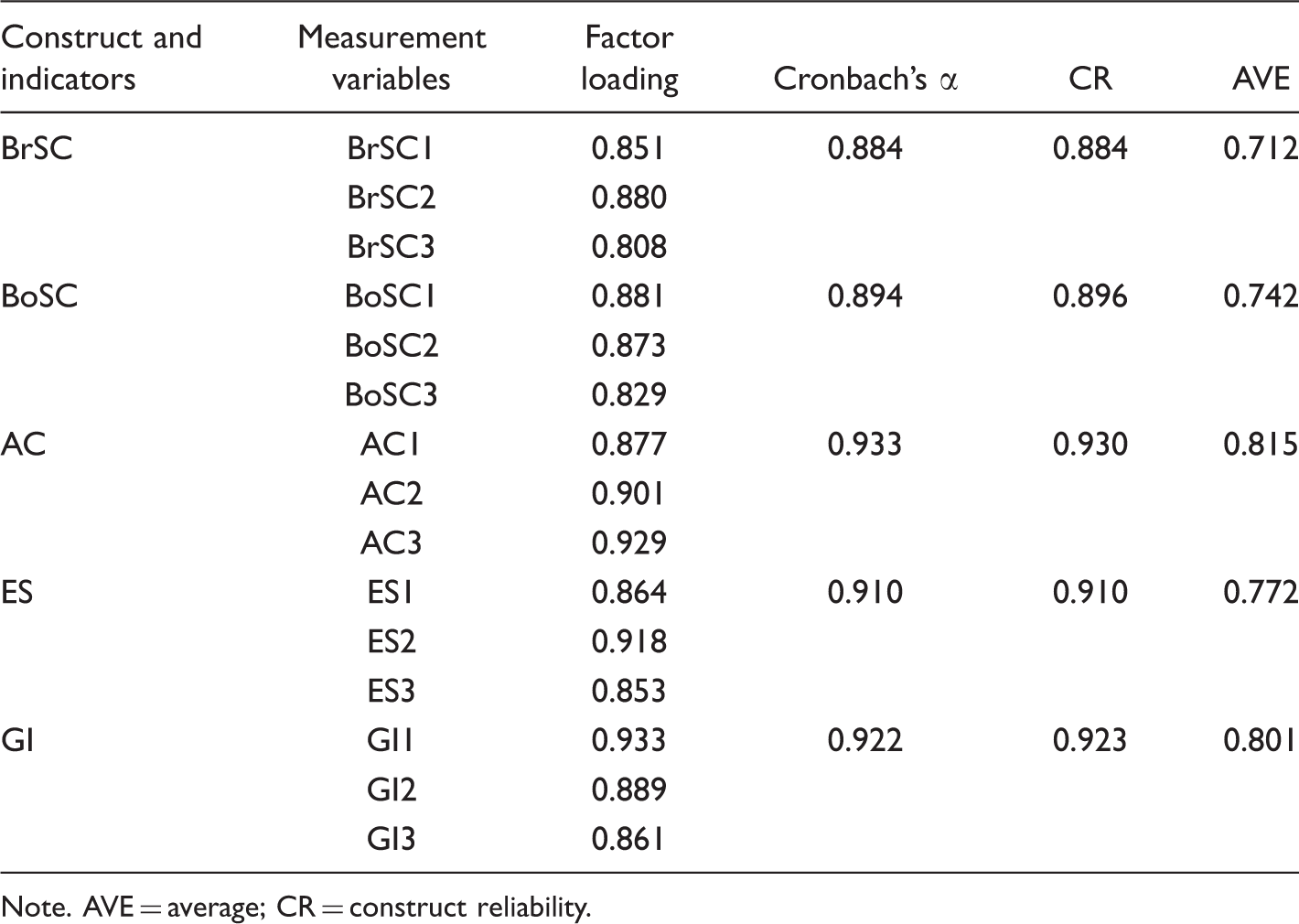
Note. AVE = average; CR = construct reliability.
Correlation Between Factors.
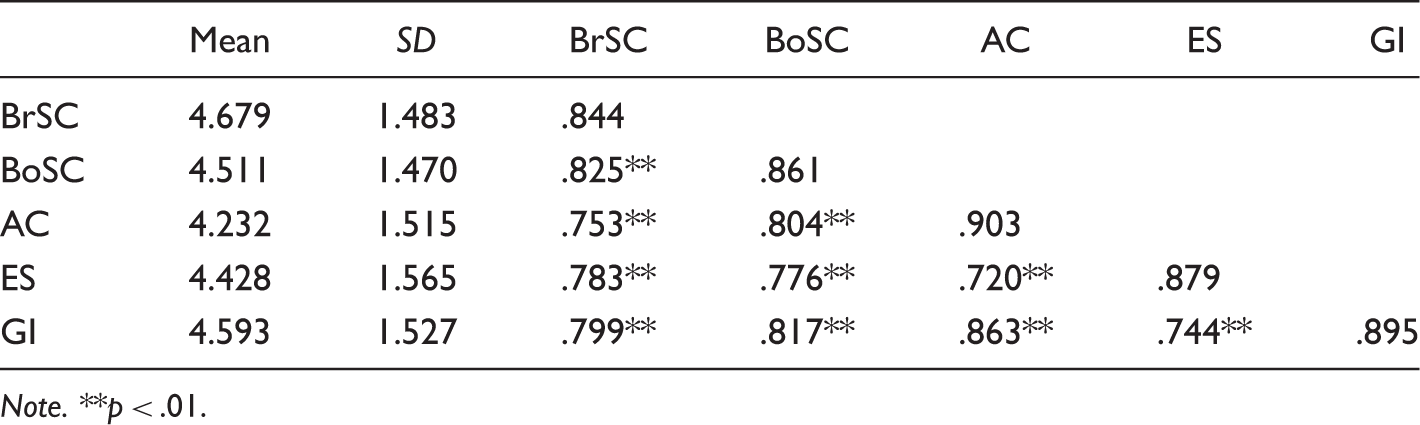
Note. **p < .01.
Final Measurement Model Measures of Goodness of Fit.
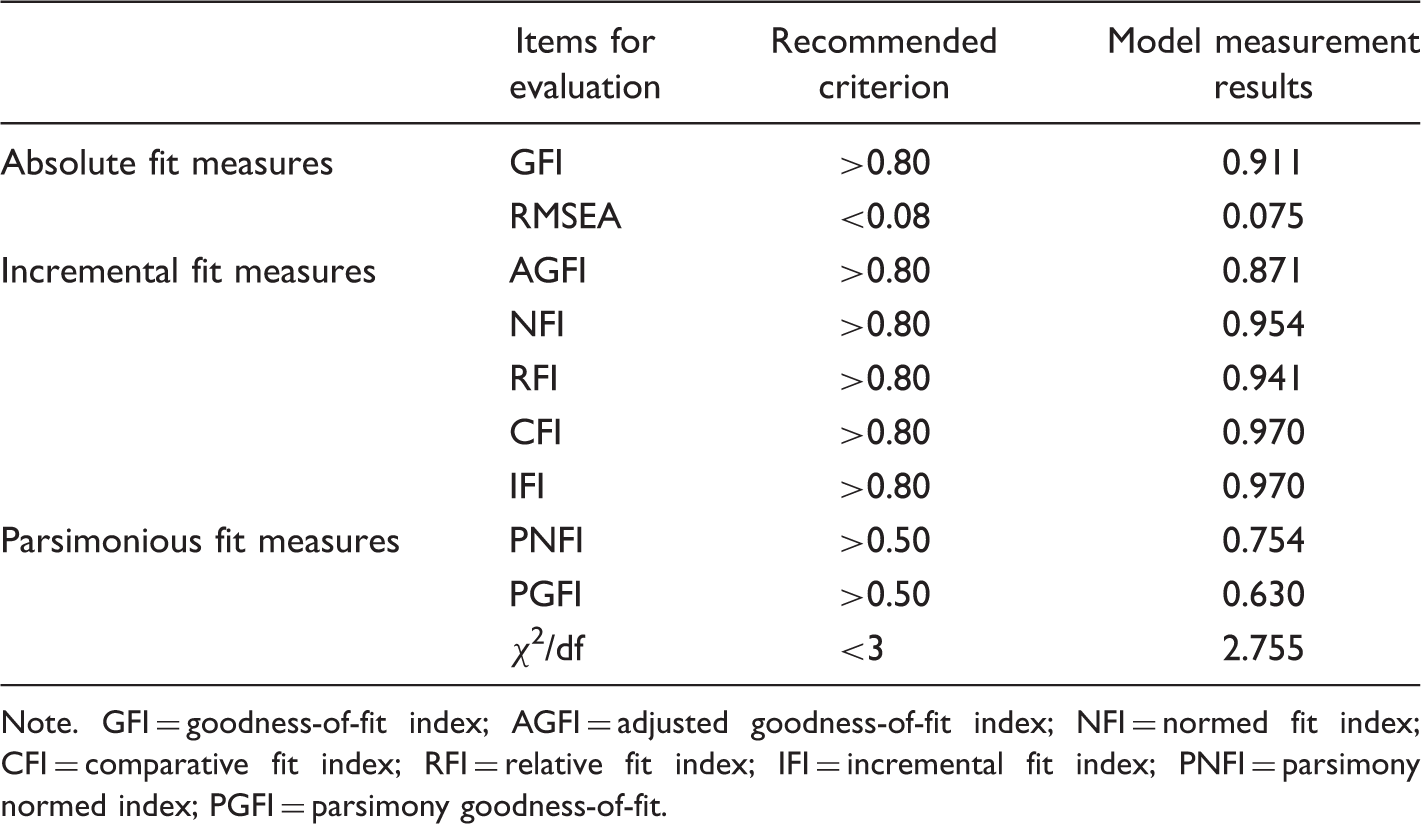
Note. GFI = goodness-of-fit index; AGFI = adjusted goodness-of-fit index; NFI = normed fit index; CFI = comparative fit index; RFI = relative fit index; IFI = incremental fit index; PNFI = parsimony normed index; PGFI = parsimony goodness-of-fit.
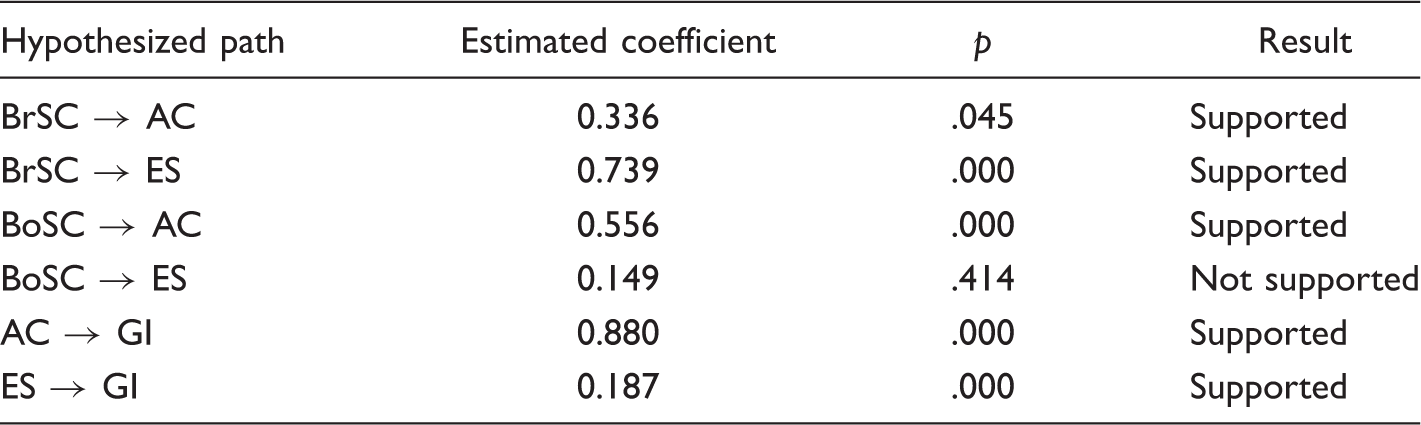
Results of Hypotheses Testing of the Initial Model.
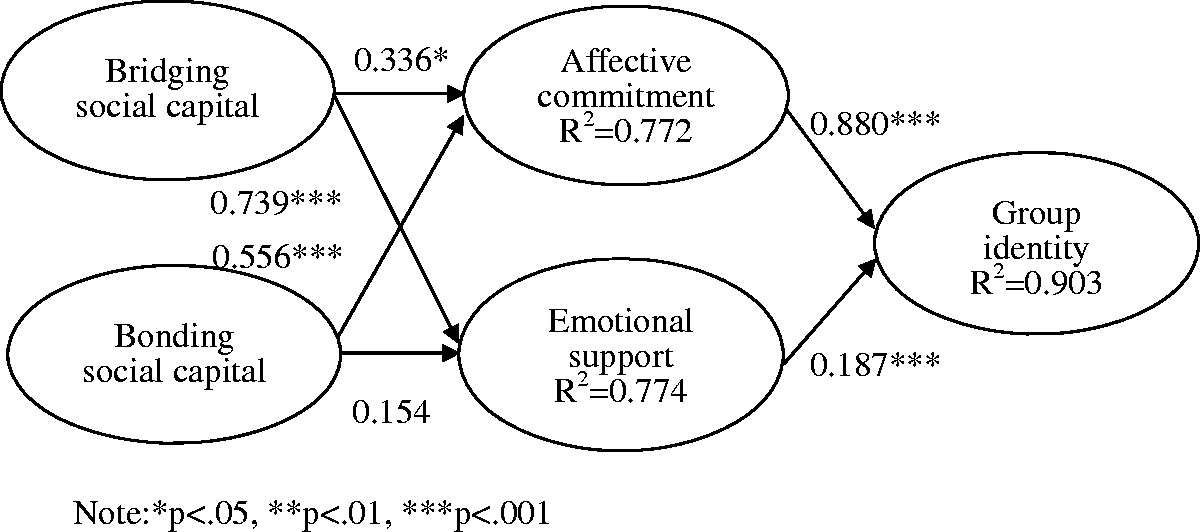
Model testing results (Path coefficients and R2 value of the structural model).
Discussion
Theoretical Implications
The results of this study indicate that bonding social capital contains a higher level of affective commitment among the virtual community members. Such affective commitment then creates a sense of belonging and emotional attachment to the community (Bateman et al., 2011; Ma & Chan, 2014; Sashi, 2012; Wu et al., 2010). At the same time, the members also generate affective commitment through the exchange of bonding social capital, causing them to merge into the group and reinforce strong ties with other members of the group, which directly affects the formation of group identity.
Finally, it is worth noting that Putnam (2000) argues that due to the weak ties inherent to its formation, bridging social capital does not contain emotional support. However, the results of this study have found that bridging social capital within the FB-based virtual classroom does not lose emotional support because of weak ties. Rather, the formation of group identity is facilitated by the existence of emotional support. Therefore, this study subsumes concepts in the SET (Blau, 1964; Homans, 1961) to support the theory that bridging social capital contains a degree of emotional support and that it affects the formation of group identity in a virtual classroom group.
While social exchange is a mutually beneficial act (Homans, 1961), social capital that exists within the social network of a virtual classroom group can be used to conduct reciprocal exchange behavior through CMC social interaction, maintaining, or strengthening ties in the social network. Regardless of whether the ties that connect members are weak or strong, both parties in an act of exchange will anticipate an equal and reciprocal reward. In addition, Blau (1964) believes that equal and reciprocal rewards can determine the existence or disintegration of social relationships. Members of a virtual classroom group are attracted to the group because the individual member receives reciprocal rewards and acceptance. Therefore, equal and reciprocal social capital returns and rewards are critical for maintaining weak ties in a virtual classroom group. When members no longer perceive rewards as reciprocal, social connections between members slowly dissolve.
Subjects in this study were members of a virtual classroom group, and no money transactions took place between members. Therefore, the fair and mutually beneficial bridging social capital between members of the group is based on internal rewards (e.g., love, emotion, admiration), which are rewards that contain emotional support. Through obtaining internal rewards, members satisfy their needs for social support. Furthermore, emotional support generated to maintain weak ties among members directly affects the formation of group identity.
Practical Implications
Moore and Huber (2001) notes that the purpose of education is to enable students to obtain through learning the necessary knowledge and skills for life. To achieve this goal, teachers and students are constantly engaged in a state of communication during activities that require physical classroom management. Through effective and harmonious communication processes, positive social relationships and strong emotional ties are established between the teacher and the student. Therefore, teachers can only become an effective classroom manager when they can aptly apply communication message reception, transmission, and feedback skills during the communication process.
However, social media websites and tools such as FB have changed the way people interact and communicate. CMC facilitates the formation and distribution of social capital within a social network structure and also extends the concept of physical classroom management to virtual classroom communities.
Although Walther (1996) suggested that CMC lacks nonverbal cues and synchronous communication characteristics, the results of this study show that CMC has positive effects on the formation of group identity. Members of the FB-based virtual classroom community depend on CMC to communicate with each other, and the social capital generated through CMC has actual benefits for effective classroom management (e.g., emotional support, knowledge obtaining, and social relationship maintenance) in the information age (Ellison et al., 2014b; Magnier et al., 2010; Oh et al., 2013, 2014; Valenzuela et al., 2009). Social capital provides emotional support and the sense of social belonging particularly when establishing harmonious communication strategies. Through the fair and reciprocal exchange of social capital, members can satisfy their needs for internal rewards and maintain positive social relationship development. Ultimately, members integrate into the virtual classroom community, thereby achieving the classroom management goal of establishing group identity.
Research Limitations
This study focused on members of a FB-based virtual classroom community, and inferences and generalizations are limited by the nature and size of the community. The results of this study should not be over-interpreted when applied to different types of communities. In addition, although research subjects were verified as members of the classroom community, the communication environment formed through CMC lacks nonverbal cues and synchrony. Therefore, whether subjects’ ability to conduct face-to-face communication is hindered and affects the formation of group identity in the physical classroom community is not addressed in this study. Further research should be conducted to explore the effects of CMC on physical classroom communities.
Footnotes
Declaration of Conflicting Interests
The authors declared no potential conflicts of interest with respect to the research, authorship, and/or publication of this article.
Funding
The authors received no financial support for the research, authorship, and/or publication of this article.