







Abstract
This study analyzes the influence of Facebook usage on building social capital among university students in Karachi by using a modified framework of technology acceptance model. Important information was gathered utilizing organized questionnaire containing items of Facebook intensity, social self-efficacy, perceived ease of use, perceived usefulness, perceived playfulness (independent variables), intention to continue use (mediating variables), bridging social capital, and bonding social capital (dependent variables), while the specimen size includes 560 university students. Furthermore, the procedures utilized as a part of the study are reliability analysis, confirmatory factor analysis, partial least square-structural equation modeling to check the impact of these factors on the building of social capital. Findings show that Facebook intensity, perceived ease of use, perceived usefulness, perceived playfulness, and social self-efficacy have a positive and significant impact on intention to continue use, while intention to continue use has a positive and significant impact on both dependent variables bridging social capital and bonding social capital concluding that social networking sites (Facebook) are helpful in building and maintaining social capital by creating intention to continue using them. This study provides useful insights about the youth experience of using Facebook and sharing information. Also, marketers would get benefit as this study would allow them to adopt effective marketing strategies.
Keywords
Introduction
The Internet was largely used for human interaction, allowing them to get engaged and being involved in the formation of societies (Ong, 1982). Humans are social and innovative by nature (Lüders, 2007); therefore, socializing through Internet has developed to become the norm for people all around the globe. It has given a new meaning to communication by enabling them to share information regardless of their location. This has resulted in changes to their personal and professional lifestyles and the mode of sharing and exchanging information (O’Murchu, Breslin, & Decker, 2004).
With the advent of web 2.0 technologies, a new set of advanced features and services appeared which included social networking sites (SNSs), blogs, message boards, and instant messaging services. Millions of people, involving educational and industrial investigators, are enticed by these SNSs (Boyd & Ellison, 2007). Among other SNSs, Facebook is one of the most attention-grabbing sites and is the prime interest to the proposed investigation owning to its extensive usability and its technological capabilities helping to maintain contacts (Ellison, Steinfield, & Lampe, 2007). According to Ellison, Gray, Vitak, Lampe, and Fiore (2013), people use Facebook in order to communicate with new people as well as with the people they know already. Furthermore, he describes Facebook as a platform where people can comment on their contact’s activities, visit their friends’ profiles, and post about their own activities and viewpoints. It has been stated in the studies that Facebook helps people to gather relevant information, develop relationships, and synchronize conducts to pinpoint mutual affairs (Gershuny, 2002; Norris & Jones, 1998). According to DiMaggio, Hargittai, Neuman, and Robinson (2001), these SNSs have greatly influenced the creation and continuance of social capital.
Social capital, created by the combination of bridging social capital (BRS) and bonding social capital (BOS) (Putnam, 2001) has been regarded as the resources gathered through the contacts among people (Coleman, 1988; Ellison et al., 2013; Jin, 2013; Johnston, Tanner, Lalla, & Kawalski, 2013). It is considered to be the combined worth of publicly recognized social networks and the tendency of doing something for people, which emerges from these networks. According to Fukuyama (2001), social capital enhances association and relationship among people, while Lin (2002) sums it up as “investment in social relations with expected returns in the marketplace” (p. 3). The investment and return can be in terms of gaining relevant information, trend, opinions, and news. Furthermore, BRS places emphasis on extrinsic connections (Adler & Kwon, 2002) which are concerned with the weak ties among people (Putnam, 2001). These weak ties or loose connections help people in giving relevant information and different views about each other without providing any emotional assistance (Ellison et al., 2007; Granovetter, 1983, Williams, 2006). Contrary to bridging, BOS establishes closely tied relations between and among those who are attached emotionally like family, bosom friends, and special associates (Adler & Kwon, 2002; Morrow, 2001). Some researchers (Ellison et al., 2007; Williams, 2006) have regarded BOS as congruent with inner kinds of associations which are also capable of providing spiritual uplift to the people who are the members of those relationships (Islam, Merlo, Kawachi, Lindström, & Gerdtham, 2006).
Various studies have been conducted to investigate the impact of the Internet on building social capital (Bharati, Zhang, & Chaudhury, 2015; Chang & Zhu, 2012, Richardson & Hessey, 2009) and have shown both an increased and decreased effect of the Internet on building social capital. A negative association between the Internet and social capital building has been reported by researchers such as Kraut et al. (1998), Nie, Hillygus, and Erbring (2002), and Nie and Hillygus (2002), while the positive association between the Internet and social capital has been demonstrated through the work of Williams (2006), Kavanaugh, Carroll, Rosson, Zin, and Reese (2005), Hampton and Wellman (2003), Gershuny (2002), Wellman, Haase, Witte, and Hampton (2001), and Norris and Jones (1998). Moreover, the effect of Facebook on the social capital building among teenagers and students of universities has also been studied (Ahn, 2012; Bohn, Buchta, Hornik, & Mair, 2014; Ellison et al., 2007; Jin, 2013; Johnston et al., 2013). Extensive research (Burke, Kraut, & Marlow, 2011; Ellison et al., 2007; Ellison, Steinfield, & Lampe, 2011; Johnston et al., 2013; Seinfeld, Ellison, & Lampe, 2008; Shah, Subramanian, Rouis, & Limayem, 2012; Valenzuela, Park, & Kee, 2009) shows that a positive relationship exists between the use of Facebook and social capital.
The Internet service in Pakistan has been available since 1990. In 2001, around 1.3% of the population were using the Internet. By the end of 2006, the figure had risen to 6.5% and in 2012, it had reached 10% of the population. The latest figures of 2015 indicate that a further rise to 11% of the population is using the Internet in Pakistan, while information technology think tanks claims that Internet users have crossed 30 million at present. The usage of Facebook is increasing day by day. In June 2013, there were more than 9 million Facebook users in Pakistan. Statistics showed that 6.4 million were men, and 2.7 million were women, while 70% of the users were aged below 26 years (Farooqi et al., 2013; Memon et al., 2015). According to the Pakistan Social Media Report—March 2014, the number of Facebook users had further risen up to 13 million out of which 72% were male and 28% were female, ranging between the age of 18 and 34 years (Pakistan Social Media Report, 2014). Although usage of Facebook is increasing tremendously, its impact on the creation of social capital is barely investigated in Pakistan. Therefore, there is a need to determine those factors which could impact the usage of Facebook resulting in the building of social capital.
The increased popularity of SNSs especially Facebook in developing countries regard them as essential tools for students to create and sustain social capital. Students of higher education, particularly, are required to build social capital for their professional growth. However, there is a very little research on how the higher education students belonging to developing countries could gain and sustain social capital. This study makes imperative contributions by investigating the consequences for the maintenance of social capital through the use of Facebook by the students of higher education. It also sheds light on how students can widen their social networks and gain diverse information in the professional environment. Moreover, this study determines the influence of factors on the building and maintenance of both bridging and bonding social capital in a developing country. It is anticipated that this study will inspire future researches on the influence of other SNSs on the creation and usability of social capital.
Lately, various researches have been conducted to see Facebook as a source of building social capital by either using technology acceptance model (TAM) or by considering demographics only, but this kind of modified model has not yet been studied, especially in developing countries. Also, social capital, the dependent variable of this study is not considered as one variable like previously studied in Jin (2013 and Sheng-Yi, Shih-Ting, Liu, Da-Chain, and Hwang (2012), but it is bifurcated as BRS and BOS. The aim of this study is to determine whether this extensive use of Facebook in Pakistan results in the building and maintenance of social capital, which is actually the accumulation of resources through the connections between individuals.
Literature Review
Theoretical Background
TAM is a chief conventional acceptance theory in the area of technology (Awa, Eze, Urieto, & Inyang, 2011). It lays a foundation to study exogenous factors which could influence the decision regarding acceptance of technology. The theory is proposed by Davis (1989). This TAM model, used for behavioral opinions and intentions, is widely utilized in studies (Davis, Bagozzi, & Warshaw, 1992; Klobas, 1995; Lee Cheung, & Chen, 2007; Venkatesh & Davis, 2000; Venkatesh, Speier, & Morris, 2002; Thong, Hong, & Tam, 2002; etc.).
Moreover, social capital theory proposed by Bourdieu (1986) and Coleman (1988) is about the capability to exchange the resources among individuals or group of individuals enclosed in their social network. This social capital is then transformed into different types of capital like human capital or intellectual capital (Resnick, 2001). This research is based upon the modified model of technology acceptance (Davis, 1993; Venkatesh & Davis, 2000) and social capital theory (Bourdieu, 1986; Coleman, 1988; Putnam, 2001). Components of TAM and social capital are discussed in the following text.
Empirical Studies and Hypothesis
Online social networking
Toomey, Mark, Tang, and Adams (1998) describe online SNSs to be the online groups which communicate and gather assets through these computer-regulated connections. Most of the time, these systems contain individuals of mutual bonds or interests who might belong to different territories (Boyd & Ellison, 2007). With the advancement in the technology, Internet has gone through a great deal of change over a period of time. As it is put up by Bargh and McKenna (2004) that the Internet is basically a combination of former innovations such as telephones, televisions, and libraries which were used as sources of communication and information. Initially, the Internet was understood to be the source of providing information only, but the emergence of these SNSs has provided people with an effective mean of connecting with each other and that too beyond expectation (Weaver & Morrison, 2008).
Taking Facebook into account, when it is used in order to collect and share information rather than for socializing, more positive outcomes are anticipated (Junco, 2012). Also, the study carried out by Junco (2012) suggested that particular uses of Facebook which imitate academic behaviors such as collecting and sharing information are linked with positive academic results. Another research conducted by Junco, Heiberger, and Loken (2011) indicated that the communication of students about the content of course lead to enhanced achievements in academic performance.
Social capital
Coleman (1988) defines social capital as the assets gathered via the connections between individuals. It is not confined to one meaning rather different meanings in various disciplines, as suggested by Adler and Kwon (2002), and is devised as a stimulus and a response (Resnick, 2001; Williams, 2006). The accumulation of assets which can be real or virtual emerges because of the possession of reliable collections of nearly standardized connections of an individual or a set of individuals, built through joint contacts and acknowledgments (Bourdieu & Wacquant, 1992, p. 14). It depends on the connections that how these assets work. According to Adler and Kwon (2002), social capital is associated with optimistic societal results which include good physical condition of citizens, decreased unlawful acts, and effective capital market. Moreover, Putnam (2001) encounters elevated societal chaos, less involvement in communal affairs, and conceivably increased mistrust in the society due to the deteriorating social capital. While discussed earlier are the negative outcomes, exactly opposite results are produced by elevated levels of social capital such as enhanced devotion toward a society and a capability to encourage joint activities along with other advantages. Also social capital can be utilized negatively, it predominantly affects positively on the communication among the members of a social network (Helliwell & Putnam, 2004).
Furthermore, social capital can be divided into two categories, cognitive and structural. Cognitive social capital encompasses personal features including opinions, ethics, norms, and attitudes (Islam et al., 2006), and it is formed by the behavior of a society such as religion, custom, and history (Fukuyama, 2001). On the other hand, structural social capital deals with the apparent characteristics of a society like systems of societal involvement or compactness of social network (Islam et al., 2006). Bridging and bonding social capital (Putnam, 2001), discussed later, also belong to the cognitive category.
Bridging social capital
BRS emphasizes on extrinsic connections (Adler & Kwon, 2002) which are concerned with the “weak ties” among people (Putnam, 2001). These weak ties or loose connections help in giving relevant information and different views about each other without providing any emotional assistance (Ellison et al., 2007; Granovetter, 1983; Williams, 2006).
Islam et al. (2006) proposes that these connections are formed among the people belonging to distinct cultural or professional settings. Also, BRS or loose connections are said to be increasingly devised and maintained by these SNSs due to the low-cost usage (Donath & Boyd, 2004).
Bonding social capital
Contrary to bridging, BOS establishes among closely tied relations who are attached emotionally like family, bosom friends, and special associations (Adler & Kwon, 2002; Morrow, 2001). Many researchers (Ellison et al., 2007; Williams, 2006) have regarded BOS as congruent and inner kind of associations and which are capable of providing spiritual uplift to the people who are the members of those relationships (Islam et al., 2006).
The revised TAM
Many previous researches have been conducted in order to study the effect of TAM on social media usage (Rauniar, Rawski, Yang, & Johnson, 2014) and in building social capital (Jin, 2013). In this study, we determine the impact of TAM along with other variables in building social capital. Davis (1989) came up with the TAM model in order to study the behavior related to the use of information technology. A second theory known as the theory of reasoned action, embraced TAM, describing an individual’s conduct through their intentions (Fishbein & Ajzen, 1975). TAM basically describes the technology acceptance which could in turn describe the usage behavior of the individuals using technology where as theory of reasoned actions generally describes human behavior (Davis, Bagozzi, & Warshaw, 1989).
Furthermore, the attitude is divided into perceived ease of use (PEOU) and perceived usefulness (PU). Perceived playfulness (PP) has been regarded as a cognitive factor (Hsu & Lin, 2008). Several studies (Davis, 1993; Venkatesh & Davis, 2000) have revised or remodel TAM by adding factors which could be used in the specific setting of technology. Along with PEOU, PP and PU two other factors, social self-efficacy (SSE) and Facebook intensity (FI) have been incorporated to see their impact on intention to use and then ultimately on social capital building (bridging and bonding social capital).
Perceived usefulness
According to an individual’s viewpoint, the extent to which his or her work output increases due to the usage of a specific system is called PU (Lu, Yu, Liu, & Yao, 2003; Rauniar et al., 2014). PU gives a clear vision about the factors influencing the actual use and intention to use (Awa et al., 2011). Both these factors of TAM impact a person’s attitudes toward the usage intention of technology (Rauniar et al., 2014); therefore, the hypothesis of PU would be as follows: H1: PU has a significant impact on intention to continue using Facebook.
Perceived ease of use
Davis (1989) and Venkatesh (2000) describe PEOU as how effortless would the use of a specific system be, in an individual’s perspective. It is a concept linked to a person’s evaluation of the struggle immersed in the procedure of using technology (Davis, 1989).
Saadé and Bahli (2005) explain PEOU as an individual’s evaluation that the use of technology would be without cognitive load and they would not require to devote much of their time and efforts while using it. PEOU defines an individual’s intention toward the use of technology (Taylor & Todd, 1995), and it can have both direct and indirect effects on ICU (Saadé & Bahli, 2005). Therefore, the hypothesis in order to analyze the impact of PEOU would be as follows: H2: PEOU has a significant impact on intention to continue using Facebook.
Perceived playfulness
Social media is one platform which is joyful and enjoyable helping individuals to release stress and triggering creativity (Van der Heijden, 2004). Studies have shown that integrating work with joy results in enhancing productivity and output (Stephenson, 1964). PP can be elaborated in terms of Facebook as the limit to which Facebook associated activities can provide enjoyment besides the predicted performance outcome (Raunir et al., 2013). Through various present researches, it has been observed that PP has an important impact on the behavior to use, such as computer technology in an organization (Hwang, 2005; Igbaria, Parasuraman, & Baroudi, 1996), instant messaging usage (Li, Chau, & Lou, 2005), and intention to continue the usage of mobile devices (Nysveen, Pedersen, & Thorbjørnsen, 2005a, 2005b). Therefore, the hypothesis for PP is as follows: H3: PP has a significant effect on intention to continue using Facebook.
Social self-efficacy
The degree of self-confidence owned by people which allow them to cope up with stress causing factors demonstrate self-efficacy (Bandura, 1977; Jerusalem & Schwarzer, 1992). Moreover, Gecas (1989) suggested that SSE is a person’s perspective about their capability to start up a social interaction and form new connections and so in an online system this would impact people’s stance and behavior in such group like Facebook (Wu et al., 2012). SSE is also employed in various fields concerning students (Fan, Meng, Gao, Lopez, & Liu, 2010; Hagedoorn & Molleman, 2006; Lin & Betz, 2009; Wei, Russell, & Zakalik, 2005).
Self-efficacy has an important impact on the intention of using and adopting technology (Compeau & Higgins, 1991; Hill, Smith, & Mann, 1987; Davis et al., 1989). According to the argument placed by Bandura (1982, 1986), the perspective of self-efficacy acts as an important generator of intention to use technology. Moreover, Hill et al. (1987) discovered that self-efficacy has an important impact on technology acceptance and it has a significant impact on influencing the decision of using them. Therefore, the hypothesis would be as follows: H4: Social self-efficacy has a significant impact on the intention to use Facebook.
Facebook intensity
Social networking sites provide a forum to interact and to get a feeling of association with the personal and social contacts (Valenzuela et al., 2009). Through researches, it has been seen that individuals devote notable time on their desirable social network expressing comparatively optimistic attitude (Chen & Haley, 2010) which would in turn impact the intention to continue using it, since attitude influences intention as evident through the theory of reasoned action (Fishbein & Ajzen, 1975). Therefore, the hypothesis would be as follows: H5: Facebook intensity has a significant impact on the intention to continue using Facebook.
Intention to continue using
TAM suggests that using the technology is decided by the intention to use it (Rauniar et al., 2014). It has been proposed by Jin (2013) that social media provides a platform in which participants make their virtual accounts, transfer resources, participate in various communal activities, and build connections with other participants. Association between Facebook usage and building of social capital has been determined by many researchers suggesting that the extensive use of social media would tremendously increase social capital. Also, individuals log in to these sites in order to nourish the connection with their old and new contacts (Ellison, Heino, & Gibbs, 2006). There are also many studies (Hu & Kettinger, 2008; Lin & Lu, 2011; Pinho & Soares, 2011) which have been carried out observing the influence of social capital on the intention to continue using Facebook. This research, however, investigates the opposite relationship, that is, impact of intention to continue using Facebook on social capital building. Hence, consistent with these observations, Jin (2013) proposed that intention to use Facebook influences the maintenance of social capital building (bridging and bonding social capital). Therefore, it can be hypothesized that: H6a: Intention to continue using Facebook has a significant impact on BRS. H6b: Intention to continue using Facebook has a significant impact on BOS.
Methodology
The extended model of TAM is represented by Figure 1, which is the conceptual model of this research. This model comprises of three conventional factors of TAM which are PEOU, PU, and PP along with two additional factors, SSE and FI. In our research, we use these factors to study their influence on intention to continue using Facebook and ultimately on social capital building among university students of Karachi.
Conceptual model.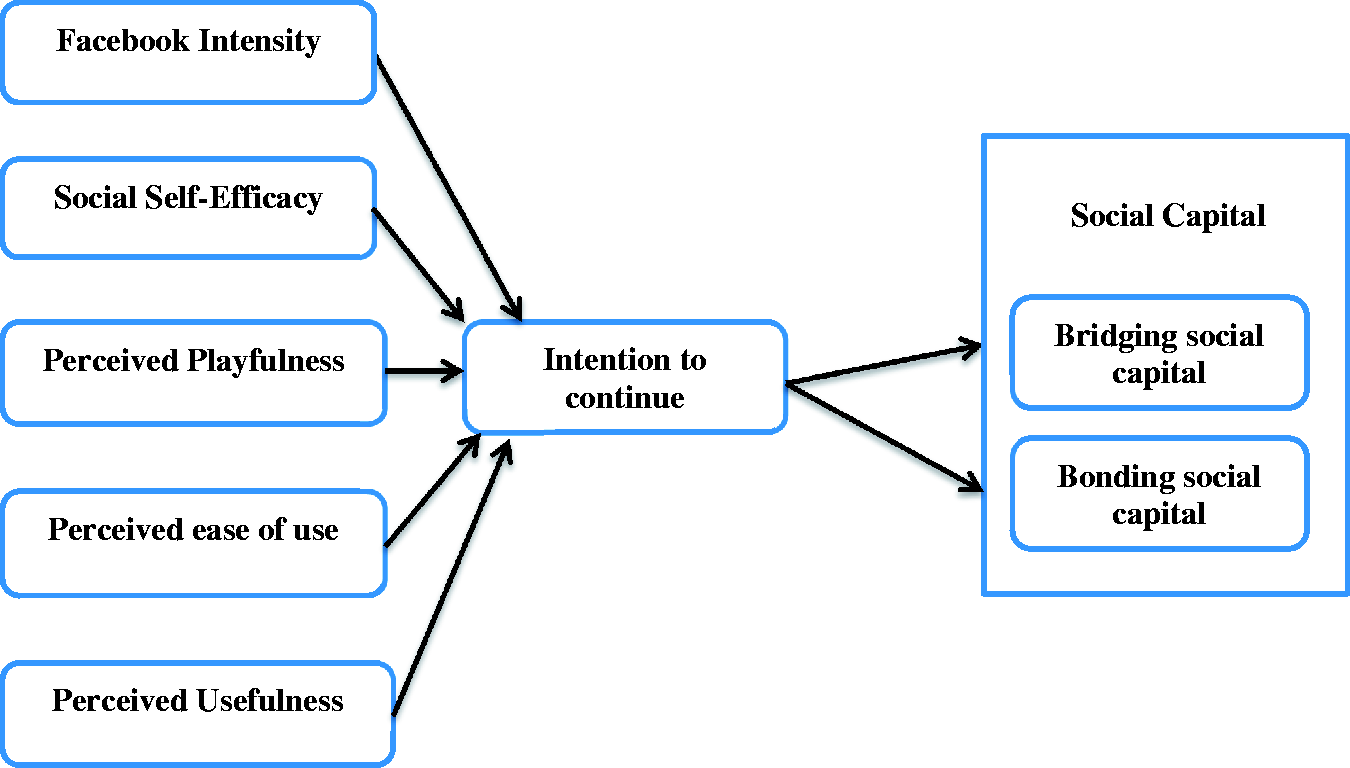
Measurement Instrument
In accordance with this study, the model of TAM (Davis, 1989) was further transformed and extended. Instrument, intended to use in this research, is a questionnaire whose items are designed according to the demand of the factors. Moreover, the content of the questionnaire is validated by educational and industrial professionals. To reassure the relevancy and convenience of the questionnaire, a preliminary test has been carried out by distributing the questionnaire among students who belong to various universities.
The questionnaire is constructed on a 5-point Likert scale which ranges from strongly disagree (1) to strongly agree (5) which is utilized to estimate the role of Facebook on building social capital. With this respect, items of the factors, PEOU (Gefen & Straub, 2000; Jin, 2013), PU (Jin, 2013), PP (Wakefield & Whitten, 2006), intention to continue using Facebook (Hamari & Koivisto, 2013; Jin, 2013), SSE (Shen-Yi, Shih-Ting, Liu, Da-Chain, & Hwang, 2012), FI (Ellison et al., 2007), BRS (Chang & Zhu, 2012; Ellison et al., 2007), and BOS (Ellison et al., 2007) are adapted and transformed according to the situation of this research. The data along with the demographic statistics, which include gender, age, and qualification, are gathered through survey method. The technique used is nonprobability sampling technique which is also called convenience sampling.
The focus of this research is to target students who are the users of Facebook. Considering the factor analysis, a sample of 50, 300, 500, and 1,000 is regarded as poor, good, very good, and excellent, respectively (Ali & Raza, 2015; Comrey & Lee, 1992). Hence, in order to continue this research, business students were selected from seven Business Schools of Karachi (Iqra University, Institute of Business Management, Institute of Business Administration, Shaheed Zulfikar Ali Bhutto Institute of Science and Technology, National University of Computer and Emerging Sciences, Bahria University, Karachi University Business School) as a sample. Consent was obtained regarding the distribution of questionnaire, from the relevant authority. Six hundred and fifteen responses were collected initially, and after removing the missing responses, the number of valid responses were reduced to 560. Items in a questionnaire should be at least 25 (Hair, Black, Babin, Anderson, & Tatham, 2006), and this requirement is met by our questionnaire since it has 45 items in total. Voluntary responses are taken from the participants, while all the information shared by them is kept confidential. Furthermore, the instrument comprises independent variable (FI, SSE, PEOU, PU, and PP and intention to continue using Facebook), while dependent variable comprises social capital: bridging and bonding social capital. In accordance with the above finding, there would be two mathematical equations representing regression models. They would be as follows:


Demographics
Profile of Respondents.
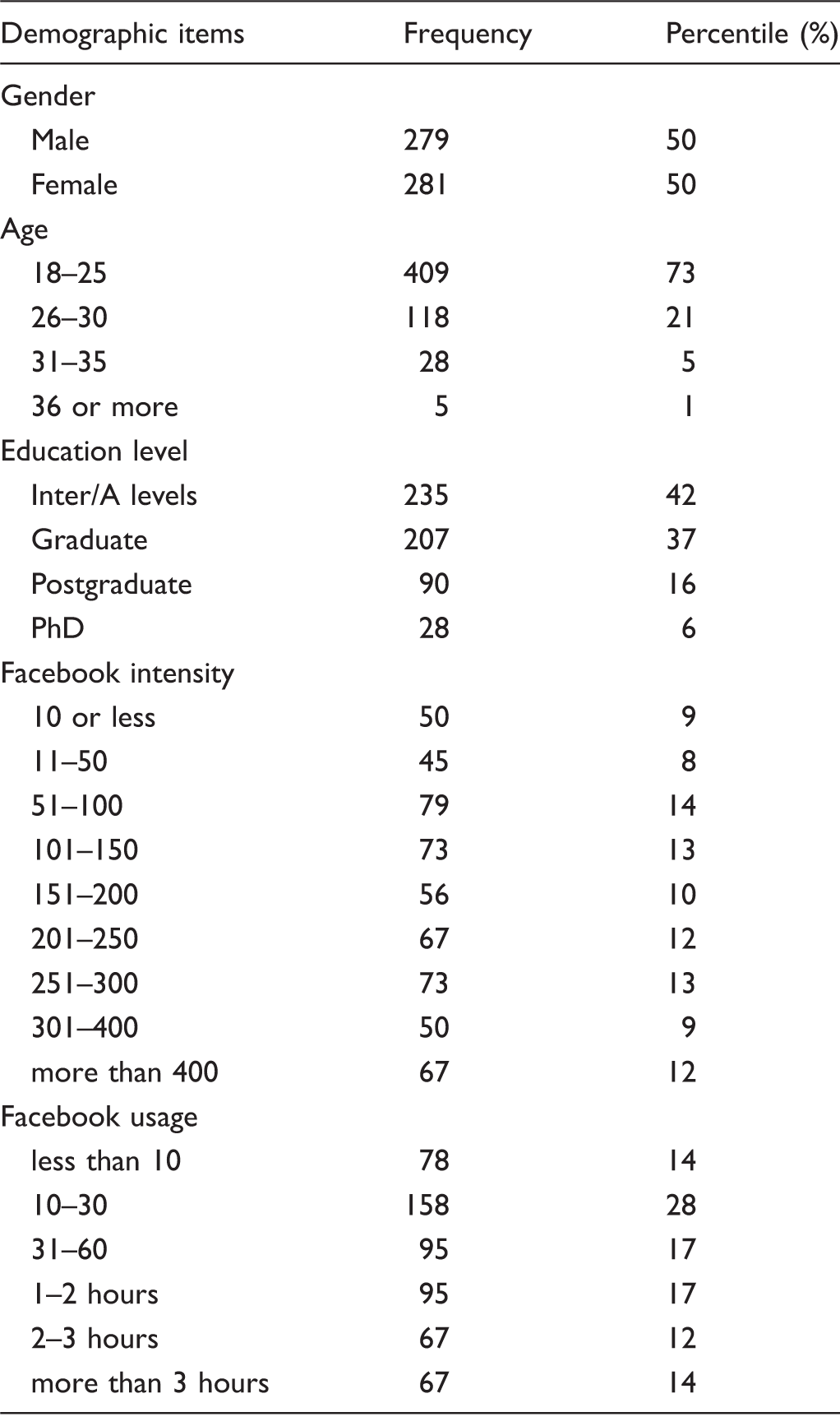
Source: Author estimations.
Data Analysis and Results
To analyze the data, structural equation modeling in SmartPLS 3.2.3 (Ringle, Wende, & Becker, 2014) along with the bootstrap resampling technique of 5,000 subsamples has been used in this study (Hair, Ringle, & Sarstedt, 2011). This technique is utilized to evaluate the measurement model and the structural model. Moreover, partial least square (PLS)-structural equation modeling technique is appropriate for the analyses of the complex framework like the one used in this study (Hair et al., 2011; Henseler et al., 2014), and it is capable of evaluating this model properly (Hair et al., 2011; Hair, Sarstedt, Ringle, & Mena, 2012).
Wold (1975, 1980) and Joreskog and Wold (1982) introduced PLS. This technique is capable of representing relationships among multiple latent variables. A latent variable is an unobserved variable which correlates other measured variables (Aibinu & Al-Lawati, 2010). PLS has the ability to function with hidden latent constructs and can interpret the measurement error in the improvement of latent variables (Chin, 1998). This study incorporates perception-based items, represented on a Likert scale, which have unknown distribution and their normality cannot be presented. Furthermore, the methods used to examine the effectiveness of the model are individual item reliability analysis, convergent validity of the measures associated with individual latent variables (Cook & Campbell, 1979), and discriminant validity (Campbell & Fiske, 1959) of the research instruments.
Measurement Model Results.

As shown in Table 2, all the variables have Cronbach’s alpha greater than 0.7 (Cronbach, 1951), which means that all the variables are reliable. However, all the variables meet the requirement of composite reliability as its value should be 0.7 or more (Nunnally, 1978; Raza, Jawaid, & Hassan, 2015). Moreover, Fornell and Larcker (1981) suggested that in order to determine convergent validity for the variables, the AVE is supposed to exceed 0.5. Table 2 shows that all variables have AVE values exceeding 0.5 except for BRS.
Summary Statistics.
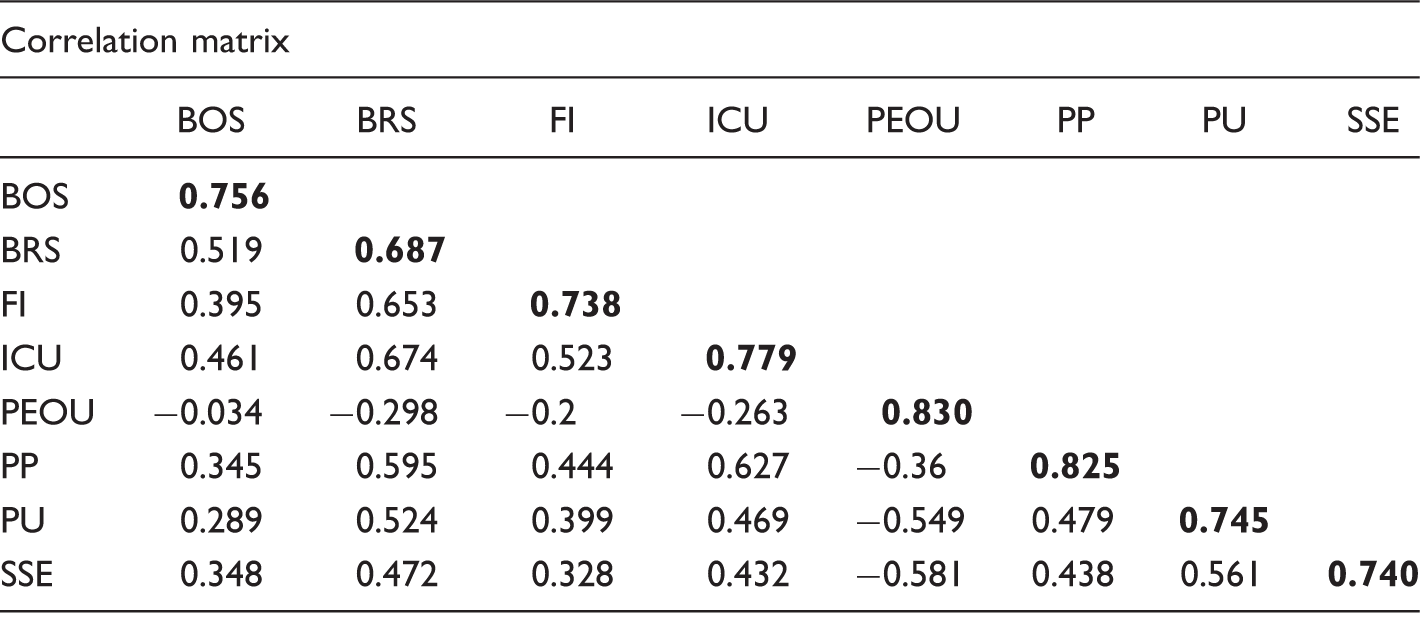
Note. BRS = bridging social capital; BOS = bonding social capital; FI = Facebook intensity; SSE = social self-efficacy; PEOU = perceived ease of use; PU = perceived usefulness; PP = perceived playfulness; ICU = intention to continue using Facebook.
The diagonal elements (bold) represent the square root of AVE (average variance extracted).
Loadings and Cross-Loadings.

BRS = bridging social capital; BOS = bonding social capital; FI = Facebook intensity; SSE = social self-efficacy; PEOU = perceived ease of use; PU = perceived usefulness; PP = perceived playfulness; ICU = intention to continue using Facebook.
Heterotrait-Monotrait Ratio (HTMT) Results.
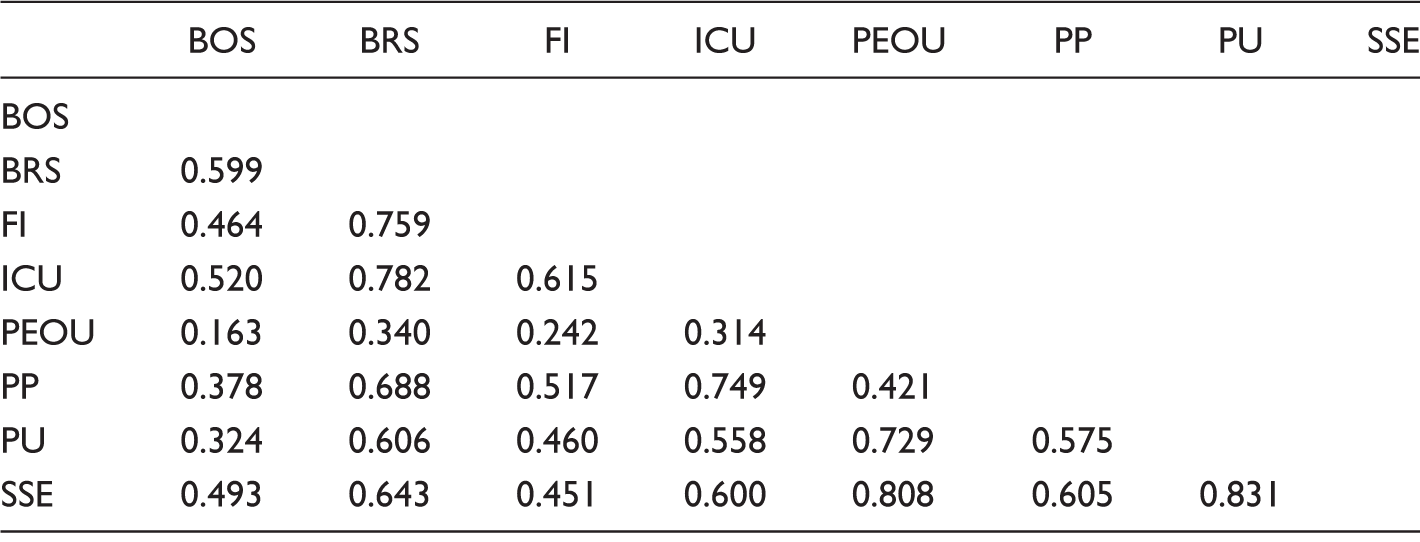
BRS = bridging social capital; BOS = bonding social capital; FI = Facebook intensity; SSE = social self-efficacy; PEOU = perceived ease of use; PU = perceived usefulness; PP = perceived playfulness; ICU = intention to continue using Facebook.
The explanatory power of the structural model can be investigated by assessing the amount of variance in the dependent variable which can be explained by the model. Breiman and Friedman (1985) suggest that R2 is essential for the assessment of a structural model. Figure 2 shows that the R2 for “intention to continue using Facebook (ICU)” is 0.5060 implying that 50.06% of the changes in the intention of students to continue using Facebook are due to the five latent variables in the model. Furthermore, R2 for BRS is 0.4640 showing that 46.40% of BRS is explained by ICU, while the R2 for BOS is 0.2180 which means that 21.80% of BOS is explained by ICU.
Path analysis.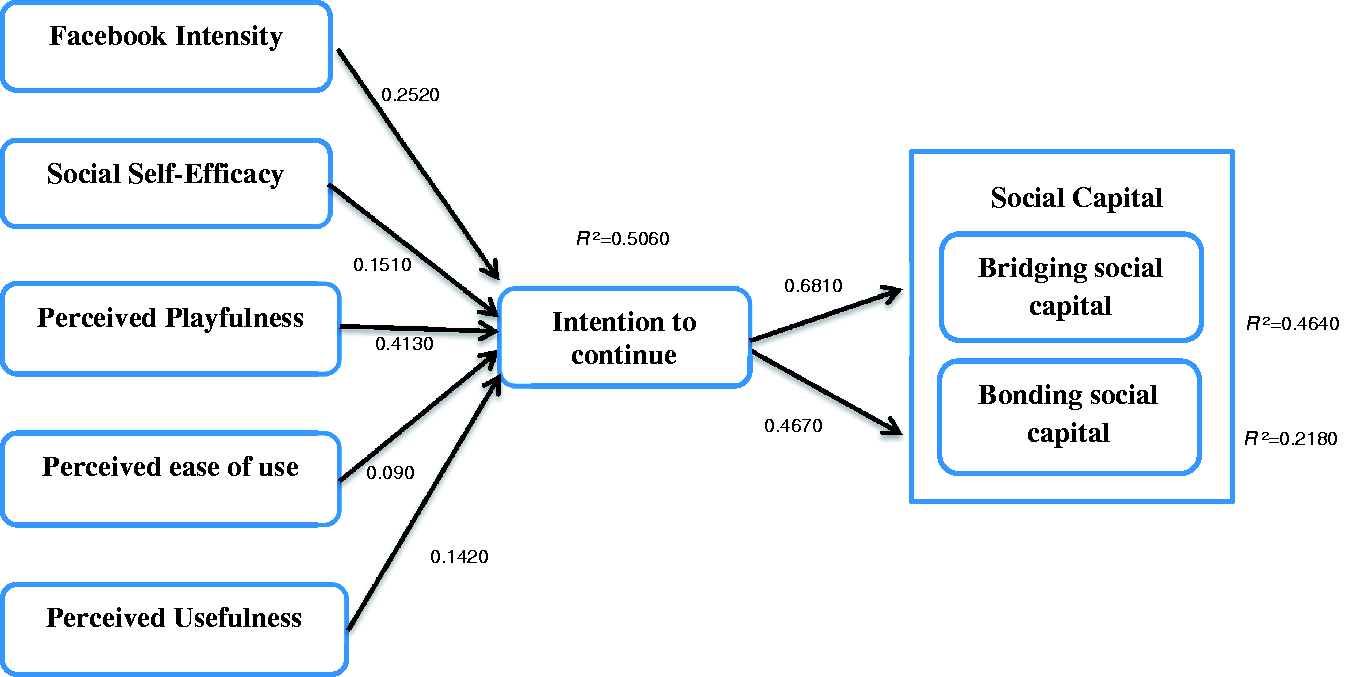
Path Analysis
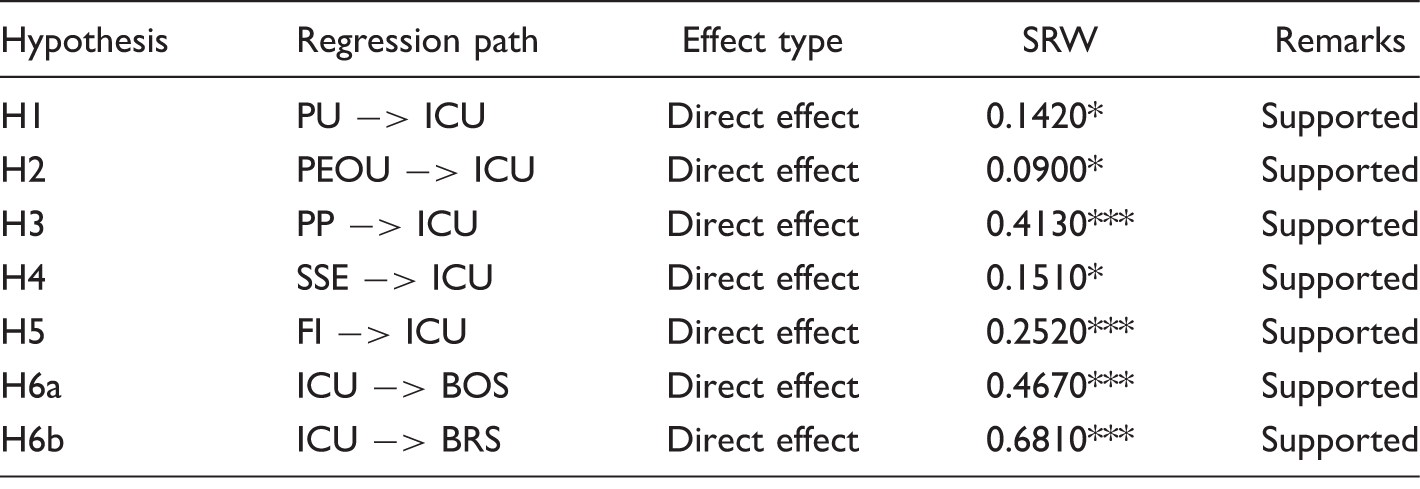
Standardized Regression Weights for the Research Model.
Note. SRW = standardized regression weight; BRS = bridging social capital; BOS = bonding social capital; FI = Facebook intensity; SSE = social self-efficacy; PEOU = perceived ease of use; PU = perceived usefulness; PP = perceived playfulness; ICU = intention to continue using Facebook.
p < .10. ***p < .01.
Moreover, as shown in Figure 2, the coefficients of paths connecting PU, PEOU, PP, SSE, FI with intention to continue using Facebook are all positive and significant; hence supporting H1, H2, H3, H4, H5, respectively. Moreover, the coefficient of path connecting intention to continue use (ICU) and BRS is positive and significant (H6), while the coefficient of path connecting intention to continue using and BOS is also positive and significant (H7).
Discussion
The aforementioned results show that all the paths between independent and dependent variables are positive and significant which mean that all the hypotheses are supported. The path connecting PU with intention to continue using Facebook is positive and significant (β = 0.1420, p < .1); hence supporting the hypothesis (H1). This result is congruent with the outcomes of other researches (Jin, 2013; Rauniar et al., 2014). Therefore, it can be concluded that PU positively impacts intention to continue using Facebook.
Similarly, the path connecting “perceived ease of use” and ICU is positive and significant (β = 0.0900, p < .1), supporting H2 and thus it is consistent with various other studies (Jin, 2013; Rauniar et al., 2014). This again shows that PEOU impacts ICU but not greatly. Again, the path connecting PP is also positive and significant (β = 0.4130, p < .1), which supports the hypothesis (H3). Different other literatures have supported this result (Jin, 2013); hence PP can have a great impact on ICU. According to Jin (2013), participants regard social media as the supplier of information which is conveniently approachable, easily usable, and also enjoyable. Thus, the above findings sum up that the social media like Facebook is favorable in meeting the demands of the customers due to its ease of use, usefulness, fun providing attribute (Jin, 2013).
Furthermore, SSE also impacts positively and significantly on ICU (β = 0.1510, p < .1); hence supporting the hypothesis (H4). This result is also consistent with the various researches (Compeau & Higgins, 1991; Davis et al., 1989; Hill et al., 1987). According to Hill et al. (1987), self-efficacy has a positive impact on the intention to continue using Facebook. Furthermore, Wu et al. (2012) suggest that SSE creates positive relation in the online Internet world specially in terms of their emotional connectivity and the sharing of knowledge. Hence, individuals’ SSE results in the building of social capital through their communication with participants.
As indicated by the results, FI has a positive and significant impact on ICU (β = 0.2520, p < .1), thus supporting H5. Similar results could be found in mentioned researches (Chen & Haley, 2010; Park & Kim, 2013). Hence, the findings suggest that the use of Facebook helps students to establish social capital, since it is easier and cheaper to maintain bonds (Donath & Boyd, 2004) and it also removes the hurdle, through its affordability, for those who are hesitant in communicating directly (Ellison et al., 2007).
ICU has a positive and significant impact on both BRS (β = 0.681, p < .1) and BOS (β = 0.467, p < .1); hence supporting both the hypotheses H6 and H7, respectively. According to Jin (2013), intention to continue using Facebook is facilitated by PEOU, PU, and PP of the users, while social capital building is mediated by intention to continue using Facebook.
This study explored that the elements of TAM along with three variables play positive and significant role in the building of social capital. Facebook, hence, plays a vital part in the course of building both bridging and bonding social capital. The outcomes of the research indicate that Facebook usage assists students in gathering and sustaining BRS since it allows participants to sustain such bonds conveniently and at a much lower cost. However, outcomes show that as compared with bridging, the use of Facebook seems to form and maintain BOS at a lower level.
Conclusion and Recommendations
This study analyzes the influence of Facebook usage on building social capital among Business University students in Karachi, Pakistan. The elements of TAM model along with three variables play positive and significant role in the building of social capital. Facebook, hence, plays a vital part in the course of building both bridging and bonding social capital. The outcomes of the research indicate that Facebook usage assists students in gathering and sustaining BRS since it allows participants to sustain such bonds conveniently and at a much lower cost. However, outcomes show that as compared with bridging, the use of Facebook seems to form and maintain BOS at a lower level.
This research provides fresh perceptions about youth experience of using social media along with their experience of getting connected to the world. Also, it gives an idea of how the information can be transferred and utilized through Facebook.
Furthermore, the outcomes of this study should be replicated in the development of marketing agendas and subject congruent with consumer preferences. The outcomes can be of value to the marketers who are looking for comprehensive approaches for attracting and acquiring customers who embrace and use SNSs. Largely, social interaction is responsible for the creation of social capital. SNSs have earned popularity in this modern society since they assist chain interactions. Hence, the findings of this study should inspire SNSs marketers to incorporate those techniques which could expose the characteristics of consumers and then to segment users with related attributes into separate divisions. The findings are also fruitful for the studies to be conducted on social networking marketing as it would help marketers to embrace effective social marketing strategies by providing them vital strategic guidelines. By developing marketing strategies using Facebook, the connection between the customer and the marketer will be intensified, since the use of Facebook will enhance the interaction of users. This research should moreover help marketers in the formation of marketing programs which are analogous to the preferences of the consumers. Furthermore, this study should also lead to the formation of strategies that could enhance marketing communication through SNSs and also to entice consumers who embrace these sites. Comprehending the driving factors of consumers to use these SNSs is the basis to fully utilize these social networking media.
Moreover, by this research, participants also come to know that if they are provided with the required information or not through Facebook. This revised model of TAM can act as a reference for practitioners, researchers, and educators of social media. The outcomes of this research can also assist social network marketing studies by proposing vital strategic instructions for social marketers who are looking for the operative social marketing strategies.
This research is also fruitful for educators and students. Higher education professionals, by familiarizing themselves with social media, can help students to gather relevant information through SNSs such as Facebook and can also assist them to use this information in a positive manner, thus enhancing the building and usability of social capital. These SNSs also encourage educators to interact with their students through social media such as Facebook which could lead to a thought provoking discussions even outside a classroom setting as according to Junco et al. (2011), the use of SNSs in an academically appropriate way enhanced involvement of students and upgraded their results. Teachers or educators can make themselves easily relatable and approachable by interacting with their students through Facebook. SNSs are the cost-efficient and effective tools which can be used by teachers as they complement and enhance the growth of essential intellectual skills.
Like any other study, this study also has some limitations. Since this study has gathered data from university students with the similar age group as that of other studies and having similar kind of live styles; therefore, the result of this research cannot be generalized. Nevertheless, people who belong to different demographic groups demonstrate different usage of Facebook and dissimilar time out activities. Most likely, the research could be extended by other factors such as subjective norm, positive and negative technology readiness, satisfaction, perceived behavioral control, attitude, and trustworthiness which could help in the formation and maintenance of social capital.
Footnotes
Declaration of Conflicting Interests
The authors declared no potential conflicts of interest with respect to the research, authorship, and/or publication of this article.
Funding
The authors received no financial support for the research, authorship, and/or publication of this article.