







Abstract
This article presents a qualitative study on Massive Open Online Course (MOOC) dropout in a developing world. Thematic analyses of semistructured interviews were conducted with 52 learners, eight weeks after their actual registration for a course of their choice as part of a self-learning activity. The results uncover novel design factors affecting MOOC retention. Among these factors are Learner Control, in which users can design their own long-term learning track from various course modules; Integrative Design, comprising learners’ own accounts on social media; and Independent Design, in which a course’s modules can be taught separately and learners need not complete an overall course but rather can select modules from various courses. Mobility and Language are identified as important decisive factors for users to drop out from or complete a MOOC Course. This research also highlights the importance of Diversity and Novelty for this type of application. The research reveals the Multitasking Behavior of users, leading to the need for Easy-to-Scan content. The findings provide a basis for improving the understanding toward reasons for MOOC drops and suggest a number of practical design recommendations for designers and providers. Furthermore, the completion rate observed in this study was slightly higher than was typically found in previous studies. This result might suggest that using a MOOC as a learning opportunity within the context of a university-accredited program would increase the likelihood of completion.
Keywords
Introduction
Massive Open Online Courses (MOOCs) have great potential to improve learners’ contact with open access world-class educational resources. In recent years, MOOCs have emerged as a popular innovative platform, offering equitable access to lifelong open learning opportunities (de Freitas, Morgan, & Gibson, 2015). However, the effectiveness of MOOCs is an open question because completion rates are substantially less than for traditional online education courses (Jordan, 2013); on average, less than 10% of the students who sign up typically complete a course (Breslow et al., 2013; Jordan, 2013).
The field of MOOC research has started a movement toward investigating low MOOC retention. Learner retention is an important measure of MOOC success because those who completed the course have a greater chance of gaining the full benefits of the learning. For MOOC providers, retention can have serious consequences for the long-term sustainability of MOOCs. Research examined an individual’s intention to continue using MOOCs rather than actual behavior (Alraimi et al., 2015). Most previous research examined a single MOOC platform or a single course (de Freitas et al., 2015), limiting the results to that specific platform. In addition, little is known about the views of those who drop out (because they typically do not fill in end-of-course surveys on the MOOC platforms). In general, very little qualitative research appears to have been conducted to date to explore in-depth the experiences of those who do and do not complete a MOOC, leading to an incomplete picture of the learners’ experience with MOOCs (Liyanagunawardena, Adams, & Williams, 2013).
The focus of the current study is MOOC retention. The researcher recognizes that completion per se is not sufficient to measure MOOC effectiveness and value. By picking only useful modules and leaving others, learners can benefit from a MOOC even when they do not complete it to certification.
This research examines actual experiences of learners who either completed or dropped a MOOC. These learners were given the option to choose between different popular MOOC platforms and to sign up for one or more courses in a range of topics of their preference. The research sets out to describe MOOC users’ experience after eight weeks of registration, within a self-development activity in their undergraduate or postgraduate degree. It is therefore expected that the results unfold MOOC general design features, not bound to a specific MOOC platform or course.
This research was conducted with non-English native speakers from a developing country. Although the potential benefits of MOOCs are particularly high for economically and academically disadvantaged societies (Zhenghao et al., 2015), many aspects of MOOC platforms are developed in the specific context of the United States (Gaebel, 2014). A goal here is to reveal MOOC experiences for learners from underresearched developing societies.
This article begins by providing background on MOOC retention literature. This part is followed by a description of the research methodology, procedures, and data collection, and then by the presentation of the results. Finally, the findings and their theoretical and practical implications are discussed. Limitations of the current work are discussed with suggestions for possible future work.
Literature Review
Between 2012 and 2015, more than 25 million people worldwide enrolled in MOOCs (Zhenghao et al., 2015). Reports revealed that only a small percentage, approximately 10%, of these millions completed the courses (Breslow et al., 2013; Jordan, 2013). Therefore, concerns were raised about MOOC career and educational benefits to learners. An increasing research strand started to investigate learners’ behavior with respect to MOOCs; however, little is known about antecedents of the MOOC dropout decision. Several gaps in the data were identified (Liyanagunawardena et al., 2013), including lack of research considering actual rather than perceived completion of courses and lack of an investigative, non–model-based approach to exploring the perspective of noncompleters. Furthermore, lack of research exploring experiences in the developing world, which represents 40% of the total MOOC population (Zhenghao et al., 2015), was also identified as a literature gap (Liyanagunawardena et al., 2013).
Factors Affecting Learner Retention in Different Learning Environments.
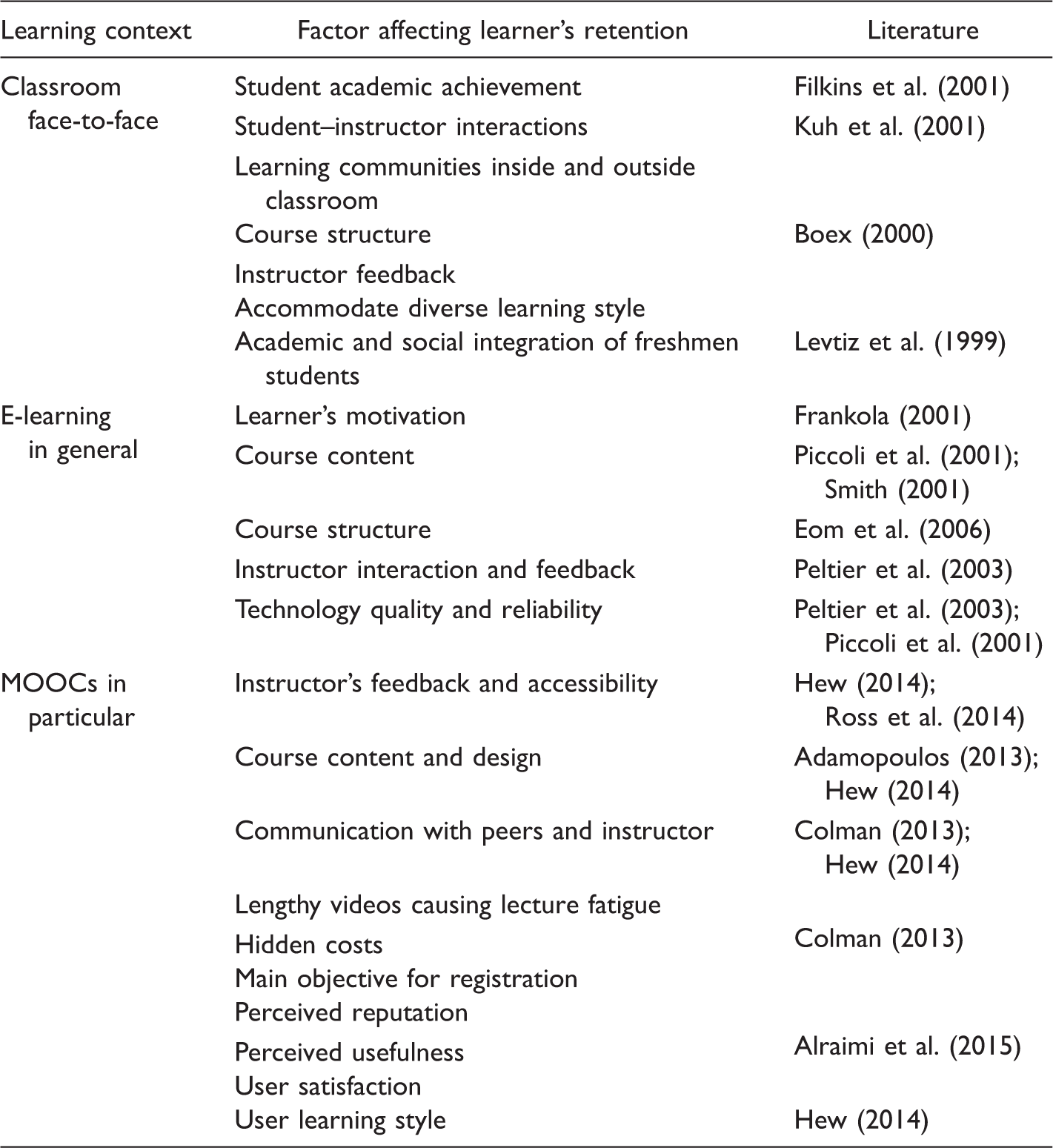
Retention in Traditional Education
Learners’ retention is treated as a strategic issue that can have serious consequences for the long-term sustainability and finance of traditional educational institutions. Even a small increase in learners’ retention can cause a significant revenue increase (Levitz, Noel, & Beth, 1999). At the benchmarking level, entities are using retention as a key indicator of academic quality in college rankings (Levitz et al., 1999).
Early research investigated the phenomenon of learners’ retention within the traditional face-to-face learning environment. Some studies have examined multiple factors that potentially affect retention, including demographic, financial, social, and academic achievement (McGrath & Braunstein, 1997); student–faculty interactions; and learning communities inside and outside of the classroom (Kuh and Hu, 2001). Other studies highlighted the importance of course structure (Boex, 2000). Course structure is seen as a crucial variable affecting teaching effectiveness, in which organized objectives, expectations, and evaluation criteria are spelled out in advance, ensuring a high level of learner satisfaction and retention (Boex, 2000). These studies provided principles of good practice to address student retention as follows: encourage contact between students and faculty, develop reciprocity and cooperation among students (Kuh and Hu, 2001), use active learning techniques, provide prompt feedback, and respect diverse ways of learning (Boex, 2000). Some of these studies suggested a correlation between students’ achievement and their retention, in which the highest retention rates were perceived to be achieved by students who earned a higher first-year GPA (Filkins, Kehoe, & McLaughlin, 2001).
Other studies suggested that students’ retention is largely problematic between the first and second years of study. Consequently, a first-year program and a summer bridge program were recommended to assist new students in new skills needed for their transition to university (Filkins et al., 2001). These studies suggested that extensive academic and social support activities such as orientation, advising, and introductory courses can lead to higher retention rates by increasing academic and social integration of first-year students and easing some of their common anxieties and concerns (Levtiz et al., 1999).
Retention in E-Learning
Many researchers examined learners’ retention with e-learning in general, in which retention rate was calculated by the number of students who withdrew from a course after the last date to drop from a course without any financial penalty (Peltier, Schibrowsky, & Drago, 2007). Multiple factors were suggested as potentially affecting e-learning retention, namely, the four aspects of learning (learner, course, instructor, and technology). Most previous research on e-learning retention focused on the learner’s perception of different aspects of an online course. The learner’s Perception of Course Effectiveness (Peltier, Drago, & Schibrowsky, 2003; Piccoli, Ahmad, & Ives, 2001), Perception of Course Content and Structure (Boex, 2000; Piccoli et al., 2001; Smith 2001), and Perception of Instructor’s Responsiveness (Eom, Wen, & Ashill, 2006; Peltier et al., 2003) were all suggested as reliable factors affecting a learner’s decision to drop or continue an online course.
In virtual communities, course structure was found to be especially important in guaranteeing that long-distant learners understand what is expected and how to achieve it via the course web (Eom et al., 2006) and consequently affect learners’ retention (Piccoli et al., 2001). Eom et al. (2006) stressed the importance of an instructor’s responsiveness and timely and helpful feedback to ensure learners’ course completion. Facilitation, motivation, interaction, assistance in solving problems, material clarification, and maintaining rapport with learners’ contribution in discussions are general practices given for e-learning instructors for better e-learner retention (Peltier et al., 2003).
Some researchers studied the e-learning retention issue from the learner’s characteristics side, namely, Learner’s Self-Motivation (Frankola, 2001; Smith 2001), suggesting that learners with strong motivation tend to complete online courses. Other researchers examined the technology side, suggesting that Information Delivery Technology quality and reliability, simulating classroom experience in terms of interactivity, and presenting materials in an interesting interactive format are important determinants of learners’ positive attitude toward the learning experience and of learners’ retention (Peltier et al., 2003; Piccoli et al., 2001).
Retention in MOOCs
In MOOCs, learner retention rate (otherwise known as completion rate) is commonly defined as the fraction of individuals of those who initially enroll (signed up for a MOOC) who successfully finish a course to the standards specified by the instructor and ultimately earn a credential signifying official completion of the course (Koller, Ng, Do, & Chen, 2013). Because completion rate is reported to be as low as 10% (Alraimi et al., 2015), retention has become a particular problem for MOOC providers and their business models (Colman, 2013). Some studies start to conduct surveys with users already registered at MOOCs to investigate factors affecting decision to continue.
An online survey (Colman, 2013) conducted with 50 MOOC users asked why they started and did not complete a course and listed some potential reasons for dropping out. These reasons were that the MOOCs are in general Lengthy and Cause Lecture Fatigue, which is for many users boring and time consuming. MOOCs are either Too Basic or Assume Too Much Knowledge, lacking a proper introduction to course pre-requisite(s) and syllabuses. Colman’s study (2003) suggested that Poor Course Design, Poor Community/Communication, and Weak Peer Review and Feedback: all affect the completion decision. Hidden MOOC Costs such as required readings from expensive textbooks written by the instructor limit students’ access to learning material. Most importantly, learners might only be attending a MOOC to learn rather than for credentials, which would explain the behavior of some MOOC users who register for many courses, continuing in some and leaving others, aiming to benefit from the content without taking the final exam (Colman, 2003).
In a study conducted by Adamopoulos (2013), positive sentiment expressed in relation to the course instructor was reported to have a positive effect on likelihood of completion; similarly, Ross, Sinclair, Knox, Bayne, and Macleod (2014) highlighted the instructor’s role in MOOCs and provided guidance to moderate online courses and mentor learners. Alraimi et al. (2015) suggested some MOOC characteristics as main predictors of users’ retention; these characteristics are Perceived Reputation and Perceived Openness as the strongest predictors of intention to complete a MOOC, and Perceived Usefulness and User Satisfaction as also affecting retention but to a lesser degree. Using participant observation and analysis of reflection data from 965 course participants, Hew (2014) suggested factors affecting engagement in online learning experience in MOOCs. These factors are Instructor Accessibility, Active Learning, Peer Interaction, and Course Resources.
Although intention to complete is widely used in previous studies on MOOCs as a predictor of actual completion, according to Reich (2014) in a study on MOOC retention, of those who indicated that they intended to complete a MOOC in this study, only 22% did so.
MOOCs in Developing Societies
The potential benefits of MOOCs are particularly high for a developing society’s learners, for whom travel and tuition expenses to register for face-to-face education at top western universities would be challenging (Liyanagunawardena et al., 2013). Studies suggest that 40% of MOOC users are reported to be from developing countries (Zhenghao et al., 2015). According to Zhenghao et al. (2015), economically and academically disadvantaged learners are taking particular advantage of MOOCs. This point supports MOOCs’ main aim, which is to provide a life-changing opportunity for those who are less advantaged and have limited access to education. More research should focus on how learners from developing societies can be supported to complete MOOCs to realize career and educational benefits (Zhenghao et al., 2015). In Egypt, the demographic of Internet users is young and active; with 40 million users, one half of them are under age 25. Egypt has an Internet penetration rate of 48%, a 1.38% share of World Internet Users and the largest population of Internet users in the Middle East and North Africa region (Internet live stats, 2015). E-learning has been recognized by the Egyptian government as an alternative delivery method to provide the growing population with quality and accessible educational opportunities (Abdel-wahab, 2008). MOOCs can provide innovative solutions to education problems in Egypt such as overcrowded classrooms, high prices of materials and books, commuting difficulty due to high traffic, and a need for continued education and specialized training for the workforce (Baraka, 2005). This study focuses on graduate and undergraduate residents in Egypt, representing a developing country in North Africa whose population appears underrepresented and underresearched with respect to MOOC participation but for which the potential benefits are high.
Research Methodology
This study was conducted as part of a wider research program on MOOC retention, in which undergraduate and postgraduate learners were encouraged to select any course from different MOOC platforms, as a self-learning element within their studies. At the end of an eight-week period of study, participants were asked to complete a survey and participate in an interview on their experiences with the MOOC course they had selected. Interviews were done with learners who completed MOOCs in full and those who dropped out before obtaining a completion certificate, hence allowing focus on factors affecting user retention by course(s) by analyzing users’ narrative, comments, and quotations.
The current research aims to explore the factors that affect MOOC completion or learner retention. The focus was on user perception of MOOC features rather than on individual learner characteristics because the main intent is to provide design recommendations for more effective MOOCs for a wide range of learners. The research participants consist of two cohorts of university or institute learners studying courses in which MOOCs were used as a self-learning element. The choice of MOOC platform, course topic, and decision to complete the course were left optional. Although these choices might be viewed as providing initial motivation for participants, that the choices were optional might provide good insight into why initially motivated learners did not complete the MOOC.
Semistructured Interview
This article presents a descriptive, qualitative study employing semistructured interviews performed with 52 undergraduate and postgraduate learners who registered in MOOC course(s).
The field of MOOC retention research has been undergoing a major movement toward quantitative approaches trying to fit the data into a preconceived model (Alraimi et al., 2015). Consequently, the results focus on one or two specific aspects of the data that were determined prior to data analysis (Crabtree, 1999). Conversely, a qualitative approach can significantly benefit the discovery and interpretation of underlying dimensions of the phenomena under investigation (Yu & Hai, 2005). The semistructured interview technique is recognized as one of the most preferred methods by qualitative researchers, when disclosure of self-reflected data is desired from individual sources (Mariampolski, 2001).
The interviewing session started with opening remarks in which participants were informed that the length of each interview would be 30 to 40 minutes long and that they had the right to stop the session at any time. With the participant’s permission, the interview was recorded using a portable recorder. Data collection was completed by saturation, which occurs when a feeling of closure is obtained from noticing repeated information.
A guiding question was then raised: “What was your experience with MOOCs?” This question was followed by a series of reflective questions to elicit in-depth responses and derive implications for the practical experience with MOOCs. The questions aimed to investigate the participants’ MOOC general experience, how much of the MOOC content they estimated that they completed, whether and when they dropped out, and what issues, if any, they experienced when working with MOOCs and tried to link these issues with dropout or completion from the course. Throughout the interview sessions, participants were asked to indicate what they like or dislike about MOOCs and to suggest ways to enhance MOOCs. In general, interviewees did not have any problem comprehending the questions.
Interviews were conducted largely in Arabic, although English terms and expressions were used during the conversations. Arabic is the mother tongue of the interviewer (the author of this study) and all of the interviewees. English is the language in which all participants of this research are studying and is the official teaching language at the university or institute at which participants were enrolled during the research. The author of this article, a bilingual researcher, transcribed the data collected into English. In the closing comments, interviewees were asked to add anything that was left unsaid in the session and they were thanked and informed that the interview was now completed.
Sample
The target sample for this study covers undergraduates and postgraduate young learners from a developing country. Undergraduates and graduates are reported as main audiences of MOOCs (MacKay, 2013). Convenience sampling was used due to the need to identify a study context in which there was a clear academic rationale to invite students to take part in a MOOC. Two groups of participants were invited to participate. The first was a cohort of students taking an MIS course as part of their undergraduate university studies. The second was a cohort of students (from a range of backgrounds) undertaking an IT diploma at a postgraduate institute. In each case, the selected course provided a context in which it was meaningful and relevant for students to experience a MOOC as a self-learning element within their studies. Both courses were already designed to include a self-learning element using a MOOC, but the choice of platform and topic was left to the participant. The topic did not have to relate to information technology. Completion of a course was left optional; participants were not required to provide a MOOC certificate of completion to gain credit or recognition for their work.
In this research, undergraduates were full-time students from different specializations (accounting, human resources, information systems, management, and marketing) enrolled in a private university in Cairo, Egypt. Postgraduates participating were either unemployed or employed in a variety of disciplines and were enrolled in a part-time professional diploma program offered by a governmental institute in Cairo, Egypt. The sample includes 52 students (24 postgraduates and 28 undergraduates) who were willing to participate in an individual interviewing session. Gender was almost equally distributed throughout the overall sample (27 males and 25 females), and age range varied between 16 and 34 years. Participants were informed that this interview is part of a study aiming to reveal learners’ behavior in MOOCs. They were also informed of their right to withdraw from completing the interview at any time. According to the participants, only 6 out of 24 postgraduates and 7 out of 28 undergraduates completed their MOOCs.
Procedure
Participants were given an orientation session on different MOOC platforms (Coursera, FutureLearn, Edx, and Khan Academy). They selected and registered for a free course (6–8 weeks long) to learn new skills of their choice based on their interest, background, schedule fit, and career path.
Eight weeks later, the same undergraduates were given the option to complete a survey and to participate in a one-on-one interview about their experience with MOOCs. The results of the survey are reported in another article (Hone & El Said, 2016), whereas the results of the interviews are reported in this article. The interviews were conducted face-to-face by the author of this article in the months of November and December 2014. Previous scheduling with participant volunteers was arranged by the researcher and, on the scheduled day, the interview was conducted in the university or institute at which the participants study.
Data Recording and Analysis
The interview sessions were recorded, transcribed, and coded through thematic analysis. The thematic analysis technique is most common in analyzing qualitative data (Boyatzis, 1998). Despite their growing popularity among academics and practitioners, qualitative methods, in general, frequently encounter analysis and reliability issues (Yu & Hai, 2005). Thematic analysis attempts to address these methodological limitations (Braun & Clarke, 2006). Thematic analysis goes beyond counting phrases or words and moves on to identifying patterns, themes, across datasets, describing the phenomenon under investigation (Guest, 2012). Thematic analysis, through a process of six phases, creates meaningful patterns to identify unfolded themes emergent from the data (Bernard & Ryan, 2009). These phases are as follows:
Phase 1: Becoming Familiar With the Data, in which reading and re-reading of the collected data were conducted, searching for meanings and patterns, until the researcher becomes familiar with the dataset. Several readings of the transcripts allow identifying overt or repeating issues and patterns, such as interactivity, integrative design, and use of multimedia versus video. Phase 2: Generating Initial Codes. Coding was done by labeling relevant words, phrases, sentences, or sections. Following the guidelines of Braun and Clarke (2006), data can be found relevant to code because it is repeated in several places (e.g., the poor use of web technology in MOOCs); it surprises the researcher (e.g., the idea to integrate MOOCs with social media to socialize when taking the course); the interviewee explicitly states that it is important (e.g., interactivity and mobility); and it is referenced in the literature (as for the case of perceived value). Phase 3: Searching for Themes, wherein relevant codes are combined into overarching themes. Identifying a theme does not necessarily yield the frequency at which a theme occurs. Ideally, the theme will occur numerous times across the dataset, but a higher frequency does not necessarily mean that the theme is more important to understanding the data (e.g., learner control features suggested to be integrated within MOOCs). Phase 4: Reviewing Themes, in which some existing themes can be grouped together (e.g., multimedia, interactive design, and video issues); others might be split into subthemes (such as course design was split into course content and course structure). This process is repeated until the researcher is satisfied with the thematic map. Phase 5: Defining and Naming Themes. Themes are defined and given names that will provide a full sense of the theme and its importance, going beyond surface meanings of the data. Phase 6: Producing the Report, in which results are reported by integrating themes to convey the story of the data in a clear, concise, and straightforward logical manner. Quotes from interviews are contained to provide sufficient evidence that themes within the data are relevant to the dataset. The results are interpreted in light of results from similar previous studies (such as interactivity), concepts from similar research strands (such as course content), and newly uncovered themes (such as technology employment and integrative design).
Findings and Discussion
Thematic analysis of the interviews resulted in a number of themes that generally reveal factors affecting learners’ decision to drop or continue with MOOCs. Four main themes were suggested; each has its respective categories, as follows:
Theme 1: Interactivity
Interactivity was mentioned by all interviewees as an issue in MOOCs. All undergraduates expressed the necessity for MOOCs to include highly dynamic and engaging interactive activities, such as quizzes and games. The main concern for interviewees was the poor opportunities for participation and the boring nature of lengthy videos. An undergraduate student indicated that she registered at Future Learn: Advanced Competitive Strategy and completed most of the videos, which were relatively short (30 minutes); nevertheless, she had to skip some videos and finally dropped the course. The student, who is taking the same course face to face in her university, indicated that although MOOCs are a faster method of capturing knowledge about a specific topic (approximately 6 weeks), she still prefers the face-to-face course (which she completed at her university in 15 weeks). The undergraduate student stated: The interactivity with the instructor and peers, the teamwork within the class, the group assignments, the participation and discussion during the class, the on-the-spot feedback provided by the instructor, the prompt response of the instructor to students’ questions … all of these motivated me during the face-to-face class. In MOOCs, I felt lonely and de-motivated to continue due to the poor interactivity nature of the online course. (Participant: P#1, female: F, undergraduate: UG)
Course interactivity
The highest majority of interviewees cited that they expected MOOCs to have a higher interactivity level to keep them more focused on the learning goal. According to them, preferred interactivity tasks include asynchronous forums with instructor and peers for providing feedback and asking questions, online voting and discussion, games, message board, mentoring forums for offering and receiving advice, and possibility for adding content.
Many interviewees justified their dropping of their MOOCs due to feeling bored and lonely because of low course interactivity. They indicated that socializing is at the very core of how they learn. One interviewee explained, “I dropped the course after the second week because I felt isolated and alone with poor course interactive activities … “ (P#8, F, UG). When asked, more than the half of the postgraduate and undergraduate interviewees indicated that due to low interactivity of courses, they performed frequent context-switches between watching the video and checking their Facebook or emails or both. They explained that this multitasking behavior was due to their low patience level and the poor interactivity of the course. An interviewee stated: Lengthy video-based courses are poorly interactive; I therefore performed frequent context-switches between watching the video and checking my Facebook and/or chat to interact with others … this of course distracted my concentration during the MOOC lectures, and I had hard time picking up where I had left off … This multitasking behavior is due to the poor interactivity of the course. (P#3, male: M, postgraduate: PG)
Learner interactivity
Interviewees suggested ideas to increase interactivity with their peers, such as Dropbox, forums, and chat rooms. One interviewee stated: “If the course had a Dropbox to share extra materials and assignments with my peers, or even with larger learning networks of those interested in the course topic, learning would have been more collaborative . . .” (P#7, F, PG).
An undergraduate indicated that one factor that helped her to complete the course was good interaction with peers: What kept me in the course was the forum (chat room) I shared with my peers for providing feedback, brain storming, asking questions, and sharing feedback about the instructor and the assignments … it was like a break room for informal discussion with peers. (P#11, F, UG)
Instructor interactivity
Almost all of the interviewees expected more interaction with the MOOC instructors. “I expected that my instructor facilitates effective communications and socializations within learners through synchronous, asynchronous discussion, forums and blogs . . .” (P#12, M, PG) as stated by an undergraduate. A postgraduate interviewee commented on the poor interactivity of the instructor: “Instructor didn’t engage learners in discussion and didn’t facilitate learners’ brainstorms. I expected that the instructor would drag attention to other resources on web or generate a course Dropbox for further readings . . .” (P#9, M, PG). Others mentioned delayed feedback of the MOOC instructor and low motivation for individual learners.
Two interviewees who registered at the Machine Learning course at EdX complained that the course contents were primarily videotaped from a real face-to-face class at one of the universities. In these videos, the instructor primarily interacted with his class students and did not provide sufficient focus to the camera. “This was like watching a documentary film … I wanted to be there … in the classroom, … I wanted to feel more close to the instructor, and have an eye contact with him . . .” (P#3, M, PG) stated the two interviewees who explained that they dropped the course after a few days.
Many Undergraduates indicated that they missed an instructor’s motivation, prompt feedback, and quick response. A freshman student who registered in a Microeconomics course at Coursera and dropped after a week stated: I had to post a question to the instructor and wait for a day to get a reply … by the time I got the reply; I had further questions to post … I needed a prompt explanation to some points, and can’t afford to wait that long, so I dropped out the course. (P#4, F, UG)
Theme 2: Technology Employment
Several issues could be broadly grouped into a technology employment theme, in which better use of technology, stated interviewees, could facilitate MOOC use. Interviewees discussed MOOCs’ poor employment of web technology and their lack of key innovative features that the web could provide. Many ideas were raised including multimedia, video issues, integrative design, and learner control.
Multimedia or video issue
Most MOOCs solely rely on videos; however, participants praised the fact that they have control over videos, because they can stop, restart, skip, and jump within the videos’ content; “Still, it forces users to access the content sequentially” (P#13, M, PG), stated an interviewee. Most interviewees indicated that in many of the courses, videos were neither divided nor categorized based on topics; instead, an hour-long lecture is occasionally videotaped. Some participants indicated that they were not sufficiently patient to digest content in the order in which videos were accessible without knowing whether what was coming next would be relevant to their needs. This issue could be linked to the rapidity value, in which interviewees indicated that in MOOCs, it is important to see the value of the course right away by quickly scanning course content and switching to desired topics. An undergraduate with an economics major who dropped the Microeconomics Principles course at Coursera said, “I don’t like the course, video-based lectures are really long, I wanted to just focus on one topic related to my study and don’t waste my time watching a 70 minutes video” (P#14, F, UG). A postgraduate learner registered for an Introduction to Marketing course at Future Learn but dropped out after a week, suggesting that a “45 minutes video is too boring; break it up so I can watch what I’m interested in” (P#15, F, PG).
Most of the interviewees indicated that courses on MOOCs generally rely on one media, which is video, with little integration of other media such as hyperlinks, charts, and text, in which various media formats can supplement and reinforce one another. The majority of participants indicated that by using video lectures, MOOCs are employing the old form of teaching but displayed on computer screens; however, the courses are neglecting the basic concept of web technology, hyperlinks, when integrating various resources and media. “Videos have to be integrated with hyperlinks, text, image, and animations; what I experienced in my Future-Learn course is a linear television on a computer screen . . .” (P#1, M, PG), stated a postgraduate interviewee who dropped the Future Learn halfway through it. Interviewees indicated that essential information contained in the video is also presented on another media, such as in text or a diagram, allowing users to pick the content that is relevant for them. A second dissatisfied learner confirmed the same reason for dropping a UK Future-Learn course, stating, “The course was not web-based designed, it does not include related links … leaving the user with no clear path to additional information or related hyperlinks … which is not for sure how online learning it meant to be . . .” (P#2, M, PG).
Conversely, a postgraduate learner, interested in Artificial intelligence, registered in a Machine Learning course at Future Learn and indicated that he completed the MOOC because the videos were short and divided into topics, facilitating skipping some topics and focusing on others. However, the learner indicated that practical examples and hyperlinks to further readings are missing from the course.
Integrative design
Integrative design with social media and Web 2.0 tools would be a good employment of web technology on MOOCs. “I need to incorporate my own calendar, Dropbox, and wiki with my MOOC’s materials” (P#14, F, UG), stated an interviewee. A second interviewee suggested that to ensure more retention in MOOCs, learners should be encouraged to gain insights not only from their peers and instructor in a specific course but also from larger learning networks on the web, for example, through wikis and Facebook. A third interviewee praised the interactive design of a Coursera course that linked the course to a debugging tool on the web: “Coursera Programming Android applications course was especially interesting to complete as it was structured to give access to GitHub to post, correct, and debug my programming quizzes, such integration with other web resources is excellent . . .” (P#7, F, PG).
Professional postgraduate learners who have been working in web development and participated in the current research provided interesting ideas during the interviews for a more integrative, multimedia design for MOOC courses, such as integrating professional MOOCs with industry knowledge management sites, on which users can extend their learning experience by accessing firm’s case studies and success stories. Using web-mining technology to integrate course modules of similar topics and learning objectives and topic-related resources available online is another idea for integrative design for MOOCs.
Learner control
Learner control is expressed by the current research participants as the extent to which MOOC users can skip unneeded sessions, revise materials, and design their own learning tracks and long-term learning objectives. Some of the interviewees indicated that the ability to replay videos, revise materials, and skip unneeded sessions is among the competitive advantages of MOOCs over face-to-face traditional classrooms. In addition to the fact that courses can be taken at the learner’s own pace, all of these options strengthen learner control over materials.
However, more control is requested by a number of interviewees, in terms of being able to design their own aimed learning tracks based on their professional learning development objectives. By dragging and dropping modules based on module prerequisites, users could identify when they can take each module. An assessment after each module could allow learners to skip topics and redesign the learning track. Therefore, courses must be designed as independent modules, each with prerequisites and assessment.
Learner control was primarily mentioned by postgraduate interviewees who have extensive experience with web applications, and some of them have been working in web development. The interviewees provided interesting ideas for learning management features to be added to MOOCs using structures that mix the learning management with more-open web resources. These ideas include the following: First, e-mentoring, with which learners can design their own learning matrix based on their professional learning development objectives and with support of an e-mentoring feature. By dragging and dropping MOOC courses or even course modules in a learner matrix, learners can track their progress toward their self-set learning outcomes from one MOOC course to the next. MOOC e-mentoring can support learners in any area of weakness by providing extra resources. Second, learning tracks are desirable, in which courses of similar topics are sorted and grouped by learning tracks. For a learner who wants to acquire an interface design skill, for example, based on a quick assessment of learner background, a MOOC could suggest an entry point and prerequisites for learners, along with a regular assessment for repeating or skipping courses toward completion of a learning track. Institutions or employers can set professional development tracks on MOOCs for their current or potential students or employees. Third, a learning portfolio could allow learners to become engaged and to have a stake in their own learning progress. “Helping learners to get engaged by designing and managing a lifelong learning portfolio, where they can incorporate calendar, Dropbox, and wikis” (P#13, M, UG), stated an interviewee. They can share their educational and professional development profile with potential employers.
Theme 3: Course Design
Course design emerged clearly as a factor from the interviewee comments, as did its effect on MOOC dropout or completion. Ideas such as structuring courses as independent modules and materials delivered in small, meaningful, and easy-to-scan chunks were raised by interviewees. Discussions under course design theme were largely focused between course structure and course content categories, as discussed in the following.
Course structure: Independent design
Course structure is described by some participants as the extent to which modules are sufficiently flexible to be designed independently with their own prerequisites, assessment activities, and even completion certificates. Some participants mentioned that although a traditional education course structure is often rigid to fulfill specific learning outcomes, in on-line education, the overall flexibility and independent design of the course are crucial elements of course structure. “Courses need to be structured as independent modules, each with prerequisites and assessment, and each can be completed separately to achieve specific objective … modules of similar topics/learning objectives can be hyperlinked . . .”(P#4, M, PG), stated an interviewee. This point matches the desire of the integrative design category, discussed earlier, in which participants showed a preference for an integrative design of MOOC modules or topics.
A course-independent structure seems to affect learners’ decision to continue or drop a MOOC, as supported by the following quotation: I dropped the Future-Learn Competitive Strategy course after the first week; I was only interested in learning about Low Cost Leadership strategy, and the course was video-based, with long, 60-75 minute, video-recorded lectures … if these lectures were available in separate modules, I would’ve completed only the part I need. (P#6, M, PG).
Course content: Easy-to-scan small chunks
Course content is expressed by some of the current research participants as the perceived quantity of materials, ease of scanning, clarity, and diversity of delivered skills. Many of the interviewees who dropped the MOOCs explained that after their registration, they found that the content was overwhelming, within which it was not easy to find topics of interest from a quick scan. Presenting content in small and meaningful chunks is preferable for many of the interviewees because this approach helps them retain information and pick up where they left off in the course. “I frequently get interruptions while taking the course with text messages and calls, I also tend to switch to check my e-mails and Facebook … “ (P#15, F, UG), stated an interviewee, describing interrupted and multi-tasking behavior when taking an online self-learning course. Another interviewee expressed a preference for rapid scanning of content, suggesting that on-line content should require less of a user’s time.
Other participants commented that the courses were theoretical, missing hands-on practical skill applications. “Videos of the course were very long and boring; videos of the finance course were an hour long … On-line contents should be shorter and more interactive . . .” (P#14, F, UG), stated an interviewee. Conversely, an undergraduate who successfully completed a Coursera course explained, “I successfully completed my course because amount of content and materials were just right, only two modules, and videos were short, 5-7 minutes long . . .” (P#20, F, UG). Participants showed their preferences for non–lecture-based courses, in which content is based on cases and real examples with diagrams and animations rather than on theoretical lectures.
Theme 4: Perceived Value
During interviews, participants envisaged MOOCs would provide value to them throughout mobility, rapidity, diversity or novelty, and timing or language, as discussed in the following.
Mobility
Mobility is expressed by the current research participants as the degree of convenience that allows learners to access MOOCs material via mobile phones. With the widespread use of smart phones, the ability to access MOOC materials via mobile was a main issue raised by high majority of interviewees. Overwhelmed with study and work, high majority of interviewees showed preference to carry around their MOOC materials and access them via mobiles in their free slots, in university bus, underground, in-campus, or even at home. Many interviewees complained that because most MOOC materials are based on lengthy videos, with variable connectivity, watching videos is very frustrating. “On smart phone, videos freeze, break, won’t load, or won’t even appear” (P#21, M, UG), stated an undergraduate.
The mobility in this context is also related to the multimedia and technology use category, within which the fact that most MOOCs are overly reliant on videos was discussed. For better mobility, MOOC materials should be accessed in multiple ways; captions and a transcript of the video could be helpful. A postgraduate interviewee stated, “This allows [picking] the content media [suited] to the user’s device, smart phone, and connectivity” (P#22, M, PG).
Rapidity
Because users must see the value of the course right away, interviewees indicated that it is essential to start with a visual diagram of the course’s content to identify the source of the information and the content within, with a possibility to switch to any part of the content directly with no need to watch all the materials or videos sequentially. “Something like a web site map,” suggested a postgraduate user. The same postgraduate participant added The first few seconds of the video [are] crucial, I need to quickly be able to understand the value of what I will be watching, how much time I need to dedicate for each video, and which parts I can skip. (P#5, M, PG)
Diversity or novelty
A few interviewees indicated that they could not find some topics elsewhere but found them in the MOOC. Interviewees who confirmed completing the course through obtaining the certificate indicated that these courses were not within their academic specialization and that they were interested in learning about the topic. For example, a Life in Space course was taken by an accountant student interested in space, and a Mechanical Engineering for nonengineers course was taken by a marketing student interested in motorcycles. Another economic major student indicated that finding a How to Motivate Children course was very interesting for him to complete because he volunteered as a coach in a children’s camp. Both participants indicated that they were seeking this knowledge and could not find similar materials elsewhere; “Such courses are … tough neither in universities nor training centers” (P#9, F, UG), stated one of the interviewees. Three undergraduate students find the Coursera: Introduction to Public Speaking course a life saver to acquire quick tips about this skill when they were selected to give a public speech at their class. One undergraduate marketing student who has a passion for mobile applications said, “I completed the Mobile Applications for Android course until its ends … it matched my passion to Android Apps” (P#5, M, UG). At least half of the participants indicated that the competitive advantage of MOOC relies on providing life-skill courses rather than academic courses, which can be taught in classes. The highest majority of interviewees who confirmed completing their MOOCs cited that these courses were quick skills, general knowledge, humanities, and soft skill courses with a few modules and a few short videos such as public speech, negotiation skills, self-confidence, character building, and body language. “Such courses provide me with just-on-time tips for timely needed skills” (P#21, M, UG), explained an interviewee. Two participants suggested that undergraduates take their soft skill university requirement courses via MOOCs and that these courses should be counted in their credit hours system.
Timing or language
Although all of the interviewees self-evaluated their English language level between Intermediate and Advanced, a few interviewees indicated that they had to drop some courses due to language difficulty. Primarily undergraduate students, who registered in specialized study courses such as Microeconomics and Finance, indicated that the level of English language used in the course was sophisticated. These students showed their preference for “Simple English, short sentences, with no jargon or complex words, and simple sentence structures” (P#15, F, UG). Others indicated that the instructor had a strong accent that they could not follow; thus, they had to drop out.
All interviewees in this study are nonnative-English language speakers. The majority of interviewees indicated that although there were more Arabic MOOCs, they would still prefer to take courses in English because this is the study language at their university (for undergraduates) and the working language (for postgraduates). “After all, we work and study in English on the Internet, while Arabic is our dominant language in social media and chat” (P#5, M, UG), a student stated. Only one interviewee indicated that the timing of the online quizzes and lectures was not suitable due to time differences.
Conclusion and Contributions
MOOCs promise to revolutionize higher education, offering free access to valuable content and providing unbounded learning opportunities to a global audience. Nevertheless, research suggests that only a small percentage of those who sign up to MOOCs stay sufficiently long to complete a course. Some previous research adopted a survey-based approach to investigate this phenomenon. However, little is known about learners’ behavior in MOOCs or about design features affecting their retention.
The completion rate observed in this study was slightly higher than what previous studies have typically found, most specifically the previous finding of Reich (2014), which found that only 22% of motivated participants completed a MOOC. In the current research, approximately 25% of participants completed their course to the point of certification. This statistic suggests that using a MOOC as a learning opportunity within the context of a broader, university-accredited program is beneficial in terms of increasing the likelihood of completion. However, the majority of learners still not completing their MOOC suggests that completing a MOOC remains an issue even for a motivated audience.
The purpose of this study was to explore learning experience concerning dropout from MOOCs. The study was exploratory in nature and was intended to provide practical implications for designers and providers of MOOCs and a number of directions for future work. Based on thematic analysis, interviewees’ responses were grouped under four main themes: interactivity, technology employment, course design, and perceived value. Within these themes, a number of categories were identified. Some of these categories have been identified in previous MOOC studies such as Course Structure (Eom et al., 2006), Course Content (Piccoli et al., 2001; Smith, 2001), Instructor and Learners’ Interactivity (Colman, 2013; Hew, 2014; Ross et al., 2014), Technology Employment (Peltier et al., 2003; Piccoli et al., 2001), and Rapidity nature of MOOCs. However, interviewee quotes in this study reveal novel perceptions of these categories, more authentic than were those discussed in previous studies. Other issues that have not previously been introduced in the MOOC literature include Mobility, Diversity or Novelty, Language, Learner control, and Integrative and Independent Design of courses. Some learners’ behaviors in MOOCs were newly discovered, such as the Context Switching and Interrupted behavior. These findings have theoretical and practical implications as discussed in more detail later.
Theoretical Implications
This research provides a number of theoretical contributions to the existing understanding of learner retention in MOOCs.
Interactivity was cited by all interviewees as an issue in MOOCs; the interviewees expected a higher level of Course Interactivity. Many interviewees justified their dropping of MOOCs due to feeling bored and demotivated because of low course interactivity. They tend to perform frequent context-switches between MOOCs and checking their Facebook or chat, and explained this multitasking behavior as being due to the poor interactivity of the course. When compared with a face-to-face course, interviewees indicated that although MOOCs are a faster means of capturing knowledge, the interactive nature of the traditional classroom remains more motivating. Higher course interactivity would keep learners more focused, decrease their tendency to browse away from the course site, and would decrease the chance to drop out. Interactivity with peers and instructor was also greatly expressed by all interviewees as an issue affecting their retention in MOOCs. Almost all of the participants expected their instructors to be more responsive, timely in their feedback, facilitate discussions, and drag attention to extra materials on the web. For many participants, poor interactivity and delayed instructor feedback was sufficient reason to drop the course. This finding supports earlier work suggesting the effect of Instructor Interactivity on learners’ retention in the MOOC context (Adamopoulos, 2013; Colman 2013; Hew, 2014; Ross et al., 2014), in an e-learning context (Eom et al., 2006; Peltier et al., 2003; Swan, 2001), and even in the face-to-face learning context (Boex, 2000; Kuh & Hu, 2001). Almost all of the participants expected more communication with their peers in the same course or even on a larger network of learners studying the same topic on line. Peer formal and informal communication channels, in which students can exchange feedback concerning the course and the instructor, was a supporting mechanism encouraging some of the participants of the current research to continue their course. This finding supports earlier work suggesting the effect of Learners Interactivity on learners’ retention in the MOOC context (Adamopoulos, 2013; Colman 2013; Hew, 2014). The importance of interactivity, suggested by this research, also confirms previous research in other contexts, such as Higher Education Management Information systems, in which the system’s interactivity was reported to influence the actual use through attitude toward the system and the intention to use the system (El Said, 2015).
The research highlights the importance of better employment of Web Technology in MOOC design, in particular with a discussion of MOOC poor employment of main innovative features that the web can provide. The highest majority of noncompleters in the current research complained about materials based solely on long videos, making a MOOCs a linear television on a computer screen, forcing users to access the content sequentially and causing frustration and lecture fatigue. This finding supports the fact that lengthy video is on the top-ten list of reasons for dropping MOOCs (Colman, 2013). This finding also confirms previous work suggesting that technology quality and multimedia presentation of materials are important determinants of learners’ retention in e-learning in general (Peltier et al., 2003; Piccoli et al., 2001). A main contribution of the current research is the wider perception of technology employment, which includes Integrative Design and Learner Control.
Integrative Design is introduced in the current research as a preference for users to integrate MOOCs with learners’ own accounts on Web 2.0, e-groups, and social media, in addition to more open web resources. This approach would extend the learning experience, allowing learners to access a large pool of web resources.
Learner Control was identified by this study as a new construct in MOOC research. Learner control is expressed by participants of the current research not only as the extent to which they can skip or repeat sessions but also to be able to design their own lifelong learning track(s) based on their long-term learning objectives. By including a MOOC sequence of courses on their learning track, learners can assess their progress toward their self-set learning objectives from one MOOC to the next.
The research highlights the importance of course design, in terms of content and structure, as a factor affecting MOOC dropout or completion rates. This finding supports earlier work suggesting the effect of course structure on learners’ retention in the MOOC context (Adamopoulos, 2013; Hew, 2014) and in an e-learning context (Eom et al., 2006). Nevertheless, a wider perception of course structure was perceived by interviewees of the current research. Although course design was expressed in previous research as the perceived value, delivering comprehensibility and flexibility of course objectives, expectations, and evaluation criteria, in the current research, course structure perception expands to include Independent design. Independent design is a new construct in the MOOC retention literature; it refers to the extent to which course modules can be taught separately, with their own prerequisites and assessment and with flexibility allowing integration with modules from other courses. Learners need not complete an overall course; rather, they can pick useful modules from various courses to fulfill a specific learning objective. This option might explain some of the high dropout rates in MOOCs in which users register in a course, complete some modules but leave others without taking the final exam.
The current research also supports earlier work suggesting the effect of course content on learners’ retention in the MOOC context (Adamopoulos, 2013; Hew, 2014) and in an e-learning context (Piccoli et al., 2001; Smith, 2001). Nevertheless, a wider perception of course content was perceived by interviewees of the current research. Course content was expressed in previous research as the perceived depth, clarity, organization, and currency of the delivered content, expectation, and assessment activities (Peltier et al., 2003). However, in the current research, course content perception expands to include ease of scanning small chunks of materials. Ease of scan is a new construct reflecting how learners study in MOOCs. Interrupted interaction, with chat and checking emails, was cited as how some learners are using MOOCs; this behavior might be due to the “boring and isolated” nature of some courses, particularly those with low interaction with peers and instructor. This frequent context-switch between watching the MOOC video and checking Facebook or emails or both was cited frequently, with the need to access easy-to-scan content in small chunks to retain information and pick up where the user left off the course.
The current research highlights the importance of perceived value as a broad MOOC retention driver. Previous work on MOOCs suggested that perceived usefulness, expressed by the learners’ perceived amount of knowledge gained from the course that will help them in their work, affects learners’ retention (Alraimi et al., 2015). Some previous work on e-learning also suggested that perceived value is affecting learners’ willingness to use an e-learning system (El Said, 2014). Participants of the current research seem more concerned with other benefits of MOOCs such as mobility, rapidity, diversity, novelty, timing, and language. Mobility is a new construct, considered a significant benefit in itself; it did not appear in earlier MOOC literature. Mobility was expressed by participants as the degree of convenience that allows learners to access MOOC material via mobile phones anywhere and anytime. Mobility is rarely considered a MOOC feature when accessed via smart phones under various connectivity conditions. The current research contributes by revealing some details on how learners actually use MOOCs, in which the high majority of interviewees show a preference to access MOOC materials via mobiles and on the run. The frustration from loading materials, namely, videos, via smart phone in public areas with slow connectivity most of the time was cited as a main reason to drop a MOOC course. Language was also identified by this work as a new construct in MOOC retention research. Some participants indicated that they dropped course(s) due to complex sentences, sophisticated terms, and unclear accent of the instructor. Obviously, this withdrawal is related to the sample used in the current research, which consists of non-English native speakers; however, it could also be relevant for many learners around the world whose first language is not English. The effect of MOOC language could be augmented when considering a larger sample with a wider variety of non-English native language learners. Conversely, few interviewees dropped the course because quizzes and assignments were due at nonconvenient times due to time differences. Cultural issues such as time and language differences should be investigated more in the MOOC literature considering the multicultural nature of MOOCs’ target audience. Rapidity was perceived as a significant value for MOOCs, in which a new skill can be acquired in 4 to 8 weeks. Participants indicated that if they do not perceive an immediate payoff of time spent on the course, they would not complete it. Rapidly perceiving the value of a course in which users can quickly evaluate required time and effort to dedicate and decide which parts might be of interest seems to be important information for users before registering for MOOCs. Currently and in most courses, users cannot perceive value before registration, causing a high dropout rate (Colman, 2013).
Diversity or Novelty was identified by the current research as a new construct in MOOC retention work. A large variety of topics, including some that are not taught anywhere else, is perceived by the participants of the current research as contributing to the relative advantages of MOOCs, indicating that they find MOOCs more relevant to general knowledge courses.
Practical Implications
There are implications from this research for both the designers of MOOCs and for MOOC providers who wish to ensure wider use of their courses. The first implication is that designers must understand how learners actually use MOOCs. Interviewees in the current research indicated that they have Interrupted Interaction with courses. Feeling isolated and occasionally bored, particularly with lecture video-based courses, users tend to switch to social networks, chatting and tweeting, when watching a course video. Others indicated that, when learning in a MOOC, they need to access their wiki or Dropbox. Such users would value content that was Easy and Rapid to Scan, presented in small comprehensive chunks to be picked up easily where the user left off the course. Such tips for design would integrate their self-learning on MOOCS within their existing social networking and Web 2.0 activities. In general, MOOCs must obtain more benefit from the integrative nature of the web by integrating courses to relevant academic and professional knowledge management sites, in which users can extend their learning experience by accessing firm’s case studies and publications.
The Novelty of topics and rapid acquiring of quick tips for timely needed skills are spelled out by most interviewees who also completed their MOOC courses. Designers must consider including topics not covered in other learning and training media. Many participants of the current research perceive a comparative advantage of MOOCs over the traditional classroom, namely, in skills and hands on courses. A suggestion was raised that undergraduates take their soft skills university requirement courses on MOOCs and that these courses should be counted in their credit hours system. This suggestion might guide future cooperation between MOOCs and academic institutions.
Another course design preference worthy of consideration by designers is to structure courses based on Independent Standalone modules that can be completed separately, and can be integrated with other relevant modules in other MOOCs courses, and other tools available online. MOOC learners in the current study expressed a desire to acquire specific needed knowledge selectively by only completing needed modules in registered courses, with a preference of being able to benefit from other resources available on the web by linking these modules with other MOOC modules or other online materials. Designing courses as independent modules, each owns its certificate of completion, and a map of different MOOC courses and modules serving a user predefined learning objective would help users to register only for needed module(s) and to ensure a higher MOOC completion rate.
In a similar vein, interviews show the preference for a Visual Diagram of the course’s content, time and effort needed in each topic, to identify the value contained within and to perceive an immediate payoff for their time, with a possibility to switch to or skip any part of the content.
Higher Interactivity level with instructor and peers is highly needed. Synchronous and asynchronous forms, blogs, games, message board, chat room, use of Dropbox for sharing extra material, are all possible tools to reach the needed interactivity levels. The use of videotaped lectures of real face-to-face classes was reported to have a negative effect on learner–instructor interaction, leading to a course drop. Complementing videos with multimedia such as hyperlinks, text, image, diagrams, and animations was expressed as a factor that would keep more learners in MOOCs.
The Mobility feature of MOOCs is highlighted, suggesting better use of web technology to ensure mobile access to materials under different Internet connectivity conditions. Designers must reduce dependency upon lengthy videos, when captions and transcripts of videos would be more accessible. Providing the option to complement or even replace videos with text or diagrams and allowing users to pick the content media suited to the available device, smart phone, and connectivity would guarantee better retention. This approach also complements the preference for a multimedia-based MOOC design in which various media formats can supplement and reinforce one another. Adding captions and of video transcripts would also address the language issue and instructor’s incomprehensive English accent for some learners. Use of simple Language and short sentences would also ensure more retention for non-English native speakers.
One main contribution of this research is suggesting the Learner Control features as perceived by interviewees, in which learners can design their own learning track(s). By dragging and dropping MOOC courses or even course modules to a learner matrix based on module prerequisites, users could identify when they can take each module. An assessment after each module could allow learners to skip topics and redesign the learning track. This approach requires an independent design for course modules, each with prerequisites and assessment. MOOC learners would be given tools to manage their lifelong learning portfolio, incorporating their calendar and Dropbox. Learners can track their progress toward their self-set learning objectives from one MOOC course to the next. An e-mentoring feature can support learners in any area of weakness by providing extra resources. Institutions or Employers can set professional development tracks on MOOCs for their current or potential Students or Employees. Learners can share their profile with potential employers. This sharing might guide future cooperation between MOOCs and professional bodies.
Limitations and Future Work
Within the current research context, participants are learners of courses in which MOOCs were already used as self-learning elements, and decisions to complete the courses were left optional. This arrangement can be considered a sample bias, providing initial motivation for participants. However, the majority of these initially motivated learners still did not complete their MOOC, suggesting that there remains an issue with MOOCs in terms of the extent to which they engender completion among a motivated audience. Another sample limitation is the geographically limited population (university learners) from the same country; further work is suggested to examine whether the results of the current study generalize to MOOC learners in other countries and learning contexts, as cited later in more detail.
MOOCs are targeting worldwide learners beyond geographical and social boundaries, in which the potential benefit of such open access quality resources is higher for learners from developing countries. Nevertheless, many developed countries, particularly the Arab countries, have been underresearched in previous MOOC studies. This research has the potential to uncover issues relevant to users from a non-English speaking, understudied culture and to provide guidelines for better MOOC international design. Nevertheless, further studies are needed to explore how learners from the developing world can achieve benefits from MOOCs, and whether those who access some MOOC content without completing the course realize career and educational benefits.
Furthermore, although interviews are helpful in revealing rich and authentic descriptions of learners’ experiences on MOOCs, the method presents limitations in terms of possible unintended bias of a single interviewer who also coded the data, given that the only source of data collection was through interviews with participants.
Footnotes
Declaration of Conflicting Interests
The author declared no potential conflicts of interest with respect to the research, authorship, and/or publication of this article.
Funding
The author received no financial support for the research, authorship, and/or publication of this article.