







Abstract
In recent years, more serious games are used in different learning areas to improve the process of knowledge acquisition and learning outcomes. This study discusses a game mode based on a jigsaw puzzle with scaffolding-aid for cultural heritage learning. A case study using an historical pattern from China examines the effectiveness of improving learning performance and motivation. By using this game in an experimental setting in comparison with traditional video learning, this paper observes and evaluates the learning outcomes of 42 freshmen with no prior knowledge of bronze mirrors` patterns and subjects. Their learning outcomes, experience and motivation change were collected via a series of tests and motivation scale. The result of the experiment demonstrates that compared with traditional video learning, the game process based on a digital puzzle can help learners better identify and retain pattern structure and improve learning motivation. This study provides experience in designing serious games for cultural heritage learning activities.
Introduction
Heritage lays the foundations for a vibrant, innovative and prosperous society. Heritage education has prominent value and universal significance in protecting world heritage for future generations (UNESCO, 1972). In recent years, the Chinese government has come to realize the importance of heritage protection and education. It has implemented corresponding education policies to promote heritage education for young students (Underhill & Salazar, 2016). For Chinese students, the purpose of heritage education is not only to help them understand the historical background and cultural affinity of heritage, but also to cultivate their aesthetic ability and human spirit. It requires students to study and explore heritage content in depth.
In the content and form of cultural heritage education, pattern heritages are also easy to be ignored. The research on cultural heritage education pays more attention to explore the text type heritage and architectural heritage, such as ancient books and sites (Malegiannaki & Daradoumis, 2017; Mortara et al., 2014). Few studies focus on the heritage of graphics and patterns, which contain historical and cultural information and educational significance that never be ignored (Harland et al., 2019). Graphic and pattern heritage is the characteristic of Chinese heritage ( Gong, 2008; L. Sun, 2016 ). Most of the representative pattern heritages come from the surface of bronze wares (Yan, 2011). A case of two bronze mirrors with dragon patterns made in Han Dynasty were used in this study. The culture of Han Dynasty is the core of Chinese national culture. It embodies the “Great Unity” culture that integrates and absorbs the essence of all kinds of regional cultures in China. Han-dynasty bronze mirrors, as a popular daily necessity in ancient times, were made by local craftsmen in workshops. The patterns used to decorate the mirror were designed to incorporate many elements of everyday life in town. The various design of patterns through time represented a shifting image in political, economic, cultural and religious changes throughout Han era. However, as a branch of many bronze artifacts, the cultural value of bronze mirrors is often overlooked in Chinese heritage education in comparison with other cultural relics, due to their small sizes and abstract shapes, which makes them have more important educational value (Golinelli, 2015). However, the traditional learning mode makes it difficult for students to discern the pattern’s structure intuitively, which leads to the lack of learning motivation.
Games are recognized by modern educational theory as important learning tools because they increase learning motivations (Boyle et al., 2016; Garris et al., 2002; Subhash & Cudney, 2018). Serious games are gradually applied in different fields of education and used to improve the effectiveness of learning and provide vivid learning experience (Prensky, 2003). Furthermore, game learning is considered a suitable method for teenagers (Ayale-Pérez & Joo-Nagata, 2019). Many researchers have explored the application of serious games in cultural heritage education (Mortara et al., 2014). These researchers pay more attention to how to use the games’ elements and graphics technology for visiting museums and architectural sites online (Malegiannaki & Daradoumis, 2017). However, there are many types of cultural heritage, which require more researchers to focus on those neglected or based on local characteristics. In addition, due to the limitations of technology and equipment, serious games used in cultural heritage learning activities are difficult to be accepted and used by educators, which reduces its application value (De Freitas, 2018).
Serious Game of Cultural Heritage
Serious games have been used in the field of heritage education and have been recognized by students and educators as a new type of interactive storytelling method in education (Lombardo & Damiano, 2012). It has been suggested that by translating traditional learning activities into game scenarios, it increases the players’ needs and motivations to learn, and improve their cognitive development (Sharp, 2012). Serious games designed for cultural heritage education embed additional intentions for cultural preservation, reproduction and appreciation, both for tangible cultural heritage and intangible ones (Laamarti et al., 2014; Mortara et al., 2014). The significance and background content of tangible heritage such as cultural relics and sites need to be explained by local cultural factors and geographical environment. They are interdependent parts of a whole (Papathanassiou-Zuhrt, 2015). Malegiannaki and Daradoumis (2017) studied the means to lead tourists or visitors to achieve an in-depth contact with heritage content and cultural information in heritage education games, and emphasized the potential relationship between the use of heritage games and social creativity. The inherent element in cultural information will keep players concentrated on the narrative content of the game and discourage the mechanical carrying out of learning tasks (Akkerman et al., 2009). In addition, some researchers try to discuss the influence of serious game design on heritage knowledge transmission and players' learning behavior from the perspective of visual cognition, which provides experience for better design of serious games and improvement of learning experience (Raptis et al., 2019).
Most of the serious game design research about cultural heritage education are based on immersive digital technology application or narrative game process design to create a scene reproduction experience or vivid story process for players (Ibrahim & Ali, 2018; Malegiannaki & Daradoumis, 2017). This game mode may be suitable for museums or architectural sites, but it is inefficient for the pattern heritages of which this paper focuses on. The combination of suitable game model and learning contents improve the entertainment and the participation of students (Melero & Hernández-Leo, 2014). Digital jigsaw puzzle games are universal and not tied to a specific equipment or type of technology (Carnegie, 2017), which makes it easy to develop and design by integrating with virtual objects to meet the needs of different educational content (Melero & Hernández-Leo, 2014). Digital jigsaw puzzle games have simple rules that could be defined independently from content and clues (Crawford, 1984) and, therefore, they can be applied flexibly to multiple subject matters and better combined with content. The interactive mode of jigsaw puzzle will arouse the players’ awareness of image details by making them pay attention to the process of fitting all pieces together (Kolfschoten et al., 2010). Therefore, we use a classic game type, digital jigsaw puzzle, to make the game mode more suitable for heritage content.
Scaffolding-Aid in Serious Games
A suitable education strategy used in serious games will achieve learning goals better and improve learning outcomes, experience, motivation and even cognitive ability (Melero & Hernández-Leo, 2014). Scaffolding-aid learning is more applied to game-based learning, which not only helps players to complete learning goals and tasks through appropriate prompts, but also provides even feedback and task-related supportive learning (Erhel & Jamet, 2013). The effective application of scaffolding elements in serious games should challenge the learners when they are correct, to explain their missteps when they are wrong, and to provide prompts and supplementary information when they have difficulty following the tasks (Fisch, 2005). Melero et al. (2011) present a serious game concept model based on puzzles in support of scaffolding theory. It adopts an active learning method that describes the activities flow for learners, in order to foster students’ motivation and improve learning effect in the current era. C.-T. Sun et al. (2018) discussed in detail how scaffolding affects problem-solving behaviors in game-based learning, while provided solutions to discourage players from becoming dependent on scaffolds. Many studies have provided sufficient evidence for the effects of scaffolding on achievement, learning experience, intrinsic motivation and cognitive enhancement in game-based learning (Barzilai & Blau, 2014; Chen & Law, 2016). However, few studies have applied them to cultural heritage learning.
Purpose
There are rich cultural and artistic values in pattern heritage, but it is often ignored or misunderstood because of its abstract shapes and complex structures. Pattern heritage requires more attention. By transforming the process of explaining pattern structure into a jigsaw puzzle, it can not only better to show learners the structural relationship of each local pattern, but it can stimulate learners' motivation to explore and actively learn. Based on this idea, a computer game named “Lost Bronze Mirror of Han Dynasty” was developed in this study. A bronze mirror made in the ancient Chinese Han Dynasty is used as a heritage case study. By comparing the traditional video learning, this study evaluated the advantages of using serious games to learn the pattern heritage. The main purposes of this study are listed as follows:
Develop a digital jigsaw puzzle game that could help students understand the pattern structure of bronze mirrors. Examine the differences in the acquisition and retention of the pattern heritages between finishing a jigsaw puzzle and watching the learning video. Study the influence of time expended in each phase of the game on the final learning performance. Evaluate the effect of playing the digital jigsaw puzzle game on students' motivation to learn the pattern heritages.
Method
In this study, participants will learn by completing the game process in the experimental group or by watching learning videos in the control group. The two groups learned the same content through different learning medium, that is, the historical and cultural information of Han Dynasty bronze mirrors, the layout characteristics and form semantic of bronze mirror patterns. Due to the characteristic of local heritage, the two groups of learning materials are produced by the researchers in this paper and combined with the experts' suggestions to ensure that heritage knowledge can be transferred effectively. Finally, the performance of knowledge acquisition, retention and transfer was evaluated by using the pattern tests and the motivation change of participants in the game group was evaluated by using the motivation scale.
Bronze “Dragon” Mirrors
Before the appearance of glass mirrors, ancient Chinese used Bronze mirrors, with one side polished bright, to give a reflection, and the reverse side with patterns. The contents and casting techniques of decorative patterns reflect the social hierarchy and the social formation. There are two bronze ‘dragon' mirrors which were made in the early Western Han Dynasty (50 BC Est) and belonged to the ruling class at that time. There are complex patterns filled with abstract graphics on the back, which is still preserved completely. The layout of each single pattern on bronze mirrors are regular. The main pattern on each bronze mirror is a set of basic patterns which are formed by rotating the center twice, each basic pattern appears on the mirror three times (see Figures 1 and 2, The right side of the two figures shows the wireframes of bronze mirror I and II, each color fills on the right wireframe represents a set of base patterns). Based on ‘Kao Gong Ji’ (Wen, 2008), a book about the artificer record explaining the bronze casting process in ancient China, the patterns in this game are divided into core graphics and auxiliary graphics. Each bronze mirror contains two core graphics, and a number of various auxiliary graphics. The pattern structure of the first and second bronze mirrors are shown in Figures 1 and 2, the filling pattern in the green rectangle on the left is the filling result of the green rectangle on the bronze mirror image (middle part of the figures), in which the red filling is the core graphic and the gray filling is the auxiliary graphic. The two kind of core patterns used in this study are the dragon pattern (the dark red one) and the rhombus pattern (the light red one). The auxiliary pattern is a cloud pattern with different shapes.
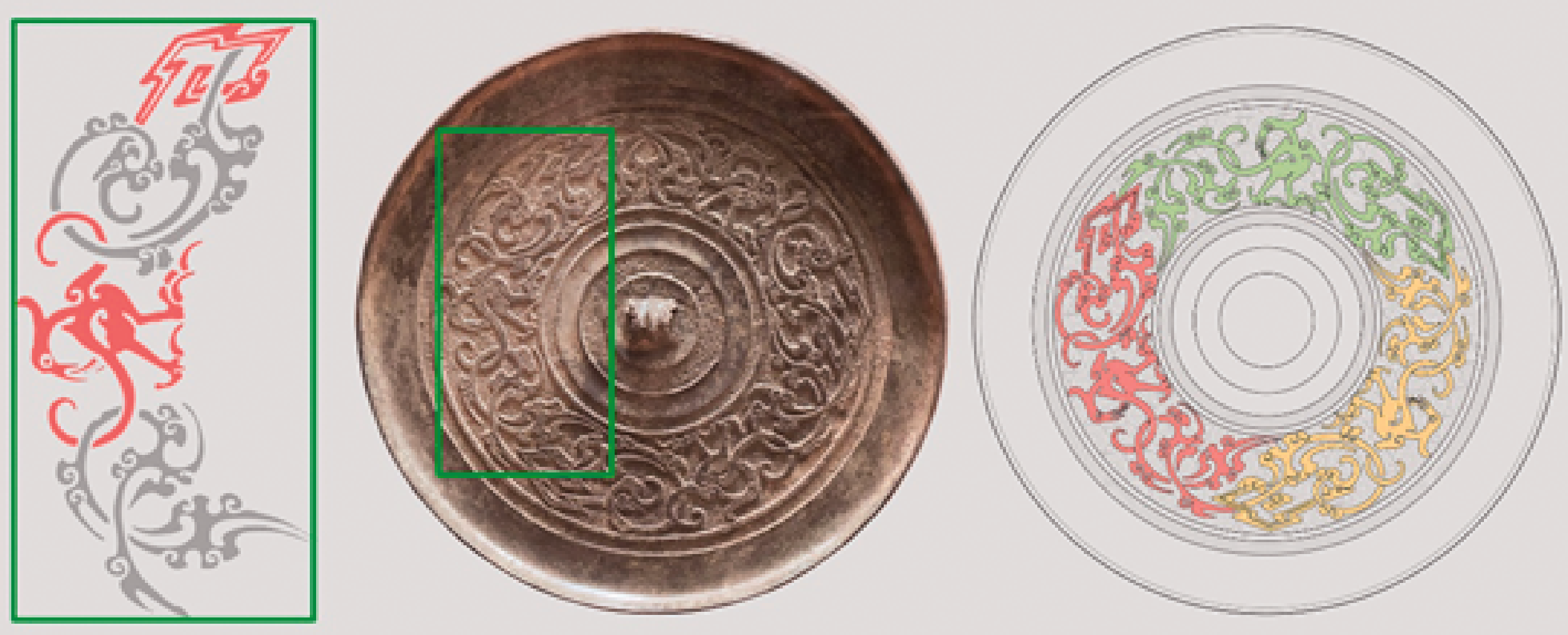
Structural Features of the First Bronze Mirror Pattern in the Game. The core patterns and auxiliary patterns are indicated on the left side, and the composition of the pattern is indicated on the right side.
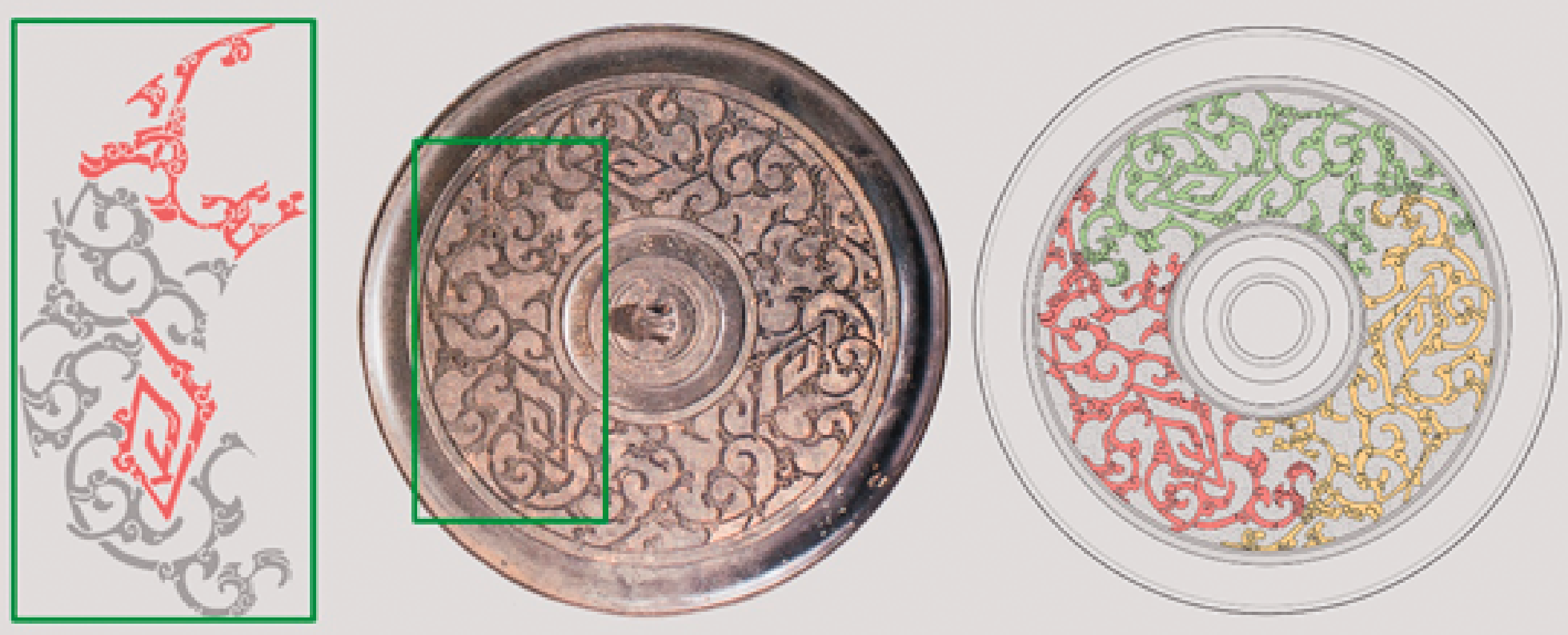
Structural Features of the Second Bronze Mirror Pattern in the Game. The core patterns and auxiliary patterns are indicated on the left side, and the composition of the pattern is indicated on the right side.
Serious Game Design
A digital jigsaw puzzle game, titled “the Lost Han-dynasty bronze mirrors”, was employed in this study. The game was designed by the authors following the rules of a jigsaw puzzle, which asked players to take the image of the bronze mirror as a reference for assembling those pattern pieces which were disrupted. However, because the weathering and corrosion of the bronze mirror surfaces, some patterns may not be recognizable in the reference picture. Therefore, it requires the player to compare and explore the form of patterns very carefully to find the location of the target pattern. After the relationship between the graphic blocks is determined, the corresponding pattern is placed on the mirror surface to complete the restoration of the pattern. The first bronze mirror has less graphics while the second mirror has more graphics to increase the difficulty. The process of the game not only requires players to identify the modeling features and relationship of each single pattern on bronze mirrors, but also guides players to find the cultural connotation of the unification of Han culture hidden in the bronze mirror pattern, so as to increase the national cultural consensus. Scaffolding was set up in the game to guide players to find the location of the target pattern and explicate their form semantic and cultural information, so as to help them better complete the game process and learn from it. In order to improve learning efficiency, the game interface and process were designed to be simple and efficient, including two interfaces: puzzle module and scaffolding. Players assembled the patterns in puzzle module interface. In restoration process, they need to select the target pattern from the pattern area on the left side of the interface, and then place the target pattern on the correct position of the mirror (see the left of Figure 3). If players cannot identify the correct location, they can enter the scaffolding interface to obtain information about the target pattern (see the right of Figure 3).
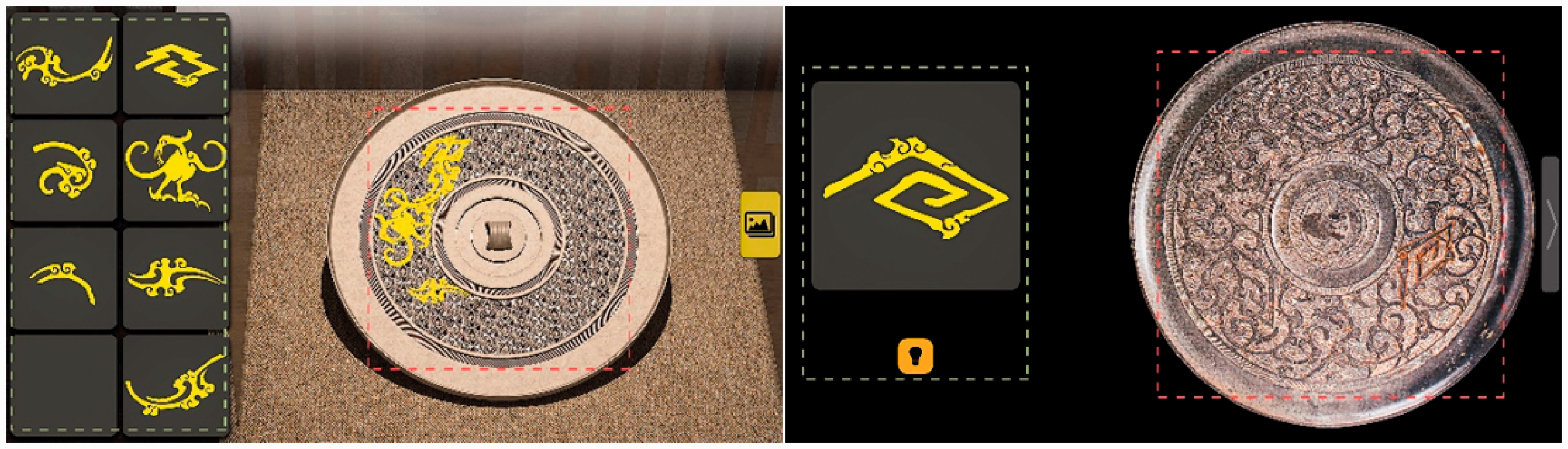
The left figure shows the Pattern restoration interface (the pattern selection area is in the green rectangle and the pattern restoration area is in the red rectangle). The right figure shows the Scaffolding interface (the target pattern area is in the green rectangle and the bronze mirror image area is in the red rectangle).
The restoration task of two bronze mirror patterns are the two levels of the game. Players will start to assemble the patterns of bronze mirror II after completing the restoration of bronze mirror I's. The restoration process of each bronze mirror is divided into two stages. In the first stage, players need to assemble a group of basic patterns to find the position relationship and modelling features of each local pattern. In the second stage, players need to complete the restoration of the remaining two groups of basic patterns to further strengthen their memory and recognition ability. Scaffolding has different function of prompting location information in these two stages. In the first stage, if the participant cannot find the location of the target pattern from the original picture of bronze mirrors, he can use the prompt button and enter the scaffolding interface, then the system will display the location of the target pattern on the mirror and its relationship with other graphics. We encourage players to make independent discovery and search, but when they fail, they will be prompted to help them overcome difficulties. In the second part, the prompts were eliminated. If the player still can't find the target pattern from the picture independently, the system will no longer prompt its location. Players needed to complete the restoration of the other two sets of patterns independently by exploring and learning from mistakes or first stage experience. For those players who are not good at location reasoning or not sensitive to modelling features, they must invest lots of energy in checking the location relationship between the graphics carefully, but it is necessary for the learning process. This phase provides more autonomy and openness to help players eliminate the impact of prompt. The game process is explained in Figure 4 with some screen shots of the game interface.
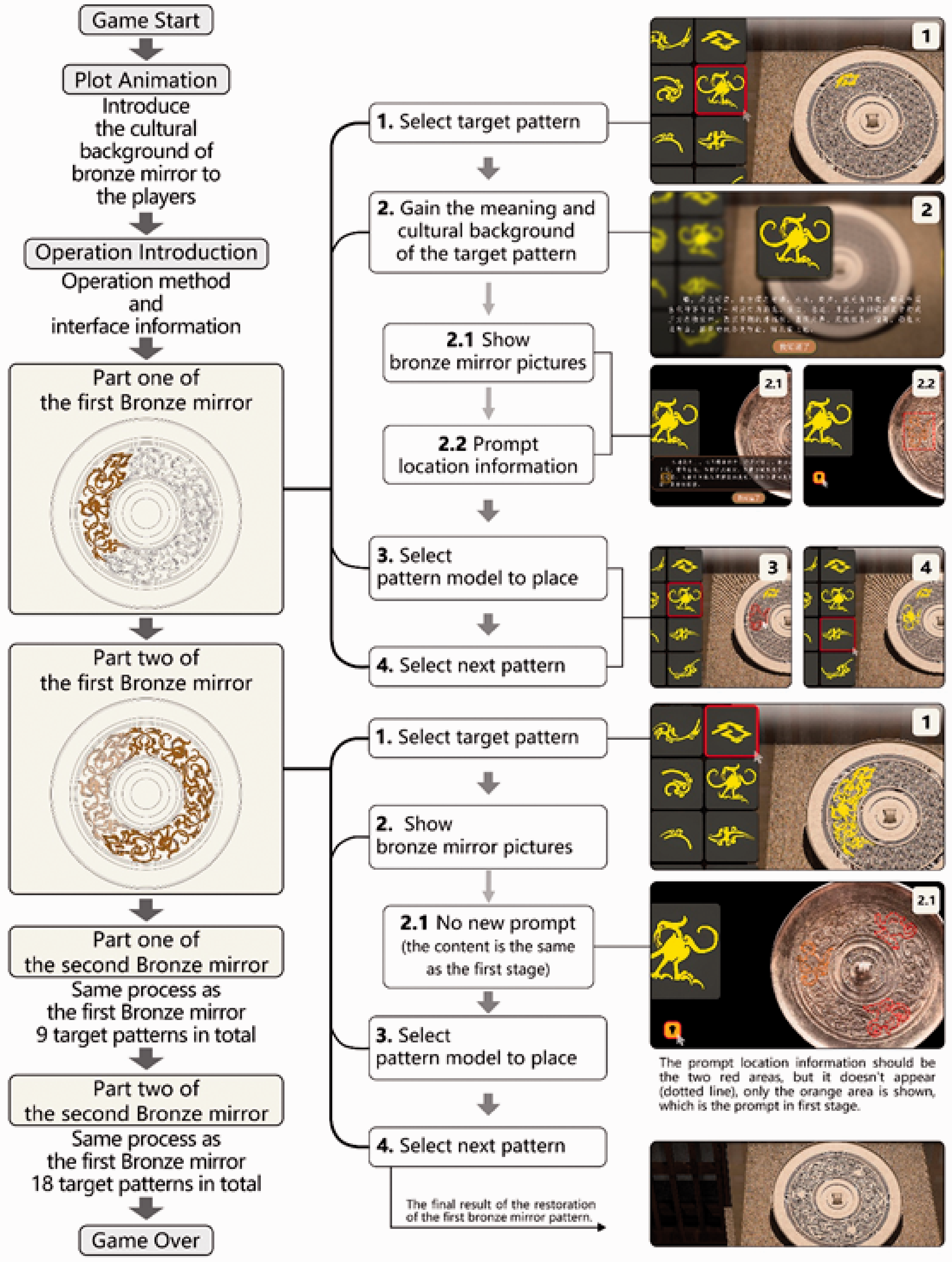
Game Flow and Related Interface Screenshots.
The final game content is integrated into Microsoft PowerPoint software, while the game interaction is realized through hyperlink and key response. PowerPoint is ubiquitous in schools and is suitable for rapid arrangement of changing curriculum content to adapt to more efficient teaching activities, even creating a virtual interaction with vivid effect (Price, 2008; Siko & Barbour, 2012). In order to improve the authenticity of the game process, we modelled the bronze mirror in 3 D Studio Max. The pattern part is separated from the whole model to form the interactive content of the game. Microsoft had given PowerPoint powerful functions of editing and displaying three-dimensional(3D) model in its latest version of MS Office 365 package, and hyperlink function provided support for our response mode and content switching. PowerPoint also supported the use of Visual Basic language for secondary development and further control. By employing PowerPoint, we were able to display relevant information, instructions and prompts in a similar way to the game design intention. Finally, the serious game for experiment runs on PC platform.
Video Learning
A ‘video group’ was set up as a control group using common teaching method of video display to compare with the ‘game group’ using the serious game as teaching method. The learning video was made by one of the authors of this paper in Adobe Premiere software, including voice and subtitles. The form of video content refers to the production form of general heritage investigation video to ensure that the video content for experiment can comprehensively and deeply explain all the heritage content. The historical background, cultural connotation and form semantic of the two bronze mirror patterns were introduced with Microsoft PowerPoint software. The video content is the same as the layout and content of the scaffolding interface in the game, except that the video has no interaction. The screenshots of the video are shown in Figure 5. In order to ensure the learning outcome from video, after the introduction of each local pattern, there will be a pause time for learners to read on-screen text and look at the patterns. The introduction of the core pattern is more complex, so the pause time is longer than that of the auxiliary pattern. There are 7 pauses in the introduction of the first bronze mirror and 9 pauses in the introduction of the second bronze mirror, because the patterns are more complex. In addition, learners will be prompted to pause the video to watch if the pause time is not enough. This also ensures that the learning content of the two groups is consistent and their learning time is basically the same. The process of video learning is shown in Figure 5.
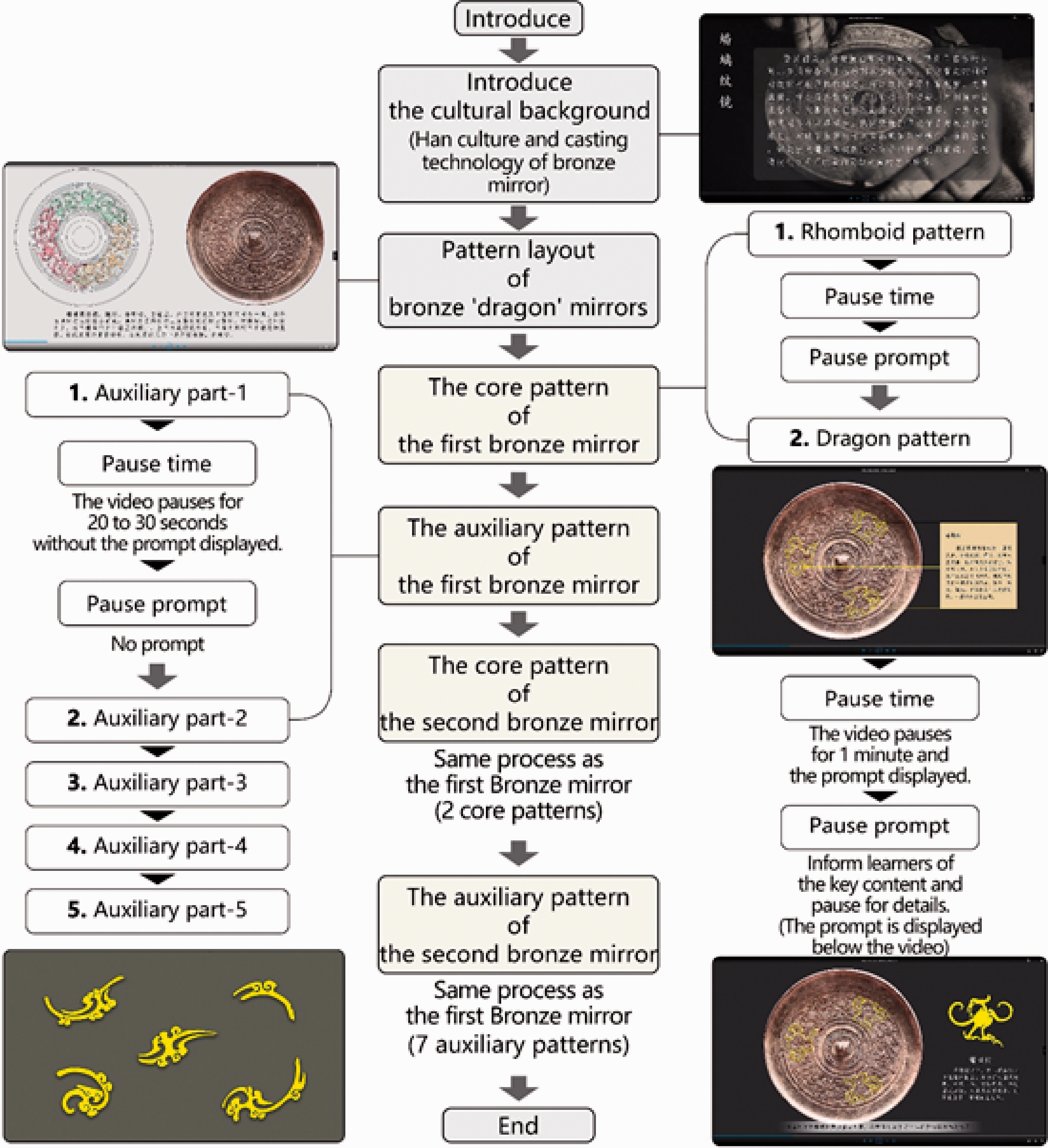
Video Learning Flow and Related Screenshots.
Bronze Mirror Pattern Test
In order to test the effectiveness of using the serious game based on digital jigsaw puzzle interaction mode as a way of learning the culture and pattern of bronze mirror, a series of test were designed to evaluate the performance of the students from both groups. The pattern tests evaluated learning performance of the participants from three aspects: knowledge acquisition, retention and transfer. The post-test, which includes basic test and search test, assesses the knowledge acquisition after finishing the game or video. The memory tests a week later to assesses learning retention. The performance of participants in knowledge transfer is evaluated by the extension test. In order to ensure the validity of the test content, we invited three experienced bronze mirror collectors who participated in content auditing in our game development process to evaluate the feasibility of our test content. Specific test contents are shown in Table 1.
Test Content Classification and Thumbnails.
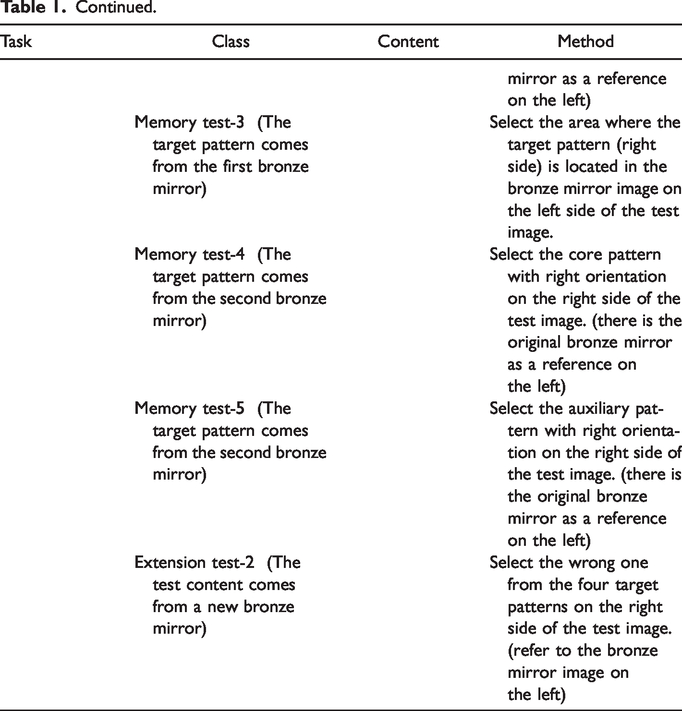
The basic test is to show participants two piece of core pattern and let them decide which one is the right shape or orientation. Both groups devoted a lot of time to learn the core pattern, so this test is used to investigate whether the participants have achieved the minimum level of knowledge. This test contained four questions, question 1 and 2 tested patterns extracted from the first bronze mirror, question 4and 5 from the second bronze mirror.
The content of the search test comes from the auxiliary patterns. Different from the basic test which focuses on the recognition performance of the core pattern, the search test is used to evaluate the familiarity with the layout of patterns. The test form is the same as the basic test's, except that participants are allowed to review the bronze mirror image. When the participants can not recall the shape of the auxiliary pattern, they can ask the experimenter to show the bronze mirror image, and then search the target pattern on image to answer. This is not allowed in basic tests. The core patterns were introduced in the learning content for a longer time, so the learners had a deeper impression. The auxiliary patterns were only briefly explained in the process of introducing the layout of patterns, so the learners may still be unfamiliar with them. The auxiliary patterns were used for filling the pattern as a whole, so they do not need to be retained like core patterns. However, the layout of patterns contains cultural information and technological skills, which need to be recognized and understood. Two questions belonged to this type of test. Question 3 tested the patterns extracted from the first bronze mirror, question 6 tested the pattern from the second bronze mirror.
The above two tests could reflect the designed learning outcomes of the learners using either traditional learning method or serious games. However, their ability on knowledge transfer outside the designed learning outcomes was uncertain. There are only classic cases of bronze mirror heritages in games and videos, not all of them because of their large number. It requires that learners can transfer the reading and searching modes on the patterns from games or videos to other bronze mirror patterns. Therefore, the third test - extension test - examined the players' ability in applying and expanding the learned knowledge. The test content comes from two unfamiliar bronze mirrors. They do not appear before, but they have the same structure as the patterns in games or videos, that is, two groups of participants need to transfer the positional relation and matching strategy learned in games or videos to the two new bronze mirrors. The illustration of the pattern structure of the two new bronze mirrors used in the extension test is shown in Figure 6. Different from the previous test form, they are not only the target pattern, but also the picture of the bronze mirror on the test image, so as to facilitate the pattern matching, as shown in Table 1. In the first extension test, participants were asked to read the bronze mirror pattern on the left side of the test image to decide whether the pattern on the right side was complete. The form of the second test is the same as the first, but the goal is to determine which of the four local patterns did not come from the case of bronze mirror shown in the test. Although the contents of the two tests are different, they are both used to evaluate whether the participants can recognize the layout characteristic of the bronze mirror pattern and reply correctly after searching. Two questions belonged to this type of test, one is the last of post-test and the other is the last of retention-test.
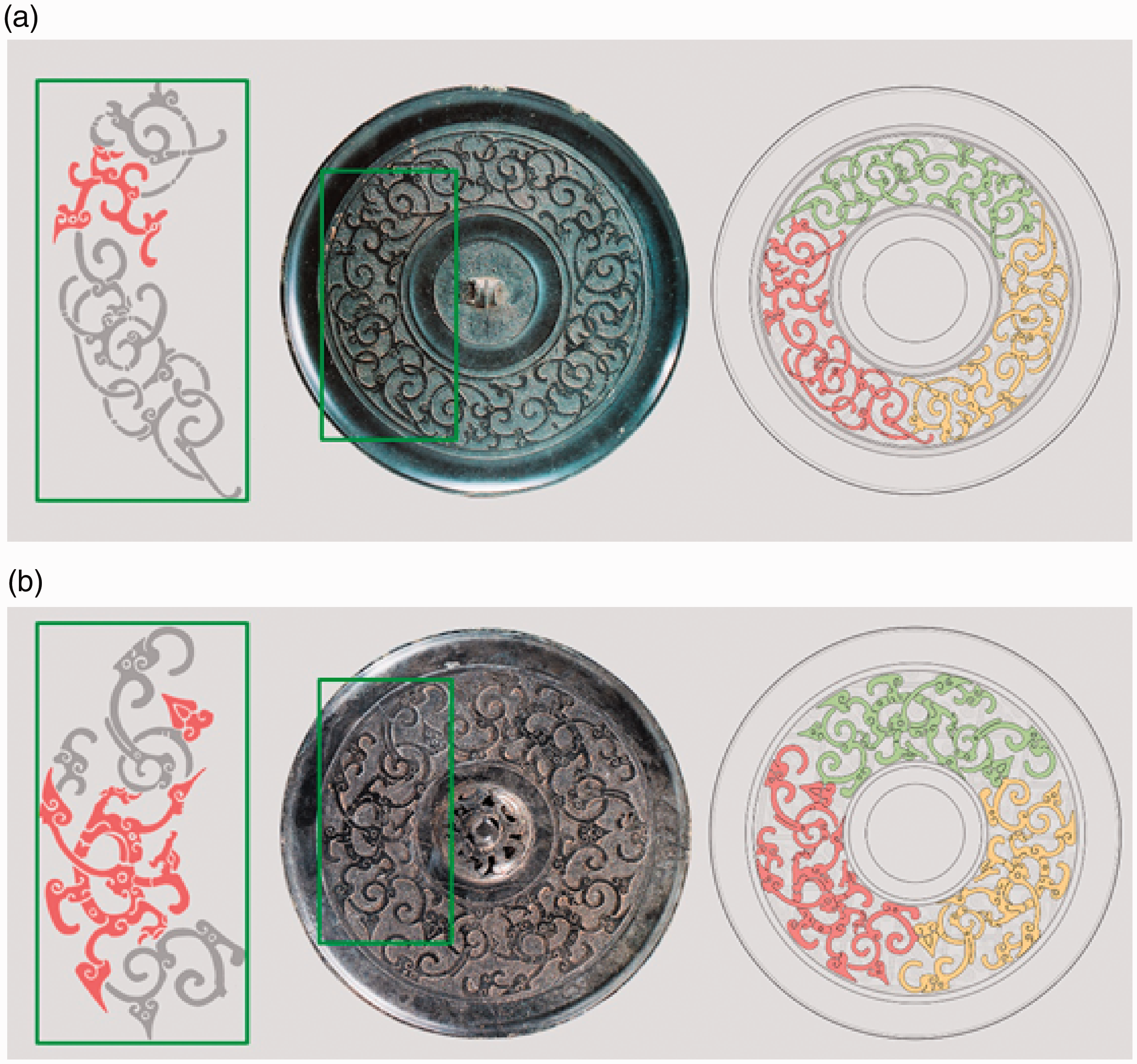
(a) Structural features of the first bronze mirror pattern in the extension test (the core patterns and auxiliary patterns are indicated on the left side, and the composition of the pattern is indicated on the right side). (b) Structural features of the second bronze mirror pattern in the extension test (the core patterns and auxiliary patterns are indicated on the left side, and the composition of the pattern is indicated on the right side).
The memory test is used to assess participants' retention of learning content one week after the experiment, including the shape of patterns and familiarity with layout structure. The content of the test comes from two groups of patterns in the bronze mirror that appear in the game and video course. The form of the test image is the same as the extension tests, that is, the decision and answer could be made with reference to the bronze mirror image from which the target patterns comes. The test content is shown in Table 1. But for those participants who can recall the patterns, they could answer directly without checking the bronze mirror image, so they may have a faster response. Among them, question 1 to 3 comes from the first bronze mirror, question 4 and 5 comes from the second bronze mirror.
Measurement of Respondents’ Motivation Change
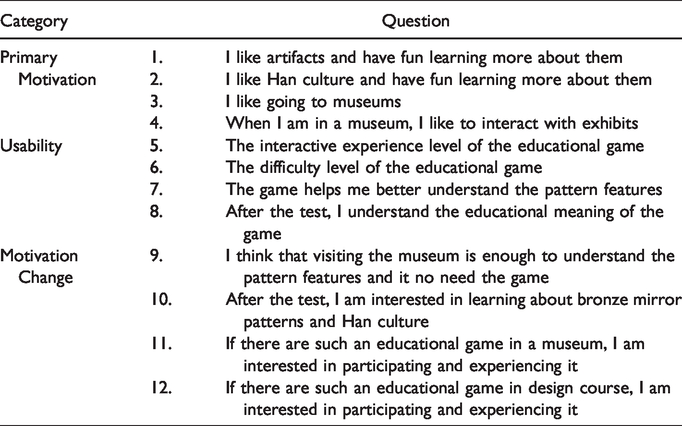
The learning motivation scale was originated from the two dimensions of Intrinsic Motivation Inventory (IMI), namely interest/enjoyment and value/usefulness. Part of the content was modified from the measure proposed by Bossavit`s museum game motivation questionnaire (Bossavit et al., 2018). Using five-point Likert scale with 12 items to investigate the students' motivation changes after the game. These items are evenly distributed in the three dimensions of primary motivation (1–4), usability (5–8), and motivation change (9–12). Among them, the topic of the primary motivation was used to evaluate participants' attitudes towards cultural heritage and museum visits before the experiment. The topic of the usability was used to evaluate the learning experience of using serious games in terms of interaction, difficulty and learning experience. The topics of the motivation change was used to reassess participants' attitudes towards cultural heritage learning and museum visits after the experiment. The contents of the scale are shown in Table 2. All questions in the scale are translated into Chinese accurately to ensure that participants can understand and answer correctly.
Scale Used to Evaluate the Change of Motivation.
Many studies have confirmed the advantages of serious games in enhancing learning motivation (Rezabek, 1994; Sung et al., 2017). Therefore, in this study, we will not compare the motivation differences between the two groups of participants, but focus more on the factors that affect the change of motivation. After the experiment, participants in the game group were given questionnaires to collect data on motivation changes.
Procedures
In order to ensure the efficient and stable operation of the game, we used a mobile workstation equipped with NVIDA GTX1060 for testing. At the same time, we exhibited the image to a 27-inch display (model DELL SE2717H) with a screen resolution of 1080p for displaying the game interface. The video of the control group was also played on the same device. During the experiment, each participant occupied an enclosed office cleared of distractions.
Before entering the game, participants in the game group need to watch an informal popular science video about the bronze mirror, which is similar to the promotional film of the local museum, so as to introduce the basic knowledge of bronze mirrors. After reading and understanding the rules of the game, the participants will start the game officially. Event triggers were set up at the beginning and end of each stage to record the player's time consuming in each stage of the game process. Participants in the video group also need to watch the formal learning video explained in Section 3.3 after watching the same popular science video as the game group. During the experiment, participants in the video group were allowed to control the pause button, but fast forward was not allowed. At the end of the game and video course, all participants were asked to take the same bronze mirror pattern test. Before the test starts, the experimenter will introduce the test process to the participants, and then the test images will be displayed on the monitor with full-page view. All test images are static. The experimenter will introduce the test content and ask the participants to answer. After that, the experimenter will switch to the next test image. The display order of the test image is shown in Table 1. Their answers and the time they spent in answering questions were recorded analysis. One week after the first test, all participants were asked to return for retention test, which have the same process with post-test. Participants in the game group also needed to fill in a motivation scale to help us collect the motivation change in the game process after the experiment.
We recruited experimental subjects from a basic design course. A total of 56 freshmen from the school of architecture participated in the study. The experiment was approved by the ethics committee of the University, and written consent was obtained from all of the participants before they took part in the study. Eight of the participants were absent from retention-test after taking post-test as their personal reasons, so their results were considered invalid and excluded from the analysis. The final number of participants was 42 (33 girls), their average age was 19.83 years (SD = 1.60 years). Participants who claimed that they had experience of playing computer games and learning with teaching video were randomly assigned to the game group and video group by drawing lots, so there were 21 participants in each group finally. Before the beginning of the experiment, the participants were interviewed to ensure that they had no idea about the bronze mirror and ‘dragon' pattern. It confirmed that no participant had any previous knowledge of bronze mirror patterns and history before the experiment or had participated in any other cultural heritage education courses. Therefore, for all the students who participated in this study, the content needed to be learned in the experiment was new.
SPSS software was used to analyze the data collected in the experiment, including the score and answer time of pattern test, the stay time of the game group in each stage during game process and the measurement results of motivation scale.
Results and Discussion
Analysis of Bronze Mirror Pattern Test
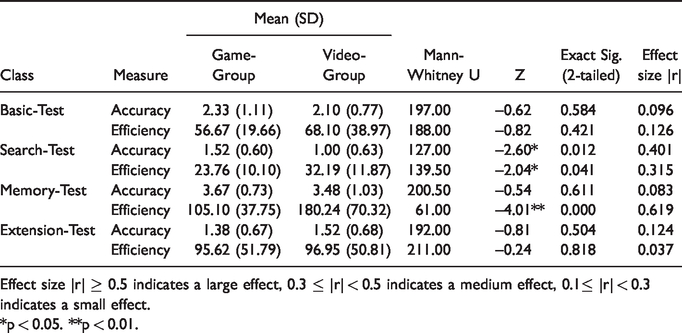
The results of the bronze mirror pattern test were used to compare the learning performance of the participants in the game and video group. The test content has passed the evaluation and approval of relevant collection experts (Dijkstra et al., 2012), so the test results are effective and reflective of the learning performance of students. The result of accuracy is the test score, which the higher the score is, the higher the accuracy is. The result of efficiency is the response time, which the shorter the time is, the faster the answer is. Figure 7 shows the accuracy (test scores) and efficiency (response time) by the two groups of students in completing the tests. Because the small sample size of each group (n = 21), Mann-Whitney U-test was used to compare the difference between the learning performance of participants in two group. The analysis results are shown in Table 3. The result reveals that the students in the game group show significant advantages in search test and memory test compared with the students in the video group.

(a) Basic test results. (b) Search test results. (c) Memory test results. d: Extension test results.
Mann-Whitney U tests on Bronze Mirror Pattern Test of the Game and Video Groups.
Effect size |r| ≥ 0.5 indicates a large effect, 0.3 ≤ |r| < 0.5 indicates a medium effect, 0.1≤ |r| < 0.3 indicates a small effect.
*p < 0.05. **p < 0.01.
The result of basic test is the same as our experiment expectation that there are no significant differences in scores (Z = −0.62, p = 0.584) and time (Z = −0.82, p = 0.421) between the two groups. Both groups devoted a lot of time to learn the core pattern, so this test is used to investigate whether the participants have achieved the minimum level of knowledge. However, the numerical distribution of the test score in the video group is more concentrated than that in the game group, which shown in Figure 7a. It indicates that there were more stable results of basic content retention by using learning video. The reason for the difference is probably that video learning as a universal learning medium can be accepted and works effectively for all participants, while games may not be accepted by some learners in a short period of time, resulting in their poor performance.
The difference between the two groups of results occurred in search test. The accuracy of the game group in the search test is higher than the video group (Z = −2.60, p = 0.012), and game group`s time consumption is less than the video group (Z = −2.04, p = 0.041). Although participants are allowed to revisit the original image during the test to recall them, it does not mean that everyone can find the target pattern and give the correct answer. From the distribution shown in Figure 7b, most of the participants of the game group could answer all correctly, while there are few in the video group. Response time was used to evaluate participants' familiarity with auxiliary patterns (Johns & Mewhort, 2003). Some participants of the video group needed to spend more time looking for the target pattern (see Figure 7b), which indicates that they are not familiar with the layout of the pattern. The shape of the core patterns is complex so there are big differences in them, so it is easy to identify. The two groups of participants also had good recognition performance after finishing the game and video learning. The auxiliary patterns are overlapped and interleaved with each other in position and their shapes are similar, so it is difficult to identify. It is thought to be an advantage of the interactive mode of a digital jigsaw puzzle (Hong et al., 2012). In the process of assembling pattern pieces, the players in the game group have to pay more attention to the position and layout of restored patterns on the base to find the possible position of the next pattern. The observation and search process will deepen their impression of the pattern layout and the shape of auxiliary patterns. As a result, participants in the game group performed better on this test. However, it should be noted that the number of search tests is only two times. Since the learning content only contains two bronze mirrors, the advantages of the game may still need more practice to examine.
In the memory test, the game group also show significant advantages in terms of response time. Time consumption of the game group was less than the video group (Z = −4.01, p = 0.000). The memory test included reference images with answers, so participants could answer correctly if they searched carefully. Both groups of participants can find the target pattern as there is no significant difference between the two groups in accuracy (Z = −0.54, p = 0.611), which further confirms the significance of differences in efficiency. Figure 7c shows that the distribution of the test score of the two groups of participants is consistent. In response time, the game group is shorter and answered more quickly. The proficiency of visual tasks based on graphics is mainly affected by long-term memory (Blalock, 2015). By evaluating the response time (Sternberg, 1969), the impression of the game players or traditional media students on the pattern can be quantify whether they have transformed the learning content from last week into long-term memory, and the accuracy of test is used to evaluate the effectiveness of response time. Game-based learning is conducive to the retention of learning content (Malegiannaki & Daradoumis, 2017). With appropriate challenges and scaffolding-aid, participants will spontaneously pay more attention to the process of restoration, especially in the process of exploring and making a wrong move. They are more likely to have a deeper impression than to be bored. In addition, the interaction mode suitable for heritage content also enhances the effect of game-based learning (Hong et al., 2012).
The results of the extension test show no significant differences in scores (Z = −0.81, p = 0.504) and time (Z = −0.24, p = 0.818) between the two groups. Due to the small number of tests, in which there were only two bronze mirrors, the results of the test were limited. In addition, the short game time could not confirm the advantages in ability development and migration (van Roy & Zaman, 2018). From the results show in Figure 7d, although the scores of the two groups of participants in the extension test are almost the same that the participants can answer at least one or all of them correctly, some students in the game group still show an advantage in reaction time. Students who spend more time in game group are considered to be restrained from the influence of scaffolding ( Schwartz, Lindgren, & Lewis, 2009; C.-T. Sun et al., 2018 ), which makes it difficult for them to solve problems independently and efficiently. As a result, some participants in the game group may had spent more time.
Analysis Within the Game Group
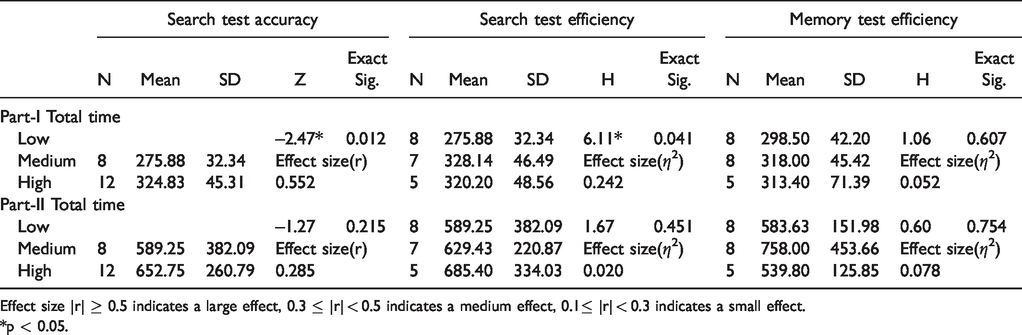
In order to find out which factors contribute to an improved performance of game group, this paper makes a further comparison on the game time in different stages of the game among participants in game group with different performances in the tests. The result shows significant differences between groups in search test and memory test.
The accuracy of search test is divided into three groups according to score, including low accuracy (score = 0, n = 1), medium accuracy (score = 1, n = 8) and high accuracy (score = 2, n = 12). Because the number of samples in low accuracy group is too small, we only compared the difference between the medium accuracy group and the high accuracy group by using Mann-Whitney U-test. The efficiency grouping combines accuracy results. The efficiency of search test is divided into three groups according to time, including low efficiency (score = 1, n = 8), medium efficiency (score = 2 and time > 20, n = 7) and high efficiency (score = 2 and time ≤20, n = 5). The efficiency of memory test is divided into three groups according to time, including low efficiency (score ≤3, n = 8), medium efficiency (score = 4 and time > 100, n = 8) and high efficiency (score ≥4 and time ≤100, n = 5). As the same as the accuracy grouping, the samples with a score of 0 in the search test are also considered invalid and discarded in the efficiency grouping. Therefore, the total number of samples in the accuracy and efficiency grouping of the search test is 20. But no sample in the memory test efficiency group was discarded, so it is 21. There is no difference in the accuracy of memory test between groups, so it was not included in the discussion. Because there was no difference between groups in the accuracy of memory test, it was not included in the discussion. Because the sample size is small and does not conform to the normal distribution, Kruskal-Wallis H-test is used for comparison.
The results of difference analysis are shown in Table 4. In the grouping of search test accuracy, there is a significant difference between medium accuracy and high accuracy in the first stage of game (Z = −2.47, p = 0.012). The game time in high-accuracy group is higher than medium-accuracy group (see Figure 8a). However, there is no significance in the second stage (Z = −1.27, p = 0.215). From Figure 8a, the high accuracy still spends more time. There are only two tests in the search test, which limits the assessment result. Even so, it's not hard to find that the first stage of the game has a greater impact on the result. Compared with the second stage of game, scaffolding plays a more important role in the first stage, which points out the position of each target pattern and the layout characteristics of the pattern to the player directly. After the prompt mechanism is cancelled in the second stage, players who spend more time in the first stage will also be familiar with the layout of the pattern. In the grouping of search test efficiency, each group`s game time also shows significant difference in the first stage of the game (H = 6.11, p = 0.041), which further verifies the role of scaffolding setting during the game process (C.-T. Sun et al., 2018). Although the effect size is small (η2=0.242), there is significant difference between low-efficiency group and medium-efficiency group (p = 0.027). However, the difference disappeared after Bonferroni correction (p = 0.08). Comparing the game process during the first stage of Bronze mirror I and Bronze mirror II respectively (see Figure 8b), it is found that the game time of each group in the first stage of bronze mirror I obviously increases with group level, which may be due to the fact that some participants in the game group did not realize the role of scaffolding and passed quickly (click the prompt information directly and do not think independently). However, there is no obvious increasing trend for each group in bronze mirror II, but the participants with low efficiency still stay the shortest. The difference between the groups with medium efficiency and high efficiency may be caused by the difference of personal ability and the improvement of game difficulty. There is no significant difference in memory test efficiency among the groups (H(Part-I)=1.06, p(Part-I)=0.607; H(Part-II)=0.60, p(Part-II)=0.754). From Figure 8c, the low-efficiency group was still the shortest, while the difference between the middle and high efficiency groups was not significant. It may require more playing time to further verify.
Non-Parametric Tests on Differences Within the Game Group of Each Game Stage.
Effect size |r| ≥ 0.5 indicates a large effect, 0.3 ≤ |r| < 0.5 indicates a medium effect, 0.1≤ |r| < 0.3 indicates a small effect.*p < 0.05.
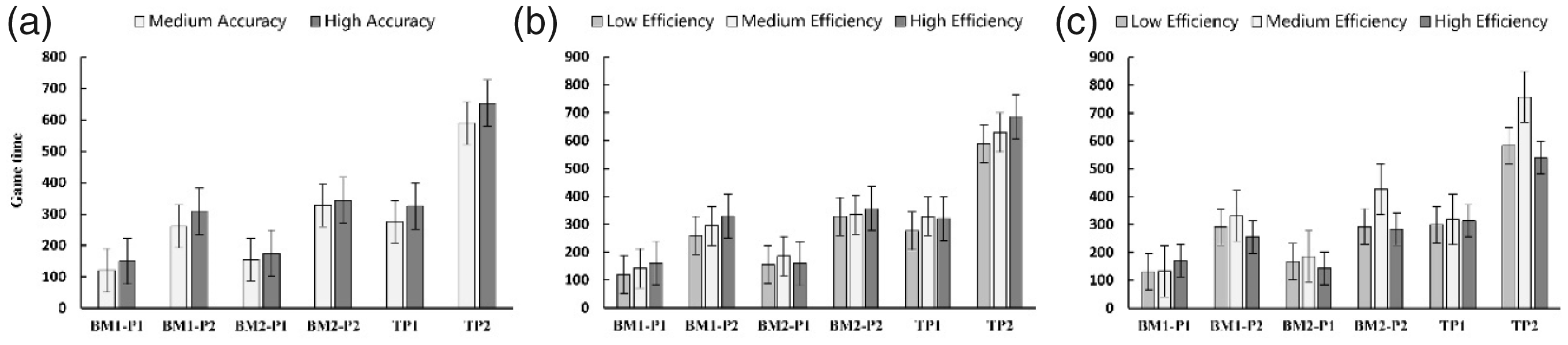
(a) Search test Accuracy. (b) Search test Efficiency. (c) Memory test Efficiency. BM1-P1 = Bronze mirror 1-Part 1; BM1-P2 = Bronze mirror 1-Part 2; BM2-P1 = Bronze mirror 2-Part 1; BM2-P2 = Bronze mirror 2-Part 2; TP1 = Total Part 1; TP2 = Total Part 2 (includes bronze mirrors 1 and 2).
The Change of Motivation Before and After the Game
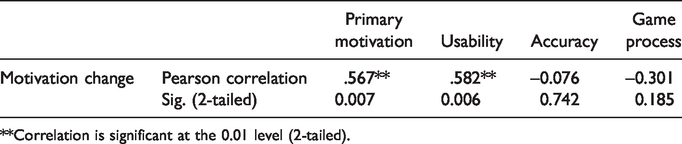
21 participants in the game group filled in the motivation scale, all the results were valid and included in the analysis process. Figure 9 shows the participants' choices at different levels of each question. The analysis of internal consistency reliability of the questionnaire revealed a Cronbach's alpha coefficient at 0.841. In order to discuss the influence of primary motivation and game usability on motivation change, three modules in the scale were analyzed. Meanwhile, total score of the pattern test (Accuracy) and total time in the game (Game Process) were the influencing factors of motivation change, so they were also included in the correlation analysis process. The results of the correlation analysis are shown in Table 5.
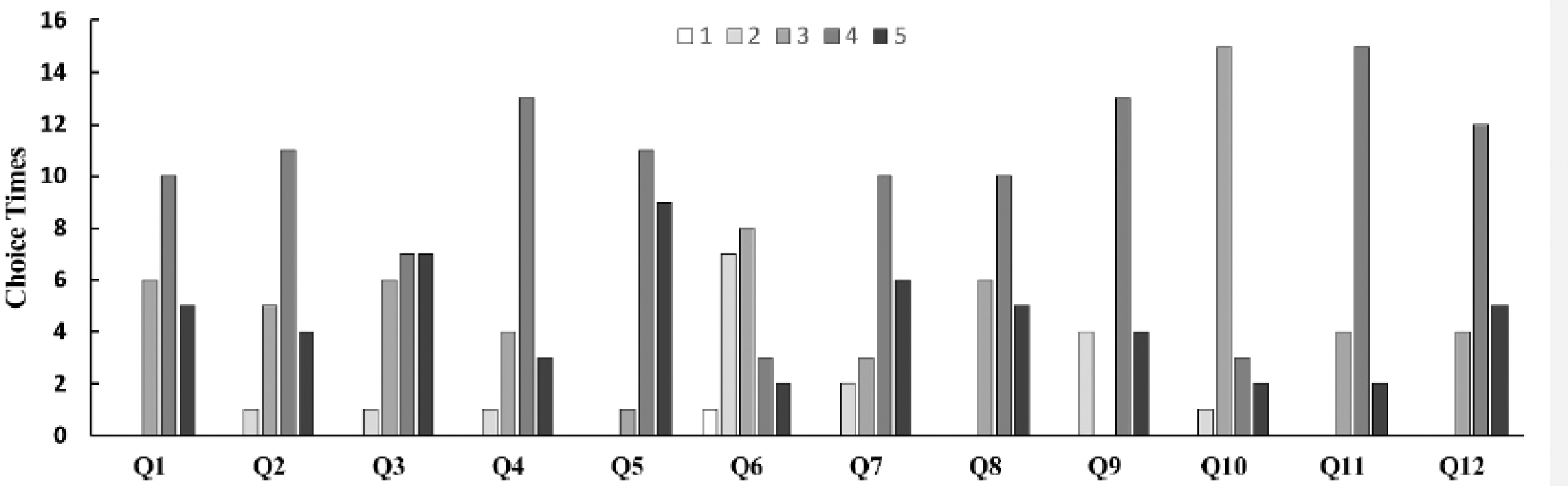
The Number of Participants' Choices at Each Level of the Question in the Motivation Scale. Q1–12: Question 1–12; The legend shows the five levels of each question on the scale.
Correlations Between the Factors Influencing Motivation Changing After Serious Games (Pearson).
**Correlation is significant at the 0.01 level (2-tailed).
In the results of correlation analysis, there was a significant positive correlation between motivation change, primary motivation (r = 0.567, p = 0.007) and usability (r = 0.582, p = 0.006). The improvement of primary motivation and usability increased the final motivation change (see Figure 10), in which usability had a greater impact. Accuracy and game process had no significant impact on motivation change (r(accuracy)= –0.076, p(accuracy)=0.742; r(process)= –0.301, p(process)=0.185). In order to provide a more reliable explanation, we built a multivariate regression analysis, concerning the possible multicollinearity among factors affecting motivation, to explore the game process and motivation change, as well as to provide more reliable guidance to serious game design.
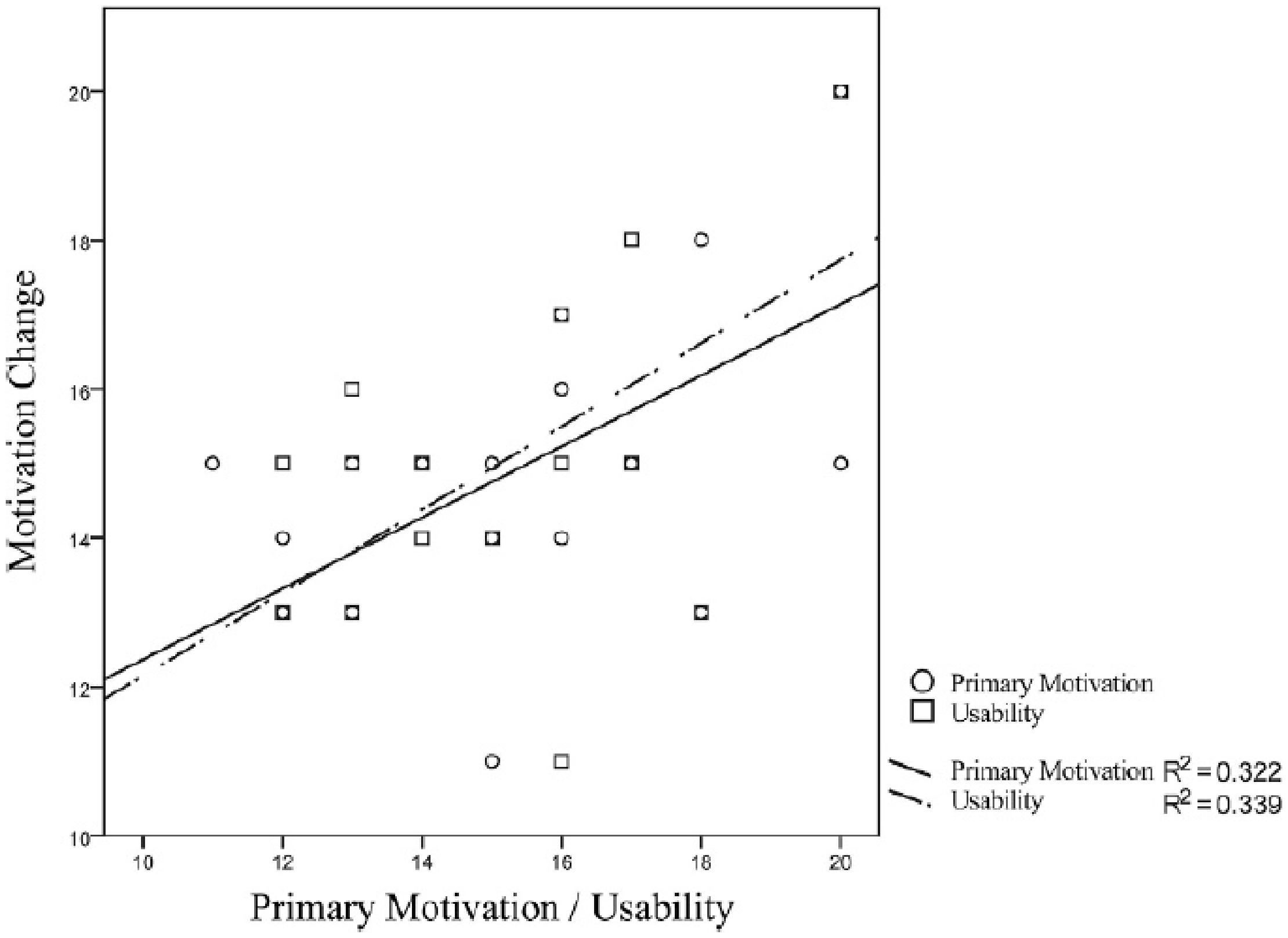
Linear Relationship Between Motivation Change and Primary Motivation/Usability.
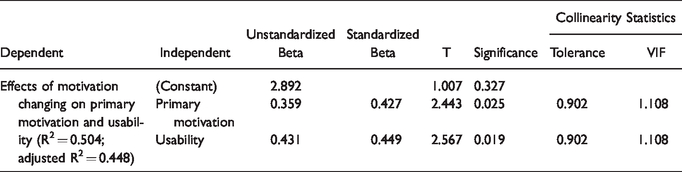
In order to accept the models, the normality of the residuals, analysis of variance and multi-collinearity were tested. This was accomplished by using the Kolmogorov-Smimo test, in which the residuals followed a normal distribution (Kolmogorov-Smirnov Z = 0.145, p = 0.200 for the effects of motivation changing). Variance analysis results revealed a linear correlation between the game process and motivation changing (F = 9.131, p = 0.002). By referring to values in Menard (2002) (value of tolerance < 0.2 or VIF > 10, which indicates a problem), our models also had no problem with multi-collinearity (the minimal value of tolerance= 0.902 > 0.2 and the maximal VIF = 1.108 < 10). It should be noted that the robustness of final model is indefinite due to the small sample size (n = 21) used for regression model establishment, which may need to be further verified by a larger sample size in later research and practice. However, in this paper, the model is used to establish the possible quantitative relationship between dependent and independent variables and the direction of correlation between them, rather than to predict, so the results of the model are acceptable.
The results of regression analysis further confirm the influence of primary motivation and usability on motivation change (see Table 6). The effect of usability is still more significant, and further correlation analysis of questions in usability is helpful to find out key influencing factors. Although there is no significant correlation between the four questions (5–8) and the final motivation change, it may be an effective way (question 8) to improve motivation by transferring the goal of the game to help players quickly integrate into the virtual learning environment during the game process from the comparison results of correlation coefficients (see Table 7). In addition, from the measurement results in Figure 9, although the change of the learning motivation after the game is small, that is, most of the participants choose the third level in question 10 (the five levels of question 10 represent the degree of the motivation change), but most of the participants choose the higher level in question 11 and 12. By comparing with the result of question 4, which shows the attitude before experiment, the attitude towards using interactive programs or games to learn heritage content is improved. It may indicate that visiting and learning about cultural heritage with serious games or other interactive programs need to provide learners with a transitional stage to help them adapt to this learning mode. However, due to the limited measurement results, it may need more practice to further verify.
The Impact of Significant Predictors for Primary Motivation and Usability in Motivation Change From Multiple Linear Analysis.
Correlations Between Usability and Motivation Changing (Pearson).

**Correlation is significant at the 0.01 level (2-tailed).
Conclusion
Through the comparison of the differences between groups of the pattern tests, it shows that serious game not only achieves the same knowledge acquisition with traditional video learning, but also confirms the advantages of serious games in learning cultural heritage. The game group performed better in learning retention, the scope of learning and comprehensive performance. The results of analyzing within the game group further confirmed that the scaffolding-aid not only helps players to complete the game process better to improve their interest in learning, but also helps players have a comprehensive view to deeper understanding of the modeling features and form semantic of bronze mirror patterns (Alfieri et al., 2011). The measurement results of respondents’ motivation change showed that the usability and clear task objectives in games are the main factors to promote the growth of learning motivation. Finally, the conclusion of this study and its contribution to the application of serious games in cultural heritage education will be discussed from game content and design methods.
This study effectively expands the design method of serious games with the theme of cultural heritage education. It further examines the effectiveness of the interactive mode based on jigsaw puzzle for learning the pattern heritage. Abstract shape mode and form semantic in pattern heritage are difficult to be described clearly to learners through on-screen text and animation in video learning. However, this is the advantage of game-based learning (Wattanasoontorn et al., 2013). In the process of the game, a puzzle task combined with the learning content of pattern heritages was set to guide players to learn the cultural information and structural features in the process of assembling those pattern pieces to restore whole bronze mirror pattern. Scaffolding-aid prompted players after a failed search and helped them take the initiative to explore and learn from it. The real experience of heritage visit was simulated in the virtual environment of the game and players were guided to interact with heritage content through embodied interaction, which improved the participants' attitude towards learning cultural heritage and made them more actively participate in heritage learning activities (Gil-Fuentetaja & Economou, 2019). Although the game promoted knowledge acquisition and improved participants' learning motivation, there were not significant advantages in promoting transfer performance, even if it was considered to be the advantage of games or simulations. The reason may be the short time frame (Van Roy & Zaman, 2018). It may take longer experiments and follow-up surveys in the future research to provide more conclusive evidence.
This study also effectively expanded the content of serious games for cultural heritage education from the previous game content based on the text and sites to the pattern and structure. As an important branch of cultural heritage, art graphics and pattern not only convey historical information but also cultural spirit (Chun, 2012). However, many contents of cultural heritage education ignore them. We have rediscovered and provided effective dissemination and education methods based on serious games. Although the patterns in heritages may be different in regions, this paper provides an attempt and reference.
This study has certain limitations. Firstly, the game cases used in the experiment are relatively simple, and the content of the game only contains two examples of bronze mirrors. In future research, we will develop it completely to integrate more content and elements to further evaluate the impact of serious games on motivation change with paying more attention to the impact of game process through qualitative data collection and analysis. Secondly, the result was limited by the small sample size. Although the statistical method suitable for small sample and rigorous tests are used and carefully discussed to improve the accuracy of the experimental results, it should be noted that further research with larger sample size is needed to validate the research. Finally, the research was limited by a short time frame. As a result, the evaluation of knowledge transfer performance can not provide reliable evidence. Further research is needed with longer time frame to understand such impact.
Footnotes
Acknowledgments
We would like to thank the 3 experts and 56 participants of college students in our trials and two anonymous reviewers’ valuable suggestions.
Declaration of Conflicting Interests
The authors declared no potential conflicts of interest with respect to the research, authorship, and/or publication of this article.
Funding
The authors disclosed receipt of the following financial support for the research, authorship, and/or publication of this article: This research is supported by China University of Mining and Technology Graduate Education and Teaching Reform Research and Practice Project (2019YJSJG050).
