






Abstract
As artificial intelligence (AI) continues to transform global education, the development of AI literacy has become a pressing priority. However, current initiatives often approach AI literacy from local or national perspectives, overlooking the importance of a broader, global context. In cross-cultural learning, immersive virtual reality (VR) environments based on 360-degree video technology offer authentic experiences; however, these are typically asynchronous, limiting learners’ opportunities for real-time interaction, feedback, and support. Such limitations may hinder the effective development of global AI literacy, innovation, and entrepreneurship. To address this challenge, the present study designed and implemented AI-powered interactive pedagogical agents (PAs) within immersive VR environments. These agents provided real-time, context-sensitive support during cross-cultural learning activities, aiming to enhance engagement and promote global AI literacy, innovation, and entrepreneurship. A total of 68 students from China, Northern Cyprus, and Kazakhstan participated in the study. With the assistance of PAs, students created cross-cultural scripts and recorded corresponding 360-degree videos, which were then exchanged among participants. Using VR headsets, students viewed immersive learning content on AI concepts and their applications across diverse cultural contexts, engaging in verbal interactions with PAs throughout the viewing experience. Following this, students reflected on their learning experiences under the guidance of PAs. A mixed-methods research, comprising pre- and post-test questionnaires, interviews, and reflection reports, demonstrated statistically significant gains in students’ global AI literacy, innovation, and entrepreneurship following the intervention. Participants also reported high levels of perceived credibility and immersion with the PAs in VR environments. Based on these findings, the study offers recommendations to inform future practices in global AI literacy education.
Keywords
Introduction
Artificial intelligence (AI) refers to the development of computer systems capable of performing tasks that traditionally require human intelligence, such as reasoning, problem-solving, and learning from experience (Grewal, 2014). With AI’s rapid advancement, its integration into innovation and entrepreneurship education presents new opportunities for global education systems. By integrating AI with innovation and entrepreneurship education, educators can cultivate an entrepreneurial mindset and better prepare students to meet the dynamic demands of contemporary businesses (Lopes et al., 2021; Zhang-Zhang et al., 2022). Therefore, mastery of AI literacy is critical for effectively integrating AI technologies into educational practices (Ng, Leung, et al., 2023; Velander et al., 2024). However, traditional curricula primarily focus on theoretical knowledge, offering limited opportunities to develop competencies needed to engage in global innovation ecosystems or to address shared challenges in entrepreneurship and beyond.
Technology-supported cross-cultural learning, such as approaches using pedagogical agents (PAs) and virtual reality (VR), plays a pivotal role in enhancing students’ AI literacy and entrepreneurial skills (Shadiev et al., 2024; Shonfeld et al., 2021; Tafazoli, 2024a). PAs, when integrated into VR environments, may show promise in facilitating cross-cultural learning and fostering innovation and entrepreneurship. For instance, in a telecollaborative project, students created culture-related learning content, such as panoramic tours, supported by pedagogical agents that guided their script writing and reflection processes (Nebel et al., 2024; Schroeder et al., 2025; Shadiev et al., 2022; Sikström et al., 2024). PAs and VR can enable students to explore technological applications in cultural contexts, analyze global business practices, and develop innovation skills through authentic, interactive, and immersive experiences. Furthermore, students’ AI literacy extends beyond local application to encompass global perspectives, enabling them to understand, implement, and adapt technologies across diverse cultural, linguistic, and societal contexts.
The Present Study
AI technologies promote higher-order thinking by automating routine tasks, allowing students to engage in complex problem-solving and creative activities (Ilgun Dibek et al., 2025; Lu et al., 2025). VR technologies are capable of creating authentic and immersive learning environments (Hameed & Perkis, 2024). However, the integration of AI within VR environments to enhance global AI literacy, innovation, and entrepreneurship remains underexplored in the current literature. To address this gap, the present study designs cross-cultural learning activities based on various topics to foster innovation and entrepreneurship within VR environments enhanced by AI interactive PAs. The following research questions (RQs) are examined: RQ1: To what extent can cross-cultural learning activities supported by AI pedagogical agents in VR enhance global AI literacy? RQ2: How effectively can AI pedagogical agents in VR-supported cross-cultural learning activities promote innovation and entrepreneurship? RQ3: What are students’ perceptions of the technologies (AI pedagogical agents in VR) employed in cross-cultural learning activities?
The motivation for this study stems from the urgent need to advance global AI literacy in an era where AI increasingly shapes education and economic landscapes across diverse cultural contexts. While current AI literacy initiatives often remain localized and rely on static VR tools (e.g., Chien & Hwang, 2022), they fall short in fostering real-time, cross-cultural engagement essential for innovation and entrepreneurship. The underexplored potential of AI-driven PAs integrated within immersive VR environments presents a critical opportunity to address this gap (Sikström et al., 2024). This study was designed to develop a cross-cultural learning activity enabling students from different countries to collaboratively explore AI applications and cultural practices, and integrating PAs to make VR environments more interactive and engaging, with the aim of enhancing global AI literacy, innovation, and entrepreneurship. This study also seeks to understand how AI and VR technologies influence learners’ learning and perceptions, offering new insights into the transformative role of AI and VR in cross-cultural education.
To clarify this, the paper is organized as follows: the literature review positions our study within the existing body of research on VR and PAs in cross-cultural learning, identifying critical gaps in current methodologies. The method section outlines our approach to integrating VR and PAs into educational design, followed by the results, which present empirical evidence of their effectiveness. The discussion analyzes these findings, emphasizing their significance for advancing global AI literacy, innovation, and entrepreneurship, and the perceptions of the technologies. Finally, the implications and conclusion consolidate the key takeaways, while the limitations reflect on the study’s boundaries and suggest directions for future research.
Literature Review
Bloom’s Taxonomy for AI-Supported Learning
Bloom’s taxonomy consists of three domains of learning, i.e., cognitive, affective, and psychomotor (Crawley et al., 2007; Sharunova et al., 2018). It includes six levels. The remember level refers to recognizing or recalling knowledge from memory. Remembering is when memory is used to produce or retrieve definitions, facts, or lists, or to recite previously learned information. The understand level represents constructing meaning from different types of functions, be they written or graphic messages or activities. The apply level consists of carrying out or using a procedure by executing or implementing it. The analyze level involves breaking materials or concepts into parts, determining how the parts relate to one another or how they interrelate, or determining how the parts relate to an overall structure or purpose. The evaluate level represents making judgments based on criteria and standards through checking and critiquing. The create level involves assembling elements to form a coherent whole or reorganizing them into a new structure or pattern.
Bloom’s taxonomy, as a well-established framework in the field of education, has been widely applied in AI-supported learning contexts. For instance, Hutson (2025) advocate for a phased introduction of AI into instruction, whereby students must demonstrate cognitive mastery at lower levels of Bloom’s hierarchy before leveraging AI tools to enhance higher-order skills such as synthesis and evaluation. Empirical studies exploring the integration of generative AI with Bloom’s taxonomy reveal nuanced dynamics in learners’ cognitive processes. For example, research involving primary students interacting with conversational agents showed frequent engagement in creating and evaluating, yet surprisingly low proficiency in applying AI-generated knowledge to new contexts (Hui, 2025). This suggests a critical need to reinforce middle-tier cognitive skills to bridge the gap between comprehension and innovation. Moreover, scholars have argued that the growing reliance on large language models (LLMs) necessitates a reconceptualization of information literacy frameworks. A proposed LLM-driven taxonomy maps cognitive behaviors such as perceiving, reasoning, and curating onto Bloom’s hierarchy, offering a structured pathway to foster metacognitive awareness and critical AI fluency (Luo et al., 2025).
Collectively, these studies underscore the relevance of Bloom’s taxonomy not only as a curriculum design tool but also as a cognitive framework for evaluating the depth and quality of AI-supported learning. Despite these advancements, there remains a notable research gap concerning how Bloom’s taxonomy can be holistically applied to assess students’ cognitive development in areas such as global AI literacy within immersive and cross-cultural learning environments.
VR in Cultural Learning
Virtual reality (VR) immerses users in highly engaging, virtual environments where their interaction with the physical world is either minimal or absent. To achieve a profound sense of immersion, VR creates expansive, inclusive, and vivid simulations of reality (Slater & Wilbur, 1997). Recognized for its significant potential, VR is widely regarded as a powerful tool for fostering meaningful, context-rich learning experiences, making it particularly beneficial in cultural learning contexts.
Previous studies on the application of VR in cultural learning have highlighted its effectiveness in enhancing students’ cross-cultural performance, including improvements in cross-cultural sensitivity (Gao et al., 2021), cross-cultural knowledge (Georgiev & Nikolova, 2021; Lucet, 2009), and cultural communication skills (Li et al., 2022; Pantano & Tavernise, 2009). Additionally, research has explored learners’ perceptions of VR and their overall experiences with cultural learning activities (e.g., Dahya et al., 2021; Shadiev et al., 2021).
However, with the rapid advancement of AI technologies (e.g., large language models, PAs), it remains unclear whether these innovations can seamlessly extend VR environments to further enhance cross-cultural learning.
The Role of AI in Innovation and Entrepreneurship Education
Innovation is commonly understood as a process that unfolds in three stages: the generation of new ideas, their evaluation, and ultimately, their practical implementation (Carayannis et al., 2015; Kahn, 2018). Innovation emphasizes the introduction of novel concepts and is driven by existing frameworks to propose alternatives that challenge conventional thinking. As a key component of effective entrepreneurship, innovation plays a vital role in the creation of sustainable, profitable, and scalable enterprises. Entrepreneurship is defined as the creation of viable, profitable, and scalable businesses, which, through innovation, form self-replicating and mutually reinforcing networks and knowledge clusters (innovation ecosystems) that contribute to robust competitive advantages (Carayannis & Campbell, 2014; Lans et al., 2010).
Recent advancements in AI, particularly in generative AI technologies, have significantly influenced the landscape of innovation and entrepreneurship education. Scholars have emphasized the urgent need to integrate these technologies into pedagogical design and practice to better prepare students for future entrepreneurial opportunities (Bell & Bell, 2023). Recent studies have also provided a comprehensive perspective on the role of artificial intelligence in innovation and entrepreneurship, highlighting how AI can help regions capitalize on opportunities arising from technological advancements and emphasizing its significance in innovation ecosystems (Carayannis & Grigoroudis, 2023). In parallel, simulated environments and adaptive platforms provide experiential learning opportunities that mirror entrepreneurial decision-making scenarios, helping students build confidence and autonomy, two traits essential for innovation (Kangiwa et al., 2024).
Although some studies have explored students’ attitudes, perceptions, reflections, and intentions related to innovation and entrepreneurship (e.g., Haddad et al., 2021; Rahim & Mukhtar, 2021; Täks et al., 2014), there is limited research that investigates the potential of AI-assisted cross-cultural learning activities to enhance innovation and entrepreneurship.
Global AI Literacy
AI literacy encompasses the recognition and understanding of AI technologies in practical contexts, the proficient application of these technologies to achieve tasks, and the critical analysis of the data and insights they generate (Chung et al., 2024; Walter, 2024). Generally, AI literacy includes three key components: AI knowledge, AI skills, and AI attitudes. AI knowledge covers essential areas such as knowledge representation, data learning, machine learning, deep learning, and ethical issues related to AI (Ahn & Oh, 2024). AI skills enable learners to identify and apply suitable AI tools to achieve learning objectives in diverse contexts. AI attitudes involve understanding and evaluating students’ perceptions and emotional responses to artificial intelligence. Furthermore, based on the iterative co-design framework for AI literacy (Chiu et al., 2024), AI ethics is also considered a key dimension. Recognizing AI ethics, such as data security risks, privacy concerns, and algorithmic biases, helps learners harness the benefits of AI while mitigating potential harms (Alnahhas & Yousef, 2024; Heilinger, 2022).
Developing AI literacy from both local and global perspectives is crucial. A local perspective enables individuals to comprehend the specific cultural, social, and economic impacts of AI within their own communities, facilitating more relevant and effective applications (Galmar, 2024; Perchik et al., 2023). In contrast, a global perspective expands awareness of diverse AI innovations and practices, encouraging collaboration and preparing individuals to navigate the interconnected nature of today’s world (Korte et al., 2024; Ma et al., 2024).
While the global importance of AI literacy is widely acknowledged, most studies on its development tend to focus predominantly on local perspectives, with limited attention given to its global dimension.
Bloom’s Taxonomy, AI and VR
Bloom’s taxonomy provides a well-established framework for understanding cognitive development in education, progressing from lower-order thinking skills to higher-order cognitive abilities. However, traditional instructional methods often struggle to effectively support students in advancing through these cognitive stages, particularly in fostering the higher-order thinking skills essential for innovation and entrepreneurship. Emerging technologies such as VR and AI-driven PAs offer transformative potential in this regard. VR immerses learners in authentic, interactive environments that facilitate experiential learning, allowing students to engage in problem-solving tasks, collaborative projects, and real-world simulations that align with Bloom’s higher-order cognitive domains (Chen, 2016; Huang et al., 2024). Meanwhile, PAs dynamically adapt instructional strategies to learners’ cognitive needs, providing personalized scaffolding, real-time feedback, and adaptive challenges that help students progress through the cognitive hierarchy of Bloom’s taxonomy (Gonsalves, 2024; Hui, 2025).
However, a disconcerting reality persists that the majority of virtual learning environments may fall short of established educational standards and pedagogical principles (Rezaei-Zadeh et al., 2013). Barari et al. (2022) developed pedagogical standards based on Bloom’s taxonomy for virtual learning environments. Additionally, some researchers have leveraged Bloom’s framework to enhance questioning strategies and reflective thinking through AI-powered tools in language learning. Despite its significant potential, the integration of VR and PAs within Bloom’s taxonomy remains largely unexplored, particularly in the context of advancing global AI literacy, innovation, and entrepreneurship education.
At the foundational levels of Bloom’s cognitive hierarchy, VR offers an immersive and engaging platform that enables students to grasp essential AI concepts, while PAs enhance understanding by delivering context-sensitive explanations and interactive assessments. As learners ascend to higher-order cognitive domains, VR supports experiential learning through scenarios such as cross-cultural simulations, where students can apply AI tools and devise innovative projects within diverse global contexts. Concurrently, PAs provide personalized cognitive scaffolding, guiding learners through intricate problem-solving processes and cultivating metacognitive awareness. By aligning Bloom’s cognitive stages with immersive and adaptive technologies, the synergy of VR and PAs fosters a dynamic, tailored, and intellectually enriching educational experience.
Research Model for the Present Study
AI literacy is closely linked to the success of human-AI interactions, particularly when AI is embodied through PAs in learning environments. In educational contexts, PAs may play a critical role in fostering students’ innovation and entrepreneurship. Similarly, in VR-supported cross-cultural learning activities, students’ global AI literacy may be enhanced through their interactions with AI PAs.
To conceptualize how these elements interrelate, this study introduces a theoretical model (Figure 1) grounded in Bloom’s taxonomy. In this model, VR-supported cross-cultural learning activities mediated by AI-driven PAs serve as the pedagogical framework through which students’ progress from “remembering” and “understanding” AI-related knowledge to “applying” it in cross-cultural contexts. This structured cognitive development supports not only the growth of global AI literacy but also the cultivation of creative and strategic competencies that underpin innovation and entrepreneurship. A model of VR and PA-supported global AI literacy, innovation, and entrepreneurship based on the remembering, understanding, and applying levels of Bloom’s taxonomy. Note: Analyze, Evaluate, and Create were not measured in the present study
This model, grounded in Bloom’s taxonomy, also emphasizes the interactive relationship between intelligent technologies (i.e., PAs and VR), teachers, students, and learning content related to AI and its application in cultural contexts.
Specifically, teachers, following the framework of Bloom’s taxonomy, design cross-cultural learning activities and content integrated with PAs within VR environments, guiding students throughout the learning process. For instance, teachers assign cross-cultural tasks and provide instructional manuals that outline how to interact with PAs and create 360-degree videos. The overarching aim is to enhance students’ global AI literacy, as well as their innovation and entrepreneurship capabilities.
PAs, serving as personalized guides, offer step-by-step support to students in completing cross-cultural learning tasks. Through interactive dialogue, PAs assist students in summarizing and refining video scripts, addressing cultural questions, and expanding their understanding of foreign cultures and AI application in cultural contexts in real-time. The diverse sources of information provide learners with novel business opportunities and solutions.
VR technology immerses learners in a virtual environment, facilitating deeper engagement with foreign cultures. By simulating real-world scenarios, VR allows students to experience cultural customs and traditions first-hand, such as traditional clothing and culinary practices. This array of information sources helps stimulate innovative thinking among aspiring entrepreneurs. Moreover, the immersive nature of VR enables students to explore AI applications within foreign cultural contexts, such as robot-assisted food delivery, thereby helping entrepreneurs recognize global trends.
Through the creation and viewing of 360-degree videos, learners gain enriched content on AI applications, their use within cultural environments, and engagement with cultural practices. These immersive experiences significantly contribute to enhancing global AI literacy.
Based on Bloom’s taxonomy, the design of the cross-cultural learning activities aligns with the lower cognitive levels: remembering, understanding, and applying. In these activities, students benefit from the guidance provided by instructors (e.g., example videos and scripts), the support of PAs in script writing, the immersive VR environment, and the application of AI in various cultural scenarios, all of which collectively foster the development of global AI literacy, innovation, and entrepreneurship.
Methods
Participants
Distribution of students

Pedagogical Agent Context and Design
Pedagogical agents (PAs) are computer-controlled, on screen characters designed to facilitate instruction, and have been used for presenting information, increasing motivational support, and providing conversation with the learner (Schroeder & Craig, 2021; Siegle et al., 2023). Through text- and voice-based interactions, these agents actively encourage learners to engage in educational tasks while fulfilling core instructional functions such as guiding learning processes, evaluating student outputs, and delivering formative feedback (Lan & Chen, 2024).
Although PAs have great potential to enhance teaching and learning, particularly in fostering AI literacy, innovation, and entrepreneurship education, existing research rarely examines their role in supporting learning. Moreover, research on the integration of PAs into immersive virtual reality and their potential to enhance the learning process remains highly limited or almost non-existent. Therefore, this study aimed to address this gap. We employed PAs to facilitate learning, evaluate students’ outputs, and provide real-time feedback (Lan & Chen, 2024). To support cross-cultural learning, we utilized ChatGPT 4o in this study. Within this version, we employed the Generative Pre-trained Transformer (GPT) functions, which allow users to create customized GPTs for specific purposes (Figure 2). Building on these functions, we developed three tailored PAs, each configured with structured project background information and clearly defined objectives to minimize AI hallucinations and enhance credibility. These PAs were designed respectively for script improvement, oral interaction, and reflection, enabling them to provide dynamic and context-sensitive responses throughout the learning activities. Customized configuration of PAs for cross-cultural learning
Furthermore, the PICO VR (https://www.picoxr.com/cn) tool used in this study was connected to the internet to enable the PAs to operate within the VR environment and to support oral interaction through ChatGPT 4o′s real-time voice conversation function. Within the VR environment, students interacted with the PA through voice, asking questions related to their partners’ cultures and receiving immediate responses. This integration supported multimodal communication, which enhanced engagement and accessibility in the cross-cultural learning activities.
Types and Functions of Pedagogical Agents
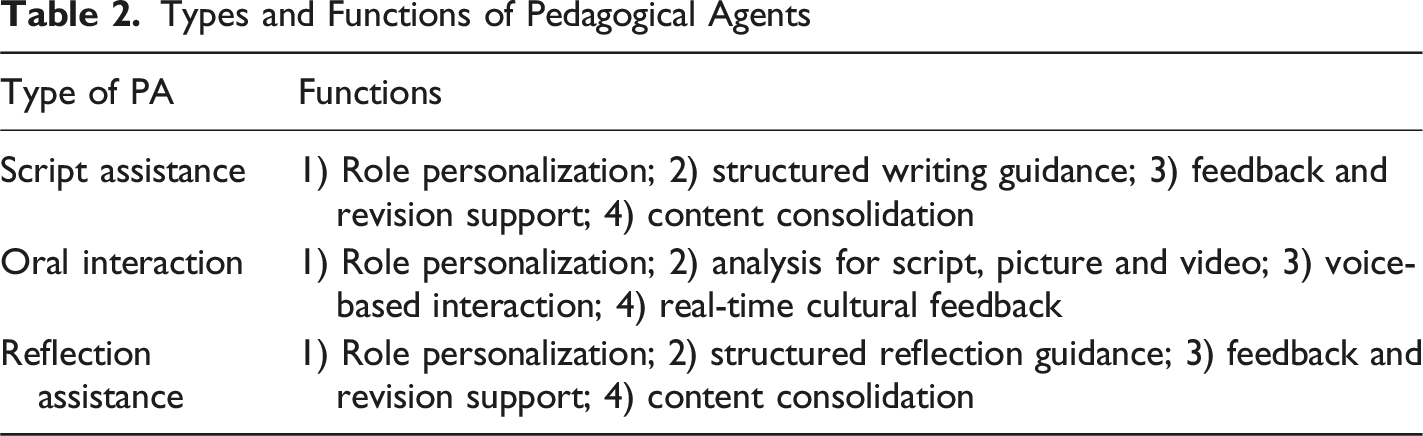
Our choice to utilize PAs in this study was based on their affordances. These agents provide precise, individualized guidance by leveraging AI technologies, addressing challenges such as the limited availability of teachers, who must manage 68 participants from three countries in this study. Unlike teachers, who are constrained by class time and the large number of students, PAs are available 24/7 and can provide one-on-one assistance. Additionally, PAs offer adaptive feedback, track student progress, provide multilingual support, and ensure consistent instruction, enhancing engagement and personalized learning experiences. In the interactions between students and PAs, all communication, whether text-based or voice-based, was conducted in English.
PA support was primarily provided for script creation (e.g., self-introductions, AI applications in cultural contexts, innovation and entrepreneurship, and reflections) and for facilitating the learning process during the viewing of immersive cultural content. For script creation, first, instructional guidance was provided to the agents, enabling them to assist students step by step in developing their scripts for cultural introduction videos. The agents offered clear and precise directions, eliminating the need for teachers to manually guide every student. After scripts were created, PAs performed content checks, ensuring the accuracy and completeness of the information presented in student scripts. For instance, the agents evaluated whether scripts adhered to cultural themes, included relevant details, and met word count requirements. In addition, PAs assessed the quality of cultural content presented in scripts, providing feedback on clarity and informativeness, and language use, particularly in ensuring accuracy and fluency as students wrote in a foreign language. Through scaffolding, PAs inspired students with ideas for script creation and provided links to supplementary information, such as more specific and meaningful details when introducing cultural festivals (e.g., historical significance, unique traditions) or highlighting AI applications in specific cultural contexts (e.g., AI-driven translation in multilingual communities, AI-assisted heritage preservation).
During the viewing of immersive cultural content, PAs facilitated real-time student learning. They were instructed to guide students by analyzing immersive content and scripts, summarizing key information to enhance understanding of the background and central concepts presented in the 360-degree videos. PAs also helped students grasp new and unfamiliar cultural and technological themes by offering clear explanations and contextualizing complex ideas. Additionally, they answered students’ questions, fostering interactive engagement and providing immediate, personalized feedback to reinforce learning.
PA for Script Assistance
First, the role assignment involved the PA introducing itself as a study partner, tailoring its identity to the student’s location and cultural context to foster engagement. For example, when interacting with Chinese students, the PA identified itself as “Linlin”, while for students from Northern Cyprus, it introduced itself as “Eylül”. This personalized role alignment aimed to enhance relatability and engagement during the learning process.
Second, the rule-based writing guidance was implemented through the PA’s structured framework, which guided students step-by-step in creating their scripts while ensuring adherence to specific requirements, such as word count and quality standards. After completing a section, the PA reviewed the content, identifying any redundancies or inconsistencies, and provided targeted feedback. Students were prompted to revise their work based on this feedback.
Third, the cohesion and finalization stage involved the PA compiling the completed script into a cohesive document, providing students with the opportunity to request refinements while maintaining their active involvement in content creation. The PA was capable of polishing the language of the script; however, students were not permitted to request content generation, reinforcing the emphasis on active student participation in the learning process.
PA for Oral Interaction in VR Environments
First, the role configuration for this PA was identical to that of the PA designed for script writing, aligning its identity with the student’s cultural and contextual background to foster engagement.
Second, the script cohesion and video analysis involved the PA prompting students to submit their scripts and screenshots of the videos they had viewed. The PA then analyzed these materials and activated its voice feature to deliver a spoken summary of the content, ensuring that students effectively grasped the key ideas.
Third, the real-time feedback in VR environments allowed students to interact directly with the PA while watching videos using VR headsets. Students could ask questions about cultural aspects from other countries, and the PA responded with detailed, topic-specific explanations. For example, when a student from Northern Cyprus inquired about the application of robotics in China, the PA provided comprehensive information on its diverse uses, enriching the student’s understanding of the topic. Additionally, when students encountered unfamiliar local terms introduced by foreign peers or came across concepts, they did not understand in the VR content, they could ask the AI agent in real time. The PA then clarified these terms, ensuring a deeper comprehension of the material.
PA for Reflection in Learning Activities
First, the rule-based reflection guidance involved the PA providing a structured, three-part framework to guide students through the reflection process. Each part of the reflection included specific requirements, such as a minimum word count of 60 words and quality benchmarks to ensure depth and relevance. If a student’s reflection was overly simplistic or lacked sufficient detail, the PA prompted them to elaborate further, helping them enrich their responses.
Second, the cohesion and finalization process occurred after students had completed all three parts of the reflection. The PA asked whether additional revisions or elaborations were necessary. If students indicated that no further changes were needed, the PA concluded the interaction, marking the reflection process as complete.
Cross-Cultural Learning Activity Design
This study was conducted over the course of a semester as part of the AI in Education course. Professors specializing in educational technology shared knowledge on AI and its ethical implications, including topics such as robotics and computer vision technologies. During the research period, participants from the three countries were supported by two instructors through a combination of online and offline interactions. The instructors facilitated online discussions and ensured active student participation in cultural information exchange activities. Additionally, a project manager oversaw the implementation and progress of the activities, encouraged online collaboration among teachers from the three countries, and provided constructive feedback and recommendations. All instructors focused on supporting student engagement in learning activities related to AI, its applications within cultural contexts, and cultural information exchange.
The research process is illustrated in Figure 3. Prior to the learning activity, researchers recruited a total of 68 participants. During the first two weeks, the researchers introduced the technologies employed in the study, including Insta 360 cameras, PAs, and VR headsets. They explained the functionality of these tools in detail and demonstrated how they supported the learning activities. Following this, researchers administered questionnaires and conducted interviews with all participants. Cross-cultural learning activity design
In the third and fourth weeks, participants interacted with the PA for script writing in English to create video scripts, which included two sections: self-introduction and local culture with AI applications. For the self-introduction, participants provided details such as their name, nationality, city, university, major, hobbies, interests, and daily life. Subsequently, students recorded 360-degree videos of their self-introductions based on the script content.
In the fifth and sixth weeks, participants selected one of ten cultural themes they were interested in (e.g., festival, tradition, historical building, handicraft, etc.). Under the guidance of the PA for script writing, each participant prepared a detailed description of the selected cultural topic and discussed the application of AI within that cultural context. Following their interactions, the PA consolidated a script for each participant based on their discussions. Using the developed script, participants recorded culture-related 360-degree videos with Insta 360 devices at locations reflective of their cultural backgrounds.
In the seventh week, participants exchanged all videos through a cloud platform. Priority was given to pairing videos on similar themes from two countries for exchange and viewing. Participants could also choose videos that matched their personal interests. This ensured that all ten cultural themes from each country were viewed by international peers. For instance, a Chinese participant (ID 5) created a video about the qipao (traditional clothing), while their Northern Cypriot partner introduced traditional clothing from their country. These videos were paired and exchanged for mutual viewing.
In the eighth week, prior to viewing their partner’s videos, participants submitted their scripts and video screenshots to the PA for oral interaction. The PA analyzed visual elements (e.g., the environment) and summarized the video scripts to prepare students for viewing. Participants then used VR headsets to watch videos created by their foreign peers. During this process, the PA for oral interaction was integrated into the VR environment to assist with cross-cultural learning by providing real-time feedback to enhance participants’ understanding, as illustrated in Figure 4. For example, when Chinese students watched a video created by Northern Cypriot students and noticed the sea, they asked the PA for additional information about Northern Cyprus’s geographical location. Interactions between students and PA in VR environments
In the ninth week, under the guidance of the PA for reflection, students reflected on their cross-cultural learning activities, critically evaluating what they had learned. For example, participants considered whether their global AI literacy had improved and whether exposure to foreign cultures had inspired innovative ideas. Upon the completion of the cross-cultural learning activities, researchers conducted questionnaires and interviews with all participants to gather comprehensive feedback and insights.
Data Collection and Analysis
A mixed-methods approach was employed to collect data, incorporating questionnaires, interviews, and reflections. Cultural concepts are often abstract and general, making it challenging to design effective evaluation methods based solely on qualitative interviews and observations (Deardorff, 2006; Gao et al., 2021). As such, a combination of quantitative and qualitative methods is considered the most effective approach to assess cultural learning outcomes.
Global AI Literacy
To address RQ1, global AI literacy was measured based on Bloom’s taxonomy in terms of AI knowledge (remembering level), AI understanding (understanding level), and AI application in various cultural contexts (applying level). The dimension of global AI literacy in this study was operationalized through the contextualization of students’ responses, which required them to describe AI use across different cultural settings (e.g., comparing local and foreign practices) rather than through separate cultural subscales. In this study, we did not consider other levels of the Bloom’s taxonomy such as analyzing, evaluating, and creating because learning activities were designed to assess foundational knowledge and understanding of AI concepts rather than engaging students in tasks that required more complex cognitive processes. The activities in this intervention were centered around acquiring basic AI knowledge, comprehending cultural contexts, and applying AI in real-world scenarios, which did not necessitate analysis, evaluation, or creation of new concepts or solutions. This approach was aligned with the objectives of the study, which aimed to develop students’ fundamental AI literacy rather than fostering advanced cognitive skills.
We evaluated students’ global AI literacy through interviews conducted both before and after the learning activities. The pre- and post-interviews consisted of open-ended questions that required students to describe events in which they used AI in their learning or daily life. For instance, students shared their knowledge and understanding of AI technologies or described their comprehension of AI applications in different cultural contexts. Participants were specifically asked to describe distinct events for the pre- and post-assessments.
We used concepts as the coding unit and adopted a three-point scale for assessing global AI literacy to deepen the interpretation. A score of “1” represented the remembering level (i.e., recalling learned content), “2” indicated the understanding level (i.e., comprehending learned content), and “3” denoted the applying level (i.e., applying acquired knowledge to new situations). For example, a student demonstrating that AI can be used for language translation and editing was assessed at the remembering level (score of 1). Few students initially demonstrated deeper understanding (understanding level), but after the learning activities, many students progressed to applying their knowledge of AI to solve problems in cultural contexts (applying level, score of 3).
Two coders independently scored responses (inter-rater reliability, Cohen’s κ = .86). Prior to formal coding, both coders received training on the coding scheme. Before initiating the coding process, the coders engaged in joint discussions of sample responses and calibration exercises to ensure a shared understanding of the coding criteria. The coding process involved two rounds. In the first round, coders independently assigned scores based on Bloom’s taxonomy levels. In the second round, discrepancies were reviewed and resolved through discussion until consensus was reached. Thematic analysis was then conducted to identify recurring patterns, such as “tool familiarity” (remembering) and “problem-solving” (applying).
Innovation and Entrepreneurship
To address RQ2, quantitative data were gathered through two questionnaires, both based on a five-point Likert scale and adapted from validated instruments (see Supplementary Materials). The questionnaire on innovation and entrepreneurship, adapted from Shadiev et al. (2022), included two sub-dimensions: innovation (12 items) and entrepreneurship (15 items). In line with conventional standards in educational research, statistical significance was set at p < .05, while results reaching p < .01 were reported as stronger evidence of significance.
Perceptions of Technologies
To address RQ3, the questionnaire on perceptions of technologies assessed two aspects: sense of immersion (17 items), adapted from Hudson et al. (2019), and perceived credibility of AI (6 items), adapted from Gong and Nass (2007).
The internal consistency of questionnaires was evaluated using Cronbach’s alpha. Each demonstrated high reliability, with values ranging from 0.926 to 0.948.
Semi-Structured Interviews
To gain qualitative insights into our three research questions, one-on-one semi-structured interviews were conducted both before and after the learning activities. The interview guide is provided in the Supplementary Materials. The interviews were held in person, with all 68 participants engaging in the sessions. Each interview lasted approximately 30 minutes, providing ample time for participants to reflect on their learning and provide detailed responses. The interviews were recorded with participants’ consent, transcribed verbatim, and analyzed by three researchers to ensure rigorous and systematic data analysis.
The aim of the interviews was to explore the feasibility and impact of using VR and AI to enhance global AI literacy, innovation, and entrepreneurship. Through open-ended questions, participants were encouraged to share their thoughts on how AI could be applied in diverse cultural contexts. Examples of the questions include: (1) What specific AI skills have you developed that you believe are most relevant when working in diverse cultural contexts? (2) How do you feel your innovation and entrepreneurship skills have evolved in an intercultural context?
The responses were then analyzed using thematic analysis, with codes derived from the interview data to identify key themes and patterns related to AI literacy, innovation, and intercultural skills development. By triangulating the interview findings with the quantitative data, we were able to gain a more comprehensive understanding of the impact of VR and AI on participants’ learning outcomes.
Reflection
To further explore participants’ perspectives on our three research questions, reflections (see Supplementary Materials) derived from participants’ interactions with the PAs were analyzed to evaluate their levels of global AI literacy, innovation, and entrepreneurship, as well as their perceptions of the technologies used.
To address the absence of a control group, this study employed a mixed-methods approach, integrating quantitative data from questionnaires with qualitative insights from semi-structured interviews and reflective reports to evaluate students’ learning gains attributable to the experimental intervention. While the lack of a control group limits direct comparisons with a non-intervention baseline, the triangulation of these diverse data sources provides robust evidence linking observed improvements in global AI literacy, innovation, and entrepreneurship to the integration of VR and PAs (Jack & Raturi, 2006). For instance, students’ reflective reports consistently highlighted specific gains in application of AI and innovative thinking, directly tied to the immersive and adaptive features of the intervention, rather than general learning effects. Although a control group would strengthen causal inference, the multi-faceted nature of our data mitigates this limitation by offering a comprehensive assessment of the intervention’s impact, aligning with established mixed-methods frameworks (e.g., Creswell & Creswell, 2017).
Results
We assessed the normality of the data distribution for global AI literacy as well as innovation and entrepreneurship using the Shapiro-Wilk test. This test is widely employed in educational research to evaluate the assumption of normality for small to moderate sample sizes (Zygmont, 2023). The results indicated that the data for global AI literacy did not follow a normal distribution (p < 0.05), whereas the data for innovation and entrepreneurship met the normality assumption (p > 0.05).
Accordingly, we employed the Wilcoxon signed-rank test to evaluate improvements in global AI literacy. As a non-parametric alternative to the paired-sample t-test, the Wilcoxon test is appropriate when the assumption of normality is not met and is commonly employed in educational research to explore deviation from normality in paired data (Taheri & Hesamian, 2013). In contrast, the paired-sample t-test was applied to analyze changes in innovation and entrepreneurship. The t-test is a standard parametric method used to assess whether the mean differences between two related groups are statistically significant under the assumption of normality (Okoye & Hosseini, 2024). This combined approach ensured the robustness and validity of our statistical analyzes.
Improving Global AI Literacy through PA- and VR-Supported Cross-Cultural Activities
The Difference Between students’ Global AI Literacy on Pre- and Post-test
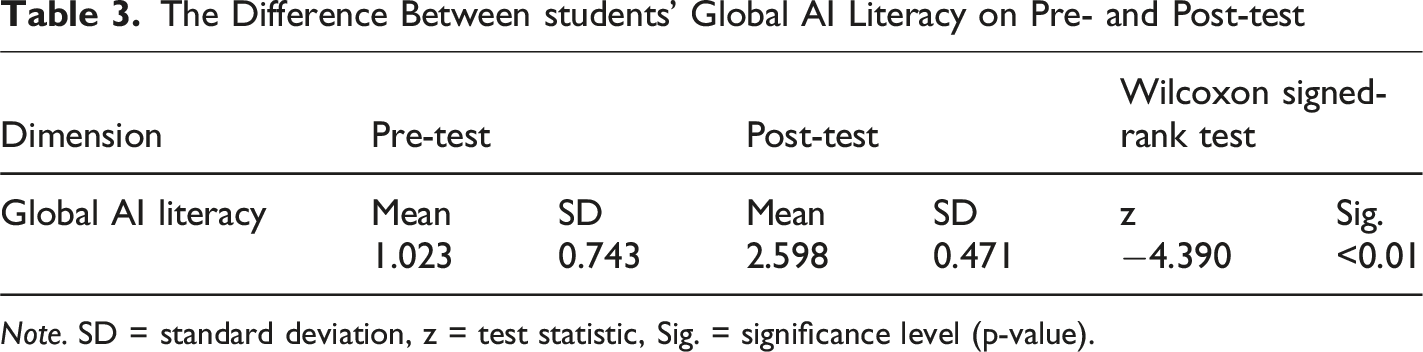
Note. SD = standard deviation, z = test statistic, Sig. = significance level (p-value).
The cognitive process level in the post-test (M = 2.598, SD = 0.471) was notably higher than that in the pre-test (M = 1.023, SD = 0.743). Statistical analysis revealed a significant difference, z = −4.390, p < 0.01. The effect size calculation further demonstrated a substantial difference in cognitive process levels between the pre- and post-tests, r = 0.79. These results suggest that integrating interactive AI PAs in VR environments to support cross-cultural learning activities is highly effective in enhancing students’ global AI literacy across all dimensions.
Key Themes of Global AI Literacy (RQ1) From Qualitative Analysis

Improving Innovation and Entrepreneurship through PA- and VR-Supported Cross-Cultural Activities
Differences in innovation and entrepreneurship

Note. SD = standard deviation, CI = confidence interval, t = t statistic, Sig. = significance level (p-value).
Key Themes of innovation and entrepreneurship (RQ2) From Qualitative Analysis

Positive Perceptions of Technologies Used in Cross-Cultural Activities
Results of technology Perception
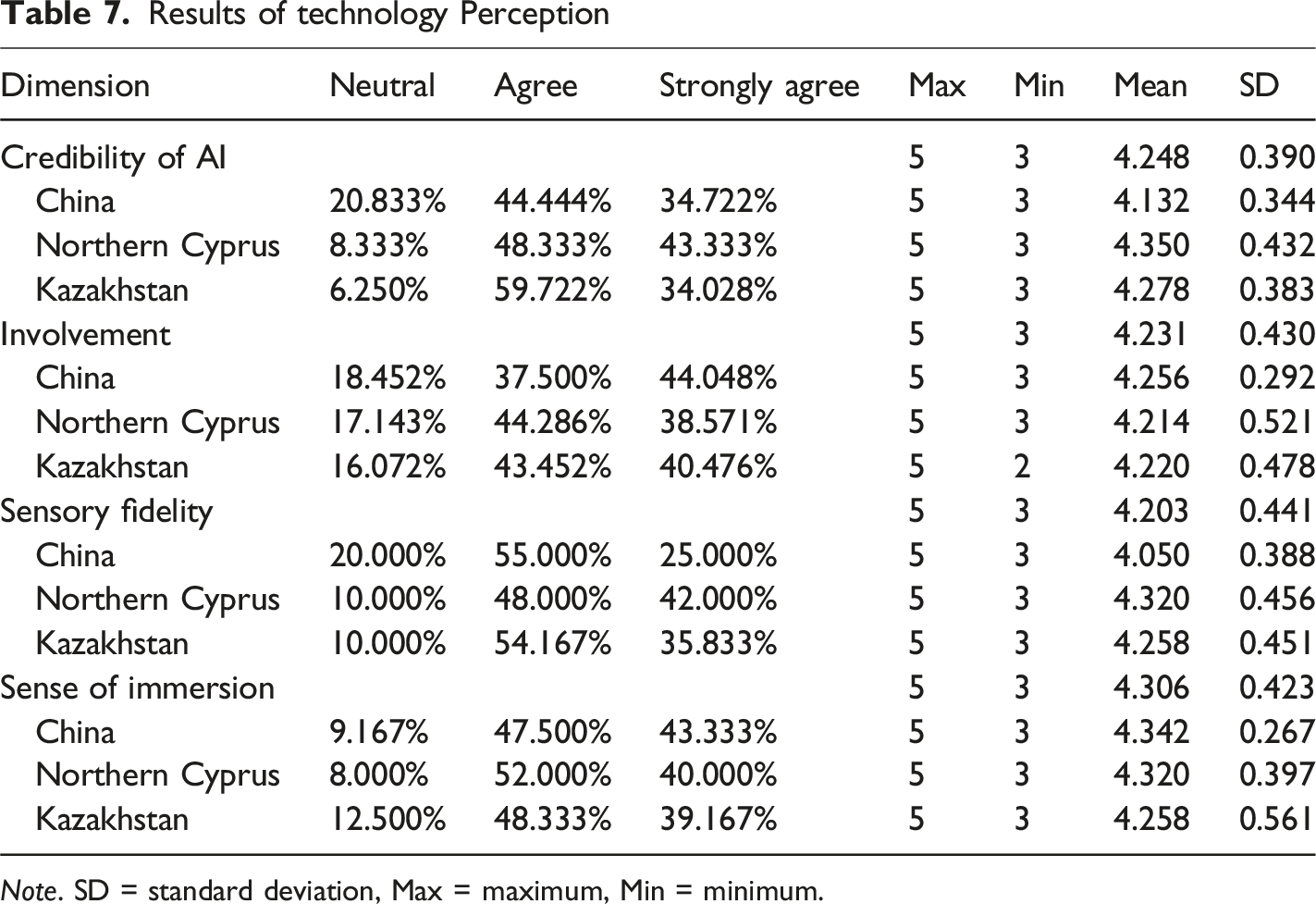
Note. SD = standard deviation, Max = maximum, Min = minimum.
The credibility of AI dimension showed a mean score of 4.248 (SD = 0.390), suggesting a relatively high level of confidence in the PAs used in the study. Notably, over 80% of participants across all three countries rated the credibility of PAs as high. In the involvement dimension, participants reported a mean score of 4.231 (SD = 0.430), suggesting active engagement during the learning activities. More than 80% of participants perceived their level of involvement in the interactive VR environment as above average. Similarly, the sensory fidelity dimension, which measures the realism of sensory input, achieved a mean score of 4.203 (SD = 0.441), highlighting the immersive and realistic nature of the virtual reality environment. A majority of participants expressed agreement or strong agreement regarding the high sensory fidelity of the system. Lastly, the sense of immersion dimension recorded the highest mean score at 4.306 (SD = 0.423), indicating that participants experienced a highly immersive environment during the activities. Only about 10% of students held a neutral stance toward their sense of immersion, while the vast majority rated it positively.
Key Themes of technology Perceptions (RQ3) From Qualitative Analysis

Discussion and Implication
This study designed cross-cultural learning activities grounded in the cognitive levels of Bloom’s taxonomy. Through these activities, students were able to gain foundational knowledge of AI, innovation, and entrepreneurship, and begin to develop an understanding of these concepts. They applied the acquired knowledge in diverse cultural contexts and engaged in analysis and synthesis within these scenarios, integrating insights from different cultural perspectives. Finally, students reflected on and evaluated their progress in terms of global AI literacy, innovation, and entrepreneurship, which may have contributed to further deepening their learning.
Understanding the Effect of Cross-Cultural Learning on Global AI Literacy
Concerning RQ1, our findings suggest that participation in PAs and VR-supported cross-cultural learning activities was associated with observed gains in global AI literacy. This result aligns with the studies of Li et al. (2024) and Tafazoli (2024b), which demonstrated the benefits of large language models and VR in cross-cultural learning contexts. However, our study differs in that it encouraged students to utilize PAs for cross-cultural information exchange and integrated PAs into VR environments to potentially facilitate deeper engagement with foreign cultures, which may have contributed to enhancing global AI literacy.
The observed patterns may be related to the instructional design grounded in Bloom’s cognitive taxonomy. During the study, students gained foundational knowledge of AI, such as the typical applications of computer vision technologies in their local context. Expert-led lectures provided students with a deeper understanding of the principles and mechanisms behind AI technologies. Building on this foundation, students were able to analyze and synthesize information generated through interactions with PAs to complete cross-cultural learning activities. This process may have supported students’ understanding of AI and its applications in cultural contexts, particularly in relation to applying PAs to cultural learning tasks. After viewing 360-degree videos created by peers from other countries, students engaged in reflective interactions with PAs to evaluate the development of their global AI literacy. This reflective practice not only deepened their understanding of AI applications but also allowed them to critically assess their progress in leveraging AI within cultural contexts.
Specifically, AI knowledge demonstrated significant gains following the PA- and VR-supported cross-cultural learning activities. This finding aligns with the principles of constructivist learning theory, which emphasizes that learners construct knowledge more effectively when they engage in authentic, context-rich environments (Hwang et al., 2026; Narayan et al., 2013; Wang et al., 2025). In this study, the VR environment provided students with immersive and experiential opportunities to explore AI applications in various cultural contexts. By interacting with real-world examples, such as the use of computer vision or robotics in different countries, students were able to connect theoretical AI concepts to their practical applications. Through these activities, students bridged the gap between theoretical knowledge and practical implementation, thereby reinforcing this dimension of their global AI literacy.
AI skills demonstrated statistically significant growth following participation in the learning activities. Previous research has also highlighted the effectiveness of using AI tools or AI agents in classrooms to enhance students’ AI skills (Morandini et al., 2023; Ng, Lee, et al., 2023). However, unlike these prior studies, our study engaged students with PAs designed for specific functions, enabling them to complete tasks such as writing cultural video scripts. Furthermore, students interacted with PAs integrated into VR environments, which not only provided deeper insights into foreign cultures but also enriched their understanding of AI concepts and their practical applications in diverse cultural contexts. Across these learning activities, students appeared to develop greater proficiency in applying AI tools to solve problems encountered during the learning process.
In the cross-cultural learning experiences, students reported statistically significant gains in their AI attitudes. They also expressed a keen interest in experimenting with various types of AI systems. Previous research has demonstrated the positive learning experiences provided by VR environments, such as in gamified learning (Derakhshan et al., 2024) and language learning (Lin & Lan, 2015). Integrating PAs into VR environments appears to be associated with students’ positive attitudes toward AI usage. During interviews and reflections, students highlighted that this was their first time participating in such an innovative cross-cultural learning activity. They expressed openness to using AI to enhance cultural learning experiences, further reflecting students’ positive perceptions of this integration.
AI ethics, another critical dimension of AI learning, also showed statistically significant improvement over the study period. Previous studies suggest that ethics is closely related to the safe and responsible application of AI systems (Cheng et al., 2021; Murugan et al., 2025; Peters et al., 2020). In our study, students emphasized the importance of AI systems performing reliably and safely. Throughout the cross-cultural learning activities, students interacted with PAs to assist in script writing, rather than relying on the PAs to fabricate content. This specific configuration of the PAs was intended to reduce the likelihood of hallucinated content during interactions, reinforcing students’ understanding of ethical AI usage.
The results indicate a significant improvement in students’ ability to apply AI in cultural contexts, which may be related to two key factors. First, students interacted with PAs, which provided detailed, context-specific information on how AI is utilized within their own local cultures. Second, by watching 360-degree videos, students explored the applications of AI in foreign cultural contexts. These immersive experiences, combined with interactions with PAs in the VR environment, allowed students to acquire authentic and reliable information about the cross-cultural use of AI both domestically and internationally. While prior research has highlighted the role of AI in preserving and promoting intangible cultural heritage (Zhang & Jing, 2022), there has been limited exploration of how AI can be effectively integrated into immersive, cross-cultural learning environments to foster practical applications of AI. This study bridges the gap by integrating theoretical knowledge with practical applications, highlighting how students engaged with real-world problem-solving scenarios using AI. For instance, students learned how computer vision technology can be applied in systems like food delivery robots.
In summary, the findings of this study make a significant contribution to the field of global AI literacy education. By integrating PAs into cross-cultural learning environments and utilizing immersive VR technologies, this study demonstrates how AI literacy can be effectively cultivated in global contexts. Compared with previous studies that focused primarily on AI literacy in general, the use of PAs in this study not only facilitated students’ engagement with AI but also enabled them to apply AI concepts and skills in culturally diverse settings. This integration of technological proficiency with intercultural competence highlights the development of global AI literacy, which extends beyond technical knowledge to encompass the capacity to leverage AI responsibly and effectively across cultural boundaries.
Understanding the Effect of Cross-Cultural Learning on Innovation and Entrepreneurship
With respect to RQ2, participants engaged in verbal interactions with PAs to gain deeper insights into cultural differences, which may have inspired innovative ideas and been associated with the enhancement of their innovation-related thinking and entrepreneurship-oriented motivation. Our findings align with previous research, which highlights how technology and digitalization are reshaping entrepreneurial and innovation practices (Si et al., 2023). Both short-term and long-term courses utilizing AR and VR have been identified as new-age learning mechanisms that effectively prepare youth for innovation and entrepreneurship (Rath et al., 2019). For instance, education based on VR technology, guided by the theory of planned behavior, has been shown to significantly enhance students’ willingness to engage in innovation and entrepreneurship (Dong & Tu, 2021). This cross-cultural learning activity may have supported entrepreneurship-related outcomes primarily by strengthening motivational and cognitive precursors of entrepreneurial intention, rather than by directly developing entrepreneurial skills. Specifically, the combination of cross-cultural tasks, PA-supported guidance, and immersive VR experiences may have enhanced students’ perceived autonomy, competence, and confidence in applying ideas across unfamiliar contexts, which are core components emphasized in self-determination theory (Deci et al., 2017).
Our carefully designed learning activities introduced students to novel cultural contexts and the application of AI within these settings. This experiential learning approach, delivered through VR environments, illustrated how technology-supported methods may support the generation of creative ideas among students. On one hand, students were able to recognize the diverse applications of AI across different cultural scenarios from multiple perspectives. On the other hand, the cross-cultural learning framework sparked innovative thinking, such as the conceptualization of multi-technology integration applications.
The findings also highlight participants’ increased confidence and motivation toward entrepreneurship, with many expressing satisfaction in pursuing entrepreneurial endeavours. This can be understood through the lens of self-determination theory, which emphasizes the importance of intrinsic motivation in achieving personal growth and competence. The cross-cultural learning activities, supported by PAs in VR environments, were associated with students’ active engagement with real-world problems, and their reported sense of autonomy and accomplishment (Shadiev et al., 2026). For instance, by identifying innovative ideas and applying them within cultural and AI-related contexts, students perceived entrepreneurship as a fulfilling and achievable goal.
Overall, the findings suggest that the integration of PAs within VR-supported cross-cultural learning activities was associated with authentic opportunities for students to generate creative ideas, strengthen entrepreneurial confidence, and explore innovative solutions in culturally diverse settings. The carefully structured design of the learning activities, grounded in Bloom’s frameworks, ensured that students could actively connect AI applications with real-world cultural contexts.
Understanding the Positive Perception of Technologies Used in Cross-Cultural Activities
For RQ3, students expressed positive perceptions of the use of PAs and VR in the learning activities. Previous research has also highlighted predominantly favorable perceptions of VR and large language models when applied in educational settings (Jeon et al., 2024; Khukalenko et al., 2022; Lim et al., 2021). This study found that embedding PAs into VR environments was associated with more positive perceptions of technology use. The immersive and realistic experience provided by VR allowed students to feel as though they were truly present in a foreign country, engaging with its culture. Moreover, for almost all students, this was their first experience of engaging in cultural learning within a technologically rich virtual environment. The constant guidance and support provided by PAs within the VR environment contributed to their appreciation of the convenience and effectiveness of intelligent technologies.
Another important concern of this study is the creation of credible PAs. During configuration, clear boundaries and contextual backgrounds were established, tailored to the cross-cultural learning activities involving students from three countries: Kazakhstan, Northern Cyprus, and China. This approach significantly reduced the likelihood of PAs generating hallucinated content during interactions. As a result, students trusted the cultural knowledge provided by the PAs. Through ongoing dialogue, they were able not only to acquire factual knowledge but also to develop deeper understanding, analysis, and insights into foreign cultures.
Taken together, these findings provide a strong indication that students’ positive perceptions were not incidental but closely tied to the structured design of the intervention. The systematic integration of PAs and VR ensured consistency, credibility, and meaningful engagement, which enhances confidence in the robustness of the results. While further studies are needed to broaden the scope, the present evidence offers a reliable basis for understanding how intelligent technologies can shape learners’ perceptions in cross-cultural contexts.
Despite these encouraging findings, several alternative explanations should be considered when interpreting the results. First, although participants were drawn from three countries, formal subgroup comparisons were not conducted due to the limited sample size within each group. Second, as the intervention was embedded within a semester-long “AI in Education” course and no follow-up measures were collected, the persistence of the observed outcomes over time remains unclear (Shi et al., 2025). Finally, while the VR- and PA-supported activities constituted a distinct, task-centered component of the course, their effects cannot be fully disentangled from other instructional elements.
Conclusion and Limitations
To the best of our knowledge, most studies on technology-supported cross-cultural learning have primarily focused on enhancing participants’ cross-cultural competencies (e.g., Benson et al., 2017; Yeh et al., 2022), while overlooking the benefits brought by interactive AI PAs in immersive VR technologies. To address this gap, this study designed cross-cultural learning activities supported by interactive PAs in VR environments, with an emphasis on developing global AI literacy, innovation, and entrepreneurship. Our findings indicated that such cross-cultural learning activities were associated with statistically significant benefits in these areas, and students reported high levels of immersion and credibility in the PA- and VR-supported environments. Based on the findings, we propose three recommendations for cross-cultural learning initiatives.
This study extends Bloom’s taxonomy beyond its conventional use as a cognitive framework by embedding it within a sociotechnical model that integrates pedagogical agents, VR technologies, teachers, and cross-cultural learning tasks. This reconceptualization demonstrates how Bloom’s taxonomy can be adapted to guide the development of global AI literacy, where cognitive growth is intertwined with technological mediation and intercultural engagement. In doing so, the study advances theoretical discussions by positioning global AI literacy as not only knowledge acquisition but also the ability to apply AI meaningfully across diverse cultural contexts, thereby expanding the scope of Bloom’s taxonomy in the era of intelligent technologies.
Both educators and learners can benefit from our approach to enhance global AI literacy, innovation, and entrepreneurship. First, AI literacy should be cultivated on a global scale rather than being confined to localized contexts. Students should have opportunities to explore how AI technologies are applied in global settings, particularly through cross-cultural learning activities. By engaging in experiential learning that compares local and foreign cultural environments, students can identify meaningful innovation points while developing creativity and problem-solving skills. This globalized approach ensures that AI literacy is not only technically proficient but also culturally adaptable.
Second, enhancing the interactivity of PAs within immersive VR environments may help improve the effectiveness of cross-cultural learning. To maximize this benefit, students should be encouraged to actively engage with peers from diverse cultural backgrounds through interactive PAs in VR environments. Such dynamic exchanges help foster deeper understanding, critical analysis, and meaningful application of cross-cultural knowledge. While previous research on cross-cultural learning in VR environments has primarily relied on passive modalities such as 360-degree video (Gao et al., 2021; Shadiev et al., 2025), these approaches often lack real-time interactivity. By embedding AI-driven interactive PAs into VR environments, this study introduces a more interactive and responsive learning experience, addressing this limitation and promoting more authentic, student-centered engagement in intercultural contexts.
Third, incorporating a broader range of representative cultures into cross-cultural learning activities can further enrich the learning experience. Exposure to diverse cultural perspectives stimulates different thinking patterns, supporting students’ innovation and problem-solving abilities. In this study, participants from China, Kazakhstan, and Northern Cyprus, representing East Asia, Central Asia, and the intersection of Europe, Asia, and Africa, demonstrated how cultural diversity broadens perspectives and fosters global collaboration. Connecting students from various regions enables them to develop a more comprehensive worldview, which not only deepens cultural understanding but also enhances the potential for international innovation and entrepreneurial opportunities.
We recognize certain limitations in this study that warrant consideration. First, the lack of a control or comparison group constrains our ability to make direct comparisons between control and experimental groups. Moreover, the observed improvements may reflect a combination of students’ natural maturation over the semester and the effects of the intervention. In addition, the novelty of these technologies may have introduced a Hawthorne effect, whereby students’ enthusiasm stemmed from the newness of the tools rather than their instructional value. Future research could employ a more rigorous experimental framework by incorporating a control or comparison group, thereby allowing for a clearer attribution of intervention-related effects and a more comprehensive evaluation of the intervention’s impact on student outcomes.
Second, while AI technologies can enhance efficiency, innovation, and entrepreneurship, they also raise concerns about privacy and ethics. Balancing technological advancements with ethical considerations, while carefully controlling for such novelty effects, is critical (Murugan et al., 2025). Future research should place greater emphasis on exploring the ethical implications of AI applications in learning activities to ensure responsible and sustainable use of these technologies.
Third, it should be noted that the entrepreneurship questionnaire captured general entrepreneurial intention rather than task-specific entrepreneurial skills. Therefore, the observed changes are more appropriately interpreted as shifts in students’ entrepreneurial motivation and confidence following the learning experience, rather than direct evidence of skill acquisition. In addition, the use of a three-point coding scale aligned with Bloom’s taxonomy, while practical for capturing developmental progression, may have limited variance and may not fully capture more nuanced differences in students’ global AI literacy. Future studies could adopt more fine-grained rubrics or mixed-scale approaches to better reflect subtle developmental changes.
Finally, although participants were drawn from three countries, the overall sample size was relatively small, which may limit statistical power. In addition, the motivational effect of participating in an international project may also have contributed to the positive outcomes. This limitation may affect the generalizability of the findings. Future research could expand the study by including participants from a wider range of countries and cultural backgrounds to strengthen the representativeness and applicability of the results.
Credit Author Statement
Supplemental Material
Supplemental Material - Enhancing Global Artificial Intelligence Literacy, Innovation and Entrepreneurship Through an Exploratory Cross-Cultural Study: Interactions With Pedagogical Agents in Immersive Virtual Reality Environments
Supplemental Material for Enhancing Global Artificial Intelligence Literacy, Innovation and Entrepreneurship Through an Exploratory Cross-Cultural Study: Interactions With Pedagogical Agents in Immersive Virtual Reality Environments by Rustam Shadiev, Gaojun Shi, Fahriye Altinay, Roza Zhussupova, Yan Li, Kaili Lu, Nurassyl Kerimbayev in Journal of Educational Computing Research
Footnotes

Funding
This research was supported by the Fundamental Research Funds for the Central Universities of the People's Republic of China, and funded by the Innovation and Entrepreneurship Education Research Project of Zhejiang University, People's Republic of China.
Declaration of conflicting interests
The authors declared no potential conflicts of interest with respect to the research, authorship, and/or publication of this article.
Data Availability Statement
Data will be made available on request.
All authors have read and agreed to the published version of the manuscript. The co-authors wrote the manuscript under the supervision of the corresponding author. All authors read and approved the final manuscript.
Supplemental Material
Supplemental material for this article is available online.
Author Biographies
References
Supplementary Material
Please find the following supplemental material available below.
For Open Access articles published under a Creative Commons License, all supplemental material carries the same license as the article it is associated with.
For non-Open Access articles published, all supplemental material carries a non-exclusive license, and permission requests for re-use of supplemental material or any part of supplemental material shall be sent directly to the copyright owner as specified in the copyright notice associated with the article.
