







Abstract
This research aims to investigate pre-service mathematics teachers’ (PsMT) intention to use artificial intelligence (AI) technologies. Specifically, this study modified the technology acceptance model (TAM) for this investigation by including variables such as AI literacy, AI-TPACK, and AI self-efficacy. Utilizing a correlation cross-sectional design was the objective of the research. In Türkiye, data were collected from 696 PsMT at 13 universities and analyzed with covariance-based structural equation modeling. The results showed that intention to use AI is primarily determined by perceived usefulness, perceived ease of use, and attitude. Furthermore, AI literacy was less likely to be a predictor of behavioral intention than an antecedent that supports proximal constructs such as perceived usefulness, AI-TPACK, and self-efficacy. AI-TPACK provided support for perceived ease of use and self-efficacy, but not for perceived usefulness or behavioral intention directly. As a consequence, self-efficacy has helped students see AI tools as less intimidating and has cultivated a more positive attitude towards them. The findings indicate that acceptance of AI is a multidimensional process encompassing cognitive, pedagogical, and psychological dimensions, underscoring the importance of comprehensive learning experiences in Teacher Education Institutions that address these dimensions.
Keywords
Introduction
Artificial intelligence (AI)’s impact on social and economic life has increased significantly in recent years, owing to improved access and a growing range of tools (European Commission, 2023). The ability to interact successfully with AI has become a fundamental skill, requiring individuals to learn new techniques and reconsider their roles (Carolus et al., 2023; Wang et al., 2023).
The increasing influence of AI can be seen especially in education, where teaching methods have rapidly changed through the use of AI tools (Zhang & Aslan, 2021). Advances in deep learning and neural network architecture-based AI can be used to personalise learning, provide real-time feedback, predict performance, and assist the teacher’s actions (Chassignol et al., 2018; Chen et al., 2020; Yoon et al., 2024).
Mathematics education benefits from the considerable pedagogical potential of AI-supported tools. Mathematics is a subject that, by its very nature, requires abstraction, logic, and step-by-step instructions. Students often struggle to relate concrete representations to abstract mathematical ideas and to address conceptual gaps. As a result, students often view mathematics as a difficult subject (Chin et al., 2022; Gravemeijer, 2005; Mangarin & Caballes, 2024). Nonetheless, standard teaching methods may not always ensure immediate and adaptive support to remove such barriers. AI tools can support lessons by tailoring to student needs, providing individual, real-time feedback, and presenting information interactively (Selwyn, 2022; Son, 2024; Wu et al., 2023). More specifically, a transformation of static objects in geometry, algebra, and calculus into more interactive forms, such as AR/VR, dynamic mathematics software, or interactive visualization, can improve students’ attitudes toward mathematics and enhance their conceptual engagement (Awang et al., 2025; Gadanidis, 2017; Mohamed et al., 2022).
Even though the technology is available, a lot will depend on teachers, especially pre-service teachers (PSTs), who will shape future classrooms. The implementation of technology for educational purposes depends on its acceptance and adoption (Ma & Lei, 2024; Nikolopoulou et al., 2021; Pal & Patra, 2021). Since teacher-unsupported innovations rarely survive (Lin & Van Brummelen, 2021), it is important to understand the factors affecting PSTs’ intentions to adopt AI tools.
The Technology Acceptance Model (TAM) (Davis, 1989) is one of the most used models to explain an individual’s intentions to accept technology via core constructs perceived usefulness (PU) and perceived ease of use (PEOU) and attitude (ATT) (e.g. Khong et al., 2023; Teo, 2011; Zhang et al., 2023) The implementation of AI in schools depends not only on various cognitive acceptance variables, i.e. whether the teacher finds the tool useful and easy to use, but also on PSTs’ self-efficacy regarding AI, their competence to integrate those technologies pedagogically, and their AI literacy (e.g. Al Abdullatif, 2024; An et al., 2023; Ma & Lei, 2024).
Therefore, the current study broadens the TAM to incorporate self-efficacy (SE), AI-TPACK and AI Literacy. In this framework, SE refers to PSTs’ belief in their ability to use AI tools in instruction (Chou et al., 2024). In contrast, AI-TPACK indicates their capacity to employ and integrate AI tools in mathematics instruction in pedagogically meaningful ways (Celik, 2023). AI literacy is a primary form of readiness. It describes the ability to understand and evaluate AI systems and use them in an ethically informed way (Long & Magerko, 2020; Ng et al., 2021).
Although some of these constructs had been studied individually or in limited combinations, there has been little research that addresses these variables in a single model and considers their interrelationships in relation to AI, especially for pre-service mathematics teachers (e.g., Al Abdullatif, 2024; Choi et al., 2023; Li, 2025). This gap is particularly significant in the context of mathematics education, as the teaching of mathematics involves a structure that places high cognitive demands due to abstract concepts and complex problem-solving processes (Phan et al., 2017; Wakhata et al., 2023). In this context, Celik (2023) and Santos-Trigo (2024), for instance, held that their functional characteristics do not exclusively determine the educational value of these tools. However, they also have pedagogically appropriate uses to support conceptual understanding and reasoning, problem-solving, and real-time feedback. Use of these tools requires PSTs to have not only strong self-efficacy beliefs about the effectiveness of these tools, but also sufficient AI literacy; that is, the ability to understand, critically evaluate, and use AI in an ethical way (Long & Magerko, 2020; Ng et al., 2021).
In light of this theoretical and empirical gap, the current study proposes an integrated model of pre-service mathematics teachers’ (PSMTs) intention to adopt AI tools in Mathematics, showing how AI literacy, SE, and AI-TPACK together contribute to this intention. In essence, the study seeks to offer a more context-specific and theory-informed account of AI adoption in teacher education.
Theoretical Framework and Hypothesis Development
TAM Constructs
The Technology Acceptance Model (TAM) based on Fishbein and Ajzen’s Theory of Reasoned Action (TRA, 1975) explains the individuals’ intention to adopt (Davis, 1989). Perceived Usefulness (PU), Perceived Ease of Use (PEOU), Attitude Toward Use (ATT) and Behavioural Intention (BI) are the four constructs under the study. PU indicates that using a system will improve one’s performance while PEOU relates to the sense that it requires little effort (Davis, 1989). The way we perceive something impacts how we feel about it. Studies have shown that what they believe about education affects teachers’ integration of digital technologies into instruction (Al Abdullatif, 2024; Eickelmann & Vennemann, 2017; Gurer and Akkaya, 2021; Ibili et al., 2019; Mailizar et al., 2021).
The proposed model of TAM has expanded beyond its original boundaries through the introduction of TAM2 (Venkatesh & Davis, 2000), UTAUT (Venkatesh et al., 2003), and TAM3 (Venkatesh & Bala, 2008). Nonetheless, PU, PEOU, and ATT remain important predictors of technology use (Marangunić & Granić, 2015). Empirical research has shown that PU and PEOU are powerful determinants of teachers’ attitudes or intentions towards technology use (Al Darayseh, 2023; Gado et al., 2022; Zhang et al., 2023) and that PU has the more powerful of the two effects (Baydaş & Göktaş, 2017; Teo et al., 2009; Teo, 2012). In the TAM, PEOU enhances attitude and intention by lowering perceived effort. In contrast, PU enhances attitude and intention by increasing expected performance (Davis, 1989). It has been consistently observed that these pathways exist in educational contexts (Al Darayseh, 2023; Gado et al., 2022). In this study, TAM has used not as primary source of theoretical originality, but as a fundamental conceptual framework enabling the assessment of the explanatory contribution of AI-specific variables. Consequently, the inclusion of classical TAM relaationships in the model aims not so much to revalidate TAM, but rather to highlight the additional contribution made by constructs such as AI literacy, AI-TPACK and self-efficacy in explaining PSTs’ intention to adopt AI tools.
Based on these theoretical and empirical foundations, the following hypotheses are proposed:
PsMTs’ PU of AI technologies significantly predicts their BI to use them.
PsMTs’ PU of AI technologies significantly predicts their ATT toward using them.
PsMTs’ PEOU of AI technologies significantly predicts their BI to use them.
PsMTs’ PEOU of AI technologies significantly predicts their ATT toward using them.
PsMTs’ PEOU of AI technologies significantly predicts their PU.
PsMTs’ ATT toward AI technologies significantly predict their BI to use them
The Role of AI Literacy
In the 21st century, AI literacy is an essential digital competence that prepares people for future societal needs (Lee et al., 2021; Long & Magerko, 2020; Yang, 2022). Kandlhofer et al. (2016) coined the term to highlight the importance of understanding the principles underlying AI technologies. Currently, AI literacy refers to a set of competencies that enable individuals to use AI tools competently and responsibly; to think critically and creatively about AI systems; and to participate in digital society actively (Kong et al., 2022; Ng et al., 2022; Wang et al., 2023). While AI technologies can form part of a broader umbrella of digital technologies, AI literacy differs from digital literacy. This is because AI draws on a wide range of disciplines, including computer science, mathematics, psychology, sociology, linguistics, and philosophy (Russell & Norvig, 2003). In fact, much like computer and digital literacy, AI literacy does not require people to gain expertise in AI theories or technology; instead, it focuses on the ability to use AI products competently and responsibly (Wang et al., 2023).
Educational contexts have become the focal point of AI-literacy discussions. Integrating AI into teaching has heightened interest in this competency (Wang et al., 2023). Within this framework, in the context of teacher education, PSTs are expected not only to adopt emerging technologies but also to identify appropriate AI tools, use them ethically, and evaluate their suitability for instructional purposes.
At this point, it is important to clarify the conceptual distinction between AI literacy and AI-TPACK. While AI-TPACK represents a specialized professional framework that enables teachers to determine how to structure the affordances of AI (e.g., personalized learning pathways, automated assessment, or student monitoring) for pedagogical purposes within their discipline (Ning et al., 2024; Celik, 2023), AI literacy involves informing individuals, at a general level, about the functioning, use, evaluation, and ethical dimensions of AI systems. Therefore, in this study, AI literacy refers to PSMTs’ ability to recognize, use, evaluate, and engage with AI technologies critically and ethically.
Research shows that AI literacy improves learners’ knowledge, attitudes, and confidence in using AI (Du et al., 2024; Su & Yang, 2024). This kind of competence is particularly important in mathematics education, where PSMTs are expected to identify an AI tool that meets their learning goals, use it ethically, and evaluate an AI-generated explanation, representation, and solution in terms of their mathematical accuracy, reliability, and pedagogical appropriateness. According to this framework, AI literacy is assumed to directly determine PSMTs’ self-efficacy, AI-TPACK, PU, PEOU, and BI. Thus, AI literacy is deemed a precursor construct that shapes their cognitive, pedagogical, and behavioral orientation toward AI.
In accordance with this conception, AI literacy also influences PU as it enables users to understand AI’s advantages and limitations, evaluate tools critically and appreciate their advantages (Laupichler et al., 2022) If teachers develop a better understanding of AI concepts, they can acknowledge its potential in learning and teaching – such as personalized learning and efficient assessment – thereby increasing its perceived usefulness (Jang, 2024; Pan et al., 2025; Qi et al., 2025). Conversely, other studies did not establish a significant association (Al Abdullatif, 2024).
AI literacy may also shape PEOU. Teachers with higher AI literacy generally find AI systems more intuitive, experience fewer difficulties, and perceive them as less complex (Al Abdullatif, 2024; Pan et al., 2025). With a higher level of literacy, one can understand what the system does. It will help the customer use and adopt the system effectively (Jang, 2024; Qi et al., 2025). Contextual moderation may be occurring, according to some studies that report no direct effect (Al Abdullatif, 2024).
Beyond PEOU, AI literacy may also help in the development of an AI-TPACK, which enables teachers to link AI tools with pedagogy and content knowledge (Celik, 2023). The foundational understanding provided by AI Literacy guides its practical application. Improving the technological aspect of TPACK, AI literacy helps teachers select tools in alignment with pedagogical goals and maximise their instructional value (Kong et al., 2022). According to Al Abdullatif (2024), teachers who are proficient in AI literacy have better understanding which enables them to use AI tools more meaningfully in bigger contexts.
Also, the self-efficacy of PSTs in artificial intelligence use can be strengthened through AI literacy. According to Bećirović et al. (2025) and Lim (2023), AI literacy is a strong predictor of self-efficacy because digital literacy enhances teachers’ self-efficacy. AI literacy combines subject knowledge, practical skills and pedagogical knowledge to enable PSTs to apply AI tools effectively. Integrating AI into instruction involves developing teachers’ capacity and has become increasingly essential.
In conclusion, these cognitive, pedagogical, and self-efficacy–based effects of AI literacy may also be reflected in PSMTs’ intentions to adopt and use artificial intelligence. In this regard, AI literacy determines individuals’ readiness to adopt AI (Wang et al., 2023) and predicts teachers’ effective use of AI in classrooms (Jang, 2024; Schiavo et al., 2024). Still, findings are mixed: some report no direct link to behavioral intention (Wang et al., 2025), whereas others reveal indirect effects (Qi et al., 2025).
PsMTs’AI literacy levels significantly predict their BI to use AI technologies
PsMTs’AI literacy levels significantly predict their PEOU of AI technologies.
PsMTs’AI literacy levels significantly predict their PU of AI technologies.
PsMTs’AI literacy levels significantly predict their AI-TPACK levels.
PsMTs’AI literacy levels significantly predict their AI self-efficacy.
The Role of AI-TPACK
TPACK, which refers to teachers’ competence in integrating technology into instruction (Koh et al., 2013), has evolved considerably since Shulman introduced the concept of pedagogical content knowledge. By merging technological, pedagogical, and content knowledge, it supports the design of effective teaching strategies (Mishra et al., 2023; Mishra & Koehler, 2006). In mathematics education, TPACK plays a crucial role in integrating digital technology due to its flexibility across various contexts and tools (e.g., Kadıoğlu-Akbulut et al., 2023; Li & Nugraha, 2025; Sofyan et al., 2023).
The rise of AI in education has prompted a reevaluation of the intersection of technology, pedagogy, and content (Ning et al., 2024). To capture teachers’ competence in this new context, the framework has been extended as AI-TPACK (Ning et al., 2024; Celik, 2023). AI-TPACK assesses teachers’ ability to select, apply, and integrate AI tools in line with pedagogical aims (Hava & Babayiğit, 2025; Celik, 2023). At this point, it is important to distinguish AI-TPACK from AI literacy. While AI literacy refers to a more general readiness to understand, evaluate, and use artificial intelligence ethically, AI-TPACK specifically denotes the capacity to integrate AI tools into the instructional process in pedagogically meaningful ways.
Recent research identifies TPACK and the TAM as complementary perspectives for examining the integration of digital technology in education (Hsu, 2016; Joo et al., 2018; Li, 2025; Mailizar et al., 2021). While TPACK focuses on the interaction of technological, pedagogical, and content knowledge (Mishra et al., 2023), TAM explains teachers’ perceptions and attitudes toward adopting technologies, such as online teaching platform or AI-based tools (Al Abdullatif, 2024; Khong et al., 2023). Within this framework, an educator who is competent in AI-TPACK may be more inclined to perceive AI tools as more accessible and easier to use. In addition, as they develop a clearer understanding of how these tools can be integrated with instructional strategies, they are better able to evaluate their concrete contributions to supporting instructional processes, enhancing student engagement, and improving performance, and thus perceive them as more useful (Al Abdullatif, 2024; Runge et al., 2025).
Empirical studies show that teachers’ or PSTs’ AI-TPACK levels significantly predict PEOU, PU, and overall acceptance (An et al., 2023; Sun et al., 2024). However, results across contexts are inconsistent. Runge et al. (2025) revealed that PSTs’ AI-TPACK levels had a direct effect on PEOU and PU of AI technologies but no significant effect on behavioral intention. Al Abdullatif (2024) reported that AI-TPACK had a direct effect on PEOU, but did not have a significant effect on PU and BI. In contrast, Tram (2025) and Runge et al. (2025) reported that AI-TPACK significantly influenced both PU and PEOU.
These contextual variations suggest the need for further research to explore how AI-TPACK affects PU, PEOU, and BI. This issue becomes even more critical in the context of mathematics education. Effective use of AI tools requires competence in how these tools can be pedagogically integrated with abstract mathematical concepts, multiple representations, and problem-solving processes (Getenet, 2024; Wardat et al., 2023). Such competence is expected to strengthen pre-service mathematics teachers’ understanding of how and for what purposes AI tools can be integrated into instructional processes. In this regard, AI-TPACK levels are considered likely to be associated with pre-service teachers’ intentions to use AI tools.
Self-efficacy is also linked to AI-TPACK. Drawing on Bandura’s (1986) social cognitive theory, which posits that competence and mastery experiences in a given domain are among the key determinants of self-efficacy beliefs, it can be argued that AI-TPACK competence may enhance teachers’ confidence and perceived self-efficacy in using AI tools (Tram, 2025). Teachers with stronger AI-TPACK typically show higher confidence in using AI, and this confidence directly enhances self-efficacy (Sun et al., 2024; Tram, 2025). However, Xu et al. (2025) found that self-efficacy affected AI-TPACK, suggesting that the direction of the relationship may vary across contexts.
Accordingly, the following hypotheses were proposed:
PsMTs’AI-TPACK levels significantly predict their PU of AI technologies.
PsMTs’AI-TPACK levels significantly predict their PEOU of AI technologies.
PsMTs’AI-TPACK levels significantly predict their BI to use AI technologies
PsMTs’AI-TPACK levels significantly predict their AI self-efficacy.
The Role of Self-Efficacy
Self-efficacy (SE) refers to an individual’s belief in their ability to plan and execute actions to achieve specific goals (Bandura, 1977, 1986). Context-dependent in nature (Bandura, 1986), it has been examined across various domains, including computer, internet, and technology self-efficacy (e.g. Hong et al., 2019; Nardi & Ranieri, 2019; Tondeur et al., 2019; Yildiz Durak, 2018). This construct is a fundamental concept for understanding motivational processes across various contexts, including education. Teacher self-efficacy, as an adaptation of this belief to the instructional context, reflects teachers’ beliefs in their ability to achieve desired outcomes in the teaching process (Bandura, 1977; Tschannen-Moran & Hoy, 2001).
Consistent with previous studies, the concept of “self-efficacy for AI use in teaching” is also grounded in Bandura’s (1977) self-efficacy framework. This concept refers to teachers’ beliefs and self-appraisal capacities regarding their ability to effectively use AI in instructional processes in order to achieve improved educational outcomes (Chou et al., 2024; Guo et al., 2025; Yang, 2025). In this regard, AI self-efficacy is conceptualized in the present study as a belief construct that reflects PSMTs’ perceived competence in using AI tools in teaching and integrating these tools into classroom practices, and that may influence their perceptions of and attitudes toward AI.
Mathematics education, by its nature, requires the concretization of abstract concepts, and AI tools such as intelligent tutoring systems and chatbots can provide personalized learning experiences in this regard (Dermeval et al., 2018; Shin, 2022). However, teachers’ ability to integrate complex algorithms, systems, and tools into classroom settings depends primarily on their self-efficacy in using these technologies (Li, 2024).
Pre-service teachers with higher levels of AI self-efficacy are more likely to perceive the use of these technologies as less complex and more manageable (Zhang et al., 2023). However, evidence remains inconsistent: while some studies report strong direct effects of self-efficacy on ease of use (Al Adwan et al., 2023; Al Darayseh, 2023; Kong et al., 2024), others find self-efficacy affects behavioral intention rather than ease of use (Tram, 2025), or even that PEOU predicts self-efficacy (Sun et al., 2024).
Within the framework of Self-Determination Theory, individuals’ sense of competence plays a fundamental role in the development of intrinsic motivation and positive attitudes toward an activity (e.g., Chiu, 2022). When pre-service teachers feel confident in their ability to use AI tools effectively for instructional purposes, they may develop more positive attitudes toward this technology. (Kong et al., 2024). Self-efficacy also directly influences attitude (Kong et al., 2024), although findings in this regard are likewise inconsistent (Falebita and Kok., 2025). Further research is therefore needed to clarify these links in AI-based contexts.
Therefore, the following hypotheses are proposed:
PsMTs’AI self-efficacy significantly predicts their PEOU of AI technologies.
PsMTs’AI self-efficacy significantly predicts their attitudes ATT toward AI technologies.
Figure 1 illustrates the proposed research model, grounded in the theoretical foundations and hypotheses outlined above. Proposed model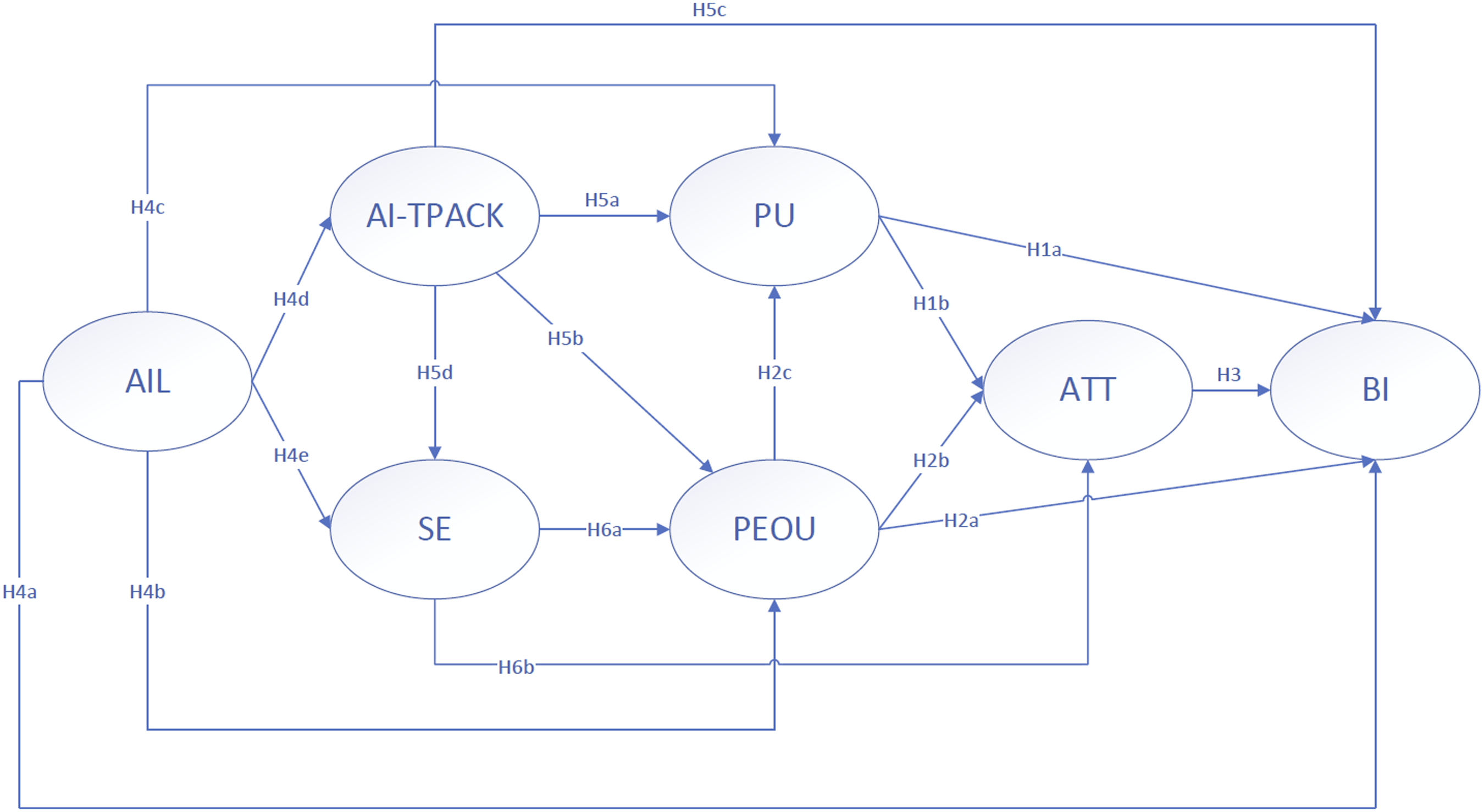
Methods
Research Design
This study employed a quantitative, cross-sectional, correlational survey design. This study investigated PSMTs’ intentions to use AI technologies in mathematics instruction and how AI-TPACK, AI literacy, and AI self-efficacy predict these intentions. It also aimed to model the interrelations among these factors within an extended TAM framework. All ethical principles were adhered to within the scope of the study, and informed consent was obtained from the participants. The research was conducted with the approval of the Istanbul Medeniyet University Social and Human Sciences Ethics Committee.
Participants
The sample for this study consisted of 696 pre-service mathematics teachers enrolled at 13 universities in Türkiye, selected through convenience sampling. The dataset initially consisted of 732 individuals. Prior to the main analyses, several data screening procedures were conducted to ensure the quality of the dataset. No missing data were observed because questionnaires with missing responses were excluded during data collection. Moreover 30 cases were removed due to careless or patterned responding.
Univariate outliers were examined by calculating z-scores for the observed scores; values with |z| > 3.29 were indentified. Mahalanobis distance (D2) values were used to test for multivariate outliers; the critical value for df = 7 at p < .001 is 24.32. Given these criteria, several responses were identified as potential multivariate outliers. In light of the above cases, the dataset for six subjects was excluded. Consequently, responses from 696 persons formed the final dataset. RMSEA approach (MacCallum et al., 1996); model df = 360; power analysis indicates power approximately equal to 1.00. Showing that the sample size was sufficient to detect model misspecification. This analysis is one of the major post-hoc power confirmations. Participants consisted of 74.9% females (n = 521) and 25.1% males (n = 175), which reflects the typical gender distribution within the teaching profession. Regarding grade level, 14.1% (n = 98) were first-year students, 22.6% (n = 157) were second-year students, 28% (n = 195) were third-year students, and 35.3% (n = 246) were fourth-year students. While 70.4% (n = 490) reported some experience with AI, only 15.2% (n = 106) had received formal training, suggesting limited structured exposure despite widespread informal familiarity with technology.
Instruments
The survey, grounded in the extended TAM, consisted of two sections. The first part of the questionnaire includes demographic information such as sex, grade level, and whether or not one has experienced AI before or attended an AI training. The items in the subsequent section were employed to assess PEOU, PU, ATT, BI, SE, AI-TPACK, and AIL constructs in the context of AI.
In developing the measurement instrument, first define the theoretical boundaries of each construct, then survey the scales that have appeared in the relevant literature, with supporting validity and reliability evidence. In this sense, we selected items related to the AIL and AI-TPACK constructs from existing scales that have been previously adapted into Turkish. Items for the PU, PEOU, ATT, BI, and SE constructs were developed by conceptually and contextually adapting statements from validated scales reported in the literature to align with the context of artificial intelligence and instruction. During the process, whilst some items have adapted directly to be context, others have rewritten to suit the context of AI and education, based on the conceptual content of the relevant items. For items without a Turkish version, the original English statements were first adapted to the research context and then translated into Turkish. The translation process used the translation–back-translation technique. The original English items were translated into Turkish by an academic expert in English language studies. Then, the items were back-translated into English by an independent expert proficient in English and Turkish. The researcher and two bilingual experts compared the back-translated versions with the original items to assess semantic equivalence, linguistic consistency, and conceptual appropriateness. Appropriate changes were executed as needed.
The measurement tools prepared in this way are then proposed by three mathematics education experts, measurement and evaluation experts, and educational technology experts through evaluations of content validity and the clarity of reasoning and language in the research context. At the wording level, three items were revised at the expert’s recommendation. The revised version was then trialed on a sample of 25 pre-service mathematics teachers with characteristics similar to those of the main sample. After the pilot study, the items’ clarity, applicability, and response process were reassessed to arrive at the final version of the instrument. The confirmatory factor analysis was applied to the final measurement model. In addition, validity and reliability were assessed using relevant statistical indicators. For detailed information on source scales, sample items, see Appendix 1.
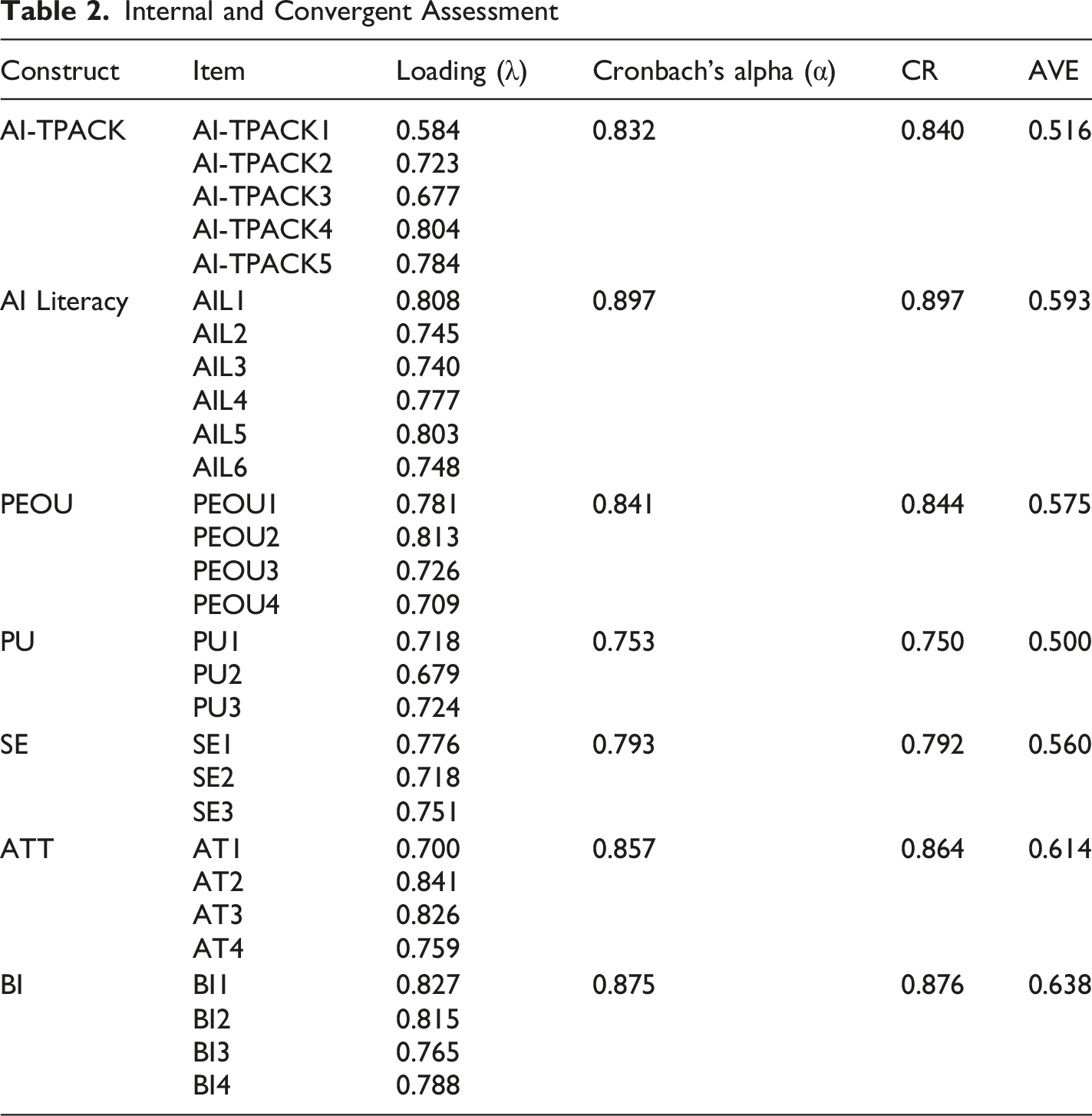
Specifically, six of the eleven items in the Turkish adaptation were used in the present study. An example item is: “I can identify the AI technologies employed in the applications and products I use.” The reliability coefficient was α = .897, the composite reliability (CR) was .897, and the average variance extracted (AVE) was .593, all of which meet the accepted psychometric standards for reliability and construct validity.
Data Collection and Analysis
Data collection took place over approximately four weeks in 2025. The participation was voluntary and online informed consent was obtained from all participants. The survey was conducted using google forms. It would take about 10–15 mins to fill the form.
To verify the proposed research model CB-SEM was adopted because the core objective of the study was to test a theoretically established model based on TAM. CB-SEM is suitable for Confirming a Theory since it allows the researcher to assess the global model fit indices after which the researcher also gets to estimate the relationships among the latent constructs in a Confirmatory manner (Hair et al., 2019; Kline, 2023).
Model parameters were analyzed using the statistical software R (version 4.5.1), and SEM computations were conducted with the lavaan package. IBM SPSS Statistics 20 was also used. Following Anderson & Gerbing's (1988) two-step approach, the measurement model was first assessed for reliability and validity, followed by testing the structural model and estimating direct, indirect, and total effects. This approach, widely used in prior studies (Gurer & Akkaya, 2022; Al Adwan et al., 2023; Kong et al., 2024), enables the refinement of measurement properties prior to hypothesis testing.
The measurement model was evaluated using confirmatory factor analysis (CFA). To evaluate the model–data fit, the following indices were used: χ2, χ2/df, p-value, CFI, TLI, RMSEA, RMSEA %90 confidence interval, and SRMR. In addition, the scaling correction factor obtained in the model estimation was 1.46. Since MLR was used for model estimation, scaled χ2 and the robust versions of CFI, TLI, and RMSEA, along with the RMSEA 90% confidence interval, were reported. CFI and TLI values ≥ 0.95 indicate an excellent fit, and values ≥ 0.90 indicate an acceptable fit (Hu & Bentler, 1999). When RMSEA and SRMR values are below 0.06 and 0.08, respectively, they indicate an excellent model fit, while values below 0.08 and 0.10 are considered acceptable (Schreiber et al., 2006). To assess the reliability and convergent validity of the measurement model, Cronbach’s alpha, composite reliability (CR), and average variance extracted (AVE) values were calculated. Discriminant validity was examined using the heterotrait–monotrait ratio (HTMT) and Fornell-Lacker Criterion. In addition, measurements were taken for multicollinearity and common method bias.
In the structural model analysis, bootstrapping with 10,000 resamples was performed in order to obtain more stable confidence intervals (Falk & Biesanz, 2015). The criterion for the significance of a mediation effect was that the 95% confidence interval did not include the value zero (0). (MacKinnon et al., 2004; Preacher & Selig, 2012).
Results
This section presents the findings obtained from the analyses conducted within the scope of the research. The results of the research are presented according to the sub-problems and the theoretical framework established in this study. The initial stage presents an overview of the model, including its graphical presentation and basic statistics, then the model assessment, and finally the outcome.
Preliminary Data Analysis
Descriptive Statistics
Descriptive Statistics and Normality Estimates
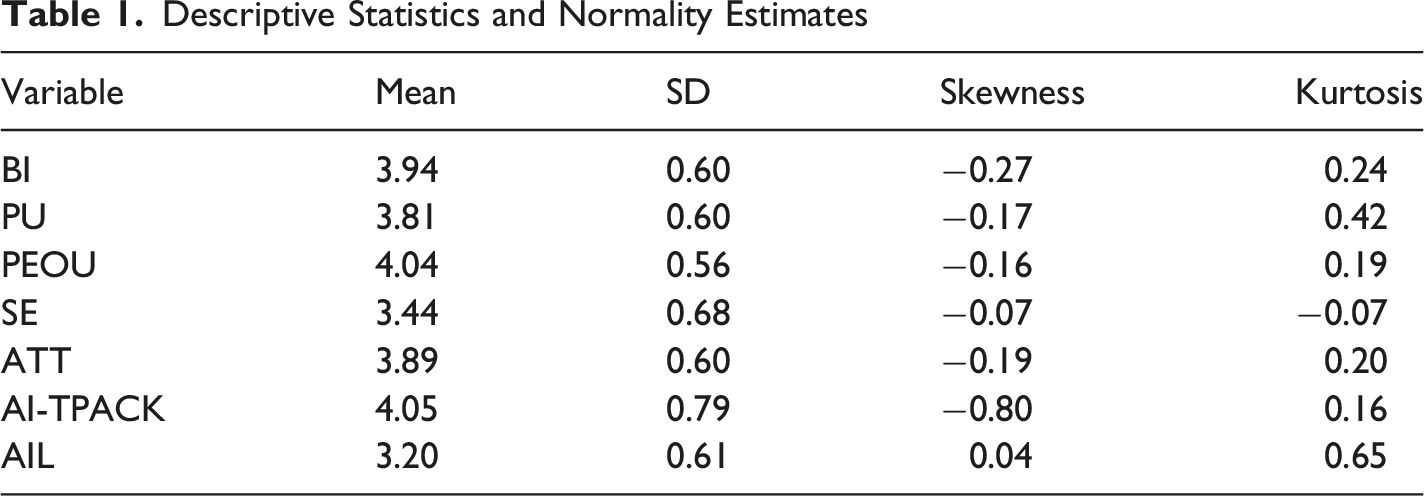
In addition to univariate normality, multivariate normality was assessed using the Mardia coefficient. The results showed that the values of multivariate skewness (16716.68, p < .001) and kurtosis (134.11, p < .001) were statistically significant, indicating that the data deviate from a multivariate normal distribution. To address this violation, the robust maximum likelihood estimation method (MLR) was used to ensure parameter estimates were less sensitive to the normality assumption.
Multicollinearity and Common Method Bias
Some assumptions related to the predictor variables were examined before the analysis. The potential multicollinearity problem among the predictor variables was evaluated using the Variance Inflation Factor (VIF) values. The results indicated that the VIF values ranged from 1.56 to 2.21. Since these values are well below the recommended threshold of 3 in the literature (Hair et al., 2019), it was concluded that there is no multicollinearity problem in the model.
In addition to statistical assumptions, common-method bias was examined. For this purpose, Harman’s single-factor test was conducted. The analysis results indicated that the first factor explains 34.46% of the total variance. The absence of a single dominant factor and the finding that a single factor does not account for the majority of the variance suggest that common method bias is not a serious concern (Podsakoff et al., 2003).
Evaluation of the Measurement Model
Convergent Validity
Internal and Convergent Assessment
Discriminant Validity
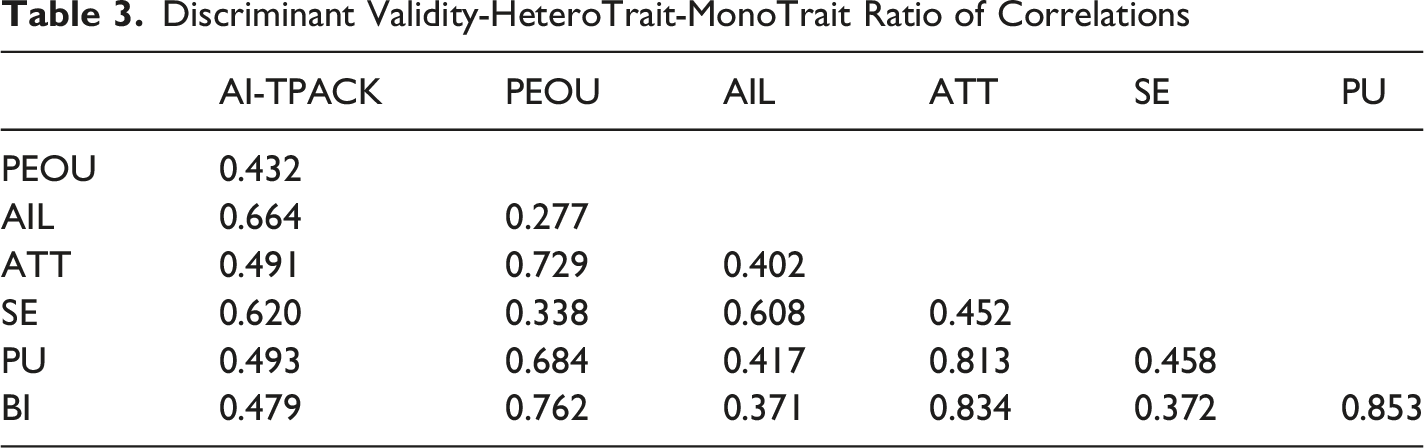
Discriminant Validity-HeteroTrait-MonoTrait Ratio of Correlations
Discriminant Validity Evaluation: Fornell–Lacker Criterion
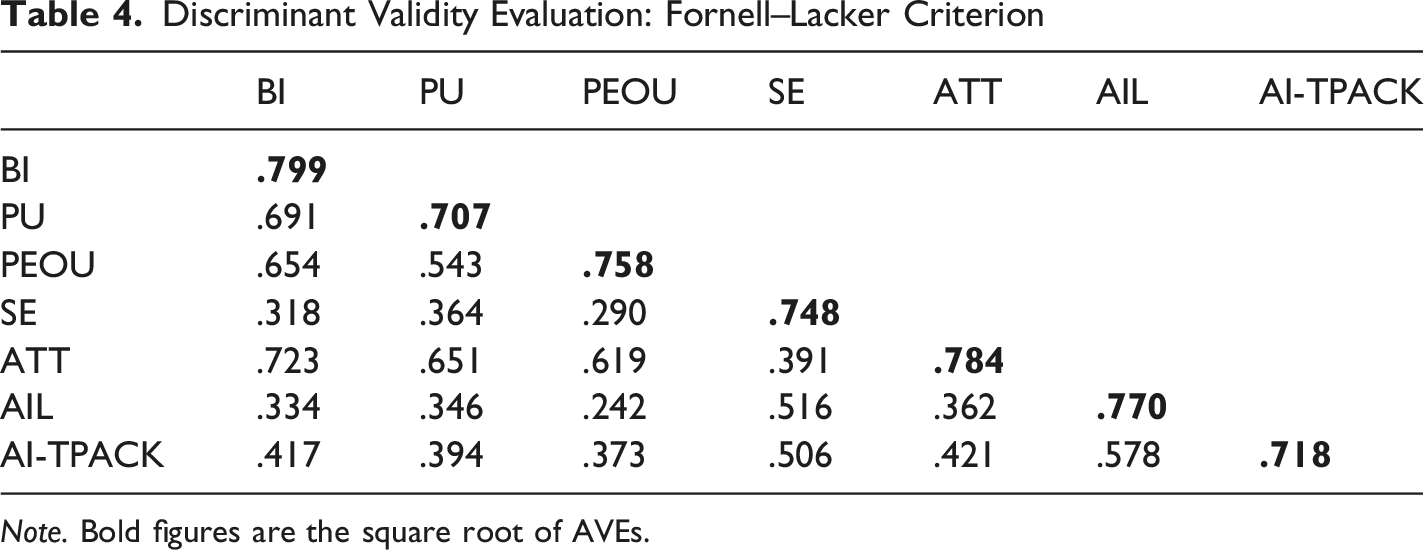
Note. Bold figures are the square root of AVEs.
The convergent and discriminant validity results together confirmed that the measurement model had adequate construct validity. The obtained values for the measurement model were χ2 (356) = 588.64, (p < .001), CFI = .969, TLI = .964, RMSEA = .037 (90% CI [.032, .042]), and SRMR = .043. According to these values, the model–data fit is acceptable (Hu & Bentler, 1999). Overall, the model showed satisfactory fit and met the validity requirements for subsequent structural analysis.
Evaluation of the Structural Model
Following the assessment of the measurement model, the structural model was tested to evaluate the hypothesized relationships among the constructs. The structural model demonstrated an excellent fit to the data: Χ2 (360) = 596.721 (p < .001), Χ2/df = 1.65, CFI = .968, TLI = .964, RMSEA = .037 [%90 CI: .032, .042], and SRMR = .043. The consistency of these indices with the measurement model values indicates that the structural constraints did not significantly degrade the model fit. The model’s explanatory power was substantial. The R2 values indicate that the model explains 82.0% of the variance in BI and 70.8% of the variance in ATT. Additionally, the model accounted for 54.8% of the variance in PU, 46.3% in SE, 41.8% in AI-TPACK, and 21.3% in PEOU. According to Chin’s (1998) criteria, the model demonstrated substantial explanatory power for BI and ATT, moderate explanatory power for PU, SE, and AI-TPACK, and weak explanatory power for PEOU. These findings suggest that the model was particularly strong in explaining pre-service teachers’ BI and Att toward AI use, but relatively limited in explaining perceived ease of use.
Structural Paths Assessment
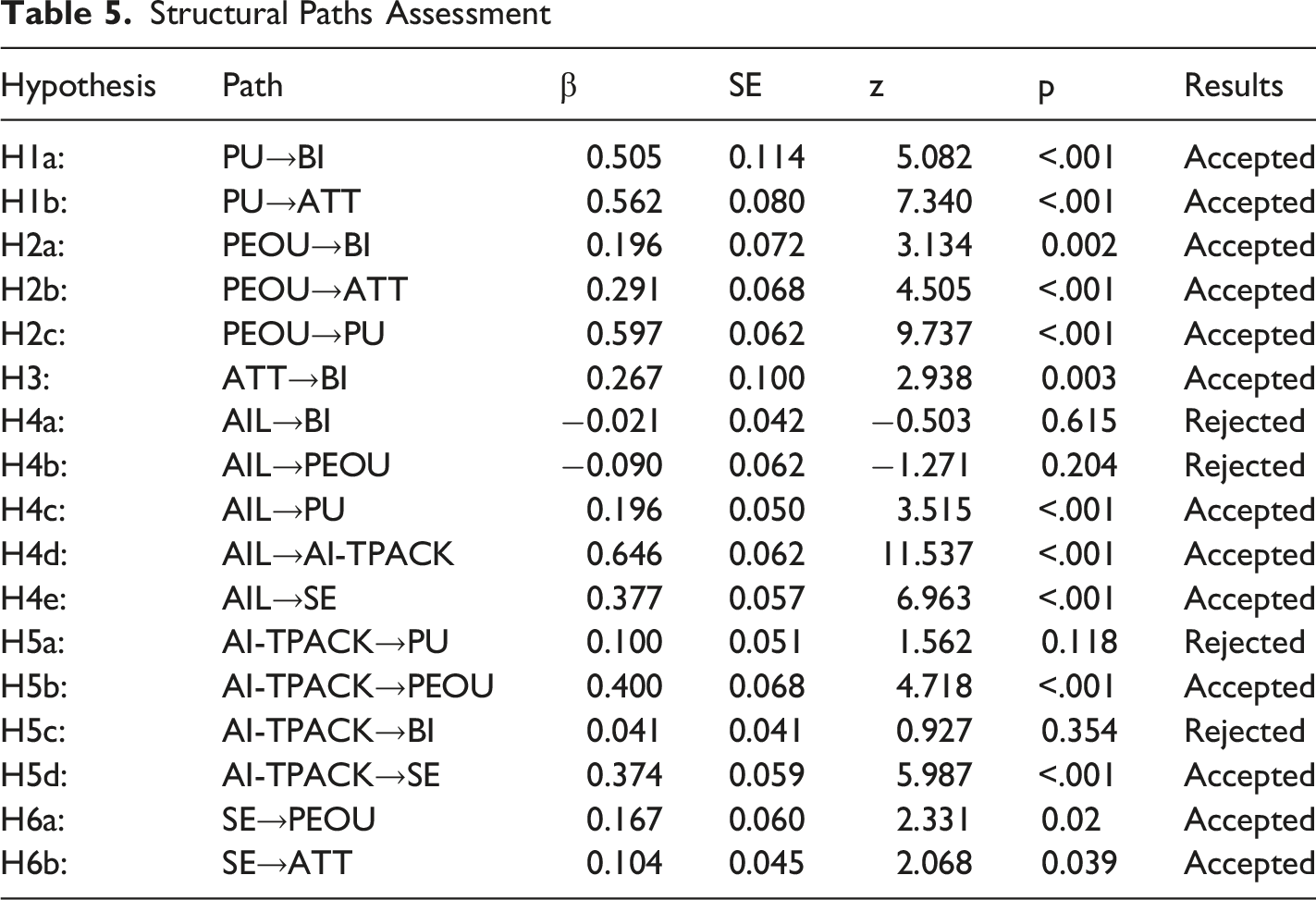
AIL had a significant effect on AI-TPACK (β = .646, z = 11.537, p < .001). In addition, AIL positively and significantly influenced SE (β = .377, z = 6.963, p < .001) and PU (β = .196, z = 3.515, p < .001). Moreover, AI-TPACK had significant effects on SE (β = .374, z = 5.987, p < .001) and PEOU (β = .400, z = 4.718, p < .001).
Within the dimensions of the TAM, PEOU significantly predicted PU (β = .597, z = 9.737, p < .001), ATT (β = .291, z = 4.505, p < .001), and BI (β = .196, z = 3.134, p = 0.002). SE also had positive and significant effects on both PEOU (β = .167, z = 2.331, p = 0.020) and ATT (β = .104, z = 2.068, p = 0.039). Regarding BI, PU (β = .505, z = 5.082, p < .001) and ATT (β = .267, z = 2.938, p = 0.003) had significant effects.
However, four direct effects were not statistically significant. Specifically, AIL did not significantly influence BI (H7: β = −.021, p = 0.615) or PEOU (H8: β = −.090, p = 0.204). Similarly, the direct effects of AI-TPACK on PU (H5a: β = .100, p = 0.118) and BI (H5c: β = .041, p = 0.354) were not statistically significant.
Direct, Indirect, and Total Effects in the Model
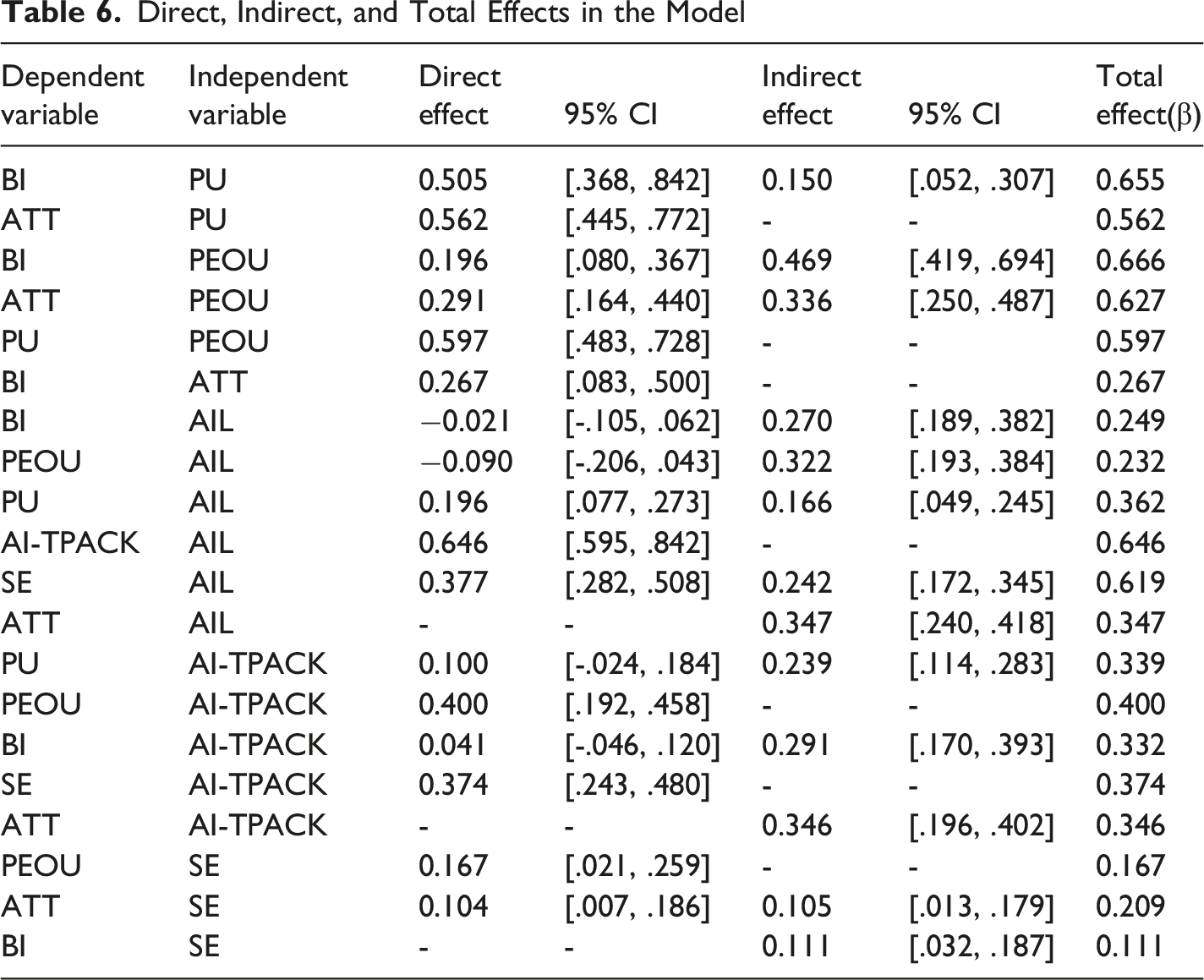
Within the TAM framework, PEOU had significant direct effects on PU (β = .597, p < .001), ATT (β = .291, p < .001), and BI (β = .196, p = .002). In addition, PEOU exerted a strong indirect effect on BI (β = .469, p < .001), yielding a substantial total effect of .666 (p < .001). SE significantly influenced PEOU (β = .167, p = .021) and ATT (β = .104, p = .042) directly. Moreover, SE had a significant indirect effect on ATT (β = .105, p = .028) and BI (β = .111, p = .006), leading to total effects of .209 on ATT and .111 on BI. Finally, PU emerged as a key predictor in the model, showing significant direct effects on ATT (β = .562, p < .001) and BI (β = .505, p < .001). In addition, PU had a significant indirect effect on BI through attitude (β = .150, p = .007), resulting in a total effect of .655 (p < .001). Consistent with the TAM framework, ATT also had a significant direct effect on BI (β = .267, p = .005).
Figure 2 illustrates the path diagram and the regression coefficients associated with the tested model. Sem diagram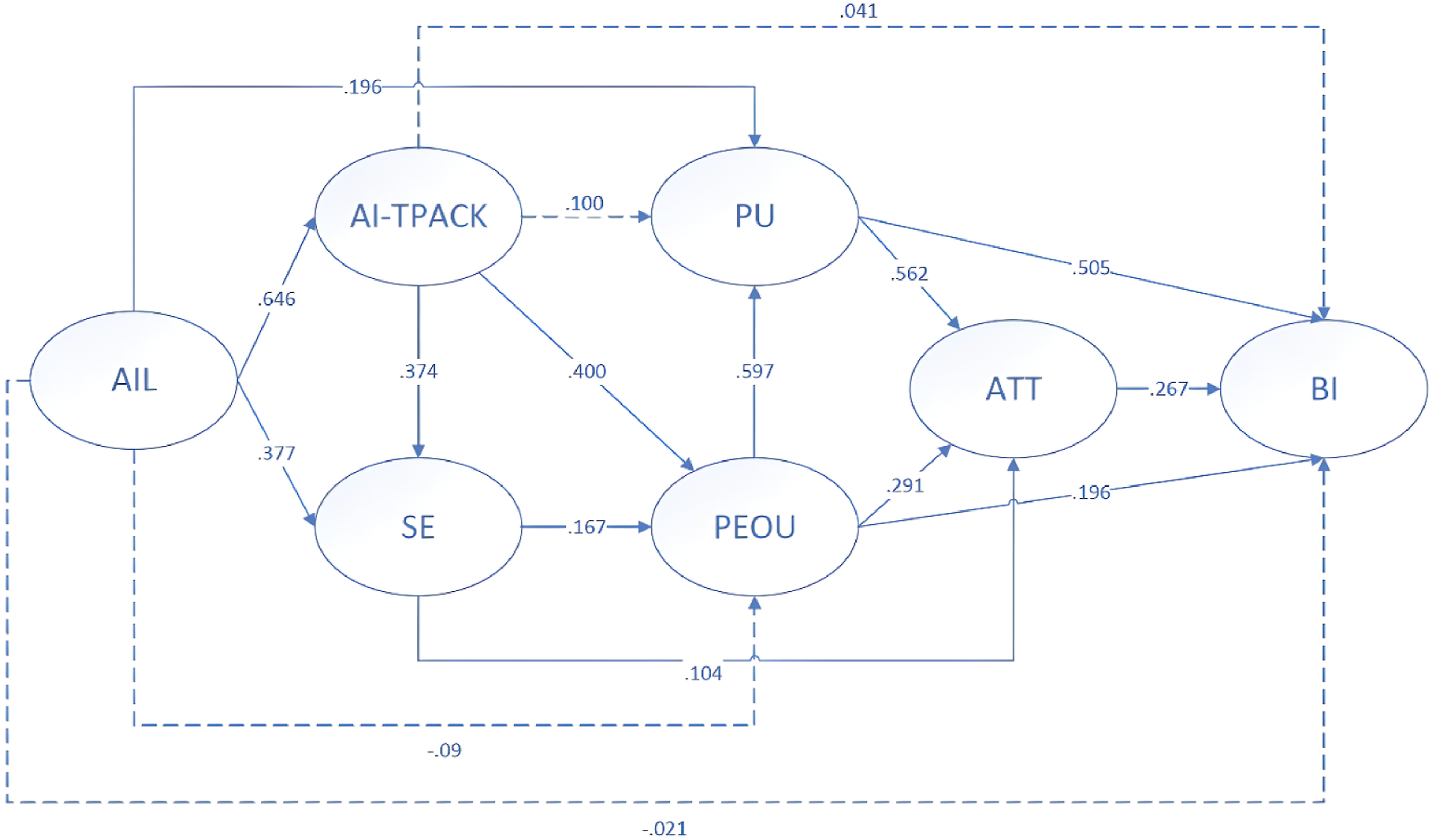
Discussion
According to the findings of this study, the use of AI in mathematics instruction cannot be justified solely based on the classical components of TAM, i.e., PU and PEOU. Additionally, the influence of PSMTs’ AI literacy, their knowledge of incorporating AI into the instructional process (AI-TPACK), and self–efficacy perceptions on the AI use. In this regard, the study offers a more elaborate explanatory framework that pulls together the cognitive, pedagogical, and psychological dimensions in the context of mathematics teacher education, thereby contributing to the TAM literature. Plus, the model provides a strong explanation of Behavioral Intention (R2 = .82). This value is notably higher than the R2 values reported by Li and Manzari (2025) (.633) and Li (2025) (.642). A plausible reason for this stronger explanatory performance is that the current model incorporates AI-related constructs, including AI literacy, AI-TPACK, and self-efficacy, which appear to enhance the prediction of behavioral intention.
Core TAM Relationships in AI Acceptance
The findings regarding to H1a–H3 indicate that PU, PEOU and ATT are complementary core mechanisms in PSMTs adoption of AI technology. This means their intention to use AI technologies is influenced by factors beyond technical ease. They also see technology as suitable for teaching mathematics, improving students’ knowledge, and facilitating problem-solving. They also have positive feelings towards these technologies. The original TAM and subsequent extensions (Al Darayseh, 2023; Davis, 1989; Falebita & Kok, 2025) remain supported by this pattern and the underlying assumptions.
To begin with, the significant influence of PU on both BI and attitude means PSMTs regard AI tools as useful only if they think these tools could make a concrete contribution to maths teaching. The finding is consistent with earlier studies emphasizing the importance of PU in accepting technologies (Sun et al., 2024; Zhao et al., 2025; Şimşek et al., 2025). The contributions could be interpreted as functions that clarify abstract mathematical concepts, diagnose students’ misconceptions, assist students in solving problems, and provide feedback.
In addition, the significant effects of PEOU on BI, ATT, and PU suggest that PSMTs who perceive AI tools as easier to use are more likely to evaluate them as useful for mathematics instruction, develop more positive orientations toward them, and demonstrate a greater tendency to adopt them. This finding is also consistent with the literature on the acceptance of educational technologies. Prior studies have shown PEOU influences PU (Al Adwan et al., 2023; Al Darayseh, 2023), ATT (Al Darayseh, 2023; Şimşek et al., 2025), BI (Tram, 2025; Zhao et al., 2025). In domains such as mathematics instruction, which require high levels of cognitive and pedagogical planning, tools perceived as complex are less likely to be evaluated as both useful and positively received.
Finally, the significant predictive effect of positive attitudes toward AI on BI indicates that PSMTs’ favorable affective and evaluative orientations toward AI tools strengthen their intention to use them. In other words, perceiving these tools as valuable and engaging increases the likelihood of adoption (Falebita & Kok, 2025; Kong et al., 2024; Li, 2025).
AI Literacy as a Foundational Antecedent of AI Acceptance
The findings regarding AI literacy indicate that this construct functions not as a proximal variable that directly explains AI acceptance, but rather as a foundational antecedent that supports the acceptance process across cognitive, pedagogical, and psychological perspectives. While the direct effects of AI literacy on BI and PEOU were not significant, its effects on PU, AI-TPACK, and self-efficacy were significant. The significant and strong effect of AI literacy on AI-TPACK suggests that as PSMTs’ knowledge and awareness of AI increase, their competence in integrating these technologies pedagogically into mathematics instruction also improves, which is consistent with similar findings reported in studies conducted in other contexts (Al Abdullatif, 2024; Aldemir et al., 2025; Biton & Segal, 2025). In other words, PSMTs who better understand how AI operates, what affordances it offers, and what limitations it entails can evaluate these tools more critically in relation to instructional goals, content, and pedagogical requirements, and to integrate them more appropriately into teaching processes (Celik, 2023; Daher, 2025).
The research finding that AI literacy significantly predicts SE in accordance with Bandura’s (1997) framework of self-efficacy suggests that the more PSMTs’ understand and are aware of AI, the stronger their belief in their capability to use these technologies to teach mathematics will be. This finding is consistent with earlier studies (Becirovic et al., 2025; Du et al., 2024; Ji et al., 2025; Lim, 2023). Additionally, the substantial influence of AI literacy on PU indicates that PSMTs’ knowledge and awareness of AI may enable them to better assess the potential usefulness of these technologies in the context of mathematics instruction, which is consistent findings reported in other contexts (Qi et al., 2025; Schiavo et al., 2024). This result suggests that AI is not only a technical tool but also a resource that supplies tangible inputs to math teaching and is therefore considered useful (e.g., Ma & Lei, 2024; Pan et al., 2025).
AI literacy has no significant impact on PEOU, suggesting that knowledge and awareness of AI do not translate into perceptions of ease of use (Al Abdullatif, 2024). Not only cognitive familiarity, but also procedural experience, practical skills, and perceptions of ease from using the technology can help explain PEOU. The significant indirect effect indicates that while AI literacy does not directly impact users’ ease of use perceptions, it does influence them through more proximal constructs, notably self-efficacy and pedagogical integration competence. As new teachers become more familiar with AI, they will build confidence with these technologies and learn how to integrate them into instruction. This preparedness may lead to AI tools being characterized as more controllable and user-friendly.
As revealed in the study’s findings, AI literacy does not directly affect the intention to use AI. This suggests that knowledge and awareness of AI, alone not sufficient to foster an intention to use it. The assumption that technology can be useful, combined with the belief that one can use it, will form a stronger behavioral intention (Ma & Lei, 2024; Qi et al., 2025). Consequently, it seems more plausible that AI literacy has an indirect effect on BI through more immediate factors PU and self-efficacy.
AI-TPACK as a Pedagogical Pathway to AI Acceptance
The findings related to AI-TPACK suggest that this construct functions not as an outcome variable that directly determines AI acceptance, but rather as a structure that strengthens PSTs’ preparedness for how to use AI pedagogically. Specifically, the significant effects of AI-TPACK on PEOU (H5b) and SE (H5d) indicate that as PSMTs’ knowledge of how to integrate AI into instructional processes increases, they perceive these technologies as more manageable and develop stronger self-efficacy beliefs regarding their effective use.
AI tools can support teachers at several stages of the instructional process, especially in mathematics instruction. For example, during lesson planning, one can produce suitable examples, questions, and multiple representations. During instruction, the teacher can diagnose student errors, provide alternative explanations, and offer solution steps within the problem-solving process. Post instruction, by analyzing student responses and producing personalized feedback. Improved knowledge of pedagogical integration will help PSTs more easily comprehend AI tools’ role in the teaching process, perceive them as more manageable and easier to operate, and enhance their self-efficacy in using them effectively. Recent research supports these effects: Al Abdullatif (2024), Runge et al. (2025), An et al. (2023), and Sun et al. (2024) found significant AI-TPACK impacts on PEOU; Tram (2025) likewise showed that TPACK enhances self-efficacy and fosters innovative pedagogy.
In contrast, the non-significant direct effects of AI-TPACK on PU (H5a) and BI (H5c) suggest that pedagogical integration knowledge alone may not be sufficient to generate a strong perception of the instructional value of these technologies or a direct intention to use them. This may be because AI-TPACK primarily represents a knowledge structure that explains how AI can be used within the instructional process. In contrast, PU and BI are shaped not only by such knowledge but also by beliefs about the technology’s contribution to student learning and by self-efficacy regarding its effective use.
In addition, the relatively recent exposure of PSMTs to AI tools may provide a further explanation for this finding. Although they may be able to use these tools at a technical level, they may not yet possess sufficient experience or practical knowledge regarding when, how, and for which pedagogical purposes these tools should be integrated into authentic instructional contexts. Therefore, having a certain level of knowledge about how to integrate AI into teaching may not always be sufficient to perceive these technologies as useful or to develop a clear intention to use them. This finding is also consistent with results reported in the literature indicating that AI-TPACK has no significant effect on BI (Al Abdullatif, 2024; Li, 2025; Runge et al., 2025) or PU (Al Abdullatif, 2024).
The Role of AI Self-Efficacy in AI Acceptance
The findings indicate that SE plays a significant role in shaping PSMTs’ perceptions of usability and their affective orientations toward AI. The significant effects of SE on PEOU and ATT suggest that self-efficacy beliefs may be a key determinant of perceiving AI tools as more manageable and easier to use, and of developing more positive attitudes toward these technologies. Similar results regarding PEOU were reported by Al Adwan et al. (2023), Falebita and Kok (2025), and Zhang et al. (2023).
Particularly in the context of mathematics instruction, PSMTs’ belief that they can effectively use an AI tool for tasks such as identifying students’ error patterns, generating alternative solution strategies, verifying the mathematical correctness of outcomes, and pedagogically refining AI-generated outputs may support their perception of these technologies as more manageable and easier to use. Similarly, this sense of competence may facilitate evaluating AI tools not as systems that generate uncertainty but as functional resources that support instruction, thereby contributing to the development of more positive attitudes toward these technologies. Similar results regarding ATT were reported by Kong et al. (2024) and Xu et al. (2025).
According to Bandura (1997), SE refers to individuals’ beliefs in their capability to successfully perform a specific task, and these beliefs can influence motivation, effort, persistence, and responses to stress or anxiety. In this regard, SE can be considered a key construct that functions between cognitive evaluations and affective resilience in teachers’ adoption of AI. The indirect effect of self-efficacy on behavioral intention also suggests that this construct influences AI acceptance not directly, but through shaping how PSMTs perceive and evaluate the technology.
Theoretical Contribution
The current research helps the literature on AI acceptance in theoretical terms by incorporating not only the classic TAM components PU, PEOU, and ATT, but also cognitive, pedagogical, and psychological dimensions such as AI literacy, AI-TPACK, and SE. The results show that AI literacy does not serve as a distal variable that directly affects BI. Instead, AI literacy serves as a bedrock antecedent that supports more proximate antecedents of AI acceptance, P. AI, AI-TPACK, and SE.
Similarly, AI-TPACK has a significant effect on PEOU and SE. However, it does not directly affect PU and BI. Hence, the fact that it does not directly mediate acceptance. Rather than functioning as a direct predictor of acceptance, this construct seems to reflect a pedagogically preparatory form of knowledge that informs how AI can be situated and used within teaching contexts. Furthermore, the notably significant relationships between SE, PEOU, and ATT indicate that this construct serves as a crucial psychological bridge between knowledge-based structures and behavioral orientations.
In this respect, the study presents a more refined, multi-dimensional, and theoretically enriched framework of AI acceptance in the context of mathematics teacher education. However, further research can examine the direct and indirect effects of this model’s constructs across other teacher groups and contexts. Longitudinal and experimental designs may reveal more about the relationships among changes in AI literacy, AI-TPACK, and self-efficacy, not only with behavioural intention but also with actual classroom use and pedagogical practices.
Practical Implications
Findings of the study are significant for teacher education programmes and policymakers to enhance applications of AI in schools. First, the findings that PU and PEOU significantly influence BI suggest that merely introducing the technical features of AI tools may not be sufficient for their adoption by PSMTs. Thus, pre-service programs must ensure practice-based experiences that render visible the tangible contributions of AI in mathematics instruction. For instance, students should have example lesson functions that use AI to analyze students’ error patterns, produce alternative solution strategies, provide multiple representations, give personalized feedback, and check the correctness of solutions. In this way, PSMTs may begin to perceive these technologies not merely as novel tools but as pedagogically useful and functional resources.
In addition, the finding that AI literacy supports BI primarily through PU, SE, and pedagogical integration knowledge suggests that AI-related training for PSMTs should aim not only to raise awareness but also to enhance perceptions of instructional value, confidence in use, and pedagogical competence. Accordingly, teacher education programs should equip PSMTs with skills such as effective prompt design, evaluating AI-generated mathematical solutions for accuracy and pedagogical appropriateness, restructuring outputs to consider students’ misconceptions, transitioning across different forms of representation, and adapting content to students’ levels.
Similarly, the significant effects of AI-TPACK on PEOU and SE indicate that PSMTs need practice-oriented learning opportunities in which they can experience using AI tools within instructional processes. Therefore, teacher education programs should include activities such as designing AI-supported lesson plans, microteaching practices, case-based discussions, and the pedagogical evaluation of AI-generated outputs. The absence of a direct effect of AI-TPACK on PU and BI further suggests that pedagogical integration knowledge alone may not lead to adoption; rather, PSMTs need concrete opportunities to experience the actual instructional value of AI in classroom contexts.
Moreover, the significant effects of SE on both PEOU and ATT highlight the critical importance of developing PSMTs’ confidence in their ability to use AI tools. For this reason, teacher education programs should create low-stakes practice spaces for PSMTs to play with AI across different teaching situations, try out different ways to use the tech, work with peers on instructional decisions, and structure reflections on the play. These supported practices are likely to ease the anxiety associated with AI, help to view these technologies as more controllable, and enhance attitudes. At the institutional level, it would also be useful for faculties to prepare sample instructional materials, ethical-use guidelines, and repositories of AI applications for the teaching of mathematics to faculty and pre-service teachers.
Limitations and Future Research
This study provides crucial insights into AI acceptance among PSMTs, but it has its limitations. One, the cross-sectional design of the study precludes us from making causal interpretations about the relationships among the constructs included in the model. While the direct and indirect effects of AI literacy, AI-TPACK, and SE on BI are significant, the evolution of these relationships over time cannot be studied in this research. The second risk involves the use of self-report measures to collect data. This can lead to a number of biases, such as social desirability bias, self-evaluation bias, and an increased risk of over-reporting more favourable intentions toward AI. Further, the research was conducted solely with PSMTs in Türkiye using convenience sampling; thus, the findings cannot be generalized to other subject areas, the in-service teacher population, or even a different cultural and institutional context.
Furthermore, this study focused on individuals’ cognitive, pedagogical, and psychological acceptance of the AI technology. However, it did not take into account contextual factors such as institutional support, technological infrastructure, AI content in the syllabus, opportunities for practice, and instructor guidance. Notably, the finding that AI-TPACK has no direct effect on PU and BI, and that AI literacy has no direct effect on BI, indicates that these constructs may function differently across contexts. Consequently, future studies should examine the model across different groups of teachers and educational contexts and apply longitudinal, experimental designs. Mixed-methods approaches to explore the extent to which changes in AI literacy, AI-TPACK, and self-efficacy are related not only to BI but also to actual classroom use and pedagogy. The incorporation of self-reports can be supplemented with other data collection methods, such as observations, performance tasks, digital trace data, and qualitative interviews, to provide a better understanding of what AI acceptance looks like in practice.
Conclusions
The use of AI by PSMTs will not be influenced solely by the classical TAM constructs, such as PU, PEOU, and ATT. Cognitive, pedagogical, and psychological factors will significantly influence it, including AI literacy, AITPCK, and self-efficacy. The paper concludes by sharing recommendations for future research. Through this lens, the research contributes to the literature on AI acceptance in a more comprehensive sense within mathematics teacher education. The findings also indicate that for PSMTs to use these AI tools in a meaningful and effective way, they must be provided not only with technical knowledge but also with learning activities that give these technologies pedagogical value, the development of pedagogical integration competencies, and the strengthening of self-efficacy beliefs about their use. Therefore, teacher education programs need to provide structured learning opportunities that integrate AI-related knowledge, pedagogical application, and hands-on experience.
Footnotes

Ethical Considerations
This study was approved by the Social and Human Sciences Ethics Committee of Istanbul Medeniyet University (Approval No. E-38510,686-050.04-2500085275).
Consent for Publication
The author confirms that they consent to the publication of this manuscript.
Author Contribution
The author is responsible for all parts of the study, including conceptualization, data collection, analysis, and manuscript preparation.
Funding
The author received no financial support for the research, authorship, and/or publication of this article.
Declaration of Conflicting Interests
The author declared no potential conflicts of interest with respect to the research, authorship, and/or publication of this article.
Data Availability Statement
The data that support the findings of this study are not publicly available due to privacy and ethical restrictions but are available from the corresponding author upon reasonable request.