







Abstract
Issue linkage—the simultaneous discussion of two or more issues for joint settlement—is a bargaining tactic that (1) increases the probability of states reaching a negotiated agreement and (2) motivates states to remain committed to an agreement. Unfortunately, beyond some suggestive case studies and a few indirect statistical tests, there exists no direct and systematic evidence to support either claim. To empirically identify the effect of issue linkage, one must overcome five difficulties: properly evaluating multilateral processes, identifying issue linkage, identifying failed negotiations, identifying enforcement problems, and accounting for missing linkage data. I address these limitations through a variety of new approaches, most notably a new unit of analysis (the k-ad) for analyzing multilateral events, new data on failed military alliance negotiations, and using “buffer states” to test the credibility of alliance commitments. I find that, for military alliance negotiations from 1860 to 1945, offers of trade cooperation provisions increase the probability of states reaching agreement and improve the credibility of those agreements. However, I also find that offers of trade cooperation do not have a positive effect on alliance negotiations from 1815 to 1859.
Introduction
Barak Obama, the newly elected President of the USA, needed to fulfill a key campaign promise: close the Guantánamo Bay prison. However, President Obama faced a conundrum: how to close the prison while ensuring that particular detainees did not go free. To accomplish this goal, the Obama administration employed a well-known bargaining tactic: issue linkage. As later reported, When American diplomats pressed other countries to resettle detainees, they became reluctant players in a State Department version of “Let’s Make a Deal.” Slovenia was told to take a prisoner if it wanted to meet with President Obama, while the island nation of Kiribati was offered incentives worth millions of dollars to take in Chinese Muslim detainees, cables from diplomats recounted.
1
Such actions are not new. Whether tying a presidential meeting to a prisoner exchange or attaching a trade agreement to a military alliance treaty, states have long tried to link issues to achieve cooperation under anarchy. Wallace (1976: 164) famously claimed that “linkage between unrelated or only loosely-related issues in order to gain increased leverage in negotiation is an ancient and accepted aspect of diplomacy”. Sebenius (1983: 283), drawing on several historic examples, states that “linkage is a prominent and venerable practice”. Morgan (1994: 104) asserts how “in a number of international crises, a peaceful resolution has become possible only after an issue not originally in contention is brought into the bargaining for linkage purposes”.
Issue linkage—the simultaneous discussion of two or more issues for joint settlement—is a bargaining tactic used by states to achieve two objectives. First, issue linkage increases the probability of agreement (Aggarwal, 1998; Axelrod and Keohane, 1985; Bernheim and Whinston, 1990; Eichengreen and Frieden, 1993; Hoekman, 1989; Lohmann, 1997; Mayer, 1992; Morrow, 1992; Putnam, 1988; Spagnolo, 2001; Stein, 1980; Tollison and Willett, 1979). This is because linkage can create benefits for those parties who would otherwise find an agreement to be of little value. The actions of the Obama administration exemplify this use of linkage. Second, issue linkage motivates states to remain committed to an agreement (Koremenos et al., 2001; Tomz, 2007). For example, including a free trade provision in a greenhouse gas reduction treaty may induce all parties to uphold their codified environmental obligations.
Can issue linkage actually accomplish these lofty goals? In the case of the Obama administration, the answer is no, as the exchange with Slovenia never happened. This failure of linkage is not surprising to some scholars. With respect to securing agreement, Morrow (1992) highlights how linkage offers can be interpreted as a sign of bargaining weakness, thereby undermining their effectiveness. With respect to enhancing commitment to an agreement, Downs et al. (1996) would argue that states add issues to a treaty only because agreement on the primary issue was likely to be reached in the first place. Moravcsik (1998) argues that, when states decide to include linkage provisions in a treaty, domestic opposition can relegate these provisions to nothing more than symbolic window dressing.
Thus, the theoretical claim that issue linkages are beneficial for cooperation may be well known, but it also might not be true. The truth is that, beyond some suggestive case studies and a few indirect statistical tests, there exists no direct and systematic evidence that issue linkages actually increase the probability of agreement or increase the likelihood that states will remain committed to their signed agreements. For example, Davis (2004) finds that higher levels of linkage are associated with higher levels of negotiated agricultural liberalization. However, Davis uses the institutional setting of the negotiation to proxy for linkage offers (since increased institutionalization is positively correlated with increased opportunities to link across trade products), not the direct presence of a linkage offer. With respect to compliance, Leeds and Savun (2007) find that linkage is associated with a reduced risk of violating a treaty’s terms. Unfortunately, since linkage is not the focus of their study, Leeds and Savun do not test implications that could verify the causal impact of linkage on commitment credibility. Tomz (2007) attempts to identify the effect of linking trade sanctions to sovereign debt repayment. He evaluates the relationship between trade dependence with a lender and a borrower’s decision to repay the loan. This approach captures the role of implied linkage, but not the direct effect of explicitly tying trade to debt repayment. Hafner-Burton (2005) shows that explicitly tying human rights standards to preferential trade concessions compels respect for those standards. However, Hafner-Burton’s study evaluates the impact of issue linkage on inducing certain behavior by a government within its state, not inducing cooperation between governments.
Even attempts within American politics to study the related issue of logrolling—vote trading in order to create a legislative coalition in support of a bill—have been unable to directly isolate linkage’s effect (Kau and Rubin, 1979; Stratmann, 1992). For example, Stratmann (1995) investigates whether vote-trading helps pass bills that provide subsidies for special interests. Analyzing a broad range of votes where logrolling is reported, Stratmann finds that a legislator who votes for the amendment favored by the city interests is also likely to vote for amendments favored by labor interests and amendments favored by farm interests. Unfortunately, Stratmann fails to account for confounding factors and only analyzes votes where logrolling was known to have been used. Without also considering cases where logrolls were not used, one is unable to determine if and how legislators’ behavior is influenced by a logroll.
This paper outlines my attempt to systematically evaluate the impact of issue linkage on reaching and remaining committed to international agreements. After precisely defining issue linkage, I explain the five impediments to empirically evaluating issue linkage: properly evaluating multilateral processes; identifying issue linkage; identifying failed negotiations; identifying enforcement problems; and accounting for missing linkage data. These impediments are not simply technical issues that can be addressed with more data or better estimation techniques, although both are surely needed. They also require reconceptualizing how scholars evaluate many fundamental processes in international cooperation. This ranges from devising a new unit of analysis (the k-ad), to re-thinking how we operationalize instances where an event did not take place. Next, after detailing how I attempt to overcome these impediments, I summarize my findings of how issue linkage affects international cooperation. As reported in Poast (2012) and Poast (2013), I find that, for the 1860–1945 time period, offers of trade linkage do appear to increase the probability of states reaching a military alliance agreement and improve the credibility of those agreements. I then present new results showing that, for the 1815–1859 time period—a time when offers of trade linkage would not have been perceived as valuable—linkage negatively affects the probability of agreement. Given the small sample size, however, these latter results should be interpreted with caution. Finally, I conclude with a discussion of the broader implications of my findings and potential next steps.
What is and is not issue linkage
Issue linkage is a bargaining strategy. Sebenius (1983) defines issue linkage as the simultaneous discussion of two or more issues for joint settlement. Similarly, Haas (1990: 76) defines issue linkage as bargaining that involves more than one issue. For example, states could have salmon catch quotas negotiated in connection with the nutritional needs of consumers or have a nuclear weapons test ban negotiated along with limits on strategic weapons. 2
When issues are linked explicitly by having both addressed in the final treaty text, this is known as expanding the “scope” of a treaty (Koremenos et al., 2001: 770). A key component of issue linkage—and a concept that makes it difficult to empirically identify—is that the linkage must take place between issues that could have been addressed in separate negotiations. If it is not the case that the issues could have been addressed in separate treaties, then it is unlikely that the issues were linked as a negotiation tactic for the purpose of achieving a cooperative outcome. For example, while negotiating the 1980 Law of the Sea Treaty, it is debatable that the issues of shipping rights on the ocean surface, fishing rights within the ocean, and drilling rights on the ocean floor could be addressed in separate treaties. In contrast (and as will be discussed more below), trade cooperation and military alliance formation are issues that do not need to be inherently discussed in a single treaty (and are frequently negotiated separately).
Within the international cooperation literature, issue linkages are part of a more general concept called side-payments. A side-payment occurs when policy-makers use either direct monetary payments (e.g. bribes) or material concessions on other issues (i.e. issue linkages) to encourage concessions on a given issue (Firman, 1993: 388; Tollison and Willett, 1979: 426). 3 Despite efforts to separate the two conceptually, the extent to which bribes and issue linkages are distinct can be questioned. Returning again to the example of the Obama administration’s efforts to empty the Guantánamo Bay prison, when the President of Yemen was approached to start a rehabilitation program for detainees from his country (who comprised about half of the remaining prisoners), his reply was “How many dollars will the US bring?” 4 Here, Yemen’s President chose to tie the exchange of money to an issue that was not previously conceptualized in terms of money (such as the acceptance of prisoners from one’s own country). In a sense, this is a form of issue linkage—the states, in effect, have added a new dimension, money, to the negotiations. Of course, the states have also decided to add a new complication to the negotiation: the subsequent haggling over the appropriate price! In the case of the Obama administration, the decision to tie money to the exchange of prisoners failed as Yemen could not promise to retain the detainees for more than a few weeks.
Having discussed what constitutes issue linkage, I will now describe how to empirically measure its effect on agreement formation and agreement commitment. However, because measuring issues linkage’s effectiveness faces several empirical difficulties, the next section will discuss these impediments.
The impediments to testing issue linkage
Why have no previous studies directly measured issue linkage’s impact on the probability of states reaching a negotiated agreement or adhering to that agreement? Five difficulties prevent scholars from providing this systematic evidence: properly evaluating multilateral processes; identifying issue linkage; identifying failed negotiations; identifying enforcement problems; and accounting for missing linkage data. I will now discuss each.
Evaluating multilateral processes
Since issue linkage is a bargaining tactic, identifying its effect requires using the negotiation as the unit of analysis. While some negotiations take place between just two parties, such as the talks leading to the first strategic arms limitation treaty (involving just the USA and the Soviet Union), other negotiations, such as those leading to the signing of the Treaty of Versailles, involved over 30 countries. Multilateral negotiations pose an empirical challenge because quantitative international relations do not offer a simple means of accounting for events with more than two actors. Instead, because the standard unit of analysis in international relations is the state-to-state dyad, common practice is to divide the participants of multilateral events into a series of dyadic combinations.
However, dividing the participants of multilateral events into a series of dyadic combinations raises both theoretical and methodological problems. Theoretically, consider the alliance relations between Turkey and Belgium, an example that begins Poast (2010). With their limited military capabilities and large geographic distance, Belgium and Turkey are unlikely allies apart from their membership, alongside 26 other states, in the North Atlantic Treaty Organization (NATO). However, analyzing them within a dyadic framework would suggest that the characteristics of the two states can alone explain why they are aligned. This is simply not the case. Instead, it is their relations with a third actor, the USA, which explains their alliance.
Methodologically, Poast (2010) provides a formal proof and Monte Carlo simulations showing that the practice of dividing multilateral events into their dyadic combinations leads to measurement error in the independent variables and, hence, biased estimates. With respect to a methodological solution, the Belgium–Turkey example might lead one to think that the problem of biased inference could be addressed by including a dummy variable accounting for the extra-dyadic actor—given that both joined NATO because of the USA’s presence in the alliance, one could add a variable for “Alliance Formation with the USA” or even “Alliance Formation with a Super Power”. Admittedly, depending on the research question, such a reasonable “quick fix” may be appropriate (i.e. if the scholar is studying the influence of the USA in two states aligning with one another). However, a dummy variable does not capture the reason why the presence of a major power leads to the formation of an alliance. Is it because the major power poses a threat, offers security or creates the “correct” balance in the capability ratio? This is not made clear by the simple inclusion of a dummy variable. Hence, an alternative approach must be sought.
Identifying issue linkage
The second problem is that scholars must clearly identify when states use issue linkage to form an agreement. When looking at a given treaty, it can be difficult to tell if the issues could have been addressed in separate negotiations. This is important, because if it is not the case that the issues could have been addressed in separate treaties, then it is unlikely that the issues were linked for the purpose of achieving a cooperative outcome. Koremenos et al. make this point clear: One difficulty in analyzing scope is that the issues themselves are not clearly defined. Does trade in all commodities constitute an issue? Or should we distinguish agricultural goods from manufactures? … The problem is simplified when negotiations are expanded to cover items that could clearly be dealt with separately or were not previously linked. (Koremenos et al., 2001: 771; emphasis added.)
Unfortunately, the solution proposed by Koremenos et al. simply begs another question: how easy is it to identify cases where the items clearly can be dealt with separately?
Identifying failed negotiations
The third problem, to borrow from Sherlock Holmes, relates to ‘the dogs that didn’t bark’: data collection efforts have focused almost exclusively on treaty negotiations that end in agreement. For example, the Alliance Treaty Obligations and Provisions (ATOP) dataset only codes instances in which states formed alliance treaties (Leeds et al., 2002). However, for scholars to know if a particular negotiation tactic had a causal impact on states reaching an agreement, they need to know if, when, and where a particular tactic was employed, but did not seal the deal. This criticism applies to any study interested in evaluating linkage. Hence, this is a situation where failure to consider nonevents introduces bias (Geddes, 1990).
Identifying enforcement problems
The fourth problem is the difficulty scholars face in empirically operationalizing the cooperation problems that, according to the international cooperation literature, motivate states to use issue linkage. In particular, the enforcement problem—the idea that states will have an incentive to defect from an agreement once it is signed—can be especially difficult to capture empirically across a large number of treaties. For example, while careful qualitative analysis may reveal an enforcement problem impeding a particular treaty’s formation, numerous case studies are required to code the presence of an enforcement problem across a variety of treaties. 5 Although such a data collection effort could be immensely useful, it entails selecting on the dependent variable. Specifically, one will only know about the presence of enforcement problems in the case of treaty formations. One must still identify when the presence of an enforcement problem could not be overcome, either because the states attempted but failed to form a treaty or they did not even attempt to form a treaty.
Accounting for missing linkage data
The final problem is that of missing treatment data: although the sources I will use to identify failed alliance negotiations may accurately and fully capture all instances of negotiation, these sources may fail to record offers of linkage. This could, in turn, impact estimates of the effect of linkage. In other words, my data collection approach may under-report the prevalence of economic linkage offers in failed negotiations.
Under-reporting of the prevalence of economic issue linkage in failed negotiations means the data fail to report how closley issue linkage is associated with failure. Thus, if my data identifies a positive effect for issue linkage, accounting for these missing linkage offers should reduce the size of linkage’s effect.
Addressing the impediments
As mentioned in the introduction, the above impediments are not simply technical issues that can be addressed with more data or better estimation techniques, although both are surely needed. They also require reconceptualizing how scholars evaluate many fundamental processes in international cooperation. This starts with devising a new unit of analysis, the k-ad, for analyzing multilateral events. It continues by re-thinking what we consider to be an observation when an event of interest does not take place. In this section, I explain how I attempt to overcome each of the five impediments to evaluating the effect of issue linkage on international cooperation.
How to evaluate multilateral processes: k-adic data
A host of international phenomena are multilateral in nature—alliance formation, the creation of preferential trade agreements, the onset of major wars, and so on. Since the dyad, despite being the common unit of analysis in international relations research, is inappropriate for analyzing multilateral events, what should scholars do? One might consider adopting an alternative analysis approach, such as network analysis (Cranmer et al., 2012; Maoz, et al., 2007; Warren, 2010). However, network analysis is still oriented towards monadic and dyadic relationships, since individual states comprise the nodes (or constituative elements) of the network and the core characteristic of network data, a node-to-node “edge” list, is inherently dyadic.
Instead, my critique of dyadic data highlights a prior, conceptual issue arising in the context of multilateral decision-making processes—namely, if the data are formed by interactions among k > 2 actors, then a dyadic format will not reflect this process regardless of how one attempts to model other dependencies. Instead, one must consider an entirely different approach for structuring the data itself. This is why I introduce a new unit of analysis, the k-ad, where k ≥ 2. Hence, a dyad is simply a special case of the k-ad.
Creating a k-adic dataset is done in three steps. First, one must obtain the “event” k-ads, which is a dataset containing just those groups of states for which the event of interest occurred. For example, this dataset could contain all groups of states that formed alliances. Second, one must obtain a random sample of “non-event” k-ads, which is a collection of groups of states for which the event of interest did not occur. 6 Keeping with the same example, this dataset could contain all groups of states that did not form alliances. Third, one can now combine the “event” and “non-event” k-ads into a complete dataset. 7
Poast (2010) explains in detail the steps for creating k-adic data. Two points are worth noting here. First, as one might expect, the computational challenges to creating k-adic data are nontrivial. The resulting datasets can be quite large. Also, it can prove difficult to create a set of k-ads in which an event did not occur. Fortunately, software is available that can assist in this process. The Stata command kadcreate_dytok can be used to convert a dyadic dataset into a k-adic dataset. 8 Additionally, Bennett et al. (2011–2014) are currently updating the widely used EuGene software to generate k-adic data.
Second, for the purposes of this study, since several of the negotiations (both ending in agreement and ending in nonagreement) include more than two states, I do not divide the negotiations with more than two members into dyadic observations. Instead, since I am interested in evaluating the success or failure of a negotiation, I will use the negotiation (even if it contains three or more participants) as the unit of analysis.
How to identify issue linkage: economic cooperation in military alliances
Many agreements deal with a variety of issues, but, as highlighted above, it can be difficult to know when a particular topic actually constitutes an issue, let alone an issue that was linked as a type of bargaining tactic. The key is to look for agreements that contain two issues that one can clearly argue need not be negotiated together. In particular, the ATOP database provides details on the provisions of all known alliance treaties formed since 1815 (Leeds et al., 2002). Some of these treaties contain provisions calling on the states to grant one another foreign aid or trade cooperation. For example, Article 9 of the 1946 mutual defense pact between the UK and Jordan (ATOPID 3040) proclaims that “Neither High Contracting Party will extend to the nationals or commerce of the other treatment less favorable in any respect than that which he accords to the nationals and commerce of the most favoured foreign country”.
Such provisions, especially those regarding trade, are clearly issue linkage provisions. This is because states quite frequently (if not primarily) negotiate alliance agreements and trade agreements separately from one other. Since there is no inherent reason that the two issues must be linked to one another, the explicit tying of economic cooperation to a military alliance is an obvious form of issue linkage.
How to identify failed negotiations: exploring diplomatic histories
Identifying failed negotiations is especially difficult, since it requires coding events that did not create an overall signed document—such as an alliance treaty—that can be archived. Therefore, I require a source of information from which I can identify failed negotiations. A logical starting point is foreign ministry archives or collections of foreign diplomatic documents such as the British Foreign and State Papers or the Foreign Relations of the United States. However, this amounts to looking for a needle in a hay barn (let alone a haystack) and is costly in terms of money and time. For instance, if one were to focus only on British foreign documents, failed attempts could be identified (assuming the ministry wished to keep documents of the failure), but after extensive time spent reading these documents, one would only have coded the failed negotiations of a single country.
Therefore, an alternative approach is to draw upon the decades of archival research already conducted by historians. This can be done using published diplomatic histories. 9 Other, highly prominent and widely used international relations datasets were created through similar sources. For instance, diplomatic histories were used to identify cases of alliance formation by Leeds and her co-authors when constructing the ATOP dataset, by Singer and Small (1966) when constructing the original Correlates of War listing of military alliances and interstate wars, and by Colaresi et al. (2007) to identify strategic rivals.
I use a number of diplomatic historical sources, such as the following prominent histories: European Alliances and Alignments by William Langer (1966); A Diplomatic History of Europe Since the Congress of Vienna by René Albrecht-Carrié (1958); The Transformation of European Politics, 1763 to 1848 by Paul Schroeder (1994); The Struggle for Mastery in Europe, 1848 to 1918 by AJP Taylor (1954); and The Lights That Failed: European International History, 1919 to 1933 by Zara Steiner (2005). My selection of secondary sources is Europe-centered, but this is reasonable given the composition of the ATOP dataset. Specifically, nearly 76% of the alliances formed between 1815 and 1945 involved only European powers. Thus, perhaps unsurprisingly, European countries were the most involved in negotiating military alliances during this time period. Additionally, I follow Leeds et al. (2002) by focusing on the pre-1945 time period when creating the first version of this dataset. Another advantage is that the diplomatic historic record is more complete for the pre-1945 time period.
In addition to identifying failed alliance negotiations, I also code which failed negotiations witnessed an offer of economic linkage. In order to match as closely as possible the coding of economic linkage offers found in the ATOP dataset, I code economic linkage offers as any identifiable offer of trade cooperation or foreign aid. Consider an example of offering to expand the negotiations along a trade dimension. In 1816, Spain sought British assistance in suppressing rebellions within its colonies. However, the British made any assistance conditional on Spain opening its colonies to trade (Schroeder, 1994: 630). Spain rejected this demand. An example of a failed aid offer can be found in the following account of a negotiation between the British and Austria–Hungary: While [former British prime minister] Derby had been trying half-heartedly for agreement with Russia, [current British prime minister] Beaconsfield had been pursuing more energetically an anti-Russian alliance with Austria–Hungary; he was equally unsuccessful. He supposed that Austria–Hungary was only waiting for an adequate subsidy, as in the old days, and asked on May 1 [1877]; “How much money do you want?” (Taylor, 1954: 244)
Combining this data on failed alliance negotiations with the relevant ATOP alliances (alliances formed between 1815 and 1945 involving at least one European state) produces a complete dataset of 308 alliance negotiations involving at least one European power from 1815 to 1945. In all, 181 of these negotiations end in agreement, 127 end in nonagreement and 20 witness an economic linkage offer (12 with trade offers and eight with aid offers). The rarity of linkage offers in my dataset is consistent with the claims made by the critics of linkage (such as Morrow, 1992) that linkage offers will be more difficult and, consequently, less frequent than scholars originally conjectured. This is particularly unsurprising given that the stakes in alliance negotiations, although not quite as high as in the crisis bargaining situations analyzed by Morrow, are higher than other, noncrisis bargaining situations (as they still involve measures to protect and ensure the survival of the state).
How to identify enforcement problems: buffer states
A particular set of states, buffer states, offer a unique opportunity to evaluate treaty credibility and the presence of an enforcement problem. A buffer is a state located between two states that recently engaged one another in militarized conflict or view one another as hostile strategic rivals. A classic example of a buffer state was Poland during the 1700s, the 1920s and 1930s, and the Cold War. According to Fazal (2004, 2007), buffer states are especially prone to violent state death, which Fazal defines as “the formal loss of foreign policy control to another state” via military invasion (Fazal, 2007: 17). The rivals on either side of the buffer state fear that its opponent will conquer the buffer state, thereby gaining a strategic advantage. Although maintaining the sovereignty of the buffer state is ideal for both rivals (as it creates a barrier between the rivals that decreases the probability of war), both rivals know that the other has an incentive to invade the buffer and gain the strategic advantage. This commitment problem contributes to the demise of the buffer state.
The alliance relations of buffer states create a difficult case for treaty compliance because they are especially prone to invasion and occupation, thereby making other states reluctant to remain committed to an alliance agreement with the buffer state. According to Fazal (2007), “states—especially threatened states—must balance to survive. But threatened states are unlikely to be able to balance precisely because they are threatened” (Fazal, 2007: 230). Thus, if linkage can enhance the credibility of alliance commitments to buffer states, then linkage should be a useful tool for enhancing treaty credibility in nearly any context. To evaluate how linkage enhances the credibility of alliance commitments to buffer states, I look at the fate of buffer states in a variety of scenarios: in alliances with economic linkage provisions, in alliances with no economic linkage provisions, and in no alliance.
How to account for missing linkage data: Molinari bounds
Various techniques have been developed for handling missing data, such as imputation methods (Honaker and King, 2010; King et al., 2001). However, when the missing data is for the key variable of interest—in this case, the presence or absence of an issue linkage offer—one might be reluctant to employ simulation techniques to fill in the missing values.
Therefore, rather than basing a key inference on synthetic data, one might instead “embrace uncertainty” by estimating, not a point estimate, but bounds surrounding the potential size of the point estimate. Specifically, Molinari (2010), building on Manski (1997), offers an approach for estimating an interval around the causal effect in observational studies with missing treatment data (where ‘treatment data’ is just data on a binary variable of interest). If a scholar is under-counting the presence of the treatment, they can identify the largest (or smallest) possible size of the point estimate. Computing these bounds is completely nonparametric. It works by combining different distributions found in the data (e.g. such as the percentage of observations in which the event occurs or the percentage of observations in which the event does not occur but the treatment is administered). Complete details for how to compute these bounds (which can be done by hand) are found in Molinari (2010), Poast (2012), and Mebane and Poast (2013).
While these bounds are the largest interval consistent with the observed data, they are not always substantively informative. For example, depending on the data, one might compute a bound ranging from −0.9 (meaning the variable could reduce the probability of an event by 90%) to 0.9 (meaning the variable could increase the probability of the event by 90%). Consequently, Molinari proposes adding assumptions when appropriate. 10 Because applying these assumptions can be necessary for obtaining informative bounds, Mebane and Poast (2013) present an approach for conducting sensitivity analysis to determine the extent to which the bounds are reliant on small deviations from the assumptions.
When applied to my data, this approach provides a principled means for identifying the maximum possible size of a linkage offer’s effect. Most importantly, this approach requires allowing for the possibility that linkage offers were unobserved by the analyst for some of the failed alliance negotiations.
Findings
Equipped with these approaches for overcoming the impediments to studying issue linkage’s effect on international cooperation, I now discuss my core findings. I focus here on discussing the role of issue linkage on alliance formation. With respect to alliance credibility, however, it is worth mentioning that Poast (2013) finds that, compared with buffer states in alliances without trade provisions or buffer states in no alliance at all, buffer states in alliances with trade provisions are able to avoid occupation and invasion at a higher rate, are attacked by third parties at a lower rate, and experience fewer opportunistic violations of the alliance terms by their alliance partners. 11 Therefore, since it appears that issue linkage can help buffer states to form credible alliance commitments, issue linkage should be a useful tool for enhancing commitments in nearly any context.
Patterns of alliance negotiations, 1815–1945
The data collected on failed negotiations, in and of itself, reveals some interesting information. Table 1 reports the countries that conducted at least 10 negotiations during the 1815–1945 time period, along with the “agreement rate” of these countries (i.e. the number of negotiations that resulted in an alliance, divided by the total number of negotiations in which that country participated). What is notable is that, although the major European military powers during this time period (Russia, Germany, France, Austria and the UK) are at the top of the list, their agreement rates range only between 41 and 54%. In contrast, the agreement rates of several minor military states (such as Serbia, Poland, Greece and Bulgaria) are substantially higher. While I do not explore this trend in depth, the disparity may be due to large countries possessing the resources (and motivation) to engage more frequently in diplomatic activities.
Alliance negotiations by country (minimum 10), 1815–1945
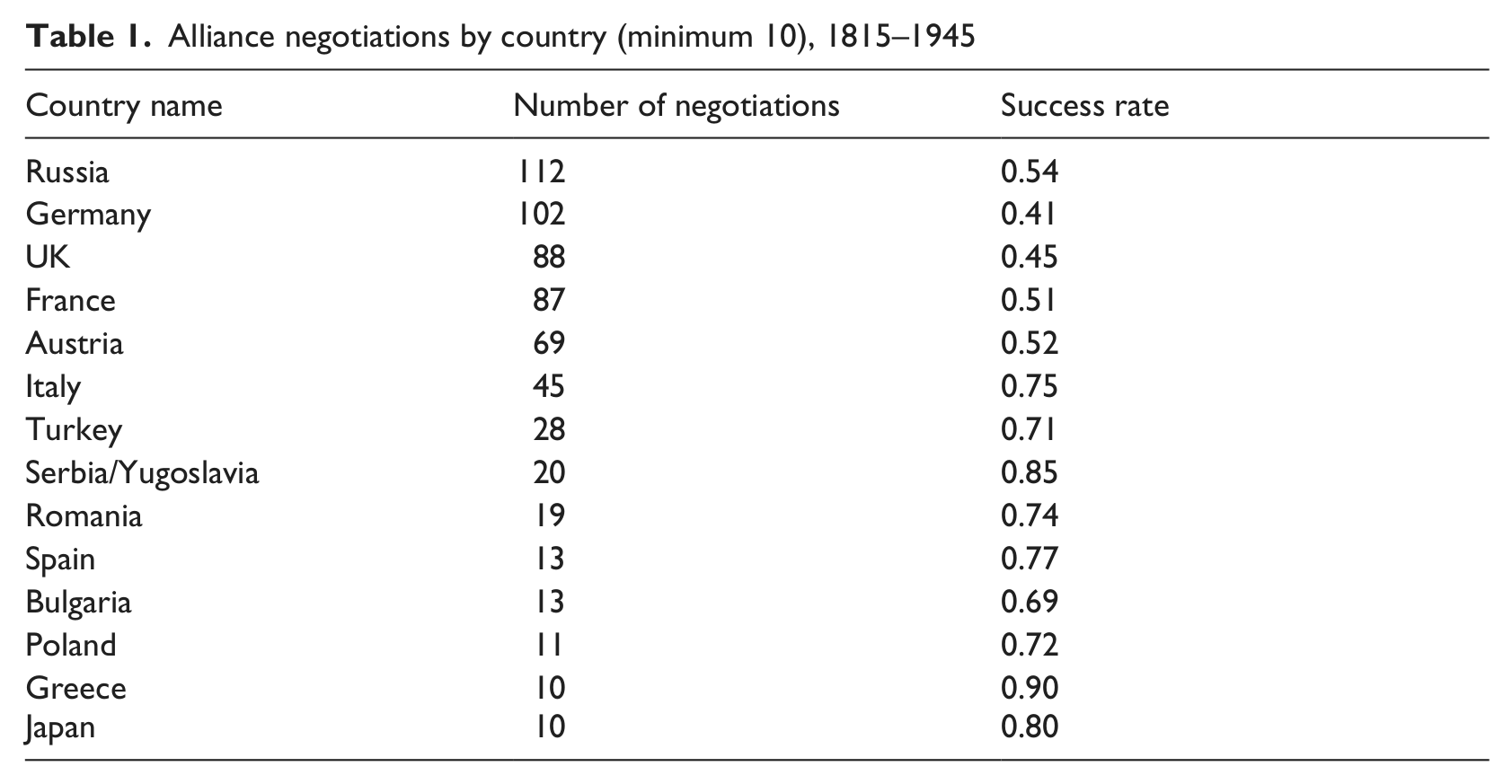
Given that such data has never before been collected, one might be curious to know why negotiations fail. Indeed, 41% (127/308) of European alliance negotiations from 1815 to 1945 ended in nonagreement. To place this number in perspective, according to the Issues Correlates of War dataset, 47% of peaceful, nonbinding third-party conflict settlement attempts (good offices, inquiry or conciliation, mediation, multilateral negotiations, peace conferences) from 1816 to 2001 failed (either the attempt ended in nonagreement or the disputing parties soon broke the agreement; Hensel et al., 2008). Given the similarity of numbers and the interest that has been given to the failure of mediation (Beardsley, 2008, 2010; Bercovitch and Diehl, 1997; Bercovitch and Jackson, 2001; Bohmelt, 2010; Favretto, 2009; Gent and Shannon, 2010; Greig, 2005; Greig and Regan, 2008; Kydd, 2006; Regan and Aydin, 2006; Savun, 2008; Svensson, 2009), one should suspect that the failure of alliance negotiations can attract similar interest.
Issue linkage and alliance treaty formation
Using the above data and applying matching techniques to account for confounding variables and selection effects (see below), Poast (2012) finds that from 1860 to 1945 offering to expand a military alliance negotiation along an economic dimension (trade) increased the probability of agreement by 36 percentage points. Poast also finds that, after accounting for missing treatment data and applying minimal assumptions regarding the nature of the missing data, the maximum possible size of the effect is an increase of 23 percentage points. Thus, it appears that issue linkage can have a substantially positive effect on the probability of states reaching agreement.
It should be emphasized that Poast (2012) only evaluates negotiations after 1860. This is for both practical and substantive reasons. Practically, data is limited for several covariates for much of the early nineteenth century. Rather than impute these values, Poast focuses on the time period for which he has the most confidence in the data. Substantively, 1860 is a reasonable starting year when concentrating on offers of trade cooperation. The year 1860 marks when free-trade arrangements in general and the most-favored nation principle in particular became an accepted tool of European diplomacy (Bairoch, 1989; Held et al., 1999: 155). It is widely recognized by political economists that the signing of the Cobden–Chevalier treaty between the UK and France in 1860—the first major free trade agreement between European powers—made open trade policies an acceptable practice throughout Europe (see Frieden, 2006; Pahre, 2008; Rogowski, 1989). 12 Whether Cobden–Chevalier resulted from widespread commercial trade becoming technologically feasible (as improvements in the steam ship, rail and the telegraph lowered the costs of international trade) or the benefits of open trade, illustrated by the British adopting a unilateral free trade policy in 1849 (with the elimination of the Corn Laws and Navigation Acts), is beyond the scope of this article (see Eichengreen, 1996; Eichengreen et al., 1999; Frieden, 2006; Kenwood and Lougheed, 1999; Oatley, 2004; Pahre, 2008; Schonhardt-Bailey, 1996). Instead, it is sufficient to recognize that these are sensible reasons for Poast (2012) to focus on the 1860–1945 time period.
Despite these reasons, it could still prove useful to identify the effect of issue linkage for the pre-1860 time period. One should expect offers of trade cooperation to not have the same positive effect since free trade agreements were not perceived to be as valuable during this time as compared with after 1860. Indeed, consider this late 1840s comment by British Foreign Minister Richard Cobden on why the British should not push other countries to adopt free trade policies. The comment duly illustrates the negative perception of trade cooperation (and that this perception might be due to its association with British hegemony): We came to the conclusion that the less we attempted to persuade foreigners to adopt our trade principles, the better; for we discovered so much suspicion of the motives of England, that it was lending an argument to the protectionists abroad to incite the popular feeling against freetraders, by enabling them to say, “See what these men are wanting to do; they are partisans of England and they are seeking to prostitute our industries at the feet of that perfidious nation …”. To take away this pretense, we avowed our total indifference whether other nations became freetraders or not; but we should abolish Protection for our own selves, and leave other countries to take whatever course they liked best. (Quoted in Bhagwait, 1989: 29.)
This creates the expectation that offers of trade linkage will, at minimum, not have a positive effect during the 1815–1859 time period and, at most, could even have a negative effect. To determine if this is the case, I follow Poast (2012) by applying nearest-neighbor matching on data for the 1815–1859 time period. Matching consists of pairing each subject in a treatment group with a subject in a control group that has similar (although perhaps not identical) values for a series of covariates. Once matches are made, one can estimate the average effect of the treatment, or average treatment effect. This is computed by using a simple difference of means t-test between the treated observations and control observations in each pair. 13
Matching is appropriate for my data since I have a binary key independent variable (offer of trade linkage or no offer of trade linkage), a binary outcome variable (alliance agreement reached or no alliance agreement reached) and a variety of covariates that account for contextual factors (described below). Moreover, since I have a small number of overall cases, identification with structural models (such as logit or probit) will be driven primarily by the parametric structure imposed on the data, not by the data itself. 14
With respect to covariates, I match on a variety of contextual variables to ensure that my inferences are based on comparing similar negotiations. First, using data from the Correlates of War project, I control for the number of military personnel held by the negotiation participant with the smallest number of military personnel. Second, I create a binary variable called buffer, coded 1 if, in year t, negotiation i contains at least one buffer state as identified by Fazal (2007), 0 otherwise. Third, I create a variable, contiguous, coded 1 if all the states in the negotiation are geographically contiguous, 0 otherwise. 15 The contiguity of the states is determined using the geographic distance data computed by the EUGene software of Bennett and Stam (2000). Fourth, I account for the number of states involved in the negotiation using a variable indicating whether two (the minimum number of states involved in a negotiation in my dataset), three, four or five (the maximum number of states involved in a negotiation in my dataset) states are involved in the negotiation. Fifth, Langer (1966: 5) states that “the great coalitions of modern history were almost always made just before the outbreak of war or during the course of the conflict itself”. To account for these crisis periods, the variable crisis equals 1 if the negotiation took place during or one year prior (i.e. in the lead-up) to the following major crisis years (1815, 1833, 1848 and 1854), 0 otherwise. Sixth, the variable prior equals 1 if a group of states are engaged in their first negotiation as a group, 0 otherwise. For example, if a group of three states have never engaged in negotiations as a triad, then this is considered a first negotiation (even if two of the members had engaged in a prior negotiation). Seventh, the variable offensive/defensive is coded 1 if a negotiation is focused on the formation of an offensive or defensive alliance, 0 otherwise. Finally, I create the variable proportion democracies. This variable captures the percentage of states in a negotiation that are democracies, where a state is considered a democracy if it has a score of 6 or higher on the 21-point Polity IV scale (Marshall and Jaggers, 2002). Summary statistics for these variables are reported in Table 2.
Summary statistics, 1815–1859
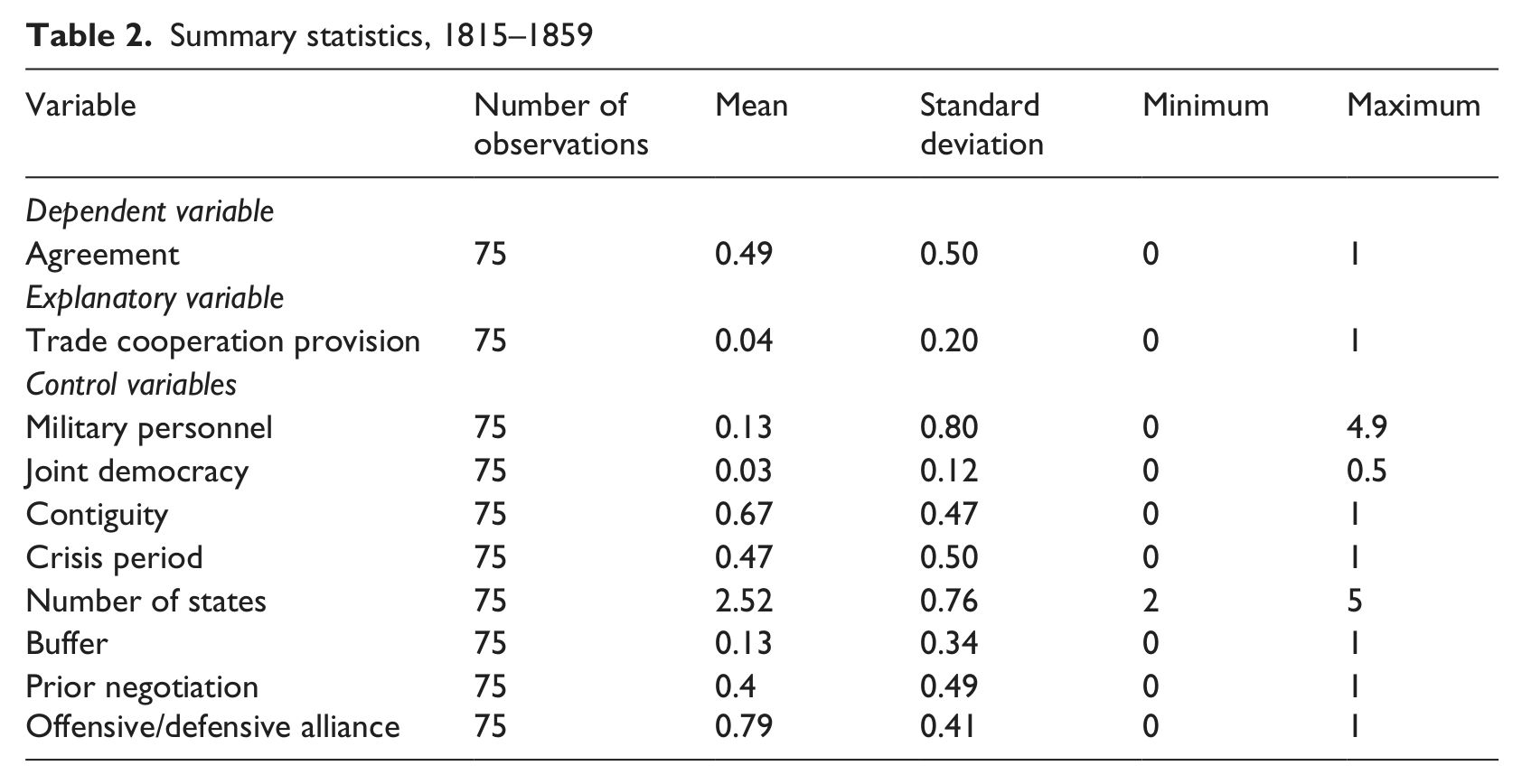
Table 3 reports the average treatment effect for each sample after the observations are matched using the above variables. For the 1815–1859 time period, Table 3 reveals not only that offers of trade linkage failed to have a positive effect on the probability of the negotiations ending in agreement, but also that the effect is actually negative. Specifically, it appears that an offer of trade linkage decreases the probability of agreement by 51 percentage points, with 0.95 confidence intervals showing that the effect is statistically significant. Of course, given the small sample size, these results should be interpreted with great caution.
Effect of trade linkage on alliance formation, 1815–1859
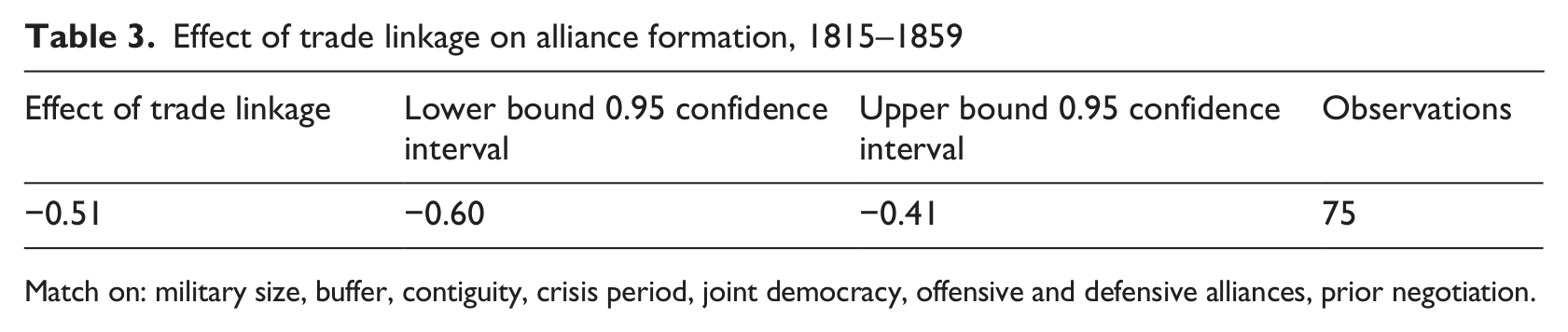
Match on: military size, buffer, contiguity, crisis period, joint democracy, offensive and defensive alliances, prior negotiation.
Conclusions
Issue linkage—the simultaneous negotiation of multiple issues into a single treaty—does appear to work, at least for alliance negotiations after 1860. For these alliance negotiations, offers of trade linkage appear to increase the probability of states reaching agreement and improve the credibility of an agreement once it has been reached. However, I also find that, for alliance negotiations prior to 1860, offers of trade linkage did not have a positive effect on the probability of agreement (and, indeed, actually had a negative effect). Therefore, while the evidence presented here can lay to rest some arguments questioning the effectiveness of issue linkage to secure international agreements, it cannot completely eliminate such claims.
Since this evidence pertains only to alliances negotiated prior to 1945, what relevance does it have for nonalliance negotiations today? Arguably, the stakes are higher for alliance negotiations than for any other type of treaty (with the exception of perhaps peace agreements). Alliance negotiations deal with something as fundamental as countering external threats to the survival of a state. Concerns over state survival were particularly acute prior to 1945, since Fazal (2004, 2007) found that states were more likely to experience violent invasion and occupation during this time period. 16 Hence, if offers of issue linkage can secure agreement during pre-1945 alliance negotiations (where the stakes were exceptionally high), it should work for a whole host of negotiations. Moreover, if linkage provisions can enhance the credibility of alliance commitments for buffer states (whose high susceptibility to invasion and occupation makes other states reluctant to form alliances with them), then linkage provisions should improve treaty compliance in nearly any context.
My findings are also important for reasons beyond the effectiveness of issue linkage. First, I find that over 40% of alliance negotiations ended in nonagreement during the 1815–1945 time period, an exceptionally high rate of failure. This finding may shed light on the high rate of alliance compliance identified by Leeds et al. (2000). Leeds et al. (2000: 697) found that alliance members failed to comply with their alliance obligations only 25% of the time, but they acknowledge how “in this study, we simply identify reliable and unreliable alliances. A clear next step is to explain why some alliances are reliable and others are not”. The high rate of negotiation failure identified here suggests that the high rate of compliance might be due, in part, to states being highly selective when choosing alliance partners. Indeed, this supports Leeds’s (2003: 808) conjecture that, “under most conditions, leaders are reluctant to make promises that they or their partners are unlikely to uphold” and, therefore, leaders carefully select the agreements that they are willing to make.
Second, my findings suggest that linkage offers are exceptionally costly. Specifically, although the study reveals that issue linkage can work, it also finds that it is rarely used. While the participants may have attempted other forms of issue linkage besides economic linkage offers, this still leaves a substantial number of negotiations that failed without witnessing an offer of linkage. The rarity of linkage offers suggests that there are costs associated with issue linkage that are quite prohibitive. Poast (2012) details these costs, which range from a linkage provision being politically unpopular with domestic audiences to the bureaucratic costs associated with ensuring that the state is in compliance with the new provision.
Third, my findings suggest a need to rethink how scholars analyze alliance formation. The high rate at which alliance negotiations end in nonagreement suggests that states decide whether or not to begin alliance negotiations and only then determine if the negotiations will actually result in an agreement. Hence, while scholars presently view factors such as threat perceptions and relative capabilities as important determinants of alliance formation, my findings suggest that such pre-negotiation observables may play a secondary role to the bargaining tactics (such as linkage offers) employed at the negotiating table.
Fourth, my findings illustrate how trade can enhance the effectiveness of deterrence, even for buffer states who are highly susceptible to invasion and occupation. This is consistent with Huth and Russett (1984), Huth (1988), and Asyegul (2010), who find that deterrence is more likely to succeed if the defender has trade ties with the challenger’s target. Unlike this previous work, my findings consider instances when trade cooperation is directly linked to security cooperation.
With respect to future research, the methods offered here point to a variety of new directions for exploring a wide range of phenomena in international relations. War onset, trade agreement formation and the creation of large environmental treaties are just a few of the many events in international relations one could classify as having a k-adic structure. Therefore, one must seriously consider employing k-adic data to evaluate these events. 17 Scholars must also take seriously how to incorporate “the dogs that didn’t bark” into their analyses. Indeed, scholars should consider more carefully factors that lead states to enter into a whole array of international diplomatic activities, ranging from trade and alliance negotiations to conflict mediation and ceasefire negotiations. Scholars, in their efforts to study the effectiveness or duration of negotiated agreements, frequently ignore the processes leading states to enter negotiations or that unfold during negotiations. At minimum, this research reveals the pitfalls of ignoring the diplomacy underlying diplomatic outcomes.
Footnotes
Acknowledgements
The research discussed in this article benefited from the comments and assistance of numerous individuals. I particularly wish to thank my dissertation committee of William Roberts Clark, Alan Deardorff, Barbara Koremenos, Walter Mebane and James D Morrow. I am also thankful for the NSF IDEAS IGERT Fellowship which accorded me the time to complete this research. All errors are my own.
Funding
This research received no specific grant from any funding agency in the public, commercial, or not-for-profit sectors.