







Abstract
During civil conflicts the distribution of power heavily influences belligerents’ war strategies, potentially including civilian targeting. Despite the potential relevance to wartime victimization, the relationship between insurgent capabilities and civilian victimization has received limited attention. A complicating factor in assessing this relationship is that power produces countervailing incentives and opportunities for violence. While greater military capabilities present more opportunities for death and destruction, incentives for anti-civilian violence should decline as the range of war strategies available to the group expands. This intuition suggests a tension between the opportunities and incentives to kill that past studies have failed to explicitly address. I help resolve this tension by examining the manner in which the origins of rebel resources condition the relationship between military capabilities and civilian victimization. Where groups rely on local support, violence declines as group capabilities increase. By contrast, when rebels rely on alternative sources of support, greater capabilities produce greater levels of violence. I test these relationships quantitatively using recently constructed data on insurgent resources and one-sided violence against civilians in conflicts occurring between 1989 and 2009.
Introduction
Power occupies a central position in research on conflict processes. 1 In the context of violent political conflict, military power represents the primary tool through which actors expect to attain their political goals. In this sense, the ability to impose costs on an opponent through the use of violence serves as a substitute for other types of power. As Mao Ze Dong (1938/1967) observed, “power grows from the barrel of a gun”, suggesting that a superior ability to inflict violence on an adversary translates into political power. Violence may therefore unfortunately reflect the ultimate kind of power (Mills, 1956: 171). Yet, as Arendt (1970: 52) observed, while violence and power often appear together, they represent distinct phenomena. Indeed, Arendt contends that violence increasingly substitutes for other forms of power when an actor weakens relative to its opponents (Arendt, 1970:53, 56). This suggests something of a tension between power and violence during conflicts. While military capabilities provide the means through which actors achieve strategic objectives, violence is perhaps more common where and when an actor’s power is weak or in decline.
Power dynamics and asymmetries in actor capabilities are particularly relevant to understanding actors’ strategy formation during rebellion. As military strategists have long observed, the nature of guerilla warfare is defined by the asymmetry of the participants’ capabilities. It is for this reason that guerillas employ sabotage, terror and hit-and-run tactics rather than fight the government’s forces in pitched battles. Put more broadly, asymmetry in capabilities limits the range of strategies the actor can effectively adopt in pursuit of their tactical objectives and strategic goals. Relatively weak groups may therefore more frequently rely on terrorism as a substitute for more conventional strategies of war specifically because they lack the resources necessary to engage their adversary directly. Consequently, previous research has often described terrorism as a weapon of the weak and viewed civilian targeting as an instrument by which weaker insurgents attempt to level the playing field (e.g. Crenshaw, 1981; Lake, 2002).
Despite this common association, the relationship between insurgent military capabilities and brutality toward civilians has not been thoroughly investigated. Existing studies produce conflicting results as well as competing logics to explain how military capabilities shape insurgent decision-making regarding anti-civilian violence (e.g. Asal and Rethemeyer, 2008; Wood, 2010). On the one hand, larger groups may be more lethal because greater capabilities imbue them with greater destructive capacity and present more opportunities for violence. On the other hand, the resource constraints imposed on weaker insurgents incentivize the use of civilian victimization as a war strategy. Weak groups resort to violence as a tool of recruitment, resource acquisition and control because they possess fewer non-coercive strategies through which to achieve these objectives. This highlights a tension between a group’s ability to inflict violence on the population and the incentives it has to do so.
This paper addresses this tension by asking two interrelated questions. How does the distribution of power between insurgent and regime forces influence rebel violence toward civilians? How do the sources of rebel military power influence the group’s violence strategies? Unlike previous analyses, it accounts for the potentially countervailing influences of capabilities on insurgents’ ability and incentive to target civilians. It does so by examining how the sources of rebel capabilities influence the manner in which rebel forces interact with and behave toward the civilian population. More specifically, I argue that, while military capabilities largely define a group’s destructive potential and create opportunities for violence, the origins of group capabilities—principally whether the group cultivates power via grass roots mobilization and popular support or acquires capabilities via foreign sponsorship or trade in illicit goods—shape the group’s willingness to victimize the population. Where groups enjoy significant mobilization potential among local civilians, violence tends to decline as military capabilities increase. By contrast, where alternative resources supplant popular support, more militarily capable insurgent groups inflict greater violence against civilians. I test hypotheses drawn from this discussion using a group-level data from a global sample of post-Cold War rebellions. The results generally support the hypotheses, suggesting that the sources of rebel support mediate the influence of military capabilities on civilian targeting.
Capabilities and violence in civil war
Realist scholars conceive of power primarily in terms of the relative balance of capabilities between actors and assert that states pursue power because it represents the primary tool through which they accomplish policy objectives (Art, 1980; Mearsheimer, 2001). The importance of relative capabilities during conflict resonates within the domestic sphere as well (Buhaug, 2010; Butler and Gates, 2009). Recent studies demonstrate that the balance of coercive power largely determines the outcome and duration of domestic conflicts (Buhaug et al., 2009; Cunningham et al., 2009). It likewise shapes insurgents’ choice of war strategies, influencing whether rebels pursue revolutionary or more limited secessionist goals (Buhaug, 2006), as well as whether conflict occurs in peripheral areas or nearer to the centers of regime power (Buhaug, 2010). These findings generally concur with Clausewitz’s (1832/1984: 283) observation that capability constraints impose limits on actors’ political goals. The distribution of capabilities may likewise influence the style of warfare that insurgents adopt (Kalyvas and Balcells, 2010; Vinci, 2009). Insurgents that suffer severe asymmetries in military technologies are more likely to fight guerrilla-style conflicts or to engage in terrorism, whereas those with greater access to material capabilities and war technologies are more likely to adopt conventional tactics (Butler and Gates, 2009). Moreover, insurgents’ choice of tactics changes as the distribution of capabilities shifts over the course of the conflict (Byman, 2008; Lockyer, 2010). This observation recalls Mao’s (1961) proposition that insurgencies evolve through discrete stages defined largely by capabilities and resource access.
Like other aspects of strategy formation, the decision to target civilians is at least partly related to power asymmetries. As noted above, previous studies posit that the relative weakness of extremist groups partially explains their reliance on terrorism in pursuit of political goals (e.g. Crenshaw, 1981; Lake, 2002). Recent analyses extend this argument, citing either group strength or shifts in the balance of military capabilities as explanations for civilian victimization within the context of civil war (Hultman, 2007, 2012; Metelits, 2010; Wood et al., 2012). According to this research, the rising threat of defeat and competition for scarce resources produce incentives for targeting civilians as a means to impose costs on the regime, acquire resources or stave off defeat. Conversely, groups that amass and maintain significant capabilities may have comparatively fewer incentives to target civilians (Wood, 2010). These groups can more effectively consolidate control over territory and purchase civilian loyalty through less coercive tactics (e.g. security, services and parallel political institutions).
A competing logic suggests that the influence of military capabilities on anti-civilian violence cuts in the opposite direction. While previous studies identify terror as a weapon of the weak, the claim that weaker groups are more likely to target civilians does not square with the intuition that more soldiers and more military hardware create more opportunities for carnage. Recent empirical analyses challenge the position that weakness breeds violence and instead argue that large, well-armed factions are more capable of victimizing larger swaths of the civilian population compared with small bands of extremists as a result of their superior resource mobilization capability (Asal and Rethemeyer, 2008; Overgaard, 1994). While smaller terrorist or guerilla groups may kill with comparatively greater efficiency because their small size increases coordination and tactical agility, spectacularly violent attacks such as Al-Qaeda’s attacks against the USA on 11 September 2001 are rare. More frequently, guerilla violence is limited to small-scale attacks in sparsely populated rural areas, and weaker urban extremists are more likely to carry out sporadic bombings that kill tens rather than hundreds of civilians. By contrast, larger organizations have the capacity to kill hundreds or thousands of persons if they so choose, especially when they enjoy access to heavy weapons and fight near or in population centers. Kalyvas (2004: 134) contends that insurgents are most likely to employ indiscriminate violence when they are on the verge of ousting the incumbent from the capital, suggesting that power may provide significant incentives and opportunities for violence against civilians.
Disentangling the relationship between insurgent power resources and victimization requires closer scrutiny of the sources of rebel power as well as how they interact with military capabilities to shape rebel violence. Military capabilities represent only one aspect of insurgent power (Wood, 2010: 606). Moreover, such capabilities are not exogenously conferred on a group but represent the culmination of multiple inputs: leadership quality, organizational capacity, natural resource wealth, foreign sponsorship and social capital. Each shapes both the military resources available to group as well as their ability to effectively utilize these resources in pursuit of their goals. Most importantly, whether rebel military capabilities flow from success at mobilizing popular support or originate from another source shapes incentives for violence against the population. Previous research shows, for example, that groups that enjoy external sponsorship and those that rely on conflict resources as a source of funding are more likely to target civilians because such resources reduce reliance on the civilian population and attract opportunistic, violent thugs (Hovil and Werker, 2005; Weinstein, 2007).
The above discussion suggests that military capabilities alone are insufficient for explaining rebel violence. Several historical examples illustrate this observation. For instance, both the Eritrean People’s Liberation Front (EPLF) in Ethiopia and the Farabundo Martí National Liberation Front (FMLN) in El Salvador were initially quite weak in terms of military capabilities compared with the governments they challenged. Yet these groups were able to mobilize significant local support, exert control over substantial territory and provide selective benefits to the local population in the form of political institutions, security and basic health and educational services. These factors promoted more (although not exclusively) pacific relations with civilians (Wood, 2003; Young, 1998). By contrast, the Rally for Congolese Democracy (RCD) enjoyed a relatively high degree of military capabilities but failed to build a base of popular support among the local civilian population and never established effective governance systems in the areas they attempted to control. Rather, the group relied on external support from Rwanda and Uganda as well as trade in lootable resources to attract recruits (Mampilly, 2011: 187–188, 206–207; Uppsala Conflict Data Program, 2013). Consequently, it engaged in high levels of civilian victimization. These examples suggest the need to account for the countervailing influences of power on violence.
Incentives and constraints
The above discussion highlights the need to simultaneously account for the influences of both incentives and constraints in the production of anti-civilian violence. Previous research in state decision-making provides a useful theoretical framework for incorporating both dimensions into investigations of actors’ strategy selection. Most and Starr (1989) contend that opportunities and willingness jointly structure non-state actor strategy formation and choice. 2 According to this framework, leaders’ strategies are constrained by the opportunities provided by the strategic environment, while the willingness to adopt a specific strategy is a function of the leaders’ calculation of the relative costs and benefits of the various strategies that the context permits (Siverson and Starr, 1990: 48–49). This framework has previously been applied to domestic repression (Enterline and Gleditsch, 2000; Poe, 2004) and civil war onset (Cederman et al., 2009; Gleditsch and Ruggeri, 2010). It also offers insights into rebel behavior toward civilians by clearly delineating both the factors that augment opportunities for violence and those that structure the incentives for it.
All else being equal, destructive potential probably increases in tandem with greater access to military resources (Asal and Rethemeyer, 2008; Boyns and Ballard, 2004; Overgaard, 1994). Rebel group size facilitates violence in large part because increasing the volume of troops presents more opportunities for soldiers to encounter and brutalize the population. Such abuse becomes increasingly likely as control over troops in the field diminishes as a result of poor monitoring by commanders, weak internal control and policing mechanisms, or the presence of large numbers of opportunistic recruits (Gates, 2002; Humphreys and Weinstein, 2006; Weinstein, 2007). Consequently, as rebel ranks swell and insurgents range over a larger geographic area, attacks on insurgents are expected to increase. For instance, with a force of nearly 20,000 troops, RENAMO killed tens of thousands of civilians during the 15-year Mozambican Civil War. Similarly, Serb forces in Bosnia–Herzegovina, which numbered more than 75,000 and had access to heavy weapons provided by the Yugoslav government, killed upwards of 10,000 civilians during the siege of Sarajevo in 1992–1993 and roughly 8000 civilians in a matter of days during the Srebrenica massacre in 1995. 3 It is perhaps not surprising that these groups, which produced some of the highest numbers of civilian casualties in recent decades, were likewise among the largest and best armed.
Smaller insurgencies may produce violence disproportionate to their meager resources; however, a force of a few hundred guerillas is unlikely to commit carnage on the same scale as an organization with thousands of well-armed soldiers because their limited resources afford relatively fewer opportunities for abuse. In part, this is because weaker rebels tend to fight smaller conflicts in peripheral areas of the state rather than near the centers of government authority (Buhaug, 2010), thus limiting their access to densely populated areas. Rural insurgencies may produce large numbers of causalities, but doing so still requires significant numbers of troops and access to war materiel. For instance, the largely Tutsi Alliance of Democratic Forces for the Liberation of Congo–Kinshasa (AFDL) killed tens of thousands of civilians in the rural border region of the Democratic Republic of Congo and Rwanda in 1996. While the insurgency was primarily located in a rural area, the group fielded some 20,000 troops and enjoyed material support from the Rwandan military, allowing it to inflict tremendous carnage on the region and its inhabitants. As this example suggests, the capabilities available to an actor (troops, military technology, material resources) constrain or facilitate the group’s ability to perpetrate violence against the population.
While greater capabilities confer upon an actor the ability to kill in large numbers, their effect on the incentive structure for violence is less clear. Indeed, larger forces may have fewer incentives to target civilians because they should be better able to hold territory, compel civilian loyalty and extract local resources (Wood, 2010). Similarly, groups that maintain a monopoly or near monopoly in a conflict area (a clear indication of power) have fewer incentives to resort to violence (Kalyvas, 2006; Metelits, 2010). Weaker groups, by contrast, suffer from core deficiencies that are likely to encourage terror and civilian victimization. Almost axiomatically, weak rebel groups experience difficulties mobilizing their support base. This situation may incentivize violence, particularly when anticipated support fails to materialize or when a base community resists recruitment (Branch, 2005; Mkandawire, 2002). In this context, violence offers one instrument through which insurgents (temporarily) compensate for their resource constraints (Humphreys and Weinstein, 2008; Vinci, 2005; Wood, 2010). Attacking reluctant or recalcitrant civilians serves either to compel cooperation or to eliminate potential threats, thereby allowing the group to consolidate control over territory and populations, generate resources, and impose costs on its adversary. 4 Conversely, when insurgents are capable of rallying popular support, there should be little incentive to abuse the population.
However, mobilization constraints are endogenously related to a group’s extant power resources. Ideological convergence between rebels and civilians should facilitate the accumulation of more recruits and larger armies. Yet popular sympathy is seldom a sufficient condition for mobilization and active recruitment. The common axiom that popular support is the “sine qua non” of revolutionary success is probably true enough (Wickham-Crowley, 1992), but even when sympathy for the movement is high, a very low proportion of the population actively participates in the insurgency (Lichbach, 1995; Mason, 2004; Wood, 2003). Rather, civilians often base their decisions to extend or withhold support on expectations regarding war outcomes and the ability of the group to provide selective benefits.
When resources are limited and the group’s likelihood of victory is low, civilians are often reluctant to actively support the insurgents. The credible demonstration of capability therefore serves as a necessary precursor to translating latent support to active participation. According to Wood (2003), a strong recursive relationship exists between insurgents’ military capabilities and their ability to attract popular support. Civilians are more likely to support groups with a demonstrated ability to challenge the government because it signals the real possibility of overturning the regime and suggests that participation will be efficacious rather than futile. Furthermore, translating potential support into mobilization often necessitates reducing potential supporters’ individual assessment of the likelihood of regime sanctions. When the movement is small, the likelihood of capture or death is quite high; however, for every additional supporter added to the movement, the risk to the next recruit declines (Mason, 1996, 2004). Consequently, militarily powerful groups are more likely to activate latent support (where it exists) because it both increases an individual’s sense of the efficacy of the movement and reduces the likelihood that the individual suffers painful state sanctions.
Robust military capabilities likewise serve as a precursor for other public and private benefits. As Weinstein (2007: 84–85) notes, insurgents must achieve sufficient strength to challenge government control before they can provide collective goods. Past research on collaboration and support likewise suggests that selective incentives such as security and access to parallel governance systems encourage loyalty and recruitment (Lichbach, 1995; Mampilly, 2011: 8; Maranto and Tuchman, 1992; Mason, 1996). The achievement of demonstrable military and organizational resources is therefore important because it signals the ability to supply such incentives. While selective incentives are not sufficient to launch an insurgency or sustain it in its infancy, they do help explain the growth of a movement and recruitment success once the group is well established (Mason, 2004: 94). For example, the National Liberation Front was able to garner substantial popular support owing to the incentives it provided to peasants—80% of the Mekong Delta’s population benefitted from National Liberation Front (NLF) land reforms, and living standards were often higher than in areas of government control (Maranto and Tuchman, 1992: 257). Similarly, in Ethiopia the Tigrayan People’s Liberation Front’s (TPLF) provision of quasi-state services enhanced popular support and spurred recruitment (Young, 1998). In part, this is because economies of scale allow larger groups to continuously offer selective incentives to supporters for a comparatively diminished cost as the movement expands. Support and capabilities are therefore not only interrelated but often build upon one another—greater insurgent capabilities should engender greater participation from the population. As active support for the movement increases—a signal of the group’s growing social capital—its incentives to target the population should decline even as its opportunities for violence increase.
Many insurgent groups, however, simply do not enjoy any significant potential for popular mobilization among the local population. As such, the group’s ability to recruit support among the population may remain low in spite of the level of capabilities it can amass. That is, in some cases, insurgent objectives and civilian interests sharply diverge, or rebels may simply misunderstand the political or social interests of the local community from which they attempt to draw resources (Mkandawire, 2002). In these cases, rebels often adopt alternative strategies of recruitment. As Weinstein (2007) demonstrates, groups that lack the interest in or ability to engage in grassroots mobilization may turn to other potential endowments such as foreign support or lootable resources as strategies for soliciting support. This type of recruitment strategy is likely to bolster the military capabilities of insurgents but has the (perhaps unintended) effect of increasing the likelihood of violence against the population (Weinstein, 2007). This outcome results largely because of the manner in which the origins of support shape the incentives for violence. Where groups rely on popular mobilization strategies, violence against civilians is likely to undermine future support and eventually deplete the movement’s resources. By contrast, groups that rely primarily on other sources of funding are less beholden to the population and therefore suffer fewer costs for brutalizing it. As a result, popular support creates a strong disincentive for brutality while external sponsorship and trade in illicit goods impose few such constraints. 5
The RCD’s behavior illustrates this relationship. While powerful in military terms, the RCD never succeeded in consolidating support among the population because it was seen as a construct and tool of the Rwandan government. Moreover, its reliance on foreign support diminished its need to pursue popular mobilization as a strategy of resource extraction (Mampilly, 2011: 206–207). Similarly, the Revolutionary United Front (RUF) in Sierra Leone was capable of fielding significant forces relative to the rapidly collapsing incumbent regime. However, the movement was never able to solidify a base of support among the population. As such, it frequently relied on violence and forced recruitment to meet its immediate resource needs and to enforce compliance among the local population. Indeed, one recent survey of ex-RUF combatants suggests that only some 12% of recruits joined voluntarily (Humphreys and Weinstein, 2008). As this discussion highlights, military capabilities do not necessarily arise organically from high levels of support. If military technology and recruits originate from sources other than the local population, increased capabilities may provide significant opportunities to inflict damage on the civilian population without imposing significant constraints on the willingness to use it. Consequently, more militarily capable groups that fail to activate (or choose not to rely upon) civilian support networks are more likely to target civilians compared with similarly capable groups that work to cultivate popular support among civilians.
This discussion highlights two important aspects of the relationship between insurgent power and strategies of violence. First, assessments of power that focus exclusively on the distribution of capabilities do not adequately account for the tension between the opportunities and incentives for violence. Second, a complex relationship exists between military capabilities and victimization. All else being equal, opportunities for militarily strong groups to target civilians are quite high. However, the incentive structure for violence that relative power creates is more ambiguous. Where rebels enjoy significant popular mobilization potential or latent civilian support, incentives for violence decline. Consequently, popular support should mitigate the influence of greater military capabilities on civilian targeting such that more militarily powerful insurgents groups that enjoy popular support should kill relatively fewer civilians than powerful groups that lack such support. Conversely, the argument suggests that groups with limited potential to mobilize civilian support should become increasingly lethal as their capabilities increase. Specifically, groups that rely heavily on foreign sponsorship or trade in illicit goods are less likely to have cultivated strong civilian support networks and are less likely to enjoy a high degree of popular support (Weinstein, 2007). Indeed, limited support and sympathy from the population may partly explain the group’s reliance on alternative resource flows. To the extent that these resources substitute for or undermine local support networks, they are likely to exacerbate the relationship between military capabilities and rebel lethality. That is, as groups that rely on such resources accrue greater military capabilities, they are likely to impose greater costs on local populations. This discussion produces two testable hypotheses:
Data and research design
I rely on standard statistical methods to test the relationships specified in the above hypotheses. To create the sample used in the statistical analysis, I merge data from the Uppsala Conflict Data Program’s (UCDP) One-sided Violence Dataset (version 1.4; Eck and Hultman, 2007; Kreutz, 2008) with the recently released Non-state Actor Dataset (NSA; Cunningham et al., 2009), which includes information on the characteristics of non-state actors involved in civil conflicts. Merging the two datasets creates a rebel–government dyad–year sample temporally bounded between 1989 and 2009. This yields more than 900 observations, reflecting more than 160 groups involved in some 90 conflicts.
The dependent variable in the analysis is an annual count of the estimated number of non-combatants killed through one-sided violence committed by a specific rebel faction (Eck and Hultman, 2007). Data on one-sided violence is collected from a range of local and international media sources as well as reports from NGOs and international organizations. The UCDP defines one-sided violence as the intentional and direct use of violence against non-combatants. This definition necessarily excludes deaths by siege or infrastructure damage as well as deaths from battlefield error, negligence or crossfire (Eck and Hultman, 2007). For instance, the execution of unarmed tribal leaders during the rebel occupation of a village would be included in the dataset while civilian deaths resulting from exchanges of gunfire between rebel and government forces in a densely populated urban area would not be included. Given the inclusion criteria, much of the violence against civilians that occurs in conflict is not included in the dataset. However, this operationalization makes these data appropriate for testing the proposed relationship because the argument outlined above focuses on strategic rather than unintentional violence. 6
As noted above, rebel military capabilities can be assessed in a variety of ways. However, following recent analyses, I account for relative rebel capabilities by means of a continuous variable that reflects the ratio of rebel to government forces (e.g. Gent, 2011; Hultquist, 2013; Wood, 2010). Troop Ratio therefore represents the annual estimated number of active rebel troops divided by the estimated number government troops. Troop estimates are compiled from the UCDP conflict database (Uppsala Conflict Data Program, 2013).
The argument above articulates that the origins of rebel resources condition the relationship between military capabilities and civilian victimization. Testing this argument therefore necessitates employing measures that reflect a group’s potential support among the population as well as other potential options for resource mobilization that are not directly related to the number of troops fielded by the group. Owing to difficulties in both data collection and measurement of latent civilian support, such measures are understandably scarce. However, the NSA dataset includes multiple measures that should serve as suitable proxies. First, I rely on the NSA mobilization capacity indicator, which reflects a group’s potential for mobilizing support among the population (Cunningham et al., 2009: 580). According to the creators, this variable represents a crude accounting of the popularity of the organization among the population of the conflict state and reflects the size of the constituency from which the organization can potentially draw support and resources. 7 The original measure includes three categories reflecting low, moderate and high levels of mobilization capability. I collapse the moderate and high categories because the measure exhibits significant skew—97% of the observations fall into either the low or moderate categories. I code Mobilization 0 for groups with low mobilization capability and 1 for groups with at least a moderate level of this ability as recorded in the NSA dataset. I interact this measure with troop ratio variable in order to evaluate the hypothesized contingent relationship.
Second, I include two variables that capture the presence of alternative resource mobilizations strategies. I include a variable reflecting whether or not a group received significant support such as weapons, supplies or cash payments from a foreign sponsor. The variable Foreign Sponsorship is taken from the NSA and coded 1 if the group received such support and 0 otherwise. 8 I also include the variable Resource Financing, which reflects whether each group financed its rebellion by exploiting drugs, diamonds, gems or other lucrative resources located in the conflict area. This variable is taken from Rustad and Binningsbø (2012). As with the mobilization indicator, I interact Foreign Sponsorship and Resource Financing with Troop Ratio in order assess the hypothesized conditional relationship.
It is important to note that these indicators do not necessarily reflect a group’s military capabilities. Nor are the measures highly correlated (Cunningham et al., 2009). As discussed above, while groups with a larger potential support base are often able to translate support into active recruitment and participation this is not always the case. Indeed, many popular groups experience mobilization constraints that limit the size of their movement. Similarly, lack of popular support and reliance on alternative resources do not directly translate into smaller numbers of recruits overall. Many rebel groups that lack popular support are able to successfully recruit large numbers of troops, often through direct payment from war loot, smuggling or externally supplied resources. Figure 1 displays the mean Troop Ratio values according to the group’s reliance on different sources of resource acquisition. It should be noted, however, that groups often rely on multiple resource inputs, so the categories are not necessarily mutually exclusive. For example, some groups with high levels of popular support may accept foreign sponsorship in order to achieve their goals. As the figure illustrates, groups with greater mobilization potential are somewhat more likely to possess greater levels of capabilities. This is not surprising given that rebels with significant local support should more easily attract recruits among the local population. Interestingly, average capabilities appear to differ very little between groups that rely on external support and those that do not. Moreover, groups that rely on financing via conflict resources on average acquire greater numbers of troops than those that do not. Consequently, popular support is not the only means by which rebels recruit fighters, and it is important to determine if violence levels differ between groups that acquire capabilities via popular mobilization and those that rely on methods such as foreign support or illicit resources.
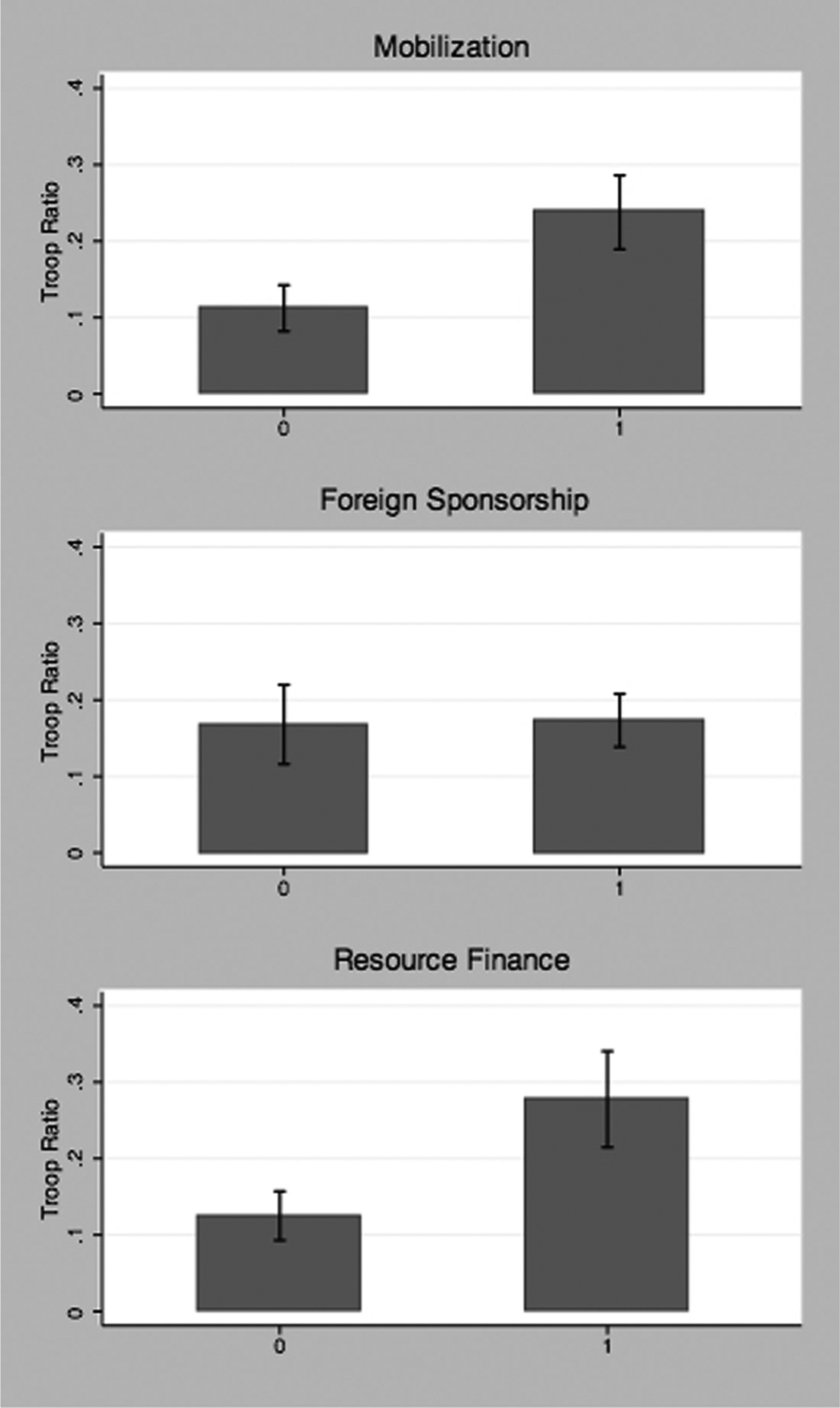
Mean troop ratio by group resource types. Sample mean values of Troop Ratio variable and 95% confidence intervals for groups possessing a given characteristic compared with those that do not.
Recent research identifies several variables that influence rebel behavior toward civilians. Kalyvas (2006) has demonstrated that territorial control shapes the types of violence that actors employ in civil conflicts. Other recent analyses note that victimization is more severe in areas of support for the adversary (Balcells, 2011; Hultman, 2009; Sullivan, 2012). While these studies focus specifically on the spatial distribution of violence, the ability to control territory in the aggregate is also likely to exert a more general influence on rebel behavior because control is often a precursor to the provision of other benefits. Territorial Control is a binary measure reflecting whether a group exerted effective control over territory within the conflict state. 9 The measure is taken from the NSA dataset. Previous studies likewise suggest that groups with weak discipline and poor control over troops are more likely to brutalize civilians (Humphreys and Weinstein, 2006; Weinstein, 2007). As a proxy for internal discipline and oversight, I include a measure of the centralization of control taken from the NSA dataset. Central Control is a binary indicator reflecting whether the leadership enjoyed at least a moderate level of centralized command over their forces in the field. Past studies also suggest that secessionist or ethnic conflicts may be especially brutal and difficult to resolve (e.g. Kaufmann, 1996). I include two measures to account for this potential relationship. I first include a binary indicator that accounts for whether the conflict represented a Territorial Conflict. The measure is taken from the UCDP Dyadic Dataset (Harbom et al., 2008). Second, because ethnic diversity may produce greater opportunities for ethnic violence, I include a measure of Ethnic Fractionalization based on data from Fearon (2003).
Conflict severity is positively related to civilian targeting (Hultman, 2007, 2012; Wood, 2010). The variable Conflict Intensity is coded 1 for years in which the conflict reached or exceeded 1000 battlefield-related deaths and 0 otherwise. The measure comes from the UCDP Dyadic Dataset (Harbom et al., 2008). Violence may also be reciprocal as insurgents and government forces engage in tit-for-tat killings (Wood, 2010). Government Violence reflects the log-transformation of the count of government one-sided deaths and is taken from the UCDP One-sided Violence Dataset. To address temporal dependence, I include a one-period of lag of the dependent variable. I also control for the conflict state’s Population size because larger populations create greater opportunities for violence. The measure is log-transformed and comes from the Correlates of War National Capabilities dataset (Singer et al., 1972). Violence against civilians may also worsen over time (Wood, 2010). Duration is the count of years since the conflict’s onset as given in the NSA data.
Model and results
The structure of the dependent variable is a cross-section of annual counts of rebel-inflicted one-sided deaths during civil conflicts occurring between 1989 and 2009. Because the dependent variable is a count and is not normally distributed, linear estimation techniques are likely to produce biased estimates, even if the variable is log-transformed. The presence of significant overdispersion in the counts further suggests that a negative binomial model is the most appropriate estimation method. In all models the standard errors are clustered on the group in order to account for within-group correlation.
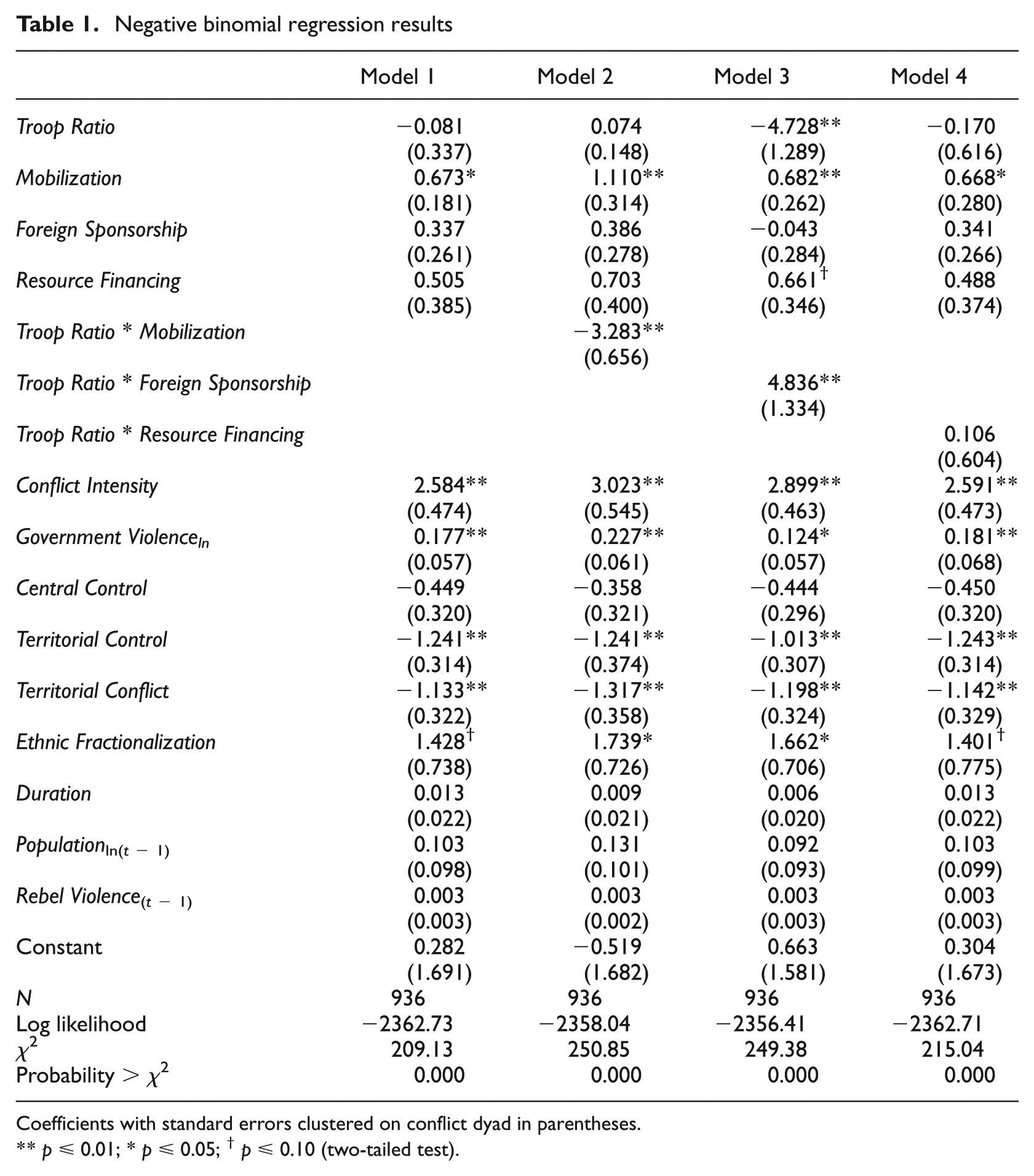
The results of the statistical models are presented in Table 1. Model 1 reports the results from the regression analyses using only the independent military capabilities indicator, Troop Ratio. The coefficient is negative, suggesting that group capabilities are negatively correlated with civilian victimization. However, it does not achieve statistical significance. This result casts some doubt on Wood’s (2010) finding that victimization decreases as insurgent strength increases. 10 It is important to note, however, that while Wood’s central argument focused on the disincentives for violence created by relative capabilities, the theory did not directly address the role that the origin of group resources plays in shaping these incentives. The conflicting evidence suggests the need to more closely examine the manner in which intervening variables may condition the relationship between capabilities and violence.
Negative binomial regression results
Coefficients with standard errors clustered on conflict dyad in parentheses.
p ≤ 0.01; * p ≤ 0.05; † p ≤ 0.10 (two-tailed test).
Surprisingly, the coefficient for Mobilization is positive and statistically significant in model 1. The result counterintuitively suggests that, all else being equal, groups with at least a moderately high potential for mobilization are actually more violent than those that lack such potential. As noted above, however, popular sympathy alone is typically an insufficient condition for recruitment and may not easily translate into active support. Even when civilians strongly favor the rebels, they often bury their preferences in order to escape punishment (Kalyvas, 2006). Moreover, while previous research argues that mass killing drives civilians into the arms of the rebels (e.g. Kalyvas and Kocher, 2007), regime violence is only likely to promote recruitment when the rebels possess sufficient strength to provide reasonable protection to supporters (Kalyvas, 2004: 133–134; Wood, 2010). Otherwise, civilians are likely to remain indifferent between supporting the rebels and remaining neutral (Moore, 1995). Consequently, mobilization potential is probably only activated when insurgents already possess at least a modest level of military capabilities. Consistent with the argument above, whereas more capable groups are likely to enjoy active support from the population, weaker groups may still rely more heavily on violence to achieve their goals, even when the population’s preferences favor the insurgents. Regardless, this result raises questions about the common assumption that rebels avoid targeting civilians when the population is largely supportive.
Foreign Sponsorship and Resource Financing are both positively correlated with insurgent violence in model 1. However, neither achieves statistical significance. This result fails to directly confirm recent arguments that point to an independent relationship between the origins of rebel resources and levels of civilian targeting (Weinstein, 2007). 11 However, as postulated here, the sources of support may condition the relationship between military capabilities and rebel violence.
Models 2 and 3 address the contingent relationships proposed in the above hypotheses. According to Hypothesis 1, the role of rebel capabilities in shaping violence toward civilians depends on the group’s mobilization potential among the population. The interaction term in model 2, which evaluates the conditional influence of Mobilization, is significant and the coefficient is negatively signed. Models 3 and 4 address Hypothesis 2, which suggests that groups relying external support or the sale of conflict resources will perpetrate violence against civilians more frequently as their military capabilities increase. Model 3 shows the results for the interaction between Foreign Sponsorship and Troop Ratio, while model 4 displays the result for the interaction between Resource Financing and Troop Ratio. Interestingly, only the interaction with the sponsorship indictor is significant, and the coefficient is positive. 12
Because neither the substantive effect nor the significance of interaction terms can be accurately inferred from examining regression coefficients, I calculate the marginal effects of the terms based on the results from models 2–4. These are presented in Figure 2. Each of the three panels corresponds to the model, including the relevant interaction term. In each panel, the x-axis reflects a range of the Troop Ratio variable while the y-axis reflects the predicted count of civilian killings. All panels reflect the difference in the predicted number of civilian deaths between groups that posses a given characteristic (i.e. relevant variable set to 1) and groups that lack the specified characteristic. It is worth noting that the observed relationship is only statistically significant when both the lower and upper confidence bands are above or below the zero line. The first panel shows the influence of Mobilization over the range of Troop Ratio. According to the predictions, relatively high mobilization potential reduces violence as military capabilities increases. The effect is significant at very low levels of the ratio and then again once a group has attained approximately 50% of the capabilities of the government. Consequently, mobilization potential reduces violence as relative strength increases, but only for groups that attain quite robust capabilities. An interesting outcome of the prediction is that very weak groups with strong potential support are predicted to kill comparatively more civilians than those without support. The theory does not directly anticipate this result; however, as argued above, low levels of military capabilities suggest the group’s inability to successfully translate potential support into actual recruitment. Moreover, insurgents may perceive civilian reluctance as betrayal and victimize the population (Branch, 2005; Mkandawire, 2002).
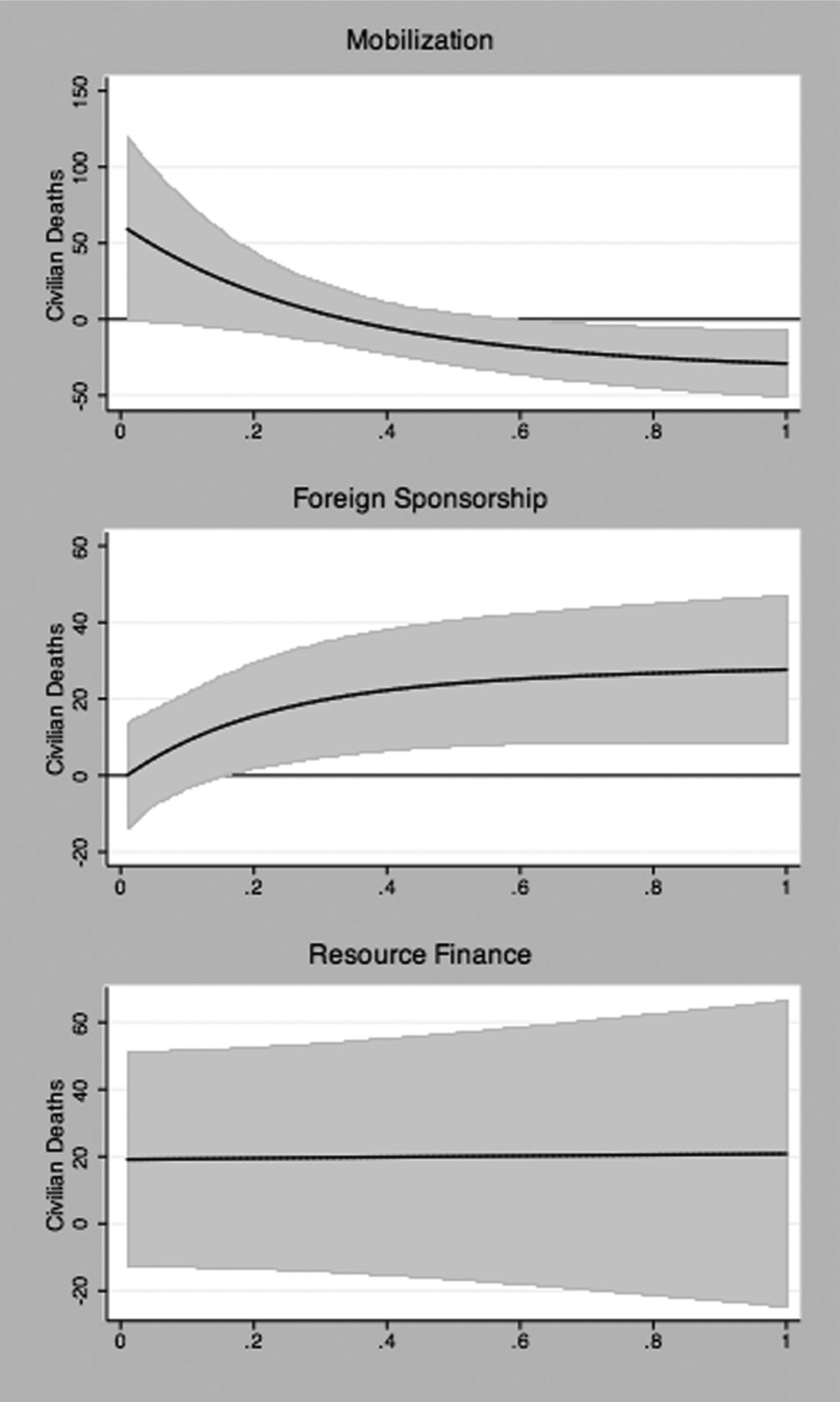
Marginal effects of interactions. Predicted rebel one-sided violence for groups possessing the specified characteristic relative to those without it over Troop Ratio. The 95% confidence intervals are denoted by shaded areas. Control variables held at mean or modal values.
The second and third panels illustrate the results from models 3 and 4 respectively. According to the predictions from model 3, Foreign Sponsorship exacerbates the influence of rising capabilities on civilian targeting. Compared with groups that do not receive significant support from external patrons, those with such sponsorship significantly increase rebel abuse over the range of capabilities presented here. The effect becomes statistically significant once a group attains roughly 18% (nearly the sample mean) of the capabilities possessed by the regime. This result is consistent with Hypothesis 2 and with the general argument. When alternative resource flows substitute for popular mobilization support and grassroots mobilization strategies, civilian costs tend to increase as rebel military capabilities expand. The prediction is therefore generally consistent with claims that groups that lack social resource endowments but possess significant material endowments are more likely to brutalize civilians (Weinstein, 2007). However, it shows that this relationship is in part dependent on the capabilities that groups posses. Surprisingly, the predictions based on model 4 suggest that Resource Financing has no significant influence on the relationship between relative capabilities and civilian targeting. The confidence intervals are extremely wide, and there is no point along the x-axis at which the interaction is significant. The theory offers little guidance on this count, but the results suggest that foreign support and resource financing differ in significant ways. Future research may wish to further examine these relationships.
Turning to the controls, across the models, Territorial Control is negative and statistically significant. This result largely supports existing arguments that increased control decreases civilian victimization. It is worth noting that previous studies have shown that spatial variations in control explain variation in violence types (e.g. Kalyvas, 2006). The variables used herein, however, simply record whether a group exerted effective control over some area within the conflict zone. Consequently, this does not represent a direct test of these arguments but simply suggests that rebels that can govern territory beyond regime control are less likely to brutalize civilians than those that do not. Central Control over troops is negative across the specifications, but the measure falls short of statistical significance. The result suggests that groups with less central authority and control are on average no more violent than those in which troop control is highly centralized.
Territorial Conflicts—those in which rebels seek autonomy or independence from the central state—are correlated with less violence. The coefficient is negative and statistically significant. By contrast, Ethnic Fractionalization is positive and attains statistical significance across the specification. These results therefore present a contradictory picture of the relationship between ethnonationalist conflicts and levels of conflict brutality. On the one hand, greater fractionalization increases brutality, but conflicts over autonomy appear to produce less violence toward civilians. Conflict Intensity is also positive and significant, demonstrating that, as battlefield costs increase, intentional attacks on civilians are likely to increase as well. Similarly, the results for the Government Violence measure support previous findings that rebels respond to regime attacks on civilians with reciprocal violence. Somewhat surprisingly, the lagged dependent variable does not achieve statistical significance. This result would seem to suggest that attacks on civilians are more likely to be episodic in nature rather than a simple of function of previous group behavior. This might suggest that civilian targeting follows a more strategic than path-dependent logic. Duration is similarly positive and insignificant in each of the models. Finally, the Population size of the conflict state is positively correlated with increased killing but fails to achieve statistical significance.
Discussion and conclusion
Recent analyses have examined the manner in which the distribution of power between insurgents and the government influences the types of warfare rebels adopt (e.g. Butler and Gates, 2009; Lockyer, 2010). Scholars have further speculated that relative capabilities may play a role in determining the level of civilian targeting employed by insurgents (e.g. Asal and Rethemeyer, 2008; Wood, 2010). However, previous studies produce inconsistent results and present competing logics linking violence and military capabilities. On the one hand, larger numbers of troops may present more opportunities for attacks on civilians. On the other, more robust capabilities may reduce incentives for violence because greater capabilities signal the group’s ability to provide selective incentives to supporters and emerge victorious, thereby encouraging recruitment.
This paper helps resolves this tension by examining countervailing influences of capabilities on violence as well as the manner in which the sources of rebel capabilities shape groups’ willingness to brutalize civilians. Borrowing from the opportunity and willingness framework proposed by Most and Starr (1989), I argue that, all else being equal, greater access to military technologies and greater troops strength provide increasing opportunities for destruction. However, capabilities do not independently alter the incentive structure for violence. Incentives for victimization are instead largely shaped by the group’s potential to mobilize support among the population and its reliance on this support for its survival. Where groups can count on popular support, violence declines as group capabilities increase. However, where alternative resource flows such as external sponsorship substitute for popular support, victimization increases as groups attain greater capabilities. This occurs because reliance on the population creates strong disincentives for victimization. First, where the potential for mobilization is high, rebels should face fewer difficulties extracting needed resources from the population, particularly after they attain a relatively high level of capabilities. Second, targeting civilians may jeopardize this support, making victimization a potentially costly strategy. By contrast, rebels that rely on alternative resource flows face fewer constraints on their behavior. In particular, where external sponsorship removes the need to rely on civilians for recruits and resources, greater capabilities simply create more opportunities for brutality.
The statistical analysis presented herein provides support for these arguments, revealing the contingent influence of different insurgent resource mobilization methods on the relationship between military capabilities and anti-civilian violence. These results are generally consistent with the conventional wisdom on popular support for a movement and observed levels of conflict violence, but suggest that the relationship only emerges at particularly high levels of rebel capabilities. Furthermore, they dovetail with recent research that posits a relationship between the origins of rebel resources and the group’s propensity for violence (Weinstein, 2007). Groups that cultivate social networks among the population are less likely to brutalize the population relative to groups that rely on alternative resources. However, as this analysis demonstrates, social and economic endowments interact with group military capabilities to jointly structure the level of victimization the group employs.
It is perhaps important to note that the results presented here are correlations of proxy measures for complex and difficult to measure concepts such as relative power and insurgent mobilization potential. While the results lend support to the above hypothesis regarding the role popular support plays in tempering rebel violence, statistical models cannot accurately capture the complex decision-making of either rebels or their potential supporters or targets. More in-depth survey or interview-based research may be able to shed additional light on the causal mechanisms theorized in the above argument. A few recent works present models for future research (e.g. Mampilly, 2011; Humphreys and Weinstein, 2006, 2008; Weinstein, 2007; Wood, 2003), but more effort in this area is clearly needed to develop a more sophisticated understanding of insurgent strategy formation and insurgent–civilian relations.
While this analysis has made a good faith effort at disentangling the complex relationships among insurgent power resources, support and the strategies of violence that groups adopt, much more attention should be devoted to the topic. Compared with the depth of attention that relative power and capabilities among states have received, research on insurgent capabilities is somewhat scant. Recent data improvements provide new possibilities to test the relationships between insurgent capabilities and conflict processes, but they only scratch the surface of the complex webs of resources available to insurgents and how they choose to employ them. Indeed, more research on insurgent governance, resource endowments, mobilization tools and organizational structures is needed in order to better understand how insurgencies develop and implement strategies of warfare, including violence against civilians.
Footnotes
Funding
This research received no specific grant from any funding agency in the public, commercial or not-for-profit sectors.