






Abstract
What is the relationship between religious liberty and faith-based terrorism? The wider literature on freedom and terrorism has failed to reach a conclusive verdict: some hold that restricting civil liberties is necessary to prevent acts of terrorism; others find that respecting such rights undermines support for terrorist groups, thus making terrorism less likely. This article moves the debate on liberty and terrorism forward by looking specifically at terrorism motivated by a religious imperative and a country’s level of religious liberty—something not attempted in previous studies. Using classification data mining, we test a unique dataset on religious terrorism in order to discover the characteristics that contribute to a country experiencing religiously motivated terrorism. The analysis finds that religious terrorism is indeed a product of a dearth of religious liberty. The study concludes by discussing the implications of these findings for policy-makers.
Introduction
Does respecting religious liberty help or hurt states in preventing faith-based terrorism? 1 Many state leaders, particularly in authoritarian countries, contend that effectively averting terrorism may require their governments to limit or suspend freedoms like religious liberty in the name of national security. This logic rests on the assumption that liberalism shackles governments from using all of the weapons in their arsenal to optimize their counterterrorism strategies. In countries where this thinking prevails, the result is a perceived zero-sum game: religious restrictions, as morally problematic as they might be, are seen as necessary to curtail religious violence. Such patterns can be seen today in countries like Egypt, France and Malaysia.
Dissenting voices refuse to accept the logic that respect for religious liberty necessarily leads to increases in religious violence. This line of thinking holds that religiously free countries are secure because of (and not despite) their levels of tolerance. They argue that restrictions on religious liberty have the effect of exacerbating religious extremism, while respect for religious rights can undermine extremist propensities and religiously motivated violence (see Henne et al., 2012). Which side is right? These are the broad contours of the debate we examine in this article.
The goal of this article is two-fold. First, and most importantly, we hope to shed light on the relationship between religious freedom and faith-based terrorism—a hotly debated, intellectually interesting and vitally important question for national security. Our findings suggest that a lack of religious liberty is indeed an important factor motivating terrorism inspired by religion. On the other hand, countries where religious freedom has become fully ensconced are remarkably free from religious terrorism. This finding has important policy ramifications for those seeking to address the root causes of religiously motivated violence in the modern world. Second, we attempt to bring a methodologically innovative approach to the field of conflict studies: data mining. Data mining is a process of analyzing data to find interesting patterns and previously unknown relationships. There are major differences between conventional statistical methods and data mining modeling. Classical statistical methods draw general conclusions from data based on averages and group means. Data mining models can make predictions for individual records using complex sets of rules found in the model. Additionally, data mining defines relationships in the data (Scime et al., 2008; Spielman and Thill, 2008).
Data mining is an especially useful technique for studying the complex phenomenon of terrorism. In contrast to regression analysis, data mining not only allows the researcher to determine which variables and their values are important in predicting terrorism’s onset but also how those variables are related to each other. It is often the case, for example, that terrorism results from a complex interplay of causes along different levels. Classification techniques reveal the precise ways in which explanatory variables work together to show which countries are especially prone or immune to terrorism, when and why. The classification mining used in this study provides knowledge about the structure and interrelationships among the data. In this endeavor, we conduct classification data mining on a unique dataset on religious terrorism, which includes all religiously motivated terrorist attacks between 2001 and 2009. Our analysis attempts to determine the relative importance of various political, social and religious variables in predicting religious terrorist incidents and to find a classification tree model that best characterizes religious terrorism using these variables.
Liberty and terrorism
This article speaks to a wider and hotly debated topic in conflict studies: whether a commitment to liberalism lowers or increases the risk of terrorism. The literature on liberalism and terrorism has not reached a conclusive verdict as to whether liberal or authoritarian regimes make superior counterterrorists. On one side are those who argue that liberty mitigates terrorism. The logic here is straightforward: the presence of political freedom and representation, robust human rights practices, minority protections, civil liberties, nonviolent conflict resolution mechanisms and responsiveness to public demands found in liberal states and not present in repressive countries affords groups and individuals the ability to pursue their political ambitions and air their grievances though institutional channels rather than resorting to terrorism (Abrahms, 2008; Eyerman, 1998; Ross, 1993). Thus, a commitment to civil liberties and human rights lessens the risk of terrorism and other forms of political violence (Eyerman, 1998; Gurr and Moore, 1997; Regan and Norton, 2005). Work in this vein also considers how the liberal response to terrorism dampens the impetus for further attacks. These scholars argue that the commitment to civil liberties restrains free states from overreacting to terrorism—the precise thing that terrorists want them to do (Abrahms, 2007; Piazza, 2011; Walsh and Piazza, 2010). Countries violating their liberal values in combating terror risk losing the support of the very constituencies—moderates, the international community and their own publics—required for success. On the other hand, by goading states into using excessive force, terrorists can actually engender support from those who would otherwise be sympathetic toward the state (Abrahms, 2007; Walsh and Piazza, 2010). For these reasons, liberal states gain and maintain a sense of legitimacy that allows them to avoid terrorism.
By contrast, authoritarian states, which do not allow participation in political decision-making and freedom of expression, increase the likelihood of terrorism in that they leave violence as the only venue by which aggrieved persons can try to change the system (Crenshaw, 1981). Furthermore, when these kinds of regimes harshly crack down on more peaceful forms of dissent such as protests, they invite retaliatory violence against governmental brutality (Enders and Sandler, 2006). Thus, when states engage in discrimination or violate basic physical integrity rights, they are far more likely to experience terrorism because these practices contribute to the underlying injustices that motivate terrorism in the first place (Piazza, 2011; Walsh and Piazza, 2010). The logic that terrorism emerges from authoritarian regimes has made its way into policy circles. Successive American presidents have justified their support of freedom on the basis that liberal forms of government do not generate or sponsor terrorism. “[T]he best antidote to radicalism and terror is the tolerance kindled in free societies”, George W. Bush (2005) remarked during a speech to the National Defense University.
The finding that liberal institutions, openness and respect for civil liberties inoculates states from terrorism has been challenged by several scholars who argue that the commitment to tolerance of dissenting views actually enables terrorist activity by providing militants with numerous advantages, including an open space to form terrorist groups, recruit members and plot and coordinate attacks (see Crenshaw, 1981; Eubank and Weinberg, 1994, 2001; Li, 2005; Schmid, 1992). In terms of counterterrorism, liberal states face more constraints than their authoritarian counterparts (bans on torture, limits on surveillance, due process, etc.) who are not bound by similar considerations, making authoritarian countries more efficient in their counterterrorist operations (Crenshaw, 1981; Eubank and Weinberg, 1994). Furthermore, if caught, terrorists know they can expect far more humane treatment in liberal states than in repressive countries, thanks to their commitment to upholding the rule of law and self-imposed restraining policies and practices. In short, liberal states lower both the costs and the risks of engaging in terrorist activity (Chenoweth, 2013: 360–362). By contrast, authoritarian countries are believed to be less susceptible to terrorism precisely because they have greater capacities to monitor society, more restraints on movement and heavier media restrictions (Wade and Reiter, 2007). Gause (2005) finds, for example, that “free” countries experience roughly twice as many terrorist attacks as countries that are “not free”. In short, according to this school, restrictive countries experience less terrorism than free ones because they increase the costs of engaging in violence, whereas the openness of society in liberal states decreases those costs.
The connection, then, between liberalism and terrorism is inconclusive, probably owing to different conceptions of liberty and terrorism. This article moves the debate on liberty and terrorism forward in important ways. Here we narrow the scope of the argument by looking specifically at terrorism motivated by a religious imperative and a country’s level of religious liberty—something not attempted in previous studies.
There are good reasons to disaggregate religious and secular terrorism. First, religious terrorism is theoretically distinct from other types of terrorism. Scholarship has shown that religious and secular terrorists are different in important ways and that religious terrorism constitutes a distinct form of political violence, inherently different from other manifestations of violence (Hoffman, 1995; Juergensmeyer, 2003; Ranstorp, 1996; Stern, 2003). Religious terrorists look to their faith as a source of inspiration, legitimation and worldview, resulting in a totally different incentive structure than exists for their secular counterparts (Hoffman, 1995; Juergensmeyer, 2003: 125–126). The belief that they have divine sanction to wage a spiritual war plausibly influences the nature and scope of the demands religious militants make and the violence they undertake. Second, even though religious terrorism is a subset of terrorism in general, by our count, there were 5759 identifiably secular terrorist attacks between 2001 and 2009 but only 2574 identifiably religious terrorist attacks during that same time frame. This means that fewer than one-third all identifiable terrorist attacks were carried out by religious actors, leading to the possibility that the traits that characterize terrorism in general may not apply to religious terrorists.
Likewise, we believe there are also good reasons to look at religious freedom specifically as opposed to liberty in general. Sometimes states (either liberal or authoritarian) take measures to curtail religious freedom specifically. One might reasonably expect people of faith to respond to these restrictions differently than restrictions on other forms of activity. Described by one scholar as the “orphaned human right”, religious freedom is not just a derivative subset of broader political and civil rights, but is rather an independent right that can stand on its own, and, as some have argued, forms the basis for all other rights in society, like freedom of speech and assembly (Hertzke, 2004: 69). Indeed, the capability to think freely about the ultimate questions of one’s existence and the quintessential pursuit of meaning and purpose—whether God exists, the purpose of life, the path to ultimate flourishing—is an essential part of human nature and constitutes the most basic form of liberty of conscience (Barrett, 2004; Bering, 2011). If people are not free to explore such timeless and fundamental questions—the ability control their own thoughts—and to worship with others holding similar views without interference, they really cannot be considered “free” in any other area (Grim and Finke, 2011; Novak, 2009). This is why many religious and legal scholars refer to religious freedom as the “first freedom” (McConnell, 1999). Political philosopher Timothy Samuel Shah describes religious liberty as “the thin end of liberty’s wedge” (Shah, 2012: 21). Others have referred to it as the proverbial “canary in the coalmine”; when religious freedom begins to be curtailed in a society, other antiliberal measure are likely to follow (Grim and Finke, 2011: 202–213). In practice this means that generally liberal countries can take steps to restrict religious liberty specifically. Recent examples include France’s restrictions on certain Muslim attire in public spaces, Belgium’s labeling of certain non-violent religious groups as “dangerous”, Germany’s ban on male circumcision and India’s discriminatory policies against religious minorities in certain states. We believe that these kinds of religious restrictions heighten the likelihood of religiously inspired terrorism for reasons we discuss in the following section.
Why religious freedom curbs religious terrorism
Past scholarship has examined a range of motivations for terrorism. Rationalist analyses of terrorism and civil conflict point to factors such as occupation (Collard-Wexler et al., 2014; Pape, 2003, 2005, 2010), economic deprivation (Fearon and Laitin, 2003; Hegre and Sambanis, 2006; Richards and Gellany, 2006) and political marginalization (Elbadawi and Sambanis, 2002; Gurr, 1970; Rasler, 1996) as key determinants. Those who take religion seriously as a cause of terrorism, on the other hand, identify two different explanations: identity and theology. Identity theorists like Samuel Huntington believe that cultural differences based primarily on religious distinctiveness are one of the biggest contributors to religious violence (Huntington, 1993, 1996). Those who emphasize theology look instead at the influence of religious belief systems on religious violence rather than simply differences in religious identity (Hoffman, 1995; Juergensmeyer, 2003; Moghadam, 2008; Rapaport, 1984; Stern, 2003). One reasonable hypothesis that has not received much attention in previous scholarship is that religious freedom curbs religious terrorism, although a few studies have concluded that religious repression may be correlated with general levels of social conflict (see Anderson, 1997; Fox, 1999; Grim and Finke, 2011; Hafez, 2003; Henne et al., 2012; Satana et al., 2013; Toft et al., 2011).
If religion really is such an intrinsic part of the human experience, profoundly integral to human fulfillment and pervasive throughout human history—an anthropological response to what is considered “ultimate” in one’s perception of reality—it stands to reason that its restriction is bound to have especially unfortunate consequences and is likely to generate higher levels of violence in ways that purely secular forms of repression do not, permitting religious terrorists to overcome barriers to terrorist activity prevalent in many authoritarian countries. This is because governmental restriction of religion inhibits or prevents altogether people from fulfilling their quintessentially human pursuit of meaning and purpose: to understand and achieve harmony with transcendent reality. Indeed, the 1948 United Nations Declaration on Human Rights grounds religious freedom in the “inherent dignity” and “worth of the human person”. As Shah (2012: 15) explains, “Because religious beliefs and social practices have proven so ineradicable, so natural in their immense variety and mutability, to repress them is to repress human dignity itself. Religious repression is the denial of the very essence of what it means to be human” (emphasis his). In other words, governments that impede the quest for the divine do not simply undercut the ability of their people to vote, form political parties or pursue economic equality—although such limitations certainly have the potential to breed aggression—they restrain the more fundamental and intrinsic rights of people to think freely about the purpose of their existence, to live justly according to their understanding of ultimate truth, to bear witness to one’s faith-based commitments, to worship together with those of like mind, to carry out rituals and practices central to their faith, and to otherwise fulfill their sacred duties that spring from a power that is both prior to and higher than the state. People of faith are therefore likely to believe that restrictions on their religious liberty run counter to the will of God. It is one thing to restrict materialist conceptions of liberty; it is quite another to deny the timeless and inborn pursuit of purpose, meaning and destiny.
This plausibly means that the similar types of political or economic restrictions that work to deter secular forms of terrorism may not always have the same effect when it comes to religious terrorism. Indeed, past scholarship has already shown that religious and secular terrorists are different in key ways: religious terrorists fight harder, last longer and cause more devastation than their secular counterparts (Asal and Rethemeyer, 2008; Jones and Libicki, 2008; Piazza, 2009). The reason for this is that religious terrorists consider the physical self to be fleeting and mortal, but the religious self to be immortal and eternal, leading them to discount physical survival more than secular terrorists who fight for purely terrestrial goals (Juergensmeyer, 2003; Toft, 2007). Accordingly, these key differences also mean that religious terrorists may respond to the effects of repression—particularly religious repression—differently than secular terrorists. Regimes that hinder the knowledge or pursuit of the supernatural play with fire when they interfere with an individual’s innate aspiration for transcendent and eternal truth. This becomes all the more problematic in a world where religion is of increasing importance in peoples’ personal lives and becoming more politically assertive (Berger, 1999; Casanova, 1994; Thomas, 2005; Toft and Shah, 2006; Toft et al., 2011). As religion resurges, the issue of religious freedom necessarily becomes both inevitable and strategically important. Religious adherents will be less quiescent in the face of these kinds of restrictions than suppression of a purely political nature on the part of the state.
Those claiming that repression works might point to the successes of authoritarian governments in crushing terrorist threats in countries like Argentina, Sri Lanka and Peru and the lack of terrorist activity in highly repressive countries. Notice, however, that the successes of illiberal regimes against terrorism tend to occur against self-professed secular terrorist organizations—the Monteneros (in Argentina), the Tamil Tigers (in Sri Lanka) and the Shining Path (in Peru). Regimes that attempt to quash or prevent religious terrorism through such brutality tend not to be as successful in the long term (Jones and Libicki, 2008). Examples include Takfir wal-Hijra in Egypt, Jundallah in Iran and the Eastern Turkistan Movement in China, all of which survived despite attempts at brutal suppression on the part of the state. At other times, “defeated” religious terrorist groups reconstitute themselves under different names like Algeria’s Armed Islamic Group (AIG), which later became the Salafist Group for Preaching and Fighting. This is not to say that repression of religion can never be successful in preventing religious terrorism, only that it tends to fuel religious violence more often than not.
Religious restrictions can take myriad forms. We focus here on governmental religious restrictions. 2 States often see it as in their best interest to curb religious ideas and institutions because they fear their political power might be threatened if they allow religion (which focuses authority away from the state) to exist uninhibited, or they might enact restrictions only on specific religious communities in order to appease their own. These limitations most commonly entail restrictions on the ability of religious communities (usually minority communities but sometimes majority groups as well) to believe what they want and to practice their faith as they see fit (Stepan, 2000). In its more extreme manifestations, states may restrict religious liberty through overt violence against particular religious constituencies. At other times, they may have statutes that limit certain activities like publishing literature, fundraising and building houses of worship (Fox, 2008; Marshall, 2007).
Religious suppression works to radicalize religious actors, weaken moderates and increase the support of extremists. Often embattled religious communities, perceiving their faith to be under attack, subscribe to a ubiquitous narrative of communal disillusionment, sometimes leading to violence against those perceived to be responsible for their marginalized and suppressed status (Bell et al., 2013; Finke and Harris, 2012; Grim and Finke, 2011; Hafez, 2003). When religious groups find themselves ostracized through laws or violent suppression, they are much more likely to pursue their aims through violence as well. In places like Egypt and Algeria, the suppression of religion had the effect of driving religious discontent underground, where it became radicalized and ultimately confronted the state through violence (Anderson, 1997; Hafez, 2003). These radicalized groups have given rise to the most lethal terrorist networks in history. Although some might argue that such repression serves to quash terrorism, this tends to be only a short-term gain and probably hardens opposition to the state. In short, religious terrorists—those who proclaim for themselves religious identities and objectives and are driven by a discernible religious ideology or motivation—are much more likely to find a receptive audience to their message that their faith is under siege under conditions of pervasive repression.
In open societies, on the other hand, religious extremists will be more likely to moderate their positions for two reasons. First, governments that refuse to systematically discriminate against certain religious groups in society allow for a wide range of religious practices and doctrinal interpretations to flourish (Berger, 2009; Gill, 2008). In such countries, individuals belonging to different religious communities tend to see each other as legitimate, even if they disagree on matters of faith and practice. This results in a marketplace of ideas in which religious extremists must compete with moderates regarding the proper interpretation of their faith and the theological justification for violence. Religious extremists holding violent political theologies may well exist, but the environment of religious freedom can serve to deprive terrorists of the much-needed logistical support they require to carry out attacks (Farr, 2008; Inboden, 2012). Senegal’s encouraging of religious pluralism and various Islamic traditions and practices, for example, has given rise to a moderate and tolerant Islam, and the country has seen virtually none of the religious terrorism that has engulfed similar countries (Diouf, 2013).
Second, the political advantages that come with genuine and widespread religious freedom afford would-be religious militants the ability to work through alternative and legitimate channels—electoral participation, grassroots activism and civic engagement—by which they can seek to shape religion, politics and society (Toft et al., 2011). In free countries, religious actors, by and large, do not react against political institutions but instead use them to their advantage, making it less likely that they will feel the need to turn to violence. A curious thing occurs when religious communities (including illiberal ones) are allowed to participate in political processes: they are forced to compete with each other for votes and thus must appeal to the political center in order to capture the widest proportion of the electorate (Schwedler, 2007). This encourages moderation and the development of cross-cutting cleavages (Anderson, 1997; Kurzman and Naqvi, 2010; Lynch, 2012; Nasr, 1997). We see evidence for such a hypothesis where religious parties have been allowed to compete electorally in places like Indonesia and Turkey. In short, religious liberty can marginalize or even prevent the rise of extremist religious groups by making it difficult for certain faith traditions to preserve monopolies, thus contributing to civil society and social capital, limiting the powers of the state and involving religious communities in democratic processes (Henne et al., 2012).
Before proceeding to the data and methods used in this study, it is necessary to underscore two things about the nature of the argument. First, this theory in no way suggests that religiously free countries never experience religious terrorism or that countries with high levels of religious restrictions always do. In fact, a good case could be made that the most brutally authoritarian states like Nazi Germany, Stalinist Russia or contemporary North Korea are best at suppressing terrorist impulses because they effectively block all collective action avenues for terrorists to organize around their cause. Grievances matter but dispossessed citizens must also have the resources, organization and opportunity to act (McAdam et al., 1996; Zald and McCarthy, 1979). This type of extreme repression notwithstanding, however, the basic correlation between religious repression and religious terrorism still holds as most states lack the ability or the desire to regulate religious life to such an extent. Furthermore, while terrorism in religiously free settings may still occur, it tends not to be widespread and is often perpetrated by “lone wolf” terrorists. Second, we in no way discount the importance of ideas in explaining religious terrorism. Indeed, political theology—the ideas a religious group holds about political authority—matters a great deal in explaining religious terrorism (Philpott, 2007). Theological explanations for religious terrorism rightly note that how religious militants interpret their faith’s foundational claims, key sacred texts, historical doctrines and contemporary contexts can inspire them to take up the gun (Hoffman, 1995; Juergensmeyer, 2003; Moghadam, 2008; Rapaport, 1984; Stern, 2003). Such theologies can also exist in any country and at times operate independently of a country’s level of religious freedom. With that said, we also believe that such theologies tend to become radicalized and more widespread under conditions of repression for the reasons outlined above.
Data and method
Data
This study makes use of a unique dataset that incorporates both pre-existing data and original coding of terrorist attacks from the Global Terrorism Database (2012). This dataset includes country-year observations for 174 countries between the years 2001 and 2009. In addition to information on terrorist attacks, the dataset also includes various data drawn from a number of sources on the political, economic, social and religious characteristics of the countries included in the study. The data are organized into a longitudinal panel format to account for changes over time. In what follows, we discuss the operationalization of the dependent and independent variables.
Data for the outcome variable of interest—the occurrence of religious terrorism—are derived and coded from the Global Terrorism Database hosted at the National Consortium for the Study of Terrorism and Responses to Terrorism (START), an open-source database of terrorist attacks, which includes descriptions of terrorist incidents between 1970 and 2012. 3 This study analyzes terrorist incidents from the dataset between the years 2001 and 2009, inclusive, as this timeframe corresponds to available data for many of the independent variables.
Coding of terrorist attacks falls into four categories. First is the total number of terrorist attacks experienced by any single country during each year from 2001 to 2009. 4 Thus the category “Total Incidents” includes attacks in which the perpetrator and/or motivation is either known or unknown. The second category includes those incidents in which the perpetrator was not identified in the description of the attack—“Unknown Incidents”. The majority of all terrorist incidents fall into this category. 5 The third category is the number of religious terrorist attacks a country experienced on an annual basis—“Religious Incidents”. An attack was coded as “religious” if the following conditions were met: (a) it was carried out by a group or individual that conceives of itself as a predominantly religious actor; (b) that group frames its mission in religious terms, although it may have other goals as well; and (c) the attacker, although perhaps involved in a communitarian conflict that politicizes religious symbols, holds a discernible religious ideology or motivation that serves to animate its strategies and goals apart from or in addition to the mere utilization of religious objects or rhetoric (Hoffman, 2006: 88–89). 6 A final category, “Secular Incidents”, includes all those attacks that do not fall into the religious category described above. 7 Because this study is interested only in identifiable religious terrorist attacks, this category serves as the outcome variable examined in this study, while the other three categories are dropped.
Data for our theoretically central independent variable, religious freedom, are taken from the International Religious Freedom Data (2012; Grim and Finke, 2007, 2011). 8 We operationalize a country’s level of religious liberty using the Government Regulation of Religion Index (GRI), which attempts to gage the extent to which governments try to control religious groups or individuals through official policies and legislation. Government regulation is defined as “the restrictions placed on the practice, profession, or selection of religion by the official laws, policies, or administrative actions of the state” (Grim and Finke, 2007: 7–8). These data are coded from the 2001, 2003, 2005 and 2008 State Department International Religious Freedom Reports, producing scores for 196 countries and territories.The scores for this index range from 0 to 10, with 10 representing the most egregious offenders of religious freedom. In the analysis, we bin these scores into three categories—low (scores between 0 and 3.3), moderate (scores between 3.3 and 6.6) and high (scores between 6.6 and 10)—in order to create meaningful groupings for the data mining process.
This study also includes a number of variables that past scholarship has found to be related to the onset of terrorism. We incorporate a measure of procedural democracy taken from the Polity IV database (“Polity”) to assess the effect of electoral politics on terrorism (Marshall and Jaggers, 2011). The Polity project codes the authority characteristics of states using a scale that ranges from −10 (strongly autocratic) to +10 (strongly democratic). Using the Polity measure of democracy allows for the inclusion of a democracy index not covariant with measures of human rights and/or civil liberties, thus separating a country’s institutional structures from its government’s behavior. Also taken from the Polity database is a measure of “Regime Durability” to test the hypothesis that recent changes in a country’s political regime predict the onset of terrorism (Eubank and Weinberg, 1998; Eyerman, 1998). Durability is measured as the number of years a country had a durable government without experiencing a change of regime, defined as a three-point change in a country’s Polity score.
We also include measures for a country’s wealth (measured as GDP/capita), population and geographical area (all logged). These measures control for the possibility that poor, populous and geographically large countries theoretically make it more difficult for states to effectively preempt terrorist activity. These data are all derived from the World Bank’s (2012) Development Indicators.
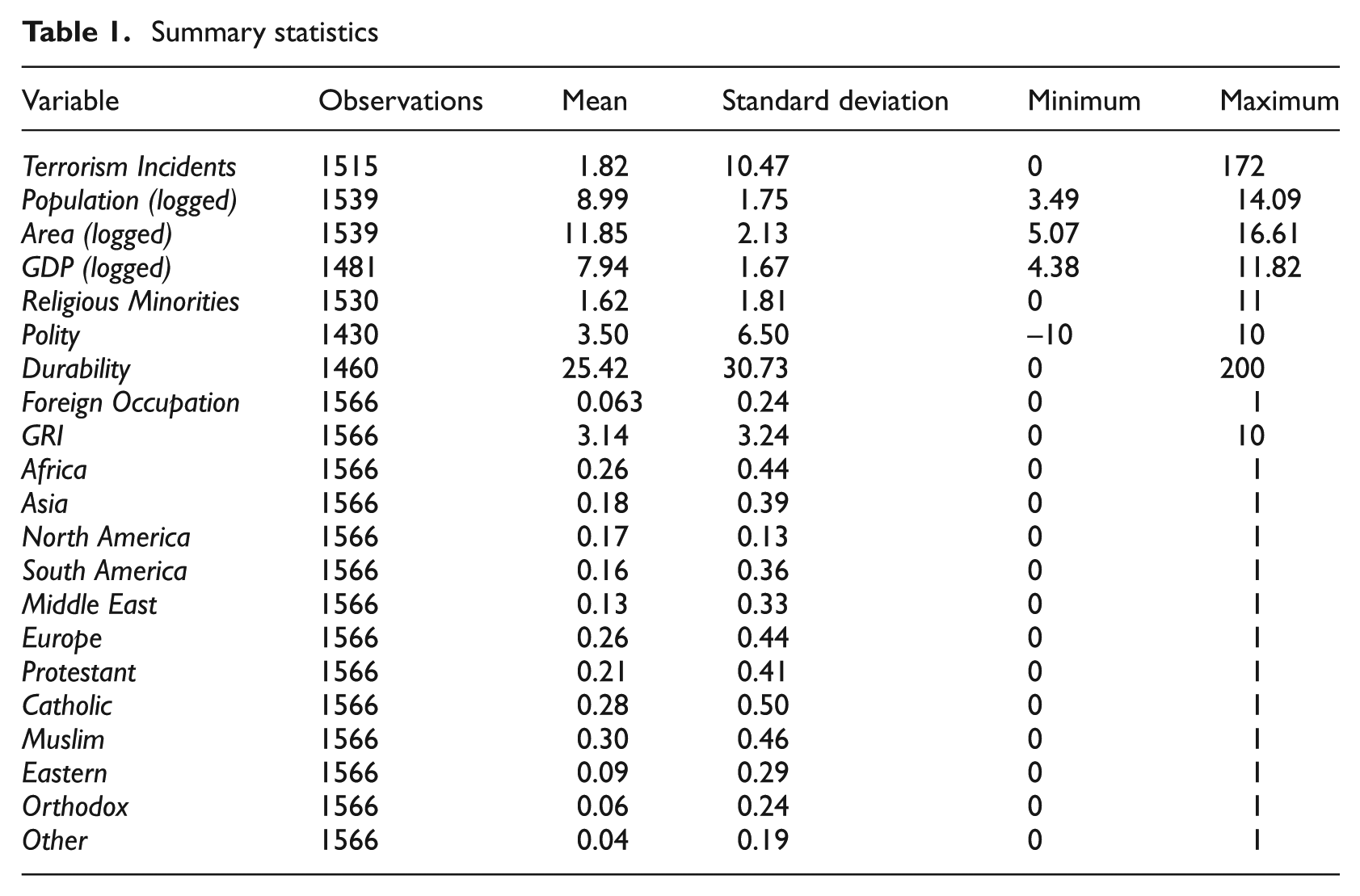
Finally, we include data that take into account the unique social, religious and political dynamics of individual countries. We include a measure of “foreign occupation” to account for the finding that occupation is the key determinant of (suicide) terrorism (Collard-Wexler et al., 2014; Pape, 2003, 2005). Data for this variable are drawn from Collard-Wexler’s (2014) list of foreign occupations, which they find to be a more important determinant of terrorism than domestic occupation. A country under foreign occupation was coded with a “1” or “0” otherwise. We consider the idea that religious heterogeneity causes violence by including data on the number of minority religious groups present in a country-year (Minorities at Risk Project, 2010). Dummy variables for majority religion and world region are included to investigate the possibility that specific regions or religious traditions are more likely to give rise to religious terrorism. 9 Summary statistics are presented in Table 1.
Summary statistics
Method
The data mining process involves both human and software resources (Hoffman and Tierney, 2003; Scime and Murray, 2007). Data mining is used not only to predict the outcome of a future event but also to provide knowledge about the structure and inter-relationships between data. Classification mining algorithms are used to create models that describe existing data and relationships within that dataset. The resulting model is expressed as a classification tree that can be easily converted into if–then type rules. The model is both explanatory and predictive (Osei-Bryson, 2004) and, as a result, has a history in politics and political science.
The 2012 Obama US presidential re-election campaign used data mining and its vast voter dataset—which included merged information from pollsters, fundraisers, field workers, consumer databases, social media and mobile contacts—to “[help] Obama raise $1 billion, [remake] the process of targeting TV ads, and [create] detailed models of swing-state voters that could be used to increase the effectiveness of everything from phone calls and door knocks to direct mailings and social media” (Scherer, 2012). According to reports, the analyses helped the Obama campaign exceed fundraising expectations and increased ad buying efficiency by 14%.
Besides being used by political campaigns to improve messaging and fundraising, data mining has contributed to the understanding of voting behavior, state leadership and terrorism. A data mining analysis of the American National Election Studies dataset of survey questions and responses identified 13 specific questions that effectively predict whether individuals will vote in a presidential election and, if they do vote, the party candidate that will get their vote (Scime and Murray, 2010). Voters/non-voters were categorized through data mining results with 78% accuracy, which meets or exceeds the accuracy rates of previous non-data mining models (Murray et al., 2009). Another data mining analysis of state leadership indicated that a leader’s length of time in office and religious beliefs are related to the level of state freedom; this suggests that support for certain types of executives will increase the likelihood of successful democratization (Jurek and Scime, 2014). A data-mined analysis of terrorism associated a number of social, political and economic conditions at the national level with the likelihood that a nation will fall victim to a terrorist incident (Scime et al., 2010).
It is easy to infer incorrectly from basic data mining models that data mining is an atheoretical endeavor. However, effective data mining is not an atheoretical or black-box process. Domain expertise is essential to the data mining process. Data mining can then be used to prove or disprove the validity of the domain theory. The domain and its associated data may contain overlapping or redundant data that require domain expertise to unravel in order to validate model performance and improve accuracy (Anand et al., 1995).
In data mining, classification algorithms (Quinlan, 1993) construct classification trees by looking at the past performance of input variables (i.e. independent variables) with respect to an outcome variable (i.e. a dependent variable, known in data mining as the class). The tree is constructed from records with known values for the outcome variable. Input variables are selected from the dataset to construct the classification tree using a divide-and-conquer algorithm that is driven by an evaluation criterion, in our case the gain ratio. The most desirable input variable at a given point in the tree is the one with the greatest gain ratio. That is, the algorithm selects the input variable that requires the fewest number of subsequent splits to reach indivisibility. Using this selection process, the data are subdivided until the set of records is indivisible. This repeated division creates the classification tree. During the tree-construction process, branches may be pruned to increase the classification performance. Pruning simplifies the tree by replacing or removing branches that do not meet a specified confidence threshold (Han and Kamber, 2001; Witten and Eibe, 2005).
An example of a completed classification tree is presented in Figure 1. This generic tree has four nodes or points at which decisions are made. A record would be classified by this tree as a w, x, y or z—the outcomes or values of the dependent variable at the leaf nodes. A group of records with the variable values (Var1 = a then Var2 = 4) would be classified as the dependent variable with outcome x. These records would be classified by following the branch that follows the Var1–Var2 edge and then the Var2–DepVar = x edge, reaching a DepVar = x leaf. Other subsets of records may also reach a leaf with DepVar = x (e.g. Var1 = c then Var3 = g then Var4 = s), but by a different path, thereby constituting a different branch.

Generic decision tree.
After the tree is constructed, branches of the tree are converted into rules. The tree presented in Figure 1 can be converted into the following rules:
Rule 1: IF Var1 = a AND Var2 ⩽ 5 THEN DepVar = x.
Rule 2: IF Var1 = a AND Var2 > 5 THEN DepVar = y.
Rule 3: IF Var1 = b THEN DepVar = z.
Rule 4: IF Var1 = c AND Var3 = g AND Var4 = s THEN DepVar = x.
Rule 5: IF Var1 = c AND Var3 = g AND Var4 = t THEN DepVar = w.
Rule 6: IF Var3 = h THEN DepVar = y.
The rules provide insight into how the outcome variable’s value is dependent on the input variables, and each rule constitutes a selection of records. A complete classification tree provides for all possible combinations of the input variables and their allowable values reaching a single, allowable outcome.
When the tree is being constructed it is possible that a given record will follow a branch, but when the leaf node is reached the value of the class is not the value at the end of the branch. This is reported as an error. The record was not correctly classified. Overall the tree has a success rate, the percentage of correctly classified records. To test the validity of a tree, a commonly used technique in classification data mining is to construct the tree and then test it with other datasets. With 10-fold cross-validation the dataset is randomly divided into 10 equal parts, or “folds”; using one fold the tree is constructed and the remaining nine folds validate the model. The validation folds are averaged to determine the tree’s overall accuracy.
Accuracy is affected by the complexity of the tree; pruning the tree reduces its complexity. During the tree-construction process, branches may be pruned to increase classification performance. Pruning simplifies the tree by replacing or removing branches that do not meet a specified confidence threshold (Han and Kamber, 2001; Quinlan, 1993; Witten and Eibe, 2005). Pruning is controlled by confidence level. The lower the confidence level is, the more pruning occurs. A confidence level of 1.0 is an unpruned tree. The tree with the greatest accuracy does the best job in classifying the records from among the trees under consideration. It is possible that a given pruned tree has an equal or better accuracy than a lesser pruned or unpruned tree.
A number of classification trees are created at varying levels of complexity and accuracy resulting from the amount of pruning. Typically, the trees under consideration are constructed by varying the confidence level from 0.05 to 1.0 in increments of 0.05. One tree is selected as the model for the dataset (Osei-Bryson, 2004). Model selection is based on Occam’s razor; the simplest tree with the highest accuracy is selected from a set of similarly constructed trees.
Some individual rules can be more interesting than others. Rule interestingness can be based on a number of factors including the rule’s own success rate or accuracy. The accuracy of a rule is the percentage of records that satisfy the rule compared with the records that meet the rule premise. That is, accuracy is a percentage of those records that are correctly classified by that rule. Another consideration for rule interestingness is the number of records to which it applies. A rule that applies to a few records may be 100% accurate but not interesting; a rule that is less accurate while applying to a large percentage of the dataset’s records may be more interesting.
The gain ratio
Each variable in a dataset has the ability to act as a decision node for dividing the dataset into subsets. The variables selected for the decision node are determined by calculating the Gain Ratio for all of the variables and the subset of records at that node. Gain ratio is the change in information entropy from the current state of the set of records (s) to the proposed state of the set of records compared with the number and size of the data subsets, disregarding the values of the dependent variable.
where GainRatio(s) is the gain ratio of a dataset and Gain(s,si) is the change in entropy for a split on variable i.
The SplitInfo(s) is the number and size of the nodes into which the variable divides the dataset without considering the values of the dependent variable.
where n is the number of records in the parent dataset, nj is the number of records in the subdataset and k is the number of subdatasets.
The information gain, Gain(s,si), is the change in entropy from the proposed division.
The entropy is a measure of the randomness of the distribution of the records in a subset (s) of records with respect to the dependent variable, d.
where H(s) is the entropy of a set, s, and P(vi) is the probability that vi is a value of attribute i.
In the case of known instances, as in classification tree construction, the probability that an attribute, v, contains value, vi, is computed for discrete attributes as
where cnt(s) is the count of occurrences of s and freq(vi, s) is the frequency of vi in s, and where in the classification tree
where di is a value of the dependent variable.
When the attribute contains a range of continuous values, say from 0 to 100, the probability is computed after finding a split point for the values, which divides the record into two subsets. Records with attribute values at or below the split point are assigned to one subset, and the other records are assigned to the other subset. The split point is calculated based on the known attribute values in the dataset.
The variable’s continuous values are sorted as an order set {c1, c2, … cn−1, cn} and the frequency is determined as the number of records falling at or below the split point or above the split point.
where
where cnt(ci>SplitPt(c)) is the count of instances ci greater than the value of SplitPt(c), where
where c1 is the first value in the ordered set of variable values and cn − 1 is the second last value in the ordered set of variable values.
The entropy is calculated for a variable, H(s), and for each resulting subset of records created, H(si|s). The entropy of the subsets is weighted by the ratio of dependent variable values in the subset.
where cnt(di) is the count of instances with the dependent variable having value i in the subset and cnt(d) is the count of instances in the parent set.
The variable with the greatest gain ratio is selected as the node for dividing the data in the classification tree at each node. At the start of the tree, the root node is the variable with the overall highest gain ratio value with respect to the dependent variable over the entire dataset. In addition to selecting the tree root node, the initial gain ratio results with respect to the dependent variable are rank ordered for use assessing the importance of the variables.
In summary, data mining provides a level of information that allows easy and direct interpretation of the data. It determines the variables and their values important to concluding the dependent variable’s value. Using classification data mining with gain ratio and 10-fold cross-validation, a dataset is processed into a set of 20 trees. From these trees the most accurate tree is selected to represent the dataset. The tree is converted into easily understood rules that allow an interpretation of the domain that the data represents. The data mining results provide two benefits for understanding the domain: (a) given new data, the value of the dependent variable is predictable; and (b) the domain as a whole is segmented and characterized.
Results
The gain ratio algorithm used to decide the data division (splits) during the classification tree construction can also be used to determine the relative importance of the variables in determining the value of the dependent variable, in our case Religious Incidents.
Gain ratio analysis on the complete dataset reveals that the most significant variable is Government Regulation of Religion (GRI). This variable is more than twice as significant as the next most important variable in the data, LogArea, the logged values for country geographical size. This is a clear indication that GRI is key to determining whether or not a country experienced religious terrorist attacks. Table 2 provides the gain ratio values for the variables with respect to the dependent variable (Religious Incidents) for the full dataset. 10
Gain ratio with respect to Religious Incidents
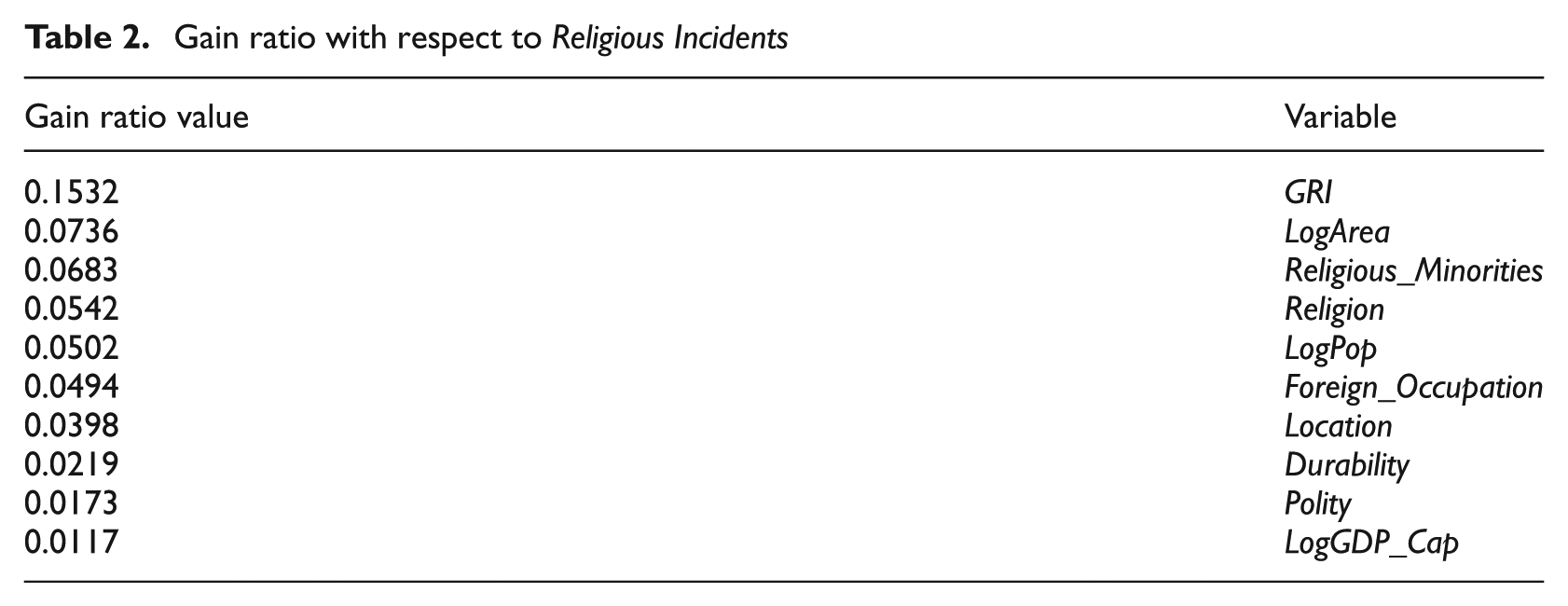
As the dataset is split into subsets during tree construction, the relative importance of a variable to the dependent variable will change. In other words, when the GRI value is established, the new most important variable may or may not be LogArea. For example, in our tree when GRI is “high” the most important variable is LogPop, the log of a country’s population in a given year.
The dataset underwent classification mining, using the C4.5 algorithm with 10-fold cross-validation to generate a classification tree model with the class variable, Religious Incidents. A number of classification trees were created at varying levels of complexity and accuracy, resulting from the amount of pruning. The trees under consideration were constructed by varying the confidence level from 0.05 to 1.0 in increments of 0.05. The simplest tree with the highest accuracy is the tree constructed with a confidence factor of 0.25 (tree-c0.25), which was found to be 93.53% successful, while producing a tree of 26 branches (Figure 2).

Classification trees confidence vs success.
Analysis of tree-c0.25
Tree-c0.25 consists of nine variables that determine whether there were religious terrorist attacks or not—GRI, LogPop, Foreign Occupation, Durability, Religious Minorities, Location, LogArea, Religion, and Polity. The other variable in the dataset (LogGDP_Cap, the log of the per capita GDP) does not have an effect. The complete tree is represented as rules in Table 3.
Tree-c0.25 rules
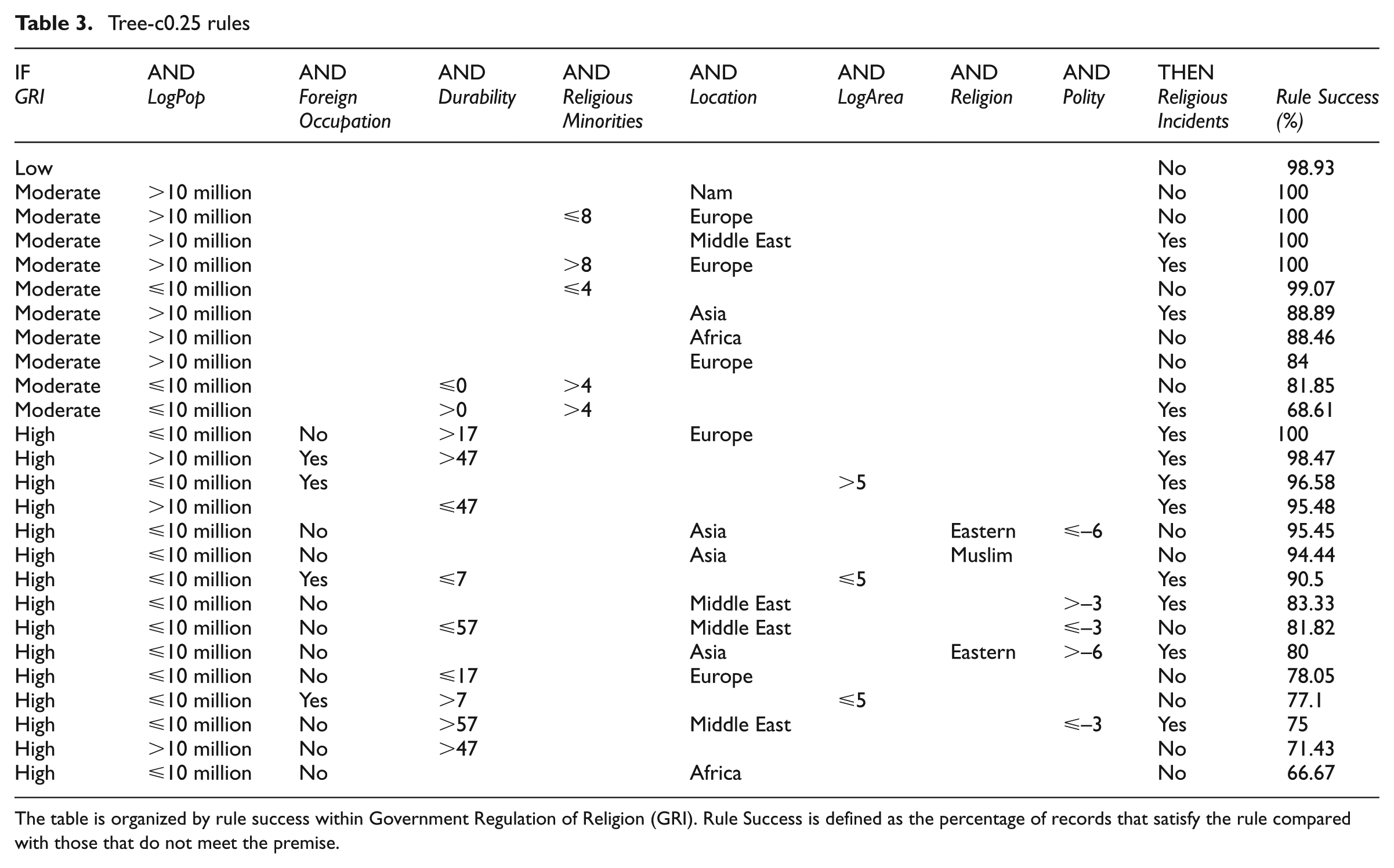
The table is organized by rule success within Government Regulation of Religion (GRI). Rule Success is defined as the percentage of records that satisfy the rule compared with those that do not meet the premise.
As seen in Table 3, there tend to be very few religious incidents when the GRI value is “low”. The analysis finds that the GRI is low in just over 844 records, and that the rule is 98.93% accurate in predicting that there are no religious incidents. This accounts for 55.71% of the dataset. When the GRI is low the values of the other variables do not have any effect. This suggests that, when a country is religiously free, religiously inspired terrorist attacks seldom occur. This finding serves as powerful evidence in favor of our theoretical argument.
On the other hand, as our argument predicts, countries with high restrictions on religion tend to be especially susceptible to religious terrorist strikes. Our analysis shows that high regulation of religion corresponds to a greater percentage of religiously motivated attacks than countries having either moderate or low levels of religious restrictions; there are about as many records in the dataset with a high GRI value having attacks as records with no attacks, a 50:50 ratio. Religious attacks occurred in countries with “high” religious restrictions and a population over 10 million with over 95.47% likelihood. This finding further corroborates our theory that countries with high governmental restrictions are comparatively vulnerable to religious terrorism.
There are a few exceptions to this rule, though. If the regime had been in place for more than 47 years and the country was not occupied by a foreign power, religious attacks occurred at a rate of only 28.57% (China and Egypt in select years). Put differently, stable autocracies not under occupation with high religious restrictions tend to not experience religious attacks. In highly populated countries with less stable regimes and also having high religious restrictions, attacks did occur.
Importantly, as the current crisis in Syria shows, the adoption of sharp controls on religion is not a recipe for defeating terrorism, as many different factors have to be taken into account, and these factors do not apply to most countries. In some cases, religious attacks did not occur in smaller (a population at or under 10 million), unoccupied countries with “high” religious restrictions. Yet there are exceptions to this rule as well. Anocratic and democratic Asian countries (Polity >−6) dominated by an Eastern religion majority or European countries with a regime that had not changed in over 17 years suffered attacks. The countries of the Middle East are even more complex. Attacks occurred in Middle Eastern countries where the regime had been in place for over 57 years and was fairly autocratic (Polity⩽−3; Iraq, Libya and Saudi Arabia in select years). In countries where the regime was less autocratic (Polity > −3), attacks also occurred, although in this case regime longevity did not matter (Israel, Jordan and Yemen in select years). These findings show the myriad ways in which diverse factors can combine with high religious restrictions to predict religious terrorist attacks. In short, there are a few cases where long-standing religiously repressive regimes have been able to effectively thwart terrorist attacks. On the whole, though, the evidence is clear: religious restrictions serve as a necessary (if not always sufficient) condition in predicting religious terrorism.
Moderately religiously tolerant countries having a low population (⩽10 million) had religious attacks when there were more than four religious minorities and the regime had been in power less than a year. When the population of moderately religiously tolerant countries exceeded 10 million, attacks only occurred in European countries with more than eight religious minorities, and in Asia and the Middle East. Our analysis of countries with moderate levels of religious tolerance shows that the attack/no-attack ratio drops from roughly 50:50 to 10:90 when compared with countries with high levels of religious restrictions.
While a number of rules have 100% success, these rules generally have few records to which they apply—not more than eight of 1515 records (0.53%). The most interesting rules are those that have success rates above the overall tree’s success of 93.51%, and apply to more than 4% of the records (60.6 records). These are as follows:
1. With 99.07% success and applying to 212 records (13.99%) records correctly, the following rule shows that countries with moderate religious restrictions coupled with low populations and few religious minorities do not suffer religious terrorist attacks.
IF GRI = Moderate AND LogPop⩽ 4 AND Religious_Minorities⩽ 4 THEN Religious_Incidents = NO
This rule applies to a number of countries for select years including Austria, Bahrain, Belgium, Cambodia, Djibouti, Kazakhstan, Kyrgyzstan, Macedonia, Romania, and the United Arab Emirates. While such countries are not among the most religiously free, their small populations and religious homogeneity have the effect of these states not experiencing religious terrorism.
2. With 98.93% success and applying to 835.01 records (55.12%) correctly, the second rule provides solid evidence for the main thesis of the paper: religious terrorist attacks are quite rare in countries that protect religious freedom.
IF GRI = Low THEN Religious_Incidents = NO
Several countries with low religious restrictions witnessed no religious terrorist attacks during the timeframe under investigation. These countries include, but are not limited to, Argentina, Australia, Bolivia, Brazil, Canada, Denmark, Estonia, Finland, Guyana, Honduras, Italy, Madagascar, Mozambique, New Zealand, Panama, Paraguay, Poland and South Africa.
3. With 95.48% success and applying to 74 records (4.88%) records correctly, the third rule reveals that religious restrictions can become especially problematic when coupled with large populations and less durable regimes.
IF GRI = High AND LogPop > 4 AND Durability⩽ 47 THEN Religious_Incidents = YES
This rule applies to Bangladesh, Burma, Indonesia, and Pakistan for each year of the analysis and to Algeria, Egypt, Iran, Nigeria, Russia, Sudan and Turkey for select years. The rule demonstrates that religious communities, particularly minority communities, are especially vulnerable in politically unstable states transitioning to either democracy or autocracy. This corresponds to the finding that state leaders often repress more to contain potential challengers when their rule is in jeopardy. Often, religious groups are seen as the biggest threats to a country’s political status quo.
In summary, classification analysis of our dataset finds that the most significant variable predicting the onset of religious terrorism is government regulation of religion; it is more than twice as important as any other variable included in this study. In fact, we find that when GRI is “low” the values of the other variables have no effect in explaining the absence of religious terrorism. On the other hand, with a few exceptions, religious terrorism increases dramatically as the level of religious restrictions also increases. Finally, our analysis also discovered that a country’s level of wealth has no relation to religious terrorism, challenging the wisdom that religious terrorism is more about poverty than anything else.
Conclusion
The question of the relationship between religious liberty and religious terrorism carries significant policy ramifications: is fighting terrorism best accomplished through religious restrictions or religious freedom? This article has made a simple but important claim: the denial of religious freedom increases the likelihood of violent religious forms of political engagement; paradoxically, the best way to combat religious terrorism is not by restricting religious practices but rather by safeguarding their legitimate manifestations. Regimes that repress religion invite the very belligerency they seek to thwart through such restrictions. These ideas are not necessarily intuitive, but neither are they new. Similar claims were made by prominent intellectuals like John Locke, Voltaire, Adam Smith, James Madison, David Hume and Roger Williams hundreds of years ago. Yet, despite the long intellectual tradition supporting religious freedom, many today fear the implications of increased religious liberty, particularly in the aftermath of the Arab Spring. They argue that that, while leaders like Iraq’s Saddam Hussein, Libya’s Muamar Gaddafi and Egypt’s Hosni Mubarak might have been brutal tyrants, they were at least able to keep extremist religious forces in their countries under control. These same voices worry that the increased religious freedom in the wake of the Arab Spring will only serve to unleash militant religious forces that dictatorial leaders were able to effectively suppress. They might point to Egypt, for example, as evidence that confirms their thesis.
However, the classification data mining techniques used in this study support the arguments of the intellectuals named above, finding that a country’s level of religious restrictions is the most significant variable predicting the onset of religious terrorism—twice more important than any of the other variables. The conditions under which a regime is able to “repress away” terrorism appear to be so context-specific that repression cannot generally be adopted by governments as an effective antidote to terrorism. This does not mean that other variables are unimportant, however, as this analysis has shown. In certain combinations, a country’s level of democracy, size of population, land area, geographical location, predominant religious tradition, history of foreign occupation, regime stability and the number of religious minorities matter in conjunction with religious liberty.
These findings do not suggest, of course, that religiously free countries never experience religious terrorism or that religiously restrictive ones always do. The point is, nonetheless, that efforts to restrict religion do not always succeed in diminishing religion’s influence. Our theory explains why this is the case. Quite often such restrictions serve to foster radicalization and give credibility to the claim made by extremists that their faith is under attack. Repressive environments that strangle religious freedom and independent thinking serve as a natural breeding ground for extremists. When states prevent religious groups from practicing their faith, such groups are likelier to turn to violence as it is seen as the only way to bring about change.
On the other hand, the inclusion of religious groups and individuals in political processes and protection of their religious rights serve to negate the claims of extremists that violence is necessary to challenge the status quo. These findings also buttress the accumulating evidence that the relaxation of religious restrictions and protection of religious liberty nurture peaceful competition of religious groups in society, thus contributing to a wide array of positive externalities that come from widespread freedom.
The results of this project call on policy-makers around the world to take religious freedom seriously. Today, hundreds of millions of people are either denied their basic rights to seek transcendent truth, or they do so in the face of stiff legal penalties, societal intimidation or both. Some might see religious restrictions as an inopportune situation for people of faith but necessary given the contemporary realities of violent religious extremism and the security threat that it poses. This position is on the surface logical: if religion poses a threat to a country’s security, then the natural response (and the default position of many governments) is to restrict its expression. This view ignores the point, however, that these restrictions themselves are often the cause of such violence to begin with. Unfortunately, until this immensely important dimension of statecraft is internalized, a perceived tradeoff between security interests and the promotion of religious liberty will continue to guide the thinking of policy-makers. Yet as this project has shown, religious liberty constitutes an important weapon in the fight against terrorism and a cornerstone of sustainable security. It is thus both a human rights and a security issue.
With respect to the Arab Spring, we believe that it is simply too soon to be able to adjudicate the effect of increased religious freedom on terrorism for the simple reason that religious freedom has yet to become enshrined in any country affected by the revolutionary wave of democratic uprisings. Our analysis would predict, nonetheless, that the establishment of regimes favorable to religious freedom in the Arab world, as elsewhere, will over time erode the political and social dominance of radical groups and lessen the likelihood of widespread religious terrorism.
Footnotes
Acknowledgements
The authors would like to thank the anonymous reviewers of this journal for their helpful comments on drafts of this article.
Funding
Research for this project was made possible by a generous grant from the Andrew W. Mellon Foundation.