







Abstract
Terrorists are supposed to be influenced by opportunities for news coverage, but does this mean that groups initiate foreign attacks in response to the absence of press freedom in their country or inattention to that state by foreign media organizations? Using Asal and Rethmeyer’s BAAD1 data on terrorist organizations, we find that increasing levels of attention by the international press reduce the odds of groups launching cross-border attacks. The propensity of groups to launch foreign attacks appears unrelated to press freedom. These results suggest that the protections that states provide for the press motivate foreign terrorism less than the way the media determines newsworthiness.
Keywords
By most measures, domestic terrorism occurs more frequently than foreign terrorism. Enders et al. (2011) estimate the ratio of domestic to transnational terrorism to be roughly 3.6:1; LaFree and Dugan (2007) suggest that the ratio of domestic to transnational terrorism is roughly 10:1. Whichever approximation one accepts, it is difficult to escape the conclusion that foreign terrorism is unusual.
The relative costs of domestic and foreign terrorism provide a ready explanation for the imbalance between the two since the financial cost of moving operatives within states is usually lower than the price of moving them across international boundaries. The average foreign attack is also more complex than its domestic counterpart. Operatives must maneuver in contexts they are unaccustomed to, deal with weapons suppliers they may be unfamiliar with, and find suitable safe houses without local allies to help them and without drawing the attention of authorities. Yet, despite added costs and complexity, groups still launch attacks abroad. Why do they do it?
Academics often answer this question by saying that the denial of press freedom in their home countries propels groups to attack abroad (e.g. Drakos and Gofas, 2006: 716). Perpetrators, however, are more likely to say that they select attack locales based on international press attention to those places. As an Irish Republican Army member explained about his group’s first London car bombing, “Last year taught us that in publicity terms one bomb in Oxford Street is worth ten in Belfast. It is not a lesson we are likely to forget in the future” (quoted in Schmid and de Graaf, 1982: 43). In this article, we report on research that we carried out to examine this debate over the influence that press freedom and international press attention have on the propensity of terrorist organizations to launch cross-border attacks.
Understanding how the mass media motivates groups to launch foreign attacks is an important part of the effort to reduce the incidence of these costly strikes. Although the press freedom and press attention arguments sound similar, they imply different strategies for stanching future foreign attacks. The close relationship between press freedom and regime type suggests that foreign terrorism is caused by the ability of autocratic governments to restrict protest activity within their borders. Counterterrorism strategies that spread democratic institutions are, therefore, sensible ways of diminishing the supply of foreign attacks. On the other hand, the idea that international press attention influences the propensity of groups to launch foreign attacks suggests that publicity-starved states are the source of foreign terrorism. The solution to this problem is to create economic incentives that encourage the foreign press to distribute its attention more equitably across states as a way of discouraging cross-border attacks.
Using Asal and Rethmeyer’s (2008) data on terrorist organizations between 1998 and 2005, we find that the evidence favors the perpetrators’ hypothesis: as the level of attention the international press pays to a state increases, the odds that groups from that state will launch cross-border attacks declines. The effects of press freedom, by contrast, are weak at best and sensitive to the measure used. These results suggest that the protections that states provide for the press motivate foreign terrorist activity less than the attention that foreign media agencies pay to particular states. Counterterrorism strategies that blame foreign terrorism on the denial of press freedom misdiagnose the source of these attacks and recommend policies that are ill-suited to choking off the supply of foreign attacks.
In the following section, we provide an overview of research on the factors that encourage groups to launch foreign attacks. Although media attention is usually thought of as a factor that inspires groups to launch foreign attacks, few studies test this proposition and none examine the distinction between press freedom and press attention. Hoffman et al.’s (2013) work on press attention is conceptually closest to our own and uses the same measure of press attention as we do, but it examines cross-national variation in the incidence of foreign attacks rather than the propensity of groups to attack across international boundaries. Bell et al. (2014) use the related concept of information transparency, which refers to the degree of control governments exercise over information to predict variation in the incidence of domestic and international terrorism, but they too have not extended this work to understand the propensity of groups to attack abroad. Finally, Neumayer and Plümper (2009) consider the possibility that foreign media coverage is a draw for terrorist organizations, but like the others they too examine the frequency with which states experience terrorism rather than the propensity of individual groups to launch foreign attacks. Our work also differs from Neumayer and Plumper’s in its use of data on the number of stories reported from every country in the world to measure international press attention. Neumayer and Plumper, by comparison, proxy this quantity using a dummy variable for states in “the West”.
Literature review
In this section, we provide an overview about what is known about the reasons groups attack abroad before turning to explaining the logic of the competing press freedom and press attention hypotheses. Broadly speaking, understanding the causes of terrorism is the central focus of the scholarly literature on this form of political violence (e.g. Crenshaw, 1981). The factors that motivate subnational groups to use or threaten to use violence against noncombatants to secure political goals are of interest in part because of the negative impact this form of intimidation has on political and economic conditions in target societies. Attacks by foreign terrorists, that is, those in which perpetrators cross international boundaries to strike, are especially punishing (Gaibulloev and Sandler, 2011).
Pull factors
Nevertheless, efforts to understand the motivators of foreign terrorism (as distinct from domestic terrorism) largely focus on where attacks end rather than where they start. The purpose of this research is to identify the characteristics of states that attract transnational terrorist attacks. Signature contributions in this area identify either the characteristics of political regimes that make states fertile ground for foreign attacks (e.g. Chenoweth, 2010; Eubank and Weinberg, 1994; Eyerman, 1998; Li, 2005; Piazza, 2007; Young and Dugan, 2011) or the grievances (e.g. Pape, 2005; Piazza, 2011; Savun and Phillips, 2009) that motivate groups to strike foreign targets.
The emerging conclusion of the work on terrorism’s pull factors is that the most attractive targets for transnational terrorism are states with governments that are sensitive to the ramifications of terrorism (Conrad et al., 2014; Pape, 2005), have political institutions that influence the peaceful resolution of disputes (Aksoy et al., 2012; Choi, 2010), and are constrained in their ability to either co-opt or coerce them (Li, 2005; Wilson and Piazza, 2013). This explains why non-democratic states that have political institutions that enable citizens to hold leaders accountable for their performance experience more terrorism than states that have weak accountability mechanisms (Conrad et al., 2014). It is also why democracies, which must exercise a degree of restraint in their counterterrorism operations, experience more attacks than other regimes.
The targeting literature further suggests that grievances play a role in determining where attacks occur. States that are involved in enduring rivalries tend to be attacked more than states that do not have these relationships (Conrad, 2013). Countries that have active and interventionist foreign policies, like the USA, are also often focal points for foreign attacks (Dreher and Gassebner, 2008; Savun and Phillips, 2009). Work showing that countries with more generous welfare programs experience fewer transnational terrorist attacks is consistent with the grievance argument as well (Burgoon, 2006).
Push factors
Less clear is why groups attack outside their countries’ borders in the first place. Several findings imply that foreign attacks are an outgrowth of the insensitivity of governments to domestic political action. This is why studies of the regime type of “supplier” states (e.g. Blomberg and Hess, 2008; Eubank and Weinberg, 2001; Kurrild-Klitgaard et al., 2006) suggest that perpetrators are more likely to come from nondemocratic states than democratic ones, although Eubank and Weinberg (2001) found the opposite. Results showing that attacks are more likely to originate in states that lack a functioning government to address the political demands of citizens (Lai, 2007; Piazza, 2008) also fit this accountability framework, although Coggins (2015) raises questions about this result.
Satisfaction and grievance also seem to play a role in determining where foreign attacks originate. As with the literature on push factors, states that are pitted against enduring rivals tend be the launching pads for foreign attacks more often than states that are not in these tense relationships (Findley et al., 2012). There is also a suggestion that that openness to international economic exchange reduces the number of foreign attacks that states “produce” (Blomberg and Hess, 2008).
The relative lack of attention to the reasons some states push more foreign terrorism on others is one reason why it is harder to identify a general explanation for cross-national differences in the supply of foreign attacks than it is to explain terrorism’s attractors. There are simply fewer tests of the factors that influence the propensity of states to be the launching pads for foreign attacks than there are of the factors that make states the targets of violence. Many possible relationships remain unexplored.
Perhaps the field’s most glaring omission surrounds the media’s effect on the decision to launch foreign attacks. The desire for publicity is often described as the “one trait” (Hoffman, 1998: 37) all terrorist organizations have in common and media attention as the “oxygen” terrorist organizations need to survive. Indeed, perpetrators from Carlos Marighela to Osama bin Laden insist that media attention is core to their strategies.
Without publicity, perpetrators would have difficulty generating the fear they rely on to coerce their enemies. Terrorist organizations usually command small followings and lack access to the communication technology necessary to reach and influence large audiences. The for-profit media, with its control of sophisticated and extensive global distribution networks and ability to command the attention of large number of people, solves these problems provided perpetrators can get the press to report their acts of violence. Consequently, terrorist organizations factor the potential for coverage of their activities by the press into their planning (Drakos and Gofas, 2006; Hoffman et al., 2013; Weimann and Winn, 1994).
Still, there is controversy over the type of media environment that most influences perpetrators to attack abroad. One school of thought suggests that the denial of press freedom, the right of people to disseminate ideas through media that operate under few governmental controls, influences groups to launch foreign attacks (e.g. Devine and Rafalko, 1982: 50; Drakos and Gofas, 2006, 2007). When governments control the media, they are able to squelch reports about terrorist activity and deny groups the publicity that they need. Groups launch foreign attacks to escape their home government’s control over the media.
Another school of thought hypothesizes that international press attention, the relative interest the foreign press has in reporting on different locations, processes and issues, drives groups to attack abroad. The reasoning underlying the press attention argument is similar to that used in the press freedom argument, but in this case the idea is that groups attack abroad in order to escape territories that foreign media organizations are disinclined to cover.
Theory
In this section, we lay out the competing arguments connecting press freedom and international press attention with the propensity of groups to launch foreign attacks. Both arguments assume that terrorists need publicity to frighten target societies into capitulating to their demands. They further assume that terrorist organizations are motivated to attack abroad by the relative dearth of opportunities they have to communicate with mass audiences, but as we outlined above, there is disagreement over the aspect of the media environment that influences groups most. Those in the press freedom camp hypothesize that terrorist organizations that operate inside states that deny press freedom are more likely to launch foreign attacks than groups that operate in states that protect this right. In contrast, those in the international press attention camp hypothesize that terrorist organizations operating in states that receive relatively little foreign press coverage are more likely to launch foreign attacks than groups that operate in states that the international press covers frequently.
The press freedom and press attention arguments differ in their predictions about the factors that motivate foreign terrorist activity because they differ in their judgments about the barriers that terrorist organizations must overcome to secure media coverage. The press freedom argument suggests that the media has a large appetite for gathering material about terrorist activity (Hoffman, 1998; Nacos, 2007; Wilkinson, 1997). Left to its own devices, the media is “almost bound to respond to terrorist propaganda of the deed because it is dramatic bad news” (Wilkinson, 1997: 54–55) and dramatic bad news helps media organizations generate profits.
The challenge that perpetrators face is that the media is not always permitted to report on their acts of violence. Specifically, governments that deny press freedom retain the right and the ability to censor reports about terrorism. Consequently, groups that operate in press-restricted environments are denied the opportunity to publicize their activities widely, which they depend on to sow fear among their enemies and generate support among their constituents. Starved of the attention they need, groups launch cross-border attacks in order to prevent the censoring of their protests (Drakos and Gofas, 2006).
The press freedom argument lays the problem of foreign terrorism at the feet of repressive governments and their willingness to control the flow of information. Its argument that foreign terrorism is a product of the press’s inability to cover terrorist activity is consistent with the broader claim that expanding freedom undercuts terrorism (Kurrild-Klitgaard et al., 2006), although it should be noted that free societies are not the only ones that protect the institution of press freedom (Egorov et al., 2009). 1 Press freedom is the mechanism that provides perpetrators with opportunities to publicize their acts of violence, as distinct from freedoms that either permit people to meet one another or move from place to place without government interference.
The international press attention argument also conceptualizes media access as the mechanism that supplies terrorist organizations with opportunities to publicize their violent acts and other efforts at intimidation, but it suggests, more explicitly than the press freedom argument, that international audiences are the primary targets of foreign attacks. Moreover, the international press attention argument lays the problem of foreign terrorism at the feet of foreign news agencies with its suggestion that that the international press’s selectivity about what information to report is a more important determinant of whether perpetrators can get the publicity they crave than the ability of governments to censor the news.
According to Hoffman (1998), terrorist organizations use foreign attacks to advertise their causes to international audiences rather than just actors within their home state. This interest in international attention is a product of two historical developments. First, Palestinian terrorist organizations in the late 1960s found that dramatic attacks (e.g. skyjackings) were capable of creating media spectacles that transformed their struggle with Israel into a matter of international concern. These early successes continue to inspire terrorist organizations today.
Second, technological advances in communication technology, like television satellites and the internet, made it possible for media firms to gather images and information about events for international distribution. As a result, impediments to the media’s ability to cover international terrorism declined. At the same time, the communication technology that makes international reporting relatively easy also helps media firms circumvent government controls on information gathering and distribution. Governments that deny press freedom can prevent their own national media from publicizing acts of terrorism, but preventing foreign media organizations and foreign citizens that penetrate their societies from disseminating information about attacks is difficult. Thus, while censorship places some limits on the information available to reporters, there are many ways that information about terrorism can escape government control. Consequently, the absence of press freedom places less pressure on terrorist organizations to attack abroad than the press freedom hypothesis admits.
A more prominent consideration for terrorist organizations than the government’s power to censor the news is the foreign media’s own assessment about what constitutes newsworthy material. The news is primarily generated by firms that sell information for profit (Hamilton, 2006), which puts pressure on editors and journalists to focus on stories that capture audience attention. All things equal, terrorism is advantaged by this decision rule because it is dramatic and shocking and often poses a challenge to the established order (for more on the criteria driving the production of news see Gans, 1979; Oliver and Meyers, 1999).
In practice, however, news organizations are selective about the terrorism stories they report (Delli Carpini and Williams, 1987; Scott, 2001) and appear to use the location of attacks as a criteria for determining audience interest (Chermak and Gruenewald, 2006; Weimann and Brosius, 1991; Weimann and Winn, 1994). The importance of location reflects a basic bias in the international press’s attention to some places over others resulting from budgetary limits to the number of reporters news agencies can hire and the number of stories these individuals can investigate.
The deployment of personnel and offices around the world by news organizations, like Reuters, reflects economic assessments about where profitable information is most likely to be found. Unsurprisingly, differential investments in reporting capacity around the world result in cross-national differences in the frequency with which states receive foreign news coverage. The data we used in our study, for example, suggests that Reuters reporters filed 24,046 stories about the USA in 1997, but only 25 from Swaziland that same year. Figure 1, shown below, depicts the number of stories supplied by Reuters in 1997 about every seventh country in our dataset. 2 Our review of press attention data for other years suggests that vast cross-national differences like these are common.
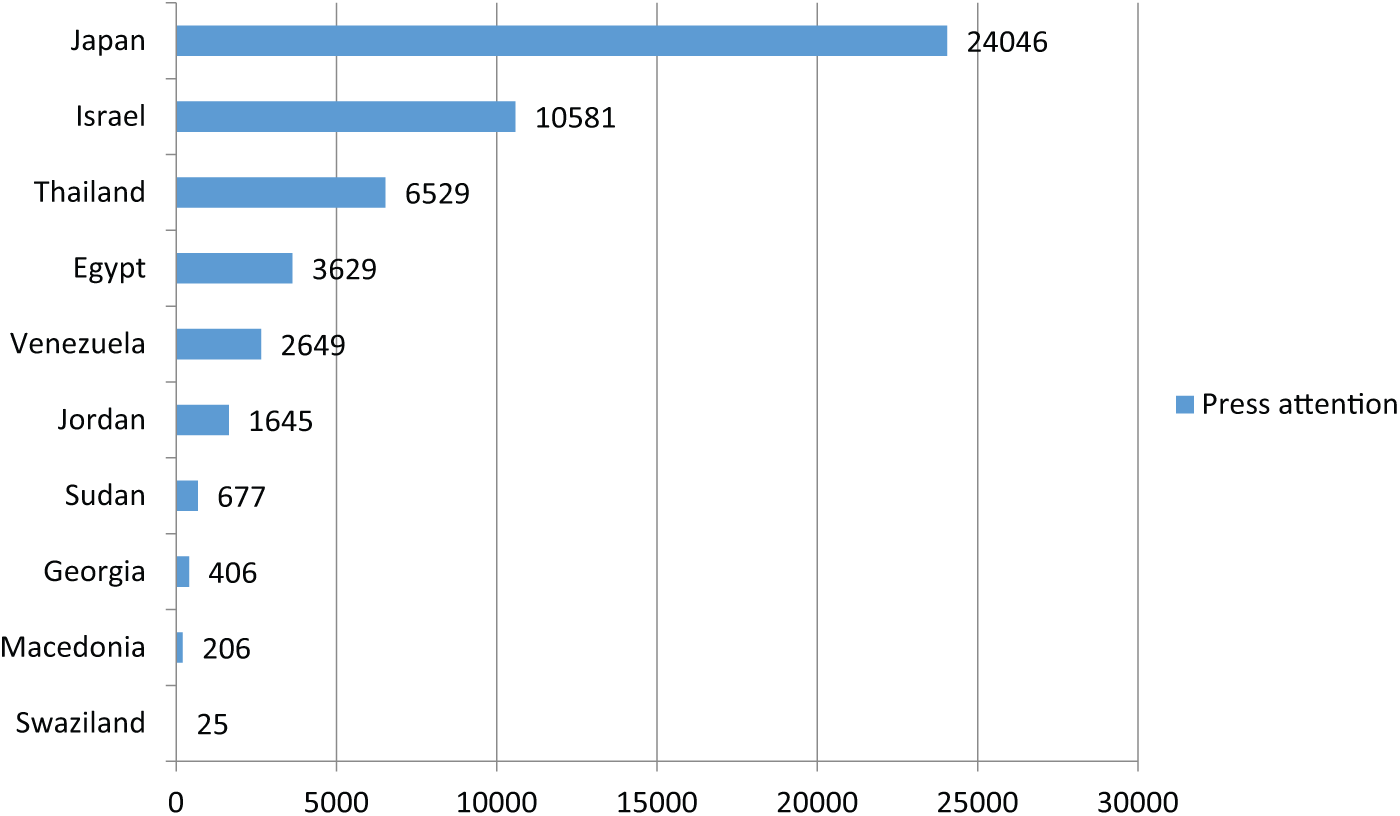
Sample press attention scores, 1997.
As the following rhetorical question from the FLN’s Abane Ramdane’s makes clear, perpetrators are aware of spatial differences in international reporting: “Is it better for our cause to kill ten of the enemy in countryside of Telergma, where no one will speak of it, or one in Algiers that will be mentioned the next day in the American press?” (quoted in Schmid and de Graaf, 1982). Indeed, it has long been argued that terrorist organizations are not just interested in publicity; they deliberately script their attacks to generate foreign press coverage (e.g. Hoffman, 1998). In light of this desire for publicity, cross-national differences in the intensity of press attention are likely to be motivating, as groups that operate in countries that the international press tends to overlook feel pressure to attack abroad in order to gain publicity for themselves.
Research design
It is possible to test these competing arguments about the influence of press freedom and press attention influence on the initiation of foreign terrorism. This section lays out the strategy we used to do this. Since our hypotheses focus on the propensity of terrorist organizations to “go abroad” (the dependent variable), we employed a research design that made the decisions of groups to launch foreign attacks our unit of observation. We did this by dividing the organizations cataloged in Asal and Rethmeyer’s (2008) Big Allied and Dangerous (“BAAD1”) dataset according to whether they launched attacks outside of their home countries between 1 January 1998 and 31 December 2005 or not (0=only launched domestic attacks; 1=attacked abroad). Based on this procedure, we determined that a little more than 43% of the organizations BAAD1 cataloged launched attacks outside of their home base.
There is no better way to understand the factors that generate foreign terrorism than to examine variation in the willingness of groups to launch cross-border attacks. Focusing instead on the total number of attacks launched from different states, as is commonly done in the attack initiation literature, requires analysts to assume that the factors associated with the genesis of foreign attacks influence terrorist organizations in similar ways. It is unclear whether this assumption is defensible. Cross-national variation in the production of foreign attacks could result from the actions of a few groups rather than the actions of many terrorist organizations. Conclusions, therefore, about the sensitivity of perpetrators to various contextual factors would overstate the homogeneity of these influences. If the media environment is truly of general importance to terrorist organizations, then the clearest way to ferret that out is by examining the correlates of group-level decisions.
Full disclosure, our focus on decisions by terrorist organizations to launch attacks rather than the incidence of attacks requires us to accept some limitations on the questions that we can examine and the inferences that we can draw about foreign terrorism. The BAAD1 data that we used to examine the tactical choices of terrorist organizations is one of the few terrorism databases available that provides information at the group level. Asal and Rethemeyer (2008) developed it from semantic information drawn from the Terrorism Knowledge Base at the Memorial Institute for the Prevention of Terrorism (MIPT, 2006). Nevertheless, BAAD1 only tells us whether groups launched foreign attacks between 1998 and 2005. It does not permit us to examine either how frequently groups launch foreign attacks or where they strike. Consequently, we cannot examine the sensitivity of organizations to temporal changes in the media environment, the propensity of groups to target states that offer more opportunities for media coverage or the relationship between the mass media and the frequency of foreign terrorism. What we can do is shed some light on the debate over the relative importance of press freedom or press attention on the incidence of foreign terrorism.
Independent variables
After settling on our dependent variable, we assembled observations made in 1997, one year prior to the period that our dependent variable covers, for a series of independent variables describing the national contexts that these groups operated in. While there are many variables we could have chosen, we limited the analysis in our primary analysis to the two variables at issue in the debate over media effects on terrorism (i.e. press freedom and press attention) and those factors that previous studies identify as important for identifying the launching pads for foreign attacks (i.e. regime type, state failure, interstate rivalry and trade openness). 3 These control variables capture the emerging sense that foreign attacks are stimulated by a combination of factors: governments that are insensitive to domestic political action (regime type and state failure), dissatisfaction with the status quo (trade openness) and grievances with foreign actors (rivalry).
We gauged press freedom using Freedom House’s three category press freedom index (0 = not free, 1 = partially free, 2 = free). 4 The scores are based on Freedom House’s annual survey of the degree of print, broadcast, and internet freedom in nearly 200 countries and territories around the world. States that are rated free are judged by a panel of country experts to have: (a) a legal environment that provides the fewest restrictions on the media to operate; (b) a political environment that makes it difficult for governments to interfere in editorial decisions and that place few restrictions on access to information; and (c) an economic environment that encourages transparency in ownership and reduces costs associated with the production and distribution of information (Karlekar and Dunham, 2014).
We measured international press attention using the square root of the total number of reports about events, excluding “fact file” stories, images and sports, issued in 1997 by Reuters for each country in the world. 5 Virtual Research Associates Inc. cataloged these reports; King and Lowe distribute them for academic use (see King and Lowe, 2003, for an introduction to this data source). During the period we studied, Reuters was (and still is) one of the world’s largest and most important foreign wire service agencies, that is, news organizations dedicated to supplying foreign news electronically to subscribers (Boyd-Barrett and Rantanen, 1998). We reasoned, therefore, that its pattern of coverage is a good proxy for the attention of the international press to the countries in our dataset.
We assigned reports to countries based on the name of the country associated with the Reuters news bureau that issued it and added up the total number of reports per country. This procedure probably misclassifies some stories because report datelines do not always correspond to the location of the bureau from which they were filed. Nevertheless, King and Lowe (2003) say that the country where the news desk is located is generally where the event took place. Then, we transformed each country’s press attention score using the square root function. We did this for three reasons. First, the marginal effect of each additional article should be decreasing. Second, the distribution of press reports is skewed (see Figure 1): 75% of countries had fewer than 6600 stories filed about them by Reuters, while the five most reported on countries were the subject of more than 20,000 reports each. Finally, the square root function makes the most sense when dealing with count data, as we are with international press attention.
We controlled for each host state’s regime type using the polity measure (Marshall et al., 2011) and for state failure using the Political Instability Task Force’s data on state failure. Following Findley et al. (2012) and Conrad (2011), we controlled for the motivating influence of interstate rivalries on foreign terrorism, identifying all of the countries involved in an interstate rivalry using Klein et al.’s (2006) rivalry data. Finally, Blomberg and Hess’s (2008) work suggests that members of the World Trade Organizations are less likely to be the sources of foreign attacks. We identified these states using the Correlates of War IGO dataset. Descriptive statistics for all of the variables described in this section appear in the Supplementary Materials.
Analysis
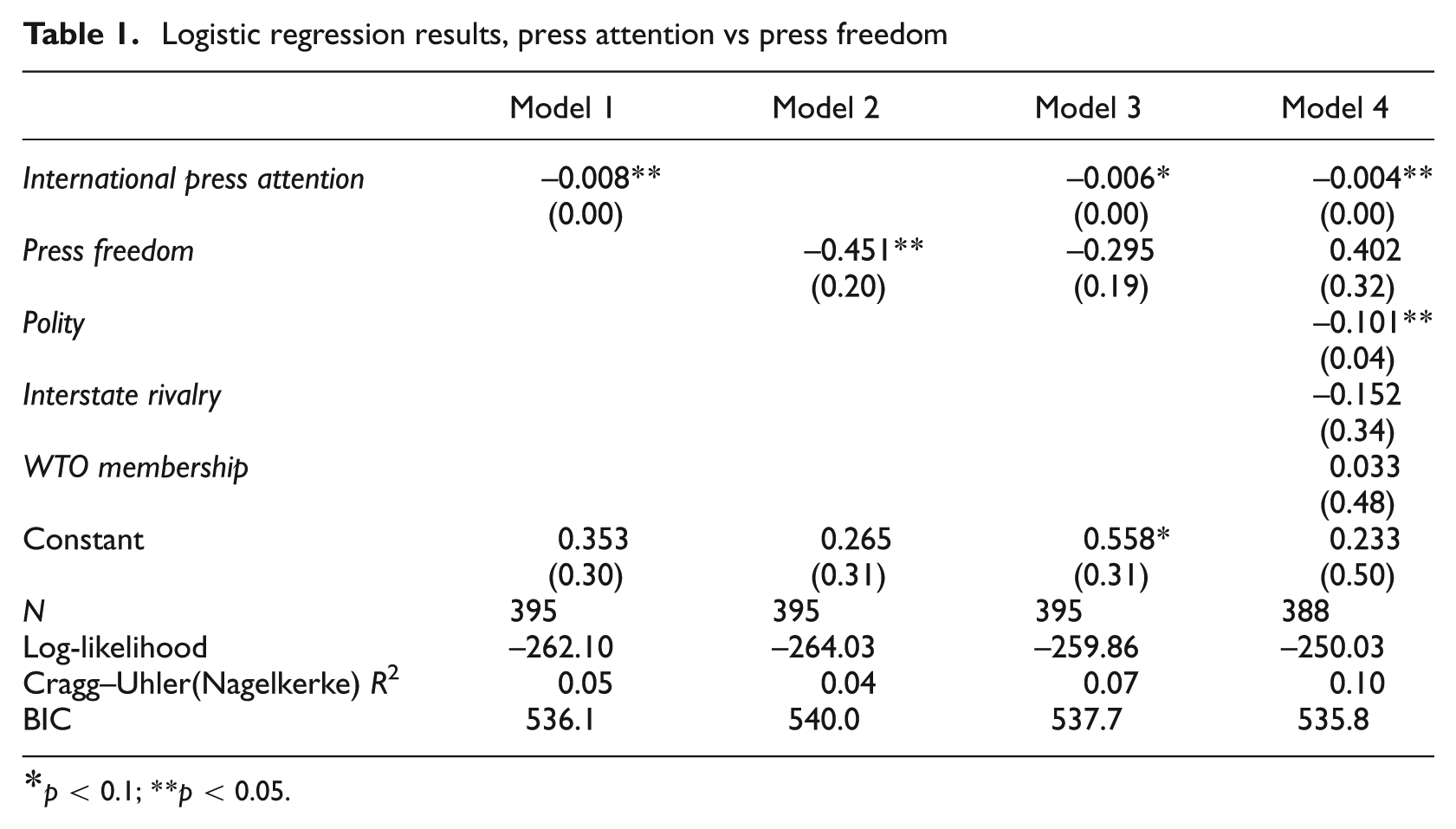
Since our dependent variable measures whether groups launched foreign attacks or not, we used multivariate logit, with errors clustered by country, to analyze our data (see Table 1). Using clustered errors controls for unmeasured (and potentially idiosyncratic) characteristics of each state that may influence the propensity of groups from those places to launch foreign attacks. This technique, however, does not drive our results. On the contrary, random effects models produce substantively similar results to those we present below (see the Supplementary Materials to view the results of our tests using random effects models).
Logistic regression results, press attention vs press freedom
p < 0.1; **p < 0.05.
We began with simple bivariate tests of the relationships between press freedom and international press attention (see models 1 and 2, Table 1). These analyses are consistent with the idea that the media context influences the propensity of groups to launch foreign attacks: as both press freedom (b =−0.451, p < 0.05) and press attention (b =−0.008, p < 0.05) increase, the chances of terrorist organizations launching foreign attacks decline.
The head-to-head test of the press freedom and international press attention hypotheses reported in model 3 tells a difference story though. When measures of press freedom (b =−0.295, p > 0.1) and press attention (b =−0.006, p < 0.1) are included in the same model, only international press attention reduces the odds of groups launching foreign terrorist attacks. This result is the same when we replace Freedom House’s press freedom score with Cingranelli and Richards’s (2008) three-category measure of press freedom (not shown). The inverse relationship between international press attention (b =−0.004, p < 0.05) and the probability of groups launching foreign attacks is also insensitive to controls for regime type (b =−0.101, p < 0.05), interstate rivalries (b =−0.152, p > 0.1) and membership in the World Trade Organization (b = 0.033, p > 0.1) (see model 4). 6
Figure 2 uses the results from model 1 to depict the relationship between the square root of international press attention and the predicted probability of groups launching foreign attacks. The values of international press attention depicted along the x-axis start at the minimum observed value of press attention and move to the maximum observed value 1 standard deviation at a time. As the figure shows, at the lowest level of press attention, our model estimates that there is nearly a 60% chance that groups will launch foreign attacks. In contrast, at the highest levels of press attention, there is a less then 20% chance that groups will launch terrorist attacks abroad.
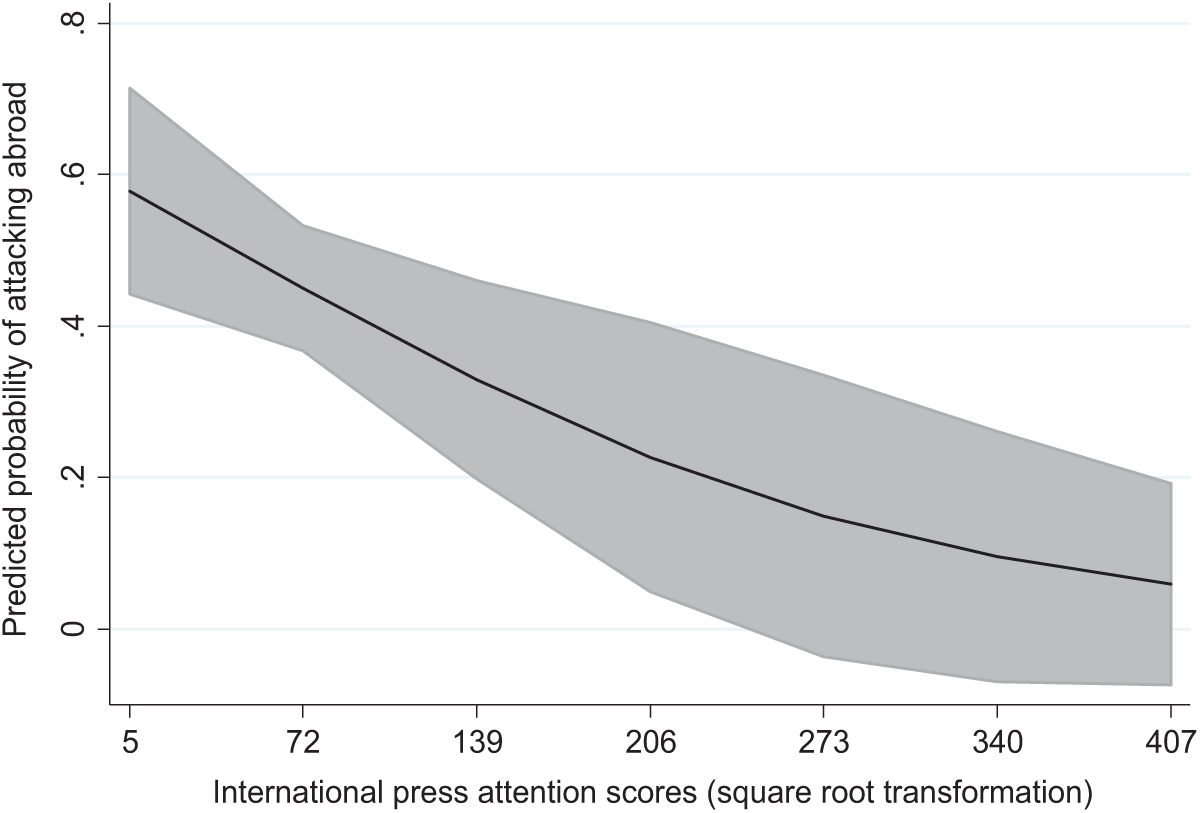
International press attention reduces the chances that groups will attack abroad.
Based on the Bayesian Information Criterion (BIC) statistics reported at the bottom of Table 1, the model we used to generate Figure 2 does not provide the best fit to our data on the propensity of groups to launch foreign attacks, but the difference between model 1 (BIC = 536.1) and model 4 (BIC = 535.8) is negligible. (We used model 1’s results for to simplify the creation of this figure.) A one-unit change in a state’s Polity score has a bigger marginal effect on the propensity of groups to launch foreign attacks (0.03) than a one-unit change in international press attention (0.001), but Polity’s range is much smaller than international press attention. A 2 standard deviation change in Polity changes the probability of foreign attacks by 16%, whereas a 2 standard deviation change in international press attention changes the chances of foreign attacks by 7%.
Robustness checks
We supplemented our principle analysis with several tests designed to examine whether the relationship between international press attention and the initiation of foreign attacks stands up to additional scrutiny. Two challenges to our initial conclusions about international press attention stand out. First, there is the danger that we are mistaking cause for effect: heightened press attention may be a function of civil conflict that also depresses the incentives that groups have to launch foreign attacks. 7 Second, there is the risk that our models suffer from omitted variable bias stemming from the absence of controls for the organizational characteristics that influence the use of foreign terrorism.
We assessed the possibility that our analysis mistakes cause for effect by examining the relationship between domestic conflict and press attention. Using the Correlates of War data on civil wars in 2006 as our proxy for civil conflict, we predicted levels of international press attention in 2007 using ordinary least squares regression with errors clustered by country. The results of this analysis suggest that domestic conflict is not influencing the levels of international press attention over our study period. The bivariate relationship, though, between civil wars and international press attention from 1990 to 2001 (the years of available data on press attention) is positive and statistically significant, suggesting that foreign press coverage and domestic conflict are indeed bound up with one another.
Since we are unable to rule out a relationship between domestic conflict and international press coverage entirely, we conducted a test to determine if there is a relationship between the involvement of terrorist organizations in civil wars and their propensity to launch foreign attacks. We identified groups in BAAD1 that were involved in civil wars using the COW semantic data on subnational participants in the civil wars it catalogs. We then checked for a relationship between involvement in civil wars and the decision to launch foreign attacks using bivariate logit, but could find no evidence that civil war involvement influences the propensity of groups to launch cross-border terrorist attacks. The results of these analyses appear in the Supplementary Materials.
The second set of robustness checks we considered examine whether the association between international press attention and foreign attacks is a function of the types of groups that occupy states rather than the media environment per se. As Abrahms’s (2008) work suggests, terrorist organizations may be less attuned to the political context they operate in and more sensitive to group-level dynamics than is generally supposed.
Abrahms’s argument is consistent with several studies that suggest that the capability of groups and the ideologies they espouse determine their violent activities. Group-level capabilities, by which we mean “the material and informational resources that a group may deploy to engage in lethal violence” (Asal and Rethemeyer, 2008: 437), define the range of possible actions that groups may take. Foreign attacks are more costly and more complex than domestic attacks. Groups must not only be able to pay for the added price to transport operatives across international boundaries; they must be able to recruit and retain agents that are skilled enough to operate in unfamiliar environments.
A group’s ideology is the other group-level factor that is thought to influence targeting choices. Ideologies provide organizations with “motive[s] and frameworks[s] for action” (Drake, 1998: 55) that include suggestions about the importance of media attention for generating influence. Marxist ideologies, for instance, imply that publicity is an important strategic asset for terrorist organizations because of the importance of mobilizing the masses in order to achieve their stated political objectives. In contrast, groups motivated by religion view terrorism as a form of piety that they conduct for their gods. Since omniscient deities are the ultimate audience for these acts, efforts to secure publicity in the mass media are unnecessary (Juergensmeyer, 1988).
These observations suggest three things about the relationship between group characteristics and foreign terrorism. First, the more resources groups have, the more likely they are to launch foreign attacks. This is an implication of the notion that foreign terrorism is costly. Second, the extensiveness and quality of the networks that groups are embedded in also influence their propensity to attack abroad. The importance of networks is applied by the difficulty of operating outside of one’s home base without the support of the population to provide safe havens, access to weaponry and bomb-making material, and local intelligence about the behavior of police and government security personnel. Third, the ideologies that groups espouse may explain their willingness to launch foreign attacks better than any measure of the media environment. Religiously oriented groups may be especially insensitive to the status of either press freedom or press attention in their home states.
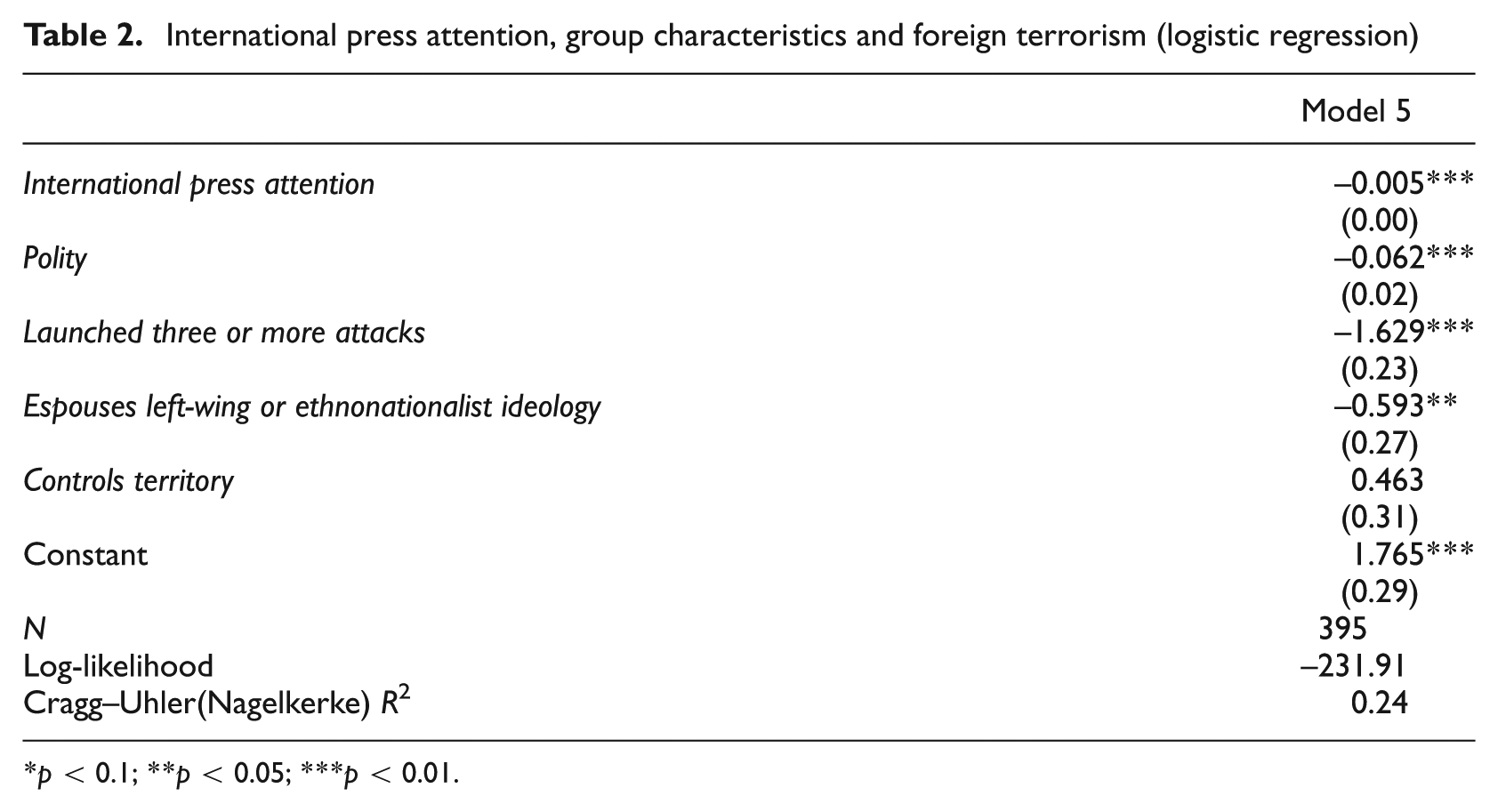
Our tests of these group-level arguments, however, do not invalidate the relationship we identified between press attention and the initiation of foreign attacks (see Table 2). We arrived at this conclusion as follows. First, we identified variables in the BAAD1 dataset that measured the capabilities of groups in our analysis, the quality of the terror networks these groups were embedded in and the ideological positions of the groups in our analysis. We gauged group capabilities using a categorical variable measuring the size of each group’s membership (an indicator of the human resources available to groups), an interval measure of the age of each terrorist organization in years from their founding until 31 December 2005 (older groups are likely to possess more resources), and binary variables identifying groups that control territory (indicating that groups are able to resist government efforts to uproot them and implying the ability to extract resources from locals), whether they have committed three or more attacks (groups that attack more often are more likely to have the resources required to attack abroad) and whether they are the beneficiaries of state sponsorship (state support increases the resources that groups have at their disposal).
International press attention, group characteristics and foreign terrorism (logistic regression)
p < 0.1; **p < 0.05; ***p < 0.01.
We measured each group’s ability to call upon their terror networks by calculating an eigenvector centrality score for each organization cataloged in BAAD1. Eigenvector centrality assesses the number of direct and indirect connections that actors have with one another, taking the overall structure of the network into account (Hanneman and Riddle, 2005). We also identified the groups that had religious dimensions to ideologies they espoused and groups that had either left-wing or ethnonationalist ideologies, since the willingness of these groups to launch foreign attacks should be sensitive to the media environment.
Second, in light of the modest sample size we have to work with (N = 390) and the availability of several plausible indicators of relevant concepts, we conducted an analysis designed to weed out those controls that do not help distinguish groups that engage in foreign terrorism from those that do not (see Supplementary Materials). This preparatory step identified three group-level characteristics that are associated with the willingness to launch foreign attacks: having a demonstrated ability to launch multiple attacks, maintaining control over territory and espousing a left-wing or ethnonationalist ideology. We did not find relationships between the decision to launch foreign attacks and group age, size, state sponsorship or the quality of a group’s network (eigenvector centrality).
Finally, we incorporated the three group-level predictors of foreign attacks into a logit model along with international press attention and polity, the strongest predictor of the decision to launch foreign attacks in our initial examination. The results of this analysis once again suggest that there is an inverse relationship between international press attention and the decisions by groups to initiate foreign attacks (b =−0.005, p < 0.01). We also found an inverse relationship between Polity and the propensity of groups to attack abroad. Groups, however, that espouse either left-wing or ethnonationalist ideologies or that have records of using terrorism in the past appear less likely to attack abroad than other groups. 8 Only controlling territory appears unrelated to the initiation of foreign attacks in this analysis.
Discussion
The analysis presented above supports two related propositions. First, there is an inverse relationship between international press attention and the probability of terrorist organizations engaging in foreign terrorism. The more attention a country gets from international media sources, the less likely terrorist organizations operating within that state are to launch attacks outside their national borders. Put another way, the more the eyes of the world focus on a state, the less groups have to do to generate publicity and, therefore, the less attractive foreign attacks become.
Second, the level of press freedom in a country appears to be a less reliable predictor of the willingness of groups to launch foreign attacks when press attention is taken into account. On its own, the latitude governments have to censor the news seems to influence the decisions groups make to launch foreign attacks. Nevertheless, the apparent relationship between press freedom and the launching of cross-border attacks disappears once patterns of press reporting are considered. This result is regardless of whether one uses the press freedom index produced by Freedom House or the alternative measure produced by Cingranelli and Richards.
Efforts to undermine the observed relationship between international press attention and the decision by groups to attack abroad were unsuccessful. The evidence for an endogenous relationship between domestic conflict, press attention and the launching of foreign attacks is weak. Although there is some evidence of a relationship between patterns of domestic conflict and patterns of press attention, we find no evidence that involvement in a domestic conflict makes groups any more likely to launch foreign attacks than groups that are not engulfed by civil violence. Our test for endogeneity bias suggests that groups involved in intense civil conflicts are no more likely to launch foreign attacks than groups that are not involved in such conflicts.
The relationship between foreign press and the willingness of groups to launch cross-border attacks holds up in the presence of controls for group characteristics. Previous work on the media’s effects on terrorist activity has been unable to examine the possibility that organizational differences, not the nature of the media environment, account for observed attack patterns. Relying on the BAAD1 data allowed us to do both.
The results surrounding international press attention and press freedom are consistent with a number of existing studies of the media’s effects on the targeting of foreign terrorist attacks. The notion that the press’s lack of attention to certain states motivates groups within those arenas to attack outside their own borders complements papers by Neumayer and Plümper (2009) and Hoffman et al. (2013) that suggest that groups prefer to attack locales that are covered heavily by the international media. At the same time, press freedom’s inability to predict the propensity of groups to launch foreign attacks is also mirrored in the wider quantitative literature on the cross-national incidence of terrorist violence where associations between press freedom and the frequency of terrorism are difficult to find. If there is a relationship between the press freedom and terrorism, it is not a straightforward one.
At the organizational level, the capabilities that groups possess are strong predictors of their willingness to launch attacks outside their homelands. Groups with previous experience launching attacks appear less likely to engage in foreign terrorism than groups that have not attacked previously. It is not entirely clear why this is, although it could be the case that newer groups launch foreign attacks to generate immediate publicity for themselves. Consistent with Horowitz and Potter’s (2014) and Phillips’s (2014) work, the connections groups have to one another provide information, access and resources that facilitate foreign terrorism. Other group-level capabilities do not appear to be important predictors of those groups that engage in foreign terrorism.
Some of the anticipated associations that did not emerge in our analysis, like the relationship Findley et al. (2012) found between interstate rivalry and transnational terrorism, may be a consequence of differences in the unit of observation that we used. Whereas most studies of transnational terrorism use event counts to assess transnational terrorism, we measure the behavior of groups using organizational-level data. The downside of the organization-level data we use is that we are not able to assess the intensity of the violence that states experience. The benefit is that we are able to judge whether various pressures to act are felt widely across disparate terrorist organizations. The event count strategy, on the other hand, could more easily mistake the behavior of a single, active terrorist organization for the behavior of many groups.
Alternatively, the limits of our data may account for the patterns that we found. Organizational-level data is currently available for a period that includes the events of 9/11 and its aftermath. As a consequence, features unique to this operational environment may account for some of the relationships that we found. Groups, for example, that otherwise would have launched foreign attacks may have become more reticent in response to more aggressive counterterrorism efforts by Western governments. When data over a longer time frame becomes available, changes like this can be explored in greater depth.
Conclusion
Whether it is described as the “crucial advantage of a liberal state to the terrorist” (Wilkinson, 1986: 103) or a sufficient condition for terrorist violence (Jenkins, 1979: 160), analysts agree that opportunities to influence a free press influence the targeting decisions that terrorist organizations make. At a basic level, this claim is undeniable: in a world of strictly controlled presses, terrorist organizations would have little hope of generating mass coverage of their attacks and there would be little point in discussing the media’s role in terrorist campaigns.
Yet, extant claims that the denial of press freedom induces groups to launch foreign attacks conflate the opportunities that governments have to restrict press attention with their willingness and ability to do so. For the absence of press freedom to motivate foreign attacks, governments must not only have the opportunity to suppress the press, they must use these opportunities effectively. It is not clear if either of these conditions actually operates consistently. There are many media outlets that operate beyond the control of national governments and are not subject to the same restrictions that local press experience. In addition, there is there is tremendous variation in the degree to which states that restrict press attention also restrict coverage from the foreign press. Bell et al. (2014) refer to this as the transparency of states to foreign media. China, for example, restricts the domestic press, but is one of the most covered countries in the world by foreign wire services.
Although we find little specific support for the press freedom–foreign terrorism hypothesis, the evidence we uncovered suggesting that terrorist organizations are influenced by levels of international press attention fits with the notion that terrorist organizations are media conscious. Terrorists who operate from states that receive little international press attention attack abroad to generate the coverage that they otherwise would be denied. The media, however, emerges as the critical gatekeeper of information driving the decision to attack abroad. The sense in the press freedom literature is that repressive governments exert the most important influence on the content of news, but the media’s preference for certain stories over others looks more significant from the vantage point of this analysis.
These findings and conclusions inevitably force us to ask what should be done to reduce the news media’s influence on foreign terrorism. Our analysis suggests that proposals to increase press freedom are unlikely to dampen the pressure that groups feel to launch foreign attacks. The ability of domestic media organizations to report terrorism does not appear to motivate foreign terrorism. Instead, our analysis suggests that the opportunities for coverage that international media organizations provide encourage groups to attack abroad. It is unrealistic to expect these firms to accept voluntary content limits when there are profits to be had by violating those standards (Frey, 2004). Furthermore, the most important suppliers of foreign news are organizations like Reuters that are headquartered in democracies whose governments have little appetite for broad restrictions on press freedom.
Another way to reduce media-based incentives for groups to launch foreign attacks involves using subsidies to encourage media firms to expand their foreign news coverage around the world. This idea is based on Rohner and Frey’s (2007) proposal to reduce sensationalized media coverage of terrorism by subsidizing quality journalism, although note that our work addresses the quantity rather than quality of coverage. The basic idea of this foreign news program is to reduce cross-national coverage disparities through a program to increase media coverage of under-covered states. If foreign terrorism is influenced by the quantity of press attention, then providing greater coverage of more states should reduce terrorism’s tendency to spill over from less covered to more covered countries.
Subsidizing foreign news is by no means cheap. The Associated Press 2012 Annual Report, for example, shows that the organization had roughly US$650 million in operating expenses, but the price of helping this organization expand its coverage of the world is surely less than the US government spends on border security and other defenses against foreign attacks. This benefit, though, must be weighed against potential costs. Decreasing the incentive for foreign terrorism could make domestic terrorism worse. Even if it does not, reducing the allure of foreign terrorism by making foreign media coverage easier to obtain addresses only one of element of the broader challenge that terrorist organizations pose. What is clear is that a broad-based counterterrorism strategy that focuses on making autocratic states freer will miss the influence of foreign media on foreign terrorism.
Footnotes
Acknowledgements

Funding
This research received no specific grant from any funding agency in the public, commercial or not-for-profit sectors.