







Abstract
We present findings of a survey experiment on a sample of 2350 American and British citizens, in which we examined attitudes towards nuclear and chemical strikes. Our findings demonstrate that even though the public accurately judges nuclear weapons as more destructive and indiscriminate, it is still more averse to the use of chemical than nuclear weapons. Our follow up study has shown that individuals are significantly more likely to associate chemical weapons with “rogue states” and terrorists, and associate nuclear weapons with modern powers. The findings contribute to scholarship on the “taboos” surrounding the (non-)use of WMDs in world politics.
In the parlance of world politics, nuclear and chemical weapons are commonly lumped together as uniquely abhorrent “weapons of mass destruction” (WMD). Many scholars and experts nevertheless find this concept highly politicized, inaccurate and perhaps even counterproductive (Panofsky, 1998; Dunn, Lavoy and Sagan, 2000; Easterbrook, 2002; Morrison and Tsipis, 2003; Archer, 2004; Martin, 2004a; Enemark, 2011; Bentley, 2012). They primarily highlight the fact that while both classes of weapons are exceptionally harmful and indiscriminate in their effects, there are still very substantial differences in their capability to cause large-scale destruction. In this view, chemical weapons are merely a “second class WMD” or a “poor man’s atomic bomb”: while the military use of both types of weapons is horrific and deplorable, the humanitarian, environmental, and strategic impacts of nuclear use dwarf those of the use of chemical weapons in their magnitude.
Notwithstanding objective characteristics, there are reasons to believe that not everyone shares the view that chemical weapons are, in comparison with nuclear weapons, the “lesser evil.” For example, a recent survey experiment found that the American public tends to see the use of a chemical agent against a terrorist camp less approvingly than a low-yield nuclear strike (Smetana and Vranka, 2021). Another survey conducted in the USA, the UK, France and Israel observed that, on average, individuals perceive chemical nerve agents to be more terrifying than nuclear weapons (Dill, Sagan and Valentino, 2019: 32). 1 Such findings would be in line with some earlier scholarship, which suggested that there may be stronger cultural or even socio-biological inhibitions on the use of chemical weapons than on the use of nuclear weapons (Mandelbaum, 1981, chap. 2).
These contradicting views highlight the fact that while scholars in our field have dedicated a great deal of attention to the study of the emergence, development and constraining effects of nuclear and chemical weapon “taboos” (Price and Tannenwald, 1996), there is a lack of contemporary studies that would systematically explore the relative strength of these norms from a comparative perspective and examine the differences in attitudes toward these two classes of weapons. To fill this gap, we conducted an original survey experiment on a sample of 2350 citizens in the USA and the UK. We presented the participants with randomly assigned fictional scenarios involving nuclear, chemical or conventional strikes in a war with North Korea, and asked them about their approval of the strike, while controlling for sociodemographic and other relevant factors. The results show that even though individuals in both countries accurately find nuclear weapons to be more destructive and indiscriminate toward civilians than chemical weapons, they are still significantly more averse to the use of chemical than nuclear strikes.
Building on these findings, we then fielded an additional survey that focused on relative judgments of nuclear and chemical use with respect to pertinent aspects of nonuse norms: morality, international law and identity. The results of this second study suggest that individuals do not generally perceive the use of chemical weapons to be less moral or legal than the use of nuclear weapons (although this reasoning does seem more prominent among some sociodemographic subgroups such as political conservatives or male respondents). Yet we also found that the respondents in both countries were significantly more likely to associate chemical weapons with “rogue states” and terrorists, and associate nuclear weapons with modern, powerful countries. These findings suggest that the issue of the state’s identity potentially plays an important role in divergent perceptions of these weapons.
Our study contributes to contemporary scholarship on the “taboos” surrounding unconventional weapons in world politics. In particular, we provide an important comparative perspective to the new wave of scholarship studying public attitudes toward the use of nuclear weapons (Press, Sagan and Valentino, 2013; Sagan and Valentino, 2017; Haworth, Sagan and Valentino, 2019; Rathbun and Stein, 2020; Sukin, 2020; Koch and Wells, 2020; Montgomery and Carpenter, 2020; Smetana and Vranka, 2021; Egel and Hines, 2021; Onderco and Smetana, 2021; Allison, Herzog and Ko, 2022; Horschig, 2022; Bowen, Goldfien and Graham, 2022; Smetana and Onderco, 2022a; Dill, Sagan and Valentino, 2022). Comparative research in this area is ever more pertinent given the recent use of chemical weapons in Syria (Bentley, 2016, 2017; Geis and Schlag, 2017; Chapman, Elbahtimy and Martin, 2018; Edwards and Cacciatori, 2018; Henriksen, 2018; Price, 2018, 2019; Koblentz, 2019), repeated employment of chemical agents as an assassination tool (Lewis, 2018; Kaszeta, 2021: chap. 15), and a progressive erosion of the “nuclear taboo” in world politics (Tannenwald, 2018a, 2018b).
A reader of our article may wonder to what extent the public opinion on this subject is relevant, given the fact that decisions over the use of nuclear and chemical weapons are reserved for the elites situated on the highest rungs of the decision-making ladders. We believe that there are good reasons that make research into public attitudes on these matters worthwhile. Notably, accounts of both the nuclear (Tannenwald, 2007) and chemical (Price, 1995) weapons taboos argue that public opinion has been critical to the emergence as well as further development and maintenance of the respective nonuse norms. As argued by Maynard (2007: 4), “[i]t is difficult to separate the position of chemical weapons as regards international law from the public view of such devices. One might assume public opinion to be one of the forces which form international law and it is probably true that international law, whether based on a treaty or upon alleged customary practice, would have little force unless it was supported by public opinion.”
Moreover, there is growing evidence that officials do take public opinion into account even in military and foreign policy matters, particularly in Western democratic countries (Croco, 2011; Baum and Potter, 2015; Tomz, Weeks and Yarhi-Milo, 2020). Interestingly, this does not necessarily apply only to elected officials who need public support for future reelection. For example, a recent study found that “public opinion also influences the advice provided by nonelected officials. Specifically, military officers appear more likely to recommend the use of force when there is public support” (Lin-Greenberg, 2021: 3). Even if public opinion would not be the only factor (or even the main one) under consideration by the country’s leadership, it is inconceivable that it would not play an important role in decisions on the use of unconventional weapons in warfare.
The article proceeds as follows. First, we formulate theoretical expectations and competing hypotheses about the relative strength of nuclear and chemical weapons “taboos”. Second, we introduce the design of our experiment. Third, we present our findings on support for military strikes across different experimental treatments. Fourth, we provide the reader with the results of our second survey, in which we focused on morality, identity and international law as factors that could explain the stronger public aversion to the use of chemical weapons. We conclude by summarizing our findings, discussing the limits, caveats and contribution of our study, and proposing avenues for future research.
Nuclear and chemical “taboos” in a comparative perspective
Since their invention, a number of states have either successfully acquired nuclear or chemical weapons or at least started relevant research and development programs (Horowitz and Narang, 2014; Fuhrmann and Tkach, 2015). Yet, the use of chemical weapons in military conflicts remains rare, and the use of nuclear weapons non-existent since 1945. That states have not employed these weapons even in situations when their use would bring them a distinct military advantage has been an intriguing research puzzle in our field.
The persisting nonuse of nuclear weapons was originally attributed to the strategic logic of deterrence (Waltz, 1981; Jervis, 1989; see also Sherrill, 2018). However, in the 1990s, a new wave of constructivist scholarship argued that leaders are mainly restrained from using nuclear weapons owing to the “nuclear taboo”, a powerful prohibitory norm that has gradually emerged in international politics and makes the military employment of nuclear weapons virtually unthinkable (Tannenwald, 1999, 2007; Gehring, 2000; Quester, 2005; Carranza, 2018). The rationalist camp eventually proposed an alternative middle-ground explanation based on the logic of precedent and reputational costs for the state that would be the first to break the time-honored “tradition of nonuse” (Sagan, 2004; Paul, 2009; Pauly, 2018; Gibbons and Lieber, 2019; see Smetana and Wunderlich, 2021 for a recent review of nuclear nonuse scholarship).
Aversion to the use of chemical weapons after the First World War has been similarly the subject of scholarly inquiry; as noted in a famous study of the history of violence, “it’s not immediately obvious why, out of all the weapons of war, poison gas was singled out as uniquely abominable—as so uncivilized that even the Nazis kept it off the battlefield” (Pinker, 2011: 274). Rationalist explanations primarily focus on the limited military utility of chemical agents and the logic of mutual deterrence (Ellis and Moon, 1984; Krause, 1991; Martin, 2004a; Martin, 2016; Chapman, Elbahtimy and Martin, 2018; Allison and Herzog, 2019). In contrast, genealogical explanations highlight the gradual emergence and institutionalization of the international norm against chemical weapon-use in world politics (Price, 1995, 1997; Bentley, 2013, 2014; Jefferson, 2014; Kovačević, Afrimadona and Claar, 2019). Finally, the “essentialist” explanations put forward arguments about the deep-rooted aversion of humans to toxic substances, supposedly encoded in our genetic and psychological make-up (Mandelbaum, 1981: chap. 2; Cole, 1998; Pinker, 2011: 275).
To this date, there has been little effort to engage in a systematic comparison of the nature and relative strength of nuclear and chemical aversion. There is a classic constructivist account about nuclear and chemical “taboos” from the mid-1990s (Price and Tannenwald, 1996), yet even that book chapter is primarily concerned with the study of the diffusion and institutionalization of the respective norms and with providing an alternative explanation to a dominant rationalist paradigm. Scholarly and expert literature nonetheless provides us with a number of scattered arguments to support the claim that either nuclear or chemical weapons are considered the “lesser evil” by the general public.
Stronger norm against chemical use
There is some limited experimental evidence to support the claim that there is a stronger norm against the use of chemical weapons than against the use of nuclear weapons, and the public would therefore be more averse to chemical strikes in warfare to nuclear strikes. For example, a recent study found that when it comes to military strikes against terrorists that involve the risk of civilian casualties as collateral damage, “the general public is more averse to the use of nuclear weapons than to the conduct of massive conventional strikes, yet still see their hypothetical use more approvingly than the limited employment of chemical weapons” (Smetana and Vranka, 2021: 375–376). From the victim perspective, the authors of a recent paper asked their respondents across four countries (USA, UK, France, and Israel) what method of killing people (nuclear bomb, conventional bomb, nerve gas or machine gun) they found to be the most terrifying (Dill, Sagan and Valentino, 2019: 32). In all countries, nerve gas was found to be more terrifying than a nuclear bomb or any of the two conventional alternatives.
Such findings would be in line with the “essentialist” explanations of chemical weapons nonuse, which argue that there is a connection between the aversion to chemical warfare and the innate dread of toxic substances that humans have developed as an evolutionary response to their dangerous environment. According to an earlier report, there is a “deep psychological aversion among the majority of people, including the military, who become aware of [chemical and biological] weapons […] Poison and disease can unnerve people to an extent which other dangers cannot” (SIPRI, 1973: 118). Similarly, Mandelbaum (1981: 31, 39) argues that “nuclear weapons inspire distaste, even revulsion, but not to the same extent as chemical weapons […] cultural restraints on chemical weapons may be deeply rooted, perhaps in human chromosomes themselves”. Other scholars also highlight the psychological distress attached to the military use of gas and the fear of asphyxiation that crosses the border of a “rational” reaction to the perceived threat (Cole, 1998; Maynard, 2007; Jefferson, 2014: 654–656).
Although one could argue that the invisible, toxic radiation that would ensue in the aftermath of a nuclear explosion should elicit similar emotions, there is evidence that many people tend to think about the impact of nuclear weapon use in a highly abstract, desensitized way (Fiske, 1986, 1987). Unlike the horrific images of chemical weapon use in Syria that were broadcast by mainstream media only a few years ago, it has been almost eight decades since the last military use of nuclear weapons and the black and white pictures from Hiroshima in history books can hardly elicit a comparable affective reaction. As Koch and Wells (2020) recently demonstrated in their survey experiment, merely a vivid description of the consequence of a nuclear explosion reduces the public support for nuclear use significantly. 2
Beyond the fear produced by “invisible” toxic substances, Price (1995: 81) suggests that the aversion to chemical use may be also connected with long-held “ideas of womanly deception and the ignominy of a death by poison”. Owing to these cultural associations, individuals may judge the employment of chemical agents in warfare as a particularly cowardly, treacherous, and “unchivalrous” way of fighting. However stretched it may sound, nuclear weapons and their awe-inspiring explosions could then be seen as more “fair” and, therefore, more acceptable weapons in war than nerve gas and other chemical agents.
Hashmi and Lee (2004: 10–11) even argue for the moral primacy of nuclear weapons over chemical weapons owing to the “special moral importance” of nuclear deterrence. The official declaratory policy of both the USA and the UK clearly states that there are legitimate reasons for using nuclear weapons, even in response to conventional threats (cf. Smetana, 2018; Drummond, 2019). In contrast, there is a robust, formal international regime prohibiting chemical weapons and both countries thereby unambiguously reject any use of chemical weapons as unlawful under the Chemical Weapons Convention (Müller, Becker-Jakob and Seidler-Diekmann, 2013). Given the violations of the chemical “taboo” in the context of the Syrian civil war and the assassination attempts probably conducted by the Russian and North Korean governments, arguments about the illegality of chemical weapons under international law have featured prominently in the news in recent years (see the debate in Blair, Chu and Schwartz, 2021). 3 Paradoxically, it may be the occasional violations of the chemical taboo that lead to norm strengthening rather than weakening. 4
Building on these arguments, we formulated a hypothesis H1 that the public is less likely to approve of the use of chemical weapons in a military conflict than to approve of the use of nuclear weapons.
Stronger norm against nuclear use
The argument that there is a stronger norm against the use of nuclear weapons than against chemical weapons would mainly depart from the objective characteristics of these two classes of weapons. Overall, chemical weapons are significantly less destructive in their effects and less harmful toward both people and the environment than nuclear weapons—to the extent that some scholars even suggest that more meaningful comparisons should be made between chemical weapons and powerful conventional weapons rather than between these two “WMDs” (cf. McNaugher, 1990; Martin, 2004b: 32–33). Sagan (2000: 113) similarly notes with respect to the US nuclear posture that “given the relatively low casualty figures expected in chemical weapons attacks, it is difficult to imagine a chemical attack that would be so harmful to US interests that a nuclear response would ever be warranted”. Some studies suggest that this perception of chemical weapons as merely a “poor man’s atomic bomb” corresponds to historical development patterns, whereas states with nuclear weapons are less likely to initiate chemical weapons programs, or more likely to abandon them once they have been substituted by nuclear arsenals (Horowitz and Narang, 2014).
In fact, some voices even question the rationale for distinguishing between killing people by chemical agents and conventional weaponry. For example, Creveld (1989: 72) asks “why the use of high explosives for tearing men apart should be regarded as more humane than burning or asphyxiating them to death”. Pinker (2011: 275) notes that “it’s highly unpleasant to be gassed, but then it’s just as unpleasant to be perforated or shredded by pieces of metal”. In the context of the Syrian civil war, Mueller (2013) even suggested the “red line” imposed on chemical use should be erased, given the historical record that proves conventional weapons to be much more lethal instruments in warfare than chemical agents (see also Easterbrook, 2002; Higgins, 2003; Walt, 2013). In contrast, the image of nuclear weapons as the ultimate instrument of warfare that could cause a massive level of destruction—and possibly result in a catastrophe on a global scale—permeates mainstream political discourse, popular culture and public consciousness (Sauer, 2015: 132).
Building on these arguments, we formulated a hypothesis H2 that the public is more likely to approve of the use of chemical weapons in a military conflict than to approve of the use of nuclear weapons.
The null hypothesis
One could also expect that the null hypothesis would apply—that is, that we would not be able to find meaningful differences between public attitudes toward the use of chemical weapons and nuclear weapons. Many individuals would probably agree that both are “primarily weapons of indiscriminate destruction” that “make discrimination between civilians and fighters virtually impossible” (Hashmi and Western, 2013), and their views could be correspondingly driven more by the qualitative similarities between these two weapon types than by their differences. For some individuals, a stronger innate revulsion to toxic chemicals can be offset by the realization of the sheer destructiveness of nuclear weapon use and the resulting “atomic anxiety” connected with the threat of nuclear war (Sauer, 2015). For others, the stigma attached to the WMD label has reinforced the “chemical taboo” by the association with nuclear weapons, which would lead to the perception that both types of weapons should be treated similarly (Price, 1995; Bentley, 2014: 1043). The factors driving the development of the two “taboos” may even out in a large public sample to the extent that the difference in the average level of approval of the use of these weapons would be statistically indistinguishable. Such finding would correspond to a null hypothesis that the public is as likely to approve of the use of chemical weapons in a military conflict as they are to approve of the use of nuclear weapons.
Experimental design
We worked with a polling company Prolific to field an online survey experiment to a sample of 2350 adult citizens from the USA (n = 1160) and the UK (n = 1190). 5 The inclusion of the UK sample allowed us to go beyond the usual US focus and study the issue from an intriguing cross-national perspective. In each country, we used quotas for gender and political identification to get a more balanced and representative sample (see Appendix 3 for the sociodemographic composition of our respondents).
In the survey, we first presented our participants with a fictional scenario, in which a coalition led by the USA and the UK declared war on North Korea in response to the North Korean invasion of its southern neighbor (see Appendix 1 for a full description of the scenario). 6 To minimize the concern about the possibility of WMD retaliation, we noted that the US Air Force had conducted a series of successful strikes against North Korean military installations containing nuclear warheads, chemical stockpiles, and ballistic missiles, effectively assuring that North Korea could not employ its nuclear and chemical weapons. The US/UK coalition then launched a ground campaign with 175,000 troops, aiming to repel North Korean forces from South Korea and topple the regime in Pyongyang. While we described the US/UK coalition as successfully repelling North Korean forces from the South, we stated that the coalition was making slow progress and sustaining heavy losses in the invasion of the North.
The next section of the scenario differed according to one of the three treatment conditions to which we randomly assigned our participants. In the control condition, the head of the coalition forces proposed using an air bombing campaign against the North Korean army to force it to capitulate without the need to send more coalition troops to the Korean Peninsula. In the two experimental conditions, nuclear or chemical strikes were proposed instead. Since we subsequently asked our respondents to indicate how much they approved or disapproved of the decision to conduct the strike (on a six-point Likert scale from 1, strongly approve to 6, strongly disapprove), this procedure allowed us to isolate the effect of using a particular type of weapon and gain empirical support for one of our hypotheses.
In line with earlier work on nuclear nonuse attitudes (e.g. Sagan and Valentino, 2017; Haworth, Sagan and Valentino, 2019; Smetana and Vranka, 2021), we also provided our participants with varying estimations of the collateral damage caused by the military strike. We experimentally varied the number of estimated North Korean civilian fatalities from “low” (25,000–40,000) to “medium” (50,000–80,000) and “high” range (100,000–160,000). We also included a condition without any specific estimate (“no range”) that allowed us to control for the theoretical possibility that the public is more averse to the use of chemical weapons than to the use of nuclear weapons because it has unrealistic expectations concerning the real-world impact of chemical strikes (i.e. that they would see chemical weapons as equally destructive or even more destructive than nuclear weapons). To this end, we additionally asked the participants to estimate the number of civilian deaths that would result from the strikes described in the scenario.
After indicating their level of (dis-)approval of the strike, the participants had to pass two very simple attention checks (see Appendix 2 for all survey items). This allowed us to remove participants who clearly did not pay attention and were not even able to recall what type of strike was employed in the scenario they just evaluated. As such, their data would only provide us with noise rather than useful information about their actual attitudes. 7
To control for sociodemographic and other factors that could drive the differences in attitudes toward the use of nuclear and chemical weapons, we also collected the data on our respondents’ age, gender, income, education and political orientation. Moreover, we included a three-item measure of retribution (Rathbun and Stein, 2020) together with a single-item measure of attitudes toward the death penalty (Sagan and Valentino, 2017) to see whether there is any interaction between the type of strike and the individual’s retributive tendency. 8
We concluded our survey experiment with a short “debrief” section where we explained our main research aims, stressed that we did not argue for the use of any kind of weapon and noted that the fictional scenario and options provided in the survey did not cover the full spectrum of considerations that would be important in real life. We also stressed that any use of force in war must obey the law of war (jus in bello), where the key principles are military necessity, distinction and proportionality, particularly with respect to civilian non-combatants. This debriefing item serves to counteract the conditioning effects of our experiment, in line with the calls for a more societally responsible approach to experimental survey research examining public attitudes toward the use of force (Carpenter, Montgomery and Nylen, 2021).
Results
We collected the data from the participants in the USA and the UK between 2 April and 21 May 2021. Altogether 2138 participants (US n = 1068, UK n = 1070) successfully passed both attention checks; the rest we excluded from further analyses.
In turn, we examined the approval rates for the three different types of military strike in our scenario. Building on Press, Sagan, and Valentino (2013), we dichotomized participants’ approval made on a six-point scale into two categories: “approve” (1–3) and “disapprove” (4–6). As we show in Figure 1, 43% of participants approved of the air bombing campaign, 21% approved of the nuclear strike and 14% approved of the chemical strike. The differences in support for the given strike were statistically significant (all p < 0.05). As such, we gained empirical support for our hypothesis H1 that the public is less likely to approve of the use of chemical weapons in a military conflict than to approve of the use of nuclear weapons.
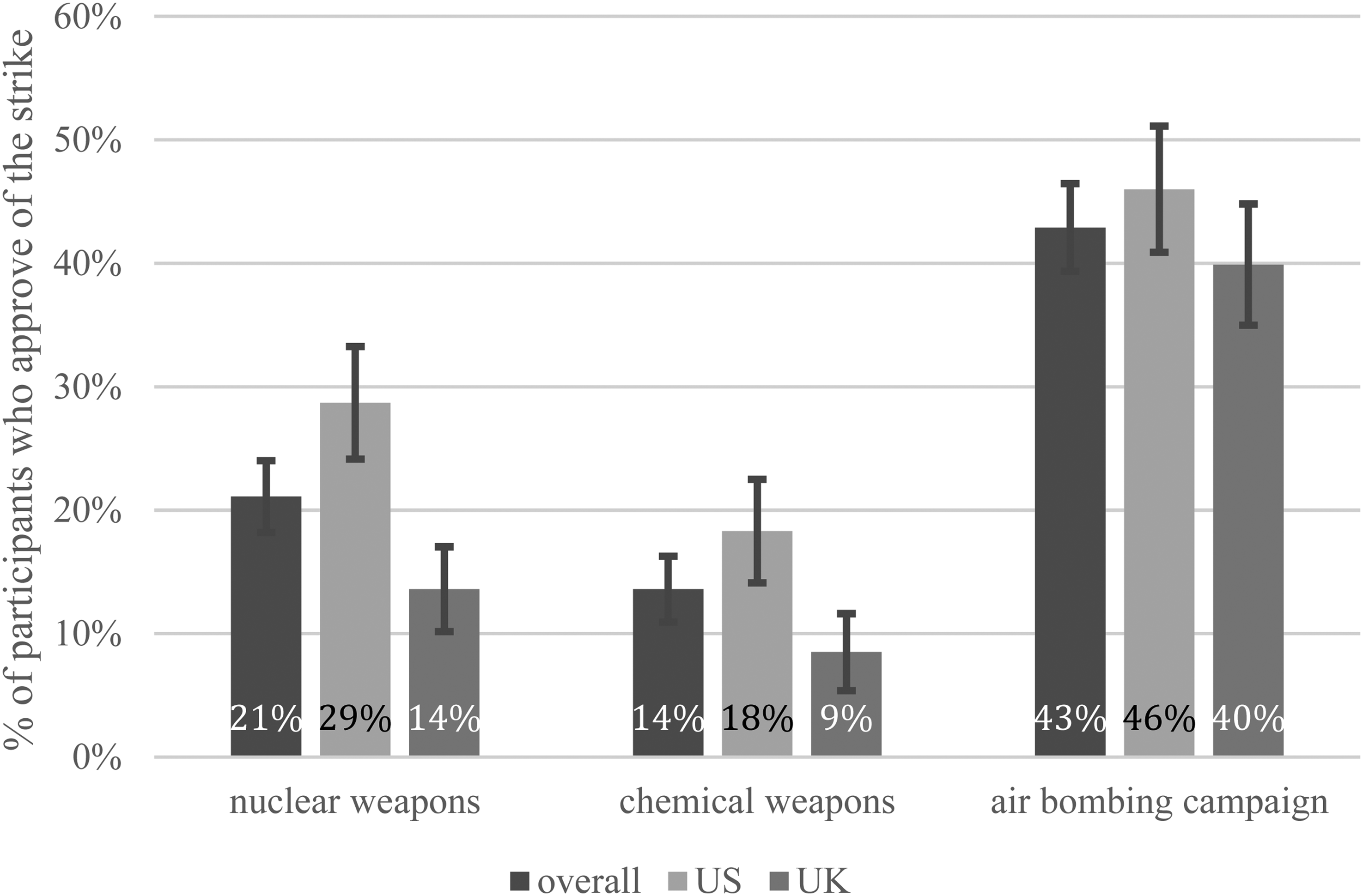
Approval of the strike. Note: Percentages of participants who approved of each type of strike are shown for the overall sample (N = 2138), as well as separately for the USA (n = 1068) and the UK (n = 1070) sample. Error bars represent 95% confidence intervals (CIs). Differences in approval are significant at p < 0.05 overall as well as for each sample. See Appendix 4 for detailed analyses.
While this finding holds for both American and British citizens, the support for nuclear or chemical strikes was significantly lower in the UK than in the USA. This is in line with the latest experimental study by Dill, Sagan, and Valentino (2022), who found that Americans are more supportive of nuclear weapon use (involving civilian casualties) against a terrorist base in Libya than British citizens are. Similar to the authors of this study, we suggest that the stronger retributive tendencies among the American public, previous use of US nuclear weapons in military conflict, as well as a more general willingness to approve of the use of military force to achieve foreign policy goals can help to explain the lower strength of the nuclear nonuse norm in the USA (Dill, Sagan and Valentino, 2022: 5–7). 9 Moreover, while we cannot support it with empirical evidence, the relatively higher aversion of British citizens to the use of chemical weapons could have also been reinforced by the more proximate direct experience with chemical agents in the infamous Salisbury attacks of 2018 (Chinonso Mark, 2018).
We also found that with respect to the range of fatalities described in the scenario, the average level of strike approval did not significantly differ between the four range conditions (low/medium/high/no range) overall (χ2(3) = 3.37, p = 0.338), or when we analyzed the approval of each type of strike separately (all p > 0.2; see Appendix 4). This is in line with the work of Sagan and Valentino (2017) and Haworth, Sagan, and Valentino (2019), who similarly found relatively stable levels of approval even when the number of civilian deaths is different by an order of magnitude.
In the next step of our analysis, we observed the extent of collateral damage estimated by our participants after reading the scenario (see Appendix 4 for detailed analyses). We found that our participants systematically (all p < 0.005) saw the use of nuclear weapons as resulting in more civilian deaths than the use of chemical weapons or the air bombing campaign (this is particularly visible in the “no range” condition where we provided neither upper nor lower boundaries for our participants’ estimates). As such, our study demonstrates that individuals in the USA and the UK are more averse to the use of chemical weapons than to the use of nuclear weapons even though they accurately perceive nuclear strikes as more indiscriminate than chemical strikes—suggesting that there are other powerful factors in play behind the relatively stronger aversion to the use of chemical weapons than unrealistic expectations about the capability of chemical weapons to cause mass destruction.
To control for additional individual-level factors that could have influenced the relative differences in attitudes toward the use of force in our scenario, we conducted a logistic regression analysis with approval of the military strike as a dependent variable (see Appendix 4 for a table with logistic regression results). The differences in relative support for the three types of strike (nuclear, chemical, air bombing campaign) remained statistically significant (p < 0.001) even when controlling for our participants’ nationality, age, gender, education, income, political ideology and the tendency to retribution (see Figure 2 for a regression coefficient plot for individual predictors). Of all interactions between the type of strike and each of the remaining variables, only the interaction with age was statistically significant (W(2) = 30.7, p < 0.001), with older participants more likely to approve of the air bombing campaign (rs = 0.14, p < 0.001), but less likely to approve of nuclear (rs = −0.14, p < 0.001) or chemical strikes (rs = −0.12, p = 0.002). 10 Importantly, we did not find any interaction between the participants’ retributive tendency and their approval of either of the strikes, ameliorating the possible concern that individuals would support some type of strike particularly because it is more horrific and therefore more appropriate as an instrument of retribution or revenge. Overall, we observe that the finding that individuals in the USA and the UK are more averse to the use of chemical weapons than the use of nuclear weapons holds even when controlling for these additional factors.
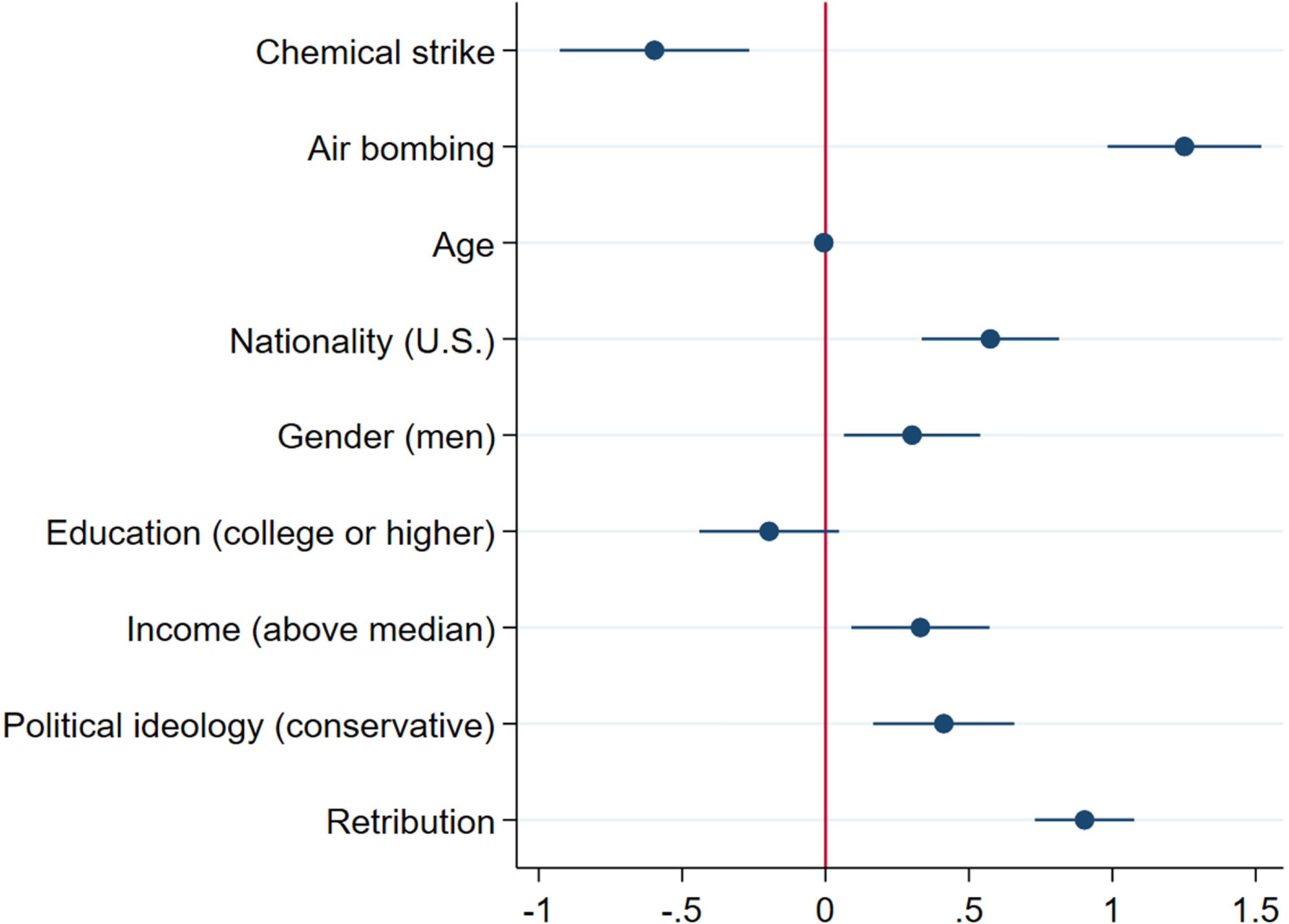
Strike approval. Note: Logistic regression estimates. Error bars represent 95% CIs. N = 1786. McFadden pseudo R2 = 0.174. We use the nuclear strike condition as a reference level for “chemical strike” and “air bombing” estimates. The “retribution” measure was not available for all participants, thus resulting in a lower number of observations in the model.
Follow-up study on morality, international law, and identity
Building on these findings, we designed an additional survey to examine to what extent the relatively stronger aversion to the use of chemical weapons is associated with three pertinent aspects of weapon “taboos”: moral judgments, the prescriptions of international law and the perceptions of the state’s identity in world politics. For this follow-up study, we used a slightly adapted version of our previous scenario depicting the war with North Korea (see Appendix 5). The key difference was that we informed the participants that the head of the coalition forces was considering using nuclear or chemical strikes to force North Korea to capitulate. In turn, we asked the participants 10 questions about the relative comparison of the two military options (see Appendix 6 for all survey items).
We collected the data between 31 May and 1 June 2021, using the same method as for the main study. Overall, 596 participants completed the survey. Half of these participants were from the USA and the other half from the UK (see Appendix 7 for detailed demographics).
As we show in Figure 3, in many pertinent aspects, most people tend to see both types of weapons as equally bad. A majority of our respondents believed that in our scenario, the use of nuclear weapons would be as unethical and morally repugnant as the use of chemical weapons. It would also cause a similar amount of suffering and be considered as “barbaric”. There are relatively small minorities that would give preference to one weapon system over another in this regard. Figure 3 also shows that there are more people who believe that the use of nuclear weapons would represent a more serious breach of international law than the use of chemical weapons, that it would be more condemned by allies, and set a more dangerous precedent. Still, for all three questions, most participants saw the use of these weapon systems as equal.
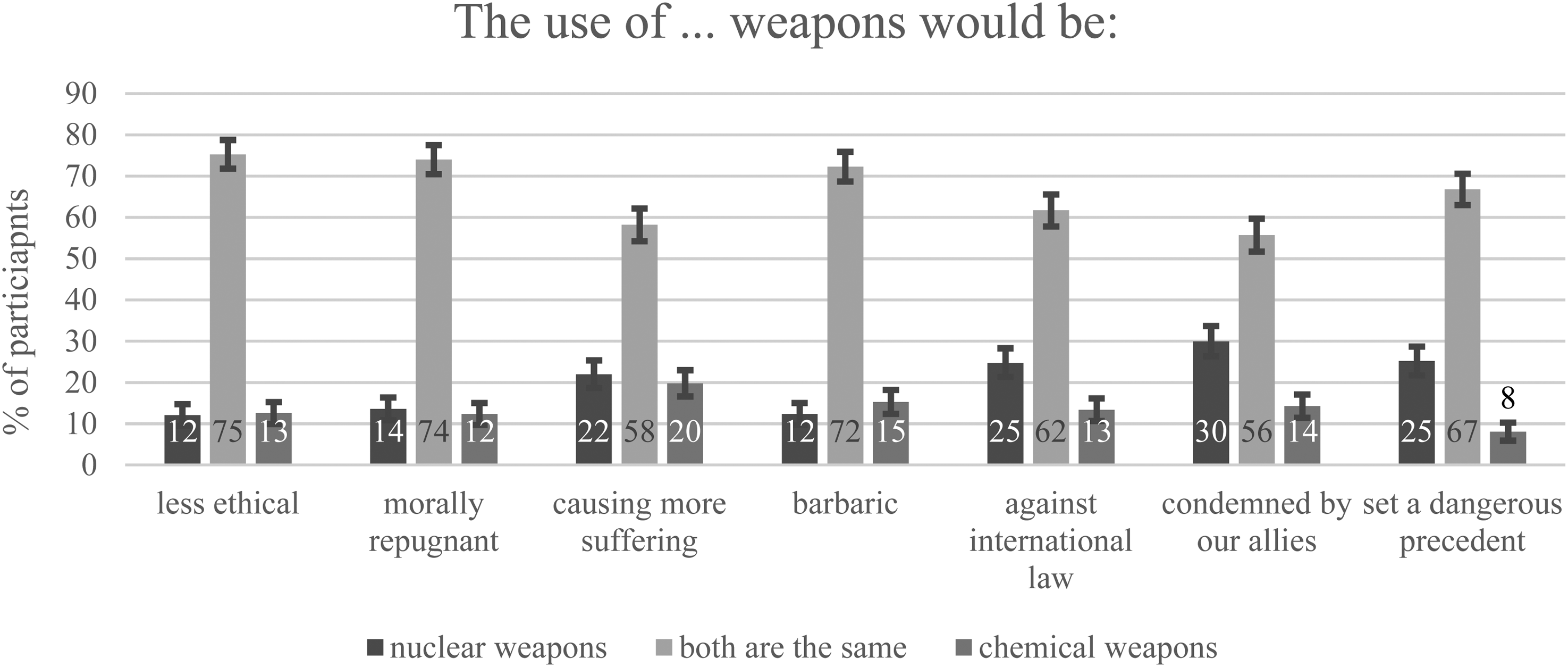
Nuclear–chemical comparisons. For each given description, the figure shows the percentage of participants who consider that either the use of nuclear or chemical weapons better corresponds to the description, or that the use of both kinds of weapons is the same in such respect. N = 596. Error bars represent 95% CIs. For all descriptions, the option that both kinds of weapons are the same was selected most often. For the last three categories, nuclear weapons were selected significantly more often than chemical weapons. See Appendix 8 for detailed analyses.
The differences, however, become much more pronounced with the remaining three questions. As we show in Figure 4, more than twice as many people tend to associate chemical weapons with “rogue states” than they do nuclear weapons—despite the fact that North Korea and Iran, perhaps the most notorious “rogues” in Western foreign policy discourse, have been making headlines particularly owing to their clandestine nuclear programs (Ogilvie-White, 2010; Smetana, 2020). Similarly, although nuclear terrorism has been strongly securitized in the post-9/11 era (Levi, 2007), a majority of our respondents associate chemical weapons with terrorism. Conversely, 60% of our respondents associated nuclear weapons with modern, powerful countries, while only 6% of respondents saw this association in reverse.
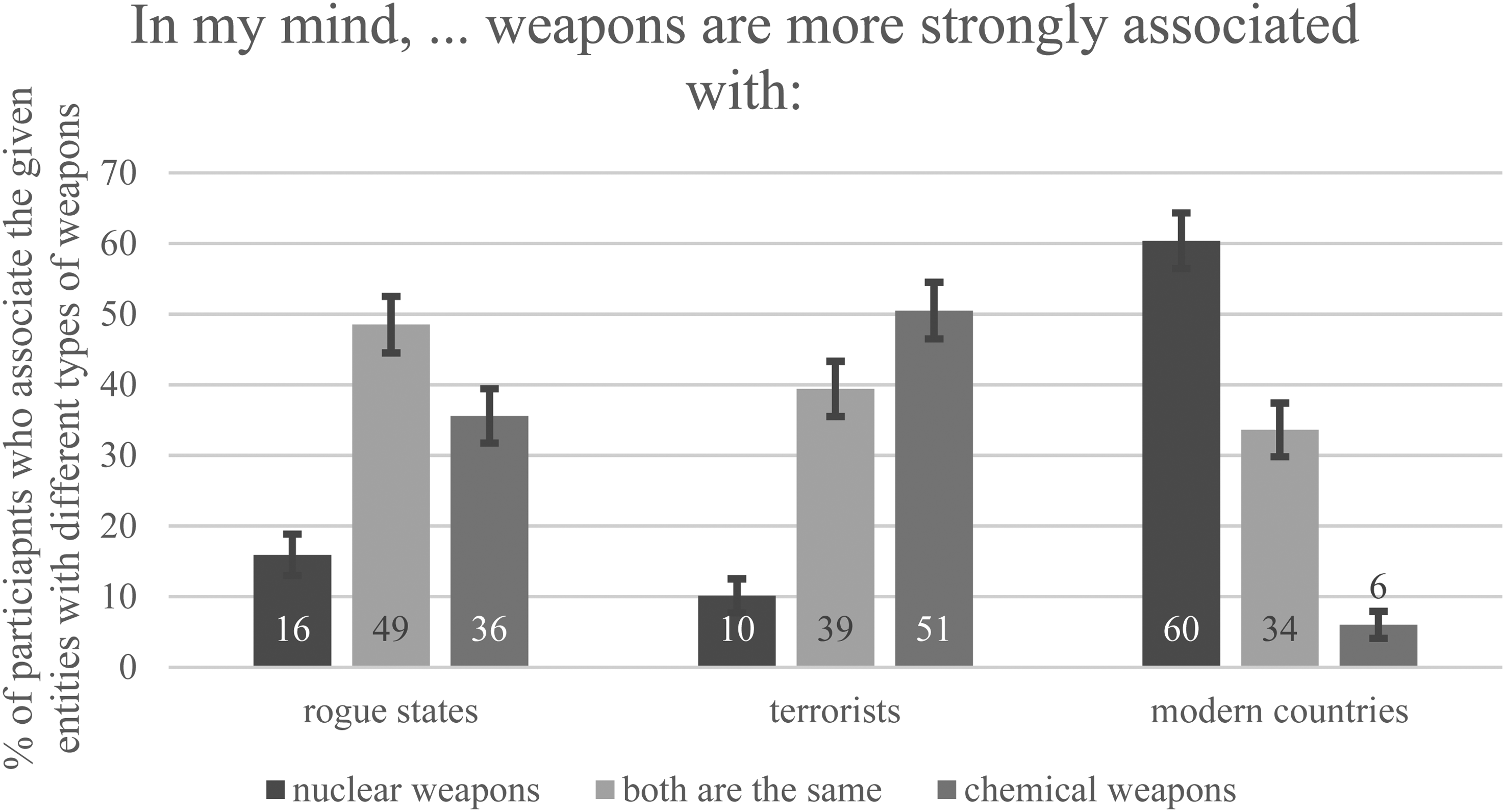
Nuclear–chemical weapons associations. Note: For each question, the figure shows the percentage of participants who consider that either nuclear or chemical weapons are more strongly associated with the entity, or that both kinds of weapons are equally associated with it. N = 596. Error bars represent 95% CIs. See Appendix 8 for detailed analyses.
Our results, therefore, suggest that it is the issue of identity and hierarchy of states in world politics that potentially contributes to the stronger public aversion toward the use of chemical weapons in Western countries. Citizens in the USA and the UK do not see the use of chemical weapons to be less ethical, more morally repugnant or as causing more human suffering. They are also more likely to believe that there is a stronger legal prohibition against the use of nuclear weapons than chemical weapons, even though the use of chemical weapons has been explicitly proscribed by the Chemical Weapons Convention, which both the USA and the UK have ratified (unlike the Treaty on the Prohibition of Nuclear Weapons, which neither country has signed). 11 Similarly, the rationalist underpinnings of the “tradition of nonuse”—that is, the resulting reputational costs and the setting of a dangerous precedent (Sagan, 2004; Paul, 2009)—are not seen by the public to be stronger for chemical weapons than for nuclear weapons. Yet the public in both the USA and the UK does seem to believe that today it is predominantly modern, powerful countries that (should) possess nuclear weapons, while chemical weapons are more likely to be pursued (and possibly used) by terrorists and the “rogue states” of world politics. In this view, the use of nuclear weapons could still be problematic from different ethical and pragmatic perspectives, yet it would not necessarily violate the idea that if nuclear strikes do happen, they are conducted by powerful, developed, modern countries; after all, the only country to have ever used nuclear weapons in warfare remains the USA. Using chemical weapons does not only make us feel bad because of the terrible consequences for civilians; we also feel that their use would violate our ideas about who we are, what our role in the world is and where we belong in the hierarchical society of states.
Conclusions and avenues for further research
In this article, we have presented the results of our survey experiment on the public aversion to the use of nuclear and chemical weapons, conducted on a large sample of citizens in the USA and the UK. Our research uncovered several intriguing findings. First, we gained empirical evidence for a hypothesis that individuals are less likely to approve of the employment of chemical weapons in a military conflict than the employment of nuclear weapons. Second, we show that the public in both countries is more averse to the use of chemical weapons even though most individuals accurately judge nuclear weapons as inherently more destructive and indiscriminate toward civilians. Third, we demonstrate that chemical weapons are significantly more likely to be associated with “rogue states” and terrorists, while nuclear weapons with modern, powerful countries, highlighting the relevance of the perception of a state’s identity in these attitudes.
We believe that our findings provide an important piece of the puzzle for the “second wave” of nuclear nonuse scholarship by providing a unique comparative perspective on public attitudes vis-à-vis the potential use of other WMDs (see Smetana and Wunderlich, 2021). Yet, an important caveat of our study is that we only examined attitudes to nuclear and chemical weapon use in two Western, culturally homogenous countries. Both the USA and the UK have also abandoned their chemical weapons programs but maintain and continuously modernize their nuclear arsenals, something that can also have some influence on public views in these matters. While we did find significant differences between the American and British samples, it is reasonable to expect that such differences could be even more pronounced if we had looked at, say, attitudes to nuclear and chemical weapons among the Indian or the Pakistani public. Further cross-national research in this direction is particularly desirable given our finding that these attitudes might be strongly shaped by ideas about what constitutes a “modern”, or a “powerful” country in contemporary world politics. To follow up on these threads, future experimental studies could possibly vary both the country that perpetuates the attack and the country where the sample of respondents is drawn from—in both cases, including Western and non-Western countries, major established powers as well as the “rogues” of international politics.
Another important limitation of our study is that we did not examine the relationship between the perception of the utility of the given strike and approval of the strike. It is worth noting that rationalist explanations of the nonuse of chemical weapons in world politics do focus on a rather limited military utility of chemical agents (e.g. Krause, 1991; Martin, 2004a; Martin, 2016; Chapman, Elbahtimy and Martin, 2018; Allison and Herzog, 2019). The seminal work of Press, Sagan, and Valentino (2013) similarly supports the idea that individuals tend to prefer the use of nuclear weapons more when they find them to be more effective than conventional weapons in the given scenario, while Sagan and Valentino (2018) found that the public willingness to inflict collateral damage is positively associated with the military advantage of the attack. While we aimed at keeping the perception of the strike utility constant across treatment groups by stating explicitly that the head of the coalition forces proposed the employment of the given weapon strike and believes that the strike will be effective with respect to achieving the stated strategic goals (with the only stated concern being the high number of civilian deaths), the perception of the military utility of both nuclear and chemical strikes as a relevant factor in nonuse attitudes could be an intriguing area for future research.
Finally, our study left out the third weapon type that is commonly lumped together with nuclear and chemical weapons in the WMD category: biological weapons. There are few studies that have investigated the nature and strength of the norms against the use of biological weapons (Cole, 1998; Koblentz, 2004; McCauley and Payne, 2010; Baum, 2015). At this point, there are good reasons to assume that the COVID-19 pandemic could have influenced individuals’ views on biological threats, which makes the problem of contemporary attitudes to biological weapons particularly worth investigating (Shang et al., 2021). Future research could employ comparative designs to examine the attitudes toward nuclear, chemical and biological weapons in different national and cultural contexts to further enhance our understanding of the “taboos” surrounding the (non)use of unconventional weapons in world politics.
Supplemental Material
sj-docx-1-cmp-10.1177_07388942221124515 - Supplemental material for The lesser evil? Experimental evidence on the strength of nuclear and chemical weapon “taboos”
Supplemental material, sj-docx-1-cmp-10.1177_07388942221124515 for The lesser evil? Experimental evidence on the strength of nuclear and chemical weapon “taboos” by Michal Smetana, Marek Vranka and Ondrej Rosendorf in Conflict Management and Peace Science
Supplemental Material
sj-zip-2-cmp-10.1177_07388942221124515 - Supplemental material for The lesser evil? Experimental evidence on the strength of nuclear and chemical weapon “taboos”
Supplemental material, sj-zip-2-cmp-10.1177_07388942221124515 for The lesser evil? Experimental evidence on the strength of nuclear and chemical weapon “taboos” by Michal Smetana, Marek Vranka and Ondrej Rosendorf in Conflict Management and Peace Science
Footnotes
Acknowledgements
We would like to thank Scott Sagan, Benjamin Valentino, Rose McDermott, Janina Dill, Kristin Ven Bruusgaard, Michelle Bentley, Wyn Bowen, Matthew Moran, Dan Kaszeta, Debra Lieberman, Lauren Sukin, Stephen Herzog, Lisa Koch, Doreen Horschig, David Minchin, Tyler Bowen, Michal Parizek, Jakub Tesar, Jan Ludvik, Vojtech Bahensky, Anastasiia Peleshenko and Kamil Klosek for their valuable feedback. We also gratefully acknowledge continued support of our work by the Charles University through its programs UNCE/HUM/28 and PRIMUS/22/HUM/005.
Funding
The author(s) disclosed receipt of the following financial support for the research, authorship, and/or publication of this article: This work was supported by the Charles University Center of Excellence program (grant number UNCE/HUM/28) and PROGRES Q18 (Social Sciences: From Multidisciplinarity to Interdisciplinarity) / Cooperatio, research area POLS.

Supplemental material
Supplemental material for this article is available online.
Notes
References
Supplementary Material
Please find the following supplemental material available below.
For Open Access articles published under a Creative Commons License, all supplemental material carries the same license as the article it is associated with.
For non-Open Access articles published, all supplemental material carries a non-exclusive license, and permission requests for re-use of supplemental material or any part of supplemental material shall be sent directly to the copyright owner as specified in the copyright notice associated with the article.
