






Abstract
Research on private military and security companies (PMSCs) often groups distinct actors together, obscuring variation. I develop a new typology of PMSCs using k-means clustering, providing a more systematic approach than existing classifications, and assess how well prevailing conceptualizations capture variation across actors. Applying this typology to existing datasets, I reassess findings on conflict termination and show that results are largely driven by actors conventionally understood to be private security companies, while the effects of private military companies are more ambiguous. The study offers both a stocktaking of the literature and a new framework for analyzing PMSCs.
Keywords
Introduction
In 2015, Specialized Tasks, Training, Equipment and Protection (STTEP), a South African-based private military company (PMC), was contracted by the Nigerian government to fight Boko Haram (Adamo, 2020). Details of the STTEP contract remain vague, but their involvement reflected a mix of military, electoral, and geopolitical pressures. STTEP was not the only PMC operating in sub-Saharan Africa. In 2019, the Mozambican police hired the Dyck Advisory Group to train state police officers and fight against an Islamist insurgency in Cabo Delgado (South Africa Litigation Centre, 2022). Their contract ended amidst reports that the group engaged in violence against civilians (Amnesty International, 2021). Nor are military operations the only operations being outsourced. In 2023, the South African “Red Ants,” a private security and eviction group, charged the Johannesburg government around 600,000 USD for three days of eviction operations in the year. 1
STTEP's operations in Nigeria, the Dyck Advisory Group's operation in Mozambique, and the Red Ants in South Africa represent instances of an increasingly common phenomenon: states engaging with security forces that fall outside the state's traditional security apparatus. This phenomenon raises several questions: why do states choose to outsource? What do these private companies actually do? What are the consequences of their operations? These questions presuppose an industry-standard definition of what constitutes a private security force. No such consensus exists. This paper therefore focuses on systematically typologizing private military and security companies (PMSCs). Understanding why states engage with these actors requires first understanding who these actors are and what they do.
This paper serves three purposes. First, I probe the meaning and manifestations of PMSCs, identifying key gaps in existing definitions and typologies. Specifically, I argue that existing typologies tend to focus only on a single dimension—such as services provided or corporate structure—which can obscure important variation across actors. Multiple dimensions, including the type and number of services provided, corporate structure, and domains of operations, all have important implications for understanding conflict termination and policy responses to these actors. Second, I extend existing datasets and assess the effects of different types of PMSC on conflict termination. This research represents a sort of “stocktaking” of the existing quantitative research on PMSCs and an attempt to bridge the disparate conceptualizations of PMSCs (Avant, 2005; Avant and Neu, 2019; Cilliers and Mason, 1999; McFate, 2014; Moyakine, 2017; Shearer, 1998; Singer, 2001; Tonkin, 2011). Third, this research contributes to the broader literature on concept formation in political science by using unsupervised learning to reassess and add nuance to existing concepts (Ahram, 2011; Collier et al., 2008; Waggoner, 2020).
I find that PMSCs can be partitioned into two or three clusters based on the number and types of services they provide, and the number and types of domains in which they operate. These clusters map well onto existing typologies of PMSCs, but also provide a more systematic, nuanced, and empirically based way to understand the variation between different types of PMSC beyond looking solely at services or structures. I also find that most of the effect of PMSCs on conflict termination is being driven by what are conventionally understood to be private security companies (PSCs), rather than private militaries, defense contractors, mercenaries, or any other type of PMSC.
An overview of PMSCs
Traditional Weberian theories suggest that the state should use its own security or military forces to address domestic security threats, thus exercising its monopoly of power and coercion (Weber, 1948). However, Weberian accounts fail to explain why modern state security configurations involve a mixture of state and non-state provision of security (Abrahamsen and Williams, 2010). Across the globe and across time, a range of non-state, private, and foreign actors are available to the state: foreign militaries, peacekeeping forces, paramilitaries, militias, and (the focus of this paper) private companies (Acemoglu et al., 2013; Mockler, 1985; Spruyt, 1994). In both academic and policy spheres, the term “PMSC” encompasses an array of actors, ranging from companies that provide security for large events to companies that manufacture weapons and provide logistical support for the military, to companies that provide “tip of the spear” combat services. Existing conceptualizations of PMSCs have successfully identified them as separate actors from say, paramilitary organizations or pro-government militias, but our understanding of within-actor variation remains limited.
Existing definitions of PMSCs
Several typologies of PMSCs have been postulated over the years. One issue is that some typologies conceptualize PMSCs in isolation from both military forces and other forms of PMSC, which, while useful for internal validity, hinders our ability to understand how PMSCs are similar to or different from these other actors (Akcinaroglu and Radziszewski, 2013, p. 797). The flipside to this is that other typologies identify PMSCs in relation to state domestic militaries. 2 This proves fraught given that (1) PMSCs tend to provide multiple services and so do not necessarily have a one-to-one military analogue, (2) the types of services provided by a single PMSC tend to vary over time and given the nature of a particular mission, and (3) PMSCs have a strategic incentive to obscure the exact services they are providing to the host country. 3 A third issue is that the scant quantitative literature on PMSCs relies on broad definitions of PMSCs, which blurs the scope conditions of analysis. In other words, it remains unclear whether these definitions are sufficiently precise to allow for meaningful comparisons across PMSCs. This last point will be covered in more depth in the next section.
Since the 1990s, calls have been made to develop a clearer analytical framework through which to understand new forms of private security (Shearer, 1999). Several advancements have been made. First, it is now largely agreed upon that PMSCs are corporate bodies, companies, or organizations, specializing in military and security services (Avant, 2005; Kinsey, 2006; Percy, 2007; Singer, 2008). Second, studies of other forms of non-state security actor provide a clearer sense of what distinguishes PMSCs. Carey et al. (2013) pioneered the concept of PGMs to encompass proxy forces, death squads, vigilantes, civil defense forces, and paramilitaries. Although the state may outsource their coercive powers to these actors, paramilitaries differ from PMSCs insofar as they are more explicitly integrated into the state's military structure, are permanently “standing” and do not rely on contracts to operate, and may offer public goods and services to the areas they serve (Besley and Ghatak, 2009). For example, in Northern Ireland, paramilitary groups develop informal wartime institutions which have proliferated even after the Good Friday Agreement. In addition to the provision of security, these paramilitaries provide welfare and transportation services for the areas in which they operate (Rickard and Bakke, 2021). Additional to PGMs, there are legionnaires, “uniformed personnel who serve in a state's armed forces, but who—at the time of their service—are neither citizens of that state nor, in the days of the empire, subjects of the government” (Grasmeder, 2021, p. 152). Legionnaires are more constrained than paramilitaries insofar as they are under the direct control of the government. They are also often employed in forward-facing combat, while private companies tend to be hired to provide support or logistical services. Private military and security companies tend not to be associated with the state outside of the contract under which they operate, meaning that they will leave the country of operation upon completion of the contract. This has implications for claims that violent non-state actors might perpetuate civil conflict, or that civil conflict occurs in response to mobilization of these forces (Jentzsch et al., 2015, p. 761).
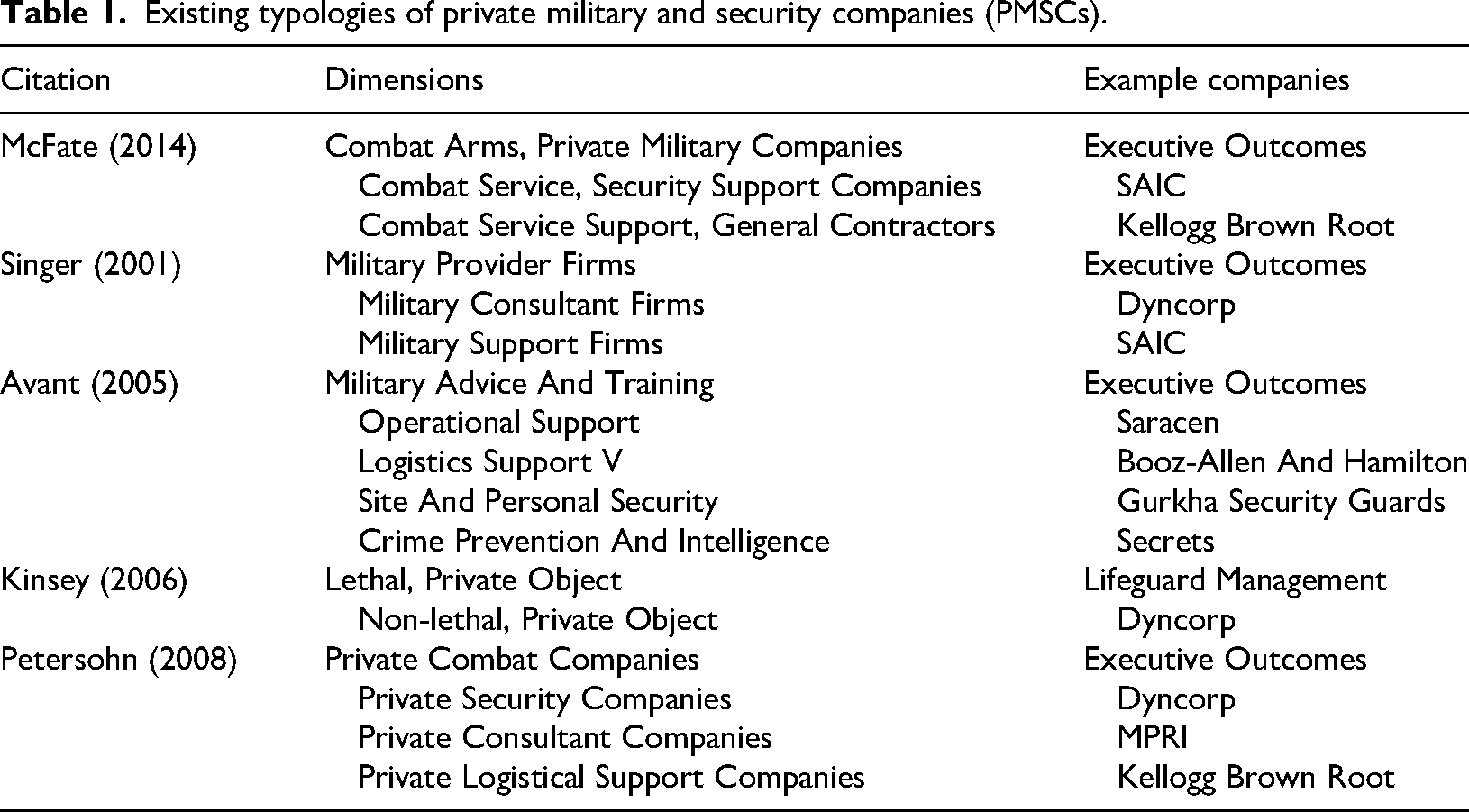
Existing research uses a variety of approaches to identify different classes of PMSC. First, Percy uses the degree of attachment to a cause and the degree of legitimate control to partition groups of actors (Percy, 2007, p. 59). Second, Kinsey (2006) uses lethality vs. non-lethality and the nature of the “object to be secured” (private vs. defense of the state) to identify different classes of private security actor and to differentiate these actors from other state or state-adjacent actor (Kinsey, 2006, p. 10). Third, others attempt to map PMSC actors to state military analogues based on the services they provide (McFate, 2014, 2019). Fourth, taking a critical-legal approach, Liu uses the application of violence and the military nature of organizations as the key dimensions by which to discriminate PMSCs (Liu, 2015). Fifth, Tkach (2019) uses the structure of contacts to demarcate between different forms of PMSC in Iraq. Sixth, Petersohn (2008) demarcates between combat, security, consultant, and logistical companies. 4 Crucially, he notes that these typologies are all “ideal” types since “most firms conduct business in more than one area” (Petersohn, 2008, p. 7).
Table 1 summarizes this discussion. That specific PMSCs are classed as distinct forms of actor depending on the typology raises questions about whether there are better ways to understand them. While this critique may appear as either negligible or an unavoidable consequence of the complexity of these actors, it warrants further exploration. The table highlights three key findings. First, PMSCs provide a range of different services, from infrastructural development to military combat operations. Second, there is significant overlap between the services provided by any given PMSC. Third, existing typologies PMSCs do not specifically demarcate between different types of actor; rather, they mention how some actors provide different services than others. This has clear implications for any quantitative analysis: If large defense contractors are treated as conceptually equivalent to small-scale mercenary outfits in quantitative analysis, much of the variation is being aggregated away by treating these actors as the same entity.
Existing typologies of private military and security companies (PMSCs).
Existing databases
There are four datasets covering the names and activities of PMSCs: the Private Security Dataset (PSD) (Branovic, 2011), the Private Security Events Dataset (Avant and Neu, 2019), the database used in Akcinaroglu and Radziszewski (2013) and expanded in Akcinaroglu and Radziszewski (2020) (henceforth, A&R), and the Commercial Military Actors Dataset (CMAD) (Petersohn et al., 2022). I briefly discuss in turn each dataset, and summarize their contributions in Table 2.
Overview of existing datasets.
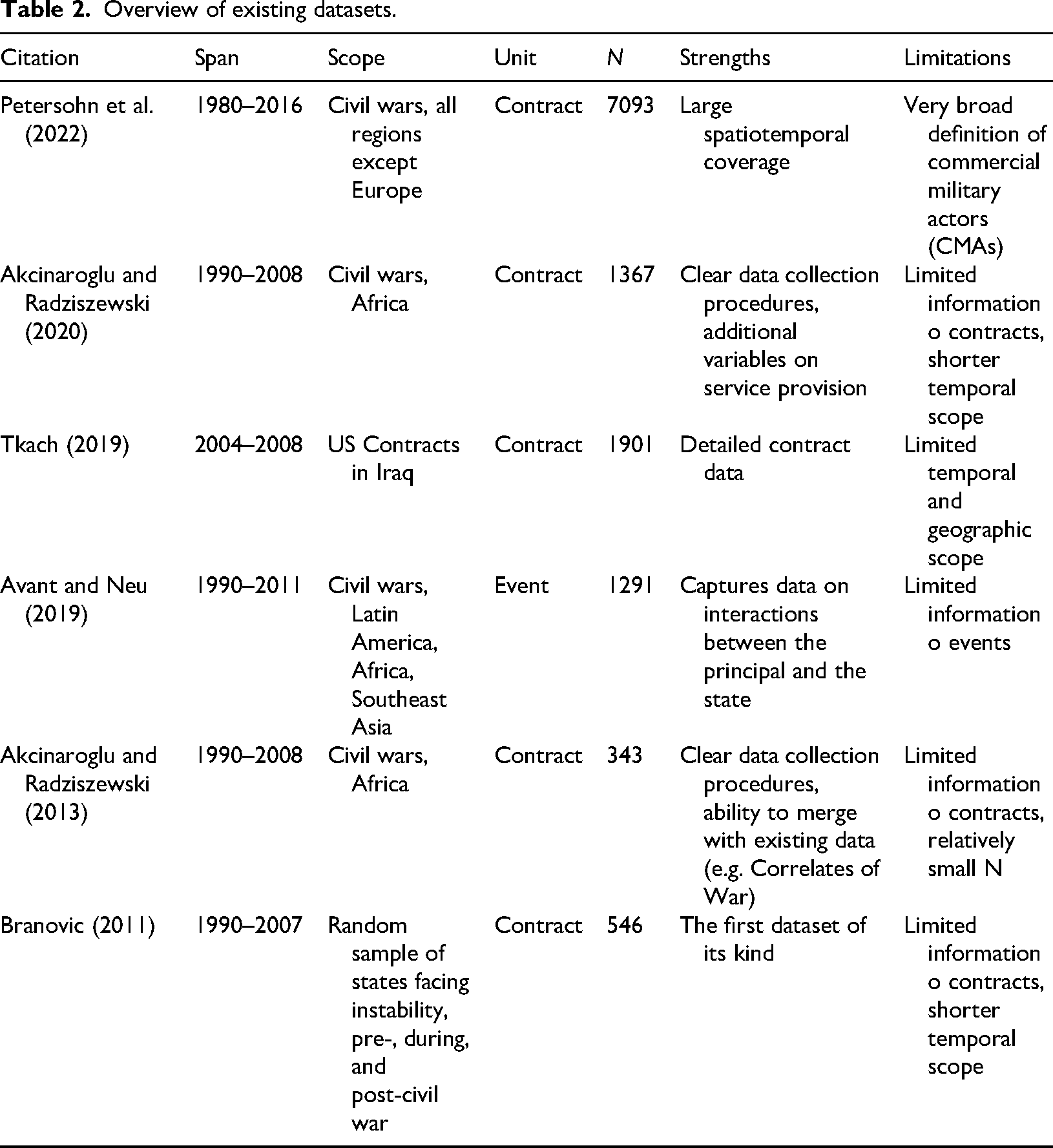
First, the PSD defines PMSCs as market-oriented, professionalized and organized, and legally registered entities. The data focuses on PMC activity in a random sample of states that have faced periods of instability, using the Political Instability Task Force data as its base (Branovic, 2011, p. 7). 5 Although the PSD allows researchers to understand the role of PMSCs before, during, and after a period of instability, it remains challenging to generalize findings to non-civil war contexts in which PMSCs are known to operate (such as G4S or Wozani Security in South Africa). Second, the Private Security Events Dataset captures PMSC involvement in specific violent events. The broader scope conditions of this dataset (compared with the PSD) mean that the findings are more externally valid, although the unit of analysis—PMSC-event—may fail to capture the nuanced impacts that the presence alone might have on their dependent variables. In other words, one might expect the presence of PMSC employees, or a PMSC base, to influence instances of conflict, especially if their presence is publicly known. Third, A&R is constrained in the same way as the PSD by only looking at civil wars and the interaction between governments and opposition groups. As Petersohn et al. (2022) suggests, this constraint misses the significant number of PMSCs that are hired by non-governmental and international organizations (Petersohn et al., 2022, p. 901). Fourth, the CMAD is broader in country-year coverage than all other datasets on this topic. Although their analysis is still limited in scope to civil wars, it represents the largest data collection effort on PMSCs to date, with data collected on actors outside of civil war contexts. The authors also collect data on the characteristics of the commercial military actors themselves. The CMAD is the only dataset to systematically record the names of the private actors involved. Some of the other datasets have a “notes” column containing the names of the actors, but they are not standardized and so cannot be properly analyzed.
These data are summarized in Table 2. While all of these databases are highly valuable in deepening our understanding of PMSCs, a crucial gap—driven by existing works’ focus on individual characteristics—remains.
Conceptualizing PMSCs
I have argued that existing approaches to conceptualizing PMSCs are broad and rely heavily on typologies that do not sufficiently capture all PMSCs nor sufficiently discriminate between different types. 6 Many PMSCs provide multiple services, vary greatly in size and scope, and have different relationships with their home governments and with the countries in which they operate. More recent conceptualizations of PMSCs, such as in Faulkner et al. (2019), Petersohn et al. (2022), and Radziszewski and Akcinaroglu (2020), offer more nuanced understandings of PMSCs and explicitly focus on the different services that PMSCs can provide. However, as we have seen, focusing solely on individual services can obscure the exact nature of these actors.
Data collection
To address these conceptual gaps, I conduct additional data collection that builds from the work of Petersohn et al. (2022). The advantage of their data is that they have both a panel structure and information on individual actors operating in each country-year observation. Specifically, the authors collect information on whether a given PMSC provides (1) combat operations, (2) military consultancy, (3) military training, (4) military operational support, (5) military logistics, (6) intelligence, (7) security, (8) security consultancy, (9) security training, (10) security logistics, and (11) reconstruction. These covariates speak to previous categorizations of PMSCs and, crucially, allow me to construct my own measure of PMSC diversification and specialization. Another advantage of their data is that the services provided by a given company can change over time and by country.
Using this data, I collect additional information on the number of domains over which PMSCs operate (land, air, sea, and cyber), the most recent estimate of employee numbers, information on their year of commencement and cessation (if applicable), and information on whether these actors appear in other PMSC datasets. 7 For each entry, I try to obtain at least three reliable sources (newspapers, academic articles, policy reports) to provide information on each of the individual entries. In some instances only one source exists on a given PMSC; in these instances, one source must suffice. In cases where I find no source of evidence, these rows are included in the final data but removed from the analysis. Table 3 presents a random sample of five entries of my data-collection efforts. 8
Random sample of dataset entries.
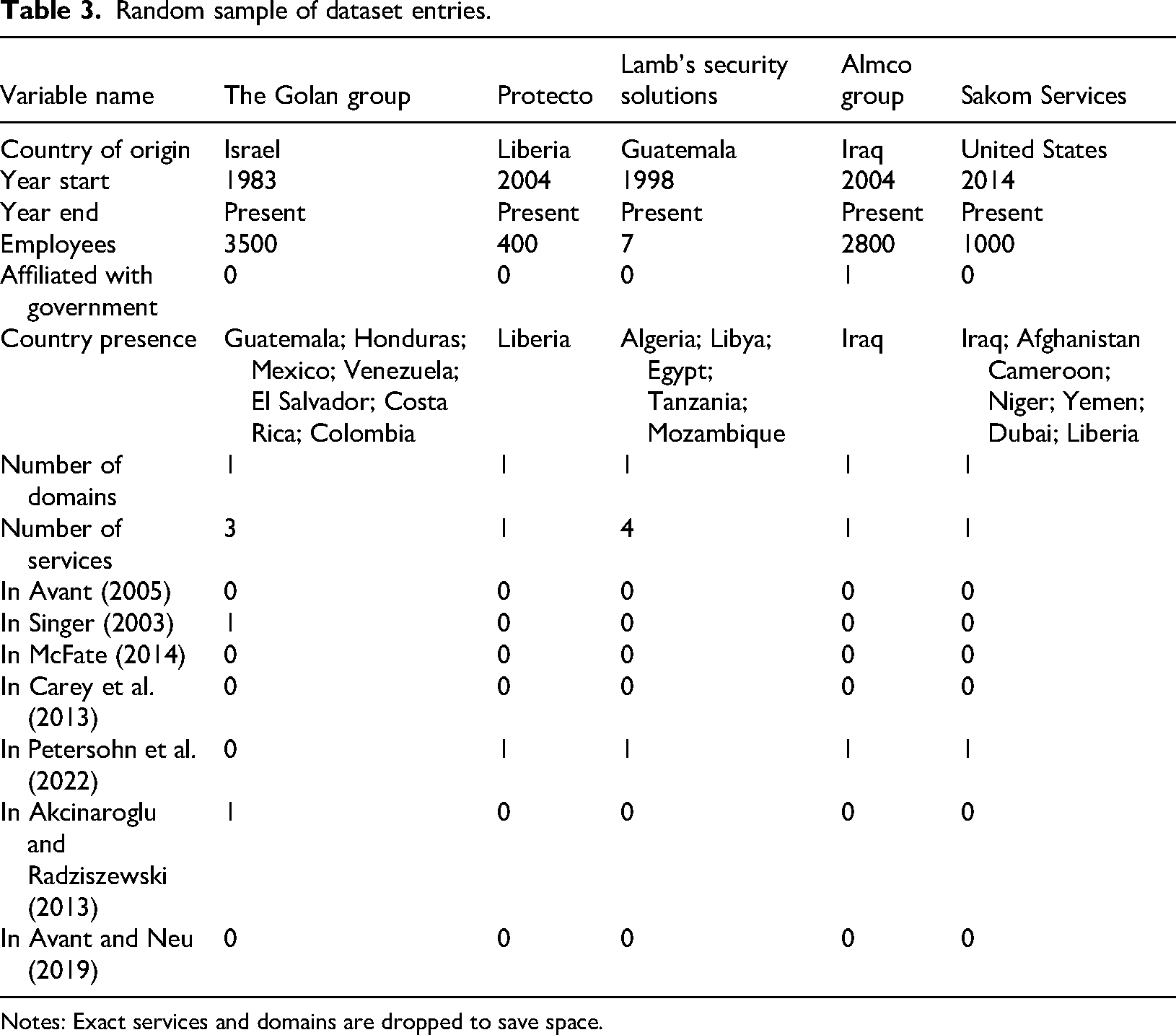
Notes: Exact services and domains are dropped to save space.
Inductive conceptualization
Rather than manually attempt to coerce each private security force into a category based on the service they provide or their military analogues, I turn to unsupervised machine learning algorithms. The workhorse unsupervised machine learning tool is k-means clustering, whereby multivariate data is collapsed into two-dimensional, non-overlapping space (Fredland 2004; Kodinariya and Makwana, 2013). By inputting variables discussed in the literature into the clustering algorithm, the aim is that the algorithm will return a number of clusters of PMSC types capturing the underlying variables and variable interactions.
It is a fair critique that unsupervised learning might be an unnecessary endeavour for a topic already containing several typologies. In the initial stages of my research, I failed to generate a typology not falling victim to the same issues of overlap that occur with existing conceptions of PMSCs. Hence, a quantitative approach—even if it aligns perfectly with existing typologies—is a useful exercise: (1) it allows us to validate existing typologies from a new epistemological standpoint; (2) it allows us to address the problem of mutual non-exclusivity in existing typologies by accounting for multiple variables and their combinations; and (3) it provides a scalable model for classifying newly identified actors, which is important given the proliferation of PMSCs (Collier et al., 2008, 2012).
This method is not particularly common in political science, although a handful of articles have deployed k-means as a way to generate typologies from large multidimensional datasets (Ahlquist and Breunig, 2011; Grimmer et al., 2021; Wolfson et al., 2004). Of the existing quantitative typology studies, almost all focus on identifying latent clusters and classes of political phenomena such as democracy (Møller and Skaaning, 2010) and political parties, party systems, and voters (Markaki, 2016). Arjona (2014) applies clustering to different forms of “wartime institution” while Gannon (2023) uses clustering to identify different types of state military equipment ownership.
I begin my inductive analysis by including variables on the types of services and domains, the number of services and domains, and the corporate structure of the organization. 9 I then collapse the multivariate data into two dimensions using principal component analysis, allowing me to see which variables are most important in discriminating between different types of PMSC. I then feed these two dimensions into the k-means algorithm to identify clusters of PMSC types. 10 Figure 6 reveals that the two principal components capture distinct dimensions of PMSC variation. Dimension 1 (the x-axis in Figure 1) is primarily driven by corporate structure—whether a company operates as an international or locally-based firm— and the provision of military services, including training, operational support, and intelligence. Dimension 2 (the y-axis) captures operational breadth: the total number of domains and services over which a company operates, with particular weight on non-traditional domains such as cyber and maritime. This dimension distinguishes highly diversified actors from more specialized companies focused on a narrower set of activities.
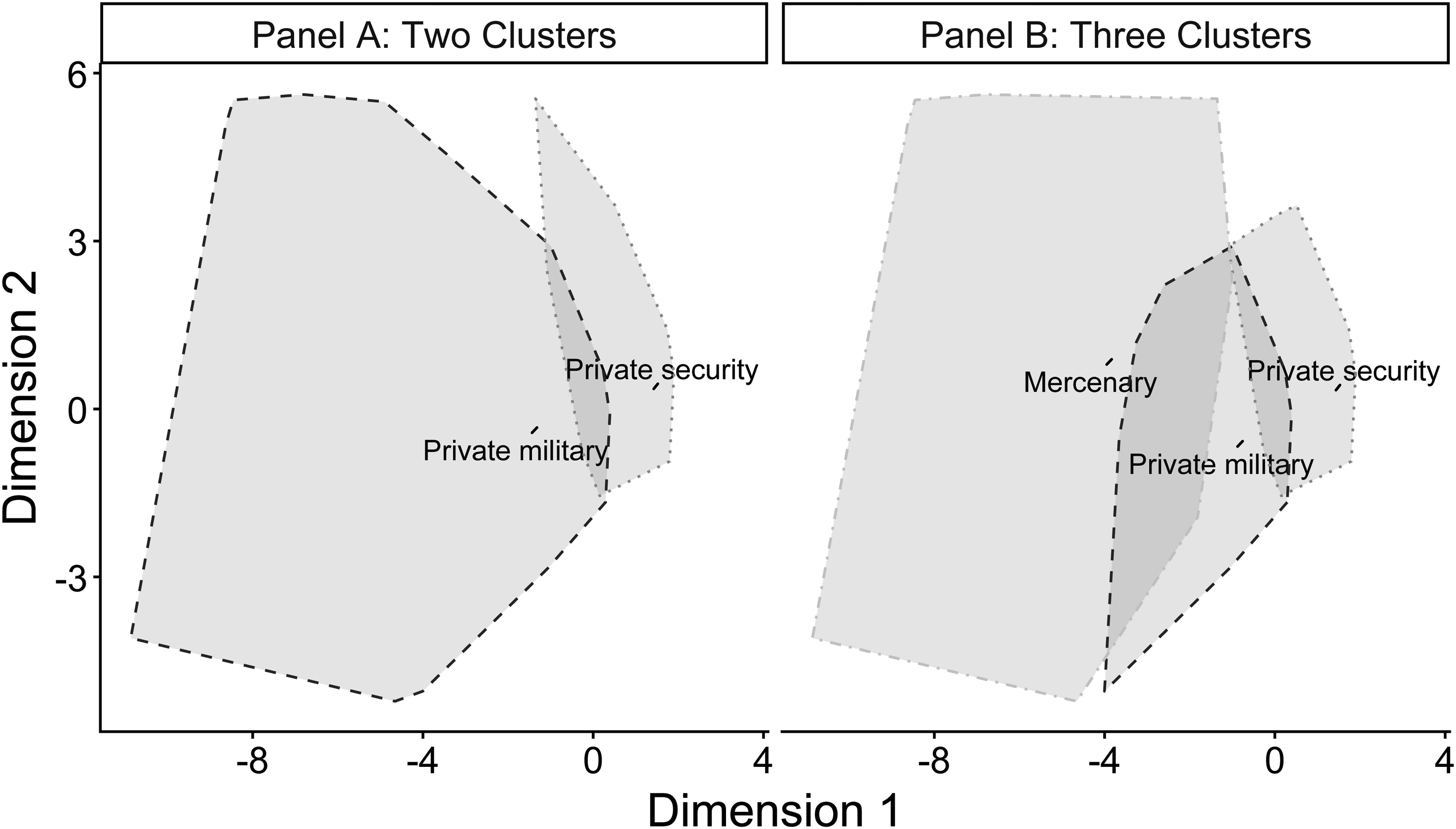
Typologizing private military and security companies (PMSCs) with K-means clustering. Notes: Data come from Petersohn et al. (2022). Dimension 1 and Dimension 2 capture the first and second principal components from principal component analysis, respectively.
Figure 1 presents a visualization of the k-means algorithm, where each panel corresponds to the number of clusters I specify. The x- and y-axes are the first and second dimensions generated by principal component analysis. Each convex hull represents the boundaries of each type of PMSC. Individual actors are omitted for ease of interpretation.
A number of interesting patterns emerge. Figure 1(a) (the two-cluster model) almost perfectly discriminates between PMCs and PSCs. The first cluster (dashed and dotted lines) contains actors who provide a larger number of services, operate across a larger number of domains, and who operate in more countries. This cluster also contains clandestine PMCs and organizations typically understood to be mercenaries. Outfits like the Wagner Group and “Mad Mike” Hoare of 5-Commando are infamous for their anti-government operations and overtly illegal activities. These organizations also tend to be remunerated through valuable resources as opposed to payment through a government contract. Within this cluster are also those actors that are typically considered to be private defense contractors. These are larger companies who tend to offer advisory or infrastructural services across a larger number of domains. Examples include companies such as BAE Systems, Northrop Grumman, and SELEX.
The second cluster (dotted lines) corresponds to what are typically understood to be private security companies broadly construed. These groups tend to provide fewer services (mainly security), operate in a single country (usually the one in which they are headquartered), and operate in a single domain (land). This cluster is smaller, but contains more observations. Private security companies are a more common manifestation of privatized security compared with these other more complex forms of security.
Figure 1(b) presents a three-cluster model. The PSCs are largely unchanged, but introducing a new cluster splits the PMC cluster into what can be understood to be PMCs and defense contractors (dashed lines) and mercenaries (dotted and dashed lines). Note that the large spatial spread of the mercenary cluster indicates that there are several different types of mercenary organization, but that all of them are conceptually distinct from the PSCs and PMCs in the first two clusters. 11
Interpreting the typology
What have we learned from this clustering exercise? First, the algorithm does a fairly good job of discriminating between latent forms of PMSC, as shown in the two panels in Figure 1. Second, there exists a trade-off between the number of clusters and the interpretability of the typology. Two clusters discriminate between our typical understanding of PMCs vs. PSCs, while three allow us to understand private security forces in a more nuanced way. More than three clusters, although providing more nuance, becomes less readily interpretable, and the conceptual distinctions between each form of PMSC become less clear. I conduct several quantitative tests to assess the optimum number of clusters (Figures 2–4 in the Online Appendix), and each suggests that two to three clusters are statistically optimal.
I select the three-cluster model (Figure 1b) to be my baseline typology, and use this model in the empirical analysis in the section “Revisiting PMSC competition in civil wars”. While the two-cluster typology is the most parsimonious and allows for better-powered statistical analysis, the three-cluster typology provides the most nuance without being arbitrary and difficult to interpret. The three-cluster model also speaks well to existing literature on these PMSCs.
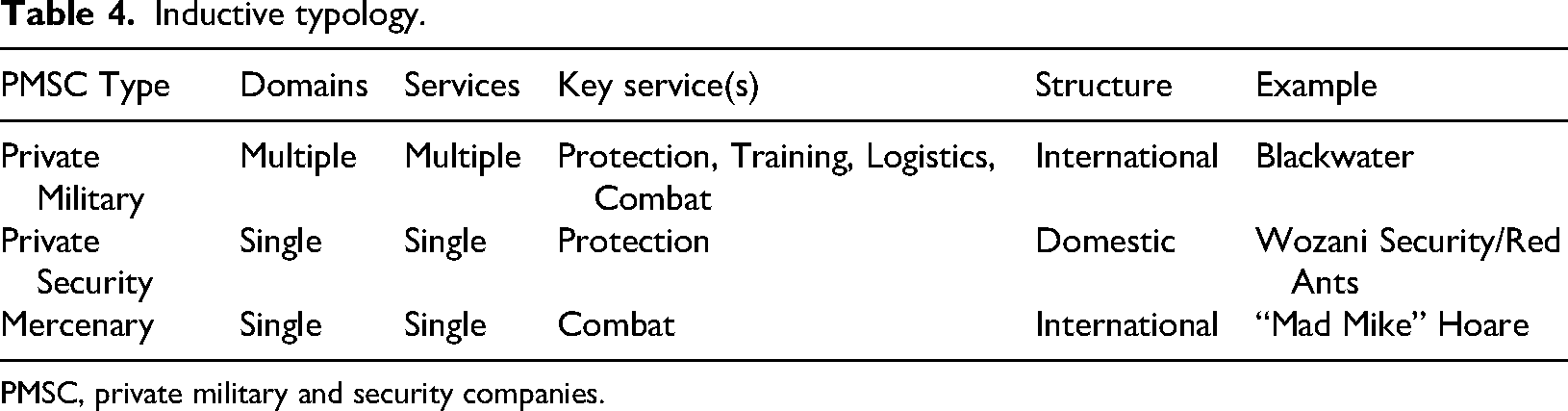
Table 4 shows the PMSC types (derived from the previous figure and table) based on corporate structure, the domains over which they operate, and the services they provide. I also include a few examples of actors who appear in each cluster in the Example column. Theoretically, the corporate structure of a group—whether it is locally or internationally oriented—and the number of services it provides and the number of domains over which it operates are likely to be key variables in understanding the differential behaviors and impacts of these actors in conflict scenarios. For example, more specialized groups, providing a single service in a single domain, may be more efficient in conflict situations and may be less willing or able to go beyond their remit.
Inductive typology.
PMSC, private military and security companies.
Is this a “good” typology? Although there is no industry standard method for evaluating typologies, Arjona (2014) presents a simple and effective set of criteria: (1) it should identify variation that makes theoretical sense; (2) it should identify types maximizing between-group variation; and (3) it should be parsimonious (Doty and Glick, 1994; Gerring, 1999). The benefits of a quantitative and inductive approach should be made clear by these criteria: because clustering algorithms are designed to generate distinct clusters based on theoretically relevant variables, and because the researcher can manually edit the number of these clusters in order to balance nuance and parsimony, each of the three criteria highlighted in Arjona's research can be seen as being met. Another advantage with this approach is that it visualizes edge cases (that is, those actors straddling the lines of two clusters), which can again be useful for theory building.
Revisiting PMSC competition in civil wars
A frequently discussed topic in the study of PMSCs is the effect of the number of PMSCs on conflict dynamics. The literature is unique insofar as scholars have been directly building on and reassessing existing data in subsequent publications. Akcinaroglu and Radziszewski (2013) were the first to quantitatively test this, arguing that conflicts with high PMSC competition (that is, many competing PMSCs) are more likely to end faster than conflicts with only a single PMSC. Fundamentally, they suggest that competition encourages PMSCs to operate more efficiently in order to win contracts, while the absence of competition encourages PMSCs to underperform in order to maximize potential profits, potentially prolonging conflict. 12
These findings were then reassessed in Avant and Neu (2019), who find that the number of events in which PMSCs participate matters more than PMSC competition. Most recently, Petersohn et al. (2022) bring the most comprehensive dataset on PMSCs and explore the differential effects of mercenaries vs. other commercial military actors. They find that rebel-hired mercenaries increase the likelihood of conflict termination, but find no effects on government-hired PMSCs or mercenaries. The core finding that competition (specifically competition among domestically hired PMSCs) increases the probability of conflict termination remains a substantively strong and statistically significant finding.
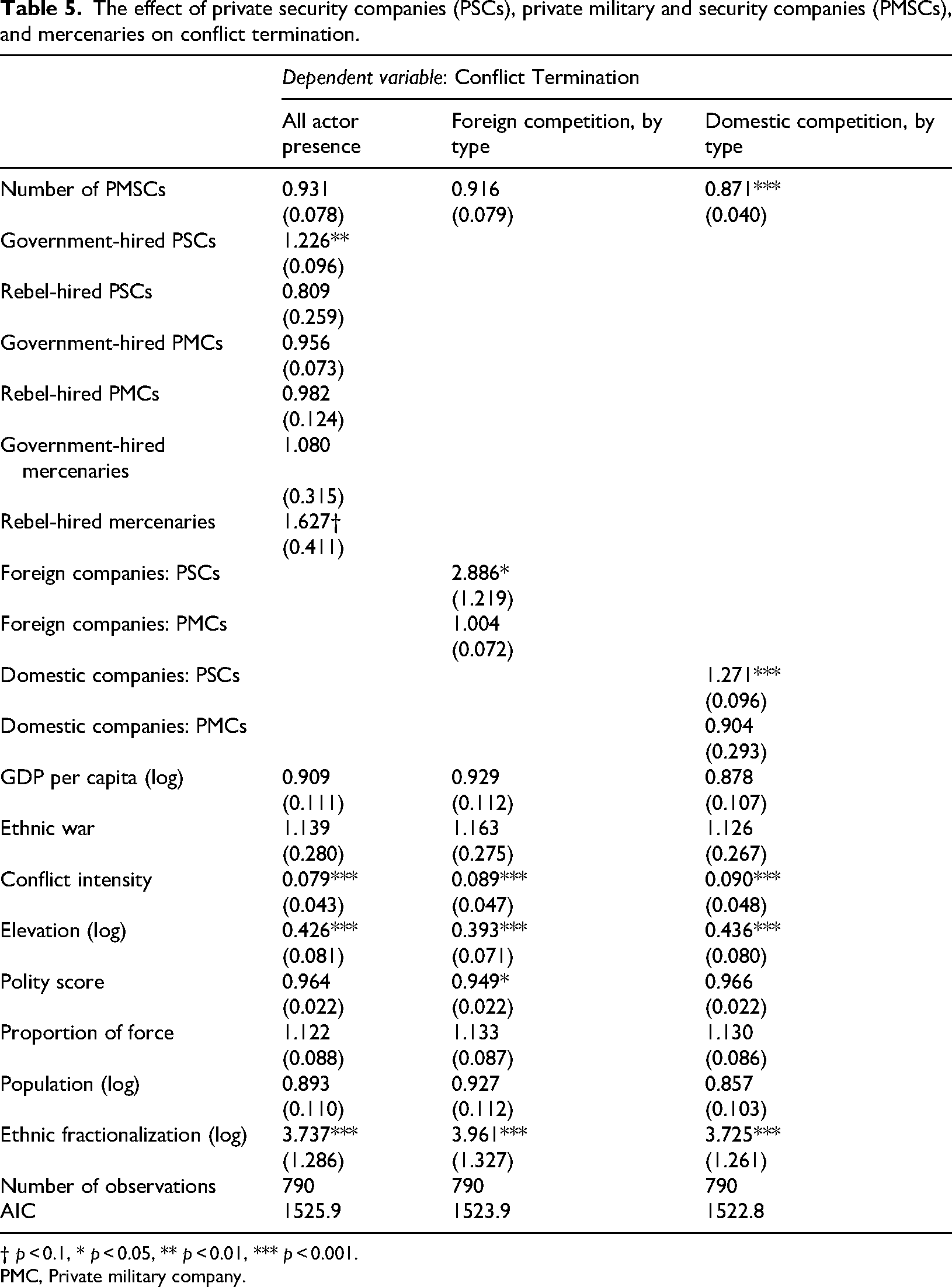
Table 5 presents a modified version of Petersohn et al. (2022) based on Table 3 in their paper. 13 In this reanalysis, I use the control variables and time-trend variables from Petersohn's original model, but split out the point estimates on PMSC competition into PMCs and PSCs per my conceptualization in the Section “Conceptualizing PMSCs.” 14
The effect of private security companies (PSCs), private military and security companies (PMSCs), and mercenaries on conflict termination.
† p < 0.1, * p < 0.05, ** p < 0.01, *** p < 0.001.
PMC, Private military company.
Across each of the models, Number of PMSCs captures the total number of PMSCs in a given conflict year. The first column contains information on the presence of different types of actor and their alignment with the state or opposition forces. The presence of government hired PSCs is associated with a 23% increase in the probability of conflict termination. There are no clear statistical relationships between the presence of government or rebel hired PMCs or mercenaries or rebel hired PSCs, and the inclusion of Petersohn et al.'s measure of mercenary activity remains directionally and statistically significant as before. First, these results broadly align with Petersohn et al.'s findings. Their suggestion is that the presence of rebel and government hired PMSCs has an overall negative effect on conflict termination. However, we can see that when we partition these actors, PMCs have negative (albeit not statistically significant) effects on conflict termination, while PSCs have positive effects on the probability of conflict termination.
Column 2 suggests competition among foreign PMCs have an ambiguous effect on conflict termination. This is in line with the quantitative literature on PMSCs and conflict termination, but adds more nuance as to the nature of the actors providing security: first, PSCs are more likely to operate domestically rather than internationally, which could explain the large but imprecise coefficient in Column 2. Second, because PMCs are more likely to operate internationally, countries experiencing a civil war may find themselves with multiple competing PMCs. Because these actors are often more diversified in terms of their operations and equipment, and are often better resourced, it is less clear whether they are more likely to be efficient in combat, pose a threat to the state at worst, or have incentives to act independently of the state and their objectives. 15
Lastly, Column 3 suggests that domestic competition (the number of domestic companies operating in a given conflict year observation) among PSCs increases the probability of conflict termination by 27%. But again, there is no clear relationship between conflict termination for PMCs. Taken together, the majority of effects identified in Petersohn et al.’s (2022) research are being driven by what are typically understood to be PSCs rather than PMCs or mercenaries. As we have discussed, PSCs are substantively different types of actor from PMCs and mercenaries, and this quantitative exercise uncovers the importance of treating them as such.
These results are striking: when we consider the characteristics of these actors (which have previously been treated as a single phenomenon), we see that they exert entirely different effects on conflict termination. The potentially negative effects of PMCs have been discussed in assessments of companies like Blackwater and the Wagner Group, but have until now not been tested quantitatively (Liu, 2015; Parens, 2022). While these types of PMSC are relatively rare, they represent a class of private security whose power and functional diversity could represent a threat to peace during civil wars.
Before concluding, it is worth addressing a few caveats with this analysis. First, these results could be driven by an imbalance in the number of recorded PMCs vs. PSCs. Applying our clustering logic to the actors listed in the AR dataset, there are 22 PMCs and 62 PSCs. However, this imbalance is not so extreme that it solely explains the point estimates in the models.
Second, although the inductive typology successfully demarcates defense contractors and mercenaries from PSCs, their relative infrequency in the data make it difficult to quantitatively identify their effects on conflict termination. Defense contractors operate in different ways from PMSCs. Existing studies identify corporate structure as a key driver of performance, but this does not isolate the specific effects that the presence of large defense firms may have in combat situations (Avant and Neu, 2019; Krahmann, 2010; Petersohn, 2024; Tkach, 2019).
Third, these models cannot uncover causality and may be prone to the confounding logic that the conflicts in which PSCs operate might be different from those where PMCs operate. However, these findings highlight the importance of treating PMSCs as comprising theoretically and conceptually distinct types of actors—ones which need to be understood and analyzed separately—and invite future work to implement instruments or other sources of exogenous variation to test PMSC dynamics (Kunkel and Ellis, 2026).
Discussion and conclusion
Using unsupervised machine learning approaches, I identify three latent clusters of PMSC. These clusters are based on a number of theoretically important variables collected as part of a data collection effort which sought to harmonize existing datasets on PMSCs. Reanalyzing existing work and controlling for the types of actors and the number of these actors in a given conflict, I find that an increase in the number of actors we typically understand to be PSCs increases the probability of conflict termination, while those we understand to be private militaries are associated with ambiguous to negative effects. Moreover, it is domestic competition among PSCs, rather than competition among PMCs or PMSCs more generally, which also appears to have positive implications for conflict termination. While these results could be driven by selection bias, these results highlight the importance of treating these security actors separately. If selection bias does play a role in determining which actors fight in which conflicts, then including all the actors in a single pooled model probably does not make theoretical sense. Future research should seek to understand under what circumstances states engage with which forms of PMSC.
This research has identified a possible limitation of existing quantitative work tending to treat PMSCs as a single phenomenon, and has argued for the use of unsupervised machine learning for developing typologies. Understanding the different services and domains in which PMSCs operate is essential for understanding why states choose to engage with these different actors, and, eventually, understanding what the differential consequences of these actors are. Unsupervised learning is useful for developing typologies from large datasets, and this approach is likely to work in a number of other contexts in political science (Ahram, 2011). Using clustering to analyze wide data on peace agreements (Bell and Badanjak, 2019) or state military equipment (Gannon, 2023), for example, could uncover patterns in these data that would allow for more nuanced conceptualization and theory building.
I believe a number of avenues of future research should be explored, both to address the limitations of this paper and to extend the study of PMSCs further. First, future research should collect more data on PMSCs and collect more information on their characteristics beyond just services and domains. Additionally, a wider variety of contexts (using natural experiments, lab-in-the-field, or survey experiments) should be analyzed in order to understand the substantive impacts of PMSCs, again conditional on actor type. New data types will allow for a variety of new methods to assess different outcomes, such as public attitudes toward privatized security, the host state, and the provider state. Similarly, more data will enable analysis of heterogeneous treatment effects. Akcinaroglu and Radziszewski (2020) find differential effects of PMSC competition by conflict intensity, but how does this then interact with PMSC type?
Second, future research should seek more broadly to integrate the existing literature on PMSCs—especially the large literature on PMSCs in the field of legal studies (Galai, 2019; Huskey, 2012; Liu, 2011)—with this new typology of PMSCs in mind. Aligning legal and empirical insights will focus empirical tests on academic- and policy-relevant distinctions, and will provide clearer guidance to academics and practitioners on where research gaps exist about how to contract, monitor, and mitigate risks from different types of PMSCs.
Third, and relatedly, although domestic regulation of PMSCs has improved over the last decades, our understanding of these actors is made more challenging when we cannot distinguish one type of PMSC from another. 16 Knowing along which dimensions we can partition private security allows for targeted and differential responses to their activities, including contracting, regulating, and sanctioning. A better understanding of the different types of PMSC that exist can also contribute to policy recommendations previously highlighted in the literature, such as ensuring competitive and transparent contracts that foster accountable performance by PMSCs and broadening the responsibilities assigned to PMSCs to enable effective responses in highly complex conflict settings (Akcinaroglu and Radziszewski, 2020, p. 173–76; Tkach, 2019, 2020).
In the context of downsizing standing armies and domestic security apparatuses, a rejection of foreign military and peacekeeping intervention, and the commodification of security, the privatization of security appears to be the logical response to these global patterns (Izadi and Pruett, 2025; Kim et al., 2026). This paper has identified different types of PMSC based on their specialization and diversity of services in order to both harmonize existing literature and highlight the importance of distinguishing between different types of actor and the promises and pitfalls they present to the states that engage with them. This agenda will only become more relevant as the number of private military and security companies proliferate over the coming decades.
In Ball and Price (2019), the authors pairwise-match death records from Guatemala's internal armed conflict from 1960 to 1996. They then infer the true number of causalities based on the proportion of names matched across each record.
For example, a PMSC named UPES—originally cited in Singer (2001)—has been repeatedly cited in subsequent papers as an organization operating in the Middle East and North Africa. The issue is that none of the papers have described any details about the organization beyond where it is reported to have operated. Having done some research, I have found that UPES stands for La Union de Periodistas y Escritores Saharauis (The Union of Sahrawi Journalists and Writers), a non-governmental organization which provides translation services for militaries and other governmental and non-governmental organizations.
Supplemental Material
sj-pdf-1-cmp-10.1177_07388942261457221 - Supplemental material for Conceptualizing private military and security companies
Supplemental material, sj-pdf-1-cmp-10.1177_07388942261457221 for Conceptualizing private military and security companies by Thomas Brailey in Conflict Management and Peace Science
Footnotes
Acknowledgements
I would like to thank Robin Harding and Stathis Kalyvas for their helpful guidance throughout the development of this paper. This work benefitted from audience feedback from various workshops at the University of Oxford, the Contentious Politics Workshop at the London School of Economics, MPSA 2024, and the PSA ECN 2023. Particular thanks go to Lily Harkes, Thomas Hazell, Angela Odermatt, and Lennard Metson, all of whom provided invaluable support, feedback, and guidance. Lastly, I am grateful to the reviewers’ and editor for their careful and constructive feedback. This research has been generously funded by the Clarendon Foundation and the ESRC Grand Union Doctoral Training Program. Replication materials can be found at  . All errors are my own.
Funding
The author received no financial support for the research, authorship, and/or publication of this article.
Declaration of conflicting interests
The author declared no potential conflicts of interest with respect to the research, authorship, and/or publication of this article.
Supplemental material
Supplemental material for this article is available online.
Notes
References
Supplementary Material
Please find the following supplemental material available below.
For Open Access articles published under a Creative Commons License, all supplemental material carries the same license as the article it is associated with.
For non-Open Access articles published, all supplemental material carries a non-exclusive license, and permission requests for re-use of supplemental material or any part of supplemental material shall be sent directly to the copyright owner as specified in the copyright notice associated with the article.
