







Abstract
How do citizens in pacifist democracies respond to military operations under exigency conditions? We examine this question based on a preregistered, real-time survey experiment we fielded in Japan during the August 2021 Self-Defense Forces (SDF) evacuation from Afghanistan. Building on research in international relations, we test whether Japanese citizens prioritize civilian control and how sensitive they are to military casualties. Our results challenge conventional assumptions. First, respondents did not differentially penalize an illegal mission ordered by a military commander (rather than an elected leader), despite the explicit legality cue. Second, while support declined sharply when SDF casualties were reported, nearly 30% of respondents still endorsed the operation. These findings complicate the common portrayal of Japanese public opinion as uniformly pacifist and suggest greater heterogeneity in attitudes toward military risk than conventional portrayals imply. The study contributes to scholarship on democratic accountability, civil–military relations, and public opinion in non-Western democracies under exigency.
Introduction
How do citizens evaluate military operations under time pressure and uncertainty? Research in international relations, much of it based on the United States, highlights two recurring dynamics in public opinion. First, citizens are expected to uphold the norm of civilian control over the military, expressing greater support for operations authorized by elected leaders than for those authorized by military commanders. Second, public backing for military action is often thought to be casualty sensitive, declining when operations result in the loss of soldiers’ lives.
However, it remains unclear whether these patterns generalize beyond conflict-prone states with extensive combat experience. Only a small number of conflict-prone states account for a disproportionate share of militarized disputes and wars, 1 while most democracies experience long periods without direct combat involvement. Do citizens in historically restrained democracies respond to security operations in similar ways? Or does a strong normative aversion to the use of force fundamentally reshape how civilian control and casualty costs are evaluated?
We examine these questions in the context of Japan. Postwar Japan exemplifies a “pacifist democracy” (Jakobsen et al., 2016): a democratic state in which constitutional or normative constraints substantially limit the use of force. Japanese pacifism has been a persistent, if evolving, element of national identity and public sentiment (Dower, 1999; Smith, 2019). This widespread aversion to the use of force, rooted in post-World War II reforms and education, has long shaped attitudes toward military engagement.
At the same time, Japan is not a sui generis anomaly. It maintains operationally capable Self-Defense Forces (SDF) and faces mounting regional security threats from China, North Korea, and Russia. 2 As host to the largest contingent of US military personnel outside the United States (Allen et al., 2020), and with strategically vital bases in Okinawa located less than 500 miles from Taiwan (Horiuchi and Tago, 2024), Japan would likely play a central role in a regional contingency. This dual position—as both a military hub and a potential frontline—brings the two theoretical dimensions into sharp focus: how SDF missions should be authorized and constrained by civilian leaders, and how tolerant citizens are of the human costs associated with overseas deployments.
Despite growing regional tensions, empirical research on Japanese attitudes toward overseas deployments remains limited. Japan's historically restrained use of the SDF in high-risk overseas missions has left few opportunities to observe public reactions under realistic security conditions. 3 Moreover, Japan's prewar militarism has contributed to a persistent cultural and institutional reluctance to engage in military-related research and public discussion on matters related to defense. 4 As a result, we know surprisingly little about whether the US-documented dynamics of civilian control and casualty sensitivity operate similarly in a pacifist democracy.
To evaluate these dynamics under conditions that approximate real-world decision-making, we leverage a rare empirical case of exigency: the evacuation from Afghanistan in August 2021. 5 We use the term “exigency” to distinguish a time-sensitive security situation from a full-scale crisis or wartime emergency. In contrast to existential crises involving large-scale combat, an exigency is an emergency in which specific national interests are acutely jeopardized, but the survival of the state is not directly at stake. Exigent situations nonetheless involve heightened uncertainty, legal constraints, and rapid decision-making by political and military authorities.
Announced on 23 August 2021, the mission unfolded amid suicide bombings near Kabul airport and strict constitutional constraints limiting SDF activities to “non-combat zones.” The SDF ultimately rescued only one Japanese national, and the mission's limited outcome generated domestic criticism. Therefore, the episode provides a rare window into how citizens evaluate military authority and the potential human costs during an unfolding security emergency.
At the height of this situation, we fielded a real-time survey experiment. Our design randomly varied (1) the authority ordering the mission (Prime Minister or SDF commander), (2) mission success, and (3) whether SDF personnel were killed. This design directly operationalizes the two theoretical dimensions—civilian control and casualty sensitivity. It therefore allows us to assess whether these well-established opinion dynamics extend to a historically pacifist context.
We uncover two notable findings. First, Japanese respondents do not consistently differentiate between civilian and military authority in their support for operations. Second, although casualty sensitivity exists, roughly 30% of respondents endorse risky operations even when SDF personnel are killed. Together, these results challenge the conventional view of Japan as uniformly pacifist and instead reveal substantial heterogeneity in attitudes toward military engagement under exigent conditions. 6
Theoretical expectations
Existing research on civilian control and casualty sensitivity derives largely from the United States and other Western democracies with active militaries. It remains unclear whether these findings generalize to pacifist democracies such as Japan, where constitutional constraints, limited combat experience, and strong anti-militarist norms shape public discourse. In this section, we develop theoretical expectations for how Japanese citizens may evaluate authority and casualties under conditions of exigency.
Civilian control and public support
Civilian control—the principle that military leaders should remain subordinate to elected civilian authorities—is a cornerstone of democratic governance (Desch, 2001; Feaver, 2005). Yet empirical studies suggest that public attitudes toward this principle are often inconsistent. In a series of experiments, Golby et al. (2018) find that Americans are more likely to oppose military interventions when senior military officials express dissent, but only marginally more supportive when those same leaders endorse action. Krebs et al. (2023) further show that a sizable portion of the US public supports allowing high-ranking officers to speak publicly on security matters and believes that the president should follow military recommendations.
Recent work by Shinomoto (2025) provides an important reference point by examining Japanese public attitudes toward military operations using survey data. The study finds that violations of civilian control by the SDF reduce Japanese public support for military action, and that backlash is stronger when disobedience involves excessive use of force rather than restraint. Building on this evidence, one plausible expectation is that, in a pacifist democracy with strong constitutional limits, citizens may be especially sensitive to violations of civilian control and therefore more supportive of operations authorized by elected leaders than by uniformed officers.
However, a competing mechanism may operate under conditions of exigency. In time-sensitive situations, the source of authority may serve as a cue for operational competence and necessity, leading citizens to rely less on constitutional hierarchy and more on perceived credibility. Public trust in the SDF has steadily increased, partly owing to its prominent role in disaster relief and peacekeeping, whereas trust in civilian political leaders fluctuates and is often comparatively low. 7 When citizens perceive uniformed officers as more credible or less politicized than elected leaders, they may be more supportive of high-risk military decisions initiated by the SDF than by an unpopular civilian executive.
Taken together, these competing considerations suggest that authority cues may operate differently under exigency. In a context where trust in the SDF is relatively high and evaluations of civilian leaders are often volatile, citizens may interpret military-initiated action as less politicized and more competence-driven.
Hypothesis 1 represents a context-dependent conjecture that departs from the conventional expectation of civilian primacy. It does not imply a general preference for military authority over civilian control, but instead reflects how authority cues may operate in a pacifist democracy under exigency. We test this expectation by introducing experimental variation in the source of authority during an unfolding policy episode, allowing us to isolate how authority cues function under exigency.
The vignette deliberately featured a legally controversial deployment, explicitly stating that it violated Japan's existing legal framework, thereby making the authority cue normatively consequential.
Casualty sensitivity and mission outcomes
A second major literature examines how public support for military operations responds to combat fatalities. Studies conducted primarily in the United States find that support declines as the number of casualties rises, although this effect is often moderated by expectations of success (Gelpi et al., 2005; Boettcher and Cobb, 2006). These findings suggest that citizens engage in cost–benefit reasoning, accepting casualties when the mission is perceived as likely to succeed. Whether such reasoning operates similarly in a historically casualty-averse context such as Japan remains an open question.
Japan is widely characterized as highly casualty averse, both in public discourse and legislative debate. Throughout the postwar period, the SDF has avoided combat fatalities, reinforcing the perception that any loss of life would be politically unacceptable. In Diet proceedings, some legislators have argued that even a single SDF fatality should trigger the resignation of the prime minister.
8
Given this history, we expect Japanese citizens to be particularly sensitive to military casualties:
We further examine whether casualty sensitivity is moderated by mission outcome. If Japanese citizens engage in similar cost–benefit reasoning to that observed in the United States, losses should be more tolerable when the mission is described as successful:
Research design
To test our hypotheses, we conducted a real-time survey experiment during Japan's military evacuation operation in Afghanistan in August 2021. 9 This high-salience event allowed us to assess Japanese public attitudes toward military risk and civilian control under exigent conditions.
The survey was administered via Lucid Marketplace on 31 August 2021. 10 We recruited 1848 respondents, using quotas to approximate national representativeness by age, gender, and region, although the sample is not probability-based. All participants provided informed consent and completed a standard attention check. To ensure common informational grounding, all respondents were shown a brief factual summary of the ongoing evacuation mission. This included factual information about the deteriorating security situation around Kabul airport.
After the background information, respondents were randomly assigned to one of eight hypothetical scenarios. Each scenario described a final attempt to evacuate civilians, ordered either by the Prime Minister or by an SDF commander. The experiment followed a 2 × 2 × 2 between-subjects factorial design, crossing three dimensions:
authority—who ordered the mission (Prime Minister vs. SDF commander); outcome—whether the mission succeeded or failed; and casualties—whether SDF personnel were killed.
Specifically, respondents read the following vignette:
11
[Prime Minister Suga/the commander of the SDF's Joint Task Force] gambled on one last chance to rescue the victims and sent troops from Islamabad to Kabul. Despite recognizing that doing so would violate the Law on Self-Defense Forces, he deployed 40 elite members of the Ground Self-Defense Force to escort five charter buses. The operation [was successful, and all five buses were/failed, and all but one could not be] safely escorted to the airport. There were [no/several] casualties among the SDF personnel involved in the mission.
After reading the vignette, respondents were asked: “Do you support or not support this operation?” Responses were recorded on a five-point Likert scale ranging from “Do not support” to “Support.” The effect of whether the Prime Minister ordered the mission or the SDF's Joint Task Force commander is used to test Hypothesis 1. The impact of SDF casualties is used to evaluate Hypothesis 2a. To test Hypothesis 2b, we include an interaction term between the casualty and success conditions. Treatment effects are estimated using ordinary least squares models with indicator variables for each treatment dimension. All regression models use robust standard errors to account for potential heteroskedasticity.
To assess treatment salience and comprehension, we included three post-treatment manipulation check questions probing recall of the scenario's key features. Manipulation checks suggest that the treatments were generally understood: 87.4% answered at least two of three recall items correctly (Online Appendix H). While we do not condition analyses on these checks to avoid post-treatment bias, they provide diagnostic information about attention and comprehension.
Results
This section presents the results of the survey experiment, beginning with tests of the civilian control hypothesis, followed by analyses of casualty sensitivity and its conditional effects. We report both descriptive comparisons and regression estimates of average treatment effects. Results from the manipulation checks and a comparison of our sample to national demographic benchmarks are provided in Online Appendix H.
Figure 1 displays the distribution of support for the operation, disaggregated by whether the mission was ordered by the Prime Minister or by the SDF commander. The distributions are nearly identical: 41.9% of respondents supported the mission when authorized by the Prime Minister, compared with 42.2% when ordered by the SDF commander.
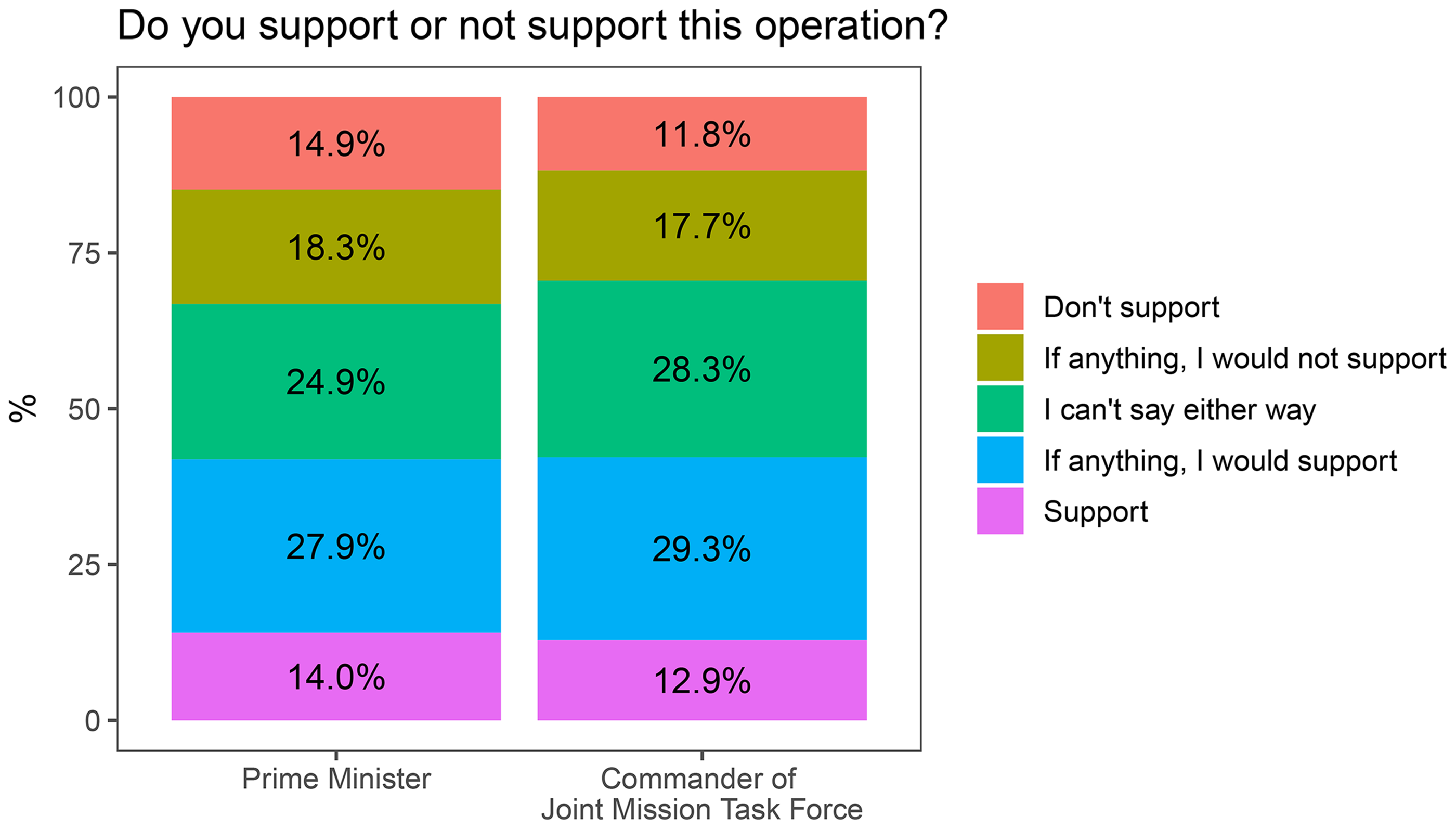
Support for the operation by whether the mission was ordered by the Prime Minister or by the Self-Defense Forces commander.
Regression analysis confirms the absence of a significant effect. In a linear model including all three treatment variables, the estimated coefficient for the “Commander” condition is 0.091 (see Table 1), with a standard error large enough to render the difference statistically insignificant at conventional levels. Thus, we find no evidence supporting Hypothesis 1. 12 This null finding is substantively notable. Although the vignette explicitly stated that the deployment violated existing legal constraints, a feature that might ordinarily be expected to activate civilian control norms, respondents did not significantly differentiate between civilian- and military-initiated authorization. As discussed below, this pattern may reflect limited salience of institutional distinctions under exigency or heterogeneous understandings of civilian–military authority, rather than a broader shift in democratic norms.
Effects of authority, mission outcome, and casualties on support for the evacuation operation
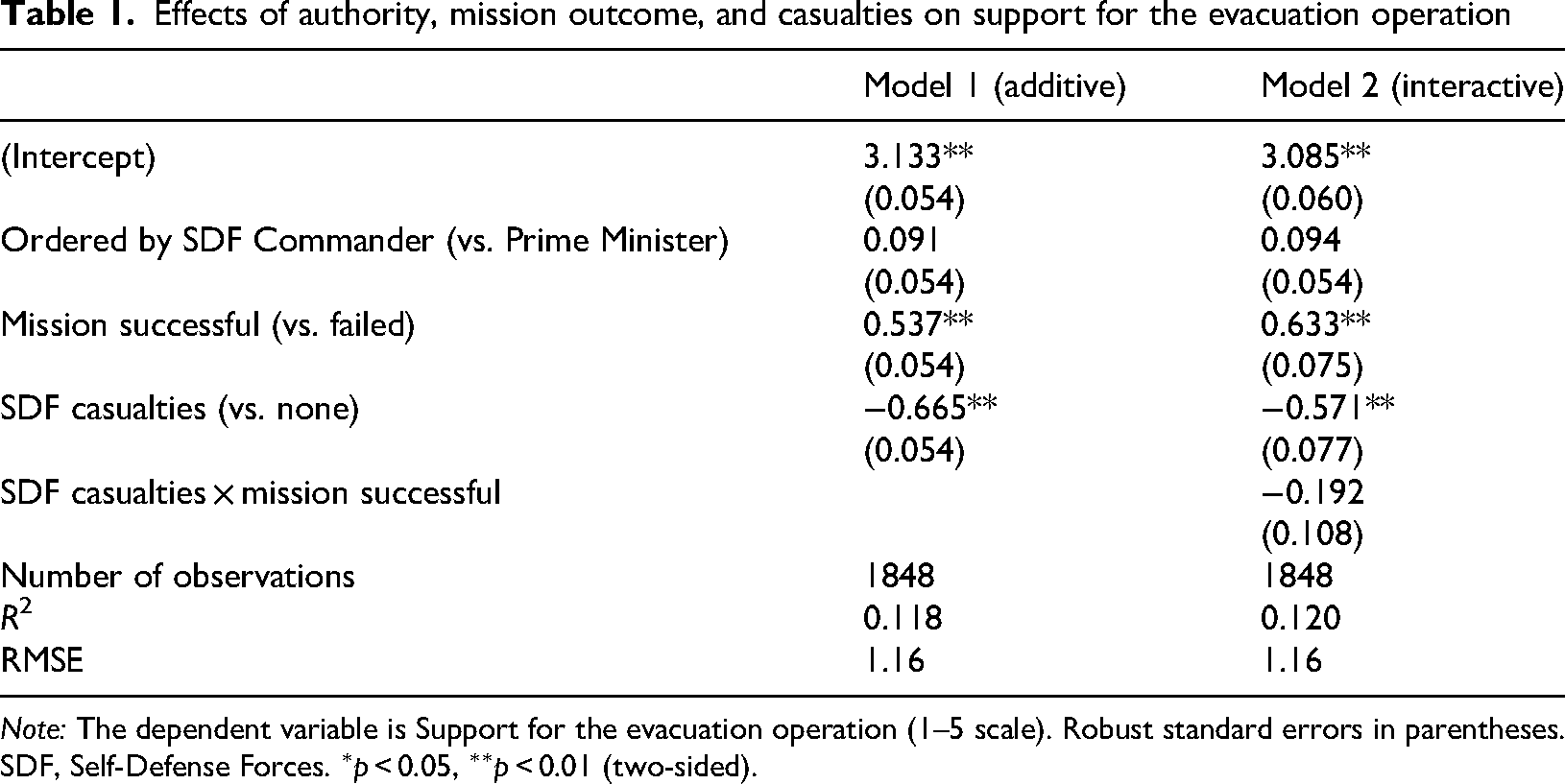
Note: The dependent variable is Support for the evacuation operation (1–5 scale). Robust standard errors in parentheses. SDF, Self-Defense Forces. ∗p < 0.05, ∗∗p < 0.01 (two-sided).
As shown in Figure 2, support declines sharply when casualties are reported (53.4 vs. 30.6%), a pattern confirmed by the regression estimates. The estimated coefficient for the casualty treatment in Model 1 is −0.665, a large and statistically significant effect.
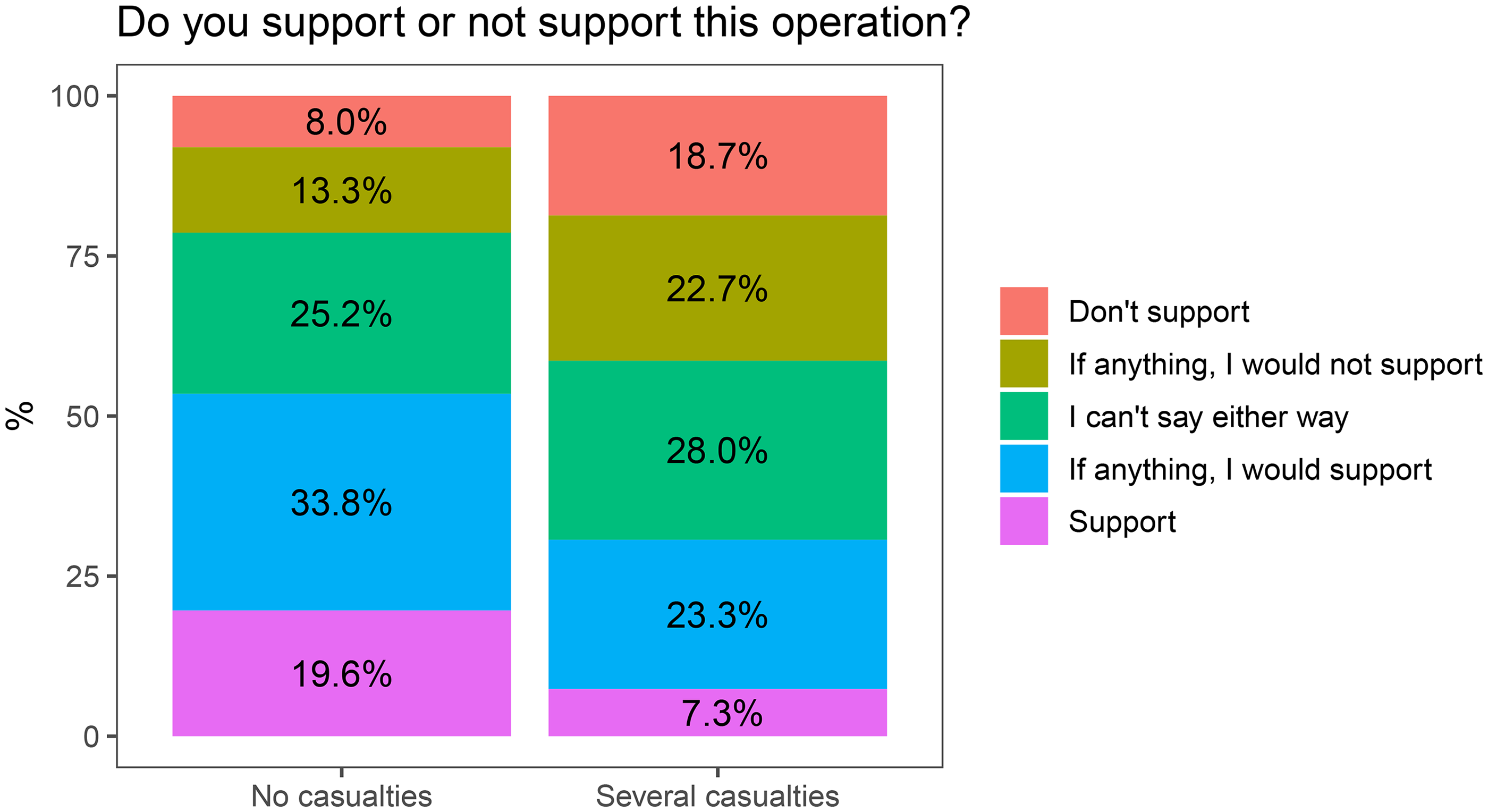
Support by casualty condition.
This provides strong support for Hypothesis 2a: Japanese respondents are considerably less supportive of risky overseas operations when informed of military fatalities.
Still, the finding that nearly one-third of respondents supported the mission despite casualties complicates conventional portrayals of Japan as uniformly casualty-averse. While support is lower than comparable US benchmarks (e.g. Lee, 2022), these results suggest that a non-negligible segment of the Japanese public is willing to tolerate operational risk under certain conditions.
Hypothesis 2b posited that the negative effect of casualties would be mitigated when the mission was described as successful. However, the estimated interaction term between casualty and mission success is −0.192 and statistically indistinguishable from zero. In other words, we find no evidence that mission success moderates casualty sensitivity. This finding is best interpreted as applying existing theories of casualty sensitivity (Gelpi et al., 2005, 2009) to a post hoc, exigency-based informational setting, rather than as contradicting prior findings. 13
Taken together, the results show that Japanese public opinion retains strong aversion to military casualties, but this aversion is not absolute. A meaningful share of respondents remained supportive of the mission even in scenarios involving operational failure and SDF fatalities.
Conclusion
Using a real-time survey experiment during the August 2021 evacuation from Afghanistan, we test two prominent hypotheses in the international relations literature—on civilian control and casualty sensitivity—in a non-US setting.
Our findings complicate prevailing assumptions about Japanese pacifism. While we find strong evidence of casualty sensitivity—support declines sharply when SDF fatalities are reported—roughly 30% of respondents still supported the operation despite these losses. This suggests that some segments of the Japanese public are willing to accept operational risk for strategic or humanitarian goals. Moreover, the negative effect of casualties was not attenuated when the mission was described as successful, a pattern that does not replicate the conditional moderation commonly observed in US-based research.
Equally notable, respondents did not penalize an illegal military action when it was ordered by an SDF commander rather than a civilian leader. This is particularly striking in a country where the constitution explicitly renounces war and legal constraints on military activity remain robust. However, additional research is needed to determine whether the absence of backlash against military-initiated action reflects shifts in democratic norms surrounding civilian control, limited public understanding of institutional distinctions, or context-specific evaluations of an unpopular civilian executive.
Because this study is based on a single experiment conducted in a real-time context, the null finding on civilian control should be interpreted with caution. In particular, the absence of a backlash against military-initiated action may reflect limited salience or variation in how respondents interpret institutional distinctions, rather than a broader shift in attitudes toward civilian supremacy. Additional experiments that vary the clarity, framing, and political context of civilian–military authority are needed to draw firmer conclusions.
Furthermore, our design does not vary the legality of orders, elite disagreement, or casualty magnitude, and therefore cannot speak to how these factors might condition public reactions. Examining such extensions is an important task for future work.
Because our analysis focuses on average treatment effects, we do not establish how responses vary across politically relevant subgroups such as partisanship, ideology or institutional trust; accordingly, we refrain from drawing strong conclusions about broader normative change in attitudes toward civilian control.
Our study still offers three key contributions. First, it provides additional empirical evidence on civil–military relations and public opinion in Japan, a core US ally whose defense posture is undergoing rapid and potentially historic transformation. Despite Japan's increasing involvement in regional security and the growing debate over constitutional revision, systematic research on how the Japanese public evaluates military decisions, especially under exigency conditions, remains limited. By analyzing responses to an overseas SDF deployment, our study sheds light on the underlying norms and tradeoffs that shape public support for military action in a legally and culturally constrained context.
Second, the study broadens the geographic and institutional scope of experimental research in international security, which remains heavily concentrated on the United States and a handful of Western democracies. Theories about casualty sensitivity, civilian control, and democratic responsiveness are often treated as generalizable, but they are rarely tested in countries with markedly different military institutions, pacifist traditions, and public experiences with war. By applying experimental methods in Japan—a country with a constitutionally limited military and a strong peace norm—we assess whether these theoretical expectations travel beyond the contexts in which they were developed.
Third, by fielding our experiment during an unfolding international exigency, we observe public reactions while the evacuation and its associated risks were salient. Although prior research has often been conducted alongside real-world conflicts, our design captures attitudes during a time-sensitive episode characterized by legal ambiguity and incomplete information. This context allows us to examine how authority and casualty cues operate when events are ongoing rather than retrospective.
These findings have meaningful policy implications. The Japanese public may be more internally divided over military risk than conventional portrayals suggest. As Japan increases its defense budget and expands its military role in the Indo-Pacific, political leaders must contend with a public that is more divided—perhaps more permissive—than previously recognized. Our results indicate that Japanese public opinion is more heterogeneous and more accepting of military risk than traditional representations suggest, consistent with the emergence of a Japan that is not uniformly pacifist. Although pacifist traditions persist, they may be more pronounced within specific subgroups, including women. 14 Japan's changing security stance, exemplified by the 2015 security law reform, is rooted in public support for military operations in the theater, marking a notable departure from the widely held view of Japan's postwar pacifism. Future research should continue to explore how these shifting attitudes intersect with democratic accountability, alliance politics, and trust in military institutions.
Footnotes
Acknowledgement
Earlier versions of this paper were presented in a seminar at Harvard University's Program on US–Japan Relations on 14 February 2022, at the 79th Annual Midwest Political Science Association Conference (Chicago, 7–10 April 2022), a seminar in the Department of Political Science at Yale University (5 December 2022), the Japanese Politics Online Seminar Series (15 December 2022) and a seminar at Waseda University (20 January 2023). We thank Takako Hikotani for numerous useful suggestions in the early stages of this project. We also thank Masataka Harada, Shoko Kohama, Jonathan Renshon, Jessica Weeks, and other participants of the seminars and the conference for their useful comments, and the United States–Japan Foundation for a research grant (No. 2019-1-18-U).

AI statement
We used ChatGPT 5.2, ChatGPT 5.5, and Writeful’s AI Assist solely for copyediting and language refinement. We also used OpenAI Codex GPT 5.5 (Extra High) to make a comprehensive replication package. It was not used for literature review, analysis, or drafting. This use complies with the journal's AI policy, and we take full responsibility for all content.
Funding
The authors disclosed receipt of the following financial support for the research, authorship, and/or publication of this article: This work was supported by the United States-Japan Foundation (grant number 2019-1-18-U).
Declaration of conflicting interests
The authors declared no potential conflicts of interest with respect to the research, authorship and/or publication of this article.