






Abstract
Governments challenged by insurgent groups use a variety of tactics during their fight. In addition to military strategies, governments use non-violent strategies aimed at influencing the course of the conflict and its outcome. An important conflict goal of a government is to increase defections from the rebel group to weaken that group's fighting and mobilization capacity. In this paper, we examine the government use of amnesty offers to accomplish this goal. We model the micro-mechanisms motivating rebel defections and show that amnesty offers can be used as a tool to facilitate desertions among rank-and-file challengers. We test the derived hypotheses from our model using data on amnesty processes implemented during armed conflicts between 1989 and 2011. We find that rank-and-file rebels are more likely to accept government amnesty offers when the rebel group is under threat and when the government can credibly threaten prosecutions.
In 2000 in the midst of the conflict against the Lord's Resistance Army (LRA), the Ugandan government offered a blanket amnesty to all members of the LRA on the condition that they renounce rebellion. The Museveni government justified this policy as a tactic aimed at achieving government victory (Loyle, 2016). The Amnesty Act resulted in over 13,000 rebel defections from the LRA, weakening the bargaining position of the group, and facilitating the negotiation of the 2006 Juba Peace Agreement. Yet not all amnesty offers are so successful. During the civil war in Guatemala, General Rios Montt offered an amnesty which was dismissed by rebel leaders as a “subversion” and a “farce” (Keesings, 1982b52; “Rebels,” 1982). Why do rebels accept some amnesty offers, but not others?
To date, most of the research into government and rebel behavior during armed conflict has focused on the violent tactics each group uses to pursue their warfighting aims (e.g. Bagozzi et al., 2017; Cohen and Nordås, 2015; Leiby, 2009; Sullivan, 2012; Valentino et al., 2004). 1 There are, however, a range of alternative, non-violent, strategies with which belligerents engage with the goal of directly impacting the outcome of the conflict. We focus on the use of amnesty offers during conflict as a government weapon of war adopted to incentivize defection and weaken the overall fighting capacity of a rebel group. 2
Amnesty refers to the legal or quasi-legal efforts by a government to overlook wrongdoings committed by individuals which would otherwise result in criminal prosecution. The literature on amnesty has focused almost exclusively on the use of these offers following armed conflict particularly as they relate to the maintenance of peace (e.g. Arnould, 2016; Dancy, 2018; Loyle and Appel, 2017; Melander, 2009; Snyder and Vinjamuri, 2003/4) and reconciliation within a country (e.g. Cobban, 2007; Mallinder 2008a, 2008b). 3 However, according to the During Conflict Justice dataset, governments made at least 405 amnesty offers to rebel groups in the midst of war between 1946 and 2011 (Loyle and Binningsbø, 2018). In this article, we argue that the strategic logic behind using amnesties during conflict probably differs from the logic of offering amnesty during peace negotiations or once violence has ended. Rather than a tool of concession and peacebuilding, an amnesty offered during armed conflict can best be understood as a tactic in fighting the war itself. Specifically, we argue that governments offer amnesty to rank-and-file rebels as a means of encouraging defection and weakening a group's ability to rebel—an essential step toward defeating the rebel group and achieving government victory (e.g. Toft, 2010; Wood, 2010). Incentivizing defection is a useful strategy for governments to pursue against threatening rebel groups as defections weaken the fighting capacity and mobilizing ability of its opponent (Toft, 2010). Amnesty offers are a valuable tool for governments striving to achieve these ends.
Yet amnesty offers are advantageous in this regard only if they are effective in encouraging rebels to leave their group. Of the 405 government amnesties only 49% were effective in encouraging rebel defections. There are conditions under which guarantees of amnesty could be seen as “phony bargaining,” making it unlikely that the policy will have its purported effect (Dancy, 2018: 339). Furthermore, amnesty offers are a potentially costly government signal capable of signaling weakness or dividing the government's domestic and international constituency (Daniels, 2021; Obayashi, 2017). For this reason, governments do not want to offer amnesties if they will not be taken up by the rebels. Given this tradeoff, it is important to understand the conditions under which rank-and-file rebels are most likely to accept amnesty offers during armed conflict.
Understanding the implementation of amnesty offers is important for our broader understanding of government and rebel interactions during conflict. Addressing the non-military policy options that governments employ in their attempts to sway conflict outcomes helps expand our knowledge of government motivations and tactical options during conflict. Understanding why rebels accept amnesty informs our knowledge of rebel recruitment and retention. Furthermore, our work advances our knowledge of the persistent “peace vs. justice” debate on the potential challenges and tradeoffs of adopting amnesty strategies rather than pursuing accountability for wartime wrongdoings.
Our article proceeds as follows. We begin with a discussion of the current work on the use of amnesty in the post-conflict period. Advancing work on rebel group incentives for accepting or rejecting amnesty offers (Dancy, 2018; Daniels, 2021; Obayashi, 2017), we develop a formal model that explores the individual calculus of a rank-and-file rebel when offered amnesty by the government. We argue that a rebel is more likely to accept a government amnesty offer and defect from the rebel group when the government can credibly offer individual security guarantees which outweigh the benefits of membership offered by the rebel group. We test the hypotheses derived from our model with data from the During Conflict Justice dataset and find that rank-and-file rebels are more likely to accept a government's amnesty offer when the rebel group is on the defensive and when the government can credibly threaten prosecution.
Amnesty, desertion, and rebel incentives
Amnesty has “traditionally been understood in a legal sense to denote efforts by governments to eliminate any record of crimes occurring by barring criminal prosecutions and/or civil suits” (Mallinder, 2008b: 132). Through her Amnesty Law database, Louise Mallinder (2008b) identifies several motivations behind the government use of amnesty, including addressing domestic political pressures, “promoting peace and reconciliation,” responding to international pressure, “adhering to cultural and religious traditions,” and “protecting state agents from prosecution” (133). This conventional approach to amnesty has led scholars to theorize the range of reasons a government may choose to adopt an amnesty process once conflict has ended, including to contribute to the duration of peace (Melander, 2009) and prevent spoilers from returning to conflict (Snyder and Vinjamuri, 2003/4).
The focus on post-conflict amnesty has produced comparatively less engagement with amnesties offered during armed conflict. Loyle and Binningsbø (2018) find that amnesty is a relatively common tool used by governments while violence is ongoing, documenting 442 amnesty offers initiated during armed conflict between 1946 and 2011, or the presence of amnesties in 48% of all armed conflicts in this period. Dancy (2018: 394) finds 61% of amnesties are offered while conflict is ongoing. These during-conflict amnesties result from different government strategies to those amnesties pursued as part of peace negotiations or offered once a conflict has ended. Reiter (2014: 147) categorizes amnesties during conflict into those intended to offer “carrots” to rebel groups incentivizing surrender, political gestures intended to lead to negotiations or peace talks, and self-amnesties used to protect state forces from future prosecution. 4 Daniels (2021) advances this carrot and stick approach, finding that amnesties are more likely to be offered when the tide has turned in the government's favor and the costs of offering an amnesty are lowered. In this way, amnesties offered during conflict are designed to impact the trajectory of the conflict rather than post-conflict peace (Dancy, 2018; Daniels, 2021; Reiter, 2014).
During-conflict amnesty offers can be included within the broader arsenal of strategies a government pursues with the aim of winning the war or achieving a favorable settlement. Encouraging defection can be an impactful tactic for governments interested in winning the war, and one toward which amnesty offers can contribute. Defection has a deleterious impact on rebel organizations and their fighting capacity (Gates, 2017; Oppenheim et al., 2015). The possibility of defection leads rebel groups to divert resources toward identifying and punishing would-be defectors and away from mobilization or warfighting efforts. Defectors can weaken a rebel group by sharing information with the government. Large-scale defection can also be a sign of group weakness, decreasing the capacity of the rebel group to continue to mobilize (Lyall, 2010; Nussio and Ugarriza, 2021). In this way, government strategies to encourage defection can be an effective mechanism through which to weaken rebel opposition.
Amnesty offers are a potentially useful strategy in this regard. For example, in 1979 during the war between the Iranian government and the Kurdish Democratic Party of Iran (KDPI), the Ayatollah Khomeini issued a pardon to all Kurds who “returned to the road of Islam” and surrendered their weapons (Keesings, 1980: 30303). By mid-October 1984, the government claimed that these operations in Kurdistan had been highly successful, leading to the surrender of a large number of Kurdish fighters, including some senior KDPI officials (Keesings, 1985: 33948). As another example, the strategy of amnesty to encourage desertion was particularly effective in the Philippines during the government's conflict with the New People's Army. In 1987, President Corazon Aquino offered amnesty to insurgents who surrendered within a 6 month timeframe. The amnesty offer was accompanied by a promise of job training and the buy-back of rebel firearms (“Philippines,” 1987). Within the first month of the program 2160 rebels had surrendered to the government (“Manila's Amnesty,” 1987). By the following year that number was close to 9000 of the estimated 24,000 rebel-strong New People's Army (BBC, 1988).
Yet offers of amnesty do not always have these desired effects. The amnesty offered to guerillas in Guatemala by the military junta of General Rios Montt was not considered effective. In 1982, the Guatemalan government declared a month-long amnesty for guerrillas and members of the security forces who had committed acts of “subversion” (Keesings, 1982: 31605). Yet dissident leader Luis Cardoza called the amnesty “a farce, a masquerade” and encouraged rebels to ignore the call (“Junta,” 1982). The amnesty was accompanied by a brutal scorched earth campaign against rural communities, further decreasing the credibility of the offer. Doubting the government's intentions and fearing for their own safety, rebels largely disregarded the amnesty offer, embarrassing the Montt government (“Rebels,” 1982). Amnesty is only a useful weapon for the government if the policy is successful in encouraging rebel defection. Given the potentially costly nature of amnesty offers, we would expect this strategy to be more likely when the government's likelihood of encouraging rebel defection is highest. We therefore model the conditions under which rank-and-file rebels are more likely to accept a government's offer of amnesty and defect from their group.
Rebel incentives to accept amnesty
While research on the strategic use of amnesties is often focused on the ability of governments to use these offers to insulate their own soldiers from prosecution (e.g. arguments within Dancy, 2018; Daniels, 2021; Snyder and Vinjamuri, 2003/4), we focus on those amnesties that pardon rank-and-file rebel combatants. Amnesties offered to rebels can be an effective weapon to weaken rebel resolve and encourage defection. In our framework, governments offer amnesty with this strategic objective.
Nevertheless, the amnesty strategy is only effective when an offer is accepted, and individual rebels agree to defect. Under conditions where amnesty is offered but rebels choose to remain in the rebel group, amnesty becomes a costly signal of government weakness or weakened resolve (Arnould, 2016, Daniels, 2021). The government may pay a reputation cost if it is perceived by domestic or international audiences as being too lenient toward the rebels by offering impunity over accountability (Daniels, 2021). A government could also pay a military cost if an amnesty is used by a rebel group as an opportunity to buy time and prepare for a new offensive (Obayashi, 2017). Given this trade off, amnesty is a weapon that a government must only wield when there is a high likelihood that individual rebels will accept the offer.
Amnesty is a tactic well suited for addressing the micro-level factors that encourage individuals to participate in rebellion (Daniels, 2020; Gates, 2017). On a micro-level, individuals make decisions about whether or not to participate (and continue to participate) in an armed challenge against the government (Gates, 2002, 2017; Humphreys and Weinstein, 2008; Oppenheim et al., 2015). Therefore, one way that a government can combat challengers is by adopting policies that explicitly seek to weaken individual motivations for participation in rebellion by either increasing individual rebel costs or decreasing individual rebel benefits. Governments may choose to adopt policies that increase the likelihood that an individual will defect from the rebel organization, ending their challenge to the government, and weakening the rebel group. While the defection of a limited number of individuals is unlikely to turn the tide of the civil war, large-scale defection can be particularly threatening to a rebel group that is already struggling with recruitment and limited resources (Gates, 2002; Lyall, 2010; Nussio and Ugarriza, 2021). For example, in 1970 the new regime of Quaoobs bin Said in Oman offered amnesty to rebels in the Popular Front for the Liberation of Oman and the Arabian Gulf. Defections resulting from this amnesty had a detrimental effect on the rebellion, causing the group to change its name and ultimately reduce its conflict aims (Buhaug, 2006). United States Colonel Robert Heinl declared the high number of solider desertions during the Vietnam War as a contributing factor to the collapse of the US Armed Forces’ offensive during that conflict (Heinl, 1971).
To understand the conditions under which an individual rebel is most likely to accept a government offer of amnesty and defect from his rebel group, we first model group retention with amnesty. We start with two actors, a rebel organization, and the government's army engaged in a military contest. Our model builds on Polo (1995), Gates (2002), and Buhaug et al. (2009). This part of our model follows from a general class of contest success functions first developed by Tullock (1980) and applied to conflict by Hirshleifer (1989, 2000), Skaperdas (1996), and others.
Our formal analysis differs from these previous works in several important ways. First, we feature the contested-policy space distance and not geographic distance. The previous works (especially Gates 2002 and Buhaug et al. 2009) focused heavily on the geographic aspects of war. Our model instead features organizational features, regarding the composition and ideological characteristics of the rebel group and the government's fighting forces. The mechanism linking “location” to recruiting and fighting strength is ideological/identity proximity rather than physical location. This is a substantive theoretical shift. Second, we explicitly formally analyze the conditions under which an amnesty offer would be made by the government and when it would be accepted. This has not been done before. By featuring amnesty offers, we move beyond the baseline participation constraints and incentives outlined in Gates (2002) and Buhaug et al. (2009). Third, Gates (2002) has no explicit government-side optimization over amnesty offers. Our model analyzes the conditions under which the government will make an amnesty offer. Fourth, our analysis furthermore sheds new light on the parameters affecting or affected by amnesty offers. We extend the participation constraint to include the option value of accepting government amnesty, with explicit expressions for the present value of remaining with the rebel army vs. accepting the amnesty. Fifth, our model examines rebel retaliation against deserters. Gates (2002) discusses enforcement but does not model the explicit post-desertion retaliation probability. We model explicitly the expected loss of being punished by former rebel comrades as a cost of accepting amnesty. We thereby substantially refine and extend our analysis beyond previous work and offer new insights. (The proof of the game in Appendix VI explicitly incorporates these changes.)
As applied to military conflict, the contest success function relates to the relative capabilities of two competing sides of a conflict, such that:

Military capability, K, depends on an unspecified combination of troop size, military budget, technological sophistication, organizational coherence of the group, etc. The formal characteristics Kr(·) (military capability) are expressed as:

By setting the respective capabilities of the rebel group and government against one another, the difference in their capabilities can be compared:

By rearranging the terms, putting the distance and military capability parameters together, the equation can be expressed in terms of the stochastic elements such that:

These stochastic parameters can be used to express the full equation utilizing a subclass of the contest success function, the logit success function (Hirshleifer, 1989, 2000).
5
This functional form allows us to emphasize the differences in capabilities between the two armies. The model also accounts for the stochastic nature of combat. The cumulative density function of the difference between the two stochastic elements, F(ηg
−
r) can be expressed as a logistic function:

The contest success function expressed in this logistic form allows us to directly account for the relative level of military effectiveness of a group by comparing the contested-policy distance between xr, xg, and xc. Specifically:

Our focus is on the conditions under which amnesty can promote defection. We thereby feature the decisions of individual rebels, specifically focusing on their compatibility constraint. This means that we feature the reservation “wage,” which induces the combatant to stay with the group rather than defecting. The fundamental decision will be the decision to leave or remain within the rebel group. We employ and extend a principal–agent model developed by Gates (2002). All rank-and-file members of the rebel group are referred to as agents for the rebel group. 6 The choices and preferences of a single agent with respect to the principal (the rebel group leadership) serve as the analytical focus. An agent, a, for each period chooses to remain a member of the rebel group, and by so doing receives in return benefits, ba ∈ [0, bmax] (meaning that benefits can vary anywhere between 0 and bmax, a maximum level of benefits associated with a particular task). All benefits are assumed to be net benefits, such that any costs of engaging in rebel activities are included. Benefits in our model can be both pecuniary and non-pecuniary. This means that in addition to material rewards, agents can derive the benefits of comradery by being part of a group and can gain functional preferences (Brehm and Gates, 1997) or what Wood (2003) refers to as the pleasures of agency, which means deriving benefits from performing a particular task itself (e.g. fighting the good fight). 7
We now move from the relationship between two actors and feature the payoffs to an individual in an environment of armed competition. We start with an agent who remains in the rebel group. The agent's compensation for remaining with the rebel group includes the discounted utility over time under threat of being killed by government troops or captured and prosecuted for his involvement, which can be expressed as:

where Va(Cr) constitutes the participation constraint under competition, which mandates a higher stream of benefits to compensate for the risk of being killed or captured by government forces, all other things being equal. The probability of protection offered by being part of the rebel army is represented by πr. If protected, the agent will survive and accrue the benefits of remaining in the group, Ua(br,t1) at time t1. The probability of the failure to protect the agent is represented by 1 − πr, which is associated with Va(Rg), which is the cost of being killed or captured by governmental forces, such that R(g) g ∈ [0,Rmax]. The denominator, 1 − δ·πr, constitutes the discounted values of the series of payoffs for remaining with the rebel group over time. 8
To maintain allegiance, the protection and benefits offered by the rebel leadership to individual rank-and-file members must outweigh the risk of being killed or prosecuted by government forces. If the government is able to offer a greater likelihood of protection and benefits, the rank-and-file rebel will be more likely to desert the rebel group. The decision of a rebel to accept an offer of amnesty from the government results in a payoff that may be obtained by modifying eqn (7), such that the present value of accepting an offer of amnesty with incentives becomes:

In such a situation, the amnesty-accepter would obtain benefits from the rebel organization in the first period, but in the second period would receive benefits from accepting the government's offer of amnesty. However, accepting amnesty from the government comes with potential costs. By accepting amnesty during conflict, a rebel will be put at risk by the rebel group. This equation takes into account the initial period of protection offered by being part of the rebel army (at t1), represented by πr. The second part of the equation incorporates the risk of being killed by his former rebel comrades, πrVa(Rr), as well as the benefits offered by the government's amnesty with incentives, Ua(bg,t2), and the government's security guarantees, 1 − πr (at t2). The third part of eqn (8) is the series of discounted payoffs once the agent has accepted the amnesty.
The critical value affecting the decision to accept amnesty with incentives occurs when V(Cr) a = V(A) a when br, t1 = bg, t2 = bmax. These reflect competing benefit structures of staying in the rebel organization vs. accepting the amnesty offer, whereby benefits are weighed against the severity and risk of punishment. In an environment of armed conflict, agents will choose the group that offers the highest utility. Rebel leadership therefore seeks to provide benefits to agents to offset the risk of engaging in conflict.
An agent can be induced to leave a rebel group through the offer of amnesty above the agent's reservation level. This can be seen, in eqn (9), through the comparison of the benefits from remaining within the group discounted over time from t1 as compared with the benefits of being in the rebel group at t1 and taking the offer made by the government in t2:

The government can increase defection incentives, b(A) g , to a level high enough to induce the agent to accept an amnesty offer, which means that the offer is better than the stream of benefits offered by the rebel group, br,t1, including t2 and all subsequent time periods that correspond to the government's amnesty offer. Consider the situation when the rebel group is weaker than the government. Under such conditions, the rebel group can offer the maximum set of benefits, br max (given its budget constraints), while the government's b(A) g,t2 is above br max (which means that the government has more to offer the agent). In such a situation, the government can offer a higher set of benefits, which in turn induces the agent to accept amnesty and desert from the rebel group to the government, since the rebel group cannot respond as it is already paying out at its maximum.
All benefits, in turn, depend on the probability of rebel or government victory, πr or πg. Even if the government amnesty offer is no better than what the rebels can offer, br,t1 = b(A)g,t2, the marginal utility of benefits from accepting the amnesty offer will be greater than that from remaining with the rebel organization, given that πg > πr, assuming πg > πa_min. The government will only be able to induce defection by those agents for whom πg is high enough to guarantee that the deserter will be able to reap the benefits associated with the amnesty offer. The probability of victory directly affects the chances of the agent's survival. 9
The implication of eqn (9) is that the incentive compatibility constraint requires a stronger military advantage (to ensure survival) if the rebel principal is to deter desertion made attractive by the government's offer of amnesty. The rebel group must offer a better chance of survival in comparison with not being affiliated with any military organization or with being affiliated with the government. Amnesty offers that overcome the protection provided by being a member of the rebel army, πr, are more likely to be accepted and will lead to defections among the rebel ranks. We would therefore expect that:
Furthermore, our model suggests that a rebel's decision to accept amnesty will be conditioned by the agent's benefit stream. Rebel groups unified around indivisible issues (in terms of ethnicity, religion, or ideology) will be better able to resist the overtures of the government (minimizing (xc – xr)
2
). In this case, the non-pecuniary benefits of the rebel group will outweigh the security benefits obtainable by the government's amnesty offer. If the rebel group's position in an issue space is close to the agent's ideal point, the agent will be unlikely to defect from the group. As the policy distance between the agent and the rebel principal increases and the policy distance between the agent and the government decreases, rebels are more likely to accept the government's amnesty offer. This leads to the hypothesis that individuals are less likely to accept a government's amnesty offer when an individual is receiving a high level of non-pecuniary benefits from participation in the rebel group. Moreover, rebel leaders may be able to offer pecuniary benefits to agents that outweigh the benefits provided by the government's amnesty offer. For example, a rebel leader may be able to offer agents direct material incentives in the form of lootable resources. Under these conditions rebel agents will be less likely to defect. This leads us to hypothesize that:
Research design
Our model allows us to theorize the conditions under which individuals are more or less likely to accept an amnesty offer. To test our hypotheses about these conditions, we turn to data from the During Conflict Justice (DCJ) dyadic dataset (Binningsbø and Loyle, 2022; Loyle and Binningsbø, 2018). This dataset covers all internal armed conflict dyads between 1946 and 2011, as defined by the Uppsala Conflict Data Program (UCDP) Dyadic Dataset version 1-2012 (Harbom et al., 2008; Themnér and Wallensteen, 2012) and includes information on judicial and quasi-judicial measures initiated to address wrongdoings while conflict is ongoing, including amnesty provisions. Whereas the DCJ dataset has unique observations for each specific amnesty process, we have re-constructed the dataset to conduct the analyses relevant here. Multiple amnesty observations in a dyad year are collapsed to allow for dyad years as the units of analysis. The dataset we use includes 1143 dyad years—271 dyads in 128 conflicts in 76 countries—between 1989 and 2011 (the time period included in our analyses).
Methods
To test our hypotheses about government use of amnesty as a weapon of war, we run logistic regressions with dyad year as the unit of analysis. To account for potential correlation in the error terms across observations within the same country, we cluster the standard errors by country. It is assumed that rebel acceptance of amnesty in a particular dyad year is independent across countries, but may be non-independent within countries.
Dependent variable
The dependent variable in our analyses is a binary variable indicating whether at least some rebels accepted a government-targeting-rebel (GR) rank-and-file amnesty. The GR amnesty implementation variable is coded as 1 if there is evidence that people were awarded amnesties, and 0 if there is no such evidence (Binningsbø and Loyle, 2022). The DCJ data distinguishes between amnesty offered by the government and those policies that were accepted by at least one member of the rebel cadre. This is an important distinction for our analysis because it allows us to (1) confirm that the government's offer of amnesty was viable and not simply rhetorical (in other words, it was a functioning policy) and (2) demonstrate that at least some members of the rebel rank-and-file believed the offer to be credible. 10 Among the 1143 dyad years in our dataset, 116 (10.2%) have at least one GR rank-and-file amnesty accepted (six of these years have more than one amnesty offer accepted); in the remaining 89.8%, the government was either unwilling to offer amnesty or did not make a credible amnesty offer.
Independent variables
Two factors are central when understanding when rebels are likely to accept an amnesty offer from the government and defect from the rebel group: the ability of the rebel group to ensure the survival of individual rebels (πr) and the utility of the benefits that the rebel group can provide to the agent (Ua(br)). The ability of a rebel group to protect its agents given the government's threat is closely associated with the survival of individual rebels. Thus, we use the estimated number of rebels killed by the government in a given year as a measure of πr. This variable, side B deaths, is from the UCDP Georeferenced Event dataset (GED) events data version 24_1 (Davies et al., 2024; Sundberg and Melander, 2013) and is the accumulated sum of deaths sustained by the rebel group, within the context of the government–rebel dyad, in one calendar year. The variable is transformed using the natural logarithm. Additionally, we assume that the risk of being prosecuted for rebel activity or group membership impacts an individual rebel's perception of protection by the rebel group and overall level of government threat. We thus use the annual count of trial processes targeting rebels (GR trials) as an alternative measure of πr. This variable is from the DCJ dataset (Loyle and Binningsbø, 2018) and includes all trials initiated by the government and targeting either rank-and-file or elite rebels. 11
To take into account the non-pecuniary benefits a rebel group is able to provide, Ua(br) or U(ba_max), and test Hypothesis 2a, we use the claim variable from the ACD2EPR dataset version 2014 (Wucherpfennig et al., 2012), measuring whether the rebel group fighting the government made an exclusive claim to do so on behalf of an ethnic group. The variable is dichotomous, taking the value 1 for rebel groups expressing direct or indirect ethnic claims and 0 if not. Exclusive ethnic claims presuppose the offer of a non-pecuniary benefit to an agent such that a government offer of amnesty should not be able to outweigh that benefit.
To measure pecuniary benefits (Hypothesis 2b), we construct a variable based on the Rebel Contraband Dataset (Walsh et al., 2018). This dataset catalogues rebel groups’ exploitation of natural resources. It includes information about four types of funding strategies (extortion, theft, booty futures, and smuggling) from 31 different resource categories and specifies if a rebel group earns more or less than US$5 million on the activity. We take advantage of the funding variable to create a binary variable with the value 1 for all dyad years in which a rebel group earned at least US$5 million from at least one type of resource exploitation strategy (22.4%) and 0 if not (77.6%). A measure of a rebel group's exploitation of natural resources captures the ability of a rebel group to offer additional pecuniary benefits to rank-and-file members, potentially beyond the benefits offered by a government amnesty offer. 12
Findings
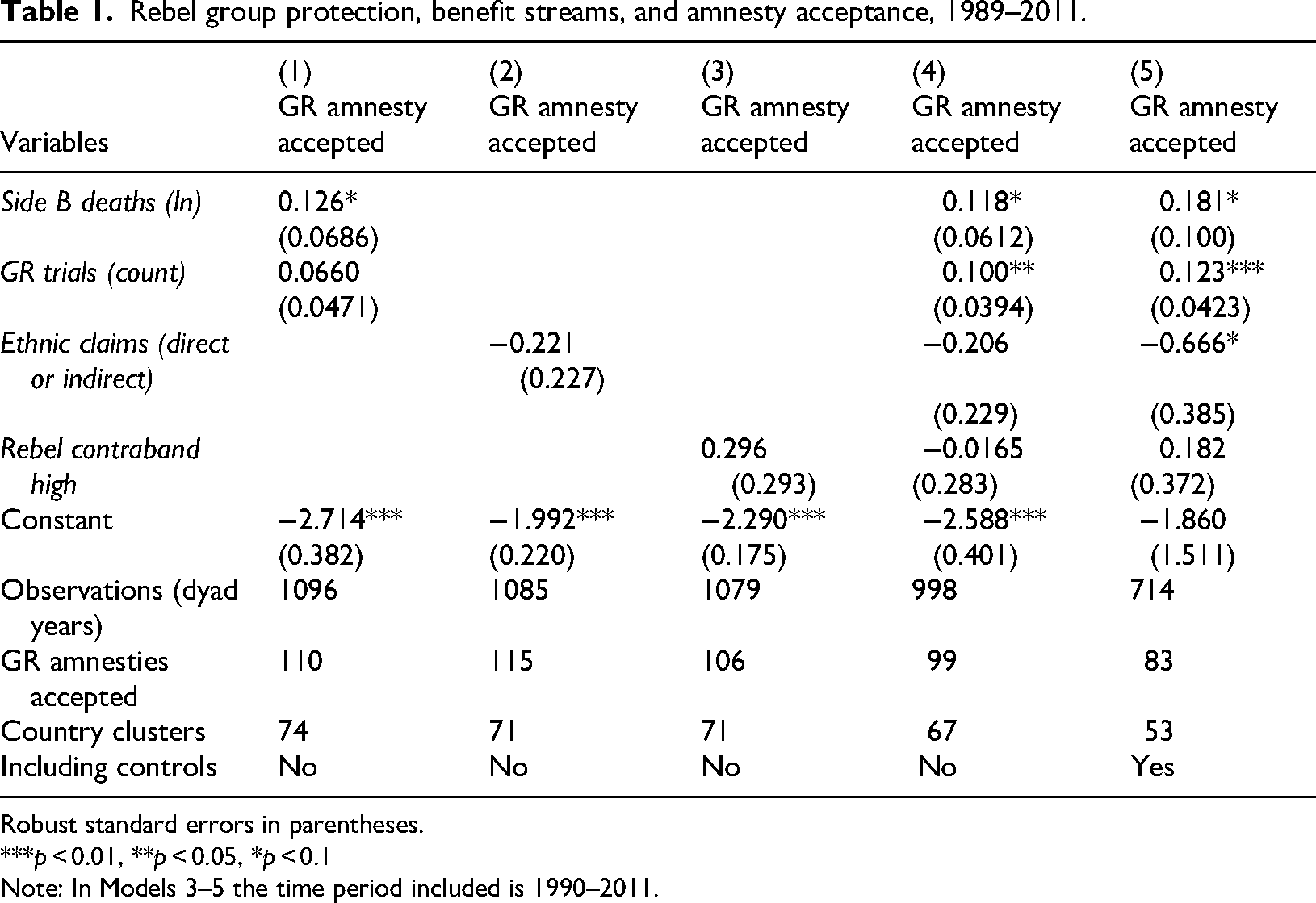
In this paper, we are interested in understanding the conditions under which individual rebels are most likely to accept an amnesty offer from the government and defect from the rebel group. We argue that these conditions include: (1) when a rebel group does not offer sufficient protection to overcome a government's threats; (2) when a rebel group does not offer a “higher good” (i.e. there is no unity in the rebel group around indivisible issues or ideologies); and (3) when a rebel group cannot offer substantial material benefits to its group members. In Table 1, we examine these relationships empirically. Models 1–3 investigate the hypothesized relationships separately. We expect that a rebel is more likely to accept an amnesty offer when the rebel group's ability to protect the individual is low—when the death toll among rebels is high and when rebels are being prosecuted for their acts of rebellion (Hypothesis H1). Our findings support this relationship. The side B deaths variable is positive, indicating that higher numbers of rebel deaths are associated with a higher likelihood of accepted amnesties among rank-and-file rebels (Model 1). A greater number of government legal trials targeting rebels in one year (GR trials), however, does not significantly impact the likelihood that amnesties are accepted (Model 1). Although the effects are not very strong, the findings indicate that rank-and-file rebels are more likely to accept an amnesty offer when under a real and credible threat.
Rebel group protection, benefit streams, and amnesty acceptance, 1989–2011.
Robust standard errors in parentheses.
***p < 0.01, **p < 0.05, *p < 0.1
Note: In Models 3–5 the time period included is 1990–2011.
In Models 2 and 3 we analyze how the benefit stream of the rebel group affects the likelihood of amnesty and defection. We anticipate that if a rebel group organizes around ideological claims (such as ethnicity), it will be more difficult for the government to shift rebel allegiance and promote defections, i.e. rebel acceptance of amnesty will be less likely (Hypothesis 2a). Furthermore, rebel groups who can offer pecuniary benefits to their members (such as resource payouts) may also be more successful at retaining their membership, reducing the likelihood that rebels accept an amnesty offer (Hypothesis 2b). Our findings, however, do not support these expectations. While our findings are in the hypothesized direction, neither the ideological (ethnic claims) nor the pecuniary (rebel contraband high) measures of rebel group benefits reach statistical significance. The benefit streams offered by the rebel group to its agents have no measurable influence on whether individual rebels accept amnesty. While the ability of a rebel group to provide benefits to its rank-and-file is negatively associated with rebels accepting a government amnesty, benefits do not provide the same motivation as a physical threat from the government. While it is possible that these benefits are important for rebel elites, rank-and-file rebels are primarily concerned with the protection offered by the rebel group.
In Models 4 and 5 we combine all independent variables in a multivariate analysis, including control variables in Model 5 (see Online Appendix II for the full model). In both models, side B deaths remain positive and weakly significant, while the positive effect of GR trials from Model 1 becomes significant. Additionally, the ethnic claims variable is negative and weakly significant in Model 5. While these changes may partly be explained by the reduced sample size, the findings add strength to our argument that rebels are more likely to accept a government's amnesty offer when they fear the rebel group is incapable of protecting them. If a rebel group is ideologically distant from the government, defecting from the rebel group and accepting the terms of the government's offer becomes less appealing. 13 Figure 1 shows the predicted probabilities that at least some rebels accept an amnesty offer given the number of rebel deaths and trial processes targeting rebels (using Model 5). 14
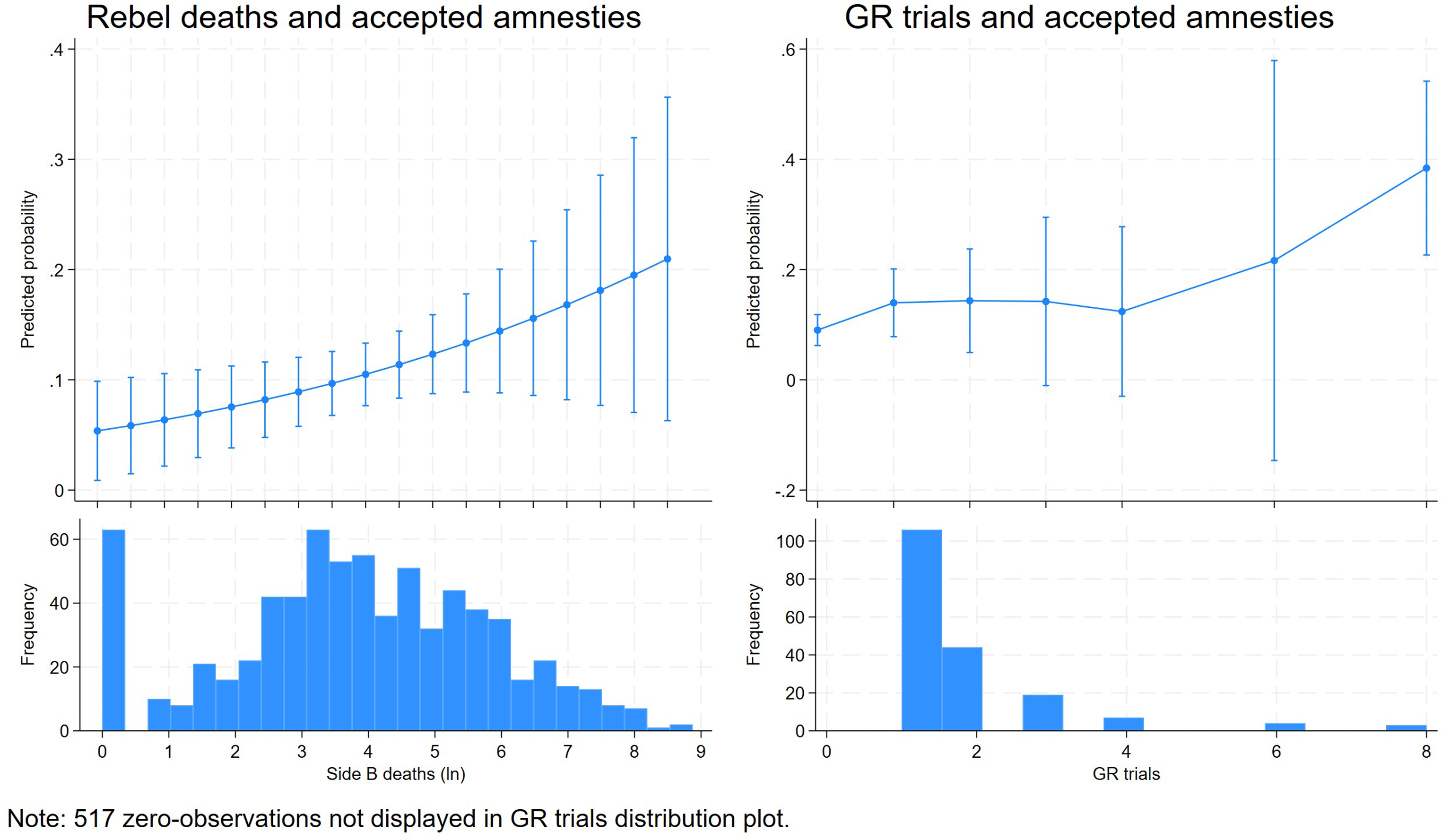
Predicted probability of accepting amnesty by rebel protection.
As the dependent variable does not distinguish between amnesties accepted by few or many, we exploit the amnesty scope variable in the DCJ dataset to test if our hypotheses are supported when considering the coverage of amnesty offers. The scope variable categorizes the targets of amnesty, separating between specific individuals, a named group, or a general group. Using the scope of the GR amnesties accepted as dependent variable in the models in Table 1 (see Online Appendix III) shows an even stronger positive effect of side B deaths and GR trials. 15 We also tested two alternative ways of measuring GR trials, one ordinal variable separating between 0, 1, 2, or more trial processes in a year and one continuous variable measuring the number of individual rebels on trial in a given year (using the trial scope count variable in the DCJ dataset). The findings resemble those in Table 1; the ordinal variable is positive and weakly significant with the reduced sample (when including control variables) and the continuous variable is positive and significant in all models, supporting H1 (see Online Appendix IV).
Summarizing Table 1 as well as the alternative operationalizations described above, a rebel's decision to defect or remain in a rebel group depends primarily on the ability of the rebel group to protect its rank-and-file from the government threat. When the risk of death or facing prosecution increases, the likelihood of a rank-and-file rebel accepting an amnesty offer also increases. Moreover, rebels’ decisions to accept amnesty are influenced by the rebel group's ability to provide non-pecuniary benefits through ideological (ethnic) comradeship, while pecuniary benefits do not play a role. Thus, our findings support Hypothesis 1 and Hypothesis 2a, but we do not find support for Hypothesis 2b.
Robustness checks and alternative specifications
We acknowledge that the empirical process of capturing individual incentives is challenging. Conflict studies, in general, lack strong and consistent measures of the concepts we theorize: individual rebels' perception of the group's protection and government threat and non-pecuniary and pecuniary benefits. The motivations for engaging in rebellion are vast (Gurr, 2015; Kalyvas, 2006; Lichbach, 1998). While we are confident that the measures we use are close approximations of our theoretical concepts of interest, we include a number of alternative proxies for our main variables to account for data limitations and test the robustness of our findings.
Hypothesis 1 suggests that the likelihood of rebels accepting an amnesty offer and defecting is influenced by the ability of a rebel group to ensure the survival of individual rebels (πr). Our findings support this expectation. As our first robustness test, we use a categorical variable from the Non-State Actor (NSA) dataset (Cunningham et al. 2009, 2013) to capture the military capability of the rebel group (rebel strength), assuming stronger rebel groups are better at protecting their members than weaker groups. We create a binary variable separating between rebel groups that are much weaker or weaker than the government (value 1) and groups that are at parity or stronger than the government (value 0). 16 Similar to our main analyses, we find that rank-and-file members of weaker rebel groups are more likely to accept amnesty offers than the rank-and-file from groups at parity or stronger than the government (Online Appendix V, Model 1). Another measure from the NSA dataset, whether a rebel group controls territory, does not significantly impact the likelihood of rebel acceptance of amnesty (Online Appendix V, Model 2). Although the NSA variables may change over time, rebel strength and territorial control rarely do, making these variables less suitable for capturing the dynamic interactions between governments and rebels that we are interested in testing.
Measuring non-pecuniary benefits is not straightforward. While we consider ethnic claims to be an important marker of non-pecuniary benefits, we observe that ideological and religious claims may also be strong and indivisible (Basedau et al., 2022; San-Akca, 2009, 2015, 2016). Therefore, we re-run Model 2 from Table 1 with alternative measures of non-pecuniary benefits. First, we use information from the orientation variable in the Dangerous Companions dataset (San-Akca, 2009, 2015, 2016) to construct three dichotomous variables measuring whether the rebel group fighting the government had an ethno-nationalist orientation (Online Appendix V, Model 3), leftist orientation (Online Appendix V, Model 4), or religious orientation (Online Appendix V, Model 5). 17 Neither of these variables yield any significant results. Second, we take advantage of Basedau et al.'s (2022) Rebels and Religion dataset to examine another way of measuring ideological and religious orientation of rebel groups. However, none of the variables we test—three binary measures of rebel groups’ theological claims (Online Appendix V, Model 6) and “other” claims (Online Appendix V, Model 7), as well as combining the two into ideological claims (Online Appendix V, Model 8)—produce significant effects on rebels’ likelihood of accepting a government's amnesty offer. Among the alternative indicators of non-pecuniary benefits we test, San-Akca's (2016) ethno-nationalist orientation variable comes closest to reaching a conventional level of significance and performs similar to the ethnic claims variable in Table 1. While mere speculation, it may be that the fluid nature of religion and ideology as identity markers provide weaker cohesion among rebels than ethnic kinship because they are often more difficult to physically determine.
As an alternative measure of material benefits from the rebel group we use a variable from Rustad and Binningsbø's (2012) natural resource conflict dataset that records whether natural resources provided income for the rebel group. The variable is dichotomous, with the value 1 for rebel groups extracting funding from natural resources and 0 for groups that do not. 18 This variable does not, however, have a significant impact on the likelihood that rank-and-file rebels accept an amnesty offer (Online Appendix V, Model 9). Likewise, controlling for whether rebel groups receive support from foreign governments, using data from the NSA dataset (Cunningham et al., 2009, 2013), does not yield significant effects (Online Appendix V, Model 10). Like the rebel contraband variable, these two variables serve as proxies for the rebel leadership having the resources to offer pecuniary benefits to rebel group members. One of the major limitations of these measures is that they cannot identify whether resourceful rebel groups actually provide individual rank-and-file members with more pecuniary benefits than those groups with less resources.
Rather than focus on the rebel groups’ ability to provide benefits (Ua(br)), we turn to additional benefits offered by governments. The DCJ dataset records whether there was a reparations program for rebels in a given year. This variable allows us to capture whether the government promised to provide defecting rebels with various types of support, for example cash payments or skills training and education. We find that benefits from the government have a strong and significant effect on rebel acceptance of GR amnesty (Online Appendix V, Model 11). If a government offers reparations to a rebel group in a given year, it is more likely that at least some rebels will accept an amnesty offer and defect. This finding suggests that governments are aware of the benefits calculation of individual rebels and have incentives to structure amnesty agreements to offset the benefits provided by rebel leaders.
We recognize that the theorized relationships are more complex than we have modelled. In particular, the causal relations may go both ways. It is possible that a successful amnesty resulting in large numbers of defectors may increase the number of remaining rebels being killed—as the rebel group is weakened and there are fewer rebel comrades to protect those who are left. 19 A similar relationship is seen in Binningsbø and Nordås’ (2022) study of impunity and sexual violence, in which more amnesties toward rebels are correlated with a higher prevalence of sexual violence during an armed conflict. Obviously, interactions between governments and rebel groups are dynamic, and one actor’s actions impact the other one's actions—repeatedly and reciprocally. Nonetheless, case evidence from Uganda, Iran, the Philippines, and other conflicts profiled in this study, demonstrate that often it is the weakness of the rebel group vis-a-vis the government that prompts individual rank-and-file rebels to choose to abandon their posts and accept a government's amnesty offer. In Iran, for example, the Ayatollah Khomeini's amnesty offer to KDPI secessionist fighters was accompanied by threats that those who did not accept the offer would be severely punished. These threats were accompanied by photographs in the national newspaper of Kurdish fighters being executed by firing squad. This was a credible threat as the Revolutionary Guard had already begun a “mopping up” operation into Kurdish regions (Reuters, 1979). Moreover, amnesties are more likely to be offered, as well as accepted, the longer conflicts have lasted, indicating that rebel groups have been both fatally targeted and weakened prior to individual rebels’ amnesty acceptance and defection. The amnesty in the Philippines, for example, was offered by President Corazon Aquino after 18 years of fighting.
Conclusion
In this article we argue that governments use amnesty as a weapon of war designed to weaken the micro-level motivations for individual rank-and-file rebels to continue to fight for a rebel group. Rather than focus on the peacebuilding potentials of amnesty, governments instead exploit the ability of these policies to weaken rebel resolve and increase the likelihood of government victory through encouraging defections. Our formal model features the ideological/identity space of the organization and amnesty as a government policy designed to encourage desertion. In our model, we demonstrate that amnesty can in fact be an important tool for a government interested in achieving these aims. Under certain conditions, offers of amnesty increase the likelihood that individual rank-and-file rebels will defect from the rebel group and given these conditions governments have an incentive to offer amnesty during conflict. Specifically, we find that amnesties most probably encourage defections when the government poses a strong and credible threat to the rebel group (Hypothesis 1). Under these conditions individual rebels may choose to accept a government's amnesty offer in order to increase their own personal security, increasing rebel defections and making an offer of amnesty more beneficial to the government. On the contrary, rebels may be less likely to accept amnesty when the rebel group can provide ideological cohesiveness and non-pecuniary benefits to its members. 20 While these effects are not as strong, and only weakly significant when we look at ethnic comradeship within the rebel group (compared to other ideologies or religiosity), it supports the expectations from Hypothesis 2a that amnesty acceptance is less likely when rebels are unified around indivisible issues or ideologies. Pecuniary benefits do not play a similar role (rejecting Hypothesis 2b).
Empirically capturing individual incentives and benefit streams is challenging across the literature. This is true also for our analysis. As our robustness checks illustrate, even if our measures are not ideal, alternative measures do not perform better. Thus, we may over-emphasize the importance of non-pecuniary and, in particular, pecuniary benefits when theorizing individual rebels' decision-making regarding amnesty acceptance and defection. On the other hand, while our analysis has focused on the micro-motivations of amnesty acceptance through engaging specifically with government amnesty offers to rank-and-file rebel group members, it is likely that rebel leaders have a different calculus. Perhaps it is in this group that we would be more likely to see the impact of benefit streams on amnesty acceptance as leaders may have a higher likelihood of both benefiting directly from rebel resources and taking advantage of government benefits through governmental posts or directed financial incentives. In other words, while we model the calculus of rank-and-file rebels, the benefit streams of rebel leaders probably differ.
Examining the use of amnesty offers in civil war is an important step toward understanding government behavior during armed conflict. Moving away from a focus on the violent strategies that governments employ during war, work on judicial and quasi-judicial strategies showcases the range of weapons at a government's disposal. This analysis also offers greater depth to our knowledge of the use and misuse of amnesties. While generally analyzed as a post-conflict process, almost half of all armed conflicts in the last 60 years have included at least one government amnesty offer (Loyle and Binningsbø, 2018). Our work therefore contributes to a greater understanding of the peace vs. justice debate in the international law and conflict literatures through outlining the conditions under which amnesties are most common, as well as the conditions under which amnesties are most likely to impact the tide of the conflict itself.
Supplemental Material
sj-docx-1-cmp-10.1177_07388942261465043 - Supplemental material for Amnesty as a weapon of war: Incentivizing rebel defection during armed conflict
Supplemental material, sj-docx-1-cmp-10.1177_07388942261465043 for Amnesty as a weapon of war: Incentivizing rebel defection during armed conflict by Cyanne E Loyle, Helga Malmin Binningsbø and Scott Gates in Conflict Management and Peace Science
Supplemental Material
sj-dta-2-cmp-10.1177_07388942261465043 - Supplemental material for Amnesty as a weapon of war: Incentivizing rebel defection during armed conflict
Supplemental material, sj-dta-2-cmp-10.1177_07388942261465043 for Amnesty as a weapon of war: Incentivizing rebel defection during armed conflict by Cyanne E Loyle, Helga Malmin Binningsbø and Scott Gates in Conflict Management and Peace Science
Supplemental Material
sj-do-3-cmp-10.1177_07388942261465043 - Supplemental material for Amnesty as a weapon of war: Incentivizing rebel defection during armed conflict
Supplemental material, sj-do-3-cmp-10.1177_07388942261465043 for Amnesty as a weapon of war: Incentivizing rebel defection during armed conflict by Cyanne E Loyle, Helga Malmin Binningsbø and Scott Gates in Conflict Management and Peace Science
Footnotes

Funding
The authors received no financial support for the research, authorship and/or publication of this article.
Declaration of conflicting interests
The authors declared no potential conflicts of interest with respect to the research, authorship and/or publication of this article.
Supplemental material
Supplemental material for this article is available online.
Notes
References
Supplementary Material
Please find the following supplemental material available below.
For Open Access articles published under a Creative Commons License, all supplemental material carries the same license as the article it is associated with.
For non-Open Access articles published, all supplemental material carries a non-exclusive license, and permission requests for re-use of supplemental material or any part of supplemental material shall be sent directly to the copyright owner as specified in the copyright notice associated with the article.
