







Abstract
Planning needs more diversity if it is to have legitimacy. Diversity can be achieved through more diverse faculty and students who become practitioners, and by increased scholarship that addresses diversity. In this essay, we examine the trends in scholarship about diversity in planning and the barriers to increasing faculty and students of color in planning schools, and we propose ways to move forward. We conclude that planning must increase the number of faculty of color in tenured and tenure-track positions and enhance the ability of planning programs to adequately address issues of race and gender to balance the power relations within the academy.
Introduction
During the past several decades, planning scholars have attempted to understand how diversity contributes to the effectiveness of planning and planning thought. They have explored questions such as, What is diversity? Is diversity desirable? How is it important to planning education and practice? How can diversity be promoted? Furthermore, how can diversity be obtained and maintained? In this essay, we focus on the last question by reviewing the planning literature and examining data regarding master’s and PhD graduates in planning. While there is still much debate over the meaning, desirability, and ways of attaining diversity, there is less discussion or action about how to create a campus climate and learning contexts that support diversity (Evans and Chun 2007). We are interested in exploring the diversity of the professorate within planning schools and the current ability of planning programs to address issues of race and gender (and their nexus) so that power structures within the planning academy might be more equitable.
Ongoing structural problems within campus climates have created a working and learning environment containing both overt and covert discrimination, culminating in an antidiversity milieu that, in turn, contributes to a low rate of recruitment and retention of faculty and students of color (Wubneh 2009). We may have never fully understood, and certainly do not fully understand now, how students of color or women choose to enter the field of planning. It is apparent, however, that the number of minority and women students in planning is relatively low compared to the student population as a whole (Forsyth 1995; Wubneh 2009). To mitigate this scenario, it is possible for the profession to fall into what Ann Forsyth (1995) calls an add-x-and-stir scenario, which pursues diversity for diversity’s sake without much critical thought given to, for example, sustaining diversity.
The lack of racial and other kinds of diversity in planning departments is, as in most disciplines, a multilayered issue. There are issues of conflicting levels of support for diversity initiatives among individual departments, colleges, and campuses. Individual faculty can, both negatively or positively, influence the experience of students and faculty of color. And the larger social, political, and economic contexts can also affect the experience of faculty of color. The anti-immigrant climate in the United States and the resulting anti-immigrant policies have negatively affected Latino students and faculty in higher education (Chacón 2008). For example, in the wake of raids, schools have seen a drop in Latinos/Latinas attending school (Thronson 2008). Additionally, retaining underrepresented faculty is influenced by national academic cultures in which publishing among senior faculty (who, in planning, are mostly white males) is still driven by the “old boys” network. Another disturbing trend documented by a 2006 study found that most newly hired underrepresented faculty in California were merely replacing other underrepresented faculty who had left the institutions, signaling a problem with retention (Moreno et al. 2006).
In planning, achieving diversity is important because it facilitates better educational development; that is, more racially diverse campus communities “tend to create more richly varied education experiences that help students learn and prepare them better for participation in a democratic society” (Chang, Denson, and Saens 2006, 431). Besides the positive impact of diversity, there is a strong correlation between the presence of faculty of color and the successful recruitment of both student and junior faculty of color (Jayakumar, Howard, and Allen, 2009, 538). Without diversity, planners lack legitimacy in the communities where they work (Sandercock 1998).
We frame our assessment and experience on the issues of achieving and maintaining diversity within the planning education and the professorate by reviewing the ways in which diversity has been addressed in planning scholarship. We also show how they parallel the rise and fall in the enrollment of women and minorities in graduate planning programs. Finally, we present a set of theoretical questions to guide the field in exploring how the diversity of its faculty and student bodies might be increased in the coming decades. We argue that diversity is critically important not only for planning departments and curriculum but also for planning theory to advance so that the field of planning becomes more effective and legitimate in an increasingly diversifying world.
Scholarship on Diversity in Planning: Where We Have Been
In planning, there are many places where racism and the negations/erasure of difference have been perpetuated but also challenged. In 1992 new guidelines were developed for the accreditation of planning schools, to include language such as “planning programs must have plans to move toward greater racial, ethnic, and gender diversity—including but not limited to—course content” (Looye and Sesay 1998, 162). This language of diversity and equity, as limited as it was, was removed from the accreditation guidelines draft revisions in 2006, replaced in the final version by language that said the curriculum should “attend to the diversity of individual and community values” (Planning Accreditation Board 2006, 14).
An additional indicator of diversity is the kinds of articles that are published in planning journals. The number of articles in the two main planning journals, the Journal of the American Planning Association and the Journal of Planning Education and Research, that specifically address issues of diversity fall into four main areas: (1) the importance of race and gender in planning practice (Ross 1990; Hill 1990; Leavitt 1983; Mier 1994; Grigsby III 1994); (2) visions for diversity in planning (Thomas 1996); (3) pedagogical and curriculum suggestions for improving diversity in planning (Ritzdorf 1993; Forsyth 1995; Looye and Sesay 1998); and (4) larger structural issues in academia affecting diversity for planning (Cordova 1997).
Scholarship on race and gender in planning started appearing in the 1970s and 1980s, but it was not until the early 1990s when there was a solid emphasis on the challenges of diversity in the education, practices, and makeup of planning students and educators. Ross (1990) laid out an agenda that targeted both recruitment and retention of minority and female students and faculty. She suggested 10 techniques and recommendations that “should help insure greater diversity in planning schools,” which encompassed financial and other assistance at the individual level, networks and other ways to identify and recruit talented students, and assistance from the Association of Collegiate Schools of Planning (ACSP) in attracting women and people of color from markets with traditionally high numbers of women and minorities (Ross 1990, 137). Hill (1990) encouraged a joint effort by planning schools to recruit, train, and hire minority faculty based on the assumption that there were not enough minority faculty to go around. Leavitt (1983) said that since the 1970s, “advocates for women’s issues have been tugging at the edges of planning practice and education” (55). Child care and the lack of it, she stated, were issues that make women’s entry into the field even more difficult than minorities (55). Having been the director of economic development during the Harold Washington administration in Chicago, Mier (1994) recommended that race be a starting point for most planning issues in urban areas, and others questioned the possibility of race-neutral planning (Grigsby III 1994). While some of the assumptions in the early theoretical and practical discussions about planning and diversity need to be updated, they set the groundwork for change.
Thomas’s (1996) vision of diversity in planning—“unified diversity for social action”—was important for advancing our conceptions about why we need diversity, and it represents the second group of planning scholarship on diversity that promotes the “it’s the right thing to do” philosophy. Promoting diversity was the right thing to do and good for business; it is also essential to advancing planning scholarship and knowledge base. According to Thomas (1996, 174), “knowledge is not really objective or academically neutral, instead it reflects assumptions, biases and culture of those who create it.” It is not just about getting beyond the rational planning model or “disjointed pluralism,” but it is also about getting to a third state where planning programs are “visionary,” with diverse faculty and student bodies, administrations that support such diversity, academic environments that promote diverse learning, and curriculums that reflect multicultural knowledge (Thomas 1996, 177). Sadly, only three authors have cited this work, none has taken on the task of expanding on it, and we have not found evidence that any department has implemented it in full.
We suggest here that progress has not been made on this for many reasons, including the interaction between the master narrative and counter narrative in the planning canon and journal review process (Stanley 2007). Stanley wrote, “A master narrative is a script that specifies and controls how some social processes are carried out. Furthermore, there is a master narrative operating in academia that often defines and limits what is valued as scholarship and who is entitled to create scholarship” (14). Faculty who conduct research that challenges the position of dominant groups or their ability to affirm social processes that define what planning scholarship is can be denied opportunities to publish their work, ultimately get promoted, and conduct further research. The master narrative carries over into pedagogy as well.
Pedagogy and curriculum is the third area of planning scholarship on diversity. Several authors have focused on developing pedagogy that reflects multicultural knowledge. Ritzdorf (1993) advocated alternative ways to teach, using, for example, nontraditional writing assignments. She suggested, for instance, that people use the fairy-tale structure as a way to write about planning; e.g., “Once upon a time there was a . . .” Sweet (2006) has written about how women, particularly women of color, have developed “Grrrilla research” and teaching techniques that take place in kitchens and community organizations, away from the framework of classrooms and traditional funding streams. Some authors have developed guidelines for changing curriculum to include more diversity (Forsyth 1995; Looye and Sesay 1998). One article described the hand-holding process a planning department could use to encourage planning professors to include diversity in their syllabi (Looye and Sesay 1998). The article suggested that one should
meet with the faculty members and ask whether diversity issues are currently being addressed in the course. (Be prepared to keep defining diversity as most faculty members think they already cover this, even though their syllabi and assigned reading tell a different story.) (Looye and Sesay 1998, 163)
While the authors’ suggestions on how to include diversity in the curriculum should be applauded, they neither define diversity nor really discuss changing planning “culture,” which, as noted in their article, is a tradition rife with inequality and “implicated in the uneven development of privilege and oppression.” (Looye and Sesay 1998, 162).
Women and people of color being on the front lines of diversity pedagogy and curriculum has its drawbacks. As teachers of diversity, they often risk becoming targets if they highlight issues of diversity. Knight (2003), in reviewing Women Faculty of Color in the White Classroom, noted that several contributors suggest that “student evaluations tend to be extremely positive or negative, displaying overt and covert statements of racism, sexism, xenophobia, or linguicism (discrimination based on language differences).” The authors argued that the multiple social identities and pedagogical practices of women faculty of color, and the impact that these factors have on evaluations, must be taken into account to understand why they often have teaching proficiency scores below departmental norms.
Structural impediments to diversity constitute the fourth area of concern to planning scholars writing about diversity. Cordova (1997) described uses of the metaphor of colonization to understand relationships in academia and how they keep women and people of color—especially women of color—out of positions of power and out of the arenas where academic agendas are set. She insisted that we need to be wary of recreating an unequal power structure as whites appropriate theorizing about race in planning while the voices of planners of color are left out or invalidated (Cordova 1994). And the voices of the latter are important—as Chang, Denson and Saens (2006, 432) state, “because of the persistent power of race to shape life experiences, racial and ethnic compositional diversity can create a rich and complex social and learning environment that can subsequently be applied as an educational tool to promote student’s learning and “development.”
Another structural issue concerns the relationships and power hierarchies that combine to create academic structures that obstruct diversity. What is important to keep in mind about these structures is that they currently operate in a national context that assumes racism is no longer in existence, which we would suggest has stifled academic scholarship about diversity in the planning discipline. Bonilla-Silva (2006) a sociologist, has argued that while there are significant race inequalities in the Unites States, “whites have developed powerful explanations—which have ultimately become justifications—for contemporary racial inequality that exculpate them from any responsibility for the status of people of color” (2). For planning, this has meant only slow increases in tenured faculty of color, especially women of color, and weak challenges for inclusion of diversity in curriculum and pedagogy.
Contextualizing Diversity in Planning: A Research Agenda
The term diversity is extremely contentious, and in a broad sense, it is about increasing the numbers of underrepresented minority faculty and students; however, we suggest that it also needs to be about challenging the status quo of power relations in which people of color and women have less power and about improving equity in terms of demographics and perspectives. Definitions and understanding vary widely, which can lead to the manipulation and obstruction of efforts to challenge the status quo. Oftentimes, diversity is used to refer to ethnic/racial diversity, but who exactly represents that diversity is not always clear. How is “ethnic/racial diversity” conceived? Do wealthy white-skinned Cubans or low-income whites fall under this rubric? What about Caribbean, African Blacks, or African Americans? Do Korean and Mexican immigrant students add equally to diversity? Who, based on which demographic variables, would be viewed as increasing diversity? Is there an implied class association with specified groups? Is there an implied focus on ethnic/racial diversity even when just the term diversity is used? It is beyond the scope of this paper to answer all these questions, but they should be explored as part of a new planning research agenda on diversity. We, instead, focus on race/ethnicity and gender as the core of what diversity means in planning faculty development and scholarship. While this is not an exhaustive list, the literature and our work are best framed by these parameters.
Diversity is necessary and desirable because of a changing world. Human settlements around the world, particularly in the United States and the most advanced capitalist societies, will become increasingly diverse (Qadeer 1997). By 2050 whites are predicted to be in the minority in the United States (Pew Hispanic Center 2008). Planners, then, need to be trained to plan for this coming reality. The canon and the practice it informs should also reflect this coming reality. Gallagher and Trower (2009) suggested that junior faculty across campuses should demand more diversity. They found that an “institutional commitment to diversity is integral to creating a welcoming and supportive culture for new faculty members” (1).
Beyond this, there are generally two arguments used to support diversity more broadly. The first is based on moral and legal grounds. There have been, and still are, structural reasons why some groups are underrepresented in planning schools. It is unfair and illegal to discriminate against people based on their difference or “other” status. Before the Civil Rights Act of 1964 was passed, discrimination was not illegal; it was fairly widespread and openly practiced. Since the passage of several pieces of legislature, including the Voting Rights Act and the Fair Housing Act, many doors have opened for minorities, but there are still structural and attitudinal issues that produce “demeaning and invalidating messages reflect[ing] beliefs of White supremacy” that keep diversity from becoming the norm (Constantine et al. 2008). For example, whites will often suggest that a minority person has achieved status or job advancement because of his or her race, gender, or other demographic “difference.” Geraldine Ferraro, for instance, said this about Barack Obama (Seelye and Bosman 2008).
The second argument proposes that diversity is good for planning practice and the education and training that prepare students for the coming reality. The argument goes that the world is diverse and if educational settings are not, students are being cheated, because when they enter the “real world,” they will not have the appropriate tools to confront and address issues of diversity (Bollinger 2003). In the progressively more global context of business and economic interactions, understanding and “dealing” with diversity is a highly necessary skill to be acquired while attaining higher education.
Assuming that most people agree diversity is a good thing, then how can it be achieved? There has been a lot written and actions taken to realize diversity in higher education. The Chronicle of Higher Education has published numerous articles and commentaries about this topic. One article highlights “8 Crucial Steps to Increase Diversity” (Anderson 2007), and others discuss specific fields and their lack of diversity (Wilson 2007; Hoover 2007; Mooney 2006). The Chronicle recently published statistics on the number of white, black, Latino, Asian, and Native American professors in universities (Race and Ethnicity of Faculty Members 2007). Affirmative action has been an important but thwarted tool for increasing diversity. California and Michigan both had their affirmative action programs challenged in the Supreme Court—with mixed results for Michigan and devastating results for California (Bollinger 2007). The strides taken by California to increase diversity in the student body have been reversed, and Michigan is still trying to adjust its policies to increase diversity within the new framework laid out by the Supreme Court. These articles, while providing information and guidance on issues of diversity for colleges and universities, also suggest that sustaining diversity in student bodies and faculty has proven to be elusive.
Maintaining diversity is a very complicated and dynamic issue. Because the extent of the hostility toward diversity or even an acknowledgment of the notion that campus climates could be hostile to diversity is at debate, blanket policies or processes to achieve diversity or understand the barriers to it should not be developed. While there is work being done on understanding and deconstructing the challenges to maintaining a positive and affirming learning environment, contexts are different on every campus and even vary by colleges and departments within the same campus.
Professors of the “diverse” persuasion may be subject to multiple challenges to their research and teaching endeavors, especially if their focus is on diversity, multiculturalism, or equity (Cloud 2009). Teaching evaluations often reveal student aversion to diversity and blatant racism and sexism with references to the professor’s race, gender, or other personal characteristics. Women and professors of color often receive evaluations that negatively state that they are “obsessed with race,” or that they are “feminists,” or that they are “biased.” One colleague recounted being accused of discriminating against a student because he was white; after being provided evidence that the assigned grade, based on class performance, was appropriate, the student dropped his formal complaint.
Issues of Attracting and Retaining Faculty and Students of Color
Ideally, academic planners would have quick and ready access to detailed longitudinal information about our degree programs, student enrollments at various degree levels and degrees held by practitioners and academics in the field. A review of the ACSP-produced Guides to Planning Education reveals notable holes in the data where schools have either chosen not to or failed to submit data. Where race is concerned, many schools report significant numbers of students for whom they are unsure of their racial or ethnic classification. An alternative source of information, the Integrated Postsecondary Education Data System (IPEDS), maintained by the National Center for Education Statistics, presents a more serious undercounting problem. Planning is conceptualized and managed very differently at universities across the country. Many programs are embedded in colleges and departments such as architecture, geography, landscape architecture, public administration, public policy, and urban studies. Where academic planners do not maintain their own named degree programs, their graduates may be counted as graduates of other disciplines. The risk here is that it renders our discipline, and its output of graduates to be much smaller than our present data sources might suggest. Furthermore, the majority of programs listed in the ACSP Guides do not report on the demographics of their undergraduate programs. The larger discipline needs to understand how well we retain planning undergraduates for advanced study and where we might find them if we want to recruit. This is especially true between the master’s and doctoral levels, where the lack of diversity is most clear.
Despite these limitations, using data from the IPEDS, we found that strides have been made toward improving the racial and gender diversity of planning programs over the last 25 years (see Table 1). Despite these gains, students of color, overall, are still underrepresented in many planning programs at the master’s level. We lack a comprehensive view of enrollments and demographic compositions of women and underrepresented students at the doctoral level. Assuming that planning PhD programs will remain the primary portal through which planning faculties arrive, diversity in doctoral programs remains an area of particular concern. However, even for those students who get through doctoral programs, there is an alarming trend that shows they are not finding success at pretenure and tenure reviews (Planners of Color Interest Group 2010).
Enrollment in Master’s-Level Planning Programs by Race, Gender, Nationality and Institution, 1984 and 2005
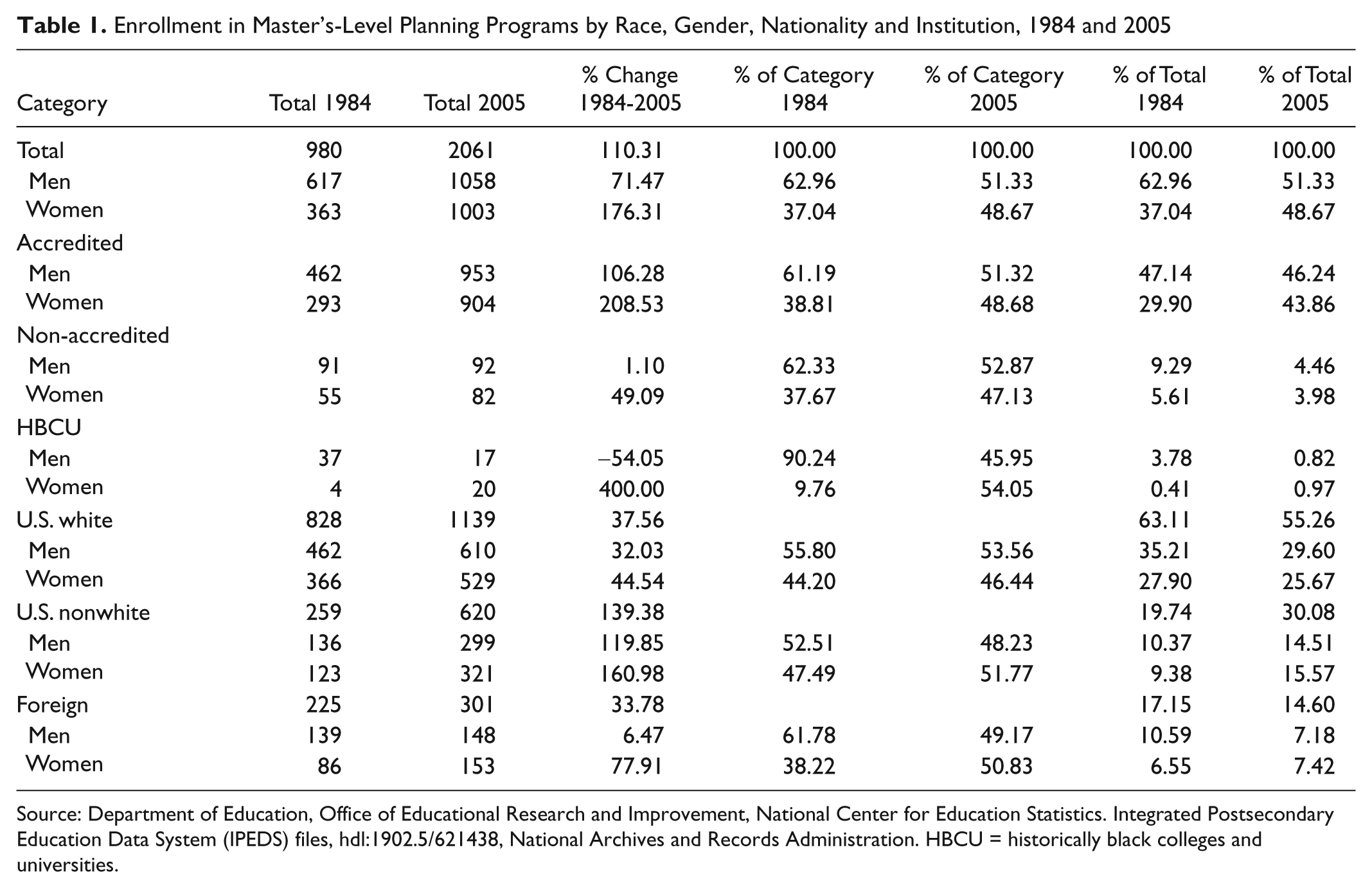
Source: Department of Education, Office of Educational Research and Improvement, National Center for Education Statistics. Integrated Postsecondary Education Data System (IPEDS) files, hdl:1902.5/621438, National Archives and Records Administration. HBCU = historically black colleges and universities.
Planning is an interdisciplinary branch of learning; it is part social science, part arts and letters, but primarily a professional field. On a broad scale, planning was born out of a public service and public sector tradition. Although numerous planners now work in for-profit settings, many remain in planning agencies and the nonprofit sector. So how planners are represented may determine who is attracted to the field. Moreover, academic planners actually need to engage with practitioners to accurately portray what students will ultimately do in practice. The normative argument that planners work for the public good, regardless of who they are or where they work, may be affective, but context is important. James Perry (1990) suggests that there are three major schools of thought in public administration regarding why workers choose public service: rational, norm-based, and affective. Perry, however, fails to consider how public service motives may be affected by different sets of pressures facing different individuals and groups. For example, in their quest for upward social mobility, parents, relatives, advisors, and mentors with their own antiurban biases may steer their college-age children away from community development and public sector work (particularly in inner cities). This may be as true (or more so) for an aging population of African Americans, Latinos, and other minority groups who have come to equate social mobility in the United States with migration out of inner-city communities and occupations (Newman 1992; Small and Newman 2001; Wilson 1987). As more lucrative professions became more available to minority groups, the ethic of public service careers for racial progress and integration waned. In efforts to diversify the field, we may be fighting the perception that public service careers in some ways contradicts the hard-won victories of the Civil Rights era and represents a regression of sorts.
Aside from the field of planning, there has been a decline in interest in public sector employment (Lewis and Frank 2002). There are also shifts in the larger perceptions and proclivities toward public sector/public service professions. The unique position of planning, as an applied field, the skill sets of which can be applied to a variety of work settings—private nonprofit and public sectors—requires a nuanced and field-specific analysis. In this vein, it is necessary to take a hard look at planning departments. Can planning attract diverse students if their department and the field are perceived as racist and lacking diversity among faculty?
In 2008, there were approximately twenty-eight African American, fifteen Latino/Latina, and two Native American tenured or tenure-track faculty at the ninety-one accredited planning schools in the United States. Of these, seven women and two men have either not earned tenure (and moved to different institutions), been terminated at the third-year review, or are experiencing very difficult climates in which they do not expect to receive tenure (Wubneh 2009). Faculty of color, especially women of color, often face obstacles in getting tenure-track jobs, and even when they do, the obstacles persist as they move through the tenure process. It is hard to document these incidents because they are embarrassing and thus there is fear that revealing such situations could potentially harm one’s career. But women and particularly women of color in planning often face discrimination and tokenism in their pursuit of tenured academic jobs (Sweet 2006).
The topic of tenure and promotion of faculty of color is an unexplored and critical link in discussions of diversity in planning. Given the pressure to publish in peer-reviewed journals and the limited options for publication for faculty of all races, ethnicities, genders, and orientations, academic journals become the forums in which racialized and gendered hierarchies of planning thought and practice are reaffirmed. By extension, these hierarchies particularly determine the composition of planning faculties who, in turn, have a direct impact on the composition of student enrollments in academic planning programs and the larger field of practice.
Scholars of color who organize their scholarly writing around challenging the prevailing ideas about race and gender may find themselves marginalized or silenced through the rejection of their work (Roper 1980). Wubneh (2009), documenting the experiences of planning faculty of color who write on race and gender issues, says that the situation “illustrate[s] that minority faculty have little confidence in their work being welcomed by their academic journals” (23). Senior scholars may unwittingly perpetuate this state of affairs in many ways, but most specifically, they can do so by shunning work that transcends narrow intradisciplinary boundaries (e.g., transportation planning or GIS). One respondent to Wubneh’s survey stated, “JAPA editor has a serious problem with any planning issue not related to land use, economic modeling or other so called ‘mainstream’ or ‘traditional’ planning areas” (23). Furthermore, planning scholarship related to relational explorations of power dynamics is simply better suited to qualitative and ethnographic research methods. If, as Cordova (1994) suggested, planning faculty of color are enmeshed in colonial relationships of unequal power, then novel ideas generated by way of other methodological approaches or theoretical frameworks foreign to planning journals are rejected, thereby limiting publication and career-advancement opportunities for junior faculty of color. The simple fact that our discipline’s training grounds hosts a small number of nonwhite doctoral students and even smaller number of nonwhite tenured faculty speaks to this point. Stated plainly, this means that challenges to, or new perspectives on, existing conceptions of race, gender, diversity, and their implications for planning practice and thought are lost in negotiations among authors, reviewers, editors, and consumers of planning scholarship.
Moving Forward
We are not in a color- or sex-blind society, and planning programs must be sensitive to, and engaged with, the ongoing issues of diversity that plague the teaching of planning that, in turn, have significant consequences for communities and planning practice. This commentary has presented the state of scholarship about diversity in planning and posed questions that could guide a research agenda for attracting and maintaining a diverse body of students and faculty in planning and, most importantly, increasing the diversity of planning faculty. This will enhance the ability of planning programs to adequately address issues of race and gender and contribute to balancing the power relations within the planning academy.
There was a marked increase in planning scholarship throughout the 1980s that began a discourse about diversity in planning education and practice. The larger context of national political shifts to the right stalled progress toward the possibility of a postracist and postsexist society planning canon. There is not a significant core group of midcareer academics with power in planning who are committed to diversity and capable of pushing an agenda. The problem is no longer just a lack of diverse PhDs, since the ones out there are not able to remain in academia or are lured into other disciplines or career paths. The framework laid out by Ross in 1990 needs to be updated to include not just planners of color and women but women planners of color and the specific barriers they face; it also should be updated to address issues of class among planners of color. The intersections of race, gender, and class need to be further explored in the planning context (Cordova 1997).
As we start the second decade of the new millennium, we can no longer assume that all students of color whose applications reach planning programs are from disadvantaged or inner-city backgrounds, or that they will feel any obligation to dedicate their careers to assuaging the problems of minority communities. While this may still be accurate in some cases, it may, however, also be wholly inaccurate. The master narrative with a logic that assumes that “urban” connotes “inner city,” “underclass,” “poor,” and/or “minority,” and that the suburb is synonymous with “white middle class” must be questioned to understand the special complexity of diversity. The movement of African American and Latino middle class—and increasingly their working-class and poor populations—to the suburbs means that at some point, more African Americans and Latinos may live beyond central city limits than within it. In some cities, such as Washington, DC, this is already the case. In addition, more Native American students are projected to be living off the reservation. The need to plan with dense, homogenous minority neighborhoods may change, creating a need to plan with racially heterogeneous and economically diverse communities. This will require a diverse generation of practitioners and planning faculty to ensure that this occurs. Failing to diversify our planning faculties and student bodies will render planning practice and thought irrelevant in increasingly complex places.
With the formation of the Planners of Color Interest Group within ACSP as well as an energized group of new scholars of color pushing for change within planning schools, senior faculty, journal editors, PAB accreditors, and the profession itself need to respond to the group’s concerns. It is necessary to foster respect and appreciation for diversity as a central value in planning schools, as it is to provide opportunities for students and faculty to work through issues of diversity in constructive ways toward a physical and social environment that is welcoming to all; it is important to normalize diversity in scholarship, teaching, and practice.
Footnotes
The author(s) declared no potential conflicts of interest with respect to the research, authorship, and/or publication of this article.
The author(s) received no financial support for the research, authorship, and/or publication of this article.