







Abstract
Planning laws, planning governance systems, and even planning curricula in Anglophone Sub-Saharan Africa were strongly shaped by the colonial history of the subcontinent, and much of this imprint remains today. Yet demands on planners and planning systems have changed dramatically as African cities battle to cope with rapid growth, inequality, informality and environmental degradation. This article considers the issue of changing planning education in this region. It documents the efforts of the Association of African Planning Schools to forge a program of action on necessary new directions and themes for planning education in a context where adherence to older approaches remains strong.
Introduction
At a planning PhD workshop at the Ardhi Institute (now Ardhi University) in Dar es Salaam in 1999, planning academic Bent Flyvbjerg, then of Aalborg University, suggested that perhaps African planning schools should organize themselves into an association following the planning school organizations that had emerged in other parts of the world. It seemed like a huge task, but the academics present from three universities—Ardhi, Kumasi, and Cape Town 1 —decided to give it a try and began to make gradual contact with other Sub-Saharan planning schools. Now, twelve years on, the Association of African Planning Schools (AAPS) has forty-six member schools from fifteen (mostly) Anglophone countries, and on the basis of donor support 2 has launched a range of projects and held two all-school meetings. This article is not intended to be a self-congratulatory piece on the successful establishment of a network. It takes a critical look at what it takes to bring about change in planning education at scale, in a context beset by constraints of all kinds. It asks questions about the networked form of the organization that has emerged, and how sustainable it might be in a situation where participation is inevitably uneven. And while actual buy-in to AAPS from its membership is hard to judge, as is the impact it has had on planning academia and curricula, some indicators of activity levels are available. A central conclusion is certainly that bringing about change of the kind envisaged by AAPS is a very long-term and resource-intensive process, probably outlasting the energies (and perhaps life spans) of those currently involved. It has taken a significant commitment from many individuals to get as far as it has, and yet like all networks, it is intensely fragile and could easily fail. The two authors of this paper have had deep personal involvement with the AAPS project, Vanessa Watson as one of those present when the idea of AAPS was born and as a member of the group that helped grow AAPS through its various phases of growth, and Nancy Odendaal as the first full-time “project manager” and traveling ambassador of AAPS from 2009, more recently in a part-time capacity as academic commitments took priority. The narrative is therefore inevitably subjective to a degree.
The story of AAPS will be told and reflected on in the following sections. 3 The first gives some background to factors that have shaped planning and planning education on the Sub-Saharan African continent. The second section discusses the AAPS project itself: how the organization has emerged and the activities it has undertaken. The third section will consider a number of key issues that confront, in various ways, any organization or network geared to bring about change: decision-making and power, shared values, commitment, continuity, sustainability, growth and change, and effectiveness. Lastly, the article will consider future directions for AAPS and how it might take the next steps.
Planning Education in Sub-Saharan Africa: Background and Context
Planning education in the subcontinent has to be viewed against a background of the region’s colonial and postcolonial past, which has shaped institutions of higher education (Sawyerr 2004) as well as national planning systems and the urban issues planners deal with. While Africa’s past relationship with colonial powers provides a degree of commonality to these factors, there is also significant diversity as a result of different colonial traditions (and different local responses to these), and more recently varying political fortunes and engagements with aid and development agencies such as the World Bank. Within the region, South Africa is often viewed as somewhat of an exception because of its apartheid history and resource wealth, but not all of its universities are necessarily in better shape than elsewhere in Africa. Its planning system remains unreformed in the postapartheid era, and its cities share common issues of poverty and service backlogs with neighbors to the north. What distinguishes South Africa, perhaps, is a stronger institutional framework for planning and for the higher education sector. The implications of this are that funding is available for research and some planning reform is underway at the municipal level. The latter is supported by highly decentralized local governments, not typical in the rest of Africa despite intentions to the contrary.
In most African countries, universities were established as part of the colonial project (providing a source of civil servants for colonial bureaucracies), but in the postcolonial period they became part of a broader nation-building process as well as a route to an emerging class of professional and political elite. 4 Structural adjustment policies in many African countries from the 1980s severely reduced state funding to universities, and universities continue to suffer from major resource constraints while student numbers have increased significantly. Most universities have very poor library holdings and insufficient computer and technical equipment. Even when there are computers, bandwidth is very limited, there is little technical support and maintenance, and there may be frequent power outages. West Africa, especially, has had very poor Internet connectivity. Staff salaries are very low (the most extreme case is the University of Zimbabwe, where staff did not receive salaries for long periods), which means that academia is not an attractive profession and staff frequently engage in consultancies and other income-generating activities. It is not surprising that PhD students continue to travel outside of the continent to complete degrees if they can afford it, and the “brain drain” of better academics to Europe and the United States, and now to South Africa, is a frequent cause for complaint. Incentives or facilities for research and publication are limited, and the production of “new knowledge” is constrained, thus perpetuating, often, a relationship of dependency on European and American universities. The same constraints limit curriculum development and the introduction of innovative teaching methods.
Under colonial rule, many African universities established planning programs to train civil servants to enforce national planning laws, usually close copies of those used “at home” by the colonizing power. In all but a few countries, these planning systems remain today, relatively unchanged (Watson 2011). It is therefore not surprising that planning curricula, as well, were strongly influenced by the traditions and models of European (and especially British) and American planning education (Duminy 2010). Many curricula still follow the older British system of town and country planning education, focusing on physical planning and technical design. However, in some countries post-independence assistance from (usually) European schools or development organizations has resulted in curricula reform; in others, particular national initiatives have affected both planning legislation and curricula. An analysis of the AAPS membership (Table 1) showed three types of educational approach in use (see Duminy 2010).
Current Member Schools of AAPS, by Region.
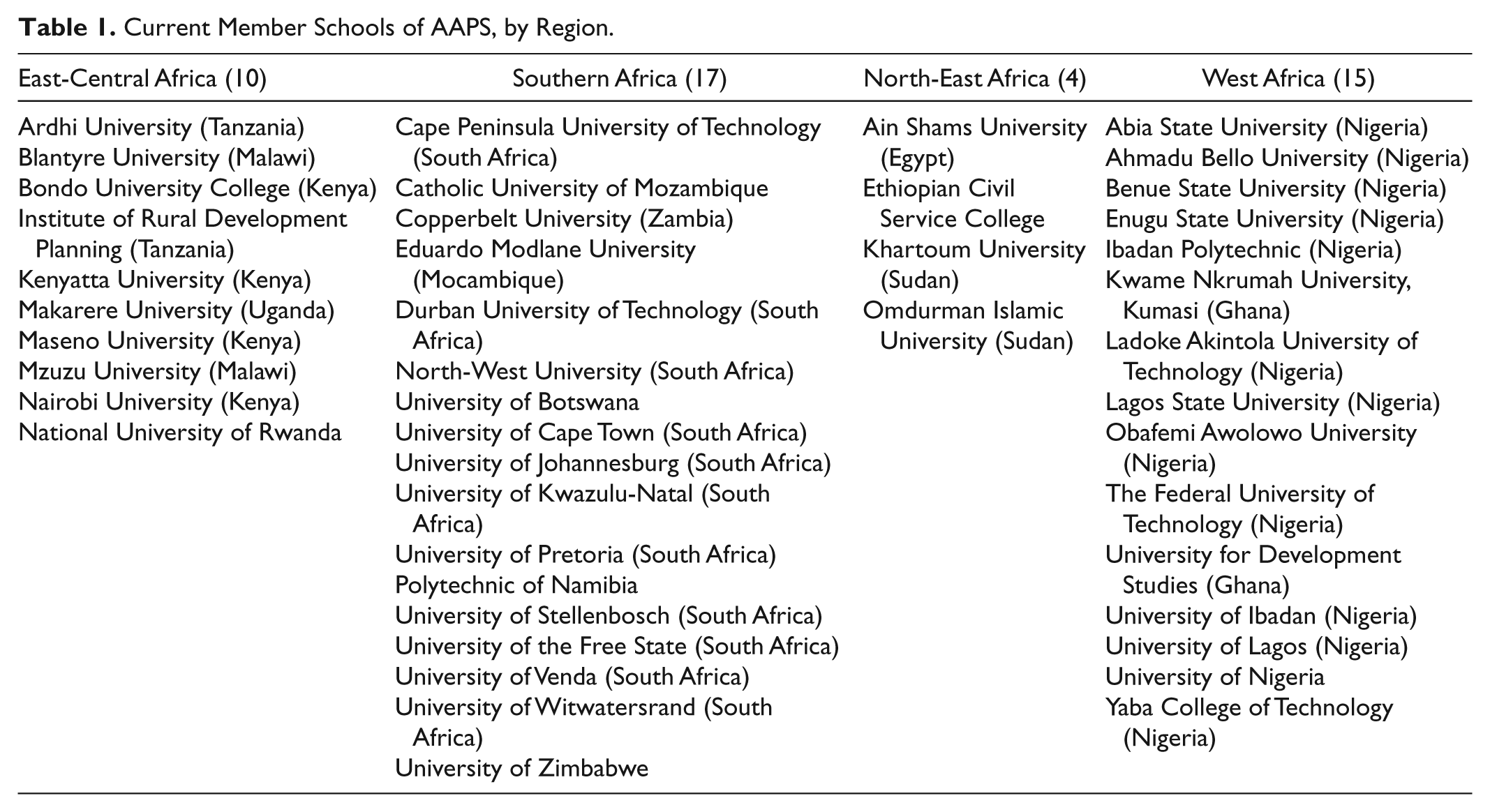
The first category consists of programs with a strong technical design/physical planning focus (i.e. planning allied with architecture or engineering), mainly offered at an undergraduate level. Examples are the University of Botswana with its bachelor’s degree in Urban and Regional Planning in the Architecture and Urban Planning Department; the Ethiopian Civil Service College (ECSC) with an undergraduate degree in Urban Planning, and more recently a master’s degree in Urban Management in collaboration with Erasmus University and the Institute for Housing and Urban Development Studies (Netherlands); and the Sudanese planning schools of Omdurman Islamic University (an undergraduate degree in planning in the Department of Architecture and Planning) and University of Khartoum (an MSc in Physical Planning in the Department of Physical Planning and Urban Design, Faculty of Architecture).
The second category consists of programs originally created with a design/physical planning focus, but with relatively recent shifts toward policy/management/administration curricular content at the postgraduate level. In Tanzania, the Ardhi Institute initiated a three-year Town Planning program in 1972, in conjunction with the United Nations Development Program (UNDP). Drawing heavily on the British model of town planning education, “the original course curriculum was based on a conception of planning as design and land-use arrangements” (Diaw, Nnkya, and Watson 2002, 346). Physical plan production was emphasized—influenced by architect planners from Europe (Poland, Sweden, and Denmark) who started teaching at Ardhi in the 1970s, through the UNDP. More recently, the Ardhi planning curriculum shifted to reflect new local issues (e.g., informal upgrading) and planning approaches, while maintaining the design- and context-based plan production focus. Currently the (now) Ardhi University offers a postgraduate diploma and MSc in Urban Planning and Management as well as an MSc in Urban and Regional Development Planning and Management (with Dortmund University). In Ghana, the curriculum in the Department of Planning (Kwame Nkrumah University of Science and Technology, Kumasi) also acquired a physical design focus in the British mold, but this shifted in the 1980s toward policy and management concerns. In 1985 an international postgraduate program in Regional Development Planning and Management was established in association with the Dortmund University. In 1996, a second postgraduate program in Development Policy and Planning was established with the Erasmus University (Netherlands).
The third and most common category is that of programs exemplifying a strong geographical/regional/environmental science approach, predominantly at the postgraduate level. In Kenya, Kenyatta University has offered a degree in Environmental Planning and Management since 1991 (within the Faculty of Environmental Studies); Maseno University offers a master’s degree in Project Planning and Management within the School of Environment and Earth Science; and the University of Nairobi offers an MA in Planning (through the School of the Built Environment), with an urban and regional planning focus.
Some of Nigeria’s many (possibly thirty-six) planning schools are strongly influenced by environmental science and design disciplines. For example, the Federal, Enugu State, and Ladoke Akintola Universities of Technology offer two-year MTech degrees (Urban and Regional Planning) within departments of environmental science or design; at Obafemi Awolowo University, the Department of Urban and Regional Planning is in the Faculty of Environmental Design and Management; and the University of Nigeria, in Enugu, operates the Department of Urban and Regional Planning within the Faculty of Environmental Studies, with early assistance from the University of Strathclyde (Glasgow). In contrast, at the University of Ibadan the Department of Urban and Regional Planning falls within the Faculty of the Social Sciences.
South Africa’s eleven schools have different lineages and influences. The first postgraduate planning program was established in 1946 at the University of the Witwatersrand, Johannesburg, strongly influenced by British consultants and staff (Diaw, Nnkya, and Watson 2002). During the Apartheid era top-down, control-oriented and comprehensive planning approaches supported the government aim of racial segregation, and some schools promoted traditional physical planning with the objective of satisfying the bureaucratic needs of the time (Todes and Harrison 2004). Other schools were highly critical of this mode and objective of planning education. From late 1970s several English-medium schools, critical of apartheid, embraced a “human-centered approach” and the notion of planning as “developmental” (Todes and Harrison 2004, 197). Postapartheid, some schools shifted to an American model of knowledge-based, social science planning education, some retained the traditional physical planning approach, and others have a greater developmental emphasis.
In 1999, when a decision was made to try and build a planning schools organization in Africa, there had been very little connection between schools, and South African schools, particularly, had been cut off from the rest of Africa during the apartheid years. Participants at the PhD workshop in Dar es Salaam had found the differences and similarities in curricula, research, and urban issues to be fascinating and were keen to continue the connections and to extend these to other schools. The Danish workshop facilitators offered to help where they could with funding proposals.
The AAPS Story: Establishing and Growing a Network
This section of the article explains how the network grew and was structured, how securing donor funding became an important necessity, and the activities and relationships that these resources made possible. This sets the scene for the third section of the paper exploring the issues and problems that confront a geographically extensive organizational network such as AAPS. The growth of AAPS falls into two periods: from 1999 to 2007 (when funding was secured) and the period thereafter when donor resources allowed activities and projects not previously possible.
Growing AAPS through Volunteer Work
Starting with the three PhD workshop attendees, AAPS grew slowly through personal email contact. This was easiest in East and Southern Africa where some exchange of staff and external examiners had happened in the past. A significant event was the ability of AAPS to link to GPEAN (the Global Planning Education Association Network). When Louis Albrechts was setting up the first World Planning Schools Congress in Shanghai in early 2001, the fledgling AAPS made contact with him and asked if the emerging African association could attend. He was most encouraging, and Dr Tumsifu Nnkya from Ardhi (Dar es Salaam) was one of the ten planning school representatives to sign the Shanghai Statement indicating support for the establishment of GPEAN (see Stiftel and Watson 2005). He was representing sixteen schools in ten African countries.
AAPS membership of GPEAN was important in two respects. Annual attendance at GPEAN meetings facilitated learning from other planning school organizations. ANZAPS (the Australian and New Zealand Association of Planning Schools) was somewhat of an anomaly in GPEAN as it functioned electronically as a peer-to-peer network of schools and had no president or office-bearers. Lack of resources and great distances between schools had produced this structural solution, but it offered a model for AAPS under similar constraints. ANZAPS helped AAPS to set up an electronic listserv, and for many years all AAPS communications were diverted via Australia. Hence AAPS took on a network form of organization (rather than the hierarchical structure of the other GPEAN members) in response to its context, with “representation” of the organization taken up by whoever happened to be available. Further, the GPEAN Dialogues in Urban and Regional Planning 5 project required each association to manage a process of choosing best published papers from their region and forwarding these to an international editorial body made up of GPEAN representatives. This proved to be an important activity bringing AAPS member schools in contact with each other, in years when a lack of resources and limited communication channels allowed for little else to maintain member interest.
The absence of funding was not for lack of trying. Attempts to secure Danish International Development Agency (DANIDA) funding failed, 6 as did several other approaches to international agencies. Funding was critical if AAPS was to develop further and especially if it was to organize face-to-face meetings of its members, given that securing individual travel grants was extremely difficult. These efforts did focus the minds of the fundraising group on the fact that AAPS needed a “project” if it was going to capture the interest of donors, retain member enthusiasm and encourage new membership. In the fundraising group there was consensus that a central issue for planning schools on the subcontinent was the gap between what students were being taught and the pressing urban issues that they would have to face on graduation. Their inability to deal with issues of rapid urban growth (averaging 3.3 percent per annum; United Nations 2008), informality, and land and service shortages (with 72 percent of the urban population living informally; International Labour Organization 2002) in an inclusive and participatory way meant that their legitimacy as professionals was being jeopardized. Funding proposals therefore argued that an AAPS project (entitled Revitalising Planning Education in Africa) would address the disconnect between the skills, knowledge, and values that are taught and the actual issues practicing planners find themselves confronting. That many countries in the region had planning laws based on the United Kingdom’s 1948 Town and Country Planning Act, also entirely inappropriate to twenty-first-century African cities, could not be held as a reason to hold back educational change. In fact, AAPS needed to put pressure on governments to reform their planning systems as well. So from an early stage the AAPS network took on advocacy concerns, driven by the highly problematic planning and urban context within which planning schools operated.
Donor Funding Secured and AAPS Changes Gear
By the end of 2007, AAPS had twenty-six members. Membership was still concentrated in eastern and southern Africa, with founder member Ghana and a couple of Nigerian schools in West Africa. Nigerian schools had been difficult to contact: the thirty-six schools had not always communicated among themselves. AAPS had refrained from recruiting schools in Francophone Africa as they belonged to a GPEAN sister organization APERAU (the organization of French-speaking planning schools). 7 And some African countries do not have planning schools at all, for example, Angola and the Democratic Republic of Congo.
In 2007, AAPS finally secured its first grant from the Rockefeller Foundation. In part, this could be attributed to the establishment of the African Centre for Cities (ACC) 8 at the University of Cape Town, which saw AAPS as a project worthy of support. ACC engaged with Rockefeller on a funding proposal and allowed AAPS project funding to be channeled through the University’s financial and auditing system. But more broadly, there was perhaps a renewed faith in the role of planning after the 2006 World Urban Forum, where speakers pointed to the magnitude of challenges facing cities of the global south and called on planners to support inclusive and sustainable cities (Tibaijuka 2006). This new climate of support for planning and recognition of the impending urban crisis under “old-style” master planning implicitly supported the AAPS cause.
Between 2008 and the present, AAPS has received three generous grants from the Rockefeller Foundation. The first (2008-2010) was for network building and implementing the AAPS project of revitalizing planning education, the second (2009-2010) was to promote case study research methods, and the third and last (2011-2013) is to further develop the AAPS project and to support its new partnership with Slum Dwellers International (SDI). Most importantly, these funds allowed for the employment of a full-time project coordinator (an experienced planning academic) and a research assistant, also a qualified planner. Both were taken on as ACC staff members, but answerable to the AAPS membership (and the donors). The funds allowed for three all-school meetings (the third in October 2012), a range of secondary meetings and workshops, a website 9 and other communication mechanisms, paper and electronic resources and support, publications, the launch of a planning law reform strategy, and a range of activities in partnership with two nongovernmental organizations: SDI and WIEGO (Women in Informal Employment Globalising and Organizing), together with WIEGO affiliate StreetNet 10 that represents informal street traders. Details of these projects follow.
School Visits
The first task of the newly appointed project coordinator was to personally visit as many of the member schools as possible to get a good understanding of conditions, constraints and issues. Despite the international trend toward greater reliance on electronic communication and social networking, face-to-face contact had proven to be essential to relationship and network building. Not all schools could be reached in the eighteen months set aside for this, but the sample provided evidence that most member universities are severely lacking in library resources and funding. The project coordinator visited twenty-four 11 schools during 2008-2009, spending two to three days with each. In addition to gaining a first-hand understanding of the constraints that schools face, discussion centered on four sets of issues: the school’s planning curriculum content and reflections on its efficacy and relevance, the function and future of AAPS, research interests and specializations, and resource constraints. It had become evident early on in that digital connectivity is uneven. Roughly one-third of schools offer broadband access to staff as well as to students in studios and laboratories while half had shared access for staff but at very low connection speeds (Odendaal 2012). This makes ongoing utilization of social networking tools for AAPS network activities difficult, further frustrated by limited digital “cultures” among older staff members (often the heads of schools).
All-Schools Workshops
Two all-schools workshops have taken place. The first in Cape Town (October 2008) was the first time that members had met, and the aim was to get to know one another, as well as the educational philosophies and research interests of different schools. At this point, AAPS had thirty-two member schools and twenty-two attended 12 (all attendance costs were fully funded). Delegates to the workshop were asked to each prepare a paper on planning issues in their country/city and how their curriculum did or did not respond to these. These papers were edited and published as an online workshop proceedings 13 and a selection as a special issue of Ardhi University’s journal (Kombe 2010). Discussion sessions aimed to identify what were regarded as the most important urban issues for planning, and these informed later curricula work. At the end of the workshop, there was a discussion as to whether AAPS should continue as a peer-to-peer network association or move to formalize itself with a hierarchy of office bearers. The decision was to remain as a network for the time being as it was less demanding on member resources and time.
The second all-schools workshop was in Dar es Salaam (Tanzania) in 2010. AAPS had grown to forty-three members and thirty schools 14 sent representatives, in some cases more than one. Altogether, with donor representatives, keynotes, and other guests, there were some fifty attendees. An important addition to the workshop was two staff members from SDI’s 15 Cape Town office, and a prominent SDI leader from Kenya as the main keynote speaker. This came about as a result of informal conversations between SDI and the AAPS coordinator. SDI was keen to engage with the planning profession, which they regarded as often creating major blockages to informal upgrading programs, and AAPS needed to consider how to teach new approaches to upgrading.
The objectives of this workshop were to discuss postgraduate curricula issues and to generate papers on the five key planning issues identified at the previous workshop, and thereafter to encourage research linkages between people with common interests. A selection of these papers is currently in preparation as a special issue in Town and Regional Planning (a South African planning journal). A further objective was to table for debate a draft skeleton curriculum for a two-year master’s degree in planning, incorporating the key planning issues identified. Finally, the organizational structure of AAPS was discussed again, and while it was decided to continue with the network form there was agreement that a steering committee, with a chair and co-chair should be elected on two-year terms.
Probably the most significant (and somewhat unforseen) outcome of this workshop was the synergy that developed between AAPS delegates and SDI. A contributing factor was the presentation by the Nairobi planning school, together with the keynote speaker, on how they had set up a relationship between their school and the local SDI affiliate to encourage planning students to undertake internships with SDI. A student participant in the presentation described how this experience had changed the way he viewed informal settlements, such that on graduation he had secured a job with SDI. This reinforcement of the idea of incorporating informality into teaching with a first-hand narrated example of how profound this experience could be had a strong effect on the workshop members. At the end of the meeting, there was support for a proposal that AAPS sign a Memorandum of Understanding (MoU) with SDI to collaborate on projects similar to the Nairobi one.
This MoU was signed on November 11, 2010,
16
with the following statement of purpose:
To promote the collaboration of SDI and SDI country-based affiliates with members of the AAPS in order to promote initiatives, plans and policies which encourage pro-poor and inclusive cities and towns in Africa. The Partnership recognizes that planners play an important role in either facilitating or hindering the inclusion and improvement of informal settlements and slums, and that the education of planners has a fundamental impact on both their values and understanding, responses and practices, in relation to urban informality. The Partnership recognizes that one of the most effective ways to change the mind-sets of student planners is to offer them direct experiential exposure to, and interaction with, the conditions and residents of informal settlements and slums.
A Draft Postgraduate Planning Curriculum
A further important outcome of the second workshop was the joint formulation of a possible postgraduate (master’s) curriculum, based on prior work done on the evolution of planning education, a review of approaches globally, the learning on pedagogy gained from the AAPS project on case study research and work on curricula content. The latter was enabled through substantive themes formulated as conceptual entry points in considering more contextually appropriate planning education. The five content themes were based on the discussions at AAPS 2008, the literature on African cities and subsequent discussions on school visits. They are informality, land access, climate change, actor collaboration, and the relationship between spatial planning and infrastructure. The themes were workshopped into curricular inputs where appropriate. The resultant curricular frame consists of three dimensions: structure, content, and delivery modes. Regarding the content themes, participants argued that these should not necessarily constitute separate courses but should be integrated in studios and lecture-based modules. For example, informality needs to be understood as a particular phenomenon, but given its prevalence in Africa it also needs to be mainstreamed into other courses as a concept. Actor collaboration is best achieved through techniques courses in conflict resolution and studio work with community-based organizations (in addition to the usual consideration in theory courses incorporated in current planning degrees). It could be argued that these themes would not necessarily leave African planning graduates well prepared for current local job markets: in governments where they might be expected to implement outdated planning legislation, or in consultancies where they might find themselves called on to design golf estates or gated communities for the wealthy. But unless planning students are exposed to the core issues of African cities in the twenty-first century, and encouraged to consider how planning might address these, they run the longer term risk of contributing to the marginalization of the profession as a whole in this part of the world.
Two structural options for a postgraduate degree were discussed. Both options suggested two years of full-time study, dividing the two years into four semesters. Each of the first three semesters is divided into a semester-long studio-based course and accompanying lecture-based (theory) courses that support the studio content. Time is allocated about half each to studio work and lecture-based courses. In both options, the first year has a scalar progression from local area (neighborhood) planning to metropolitan scale planning. The second year can either be a specialization year (e.g., urban design or transportation planning) or a further scalar progression to regional and/or rural planning. The last semester involves a dissertation (see Figure 1).
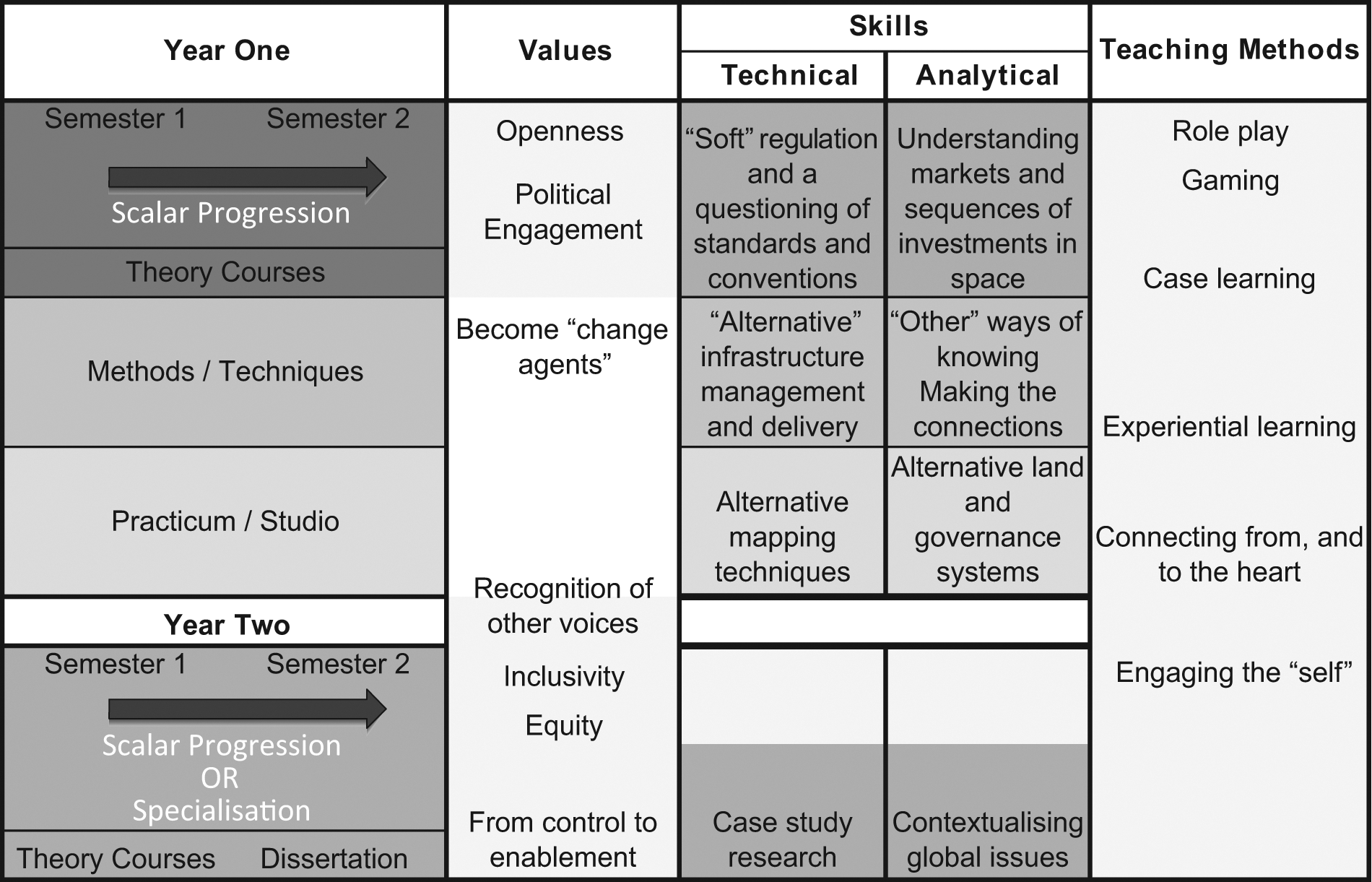
Possible curriculum framework for a two-year master’s degree program.
The proposal promotes spatial planning, through a studio-based pedagogy, as a core competency for planners, given that spatial distortions and fragmentation are a central problem in African cities. Many schools already teach this way, but what is different from some current approaches is the foregrounding of the values needed to inform planning in the African context: a pro-poor agenda facilitated by a form of planning that is inclusive and enabling rather than controlling and punitive, the emphasis on contextually relevant content (either as separate courses or embedded in the usual curricular fare), and a pedagogical approach that places emphasis on experiential learning. For some schools, content on the five issues referred to above would also be new.
It is important to emphasize that this framework was presented as a flexible outline that could be adapted to different contextual requirements. The studio-based and spatial elements were considered important, as spatial fragmentation and marginalization of poorer communities is a central issue in African cities, given the influence of colonial development. And the experiential learning that can potentially come with (community-based) studio projects has been widely supported. Subsequent to the 2012 AAPS meeting, staff of a new planning program currently being established at the University of Zambia agreed to pilot this master’s framework, for launch in 2013. They have already begun adapting it to local issues and staff capacities, while agreeing to embrace the idea of community-based studios.
Production and Distribution of Educational Resources
The years 2008-2010 also saw the production and distribution of educational resources. The intention has been to produce online educational “tookits” on each of the key themes identified at the 2008 AAPS workshop. To date, toolkits have been uploaded onto the AAPS website covering: planning law in Africa, actor collaboration, climate change and African cities, the informal economy, and mapping cultural landscapes. Several more are in the pipeline. Establishing the AAPS website in 2008 was an important step, as was setting up a new listserv (now with 201 members) and a Facebook site, now with 200 members. The latter was a specific attempt to reach young planning academics and students through a medium with which they feel comfortable. Poor connectivity has been well understood, and hence attempts have been made wherever possible to distribute hard copies of material and resources copied onto CDs.
The Case Study Research and Teaching Project
A second and parallel AAPS project funded by the Rockefeller Foundation (2009-2010) was the case study research project. The idea of promoting this particular research method had its roots in Danish-assisted research and postgraduate work over many years at Ardhi University, discussed and supported at the 2008 AAPS workshop. The case method allows for deeper interrogation of context and a more nuanced understanding of African urban spaces and planning practices than is possible with other methods. The practical and concrete knowledge gained from the interrogation of cases would contribute to the body of research and publication on African cities as well as provide material for teaching. The case study work of Bent Flyvbjerg, who had also engaged with Ardhi and the Kwame Nkrumah University of Science and Technology (KNUST), was highly influential in the motivation for this project.
This project entailed three similar workshops (in Western, Eastern and Southern Africa), each three days in length. Invitations were issued to interested persons in member schools, and each workshop involved presentations of the case method and discussions on material presented by the participants, whenever available. Workshop facilitators were, for the first one, Bent Flyvbjerg (now University of Oxford), Jorgen Andreasen (retired professor) and Fred Lerise (previously Ardhi University). Using material prepared by Flyvbjerg, the second and third workshops were facilitated by Andreasen, Lerise, and AAPS staff. Some very rich material emerged from these workshops, including drafts of case studies used for research and for teaching. Currently a book is in preparation on using the case method in planning research and teaching in Africa, based on the workshop presentation material and a selection of the individual cases presented.
Continued AAPS Network Building and Relations with NGO Partners
The third grant from the Rockefeller Foundation was received in September 2011 and covers activities between then and mid-2013. The Foundation has indicated that this will be its last grant to AAPS. Funding was granted for two areas of AAPS work: to continue to build the network and to implement the partnership with SDI, both with the overall aim of revitalizing planning education in Africa.
The network building activities consist of a third all-schools workshop in October 2012, in Nairobi, with the aim of discussing a draft undergraduate curriculum, progress on the postgraduate curriculum pilot, research on the theme issues, and the “learning studios” with SDI. A further element is to begin to focus African governments’ attention on the need to reform their planning laws, and a land-legal expert has been engaged to commence a lobbying process in this regard, beginning with a subcontinent-wide workshop at the Rockefeller Centre of Bellagio in July 2012. The partnership with SDI is being tested in joint, month-long planning studios at six planning schools and involving the engagement of students in informal upgrade projects with local SDI affiliates. This experiential learning process will shift the mindsets of students such that they begin to understand the realities of life in informal settlements, and the importance of producing plans that build on these everyday needs and capacities. The hope is that the studios will begin to initiate relationships in these locations between planning schools, SDI, and informal communities (as has already happened in Nairobi and some other cities), which will lead to lasting engagements and new pedagogical shifts.
Also built into the 2011-2013 proposal was a series of “communities of practice” research meetings. This is an attempt to build research networks among schools around the key AAPS research themes. The first of these (December 2011), on informality, spatial planning, and infrastructure, was held in Lagos, largely because urban informality evokes strong responses, both for and against, among Nigerian planners. There were 16 participants, the majority from Nigeria, and with delegates from Malawi and South Africa. Intense debates and a fieldtrip to the “floating” informal settlement of Makoko inspired delegates to pen a call from AAPS to African governments to desist from demolishing informal settlements and to engage in constructive upgrade (see AAPS website). AAPS had embraced an advocacy role!
A further partnership MoU was signed in 2011, this between AAPS and WIEGO, with the intention of extending this to WIEGO’s affiliate, Streetnet, which represents informal workers in many parts of the world, including African cities. A first expression of these partnerships with SDI and WIEGO occurred at the third World Planning Schools Congress in July 2011, where representatives of both organizations accompanied AAPS to Perth to present on the roundtable: Global Planning and Engaged Scholarship. As a gesture of solidarity with those living in informal settlements around the world, the partners constructed a symbolic shack in the Perth conference centre foyer, with the help of Perth planning students.
Networked Organizations: An Effective Structure?
This section assesses the AAPS experience to consider whether such an organization has the potential to be effective and sustainable. This in turn raises questions about the extent to which all AAPS member schools share the vision of changing planning education, support the notion of promoting inclusive and sustainable cities, and agree that the five AAPS themes are the important ones to include in curricula. A critical factor here is the way in which decision-making takes place in a network, as lines of communication and authority may be far less clear than in a traditional hierarchical organization. All this becomes potentially more complicated when networks link up with other networks, as AAPS has done through its partnerships with SDI and WIEGO: partnerships can strengthen organizations or can lead to tensions around differing agendas. Finally, the long-term continuation of AAPS, dependent as it is on donor funding rather than membership fees, is a cause for concern. A question this raises is, how much effort is needed and for how long, to bring about structural change in what are often highly inflexible university systems where incentives to change may be minimal, as are the resources to do so? Since no formal evaluation of the impact of the AAPS projects has been undertaken at this time, the answers to most of these questions can only be speculative. Reflecting on these issues is, however, important for the organization as it considers its future beyond 2013.
The AAPS vision of educating planners to promote inclusive and sustainable cities, and prioritizing in curricula the issues of climate change, informality, land release and tenure, actor collaboration, and spatial planning linked to infrastructure planning, all emerged from delegate input at the 2008 workshop. The themes were discussed again on school visits. But not all schools necessarily focus equally on all of them. Some schools (or individual academics) do have other areas of interest, for instance para-transit (Mzuzu, Rwanda), Indigenous Knowledge Systems (Ibadan, Rwanda, and Free State, South Africa), and rural development and agriculture (Institute of Rural Development Planning in Tanzania). It is also to be expected that academics within schools have different positions on planning and planning education, and it may well be the case that those interested in change have self-selected to engage with AAPS. While much communication in AAPS does go through school heads, there are cases where the most active members are not department heads. Hence AAPS cannot claim complete support for its vision and agenda, but there appears to be sufficient consensus among active membership to proceed, and no dissenting voices have yet made themselves heard.
Adopting a positive and inclusive approach to urban informality (work and settlement) in research and teaching is probably the most potentially contentious of AAPS’s objectives. This may seem strange on a continent where informality is the norm in cities rather than the exception, but traditionally planning here has been anti-informality and in favor of modern, orderly, clean Western urban models. Informality is often referred to as “illegality” or by politicians as “rubbish” that needs to be “cleaned up” (Berrisford and Kihato 2006). Anti-informality appears to be particularly strong in Nigeria, where the educational accrediting body has a high degree of control over planning curricula, and does not even mention informality as an issue that should be dealt with. Yet the “communities of practice” research meeting on informality, spatial planning, and infrastructure held in Lagos in December 2011 found strong support from AAPS delegates for an inclusive approach to the in situ upgrading of informal settlements.
A key concern in any network-based organization is how decision making takes place. In a hierarchically structured organization, this is clear: power is vested in an elected president or executive committee, with functions delegated to office bearers (treasurer, secretary, etc.). In peer-to-peer networked organizations (such as AAPS and also ANZAPS), power may be far more “distributed” but potentially also open to “capture.” The issue of organizational structure has been debated at each all-schools meeting, and support each time has been to continue as a network but now with an elected steering committee, chair, and co-chair. 17 With thirteen member schools in Nigeria and eleven member schools in South Africa, potential domination by these two countries has been constrained by maintaining one steering committee member from each of these countries and spreading the rest of the membership between other southern and west African countries and east Africa. 18 A constitution that enshrines these provisions is in the process of being prepared for debate.
Regarding the direction and implementation of AAPS projects, inevitably the channeling of funding through the University of Cape Town and the African Centre for Cities locates both power and responsibility. Project coordinators have been very much aware of this potential asymmetry and try hard to locate decision making in the full steering committee and to circulate information and debate through the full membership. Events (workshops, research meetings, all-school meetings) occur either subregionally (the case method workshops) or with geographic centrality (all-school meetings in Dar es Salaam in 2010 and Nairobi in 2012). Ultimately, success of any organization depends on the interest and participation of all members, and AAPS schools will only engage if they feel benefits from membership as well as the ability to contribute to, and shape, the organization.
The new partnerships with SDI and WIEGO are an exciting development for AAPS, but the intentions in the MoUs still have to be put into practice and outcomes assessed. The hope is for joint and collaborative projects, studios, and internships to enhance the learning experience for students and open research opportunities for postgraduate students and staff, and at the same time offer useful skills, ideas, connections, and assistance to community-based organizations. The benefit to students of experiential learning is well recognized in planning (Tyson and Low 1987). At the AAPS 2010 workshop, the Nairobi planning school graduate described how he had always viewed informal settlements as dangerous places inhabited by criminals and deviant people. For him they were “the other” and he had no understanding of, or sympathy with, their plight. After involvement with SDI in a planning internship, he described how his class had begun to “hang out” in the settlement and visit new friends there. The area and its inhabitants were no longer seen as strange. Students had clearly undergone a deep and personal mindset shift that could not have been achieved through classroom-based and textbook learning. Introducing experiential learning opportunities such as these to students could be far more immediately effective than just changing lecture content.
The establishment of a learning relationship between planning schools, NGOs, and communities will need to occur within a clear framework of rights, responsibilities, and power. While SDI has an approach to learning within informal communities, which is “bottom up” and based on the actual practices and understandings of these organizations, the traditional approach to learning and research prevailing within university environments is more likely to follow a rational-scientific approach where knowledge/power begins and remains within the hands of the researcher. Even where there has been a shift toward recognition of other forms of knowledge in marginalized communities, Briggs and Sharp (2004, 664) argue that the interest (of researchers) is often in the manifest “experiences of the marginalized” rather than on the processes of their knowledges, theories, and explanations. This can lead to the danger that forms of understanding not easily fitting with Western scientific concepts, categories, and policy positions are invalidated or trivialized. It is with this understanding of the relationship between knowledge and power that SDI has, as one of their “rituals,” appropriated surveying and mapping as a community-based rather than a state-driven activity. If, as is the intention, relationships are established in particular locales between planning schools and SDI and WIEGO membership, then the research engagement that could involve postgraduate students and staff will have to be carefully discussed and managed (and formalized through a MoU) if the relationship in either direction is not to become exploitative.
The question of the continuation of AAPS projects and meetings when donor funding comes to an end in mid-2013 is a critical issue. Activities of this kind are commonly dependent on donor funding on the continent, and while this is certainly not ideal, personal, university, or state resources are simply not available. At the 2010 all-schools workshop, the idea of membership fees to sustain AAPS was discussed and comparisons drawn with the level of fee contribution in other planning school associations. Most members were adamant that their universities or departments would not have the resources to contribute; some but not all would be able to raise AAPS conference attendance costs. This long-term insecurity was one reason for the decision to stay as a network: establishment of an executive committee would demand resources for meetings that were unlikely to be available. Failing further funding, AAPS would continue with volunteer input, but activity would be significantly downscaled.
Two kinds of actions therefore become important. One, clearly, is further donor fund-raising efforts, and support from partners should help this. A second one is that new initiatives, perhaps even more local ones, emerge from various parts of the network. This could also be regarded as a sign of success of the AAPS initiative. There are already indications of this happening: the University of Nairobi, with its own Rockefeller funding, has entered a partnership with the Nairobi SDI affiliate to provide staff assistance and student internships. And one active AAPS individual from Makerere University linked with UN Habitat to conduct a workshop on planning education and climate change.
Conclusion: Future Directions and Issues
This article has related the efforts of AAPS to forge links between planning schools in Sub-Saharan Africa to create, firstly, a functioning organization with sufficient common interest to engage member participation, and secondly, with the ability to fund and implement projects to improve the quality and relevance of planning education. Since 2007, AAPS has succeeded in executing an impressive array of activities to further these aims, but changing something as deeply entrenched as a disciplinary approach and pedagogy will take far longer than five years.
The discussion has placed emphasis on the nature of AAPS as a peer-to-peer network, reliant on electronic communication and with free membership: this has allowed it to function under the constraints of large distances between schools and minimal resources. A key issue for AAPS going into the future is how to maintain this flexible and accessible organizational form while at the same time keeping the network active and engaged through projects and meetings, and maintaining a balance between distributed power and the need for some form of leadership, decision making, and representation of the body. It seems likely that outside funding sources will be needed for some time to come, together with the management of this in interests of the organization as a whole. One of the objectives of the “communities of practice” initiative currently underway is to stimulate research partnerships that will sustain the network from within. This relies heavily on the existence of a research culture in schools, but the absence of library resources, limited digital connectivity, and the primacy of consultancy (given inadequate salaries), could potentially undermine this initiative. The Lagos workshop indicated, however, how a joint emotive and a principle-based response to a live case could galvanize action. This may well be the direction AAPS needs to take.
A further important issue, linked to the above, is the extent to which AAPS remains a knowledge-network or fully adopts the role of an advocacy body, promoting the idea of inclusive and sustainable cities. The NGO partnerships it has forged and the normative orientation of its projects make this a likely way forward, and it is a stance that would find favor with donor organizations. The spontaneous decision at the 2011 Lagos workshop to send out a call to governments on informal settlements indicates that there is a leaning in this direction, certainly in parts of the organization. AAPS still needs to engage more closely with professional planning and accrediting bodies (there has been little of this to date), which are sometimes more closely aligned with governments and may be more conservative. There may be a fine balance to achieve between these various planning stakeholders, but in the context of African cities it is impossible to remain neutral on the issue of promoting inclusivity.
Finally on the issue of growth, AAPS at forty-five members is already a sizeable organization. Further growth potential is in Nigeria and in Francophone Africa (total number unknown). 19 Numerical dominance by certain regions (Nigeria and South Africa) will have to be carefully tempered by the AAPS leadership to keep a balance of power and hold the network together. Engagement with French-speaking schools will raise further difficulties of incorporating very different intellectual and pedagogic traditions. Growth will need to happen cautiously.
The success of AAPS in changing attitudes to planning and planning education, on the continent where planning will face its greatest challenges (given rapid urbanization in a context of extreme poverty and inequality), may ultimately have implications for the discipline more generally as planning concerns shift to the cities of the global South. Its projects will have certainly been an instructive experiment in shifting educational approaches.
Footnotes
Acknowledgements
We acknowledge the Rockefeller Foundation for long-term financial support of AAPS projects, and especially Anna Brown for advice and guidance. The African Centre for Cities has been an essential and supportive base for AAPS work.
Declaration of Conflicting Interests
The author(s) declared no potential conflicts of interest with respect to the research, authorship, and/or publication of this article.
Funding
The author(s) received no financial support for the research, authorship, and/or publication of this article.