







Abstract
Despite emergence of federal policy experiments, knowledge about the influence of federal policies on local land use policy is almost nonexistent. We examine the effects of a federal mandate and a federal incentive program on adoption of land use policies in local hazard mitigation plans. Comparative statistics were used to determine adoption rates by federal and state programs, followed by Poisson regressions to explain degree of adoption under the federal policies controlling for state policies and local contexts. We found that federal policies do not make a difference in local land use actions, but state policy exerts a strong influence.
Despite efforts to mitigate adverse impacts of natural disasters, the United States has experienced exponential growth in losses from disasters. Annual property damage has increased geometrically over the last few decades, and the affected communities have risen to historic levels. 1 Increases in population, property values, and concentration of assets in hazard-prone areas are primary causes (NRC 2006). Recent climate studies indicate we should expect more extreme weather–related events in the future (IPCC 2013). The cumulative expected exposure of the U.S. government to catastrophes over the next 75 years could reach $7 trillion (Cummins, Suher, and Zanjani 2010). Unlike global trends, the United States has experienced a steady decline in loss of life associated with natural disasters. Yet, the staggering loss of life of over 1,800 people associated with Hurricane Katrina in 2005 has brought this declining trend into question.
Planners and hazard mitigation specialists increasingly emphasize the importance of proactive land use planning focused on avoiding or minimizing loss, rather than simply reacting to a disaster event (Burby, French, and Nelson 1998; Peacock et al. 2008). The intent is to prevent new development in hazardous areas in the first place, or to ensure that existing structures can be relocated before or after a disaster event. The preventative land use planning approach has been characterized as the most promising long-term solution to mitigate the destructive effects of disasters (NRC 2006). Prior research supports this characterization by demonstrating that high-quality land use plans that include mitigation goals, facts, and policies have a significant impact in reducing vulnerability to natural hazards (Burby et al. 1998; Nelson and French 2002). The implication is that communities that invest in planning are more resilient—a critical concept in hazards research—as they are better able to anticipate and adaptively respond to extreme events, to rapidly recover, and to reduce future vulnerability (Peacock et al. 2008).
A major obstacle to the preventative approach is the shared governance dilemma where the higher level of government has a strong stake in promoting a policy, but lower governing bodies are unwilling partners (Berke 1998; May and Williams 1986; Smith 2011). For natural disasters, the federal government bears the brunt of financial loss in disasters as indicated by rising disaster reconstruction costs that are placing ever greater burdens on federal budgets, but local governments are reluctant to pay sufficient attention to prevention. Local officials give low priority to land use as a means for reducing disaster losses given the lack of a public constituency, costs of mitigation are immediate, benefits are long-term and uncertain and may not occur during the tenure of elected officials, and the physical manifestations of improved public safety are not visible (Burby et al. 1999; Burby 2006; Mileti 1999).
To resolve this dilemma, the federal government has taken a more active role in creating shared governance programs aimed at motivating local government action, with states acting as key partners in interpreting federal policy and, in turn, effecting local action. Despite the emergence of federal policy experiments, knowledge about the influence of federal policies on local planning is limited. Shared governance implementation studies in the planning field have primarily focused on the role of state mandates on local comprehensive plan quality and plan implementation (e.g., Berke and French 1994; Brody 2003; Bunnell and Jepson 2011; Burby and May 1997; Dalton and Burby 1994; Deyle and Smith 1998; Hoch 2007; Pendall 2001). Systematic evaluations of the effects of federal laws on local plan quality, particularly concerning land use actions, are almost nonexistent. The few exceptions provide important initial empirical evidence, but have a key limitation by only focusing on a single national policy (Berke et al. 2006; Tang et al. 2011). 2
We report on a comparative evaluation of the effects of two federal policies (Disaster Mitigation Act and the National Flood Insurance Program’s Community Rating System) in two states (Florida and North Carolina) based on a sample of local government decisions in each state to incorporate preventative land use actions into local mitigation plans. The main objective is to examine the independent effects of each federal policy on incorporation of land use policies in local mitigation plans, relative to the influence of state policy that facilitates (or obstructs) incorporation of preventative policies.
Four basic research questions are addressed: (1) Do local mitigation plans prepared in response to federal and state mitigation policies support preventative land use actions more (or less) than other types of actions (e.g., structural strengthening of buildings, emergency preparedness, public awareness campaigns)? (2) How influential are alternative federal policies (regulations versus regulations with incentives) on local plan support of preventative land use controlling for state policy? (3) How important are alternative state policies (top–down, prescriptive vs. bottom–up, flexible) on local plan support for preventative land use controlling for federal policy? and (4) How important are federal and state policies, relative to local factors in explaining local plans’ support for preventative land use? Answers to these questions will provide insight into addressing the general challenges of intergovernmental implementation that face the nation in attempting to carry out national strategies aimed at reducing vulnerability to natural hazards.
Conceptualizing Local Mitigation Actions, Federal Policy, State Policy, and Local Context
The conceptual framework to guide the analysis consists of four dimensions. The first dimension sets forth the characteristics that define preventative land use actions. Dimensions two, three, and four constitute federal policy, state policy and implementation efforts, and local context, respectively, that, in combination, are intended to influence how well local plans support the preventative land use approach.
Preventative Land Use Mitigation
Traditional land use and hazard mitigation programs typically use the same type of planning and implementation actions. Table 1 presents six major categories of land use management actions. Within each category, the table briefly describes how each can be applied to natural hazard mitigation.
Land Use Policy Actions for Natural Hazard Mitigation.
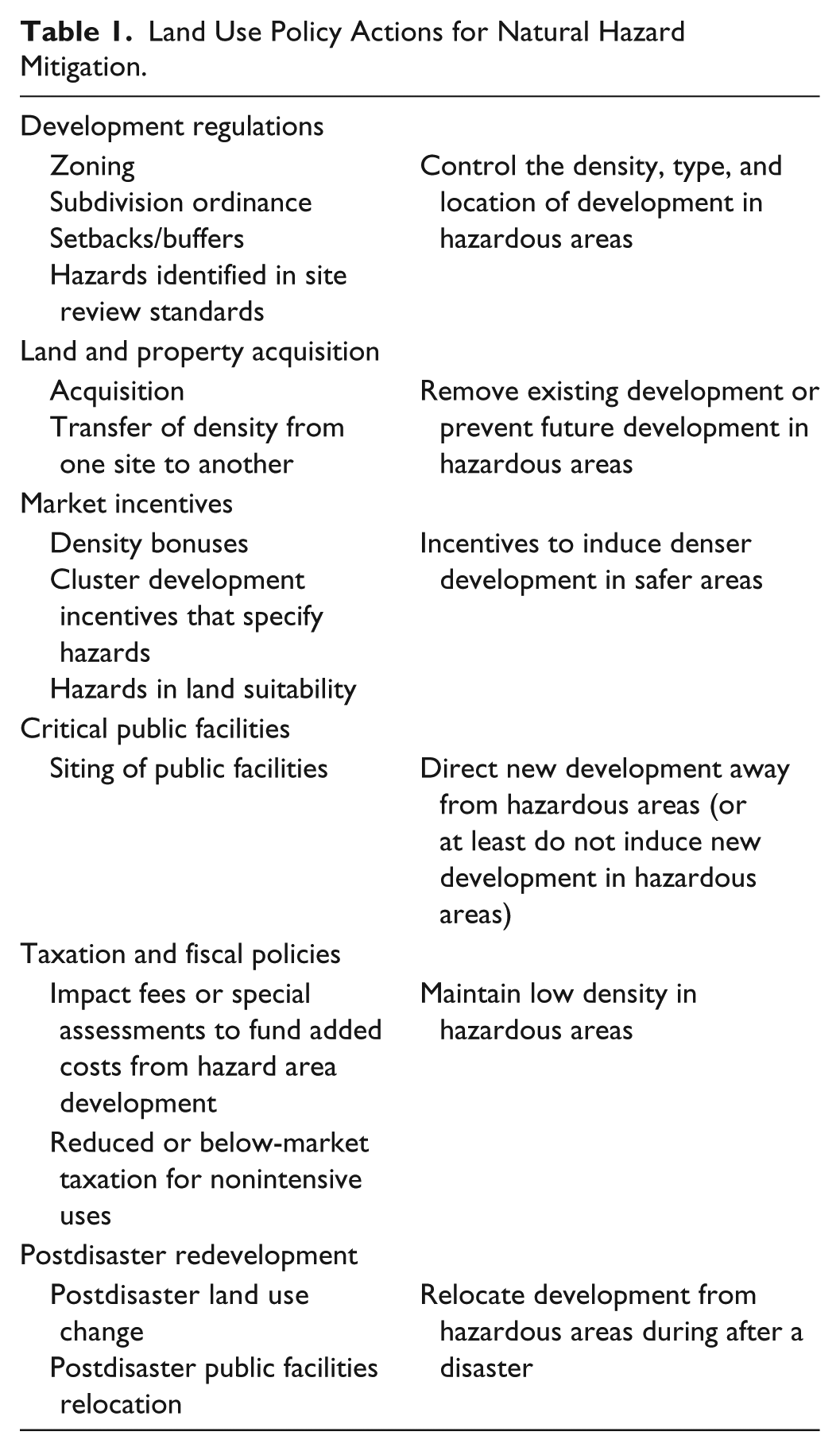
Studies have uncovered some solid examples of how land use activities have been incorporated into hazard mitigation plans and projects (Schwab 2010a, 2010b; Smith 2011; Stevens, Berke, and Song 2010). 3 Despite this progress, local governments lag in successful adoption on preventative land use actions in local plans (Burby and May 1997; NRC 2006; Olshansky and Kartez 1998). In a consensus document of the National Research Council (2006), leading researchers in the human dimensions of disasters concluded that while the quality of local plans in advancing mitigation have improved modestly over the past two decades, the preponderance of evidence suggests local governments and the public place limited importance in discouraging development in hazardous areas (NRC 2006). Burby and May’s observation over a decade ago is still relevant today, “Like debates on land use more generally, debates about controlling development in hazardous areas often focus on . . . appropriate uses of land, controls over development, or regulation of construction in hazardous areas making the stakes in these decisions . . . large, and conflicts . . . not easily resolved” (1997, p. 22). Consequently, other types of mitigation (e.g., structural strengthening of buildings, emergency management, and public information) are more tractable and more frequently relied on as they do not entail difficulties that simultaneously deal with private property rights, environmental protection, and economic development issues (NRC 2006).
Alternatives for Federal Policy Influence
Over the past two decades, various federal laws were enacted to integrate and leverage the capabilities and resources of the federal, state, and local levels of government to protect the environment and reduce loss from natural hazards. Sociologist Gunther Teubner (1983) identified this legal framework as “reflexive law” which is designed to build connections among policy sectors, interest groups, resources, and disciplinary knowledge bases that are essential to solving complex societal problems like hazard loss reduction. In contrast to “regulatory law” that entails the federal government setting explicit standards that control state and local government actions, and applying sanctions for enforcement, reflexive laws impose procedures that guide the process of subnational action. State and local governments have flexibility to tailor solutions that fit their context to achieve compliance with federal policy. Incentives can be used to induce subnational governments to continually assess their actions and adjust them over time (hence the reflexivity). A collaborative and communicative approach takes precedence over top–down hierarchical relationships, and governing is viewed as fostering interaction and learning among interested actors (Fiorino 2006; Nolan 2009).
There are two major variants of “reflexive laws” (Nolan 2009). The mandate variant requires subnational action and relies on regulatory sticks to ensure compliance, but still supports intergovernmental collaboration and self-organized action. State and local governments, for example, would be required to achieve a federal hazard mitigation goal, but determination of how to comply is the responsibility of these lower level governments. The voluntary variant relies on carrots with the aim of incentivizing action. Emphasis is placed on state and/or local adoption of mitigation policies that fit their contexts and meet national goals.
As will be discussed, under reflexive policy framework the Disaster Mitigation Act (DMA) represents the mandate variant and the Community Rating System (CRS) represents a combination of the mandate and incentive-based voluntary variants. We would expect support for preventative land use actions in local mitigation plans to be stronger for plans given credit under CRS.
Alternatives for State Policy Influence
States have a critical role in a reflexive legal system as they adapt to federal law and, in turn, influence local actions (Berke 1998; Rabe 2006). States can offer a rich source of innovation and capabilities in working with local partners to achieve national goals in a reflexive federal policy framework. In contrast, states can also choose to add an additional source of interdependence and complexity that can pose additional challenges to shared governance implementation. In the case of hazard mitigation, the federal government can establish vulnerability reduction goals and programs for reaching those goals, but the detailed implementation of federal policy rests on actions by states that, in turn, shape local reaction in preparing plans that regulate land use and protect public safety. 4 Thus, state interpretation of a common federal policy can vary widely and lead to diverse outcomes at the local level.
State interpretation of federal policy can range from coercive top–down approaches to cooperative-flexible approaches aimed at motivating local action (May 1991). Earlier work by various planning scholars examined the effects of state mandates on local comprehensive plans (Berke and French 1994; Burby and May 1997), and for comparative analyses among intergovernmental programs in international settings, including Australia, New Zealand, and the United States (May et al. 1996). More recent work extends prior efforts by examining how specific state planning program design features affect local plans, including collaborative versus prescriptive implementation styles, and degree of technical assistance, qualified staff, and funding (Bunnell and Jepson 2011; Hoch 2007; Pendall 2001). 5
Based on these studies we identify six conceptual dimensions that can be used to characterize state programs: (1) state agency staff capacity; (2) technical support (assistance, training, development of databases); (3) funding for local planning; (4) distribution of authority to plan between state and local governments; (5) policy approach (narrow/specific to comprehensive/integrated); and (6) consequences of noncompliance. We use these dimensions in investigating the comparative effect of state policies in Florida and North Carolina on support of land use actions in local hazard mitigation plans under two federal policies (DMA and CRS). As will be documented, the Florida and North Carolina programs offer considerable variation along most of these dimensions.
In sum, the two federal policies and two state mitigation planning programs provide substantial variation in factors that are hypothesized to affect local mitigation plans. The variation between federal policy approaches will allow us not only to compare local plans under the DMA mandate with and without the CRS incentive, but also to compare the influence of the two state programs under each federal policy approach. As noted, the influence of state mandates on local plans has been evaluated in other studies, but the relative impact of states in carrying out the intentions of federal policies has not been examined. This study extends knowledge on how higher-level governments influence local plans by simultaneously examining the independent effects of federal and state governments on land use actions adopted in local plans.
The Role of Local Context in Explaining Inclusion of Land Use Policy Actions
Using a prior literature review on studies that predict plan quality (Berke and Godschalk 2008) and a review of more recent work (e.g., Tang et al. 2008; Norton 2008), we identified twenty-two published studies that predict plan quality. The results for local contextual variables are mixed. Four local contextual variables were found to be the most consistently related to local plan quality: local government capacity to plan (population size), human capital (median home value), growth pressure (population growth), and disaster experience (disaster frequency) (Burby and Dalton 1994; Berke et al. 1999; Berke et al. 2002; Burby 2003; Burby and May 1997; Manta Conroy and Berke 2004; Norton 2005a). 6 As local capacity, human capital, growth pressure, and disaster experience increase, inclusion of preventative land use policy actions in mitigation plans likely increases. However, research from a study of 176 local comprehensive plans in six states found that contextual variables did not have any detectable effect on the quality of local plans in states that had strong local planning mandates (Berke et al. 1996; Burby and May 1997, chap. 7). These researchers concluded that localities take all of their signals about what the plan should address and how it should be prepared from the planning mandate.
Planner involvement is included as a fifth local contextual variable. Hazard mitigation has been dominated by emergency management agencies with limited involvement by local planning departments (Godschalk et al. 1999; Smith 2009). Since planners have expertise about land use, their involvement is expected to positively influence use of land use policies in mitigation plans. Prior plan quality studies likely did not address planner involvement because the focus was on the comprehensive plan, which is the primary responsibility of planners.
In sum, we expect federal policies and state programs to affect local land use policy, but the expectations for the local contextual variables are mixed depending on the design of state policy. By including all these factors in a multivariate model, we can estimate the relative contribution of each factor, while simultaneously accounting for the effect of the other factors.
Study Design and Data
Sample Selection
The samples of local governments with plans were derived from two separate prior studies that covered coastal counties and municipalities in Florida and North Carolina, including random samples of forty-three local governments with stand-alone DMA plans (n = 24 in Florida; n = 19 in North Carolina) and twenty-eight with DMA plans submitted under the CRS (n = 17 in Florida; n = 11 in North Carolina). 7 Communities with a population of five thousand people or less were eliminated from the sample, since the large number of such communities would skew representation toward very small places. We also excluded several major metropolitan cities and counties with populations over 750,000 (Miami, FL) to ensure some compatibility in planning capacity and complexity. We focus on coastal local governments because they represent diverse geographic locations and have wide variation in population growth and development rates. Moreover, hazard mitigation through land use management is an especially important planning issue for coastal local governments because coastal areas are especially prone to hazards and tend to experience higher growth rates than the rest of the country (Beatley, Brower, and Schwab 2002; NOAA 2013).
The state mitigation planning programs were evaluated on the basis of two sources of information. The first involved interviews with the lead state hazard mitigation officer responsible for state and local mitigation (i.e., Florida Department of Community Affairs and North Carolina Division of Emergency Management) to gain information on the extent which each state was devolving authority to plan, offering technical assistance, encouraging local participation, and funding. The second source involved review of agency reports that provided additional insights on the state programs. The sources provided the basis to make judgments in evaluating the comparative strength of mitigation planning programs for each state.
The data for contextual variables were collected from the U.S. census fact sheet, the Public Entity Risk Institute (PERI), and the local mitigation plan documents. For the U.S. census, population was measured as the number of people in a community in 2000, population growth was calculated by the percentage change in population ten years prior to plan adoption and date of adoption, and home value was measured by the median home value in 2000. For PERI, disaster experience was measured as the number of presidentially declared disasters ten years prior to the adoption of the local mitigation plan. For the plan document, planner involvement in plan preparation was measured based on whether or not a local plan identified that a local government land use planner was involved in the plan-making process. 8
Coding Protocol and Procedures
The two samples of plans were used to identify the number of policies for preventative land use category plus four additional categories of mitigation activities (structural protection of property, emergency services, information and awareness, and structural protection of infrastructure) established by FEMA. A coding protocol was developed based on coding items that serve as the recording unit for our data. The items were selected to identify mitigation actions within each of the five categories of activities that could be included in the local mitigation plans (see Table 2). Each item was measured on a 0 to 1 binary scale, with 0 denoting that the item in question was not included and 1 denoting that the item was present.
Source and Measurement of Variables.
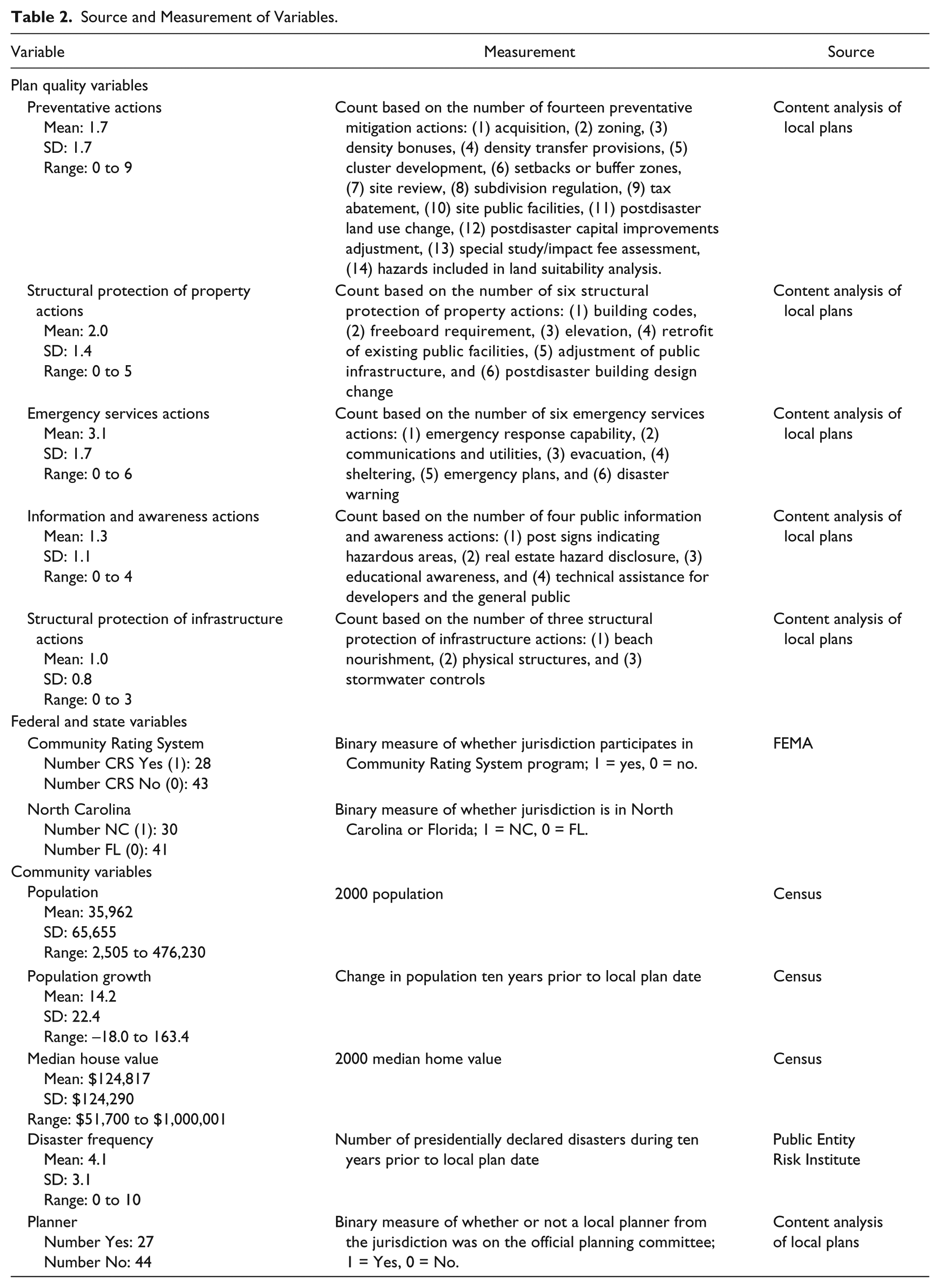
Multiple rounds of testing the coding protocol on plans outside the study area were conducted following standard code development procedures (Krippendorf 2004). To increase efficiency and reliability of content analysis of plans, the protocol was converted into Atlas.ti 6.0 qualitative data analysis software. The software enables the creation of code trees in which indicators are assigned to selected text segments.
Each local mitigation plan was content analyzed by two of seven coders on the coding team who independently coded each plan. Rules were developed by the research team to ensure that all coders interpreted the items as consistently as possible. We systematically varied pairings of coders. This tactic minimized the potential for intercoder dynamics that could reduce reliability, such as deference of one coder to another during the reconciliation process whereby the coders reviewed each difference in measurement and rechecked the plan document to determine which code was accurate. Rules were developed by the coding team to ensure that coders interpreted the items as consistently as possible. In cases when there are differences between coders for the double-coded plans, the coders reconciled each difference to achieve agreement in measurement by rechecking the plan to determine which code was accurate. Our overall reliability score was 88 percent for the DMA standalone plans and 89 percent for CRS-credited plans that were calculated from the double-coded data before the reconciliation process. 9 Our intercoder agreement scores are acceptable compared to scores reported in the plan quality literature that range between 70 percent and 97 percent (Berke and Godschalk 2008).
Computation and Analytical Procedures
Mean percentages for each of the five categories of mitigation actions (land use, structural of private property, emergency services, informational, and structural protection of infrastructure) across federal policies and state programs were calculated based on the sum of actions (Figure 1). Mean percentages were also calculated for each of the fourteen preventative land use actions (Table 3). Individual scores for the seventy-one local plans based on the sum of land use actions included in each plan are shown in the appendix (see Table A1). Poisson regressions using dummy variables were used to test for differences in the number of preventative actions adopted in the plans in response to alternative federal policies controlling for state policies and local contextual factors (Figure 1, Tables 4 and 5). Poisson models treat each possible action as being equally important and all the actions as independent of each other. A quasi-Poisson model was run for the Poisson models and none of the dispersion parameters were substantially greater than 1.00. Thus, overdispersion was not a problem.
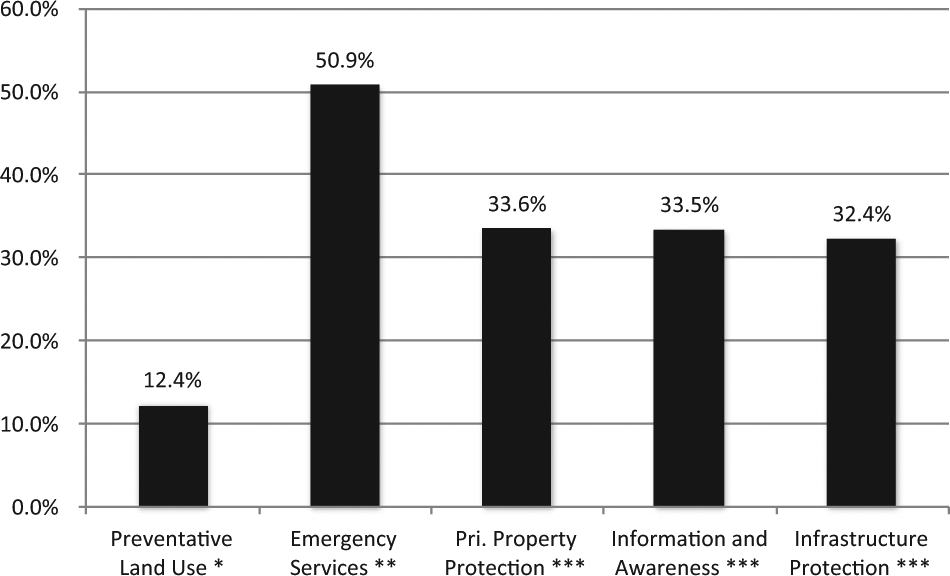
Means of the Percentage of all Possible Policy Actions.
Comparison of State Planning Mitigation Program Features.
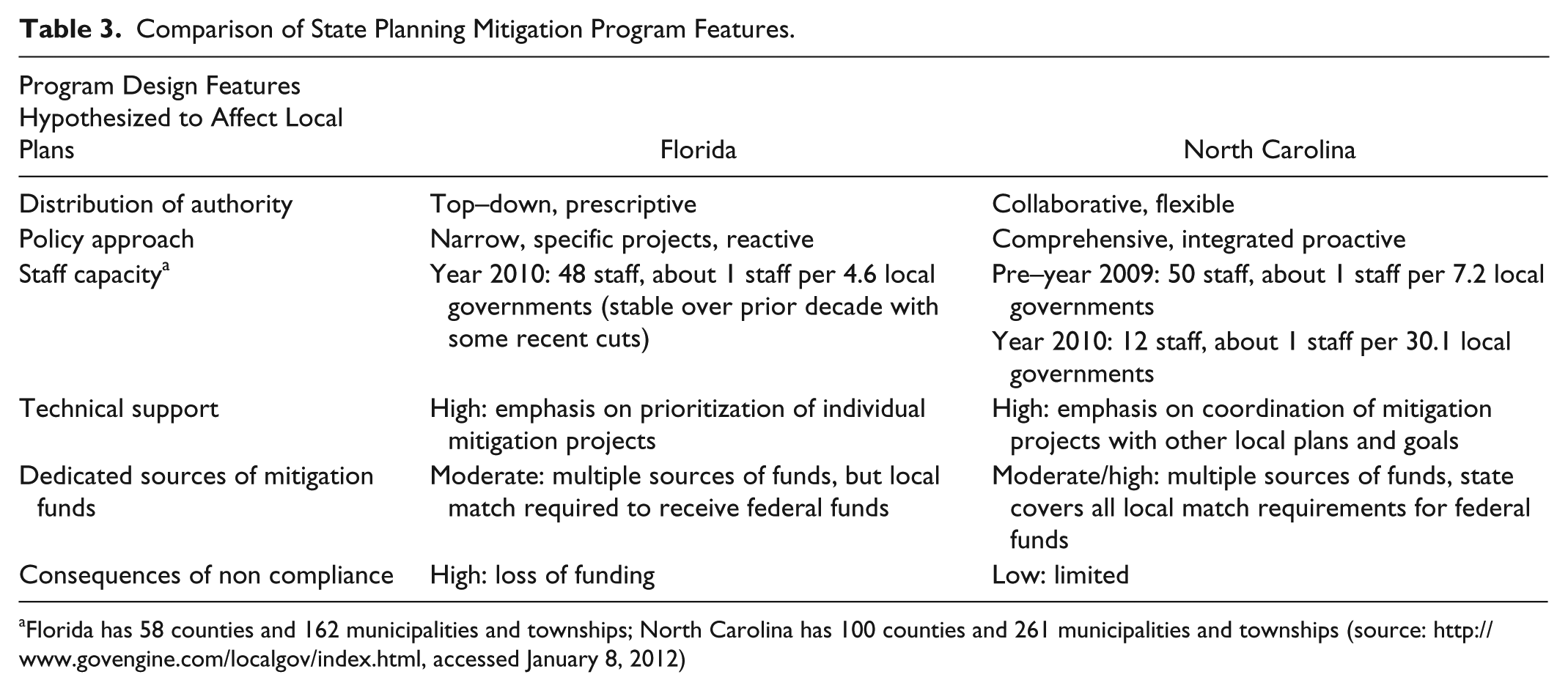
Florida has 58 counties and 162 municipalities and townships; North Carolina has 100 counties and 261 municipalities and townships (source: http://www.govengine.com/localgov/index.html, accessed January 8, 2012)
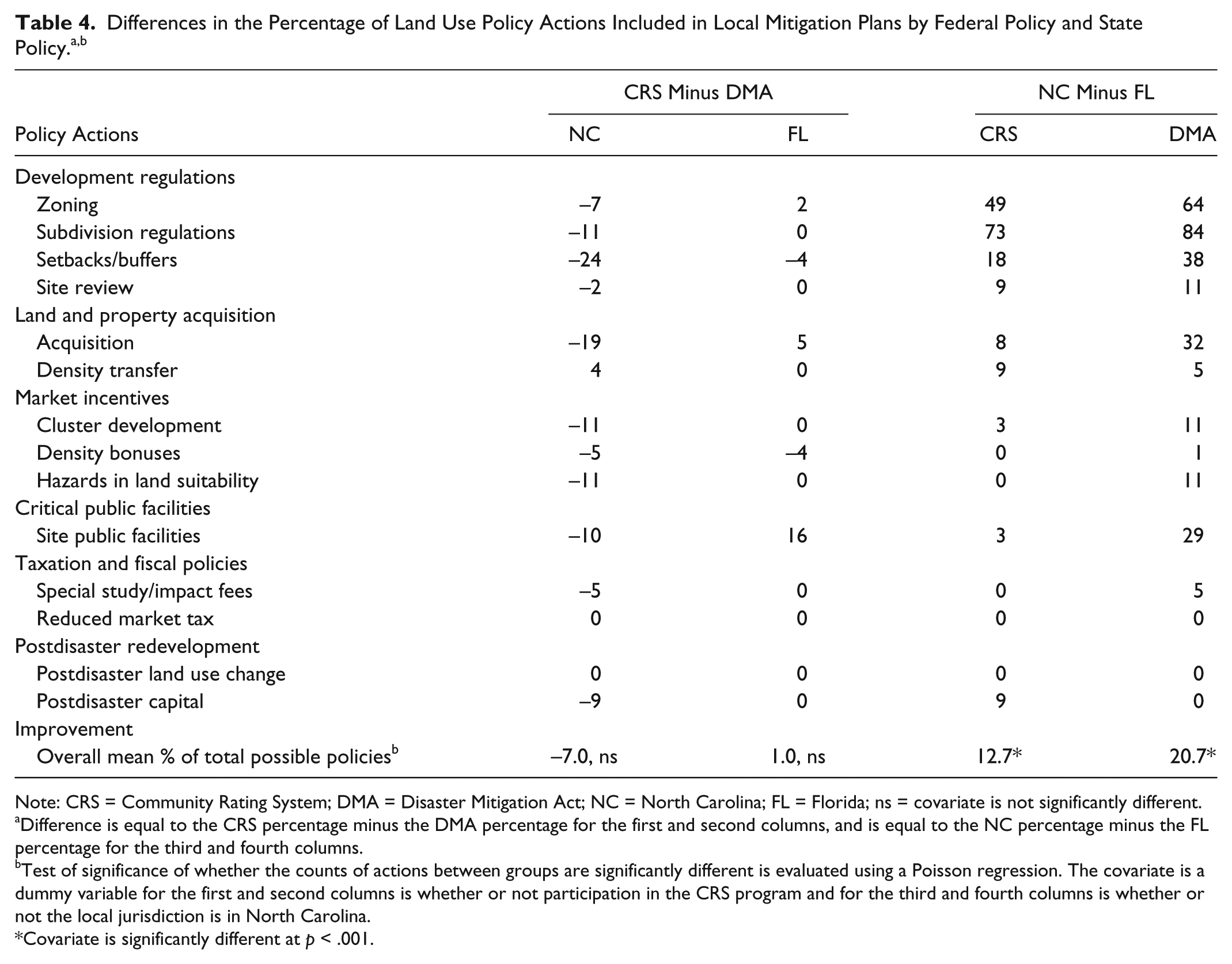
Note: CRS = Community Rating System; DMA = Disaster Mitigation Act; NC = North Carolina; FL = Florida; ns = covariate is not significantly different.
Difference is equal to the CRS percentage minus the DMA percentage for the first and second columns, and is equal to the NC percentage minus the FL percentage for the third and fourth columns.
Test of significance of whether the counts of actions between groups are significantly different is evaluated using a Poisson regression. The covariate is a dummy variable for the first and second columns is whether or not participation in the CRS program and for the third and fourth columns is whether or not the local jurisdiction is in North Carolina.
Covariate is significantly different at p < .001.
Poisson Regressions Predicting Count of Land Use Policy Actions. a
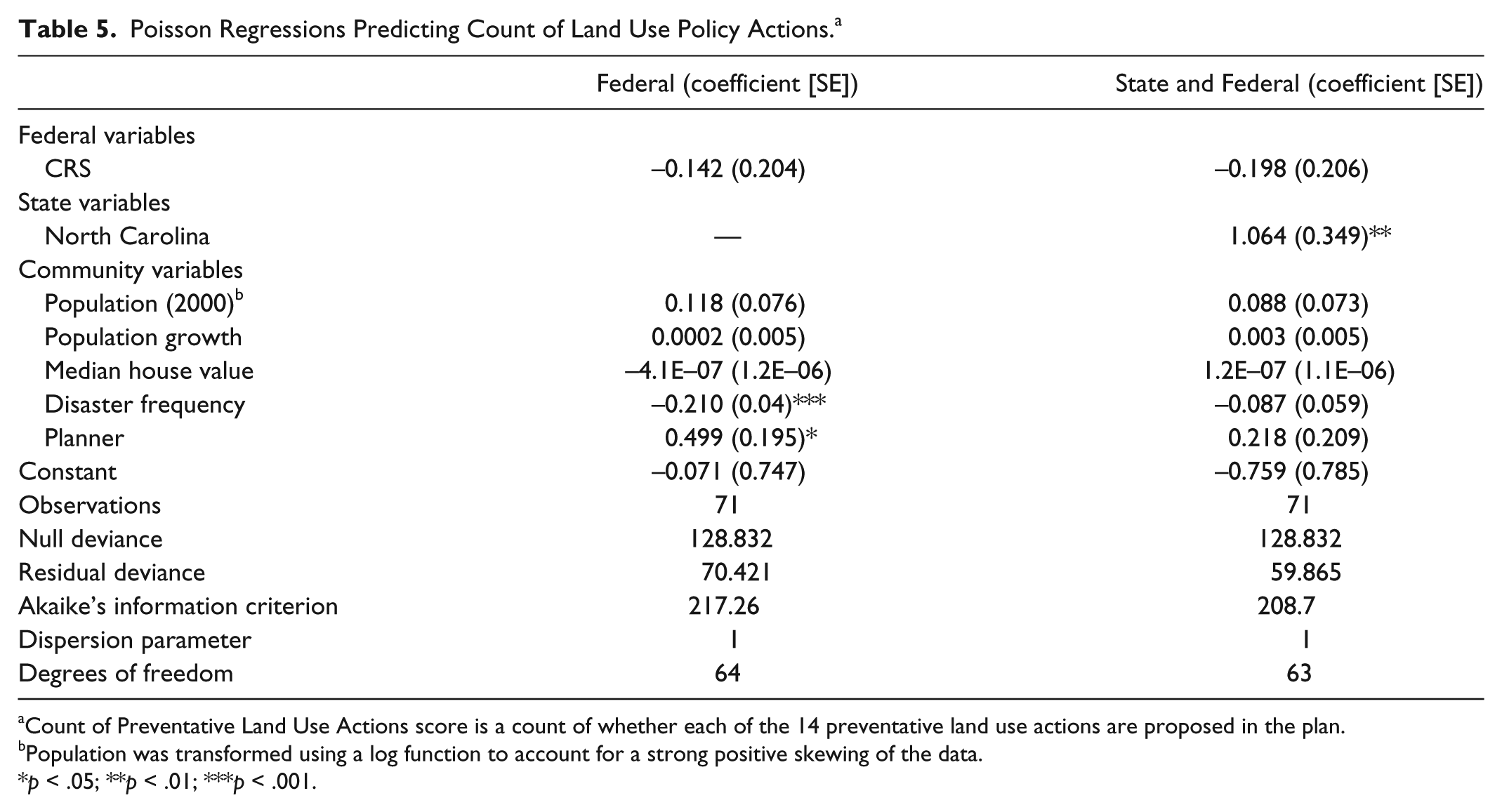
Count of Preventative Land Use Actions score is a count of whether each of the 14 preventative land use actions are proposed in the plan.
Population was transformed using a log function to account for a strong positive skewing of the data.
p < .05; **p < .01; ***p < .001.
Overview of Federal Hazard Mitigation Policies
The Disaster Mitigation Act (DMA) was passed in 2000 by Congress in response to rising disaster losses in the United States, a desire to take a more proactive approach, more effectively and efficiently distribute federal mitigation funds, and respond to questions about the efficacy of existing mitigation programs (Godschalk et al. 1999; Burby et al. 1999; Birkland 2006; Smith 2009). 10 The DMA provides a framework of federal, state, and local cooperation needed to achieve a comprehensive and integrated approach to hazard mitigation (Nolan 2009). States and local governments are encouraged to undertake a collaborative process to develop hazard mitigation plans that are reviewed and approved by the Federal Emergency Management Agency (FEMA)—the lead federal agency charged with implementation. 11 The DMA is essentially mandatory because state and local governments are denied access to significant funding for predisaster mitigation and postdisaster mitigation for rebuilding without approved plans.
States are to coordinate activities relating to risk assessments, identification and implementation of mitigation strategies, including land use strategies, and monitoring and evaluation of mitigation performance by supporting development of local mitigation plans and providing technical assistance to local governments. Hence, states are the linchpin for successful mitigation and long-term disaster resiliency under DMA since they are to establish comprehensive regimes for building cooperation among state agencies and between state and local government planning.
The Community Rating System (CRS) was established in 1990 as an incentive-based voluntary program designed to entice better local floodplain mitigation efforts. The incentive entails federally backed insurance premium rate reductions for property owners that reflect the level of local government mitigation effort under four categories of activities, including public information, mapping and regulatory, damage reduction, and emergency preparedness. As credits are accumulated, a community CRS rating improves and local policyholder rates are reduced. One activity under the damage reduction category gives credits to those local governments that prepare and implement a comprehensive flood mitigation plan. Under this activity, the CRS credits communities for developing a flood mitigation plan following a standardized planning process that is consistent with the regulations established by the Disaster Mitigation Act of 2000. For this study, we focus on the policy element of these plans. The greater the number of mitigation policy actions included in a local plan, the greater are the insurance rate reduction credits assigned to a locality.
Communities are allowed to submit multihazard mitigation plans prepared under DMA to obtain CRS credit or they can submit a stand-alone flood mitigation plan. Communities almost always chose the multihazard option to take advantage of coordinating flood mitigation with mitigation activities linked to other hazards. Thus, CRS-credited plans are prepared within the DMA intergovernmental framework must meet both program requirements to be eligible for the incentive. (For the remainder of this article, we refer to DMA plans that receive CRS credit as CRS-credited plans, and plans without credit as DMA plans.)
Overview of State Policy Response
Table 3 provides a comparative summary of the state mitigation planning program features of Florida and North Carolina. Florida takes a top–down approach by lodging authority to state agencies for specifying how local mitigation policies are to be developed under the federal DMA and CRS policies. Local plans are to narrowly focus on specific mitigation projects (e.g., elevation of an existing building, placement of hurricane shutters on a public facility) that are prioritized and ranked based on cost–benefit analysis procedures developed by the Florida Department of Community Affairs (2007, p. 20–21). The aim is to prepare plans that preidentify hazard mitigation projects to be eligible for pre- and postdisaster hazard mitigation funds to pay for them.
Building local government capacity in Florida is strong. The state provides a range of dedicated funding sources to prepare and implement mitigation plans, but requires local governments and individual property owners to assume a percentage share of the nonfederal match for projects in the implementation phase. 12 Florida has historically offered a high level of technical support based on distribution of a series of well-developed guidebooks that cover a range of topics focused on identification, prioritization, and implementation of individual mitigation projects (e.g., how to conduct vulnerability assessments, lists of sources of hazard data, how to meet state requirements in plan preparation), and provided regular advice via workshops and hotlines and mobile planning clinics (Smith, Lyles and Berke 2013). Staff capacity (48 staff in 2010, or about 1 staff per 4.6 local governments) for assisting local governments has been stable over the past decade (ranging from about 40 to 50 staff) and considerably higher compared to prior staff support in other states. Godschalk et al.’s (1999) study of 39 states’ mitigation programs found that more than three-quarters of states had fewer than five hazard mitigation staff and approximately one-half of states had one staff person or no one tasked with hazard mitigation activities (p. 472).
North Carolina devolves more authority to local governments in developing plans than Florida. Local governments are to create mitigation solutions that can range from specific individual actions to more comprehensive and integrated mitigation strategies. Like Florida, technical support is strong, but more proactive and integrated. For example, a series of guidelines were distributed on how to apply land use planning to transform mitigation from a reactive project-by-project approach to a proactive one, and development of an extensive hazard mitigation planning training program that emphasized land use measures, including coordination of hazards mitigation with other community objectives (e.g., acquiring flood-prone properties to achieve open space goals) (Smith, Lyles and Berke 2013). Further, under the North Carolina Floodplain Mapping Initiative, the state has assumed the traditional federal responsibility for the remapping and updating of the state’s Flood Insurance Rate Maps.
Like Florida, North Carolina provides a range of dedicated sources of funding for plan preparation and implementation. 13 However, unlike Florida, North Carolina offers coverage of nonfederal match requirements that eases local efforts to obtain eligibility of federal hazard mitigation grant funds. The consequences of noncompliance are weaker in North Carolina compared to Florida.
Staff capacity was high but has been recently weakened. Following Hurricane Floyd in 1999, this federally declared disaster provided substantial hazard mitigation funds (in excess of $500 million) to engage in a number of activities, including the hiring of staff of fifty hazard mitigation planners, grants managers, and risk assessment personnel (about 1 staff per 7.2 local governments) for nearly a decade. Most of these positions were time-limited—paid for by federal funds associated with the administration of postdisaster hazard mitigation grants and development of an extensive hazard mitigation planning training program that emphasized land use measures. Once the federal grants were completed, the funding supporting these positions was discontinued with staff capacity substantially reduced (12 staff in 2010, or about 1 staff per 30.1 local governments).
Findings on Mitigation Priorities, Federal and State Policy, and Local Factors
Is Land Use a Priority?
The first step in our analysis focused on the degree to which local government hazard mitigation plans give attention to land use actions compared to other types of polices. Figure 1 compares the means of the percentage of all possible actions that were included in the plans for each of the five categories of mitigation actions. Scores for all plans were pooled since the pattern of findings were consistent across federal and state policies.
The figure reveals that preventive land use category of actions had the lowest mean percentage of possible actions considered among the five categories of policy actions. Specifically, only a mean of 12.4 percent of all possible preventative actions are included in local plans and is significantly lower (p < .001) than the means of all other categories. Emergency service actions had the highest mean percentage of 50.9 percent, which is significantly higher (p < .001) than the means of all other categories. About one-third of all possible actions were identified in plans for the remaining categories, including structural protection of property (33.6 percent), information and awareness (33.5 percent), and structural protection of infrastructure (32.4 percent), and each of these categories was not significantly different from the other four categories (p > .1).
This analysis permits us to answer our first research question concerning the extent of support in local mitigation plans for preventative land use policies compared to other policies. Findings clearly indicate that local plans give less attention to preventative land use policies than other policies. As a result, local mitigation plans fail to provide a platform for guiding new urban growth to locations outside of current and forecasted hazard areas, assisting property owners to relocate homes and commercial buildings to safer sites, and managing postdisaster redevelopment in ways that reduce future risk. Rather emphasis is placed on easier-to-achieve activities (e.g., emergency services, public information campaigns, and structural protection of in situ development) that avoid property rights issues, do not threaten economic interests, and do not generate political opposition.
Do Federal and State Policies Make a Difference?
The next analysis addresses the question of whether federal policies and states have an influence on the degree to which local mitigation plans incorporate preventative land use policies. Table 4 compares the differences in mean percentages of fourteen land use policies and overall mean difference of all possible policies that were included in the plans between federal policies in each state, and between states under each federal policy.
The table reveals several findings. Unexpectedly, the overall mean difference in percentage of total possible land use policies included in the CRS-credited plans compared to DMA plans was not significant for plans in North Carolina (7 percent less in CRS-credited plans, p > .1) and in Florida (1 percent more in CRS-credited plans, p > .1). With the exception of hazard area setback requirements (24 percent less in CRS-credited plans) and land acquisition (19 percent less in CRS-credited plans), there are no major differences between CRS-credited and DMA plans in adoption for the remaining 12 policy actions in the Florida and North Carolina samples. 14 This suggests that incentives under CRS did not induce local governments to adopt more land use actions in the policy element of mitigation plans.
In contrast, the overall mean difference in percentage of total possible land use policies was significantly greater for North Carolina plans than Florida plans for both the CRS-credited plans (12.7 percent, p < .001) and DMA plans (20.7 percent, p < .001). More traditional development regulations had the greatest differences for CRS-credited plans in North Carolina including subdivision design codes (73 percent more) and zoning (49 percent more), and DMA plans in North Carolina including subdivision design codes (84 percent more), zoning (64 percent more), and hazard area setback requirements (38 percent more). Major differences extend beyond traditional regulations under DMA, as the difference was greater for North Carolina plans for property acquisition (32 percent more) and siting of public facilities (29 percent more). 15 These findings indicate that the design of state planning programs has a significant influence on use of preventative land use actions.
These findings allow us to answer the second and third questions concerning the influence of federal policies on local plan support of land use actions controlling for state policy, and the influence of state policies on local plan support for land use actions controlling for federal policy. First, reliance on land use activities under the incentive-based CRS-credited plans was not significantly greater than local DMA mitigation plans in both states. A potential interpretation of this result is related to a weak incentive structure for creating a mitigation plan that includes preventative land use actions. A CRS plan can only receive a maximum of 294 credits out of a possible 4,500 credits as credits are also given for a range of nonplanning actions that focus on adoption of individual mitigation actions. A community receives a 5 percent insurance rate reduction for each additional five hundred credits up to a maximum of 45 percent. As a result, even a high-scoring plan may not achieve enough credits to achieve the 5 percent reduction threshold. Further, inclusion of preventative land use actions in plans are given the same weight as other policy actions, as local governments can choose any combination of actions under the five categories of mitigation actions (see Figure 1) with each combination receiving an equivalent maximum of seventy credits (e.g., emergency services, public awareness, and preventative land use actions receive equivalent credit). Thus, while the overarching conclusion of the shared governance literature is that policy instruments that bind rewards to performance encourage greater effort (Prendergast 1999), incentive schemes have been found to have limited or no influence on effort if rewards are too small or too discrete (e.g., Zahran et al. 2010).
Second, state policy targeted at local government plans made a significant difference. Not only do states make a significant difference, but that the design of a state policy and implementation program makes a difference. This suggests that the more flexible and broader approach used by North Carolina motivated local governments to embrace land use actions. The narrower and more prescriptive approach taken by Florida may have induced local governments to avoid more comprehensive, integrated, and potentially controversial mitigation solutions that are required in the land use policy arena.
The Role of Local Factors
Multivariate Poisson regression analysis indicates which factors, including federal policies, state policies, and local contextual variables, significantly influence the number of land use actions incorporated in plans (see Table 5). We tested two regression equations by sequentially adding the federal policy variable (column 1) and state policy variable (column 2) to the set of local contextual variables to examine their effects on number of actions included in plans.
Several key findings were derived from the regression analyses. First, federal policy does not make a difference. The presence of a CRS credit incentive to reduce property owner flood insurance premiums does not induce a more robust set of land use actions used in plans. As noted, the lack of explanatory power of CRS incentives is likely due to the weak incentive structure for creating a mitigation plan that emphasizes preventative land use actions. Second, state programs and policy guidance substitute for rather than add to the influence of local factors. The influence of federal policy independent of state policy (column 1) indicates that two local factors had a significant influence on land use actions, presence of local planners involved in plan development and disaster frequency, but these factors were insignificant and replaced by the presence of state policy (column 2). This finding is consistent with prior research indicating that the strength of state policy can overwhelm local contextual variables in affecting variation in the quality of local plans (Berke et al. 1996; Burby and May 1997, chap. 7). Third, there are significant differences in the strength of state policy (column 2). North Carolina’s bottom–up, flexible and integrated approach to local plan making had a significant positive influence. In contrast, Florida’s top–down and prescriptive approach backed by more punitive actions for noncompliance negatively affected use of land use actions.
Let us further interpret these findings. Two indicators of local planning capacity to support planning were used. Population size as an indicator of greater resources for planning was an insignificant factor in explaining use of preventative land use actions. 16 Participation of a planner from the local planning department was a significant predictor of inclusion of land use actions in mitigation plans but, as noted, had no effect when state policy is included in the regression model. When state policy is not included in the regression model, local planners are influential as they are likely to take a more forward-looking approach that embraces the tenets of land use planning relative to other local officials who may lead local mitigation planning efforts (e.g., emergency managers give attention to evacuation, sheltering, and warning, and stormwater engineers focus on identification of at-risk structures and enhancement of building codes). However, state policy could conceivably substitute for the presence of local planners in focusing attention on preventative land use actions or that it drives whether or not local planners are involved in the planning process (Berke et al. 1996; Burby and May 1997, ch. 7).
Previous research suggests that as population growth rates increase, the importance of land use planning as a means to reduce social, economic, and environmental impacts of growth will increase (Manta Conroy and Berke 2004; Norton 2005b). However, the lack of explanatory power of population growth rate was unexpected. These findings probably suggests that the heightened salience of land use planning in general in places that are experiencing rapid growth have limited influence, at least for hazard mitigation.
An indicator of human capital, median home value (or wealth), was unexpectedly an insignificant predictor of the number of land use actions. While the common argument has been that wealth reflects an ability to fund planning and a wider array of land use activities, it also suggests the existence of environmental groups that can help formulate development-limiting policies and adequate local resources to reduce the need for increasing tax base through additional hazard area development. Thus, wealthy communities are more likely to be antigrowth and supportive of land use actions that control growth (Berke et al. 1996; Burby and Dalton 1994).
Past research suggests that increased frequency of losses serve as focusing events that catalyze public attention to disaster that translates to greater attention to land use (Brody 2003; Burby 2003). Unexpectedly, the degree of repeated losses had a significant negative influence on inclusion of preventative land use actions in hazard mitigation plans. It could be that increased repetition of disaster losses may raise salience and support for visible and immediate actions like emergency management and structural protection but does not motivate land use actions that are often associated with greater obstacles associated with property rights and economic development (NRC 2006). Yet, as discussed, disaster frequency had no effect when state policy was included in the regression model. It is plausible that state policy replaces the effect of disaster events as local governments are directed to place emphasis on preventative land use actions regardless of whether they experience disasters.
Discussion: Challenges to Overcoming the Shared Governance Dilemma
Our analysis of seventy-one local mitigation plans offers several findings on local priority of land use planning for reducing vulnerability, and the role of reflexive federal policy approaches in creating plans that promote preventative land use actions, while accounting for state policy and local factors. However, before we present findings, caution should be used in their interpretation. A potential methodological limitation of this study is the nonrandom selection of the sample of only two states. This precludes the ability to statistically detect effects of individual state program design features on the degree to which local mitigation plans incorporate land use policies. Despite the sample limitations, several factors give confidence that the findings are analytically more generalizable. The state programs in this study reflect a range of design features found in coastal state mitigation programs (Smith, Lyles and Berke 2013), as well as more general intergovernmental challenges involving roles and responsibilities of federal, state, and local governments. Confidence in these findings is also enhanced because the results are generally consistent with prior research indicating that the effects of local factors on land use policy are replaced by the presence of state policy (Berke et al. 1996; Burby and May 1997, ch. 7; Deyle and Smith 1998).
Four major findings were derived from this study. One is that land use actions are given low priority by local mitigation plans produced under the DMA (both CRS-credited and non-credited plans) compared to other mitigation activities that are less effective in vulnerability reduction and politically easier to achieve. The emphasis placed on the identification of discrete hazard mitigation projects, particularly in Florida, are also indicative of a planning process driven by federal grant programs that disproportionately fund single mitigation projects, perhaps resulting in strong emphasis on plans that identify these projects rather than simultaneously adopting a more future-oriented, land use–focused plan. This finding reflects the difficulties of the shared governance dilemma for use of land use actions in plans. Despite the strong motivation to act at the federal level because of the rising costs to federal governments in disaster outlays, local governments place low priority on land use actions and instead emphasize less tangible and easier to achieve activities, especially mitigation projects that are subsidized by the federal government.
A second finding is that the federal incentive scheme under the CRS does not strengthen local plan support of preventative land use actions. This suggests that CRS incentives are too small and inconsequential. The net result of federal policy limitations are disjunctive impacts in the strength of local plans across states as indicated by the significantly lower number of land use actions incorporated into Florida plans compared to North Carolina plans.
A third finding is that state policy has a strong influence on inclusion of land use activities in local mitigation plans, which suggests that states appear to substitute for what are otherwise important, but often absent, local contextual factors that induce local governments to focus on land use actions aimed at preventing loss. As a result, the level of support for land use is highly dependent on how state policies and implementation programs are designed. While local land use planners who are influential and may still be present and supportive of preventative land use actions, state policy may replace dependency on local planning staff. State policy also replaces dependency on focusing disaster events. While greater frequency of disaster events may increasingly suppress preventative land use actions, state action alleviates the influence of such events.
A fourth finding suggests that state action does not guarantee support for land use initiatives. Use of land use actions showed significant variation between Florida and North Carolina. It is conceivable that North Carolina’s more devolved, flexible, and integrated approach motivated local governments to embrace land use actions. Florida’s more top–down, prescriptive, and narrow project approach may have induced local governments to avoid more comprehensive and integrated mitigation solutions that are more prevalent in the land use planning arena compared to other policy areas, notably emergency services. Further, the reliance on a project-by-project approach could be explained by Florida’s more coercive sanctions as local governments are reluctant to risk noncompliance.
Policy Recommendations
Given the increasing buildup of development in hazardous locations and the likelihood that catastrophic losses from extreme events are on the rise, the nation must come to grips with reversing this trend. This means overcoming the shared governance dilemma. While land use approaches offer a fundamental solution to reduce the threat and reducing federal disaster outlays, federal policy under the Disaster Mitigation Act and the National Flood Insurance Program’s Community Rating System need major improvements. We offer the following set of tentative recommendations.
The DMA needs to include a stronger set of requirements aimed at the preventative land use approach to local mitigation planning
To be eligible for mitigation funds, our proposed new requirements should stipulate that all local mitigation plans include a land use element. It would address predisaster land use actions aimed at limiting future growth in known hazard areas, and guide postdisaster recovery to take advantage of opportunities created by a disaster event to steer rebuilding away from hazard areas. The category of emergency services should not be included as a mitigation action and thus be excluded from consideration under DMA. Emergency services are critical for supporting effective warning, evacuating and sheltering at-risk populations once a disaster event occurs, but they not address long-term solutions to avoid or at least limit at-risk populations and built environments in hazard areas.
Strengthen the incentives in the CRS for local mitigation plans and land use actions
Incentives for planning that support land use actions should be increased in several ways. First, more insurance rate reduction credits should be given to local governments for creating a local mitigation plan. As noted, the current incentive structure only assigns only 294 credits out of a possible 4,500 credits for mitigation planning. The allocation limits prospects for integration and coordination required by land use actions and encourages a more fragmented and individual project approach to mitigation. Second, preventative land use actions within each plan should be given more weight in assigning credits than other categories of actions. Given the escalating trend in buildup of urban development in hazardous locations throughout the United States, land use policy solutions are increasingly becoming a more essential tool in reducing risk. Third, local governments should be given substantial credit for coordinating actions in local mitigation plans with local comprehensive plans. Prior research has shown that when mitigation efforts are integrated into well-established and ingoing local comprehensive planning efforts, insured losses from hazards significantly decline (Burby 2006).
The DMA should require states to give greater attention to land use policy
The contrast between Florida and North Carolina suggests states must be active in integrating land use policy in local mitigation plans. Support for local land use policies are more likely to result from a state that places strong emphasis on land use as a key component of local mitigation policy. Given the relative higher complexity of land use policy solutions relative to other mitigation actions, such solutions are strongest when authority is devolved to local governments and local officials are given flexibility in setting policy tailored to local needs. Further, broader coverage of required local matches by states should be used to obtain federal mitigation grants to ease local efforts to support land use solutions.
Federal policy should be aimed at including land use planners in plan making and building their capacity
DMA should specify that land use planners must play a key role in local mitigation plan preparation. When land use policy is not promoted by strong state policy, support for local land use policy may be more dependent on the presence of local land use planners. As noted, unlike emergency managers or floodplain managers, land use planners tend to be more forward looking in accounting for future spatial patterns of development and risk avoidance. As the lead national agency charged with implementing DMA, FEMA should develop ongoing training programs as well as support states in building a cadre of qualified land use planners to deal with hazard mitigation.
Further research is needed to separate out the effect of individual federal mitigation program designs’ features on local mitigation plan support for land use actions
Future studies on federal mitigation policy should include larger samples of states and local planning efforts to separate out the effects of federal programs and state programs on local land use policy efforts. Unfortunately, our study was unable to systematically identify which particular features, or the combination of features that represent each federal (and state) policy, are most significant in influencing local mitigation plans. Improved knowledge of the effects of different features would be of great utility to state planners and policy makers, and contribute to theories on plan quality and intergovernmental implementation. Further, this area of research should extend to understanding how well land use actions reduce community vulnerability to hazards.
In sum, because of weak federal mitigation policy and fundamental difficulties in influencing adoption of land use policies by reluctant and unwilling local governments, our analysis makes it clear that federal policy has resulted in disjunctive impacts among local government mitigation planning efforts. Some communities are fostering land use solutions and others are not. We hope our policy recommendations offer a pathway to more resilient communities.
Footnotes
Appendix
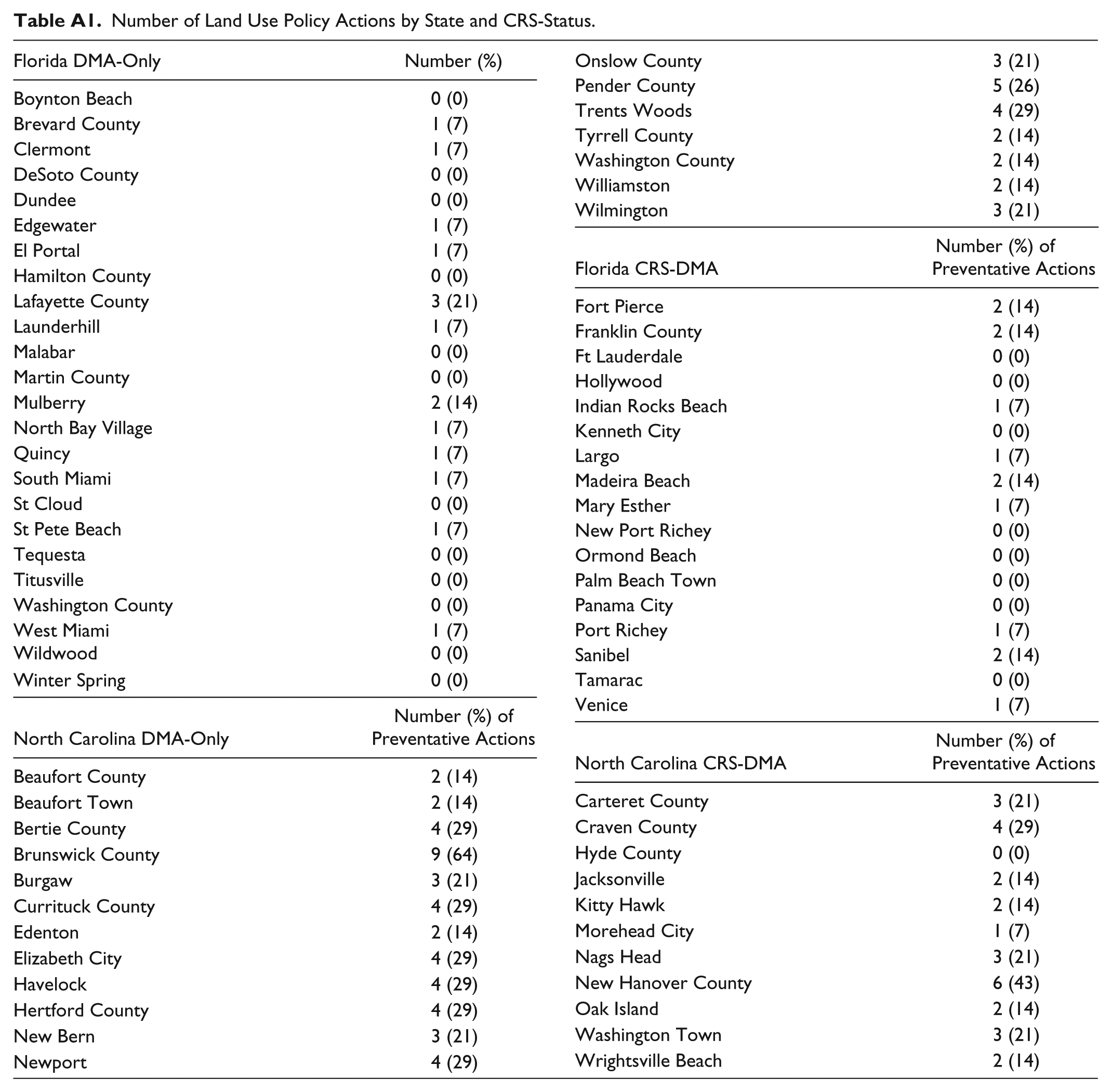
Number of Land Use Policy Actions by State and CRS-Status.
| Florida DMA-Only | Number (%) |
|---|---|
| Boynton Beach | 0 (0) |
| Brevard County | 1 (7) |
| Clermont | 1 (7) |
| DeSoto County | 0 (0) |
| Dundee | 0 (0) |
| Edgewater | 1 (7) |
| El Portal | 1 (7) |
| Hamilton County | 0 (0) |
| Lafayette County | 3 (21) |
| Launderhill | 1 (7) |
| Malabar | 0 (0) |
| Martin County | 0 (0) |
| Mulberry | 2 (14) |
| North Bay Village | 1 (7) |
| Quincy | 1 (7) |
| South Miami | 1 (7) |
| St Cloud | 0 (0) |
| St Pete Beach | 1 (7) |
| Tequesta | 0 (0) |
| Titusville | 0 (0) |
| Washington County | 0 (0) |
| West Miami | 1 (7) |
| Wildwood | 0 (0) |
| Winter Spring | 0 (0) |
| North Carolina DMA-Only | Number (%) of Preventative Actions |
| Beaufort County | 2 (14) |
| Beaufort Town | 2 (14) |
| Bertie County | 4 (29) |
| Brunswick County | 9 (64) |
| Burgaw | 3 (21) |
| Currituck County | 4 (29) |
| Edenton | 2 (14) |
| Elizabeth City | 4 (29) |
| Havelock | 4 (29) |
| Hertford County | 4 (29) |
| New Bern | 3 (21) |
| Newport | 4 (29) |
| Onslow County | 3 (21) |
| Pender County | 5 (26) |
| Trents Woods | 4 (29) |
| Tyrrell County | 2 (14) |
| Washington County | 2 (14) |
| Williamston | 2 (14) |
| Wilmington | 3 (21) |
| Florida CRS-DMA | Number (%) of Preventative Actions |
| Fort Pierce | 2 (14) |
| Franklin County | 2 (14) |
| Ft Lauderdale | 0 (0) |
| Hollywood | 0 (0) |
| Indian Rocks Beach | 1 (7) |
| Kenneth City | 0 (0) |
| Largo | 1 (7) |
| Madeira Beach | 2 (14) |
| Mary Esther | 1 (7) |
| New Port Richey | 0 (0) |
| Ormond Beach | 0 (0) |
| Palm Beach Town | 0 (0) |
| Panama City | 0 (0) |
| Port Richey | 1 (7) |
| Sanibel | 2 (14) |
| Tamarac | 0 (0) |
| Venice | 1 (7) |
| North Carolina CRS-DMA | Number (%) of Preventative Actions |
| Carteret County | 3 (21) |
| Craven County | 4 (29) |
| Hyde County | 0 (0) |
| Jacksonville | 2 (14) |
| Kitty Hawk | 2 (14) |
| Morehead City | 1 (7) |
| Nags Head | 3 (21) |
| New Hanover County | 6 (43) |
| Oak Island | 2 (14) |
| Washington Town | 3 (21) |
| Wrightsville Beach | 2 (14) |
Authors’ Note
The views and conclusions contained in this document are those of the authors and should not be interpreted as necessarily representing the official policies, express or implied, of the U.S. Department of Homeland Security.
Declaration of Conflicting Interests
The author(s) declared no potential conflicts of interest with respect to the research, authorship, and/or publication of this article.
Funding
The author(s) disclosed receipt of the following financial support for the research, authorship, and/or publication of this article: This material is based upon work supported by the U.S. Department of Homeland Security, Center for Natural Disasters, Coastal Infrastructure and Emergency Management under Award No. 00313690.