







Abstract
Given the importance of the media in 21st-century western liberal democracies, planning actors that seek media attention may do so for multiple ends, such as to dampen controversy and increase their status as “stars” in their professions through media branding. We develop a case study of the Woodrow Wilson Bridge project, along with expert interviews with public relations specialists, journalists, editors, producers, and scientists. We find that development professionals, including scientists, adopted mediatized behaviors, such as filming themselves, while working so that audiences might witness experts’ actions and successes. The stories and ideas that reached broad audiences concerned experts’ stories rather than those of a broad array of stakeholders.
Introduction
What stories should planners craft for the media, and for whose ends? 1 These questions are important because the media select, advance, and privilege particular stories that can influence the way people think about cities and planning (Flyvbjerg 2012). Nonetheless, most mass media are market-oriented purveyors of information, and what sells to consumers may not be the most important information to stimulate and inform democratic discussions about cities and planning. Theorists of democratic deliberation disagree about the role that the media play, and the role that the media should play, in social learning 2 and ensuring informed public political judgment, largely because media content tends toward the simplistic and spectacular rather than the complex and reasoned (Meyer 2002; Allern 2011).
This article examines the tensions planners encounter when interacting with media, particularly during agonistic 3 conflicts over development. We argue that planning occurs within the context of what political theorists refer to as a “mediatized politics” 4 in which participants perform for and message to audiences 5 for both long-term, reputational ends as well as to address the demands of an immediate issue or conflict. Like many other possibilities for influence, 6 access to media, particularly premier media outlets that command large audiences, is unequal among participants in local planning conflicts, as is the expertise necessary to frame ideas to appeal to journalists who write or broadcast for mass audiences (Innes 1998). The question becomes how planners and project staff enmeshed in political conflicts should proceed in democratic contexts saturated by media engagement and coverage. In the social construction of what is real and important in cities and development, the media’s emphasis on what is entertaining, spectacular, 7 or readily comprehended presents public deliberative decision-making, and planners who would seek to catalyze it, with both opportunities and pitfalls. Opportunities exist for professional self-promotion and marketing, while the potential pitfalls concern media that reinforce inequalities of power between state institutions and communities.
Media relations constitute one of the greatest divides between theory and practice within the profession. Planning and development theorists seldom discuss the mass media, even as they discuss planning as storytelling or communications. There are a few, notable exceptions (Gunder 2011; Throgmorton 2003; Innes 1998). Practitioners in both public agencies and nonprofit organizations are subject to intense, ongoing scrutiny by media in their day-to-day practice, particularly planners working in major metropolitan areas where even regional media can command mass audiences numbering in the millions. Practitioners employed in major public agencies, or in large consulting firms, can do little without considering how their words and images occur within the gaze of mass audiences as filtered and interpreted through media professionals and organizations, such as what might be forwarded in a “blast” e-mail or voicemail to media outlets, or via video captured via a camera phone or shared via social media. We argue that while storytelling and rhetorical theories have much to offer planning, planning theory has overemphasized the power of planners as storytellers and underemphasized the role that both media and audiences have in co-creating narratives about planning and development.
We illustrate our broader arguments using an exemplary case in Washington, DC, involving the Woodrow Wilson Bridge replacement. We conducted expert interviews with media professionals employed as producers, reporters, public relations specialists, editors, or journalists. We employed the casuistical methodology advocated by Thacher (2004) in this journal, which allowed us to ground the normative tensions of media engagement for development within the context of a high-profile case. 8
The public agencies pressing for the bridge’s expansion and replacement adopted media-ready environmental frames 9 to counter each, oppositional story offered by the initiative’s opponents. Very similar to the Cross City Tunnel in Sydney, Australia (described in Haughton and McManus 2012), the Woodrow Wilson Bridge Project employed extensive public relations and marketing ex poste of planning and during implementation to highlight the project team’s environmental management. The project team’s media efforts successfully created a dominant narrative for national and regional media concerning the effort as an example of good public management and strong, ecologically sensitive leadership. Mass media readily accepted frames from project staff and public relations professionals. Community and oppositional narratives occasionally appeared, but these groups had neither the tools or relationships (communications infrastructure) nor sufficient novelty to attract media or audience attention. Further, some of the most innovative aspects of the project’s environmental planning never received any real attention in the mass media and, instead, remained the purview of expert audiences only.
We begin with a brief discussion of relevant communication and political theory. Thereafter, we present the case and analyze the comments we obtained during interviews with journalists, public relations professionals and those otherwise engaged with the project. The article’s final section reflects on the case and what it portends for planning as a profession that exists within both deliberative and performative democratic contexts, and for further developing theory on the relations between professionals engaged in development and media.
Mediatized Planning and Development
The constructs that frame our discussion have generated large literatures in political philosophy and communications. It is impossible in this space to capture the full range of ideas or studies in these fields. Instead, we provide a brief snapshot of particularly relevant arguments and basic questions to formulate a conceptual model. Planning theorists have drawn on political theory to envision the conditions, practices, and outcomes necessary to conduct planning as democratic deliberation (Quick and Feldman 2011; Goldstein 2010; Innes and Booher 2010). In general, deliberation implies a dialogue that occurs within a democratic 10 context designed to evaluate reasons, evidence, and understandings to produce policies or resolve conflicts.
Modalities of Democratic Engagement and Communication
Rummens (2012) divided deliberative practices into three modes based on their spatial reach and number of participants. Fora or forum covers the first deliberative mode, with a small group of actors, or what Rummens calls a “mini-public,” that work on specific problems. An exemplar of this approach includes communities of practice (Quick and Feldman 2011; Schweitzer, Howard, and Doran 2008). Rummens distinguishes these from “network” modes of deliberation in which small groups engage together, but those groups themselves are linked to groups in other sites. The planning theory analogue of this second deliberative mode includes research on collaborative governance and learning networks (Goldstein 2010; Butler and Goldstein 2010; Innes and Booher 2010).
A third modality for deliberation concerns “staging” and what other theorists, including Hajer (2009), have called performative or dramaturgical modes. Staging involves representative agencies, non-governmental actors and elected officials engaged in deliberation, perhaps in a forum or network mode with small groups, but observed by audiences without direct engagement in the process as it is currently being conducted. Development decision making and planning often occur in this type of context, in which large corporate or state institutions confer with a spatially connected subgroup, the “mini-public,” while that interaction is available for other groups and individuals to experience via mediated images and narratives about the activities and participants.
Planning theory emphasizes fora much more than staging, and that oversight is a problem for planning that occurs in environments saturated by mass media and mass audiences. Flyvbjerg (1998) captured this “staging” style of deliberation in his case study of rail transit development in Aalborg, Denmark, in which he offered a firsthand account of his appeals to the media to counter state development narratives. In later work, Flyvbjerg (2012) reflected on his earlier experiences studying development conflicts and the media’s role in politics, and argued that his personal engagement with media fosters social innovation by introducing new ideas so that they become widely salient for practice. In a section in which he argued “zero public exposure 11 means zero impact,” he portrayed mass media as a cost-effective way for planning researchers to influence the profession. While Flyvbjerg suggested that planning researchers should seek media exposure for “impact,” he did not make clear how he, as a planning researcher, acted within a larger media context that governed his actions, such as the way he crafted narratives or presented himself as character to media professional, or how they picked up, or did not, different aspects of his story, along with the stories of others.
Johnson and Graves (2011) have similarly suggested that planners use entertainment media strategies to change the way the profession engages with mass audiences. They used the program Imagine KC (Imagine Kansas City) as a launching point to develop an alternative format for televised town meetings that feature audience engagement and interactive practices otherwise common to reality television. Graves and Johnson, because they do not implement their alternative vision, miss some critical points about media. Media markets and audiences may not change simply because new material is supplied, let alone a supply of more wholesome content. Graves and Johnson assume they can pick and choose from the reality format, and that thus they can neatly set aside the “dark side” of the genre that for-profit television producers emphasize. Graves and Johnson thus never have to contend with the problem that reality television producers perhaps emphasize manipulation, humiliation, drama, losers, villains, heroes, and all the other disturbing tropes of reality television because those more salacious practices create the spectacle to draw the viewers that Johnson and Graves seek for public engagement. That said, mass audience appeal may matter less than changing the engagement experience for those who participate rather than any hope to gain a mass audience. Nonetheless, what planning stands to gain or lose from mass audience reach, other than scholarly reputational effects or attention for the field’s activities, remains somewhat unclear from both Flyvbjerg and Graves and Johnson.
Gunder (2011) draws on Lacan to examine the role that media have in engaging with planners and urbanity in the production of social fantasies about future cities and future states as objects of desire: “planning, as propagated by the media, is deployed to constitute an appropriate spatial frame-work for this desired social reality via the structuring of the built environment and, importantly, fostering and supporting the future aspirations and aims, not to mention fantasies, of a polity” (Gunder 2011, 337). Gunder calls for critical theory to examine the effect that media has on planning.
In order to start in on building such theory, media must be conceptualized more actively and with more diversity than planning theory currently allows. Virtually all theorizing about media in planning, save for Johnson and Graves (2011), treat media as a rather flat, predictable set of external actors who either take up planners’ messages or confound those messages in some way. There are two major problems with conceiving of the media in such a way. First, it obscures the diversity of media practices and markets that exist in today’s social and political environments. Media cover everything from small-town newspapers to global advertising firms to interactive, social media. These different media have vastly different priorities and ways of story-telling, largely targeted by perceptions about the number and types of audiences media content creators seek. For instance, unlike media that seek out national audiences, geo-ethnic media tend to serve specific neighborhoods and ethnic groups, and depending on the audience, may have relatively high audience numbers even if they are little consumed outside their communities (Ball-Rokeach, Kim, and Matei 2001).
Second, treating media as a separate, and distinct, set of actors obscures the ways in which media in various forms have entered consciousness and altered individuals’ ways of being and thinking, long before planners, community members or politicians engage with each other about places, planning, and individual projects. Many global city residents live in both private and public spaces full of screens, blasting and blasting away with media content. Early on, McLuhan (1964) argued that media of all types serve to extend human perception and, importantly, experience, adding new, mediated representations about places, people, and events in human cognition. Social and media theorists differ critically in how these representations influence understandings, and how those affect politics. Some, like McLuhan, suggest that representations make possible a global unity around shared understandings. Others describe the political economy of the media in class terms, so that media content reflect and reinforce dominant class interests (Chomsky 2002).
Baudrilliard (2012), in both following and critiquing McLuhan, theorizes media as domination. Bombarded with media content that both relays and interprets ourselves in the messaging of that content, people view and respond to the world through mediated experiences, interpreting other people and places as functions of mediated representations (simulacra) rather than through lived experiences. For Baudrilliard, mass audiences are complicit in their own domination, settling in to passivity and consumption of “spectacle” or “catastrophe” rather than engage with political institutions or politicians that neither represent their interests nor offer more than token democratic engagements.
Media Logic and Mediatized Politics
In planning, Flyvbjerg (2012) and Johnson and Graves (2011) exemplify different responses for how individuals and institutions may seek to alter their professional strategies and conduct to attract media attention or to gain mass audiences, to varying ends. In order to appeal to media professionals and audiences, planning practitioners can or might adopt what Altheide and Snow (1991, 8) dubbed “media logic,” which is the orientation that governs the culture and practices of media as a (largely) for-profit industry (Mazzoleni 2008: Strömbäck 2011). Mediatization theories hold that media have “colonized” politics, in that political actors must, if they are to be successful in gaining influence with mass audiences, habituate their conduct, strategies, and ways of thinking to the norms and practices of journalists and publishers rather than the other way around (Helms 2012).
Mediatization scholars suggest that the whole of politics, much like Baudrilliard’s description of socially mediated realities, has begun to center almost exclusively on activities that appeal as spectacle, celebrity, simplicity, and other aspects of entertainment, rather than detailed or complex issues (Meyer 2002; Meyen, Thieroff, and Strenge 2014). Accordingly, Strömbäck (2011) has posed a key question for mediatization: who controls whom? Baudrilliard asserts audience complicity, yet media act as gatekeepers in selecting sources (in this instance, usually planning professionals) to provide content for production or publication (Whitney and Becker 1982; Singer 2001). Yet they do so disciplined to some degree by what will attract consumers for the media. For-profit media must consider advertisers, and non-profit and independent media similarly have sponsors’ and donors’ interests to watch. All of them seek audiences, and all of them can assert influence on framing and storytelling. Media compete for audiences so that, in turn, anticipated audiences shape what journalists will select among information from political actors. Media logic is, thus, market logic, even among independent media. As one of our informants pointed out, Online media, traditional media, independent media . . . it doesn’t matter. Everybody is out there marketing their content . . . media means markets. Audiences don’t let you show them something they don’t want to see.
12
Contingent on what audiences allow themselves to be shown, researchers have offered three major theories for how media influence may occur among media consumers: agenda setting, framing, and priming (Scheufele 2000).
Figure 1 summarizes the conceptual framing we offer for mediatized planning and possibilities for influence.
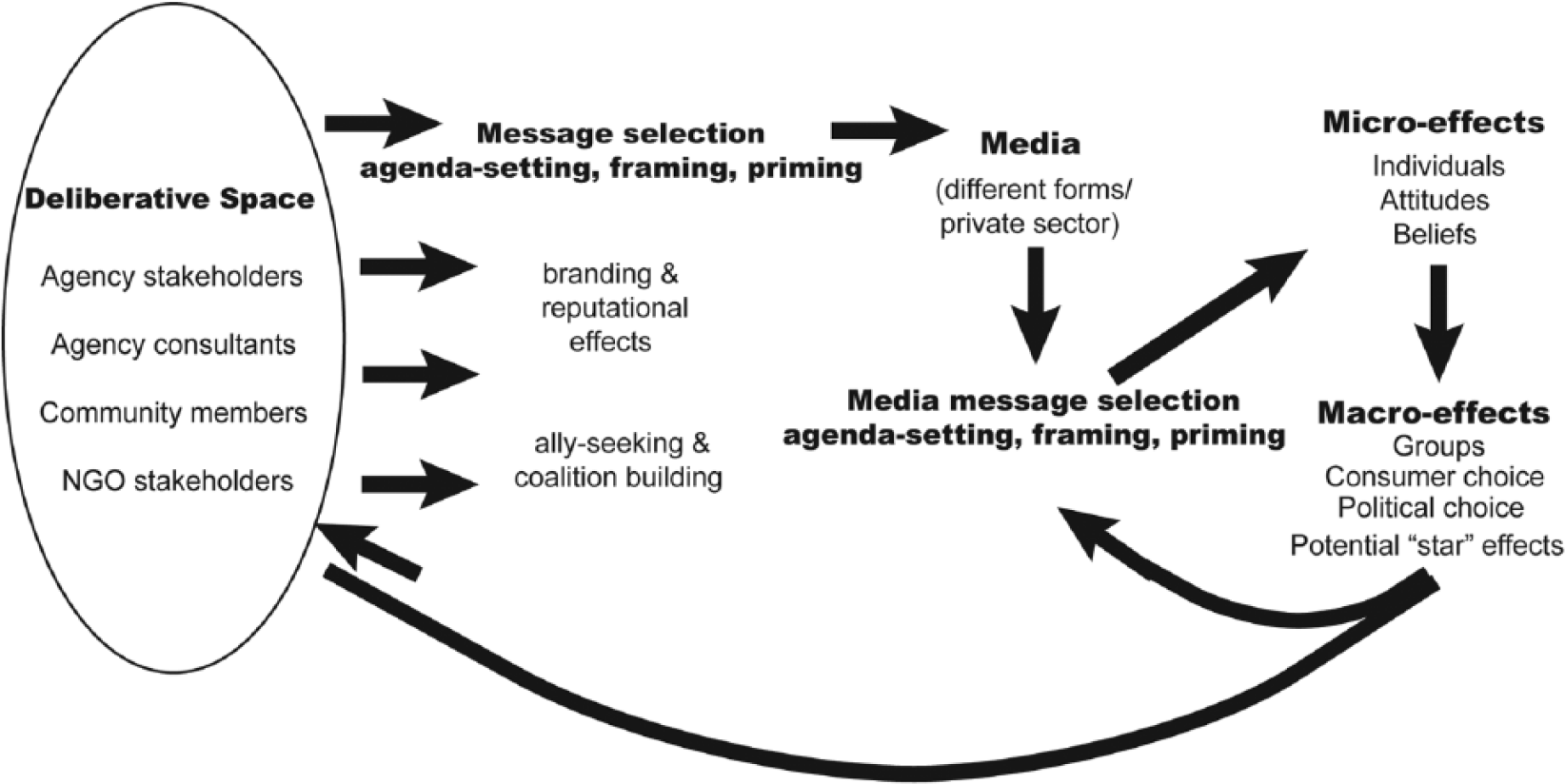
Conceptual model of mediatization and potential effects.
Agenda-setting concerns the idea that by highlighting and repeating stories, media can elevate certain concerns to a higher priority status for elected and other public leaders (McCombs and Shaw 1972; Gans 1979; McCombs 2004). With framing, journalists and other media content producers appeal to ideas and understandings that consumers already “know” or believe, consciously or not, to communicate content (Goffman 1974; Entman 1993; Scheufele 1999). Finally, “priming” concerns markers that media content contains that stress what viewers should use as standards for evaluation (Scheufele and Tewksbury 2007). As one of our informants described to us, Journalists know their audiences. They pick their frames to suit audiences. Maddow, O’Reilly, Limbaugh, . . . they are brands that increase sales to consumers with specific tastes, and every story goes through that framing process so that it’s simple to understand.
13
In a meta-analysis of the magnitude of media effects, however, Perse (2001) finds that media effects are at best mixed, with moderate, if any, effect on individuals’ attitudes and beliefs. However, the possibilities for influencing attitudes and beliefs become greater when multiple, trusted sources echo the message and when the content (a) involves vivid representations (particularly visual images) and (b) reinforces attitudes, beliefs, and understandings the individual already has (Iyengar and Kinder 1987; Iyengar 1991). Whether changes to individuals’ attitudes and beliefs, when it does happen, result in macro-scale changes in politics or political behavior also remains unclear.
Mediatizing Planning and Development Professionals
Elected officials must reach and mobilize voters, so seeking influence through the media makes sense for those actors, even if the process is hit-or-miss for them in term of outcomes. Less clear is why nonelected professionals, such as planners, public administrators, and agency consultants should adopt media logic in their own practices. One possible reason for mediatizing public professionals, like those engaged in planning and development, is the potential for career effects. By obtaining media attention, professionals can gain social status and prestige within their networks, or what Sennett (1996) has called a “star” effect. Professionals may thus mediatize to obtain influence and to gain status in elite networks as a way of marketing their accomplishments and establishing their status as elite practitioners to existing and future clients, like public agencies (van de Rijt et al. 2013; Cattani, Ferriani, and Allison 2014). Understood in this way, mediatization is a potentially high-payoff strategy that, while it may not work out, nonetheless costs little to the professionals themselves and rewards them disproportionately when it does occur.
That said, mediatization theory suggests that seeking to self-promote and market projects can have consequences for democratic engagement and development. Audience and media acceptance for messaging influence what strategies and activities political actors choose to take up specifically to have the mass appeal likely to win approval with audiences. This in and of itself does not mean that media necessarily results in corrupting or undermining democratic engagement or deliberation. But if mediatization theories are correct, it does mean that media-ready symbols, actions, and endeavors can take precedence over others less amenable to mass media. Multiple possibilities enter into mediatized planning contexts. One involves displacement: activities, ideas, and approaches that are less media-friendly, but perhaps very important, become lower priority in an effort to garner media attention, or become drowned out or marginalized as media amplify particular narratives over others. Throgmorton (2003, 127) notes that “powerful actors will strive to eliminate or marginalize competing stories, and hence will induce some planners to devise plans (stories about the future) that are designed to persuade only the audiences that most matter to them.” Again, however, given the research on media markets and mass audiences, questions remain about just how much ability any planner, journalist, or even public relations specialist has to move media markets rather than to accommodate their messages to ideas, symbols, and stories that, on the whole, are palatable to mass audiences and the media professionals that curate stories for those audiences.
Another possibility is enhancement rather than displacement. In a mediatized context, where agencies are undertaking planning and development activities in active media markets, garnering favorable attention and mass audience approval enable those agencies to conduct all their activities, even the low-profile, “housekeeping” activities, with less need for conflict management because they have secured for themselves an image among mass democratic audiences as competent, trustworthy, or even exemplary professionals.
It is possible that both enhancement and displacement occur, to varying degrees, at different points in planning and development with the media. In examining a specific case, the Woodrow Wilson Bridge Project, we seek to examine how different aspects of the project came to the fore in media, who crafted those messages, and whether both enhancement and displacement occurred.
Case-Building Method
The Woodrow Wilson Bridge (WWB) expansion and reconstruction project illustrates how groups at multiple political scales—local, state, and national—sought to provide compelling narratives to mass media outlets. This case allowed us to examine the strategies of those working on the project in the mediatized environment consisting of the US capital as it socio-political backdrop, the presence of influential media outlets, such as the Washington Post and National Public Radio (NPR), and the project’s multi-billion-dollar scale. As one interviewee with nearly thirty years of experience as a newspaper editor suggested, the Woodrow Wilson Bridge project exemplified many elements of how the media treats such development: Nothing about the Woodrow Wilson Bridge story . . . surprised me in the least. It captures the way the [news] business works perfectly. It was textbook.
14
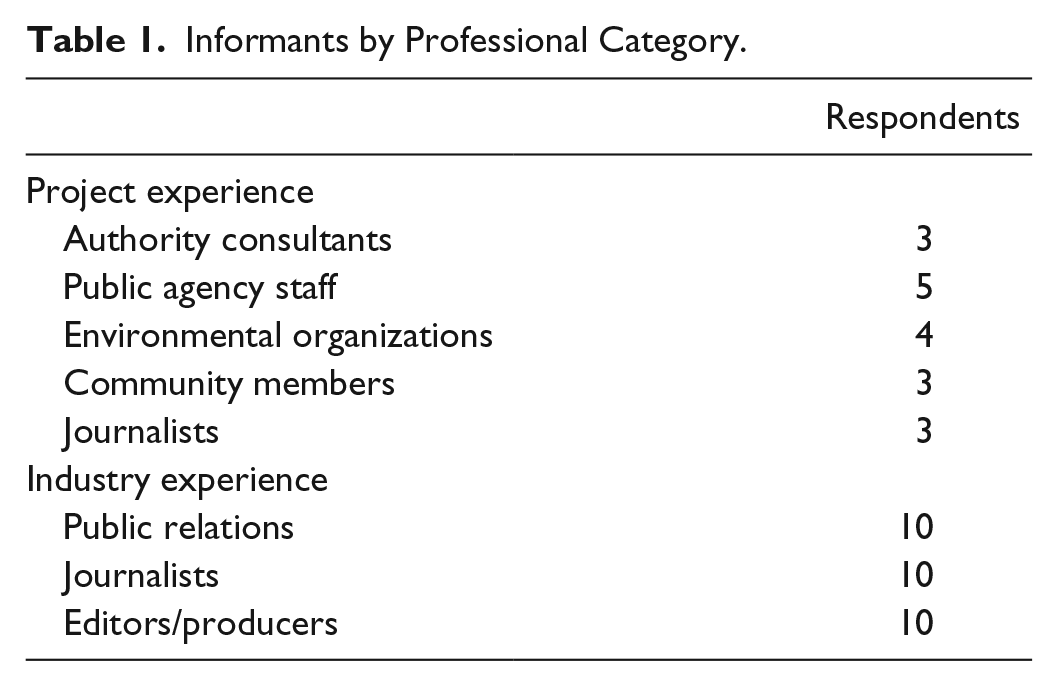
Our case draws on data from fifty-one interviews with forty-eight individuals. We spoke with some interviewees more than once to clarify points or obtain additional information. Table 1 provides a snapshot of our respondents by expert category and relationship to the project. Our sample included fifteen individuals associated specifically with the Woodrow Wilson Bridge Project, including consultants. We also interviewed environmental organization and community members. 15 We selected the remaining thirty experts from media: journalists, editors, public relations specialists, and producers. Participants associated with the project were approached by e-mail and telephone solicitation based on an archival search and subsequent snowball sample; media participants came from referrals through the Annenberg School of Communication and snowballed outward based on participants’ recommendations. The principal author conducted all interviews by telephone, which were unstructured in character and averaged sixty to ninety minutes in length. Key responses and quotes were noted and read back to the speaker for clarity.
Informants by Professional Category.
We also reviewed, archived (via DEVONThink), and analyzed records of community participation (e.g., committee meeting minutes, compilations of data from public input), government documents (e.g., plans, budgets, project proposals, environmental impact statements, and staff reports), and community organization websites. We analyzed these digital and printed materials using standard, descriptive coding methods (Maxwell 1996). We also conducted a LexisNexis search of the term “Woodrow Wilson Bridge” and examined the roughly 1,700 pages of materials that resulted. 16 Other documentary sources included the project-relevant agendas and meeting minutes of the City Council of Alexandria, VA, and Board of Supervisors of Prince George’s County, MD, and all project-related public reports, documents, memoranda, and Web pages of the Federal Highway Administration (FHWA), Maryland Department of Transportation, Virginia Department of Transportation, and District of Columbia Department of Transportation. Finally, we examined other federal documents concerning the bridge’s reconstruction, including relevant Congressional testimony and court decisions.
The Woodrow Wilson Bridge Reconstruction and Mediatization
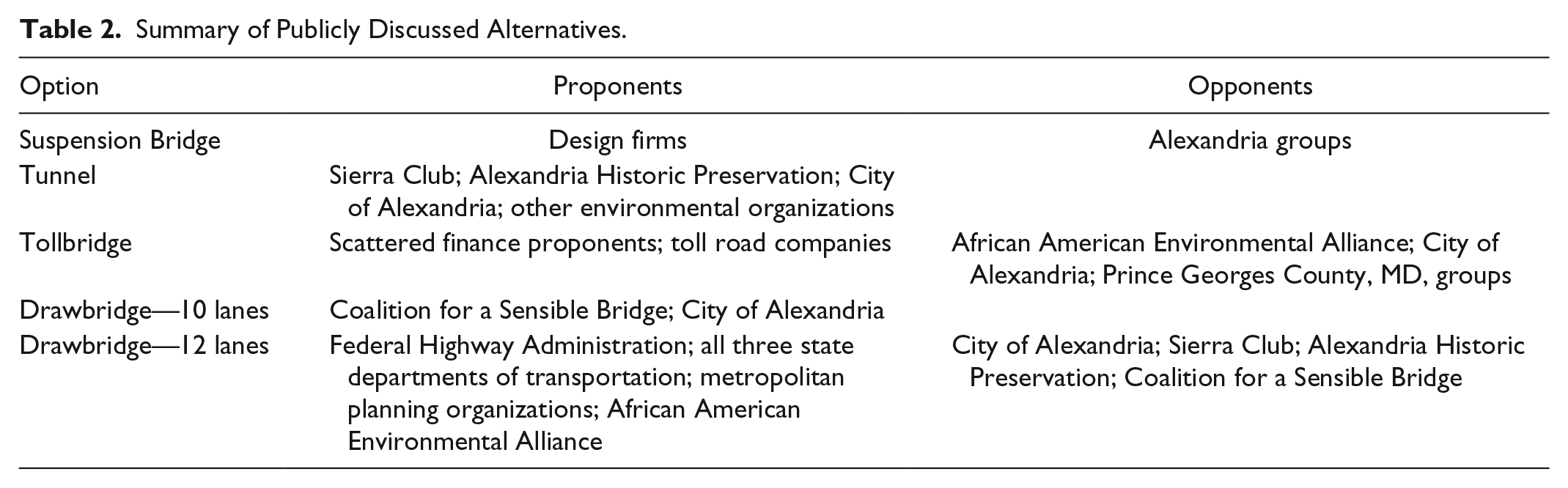
The Woodrow Wilson Bridge, which spans the Potomac River between Virginia and Maryland, is part of Interstate 95, which also serves as the Capital Beltway eastbound. Three issues arose as planning began in earnest to upgrade the aging original drawbridge (completed in 1961). Questions included whether to widen the span to alleviate congestion challenges, how to do so, and by how much. Table 2 summarizes the various proposals. Whatever the option selected, the agencies required that expansion be planned so as to continue to permit the river to serve naval and other maritime traffic (Porcari and Ybarra 1999). As discussions proceeded, many interested groups suggested alternatives, including a suspension bridge elevated such that ships could pass beneath it without disrupting automobile traffic—an idea that never gained support, due primarily to community opposition from nearby Alexandria, VA, residents (Fehr 1995). An FHWA Notice of Intent in the Federal Register on May 17, 1990, formally announced planning for the project, with a preferred alternative for a twelve-lane expansion and reconstruction. 17
Summary of Publicly Discussed Alternatives.
Opposing Agendas Go Public and to the Courts
Official embrace of a lanes-expansion alternative prompted the City of Alexandria formally to announce its opposition through its mayor, Kerry Donley, who had previously issued a formal statement arguing a ten-lane-bridge would adequately relieve congestion, while the preferred alternative, with twelve lanes, would overload local roads and break the project’s budget (Donley 1997). Meanwhile, affected Maryland governments, including Prince George’s County, and one environmental justice organization, the African-American Environmental Alliance (AAEA), expressed strong support for the reconstruction and expansion as a badly needed boost for mobility and jobs for local construction union members (MacDonald 2008).
The Woodrow Wilson Bridge Authority (WWBA) was created as a cooperative public authority for constructing the project for the Federal Highway Administration and the Virginia, MD, and District of Columbia Departments of Transportation. The WWBA published its Record of Decision (ROD) on November 25, 1997, which marked the end of the National Environmental Protection Act (NEPA) process. The WWBA continued officially to support a twelve-lane alternative. In response, the City of Alexandria joined a community organization, the Coalition for a Sensible Bridge, and the Alexandria Historic Restoration and Preservation Commission in a lawsuit challenging that option and its accompanying interchange modifications (City of Alexandria v. Rodney Slater 1999). Meanwhile, the WWBA launched a design competition based on its preferred option and hired a public relations firm, Stratacomm, and an environmental compliance group from URS Corporation to assist as the project moved forward.
In December 1998, the Sierra Club joined other environmental nongovernmental organizations (ENGOs), including the Coalition for Smarter Growth and the Coalition for a Sensible Bridge, to submit a “friend of the court” brief in support of Alexandria’s lawsuit (City of Alexandria v. Rodney Slater 1999). Among other things, the suit contended the FHWA should follow up on the implications of construction for the US Fish and Wildlife Service’s recent discovery of bald eagles nesting near the existing bridge span. In so doing, project opponents provided the story line by which the project’s public relations consultants, Stratacomm, would completely alter media discussion about the ecological effects of the Bridge expansion effort.
The Woodrow Wilson Bridge Eagles Become Celebrities
Public attention to bald eagles along the Potomac River near Washington, DC, increased after a nesting pair was identified near the Woodrow Wilson Bridge in 1998. In response, the Bridge Authority began to develop high-profile, user-friendly web tools and media relations methods for addressing environmental challenges based on the presence of wildlife or specific habitats. A key part of the Authority’s communication strategy was an interactive website map that allowed users to click on the environmental mitigation projects it was implementing, including riverbank stabilization, fish passageways, preservation of 140 acres of nearby woodland in Prince George’s County, and the creation of an 84-acre bald eagle sanctuary, also located in Prince George’s County.
Of these measures, the nesting eagles’ story achieved the greatest public salience.
18
There were more than five hundred mentions of the birds in the print, online, and broadcast archives, including national coverage of the story on the “CBS Early Show.” An Associated Press account on the nesting pair was picked up by 74 news outlets and received 143 television broadcast mentions. Nonetheless, the mega-project’s other environmental efforts often were truly innovative, whether they gained broad salience or not: The team on this project did a lot of innovative things in environmental management. They reclaimed dredge for agricultural land. I mean, this dredge was a big problem for construction . . . for decades it’s been a problem, and these environmental guys figured it out. Their solution is still, what . . . a decade later, the state of the art and projects are still reclaiming dredge. But that story, about the dredge, the project did not get much attention for it, past a few mentions.
19
Another interviewee noted that audiences did not always choose the most innovative aspects of the environmental planning effort: There was significant environmental leadership on this project. They did ecological restoration for Rock Creek Park . . . made it possible for fish populations to recover from decades of bad practices. They figured out how to avoid fish kill when driving pile in river and marine ecologies. Those were important innovations. But if I recall right . . . the project management sent out PR material on just about all those things . . . but what did they get? Maybe a mention here and there. A dull thud, mostly. The press focused on the eagles . . . that was the story people wanted.
20
A public relations specialist who consulted on the project discussed the value of the eagles as a way to frame the project in a way that audiences already understand and wanted to hear about: It’s a matter of pitching bald eagles versus pitching mud. We did a lot to highlight the other environmental programs; we did a lot of work on the environment. But the story that catches on is the one that people can relate to, that they are interested in.
21
According to the project’s spokesperson, construction workers originally named the eagles “George” and “Martha” after the first US President George Washington and his wife. Informants for the study unanimously agreed on how attractive a story the eagles were: If a project hands you something like bald eagles, you have got to use it. You’re not doing your job if you don’t.
22
Eagles named George and Martha? Inside the beltway, no less. Genius. Are you kidding me? You couldn’t make up a better story. Are you sure they weren’t robot eagles put out there by the PR team?
23
One journalist commented on how easy it is for such professionals to pursue these types of stories, particularly given mediatized agencies and staff: This story was the stuff that reporters’ dreams are made of. [Questioned on what he meant by this comment, the respondent laughed]. You don’t have to do much real work on the story . . . you don’t have to make a million phone calls and chase sources. You have a PR team lined up to supply information, and the project had a team of environmental experts who could fill in details if you need those. . . . It’s an easy-sell, low-effort bonbon of a story that readers will enjoy.
24
The initial WWBA website updates concerning the eagles reported on their basic biological characteristics as well as the scientific and design rationales for the various environmental mitigation projects undertaken with the construction, including efforts to allow the raptors to continue using their chosen nest site. But the combination of place, symbol, and animal images came together to define the project’s overarching environmental frame when the eagles managed successfully to start a clutch of eggs.
In 2004, after nearly five years of eagle watching near the bridge and with construction in full swing, the WWBA reported the birds were incubating eggs. The project set up a Web-camera so the public could observe them. Soon thereafter, the Authority and its “resident eagles” began to receive increasing attention from major media outlets, including the daily newspaper with the largest circulation in the region, the Washington Post. As more stories about the nesting pair moved into the media, project staff released updates of the birds that included captions of the eagles apparently speaking to the audience about parenting concerns in Figure 2.
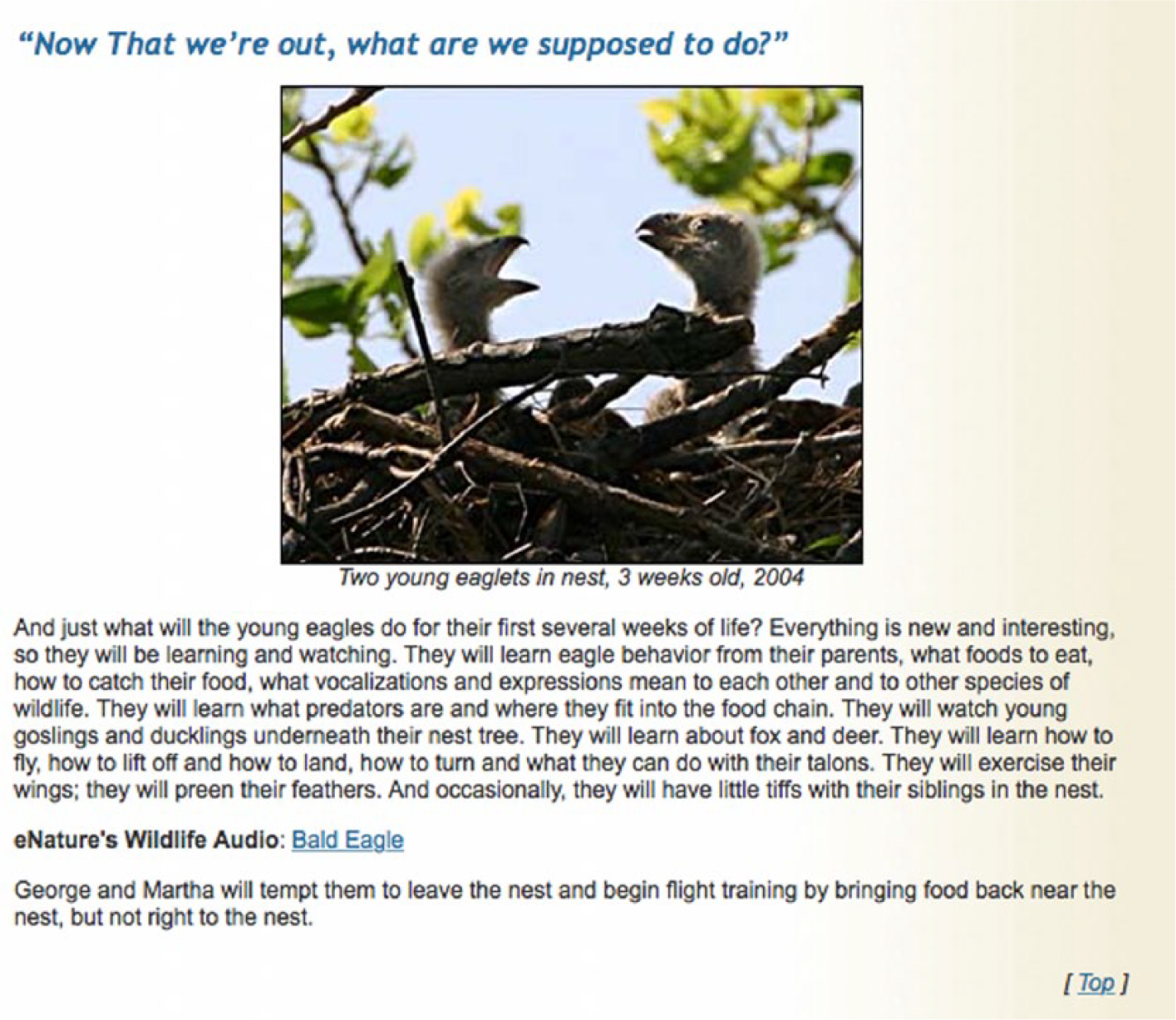
Web updates of eagles’ progress.
The eagles’ first attempt to nest was disrupted by an injury; the female was hurt in a fight with another eagle. A PR specialist with the project recounted the mediatized thinking that governed the project team’s next steps.
They found a big thirty-gallon receptacle and found Martha. She was hiding under a downed tree. That’s where she went to die. They reached down and . . . by some miracle they were able to capture her in the receptacle. It’s amazing the environmental team had the presence of mind to videotape the rescue. We had it dubbed, and we then had it delivered to all the TV stations. It got covered all over the country. . . . It was a very powerful story.
25
Those filming themselves are not public relations personnel. The environmental science team knew the media well enough to document their effort to save Martha in order to provide public relations staff with the documentary material to promote the project. This moment epitomized mediatization: the environmental science team did not just manage wildlife, they filmed themselves managing wildlife because they recognized the media-readiness of their actions and choices.
As Martha recovered from her injuries at the raptor rehabilitation center in Delaware, journalists carried forward the eagles’ stories, framed in human terms, independently of the public relations team. A transcript of an NPR interview with journalist Liane Hansen and Craig Koppie, a biologist with the US Fish and Wildlife service, has Hansen asking if George will be able to carry on as a “single parent” (Koppie 2006). Koppie managed to work in some ecology toward the end of the story: As time has moved forward, most of the optimum habitat has been taken up by eagles and now the lesser habitats, which are still available are closer towards human existences and that’s why I think we’re seeing now more of these interactions, these behaviors that we really haven’t been able to see up close before. (NPR 2006)
Public relations specialists in our interviews regarded the eagles as the only real possibility for discussing science or ecology at all, or as the means for enhancement of their ability to communicate about the environment. As project spokesman reflected, “we got a little lucky with the news cycle . . . to make sure the environmental improvements got attention. There would not have been environmental communication at all (interviewee’s emphasis) without those eagles.”
In a follow-up question for why that would be so, our informant observed: Look, people are not going to be force-fed their Brussels sprouts. Reporting just on the facts and the science. . . . It’s a snoozefest. . . . We had a good news hook, the eagles . . . and we leveraged it to have the only conversation we were probably going to be able to have to let people know about the environmental aspects of the project. (emphasis added)
26
Another communications specialist associated with the project agreed: I think the human interest and environmental stories went together [more than you suggest] . . . I wouldn’t say that the eagles story overshadowed the other stories at all. I think the eagles opened doors for us to be able to have conversations with people who never would have engaged with us had it not been for the human interest and the eagles. (emphasis added)
27
Nonetheless others associated with the project granted that the eagles served as both displacers and enhancers of the project’s other stories: Sure . . . at times the eagles were a clever smoke screen that we could use to distract people. But they also worked to get more people engaged. We would talk about the eagles with school kids . . . and some kids would start with the eagles, but then they’d get into the project’s other aspects . . . the other innovations. I really do think we maybe pushed some kids into thinking about engineering and science doing those programs, and those programs were possible because people were interested in the eagles to start with. (both emphases added)
28
We wanted to be proactive, do what I call “build up chips.” You got a project like this . . . something this size, that takes this long . . . people get tired of the construction. And bad things are going to come up. There are going to be mistakes, inevitably. The press is going to be all over those mistakes. We wanted to make sure that the things we did right got a hearing in the larger community, too. That way, when things go wrong—and man, we had some problems on this project!—but if you help people see the things you do right, they will be more patient when the mistakes happen.” (both emphases added)
29
Other, nonassociated experts backed up the public relations specialist who served on the project in that displacement occurs because of lack of interest in the more detailed, more difficult aspects of the issues: If viewers were screaming for complexity, it would come to the attention of the corporate masters, and then you would see complexity. But otherwise, it’s audience-driven.
30
With reporters, you don’t hear them clamoring for complexity, either. It takes time, energy, and work to do research. It takes contacts and time.
31
Displacing Neighborhood Environmental Opposition
As the Authority launched its public relations efforts around the eagles in 1999 and 2000, talks between the project’s staff, Virginia elected officials and the City of Alexandria continued. Those discussions ended in February 1999 when the City settled its lawsuit with the FHWA in exchange for several concessions, including $60 million for improvements to Jones Point Park near the project, a memorial and some parking spaces, and a promise that there would be no more bridges constructed near Alexandria (City of Alexandria 1999).
NGOs opposed to the project continued to pursue legal options based primarily on what they argued were inadequacies in the original environmental assessment. On April 16, 1999, Federal Judge Stanley Sporkin blocked construction on the bridge replacement based on the project team’s insufficient consideration of the requirements of the federal Clean Air Act, inadequate examination of the ten-lane alternative, unsatisfactory estimation of construction-related impacts on Old Town in Alexandria, and an incomplete inventory of properties in historic Alexandria potentially protected by the National Historic Preservation Act.
NGO representatives supporting the lawsuit considered Sporkin’s ruling a major victory. The Washington Post reported one Alexandria activist’s view of the story: “It’s been like David battling Goliath,” said Robert Montague III, chairman of the Alexandria Historical Restoration and Preservation Commission. “We are a group of volunteer citizens. We’ve been up against massive forces.” (Sipress 1999)
Montague’s metaphor was never echoed or mentioned again in any subsequent media story. Despite relatively broad coverage in regional print media for the original ruling, news outlets dropped the historic preservation story quickly, and the NGOs’ triumph was short-lived. The FHWA filed an appeal and continued with planning and design work as that petition proceeded. In December 1999, a federal appellate court panel allowed the WWBA to proceed with construction. The NGO groups appealed that decision to the United States Supreme Court, but the high court declined to hear the case. The legal challenges, at least from Alexandria-based groups, were over.
One communications specialist with an environmental organization reflected on what, in retrospect, he considered to be obvious signs of displacement: I was fresh out of school then, I didn’t quite see it, but my boss at the time did. As soon as he saw the first story on the eagles, it seemed like his attitude changed. [Interviewer asks why] I didn’t understand at the time, but I do now. The eagles . . . It’s a brilliant symbol for people to latch onto. From that point onward, the agencies building the bridge and protecting the eagles were the heroes, the guys in the white hats.
32
One community member shared his discouragement with the media’s willingness to displace community concerns in favor of the project’s messages: For me . . . just watching the Washington Post . . . (guttural sound) . . . [pause]. They string you along for a bit . . . they pay attention for a bit, but only for a bit. Then the reporters decide they like a project and the people associated with the project, and that’s it. They shut you out. They never want to hear your side again. The Post is just daily evidence to me that nobody with any power cares about what happens to people . . . or what regular people think.
33
That perception was echoed by journalists we interviewed, who agreed that opposition, as a story, generates little interest outside of the community directly affected, and majority conflicts with democratic subgroups are hardly compelling news, except when there are sympathetic communities in play: I lived on the Virginia side of the river for this whole time. . . . Everybody hated that bridge. . . . The Post might [emphasis in speech] cover some basic controversies, early on, but in the end, I’d bet most people wanted that bridge and could have cared less what a bunch of NIMBYs from Alexandria thought about it.
34
Another journalist repeated this sentiment, if a bit more sardonically: You mean people are upset that government is building a thing? Better build a shelf for the Pulitzer you’re going to get breaking that story [emphasis in speech]. There’s no novelty.
35
Our informants did not hold out much hope that social media or other online venues would offer ready avenues for protest or voice among those less linked in to traditional media than project agencies and professional public relations staff: Sure, it’s easy to put up a blog, but you better have started that blog in 1996 . . . because otherwise, you will be blogging for your mom and nobody else . . . your message is just lost in the noise on the internet. There is an audience-driven hierarchy of outlets on the web . . . you need to get the attention of the gate-keepers there, too.
36
I think it is possible [emphasis in speech] for social media to work for the “underdogs,” that’s what you are asking, right? [interviewer says yes] Social media, camera phones . . . those are changing journalism, a lot . . . but even with those, the story has to be poignant in some way for people to pay attention. This story here . . . these are just people put out by a bridge. It’s an ordinary conflict by every standard, online or traditional media.
37
For those residents of Alexandria who hoped to have influence, their problems just were not spectacular enough for most media outlets to continue the story.
A Second Environmental Agenda–Setting Effort: The National Wilderness Institute
Public relations staff we interviewed agreed that while government agencies do seek to benefit from positive media coverage, environmental groups and nongovernmental organizations use their communications staff in the same way. One example to which four informants directed us was a 2001 National Wilderness Institute (NWI) lawsuit. NWI of Washington, DC, charged in its filing that construction and dredging associated with the Woodrow Wilson Bridge and another project, the Washington Aqueduct, would threaten several endangered species. The NGO contended that such claims routinely block infrastructure and land development plans in western and rural locations, but in this case in Washington, DC, the Environmental Protection Agency had looked the other way. 38
Interviewees pointed to this episode as an example of how NGOs use public projects to gain access to mass media solely as a means for enhancing their own communications: All those . . . interest organizations. . . . They have their own public relations strategies. They are suing to show their donors and constituents that they are doing something, scoring points against the big-bad construction industry.
39
For PR for an organization like Wise Use, you want to get in, score a few points, get out. Nobody who supports you is paying attention other than . . . did they stick it to those East Coast bastards? Check. Did they scream and yell about the Endangered Species Act? Check.
40
We had thousands of pages of environmental discovery on all the species they claimed we never studied! They stick the taxpayer with a huge bill so they can get [their story out there].
41
The NWI lawsuit was dismissed and the organization disbanded soon afterward.
George the Eagle Becomes a Widower and Tabloid Story
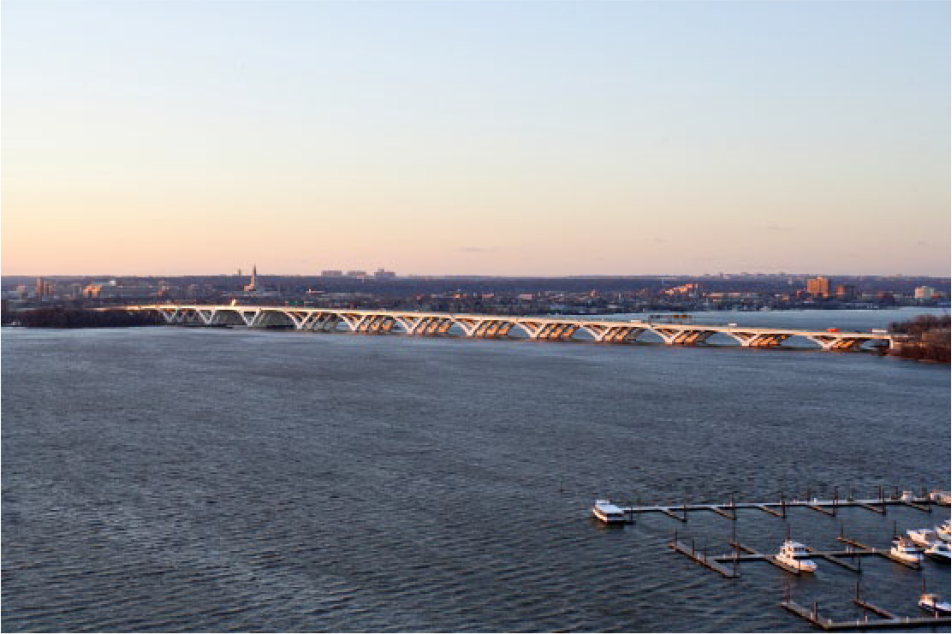
The WWBA finished the span’s reconstruction on time, and the newly expanded Bridge was scheduled to open in August 2006. Figure 3 shows the finished bridge span.
The completed Woodrow Wilson Bridge.
Just as those events came together, another drama associated with the project’s wildlife stars began to unfold. After Martha’s rehabilitation, she was released, accompanied by the cheers of WWBA construction workers and Washington Post reporters. However, soon after she collided with a power line and was injured badly enough that veterinarians decided to euthanize her. The WWBA press release, headed with the words, “In Memoriam,” reflected a genuine human–animal bond that had formed over the time the Bridge’s environmental managers and public relations staff had watched over and reported on the nesting eagles. Both the Washington Post and the NPR reported the story of the eagle’s death. One of the journalists recollected: I had been living in San Francisco for maybe five years by then. . . . I hadn’t seen a bridge story in I don’t know how long, and my mother called to tell me to check out the NPR story when they decided to put Martha down. My mother was so upset. Those eagles . . . they meant something to her. I think lots of people felt the same way as my mother did.
42
This abiding interest resulted in media coverage of the eagles for several more years as the younger female with whom Martha had originally fought moved in and began a courtship with George. This time, the anthropomorphism and connection to celebrity culture could not have been more apparent as the Washington Post described the eagles as the “Brangelina”
43
of the Wilson Bridge’s Bald Eagle Set: Martha is scarcely cold in the grave, and George has already shacked up with another bald eagle. Worse: It’s the nest wrecker who tried to peck to death Martha, George’s longtime mate and the mother of his 16 eaglets. Even the brawny bunch of construction workers on the Woodrow Wilson Bridge project near the eagles’ nest are aghast. They call the younger bird in George’s life “Camilla,” “Angelina” and “Charlotte the Harlot.” “George has taken a second wife,” said John Undeland, spokesman for the bridge project. “He’s moving on with his life.” (Deane 2007)
The animals were now framed as in a tabloid human drama rather than as a separate species.
When the bridge was set to open, our interviewees concurred about the WWBA’s media strategy and its benefits for the agencies and professionals involved. The eagles, as the centerpiece story from the project, lent the entire project a broad and sustained interest from journalists. That interest helped leverage other media opportunities for the project and its team.
44
One public relations specialist, impressed at the awards the project had garnered, described the eagles as key to opening more and more doors within the media: By highlighting the eagles the way they did, they found a story that they could revisit again and again, to keep people interested. There’s only so many people who care about your giant feats of engineering. People got attached to the project because of the animals . . . and that attachment kept the media coming back to the project team for more. Attention begets attention in this business.
45
Professionals both with and external to the project attested to the project’s “star” effects for the individual practitioners as well: The Wilson Bridge was the project that made my career. It’s that simple.
46
This project was a gold standard for media relations. People in the industry definitely noticed the project spokesman and how he made stars out of his experts. There was that one environmental management guy, I don’t remember his name, but he was a great interview, too. He was young and good-looking . . . and just as smart as a whip, too . . . could think on his feet. His face time with journos was personal branding for him and free advertising for the company that employed him.
47
Others emphasized the connections between star status, smooth media relations, work quality, and innovation.
We got a lot of media attention, and I think much of it was deserved. It isn’t just that the PR team managed the media well. It’s that the whole team did great work. It was one of the best teams and best projects I’ve ever worked on, and I still miss it, if you know what I mean by that. [Interviewer says that she does understand.] I also think the great work . . . I think the great media relations enabled the great work. By keeping things positive, the environmental and construction management groups were able to experiment with cutting-edge techniques that worked instead of having to fear failure, and then getting chewed up by the media . . . and then the politicians.
48
Conclusions
Once the eagles were in play, the other environmental and social questions were over . . . at least as far as most media actors were concerned.
49
Selling plans has a long history; perhaps most famously, Daniel Burnham commissioned talented artists and astute marketers to put his plan for Chicago in leather-bound copies for his fellow urban elites (Smith 2006). Even so, today’s planning and development occurs in tandem with 24/7 media cycles, with vast repetition and overlap, so that story-telling occurs in ways that planning professionals have never before encountered. We have examined how animal imagery and related storylines emerged as a major narrative in the controversy surrounding expansion and reconstruction of the Woodrow Wilson Bridge, in an effort to understand how mass media engagement either enhances or displaces information about development conflicts to mass democratic audiences. Our case suggests that (a) the practitioners associated with the project engaged in mediatized behaviors that (b) framed appealing narratives in readily understood ways so that (c) both elite and popular audiences would primarily see the stories from the perspective the project’s expert principals advocated, rather than alternative frames from nonexperts outside the WWBA. Throgmorton’s decade-old call that “planners’ stories will have to make narrative and physical space for diverse locally grounded common urban narratives” (2003, 146), in this case, occurred in deliberations staged within a mass media market distinguished less by diversity and orientation to specific places and more by a ready alliance among state agencies, experts, media specialists, and democratic majorities.
We do not contend that the way in which the WWBA handled its media relations solely determined the project’s implementation. To be sure, too, the WWBA forged significant environmental innovations as a part of its implementation effort, which is one reason why the project succeeded in maintaining their crafted message about the environment. They developed solutions for multiple, difficult environmental problems. Yet those advances did not reach mass audiences. Instead, as a project manager noted, “audiences sort themselves, and the other environmental stories still got play with technical audiences—engineering audiences. Those specialized audiences are important, too, even if the information doesn’t get to mass audiences.” 50
But our case suggests that the mass media engagement on the part of the project’s professionals served to de-politicize potential conflicts during implementation. For those employed in building the project, that de-politicization was perceived largely as a positive thing, as a means to allow them to get on with getting the project done without loss of political support or funding. Nonetheless, political conflicts can be productive to the degree that those can ensure greater accommodation for the interests of democratic minorities seeking greater influence over what is going on in their neighborhoods. The project’s media team effectively displaced opponents once they had pressed their initial set of environmental challenges concerning whether to pursue a tunnel rather than a bridge, in no small degree by crafting a strong environmental profile for the project among mass audiences through a focus on the eagles. The high-quality environmental innovations created during construction nevertheless occurred in what would turn out to be a facility with much greater vehicle capacity than Alexandria community opposition wanted. The new and good environmental aspects in construction, along with the media amplification of those innovations, enabled the agencies to retain a larger project that expanded vehicle throughput.
The WWBA public relations team forestalled opportunities for environmental organizations to take a high-ground position relative to the project’s most evocative environmental symbols, the eagles, by associating them with the project and the state agencies. The bridge replacement effort and its management were presented positively, time after time, in such mass media as the Discovery Channel and the Washington Post, while the project’s environmental and community-based opposition only infrequently found ways to entice regional media outlets to report their perspective at all, let alone in a sustained manner.
Despite the possibility that experts might use media to share more complex messages about policy and planning issues, the potential for displacing, as well as enhancing, deliberation appears to be real if our case is any indicator. Long-term, more intractable development concerns about increased vehicle throughput left the media content during construction and implementation. Social media and self-publishing, moreover, appear to offer a chance, but a small one, that community members will be heard among audiences external to the project unless there is something exceptional going on, according to our informants.
Perhaps the lesson is that planners and community organizers should become more adept at mediatization themselves. Certainly, our interview participants attested to the personal branding and career effects that echo those reported by Flyvbjerg (2012). Hajer (2009) has suggested, for example, that performance and drama as political argument offer a greater diversity of participation because theater, photography, and imagination provide far more opportunities for democratic engagement than science, urban planning, or environmental management discussions ever have due to the latter fields’ reliance on credentialing and expertise.
Our case, however, did not evidence that possibility. Throughout this conflict, environmental and nature narratives framed in dramatic human tropes did trump media take-up (in terms of publication and video numbers) for those stories with more complex scientific and ecological concepts, even though the public relations staff prepared press releases on virtually every environmental innovation associated with the project. But those simple stories were still the experts’ stories for the most part. None of those we interviewed believed that mass audiences or the media targeting those audiences particularly wanted complex, conflicting, or community-defined stories of the Project’s environmental impacts. Moreover, none of our journalist and public relations experts were hopeful that this situation would soon change in mass media outlets.
Instead, this case suggests that mediatization can reinforce existing status hierarchies between experts and nonexperts and between democratic majorities and place-based, democratic minorities. Experts appeared all over the media stories; nearly 40 percent of the Washington Post articles from the mid-2000s onward included quotes from project experts, second only to quotes from elected officials. But even the experts who hoped that the media coverage enhanced dialogue noted that much of what media reported concerned simple, straightforward stories that affirmed agencies’ and consultants’ perceptions of the project’s efficacy.
Planners may have a unique role to play in helping to even the playing field between the necessary complexity and dissent that must be addressed via deliberation and the epistemic demands of mediatized planning in a highly charged political environment in which different groups enjoy differing levels of media access and communications expertise. But such can occur only if planners envision their own roles somewhat differently than an unreflexive turn to mediatization would suggest. Communications and business schools are full of bright people capable of handling public relations and “selling” projects. Planners hardly need to take up those practices, save for the professional advancement potential. Instead, planners might distinguish their own professional engagement with the media by privileging access to their content among journalists who practice participatory journalism that engages with community members in storytelling, by referring journalists to community leaders as sources as often as planners themselves speak as experts, and by reaching out to geo-ethnic and independent media as vigorously as seeking “exposure” through broad, corporate media (Chen, Ball-Rokeach, and Parks 2010). All of those strategies, though potentially useful, assume planners have both the ethos and the leverage to direct media efforts to multiple democratic actors and perspectives. They may not. New media technologies and markets portend changes in planning practice far more complex than those faced by Daniel Burnham and other media-savvy self-promoters and marketers of yesteryear.
Footnotes
Acknowledgements
Many thanks to our editors and reviewers and to comments from USC colleagues David Sloane, Martin Krieger, Nicole Esparza, Jovanna Rosen, and Sarah Mawhorter.
Declaration of Conflicting Interests
The author(s) declared no potential conflicts of interest with respect to the research, authorship, and/or publication of this article.
Funding
The author(s) received no financial support for the research, authorship, and/or publication of this article.