







Abstract
Scholars typically categorize pop-ups as part of insurgent do-it-yourself (DIY) movements or simple creative placemaking events. It is unclear if these dominant narratives are accurate representations or how these acts of temporary urbanism are connected to planning. This study serves two connected purposes: to identify how pop-ups are organized and explore how pop-ups combine political art and urbanism to create opportunities for civic engagement and public participation. Drawing on a national sample of principal cities and a comparative study of exemplar art pop-ups in Austin, Baltimore, and Boise, this research addresses how pop-up organizers influence urban planning and urban policy from outside traditional channels. Findings suggest that these events are undertaken by diverse sets of organizations and partnerships to increase civic dialogue and educate citizens. The prevalence of pop-ups in public space and their focus on urban issues suggests the need to integrate these complementary strategies into planning practice. More broadly, the study shows that art pop-ups can be a legitimate form of urban planning rather than performing purely as urban entertainment.
Introduction
Temporary urban revitalization, frequently labeled as pop-ups (POP), is increasingly popular in the United States, inspired by the dual and often competing efforts of international participatory democratic activities supporting the “Right to the City” movement and civic booster efforts championing “Return to the City” economic growth agendas. A pop-up is an ambiguous term falling under different rubrics of urbanism, whether guerrilla (Simpson 2014), informal (Mukhija and Loukaitou-Sideris 2014), insurgent (Hou 2010), everyday (Chase, Crawford, and Kaliski 2008), tactical (Lydon and Garcia 2015), do-it-yourself (DIY) (Talen 2015), or extra small. Scholars are moving from largely superficial portraits to more robust renderings by capturing motivations, intentions, and outcomes. While they debate interpretations of formality, intentionality, legality, and structure, their work marks important progress in capturing the pop-up ethos. However, limited knowledge exists on how temporary political art combines with some form of urbanism to increase civic engagement and civic literacy around planning issues. This study shows how art pop-up organizers orchestrate their events as a democratic method for creating change through highly visible and often entertaining political performances in the public realm. While planners generally treat these events as simple creative placemaking endeavors, the organizers envision their role as complementary forms of planning engagement that happen outside of traditional planning channels.
While some temporary performances are for pure enjoyment, marketing, or commercial enterprise, others are politically motivated statements communicated through choices about spatial location, activity offerings, organizational structure, and partnership mix. From the perspective of organizers, the nature and level of the political act sits on a spectrum from educating participants to organizing protests. The level and awareness of engaged political talk also varies when considering the diverse set of people involved, whether it is the organizers, funders, participants, or policymakers. In this paper, I focus on pop-ups as a form of tactical urbanism that champions short-term action for long-term change. Examples include advocacy groups transforming wide streets into parklets to advocate for public space, health officials organizing food truck rallies to highlight food deserts, neighborhood residents seedbombing vacant land to create flower gardens, and grassroots organizers painting illegal bike lanes to protest auto-dominated streets, among others. They offer a complementary form of public engagement that is small scale and incremental in nature, highlighting places, people, and interests that market forces and policymakers often overlook. As Lydon and Garcia (2015) note, this intentionality to influence policy and market dynamics sets these pop-ups apart.
My research focuses on the nexus between public art and tactical urbanism where organizers use these pop-ups to challenge conventional planning narratives, processes, and projects. While planners promote public art for creative placemaking, the planning field has struggled to integrate public artists or arts experts within public planning and civic engagement processes (Markusen and Gadwa 2010a). Some art pop-ups are part of a broader movement to leverage arts, culture, and design in our city for economic and community development ends. The focus is not just about generic arts participation (e.g., how many people visited a museum in a cultural district) but the way that art and design can suggest an alternative future by drawing on insights and knowledge from everyday people or those who have been underrepresented or ignored (Bedoya 2013).
To contribute to the pop-up conversation, I ask: How are pop-ups employed and organized in the United States? How do pop-up art organizers use public art and public space to build local planning capacity and increase civic engagement? How should planning practice and education respond to this phenomenon? I develop the first national database of principal cities on tactical pop-ups and highlight partnership structure and organizational form to show pop-up complexity and motivation. To complement this broader picture, I conduct a comparative case study of exemplar public art pop-up efforts designed to influence planning and urban development in three different cities: Austin (TX), Baltimore (MD), and Boise (ID).
Findings show that despite common perceptions, pop-ups are widely used and involve participants from commercial, nonprofit, and community sectors who work independently or collaboratively to support a diverse range of motivations. The three cases reinforce and expand the macro-level data by showing that public art pop-ups act as a forum for public engagement where organizations use temporary programming to propose alternative futures, protest current urban development practices, pilot test new ideas, and initiate community conversations about urban issues. These interventions mark an outlet for democratic engagement that is not fulfilled by traditional participation outlets. At its most basic, pop-ups are a complementary strategy for planning communication that transcends a single planning theory as a method of political “talk” through “visual” performance in urban space (Innes 1998). Research findings support Silver, Scott, and Kazepov’s (2010, 453) suggestion that “rather than seeing participation as either consensus-building or conflicts of interest, as either a top-down or bottom-up process, that it can be all of these.” Pop-ups offer a pragmatic way to communicate how everyday people feel about their streets, neighborhoods, and communities.
Literature Framework
Pop-ups are a relatively new area of study, but most peer-reviewed research focuses on DIY efforts that emphasize the individual or highlight a small set of citizen activists and their “small” efforts to protest urban investment and decision making through sanctioned and unsanctioned acts. 1 Talen (2015) deftly shows how these DIY pop-up efforts, rooted in the early twentieth century, pit grassroots civic agents against top-down formal planning visions. From a contemporary perspective, Colomb (2012) demonstrates how these insurgent ideas in Berlin are appropriated by public and private marketing bodies for pro-growth agendas. Many of these studies argue that the DIY actions are a symbol or reaction to an unjust and uneven city where these politically minded citizens target public or quasi-public space (Hou 2010; Talen 2015). These grassroots activities reinforce the use of public space where “political power [is] staged, displayed, and legitimized” (Hou 2010, 3) by outsider groups who have been marginalized or excluded from planning and development conversations. The few outcome studies that exist suggest that the DIY efforts are “small experiments” and have yet to give “birth to a more democratic city” due to political and institutional constraints (Iveson 2013, 955).
While these scholars embody robust philosophical interpretations of formality, legality, temporality, and purpose, they overlook the fact “not all DIY urbanism efforts are tactical, and not all tactical urbanism initiatives are DIY” (Lydon and Garcia 2015, 7–8). Lydon and Garcia (2015) provide the beginnings of a framework for understanding who is undertaking POPs. They not only identify the “Right to the City” citizens who “bypass conventional project delivery process and cut through municipal bureaucracy by protesting, protesting, or visually demonstrating the possibility of change” but also highlight city government, developers, and nonprofits who use the tool to build citizen interest or test projects that are in “phase 0.” Their basic framework is a useful start, but it also suggests the need for more complexity when considering who undertakes these POPS and why, including gathering more information about partnership structure, viewing the municipal government apparatus as multiple entities with different interests rather than a singular voice, and uncovering the role of participants and funders.
Additionally, the existing research sidesteps the relationship between arts, urbanism, and planning. Despite the rich history of art performance as a social agent for change in urban politics scholarship, most planning and public art research sidesteps the role of arts in civic engagement and public participation. 2 This intersection between urbanism and civic arts is an area that planning struggles to address despite a deep history and evolution of urban arts revitalization in the United States related to workforce development, anchor institutions, creative industries, and City Beautiful efforts (Ashley 2017). Many contemporary planners are not trained to use art and culture as a tool or strategy. However, planners have shown a recent interest in creative placemaking initiatives, which is spurred by generous grants from the National Endowment for the Arts, national arts organizations, and private foundations. The arts philanthropic sector, following the lead of the federal government, has invested significant resources into initiatives that integrate the arts and culture in urban planning. This has partly been done to include the arts in a broader political agenda and be able to advocate for more funding for the sector. Arts advocates have been able to lobby for more funding for the sector by showing that the arts (i.e., artists and arts organizations) are important to our cities.
Creative placemaking in practice focuses primarily on public art as a bricks and mortar strategy. Here, pop-up public art is an attractive program for civic boosters who argue that these beautification interventions are good for tourism and attract educated workers despite criticisms that such public art supports pure growth and not equitable development (Eisinger 2000; Strom 2008; Whitt 1987). Planners employ simple placemaking efforts to “set the table” for development or as a way to attract the coveted creative class through arts and culture amenities like bohemian neighborhoods, arts and culture districts, or adapting historic buildings through urban design. These are the places where planners are more comfortable, particularly with public realm design. They collaborate with consulting firms like Projects for Public Spaces (PPP), who share information on design principles and best practices, including “Ten Strategies for Transforming Cities and Public Spaces through Placemaking” (PPP 2014), or provide guidance to community members about how to evaluate sites through their popular Place Game (PPP 2016), which examines sociability, accessibility, safety, and activity.
However, critics caution against “opportunistic placemaking” (Lydon and Garcia 2015) that focuses more on beautification and marketing than using public art and public artists to engage citizens around planning issues. The placemaking critiques underscore the tension between how public art is used by traditional planners who work in formal channels and people outside of planning who desire to influence the planning process. Current creative placemaking efforts are helpful ways of conceptualizing, designing, and evaluating public space, but they are relatively neutral in action and are more about outcome than process. It is less about using art as a language and civic engagement tool for the public to express their ideals or values around planning decisions. Carp’s (2004) research thoughtfully explores how different public art planners can negotiate or create the boundaries for public participation by examining public/community interactions, physical planning access, and project ownership. 3
Carp’s work carves out a generous space to study the politics of public art and the use of public art as a type of political or civic theatre (Faga 2006). Public art as a political act is well understood as recently epitomized by Banksy’s dystopian Dismaland in London; however, there is less knowledge about how public art that is political can influence urban planning. Art pop-ups are political acts, whether they are overt and take on the form or protest or unassuming entertaining events to inform the public on a planning issue. These pop-ups often occur in public space and public forums that provide a site for arts-led civic participation and democratic debate. Whether it’s arts economic or arts community development research, the urban politics literature largely centers gentrification where artists are most often the victims (Zukin 1989; Murdoch, Foster, and Murdoch 2016) and sometimes the invaders (Wolf-Powers 2005) rather than the use of arts for increasing civic literacy and engagement.
In part, this is an understudied area because pop-ups often involve players from outside traditional planning channels. Brabham (2009) labels the information gleaned from strategies like tactical pop-ups as “non-expert knowledge while others conceptualize it as participatory, deliberative, inclusionary, or ordinary democracy” (Silver, Scott, and Kaplzepov 2010, 453).
As Ashley (2015), Grodach (2009, 2011), and Markusen and Johnson (2006) note, urban arts development is often led by nonplanners, including art nonprofits, community-based organizations, or municipal departments specializing in art and culture or economic development. Grodach (2009) argues that many community art spaces are an overlooked public space where they not only present or exhibit art but serve as schools, outreach centers, and community gathering centers. Such physical spaces and buildings “build on local assets to enhance community involvement and engage in neighborhood improvement projects” (Grodach 2009, 475). Arts and planning scholars (Grodach 2009; Markusen and Johnson 2006) also move beyond the physical form and look at understudied actors, including community-based arts institutions and artists’ centers, and how they inform urban planning and policy or contribute to the economic and community health of the neighborhood, city, and region.
My study expands on these understudied actors, organizations, and partnerships that seek to inform urban life whether directly or indirectly by looking at a national picture and then focusing a single approach, the art POP. These art POPs are often housed in the type of community art spaces that Murdoch, Foster, and Murdoch (2016) outline or the spectrum of public and quasi-public spaces everyday urbanism represents, whether that’s a street, conventional art space, non-art building, or interstitial or hidden space (Chase, Crawford, and Kaliski 2008). My study adds to this conversation by providing more nuance, complexity, and robustness to these urban actors that seek to shape urban planning and policy.
Overall, evidence remains mixed about whether tactical pop-ups influence local planning capacity and urban development policy. As with new social media tools, it is also unclear how formal public planners “consume” this outsider information and whether they have the knowledge or political will to balance public input from different participation strategies and “publics” (Bryson et al. 2013; Umemoto 2001). Thus, it remains to be seen how planning, in its “technocratic and output-oriented notion of ‘good governance’” (Silver, Scott, and Kazepov 2010, 453), takes into account civic engagement efforts structured outside of traditional, formal planning boundaries or at a broader level, how public arts can shape planning.
Thus, my research answers Iveson’s (2013, 942) call to consider broader trends, agents, meanings, and outcomes for these “cities within cities.” To further connect tactical pop-ups to political performance and participatory engagement, I also follow Carp’s (2004) direction to study the difference between public art and planning. I pay special attention to public art pop-ups that play a planning function even though they are not formally viewed as such. These POPs are a viable and important area of planning study as these tactical groups are using urban space to craft their own form of public participation and civic engagement that questions public investment and decision making.
POP Patterns and Trends
A handful of researchers and practitioners have developed typologies for pop-ups and couched their work in specific urbanisms as laid out in the literature review. However, few scholars have identified broader trends or connected broader trends to a microlevel analysis. For this empirically driven study, I developed a database of POPs in the 30 largest city-regions in the United States and included others that were identified during the exploratory data phase. The database helps identify POP trends and capture patterns of activity to supplement the largely case study research of POPs. Between September 2013 and August 2014, I searched individual markets, newspaper dailies, and alternative weeklies using the terms pop-ups, guerrilla urbanism, everyday urbanism, tactical urbanism, open streets, better blocks, do-it-yourself, pop-up art, parklets, and temporary urbanism. 4 Drawing on textual analysis, I synthesized the search outputs to identify those POPs that had an explicitly stated political motivation to influence or shape urban planning and urban investment as defined by the tactical urbanism agenda (Lydon and Garcia 2015). 5 While a number of variables were considered, the ones that were prioritized included project type, organizational type, and partnership type. 6 The final database includes 219 observations.
The sample is conservative because it favors organizations with the resources to have an Internet and social media presence, and it likely overlooks hyper-local POP activity where grassroots or word of mouth is the primary mechanism of event sharing. Despite these limitations, the database is the first overarching sample that offers insight into different POP factors and also underscores their presence and magnitude. The purpose of the database is not to say that one characteristic of POP is more prevalent or more important than another; rather, the objective is to show the breadth and depth of pop-ups and the complexity of organizational structures and partnership type.
Exploratory and textual analysis of the POP sample shows several key findings as it pertains to planning research, practice, and education. First, POPs are not isolated experiments; rather, they are diffused and activated across metropolitan regions in principal cities rather than suburban or lower density communities (Figure 1).
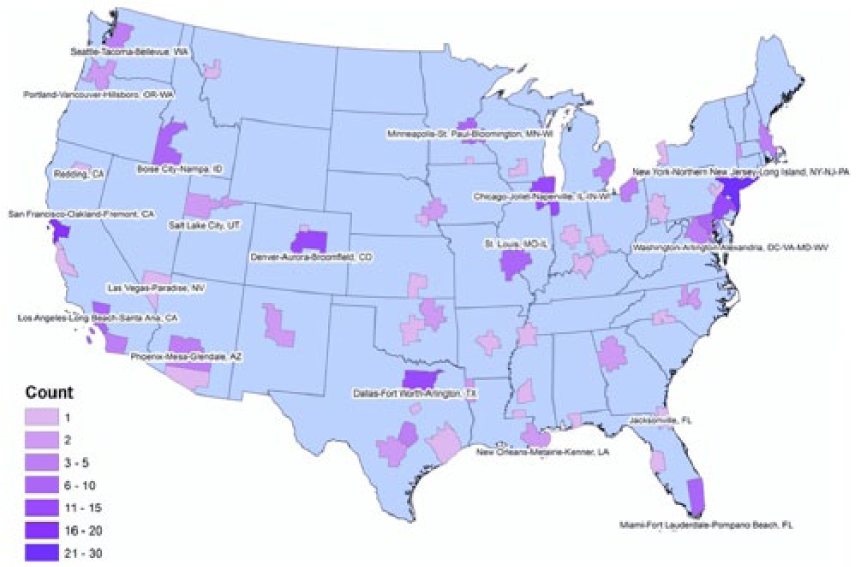
Pop-up diffusion and magnitude in top U.S. metropolitan statistical areas.
Second, organizations typically engage in eight different POP types, which reinforces the qualitative observations that Talen (2015), Iveson (2014), Hou (2010), and Mukhija and Loukaitou-Sideris (2014) have identified in their analyses on tactical, informal, and insurgent urbanisms. The first is public art installations, which can take on a variety of features, whether it is using public art to activate vacant buildings or convert underused public space such as alleys into a different purpose. The second is better blocks/complete streets, where auto-dominated streets are transformed to show what a multimodal street would look like or how to enliven streets through greening, infrastructure, and street furniture. The third is a ciclovia, closed or play streets where these streets are closed to cars and opened to pedestrians, bicyclists, and skaters as a call to create more open public space. The fourth is festivals, which while a broad term, centers on the use of such events to articulate a position on urban development policy. The fifth is garden and community space, where the term is broadly conceived to consider food deserts or food access as garden projects, which involve a range of initiatives, including seedbombing or occupying vacant lots with temporary gardens as well as using pop-up restaurants and food truck rallies to protest underused space. The sixth type is guerrilla wayfinding, infrastructure, and public space, where illegal or unsanctioned methods are used to protest rules and policy guiding public space. This can include illegal bike lanes, speed limit signs, and chair bombing (putting seated infrastructure in places to create open space). The seventh type is mobile labs and stores that seek to educate people about urban development policy or try and bring activity and awareness to abandoned areas. The eighth type is parklets, where people protest the lack of parks and open space by turning parking spaces into impermanent parks. The ninth type is shipping and storage conversion, where storage, dumpster, or shipping container spaces are turned into a variety of uses such as swimming pools to offset urban heat problems, retail stores in vacant parking lots, and affordable housing. The tenth is street furniture where communities are adding movable street furniture to “odd” places, such as chairs that can be attached to scaffolding. These POP types and their respective physical locations provide a framework for how activists use and claim public space.
These diverse set of initiatives employ pop-ups as a performance vehicle to tackle a range of issues spanning community development, economic revitalization, equitable development, social justice, public health, and affordable housing within urban development (Table 1). The largest target area is activating space (74; 33 percent), with community development at second (47; 21 percent), followed by public health (32; 15 percent). Yet despite these prolific target areas, the data show that POPs do focus on urban space either as a POP site or a topical area. Even though most projects involve more than one motivation, they still often pursue a primary target or goal.
Organizational Motivation for Implementing Pop-up (POP) Strategy.
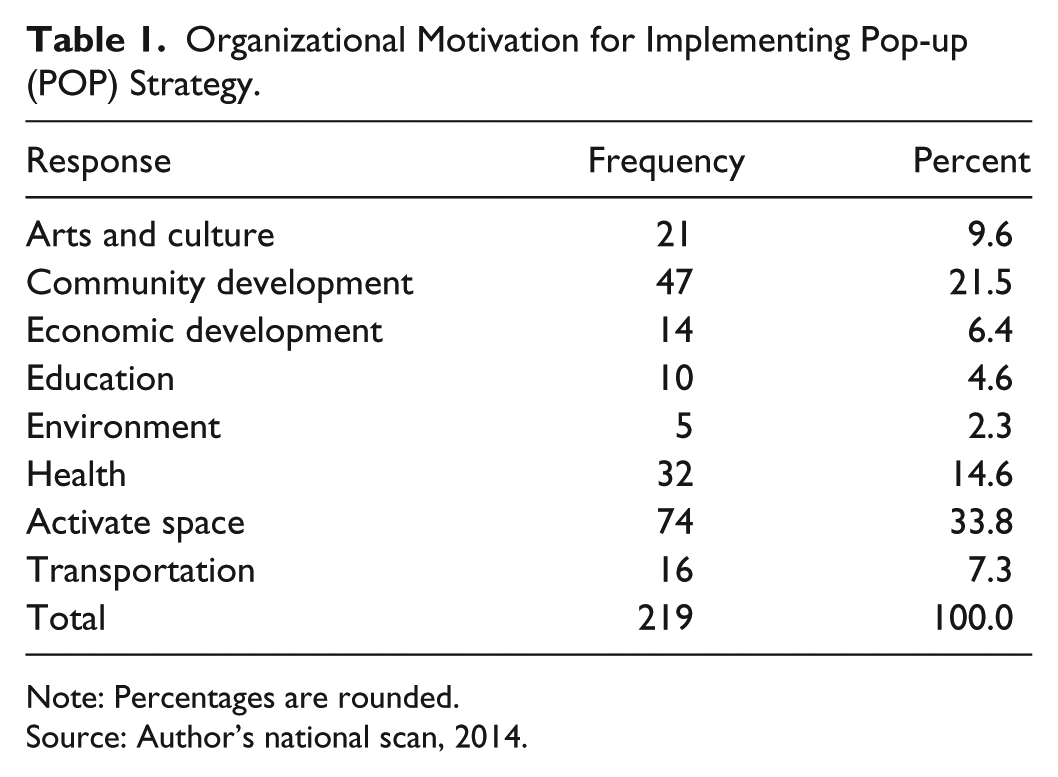
Note: Percentages are rounded.
Source: Author’s national scan, 2014.
The current literature focuses on POP connectivity to guerrilla, DIY, and everyday. The common narrative is that it is led by the average citizen or community organization rather than through a private or public entity (Table 2). The sample data show that there is a much wider spectrum of organizational engagement. Many efforts are often sanctioned and part of public/private partnerships and/or civic collaborations in the broadest sense. The public sector (76; 35 percent) and private sector (64; 29 percent) lead, with nonprofit (40; 18 percent) and civic organizations (39; 18 percent) also having a sizable presence. While the database favors sanctioned events as discussed in the research section, that data suggest the importance of looking at whether POPs have been co-opted as Colomb (2012) and Talen (2015) suggest or are becoming a tool more widely used by many sectors and groups within the city.
Pop-up Type Compared with Organizational Sector.
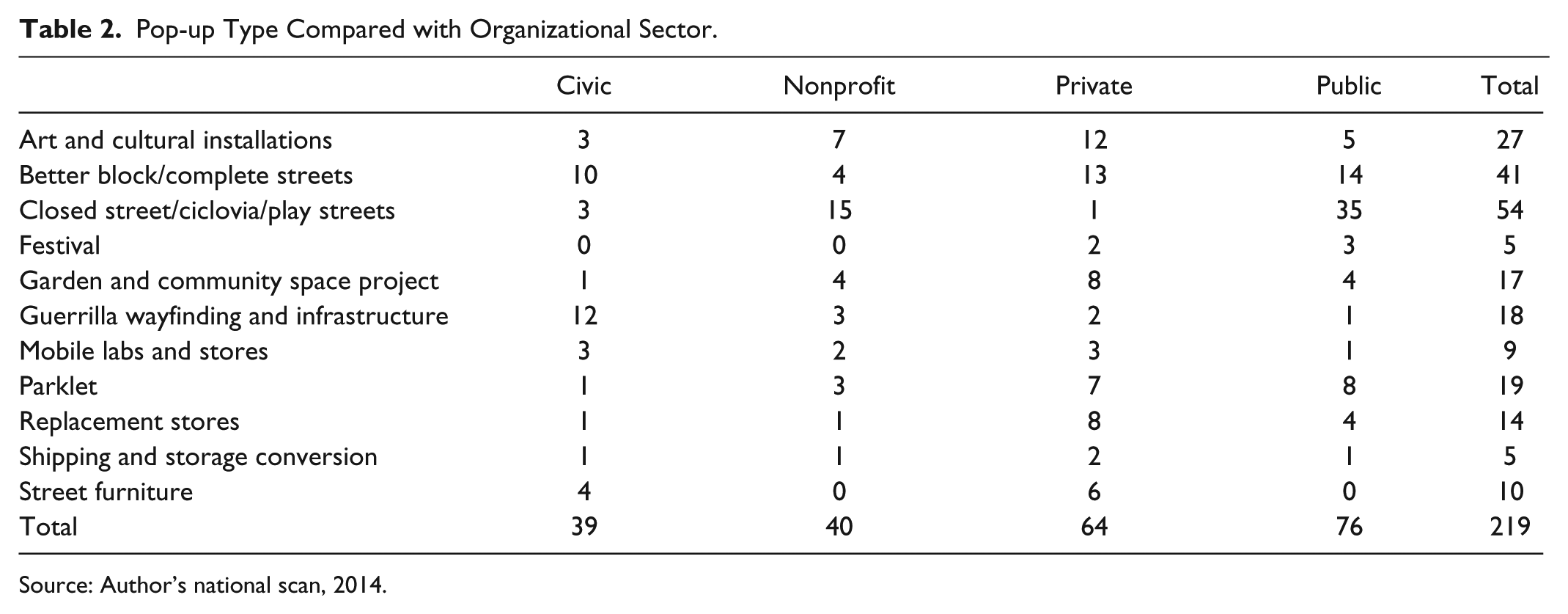
Source: Author’s national scan, 2014.
The database underscores that POPs often represent strategic collaborations between design firms, arts organizations, public agencies, community-based urban improvement groups, educational institutions, individuals, and private industry to build local planning capacity (Table 3). Approximately 75 percent of the projects are some form of partnership where different resources and expertise are exchanged and negotiated, as the cases in the following detail. Of the POP partnerships identified, most are public/private partnerships in a broad sense, as represented by 30.6 percent of the pop-ups. Again, the data show that POPs are not the purview of a single partnership structure but that different collaborations likely support the unique context of place and intended motivation. This makes sense, as many POPs, depending on scale and complexity, require different types of capacity, as discussed further in the case study section.
Partnership Features in Pop-up Initiatives.
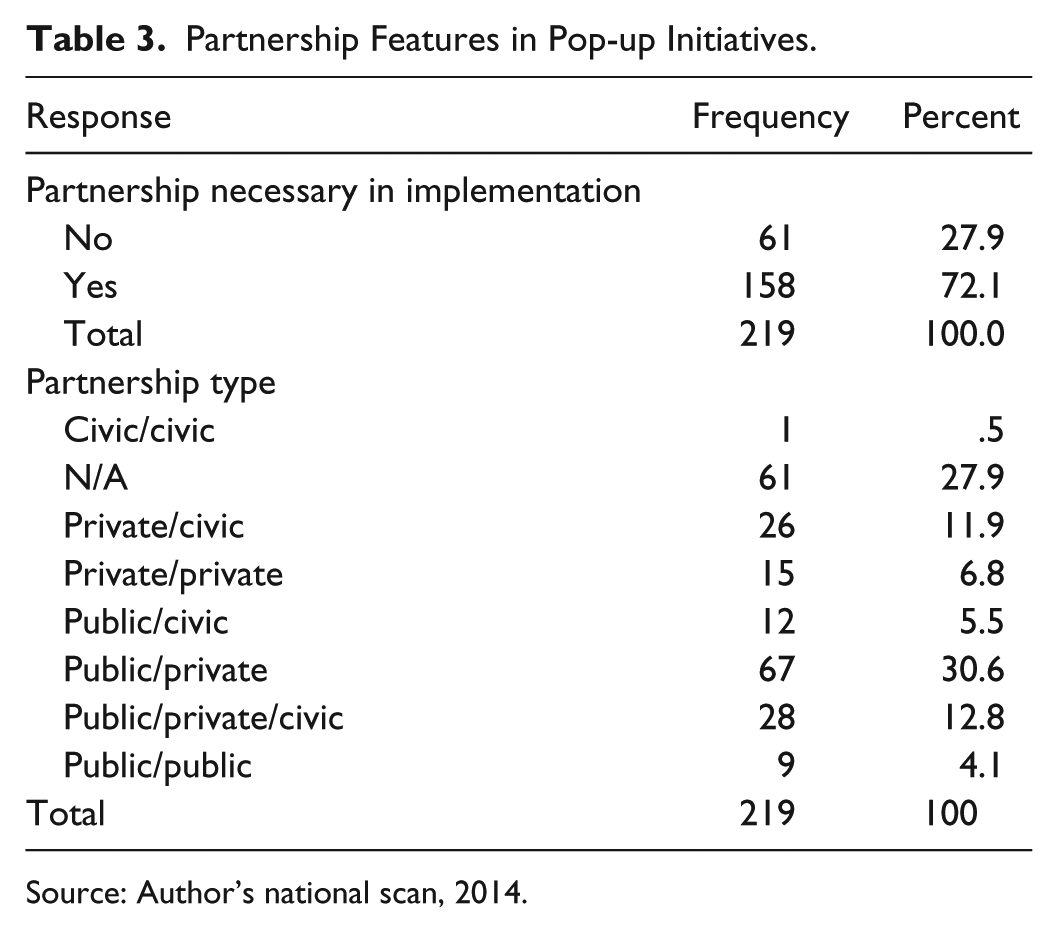
Source: Author’s national scan, 2014.
The data reinforce Lydon and Garcia’s (2015) call to reframe participating typologies and engagement philosophies in temporary urbanism since there is a broad spectrum of actors. A comparative case study can help unpack these partnerships and complexity of organizational involvement.
POP Case Study Analysis: Public Art Initiatives
To supplement the principal city data and examine the fine-grained complexity of organizational structure and planning capacity building, I conducted a comparative case study of three cities in the United States to better understand how art pop-ups, one type of POP illuminated in the data set, operate as a form of civic engagement and the different ways that represent political activity designed to influence urban planning and development. I also focus on public art because of the recent policy interest in creative placemaking and how a subset of POPs is turning art into a political call to action to increase local planning capacity. I draw on an actor-centered methodological approach (Markusen 2003, 415) that calls for better understanding of decision makers rather than prioritizing “distressingly abstract and actor-less processes.” While Markusen (2003) is referring to economic geography and regional economic development, the same can largely be said for arts economic development that focuses on creative agglomeration processes and urban arts revitalization (physical arts spaces, including cultural districts, maker spaces, community spaces) where placemaking is a physical process rather than an actor-driven process. This actor-driven process creates an opportunity to explore in greater depth the implementation process from a variety of different organizational perspectives, including better understandings of motivations, opportunities, and challenges for POP endeavors.
In Baltimore, Austin, and Boise, I investigate three exemplar cases of tactical pop-up public art to explore political communication and mobilization and its connection to planning and urban development. I also selected these cases because they differed in their connection to formalized planning, the ways they viewed civic engagement and activism, and their use of urban space as a political device. These cases reinforce the national database findings that many of these pop-ups are not run purely by DIY activists or formal planners but are strategic partnerships to shape the planning and development environment. The case studies are geographically diverse and show a range of organizational structures, partnership structures, and strategic deployment of POPs. Qualitative case data were compiled from interviews and document analysis. I conducted six semi-structured interviews with those involved in implementing POPs, including project managers, curators, and/or organizational founders. I analyzed documents drawing on public reports, local media, and community blogs as well as project artifacts, including press releases, and organizational websites.
A more fine-grained analysis of actor-centered behavior adds richness to the national data set by showing how different arts organizations navigate their efforts to use public art pop-ups to increase participatory democracy and local planning capacity. The three cases exemplify how tactical pop-ups perform as a communication or civic engagement device in a low-risk environment. The cases are not full renderings but are targeted organizational analyzes that reinforce and reflect the database findings. Each case speaks to tactical intent, partnership structure, pop-up location, and planning outcomes. The pop-up public art illustrations highlight how established organizations leverage their expertise in non-planning fields to influence urban development and planning arenas. The cases raise questions about how planning practice and education address these complementary forms of informal planning participation into formal practice and educational settings (Table 4).
Summary Dimensions and Features of Public Art Pop-up.
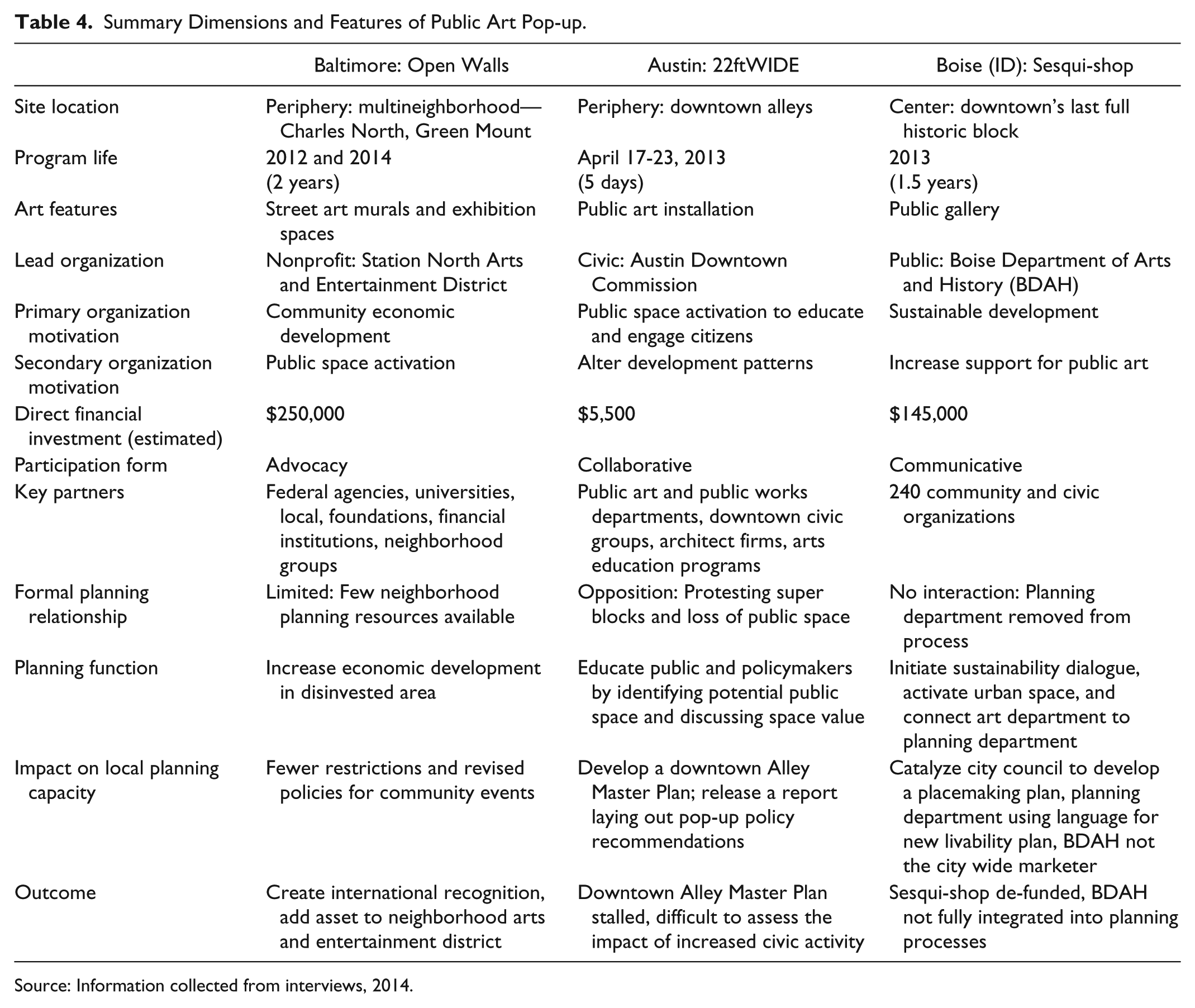
Source: Information collected from interviews, 2014.
Open Walls, Baltimore (MD)
Baltimore Station North Arts and Entertainment District Inc. (Station North) is an internationally renowned arts organization formed in 2003 that has spearheaded the ongoing revitalization of Charles North and Green Mount neighborhoods through creative placemaking initiatives. The district is championed by many advocates and anchored by several higher institutions of education, including Johns Hopkins and the Maryland Institute College of Art, and it encompasses two strong neighborhood organizations representing the district on planning issues. The struggling district is in a shrinking, rustbelt city that has seen decades of neglect, loss of public investment, and unrelenting racial discrimination. Despite the structural issues, the district has many assets, including a historic urban fabric, the anchor institutions mentioned previously, and the neighborhood leaders.
In 2012, the National Endowment for the Arts (NEA) awarded Station North and the Maryland Institute College of Art (MICA) $150,000 to develop and implement the pop-up public art initiative, Open Walls. This nonprofit/education partnership envisioned using the temporary mural program featuring international street artists to bring further investment and awareness to the distressed Charles North and Green Mount neighborhoods. Station North, Baltimore’s first state-designated arts district in 2003, sought to leverage the NEA grant to support its community economic development agenda to transform these neighborhoods perceived for “blight, vacancy, drugs and crime” into an internationally renowned district for street art creative arts activity (Figure 2). For more than a decade, Station North had slowly developed and implemented a comprehensive arts strategy, including building a series of high-profile artist housing and live/work programs, garnering large federal grants, and securing state tax incentives to support creative placemaking and artist worker tax relief in the community. The mural program provided another opportunity to grow and market its art and culture reputation.
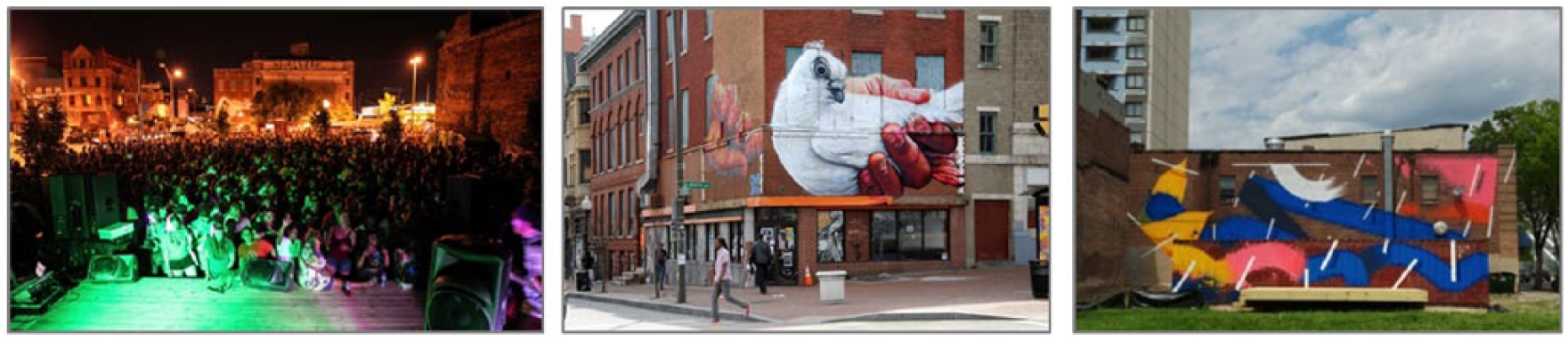
Station North pop-ups. (Top) Open Walls opening party. (Bottom left) Y-Not Lot. (Bottom right) Open Walls mural by Gaia.
Station North had the planning and design expertise along with the political will to recruit a diverse set of civic partners for the public art pop-up. The magnitude of the pop-up initiative necessitated project partners for the overarching program, but it also required grassroots and neighborhood collaborations for individual mural projects. The breadth and depth of partners required Station North to finesse a range of motivations and goals ranging from corporate to curatorial interest. For example, at the urging of the Baltimore Museum Art, PNC Financial Services directed corporate funding to help achieve their objective to facilitate a friendly home-buying market in the distressed neighborhood. Johns Hopkins University and MICA also provided direct funding and indirect resource support to remake the image of their university neighborhoods to better attract investment and students. At the neighborhood level, Charles North and Green Mount neighborhood community organizations partnered with Station North to tackle site and mural design. At the curatorial level, Station North hired renowned street artist and MICA alumnus, Gaia, to collaborate with MICA and the neighborhood organizations to curate the pop-up show, which aligned with Gaia’s own strategic interests to support public artists and community needs. Later, in the pop-ups’ second iteration in 2014, Station North developed a global partnership with the European Union Institute of Culture where several countries provided funding and resources for their artists to take part in the pop-up in a form of global cultural exchange.
These private/civic/nonprofit educational partnerships all sought to advocate for the district and its embedded neighborhoods, and they did so though different and sometimes competing ways. Station North’s extensive planning process involved crafting an intricate, political siting and curatorial program. Gaia and his curatorial team first developed selection criteria for public artists and then established unique design criteria for different locations and projects. The site and artist criteria required a neighborhood review process with both Green Mount and Charles North mandating that the public art needed to represent the neighborhood’s racial and class politics. These neighborhood values pushed up against some public artists’ desire for limited oversight. Station North had to ameliorate concerns by wary neighborhood organizations that the nonprofit was marketing rather than planning or representing district interests—an ongoing issue for the neighborhood organizations who had traditionally played an informal or community-planning role. Station North also negotiated with property owners to obtain rights to use external building walls and gain approvals for artist selection and design. In addition, organizers waded through Section 106 requirements to ensure that all sites in the nationally designated historic district met federal compliance policies.
The stabilization and revitalization of the district through public and private space theoretically makes the district and the POP the purview of formal planning oversight; however, Station North and its pop-up team had limited contact with Baltimore’s planning department. The planning department provided some general assistance and traditional liaising with building and code enforcement, but the pop-up organizations also had to confront a series of expensive permits and lengthy processes for approval that created roadblocks.
The impacts of the NEA pop-up program are intertwined with Station’s North’s other portfolio of temporary revitalization initiatives and their relatively permanent programs. The organization orchestrated several additional POPs in their quest to reactive urban space and spur community economic development. They negotiated a two-year, $1/year office lease in a vacant building to house their operations, gallery, and exhibition space. Across the street from their headquarters, they built the Y-Not Lot, an outdoor pop-up community event space. In the project Wonderground, Station North collaborated with another local artist to turn four vacant parcels into a temporary playpark for neighborhood children. This diverse set of pop-up strategies is not “opportunistic placemaking” (Lydon and Garcia 2015) but tactical efforts to revitalize a district through arts and cultural assets.
Civic and private investment has been a slow build in Station North, but there is some change in increasing local planning capacity at the neighborhood and municipal levels. For example, the Charles North neighborhood organization plans to transform the Wonderground playpark into permanent park space. Municipal administrators have become aware of the egregious police and security requirements for pop-up nonprofit events that make them difficult to implement. This has created the groundwork for changes in municipal event policy to support more alternative participatory events. The caliber of the street art program has added to Station North’s reputation and moved the art district into more of an international tourism site, giving them greater capacity for future endeavors. The murals, with an extensive public process, helped beautify rundown and disinvested areas, helping bring neighborhood arts assets into clearer view.
The success of Open Walls speaks to the advocacy efforts of a diverse group of partners with unique sets of resources. It makes not only an impressive visioning effort but also a laudable story of implementation and rewards. However, if communities value pop-ups, whether as one-offs or part of a larger revitalization strategy, there needs to be the municipal policies and available soft resources to support these kinds of projects. Few nonprofits have the capacity to carry these kinds of project-making partnerships. The funding partnerships are particularly challenging considering the highly competitive granting process. Pop-ups have a greater weight to carry in showing their value given that they are temporary in nature.
20ft WIDE, Austin (TX)
The city of Austin’s 2011 Downtown Plan called for activating public space similar to many district and city core plans across the United States. Despite its reputation for art, music, and creative economic activity, Austin has few permanent physical resources to support this cultural identity within its downtown core. A growing civic consensus argued that the city suffers from “a critical lack of developed vibrant public spaces” (City of Austin Downtown Commission Alley Activation Workgroup 2013, 3). Concerns about losing public space grew as more super blocks developed in the core, creating growing public dissent over the loss of an ideal urban fabric. In response, Austin’s Downtown Commission organized a civic working group in November 2012, including members from Downtown Austin Alliance, Creative Arts Alliance, Art Alliance Austin, city public works officials, city council aides, and students from the University of Texas Center for Sustainable Development. Their charge was to look at public space activation, and the working group selected a pilot project to develop a public art pop-up in the city’s alleys that would turn “functional hidden space to active public space.”
The Art Alliance Austin (AAA) secured the city’s request for proposal to serve as the curatorial director, and the city awarded AAA the right to oversee the POP due to the organization’s experience with “projects for the common good.” The local organization also had a highly visible public history of working successfully with city departments, property owners, and local business owners through art festivals, public art initiatives, and community event planning. Given their design background, AAA approached the project with a single question: What is the role of the public art in public space and public life as a forum for conversation?
AAA quickly convened a stakeholder group and gathered municipal resource support, from the Cultural Arts Division of the Economic Growth and Redevelopment Services, the Austin Street & Bridge Department, and the Office and Public Works Department. At AAA’s guidance, the team invited Dan Cheetham, principal and founder of Fyoog, to become the lead designer/architect/artist. Cheetham was charged with running the planning process and coordinating existing partners, including TBG, the landscape architectural firm, and Creative Action, the children’s arts advocacy group, to curate and design the pop-up. Cheetham, with extensive experience in large-scale projects and extensive public engagement campaigns, sought to create a collaborative, civic-wide approach. This participatory democratic approach was intentional rather than just common practice, and the focus on designing a forum for public engagement reflected Cheetham’s chief concern over the lack of a “public collective” in the community: “People in Austin are working on an island. We represent a bunch of decentralized influences. We need to create a civic voice.”
The public art pilot project centered on public space activation in alternative spaces through a combination of community events and public art and design installations (Figure 3). The curatorial team initiated an intensive planning effort beginning with an in-depth, multi-month intensive alley screening process. After their first site was rejected over parking rights, they selected the second site, Alley Number 111, located on Ninth Street between Congress Avenue and Brazos Street. Even though the alleys are public space, coordinating temporary site usage was challenging for the lead group. For example, municipal fire codes made event planning difficult, and nearby private business owners saw the alleys as their own privatized space, giving them greater rights over usage, especially as they controlled many of the public lots connected to the alleys. Cheetham and others successfully worked to convince wary stakeholders to participate in a “shared approach” for how the alleys would be used for the pop-ups and public space.
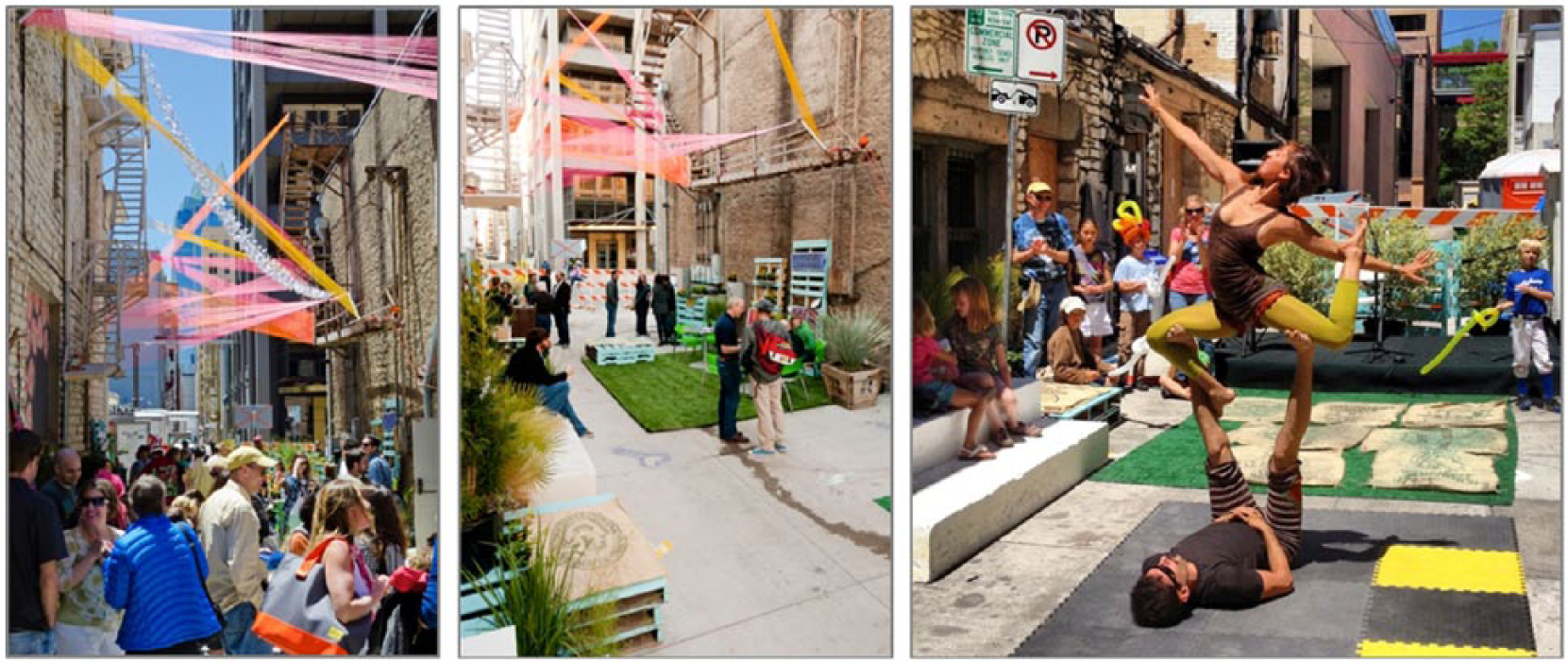
20ft WIDE pop-up in Austin, TX.
Team members worked with local community organizations to program and design the space in a way that was multigenerational and active. The public exhibition, marketed as 20ft WIDE, a nod to the 1839 historic plan guidelines for alley width, lasted five days and coincided with the popular Art Week. Simultaneously, the team also developed another pop-up in a historic building on 912 Congress Avenue to continue the discussion about pop-space, and it lasted for six more weeks. Instead of focusing on alleys, this public art pop-up centered on retail storefront activation. Their goal centered on facilitating conversations about the urban fabric of the city, what role alleys played in urban life, and how to reactivate or reimagine space rather than demolish hidden assets.
Despite the high-profile nature of the project, project financing from municipal and local grants were minimal: The City of Austin Cultural Arts Division awarded $5,000 to the project, and TBG granted $500 for ground activity and design, with donations and volunteered time covering the rest. Sweat equity and in-kind contributions of time fueled and financed the project.
The impacts of the intervention on long-term planning are mixed. The working group released the report, Activating Austin’s Downtown Alley (City of Austin Downtown Commission Alley Activation Workgroup 2013), which sought to affect pop-up policy and act as a resource for others interested in a similar program by outlining the list of logistical challenges that come with organizing pop-up art and temporary activities in the alleys. The event catalyzed a “critical dialogue about the urban realm” in a city that is changing rapidly. The event helped convince the Austin City Council to adopt a resolution on March 21, 2013, to develop a Downtown Austin Alley Master Plan; however, public funding and support never materialized. As with many pop-ups, tactical public art initiatives create a significant amount of energy, “demystify public engagement,” and help “prototype a model of urban design and development.” Yet it seems unlikely that the city will incorporate public art pop-ups as a public participation method or civic engagement strategy around urban investment decisions. In part, this likely stems from a limited way of considering how the planning community can use public art and its process to facilitate such dialogue.
Sesqui-Shop, Boise (ID)
In January 2013, Boise’s Department of Arts and History (BDAH) launched the city and state’s first POP project, the Sesqui-Shop (S-Shop). On the surface, the public art gallery promoted the city’s 150th anniversary, but the BDAH had a broader political motivation: to show the value of arts and culture as a tool for urban development and planning in a city that had only recently established a formal arts and culture department. BDAH’s goal was twofold: first, to use the pop-up as a pilot test for supporting a city-funded public art space that would act as a central forum for civic engagement for community issues and second, to situate the arts and culture department as a planning body with expertise and knowledge to contribute to conversations about urban investment.
BDAH’s executive director and S-Shop curator scouted several locations, looking for a privatized vacant storefront that they could turn into public space. Given their unique dual arts and history mission, they sought a historic site as well as a place that would be comfortable and welcoming for community members to access. After significant deliberation, they settled on a vacant downtown storefront on Main Street that marked the city’s last full historic block—a struggling area with significant vacancies. They negotiated a low rental fee of $1,700/month with the property owner, which made it easier to secure mayor and city council support.
The BDAH planning team developed a curatorial framework based on the themes of “Community, Enterprise, and Environment” and designed programming on a monthly rotation for a year. Initially, BDAH selected these thematic labels from reading cultural artifacts from Boise’s history “without thinking about sustainability” as a starting point. However, BDAH saw an opportunity to initiate a regional discourse about sustainability—a topic that surprisingly had yet to take hold in Boise’s municipal and planning divisions. The art and history department envisioned giving citizens rather than administrators the opportunity to craft the meaning of sustainability through their own lens and experience. Through an extensive public outreach effort, the shop’s curator collaborated with 240 community organizations to organize pop-ups within the pop-up shop (Figure 4). Staff showcased a different community nonprofit every day for a month so these local organizations could test out their own pilot ideas with low risk.
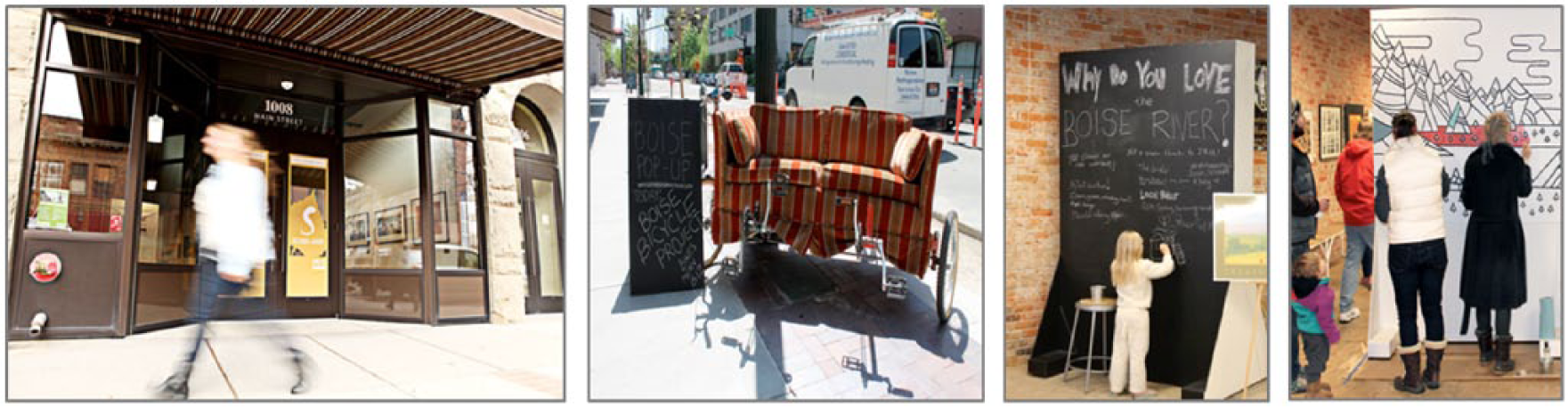
Sesqui-Shop pop-up in Boise, ID.
The public art POP embodied many features of communicative planning where “[communicative planning] is also the subject of planning—the decision makers, the implementers, the people affected by the decision or the plan, and the planners and public managers—and their relationship. Substance, process, and relationships are intertwined” (Ozawa 2008, 3). The communities shared their different views about sustainability through an alternative mechanism, a pop-up public art gallery, rather than more traditional planning processes that may not have as much citizen-led content and perceptions.
The impact on long-term planning capacity and civic engagement is uncertain. In a city and region with 240,000 and 600,000 people, respectively, 30,000 people passed through the exhibition in a single year, making it a widely successful effort. However, BDAH’s initial desire for a designated bricks and mortar site waned as they realized they did not have the resources and departmental capacity to pull it off in a long-term fashion. They redesigned the program with lower overhead after the mayor and city council approved a second year, but the events were less successful. The pop-up space closed shortly after its second season. The property owner did not renew over demands for building improvements without a long-term commitment.
This case shows how art organizations and public pop-ups can be “change agents in society.” Many programmed planning conversations around urban development took place at the S-Shop rather than purely through traditional, top-down public meetings or charrettes. More than the other two cases, there has been a slight change in the formal planning apparatus. The mayor hired a sustainability consultant to advise the planning and development department, who expressed interest in learning how to “talk” and “think” about sustainability. The consultant said, “[the city] is already doing it, look to the BDAH as model for integration, communication and community participation.” The city council later initiated a creative placemaking committee to work on using art and history for urban activation to supplement the work that BDAH has done in the urban realm through the shop and other projects. The council also recently adopted a new livability plan, LIV Boise, which uses the language and ideas promulgated by the Sesqui-Shop and its community partners. One BDAH staff member noted that the exhibition was also subtly political in the ways that it questioned long held beliefs about who has a “right to space” in the downtown core and the ways that public policies hinder urban development and public space. The pop-up also inspired BDAH to draft its first citywide culture plan and hire one of the country’s first cultural planners to bridge arts and urban planning.
Lessons for planning largely centered on the way that BDAH employed the art pop-up as an urban communication and civic engagement tool. The pop-up allowed the community to translate what sustainability meant to them rather than fitting their views within already built planning frameworks. BDAH’s executive director reflected, “There is an interest and means to communicate differently: the way we pushed out information, the way we worked with community is all trickling back to different departments, including planning and development.” Their facilitation model represents the communicative ideals espoused in planning theory but also critiques its lack of presence in planning practice. BDAH’s executive director, with training in public history and experience as the former communications office for the regional planning agency, knew how to build and sustain interest through a community-driven narrative that “looked at the eyes of the community through the community; it was by them, for them.” While the community was not involved in the planning process, it was their voice that shaped the pop-ups in programmatic design and implementation. But it is also a cautionary tale for planners in that this kind of approach does not always work as well from a grassroots focus because of the time, energy, and resources it takes to pull it off where “it is a community model, not a grassroots model.” Nor should POP always aim for permanence, and while it is good to “sample and test ideas,” BDAH was forced to develop two additional operating and programming models, including grassroots-led, because of lost resources.
Conclusion
As it pertains to pop-ups, arts organizations have the ability to leverage the beauty and visibility of art pop-ups, set as political performances in public spaces, to serve multiple purposes, including communicating planning problems and solutions through art and design, using public art as an accessible place to engage in low-risk civic activism, and relying on the location of public space to intrinsically promote democratic participation. Some of the pop-up art organizations, as the cases show, are claiming their right as planning agents in their communities. Thus, these art pop-up strategies move beyond simple placemaking to test alternative futures, offer new avenues for dialogue and education, and/or question urban development policy.
This study asks and answers three central questions. First, how are pop-ups dispersed and organized across the United States? The research shows that POP is a growing phenomenon and strategically employed in principal cities across the United States. Findings show that despite the discourse that pop-ups are largely a form of guerrilla or DIY urbanism, they often involve participants from a range of commercial, nonprofit, and community sectors who work independently or in collaboration for a number of initiatives. Their motivations are not always purely confrontational but work in partnerships to achieve organizational goals related to such planning areas as sustainability, public health, community development, and social justice as these topics pertain to urban development. Future research should consider how successful these identified organizations have been in meeting their objectives.
Second, how do pop-up art organizers use public art and public space to build local planning capacity and increase civic engagement? The three cases reinforce the database knowledge and show the complexity of approaches, partnership structures, political motivations, and challenges. They also bring to mind early-mid–twentieth century debates where City Beautiful and City Practical proponents argued the value of aesthetics in planning practice and accomplishing urban utopias. Freestone (2011) articulates this complex divide in his analysis of how John Nolen, arguably the first town/city planner in the United States, reconciled the simplistic divide between beauty and utility. This tension about the value(s) of art in cities and regions continues as communities have fewer resources but desire live/work/play/create environments. In part, this explains the recent quest to integrate creative placemaking within the public urban realm where beauty and utility connect in the everyday.
The cases show that pop-up public art is more than “opportunistic placemaking” (Lydon and Garcia 2015). Rather, the research shows that art is used not just as an outcome but as a method for public participation and engagement to create a civic voice. The cases reinforce that POPs do not belong to a single planning participation theory but that they represent different versions of “political talk and performance” in each unique context. These public art pop-ups initiate discussions in urban space to engage citizen input about where public and private investment occurs and how urban space is used. All of the cases experienced some kind of success, whether it was temporal action that led to a change in policy, a greater awareness about a particular issue, or a reminder that different futures exist for urban space. However, in every case, success was incremental and limited, which shows the need for looking at these pop-ups in relation to other movements around similar topics to see if the whole has more progress than the individual actions. It is important to consider how pop-ups in general might include or exclude particular groups. This is an important area for future study and speaks to critics of creative placemaking who argue that such aesthetic interventions have the potential to engender gentrification and exclusion even as they enhance engagement for others.
This research suggests that there is a need to bring or integrate public art into planning practice and use political art as a legitimate method for planning engagement. Faga (2006) calls public participation processes “civic theatre,” and in some cases, pop-up public art is literally that, while in other instances it is figuring out how to unleash the use of public art and the skills of arts organizations to help guide and shape both formal and informal efforts to increase democratic process and urban development policy. In many instances, it is unclear to what extent these pop-ups are direct political action or if they simply create opportunities for engaged political talk around art and planning. For the most part, the cases show how these organizations are using the art pop-ups to educate their communities around planning issues, hoping that it will create some level of civic literacy or planning knowledge. The political tone or edge is mild even if the organizer has a more direct objective in mind, whether that is stopping anti-urban development, reclaiming lost public space, rejecting a top-down sustainability approach, or highlighting publicly and privately disinvested places. While civic engagement is political, there is a spectrum of political dialogue where political art is often at the end of forthright public protest and dissension where urban arts planning is trying to find a place.
Third, how should planning practice, education, and research respond to this phenomenon? This research along with the impressive works of other scholars suggest that it is time for planning practice to consider more concretely how to (1) integrate the input from these alternative civic engagement and event strategies into their decision-making process, (2) collaborate with these groups to build local planning capacity in sustained and meaningful ways, and (3) partner on these projects without drowning out the civic ethic or values. This research harkens back to Silver, Scott, and Kazepov’s (2010, 453) early suggestion to have a more nuanced understanding of engagement and participation as a continuum.
It is clear that this is not only an issue for practitioners but for educators, especially as these tactical methods grow in prominence and usage. Planning educators should consider how to address these forms of participation in standard curriculum and through continuing education. Future research in this area would be beneficial, including surveying faculty and practitioners to find out how these are addressed in curriculum and what employers want planning students to know about these alternative engagement forms and how to work with nonformal planners. Part of this is also figuring out what subpopulations (age, gender, sexual orientation, race, ethnicity, socioeconomic status, geographic location) and “publics” respond better to these kinds of strategies and how such POPs might increase or decrease general civic engagement but also particularly in planning and development issues. 7
The art POP exemplifies the ways in which urban arts activism is removed from traditional or contemporary planning practice even when that combination of political art and some form of urbanism falls under the umbrella of urban arts planning or urban arts revitalization. It raises questions about whether the placemaking agenda, heavily funded by the arts sector, is a reflection of democratic engagement by nontraditional planners or is, as Rushton (2016, 409) says, the “current fixation or flavor-of-the-month with no obvious lasting public benefit”? The cases in this study show that it is a reflection of democratic engagement to varying degrees, but that it is also part of a longer-term agenda by civic activists to reshape urban planning and investment. Future research should look at whether these cases are exemplar or part of national trends based on identifying funding sources and programmatic outcomes.
In sum, POP can be a mechanism for democratic dialogue and civic engagement that is an alternative to traditional participation methods. It raises questions about who is a planner since in many of the cases studies, these POP organizers were fulfilling that function but outside of formal channels. Tactical pop-ups are the purview of planning and development and thus require a greater understanding and connection between planning practice and pop-up activity, particularly in developing regulatory and policy landscapes that make such activity and engagement easier.
Footnotes
Acknowledgements
Thanks to Barb Alm, Lori Hausegger, Jaci Kettler, Aaron Mondada, and Jennifer Stevens for their guidance on this manuscript.
Declaration of Conflicting Interests
The author declared no potential conflicts of interest with respect to the research, authorship, and/or publication of this article.
Funding
The author received no financial support for the research, authorship, and/or publication of this article.