







Abstract
Drawing on the instructor and student experiences of a service-based learning course with Indigenous peoples, this paper considers how studios develop the skills and competencies outlined by accrediting bodies. Yet, this approach to teaching and learning can also unsettle students’ sense of professional competence and faith in the usefulness of conventional planning methods. In this case, unsettlement was a valuable and productive outcome that supported the development of a more critically reflective approach to working with Indigenous peoples and a newfound appreciation of the need to engage in disquieting conversations about the colonial underpinnings of the planning profession.
Introduction
One of the great challenges in planning education is how to attend to ever-evolving knowledge and technical competencies (Alexander 2001; Dalton 2007; Guzzetta and Bollens 2003; Ozawa and Seltzer 1999), while also developing reflective practitioners who understand the ethical, cultural, and sociopolitical dimensions of planning practice and the controversies surrounding them (Campbell 2004; Dalton 2001; Friedmann 1996; Sandercock 1999). This challenge is particularly relevant in settler-colonial contexts, where planners need to be prepared to confront their profession’s role in Indigenous dispossession—dispossession not simply of lands but also of the authority to steward those lands according to customary laws and governance structures (Porter 2010; Porter and Barry 2016). At the same time, planners need to develop a greater appreciation of how their knowledge and technical skills might coexist with Indigenous ways of knowing and how this coexistence may be a “fundamental source of change” (Ugarte 2014, 409).
In this paper, we use the language of unsettlement to frame planning education in settler-colonial contexts. As Blomley’s (2004) work on urban legal geographies notes, the word “settle” evokes a sense of ordering, arrangement, and stability, whereas the word “settlement” is more easily connected to everyday talk of resolving a dispute. It is “‘to free from disturbance; calm or quiet, ‘to prevent from creating a disturbance or interfering’ and ‘to end’” (Blomley 2004, xiv, quoting Webster’s Dictionary). To unsettle, or to engage in a practice of unsettlement, can therefore be understood as a challenge to existing orders and arrangements, as a sense of unease and as a beginning, rather than an end, to a potentially disquieting conversation. Although these definitions of unsettlement provide a productive frame for thinking about a wide range of cross-cultural planning encounters, particularly those that are characterized by “deep” epistemological and ontological differences (Watson 2006), the words take on a particular meaning in critical Indigenous theory and settler-colonial studies. Here, the conceptual, political, and material dimensions of (un)settlement are inextricably linked to the wider project of decolonization.
Decolonization is often understood as a radical unsettlement of colonial structures, so that Indigenous peoples can reclaim and rearticulate their languages, cultural teachings, governance traditions, and relationships to land (Corntassel 2012; Simpson 2014). It also stands apart from the claims for political recognition and justice among other cultural and systemically marginalized groups (for a more detailed discussion of these issues, see Coulthard 2014; Tuck and Yang 2012), as it requires deep engagement with the material and political implications of the ongoing erosion of Indigenous sovereignty and self-determination. Although decolonization does demand economic and political redress (Tuck and Yang 2012), attention also needs to be paid to non-Indigenous peoples’ ways of knowing and taking action in the world around them (Lowman and Barker 2015; Snelgrove, Dhamoon, and Corntassel 2014). These tend to function as an unacknowledged “settler common sense” (Rifkin 2013, 322) that marginalizes Indigenous peoples’ ways of being in and exercising cultural responsibilities toward their ancestral territories.
Decolonization, therefore, cannot be for Indigenous peoples alone—a point that is clearly articulated in Regan’s (2010) book, Unsettling the Settler Within. How this transformative learning occurs, she suggests, is just as important as what is learned, with an attention to experiential processes aimed at facilitating spaces of respectful encounter and critical dialogue. Yet, as de Leeuw and Hunt (2018) argue, the practices of unsettlement need to extend beyond increasing the self-reflexivity of non-Indigenous persons and practitioners; these practices must also be attentive to uneven relations of power and the ever-present potential that such spaces of encounter may result in little more than a re-inscription and re-centering of colonial authority structures and processes of knowledge production. Although de Leeuw and Hunt were writing about geography, the same risk exists for planning.
This paper uses the University of Manitoba’s Indigenous Planning Studio to respond to the idea of unsettlement as a productive educational process. We build on the lead author’s previous reflection on her experiences as the instructor of this service-based learning course with several Indigenous partners (see her contribution to Porter et al. 2015). Although this paper draws on her observations from five years of studio instruction (2013–2018), a particular focus is placed on the 2015 studio. This cohort was asked to engage in an additional evaluation exercise, and eight of its ten students are coauthors of this paper. We begin by connecting the literature on studio-based learning to the design of this particular studio. Next, we use data drawn from the students’ self-assessment of planning competence and a separate reflective writing assignment to explore how studio-based learning can simultaneously develop and unsettle notions of planning competence. We find the tension between these two outcomes can catalyze some rather profound reflections on non-Indigenous students’ roles and responsibilities in the decolonization of their chosen profession.
Studio-Based Approaches to Teaching and Learning
Studio courses are prevalent features of many North American planning schools (Edwards and Bates 2011; Long 2012; Németh and Long 2012), with similar approaches in the United Kingdom, Europe, Australasia, and South Africa (Porter et al. 2015). They are often used to teach students how to identify planning problems, devise solutions, and reflect on and evaluate their actions (Baum 1997). Like design studios, planning studios tend to allow students to work their way through complex, real-world questions with faculty and other students providing feedback at key points in the process (Brandt et al. 2013; Shraiky and Lamb 2013). As Németh and Long (2012) found in their study of American syllabi, the majority of these courses include a real client or community partner and often one that has limited access to planning services (Agnotti, Doble, and Horrigan 2011). These courses can be, therefore, akin to service-based learning: a combination of academic and community-based work that expresses a strong commitment to reciprocity, reflection, and colearning (Agnotti, Doble, and Horrigan 2011; Harris and Irazabal Zurita 2011; Porter et al. 2015; Roakes and Norris-Tirrell 2000; Sletto 2010).
In accredited programs, studios are often key sites for the development of recognized standards of professional competence. These standards vary from country to country. However, Fischler’s (2012) review of accreditation standards in Canada and the United States suggests some broad similarities. Students must be introduced to substantive theories about the histories, policies, and processes that inform the planning of human settlements. Analytical and communication skills are also prominent, as are planning ethics, professional judgment, and reflective practice. This approach to planning education is not without its critics. As Sandercock (1999, 534) diagnosed twenty years ago, it has the potential to reduce planning education to “a shopping list of skills and competencies which have turned out to need continuous updating.” It risks reducing students to “empty vessels,” ready to be filled up by a one-directional flow of information that is inattentive to alternative ways of knowing. The challenge then becomes how to use studio-based learning to address accreditation standards, while also engaging in respectful and multidirectional partnerships with diverse peoples and knowledge systems.
The Indigenous Planning Studio: Underlying Principles and Ongoing Tensions
The curriculum for the University of Manitoba’s Master of City Planning applies many of these pedagogical principles and encounters many of these tensions. It includes three community-based studios in a two-year degree. As a small planning program, located in a province where there are only approximately one hundred certified planners, identifying potential studio projects is relatively easy. Community partners are identified through the faculty members’ professional networks and their engagement in a range of local and regional planning issues. The topics and partners have varied over the years and are largely at the discretion of each individual studio instructor; however, there is always some level of discussion with the other studio instructors and Department Chair.
There is also a collective commitment to ensure that the studio sequence progressively develops professional skills around project management, client relations, and teamwork. The first studio tends to be a bit more structured to accommodate the needs of first-year students, the vast majority of whom have no prior experience with studio-based learning. Assignments are more standardized and the instructor plays a greater role in managing the relationship with the community partner. With each subsequent studio, students are expected to exercise more leadership over the development of their group projects and relationships with external partners. This approach parallels Grant and Manuel’s (1995) work on “peer resource learning models,” in that it deliberately de-centers the studio instructor, encourages the sharing of skills, and fosters a sense of collegiality among the students. It also allows the department to address all the accreditation standards. As discussed below, the Canadian standards place a great deal of emphasis on the development of “soft” skills (e.g., communication, critical thinking, and leadership), which are often ill-suited to traditional teacher-centered approaches.
From 2010 onward, the final studio has centered on the planning concerns of First Nation (Indigenous) peoples. The Indigenous Planning Studio grew out of a one-off course with a First Nation partner in northern Manitoba that was taught by a former dean, who had also been a principal at a consulting firm that is well regarded for its work with Indigenous communities. Given Canada’s ongoing efforts to repair its relationship with Indigenous communities, the Department of City Planning decided that this type of engagement ought to become a regular part of its curriculum, especially as many Indigenous communities lack the fiscal and human resources needed to engage in planning. One of the existing faculty members developed a service-learning approach for this new studio and taught it for two years before his retirement. A contract faculty member taught it the next year, while the department hired a new full-time faculty member (i.e., the lead author). 1
The current approach to the Indigenous Planning Studio includes eight to ten students, working with two to four partnering First Nations. The students are divided into small groups of three to five students, with one group for each First Nation. From 2010 to 2016, it was run as a one-semester course, albeit with quadruple the number of contact hours of a regular course. Approximately, one-quarter of the hours for the entire semester is devoted to structured activities, with the vast majority of those occurring within the first four weeks of class. The students have guest presentations from practicing planners who work directly with Indigenous communities, as well as representatives from the federal agencies involved in First Nation land management and housing provision. As the semester progresses, more and more time is devoted to relatively unstructured work periods, with the groups reporting on their progress in plenary sessions and then engaging in one-on-one consultations with the instructor. In 2017, the studio was stretched over two semesters to provide more continuous support to the First Nation partners; however, the total number of contact hours and studio format has remained the same.
The First Nation partners all come with a planning idea, and the instructor works with them to scope out a project that is within the students’ capabilities. Most of the projects relate to some aspect of Comprehensive Community Planning, a holistic form of planning that is promoted by the federal government and that many Indigenous nations use as a way to exercise self-determination. Most partners work with the studio for several years, allowing successive groups of students to engage in projects that support different phases of a typical planning cycle. Past projects have included designing community surveys, creating communication and public engagement plans, providing mapping support, and analyzing community feedback. Each group must develop a detailed project plan and is responsible for the day-to-day communication with a designated contact from their First Nation partner. The students work with that person to arrange community visits and solicit feedback on draft work. The number of visits varies, but the goal is to spend at least three full days in the community (at the beginning, middle, and end of the studio) and to use email and phone calls during the intervening weeks. Students are encouraged to travel as often as their community contact’s schedules will allow, as regular interaction enhances the experience for all parties and tends to improve the quality of the final deliverables. The deliverables are just as diverse as the projects; however, all groups must submit a detailed discussion of their project approach (overall process, sources of information, methods) and a portfolio of all the outputs provided to their First Nation partner.
The Department of City Planning is not alone in its efforts to address Indigeneity in its curriculum. The University of New Mexico created the Indigenous Design and Planning Institute (ID+PI) in 2011 and has run numerous studios with tribal communities primarily in the American Southwest. In 2012, the University of British Columbia launched its concentration in Indigenous Community Planning and also supports First Nation partners with the development of Comprehensive Community Plans. The Indigenous Planning Studio is unique in that, from 2010 to 2016, it was taken by all students in the Master of City Planning.
The University of Manitoba continues to offer the studio, but it is no longer required as its curriculum was reoriented to provide more advanced studio options. The Indigenous Planning Studio is also a challenging course to run, with no stable source of operational funding and considerable travel costs to get students to and from their First Nation partners. It now has a cap of ten students and can therefore only accommodate approximately 60 percent of the Master of City Planning cohort. Despite this cap, not a single student who has expressed an interest in the course has been turned away as there are inevitably some students who feel their professional goals would be better addressed in one of the other studio options.
The Department has not required students to have any prior knowledge or specialized training in Indigenous studies before registering for the course, simply a willingness to learn and approach the work in a spirit of mutual learning and cooperation. This principle has been folded into the entire studio philosophy, which is informed by two goals. First, it seeks to support the growing number of First Nations who express interest in increasing their knowledge of all forms of planning, including those practiced by federal, provincial, and municipal governments. Second, it aspires to make small but potentially impactful contributions to the decolonization of planning by encouraging its future practitioners to critically examine the norms, values, and practices that shape the planning profession in Canada.
The course includes readings and classroom discussion on the importance of ensuring that Indigenous communities are empowered to take control of their own planning data, with the OCAP principles (Indigenous ownership, control, access, and possession of intellectual property) as a key tenet. Students are also encouraged to produce resources (guidebooks, factsheets, templates) that the First Nation planning team can continue to use after they leave. The classroom discussions introduce other Indigenous ethics to help prepare students for their studio experience. For example, the 2017 studio was framed around the idea of “two-eyed seeing” (Bartlett, Marshall, and Marshall 2012), an Indigenous concept that encourages critical reflection on and practical application of the strengths of both Indigenous and Western ways of knowing. Although two-eyed seeing is a new addition to the studio curriculum, it is strongly aligned with the cross-cultural approach that has evolved over several years of studio instruction.
Despite the course name, the instructor has not attempted to teach Indigenous ways of planning (see Jojola 2008; Matunga 2013) and deliberatively resists treating these theories and practices as objects of study that can be extracted and dissociated from the diverse peoples, environments, and laws through which they find their expression (see Simpson 2014). These concerns are amplified by the fact the instructor and majority of students are settler-Canadians. The studio instructor has included some cultural awareness training (sessions with campus Elders and discussion of important cultural protocol) and students have occasionally been invited to participate in sweat lodges and other cultural ceremonies. However, most of the cross-cultural learning occurs through day-long or multiday visits to the Indigenous communities and relatively unstructured conversation with the community contacts. This approach tries to ensure that students are exposed to the contextual and embodied aspects of Indigenous knowledge and, by extension, Indigenous planning. However, even the most robust expressions of this kind of experiential learning cannot and do not result in anything other than partial insight into the social, political, environmental, and spiritual contexts in which Indigenous knowledges are produced, shared, and ascribed meaning. Anything else would take a lifetime of learning. As a result, the “Indigenous Planning Studio” is simply a convenient, albeit highly imperfect, shorthand for a structured and supported exercise in “intercultural capacity development” (Howitt et al. 2013) between Indigenous and non-Indigenous peoples.
Intercultural capacity development will, almost by definition, mean different things in different contexts. Yet, it is framed by a common commitment to engaging in a practice of “situated engagement,” in which “concepts and practices . . . assumed to be universal, can be unsettled, challenged and opened up to unimaginable possibilities” (Suchet 1999, xviii, emphasis added). Although similar ideas can be found in Agyeman and Erickson (2012), Howitt and his colleagues’ work distinguishes itself by adding the prefix “inter,” thereby calling attention to the multidirectional and reciprocal nature of this learning. It also suggests that the unsettlement of planning concepts and practices does not necessarily lead to outright rejection, rather the development of a more context-specific and hybrid understanding of the possibilities for planning in Indigenous contexts. Indeed, many of the First Nation partners come with the goal of wanting to increase their knowledge of conventional planning practice, while also recognizing the importance of sharing their community’s approach with the “mainstream” planning community. In fact, one of the 2015 community contacts very explicitly framed the studio as an opportunity to blend Indigenous and non-Indigenous knowledge systems—an idea that has obvious parallels to two-eyed seeing.
From 2011 until 2014, the studio received both financial and in-kind support from a key Indigenous organization and a federal housing provider. This support covered the studio travel costs, created new jobs for Indigenous community members, and funded workshops on Indigenous-led planning. It also helped increase the profile and legitimacy of the studio, so much so that all of the recent partners learned of the studio through word of mouth and asked to participate. In 2014, government cutbacks and new institutional priorities meant that the previous funders could no longer financially contribute to the running of the studio. In 2015, a successful application to the University of Manitoba’s Teaching and Learning Enhancement Fund provided enough funds for the studio to continue, without having to pass its considerable costs onto either the participating First Nations or students. This model of seeking out short-term, university-based funding has continued, with a successful application to the University of Manitoba’s Indigenous Initiatives Fund supporting the last two years of studio work.
Evaluating the Indigenous Planning Studio
Although the impetus behind the 2015 application to the Teaching and Learning Enhancement Fund was financial, the evaluation requirement of the grant provided a welcome opportunity to reflect on five years of work (the lead author was the instructor for two of these years). We already had informal feedback from our Indigenous partners that suggested we were achieving our goal of providing tangible benefits to their communities. However, the university-regulated course evaluation forms provided the only insight into student learning. An additional tool needed to be developed to gain insight into how the department and studio instructor were negotiating their goal to encourage deeper and more critical reflection on the possibilities for planning with Indigenous peoples and their responsibility to address recognized standards of professional competence.
The ten students enrolled in the 2015 studio were asked to assess their perceived level of planning competence at the beginning and end of the course. They used an online questionnaire that was created by the instructor to fulfill the evaluation requirement of the Teaching and Learning Enhancement Fund and that used the competencies outlined by the national accrediting body. This questionnaire was entirely different from the standard course evaluation that is used in all courses at the University of Manitoba, which is a poor fit with the higher levels of critical thinking and more learner-centered approach typically found in graduate education. The university forms have also not been designed to assess how the teaching methods support the development of recognized standards of professional competence. In Canada, these competencies are divided into two general categories. The functional competencies “identify the common knowledge and skill base of all planners,” whereas the enabling competencies “identify the capacities required of a planner to practice effectively, professionally and ethically” (Canadian Institute of Planners 2011, 6). The studio-specific questionnaires asked each student to rate their perceived level of competencies for the nineteen functional and fifteen enabling competencies (Table 1), using a 4-point Likert scale.
Functional and Enabling Competencies for Professional Planning Practice in Canada (CIP, 2010)
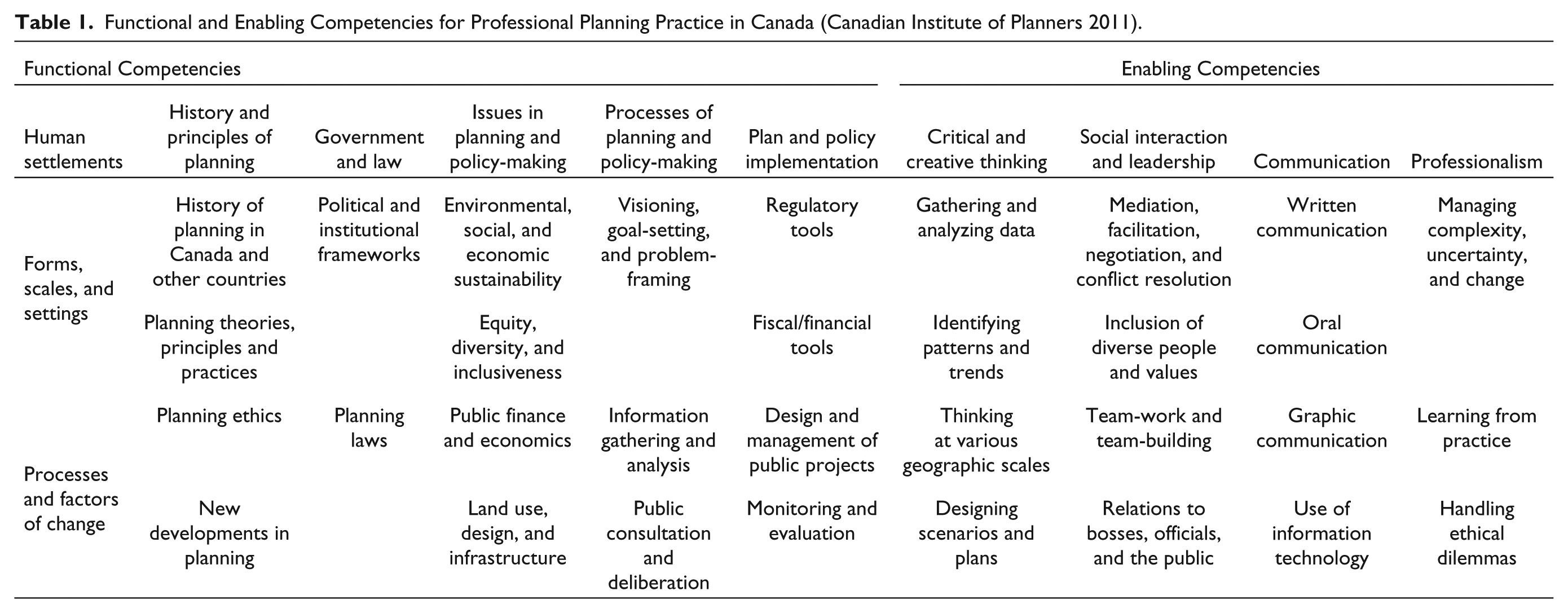
The analysis of the completed questionnaires focused solely on whether there had been a change in the self-assessments of planning competence. As in any educational setting, the students entered and exited the studio with different strengths and weaknesses. The learning objective was simply to develop planning competence, not to bring all students up to the same level. Moreover, the questionnaires were not intended to generate reliable and valid quantitative data; they functioned more as a heuristic to direct and focus the analysis of a separate reflective writing assignment. As a result, the sections that follow present only a very broad overview of students’ assessment of planning competence, focusing instead on how the questionnaires prompted a different way of reading the writing assignment.
This assignment was a mandatory and graded component of the course that asked students to prepare a five to seven–page reflection on their studio work and lessons they draw for professional practice. It was written at the end of the course, in parallel to the second self-assessment of planning competence. The students were asked to pay particular attention to the knowledge, skills, and sensitivities they thought planners might need to effectively support the planning efforts of Indigenous peoples. All eight of the student coauthors have contributed both their questionnaire responses and reflective writing assignments to the development of this paper. These reflections were thematically coded, using a qualitative software program (NVivo). The lead author conducted all of the coding, but the coauthors reviewed the preliminary results, which helped ensure a more accurate interpretation of the students’ collective experience. The student coauthors have also been engaged in each step of the development of the paper, providing additional commentary and reflections. In the passages that follow, the term “coauthor” is used to when referring to a comment or experience that is specific to one of the eight students who participated in the development of the paper, whereas the word “student” is used when the lead author is contributing her own observations of how students have experienced the course.
The coauthors’ thoughts about working with Indigenous communities inevitably grew out of the particularities of their studio projects. In 2015, the coauthors worked with three First Nations. Two worked with a longstanding partner that had completed its Community and Land Use Plan (with the support of three previous groups of students) and was starting to think through the development of its urban parcels. These individuals researched First Nation municipal planning precedents and prepared a guidebook to help their partner better understand the planning system on adjacent municipal lands. Three of the coauthors worked with a First Nation that was just beginning its Land Use Plan. They helped compile a community profile and prepared various geographic information systems (GIS) maps. The final three coauthors worked with a First Nation that was over two years into the preparation of a Land Use Plan for their Resource Management Area (a significant portion of their territory, which supports hunting, fishing, and trapping). That First Nation was continuing to hold community engagement workshops, with the students providing various forms of facilitation support. Its planning team was also struggling to analyze a large number of interviews that had been conducted with Indigenous trapline holders and other resource users. The coauthors ultimately lent their research skills to the project and helped train members of the Indigenous planning team in qualitative coding. Despite their diversity, all the projects required the students to think critically about how and to what degree general planning and research skills acquired in previous courses could be used to address the goals of their Indigenous partners—commonalities that are underscored in the coauthors’ reflections below.
Unsettling Assessments of Planning Competence
Although the coauthors’ self-assessments of planning competence do need to be viewed with a great deal of caution due to the small sample, there are some intriguing results. There were some notable increases in the functional competencies, with a majority reporting an increase in their knowledge of planning history, political and institutional frameworks of planning, planning law, and information gathering and analysis. These increases can be readily connected to the course content, which included sessions on Canada’s colonial history, as well as the legal, policy, and administrative structures that guide the planning of Indigenous lands—topics that would not have been covered in other classes. A majority also reported an increase in a number of enabling competencies: gathering and analyzing data, thinking at various geographic scales, designing scenarios and plans, managing complexity and change, learning from practice, and handling ethical dilemmas.
The coauthors did not report such encouraging increases across all competencies. A majority reported no change in their development of twelve of the nineteen functional competencies and six of the fifteen enabling competencies. Perhaps more significantly, a minority of the student coauthors reported declines in five functional competencies and six enabling competencies. These declines might have been due to the fact that the survey platform (Google Forms) did not allow them to review their responses to the first assessment before completing the second. Nonetheless, these results were initially very unsettling to the lead author/course instructor in that they seem to challenge the idea that studio-based learning is an effective avenue for the development of planning competence. Competencies, she expected, should go up not down, causing her to worry initially that the results were indicative of an ineffective teaching approach.
However, when these results are read in the context of the coauthors’ reflective writing assignments, an entirely different perspective begins to emerge. The reported declines in competence can be interpreted as an essential part of their development as professional planners. As one reflection suggested, the coauthors did not necessarily feel that they had learned something entirely new, rather they were gaining confidence and starting to feel less like a student and more like a junior professional: [An] aspect of this studio that required personal adjustment was the idea that I had something of value to offer the community. In past studios, the learning curve was so steep—attempting to learn how to use different types of software, acquiring skills in InDesign and GIS, and delivering very formal presentations. I expected more of the same in this studio when in reality I found we were using the skills we had already acquired in the past year and using them to help shape our project . . . . It was a novel realization that the . . . skills I already possess could be useful to this community.
At the same time, studios were described as challenging, if not deeply unsettling, experiences, with occasional feelings of burnout and a higher potential for interpersonal conflict among group members. But the initial sense of discomfort that arose out of this shift from a passive to a more active form of learning was described as an integral step in the students’ development. One coauthor made connections to her previous experiences in a French language immersion program, where she had no choice but to jump in and quickly apply all of the knowledge and skills she had gained in her previous training. Another coauthor picked up on this theme when reviewing an earlier draft of this paper. He is now working for a local government and was able to draw connections between the studio and his new experiences as a professional planner. He noted that each project is marked by an initial sense of confidence, before becoming aware of all of the knowledge and skill gaps that would need to be addressed to be successful—a learning process that he recalled encountering during the studio. Several of the coauthors reflected that, even though their initial sense of confidence may have been unsettled, the “realness” of the projects and the sense that their Indigenous partners were counting on them to make tangible contribution motivated them to challenge themselves and take more control over their own learning.
These experiences are not particularly unique to the Indigenous Planning Studio and will likely resonate with many instructors and students that have engaged in studio-based learning. As the literature on reflective practice teaches us, there are often multiple dimensions and levels to professional learning. Argyris and Schön’s (1974, 1978) conceptualization of “double-loop” learning is of particular note. 2 They describe single-loop learning as basic problem-solving, whereas double-loop learning is a more complex process of exposing and reconstructing—and perhaps even unsettling—the norms and values that underlie the proposed strategies for action: a process that inevitably involves moments of uncertainty and doubt as to the potential ways forward. In these ways, the apparent stasis in the development of a number of key competencies is not necessarily a cause for concern. Critically, reflective planning practice takes time and students need not be rocketing forward in the development of key competencies to be deepening their understanding of the ethical, cultural, and sociopolitical dimensions of planning.
Moreover, the cross-cultural nature of this studio makes the unsettling character of double-loop learning a bit more apparent. It led to a great of hesitation among the coauthors, with many reflecting that they were particularly worried about causing offense and/or harming the relationship with their Indigenous partners. The students were especially conscious of their written communication, with many visibly struggling to translate the academic prose that they had honed in other courses into a plain-writing style that would be more useful to their Indigenous partners. They were also learning to be more careful with their language, with some students being gently corrected by either the course instructor or their Indigenous partners when they unknowingly used terms and phrasings that were inattentive to Indigenous self-determination. Many of the coauthors reflected how these experiences, however uncomfortable they might have been at the time, encouraged them to ask more questions, become more mindful of their own positionality, and develop more humility. These experiences of unsettlement serve as an important reminder that learning is rarely a straightforward process and that moments of doubt, insecurity, and fear of failure can be incredibly productive—and even transformative.
The coauthors’ hesitation potentially explains the reported decline in some competencies. In fact, several reported that they were not surprised by the reported declines. One coauthor recalled that her uncertainty over how to respectfully engage in an Indigenous planning issue led to a more critical self-evaluation of her existing knowledge, experience, and skills. In some respects, her task was relatively simple: conducting an analysis of existing Indigenous-municipal agreements, using some of the enabling competencies (Table 1) around gathering and analyzing data, as well as identifying patterns and trends. However, the very idea of an Indigenous–municipal agreement is a product of ongoing concerns about the treaty relationship, Indigenous land claims, the nation-to-nation relationship—issues that she had not been exposed to in previous courses. For her, the more she learned, the more obvious it became how little she knew.
Unsettling Ideas about Planning
At the same time, the coauthors’ reflective writing assignments can also be read as expressions of a deeper and, at times, overtly political line of questioning about the usefulness and appropriateness of conventional planning methods. For many of the coauthors, the Indigenous Planning Studio provided an opportunity to not only “take stock” of their learning but also challenge established ideas about planning and think more critically about their power and privilege as professional planners. Some of them did acknowledge the usefulness of a number of the functional and enabling competencies developed in other courses; the ability to gather and analyze data, adopt multiple forms of communication, facilitate discussion, and think across different geographic scales were some of the competencies that the coauthors viewed as being particularly relevant to planning projects identified by their Indigenous partners. Yet, some expressed a sense of surprise, if not profound discomfort, with “the level of regard we received [from Indigenous staff members] as students and the belief that our skills were strong enough to assist them with any issues.” The 2015 cohort was not alone in its struggle to reconcile the apparent usefulness of many planning tools and approaches learned in other courses and studios with their growing awareness of the ways in which those very same methods have dispossessed Indigenous peoples of their own planning knowledges and authorities. Students enrolled in all five iterations that the lead author has taught have expressed similar feelings of discomfort.
The sense of discomfort led at least one of the members of the 2015 cohort to very directly question the appropriateness of the whole studio endeavor and of the dominance of non-Indigenous planners more broadly. His Indigenous partner had amassed a diverse planning team that was entirely composed of community members and was rapidly developing expertise in the more technical aspects of planning contemporary practice (e.g., GIS), leading him to reflect on his role in their planning process: . . . I feel that the fact that the Indigenous planning industry/field even exists, and that we even have this studio course, may imply planning processes in First Nations communities . . . are the problems that need to be “fixed.” Effective planning practices and “good planning” can be considered a normative ideal in Western culture. Perhaps blindly encouraging Indigenous communities to subscribe to such practices may actually hinder rather than help their cause. Do First Nations communities even care about planning? Will what we do make a difference? . . . There is no real way to answer these questions, though it does highlight the fact that planning practitioners should have an obligation to tread lightly and respectfully . . .
Although not all of the coauthors expressed their reservations quite so openly, they all were grappling with what this “obligation to tread lightly and respectfully” might look like in practical terms. They used their writing assignments to identify additional skills and sensitivities that they felt were particularly relevant to an intercultural engagement between Indigenous and non-Indigenous planners. They spoke about patience, flexibility, and empathy as many of their community contacts (like many Indigenous staff people) wore multiple “hats” in their communities and did not always have time to respond to the students. Humility and a willingness to reserve judgment were also frequently mentioned. For although the coauthors recognized that they were being asked to lend specialized knowledge to a community-driven project, the cross-cultural nature of studio led to increased reflection on what skills were most appropriate. It was also a chance to think more about the humanity of working with their Indigenous partner, with some of the coauthors drawing attention to the value of sitting with Elders and other knowledge keepers, as well as the importance of sharing food, drinking tea, and learning some of the language.
Somewhat similarly, many of the coauthors expressed newfound awareness of the possibilities for other, Indigenous ways of expressing the theories, ethics, and practices of planning. One coauthor recalled visiting her partner’s office and seeing the familiar words “bottom up, not top-down” scrawled on their whiteboard. She went on to describe how, after participating in several days of community meetings, these words began to take on new meaning. Planning from the “bottom up” in Indigenous contexts is about “the emergence of and reclaiming of Indigenous planning theories, principles,” she writes, and her role as a settler-Canadian engaged in these efforts is to “help build capacity and support communities that are in this reclamation process.” Other coauthors echoed her thoughts, acknowledging that they had not necessarily learned enough to clearly express what those theories and principles are. Still, they knew enough to be suspicious of any suggestion of a unitary, culturally unspecific way of understanding planning.
In some cases, this awareness of a plurality of planning approaches prompted increased reflection on the roles and responsibilities of non-Indigenous planners. In this next excerpt, the student coauthor is calling attention to how the community-based nature of the work prompted him to question static and generalized notions of professional ethics and standards. After having attended three full days of community meetings where Indigenous leaders, staff, and community members lamented past experiences with outside consultants, he is now starting to think about how planners’ duties and responsibilities are broader than the application of planning laws and regulations: It . . . made me think about how planners must consider what is useful work. Too often planners have done work that Indigenous communities have spent money on, without there being any tangible benefits for those communities after. So, for me, when I think of acting ethically in Indigenous communities it goes beyond laws and laid out professional standards. I think of how planners have a duty to do work for people that will help facilitate reaching their goals and doing so in a culturally appropriate and sensitive way.
Other coauthors picked up on these themes suggesting that, in addition to the development of formal competencies, the studio allowed them to start thinking about their professional responsibility to “approach planning in all types of communities, with more creativity and compassion.”
The Indigenous Planning Studio also helped catalyze personal and professional reflection on what it might mean to be a professional planner in settler-colonial Canada and what planning might or, perhaps, can mean for Indigenous communities. One coauthor quite cautiously mused whether Indigenous planning might be seen as “liberation”: a way for Indigenous leaders and staff to work with their community to make collective choices about the long-term future of their nation. The studio provided the students with an opportunity to witness and make small, but hopefully impactful, contributions to this community development process. And, as this final reflection suggests, it promoted a much more expansive understanding of the possibilities for professional practice: I now realize how integral planning is becoming to Indigenous communities. I do not want to exaggerate or sound hyperbolic but, in some ways, I felt like I was part of a process that was challenging our colonial government and institutions in Canada. Thus, while our approach and outputs were not as grand and comprehensive as previous studios, I felt like they had more tangible benefits than the work we did previously. We were on the ground of a continuous historic struggle. I felt like we were part of a process that is pushing the boundaries of what planning means in Canada.
For him, this process of “pushing the boundaries” was about confronting ongoing and historical injustices through open and multidirectional dialogue with Indigenous partners. Conventional planning skills and approaches may still be used, but he was now far more aware of a need to enter into a “relationship of learning” with Indigenous peoples.
This awareness has far more in common with Regan’s ideas of about the need to “unsettle” settler-Canadians and to enter into and work to support spaces of respectful encounter, than it does with the Professional Standards Board’s staid and rather apolitical way of expressing the “functional” and “enabling” competencies of professional planners. Porter and Barry (2016) have already used Howitt and others’ (2013) work on intercultural capacity development to offer some suggestions for how these competencies could better account for the challenges of planning with Indigenous peoples, Indigenous knowledges, and Indigenous governance systems. They draw attention to the importance of embracing the unexpected and of, at times, rejecting the norms of conventional land use planning, so that planners can truly listen, and not just hear (see Forester 1989), the claims Indigenous peoples are making. These skills cannot easily be framed as either an “enabling” or “functional” competency, but they do need to be reflected in the training of planning students. The final section returns to Regan and others’ ideas of unsettlement to reflect on the pedagogical challenge of encouraging the development of these intercultural capacities in planning students.
Unsettlement as a Productive Learning Outcome: Lessons for Studio Pedagogy
As the students’ experiences of the University of Manitoba’s Indigenous Planning Studio have shown, the language and practice of unsettlement capture many of the anxieties and moments of deep personal and professional transformation that students often experience in cross-cultural approaches to both studio-based and service-based learning. There was a common sense of unease and disquiet upon realizing that their previous educational experiences had provided knowledge and skills that were both immediately useful to their First Nation partners but also woefully incomplete in terms of preparing them to work in such a radically different planning context. These experiences point to some of the ways that working with an Indigenous partner can challenge the students’ sense of themselves as emerging planning professionals and allow them to confront established planning norms and values, while also creatively exploring how non-Indigenous planning tools, approaches, and knowledges can be sensitively, carefully, and collaboratively applied to Indigenous planning concerns. In settler-colonial contexts, the development of this kind of reflective self-awareness—both as an individual and as a member of a profession that has such fraught history with Indigenous peoples—is especially important.
The students’ experience of this exercise in studio and service-based learning also points to a number of pedagogical challenges. Some of these challenges likely resonate with instructors engaged in cross-cultural studio projects in non-Indigenous contexts. For example, the students’ experiences of the Indigenous Planning Studio point to the benefits of a relatively unstructured approach that intentionally creates space for students to experiment, problem-solve, and perhaps even fail. The challenge then becomes how to appropriately support and mentor the students, so that this embracement of unsettling dynamics of instability, fluctuation, and change does not lead to a sense of paralysis. This mentorship is particularly important when working with self-determining Indigenous peoples. Students need access to both academic and culturally grounded, community-based support to successfully balance the twin goals of developing the skills and competencies outlined by the accrediting bodies and encouraging a greater appreciation of Indigenous ways of planning. Yet, as the Indigenous Planning Studio illustrates, these intercultural capacity development goals are complicated by ongoing structural inequities and considerable variation and noticeable gaps in the number of community development and/or land management staff that work for Indigenous governments. Therefore, even well-intentioned learning partnerships can create additional responsibilities to respond to student work for an already overburdened community partner. This creates a need to explore other means for ensuring that students are able to appreciate and (hopefully) begin to practice the art of two-eyed seeing, which might include additional guest lectures and Indigenous advisory groups, if not a sustained effort to recruit and support Indigenous planning instructors.
In these ways, the language and practice of unsettlement help clarify the importance but also the challenges, of community-based approaches to teaching and learning with Indigenous peoples. It calls for an approach to planning education that supports disquieting conversations about the colonial underpinnings of many established ideas and that listens to the perspectives of Indigenous peoples as they reclaim and rearticulate their languages, cultural teachings, governance traditions, and relationships to land. This work is not easy, as the coauthors’ reflections suggest. They wrestled with how to approach this work in ways that do not reinscribe the supremacy of non-Indigenous planners, and expressed both angst and optimism about their roles and responsibilities in an Indigenous planning process. In the end, this ongoing sense of unsettlement and appreciation of the indeterminacy of this work may, in fact, be the most valuable learning outcomes, and ones that are difficult to realize in lecture and seminar–based approaches to teaching. It was through real-world, studio-based projects that students developed an embodied and experiential appreciation of the importance, potential, and incredible challenge of respectful encounter and reciprocal dialogue—a potentially hugely important lesson that should prove to be essential as these non-Indigenous planning practitioners begin a lifelong journey of decolonization.
Footnotes
Acknowledgements
The 2015/2016 Indigenous Planning Studio gratefully acknowledges the University of Manitoba’s Teaching and Learning Enhancement Fund. The authors also say Meegwetch and Ekosani (thank you in Ojibway and Cree) to the three partnering First Nations that year: Brokenhead Ojibway Nation, Long Plain First Nation, and Nisichawayasihk Cree Nation. The Indigenous Planning Studio, and the opportunities it creates for reflective planning praxis, would not be possible without these Nations’ willingness to welcome planning students and instructors into their community.
Declaration of Conflicting Interests
The author(s) declared no potential conflicts of interest with respect to the research, authorship, and/or publication of this article.
Funding
The author(s) disclosed receipt of the following financial support for the research and/or authorship of this article: Financial support came from the University of Manitoba’s Teaching and Learning Enhancement Fund.