







Abstract
This article examines the role of multilateral social and environmental safeguards in land acquisition for renewable energy (RE) development in Southeast Asia. We assessed the development of two large-scale wind projects in Indonesia and the Philippines through a qualitative comparative case study analysis. We find that the influence of safeguards is the product of two factors: the timing of multilateral funds in project development and the relative ease through which developers can acquire land through non-safeguard-compliant pathways. Our findings highlight the continued importance of land use policy and planning in mediating the social and environmental impacts of RE infrastructure.
Introduction
Southeast Asia 1 is home to 10 percent of the world’s population and some of the world’s fastest-growing economies. Since 2000, rising incomes, industrialization, urbanization, and improved electricity access have driven an 80 percent increase in overall energy demand across the region (International Energy Agency [IEA] 2019). The rapid increase in demand has strained existing energy supplies and infrastructure, raising significant concerns over energy security for Southeast Asian nations reliant on increasingly expensive energy imports (International Renewable Energy Agency [IRENA] 2018). Continued reliance on fossil fuels is forecast to increase energy-related greenhouse gas emissions by over 60 percent by 2025 (IRENA and ASEAN Centre for Energy [ACE] 2016), exacerbating climate-related threats in a region long subject to extreme weather events and rising sea levels (Yuen and Kong 2009).
The combined challenges of energy access, energy security, and energy-related environmental degradation have led to growing support for expanding renewable energy (RE) across Southeast Asia, which has long lagged many other regions in RE development. The presence of equatorial sunlight, coastal winds, and seismic activity produce a wealth of solar, wind, and geothermal resource potential (IEA 2019). In 2015, the Association of Southeast Asian Nations (ASEAN) set a regional target of securing 23 percent of its energy from renewable sources by 2025: a fourfold increase given existing capacity and projected growth in energy demand (IRENA 2018). The regional target, combined with international energy and climate commitments and support from multilateral organizations such as the Asian Development Bank (ADB), has helped push the rapid expansion of RE generation across Southeast Asia (ADB 2019a; IRENA 2017a).
Mirroring global trends (Frankfurt School-UNEP Centre/BNEF 2019), large-scale facilities have become the dominant form of RE generation across Southeast Asia, with a growing number of projects occupying hundreds of hectares (Dorothal 2018). However, the acquisition of contiguous land for large RE projects poses significant challenges in a region with a long history of colonial intervention and land-related conflict (Hall, Hirsch, and Li 2011). Complex permitting processes, informal tenure arrangements, and conflicts with existing land uses have further hindered land procurement for RE development (IRENA 2018). In response, national governments across the region have sought to address land acquisition barriers by streamlining licensing and permits and reducing land acquisition costs. While RE advocates view such measures as essential for accelerating RE development (Department of Energy 2017; PricewaterhouseCoopers [PwC] 2017), in other contexts, similar efforts have been linked to land-based conflict and further marginalization of rural land users, raising concerns regarding the social and environmental impacts of the region’s energy transition (Avila 2018).
In response to these challenges, multilateral institutions financing RE development have sought to implement safeguards to minimize the economic, social, and environmental impacts of large-scale infrastructure projects, including RE (Skinner and Haas 2014). Safeguards require funding recipients to meet specific requirements regarding compensation, assessment of social and environmental impacts, resettlement planning, and monitoring and reporting (ADB 2009). In this way, safeguards represent an external layer of land use and environmental regulation, operating in addition to—and potentially in competition with—domestic governance structures (Greenstein 2022). Understanding the interaction between multilateral safeguards and local land acquisition governance structures is crucial for understanding how the social and environmental dimensions of the region’s energy transition may unfold.
This article employs a qualitative comparative case study (CCS) approach to examine the interactions between local governance structures and social and environmental safeguards in shaping the process of land acquisition for RE development in Indonesia and the Philippines, two of the largest recipients of ADB funding in the ASEAN region (ITA 2022). We argue that the influence of safeguards on land acquisition processes is the product of two factors: the point at which developers access ADB funding in the project development process; and the relative ease through which developers can acquire land through non-ADB compliant pathways. While the most expedient strategy may align with the provisions contained in ADB safeguards, this is by no means guaranteed. Safeguard effectiveness is thus likely to improve when compliance is also the fastest option for developers. Our findings offer suggestions for improving the efficacy of multilateral develeopment bank (MDB) safeguards while highlighting the importance of land use policy and planning as critical levers in mediating the social and environmental impacts of RE infrastructure.
The article is structured as follows. The section “Governing the Land–Energy Nexus” presents our theoretical framework through a review of the literature on the land–energy nexus related to large-scale RE development in the global South. The section “Research Design and Case Selection” details the methodological framework for our analysis. The sections “Eastern Indonesia Renewable Energy Project (EIREP)—Phase 1, Indonesia” and “Burgos Wind Farm, the Philippines” present the two case studies of large-scale wind projects in Indonesia and the Philippines. The section “Discussion: Implications for RE Planning and Policy” compares land acquisition processes in the two case studies and discusses potential implications for local land uses, livelihoods, and broader processes of energy sector transformation. We conclude with a brief overview of avenues for future research.
Governing the Land–Energy Nexus
RE is widely viewed as a clean, inexhaustible, and largely benign alternative to socially and environmentally disruptive fossil fuels (Rignall 2016). In the global South, however, RE development has been linked to reduced access to livelihood resources (Sellwood and Valdivia 2018; Stock and Birkenholtz 2019), loss of biodiversity (Rehbein et al. 2020), and the transfer of locally owned land to corporate entities (Baker 2015; Kennedy 2018). Many scholars have attributed these impacts to the land requirements for RE technologies such as solar and wind, which require roughly four-to-six times the land area as coal per unit of electricity generated (McDonald et al. 2009). Others argue, however, that such deterministic explanations of RE’s social and environmental impacts based on land requirements overlook the deeply political processes through which land is rendered available and investible for RE development (Huber and McCarthy 2017). One such process is the acquisition of land.
In the global South, the mechanisms and conditions of land acquisition—purchase or lease, formal or informal—often exist in an uneasy balance between customary forms of land titles and efforts introduced under colonial control to formalize land tenure and regulate land uses (Hall, Hirsch, and Li 2011). In India, for example, the state employs colonial-era eminent domain laws to transfer land to private solar energy developers (Yenneti, Day, and Golubchikov 2016). Also in India, governments label common lands used by agropastoralists for grazing and fuelwood foraging under customary rights as “wastelands,” casting these spaces as unproductive and thus available for solar development (Stock and Birkenholtz 2019). Relatedly, efforts to streamline land acquisition have resulted in land-based conflict and further marginalization of rural land users (Avila 2018). Attention to the processes of RE-related land acquisition is thus crucial for understanding where, how, and with what implications energy transitions may continue to unfold.
Infrastructure-related social and environmental disruptions are not unique to RE. An estimated 15 million people are displaced annually through the conversion of farmlands, fishing grounds, forests, and homes into capital-intensive, high-technology, large-scale projects, many of which are supported directly by MDBs such as ADB (Oliver-Smith 2009). In response to civil society pressure in the 1980s and 1990s, and building on similar efforts by the World Bank, the ADB created a series of safeguard policies intended to reduce the social and environmental impacts of its funded projects: Involuntary Resettlement Policy (ADB, 1995), Policy on Indigenous Peoples (ADB, 1998), and Environment Policy (ADB, 2002). In 2009, the ADB consolidated the three policies under the Safeguard Policy Statement or SPS, which applies to all ADB-supported projects reviewed after January 20, 2010. The SPS includes aims and specific requirements related to three broad safeguard categories—environment, involuntary resettlement, and Indigenous peoples—with responsibility for meeting the requirements resting with the host country or developer receiving ADB funds.
Of particular relevance to the case studies that follow are the provisions regarding involuntary resettlement. The involuntary resettlement safeguards cover both physical and economic displacement due to (1) involuntary acquisition of land or (2) involuntary restrictions on land use or access to legally designated parks and protected areas. Instances of involuntary displacement trigger the ADB’s involuntary resettlement policy, which requires the ADB funding recipient to prepare and implement a resettlement plan with time-bound actions and a budget based on an assessment of social impacts for every project that produces involuntary resettlement impacts. According to the SPS, the objective is to ensure that “the livelihoods of all displaced persons are improved or at least restored to the pre-project levels and the standards of living of the displaced poor and other vulnerable groups are improved” (ADB 2012, 18).
As a form of non-state governance, the implementation and efficacy of safeguards is shaped through their interaction with existing governance structures in which they are applied, which often are multi-layered and offer varying degrees of environmental and social protections (Dann and Riegner 2019). Recent critical literature on energy transitions has drawn attention to the broad political economy of energy system transformation (Bridge et al. 2013; Calvert 2016; Newell and Mulvaney 2013), with particular attention on the dynamics of RE opposition in sites of RE development (e.g., Avila 2018). To date, however, the interactions between multilateral safeguards and domestic land acquisition governance regimes have received limited attention from a planning perspective.
Research Design and Case Selection
Our analysis draws on the CCS approach developed in comparative education (Bartlett and Vavrus 2017). In contrast to Yin’s (2009) emphasis on cases as bounded as units of analysis, the CCS approach examines processes shaping observed phenomena across horizontal, vertical, and transversal scales (Bartlett and Vavrus 2017). Whereas traditional case study research typically begins with a site as the focus of the analysis, CCS advances a relational perspective by situating a particular phenomenon—in our case, land acquisition—as the starting point of the analysis (Bartlett and Vavrus 2017). The CCS approach allows us to use qualitative data to explain how different multilateral and local institutional processes shape land acquisition for RE development.
We selected two cases by first developing a dataset that includes all large-scale RE projects subject to ADB safeguards in Southeast Asia since 2000. Indonesia and the Philippines were selected due to geographic similarities (both being archipelago nations, which has implications for electricity grid design), stated commitments to RE development, and as two of the largest recipients of ADB funding in the ASEAN region. We maintain internal validity by selecting two wind projects developed in two different national and local contexts with support from the same multilateral institution (ADB), which allowed us to identify similarities and differences in policy contexts and land acquisition processes.
Drawing on recent critical literature on energy transitions, we ask the following questions: (Q1) How do developers acquire access to land for large-scale RE projects in the context of multiple and often misaligned governance structures? and (Q2) How does the presence of multiple governance structures influence RE project design and potential implications for existing land use and livelihood practices? We approach Q1 by examining the institutional context and land acquisition processes associated with each case through a critical review of national, state, and regional energy policies and land use regulations. We supplemented this review through informal interviews with two ADB representatives to understand how ADB safeguards are developed in relation to domestic policies and regulations. Project-specific data draw primarily from environmental and social impact assessments required of ADB funding recipients. We approach Q2 by examining how the articulation between standardized ADB practices and host-country land use policies and regulations produces differences in land acquisition processes across the two study sites. Our case studies compare the following outcomes in the two sites: mode of land acquisition, determination of compensation, and total land users affected by project area and unit of electricity generated.
Eastern Indonesia Renewable Energy Project (EIREP)—Phase 1, Indonesia
Land and Energy Governance: National Context
Indonesia accounts for nearly 40 percent of total energy use among ASEAN members (IRENA 2017b). Through its energy policy framework, the Indonesian government aims to sustain economic growth, maintain energy affordability, improve energy access in remote regions, and comply with international climate agreements such as the 2015 Paris Agreement (Kennedy 2018). The national government aims to derive 23 percent of Indonesia’s energy from “new and renewable” 2 sources by 2025, including biomass (10%), geothermal (7%), hydro (3%), and other sources such as wind and solar (3%; IRENA 2017b). Progress toward this target has been sluggish, with the 2019 Energy Supply Business Plan (RUPTL) expecting the share to be closer to 16 percent in 2024 (PT PLN 2019). Slow progress has been attributed to a range of factors, from policy uncertainty and restrictions on foreign ownership, to the political dominance of the state-owned utility PLN (Burger 2019; Kennedy 2018). Underpinning many of these issues, however, is access to land.
Prior to 2012, Indonesia did not have an established legal procedure for the compulsory acquisition of land for public purposes, including energy infrastructure. Following the fall of President Suharto in 1998, local and regional governments gained greater autonomy over land acquisition and land use permits (McCarthy, Vel, and Afiff 2012). From a developer perspective, however, decentralization meant added layers of bureaucracy, which often stalled the land acquisition process (Guild 2019b). In 2012, permitting was recentralized under the Land Acquisition Law, 3 which aimed to improve investor certainty by imposing time limits on the land negotiation and dispute settlement process (Bedner 2016; Guild 2019b). However, the law also required land procurement to comply with existing spatial, development, and strategic plans at the regional level (Global Business Guide [GBG] 2013; Republic of Indonesia 2012). As a result, acquisition periods under the law remained lengthy—up to 546 working days—making it faster in many cases for developers to negotiate mutual land settlement arrangements with private landowners rather than invoking the procedures under the Land Acquisition Law (Baker & McKenzie 2016).
Following the partial recentralization of land use regulation, new RE projects must comply with four subnational levels of political jurisdictions that govern land use in Indonesia: provinces, regencies and cities, districts, and villages. Projects sited on officially designated forest land—which accounts for approximately 70 percent of all land in Indonesia—require additional approval from the national Ministry of Forestry (McCarthy and Robinson 2016). A regency with the appropriate jurisdiction may issue a Location Permit after ensuring compliance with all such requirements. Upon receipt of the permit, developers have three years to purchase all required land from its original owners (Republic of Indonesia 2015).
To many observers, the multi-layered approval process posed a significant barrier to private investment in the country’s energy infrastructure (PwC 2016). To accelerate progress toward the country’s energy targets—including RE—in 2016, the Indonesian government introduced a new regulation 4 providing a government guarantee for the development of power projects and shortening the time to obtain necessary permits for the development of power generation projects. Together, the stated commitment to RE coupled with regulatory changes designed to attract private investment led to unprecedented attention from international investors and developers in Indonesia’s RE sector (Kennedy 2018). We now turn to one project, the Tolo Wind Farm, to examine the implications of this regulatory shift on land acquisition processes for large-scale RE development.
Eastern Indonesia Renewable Energy Project (EIREP)
The EIREP consists of five solar and wind projects on the eastern Indonesian islands of Sulawesi and Lombok. Phase 1, the 72 MWp Tolo Wind Farm in Jeneponto Province in southern Sulawesi and the focus of our study, is the largest of the five projects completed under the EIREP. The 44-ha project site spans eight villages across four districts within Jeneponto Province, including paddy fields and other forms of rain-fed agriculture (ESC 2017). As depicted in Figure 1, the project consists of twenty turbines accounting for 12.7 ha of the total project footprint, with the remainder comprised of access roads (19.5 ha), transmission towers (0.2 ha), multipurpose areas (9 ha), and a substation (2.7 ha).
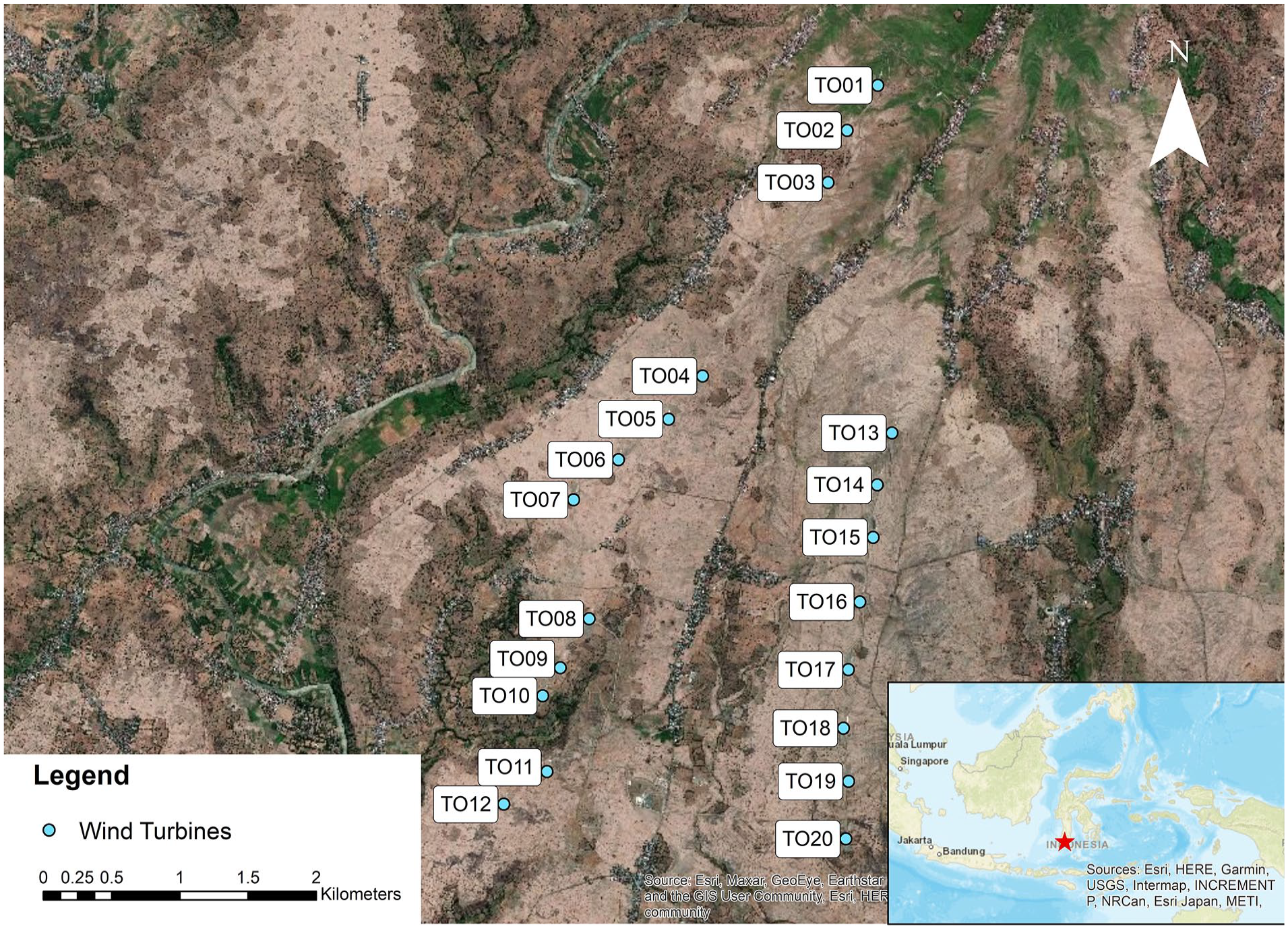
Layout of Tolo Wind Farm, Jeneponto Regency, South Sulawesi.
EIREP was initially proposed as part of a World Bank–supported RE project in the mid-1990s. Following a series of financial setbacks (World Bank 2004), the EIREP was revived and expanded in 2016 under a thirty-year power purchase agreement (PPA) between Redaya Energi, the Indonesian platform of Singapore-based RE development firm Equis, and PLN. Equis used a project finance model in which it created a subsidiary company—PT Energi Baru Jeneponto (EBJ)—to assume financial responsibility for the project. In 2017, EBJ obtained a national-level environmental permit and secured a 396-ha Location Permit from the Regent of Jeneponto shortly thereafter (ESC 2017). As the proposed project area did not coincide with officially designated forest area, it avoided the need for Ministry of Forestry approval (ESC 2017). Despite the presence of active rice fields, all lands were determined eligible for conversion from agricultural land through the provision of Right to Build (locally known as Hak Guna Bangunan, or HGB).
With approvals in hand, in 2017, EBJ leveraged the guaranteed revenue stream under its PPA with PLN to pursue a $120.8 million ADB financing package. According to environmental and social impact assessment reports required under ADB’s safeguard requirements, EBJ acquired 44.17 ha of the 396-ha area under the Location Permit from 497 landowners, with an average of 0.08 ha acquired from each owner (ESC 2017). Over one-quarter of landowners transferred more than 10 percent of their total land holdings (ESC 2017). EBJ purchased the land through an ADB-compliant willing-buyer willing-seller negotiated settlement, with compensation determined individually based on proximity to existing infrastructure, with most lots acquired at prices above appraised values (ESC 2017). 5 Based on these factors, the ADB determined that the project did not have a significant risk of involuntary displacement and approved the project funding without requiring the preparation or implementation of a resettlement plan (ADB 2017a).
While the willing-buyer/willing-seller approach avoided ADB-mandated displacement avoidance measures, the developer’s rationale for adopting this approach is unclear. As noted in the ADB approval, “To expedite the project, EBJ procured project land using a willing buyer–willing seller process without using the provisions of National Land Agency Law No. 2/2012 on land procurements for development in public interest” (ADB 2017b, 2). As an eligible project type under National Land Agency Law No. 2/2012, the developer could have acquired the project land via eminent domain. However, acquisition through eminent domain—classified as a form of involuntary resettlement under the ADB’s safeguard mechanism—would have required EBJ to assess social impacts and implement a resettlement plan (ADB 2012). Paradoxically, the EBJ’s decision not to invoke eminent domain was not solely an effort to avoid implementing a resettlement plan but instead driven by the complex and lengthy expropriation process. As such, ADB safeguards serve primarily as a mechanism to assess social and environmental impacts but, in this case, are subordinate to local regulations.
Burgos Wind Farm, the Philippines
Land and Energy Governance: National Context
The Philippines Renewable Energy Act (2008) was the first national-level legislation specifically intended to promote RE in Southeast Asia. The Philippines faces numerous energy security challenges, including heavy reliance on imported fossil fuels (IRENA 2017c), forecasted increases in power demand (IRENA 2018), challenges of extending reliable electricity access to smaller islands, and worsening climate impacts (IRENA 2017c). The Act aims to address these challenges through a threefold increase in domestic biomass, solar, wind, hydro, geothermal, and ocean energy sources by 2030 (Republic of the Philippines 2008). The Philippine Energy Plan (PEP) 2020–2040, last revised in 2021, sets a target, under the Clean Energy Scenario, for RE to provide 35 percent of the power generation mix by 2030 and 50 percent by 2040. In 2012, the Philippines government implemented a feed-in tariff (FiT) to incentivize RE investment by guaranteeing a competitive fixed price for at least twelve years (IRENA 2017c). The policy has supported significant RE expansion, with installed wind capacity increasing from 33 MW in 2012 to almost 443 MW in 2021 (Guild 2019a; IRENA 2022).
Land in the Philippines falls under two categories: (1) protected areas (15.9 million ha) and (2) alienable and disposable lands (14.2 million ha), the latter of which are mostly privately owned (65%) or state-owned but eligible for private ownership (35%; Koirala, Mishra and Mohanty 2016). Beyond this distinction, land use is regulated at the national level and three levels of local government units (LGUs): provinces, component cities and municipalities, and barangays (Congress of the Philippines 1991). Following the fall of President Marcos in 1986, LGU endorsement became a prerequisite for approval for environmental impact assessment (EIA; Bosselmann, Engel, and Taylor 2008). However, efforts to streamline the EIA process have since removed this requirement (Department of Environment and Natural Resources [DENR] 2007).
The country’s topography and history of land-based conflict also complicate land use and acquisition (Franco and Borras 2007). As an archipelago with rugged and mountainous interiors, only 16 percent of the total land area is arable (Quizon and Pagsanghan 2014). Efforts to maintain state control over land and address landlessness among farmworkers have informed land use and ownership restrictions. Private corporations cannot hold alienable lands in the public domain except by lease, limited to a once-renewable term of twenty-five years and a maximum area of 1,000 ha (Republic of the Philippines 1987). Lands with a slope of 18 percent or greater are classified as forest lands and subject to state control unless covered by existing titles or occupied continuously for at least thirty years (Republic of the Philippines 1975).
Agricultural land is subject to further limitations under the Comprehensive Agrarian Reform Program (CARP), which affords ownership rights to landless farmers on lands acquired by the government (Bankoff 1996). While CARP prohibits land sale for ten years, farmer-beneficiaries can engage in commercial contracts like leasing that allow investors or developers to use it (DAR Admin Order No. 2 Series of 1999). With Department of Agrarian Reform approval, CARP allows agricultural land to be converted to other uses, particularly if agriculture is not deemed the most economically beneficial land use (Bankoff 1996). While CARP affords farmers a range of protections, these are limited by a 1993 Supreme Court ruling which authorizes the Philippine government to override CARP through eminent domain for projects in the public interest, including energy infrastructure (Republic of the Philippines 1993).
Burgos Wind Farm
The 150-MW Burgos Wind Farm, depicted in Figure 2, is located on 618 ha in the municipality of Burgos in Ilocos Norte Province in the northern Philippines. The site comprises 219 ha of public land and 399 ha of private land consisting of 273 private lots and approximately 200 ha of communal pastureland used by sixty-seven small-scale cattle herders (EDC Burgos Wind Power Corporation [EBWPC] 2014). The fifty-turbine project was the first wind project nominated for the national FiT incentive scheme, and upon completion in November 2014, it was the largest wind project in Southeast Asia. The 42 km transmission line encompasses an aggregate land area of 121 ha spread across twenty-nine barangays. The project feeds into the Luzon grid, which serves 75 percent of electricity consumption in the Philippines, including the megacity capital Manilla. The Burgos Wind Farm was developed by EBWPC, a special purpose vehicle wholly owned by the largest geothermal energy producer in the Philippines, Energy Development Corporation (EDC). Initial planning for the project, including land acquisition, began in 2000 (Philippine National Oil Company [PNOC] 2004).
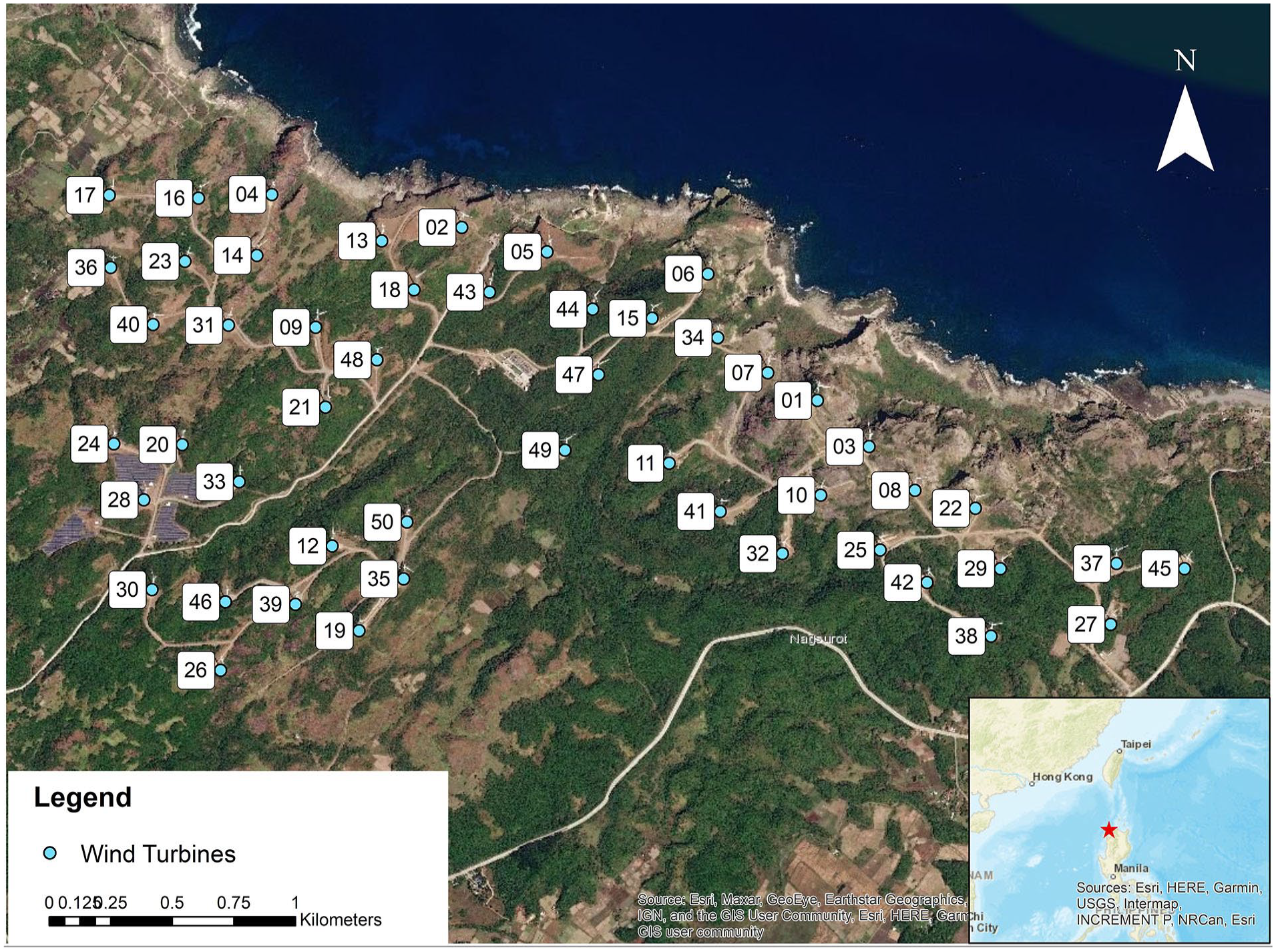
Layout of Burgos Wind Farm, Burgos Municipality, Ilocos Norte Province, the Philippines.
The project was initially conceived as a 42-MW wind project with sixty-three turbines covering approximately 255 ha and subsequently expanded through integration with an 80-MW project in 2008 (EBWPC 2015). Under Philippine law, the multiple existing land uses required approval at provincial and national levels. In 2008, the Burgos Municipality, representing the communal pastureland organization, signed a joint Memorandum of Agreement (MOA) with EBWPC’s parent company to accommodate the herders’ continued use of the land, and all affected LGUs subsequently endorsed the proposal (EBWPC 2015). The DENR certified the final EIA in 2010 and issued a Forest Land Use Agreement that approved the use of public land in 2012 (EBWPC 2014, 2015). With national and local approvals in hand, in 2015, EBWPC secured USD 20 million in debt financing from ADB as part of a larger refinancing deal, making it subject to ADB’s social and environmental safeguards and reporting requirements (ADB 2019b).
According to the ADB-required Social Safeguards Compliance Audit Report, EBWPC sought to acquire fixed-term possessory rights over the land rather than permanently acquiring title or ownership. The report cites three reasons for this approach: “(i) higher cost compared to leasing the property, (ii) less social acceptance of the affected community because of the mass acquisition of the property, and (iii) limitations on the ownership of agricultural land in terms of total land holdings” (EBWPC 2014, 11). According to the audit report, EBWPC initially planned to offer easement contracts for the wind farm and substation land before proceeding with expropriation. Doing so, however, would have required EBWPC to engage in the time-consuming processes of securing ownership documents and applying for conversion of the land from agricultural to industrial under CARP. To expedite construction, the strategy changed from easement contract to expropriation in early 2011. As stated in the audit report, “[e]xpropriation automatically converted agricultural land which shortened the needed lead time” (EBWPC 2014, 11). This arrangement granted EBWPC control over the land without acquiring formal title, which is prohibited under CARP.
Of the 273 lots ultimately acquired for the wind farm, 252 were subject to expropriation proceedings involving 258 individual landowners (EBWPC 2014). Compensation was determined at the national level by the Bureau of Internal Revenue’s zonal valuation system, which, distinct from market valuation, provides estimated values for taxation purposes (Castillo 2019). EBWPC claimed that the project affected only 0.23 to 5.96 percent of individual holdings, and the average impact was 2 percent (EBWPC 2014).
The audit deemed EBWPC’s acquisition strategy compliant with national requirements. As land was expropriated for use, not title, landowners maintained legal ownership. Users could also continue accessing the land, provided those activities did not interfere with the wind farm operation. However, due to ADB’s late entry, the auditor’s additional recommendations are made to bring the existing approach into compliance with ADB safeguards. As the acquisition was already underway and affected landowners were unwilling to relocate, these recommendations focus on additional actions such as legal support, stakeholder engagement, and the implementation of livelihood restoration measures. As such, these measures seek to address impacts stemming from the acquisition process already underway at the point of ADB involvement rather than shaping the land acquisition process itself.
Discussion: Implications for RE Planning and Policy
The two case studies offer preliminary insights regarding the multi-scalar dimensions of land acquisition for RE development in the global South. Both projects received financial support from the ADB and were therefore bound by the same rules on involuntary resettlement and socioeconomic impacts. However, as summarized in Table 1, differences within these policies and institutional contexts resulted in developers making vastly different choices for the mode of acquisition and compensation for existing landowners and users. These differences, we argue, also align with differences in project design and footprint, suggesting a connection between acquisition processes and the overall social and environmental impacts of large-scale RE infrastructure.
Comparison of the Two Cases on Key Variables of Interest.
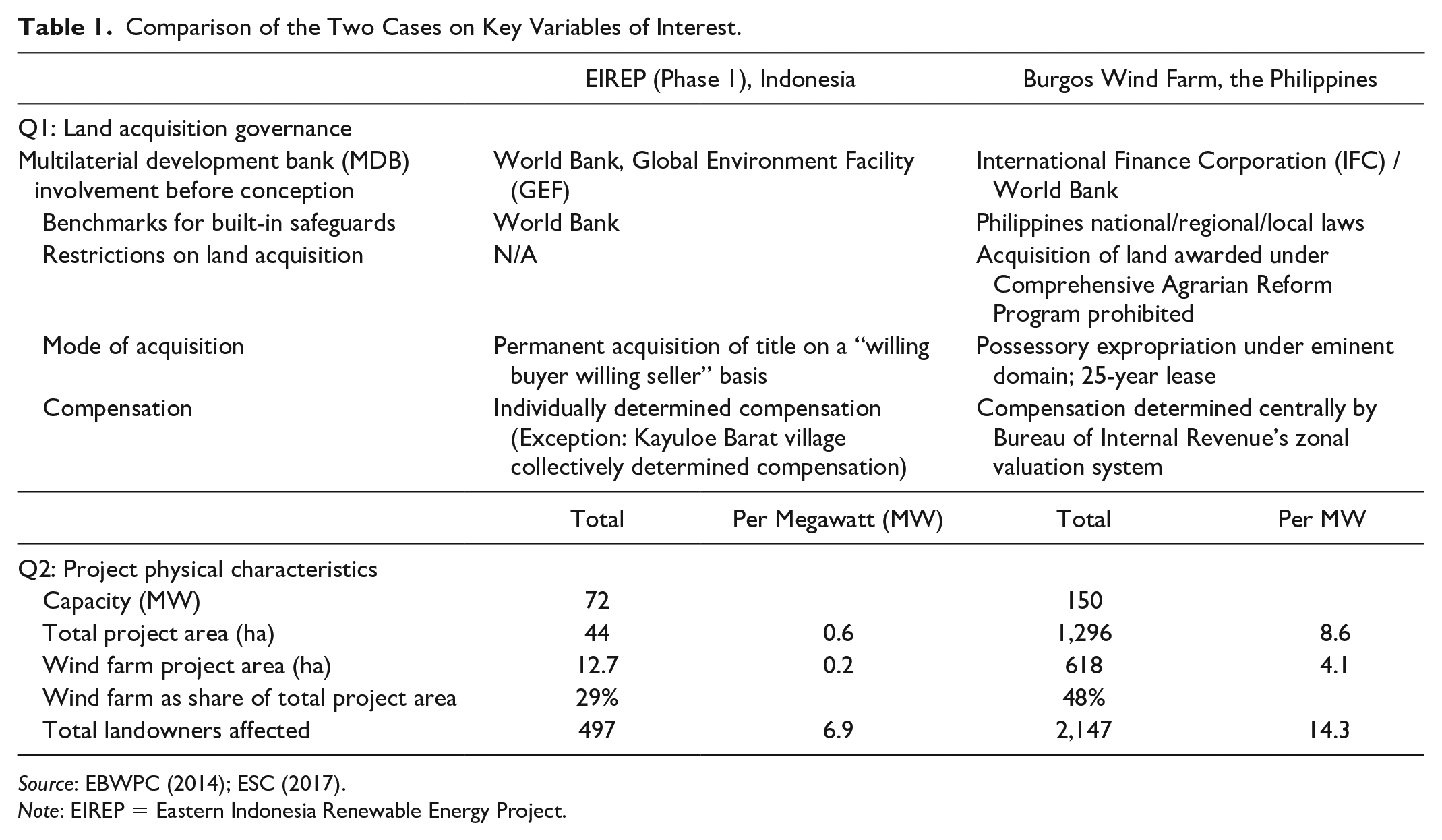
Source: EBWPC (2014); ESC (2017).
Note: EIREP = Eastern Indonesia Renewable Energy Project.
Neither project reported any involuntary resettlement after receiving ADB support. In Indonesia, the land needed for RE projects was acquired outright, and all such transactions were reported to be “voluntary” and at mutually agreed values. These determinations were made for individual landowners or, in one case, at the level of the village, suggesting greater local negotiation power than in the Philippines. In the case of Burgos, the developer easily navigated the complexity imposed by the CARP—which restricts title transfers—by securing access through eminent domain. In Indonesia, the absence of eminent domain made acquisition more complex, requiring individually negotiated settlements between the buyers and willing sellers.
A key factor here is the ease with which developers were able to acquire land through eminent domain. In Indonesia, the eminent domain process was deemed too time-consuming, making individual negotiations the preferred acquisition strategy. In the case of the Philippines, however, eminent domain allowed the developer to bypass more onerous CARP requirements. The option to obtain possessory rights, as opposed to acquiring title, not only complied with the ADB’s involuntary displacement safeguards but was viewed by the developer as a lower cost option. In sum, while both projects were deemed sufficiently compliant to secure ADB funding, the rationale for adopting compliant acquisition practices appears to follow the path of least resistance rather than attempts to avoid resettlement planning efforts required by the ADB.
These differences in acquisition processes exist alongside critical differences when the ADB was approached for support. EIREP was set up with the support of the World Bank and, as such, incorporated a variant of MDB safeguards at inception. Moreover, ADB support was sought in the initial phases and before any construction or land use change had started. On the contrary, ADB support was requested for Burgos after the land had been acquired and construction had already started. This timing meant that a full social impact assessment was not carried out before the original land users and owners were relocated, and the ADB only conducted a post-fact audit in line with its operations manual. This difference exposed the two projects to two different governance regimes within ADB’s broader safeguards policy, facilitating long-term leases without transfer of ownership through expropriation and eminent domain in the case of the Burgos project and a willing-buyer / willing-seller negotiated settlement in EIREP.
A final finding concerns the relationship between acquisition processes, project footprint, and the number of landowners ultimately affected. The relative project footprints—measured in terms of MW per ha—differed considerably between the two projects. The 72-MW EIREP occupied a little over 14 ha, whereas the 150-MW Burgo project occupied over 600 ha. Put differently, while the Burgos project is roughly double the generating capacity of the EIREP, it occupies an area forty-four times greater than the Indonesian project. At the same time, the total number of landowners directly affected by the Burgos project (2,147) is over four times that affected by the EIREP (497). Finally, while the wind farm occupied 29 percent of the total project area in the Indonesia project, the wind farm in the Burgos project occupied almost half (48%) of the total project area. While additional research is required to determine the specific causes behind this variation, our analysis suggests that the challenges associated with individual negotiations on a “willing buyer willing seller” basis may encourage a more compact project design that not only affects fewer landowners but also reduces the extent of environmental disruption and degradation associated with such forms of large-scale infrastructure development.
Conclusion and Avenues for Future Research
The two case studies highlight the importance, complexity, and potential implications of land acquisition for RE development in Southeast Asia. Despite standardized efforts to safeguard against adverse social and environmental impacts, land acquisition for RE development is a highly context-specific process that can result in wide variation in project footprint, number of affected land users, and compensation. In this way, our findings demonstrate the potential for local, regional, and national policymaking to work with global institutions to respond to energy challenges in a way that attends to the specificity of local political-ecological contexts and broader climate and development goals. With RE development in the region set to accelerate—COP27 saw the United States and other nations commit USD 20 billion over the next three to five years to accelerate Indonesia’s energy transition (The White House 2022)—land and land acquisition will no doubt remain central, if not contention, issues.
Our two case studies offer several important avenues for future research. The generalizability of our findings can be strengthened by studying land acquisition processes across a greater number of projects and contexts, with greater attention to the dynamics of opposition and resistance in response to potential transformations of land ownership, access, and use. Based on available social and environmental impact reporting, it is difficult to understand the impacts of these projects on adjacent areas, including the proximity of turbines to specific land use types, the types of landowners and users affected, and the relationship between turbine placement and formal versus informal tenure. Long-term field visits, including surveys and interviews, are required to provide a more nuanced understanding of the complexity and long-term implications of large-scale RE development in rural landscapes. Higher resolution socioeconomic data are required to determine who exactly enjoys the benefits and whether those benefits are ultimately derived through exclusion and expropriation.
Our analysis benefited greatly from data contained in ADB social and EIAs typically not available for projects funded purely through private means. The shift in RE finance from public to private sources raises transparency concerns regarding instances of displacement associated with large-scale RE development. While the rise of environmental, social, and corporate governance (ESG) reporting is increasing, there remain significant barriers to replicating this analysis beyond MDB-supported projects. In this context, future research should assess specific socioeconomic and environmental implications by directly engaging those directly affected by RE development. Doing so would also illuminate the political dynamics within the social groups (landowners, sharecroppers, planners) identified in this study. Understanding these dynamics and their ongoing relationship to land use policy is crucial to supporting forms of energy transition that foreground equity and justice concerns on the path to a low-carbon future.
Footnotes
Declaration of Conflicting Interests
The author(s) declared no potential conflicts of interest with respect to the research, authorship, and/or publication of this article.
Funding
The author(s) disclosed receipt of the following financial support for the research, authorship, and/or publication of this article: This research received financial support from the University of Illinois Urbana-Champaign Institute of Sustainability, Energy, and Environment (iSEE).
