







Abstract
“Social justice” and “public interest” have traditionally been fundamental concepts for most planning theories. The planning literature about these concepts has become a complex set of interpretations that make it difficult to explain the relationship between the two concepts. The current article attempts to shed light on this conceptual confusion about the relationship between these concepts by using the meta-synthesis method. This meta-synthesis leads to the identification of four distinct perspectives “Utilitarians,” “Democratic Proceduralists,” “Structuralists,” and “Post-structuralists.” Each of which places them in different positions from each other according to their distinct definitions of these concepts.
Keywords
Introduction
“Social justice” and “public interest” have traditionally been fundamental concepts for most planning theories. These concepts have evolved with the evolution of planning thought influenced by exogenous philosophical theories (Allmendinger 2002) and context-oriented changes. The review of the theoretical literature on social justice in planning shows that the effect of this concept of ethical and political philosophy on the evolution of normative planning thinking has led to a variety of perceptions and a lack of consensus in providing a coherent definition (e.g., Dadashpoor and Alvandipour 2020; Davidoff 1965; S. S. Fainstein 2010, 2014; Harvey 1973; Healey 1997; Marcuse 2015; Marcuse et al. 2009; Sandercock 1998; Soja 2009, 2010).
This effect can be traced back to the influence of utilitarian intellectual current on the rational comprehensive planning paradigm and subsequent theories (Campbell 2006). As in the framework of utilitarianism, with an ontological view, moral issues such as justice can be determined by logical and decisive calculation of the action result (Moroni 2016), the utilitarians’ definition of social justice becomes the central concept of planning until the second half of the twentieth century. Utilitarians, by defining “total utility” as the only final moral value that should be maximized (Clark and Elliott 2001), link judgments about all things, including justice, to the resulting utility.
However, in the second half of the twentieth century, affected by the communicative turn in the planning theory, which is implicitly related to Rawls and Habermas’s deontological reading of justice, the definition of social justice in the planning theory undergoes transformation (Campbell 2006; Campbell and Marshall 2002; Stein and Harper 2002). For the deontologists, moral questions or questions about justice are related to the claim of the rightness of action (Campbell and Marshall 2006), which must be approved by all people involved in the discussion. Furthermore, with the criticism of “idealization” in liberal concepts of justice, which leads to their ineffectiveness in solving the situational planning issues (e.g., O’Neill 2000; I. M. Young 1990), in definition of justice, the necessity of linking abstract principles to context-sensitive judgments about specific cases is raised.
Since the 1970s, the integration of the universal and abstract understanding of justice with the understanding of contextual characteristics of planning practice has created a new framework for conceptualizing justice in planning (e.g., Harvey 1996; O’Neill 2000). In this new framework, on one hand, planning theories with a political economy approach, emphasizing the need to criticize liberal economic and political structures and the need to pay attention to wealth redistribution structures, conceptualize social justice based on “fair distribution through fair means” (Harvey 1973). On the other hand, postmodern theories of planning, emphasizing cultural and social issues as important indicators of unequal distribution of power and resources, present an idea of justice that, in addition to distribution patterns, consider the production and reproduction processes and relations of these patterns (Fincher and Iveson 2012; Sandercock 1998; I. M. Young 1990).
In this regard, the concept of public interest as one of the most challenging and, at the same time, inevitable concepts in the field of planning has taken different definitions due to the evolution of planning thought (e.g., Alexander 2002b; Campbell and Marshall 2002; Flathman 1996; Lennon 2017; Meyerson and Banfield 1955; Moroni 2004, 2019).
At the beginning of the twentieth century, the modern planning argued that the common good can be defined objectively and unitary as the laws of reality (Meyerson and Banfield 1955). This concept of public interest was taken for granted at the peak of comprehensive planning until the second half of the twentieth century (Alexander 1992; Altshuler 1965). However, from the 1960s to 1970s, influenced by pluralism and postmodernism, planning was accepted as an inherently political and value-based activity, which occurs in a context of competing interests and in an atmosphere of power asymmetry. On this basis, the planning theory enabled the emergence of the interests of different social groups by creating structural reforms in decision-making processes (Davidoff 1965). In the 1990s, the “communicative turn” in the theory of planning, influenced by the theory of “communicative action” by Habermas (1984), completely changed the orientation toward public interests. In the communicative paradigm, public interest is reflected not as the normative content of planning but as the justice of participatory procedures (Forester 2012; Healey 1997; Innes 1996; Mattila 2016). Finally, in criticizing the idealization and globalization of the concept of public interest in liberal ideas and the need to pay attention to the contextual characteristics of planning practice, a new concept of public interest in planning theory with emphasis on changing liberal structures is born to attend to a set of specific plural interests based on distinct social groups (Sandercock 1998; Watson 2009).
Despite all the tensions over these concepts in general in the theoretical literature, “public interest” is the main goal and the essential criterion of planning legitimacy (Alexander 2002b, 2010; Campbell and Marshall 2002; Heywood 1990; Moroni 2004; Taylor 1998), and “social justice” as the guiding principle of planning (Campbell and Marshall 2006; Dadashpoor and Alvandipour 2020; S. S. Fainstein 2005, 2010; Harvey 1973; Marcuse et al. 2009) are both the basis for the development and evolution of planning thought and are influenced by it.
The public interest as the normative content of planning has from the beginning been associated with pervasive public values such as social justice and has followed a similar logic (e.g., Chettiparamb 2015; Heywood 1990), but conceptual tensions surrounding these concepts make it difficult to provide a clear explanation of their relationship. These concepts, as the central concepts of planning, sometimes are defined as equivalent to each other (Mill [1861] 1957), sometimes the result of one another (Habermas 1984; Rawls 1971), and sometimes part of each other (Harvey 1973; I. M. Young 1990).
Thus, as the planning literature in this field is a complex set of theories that define these concepts in different situations, this article seeks to answer the question that “What is the relationship between social justice and the public interest in the planning literature? To answer this question, we must first consider that each theory of social justice is supported by a theory of “Good” (Smith 1997), or, according to Harvey (1992), there are different interpretations of social rationality corresponding to competing theories on social justice. Thus, in the evolution of these concepts, there must be common grounds based on which their position can be explained. To this end, all competing interpretations of social justice and public interest must be clarified to provide the ground for an explanation of these concepts’ relationship in the planning theory. In the present article, to organize the conceptual confusion about the relationship between the concepts of social justice and the public interest in planning, a meta-synthesis method was used for identifying and combining the literature and rethinking and restructuring them to gain a comprehensive understanding of the relationship. Meta-synthesis as a subset of meta-study (Bench and Day 2010; Paterson et al. 2001) leads to an understanding of the relation of the different researches and makes comprehensive and interpretive findings by combining, interpreting, and integrating the primary data of selected studies (Beck 2002; Zimmer 2006).
Using Sandelowski and Barrosos’ (2006) proposed model for the meta-synthesis of qualitative studies, this article attempts to answer the question of “the relationship between social justice and the public interest in planning.” For this aim, the sources were selected through a systematic review process. The documents were selected based on the searched words in the keywords, titles, and abstracts of English articles and books indexed in the Scopus citation database over sixty-six years from 1955—when Meyerson and Banfield (1955) highlighted the concept and application of the public interest in modern planning in their book titled Politics, Planning, and the Public Interest—to the present. The documents entered into the review process are refined based on the relevance of the articles’ title, abstract, and text to the research aim. Subsequently, those resources are analyzed that explicitly define or conceptualize the “social justice” or “public interest” in planning and provide a good context for explaining the relationship of these concepts.
The resource selection process in this study is performed in three steps. In the first stage, the keywords of “social justice” and “just city” in combination with “planning,” “urban planning,” “planning theory,” “planning practice,” and “planning profession” were examined as the context descriptors. The result was 2,206 early documents, out of which forty-nine documents were selected for analysis in the refining process. The keywords “public interest” and “common good” in combination with “planning,” “urban planning,” “planning theory,” “planning practice,” and “planning profession” were examined. The result was 897 initial documents, out of which thirty-seven documents were selected in the refining process for analysis and review. In the third stage, the references of the documents obtained from the systematic review were examined to ensure that all related sources were reviewed. Fifteen articles and books were added to the selected resources in this stage. Finally, the meta-synthesis of social justice and the public interest concepts in the planning literature were performed on 101 documents.
In the following, the meta-synthesis result is provided by the four intellectual-philosophical perspectives of the Utilitarians, Democratic Proceduralists, Structuralists, and Post-structuralists. Each perspective provides its unique reading of these concepts and puts them in a different position. Two points should be attended to, first, the categories presented result from a review of the planning literature through the lens of exploring the relationship between the concepts of “social justice” and “public interest.” In this process, ignoring some semantic subtleties to organize the theoretical literature and arrive at a clear answer to how these concepts relate has been inevitable as a constraint on any category.
As S. S. Fainstein (1997) states, no classification can do justice to all thinkers and address their arguments that are beyond the boundaries and limitations of research. Therefore, considering the breadth and complexity of this work, the theoretical contribution of the thinkers in each category is determined solely from the perspective of explaining the relationship between the concepts of “social justice” and “public interest.” Second, the discussion about social justice and public interest in planning is more than summarizing the ideas of great philosophers of justice and public interest. These philosophers did not consider planning as a context in which they wanted to apply their ideas, and their concern was generally about the basic principles of entire societies. Therefore, the purpose of presenting philosophical theories or, in the words of Allmendinger (2002), exogenous theories of planning, is not their direct translation in the field of planning, but the genealogical examination of different interpretations of justice and public interest in the planning theory.
Finally, we compare definitions and positions of these concepts to create an integrated interpretation of the findings. The article concludes with the argument that since the concepts of social justice and the public interest are complex concepts with different interpretations, there is no consistent and direct answer to the research question. Each time, various theoretical flows and contexts, based on different readings of these concepts, give different answers to this question. However, a clear framework of these answers helps the theorists and professionals to use this multiplicity to conceptualize the public interest and social justice as an opportunity to find the best version that fits the prevailing lines of thinking and contextual conditions in different areas of action.
Utilitarians
In the ethical school of consequentialism, no action is good or bad by nature. The judgment of an action is related to its consequences and results. Within this ethical school, the most common and influential answer regarding the good or bad result is utilitarianism (Nussbaum 1979). As the pioneer of utilitarianism in the contemporary era, in explaining the problem of “justice,” Bentham sought an objective and applicable criterion in the external context for judging the outcome of actions (Bentham 1970, 25). In an Introduction to the Principles of Morals and Legislation (1789 ed.), Bentham introduces pleasure and pain as the simplest moral elements and the right and wrong criteria of the individuals’ actions. He sees individual interest as the basis of pleasure and considers individualism a principle by emphasizing that there is no source of value independent of the rational human being (Mill [1861] 1957). For Bentham, the reason was not a tool for exploring ethical issues but a capacity to evaluate empirical phenomena objectively. As a result, any theory of justice that is not based on its result is subjective and incapable of providing principles to gather conflicting interests. Bentham and his followers define “total utility” as the only final moral value that must be maximized (Clark and Elliott 2001), and link judgments about all matters, including justice, to the benefit that comes from it.
Thus, the fair situation here is the state where the total utility is maximized. The maximum of the total utility, or the maximum of welfare, is where the ultimate utility of each individual in society is equal. Since the utility function is considered equal for all society members in this process, there is a kind of equality in this view (Sen 1992). However, in practice, due to differences in the individual’s utility function, the result of this attitude is anti-equality and injustice. Since in the distribution of resources, the wealthier people are probably more capable of earning money, the significant share of these resources in the fair distribution of the utilitarian belongs to them, as they can use their skills and abilities to add more value to society as a whole (Fitzpatrick 2011; Musgrave 1973). In addition, since the utilitarians judge based on the total utility in society, they are not only indifferent to how it is distributed in society but, in many cases, they prefer the distribution of inequality, which ultimately maximizes the total utility (Rawls 1971, 26–27; Sandel 1984; Sterba 1992). As a result, in practice, the utilitarian view completely neglects equality and defines justice as the result of the increased total utility of society.
Finally, the issue that highlights the incompatibility of justice with maximizing total welfare is the nature of utility or welfare. The definition of utility or welfare as an inner state such as pleasure or satisfaction originated from the satisfaction of individual preferences of members of society; regardless of the content of these preferences, it can contradict ethical values such as justice (Moroni 2016). The conceptual incompatibility between “justice” and “utility” and the attempt to resolve the deep conflicts between these concepts are best explained in the works of John Stuart Mill ([1861] 1957) to the extent that the contemporary utilitarians (e.g., Hare 1992; Pigou 1920; Sterba 1992) refer to it to explain the compatibility of these concepts. On the compatibility of justice and utility, Mill ([1861] 1957) explains justice as an ethical matter. Although the feeling of justice is a natural feeling of retaliation and revenge, lacking an ethical element, it becomes an ethical feeling when used exclusively in compliance with the “public interest.” As the “utility” is the ultimate answer to all ethical questions, justice can be the same utilitarian consideration—that is, attaining the most significant benefit for the greatest number (Mill [1861] 1957). Thus, in the utilitarian reading, justice is not an independent and intrinsic value but a set of ethical principles resulting from realizing the public interest.
In defining the public interest, Bentham and his followers see it as the sum of individual interests (Held 1972; Klosterman 1980). According to utilitarianism (Bentham 1970), something is in the individual’s interest when it adds to the individual’s pleasures or alleviates his or her pain. As a result, the public interest here is derived from the sum ranking of individual interests. Nevertheless, the main issue in this definition is the process of aggregation of individual interests that requires analytical methods to identify and aggregate individual preferences (Alexander 2002a; Campbell and Marshall 2002; Held 1972; Howe 1992; Meyerson and Banfield 1955; Moroni 2016). The aggregation of individual interests by the “pluralistic aggregation” method, as the most direct democratic idea in the public interest (Howe 1992), is the sum of the preferences expressed by individuals and their aggregation is determined by politicians in a political deal. The most critical challenge in these methods is the possibility of ignoring the rights and interests of minorities and the appearance of unfair consequences (Graham and Healey 1999) and “free-riding” (Olson 1971).
In the aggregating of individual interests alongside the issue of unfair outcomes and “free-riding,” by considering critiques such as reductionism, uni-dimensionality, and equal consideration of preferences (Alexander 2002b; Moroni 2016), Meyerson and Banfield (1955) introduced the second standard in addition to the principle of utility. According to the new standard, individual preferences that lead to “total utility” outweigh other preferences (Meyerson and Banfield 1995, 324–26). This utilitarian approach, called quasi-utilitarianism, considers the function of individual preferences in social welfare to determine the public interest (Sager 1990, 149–52). As a result, in aggregating individual interests, the interests with a more significant impact on social welfare carry more weight in defining the public interest.
However, the problem still remained as how to aggregate individual preferences (often incompatible) to determine the public interest. The answer required analytical methods to recognize and aggregate individual preferences (Alexander 2002a; Campbell and Marshall 2002; Held 1972; Howe 1992; Meyerson and Banfield 1955; Moroni 2016), which was best responded by economists in Litchfield’s cost–benefit analysis methods and subsequent reforms in planning balance sheet analysis and community impact evaluation (CIE) (Lichfield 1964, 1971).
Utilitarianism has had a significant impact on the theory and practice of planning and defining the role of planners by defining the public interest as a criterion for evaluating and legitimizing the planning practice. The success of utilitarianism in planning can be attributed mainly to the fact that among the various ethical theories available, it is the closest theory to the traditional technical and scientific mentality of planning. In utilitarianism, ethical issues can be determined by logical and decisive calculation (Moroni 2016). A clear example of this is the fundamental role of Bentham’s utilitarian principles in the nineteenth-century English social reform movement (Campbell and Marshall 2002) and subsequently its impact on the tradition of social reforms in planning and to some extent on comprehensive-rational planning.
Although primarily in the second half of the twentieth century, the mainstream of planning distanced itself from utilitarian concepts, this perspective can be traced to twentieth-century pragmatic planning (Friedmann 1987; Lindblom 1959) and smart cities development (Custers and Ranchordas 2019; Lara et al. 2016; Malek, Lim, and Palutturi 2021). However, specifically from the early twenty-first century, the utilitarian perspective has re-emerged in the theory and practice of planning through the market-oriented philosophy of neoliberalism (Richardson 2008; Sager 2009; Taşan-Kok 2012; Watson 2006). Understanding social justice in neoliberal thinking is not distinct from its underpinning ethical philosophy, utilitarianism. In planning neo-liberalization, there is virtually no concern for social justice (Gunder 2006), as justice has given way to efficiency. In other words, justice has essentially lost its communal meaning, and the individual cost and benefit gained importance (Brodie 2007). The same thinking can be traced to the concept of public interest in the neoliberal era (Cheyne 2015; Dadashpoor and Sheydayi 2021). In a neoliberal society, the individuals and interest groups as separate individualities in the free market context are the focal points of the definition of the public interest. The public interest is achieved by balancing the divergent views as they are most efficient.
Finally, by emphasizing the usefulness of justice, the utilitarians do not value it independently of utility (usefulness) and conclude that justice is nothing but utilitarian considerations; thus, by transforming justice into a marginal concept, they define the goal of actions as efficiency and the fair distribution in the context of optimal allocation. Consequently, for the utilitarian, justice is defined not as a superior and fundamental guiding value in the planning process but as a result of the public interest. Moreover, when the concept of “efficiency” becomes the core value and normative content of planning instead of “justice,” it is not surprising that we cannot see justice-oriented planning theories in this stream of thought.
Democratic Proceduralists
For democratic proceduralists, “justice” and “right” are born after developing people’s rights. This conventional view of justice contrasts with the utilitarian view, in which justice is an external criterion for judging the outcome of actions (Sandel 1984). The definition of justice based on the “acceptance of social duty in a social contract” is rooted in the ideas of Hobbes (1679–1688), Locke (1704–1632), Hume, and other classical liberal theorists, who equated justice with observance of contracts and fulfillment of covenants (Klosko 1993; Strauss 1953). Democratic proceduralists emphasize the rule of law since, in the establishment of laws, the individual interest is taken into account along with the acceptance of empathy for the benefit of others (Liedman 1993). This empathy gives a value and ethical dimension to “making laws” and “committing to them.” The emphasis of the ethical approach to law is based on the hypothesis that law is the best means of achieving consistent and impartial decisions and thus protecting individual rights (Nozick 1974). Justice in this perspective, then, is the ethical obligation of all individuals to abide by the laws agreed upon by all and recognize the right of all individuals to pursue individual interests.
Within this perspective, the theoretical efforts of John Rawls (1967, 1971, 1982) and the ideas influenced by it in explaining and expanding the concept of social justice provide a suitable lens for examining this concept and its relationship with the public interest. In “the Theory of Justice,” Rawls (1971) depicts an abstract situation in which people agree on two things, which Rawls calls the principles of justice or the moral principles of liberal democratic society. The first principle is freedom. Individuals have an equal right to freedom in the broadest sense, which is at the same time compatible with the same freedom for all. The second principle is inequality. Inequalities are acceptable if they benefit all and, second, everyone has equal access to them. Social and economic inequalities must be regulated to benefit the weakest and most disadvantaged members of society (Rawls 1971).
Given that Rawls does not explain how his ethical conceptions of justice are achievable, Habermas’ theory of communicative action and discourse ethics with the same Kantian origin tries to provide a good platform for explaining how justice is achieved. Influenced by Rawls, Habermas seeks the roots of justice in constitutional structures and regulations (Habermas 1996); however, to reduce the abstract level, considers the process of achieving the principles of justice to involve more real social factors (Moon 1995; Peffer 2014) such as social, economic, and governmental institutions. He tries to place justice in the process of discussion and argument, not in its normative content (Campbell and Marshall 2006); thus, his conception of justice is based on a process of practical discourse.
To define justice, Habermas refers to the concept of “communicative rationality,” which lies at the heart of language and discourse (Habermas 1984). He defines the “unavoidable presuppositions” such as the “ideal speech situation” to advance credible claims in an ethical debate. In this unrealistic situation, individuals use linguistic communication to achieve mutual understanding and take a position regarding reciprocal claims’ rightness (Habermas 1984, 15–18; 1993). According to Habermas, ethical questions or questions about justice relate to the claim about the rightness of the action (Campbell and Marshall 2006)—that is, an action that is considered correct by all participants in the debate and is an interpretation of justice that can be generalized as an ethical, general, and indispensable matter (I. M. Young 1990). Therefore, justice is a credit concept (Habermas 1993, 152). There is no such thing as justice before executed legitimate dialogue (Williams 1999, 118), and it is created in the form of ethical norms through practical discourse.
To clarify the concept of “public interest” in this perspective, we can return to the starting point of Rawls and Habermas, namely, “the irreconcilable multiplicity of the nature of good” and “rejecting the a priori concept of good” (Habermas 2018). Here, “public interest” does not exist as an a priori norm but emerges through applying justice as an ethical norm in practical discourse. This interpretation of the public interest is related to the necessary and obligatory respect of individuals and institutions for moral laws and norms and adherence to them (Falconi 2016). In this regard, Habermas’ discourse ethic in constructing a credible dialogue will move toward something that can be considered the public interest (Dryzek 2002; Innes and Booher 2015). In the communicative action theory, Habermas pursues the concept of public interest using the term “generalizability of interests.” The generalized interest refers to the public interest abstractly and can provide a sound basis for coordination and moderation of collective action (Mattila 2016). The public interest obtained through discussion is distinct from individual and partial interests (Habermas 1987, 1993). In this theory, Habermas shows that the public interest, like justice, is not a predetermined subject but evolves in just dialogue. Therefore, the emphasis is on creating ways to facilitate credible dialogue, as the public interest is thought to lie in fair decision-making procedures.
The influence of Habermas’ theoretical views on planning thought has emerged since the 1990s in the form of the “communicative paradigm” (Innes 1995). All planning theories in this paradigm (e.g., Forester 2012; Healey 1997; Innes 1996; Stein and Harper 2002) pursue “justice” as the central subject of planning in the form of creating institutional domains for the realization of undistorted dialogue and the resulting consensus (Campbell and Marshall 2006). The communicative paradigm encompasses a wide range of planning theories, all of which are associated with Habermas needing to adhere to “communicative action” and see it as a helpful tool for realizing public interest (S. S. Fainstein 2009) but acting differently on how to reach an agreement.
In the realm of planning, Patsy Healey’s collaborative planning theory is an excellent example of referring to Habermas’s definitions of justice and the public interest. However, contrary to Habermas’s ethical philosophy based on generalization, Healey strives to turn the public sphere into a suitable space for paying attention to context-based values (Healey 1992, 1515–52; 1997, 54) and, thus, achieve a fairer outcome. The concept of consensus in this theory does not point to the Habermas consensus, which is ideally based on undistorted, open, and inclusive discussion processes (Mattila 2018); it is instead achieved through controlling and directing the dispute toward the public interest by the planner.
John Forester’s (1989) theory of communicative planning, another example of justice-oriented planning theories, draws on the Habermas communicative rationality, which was raised in response to criticisms such as ignoring the issue of power in communicative action. At the heart of these criticisms is the emphasis that consensus in an area of conflicting interests is not possible by exercising the permanent will of the actors (Flyvbjerg 1998; Hillier 2002). Thus, the public interest does not result from the consensus process; it is a balance of competing interests (Knight and Jack 1992; Murphy and Fox-Rogers 2015), which is determined by the bargaining power of groups (Hossain and Hackenbroch 2019) in a conflict, where everyone has an equal chance of being heard (Moroni 2019).
Consequently, although Rawls and Habermas’s works and their definition of justice have undoubtedly been the basis of theorizing in the communicative paradigm, each planning theory has taken different steps to achieve this matter and its result as the concept of public interest by connecting to other philosophical and social theories, to fill in the potential gaps. However, what is fixed in all planning theories within this perspective is the position of these concepts on each other: “Justice is the ethical norm governing the planning process, and the public interest lies in the commitment to this just process.”
Structuralists
The structuralists’ definition of social justice is rooted in a critique of the political and economic structures of the capitalist system (e.g., Harvey 1973; Lefebvre 1996; Marcuse 2009a, 2009b; McDougall 1982; Soja 2009). Although traditional Marxism does not explicitly explain the concept of social justice, by focusing on the mode of economic production, it conceptualizes it in the form of eliminating inequalities and attributes inequalities to the way social work is divided (Marx 2011). In The Manifesto of the Communist Party, Marx and Engels (1848), introducing capitalism’s mode of production as the most important cause of inequality, consider that the only way to establish justice is to change the structure of capitalism.
This concept of social justice in David Harvey’s (1973) Social Justice and the City explicitly addressed the city and its redistribution mechanisms (Smith 2002). Like his predecessor Marxists, Harvey traces inequality in the capitalist mode of production and sees the elimination of capitalism as the prerequisite for justice. However, referring to the neoliberal flow of wealth production, accumulation, and distribution in cities, he argues that eliminating inequality needs to change the capitalist production structure and necessarily requires attention to the structures of wealth redistribution. He conceptualizes social justice based on equitable distribution through fairness (Harvey 1973). Consequently, the cornerstone of this definition of social justice is equitable distribution as “fairness in the apportionment of resources in society” (Burton 2003, 539). By defining distributive justice as an operational concept of social justice, Heikoff (1967) attributes economic and political components to the concept of social justice. He considers the economic component related to the distribution of income and access to economic resources and goods and its political component related to the distribution of political rights.
In this regard, the Marxist tradition of structural analysis of the city, a concept referred to as the political economy perspective on planning (Cardoso and Breda-Vázquez 2007), was formed by criticizing capitalism’s economic and political structures as a factor of injustice since the 1970s. In the analysis of political economists, any just distributive program without a change in the capital structure is doomed to failure. Because the tools of capitalism always serve the purposes of capitalism, and the purposes of capitalism are not necessarily compatible with social justice (Castells 1977; Foglesong 1996; Harvey 1973; Marcuse 2009a, 2009b). Thus, realizing justice requires changes in the existing macro-social structures and economic relations that perpetuate inequality.
Another reading of justice that stems from the political economy perspective is the concept of “spatial justice.” Here, space is a central element in defining justice (Dikeç 2001, 2009, 2012; Marcuse 2009b; Soja 2009, 2010). The concept of spatial justice shows how the imbalance of economic and political power in the accumulation of capital steps into the spatial domains and how the resulting social space exacerbates this inequality (Harvey and Potter 2009; Parker 2015). As a material aspect of social justice, spatial justice is conceptualized in a socio-spatial dialectic and calls for equal distribution of resources and interests among urban residents (Dikeç 2009).
In contrast to the structuralists’ critique of the unjust distribution of power (social, economic, political), neoliberal economic policies have increased injustice by removing restrictions on the exercise of unequal power and consequently created a wide range of urban social movements. The theorists of political economy peruse the core of these movements in the sense of the “right to the city” (Harvey 2003; Lefebvre 1996). The right to the city is based on social justice, “the right of redistribution, not for all human beings, but for those who are deprived of it and need it” (Mayer 2012, 71). The right to the city is a public right, dependent on the exercise of collective force for democratic control over surplus production and distribution (Harvey 2003). Consequently, the agenda for achieving social justice is based on developing a compatible platform for resistance against “the plans that intensify the capital accumulation to the detriment of ordinary citizens” (S. S. Fainstein 1996, 21) and consequently increase inequality. This movement means challenging neoliberalism’s particular conception of justice and proposing alternatives (Edwards 2015) that focus on the economic content of cities to make structural changes and try to share the interest and allocate the burden.
The core of social justice definition in this perspective refers to the distribution of interests and burdens in society (Hart 1961; Israel and Frenkel 2018) or the proper ethical distribution of good and bad across members of society (Martens 2006), which is achieved through fundamental evolutions in the economic and political structure of capitalism. In this perspective, the just distribution of “interests,” “good,” or, according to Harvey (1973), “public interest” is one of the criteria of social justice—a criterion that must be followed both in the process and in the result.
In the critique of this approach to the structure of capitalism, the “public interest” is a tool in the hands of the ruling class that legitimizes state action (N. I. Fainstein and Fainstein 1979). In addition, the depoliticization of the distribution of resources eliminates the possibility of understanding the fundamental mechanisms and power relations in the distribution of public goods (Sandercock 1998). Thus, trying to evolve capitalist structures to achieve social justice requires the redefinition of the concept by the informal sector (people, groups, and civil society) versus the formal sector (government, organizations, and ruling institutions) (Sheydayi and Dadashpoor 2022; Watson 2009). For structuralists, defining the public interest is not the sphere of agreement and consensus on a unitary public interest but the sphere of conflict and confrontation of the interests of the ruling class against the interests of the people (in an unorganized way), special interest groups, and civil society. Each of these sectors pursues a different goal of public interest: the formal sector uses the concept as a tool to legitimize government hegemony, and the informal sector uses it to influence the formal system and the visibility of individuals and marginal groups.
Radical planning can be seen as an excellent attempt to implement a part of the structuralist (neo)Marxist analysis in the city (Brenner, Marcuse, and Mayer 2012), a theory that does not accept planning in the formal structures of neoliberal capitalism and stands against the government organizations and the economic interests of developers (Friedmann 1987; Grabow and Heskin 1973). Radical planning denies the formal political system of society and acts outside it to change the economic and political structures to eliminate systematic inequality (Schoenwandt 2016). In this approach, by turning planning into a bottom-up, political, and negotiating practice (Allmendinger 2001; Tewdwr-Jones and Allmendinger 2002), planning becomes a political and context-based action that, by rejecting the formal public interest, redefines public interest as the result of the conflict of interests of the formal and informal sectors in the form of a temporary compromise to overcome the hegemony of the power.
S. S. Fainstein (2003, 2010, 2014), along with political economists, draws a picture of a just city and explicitly speaks of an urban theory of justice pursued through a normative system of planning (Ansaloni and Tedeschi 2016). The values of this normative system are rooted in social rationality and the perception of the collective good (S. S. Fainstein 2010). For Fainstein, the nature of a just city is explained according to its socio-historical context. The most important context is the context of power in which the city is located (S. S. Fainstein 1996, 2005). In analyzing this context, Fainstein distances political economists by pointing to other forms of inequality, such as the distribution results based on non-class groupings (S. S. Fainstein 2003). With the simultaneous emphasis on fair procedure and outcome and how benefits are distributed, she also calls for sensitivity to process and discourse (S. S. Fainstein 2005, 128). This theory depicts a picture of a just city that pursues justice in the normative content of cities through fair processes, emphasizing the right of individuals to pursue their interests in decision-making processes.
Thus, to explain the position of the concepts of “social justice” and “public interest” in the structuralist interpretation, we can return to Harvey’s (1973) definition of social justice, in which the concept of public interest is defined as a criterion of social justice. Although what Harvey (1973) defines as public interest is different from what is further developed in the political economy approach, this concept’s position as a criterion of social justice does not change. The public interest, both as a criterion for the allocation of resources and as a result of formal and informal sector conflict, is one of the criteria that leads to the realization of social justice.
Post-structuralists
In the philosophical sense, Poststructuralism, as one of the flows of the postmodernism paradigm, is based on the critical evaluation of texts to reveal cultural biases in language structure. However, Poststructuralism in urban studies emphasizes awareness of the various foundations of social bonding and the various roots of repression. This awareness has led to the appreciation of “diversity” (S. S. Fainstein 1994). Thus, accepting “diversity and difference” [here, the characteristics of identifying individuals and groups] becomes a central concept. Theorists in this perspective introduce differences as the cause of deprivation and inequality in society and consider “social justice” as the way to cure it (Mela and Toldo 2019). Such conceptualization of social justice begins based on the critique of ignoring the differences of social groups or the attempt to resolve these differences in liberal and (neo) Marxist thoughts.
For post-structuralists, the liberal theory of justice is as repressive as it is liberating, that is, with the claim of equal political and individual rights and raising the issue of “inclusion” (e, g., Klosko 1993; Nozick 1974; Rawls 1971; Strauss 1953), liberalism gradually includes disadvantaged and minority groups in citizenship. On the contrary, it provides a suitable space for the exclusion, deprivation, and repression of different groups by cultivating the concepts of “generality” and “uniformity.” According to the concept of generality, citizens should ignore their differences to reach a consensus on a common good. According to the uniformity concept, the laws should apply equally to everyone, regardless of their effects on different individuals and groups. Thus, liberalism does not show equality between different people but rather the dominance of the “ideal of equality” over “difference” (I. M. Young 1989).
Post-structuralists’ critiques of the (neo) Marxist concept of justice simultaneously address the meaning of distributable goods and distribution principles (e, g., Sandercock 1998; Smith 1998; Tajbakhsh 2001; Walzer 1983). Post-structuralists argue that the meaning of distributable goods must be different according to social and cultural contexts, requiring different distribution principles in different domains (Walzer 1983). As a result, the political economy approach is criticized for assuming that the economic class is a single category to globalize the characteristics of other identities such as race, ethnicity, and gender (Fincher and Iveson 2008). In contrast, post-structuralists emphasize the cultural and social contexts and “recognition of differences” as important distribution indicators (e, g., Fraser 1995; Marcuse et al. 2009; Sandercock 1998; I. M. Young 1990). In comparison with the political economy approach, for post-structuralists, “culture,” instead of the economy, is the factor of social group identification (S. S. Fainstein 1996; Fraser 1995) and the basis for differences that conceptualize the distributable goods and the principles of distribution. The focus on recognition is not necessarily incompatible with redistribution; rather, recognizing differences has replaced the constant focus on redistribution patterns (Fraser 1995; Fincher and Iveson 2008, 2012).
In the mid-1980s, various critiques of the nature of justice and injustice in the city agreed upon the issue of “difference” (Fincher and Iveson 2012; Smith 2002). Politics of Difference (I. M. Young 1990) emerged around challenging distribution policies in which groups may be maltreated because of their different identities. As a result, the politics of difference can perhaps be seen as a “cultural turn” in the political economy view which is formed to recognize the development inequalities in a broader range of Marxists’ focus on economic class (Connolly and Steil 2009). Thus, the emphasis on recognizing the differences and identities of social groups leads to a different definition of social justice.
Social justice, in this sense, is attending to the social relations that differently position people and condition their experiences, opportunities, and knowledge of society (I. M. Young 2002, 83). I. M. Young’s (1990) normative and critical project is linked to two aspects of society’s understanding, including “social group differentiation” and “social relations mediation.” It replaces the liberal-communist debate on social justice (Tebble 2002). The two concepts of domination and oppression are the point of focus in distinct social groups. These two concepts are defined in Young’s work as the “institutional constraint on self-determination” (I. M. Young 1990) and the “institutional constraint on self-development” (I. M. Young 2002). Young seeks to give voice to other culturally oppressed, dominated, or excluded groups, by liberating them from the hegemony of the dominant culture. The concept of social relationship mediation also refers to the importance of social relations in structural injustice, what Young calls social relation responsibility (I. M. Young 2001). Social relation responsibility refers to the (political) responsibility of individuals, institutions, and groups in resolving injustice.
As a result, post-structuralism, influenced by the “process-oriented understanding of society, which focuses on the power [and] decision-making structures” (I. M. Young 1990, 37), offers an idea of social justice that considers the distributive patterns and the processes and relationships of production and reproduction of these patterns. It emphasizes the consulting centers and decision-making processes and, in general, emphasizes all social and institutional relationships prone to collective decision-making to give voice to marginalized groups (Mela and Toldo 2019). According to I. M. Young (1990), group representation is the best way to observe justice as a democratic decision-making process since it is the fairest institution in the context of repression and social domination.
The concept of “public interest” in this perspective, influenced by the viewpoint of diversity and plurality, has turned into a pluralistic and fluid (but inevitable) concept in planning thought (Short 2014). As Sandercock (1998, 186) argues, despite the focus on differences, “the politics of difference must ultimately be able to redefine some notions of good in society.” Post-structuralists, and in particular feminists, critique concepts such as “generalization,” “generalized interests,” and “generalized other” in liberal and Marxist ideas and emphasize context and cultural body of issues and “concrete other” (Benhabib 1997; I. M. Young 1990), and provide a good platform for redefining the concept of public interest in this stream of thought. Here, by recognizing the diversity of needs based on group differences, the public interest is understood in the form of a set of specific and pluralistic interests based on distinct social groups.
Instead of reaching an agreement among different groups in the form of consensus, different groups are allowed to define and pursue their specific interests. Because in practice, interests are so distinct that any consensus is in favor of or to the detriment of certain groups. Young has helped us start from the point of pluralism instead of homogeneity of interest in any meaningful social action to define the public interest in the fight against injustice (Holden 2017). Post-structuralists, emphasizing heterogeneous public interests in society, argue that this heterogeneity does not mean the fragmentation of policies and the confrontation of individuals and groups; instead, it is a distribution of power (Allmendinger 2001). Like in the political economy, “conflict” is an excellent alternative to “agreement,” except that in this perspective, conflict is not between the formal and informal sectors but between all social groups that distinctly identify themselves. This process, providing a voice for the different groups that dwell together in the city without forming a community (I. M. Young 1990, 227), allows participants to maintain their autonomy and diversity as long as it is compatible with the joint plan (Hillier 2002). In this perspective, the concept of public interest as the end product of the dispute and the exchange between relative interests, at best, resolves the differences temporarily (Lennon 2017).
Planners in the post-structuralist perspective value complexity, differentiation, diversity, and pluralism and believe that there is no specific ideal city for human beings (G. Young 2008). Sandercock (1998) sees the overall goal of the Postmodern Planning Project as creating a political process that, through cultivating everyday policies of dialogue and negotiation, gives meaning to the heterogeneous public idea based on the recognition of difference. Here, the assumption is that preserving group differences, giving voice to different marginalized groups, and creating an opportunity to pursue pluralistic group interests lead the existing processes to the emergence of an idea of social justice that addresses social relations by focusing on differences instead of formal inclusion or equality.
Discussion and Conclusion: Explaining the Relationship Between the Concepts of “Social Justice” and “Public Interest” in Planning
A review of the theoretical literature shows that responding to the question “What is the relationship between the concepts of social justice and the public interest” is not possible without addressing the high-order criteria. These high-order criteria as the competing intellectual and philosophical contexts, providing a distinct definition of these concepts, put them in a different and unique position from one another. As a result, the planning literature about these concepts has become a complex and sometimes contradictory body of theories, the only reliable point of which is these concepts’ historical association and their similar logic in the evolution of the planning theory. Therefore, studying the relationship between the concepts of “social justice” and “public interest” requires that we first determine our position about the intellectual and philosophical currents or higher order criteria. Then, the relational explanation of these concepts is available.
The meta-synthesis of the theoretical literature shows that contemporary definitions of social justice are dominated by liberal political philosophies (Connolly and Steil 2009) in the form of utilitarians and democratic proceduralists. Two other distinct flows can be seen in the conceptualization of justice since the 1970s: structuralists that express their definition of justice based on the critique of macro-capitalist structures, and post-structuralists that, criticizing other flows, see the recognition of diversity and social differences as the cure to the injustice.
Previously, in each of the perspectives, the evolution of thought that leads to a unique reading of the concepts of social justice and public interest was examined. In the following, focusing on the definition that each of the four perspectives provides of the desired concepts, we will try to look at the basic and fundamental differences between the perspectives in the conceptualization of “social justice” and “public interest,” and draw the precise boundaries and clear connections between them. To achieve this goal, we have returned to the initial roots of definitions in each perspective. This step back from the evolution of approaches may seem a kind of simplification and ignorance of the subtle changes and transformations in the evolution of thought in each perspective, but to draw precise boundaries between the concepts of public interest and social justice, we should focus on the basic concepts and basic definitions in each of these approaches.
For utilitarians, “good” takes precedence over morality (Chambers 1996). Defining the “total utility” or “good” as the only ultimate ethical value to be maximized, they link the judgment of all things (including justice) to their utilities. By emphasizing the usefulness of justice, utilitarians do not value it independently of interest (utility) and conclude that justice is nothing but utilitarian considerations that result from the public interest. Therefore, in this perspective, social justice is the same public interest defined as a maximum utility for most people (Meyerson and Banfield 1955).
Democratic proceduralists, with an ethical approach, focus on how social justice is realized. In this perspective, justice is rooted in the structure and constitutions (Habermas 1996; Rawls 1971), which provide the right of political participation for all individuals in a just process. They seek to place justice in the debate process so that what is considered correct by all participants in the debate is, as a morality matter, a conception of justice that can be generalized. As, in this perspective, the right takes precedence over the good (Chambers 1996), “public interest” does not exist as a pre-existing norm; instead, as a procedural nature, it emerges as a result of the commitment to a just procedure in the form of a consensus.
Structuralists, along with Marxist justice, seek the equality of all individuals and social groups to enjoy public resources and interests. As this is not possible without the redistribution of power (social, economic, and political), the core definition of social justice in this perspective can be in the form of “distributive justice.” Consequently, the concept of social justice concerning the distribution of interests and burdens in society (Hart 1961; Israel and Frenkel 2018) or the proper ethical distribution of good and bad across members of society (Martens 2006) defines the “public interest” as one of the criteria of social justice. In this perspective, “public interest” is the result of the conflict between the interests of the ruling class (formal sector) versus the interests of the people and other groups (informal sector) and a criterion for the allocation of resources, which leads to the realization of social justice both in consequence and process.
Finally, post-structuralists, with an emphasis on recognizing the differences and identities of social groups, offer an idea of social justice that consider the production/reproduction relations and processes, in addition to distribution patterns, and emphasize the social and institutional relationships prone to collective decision-making to ensure the participation of all distinct social groups (I. M. Young 1990). In this perspective, public interest turns into a pluralistic, fluid (Short 2014), and context-based concept (Healey 1997). Here, the distinct groups are allowed to define and pursue their specific interests. By emphasizing the heterogeneous public interests in society, it is considered a kind of distribution of power in society (Allmendinger 2001), which ultimately leads to social justice.
In addition to the differences that the mentioned perspectives have in addressing the concepts, their perception of public interest and social justice as procedural- or consequential-oriented can also be a good criterion for comparing perspectives. As shown in Figure 1, for utilitarians, public interest and social justice are consequential concepts resulting from the implementation of appropriate policies. Democratic proceduralists, on the other hand, see social justice as a procedural-oriented concept and seek it in procedures; they consider the public interest the result of a just process. In contrast to the utilitarians are the neo-Marxists, who, by defining the public interest as a procedural-oriented concept, see it as a criterion of social justice and, consequently, consider procedural-oriented concepts for both, especially in recent developments. Finally, defining public interest as a procedural concept that results from the constant communication of different social groups, post-structuralists take social justice as a result of this process.
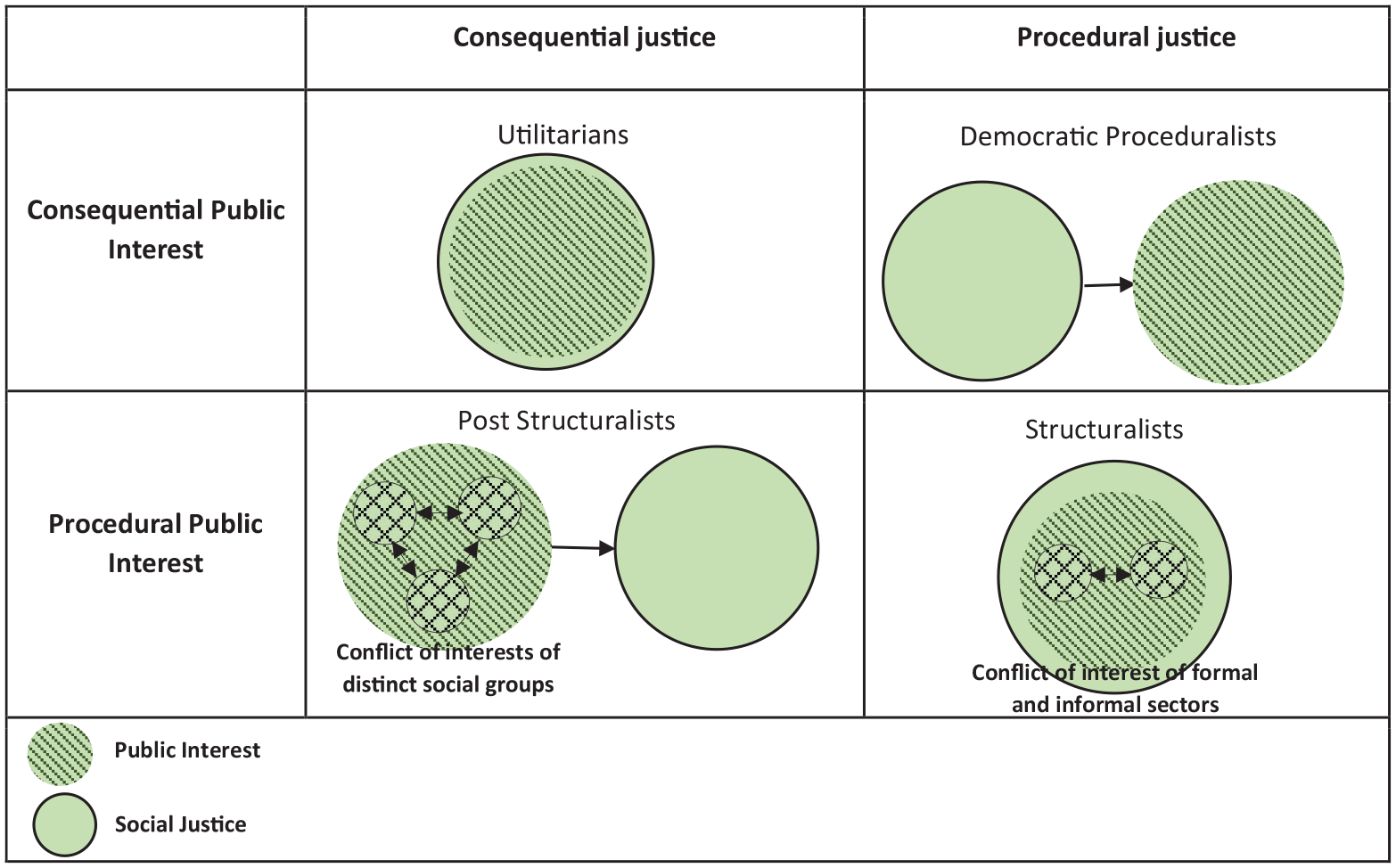
The relation of “social justice” and “public interest” concepts in the planning thought.
These perspectives are different types of understanding of public interest and social justice in planning. They are based on the contextual or philosophical characteristics that govern a context in planning theory and practice. Thus, there is no fixed answer to the question of what is the relationship between the concepts of public interest and social justice, and there are different answers to this question depending on the nature of higher order criteria as philosophical theories. However, clarifying the framework of these answers helps theorists and professionals to provide the appropriate answer to this question by specifying their position in relation to philosophical theories. In addition, this flexibility in the conceptualization of public interest and social justice provides a suitable space for the clarification, expansion, and development of these concepts in planning theory.
Footnotes
Declaration of Conflicting Interests
The author(s) declared no potential conflicts of interest with respect to the research, authorship, and/or publication of this article.
Funding
The author(s) received no financial support for the research, authorship, and/or publication of this article.
