







Abstract
This paper examines how tools from Higher Education for Sustainable Development (HESD) can be adapted to strengthen sustainability and climate change education in urban planning. Drawing on a literature review of eighty-three HESD articles, it identifies a relational perspective that foregrounds nature and the environment as a foundational pedagogical orientation. From this review, the paper highlights four key pedagogies—interdisciplinarity and transdisciplinarity, reflexivity, project-based learning, and role-playing games—discussing how they can be adapted into planning curricula to better prepare future planners to address sustainability challenges, and particularly climate change, in diverse urban and regional contexts.
Keywords
Introduction
In 2017 the Planning Accreditation Board (PAB) accreditation standards guided urban planning education to incorporate sustainability and healthy environmental systems as essential components for fostering sustainable communities and futures. 1 The 2022 accreditation standards advance this issue further, explicitly emphasizing climate justice, sustainability, and resilience and highlighting the importance of “reducing impacts of climate change and creating equitable and climate-adapted futures” (p. 9). 2 However, possibly due to the fact that the PAB has yet to specify which sustainability knowledge should be included in the core planning curriculum for accreditation (Laurian and Göçmen 2025), planning education and pedagogy—traditionally emphasizing responsible citizenship, reciprocity between planners and the public, and diversity and inclusion (see, e.g., Bose and Horrigan 2014; Botchwey and Umemoto 2020; Shilon and Eizenberg 2020)—often falls short of this requirement. This underscores the need to strengthen tools, approaches, and strategies (TAS) that effectively address sustainability challenges and particularly climate change, ensuring their full integration into planning education (Farhangi et al. 2023; Hurlimann et al. 2023; Laurian and Göçmen 2025; Teff-Seker, Portman, and Kaplan-Mintz 2019).
Given the urgent need to address climate change and related sustainability crises through urban planning, and the recent calls in planning literature for training in sustainability (Anacker 2023; Farhangi et al. 2023; Hurlimann et al. 2023; Laurian and Göçmen 2025), urban planning schools are required and well-positioned to integrate sustainability into their curriculum, embedding skills, and competencies for urgent sustainability issues, particularly climate change challenges (see also Hurlimann and March 2012). Some analyses, however, demonstrate that although planning curriculum draws from diverse fields, it often operates in disciplinary silos (see Frank and Silver 2018), with urban planning programs falling short of meeting the needs for sustainability education, particularly in the context of climate change (Bina et al. 2016; Hurlimann et al. 2023).
This paper addresses these recent calls within the planning literature to prepare future planners to proactively deal with climate change and sustainable urban futures. Drawing on an extensive literature review, it proposes a structured path to integrate existing pedagogical TAS from Higher Education for Sustainable Development (HESD) into planning education. To clarify our intentions, it is essential to define how we understand “pedagogy” and particularly “pedagogical tools, approaches and strategies.” Drawing on Sandri (2022), we address pedagogy as a broad worldview that includes an integral reflexive component and that operates “. . . at an ontological and epistemic level underpinning an educator’s conceptual frameworks” (p. 119). Pedagogical TAS are more focused applications through which an educator’s or a scholarship’s worldview can be materialized in educational practice. HESD TAS can teach planners to be more flexible and adaptable to unforeseen urban transformations, better equipping them to tackle these complex problems. The paper argues that by strengthening specific pedagogical TAS from HESD into planning education, urban planning and planners can better fulfill their potential and meet present and future climate challenges in diverse urban and regional settings.
The study employs a literature review, reviewing seven urban planning articles that discuss the lack of sustainability education in urban planning and eighty-three HESD articles to identify the most recommended pedagogical TAS in HESD that can be applied to planning education, enhancing the education and preparation of future planners to address climate change and foster sustainable urban futures. By conducting a thematic analysis of the gathered articles, this paper identifies and adopts a broad relational perspective as a foundational pedagogical approach to planning education and encapsulates the most common pedagogical TAS from HESD, aligning them with planning and planners’ needs.
In particular, while traditional planning education tends to draw on more instrumental and analytical thinking, this paper’s findings emphasize a relational outlook that integrates the often-separated concepts of nature and culture. This approach, which is underrepresented in urban planning (see e.g., Buser 2014), is emphasized in HESD and in many of the articles reviewed for this research. Additionally, the systematic review identified four main pedagogical TAS that can be used in planning education to meet socio-environmental challenges in present-day and future urban planning. Two of these advance specific teaching approaches: (1) interdisciplinarity and (2) reflexivity. The remaining two are more practice-based teaching activities: (3) project-based learning and (4) role-playing games. Because the field of urban planning is well-positioned to advance sustainability education, urban planners are required to be well-equipped to foster sustainable urban futures. We suggest, therefore, that the pedagogical tools used in planning education be adapted and leveraged to better address the challenges of climate change and the creation of sustainable human settlements.
HESD
The concept of sustainability comes from the idea of sustainable development, which emerged in the context of international economic development (i.e., the Brundtland Report). Sustainability has since evolved to become an academic focus area and interdisciplinary scientific endeavor, which in many contexts is known as sustainability science (see Kates et al. 2001). In the international policy realm, the Millenium Development Goals of the UN from 2000 to 2015 gave way to the United Nations’ Decade of Education for Sustainable Development (2005–2014; UNESCO 2004, resolution 58/219) and the seventeen sustainable development goals, developed in 2015. Discussion of what type of education fosters sustainable development and sustainability science has flourished, including the identification of approaches and competencies for sustainability education from UNESCO (2017) and from numerous other authors, such as Wiek, Withycombe, and Redman (2011), Sterling (2010), Glasser and Hirsh (2016), and Brundiers et al. (2021). Over the course of the twenty-first century, universities have responded curricularly by creating schools, majors, focus areas, and courses in sustainability, sustainability science, and sustainable development, which Rieckmann (2012) refers to as HESD. In the United States alone, university programs in sustainability increased 15 percent between 2012 and 2016, with 2361 sustainability-focused and sustainability-oriented programs offered in 872 institutions (Brundiers et al. 2021, citing Vincent et al. 2017). It is important to note how a program in sustainability is defined. While the purpose of this paper is not to discuss the diverse definitions of sustainability education, Vincent et al. (2017) consider a sustainability program to include “sustainability” in the name of the program, which would separate it from a program in environmental studies/science or urban planning, for example, even if these programs incorporate coursework or projects related to sustainability. However, it is worth noting that they do include combined sustainability programs, such as environmental sustainability or sustainability and energy and programs specifically focused on sustainable development. HESD directly refers to programs where sustainability is at the core of the curriculum.
Addressing the core competencies of HESD is therefore crucial to produce practitioners that can address urgent and wicked problems, or problems that are difficult to define and address (Davidson, Prahalad, and Harwood 2021) and foster a more comprehensive approach to sustainability education expectations. This is especially important since sustainability programs often have diverse or unclear learning outcomes, depending on the focus of the program (Brundiers et al. 2021). Although there is no consensus, competencies for sustainability tend to focus on systems thinking, anticipatory or futures thinking, normative or values thinking, strategic thinking, interpersonal or collaborative competencies, and problem-solving competencies (Brundiers et al. 2021, citing Wiek, Withycombe, and Redman 2011). It is commonly argued that these competencies are necessary to usher in transformative change for sustainability between diverse stakeholders and actors, including academic and non-academic ones. For the purposes of this paper, what is therefore imperative for university educators is to integrate diverse pedagogical approaches that can foment these competencies. This is especially important in the context of high disciplinary boundaries typical of the curriculum in many universities and an emphasis on lecture-based classroom education so common in universities across the globe. Indeed, Brundiers et al. (2021) consider that developing sustainability competencies requires “targeted and ongoing efforts to learn about competencies and through working with each competency’s set of concepts, methods, and skills” (p. 25). HESD has the potential to be “transformative and transgressive” in its ability to advance “action-oriented capabilities” to usher in sustainability transformations (Lotz-Sisitka et al. 2016).
Urban Planning Education for Sustainable Urban Futures
Urban Planning is a field dedicated to educating future practitioners who will navigate complex and dynamic urban environments and address multifaceted needs of diverse populations. It is, similar to HESD, focused on values and skills that will guide urban planners in their work. According to the 2022 PAB standards, urban planners are expected to be “. . .committed to serve the public interest, infusing the values of equity and sustainability into their knowledge and skills as they envision the future and lead in decision-making that affects people and places” (p. 8). The PAB also notes that accredited urban planning education programs should be committed to ethical principles that will be embedded in required courses. including courses that focus on climate justice, sustainability, and resilience.
Additionally, the American Planning Association (APA) elaborates on the skills planners need. These include the ability to function as a mediator or facilitator when community interests conflict; solve problems using a balance of technical competencies, creativity, and pragmatism; envision alternatives to the physical and social environments in which we live; work with the public and articulate planning issues to a wide variety of audiences; master techniques involving a wide range of people in making decisions; understand local, state, and federal government programs and processes; and understand the social and environmental impact of planning decisions on communities. 3
However, while urban planning education has been dedicated to values such as equity, diversity, and inclusion (Sen et al. 2017; Shilon and Eizenberg 2020), planning curricula arguably does not do enough to grapple with urgent climate change responses and proactive planning (see also Laurian and Göçmen 2025). Hurlimann et al. (2023) elaborate: “Urban planning has capacities that make it suitable to address the issue of climate change in a meaningful way. . .” however, “. . . urban planners must have appropriate and up-to-date knowledge, skills, and competence to inform effective climate change planning” (p. 13). The authors conclude that if urban planners are to meet climate change challenges “. . . their knowledge, skills, and competencies need to be boosted through improved education, both formal and professional, on climate change” (p. 14). Additionally, Anacker (2023) defines this need as particularly important to U.S. planning education’s fifth era, which involves complicated issues of sustainability and requires, thus, a transition toward reflexive transdisciplinary planning education. Farhangi et al. (2023) argue that planning practice is incapable of addressing the required transition toward sustainability with long-term solutions and is lacking pertinent knowledge that has been developed about sustainability transitions. To “develop coherent ideas and strategies for addressing environmental issues through guiding and intervening in the process of the reciprocal adjustment of space and society” (Farhangi et al. 2023, 2), planning education is required to integrate theoretical as well as practical knowledge, specifically regarding the application of sustainability transitions’ theories into planning, drawing on empirical case studies. Finally, while many planning programs include environmental education, these greatly vary in terms of the required knowledge areas to be implemented in core planning courses, leading to a situation in which “it remains possible that planning students graduate without foundational environmental planning knowledge or specific environmental planning skills” (Laurian and Göçmen 2025, 205). Given the urgent need to address climate change and recent calls for HESD both from international specialized agencies and organizations (e.g., UNESCO) and sustainability and planning literature, urban planning education is not only well-positioned but also necessarily positioned to advance pedagogy for sustainable development and climate change (see also Moosavi and Bush 2024).
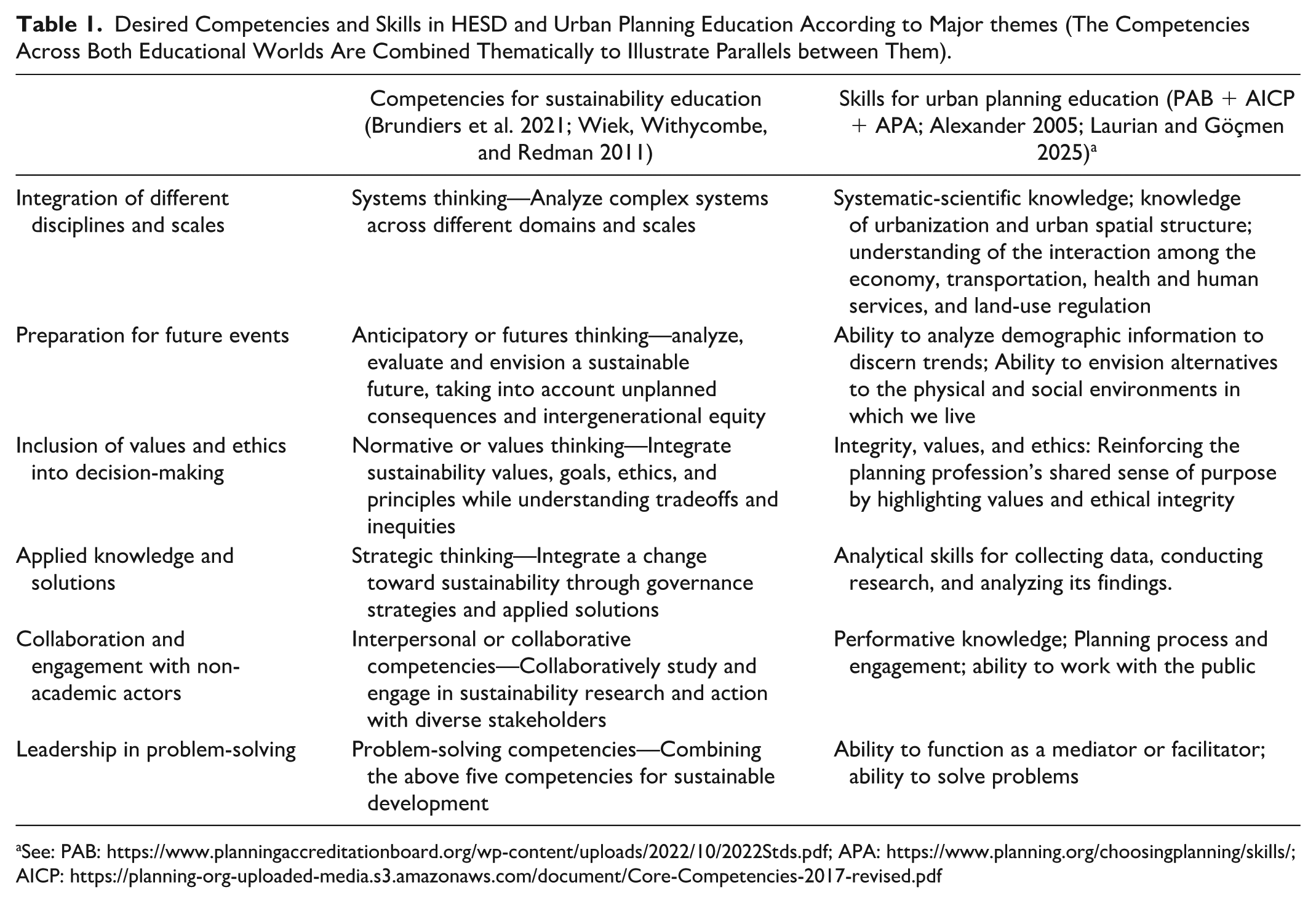
Table 1 presents the competencies prioritized in sustainability education and the related skills emphasized in urban planning. These competencies and skills are drawn from seminal academic work in both areas, as well as from professional networks and organizations that shape urban planning education, including PAB, the American Institute of Certified Planners (AICP), and the APA. Although not exhaustive, the listed items demonstrate that many requirements are shared across the two fields. Accordingly, urban planning education can draw on HESD pedagogy to better prepare future planners to address sustainability crises, with particular attention to climate change and environmental challenges.
Desired Competencies and Skills in HESD and Urban Planning Education According to Major themes (The Competencies Across Both Educational Worlds Are Combined Thematically to Illustrate Parallels between Them).
Methodology
Our analysis addresses the recent calls made within the planning literature (see Anacker 2023; Farhangi et al. 2023; Hurlimann et al. 2023) by reviewing and refining pedagogical TAS from HESD. While most of the TAS presented in this study were not originally developed in HESD but were refined or adapted to meet sustainability education goals, drawing on HESD’s use of these TAS in planning education seems particularly pertinent in light of sustainability crises and specifically climate change mitigation and adaptation.
In order to sort existing, common pedagogical TAS from HESD, we conducted a literature review using the ProQuest search engine and using specific criteria. Initially, we traced the ways in which HESD deals with uncertainties regarding climate change and sustainability issues, defining the search to include a combination of the following key terms in the abstract, full text, keywords, and title: (1) higher education AND (2) urban planning OR sustainability OR climate change, AND (3) anticipatory OR flexible OR futures, published between 2001 and 2024. We chose 2001 as the start date because the literature about sustainability pedagogy in higher education began to accelerate with the publication of Kates et al. (2001) and the advent of sustainability programs and courses in universities. This search yielded many articles that were not discussing pedagogical TAS. Therefore, as our work progressed, we developed specific criteria for the articles to be included in our search and manually selected those that met them. Articles were included if they satisfied the following criteria:
The article needed to specify that it is related to pedagogy within a higher education institution (e.g., pedagogical approaches with students and student learning). This means that articles covering approaches for institutional sustainability were discarded.
The article needed to discuss a teaching methodology, framework, or tool to foster sustainability and/or climate education competencies in sustainability or related pedagogical programs within higher education.
In addition, because of the general applicability of the terms (e.g.,‘sustainability’), we drew on different combinations of terms found in different parts of the article (i.e. title, abstract, full text). If a search yielded more than 150 articles, we refined the results by limiting the search to specific sections. For example, if searching for “sustainability” in the title, abstract, and full text returned more than 150 results, we narrowed the search to the abstract and title. If this still produced over 150 articles, we further restricted the search to the title alone. Finally, to be selected, an article had to meet at least one of the following criteria:
The article needed to discuss a teaching methodology, framework, or a tool that advances Sustainable Development Goals within sustainability or related pedagogical programs within higher education.
The article analyzed sustainability competencies/capabilities/activities in sustainability and/or urban planning-related programs/courses within higher education.
This structured approach ensured that the articles we selected focused directly on the terms of interest. Summing the narrowed searches yielded 659 articles (with minor overlaps) which were then narrowed down again by choosing those focused on a teaching methodology, approach, strategy, or tool in order to foster sustainability and/or climate education competencies in sustainability and/or urban planning related pedagogical programs within higher education. The final search included eighty-three articles. One limitation of this methodology was that the manual sifting of articles prevented us from searching a larger pool. Furthermore, sustainability education is a newer field than planning education, which limited our search to the last twenty-three years (2001–2024).
We conducted a content analysis of the eighty-three articles identified to determine which specifically discuss TAS for HESD. Each article was carefully read and summarized, and the TAS mentioned were systematically recorded. This information was organized in two ways: a designated table providing an overview of each article and its associated TAS and an additional document offering a more detailed elaboration of the content and focus of each article, allowing for a deeper understanding of how TAS are applied in HESD contexts. This approach also allowed us to identify overlaps or divergences between the TAS articles as detailed in Appendix.
Articles discussing syllabi were excluded unless they examined a specific program and pedagogical TAS and evaluated their effectiveness. Additionally, while some papers demonstrated more rigor than others (e.g. redefining interdisciplinarity to explicitly foster HESD versus broadly suggesting interdisciplinarity), our analysis included only those articles that proposed specific pedagogical TAS and either tested, evaluated, or recommended it for HESD. Articles focusing solely on competencies were excluded, even if those competencies were considered tools in other studies (e.g. if “systemic thinking” was classified as a competency in one article but defined as a tool in others, the article that discussed it solely as a competency was not included in our final selection of articles). We found thirty-seven articles discussing TAS for fostering HESD. Among them, we found eighteen distinct pedagogical TAS aimed at fostering HESD (see Appendix). The following section will discuss our findings and their utility for planning education for sustainable development.
Findings: TAS for Sustainable Urban Futures
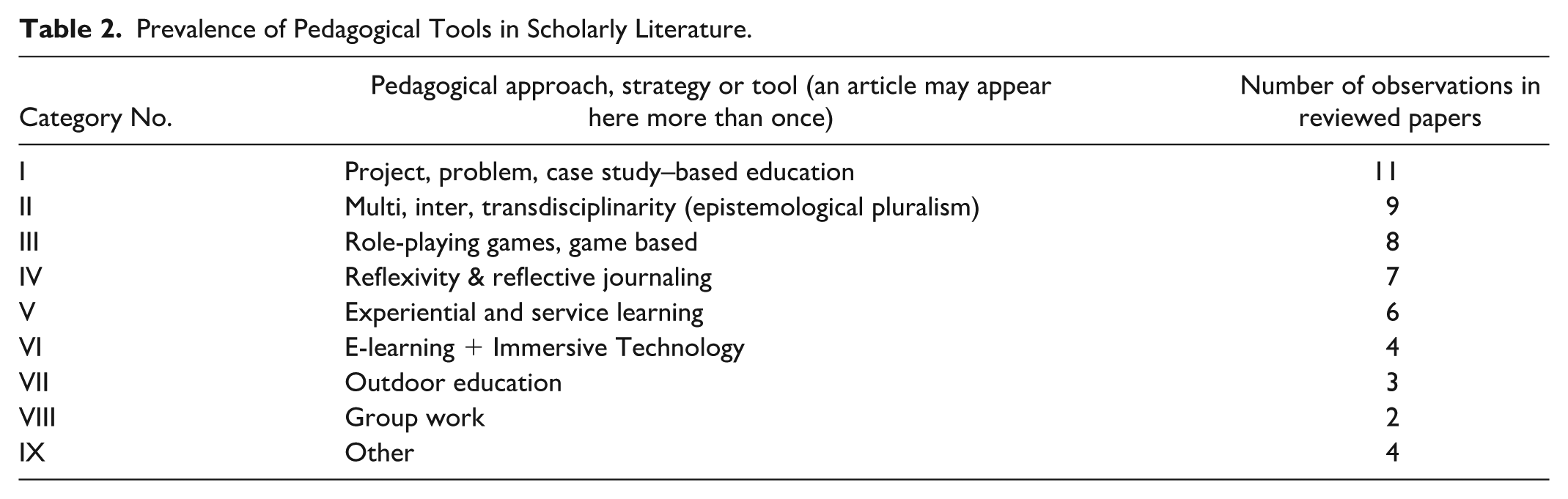
To discuss our findings, we manually consolidated the eighteen pedagogical TAS found into a table (see Table 2. Prevalence of Pedagogical Tools in Scholarly Literature) in which the pedagogical approaches found were combined together due to their definition, use, and conceptualization in the articles we reviewed (for reference see also Appendix). Our findings highlight the most prevalent pedagogical TAS from the thirty-seven reviewed articles and their relevance for urban planning education. We identified four key pedagogical TAS that can be applied in planning education to address sustainability crises and climate change in urban planning. Two of these are more abstract: (1) multi, inter and transdisciplinarity and (2) reflexivity. The remaining two are more practice-based: (3) Problem -, Project-Based Learning and Case Studies and (4) Role-Playing Games. We included a specific approach of group work and did not combine it into other categories since this is a means to conduct any of the other pedagogical TAS. While these TAS are used in planning education, this article does not address their scope or applications within planning programs. Instead, we draw extensively on their objectives and uses in HESD and adapt them to address the needs of planning and planners in responding to climate change and sustainability challenges.
Prevalence of Pedagogical Tools in Scholarly Literature.
Many articles included in the review use a relational approach that suggests an integration of people and the environment (e.g. animals, trees, and rivers), seeing both as equally important for sustainable futures (Lugg 2007). This relational approach understands humans and more-than-humans as interconnected and their relations as dynamic and constantly evolving (in the context of urban environments, see Adey et al. 2013; Bissell 2010; Farías and Bender 2010; Simpson 2013). Scholars within the planning literature align with these studies and call for the use of relational approaches in urban planning research and practice (Buser 2014; Shilon and Eizenberg 2020). Recognizing the importance of this perspective, the following pedagogical TAS adhere to HESD’S relational approach, linking nature and culture, humans and more-than-humans, a diversity of disciplines, and research and practice.
Multi, Inter and Transdisciplinarity—from a Notion to Practice
Drawing on Choi and Pak (2006), we refer to interdisciplinarity as the capacity to link different disciplines to conduct a more holistic analysis. Urban planning has traditionally drawn on diverse fields in order to understand and analyze a range of urban phenomena. Additionally, the planning curriculum draws on diverse fields and many worlds of knowledge, commonly offering courses such as “urban sociology,” ‘urban economics “urban politics,” and “transportation planning” in planning schools. However, scholars question the actual commitment of planning education to interdisciplinarity with some arguing that planning is acting in disciplinary silos (see e.g., Frank and Silver 2018).
Anacker (2023) divides urban planning education in the United States into four eras (from early to mid-twentieth century to late-twentieth century) that draw on interdisciplinarity in different forms. While interdisciplinarity has characterized urban planning in these four eras, research shows that it is required to better embed interdisciplinarity in urban planning “to be able to effectively address climate change impacts through policies, programs, and projects in the built environment” (Hurlimann et al. 2023, 11). Anacker (2023) argues that due to the scope and complexity of current urban sustainability challenges, the transition to a fifth era in urban planning education requires an additional and more advanced transition from interdisciplinarity to transdisciplinarity that includes professionals and skills from different fields and outside of academia.
For us, this desired transition to transdisciplinarity in urban planning education should encompass two main goals: first, given the pressing sustainability challenges and the existing gap in sustainability and climate education within urban planning (Anacker 2023; Hurlimann et al. 2023), integrating environmentally oriented disciplines, such as marine biology, environmental science, and geography, can offer valuable insights and provide an important path for policy-makers to make informed decisions (Mauser et al. 2013; see also Schlossberg et al. 2018); and second, a better connection between academia and other partners such as municipalities, stakeholders, and NGOs can help analyze and resolve socio-environmental issues by sharing goals, aspirations, and skills (Anacker 2023; Choi and Pak 2006), and integrated research and education between academic and non-academic actors contributes “to the development of robust policy solutions and their effective, equitable implementation” (Mauser et al. 2013, 428). This is indeed important for urban planning, as future planning practitioners are required to work in highly diverse settings and to incorporate into their planning practice diverse knowledge, needs, desires, and values facing an extremely dynamic and uncertain urban future under climate change and environmental challenges.
HESD suggests several ways to expand disciplinary scopes and limits and integrate diverse approaches into learning and practice in a transdisciplinary manner. For example, Miller et al. (2011) suggest the notion of epistemological pluralism to advance multiple ways of knowing, which is defined as an integral characteristic to sustainability knowledge. The authors denote the requirement that higher education institutions will address sustainability issues through the organizing characteristics of epistemological pluralism and reflexivity. Tejedor et al. (2019) discuss five didactic strategies (for elaboration see section 3 below) to advocate for community-oriented learning and interaction with stakeholders to advance transdisciplinarity. Another aspect that is discussed in HESD in this regard is the integration of diverse learning environments as advancing transdisciplinarity and sustainability (see e.g., Roysen and Cruz 2020; see also Lugg 2007). Based on the case study of an academia-community partnership in the area of Alto Paraíso de Goiás, Brazil, Roysen and Cruz (2020) emphasize the significance of outdoor learning as a transdisciplinary tool that advances sustainability pillars of collaboration and reflection. Transdisciplinarity is promoted through the collaboration between academic and non-academic actors in the outdoor setting of an ecovillage, wherein students are motivated to advance sustainability transition through three main approaches: (1) the perception that there are alternative ways of doing things; (2) the emergence of a feeling of co-responsibility for the world; and (3) the sharing of knowledge, feelings and affections (p. 988).
While some of these suggestions can be found in the planning curriculum, the explicit emphasis and practical application of transdisciplinarity that is directed toward climate change and socio-environmental challenges seems to be weaker as a systematic approach in planning education. Particularly inspired by Roysen and Cruz’s (2020) approach to question student about their daily practices and routines to foster a sense of co-responsibility for the world, we suggest that transdisciplinarity addressing climate change and environmental challenges should be integrated into planning curricula through activities outside the classroom, yet within familiar settings. Although planning education frequently draws on diverse out-of-class settings for learning, these do not always leverage familiar contexts such as campus environments or nearby residential areas that offer distinct advantages. In these settings, students are more likely to be aware of local narratives and experiences, understand stakeholders and users, and have relatively easy access to professionals from diverse fields, including STEM disciplines, who can provide information about pertinent local issues. In these familiar settings, transdisciplinarity can more easily be integrated as students can engage with their own experiences and envision how they see their future surroundings evolving, as well as identify actions they can take to foster sustainable transitions. By working in familiar settings, students can better understand their roles and responsibilities, while also experiencing the success of making a tangible difference, which can later be applied in more distant urban settings.
The Role of Reflexivity
Since the beginning of the 1980s scholars have emphasized the important role of reflection in practitioners work (Schön 1983), with studies about different forms to integrate reflection in planning research and practice (see De Leo and Forester 2017). Reflection in urban planning is used to advance the understanding of actions and reshape them throughout planning processes and practices. Balducci and Bertolini (2007) argue that “the complexity of the challenges faced by modern planning mean that a deeper level of reflection is beneficial, or even necessary, for the process to be effective” (p. 532). However, reflection is rarely discussed in planning literature with regard to climate change and socio-environmental challenges, and if so, it is mostly concerned with the inclusion of underrepresented communities (see e.g., Haverkamp 2017). This is possibly the case because urban planning often focuses on the integration of different views and understandings of urban settings by diverse groups of people (e.g., in civic engagement processes). While seminal scholars such as Marina Alberti (2005, 2024) and Moira Zellner (2008) emphasize the complexities brought about by the interactions, dynamics, and networks created between social and environmental systems, urban planning’s attention to more-than-humans as active actors that use and shape the urban environment in their own capacity, asking, for example: “what about what Nature thinks about this, in its own right?” (Sarkissian 2005, 107), is still scarce compared to in HESD.
As mentioned above, HESD often incorporates a more relational approach that integrates humans and the environment as well as a focus on reflection of tradeoffs in decision-making for sustainable futures. A systems-thinking approach is central to sustainability competencies, which includes the integration of social and ecological systems at different scales and the identification of the feedback loops between them (Wiek, Withycombe, and Redman 2011). This integration requires the understanding of both natural systems and human systems, including the cascading effects of human activity, and the corresponding social systems with their values, norms, institutions, and individual and collective action and how they interact with the environment (Wiek, Withycombe, and Redman 2011). Understanding these linkages and feedback necessarily integrate different types of modeling, both quantitative and qualitative, and ways of visualizing the impacts that the environment has on human society and vice versa.
Systems-thinking by itself, however, does not necessarily promote reflective considerations of the relationships between nature and society. Indeed, the normative competency, which emphasizes tradeoffs in decision-making for sustainable futures, not only includes an emphasis of justice and equity in society but of nature as well (Redman and Wiek 2021; Wiek, Withycombe, and Redman 2011). For example, reflecting on the historical power dynamics that are laden in environmental change and the diverse ways that humans coexist with nature are fundamental to foster normative competencies. Exercises fostering reflexivity require students to understand the multiple worldviews and knowledges in understanding sustainability challenges such as climate change. These considerations require approaches such as reflective writing and journaling (e.g., Gardiner and Rieckmann 2015; Noy et al. 2017), reflective small group discussion or “reflective observation” (e.g., Ely 2018), and other guided exercises that foster individual reflection as promoted through the Reflective Learning Framework (Whalen and Paez 2021). It is worth noting that reflexivity is integrated into both inter- and transdisciplinary education (above), and project-based learning (below), since they all contribute to a “continuous cycle or spiral of experience, reflection, thinking, and acting” (Whalen and Paez 2021, 110, citing Kolb and Kolb 2005). Integrating a reflective approach with HESD tools, such as reflective journaling and observations that focus specifically on the environment and the roles of more-than-humans within it, into the urban planning curriculum can enhance students’ sustained and in-depth engagement with environmental issues by fostering a deeper understanding of human–environment relationships and their implications for urban futures.
Project-Based, Problem-Based Learning, and Case Studies
Project-based learning engages students with finding solutions to real-world problems, focusing on an understanding that is based on a specific case study and providing practical solutions for it (Brundiers and Wiek 2013; Teff-Seker, Portman, and Kaplan-Mintz 2019). In urban planning, project-based learning is commonly employed in various forms, such as experiential learning, problem-based learning, case study–based learning, and engagement with real life examples (see Gonzales 2018; Kotval 2003; Martin 2024). These types of learning strategies are considered more contemporary forms of education that enhance students’ understanding of spatial design, decision-making processes, and communication skills by focusing on the planning processes and challenges arising in spatial planning. Drawing on real-world examples and seeking solutions is a common planning education practice that helps students engage with similar challenges to those they might face as planning practitioners (Bertolini et al. 2012). Therefore, a direct focus on sustainability and particularly environmental issues and climate change can highly contribute to the present-day requirement from planners to develop competencies that will assist them in dealing with these issues as practitioners (Hurlimann et al. 2023).
In HESD, project-based and case study learning is fundamental to the development of skills to address socio-environmental challenges such as climate change and to contribute to the implementation of more sustainable futures. For example, Tejedor et al. (2019) consider five “active learning” pedagogies for sustainability that include problem-based learning, project-oriented learning, service-learning, case studies, and simulation (i.e., role-playing, see below) that can be used to develop competencies in sustainability education. The first four are specifically focused on real-world problems and provide participatory approaches to active learning either individually or in groups. Aránguiz et al. (2020) argue that project-based learning advances individual and collective reflection on decision-making processes, which contribute to the development of critical thinking in regard with sustainable development.
Additionally, Remington-Doucette and Musgrove (2015) demonstrate that the sustainability competencies outlined by Wiek, Withycombe, and Redman (2011) can be facilitated through classroom activities such as case studies and problem-based learning, although the differences in the acquisition of competences can vary by major and gender. Thomas and Depasquale (2016) echo this claim in their study, arguing that problem-based learning approach supports competencies outlined by Wiek, Withycombe, and Redman (2011), with the interpersonal competency most strongly developed through this type of learning, which involves interdisciplinary collaboration. Finally, Ely (2018) adds that, unlike project- and problem-based learning, discussions based on case studies can be fully practiced in classroom settings, offering a valuable pedagogical tool that bridges theory and practice—a common desired connection to be made in urban planning research and practice.
Because HESD scholarship indicates a direct correlation between project-based and problem-based learning and sustainability competencies, we suggest advancing this type of pedagogy specifically focusing on problems and projects that are dealing with environmental challenges and climate change in order to better equip future planning practitioners with the experience of facing sustainability challenges and finding ways to mitigate them. An example for a problem-based learning tool that can be adapted to meet environmental challenges is provided by the IFI (https://www.ifi.mta.ac.il/simulationgame). This tool exemplifies experiential learning, enabling students to engage with real-world problems through an interactive activity that balances community well-being and individual interests. 4 When adapted to focus on environmental concerns and climate change, these tools can advance sustainability education in urban planning through problem-based learning.
Role-Playing and Simulation Games
The use of both digital and non-digital games as a pedagogical tool is a common practice in higher education, including in urban planning (Gaber 2007; Meligrana and Andrew 2003; Pojani and Rocco 2023; Reinart and Poplin 2014). These types of games can extend beyond the classroom and be incorporated into actual planning practice and civic engagement processes (Ampatzidou et al. 2018; Reinart and Poplin 2014), effectively simulating real-world scenarios (Tóth 2015). Building on the concept of Edutainment, which blends education with entertainment, Pojani and Rocco (2023) suggest that serious games and role-playing activities promote situated learning and enhance communication skills. Role-playing games are particularly popular among students due to their entertaining aspects, which make the learning experience more engaging. They also help develop the ability to engage with complex issues that professionals often encounter within a controlled classroom environment.
Role-playing games are particularly useful in disciplines such as urban planning, where negotiation and consideration of multiple perspectives and diverse needs are integral to the practice, and where the goal is consensus-building (Innes and Booher 1999; Pojani and Rocco 2023). While urban planning has traditionally emphasized consensus-building in role-playing games (Innes and Booher 1999), more recent approaches view planning as a relational effort, considering it a “pluralist pursuit, in the sense that its values, truth, and morality exist in relation to stakeholder groups, local society, culture, and historical context, and are not absolute” (Pojani and Rocco 2023, 586). This outlook has been integrated into role-playing games in planning education (Pojani and Rocco 2023). Despite the incorporation of the importance of diversity and multiple perspectives into present-day planning curriculum and experiential learning, sustainability, which is central to planning education and practice, is rarely the focus in urban planning’s experiential learning tools such as role-playing games (Ellis and Weekes 2008).
HESD role‑playing games can support recent pedagogical approaches in urban planning that emphasize a relational perspective that accommodates multiple viewpoints (see, e.g., Eizenberg and Shilon 2016). This shift is particularly valuable for addressing complex issues such as climate change, which require integrating diverse human and more‑than‑human perspectives. Vatalis (2017), for example, suggests a role-playing game that integrates a holistic viewpoint that equally considers economic growth, human needs, and the environment, and as such can advance a relational perspective and sustainability education. Stoeth and Carter (2023) use role-playing games as an educational strategy in a climate change education class, arguing that it advances the notion that knowledge is subjective and “. . . influenced by more than just factual data” (p. 1798). A similar approach is taken by Castro Santa (2023) that presents climate change mitigation as a social dilemma integrating relationality through conceptualizations such as inequity and the different outcomes of climate change for different people. Cruickshank and Fenner (2012) suggest that role-playing games can also advance emotional attachment and create sympathy toward diverse needs and interests. The authors also align role-playing games with the consensus-building approach, which still serves as a common goal in planning processes.
However, our review suggests that HESD’s role-playing games have the potential to promote an even more thorough relational perspective that can guide future planning practitioners in decision-making processes focused on environmental issues and climate change. While HESD has traditionally embraced a relational perspective that emphasizes the relationship between people and the environment, treating both as equally important for sustainable urban futures, both traditional and recent planning approaches tend to focus primarily on people as key resources and those most affected by planning (e.g., Davidoff’s Advocacy Planning, Innes’s Communicative Planning, and Grabow and Heskin’s Radical Planning). These approaches often fail to fully consider the environment as a significant factor that should participate in planning processes. Adopting HESD’s relational perspective in role-playing games in planning education can assist planners to equally account for humans and more-than-humans in decision-making processes. We propose, accordingly, to use role-playing games to position the environment as an active participant in urban planning, which has its own voice in shaping socio-spatial realities. This also echoes Sarkissian’s (2005) aforementioned question about nature’s own rights. Seriously considering the role of more-than-human actors in role-playing games can broaden the scope of planning processes, as well as the approaches of future practitioners. This perspective not only addresses the desired pluralism and relativism (Pojani and Rocco 2023), focusing on the diversity of people, but also advances the inclusion of the environment—animals, trees, rivers, air, and atmosphere—ensuring that their needs are integrated into the future of our cities, creating a more balanced approach and positive outcomes for people and the environment.
Conclusion
This paper responds to recent calls in planning literature to equip future planners with the skills to proactively address climate change and foster sustainable urban futures. We employed a systematic literature review to uncover common pedagogical TAS in HESD to prepare students to confront urban climate change and sustainability challenges that society currently faces. Our findings indicate four key pedagogical TAS to be applied in planning education according to their prominence in HESD and possible application in planning. These are (1) multi, inter and transdisciplinarity; (2) reflexivity; (3) problem and project-based and case study learning; and (4) role-playing games. Through this process, we suggest a more integral approach to planning education that considers these TAS and incorporates them into the planning curriculum. It is worth noting that drawing on a single tool from these four will not be enough (see also Teff-Seker, Portman, and Kaplan-Mintz 2019). We suggest redirecting the planning curriculum to fully integrate climate concerns and sustainability into its main focus areas, similarly to how civic engagement became a significant pillar in planning education. Our analysis provides the main TAS that can and should be embedded in these programs.
However, implementing sustainability-based programs in higher education institutions presents recognized challenges (see e.g., Angelaki et al. 2024; Gale et al. 2015), and we anticipate specific obstacles in integrating pedagogical TAS into planning education. In particular, TAS educational efforts require significant labor, time, and resources. For example, teaching assistants may be needed to support students and facilitate a collaborative learning environment in smaller groups. Additionally, lecturers might need to allocate more time for engaging with professionals and creating relationships with non-academic partners. Furthermore, educators should receive sufficient support and training to deliver courses that draw on diverse knowledge sources, incorporate a range of realistic case studies, and integrate reflexivity as a central component. In other words, a systematic approach is necessary to support this educational transition.
We propose that such a framework should include (1) The full integration of HESD into PAB accreditation standards. This would extend the 2022 standards to more explicitly emphasize the types of knowledge that planning programs should deliver, ensuring stronger connections between theoretical foundations, essential values and skills, and real-world planning practice (see also Laurian and Göçmen 2025). Our ongoing research examines accredited undergraduate planning programs in the United States to identify what such integration would entail in practice. (2) Required core course in accredited planning programs that incorporate TAS to provide an in-depth understanding of climate change impacts, its challenges, and mitigation strategies. These courses should explore the intersection of HESD and planning as a means to develop solutions and address the role and skills of planning practitioners in mitigating climate issues. (3) Adequate training for planning educators to be equipped with the necessary training to meet these standards, ensuring they have the tools and expertise to effectively integrate HESD and TAS into their teaching and curriculum development.
Additionally, this study joins the call for urban planning education and practice to respond to current needs and uncertain urban futures amidst ongoing, dynamic changes, including environmental, demographic, and technological changes, as well as wars and natural disasters that need to be mitigated by flexible and adaptable urban planning and planners. Following HESD, we suggest a relational approach that integrates more-than-humans and their relationships with humans as active actors that needs to be fully addressed in planning practice and incorporated into planning education. This also addresses recent discussions in the planning literature that propose more relational views in planning education (Eizenberg and Shilon 2016). Acknowledging the participation of more-than-humans in urban planning in the PAB will advance a post-anthropocentric view that can be embedded into planning curricula. This might include courses in environmental and climate science and also focusing course projects on climate action and resiliency planning with non-academic actors. While some planning programs do integrate these approaches and tools already, they need to be strengthened and placed as central to the curriculum of urban planning programs. Once human-nature relationships become an integral part of urban planning education, planners will be better equipped to address the rapid socio-environmental changes occurring in human settlements. This will enable them to fulfill their role more comprehensively and effectively, meet sustainability goals, and adapt to the dynamic and complex needs of both humans and more-than-humans.
This paper suggests a threefold contribution to urban planning: first, it responds to calls in planning literature by addressing a key issue in present-day human settlements: uncertain urban futures. By integrating these four pedagogical TAS into the planning curriculum, we aim to foster planners who are more flexible, adaptive, and capable of addressing complex, real-world challenges. These TAS encourage planners to think critically, engage with diverse perspectives, and formulate innovative, sustainable solutions that respond effectively to emerging urban issues.
Second, we present a consolidated approach, connecting these TAS into a cohesive framework that emphasizes sustainable development and climate change alongside planning’s traditional focus on diversity and inclusion. By emphasizing the interconnectedness of social, economic, and environmental factors, this framework equips planners to tackle the pressing challenges of climate change and sustainability. Rather than introducing entirely new methods, we adapt existing tools into a cohesive approach, making it easier for educational institutions to integrate this framework into existing planning programs. This consolidation not only strengthens planners’ ability to engage with diverse, complex issues but it also aligns planning pedagogy more closely with contemporary sustainability imperatives.
Finally, because we adhere to the HESD relational view, the study responds to a broader call in planning literature and a major challenge that urban planning has traditionally faced, namely, associating theory and practice. Through a relational lens, which emphasizes the interconnectedness of humans and more-than-humans, we propose an approach that integrates environmental and social dimensions into planning. This perspective encourages planners to think beyond human-centered solutions, considering the broader systems at play. By embedding this into both educational and practical settings, we aim to address the gap between abstract theoretical models and the complex realities planners face, creating a more holistic and sustainable urban planning practice.
We hope that by integrating this framework into the planning curriculum, future planners will be equipped to address the diverse, bottom-up needs of both people and the environment. More advanced research could explore an empirical case study of a planning program that implements this framework, assessing its impact on planners’ understanding, approaches, and literacy regarding sustainability challenges, and especially climate change (see Moosavi and Bush 2024). While it is too early to evaluate the framework’s full potential, we view this study as an important scholarly contribution toward advancing a positive transition in planning pedagogy, that is, in turn, expected to produce positive outcomes in planning practice.
Footnotes
Appendix
Elaborated Table of Pedagogical TAS.
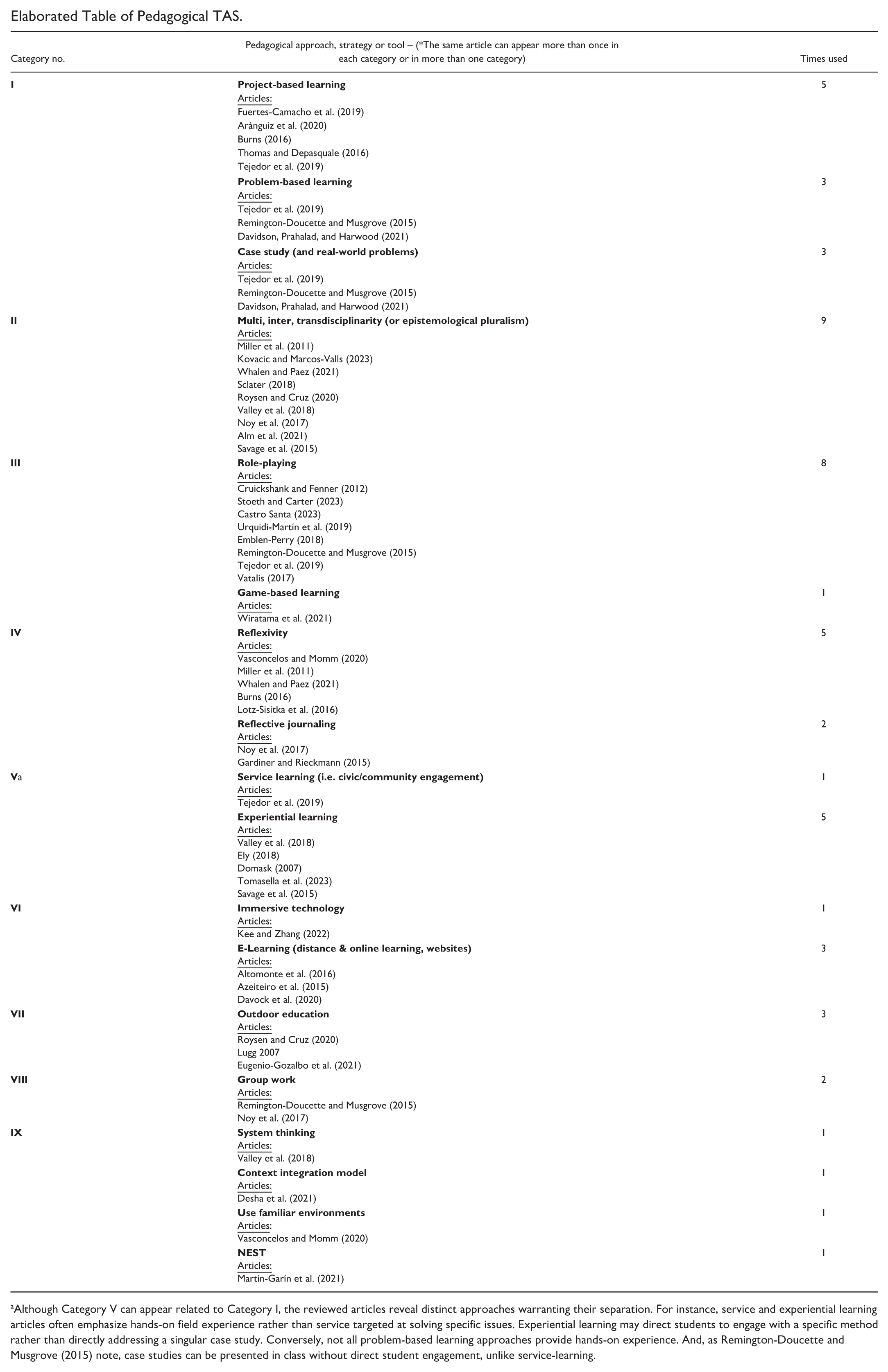
Although Category V can appear related to Category I, the reviewed articles reveal distinct approaches warranting their separation. For instance, service and experiential learning articles often emphasize hands-on field experience rather than service targeted at solving specific issues. Experiential learning may direct students to engage with a specific method rather than directly addressing a singular case study. Conversely, not all problem-based learning approaches provide hands-on experience. And, as Remington-Doucette and Musgrove (2015) note, case studies can be presented in class without direct student engagement, unlike service-learning.
Acknowledgements
The authors thank Lily Keefauver for her diligent research skills that shaped the results of this paper.
Declaration of Conflicting Interests
The authors declared no potential conflicts of interest with respect to the research, authorship, and/or publication of this article.
Funding
The authors disclosed receipt of the following financial support for the research, authorship, and/or publication of this article: The authors thank the UCSD Department of Urban Studies and Planning and the MGSDII for their support in this research.
