






Abstract
Planner involvement in disaster recovery provides valuable opportunities to apply planning tools and knowledge that enhance community resilience. We interviewed professionals experienced in disaster recovery to identify essential knowledge planners need for improved engagement and leadership in disaster recovery operations. This article describes the continuing challenges of disaster recovery faced by planners and highlights educational opportunities, both in the classroom and on the job, that can foster recovery-related learning. Using the results, we provide recommendations for learning opportunities that mirror the complexities of disaster recovery planning, which will result in planners better prepared to address disaster recovery and planning overall.
Introduction
The increasing frequency of disasters due to climate change highlights the need for planners to be prepared for extreme events and disaster rebuilding (USGCRP 2023; Van Zandt et al. 2020). Experts have urged planners toward increased leadership and active participation in post-disaster recovery (Schwab 2014; Smith and Glavovic 2014). Planners’ core competencies support community redevelopment, as they connect the systems disrupted by disasters, from housing, transportation, and infrastructure to social services and environmental management (Berke, Kartez, and Wenger 1993; Burby et al. 1999).
Yet, research still indicates that planners rarely see themselves as central to disaster recovery planning, lack knowledge on many recovery topics (Meyer et al. 2025), and remain isolated from disaster planning (Berke et al. 2014, 2023; Berke, Kartez, and Wenger 1993). This paper focuses on preparing planners for disaster recovery by seeking to inform education and training tools that will support planners in the complex, time-compressed realities of post-disaster planning. Findings from interviews with recovery professionals who have experience across communities and disaster types about what they wish they and other planners had known about recovery before the disaster outline lingering challenges for the profession and underscore findings from previous literature. Most planners encounter disaster recovery topics for the first time while on the job and wish for more intentional and integrated learning opportunities. We use these interviews and the existing literature to describe recovery competencies and classroom or on-the-job planner training to improve these competencies such that planner involvement in recovery and community resilience is ultimately increased.
To situate this discussion, we review what planners do in disaster recovery and how planning education currently incorporates disaster.
Planners in Disaster Recovery
Recovery refers to the process of restoring and improving the physical, social, economic, and environmental conditions of a community following a disaster (Federal Emergency Management Agency [FEMA] 2019; Smith and Wenger 2007). The United States National Disaster Recovery Framework (NDRF) outlines five core recovery capabilities: rebuilding infrastructure, providing interim and long-term housing, revitalizing health and social services, promoting economic development, and restoring natural and cultural resources (FEMA 2016, 4). These capabilities inform the six core recovery support functions: (1) community planning and capacity building; (2) economic; (3) health and human services; (4) infrastructure systems; (5) housing; and (6) natural and cultural resources, all familiar topics to planners. Recovery planning involves activities familiar to planners: community visioning, analyzing spatial, physical, and social data, engaging stakeholders, implementing land use tools, and resolving disputes over competing priorities.
Disaster recovery, while involving planners’ usual development operations, is more complex, specifically due to the rapid pace and need for quick decision-making (Lindell, Prater, and Perry 2018; Quarantelli 2000). Recovery presents the dilemma of swiftly rebuilding while also integrating long-term mitigation strategies to reduce future hazards and achieve community goals (Smith and Wenger 2007; Smith, Martin, and Wenger 2018). This dilemma is referred to as “time compression” and complicates traditional planning methods through the high levels of uncertainty, competing priorities, and rapid changes in the built environment that conflict with the desire to build back better (Olshansky, Hopkins, and Johnson 2012). Recovery, unfortunately, often recreates or worsens hazard risks and pre-existing social issues (Berke, Kartez, and Wenger 1993).
Planners contribute to recovery by coordinating land use decisions, engaging stakeholders, integrating equity, and aligning recovery actions with broader community goals and plans (Schwab 2014; Smith and Glavovic 2014; Van Zandt 2019). However, deploying participatory planning processes focused on consensus building is difficult during the time-compressed recovery environment (Healey 1997, 2003). Quality public participation is hindered by competing stakeholder priorities, resident displacement, and the emotional urgency to rebuild quickly (Contreras 2019; Hamideh 2020).
Lack of participation leads to procedural, structural, and distributional justice issues. Equity requires engaging vulnerable-impacted populations while they are individually trying to recover (Meerow, Pajouhesh, and Miller 2019). Studies show low-income, renting, and minority populations are disproportionately affected by disasters and underserved during recovery (Masterson et al. 2014; Rivera, Jenkins, and Randolph 2022). Redevelopment often raises housing prices, pushing low-income and marginalized groups out (Howell and Elliott 2019; Pais and Elliott 2008). Affordable housing, especially rental and government-subsidized housing, recovers more slowly, if at all (Hamideh, Peacock, and Van Zandt 2021; Lee and Van Zandt 2019; Peacock et al. 2018).
Post-disaster equity is better ensured if it is incorporated pre-disaster, but this remains challenging for planners (Zapata and Bates 2015). Incorporating recovery considerations (including policies and actions) into existing community plans, such as hazard mitigation, comprehensive, housing, and long-range plans, helps align resilience goals and actions with other community goals (Berke, Gavin, and Ward 2012; Horney et al. 2017). Yet, plan integration across emergency management and core planning domains remains limited (Berke et al. 2014, 2023).
Learning about Disaster Recovery
The study and practice of disaster recovery planning – particularly as it relates to planners’ roles – draws heavily on theories of community engagement, equity, governance, and decision-making under uncertainty (Abbott 2005; Peek 2006; Schwab 2014). Planners are well-equipped with these aspirational qualities, but additional learning opportunities are needed to fully utilize their skills during recovery. These learning opportunities include both classroom pedagogy and on-the-job experiences.
The profession regularly addresses recovery learning in situ, post-disaster. Recovery leaders often suggest peer coaching and mentoring to support planners working through the complexities and nuances of each community and its recovery process (Craddock et al. 2016; Reed et al. 2010; Ross, Haque, and Berkes 2024). The American Planning Association (APA) Recovery Planning Assistance Teams (RPATs) were a subset of the Community Planning Assistance Teams (CPATs) in which volunteer professionals work with local stakeholders through a planning process. 1 Since 2005, CPATs have supported nine projects related to hazard mitigation, disaster recovery, and climate adaptation. The only other planning issue with more CPAT involvement is downtown/neighborhood redevelopment (APA 2024). These post-disaster methods support learning that can only be fully achieved through experience.
These peer-support practices address a lack of exposure to recovery topics and may be better utilized if planners had baseline recovery knowledge to bring into a disaster. As described by Brady (2018, 10), basic knowledge about recovery should become a norm just as first responders are formally trained for disaster response, “We systematically expect people who are inadequately trained or resourced before a disaster to coordinate community-led recovery. While we continue with this approach, we cannot expect to see dramatic improvements.”
In this vein, disaster experts are beginning to call for a “disaster recovery pedagogy,” especially in the context of increasing climate change impacts (Smith and Nguyen 2023). Allied disciplines like emergency management, engineering, and architecture already include disaster recovery curricula and disaster-related experiential learning opportunities (Charlesworth and Fien 2022; Kapucu and Knox 2013). Despite advances in curriculum design for disaster resilience across various fields, the available education related to recovery and resilience in planning is unclear. Disaster recovery is currently not considered core planning knowledge for the American Institute of Certified Planners (AICP) examination (APA 2017). “Hazard mitigation and resilience” is an area of practice, which may or may not include recovery-specific information, and furthermore, these topics may not be covered on the exam. It is also currently unclear how many Association of Collegiate Planning Schools (ACSP) member schools offer planning courses on any disaster topic and how many students take them. Tracking of such information is needed to fully understand how much (or little) planning programs support planners for recovery.
Lack of formal education means most planners likely have limited knowledge about the complexity of recovery operations until they experience it, and, importantly, are also not aware of pre-disaster recovery planning activities they could undertake. Research supports this: APA members specializing in hazard mitigation or environmental planning reported greater knowledge of disaster recovery topics and funding, more collaborations with disaster management, and a higher likelihood of seeing planners as important to disaster recovery operations whether or not they had firsthand disaster experience (Meyer et al. 2025). APA members who have been through disaster before also reported greater knowledge, indicating that pedagogy and firsthand experience both have roles in recovery learning.
Incorporating disaster recovery into planning education is challenging but can be rewarding even for students who never need it. Complex, time-compressed recovery situations with many stakeholders are not well-simulated through traditional experiential learning, planning studios, or service-learning projects (Balassiano 2011; Balassiano and West 2012). Planning studios, which develop core planning competencies and communicative approaches, control many unpredictable factors that often plague disaster recovery (Long 2012; Németh and Long 2012; Sletto 2010). Incorporating disaster recovery and its complexity and unpredictability, though, may produce better educational opportunities and potentially better planners. Balassiano (2011) contends that the more unpredictable and fraught the studio (whether about disaster or not), the greater the learning opportunity. Working with uncertainty is a core element of everyday planning, which disaster recovery dramatically illuminates (Abbott 2005; Beauregard 2021). Wilson (2024) noted that educational training that exposes students to disorientation from competing priorities, opportunities for reparative justice, and time compression can make more reflexive and prepared professional planners. In short, learning about disaster recovery, as a microcosm of normal planning issues, will make all planners better at their jobs.
Introduction to disaster in planning curricula may also later improve cross-agency collaboration important to resilience. Planners and emergency managers approach recovery from different perspectives and often work in silos (Smith 2010). Differences in urgency, timeframes, and the paramilitary influence on emergency management contribute to this divide. Limited planner engagement in disaster planning impacts communities. For instance, hazard mitigation planning is often led by emergency management offices (Matos et al. 2023; Samuel and Siebeneck 2019), even though land use management fits well within the realm of planning. Current mitigation plans in the United States have been found to meet only the minimal mandated standards resulting in plans that are generally low-quality, lack planner involvement, ignore land use, and use only public notices, open meetings, and websites for public participation (Kim and Marcouiller 2018; L. W. Lyles, Berke, and Smith 2014; W. Lyles, Berke, and Smith 2014). Effective mitigation and reconstruction require collaboration between planners, emergency managers, and others and improved planning curricula could support post-disaster actions as well as increase the likelihood of planner engagement in pre-disaster planning.
To identify needs for classroom and on-the-job training related to disaster recovery, we interviewed recovery experts about what information and education they felt were needed. They drew upon their own experience and that of communities they have coached to suggest recovery educational needs. Aligning with existing literature on disaster recovery planning, our findings address three questions aimed to inform improvements to planning training:
What competencies do planners need for effective disaster recovery? And what challenges are most important to understand?
How do professionals address these knowledge needs and prefer to learn about disaster recovery?
What recommendations for classroom or on-the-job training do these findings suggest?
Research Methods
Open-ended interviews with experienced professionals provided in-depth insights into experiences, needs, and opportunities and allowed related challenges and opportunities to emerge through conversation (Denzin and Lincoln 2011; Saldana 2011). Interviewees represented diverse backgrounds, locations, and professions. The purposive sample included planners, planning scholars and recovery specialists, and other professionals knowledgeable about recovery planning: emergency managers, disaster recovery consultants, non-profit recovery leaders, floodplain managers, and city managers (Table 1). We initially identified forty-seven individuals and used referral sampling to complement this list (Lofland et al. 2022; Parker, Scott, and Geddes 2019). After contacting each person at least three times, we reached data saturation with thirty-three interviews, including nineteen women and fourteen men (Morse 2015). Interviewees had diverse experiences with disaster types and locations and different professions. Figure 1 shows the geographical distribution of recovery experience across the sample.
Interviewee Roles.
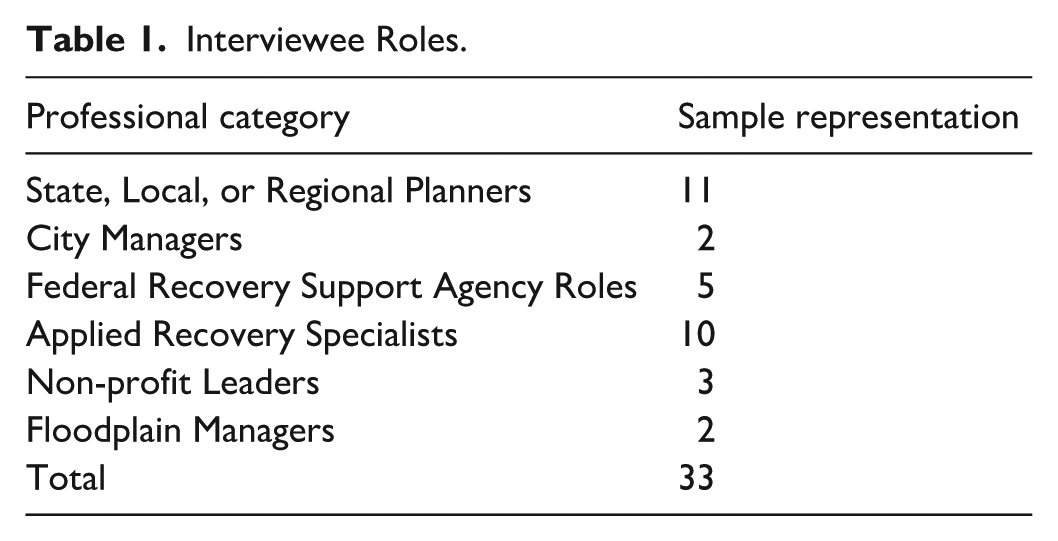
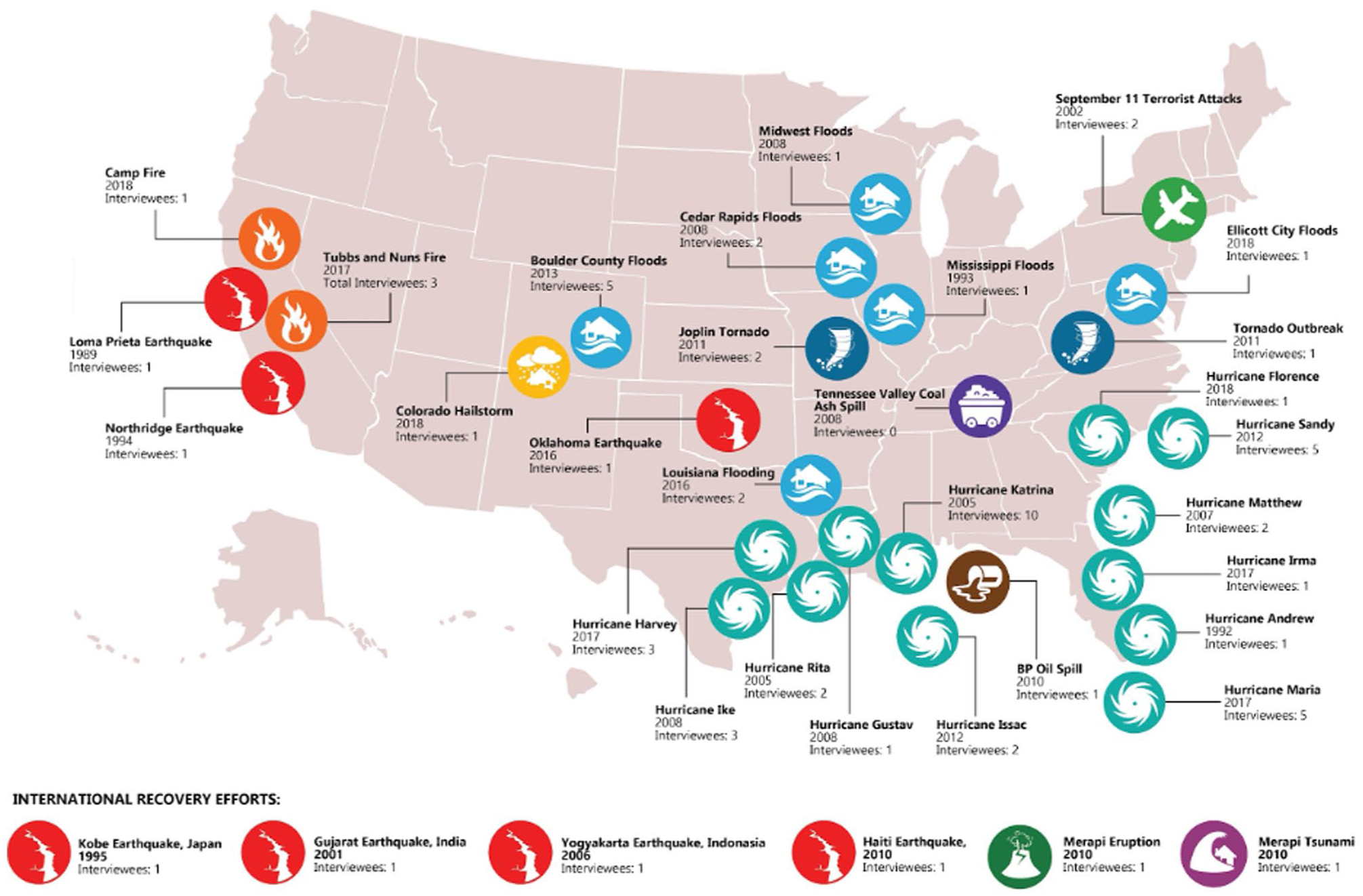
Image showing spatial distribution of the various recovery operations and experiences of the interview sample.
Interviewees described their roles in disaster recovery (or recoveries), perspectives on pre-disaster and post-disaster recovery planning, and educational needs and suggested methods for learning about recovery. Interviews were conducted via phone or video call between April and June 2019 and lasted 90–120 minutes. They were recorded and transcribed. Two team members reviewed transcripts for accuracy, while two others coded the interviews (Saldana 2011). The codes were analyzed to identify major themes associated with the challenges faced by planners and their preferred learning methods for disaster recovery.
Findings: Understanding Common Recovery Competencies
Disaster recovery experts, with varied pre- and post-disaster planning experience, identified five main challenges hindering their effectiveness that educational materials/programs could address: (1) recovery funding; (2) volunteer coordination and resources; (3) equity; (4) public participation; and (5) collaboration. These challenges represent recovery competencies that could be introduced in planning curricula and developed further as needed through on-the-job experiences.
Recovery Funding
Applying for and managing funding is critical to recovery processes (Macaskill and Guthrie 2018; Olshansky and Johnson 2017). All interviewees lamented difficulties in finding, using, and aligning funding to recovery needs. Recovery funding is a known challenge described in the literature (Fraser et al. 2022), and these respondents outlined why understanding and accessing government funding is challenging. First, recovery funding programs exist across multiple governmental agencies, making it difficult to find and apply to multiple sources with different criteria. Second, reading large amounts of funding information for the first time frustrates those in the time-compressed post-disaster environment, as a planner shared, “. . . it’s hard for people to go through all this information and find out what’s useful . . . .” Third, funding opportunities lack clear guidelines or change regularly, as another interviewee noted, Even when we have these plans and policies in place that line up nicely with the federal government or the state [such as in a pre-disaster recovery plan], a year, two years down the line, they may not be relevant anymore because the policies have changed.
Fourth, many funding objectives do not match community needs. One interviewee from a historic coastal town shared that during the post-disaster recovery, “We couldn’t convince FEMA to spend the money on stabilization versus demolition. We worked for a long time to show that that could be an acceptable option for the money.” This uncertainty exists even when pre-disaster recovery plans are in place, as a recovery consultant noted in one of their experiences, “They really referred to it [the pre-disaster recovery plan] but they recognized that it had to be flexible and that priorities couldn’t always be met because many of [the actions] were driven by external rather than internal resources.” Finally, obtained funding is slow to arrive. Several federal programs take extensive pre-planning for the application and may take months or years for approval, such as the Department of Housing and Urban Development (HUD) Community Development Block Grant-Disaster Recovery (CDBG-DR). A city employee lamented, “It took HUD three years to issue us the money for the buyout program!” Instead, the municipality fronted its own money while waiting for federal funds, an option not available to all communities.
Streamlining the bureaucracy of government funding and revising recovery programs to meet each individual community’s needs is a laudable goal. But aligning projects to funding opportunities is a core task for practicing planners. Recovery education and training could raise awareness of funding challenges for recovery and encourage pre-disaster recovery planning or review of funding programs. As one interview noted, basic awareness of funding options could improve pre- and post-disaster planning, Disaster recovery is funded with two or three large programs or buckets of money. If planners become more familiar with the programs and the flexibilities of the programs and how they work together, how they don’t work together and what they can do, I think that would help because there’s a disconnect between a plan and its implementation resources.
Formal education that provides basic awareness of which agencies provide recovery funding and how could jumpstart planners’ post-disaster search for funding and improve alignment of pre-disaster plans with implementation, as the interviewee noted. Planners could then refresh themselves on details of specific funding programs during the post-disaster recovery process.
Volunteer Coordination Post-Disaster
An influx of volunteers with varying skills and resources can offset some funding and timing constraints (Whittaker, McLennan, and Handmer 2015), but only if well-organized (Phillips and Mincin 2023). Ad-hoc spontaneous volunteers are a well-known coordination problem for emergency management (Drabek and McEntire 2003; Helsloot and Ruitenberg 2004), but this topic is less emphasized in the disaster planning literature. Volunteers in disaster recovery range from spontaneous citizens arriving to support relief, professional teams deployed to support jurisdictions, as well as citizens who become community recovery champions (Phillips 2013).
While volunteers are common in emergency management, planning interviewees lacked clear plans for volunteer management. Coordinating volunteers to match skillsets to needed recovery processes challenged local professionals who felt that volunteers distracted them from other recovery priorities. One historic preservation professional lamented this issue in their experience post-disaster: One of the huge issues was how to manage those volunteers . . . get them where they need to go and to make sure they are providing the right type of assistance. . . . There were many volunteer groups that came in and were not adequately trained on dealing with historic buildings. . . . Having volunteers can be a good thing and can be a difficult thing if we don’t know how to manage them.
Professionals, without awareness of volunteer engagement in disaster recovery, often failed to recognize these volunteers as assets. For example, one planner did not see volunteers as something useful for the post-disaster recovery process, although volunteers were clearly addressing unmet needs in their community: We didn’t get any real community groups engaging in the [post-disaster recovery]. But most of the people who are organizing are the members of the public, community groups and environmental groups, [who] were responding to the public’s need for housing, or food, or opening their own homes or putting together a response.
One recovery leader who started as a volunteer emphasized that volunteer coordination for recovery is not discussed well in planning education: What I don’t really see so often in planning books is that communities should never underestimate the role that citizens and volunteers can play in long-term recovery. I’m not the only person that’s done this work as a volunteer. . . . There are all kinds of people that are going to be willing to step up.
Interviewees even noted that professional planning volunteers were a burden. While expert advice is beneficial before too many recovery decisions are solidified, interviewees felt that well-intended RPATs didn’t match the needs at that time. One professional described their experience: After the storm you really need teams that can do surveying, assess damage before you can even start developing plans. . . . There were a lot of planning assistance teams that came in to do planning-related work as far as zoning and ordinances, but I definitely think that is needed later in the process and not in the beginning . . . .
Interviewees confirmed previous literature that the post-disaster period can create “planning fatigue” (Nelson, Ehrenfeucht, and Laska 2007). “We called it ‘planning fatigue.’ We had so many [professional] volunteer groups coming in and trying to help with [post-disaster] planning efforts and all these meetings and eventually the residents just got tired,” one respondent recalled.
Overall, planners and allied professionals describe a need for improved competency around coordinating both professional and spontaneous volunteers, whose influx is a unique component of disaster recovery compared to everyday planning.
The Need for Equity in Recovery
The AICP Code of Ethics emphasizes equity and inclusion (APA 2021), and this is an important issue in disaster recovery. Interviewees witnessed varying levels of success in integrating equity into pre- or post-disaster recovery planning and described their own and professionals’ lack of awareness of how equity could be integrated.
Most interviewees lacked examples of equity in recovery planning. One city planner stated, “To be blunt, we don’t talk about social justice much in pre-disaster [recovery planning].” Attempts at equity incorporation into pre-disaster planning failed due to difficulty translating equity goals into outcomes: I’ve seen some recovery planning processes, primarily pre-disaster processes, trying to navigate how to build some sort of equity framework, how to prioritize assistance to certain parts of a community where there’s been disinvestment in the past, but I don’t know that I’ve seen anything yet that is entirely successful.
Turning words into actions was the challenge, even when professionals were aware of vulnerable populations and neighborhoods. One expert provided an example from a community completing a post-disaster plan: If you look at the recovery plan of what projects were prioritized, they really prioritized the needs of vulnerable populations, especially low-income, elderly, single-parent, and tried to think about equity as an important driver of recovery decision-making. But past that, the actual process of getting [those priorities] done required other political processes.
Across our interviews, speedy housing and infrastructure replacement overshadowed equity concerns, as exemplified by one professional’s quote, “It [equity] wasn’t an issue that really came up. In the thick of things [post-disaster], we just wanted to provide housing in the quickest manner possible.” Another planner noted that equity efforts are siloed from other aspects of planning, “Vulnerable populations are something that probably doesn’t get enough attention in terms of recovery, because usually that’s already something special we need to do.”
Successful equity incorporation involved continuous efforts throughout the overall planning process, not just during disasters. Communities that had pre-existing procedural equity efforts also attempted equity during recovery visioning. A local planner described their use of pre-existing equity programming for recovery outreach: We have developed a department that came out of a perceived need to reach out to the lower-income, ethnic neighborhoods. . . . This group also took over neighborhood watch meetings and brought us in at neighborhood watch meetings to help when we’ve got a special project that’s going on or if somebody has proposed a development in the neighborhood. We’ll come in ahead of time and talk to them about any of their concerns.
Another planner described their own community’s approach: We have city council appointed advocates to our Board to help keep [neighborhood inequality] in the forefront and have created a department to help make sure that we don’t miss outreach opportunities or opportunities for them to speak to us through public meetings.
Another planner relayed an example in which equity facilitated the inclusion and participation of lower-income communities in various planning efforts because of engagement efforts prior to the disaster: We do take care of lower-income neighborhoods and there are some predominant minority neighborhoods near the downtown area that have been getting a lot of specialized attention for 20 years. They’re getting attention because they had public input during the visioning process in ’97 [disaster] that brought it to the forefront, then really pushed it forward in the 2000 comprehensive plan which was replicated by outreach and workshops in the 2010 comprehensive plan.
In summary, equity was not central in either pre- or post-disaster recovery in most professionals’ experience, though a few exceptions existed when equity was already something the community prioritized. As a core planning topic, the lack of consideration of equity shows a continued need in general planning education, not just recovery training. Providing educational opportunities that support planners to address equity in everyday planning activities may help counteract the recovery challenge of time compression, which often resulted in communities prioritizing speed of recovery actions over inclusive engagement. Engagement in general, though, was a challenge faced by planners undertaking recovery.
Public Participation in Recovery Planning
Interviewees indicated that participation in general was not central to recovery planning. As mentioned above, “planning fatigue” is one challenge to robust participation in post-disaster recovery planning. But another challenge discussed by interviewees was that public participation during post-disaster recovery – led mostly by emergency management – focused on just informing rather than broader engagement (Arnstein 1969). The public was aware of this, as a recovery consultant explained: I think there’s a very real question of return on investment for community members who participate because very often, they’re getting presented a set of options that have already been predetermined, so they’re being asked to rank options somebody else came up with, and there’s no real guarantee that much will come out of what people say or ask for.
Interviewees indicated that planning professionals were not as involved in public engagement as one would expect from the disaster or planning literature, as noted by a planning department supervisor: We don’t do the recovery process, per se, but I know that the emergency management folks have a manager who works on public participation, so I know that they do conduct public participation. As a planning agency, we’re not necessarily involved in that aspect of the recovery process.
Planners, unlike emergency managers, though, are trained to conduct public participation and are also aware of what meaningful participation looks like. Post-disaster participation often did not extend beyond mandatory requirements and took the form of public meetings. Planners, as described by the interviewees, did not leverage their training in public engagement, despite its recognized importance in the planning profession. A community capacity officer reiterated what post-disaster participation often entails in recovery: We simply try to get everyone in the community aware of the process and to get them to engage with us. So whether by sending out flyers, talking about the process in churches, getting the city council or county commissioners to put up notice out there and encourage people to come and participate.
Communities are being encouraged to participate in a process that has mostly already happened without their input. Public participation standards in accessing disaster recovery funds rarely galvanized enough support from communities, especially when public engagement was limited pre-disaster. An applied recovery expert detailed: Certainly the formal planning processes, when there were more formal processes, had a set of deliverables or milestones in terms of timelines for bringing people together for doing some type of discovery, for doing community outreach, for creating goals and projects. . . . I would say, though, that simply achieving a certain level of interest, buy-in, and participation is to me maybe one of the most important milestones, and I have rarely seen that really happen.
The interviewees’ discussion implies two concerns for planning. First, planning professionals seem to be disengaged from public engagement in recovery, which is something that is a core competency for the field. Second, even if they are involved, disaster recovery public engagement is unique and more difficult, as residents are either not interested pre-disaster or fatigued, preoccupied with personal recovery, or displaced post-disaster.
Expanded Professional Collaboration for Recovery
Recovery, all interviewees agreed, requires broad government and non-governmental engagement. But that does not regularly happen in their experience, and interviewees blamed both planners and emergency managers for this disconnect. They felt emergency managers had limited relationships for broad collaboration, but that planners did not understand recovery well enough to engage.
An applied recovery specialist described the lack of relationships that emergency management had with other entities as “one of the biggest challenges” for recovery, “Repeatedly, I’ve just seen a lack of folks at the table, often because they weren’t invited, other times because they didn’t see the value.” An emergency manager agreed that they wanted better coordination and that their profession was not best suited to lead recovery: “Some of the best practices that we’ve seen from other places is that the emergency manager might not be the best person to lead the community recovery.” Another emergency manager felt that planners should be central to recovery, but planners were not stepping forward: The actual planners, themselves, don’t see recovery as a responsibility of theirs, even though when we look at the types of activity that would take place as part of recovery planning a lot of it is very similar to the type of work they do day-to-day.
Some interviewees suggested that time compression was the barrier to planner engagement because planners could not or would not adapt their regular planning processes. A floodplain manager described their role as “more practical” to the recovery environment compared to planners’ traditional processes: What I mean by practical is doing kind of short-cut planning processes, meeting communities where they are at in acknowledging that they want to get back to normal as quickly as possible. In my experience, I have seen a lot of the planning response being a little too focused on breadth and consideration versus speed.
Another allied professional supported this view that planners didn’t grasp the urgency of the recovery process, making collaboration difficult. The time-compressed nature of recovery highlights competing priorities and differing competencies of these two professions. Emergency management, historically top-down, is designed for speed, while planning focuses on deliberation and consensus building – making time compression challenging not just to recovery processes but even to coordination between professionals. A principal planner felt that planners needed to learn from other fields: “In trying to learn about the recovery process, I’m hoping that we don’t just talk to planners, that we are talking to engineers, emergency operation folks, things outside of our usual realm of professional contacts.”
An opportunity for planners and emergency management to coordinate better is via plan integration. Literature and results from our interviews showed that planners and emergency managers have limited engagement in pre-disaster recovery planning. It is especially untenable to advance this collaboration for the first time during post-disaster recovery processes. Interviewees had different reasons why plan integration was not occurring. One experienced practitioner felt that the influx of money encouraged states to start fresh rather than draw upon existing plans: In some communities, no plans are used [after a major disaster]. Once there was that much money, the governor created a new entity, and the state mitigation plan went out the window. Comprehensive plans I’ve seen get updated completely separate from everything that was going on with disaster recovery and with mitigation.
Another respondent expressed that the existing comprehensive and hazard mitigation plans were not relevant to post-disaster recovery because they were “rebuilding in place” and is evidence of the disconnect between disaster recovery and building long-term community resilience: I will say that the comprehensive plan doesn’t come into play too often in my experience because most of what you’re doing following a disaster is you’re rebuilding in place, which means that you’re not really replanning an area. So you’re not looking at it from the comprehensive planning standpoint.
Ignoring comprehensive planning processes and goals for land use and disaster mitigation might result in another disaster event.
Respondents felt the lack of collaboration was acute in communities not recently affected by disaster. The interviews captured the need for wider collaboration between planners, other professionals, agencies, and communities working in disaster recovery, both pre- and post-disaster, while noting that planners may lack awareness of emergency management processes and willingness to engage in collaboration.
Learning about Disaster Recovery
The experienced recovery professionals we interviewed were well situated to discuss what they wish they had known before the disaster, as highlighted in the above themes, as well as how they would have liked to learn about recovery. These challenges offer recovery competencies for planning professionals that could be fostered through either formal classroom training or on-the-job opportunities. The interviewees emphasized the need for basic awareness of disaster recovery processes that would be extended and deepened through various types of on-the-job learning.
Supporting previous research (APA 2019; Craddock et al. 2016), this theme describes how planners and other officials used peer connections, improvisation, and self-directed learning to access actionable disaster recovery information. Planners interviewed indicated that they were not exposed to disaster recovery issues or planning actions in formal training. Planners sought ideas from their networks, but when unavailable, they improvised or adapted existing models. A scholar noted that communities often cannot find “the kind of context-specific information resources that are needed. Very rarely are there people in [planning positions] that actually have the time or ability to find or seek out that information.” Without a minimum understanding of disaster recovery, online searching for information quickly post-disaster becomes overwhelming. As one recovery consultant described, planners doing post-disaster recovery have so many questions, Where do we get the resources, how do we access those, how do we learn the rules behind CDBG-DR, SBA, all that stuff? There’s a lot. And learning it on the job – in the middle of a crisis – is not a great solution.
Interviewees described existing FEMA and APA educational resources as hard to use during post-disaster recovery. A community recovery coordinator desired short and simple educational texts and recovery examples for post-disaster, rather than current large documents: “[A new resource] doesn’t have to be a 500-page plan, which is one of the examples we’ve been using . . . which thank heavens we’re getting away from, [the 500-page plan] is too big and too unwieldy.”
Respondents wished they had collected specific community data well before recovery. Limited data made it difficult to use recovery guidelines or benefit from mentorship or resources like planning advisory groups, think tanks, consultants, and technical teams that arrived post-disaster. They wished for more pre-disaster data, such as risk assessments, updated community plans, recent topographic and/or community-scale maps, and historic resource registers, which would have sped their recovery initiation.
Embedding outside experts or using post-disaster recovery tools like plans and ordinances from other communities were two approaches taken by interviewees. A local planner said, You find a jurisdiction that has recently gone through a disaster, and they’ve dealt with issues, like temporary housing, for example. Get a copy of their ordinance, see if it works for you, and copy as much as you need to.
A recovery consultant agreed that specific examples address the information overload that planners are wading through post-disaster, Sometimes communities are very overwhelmed by the plethora of options. I have seen instances where having very direct examples of language – here’s what this community’s ordinance looks like – and peer-to-peer communications, networking, knowledge-sharing – I’ve just seen that be very effective.
Coaching, networking, and mentorship helped planners apply existing recovery educational tools like templates, checklists, best practices, and models in real time post-disaster. Professionals desired more case studies and best practices for community recovery that can be applied without extensive research on feasibility. A community planner emphasized the value of peer experience: The information that someone in a peer community who’s been through disaster brings, there’s no better information for how to do disaster recovery than those city managers in [the next] town. And there are several people in this country who are like that. There isn’t any one source, but I think peer communities and folks who have been through the experience are probably the most credible at least in my mind.
Networking, mentorship, and skill development are needed for sharing experiences and best practices. One mitigation and resilience specialist noted: It’s networking and finding support systems. . . . It’s important for the people who are in the trenches [post-disaster] to feel like they’re not alone and to have a way of pinging other people when they are dealing with things, and professionally it’s important for people to have some sense that they’ve got, not so much a safety net, but at least other people who are dealing with the same things. Because often in office we are very much isolated [from other departments], and we are on opposite ends of the emergency management spectrum.
Interviewees emphasized the complex post-disaster environment as a time for peer resources and short-form materials. Using these resources to the best of the planners’ ability, though, would be improved through pre-disaster data collection and understanding of general recovery processes.
Discussion: A Way Forward for Planning Education
The challenges identified through interviews – recovery funding, volunteer coordination, equity integration, and collaboration – are well described in the disaster literature. Yet, while planners are trained in systems thinking and community engagement, they often lack the specialized knowledge and adaptive capacity needed in post-disaster contexts (Meyer et al. 2025; Smith and Glavovic 2014). Educational opportunities have the potential to make a meaningful difference by preparing planners to navigate uncertainty, collaborate across disciplines, and lead recovery efforts with confidence and equity (Peek 2006; Reed et al. 2010; Schwab 2014). Not all aspects of recovery planning can be learned through the classroom, but improved formal educational experiences would complement the peer-to-peer learning, RPAT programming, and recovery improvisation planners currently use during recovery.
Each challenge identified in this article maps to specific educational competencies. Equity, public participation, funding, and collaboration are all aspects of core planning education that disaster recovery makes more challenging or adds unique specificity. Equity integration requires deeper engagement with procedural, structural, and distributive justice everyday so that it is a part of recovery planning (Hendricks and Zandt 2021; Meerow, Pajouhesh, and Miller 2019). Public participation requires understanding how to adapt traditional engagement procedures to the time-compressed environment or foster inclusive engagement pre-disaster. Navigating funding challenges calls for financial literacy and policy agility, and awareness of funding programs, roles, and challenges specific to recovery (Fraser et al. 2022; Macaskill and Guthrie 2018). Collaboration with emergency management necessitates cross-disciplinary fluency and shared decision-making frameworks that planners have with many fields but less so with emergency management (Kapucu and Knox 2013; Smith 2010). Volunteer coordination demands training in logistics and community mobilization, which is less common to other core planning activities (Drabek and McEntire 2003; Whittaker, McLennan, and Handmer 2015). Below, we imagine planning education opportunities for recovery planning that further their everyday planning as well. We focus more on formal educational opportunities because the interviewees noted the lack of attention to recovery in their classroom background.
Introducing Time Compression into Planning Education
All the challenges faced above relate to time compression in disaster recovery. Time compression is a unique aspect of recovery planning, affecting planners’ capacity to implement their skills from public participation and equity to building collaborations and using funding (Olshansky, Hopkins, and Johnson 2012). Many interviewees noted the issue of speed versus deliberation, and specifically how planners are not trained for speed, as exemplified by one interviewee’s suggestion, I think that we need to rewire our entire system, we’re not wired the same way as the folks that are dealing with disaster response programs. First responders, they are in and out, they work with a sense of urgency. As planners, we don’t. And we need to have a collective sense of urgency and speed because that’s the pace at which recovery is actually occurring.
Another interviewee expressed the need for planners to understand ahead of time just how fast recovery happens, “Make sure that folks understand how fast this stuff moves. How fast communities want to move, and property wants to move, and begin to make that part of the framework for recovering.”
Classroom interventions can expose students to this context through case-based learning with real-world dilemmas and decision-making under pressure (Abbott 2005; Balassiano 2011).
University programs could simulate the time-compressed, competitive nature of disaster recovery, allowing students to confront conflict and uncertainty (Balassiano 2011; Balassiano and West 2012). Embedded studios in communities recovering from disaster also offer experiential learning that mirrors time-compressed environments and showcases the challenge of disaster recovery public participation (Sletto 2013; Wilson 2024). Opportunities to reflect on these exercises are critical to developing new knowledge systems for disaster recovery (Ross, Haque, and Berkes 2024). Programs with service-learning partnerships could return to their previous communities when disasters occur to support plan integration with recovery operations (Botchwey and Umemoto 2020). Other options include charrettes requiring intense work over a short period or with limited information. Programs could simulate shortcut or quick planning processes in charrettes as desired by an interviewee, “how to do some quick planning and quick successes. Not necessarily just the full-on, most comprehensive way to do recovery planning, but how to do quick-wins, quick-successes.”
Once on-the-job, educational needs post-disaster revolve around finding and distilling large amounts of information in ways appropriate for their community quickly. Expansion of professional support networks would provide greater access to peers, which are so crucial to planners’ learning and emotional well-being. Databases of short case studies, example tools and actions, and up-to-date funding information will also support planners during time compression.
Learning with Emergency Management
Our results and previous research on the lack of integration related to hazards emphasize that planners need more awareness of disaster management including the basics of emergency operations and risk assessment. Cross-training with emergency management can foster mutual understanding and collaborative capacity (Botchwey and Umemoto 2020; Kapucu and Knox 2013). Additions to formal planning programs include electives on disaster management, guest speakers with disaster experience, and case studies of recovery across various courses. These additions of emergency management expertise will expose students to volunteer management and financing challenges. Other pedagogical options include joint tabletop exercises or semi-functional exercises, common in emergency management (Kapucu and Knox 2013), where scenarios are targeted toward challenges such as donations management, volunteer integration, or funding. These activities help each profession understand the other’s decision-making and simulate time compression.
Service-learning opportunities in disaster management are also beneficial. Students could review hazard mitigation plans during other projects and meet with emergency management to understand their processes. Applied planning studios could tackle hazard mitigation plans or pre-disaster recovery plans. Cross-listed studios, charettes, or design challenges could bring together planning and emergency management students. Internships with emergency management could provide valuable experience in recovery planning and funding.
Educational opportunities for practicing planners should encourage their engagement in emergency planning activities and networking with those professionals. Convincing practicing planners that disaster planning is valuable may be achieved through “cross-listing” of continuing educational credits for disaster-related conferences, offering short courses from APA taught with emergency management, and encouraging hazard-focused plan integration.
Incorporating Disaster Resilience into Comprehensive Planning
Research shows that community processes emphasized pre-disaster will continue post-disaster (Schwab 2014; Smith 2014), and those not emphasized will also not continue, as our interviewees confirmed. Lack of equity considerations in recovery as well as the disconnect between long-range planning and recovery planning discussed by the interviewees highlight how this continuity undermines the ideal of re-envisioning community development post-disaster (Jerolleman 2019). Interviewees wanted recovery considered in planners’ everyday roles, “I think connecting recovery to their day job and how doing some work up front will really help recovery. . . . It’s really hard for people to think about how to re-envision their community post-disaster.” Learning about plan integration as students and then implementing it as practicing planners could address several of the recovery competencies including promoting collaboration, incorporating equity, and supporting public participation.
Core planning curricula improvements emphasizing well-designed comprehensive plans, plan integration, equity, and participation will support planners everyday and during recovery. Interviewees emphasized the need to encourage good planning practices in the face of a desire for speed, I spend a lot of time in community meetings after floods talking to them about not doing something stupid like repealing their codes. Because in their minds it helps facilitate a faster rebuilding process, an easier process. [I would] actually do the opposite, which was encouraging more stringent standards so that the recovery was more resilient.
Considering disaster recovery and equity together with comprehensive and long-range planning acknowledges that disasters will affect the goals and strategies of an existing comprehensive plan, while a well-developed comprehensive plan provides the groundwork for successful recovery planning. Education on opportunities for improved equity in day-to-day planning practices would also support recovery planning. Curricula focused on public participation in core planning education can add nuances for disaster planning, encouraging future planners to guide this aspect of recovery. Increased attention to these competencies in core planning classes and in continuing education opportunities will support planners overall and during recovery.
Conclusion
After a disaster, a planner will face confusing recovery funding options, disparities in impacts resulting from pre-existing inequities, reconstruction time pressures that challenge robust public engagement, and interagency coordination difficulties as many agencies work in their own silos. To address these challenges, planning education must evolve. While no amount of formal education will be able to make disaster recovery an easy process, the approaches we suggest can cultivate planners who are not only technically proficient but also resilient, reflective, and ready to lead in times of crisis.
This study focused on practitioner perspectives and does not include direct interviews with planning educators or a systematic review of existing curricula. Future research could explore how disaster-focused programs structure their courses, assess student learning outcomes, and identify institutional barriers such as Planning Accreditation Board (PAB) standards or resource constraints. These inquiries are essential for translating the growing body of recovery knowledge into scalable and sustainable pedagogical reform.
The increasing frequency of disasters and the realities of climate change make disaster planning essential for all current and future planners. Planners’ roles will expand beyond traditional boundaries, influencing community well-being and resilience. By integrating disaster preparedness and recovery into their education and practice, planners can apply their skills to critical needs, ensuring communities are better equipped to handle crises.
Footnotes
Acknowledgements
The authors thank Joseph DeAngelis for support in developing the study and reviewing the results. The authors also thank graduate research assistants Troy Brundridge and Abrina Williams for data collection and analysis support. In addition, the authors thank all the participants for sharing their time with us.

Funding
The authors disclosed receipt of the following financial support for the research, authorship, and/or publication of this article: This project was funded by the American Planning Association and Federal Emergency Management Agency (FEMA) Cooperating Technical Partners Partnership Agreement.
Declaration of Conflicting Interests
The authors declared no potential conflicts of interest with respect to the research, authorship, and/or publication of this article.