






Abstract
This study examines how Islam is covered in 18 large circulation U.S. newspapers and finds six frames that draw a nuanced picture of how Islam is framed in the news media. Two frames are negative, one is positive and three are neutral.
From debates over mosque construction and domestic surveillance to discourse surrounding military intervention in areas of global tension like Iraq, Afghanistan and Syria, controversies related to the status of Islam in western countries remain a source of tension in public discourse. In the United States, opinion polls show consistently negative attitudes toward Muslims. 1 For example, a 2010 Gallup poll showed 43 percent of Americans feeling at least some prejudice against Muslims 2 —this despite the fact that Muslims make up less than one percent of the U. S. population, according to some estimates. 3 Even though Muslims only represent a tiny fraction of the U.S. population, stories related to Islam are often reported in the news media. 4 This combination of factors—strong opinions about a topic that audiences have little firsthand knowledge of but that is the subject of large amounts of media coverage—suggests that the way Islam is framed in media coverage is an important topic to study. Further, Islam is the fastest growing religion and the most controversial among the three major global monotheistic religions: Islam, Christianity and Judaism. 5
This study examines how Islam is framed in U.S. newspapers by content analyzing the coverage in 18 large-circulation newspapers that have a collective paid circulation of approximately 10 million. 6 This study adds the dimension of valence or tone that is particularly important in the context of Islam coverage. Drawing on the rationale of valence framing, this study examines how Islam has been framed in U.S. media almost a decade post-9/11 to clarify the phenomenon of how numerous US outlets report on this specific religion. Research into valence in framing—the presentation of an issue in media coverage in stark positive or negative terms—examines how changes in valence affect attitudes about the topic under consideration. 7 This study’s contribution is the addition of valence to search for frames in media texts. This is a potentially important contribution, given that previous research suggests that valence exerts a powerful influence on public opinion. Furthermore, the framing approach is useful for discussing media representations of Islam, in part because some suggest there is perceived to be a gap between the abstracted and homogenous media images of Islam and the lived realities of diverse Muslim communities. 8
Further, this work represents one of the first studies to examine the coverage of religion in U.S. media—particularly Islam—by using a hierarchical cluster analysis approach to framing first proposed by Matthes and Kohring. 9 This approach has been shown to yield better results regarding reliability and validity when compared to previous methods used in literature looking at media frames.
Islam in Western Media
More than a decade after 9/11, many people in the United States claim the attacks have evoked feelings of Islamophobia. 10 As a result, it has been suggested that Muslims representing all strata of society throughout the world continue to face an extraordinary degree of negative attention often resulting in discriminatory practices from both the public and the governments. Critics have claimed these practices, born of stereotypical descriptions and definitions of “Islam” and “Muslims,” in western media are connotative of the level of fear and hatred in many parts of the world when topics concerning this religion and its adherents arise.
Critics and scholars have suggested several key models for these negative attitudes including the historical rivalry between the Islamic World and the Western World dating back, for example, to the eras of colonialism and the Crusades. 11 Others have adopted the more recent Clash of Civilizations theory coined by Huntington 12 in response to the fall of the Soviet Union and the changing power relationships among key nations, including the United States. Finally some scholars have focused on the oversimplification and decontextualization of Islam in the media 13 and the rise of political Islam. 14
Previous scholars 15 have described the important role media play in representing, articulating and reproducing discourses and social assumptions regarding various subordinate subgroups in which meanings are created, emphasized and mediated. Overall the literature suggests that interest in religion, specifically Islam, augmented in recent decades in relation to media and public discourse. 16 Indeed several scholars 17 have suggested that western media have produced a negative bias and that Islam in general has been discussed in public discourse in terms of violence and terrorism, suggesting an overall negative slant toward this specific religion.
However before delving into the framing literature of Islam one should explain how this religion has been often seen as a tradition outside the norm of the predominantly Christian tradition in the West. The media sphere, Said 18 asserted, is filled with “a limited series of crude, essentialized caricatures of the Islamic world presented in such a way as, among other things, to make that world vulnerable to military aggression.” Said’s view of Orientalism 19 mainly deals with western superiority regarding broad stereotyping of the East that is perceived as inherently resistant to modernity and civilization. Huntington 20 claimed this divide was leading to what he described as a “clash of civilizations;” a theory that has since been heavily criticized by numerous scholars, including by Said himself. 21
As mentioned earlier, the coverage of Muslims has been a topic of increasing salience in part because the 9/11 attacks thrust Islam into the glare of U. S. media attention more than ever before. Several studies have been conducted examining the representation of Islam in the media. 22 For example, a framing analysis of four daily newspapers found an elevenfold increase in news items mentioning Muslim-Americans and Arab-Americans (distinct identities that are often conflated in media discourse) in the six months after the attacks than were published in the six months before the attacks. 23
But it is not simply the amount of coverage that is important—the type of coverage is important as well. Nacos and Torres-Reyna 24 found an increase in positive coverage of American Muslims and Arabs after 9/11, while Altheide 25 found negative media frames that linked longstanding images of crime and terrorism to depictions of Arabs and Muslims to emphasize a new era of danger, risk and fear that required the diminution of civil liberties in the pursuit of security. Meanwhile, Ibrahim 26 found contradictory frames of Islam, detailing some disapproving depictions of the religion on the international stage with others portraying Muslims as vital contributors to American life. 27
Further, highly controversial issues related to Muslims in America and globally have persisted. These include a proposal to build an Islamic community center near the site of the terrorist attacks in New York, other mosque-building controversies around the United States and an increased push for states to pass legislation to ban Islamic sharia law. Such debates raise the question of whether American Muslims are portrayed in positively valenced terms as contributing and integral members of American society or whether they are covered in negatively valenced terms as a threat to society.
Framing: Patterns of Selection and Interpretation
Inspired by Goffman’s 28 1974 treatise on frame analysis as a way of describing how people organize experience, four decades of framing researchers have used framing in the search for the “persistent patterns of cognition, interpretation and presentation, of selection, emphasis and exclusion, by which symbol-handlers routinely organize discourse.” 29
One basic assumption of framing theory is that communicators, journalists and audiences do not simply mirror political events or topics. Rather, political issues are subject to different patterns of selections and interpretations. 30 These interpretations of issues are negotiated, contested and modified in a way to produce selective views on issues. As Entman explained, “To frame is to select some aspects of a perceived reality and make them more salient in a communicating context, in such a way as to promote a particular problem definition, causal interpretation, moral evaluation and/or treatment recommendation for the item described.” 31 Framing research bridges several important areas of communication. In fact, scholars have identified frames for political and organizational actors, for journalists, in news media content and in the minds of citizens. 32
While framing is something that theorists suggest is performed by individuals in their day-to-day-lives as they develop their subjective interpretations of social events, 33 a large portion of framing research has been devoted to the study of the ways news coverage contributes to the social construction of reality. 34 Again, the underlying idea in this strand of research is that strategic frames are selected and modified by journalists, who can also bring in their own frames. Such journalistic frames are manifest in news content and as a result of that, different frames appear in different news outlets depending on, for instance, journalists’ ideology, ethics, religious background or the market position of a newspaper or channel.
While framing has been one of the most active and important areas of journalism research in recent years, 35 there are ongoing debates on the nature and definitions of frames. 36 Amidst criticisms of conceptual imprecision, 37 there have been frequent debates about the best ways to measure frames. 38 The key challenge is to identify and reliably code such abstract and holistic variables such as frames. For a frame to be present, several frame elements as defined by Entman 39 must be salient in a news item. Typically, researchers define frames based on a subsample of news and then code them as a holistic variable that can be present or not. There has been much discussion in the literature as to the reliability of such holistic coding. 40 The most critical argument is that reliability in content analysis decreases the more abstract a concept is, that is, the less it can be translated to precise indicators that are easy to code. There is no doubt that frames are such abstract entities. Based on this insight, Matthes and Kohring 41 have suggested a different approach to measuring frames, the clustering method. Rather than coding frames as holistic variables, they suggest splitting a frame into its defining elements. These defining elements are problem definition, causal interpretation, moral evaluation and/or treatment recommendation. While not all of them need to be present in a given frame, each frame can be conceptualized as a specific and unique pattern of these elements. In other words, if there is a cluster of news items that shows a particular pattern of frame elements, that cluster can be called a frame.
Valence: Positive and Negative Interpretations
As another controversy in framing research, some scholars understand frames as cognitive entities without any inherent valence. This view regards frames as salient considerations of issue aspects. Others, however, have suggested incorporating valence into the analysis of news frames. 42 The latter view treats frames as strategic tools with which communicators strive to push journalists and audiences in a clear direction. Research suggests that valenced frames can influence and direct—though not control—news consumers’ perceptions and attitudes toward a subject matter. 43
The most important implication of these findings is that they suggest that the journalistic convention of balance plays out through competing frames, rather than within one frame.
Previous research into valence framing effects generally focuses on the impact of different ways of wording a message on individual-level understandings, 44 an effect that occurs at the point where a frame comes into contact with the semantic nodal structures that comprise an individual’s prior knowledge. 45 For example, people gave inverse preference selections when a public health program was described in terms of lives saved rather than lives lost, even though the scenarios were numerically equivalent. 46 In another seminal study, stories about a Ku Klux Klan rally elicited more tolerance from readers when framed as a free speech issue then when framed as a threat to public order. 47 However, this approach has been critiqued for a lack of validity for the unrealistic way people are exposed to one frame at a time in experimental situations, in contrast to the multiple frames people encounter in real life. 48 In contrast to these earlier valence framing studies based in the cognitive paradigm, this study is grounded in the constructivist paradigm. This paradigm focuses on how frames are constructed and how new frames emerge and are used by a wide range of social actors—including journalists—who co-construct the culture surrounding a particular issue. 49 In this sense, newspaper coverage is only one part of a much larger process that includes other types of media as well as interpersonal networks.
While there is a considerable amount of previous research into the valence of frames in communicating texts, most of it has been in the context of health communications and has been focused on the individual level—i.e., which frames are more powerful in terms of getting people to make certain health-related decisions. This line of research has not been extended much to the realm of other social issues, such as religion. Media coverage of Islam lends itself to studying valence of coverage. In one example, Mosemghvdlishvili and Jansz 50 looked at valence in YouTube videos about Islam and found a slight majority of them were balanced rather than negative.
Based on these insights, this paper aims to investigate whether frame valence plays a role in the framing of Islam while applying the Matthes and Kohring clustering method to this important but under-researched area of news.
Research Questions
Because previous research has shown that valence is a powerful influencer of public opinion, 51 it can be assumed that the framing of Islam will have strong valenced components, positive or negative. The degree to which news stories evaluate Islam and its components and are clearly positive or negative is therefore an important research question. Thus, this study’s contribution is in the addition of valence to the framing concept.
Furthermore, because the cluster analysis technique proposed by Matthes and Kohring is still relatively novel, the study at hand could be seen as another test of the method’s effectiveness. The question is whether meaningful frames can be identified by splitting a frame into its single frame elements. The results achieved are empirically determined clusters of articles that differ in their specific pattern on frame elements. The challenge, however, is to interpret these clusters as meaningful frames. Based on these insights, this research poses two research questions:
Are the frames related to Islam in newspaper coverage clearly valenced or not?
Can meaningful frames about Islam be empirically determined by a cluster analysis of frame elements and the valence of those frames?
Method
To examine the framing of Islam in American newspaper coverage, this study is based on a secondary data analysis of a content analysis of 18 large-circulation newspapers representing a wide geographic distribution from across the United States: USA Today, New York Times, Los Angeles Times, Washington Post, New York Daily News, New York Post, Houston Chronicle, Philadelphia Inquirer, Newsday, Denver Post, Minneapolis Star-Tribune, Chicago Sun-Times, Cleveland Plain Dealer, San Francisco Chronicle, Oregonian, Newark Star-Ledger, San Diego Union-Tribune and St. Petersburg Times.
The content analysis focused on coverage that was published between Oct. 13 and Nov. 13, 2009. This time period was specifically chosen for two main reasons. First, the news coverage analyzed was in the wake of the Park 51 controversy in which opponents of establishing a mosque close to Ground Zero perceived the Islamic center to be offensive—expressing concern that 9/11 hijackers were “Islamic terrorists.” Second, shortly after the selected timeframe, polls highlighted a sharp divide with respect to views on Muslims and indicated that anti-Muslim political rhetoric has taken a toll on U.S. public opinion. 52
The unit of analysis was the news story. A Lexis/Nexis search regarding newspaper coverage that dealt directly with “Islam” and “Muslims” in this time frame yielded 1,052 reports. Of these reports, editorials and other opinion pieces were discarded from the sample, leaving a final N=671 news stories for analysis. Using a sub-sample of 106 news stories (15.8 percent of total) inter-coder reliability estimates were calculated using Scott’s pi. Reliability estimates ranged from .97 to .82. They were as follows: Tolerance of homosexuality .96; Religious tolerance .94; Racial tolerance .95; Gender equality .97; Religious belief difference .95; Desire for peace associated with Islam .92 and overall valence .82.
Findings
To determine the frames present in the sample, a hierarchical cluster analysis was performed using Ward’s 53 method. This is the most commonly used clustering algorithm in framing research. 54 In this procedure the analysis begins with a group of subsets equal to (n), where (n) equals the number of individual cases. In the next step, the two most similar individual cases are united into a new cluster. This process is repeated (making it a hierarchical method) until there remains a single cluster of all cases (making it an agglomerative method). 55 Ward’s method can also be called polythelic, which means that objects in the cluster are similar on some variables, but not all variables. Nearly all methods of cluster analysis produce polythetic clusters “because they result in ‘natural’ clusters that are almost inevitably imperfect, not all members being identical on all variables.” 56
Upon visual inspection of the results of the cluster analysis in this case, a six-cluster solution was determined to offer the optimal solution, compared to three-, four- and five-cluster solutions. [See Table 1] Determining the proper cluster solution is a somewhat interpretive task because, as Bailey notes: “The problem of how to cut the cluster must be solved subjectively. There is no objective method of cutting.” 57 However, Rapkin and Luke 58 identified several sources of relevant information in the selection of the best cluster solution, including examining the scree plot of results and general cluster interpretability, both of which were used in this case.
Frequencies of Six Frames Related to Islam
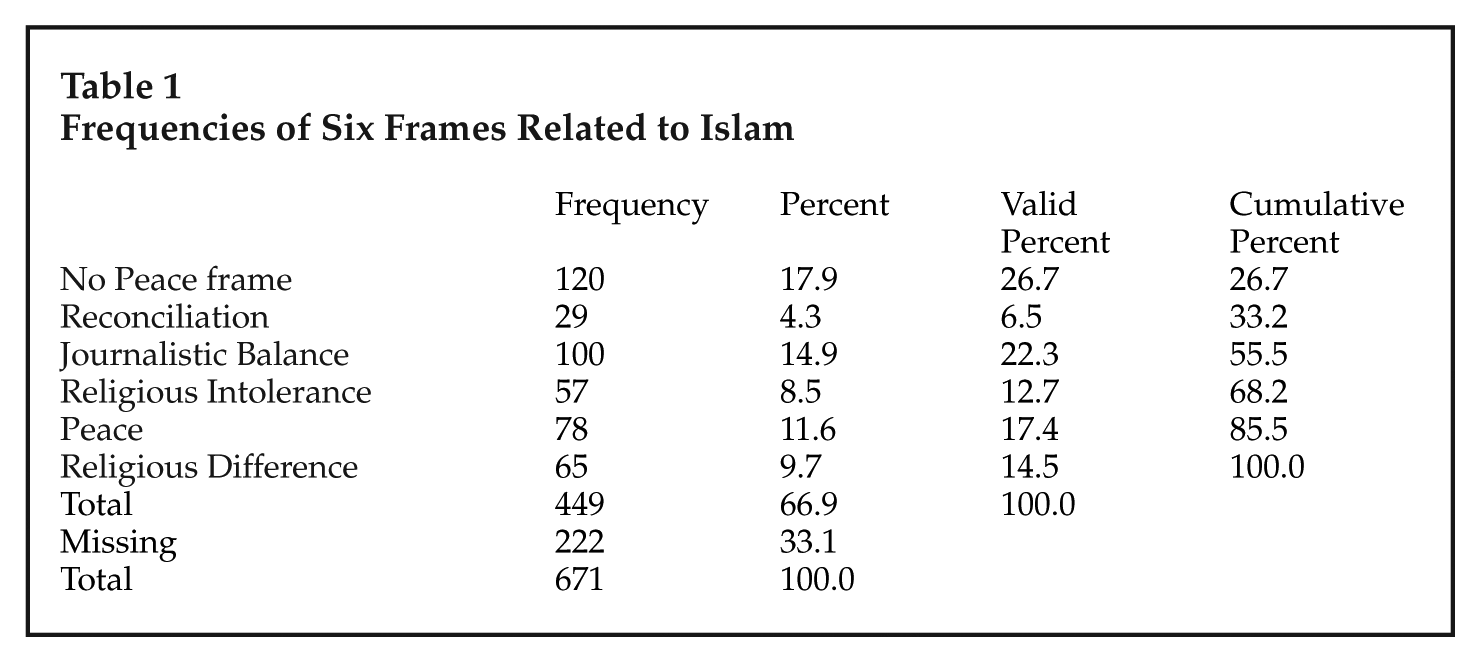
The six-cluster results were saved as a variable in the dataset, so each observation’s cluster membership was recorded. Table 2 breaks down the main variables in each frame. Each of the six frames’ main characteristics is described below.
Means for all Frame Elements in Each Frame Related to Islam*
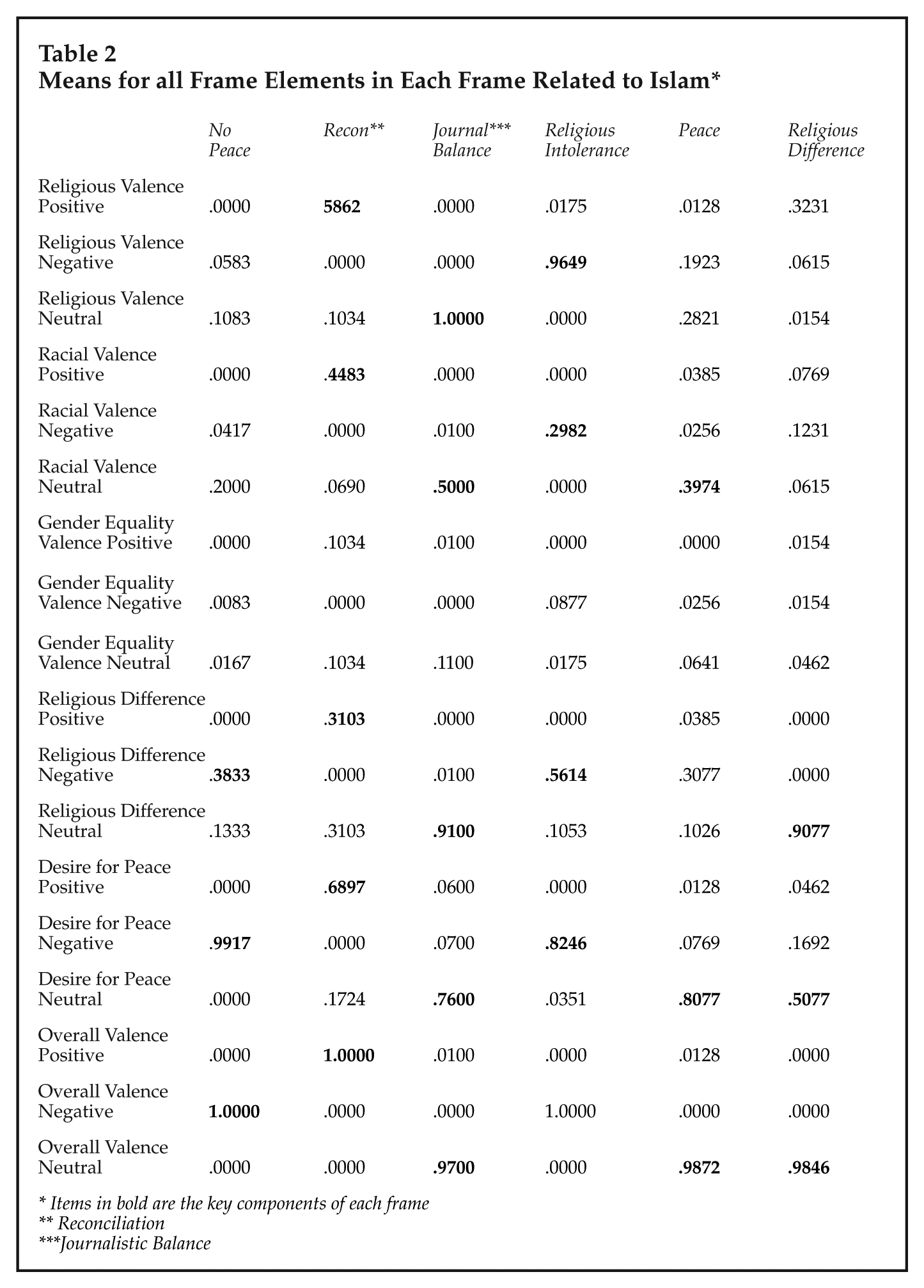
Items in bold are the key components of each frame
Reconciliation
Journalistic Balance
The first frame, the No Peace frame, clustered mainly around negative valenced Desire for Peace (.99) and Religious Difference (.38) variables
With an entirely negative overall valence (1.0), this frame suggests that Muslims do not desire peace and are intolerant of those with different religious beliefs. Given its overwhelming negative valence, this frame may reflect Islamophobic tendencies, which Bleich defined as “indiscriminate negative attitudes or emotions directed at Islam or Muslims.” 59
The second frame, the Reconciliation frame, was the only positively valenced frame
The variables clustered around positive Religious Tolerance (.59), Racial Tolerance (.44), Religious Difference (.31) and Desire for Peace (.69) variables, with an overall positive valence of (1.0). This frame suggests that Muslims are both tolerant and similar to other groups, rather than an “other” to be feared.
The third frame, the Journalistic Balance frame clustered around neutral valence of Religious Tolerance (1.0), Racial Tolerance (.50), Religious Difference (.91), Desire for Peace (.76) with overall neutral valence (.97)
With such middle-of-the-road portrayals, this frame is reflective of the dominant American journalistic norm of balance and detachment.
The fourth frame, the Religious Intolerance frame, clustered around negatively valenced Religious Tolerance (.96), Religious Difference (.56) and Desire for Peace (.82)
While negative Racial Tolerance valence was a small part of the cluster (.30), this frame was where it had the highest level of occurrence. The overall valence was negative (1.0). By focusing on a view of Islam that is intolerant, different, warlike and racist, this frame suggests the construction of Muslims as a sinister outside group to be feared.
The fifth and sixth frames were both characterized by strongly neutral constructions
The fifth frame, the Peace frame, clustered largely around neutrally valenced Desire for Peace (.81) but also featured neutral Racial Tolerance (.40). This frame’s overall valence was neutral (.99). The sixth, the Religious Difference frame, clustered around neutrally valenced Religious Difference (.91) and neutral Desire for Peace (.51), with an overall neutral valence (.98).
Discussion and Implications
This study posed two research questions. With regard to the first research question—whether the majority of frames are valenced or not—the results are unclear. Three of the frames are neutral, only two are negatively valenced. Based on previous research, 60 we would argue that the valenced frames are more important in terms of effects but still, the majority of coverage does not seem to be hot-blooded. This result may show the impact of certain American journalistic conventions like objectivity—which itself is a value-laden concept 61 —to the construction of certain storylines. And, even though a majority of the stories contained neutral frames, there was still a notable disparity—taken together, 26.4 percent of stories had negatively valenced frames, while only 4.3 percent of stories featured the positively valenced frame.
The most important implication of these findings is that they suggest that the journalistic convention of balance plays out through competing frames, rather than within one frame. Notably, the frames were not mixed in terms of valence. There were no incidents where a frame featured strongly positive valence on one variable and strongly negative valence on another. Media frames often contain an inherent valence by habitually highlighting certain positive or negative aspects or treatments related to an issue, 62 such as in the case of earlier Cold War or dictatorship-democracy frames. With the end of the Cold War, some scholars suggest that Islam “has come to represent America’s major foreign devil.” 63 While the Clash of Civilizations theory suggests that frames related to Islam may have inherited such an inherently valenced status, the results of this study are more complicated. Yes, coverage of Islam is far more negative than positive, but it is also more neutral than negative.
It is important to pay attention to negatively valenced frames because previous research has found they have stronger effects than do positive ones, 64 particularly with regard to enhancing attitude strength, 65 although people with more political sophistication may be more influenced by positive framing. 66 Such negatively valenced news frames could carry consequences. Experimental research has found that audience members exposed to negatively valenced stories had more negative attitudes about the topic being discussed 67 and that support for public policy initiatives declines when negatively framed as a risk compared to when it is framed in positive terms as an opportunity. 68
In regard to the second research question—whether the Matthes and Kohring method works for identifying frames related to Islam — the answer is yes. Given that this procedure is coming into more widespread use 69 and has been recommended by other researchers, 70 it is important to continue to refine the technique. Through the use of cluster analysis, this research was able to identify six frames in the content in a way that was sensitive to the characteristics of the content itself, rather than trying to force the content into frames that had already been defined by the researcher. Such researcher bias has been identified as the major problem in framing research and this cluster analysis procedure offers an effective way to mitigate such researcher bias. This study identified six frames that draw a nuanced picture how of Islam is framed in the news media.
Conclusion
By focusing on the concept of valence, this study makes an important contribution to the topic of the framing of religion. Most research has treated news frames as cognitive entities by focusing on the salience of considerations. In these studies, the valence of frames was not taken into account. 71 However, public political debate may be framed in such a manner that it carries inherent evaluation; thus it is important to determine the inherent valence of such categories, which may be contested. 72 This is especially true for the coverage in Islam. There is a huge difference between news coverage that highlights several issue aspects that are associated with Islam and stories that explicitly evaluate Islam in negative or positive ways. The reason for that is clear because valenced news frames are thought to have inherent power to persuade. 73 Therefore, when looking at the ways the news media frame Islam, researchers need to incorporate the concept of valence.
Still, this study contains several key limitations. The gender equality beliefs did not cluster in any one frame to a sufficient extent to be considered a major part of any of the frames. This is somewhat perplexing, given that the position of women in Islam is a topic of frequent debate. Clearly, the stories on that topic did not represent a sufficient part of the coverage of Islam in our sample to make up a large part of the data analysis. Future researchers should focus in particular on coverage of gender issues and Islam.
Also, this study treated textual frames as the dependent variable. 74 Therefore, while some studies of valence in media framing work to directly connect it to attitude changes, 75 this study does not. In future research, multi-method studies on this topic should be undertaken to probe the entire framing process—the antecedents of particular frames, the nature of the frames themselves and the effects of frames on the public. 76 In particular, studies are needed that analyze frames about Islam not on the textual level but on the individual level, e.g., by conducting interviews with journalists.
Finally, this study offers merely a single snapshot in time, while Islam remains an important topic of news coverage. 77 Future researchers should build upon this analysis by conducting a time trend study of the valence in news framing of Islam to develop a broader understanding of the tone of portrayals and how they have changed over time.