







Abstract
This study examines the effects of newspaper endorsements of candidates in the 2012 U.S. presidential election. By endorsing a particular candidate, newspapers appear to play an important role in terms of motivating college students to make their voting decision or jump on the bandwagon of a candidate who is widely endorsed by the press.
Keywords
One of the beliefs about media effects in politics is that variations in media power, real or presumed, can be attributed to perceptions of voters. Several media effect theories—agenda-setting, hostile media effects and third-person effects—rest on this perspective. The thrust of the third-person effect hypothesis, for example, was characterized as “‘what we think others think’ of the power of media.” 1 Numerous studies have documented the third-person perceptual bias that political messages do not affect themselves but others. 2 As Lasorsa argued, perceived effects of media are real effects in terms of triggering various behavioral responses. 3
However, previous research has reported that the magnitude of perceptual bias as a predictor on behavior has been inconsistent, even unreliable. 4 To overcome the limitation, Gunther and Storey proposed a model about media’s perceived influence—the influence of presumed influence. 5 According to them, people tend to adjust their attitudes and behaviors according to their perceptions of media influence on other people. 6 Their model no longer requires third-person perception to be a component in examining the perceived effects of media messages.
The influence of presumed influence model was tested in a variety of contexts, including politics, health communication and advertising. 7 Past research consistently demonstrates an advantage of Gunther’s and Storey’s approach to the perceived effects of media message on behavioral outcomes, which has broadened the scope of behavioral consequences of perceived media effects beyond the traditions of censorship. 8
Press endorsement of candidates in presidential elections is a time-honored tradition in U.S. journalism. Large and politically important newspapers ritualistically endorse a candidate before election day. Past research about opinion journalism suggests that editorials may have an impact on public opinion regarding important issues, hence, potentially influence voting decisions; however, empirical evidence is inconclusive. 9 In a study of the 1964 presidential election, in which the Democratic candidate was widely endorsed, Erikson found that endorsements from the local newspaper added five percentage points to the 1960-64 Democratic gain. 10 However, recent research suggests that few voters are swayed by newspaper endorsements of presidential candidates. Jamieson argued that the direct effect of editorials does not appear to be significant enough to find. 11
To shed light on the issue of whether press endorsements have any influence on voters, the present study examines the perceived effects of newspaper endorsements of presidential candidates in the 2012 election on college students’ voting intention. Specifically, this study assesses the perceptions of the influence of endorsements in the 2012 election in terms of its credibility and how the perceived effects of credible endorsements on self and on others affect college-age voters’ decision-making.
Newspaper endorsements of candidates in elections provide a fitting context to pursue a presumed effect study:
First, newspaper reading has been declining among young adults. According to Pew, only 26 percent of 18-24 year-olds read a newspaper. 12 Nevertheless, the influence of newspaper endorsements of candidates in elections is contingent upon student voters’ perceptions of what others think about the influence of the endorsements on themselves versus others and what they will do based on the perceived effects on themselves and others. Under such circumstances, an understanding of the perceived effects of newspaper editorials endorsing a presidential candidate on oneself is critical, as endorsements provide important political stimuli to voters in making sense of the extent to which a candidate has garnered support. Then, perceived effects can directly affect voting intention.
Furthermore, endorsements of candidates by newspapers serve an important role in the democratic process by providing voters with perspectives about complex issues and policy stances of competing candidates. 13 If the candidate endorsed by a prestigious newspaper is the candidate that a voter supports, the endorsements will qualify as a benevolent message, which may help bolster his/her confidence in the candidate. 14
Literature Review
The Influence of Presumed Influence
According to the influence of the presumed media influence approach to media effects, people estimate the potential effects of media on other people and change their attitudes or behaviors accordingly. 15 A large number of studies offered empirical support for the model. Cohen, Tsfati and Sheafer collected survey data of Israeli members of Knesset and parliamentary reporters about the Knesset members’ media appearances. 16 They found that that politicians’ belief in the power of media increases their motivation to be covered in media, which in turn is related both to their greater media prominence and to more parliamentary activities. Consistent results were obtained in another study explaining the amount of media coverage of science and scientists by assessing scientists’ beliefs regarding the effect that media appearances had on their careers. 17
More importantly, Gunther, Bolt, Borzekowski, Liebhart and Dillard argued that a few mediating variables tend to affect the type of presumed media influence on oneself and others. 18 The mediating variables include demographics, media exposure, knowledge, perceived prevalence and peer norms. 19
In the context of press endorsements, the credibility of media messages will also mediate the influence of voters’ presumed media effects on oneself and on others. As an attribute of information, credibility refers to whether the source, the information or the medium is perceived to be trustworthy and truthful. 20 Past research has examined the construct along three dimensions: source credibility in terms of trustworthiness, expertise, accuracy, fairness and believability; media credibility in terms of the truthfulness and believability of a media channel; and content credibility in terms of the truthfulness and believability of the message. 21 For instance, advertising is seen as less credible than news. 22
Focusing on perceived effects of the strength of the argument, White reported that weak arguments are more likely to produce a greater effect on others than on oneself, but strong arguments are more likely to produce a greater effect on oneself than on others. 23 His study suggests that people are willing to admit to being affected by convincing augments when they perceive it is smart to do so. In a study of political advertising of the 2000 presidential election, Meirick proposed that people would perceive a desirable message to have the greatest, most “optimal impact” 24 on themselves. 25 He reasoned that people tend to admit they might be influenced by benevolent ads more than ads for less desirable items for the benefit of self-enhancement. Similarly, Wei, Chia and Lo reported that the higher the perceived credibility of election polls, the greater the perceived positive effects on oneself and others. 26
Hypotheses
In the context of candidate endorsements by the newspapers, if voters perceive an endorsement as highly credible, they also perceive that it represents broad support for the candidate. To individuals, they would find it desirable or smart to be influenced by these credible endorsements, especially when the endorsed candidate is the one they support. Following the logic of self-enhancement, to admit to be affected by newspaper endorsements of credibility may bolster their confidence in the candidate they support. 27 Accordingly, researchers expected that the credibility of newspaper endorsements in the 2012 presidential election would be related positively to the perceived effects of endorsement on the self:
H1:
The perceived credibility of newspaper endorsements of candidates in the 2012 presidential election will be more strongly and positively related to the perceived effect of the endorsements on oneself than on others.
The presumed influence of media influence has real consequences for behavior. 28 With regard to the presumed influence on the self and others, Gunther et al. proposed two broad categories of behavioral outcomes: prevention and accommodation. 29 By prevention, the behavioral responses to perceived effects on the self and others were concerned with supporting censorship of harmful messages. By accommodation, the behavioral responses to the perceived effects on the self and others concerned how individuals adjust their own behavior like voting and vaccination. 30
Gunther suggested that people’s pro-censorship attitudes reflect their intention to penalize the media for doing harm to others by circulating undesirable messages. 31 To illustrate, when voters perceived election polls biased in favor of the candidate to whom they oppose, they at the same time perceived that the polls disfavor the candidate whom they support. Wei et al. found that the voters were likely to support restrictions of election polls to penalize the media and to compensate the candidate whom they supported. 32
Interestingly, an experimental study suggests that press endorsement’s impact on voters depends on the level of ideological congruence between the voter and the source of the endorsement. Dropp and Warshaw found that voters tended to reward congressional candidates when they perceived that an endorsing newspaper was ideologically similar to their preferences but punish endorsed candidates when they perceived that the source was ideologically distal. 33 In the context of newspaper endorsements of a candidate in the 2012 two-way presidential race, if the newspapers’ endorsed candidate were the one that an individual opposed, the endorsement would qualify as undesirable message to him or her. In this case, the individual who perceived to be affected by the highly credible endorsements (the concern of H1) may be prompted to take punishing action against the endorsement that persuaded voters to support the candidate he or she opposes. Evidence in the literature justifies such an expectation. Applying the theory of reasoned action to explain why people are motivated to act on the perceived effects of media messages, Golan and Banning reported that people tend to perceive the self to be more influenced than others by socially desirable public service announcements. 34 Furthermore, such perception was positively related to the likelihood of the self to engage in socially desirable action. Accordingly, researchers hypothesize that the perceived effects on the self will motivate respondents to boycott newspapers whose endorsements they viewed as undesirable to the supported candidate’s chance of winning the election. To them, doing this sort of prevention may be considered socially desirable.
H2:
The perceived effects of newspaper endorsements of a candidate in the 2012 presidential election on the self will be more strongly and positively related to the likelihood of boycotting newspapers that endorsed the opposing candidate than will the perceived effects on others.
Finally, past research has explored accommodating behavior in terms of voting. Scholars argued that people who believe political messages affect others would themselves have a greater motivation to vote. 35 That is, what people think the media do to other voters may influence their own voting decision. According to Banning, when people perceive others will be either motivated or deluded by political messages in the media, they may reason that they must vote to countermand the forces of their political adversary. 36 On the other hand, Golan and Day argued that perhaps certain media messages “do not affect others enough.” 37 To remedy the situation, they suggested the use of perceived effects on the self as an important antecedent of political behavior. 38 The rationale is that voters may be willing to act because they believe they, themselves, are affected by political messages.
Considering that newspaper endorsements of presidential candidates in the 2012 election might affect the outcome of the closely contested election between President Obama and his GOP challenger Mitt Romney, it is anticipated that the perceived effect on the self would be a significant and positive predictor of voting because, if people believed that the endorsements would affect others and themselves equally or affect themselves more than others, it is plausible that they would feel that their own vote would make a difference or they would feel compelled to vote for the candidate who had gained momentum from more endorsements by newspapers. Because respondents who rated the endorsements of candidates as highly credible would tend to believe the endorsements would affect themselves more than others, they would likely seek to enhance the perceived effect of the endorsements by voting in favor of the candidate who received more endorsements (i.e., going with the winner to secure a win). Accordingly, the following is hypothesized:
H3:
The perceived effects on the self will be more strongly and positively related to voting in support of the candidate who received more newspaper endorsements than will the perceived effects on others in the 2012 presidential election.
Method
Data for this study were collected from a survey with a probability sample of college students. College students were sampled because census data show young voters were among the faster-growing groups of voters in the 2008 presidential election. Some 24 million young Americans ages 18–29 voted, making the 2008 presidential election the second largest youth voter turn out in history. Specifically, the sample was drawn from a public university in the Southeast with an enrollment of 22,550 undergraduate students. Using classes as the sampling unit, general-education classes with more than 200 students enrolled were drawn in a simple random fashion, which resulted in a total of four randomly selected classes. The sample size totaled 948.
Trained and supervised graduate students assisted in administering the questionnaire. Considering that press endorsements tended to be announced in the last couple of weeks before election day, the survey was conducted in a two-week period starting in late October and ending on November 4, 2012. Prior written consent from the faculty was obtained in advance. Participation was voluntary; no class credit was offered. The survey assured respondents of anonymity and confidentiality. Among the 948 students in the sample, 520 turned in a valid survey. The response rate reached 54.85 percent.
Among the 520 respondents, 57.5 percent were males. The mean age was 20.03 years (SD = 3.49, ranging from 17 to 56). Of the sample, 34.7 percent were juniors, followed by freshmen (33.4 percent), sophomore (20.9 percent) and seniors (10.9 percent). In terms of race, 74.4 percent were white, 11.5 percent were African-American, 5.1 percent were Asian and 0.7 percent were Hispanic. With regard to party affiliation, 28.2 percent self-reported as strong or moderate Democrats, 23.6 percent as Independent and 48.3 percent as strong or moderate Republicans.
Operationalization
Perceived Effects of Newspaper Endorsements on Oneself and Others
Respondents were asked to first rate the effect of the local newspaper’s (such as Charlotte Observer) endorsement of candidates in the 2012 presidential election on their voting intention. They were then asked to rate the effect of endorsements of candidates by national newspapers (such as The Washington Post) on their voting likelihood. The 5-point response scale ranged from 1 (“no effect at all”) to 5 (“a great deal). The two items were averaged to form a measure of “perceived effects of newspaper endorsements on self” (M = 2.02, SD = 1.02, r = .61). Using the same scale, respondents were asked to rate respectively the effect of local and national newspapers’ endorsements of candidates on others’ voting decision. The two other items were combined to create a measure of “perceived effects of newspaper endorsements on others” (M = 3.29, SD = .86, r = .60).
Credibility of Newspaper Endorsements
Respondents were asked to rate the credibility of the newspaper endorsements in the 2012 presidential election on a 5-point scale, where 1 meant “strongly disagree” and 5 meant “strongly agree.” The three statements were (1) “Newspaper endorsements are credible;” 39 (2) “Newspaper endorsements are reliable;” 40 and (3) “Newspaper endorsements are trustworthy.” 41 Results of an exploratory factor analysis indicated that the three items were grouped in a single factor (Eigenvalue = 2.41, accounting for 80.36 percent of the variance). They were averaged to create a measure of “perceived credibility of newspaper endorsements” (M = 2.55, SD = .87, α = .88).
Likelihood of Boycotting Newspapers
Conceptually, this variable refers to the likelihood of respondents’ abstaining from and persuading others to avoid using and reading newspapers that endorsed the candidate they oppose. Three items measured it. Respondents were asked about the likelihood that they would (1) boycott the newspaper that endorsed the candidate that they oppose, (2) avoid reading the newspaper that endorsed the candidate that they oppose and (3) persuade others to avoid reading the newspaper that endorsed the candidate that they oppose. The 5-point scale ranged from “1” (very unlikely) to “5” (very likely). Results of an exploratory factor analysis showed a single-factor solution (Eigenvalue = 2.42; accounting for 80.74 percent of the total variance). A composite measure of “likelihood of boycotting the newspaper that endorsed the opposing candidate” was created by averaging the three items (M = 1.71, SD = .94, α = .88).
Likelihood of Voting for the Candidate
On the same 5-point scale, respondents were requested to indicate how likely they would (1) vote for the candidate who received more endorsements by newspapers and (2) persuade others to vote for the candidate who received more endorsements by newspapers. A measure of “voting in support of the candidate who received more newspaper endorsements” was created by using the average of the two items (M = 1.75, SD = .93, r = .80).
Findings
To test H1, which predicted that the perceived credibility of newspaper endorsements in the 2012 presidential election would be more strongly related to the perceived effects of such endorsements on oneself than on others, Pearson’s correlation was used. The results showed that the perceived credibility of a newspaper endorsement was more strongly related to perceived effects on the self (r = .32, p < .001) than on others among surveyed college students (r = .22, p < .001). A z-test for two correlation coefficients showed that the difference is statistically significant (Z = 3.38, p < .01). H1 was supported.
To gain further insight into relationships among perceived credibility of newspaper endorsements, perceived effects of newspaper endorsements on the self and on others, two hierarchical regression analyses were performed. The first block of the equation entered gender, age, political party affiliation and race. The second block entered attention to election news and to newspaper endorsements. The third block entered perceived credibility of newspaper endorsements. As shown in Table 1 (columns 1 and 2), after controlling for the influences of demographics, attention to election news and attention to newspaper endorsements, the perceived credibility of newspaper endorsements was a significant predictor of perceived effects on self (B =.26, p < .001) and on others (B =.19, p < .001). Moreover, the beta size of perceived credibility of newspaper endorsements as a predictor of perceived effects on self was larger than that of perceived effects on others These findings provide additional support for H1.
Predicting Perceived Effects of Press Endorsements
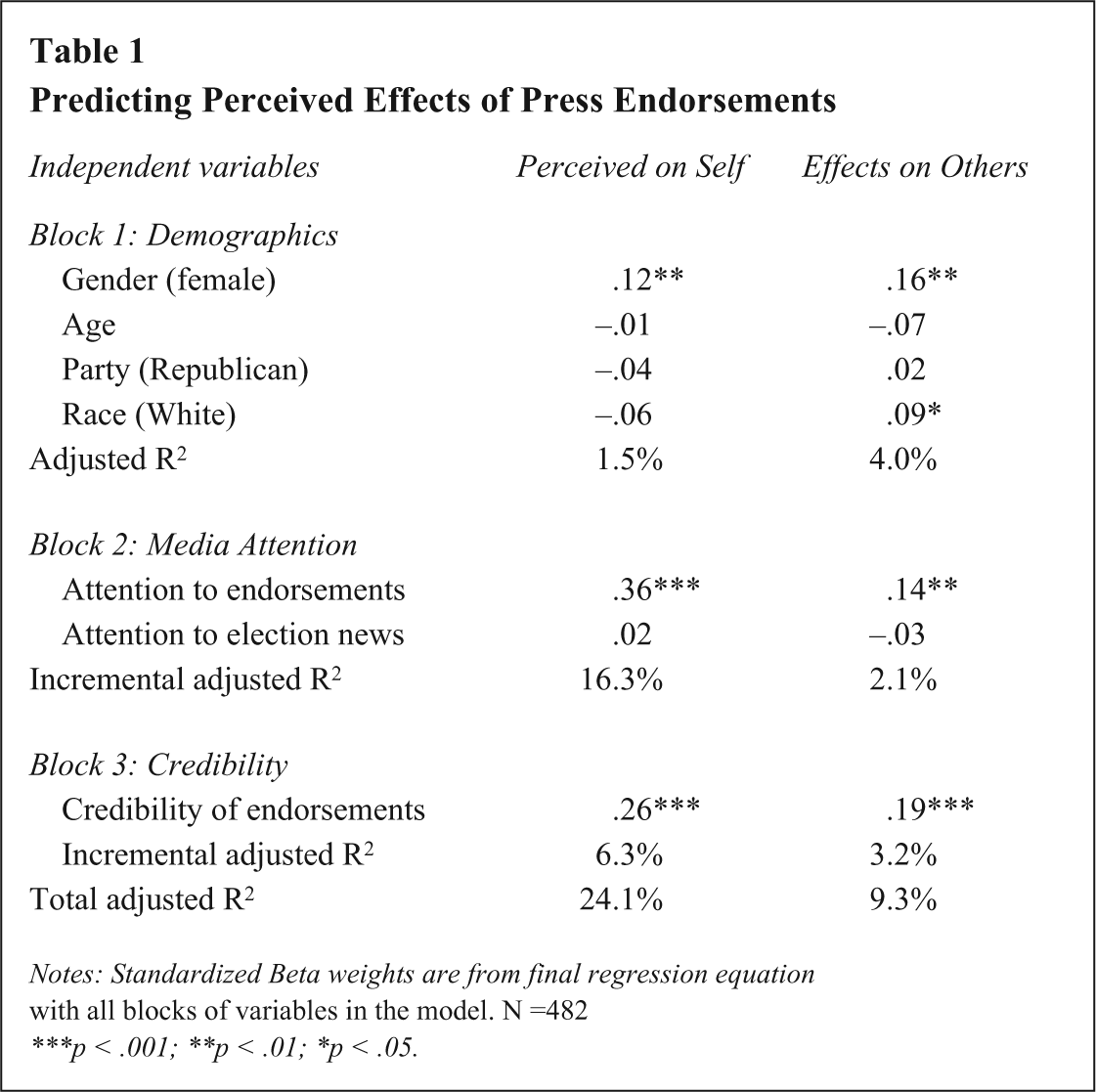
Notes: Standardized Beta weights are from final regression equation with all blocks of variables in the model. N =482
p < .001; **p < .01; *p < .05.
H2 predicted that the perceived effects of newspaper endorsements on self would be more strongly and positively related to the likelihood of boycotting newspapers that endorsed one’s opposed candidate than would perceived effects on others. Pearson’s correlation was used to test it. The results showed that perceived effects on self were correlated more strongly with the likelihood of boycotting newspapers that endorsed one’s opposed candidate (r = .31, p < .001) than were perceived effects on others among the surveyed college students (r = .03, p > .05). A z-test for two correlation coefficients showed that the difference is statistically significant (Z = 4.55, p < .001), supporting H2.
A separate hierarchical regression analysis was performed to further examine the relationships among the perceived effects on self, on others and the likelihood of boycotting newspapers that endorsed one’s opposed candidate. The first two blocks of the equation entered demographics, attention to election news and newspaper endorsements and as control variables. The third block included perceived credibility of newspaper endorsements. The final block entered perceived effects of newspaper endorsements on the self and on others. As Table 2 shows, perceived effects on self was a significant predictor of the likelihood of boycotting, (B =.14, p < .05) while perceived effects on others was not (B =-.06, p < .05). That is, the more college students believed that newspaper endorsements of presidential candidates had influenced them, the stronger their likelihood of boycotting the newspaper that endorsed the candidate they opposed. Additional tests for the difference between two regression coefficients using Cohen and Cohen’s (1983) method show that the difference between the betas of perceived effects on self and on others was significant (t = 2.60, p < .01). H2 was supported.
Predicting Likelihood of Boycotting Newspapers and Voting in Support for the Endorsed Candidate
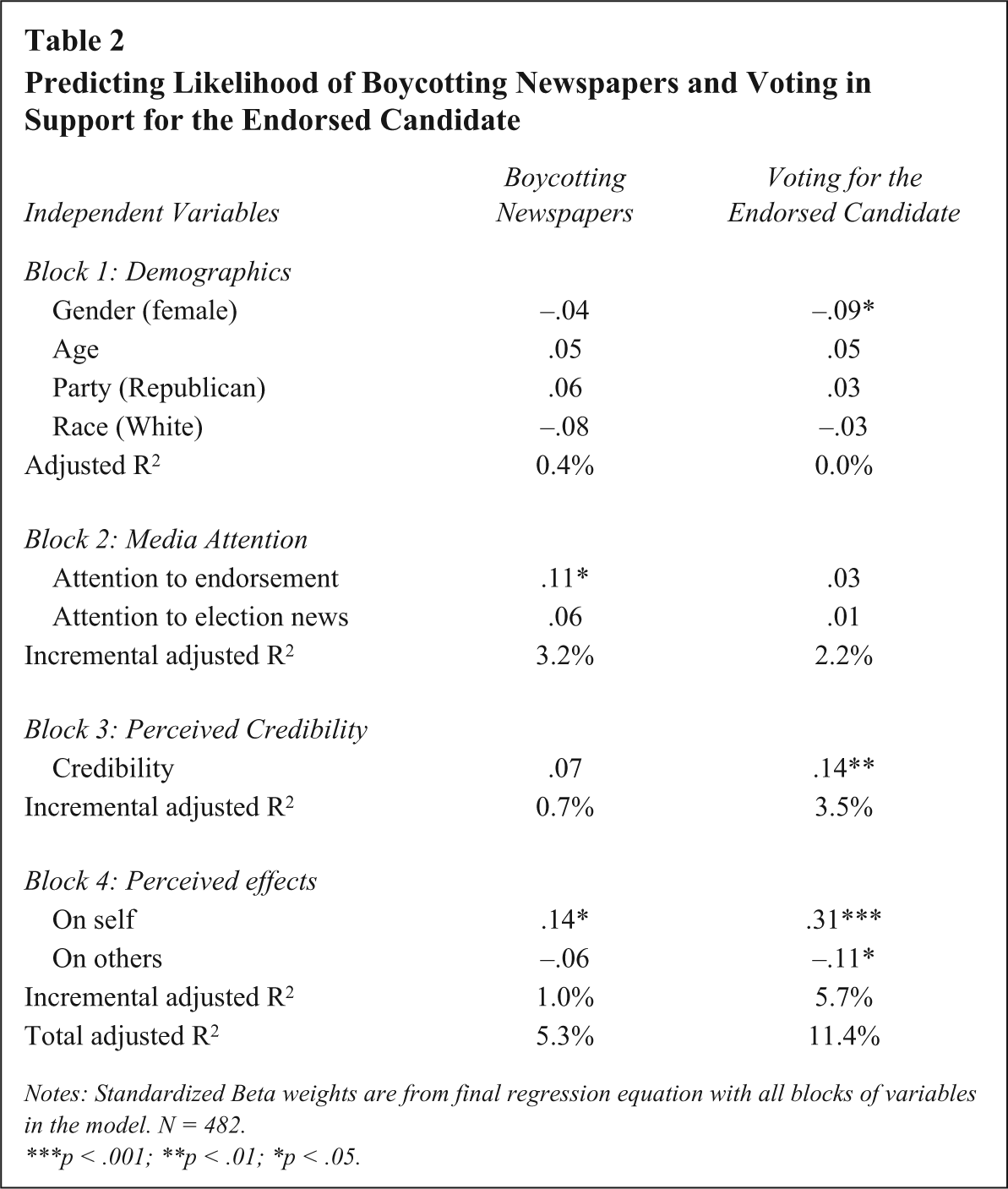
Notes: Standardized Beta weights are from final regression equation with all blocks of variables in the model. N = 482.
p < .001; **p < .01; *p < .05.
H3 predicted that the perceived effects of newspaper endorsements on self would be more strongly and positively related to the likelihood of voting in support of the candidate that received more newspaper endorsements than would the perceived effects of the endorsements on others. Results of Pearson’s correlation showed that the perceived effects on self were correlated more strongly with voting in support of an endorsed candidate (r = .19, p < .001) than were the perceived effects on others among the surveyed students (r = .02, p > .05). A z-test for two correlation coefficients showed that the difference is significant (Z = 2.62, p < .01). H3 was supported.
As shown in Table 2, results of a hierarchical regression analysis showed perceived effects on self were significantly related to likelihood of voting in support of the endorsed candidate (B =.31, p < .001), whereas perceived effects on others were a significant but negative predictor (B =-.11, p < .05). The difference between the betas of perceived effects of endorsements on self and on others was also significant (t = 5.46, p < .001), further supporting H3.
Discussion
The purpose of this study is twofold: (1) to examine the perceived effects of newspaper endorsements of candidates in the 2012 U.S. presidential election in order to shed light on the question of whether the time-honored practice of press endorsements has any impact on college students and (2) if so, how. Results of the analyses show that when the endorsements were seen as credible, the perceived effect on the self is greater than on others. It seems that newspaper endorsements are more influential among college-age voters who consider them a credible source of information about a closely contested presidential race. Endorsements by newspapers may imply widespread support for a candidate or indicate that a candidate has the winning momentum. Thus, it is desirable for the surveyed students to believe to have been influenced by the credible endorsements. Doing so may give them a sense of solidarity with the newspapers and the broad support of the electorate. Also, believing oneself to be affected by the highly credible endorsements may bolster their confidence in the candidate they support. In other words, viewing themselves to be more influenced by the endorsements may derive from student voters’ need for self-enhancement. 42
Therefore, the influence of newspaper endorsements on voters comes from the effects perceived by voters, regardless of the direct effects on them. Findings further show that the perceived effects are real because they hold some significant and positive predictive powers over college-age voters’ voting intentions. As support for H2 indicates, respondents tend to punish the press for endorsing a candidate not of their choice when they believe the endorsement affects them. In addition, the willingness to boycott newspapers might be related to respondents’ need to prevent other voters from being exposed to endorsements that support the candidate they oppose. Taken together, these findings concerning the behavioral aspects of the perceived influence of press endorsements indicate that the respondents were motivated to boycott the newspapers that endorsed the candidate they opposed, a message that they perceived as dangerous.
Furthermore, it appears that the fact that a newspaper endorses a candidate makes respondents perceive that the candidate has the momentum to win the election. Support for H3 showed that the perceived effects on the self positively predicted voting intention for a candidate who received more endorsements. The intention resembles a type of bandwagon effect in voting decision-making. In other words,some people will vote for the candidate who receives more newspaper endorsements. The perceived effects on the self motivated surveyed college students to make a choice among candidates and vote to support that candidate.
The fact that a newspaper endorses a candidate makes respondents perceive the candidate has momentum to win the election.
Social identity theory offers a plausible explanation for this sort of motivation. 43 Voting for a candidate who received more endorsements may fulfill a voter’s need to be part of a group. Findings about motivations are also consistent with the theory of reasoned action, which suggests people are motivated to take actions based on their perception of social expectations. Thus, supporting a candidate who received more newspaper endorsements is like taking socially desirable action based on social expectations. Future research can fully test this reasoned action model of voting decision-making.
As Cohen, Tsfati, and Sheafer suggested, the influence of the presumed influence model of media effects in politics contributes to the understanding of the effects of media on politics. 44 Focusing on the perceived influence of press endorsements in the 2012 presidential campaign on college students, the findings highlight the role of editorials in presidential campaigns. By endorsing a particular candidate, newspapers appear to play an important role in terms of motivating college students to solidify their voting decision or jump on the bandwagon of a candidate who is seen as widely endorsed by the press.
These findings, however, cannot be readily generalizable to general voters because of the use of a college student sample. This study is concerned only with college-age voters in examining the influence of press endorsements on voting. Furthermore, the regression model accounted for a limited amount of variance in boycotting, which suggests the model can be improved with adding variables such as political knowledge and political efficacy. The limitation of the study points a direction for future research. Finally, newspaper reading was not included in the study, making it impossible to test the impact of reading newspapers on the perceptual and behavioral effects, hence another limitation.