







Abstract
This study examines news consumption patterns of college students by asking where respondents get breaking news and where this source leads them next. The findings, based on an online survey, show the majority gets breaking news from Twitter first, but Twitter also leads users to get more information from websites of traditional news organizations, whose news reports students view as more credible than Twitter.
Keywords
Two bombs went off early afternoon on April 15, 2013, in the city of Boston, and the world got to know first about what happened through a short message written in 74 characters. A tweet from the Boston Globe read: “BREAKING: A witness reports hearing two loud booms near the Boston Marathon finish line.” 1 The terror attack and the subsequent investigation unfolded on social media, with journalists, officials and individuals sharing and monitoring information on Twitter, Facebook and Reddit. 2 In several ways and instances, such as when the Boston Police broke the news first on Twitter that the second suspect was finally arrested, 3 social media bypassed traditional media as an information platform. It used to be that traditional media platforms, particularly television, had the monopoly of breaking news. This no longer holds. More and more people are getting their news from Twitter. 4 Thus, news organizations are investing a lot of time increasing their Twitter presence. 5 But the 140-character limit on Twitter can only disseminate so much, so where does Twitter lead people next in terms of news consumption?
This study hopes to contribute to this area of research by examining the assumed social-media-to-online-news pattern of news consumption, specifically when it comes to breaking news. Furthermore, this study tests this assumption empirically in the context of an actual news event—the Boston bombing attack. This study seeks to test the assumption that social media, particularly Twitter, is displacing traditional media at least for the function of breaking news. If this displacement is true, how does it affect news consumption habits, particularly among the young demographic that uses Twitter?
Literature Review
Niche Theory
Fueled by fears from traditional media, media research has focused on the assumption that online media are displacing traditional media. This is often referred to as the displacement hypothesis. In the media ecosystem, media organizations compete for finite resources. This is the main assumption of niche theory. 6 Because no two organisms can occupy the same space, a new medium entering the ecosystem will have to compete with older media for resources. 7 The extent of competition will depend on the degree of overlap between two or more niches. Three possibilities arise when there is a high degree of overlap: resources will be increased, a competitor might be displaced, or a competitor might be excluded. 8 For example, a study found that the Internet had some negative effect on television and newspaper use. 9 A plausible reason is that the Internet was better in competing for the resource of gratification opportunities. Although gratifications refer to those that users seek and obtain from the media, gratification opportunities refer to those factors that allow gratifications to be satisfied, such as space and time. 10 The Internet, for example, offers almost the same set of gratifications as old media do; however, with Internet access, these gratifications can be met anytime and anywhere. 11 The displacement hypothesis that the niche theory offers is not new. Studies of the impact of television on children’s activities found that the coming of television reduced time spent on other activities. 12 These studies, which compared children in areas with television with those in areas that television had not yet reached, found that television watching reduced comic book reading, movie-going and radio-listening. 13 When exposed to one medium, children wanted less of the other. 14 However, numerous other studies also found support to another hypothesis—that of media saturation. 15 For example, early Internet users continued using television. 16 Online news supplemented and did not replace traditional news use, 17 and searching for specific content drove news consumption across different media. 18 A potential reason for conflicting findings in this area is the “artificial differentiation among print, broadcast and online news consumption in most of the research.” 19 An individual, for example, can now follow the news—even from the same news organization—across multiple platforms. There is also evidence that time spent on the media increased over the last few decades as more media platforms emerged. 20 Media displacement and media saturation are not necessarily contradictory hypotheses. It is plausible that while particular uses of some platforms are being displaced, remaining platforms might become more specialized in terms of use and that new platforms might also drive the use of existing ones. 21
Individuals use different media for different reasons. 22 This current study argues that an approach to understanding the displacement hypothesis that is theoretically grounded in how individuals use the media would be to focus on a specific media use that is tied to a particular, time-sensitive resource, instead of considering different media as functionally equivalent. Considering media as functionally equivalent has been a problem inherent in earlier displacement studies, which considered media use as a zero-sum game instead of a complex process where different platforms can be used for different purposes and can complement one another. In the study of news production and consumption, an important concept is that of breaking news. 23 The present study focuses on this specific media function in testing the displacement hypothesis.
Breaking News in Traditional Media
Shoemaker has argued that biological and cultural factors influence a surveillance function in consumers’ minds or a natural desire to know about the news and what is going on around us. 24 Culture affects what kinds of stories audiences pay attention to, but evolutionary factors force individuals to attend to a small amount of news. 25 Newsworthiness is one of the factors that determine news attention from audiences. It can take the form of threatening or proximal news. 26 For example, a study found that news about high proximity health threats garnered more attention and higher recognition among participants. 27
This evolutionary hypothesis is a plausible reason why breaking news is effective in getting viewers’ attention. 28 Viewers remembered more from breaking stories than from traditional ones, 29 plausibly because of people’s need for surveillance. According to an earlier study, “Breaking news triggers the innate need to survey the environment and identify possible threats.” 30 Thus, breaking news can be considered as a way to capture the attention of news consumers. This initial attention is what news organizations hope to sustain to maintain viewership.
The concept of breaking news stories has become the norm and the expectation of news organizations that are competing to break the news first. 31 Therefore, it is important to study the concept of breaking news from both the journalism production side and from the news user perspective. This norm of breaking news is informed both by the news value of timeliness and by news communication technologies. 32 For example, live reporting became prevalent in television news, although “much of it is gratuitous with no apparent journalistic justification.” 33 Journalists also now are taking advantage of Twitter to break news stories. 34
Twitter and Breaking News
Twitter use has become commonplace in journalistic practice for reporting and engaging media consumers, 35 and both news organizations and journalists have adopted Twitter. 36 Newsrooms consider Twitter as a means to disseminate news very rapidly to a large number of people who can easily access the information through the technology. 37 Twitter can also help journalists gather facts, ideas or sources on developing stories or stories where a citizen on the scene may have better information or photos than will a professional journalist. 38 Social media outlets, such as Twitter, disengage the process of gatekeeping; 39 however, the reason journalists are using Twitter to disseminate information is because there is a growing audience for short but fast bits and pieces of news.
Twitter emerged in 2006 as a short messaging system for mobile phone communication, 40 and it has evolved to become a popular social media site, where users can read and share messages in 140 characters. It has also become a growing medium for news. 41 A study found that information-sharing and news reporting are among the main reasons for Twitter use. 42 Information-seeking and conversation were also found to drive Twitter use. 43 Twitter users are information-seekers also driven to share information with others.
Traditional media are not only losing their audience but also their credibility. Over the years, the news media, in general, have been getting lower and lower trust ratings. 44 This is plausibly one of the reasons many news consumers are looking for alternative sources of information, such as Twitter. But news consumption can also be due to incidental exposure. 45 For example, a study conducted in the 1998 elections found that the more frequently people went online, the more likely they were to report news exposure. 46 This type of news consumption is not trivial because “unintentional exposure can lead to greater knowledge of current affairs.” 47 This incidental exposure to news also happens on social media sites such as Twitter, especially because social media have become popular news referral or sharing entry points to actual news sites. 48
Some 8 percent of adults in the US get their news through Twitter, 49 and those who get their news from Twitter tend to be younger and more educated than the general population. 50 A survey by the Pew Research Center found that 52 percent of Twitter users in the US get their news from the site. 51 An analysis of conversations on Twitter around news events also found that a lot of tweets came from users passing along breaking news. For example, some 39 percent of the tweets shared during the acquittal of George Zimmerman in the death of teenager Trayvon Martin shared news on the verdict—without any opinion or emotional remarks. 52 Understanding news consumption patterns on Twitter is important, considering that 45 percent of all Twitter users are between 18-29 years old, 53 a demographic that has remained elusive for traditional news media. Because this current study, which focused on the use of social media for breaking news, involves college students as participants, it is predicted that:
H1:
The majority of participants learn about breaking news from Twitter first.
RQ1:
What factors affect the likelihood that a participant would hear breaking news from Twitter first?
A survey by the Pew Research Center in 2013 found that 18 percent of Twitter users also reported getting news often from print newspapers, 17 percent also got news often from cable TV, 32 percent also got news from local TV and 24 percent also got news from the radio. 54 These results demonstrate some complementarity between Twitter and traditional news sources. It is plausible that Twitter functions as a gateway to these other traditional sources because of its popularity for breaking news. In order to examine this assumption empirically, the following research question is also asked:
RQ2:
Where does Twitter use for breaking news lead the participants next?
Learning about Bad News
The Internet has played a special role in spreading negative news. Therefore, it is likely that news sharing tendencies may increase during a time of tragedy or crisis. For example, after the Sept. 11, 2001, attacks, some 69 percent of Internet users used the Internet to get news about the investigation. 55 Sharing “bad news” has attracted scholarly attention. Bad news is defined as “a message communicating information that is previously unknown to the receiver, is anticipated to be personally relevant to the receiver and is perceived by the delivery agent to be negatively valenced by the receiver.” 56 People do not want to share bad news through interpersonal communication because of self-presentation and sensitivity to the news receiver’s emotional state. 57 This view contrasts with the traditional journalistic maxim that bad news sells. For example, sharing bad news on radio and television has received attention in the literature. 58
This contrast apparently is observed on Twitter, as well. For example, a study found that a positive message in social tweets is more likely to be re-tweeted; however, the negative messages among news tweets get re-tweeted more often. 59 This finding is supported by another study that found tweets with negative valence tend to get re-tweeted more often. 60 This makes Twitter a platform where breaking news on crises and tragedies—bad news—gets shared a lot. Thus, this current study also explores how individuals learn about breaking news on specific negative events by focusing on the Boston bombing. Therefore:
H2:
The majority of the participants first learned about the Boston bombing from Twitter.
RQ3:
Where did Twitter lead the participants next in terms of getting more information about the Boston bombing?
Method
This study is based on an online survey of 224 college students in the United States recruited from a large university in the Midwest. The students were recruited from an introductory class in journalism and were offered course credit for their participation. The university’s Institutional Review Board approved the study and the students were provided an alternative assignment if they chose not to join the study; however, no one took this option. Participation was voluntary and anonymous. The average age was about 19.8 years old (SD = 2.51). Some 70 percent were females and most of the participants were white Americans (78.9 percent).
The survey was conducted in May 2013, a month after the Boston marathon bombing. The respondents were sent an email containing a link that took them to the survey. On average, the survey took about 15 minutes to complete.
Questionnaire
The participants were first asked where they first learn about the latest news in general. They also were asked to select just one among these options: personal communication, text, print copy of a newspaper, network TV news, cable TV news, news magazines, radio newscasts, newspaper websites, TV news websites, news magazine websites, online-only news sites, blogs, Facebook, Twitter and email. If it were through none of these options, they had could write in their source. They were asked next where they usually got more information about something they heard first from whichever source they had selected and were provided with the same set of choices.
The survey was conducted five weeks after the Boston marathon attack in April 2013. The participants were asked how they first learned about the attack, and they were again provided with the same options discussed in the previous question. Next, the participants were asked if they looked for more information about the incident after learning about it from whichever source they indicated in the preceding question. If they did, they were asked where they got more information about the attack and were again provided with the same set of choices.
Twitter use was measured by a single item that asked the respondents how often they use Twitter. The respondents responded using a 7-point scale from 1 (never) to 7 (always). The respondents use Twitter quite often, (M = 5.25, SD = 1.88).
The participants also were asked to indicate an estimate of their number of followers on Twitter (M = 258, SD = 846) and the number of people they follow on Twitter (M = 224, SD = 175).
The effects of perceptions of credibility on news consumption choices also were explored, considering the decline on general trust of the media over the years. 61 The respondents were asked to rate how credible they perceive mainstream journalists to be. Five items to measure credibility were adapted from previous studies. 62 The respondents used a 7-point Likert scale from 1 (strongly disagree) to 7 (strongly agree) to rate how much they agreed that mainstream journalists are fair, are accurate, are biased (reversed), tell the whole story and can be trusted. The scale is reliable after the third item was excluded, Cronbach’s alpha = .80. The respondents agree that traditional journalists are to some extent credible (M = 4.96, SD = .89).
Next, the respondents were asked to rate how credible they perceive users who share information on Twitter in general to be. They also used the same 7-point Likert scale used for traditional journalists. The scale is reliable also after taking out the third item for consistency with the traditional media credibility scale, Cronbach’s alpha = .85. The respondents perceive those who share information on Twitter as not very credible (M = 3.40, SD = 1.12).
Findings
H1 predicted that majority of the respondents get breaking news from Twitter. A comparison of responses showed that H1 is supported. Some 52 percent of the participants reported learning about news first from Twitter. This was followed by personal communication (9.9 percent) and mobile phone alerts (9 percent). Traditional news platforms trailed behind. [See Table 1]
Breaking News Source
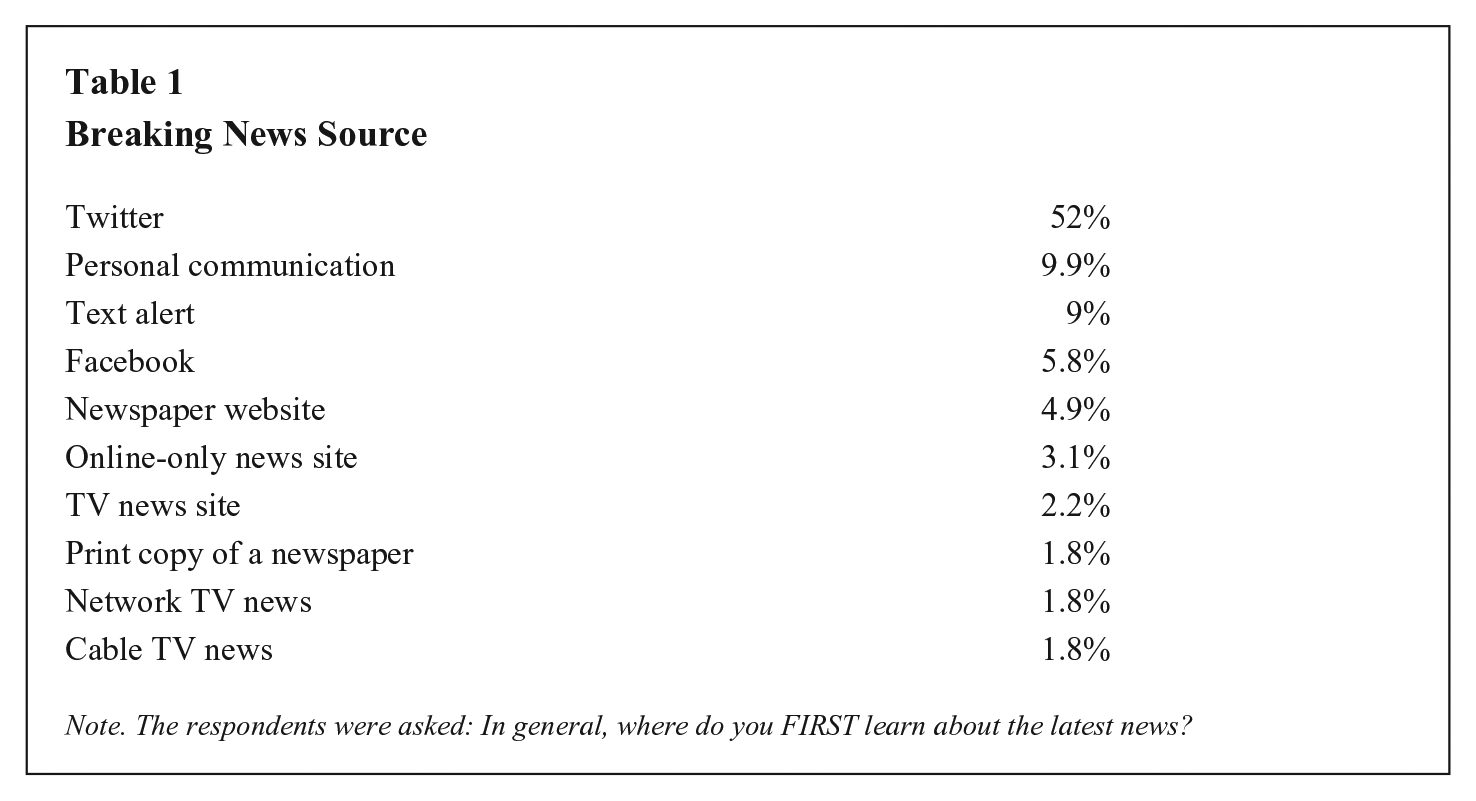
Note. The respondents were asked: In general, where do you FIRST learn about the latest news?
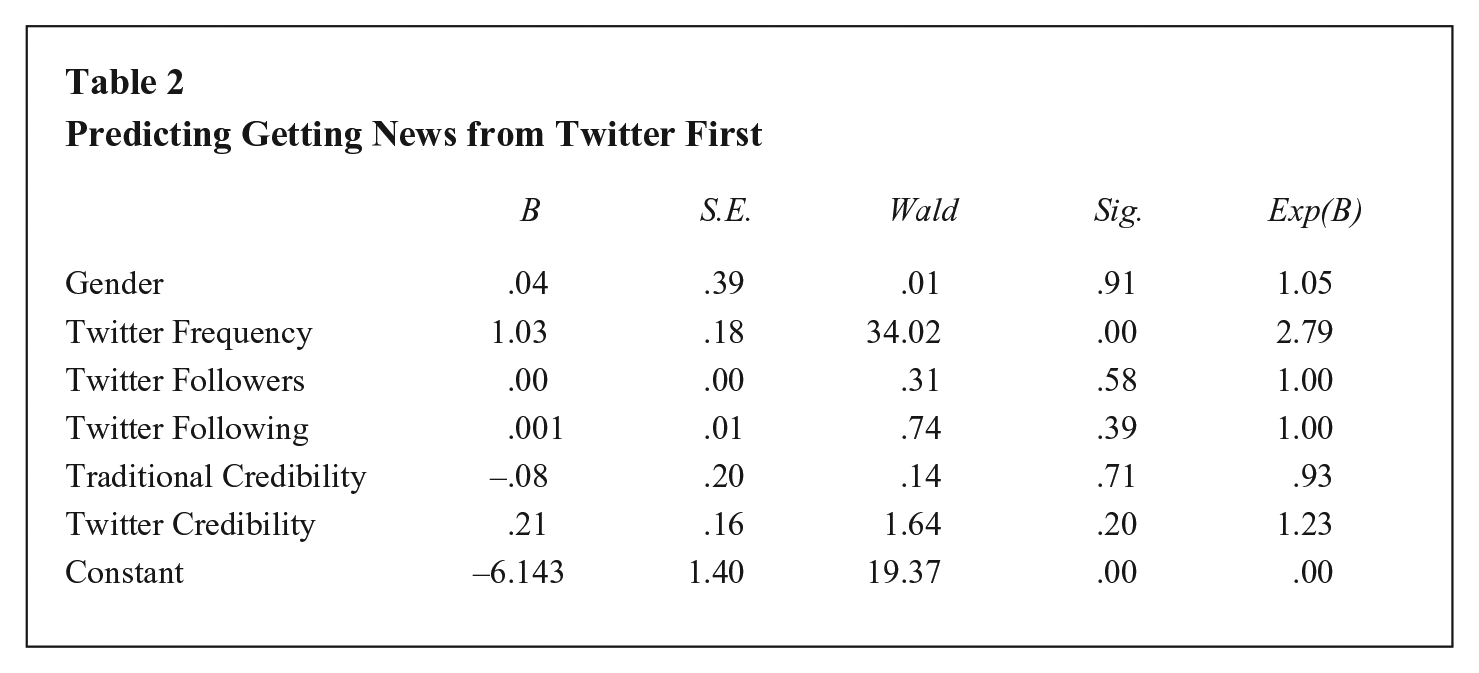
RQ1 asked about factors that affect the likelihood that respondents would get breaking news from Twitter first. A logistic regression was conducted to examine what factors predict learning news first from Twitter. Frequency of Twitter use, number of Twitter followers and number of people one follows on Twitter were entered to measure the impact of Twitter use, in general, to exposure to news on Twitter. Measures of traditional news credibility as well as Twitter credibility were also included to explore their effects. The Hosmer and Lemeshow Test for goodness of fit showed that the data fit the model well, χ2 (8) = 13.85, p > .05, accounting for between 30 percent (Cox & Snell R2) and 40 percent (Nagelkerker R2) of the variance. However, only frequency of Twitter use was a significant predictor, B = 1.03, p < .001. Still, the model was able to make correct outcome predictions at 76.6 percent. Thus, in response to RQ1, frequency of Twitter use accounts for the likelihood users would get breaking news from Twitter first. [See Table 2]
For those who hear the news from Twitter first, 41.4 percent seek more information from newspaper websites while 19.8 percent go to TV news websites and 12.1 percent go to online-only news sites.
Predicting Getting News from Twitter First
RQ2 asked where learning about news first from Twitter leads to in terms of information seeking. For those who hear the news from Twitter first, 41.4 percent seek more information from newspaper websites while 19.8 percent go to TV news websites and 12.1 percent go to online-only news sites. It appears that social media leads users to seek information within the online news ecosystem. [See Table 3]
From Twitter to…
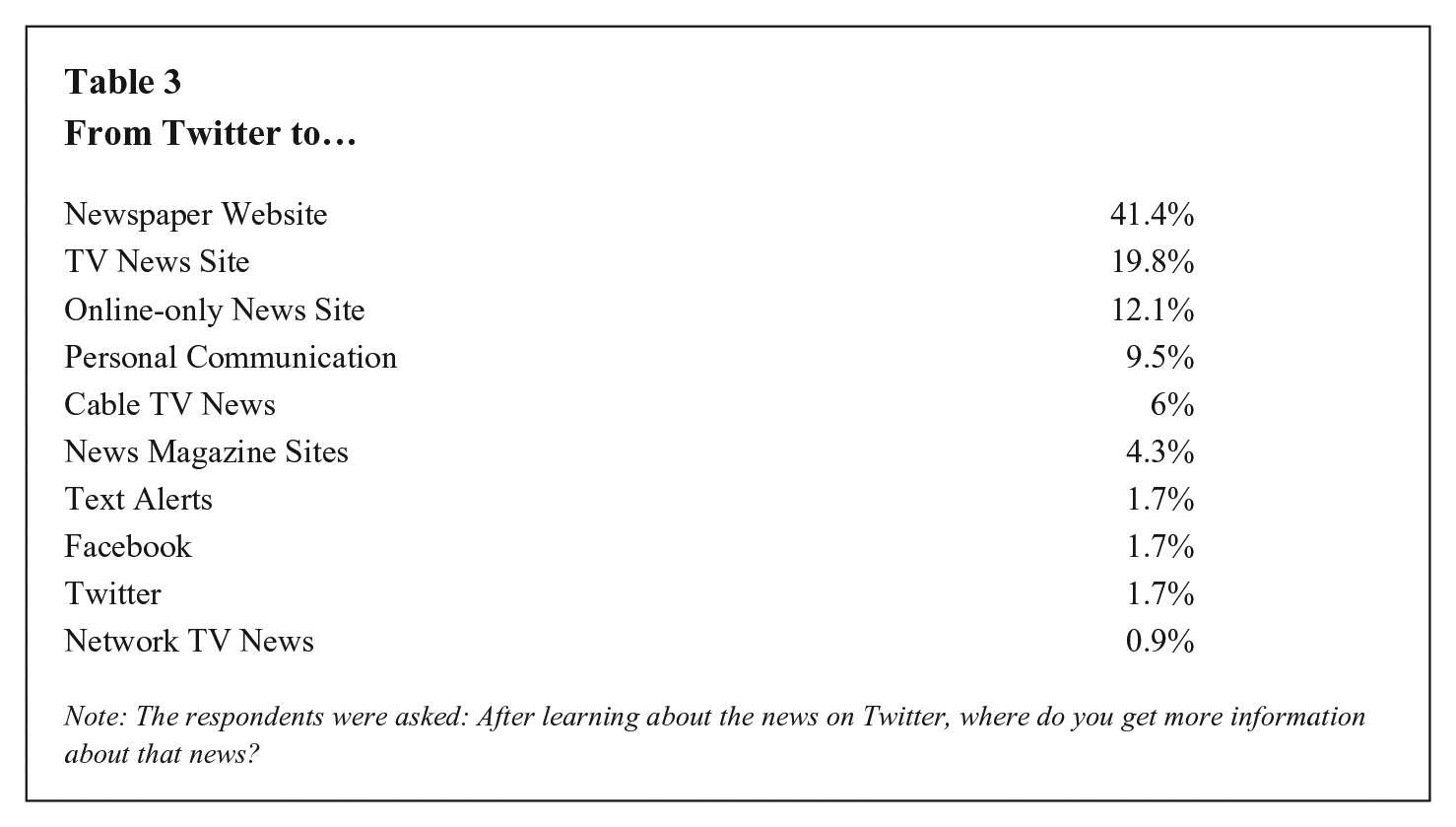
Note: The respondents were asked: After learning about the news on Twitter, where do you get more information about that news?
The literature argues, however, that bad news is responded to differently, and so this Twitter-to-online news consumption pattern was tested using a specific case—that of the Boston bombing in April 2013.
H2 predicted that the majority of respondents first learned about the Boston bombing from Twitter. H2 is not supported. The biggest percentage of the respondents first learned about the terrorist attack through Twitter (36.9 percent), but this was much smaller than the 52 percent who said they get breaking news from Twitter in general. Instead, some 22.5 percent first learned about the Boston bombing from personal communication with friends and family while 10.8 percent learned it from a mobile phone alert subscription. [See Table 4]
Learning about the Boston Bombing
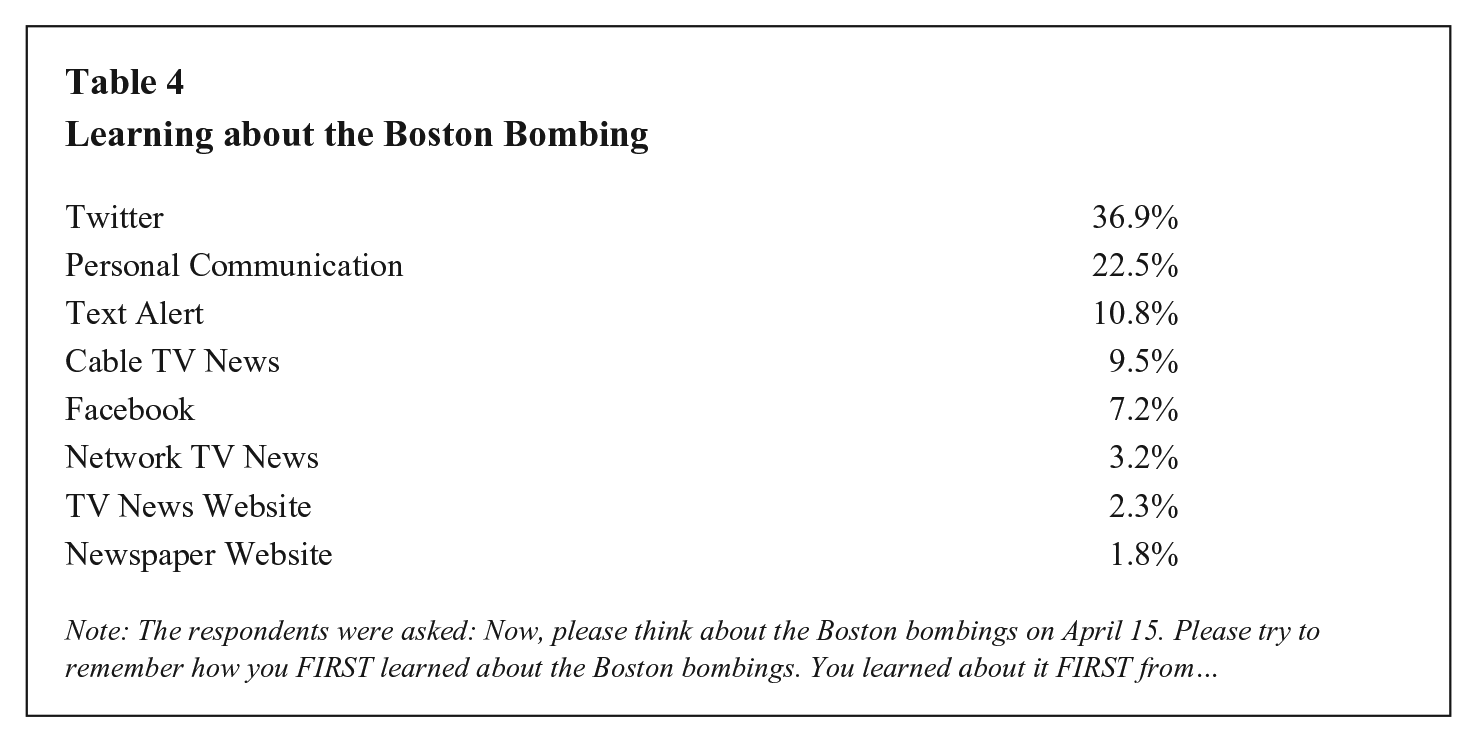
Note: The respondents were asked: Now, please think about the Boston bombings on April 15. Please try to remember how you FIRST learned about the Boston bombings. You learned about it FIRST from…
RQ3 asked where Twitter led users next in terms of getting more information about the Boston terror attack. Of those who first heard about the attack through Twitter (n = 82), some 22 percent turned to TV news websites for more information while another 22 percent turned to newspaper websites. Some 17 percent turned to cable television news while 13 percent turned to network television news. This led to the examination of where personal communication led to next in terms of news consumption among those who heard about the attack first through friends or family (n = 50). Some 26 percent got more information from personal communication. Nearly half went to social media. Of those who used social media,10 percent got more information from Facebook while 38 percent took to Twitter after learning about the Boston attack from friends or family. [See Table 5]
Where Next…
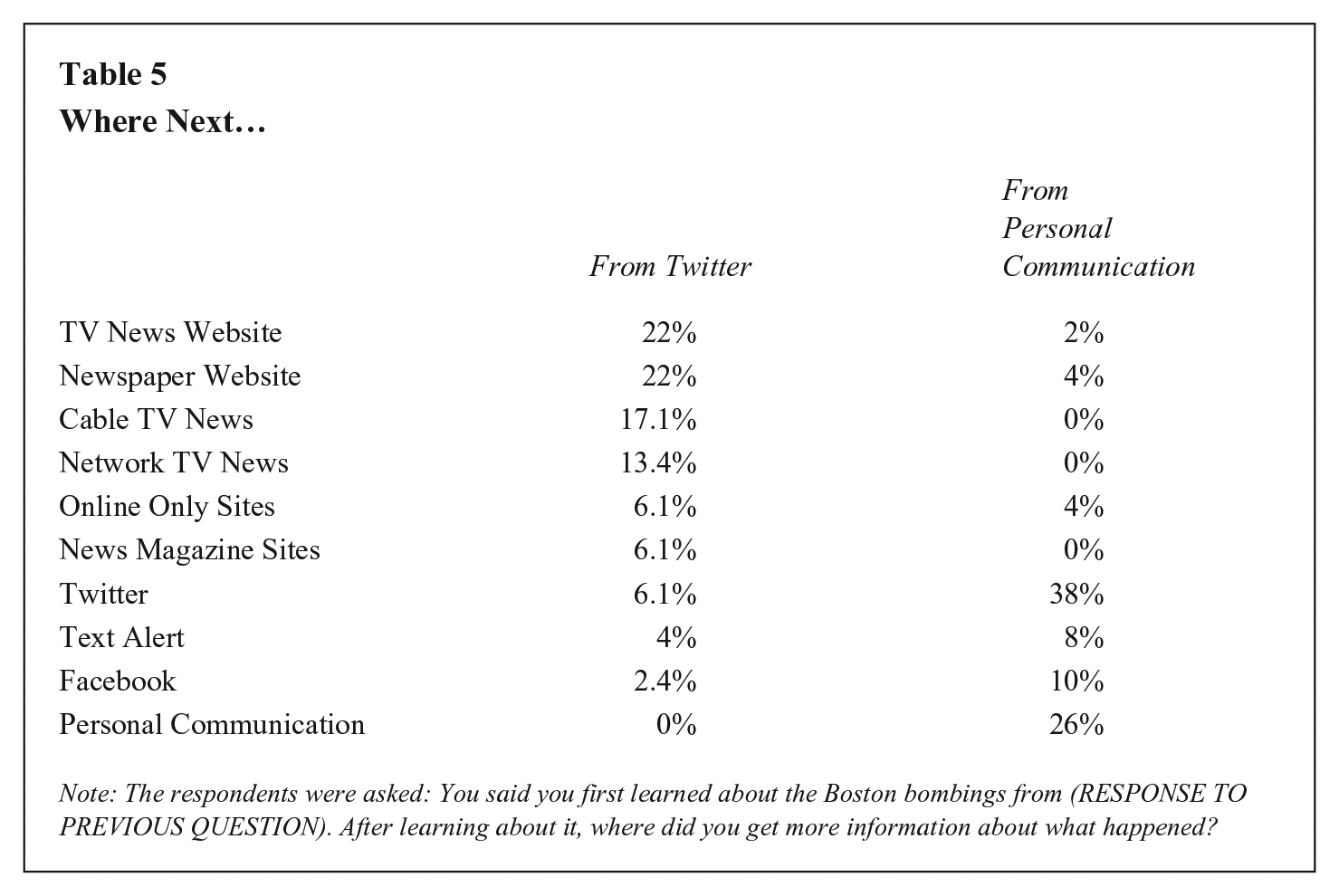
Note: The respondents were asked: You said you first learned about the Boston bombings from (RESPONSE TO PREVIOUS QUESTION). After learning about it, where did you get more information about what happened?
Discussion and Conclusion
This study sought to determine the news consumption patterns of a group of college students by asking where respondents get breaking news and where this source leads them next. Guided by the displacement hypothesis, it was predicted that social media, particularly Twitter, was displacing traditional news media at least for the gratification of learning about the news first. The findings in this study supported this general assumption. In general, more than half of the respondents learn about breaking news first from Twitter.
The only significant predictor of learning news first from Twitter instead of any other source is frequency of Twitter use. The effects of personal motivations, such as social connections measured by number of followers and followed, as well as personal perceptions of traditional media and social media credibility were examined. However, these were not significant predictors. This finding seems to point to incidental exposure. 63 Users who use Twitter frequently get exposed to news first on the same medium. They get exposed to news not because they were motivated to access news to begin with, but because they happen to be in that communication space. Incidental news exposure is consistent with niche theory’s reference to gratification opportunities as an important resource that media organizations compete for. 64 Because heavy users of Twitter are in that space for other reasons, the gratification opportunity to gratify their need for information or breaking news is present.
In large part, this study found a social-media-to-online-news-media consumption pattern, specifically originating from Twitter, when it comes to news consumption that is triggered by breaking news. However, the study also found that this might not always hold, especially when it comes to particular types of stories, such as the Boston terror attack. While Twitter was still a significant source for the largest group of people, interpersonal communication came in next. This is consistent with the literature on negative stories, or what people generally refer to as bad news. Although negative news tends to be re-tweeted more than positive news, 65 it is plausible that other processes are at work here. News about threats travels fast because of the evolutionary need to monitor for threats constantl, 66 as well as because of people’s concern for others. It is possible that the first few people who learned about the attack had to share it with people around them. Thus, usual news consumption patterns might not hold for an unusual news story. A plausible alternative explanation is response bias. It is plausible that some respondents easily remembered the vivid images disseminated from the Boston bombing and associated that memory with media platforms other than Twitter, such as television. Thus, while the respondents reported to getting breaking news first from Twitter in general, they remembered other traditional sources when specifically asked about where they first learned about the Boston terror attack.
Yet, what was interesting in the findings for the Boston bombing news is that Twitter still showed itself as a significant news source for the college demographic involved in this exploratory study. Nearly half of those who heard the news first from either friends or family took to Twitter (38 percent) or Facebook (10 percent) to get more information. A plausible reason is that social media sites, accessible across platforms—laptop, tablet, smart phone—have a monopoly of gratification opportunities for mass communication for both ease of access and ease of use, as well as for sheer habit among users.
The context of the nature of the news story can also explain where Twitter led users next. In general, Twitter leads users to consume more news from online news sites. However, in the case of the Boston attack, Twitter use also led some users to television as a platform. Again, this might be because of the nature of the incident—a news story with multiple visual elements—and for some groups of people, including the visually oriented, television is a medium that can best fulfill the need for visual orientation. In contrast, learning about the attack from personal communication apparently led to more interpersonal communication and social media use. [See Table 5] This finding may be because of interpersonal discussion involved in this conduit. In other words, learning about the attack from a friend provokes more discussion with others, either online or offline, which also leads to more incidental exposure to more information.
The findings of this study have important practical implications, particularly for news organizations trying to follow where news consumers go. The findings lend support to earlier studies that show young news consumers tend to attend to news on social media but also that much of news consumption on Twitter is incidental. 67 The findings justify efforts of news organizations to increase their Twitter presence. As journalists and news organizations were able to boost their number of followers in the event of the bombing, it is clear that taking advantage of using Twitter as a way to break news is beneficial. This can increase website traffic and improve the popularity of particular journalists.
However, incidental exposure to information on Twitter also has ramifications for those who depend on Twitter for information. Twitter is a platform vulnerable to misinformation, and credibility ratings by the participants in this study show that users are aware of this weakness. News consumption on Twitter might be incidental, but even incidental news consumption exerts cognitive effects. 68 In that case, how does incidental exposure to misinformation affect Twitter users?
This study is not without limitations. First, surveys rely on self-reports and the results are at the mercy of the respondents’ capacity to remember personal behavior accurately and their willingness to divulge such information. Thus, aside from asking about news consumption patterns in general, the questionnaire also asked about a specific and familiar event, which might aid in a more concrete recollection of their specific actions. Second, the study focused on a group of college students recruited from a class. While they are an important demographic for the examination of Twitter use, other groups of people might be engaging in a different news consumption pattern altogether. The results are therefore not generalizable beyond those who participated in this exploratory study. However, they also offer important and interesting insights in terms of the relationships between particular media uses. Specifically, the results provide empirical support to the assumed social-media-to-online-news consumption pattern. The results help demonstrate how Twitter is displacing traditional news sources for breaking news in this group of college students, and they also show how Twitter is leading the participants to other online sources to get more information. Thus, Twitter also is playing a complementary role. While this study shows a displacement of traditional news sources by Twitter in terms of breaking news, it also shows a general pattern of complementarity in terms of Twitter leading the participants to other online news sources, consistent with what other studies have found. 69
The findings of this exploratory study offer a springboard for future work to understand the complex news consumption patterns among different types of users. Future studies should test this study’s conclusions on a representative sample that would encompass different demographics of news consumers. In the meantime, it is hoped that the study’s findings can contribute to the understanding of how people learn about breaking news. In addition, one hopes the findings also show how media displacement is unfolding with respect to the gratification opportunity of breaking news stories and, finally, how media complementarity appears to be at work with Twitter use that leads to news consumption from other platforms.