







Abstract
This study explored how the different media in Nigeria report banditry currently ravaging some parts of the country. We sampled two newspapers and two television stations to articulate the study. The result showed, among others, that both TV and newspapers did not adequately set the agenda on the problem of banditry in Nigeria. Comparatively, newspapers did better than TV stations. We discussed these findings in the light of agenda-setting and made suggestions for further studies.
Introduction
Nigeria is currently battling different security challenges that have posed a serious threat to lives and property. Examples of security threats facing Nigeria include Boko Haram insurgency, farmer-herder conflicts, secession agitation in South-East and South-West Nigeria, Niger Delta militancy in South-South and banditry. Researchers (Ademola, 2021; Ejirefe, 2021; Ekene, 2015; Kwaghtser, 2019; Obi-Ani & Obi-Ani, 2019; Ogbonne, 2019; Onyebuchi et al., 2019) note that Nigeria, like many other countries of the world, is going through pockets of crises and attacks in its territory.
Armed bandits are incessantly making lives unbearable for residents in the Northern parts of Nigeria. However, security problems posed by these groups have attracted the attention of many concerned citizens, including the international community. Life in some parts of Northern Nigeria is no longer sacred, and the overall effect will inevitably last for very long (“Anger Spreads as UN Says,” 2020; Epron, 2018; Nkwede et al., 2015, 2015). The Northern part of Nigeria, especially in Zamfara, Sokoto, Katsina, Kaduna, North-Central and Kebbi States, has witnessed an increase in the activities of Bandits. They have launched attacks on innocent citizens and destroyed many properties.
During challenging times like this, the media must ensure that information is available to the general public. For example, researchers (Adisa et al., 2015; Gever, 2018) agree that in times of emergency, such as the current banditry activities in parts of Northern Nigeria, the role of the media in information dissemination is essential. The mass media, such as newspapers and television, ensure that people get accurate and up-to-date information on banditry activities in Nigeria. But the question is whether the media is giving adequate coverage of banditry activities in Nigeria to enable people to know what is happening and be security conscious. According to Olomojobi and Ajilore (2018), the surveillance function of the mass media is greatly needed in times of security challenges to come up with ways of addressing it, especially from a press system that will allow it.
The selection of what becomes reported as news by the mass media concerning issues related to conflict can influence public perception and opinion on such matters. Issues raised about the conflict through media reports can influence the outcome of the conflict situation (Olomojobi & Ajilore, 2018; Abdulbaqi & Ariemu, 2017). In the words of Gilboa (2009), the mass media’s coverage of conflict, in one way or the other, directly affects people who are engaged in conflict and conflict resolution. Scholars (Gever & Coleman, 2019; Isu, 2019; Ogenyi, 2019; Ottah & Gever, 2020) who have examined media coverage pay attention to indices such as frequency of coverage, volume of coverage and the solution suggested in the media. These indices have been found helpful in providing insights into how the media report events. This study used the frequency of coverage, the volume of stories and the highlighting of solutions related to banditry in Nigeria. We also paid attention to the issues highlighted in media reports vis-à-vis banditry in Nigeria. A crucial consideration in the study is that we compared both newspapers and television to determine how they differ or are similar in their reports of bandit activities in Nigeria. Also, the rationale for this comparative study is to ascertain which media outlets carry out their agenda-setting role as it concerns banditry in Nigeria. Therefore, based on the background above, the researchers examined newspaper and TV coverage of banditry in Nigeria.
Objectives of the Study
The general objective of this study was to investigate the extent of agenda-setting in news media vis-à-vis the issue of banditry in Nigeria. The researchers paid attention to indices like the frequency of coverage, the volume of coverage and the story type of media coverage of banditry in Nigeria. Others are media coverage vis-à-vis solutions related to banditry in Nigeria.
The Dual Agenda-Setting Role of Media
Agenda-setting is one of the fundamental ways the mass media of communication influences events in society. Agenda-setting asserts that mass media shape people’s social reality by selecting and publicizing specific issues. In addition to general information, audiences also “learn how much importance to attach to [an] issue from the amount of information in a news story and its position” (McCombs & Shaw, 1972, p. 176). For example, Bulkow et al. (2013) carried out a study to examine the duality of the media agenda-setting role. The researchers conducted two different experiments and reported that the duality of agenda-setting processes is a product of different types of information processing. Finally, Bulkow et al. note that the duality of media agenda-setting can take place on a conscious level or an automatic one depending on the nature of the information processing level of those involved.
Vliegenthart et al. (2016) carried out a study wherein they examined the dual effect of media agenda-setting. The researchers focused on six Western European countries and integrated several data sets on protest, media and political agendas. The researchers found that the more media attention focused on demonstration, the more parliamentary questions on that issue are asked.
McCombs and Stroud (2014) carried out a comprehensive literature review focusing on how and why agenda-setting takes place and suggested that a dual-path model can be used to explain the agenda-setting process. According to McCombs and Stroud, the dual-path model includes both casual and deliberative paths. According to McCombs and Stroud, a casual path means that agenda-setting effects occur with less effortful media use as a consequence of cognitive accessibility due to the salience of media coverage, like headlines. A deliberative path entails that the impact of agenda-setting is due to effective media use, like heavy reading.
Lee (2019) conducted a study wherein he examined whether and when a dual-path agenda-setting model occurs by introducing motivated goals that guide individuals to attend to particular types of news. The researchers made use of experimental design to achieve the study goal. The study showed that a deliberative path—that is, reading more articles—was likely to result in higher agenda-setting effects and equally resulted in even more significant agenda-setting effects for individuals with accuracy goals than individuals with directional goals. The additional result showed that a casual path had greater agenda-setting effects for individuals with directional goals than those with accuracy goals. Although the studies reviewed above-offered information regarding the duality of media agenda-setting, they mainly were conducted with little or no attention to banditry. In addition, most of these studies were carried out in developed countries, hence the need for the current study.
A Look at Banditry in Nigeria
Nigeria is in great distress, the evidence of which is how armed violence and criminality in various parts of the country have continued to occur, especially in the northern region (Okoli & Ugwu, 2019). As Northern Nigeria continues to grapple with the Boko Haram insurgency for over a decade now, there is an upsurge of armed banditry majorly in the same Northern Nigeria. According to Okoli and Okpaleke (2014), armed robbery and similar violent crimes, such as kidnapping, cattle rustling and village or market raids, are referred to as banditry. It entails using force, or the threat of force, to threaten an individual or a group of people to rob, rape, or murder them. Ojo (2020) states that banditry is generally considered an organized crime with an often economic focus.
In the Northern region of Nigeria, armed banditry has become a significant challenge. Since 2011, precisely after the general election, the banditry scourge has been consistently increasing, resulting in violent conflict between the Fulanis and their allies from within and outside the country with farmers and even residents of communities (Nadama, 2019; Olayoku, 2014). Researchers (Ikechukwu-Ilomuanya et al., 2022; Obodo et al., 2022; Ugwulor-Onyinyechi Tunca et al., 2021) agree that banditry has continued to pose a severe security threat to the Nigeria nation, with particular reference to Northern Nigeria.
Nigerian Press System
The plurality of ownership defines the Nigerian press system (Kur & Nyekwere, 2015). Most private owners are either southern and/or Christian businessmen or politicians. Oso (2013) notes that despite the plurality of ownership, these two features limit the media’s ability to diverse inclusion and act as a proper public sphere for the country. The Nigerian press system focuses mainly on the elites and pays little attention to the commoner in the society. In as much as a democratic system is in place to enable liberalization of the press compared to the one obtainable from the developed world, the government, in one way or the other, still controls the media through unnecessary regulations with a claim is for the national interest.
There is a relationship between media coverage of banditry and public opinion and government policy. This is because how the media report banditry issues could influence public opinion while also propelling government policies and programs to address the issue. According to Gever et al. (2018), media coverage of security issues plays a considerable role in determining people’s opinions regarding the matter. Within this context, it can be said that the media in Nigeria possesses the agenda-setting ability to shape public views regarding banditry in Nigeria. Soroka and Wlezien (2019) and Berry et al. (2012) note that the media play an essential role in driving the government’s public policies.
Theoretical Framework
To articulate this study, the researchers used framing and agenda-setting theories. Goffman first proposed framing theory in 1974. The framing theory posits that the volume of coverage devoted to a specific issue is not as essential as the media’s frame in reporting it (Druckman, 2001; Gever, 2015; McCombs, 1993; According to Goffman (1974), people perceive what is going on around them based on their primary framework. According to McQuail (2005), the frame helps explain why content in the news is shaped and put in context by journalists. Whatever journalists package as reports are predicated on their frame about that issue. Entman (1993, p. 52) observes that to frame is to “Promote a particular problem definition and/or treatment recommendation.” Given relevance to any aspect of an issue by the media will possibly influence how it is seen and discussed in the public domain. The way news is framed in the media has a significant effect on how people view and think about it (Chong & Druckman, 2007).
This theory is relevant to this study because it offers the framework for understanding the power of the media in highlighting certain aspects of the crisis. For example, through the power of framing, the media can promote a particular problem definition related to the bandit issue in Nigeria.
Agenda-setting theory became a full-fledged media theory due to the study of McCombs and Shaw in 1972. The researchers carried out a study and examined 100 voters at Chapel Hill. They aimed to ascertain the relationship between media agenda-setting and the voting behavior of undecided voters. Their results showed that issue agendas were significantly dependent on media content. Based on the study results, the researchers concluded that when news editors select and display information, they contribute to shaping public views about issues. Gever (2015) conducted a study wherein he tested the agenda-setting theory among a sample of 400 youths and found that the media play essential roles in influencing the public agenda. Within the context of this study, it can be argued that the press in Nigeria can potentially shape the public agenda related to banditry. How the media report issues related to banditry is capable of shaping public views and influencing public policy on the subject. The press in Nigeria can set the agenda on policy and legal issues related to banditry in Nigeria. It can, therefore, be argued that media agenda-setting on issues is worth comparing based on different media. The argument advanced in this study is that agenda-setting related to banditry may differ according to media genres. This theory is significant to the research objectives because it helps understand the role media play in setting the agenda of discourse, especially as it concerns banditry. Consequently, based on the agenda-setting theory, the following hypotheses have been articulated: however, the principal hypothesis is that the media will significantly differ in their coverage of banditry in Nigeria. The sub-hypotheses are as follows:
Methodology
The research design that was used in this study was content analysis. The choice of content analysis was because this study aimed to examine existing media content related to banditry in Nigeria. Content analysis is usually the most suitable design if a researcher seeks to evaluate media content about an issue. The sample size for the study was made up of two newspapers and two TV stations. The two TV stations were Channels Television and the Nigerian Television Authority. While the first TV is of private ownership, the latter is owned by the Federal Government of Nigeria. Channels TV is well known for upholding the highest ideals in reporting news with objectivity and fairness and satisfying the right of the individual to be informed. It has a wide reach in almost the whole states in Nigeria and is a top private brand in the broadcast media industry in Nigeria. Because of its commitment to professionalism in the media landscape, Channels TV has earned a remarkable reputation across the country. Channels Television holds the record of the best television of the year for more than a decade by the Nigerian Media Merit Award (Gever et al., 2018). Nigerian Television Authority (NTA) is the largest TV network in Nigeria; its vital function is to provide independent and impartial television broadcasting for general reception in the interest of Nigeria. NTA is also charged with the social responsibility of public interest broadcasting. Unlike Channels TV, a private TV station, NTA is a public TV station that promotes peace and unity in Nigeria through its broadcasting (Gever et al., 2018). The two newspapers which the researchers examined were Nation and Punch.
The Punch is a Nigerian national daily founded by two friends, James Abiodun and Sam Amuka. The newspaper was apolitical and sustained itself by delving into broad issues that interested a myriad of people. However, during the twilight of the second republic, political exigencies introduced conflict to its original intentions. Abiodun and Amuka parted ways due partly to political strife, and the paper began to take a political stance against the Shagari government. The Punch was registered on August 8, 1970, under the Company Act of 1968 to publish newspapers, magazines and other periodicals of public interest. It was designed to perform the tripartite function of the popular mass media and inform, educate and entertain Nigeria and the world. The Punch offers the best quality color newspaper daily and prides itself on being the most circulating newspaper in Nigeria (Obayi et al., 2019). The Nation is one of the national newspapers with a robust presence in all the geo-political zones in Nigeria, the highest-circulating newspaper in most parts of Nigeria. The newspaper became the first of its kind to gain nationwide circulation across the 36 states of Nigeria within two years of operation (The Nation, n.d.). This resulted from its popular eight-page pull-out, its headquarter is in Lagos.
The reason for using both newspaper and TV was to compare the extent of coverage given to banditry in Nigeria by these media outlets. Both newspapers are privately owned because the government owns no national dailies in Nigeria, and these newspapers are widely circulated across Nigeria. The time frame for this study was January 1, 2018, to November 30, 2021. We decided to use this time frame because it marked when banditry was at its peak in Nigeria.
Story Selection Strategy
We made use of the motif sampling approach to select the stories that were examined in this study. According to Gever (2018), motif sampling strategy is the utilization of keywords to get data from the websites of media outfits. Consequently, the researchers used keywords such as “bandits,” ‘bandits, “attacks,” ‘banditry abductions’ on the individual websites of the media examined. After the search, a purposive sampling technique was used to sample and select only stories related to the subject matter within the study duration.
Measures Used
The researchers made use of the following measures in the study to achieve the objectives of the study:
1. Solutions: Stories were regarded as solutions if they made recommendations on addressing the problem of banditry in Nigeria.
2. Attack stories: Stories were regarded as an attack if they focused on attacks carried out by bandits.
3. Abduction: Stories were regarded as abductions if they paid greater attention to kidnap carried out by bandits.
4. Ransom: These stories paid greater attention to the payment of ransom related to bandits.
The unit of analysis for the study was the article. Articles from newspapers and TV stories on banditry were used in the study. The code sheet served as the instrument for data collection. A total of three experts examined the code sheet based on the study’s objectives and validated it. The inter-coder reliability was ascertained by evaluating 25 percent of the stories. This was achieved by randomly selecting two coders to carry out the inter-coder reliability. The researchers used Krippendorff’s Alpha (KALPHA) to assess the inter-coder reliability with the application of the SPSS 22 version. After the analysis, we arrived at inter-coder reliability of .90 for story frequency, .76 for story type, .74 for a story theme and .77 for volume. The implication is that the instrument was reliable. We used descriptive and inferential statistics to analyze the data for the study. Since it is a comparative study, it was appropriate to use descriptive and inferential statistics to analyze the data because it helps to suggest explanations for situations or phenomena and allows you to conclude. Finally, we tested the hypotheses using the z-test. Typically, the z-test compares the mean difference of two groups where the sample size is more than 30. Therefore, the z-test was found helpful because it is an appropriate statistical tool for examining the mean differences between two groups with more than 30 samples. Finally, the results of the study were presented in tables and charts.
Results
We evaluated the media selected for the study and generated a total of 647 stories that were related to attacks in Nigeria. We further examined these stories, and 301 stories representing 47 percent related to banditry. The result of the hypotheses testing are presented below:
The goal of plotting Figure 1 was to determine the frequency of the coverage of banditry in the four media examined. The study result showed that newspapers had a higher score than television. Further analysis revealed that the calculated z-value (3.5) is more than the critical z-value (1.96) at three degrees of freedom (df) and 0.05 confidence level. Therefore, the first assumption was supported, and the researchers concluded that newspapers and TV significantly differed in their mean scores on the frequency of the coverage of banditry in Nigeria.
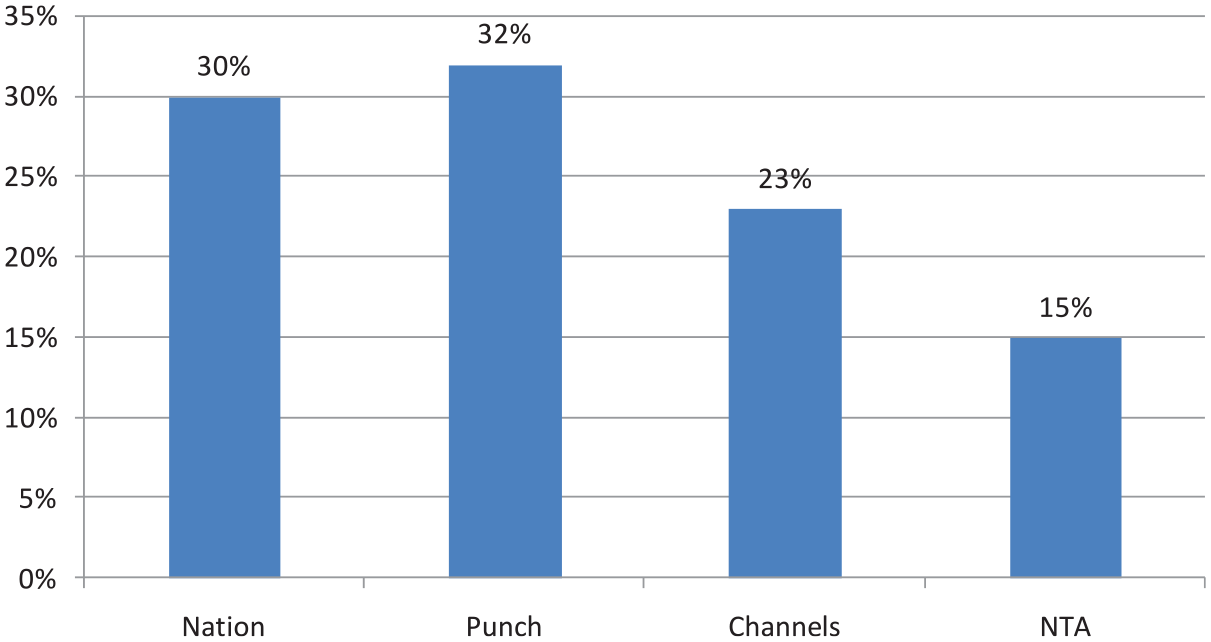
Frequency of Coverage of Banditry Across the Media
As presented in Figure 2, the result of the study sought to determine the volume of coverage of banditry across the media examined. The result of the study showed that newspapers devoted more space to the coverage of the issue than television. Further result revealed that the calculated z-value (3.3) is more than the critical z-value (1.96) at four degrees of freedom (df) and 0.05 confidence level. Based on this outcome, the second hypothesis was supported, and we concluded that the media investigated differed in their volume of stories on banditry. In particular, TV had shorter news stories while newspapers had medium length articles. In addition, newspapers had longer stories than TV.
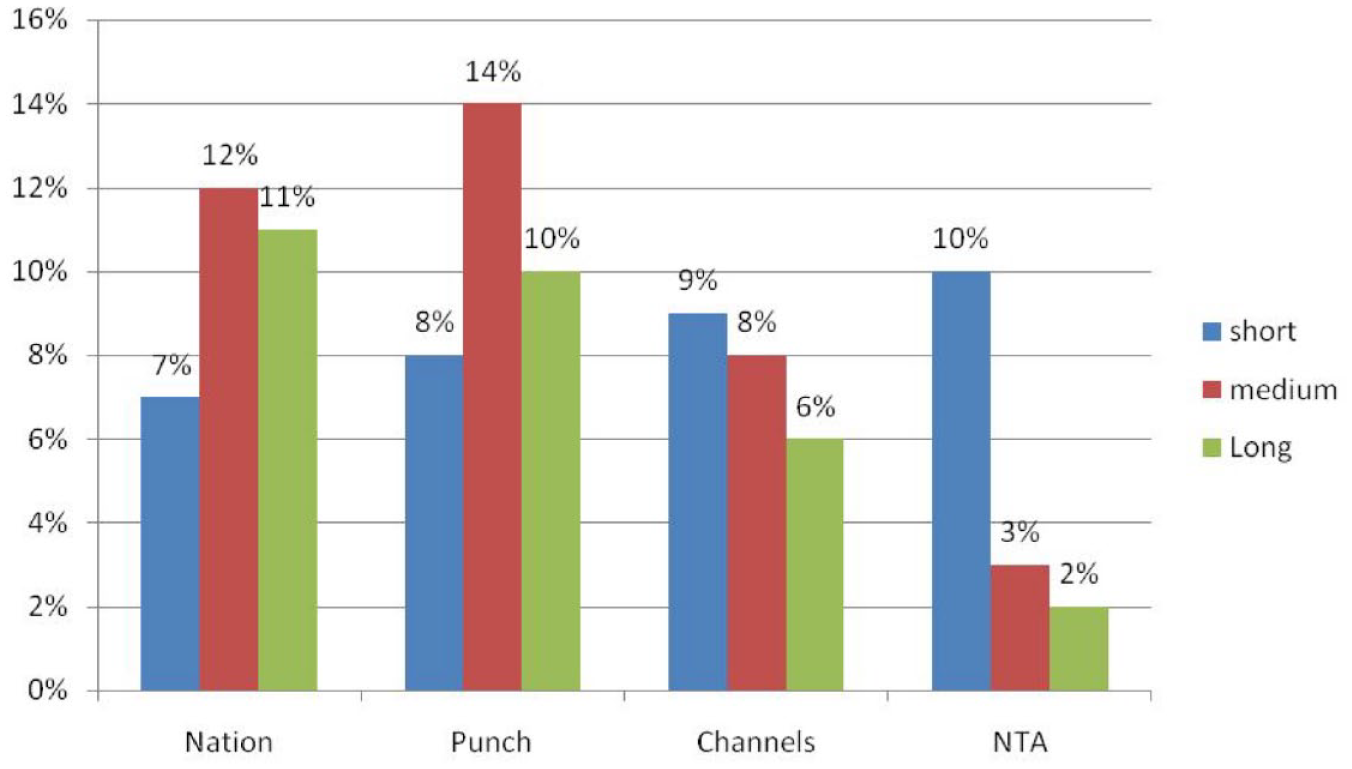
Volume of Coverage
As presented in Figure 3, the result of the study sought to determine the story type in media coverage of banditry in Nigeria. It was found that newspapers utilized mainly feature stories while TV stations used straight news format. Further results showed that the calculated z-value (3.8) is more than the critical z-value (1.96) at five degrees of freedom (df) and 0.05 confidence level. Therefore, the third hypothesis was supported, and we concluded that the media investigated differed in the story type used in reporting banditry. Finally, we found that while TV used mainly straight news, newspapers had more variety in story type in their coverage of the issue examined.
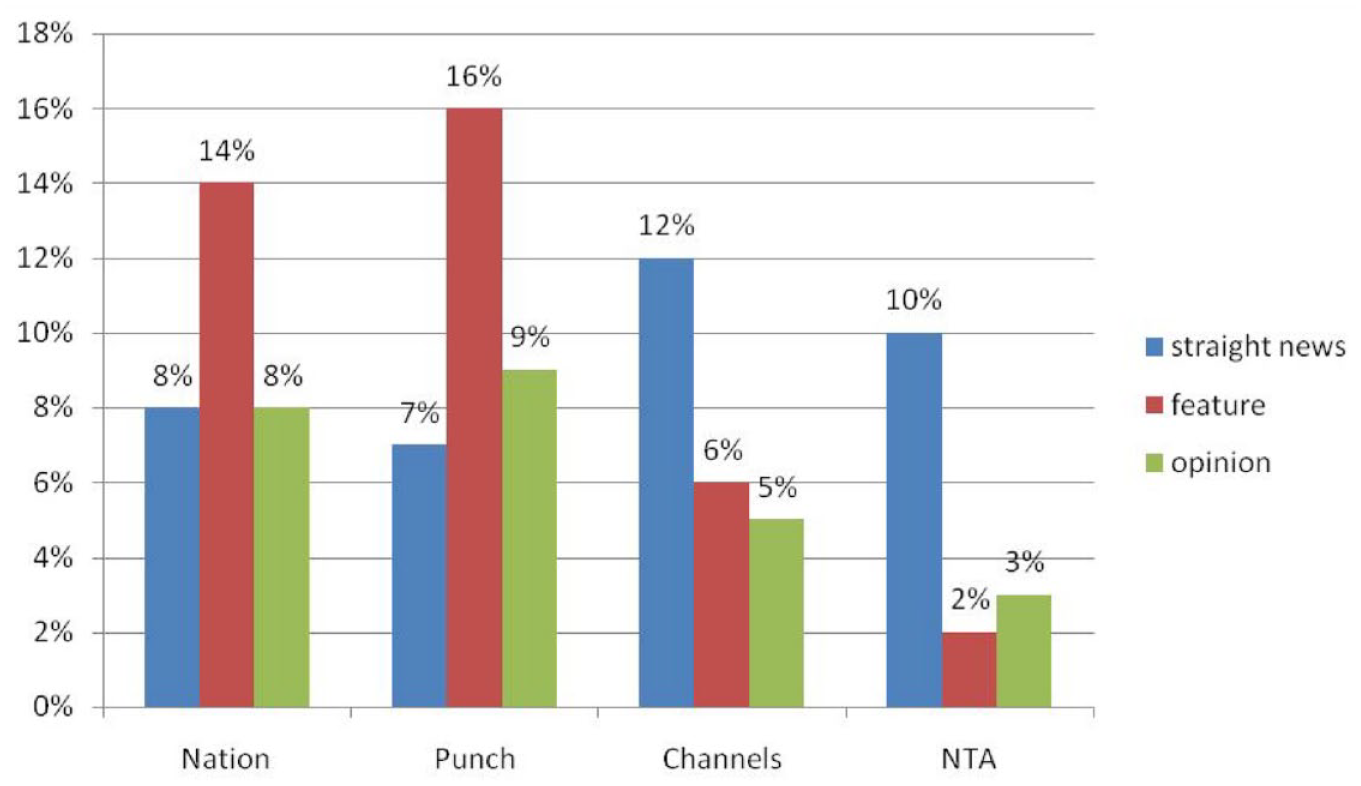
Story Type
The researchers computed Table 1 to ascertain the key issues contained in media coverage of banditry in Nigeria. The study showed that solution-related stories were least found across all the media examined, while attacks and abductions cumulatively made up more than half of the stories. The implication is that the press examined paid less attention to reporting issues related to solutions to banditry in Nigeria. Additional results showed that the calculated z-value (1.2) is less than the critical z-value (1.96) at six degrees of freedom (df) and a 0.05 confidence level. Based on this outcome, the last hypothesis was not supported. Therefore, we concluded that the media investigated did not differ in their critical issues related to banditry coverage in Nigeria.
Percentage of Stories on Critical Issues Contained in Media Reports on Banditry
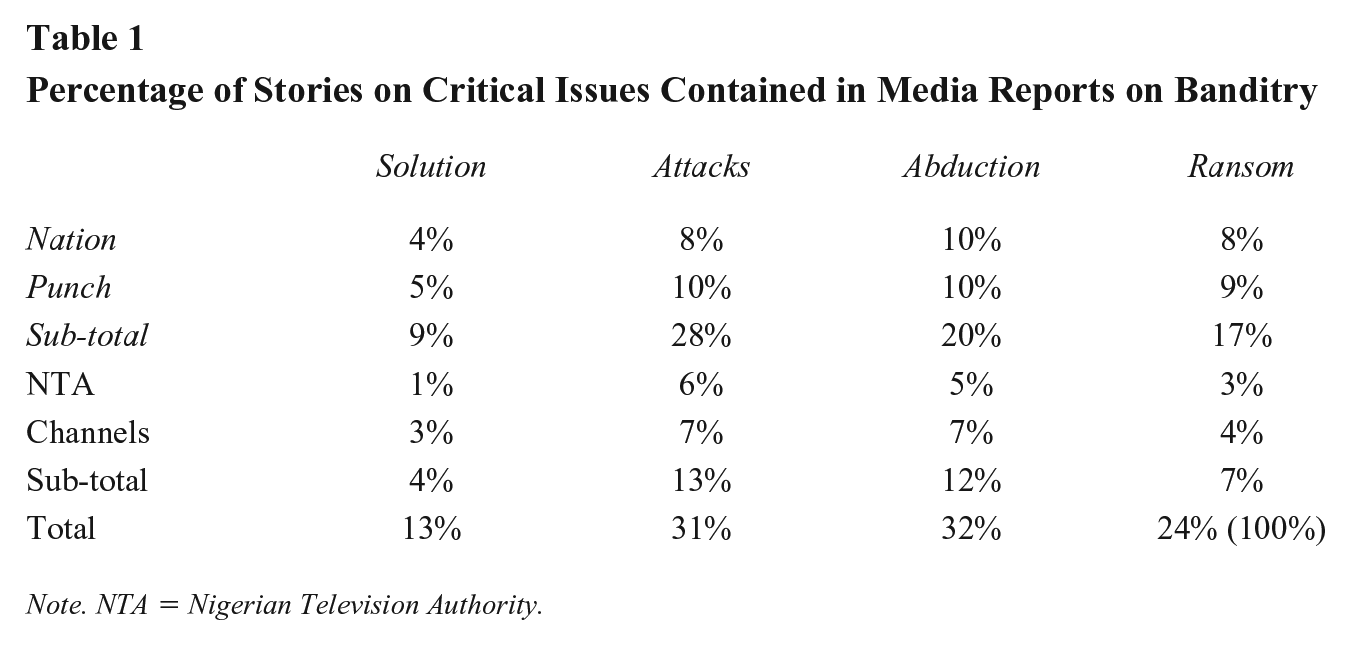
Note. NTA = Nigerian Television Authority.
Discussion
In this study, we examined media coverage of banditry in Nigeria. We paid attention to the frequency of coverage, the volume of coverage, the type of stories used and critical issues in stories related to banditry in Nigeria. The study was theorized within the framework of agenda-setting and framing theories. In addition, media coverage was examined by comparing the coverage based on the media genres—TV and newspaper. Finally, we tested the hypothesis that the media will significantly differ in their coverage of banditry in Nigeria. This assumption was broken down into four hypotheses tested using the z-test statistical tool. Finally, we found that the frequency and the volume of coverage differed according to the media genre.
Newspapers had more stories with more space dedicated to the problem of banditry than TV. Also, newspapers and TV differed in terms of the stories used. Also, there was a low volume of stories on banditry, and most of the media examined did not use feature stories to provide details about the problem of banditry. However, both newspapers and TV stations did not significantly differ regarding the attention paid to key issues in banditry stories. This is because both newspapers and television paid less attention to solutions regarding the problem of banditry in Nigeria. Instead, attention was mainly focused on attacks, abductions and ransom payments. Overall, this study found that Nigerian news media have little interest in covering the issue, which arguably is one of the most serious issues faced by the country. Hardly does a day pass that bandits do not attack one community in Nigeria. The issue has become so severe that the Nigerian government had to designate bandits as terrorists. Places like schools, markets, places of worship and even homes are no longer safe. Bandits are gradually making life unbearable for the Nigerian public. There is a wave of fear among the Nigerian public as highways have also become targets of bandits. Motorists now dread plying Nigerian roads due to the security threats posed by bandits.
This study has extended previous studies (Gever & Coleman, 2019; Berry et al., 2012) on media coverage of insecurity in particular. This study has added solutions to insecurity in media coverage of conflict-related issues. Previous studies on the subject matter have not examined this aspect. Understanding how the media highlight solution to insecurity in their coverage is essential because the lingering problem requires serious government attention through policy and legal frameworks. Although it is good to report attacks, abductions and payments of ransom, it helps to focus attention on issues related to ways of addressing the growing banditry activities in Nigeria. Ignoring the solutions to the activities of bandits is not beneficial to Nigerian society because the attention should be more on how to address the problem instead of the media creating publicity for bandits. Ottah and Gever (2021), in a study, reported that the press usually pays less attention to suggesting solutions to insecurity, and this is not helping in addressing security threats facing the Nigerian society.
The result of this study also has implications for agenda-setting theory by revealing how newspapers and TV differ in their agenda-setting efforts on issues related to banditry. This understanding has also extended the argument on inter-media agenda-setting by revealing that newspapers and TV differ in their agenda-setting efforts. This perspective will shape future debates on agenda-setting, especially from the perspective of developing countries where studies in this direction are relatively scarce.
Finally, the result of this study has compared both newspapers and TV to ascertain their coverage of banditry. This is a significant addition to the literature in this direction. Even the study of Ottah and Gever (2020) that is among the few to examine media coverage of insecurity with attention to the solution suggested focused only on newspapers. Therefore, by combining both newspapers and TV, the researchers investigated media agenda-setting beyond just one media genre. This addition has extended the argument (Gever, 2015; McCombs, 1993; McGrawHill & McCombs, 2005) on agenda-setting and offered a fresh perspective that could shape future debates on media agenda-setting vis-à-vis insecurity. This study has equally extended studies (Ikechukwu-Ilomuanya et al., 2022; Obodo et al., 2022; Ugwulor-Onyinyechi Tunca et al., 2021) that have examined other aspects of banditry activities in Nigeria without looking at media coverage. Most of the studies cited here examined how to make school children security alert to avoid being victims of kidnapping by bandits, how to prevent school dropout among school children who are survivors of banditry attacks (Obodo et al., 2022) as well as how to promote classroom concentration among survivors of banditry abductions (Ikechukwu-Ilomuanya et al., 2022). However, in this study, attention was paid to understanding media coverage of the bandits activities.
Conclusion
Drawing from the results of this study, the researchers make two conclusions. First, it is concluded that the media agenda-getting on banditry in Nigeria is generally poor because it is characterized by a low frequency of stories, low volume of stories, lack of detailed stories, as well as less focus on solutions related to banditry. In the second place, it is the conclusion of this study that media coverage of banditry in Nigeria significantly differs based on media genre with newspapers performing better than TV stations. The researchers make three recommendations for further studies. First, further studies are recommended to examine the influence of ownership on media coverage of banditry. In the second place, further studies are recommended to investigate the influence of media coverage of banditry on public perception. Finally, studies should be expanded to include how radio and magazines report banditry. This study provides direction regarding the difference that exists between newspapers and TV in their coverage of security issues in Nigeria.
