







Abstract
We examined parental preferences in raising Spanish/English bilingual children. We identified factors influencing their decisions, and the strategies used to promote bilingualism. Focus groups were conducted with Spanish-primary-language parents of children 3 to 7 years old. These groups were audiotaped and transcribed. Three reviewers independently analyzed transcripts for themes using margin-coding and grounded theory; disagreements were resolved by consensus. Thirteen Spanish-primary-language parents participated in two focus groups. The results show that parents wanted their children to be bilingual. Parents also stated that the benefits of bilingualism included better career opportunities, and preservation of culture and native language. Family members, schools, and prior parental experiences influenced the parents’ decisions to raise bilingual children. Parents preferred English-only school classes and to teach Spanish at home. Strategies identified for raising bilingual children included reading bilingual books and having children speak only Spanish at home. Schools and pediatricians are used as resources.
Children in immigrant families constitute the largest and fastest growing group of children in the United States (Toppelberg & Collin, 2010). Approximately 20% of U.S. children speak a language other than English at home, with Spanish as the most common non-English language (Kohnert, Windsor & Ebert, 2009: H. B. Shin & Kominski, 2010; Tienda & Haskin, 2011). Many of these children are inconsistently exposed to English until they begin elementary school (Kohnert et al., 2009). Bilingualism invariably presents itself to children as they are exposed to more than one language. Different definitions of bilingualism exist. For example, active bilingualism is when one person speaks and uses both languages. Passive bilingualism is where one person is completely fluent in one language but is only able to understand the other (Vera, 2011). Studies suggest that potential assets of bilingualism include preservation of native language and culture, academic advantages, better career opportunities, and promotion of cross-cultural communication (King & Fogle, 2006; Mosty, Lefever & Ragnarsdóttir, 2013). Perceived disadvantages of bilingualism include potential language confusion and mistaken beliefs that it can cause language delay (Vera, 2011). Fluently bilingual children have been shown to have high self-esteem, abstract thinking skills, and academic success (Han, 2012).
Parental decision making about raising children to be bilingual may be influenced by several factors, including community influences and personal knowledge of languages (Mosty et al., 2013; Toppelberg & Collin, 2010; Velázquez, 2009; Vera, 2011; Yan, 2003). In El Paso, Texas, one ethnic Mexican community maintained positive attitudes toward bilingualism with English and Spanish languages (Velázquez, 2009). Past views on bilingualism in the United States, however, have not always been positive, suggesting native language subtraction as the majority language was introduced (Moore & Pérez-Méndez, 2006). Parents’ knowledge about language development also influences their interactions with their children, ultimately affecting their child’s language development (Rowe, 2008). Not enough is known, however, about parents’ perspectives on raising their children to be bilingual in Spanish and English in the United States, and the strategies they use to do so (August et al., 2006; Slavin & Cheung, 2005; Velázquez, 2009; Yan, 2003). In a qualitative study of Arabic, Chinese, Hebrew, and Spanish-speaking parents in an English-majority environment in Iowa, the reasons parents gave for maintaining their native language included preservation of religion, strengthening family and moral values, continued connection with their native culture, and economic advancement (Yan, 2003). Limitations of this study included potential selection bias, as participants were recruited from dual-language schools in which parents intentionally enrolled their children with the goal of learning their heritage language. The sample of Spanish-speaking families was small, and data were analyzed for participants from all language backgrounds collectively, without focusing solely on themes for Spanish-speaking parents. Another study in El Paso, Texas, which used interviews and surveys with five bilingual mothers, found that parents’ positive attitudes toward speaking Spanish did not translate into fostering the development and use of the Spanish language with their children (Velázquez, 2009). Strategies used by parents in the United States and outside the United States to enhance bilingualism at home include books, videos, DVDs, television programs, and music CDs (King & Fogle, 2006; Mosty et al., 2013). Dual-language programs also exist; however, information about parental perspectives on these programs is limited.
Little is known about the perspectives of Spanish-primary-language parents on raising their children bilingually in the United States. The purpose of our study, therefore, was to examine the attitudes, preferences, and intended behaviors of Spanish-primary-language parents in Dallas, Texas, on raising their children to be bilingual, which ultimately could provide new information for the development of strategies to support and foster bilingual children. We hypothesized that focus groups with Spanish-primary-language parents would reveal preferences and intentions to promote bilingualism in their children.
Method
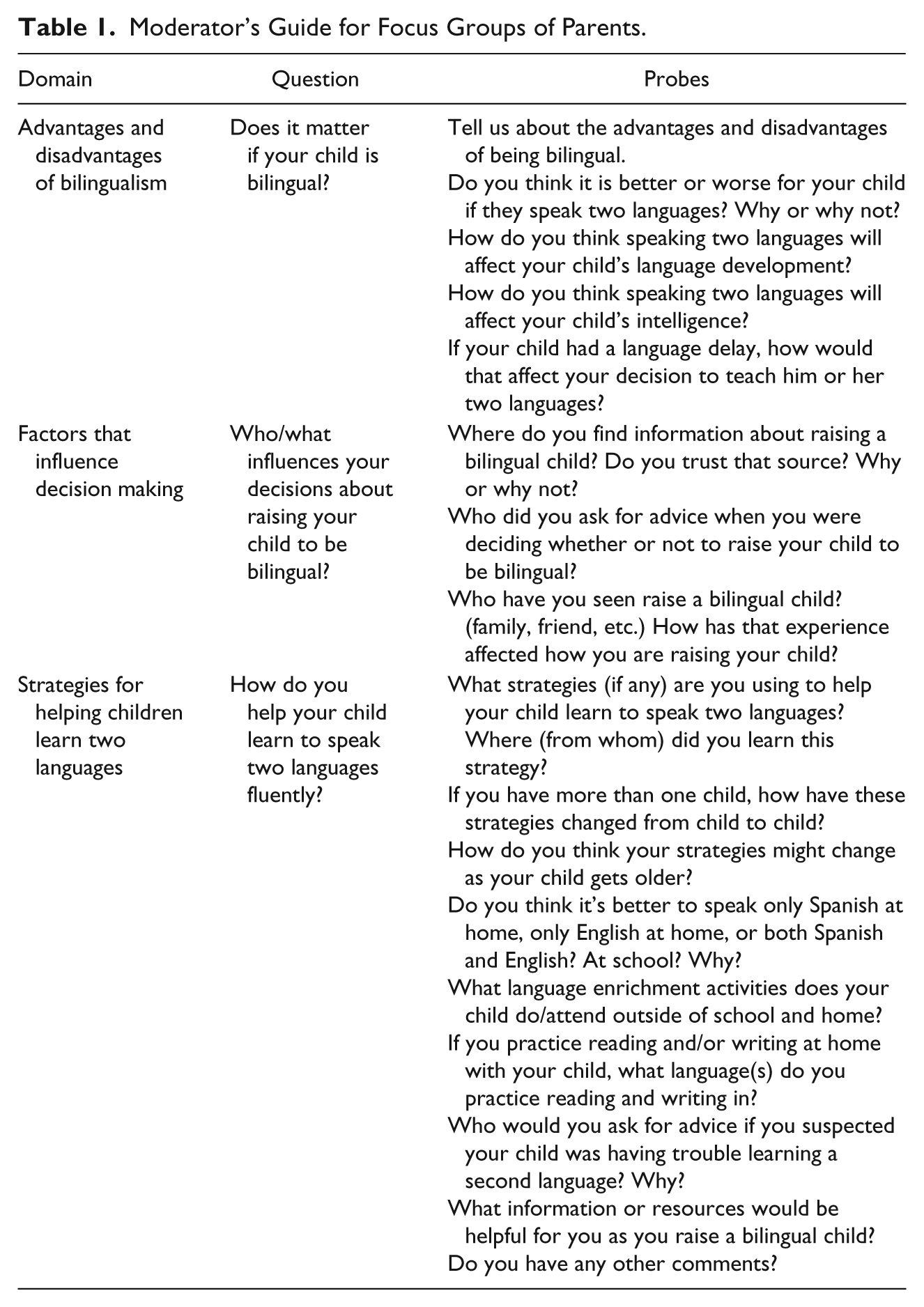
Two focus groups were conducted with Spanish-speaking parents of children 3 to 7 years old in Dallas, Texas. Focus-group methodology was chosen because it provides insight into participants’ attitudes, experiences, knowledge, and motivations within the participants’ cultural context (Kitzinger, 1995). Parents were recruited consecutively over 4 weeks from a university hospital–based resident continuity clinic where more than 50% of patients speak Spanish as their primary language at home. Parents were eligible to participate if they spoke primarily Spanish in their home, were at least 18 years old, and had a child between 3 and 7 years old. Parents were recruited in the clinic waiting room prior to scheduled appointments, with face-to-face screening interviews with one of the bilingual authors (A.B.), and informed consent was obtained. Focus groups were conducted in a private conference room at a time convenient for participants, and each session was about 1 hour in duration. Each session was audiotaped, and moderated by one of the bilingual authors (A.B.). A moderator’s guide was developed using the authors’ clinical experience caring for bilingual children and review of the relevant, current literature (King & Fogle, 2006; Sakai et al., 2010; Shetgiri et al., 2013; Vera, 2011). The guide consisted of three primary questions and 17 probes (Table 1). The domains for the primary questions were advantages and disadvantages of bilingualism, factors that influence parental decision making about raising children to be bilingual, and strategies for helping children learn two languages. Sociodemographic information was collected using an eight-item questionnaire, and each participant received a US$20 honorarium. Because the customary primary aim of focus-group methodology is qualitative theme identification, it is not considered appropriate to report frequencies or percentages of specific themes or item responses (Kitzinger, 1995), and therefore, theme/response frequencies and percentages were not reported. This study was approved by the UT Southwestern Medical Center institutional review board.
Moderator’s Guide for Focus Groups of Parents.
Analysis
Focus groups were transcribed by a bilingual research assistant who was blinded to the purpose of the study. Transcripts were reviewed for accuracy by one of the authors (A.B.) by simultaneously listening to the audio recordings; they were translated into English, and the accuracy of the translation was confirmed by comparing it with the original Spanish version. Transcript-based thematic analysis (Bertrand, Brown, & Ward, 1992; Krueger, 1994) was performed using grounded theory, where new theory was created and existing theory was modified by comparison with incoming information, to create a taxonomy of themes (Denzin & Lincoln, 1994; Glaser & Strauss, 1967). Saturation of major themes was determined to have been achieved after two focus groups; therefore, additional focus groups were not conducted. Three study authors analyzed the transcripts independently and then met to resolve any differences by consensus. Theme consensus initially was not achieved in only a minority of instances (<5%).
Results
Sociodemographics
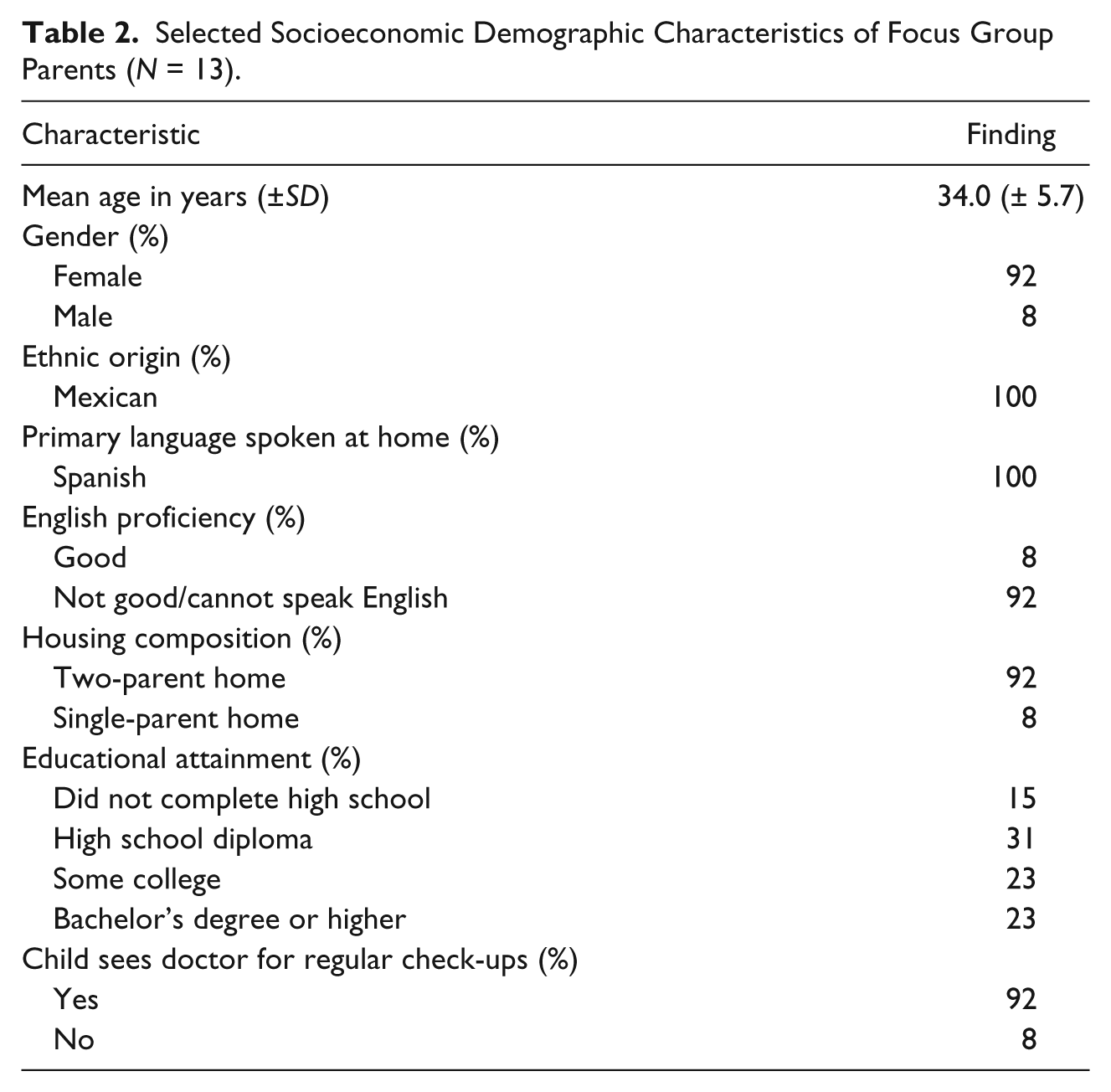
There were 13 participants in the two focus groups. The mean parental age was 34 years; 92% were female (Table 2). All participants self-identified as of Mexican origin, and all spoke Spanish as their primary language at home. Only 8% of parents reported “good” English language proficiency and living in a single-parent home. Thirty-one percent of participants were high school graduates, and 46% had attended at least some college; 92% reported that their child had a regular doctor.
Selected Socioeconomic Demographic Characteristics of Focus Group Parents (N = 13).
Attitudes, Beliefs, and Intended Behaviors of Parents Raising Bilingual Children
Table 3 summarizes the nine categories of themes cited by parents.
Taxonomy of Parental Attitudes, Beliefs, and Intended Behaviors About Raising Bilingual Children.

Benefits of raising children to be bilingual
Parents stated that bilingual children would have better opportunities in life; for example, better jobs. A mother said, “It’s very important that they speak Spanish and English, because they have more opportunities. It makes the road easier for them.” Another theme was that the United States is becoming increasingly multilingual. One mother said, “We’re in a country where they speak more languages”; another parent commented, “One should learn English, as it is the principal and official language in the United States.”
It also was noted that bilingual children could help their parents learn English. One mother remarked, I read to my kids in Spanish, and then I try to read with the English that I know. If I’m saying a word wrong [in English], even if it’s with the little one, he says “no,” and corrects me. We learn together.
Other focus-group comments included that bilingual children offer a different point of view or perspective than monolingual children, and they are friendlier than monolingual children.
Reasons for teaching Spanish to children
Parents stated that they teach their children Spanish due to a desire to maintain their native language. A mother commented, “We need to know our language first and then adapt.” Another parent stated, “For me, it’s important for them to speak both, first because of work, and second because they are Mexicans that were born here. They need to speak their language.” Several parents also stated that monolingual, English-speaking children have difficulty communicating with monolingual Spanish-speaking family members. Parents are embarrassed when Latino children cannot speak Spanish. A father reported, “regrettably, there are a lot of people that have Mexican parents, and they [the children] look Mexican, and they don’t speak Spanish.” A mother replied to this father’s comments by saying, “they [children] look ridiculous.” Two parents additionally said that Spanish is a beautiful and easy-to-understand language, and that it is important that children learn to speak Spanish correctly.
A concern was raised about the true meaning of bilingualism. One mother reported that her Latino cousins asked her to read Spanish-language signs in Mexico. She responded by asking them, “Aren’t you bilingual? Don’t you know how to read them?” and they replied, “no, I just speak it.” This conflicted with the participants’ belief that to be truly bilingual, children should read, write, and speak in both languages.
Language and culture are intertwined
Several parents expressed a strong belief that speaking Spanish is an important way to preserve their heritage and to connect with older family members. By not speaking Spanish, children cannot understand cultural norms, and may be perceived as lacking positive Mexican values. One father commented, I have nephews that go to Mexico on vacation and they don’t know Spanish. Their grandparents are telling them “Son, how are you?” and the child is like “what, what, what?” When someone comes and says something in Spanish, they just look at them.
Several parents stated that some children who do not speak Spanish are ashamed of their parents and culture. One mother expressed the desire to counteract this by building a “strong foundation” for her children, saying, “You have to make their foundation strong, to be proud of where they are from, who they are . . . and then everything is fine.” One mother also commented, On my husband’s side, they raise them bilingual, and on my family’s side, I feel like they don’t, and I also feel that they [bilingual children] are more friendly, more likeable, the kids that speak English and Spanish at home.
Decision making regarding raising children to be bilingual
Most parents stated that they themselves were ultimately in charge of deciding whether to raise their children to be bilingual. A participant commented, “A lot of parents are different and don’t want them [their children] to learn Spanish.” A few parents also stated that their experiences with previous children helped them decide what to do with their other children. One mother said, “Since I’ve already raised some kids that are grown now . . . how I raised them, I’ll raise the others.” There was a lack of information available to help parents decide about bilingualism. Conflicting opinions from other family members also played a role. Other sources used to decide on bilingualism were relatives’ and neighbors’ experiences, school and community programs about raising children, and talking with school teachers. One parent concluded, “Well, the environment [decides] where the child develops [and learns language].”
Barriers to raising bilingual children
One identified barrier was the resistance of children to learning Spanish because it was more difficult than learning English. Teenagers were uncooperative due to being embarrassed by speaking Spanish, believing it was “un-American.” Furthermore, one parent stated, There are a lot of kids that, when they start being teenagers, they’re embarrassed to speak Spanish because they have the attitude that, “We are Americans. We don’t need to speak Spanish to our Mexican parents.” It has a lot to do with how you raise them.
Exposure to a second language also was believed to cause confusion in children, and the use of different languages in different environments was seen as challenging to children. A few parents stated that although resources exist to aid with raising a bilingual child, these resources are underutilized. These parents did not explain or further explore why resources are underutilized.
Parents’ attitudes about bilingual programs at school
Parental attitudes toward school bilingual programs were predominantly negative. Some parents believe that it is difficult to learn to write two languages at once, and that bilingual classes in kindergarten hinder a child’s language development and learning. One parent commented, “Kids [in bilingual classes] struggle more to learn English afterward; it’s harder to learn.” An additional theme was that children who struggle academically should be placed in English-only classes and have Spanish taught at home. It was considered preferable to start bilingual classes before kindergarten. Another theme was parental concerns about the quality of teachers in bilingual classes. They were concerned that these teachers may not be fully bilingual, and that Latino teachers may have an accent when speaking English, which could be transmitted to their students. Furthermore, many parents did not report having received active counseling or guidance from the school district about bilingual education choices.
Parents’ methods for teaching bilingualism
The location and method for teaching both languages was important to the participants. Some parents recommended teaching Spanish to children when they are young and building a strong foundation in Spanish to prevent forgetting the language later on. Some parents preferred to speak only Spanish at home and only English at school. Others recommended speaking both languages at home, or beginning to speak English immediately before starting school to help with the transition. One parent stated that the choice of which language to speak was up to each child as he or she grew older.
Most parents from both focus groups had strong opinions about how to teach Spanish. They wanted to assume the role as the Spanish teacher and continue to teach Spanish at home as children grow up. Several parents wanted to personally practice and correct spoken Spanish with their children, adapting teaching and learning strategies for each child. One suggestion was to compare and use the same vocabulary words in English and Spanish. The parent would teach the child a word in Spanish, and the child would teach the parent the same word in English. A parent stated, “For me, if they learn a word in English, they have to know it in Spanish. It’s something that’s basic for me. If they say something in English, they should have already known what it was in Spanish.” Several parents also revealed a desire for their children to speak to them in Spanish and not allow them to speak only in English at home. One mother remarked, “I speak Spanish with you [child], you speak English with me.” Parents recommended teaching children that similar words in Spanish and English have the same meanings. It was considered acceptable for parents with limited English proficiency to use broken English in order to teach proper Spanish. The parents believed themselves to be the most important influence on their children in speaking, reading, and writing Spanish well. Parents did not cite use of any bilingual community programs.
How bilingualism affects language development
Several parents stated that speaking two languages has no effect on their child’s language development, whereas others believe that there is some initial difficulty with learning two languages simultaneously that requires some time for adaptation. One mother stated, “My children struggle with two languages, but they can do it.” English language media (television) in the home was believed by some to be a source of confusion and potential language delay for children. One parent believed that their child was emotionally affected by the parent’s inability to help him with English at home.
Two parents commented that developmental delays do not interfere with speaking two languages. Specifically, one parent relayed that his cousin has Down’s syndrome and is bilingual in Spanish and English. Another parent stated, “I have a niece that is delayed, and she can speak Spanish and English.”
Resources for raising bilingual children
Parents looked to a variety of sources for knowledge and advice about raising bilingual children. Personal experiences, bilingual families, relatives, and information from magazines, schools, teachers, community programs, and pediatricians were listed as primary resources for advice. Parents appeared to value and trust these resources at face value. Specific tools used to teach children how to be bilingual included bilingual education in schools, television shows, internet sites, toys, bilingual books, and pediatric office pamphlets (Table 3). One parent stated, Information? In magazines, on the Internet. For example, a magazine called Vida just arrived for me. And it has an article about being bicultural, about how the kids . . . about how to make them bilingual, and how they learn as much from one culture as from the other.
The Es el Momento television show, the Univision television station, and the Ser Padres magazine were specifically cited by study parents. Schools and libraries were locations to access these tools. Regarding cartoons, one mother said, “At home, the girl [four years old] starting speaking English by herself because of the cartoons; she watches only the ones in English.” Another mom remarked, “Reading is very important . . . in one language as in the other. Reading will be a tool that serves them well. They will be more successful kids with their books.”
Discussion
This study used focus groups to examine the attitudes, beliefs, and intended behaviors of Spanish-primary-language parents in raising their children to become bilingual in Spanish and English. The study findings indicate that Spanish-primary-language parents want to raise their children to be bilingual, and family members, past personal experiences, and schools are major influences on their decisions to do so. Parents prefer English-only classes in school and teaching Spanish at home. Parents use family and friends, bilingual books, schools, media, pediatricians, and community programs as resources.
Preference for Bilingualism
The parents in our study identified various benefits of bilingualism for their children, including economic and career advancement, communication advantages, becoming a well-rounded individual, and preservation of their culture. This is consistent with the literature that noted similar advantages of bilingualism (Moore & Pérez-Méndez, 2006; Toppelberg & Collin, 2010; Velázquez, 2009; Yan, 2003). Historically, societal and school pressures have promoted monolingualism in the majority language and encouraged children to lose their native language (Han & Huang, 2010; Portes & Hao, 1998). This negative view of bilingualism also was promoted through discrimination and stigma associated with lack of English fluency in a predominantly English primary-language country such as the United States (Linton, 2004; Portes & Hao, 1998). The benefits of bilingualism were thereby undervalued. More recent studies, however, show that the development of a child’s non-English primary language spoken at home may increase family cohesion, intimacy, and preservation of cultural norms, enhancing preservation of the family (Toppelberg & Collin, 2010). Compared with immigrant children who speak only English, immigrant children who speak both the majority language and their native language are more likely to graduate from high school and to develop close family and cultural connections, leading to a higher likelihood of better social and emotional health (Kohnert, 2010).
Although parents in our study identified economic benefits to bilingualism, there is conflicting evidence on these potential benefits. Several studies suggest that bilingual individuals have economic advantages over monolinguals, given the current focus on global economic issues; other studies, however, indicated that economic benefits of bilingualism were not superior to those of English-speaking monolingual dominant language speakers (Coomer, 2011; Moore & Pérez-Méndez, 2006; Oh & Min, 2011; Proctor, August, Carlo & Barr, 2010; H. Shin & Alba, 2009). Additional study of this topic is warranted to further examine the association of bilingualism with economic consequences.
Influences on Decision to Raise Children Bilingually
Focus-group participants stated that there was a lack of information available to parents in aiding them with their decision-making processes for promoting bilingualism. Parents identified family members’ opinions, past experiences with bilingualism, and school-system practices as most influential in their decisions regarding raising bilingual children. Our findings complement prior research demonstrating that home and school environments are influential in the learning, acquisition, and preservation of the native language (Toppelberg & Collin, 2010; Yan, 2003). Multilingual communities also may influence parental choices regarding transmission or non-transmission of the native Spanish language (Velázquez, 2009).
The parents did not report any specific guidance offered proactively from the school district to help families with bilingualism education choices. Parents did, however, identify schools and teachers as resources for raising their children to be bilingual, once the parents had chosen their child’s educational path. Schools in which the participants’ children were enrolled offered standard English education and bilingual education.
Methods for Teaching Bilingualism
Parents in this study articulated a preference to have their children learn English at school and Spanish at home. They also expressed negative views of bilingual education in schools. Participants stated that the home should be where the native language was taught, and preferably, spoken exclusively. Parents also used different tools and methods to help with teaching bilingualism. These included bilingual books, magazines, and media, such as audio, television, and computer-based instruction. The existing research is unclear about the ideal timing, method of instruction, and location of the acquisition of a second language (Slavin & Cheung, 2005). Our study participants expressed a preference for schools teaching English as the children enter kindergarten or elementary school.
Research documents that children can effectively learn two languages simultaneously, regardless of their being normal-learning or developmentally challenged (Dufresne & Masny, 2006; Moore & Pérez-Méndez, 2006; Paradis, Genesee & Crago, 2011; Rowe, 2008; Westman, Korkman, Mickos, & Byring, 2008). This is consistent with participants’ statements that the presence of a developmental delay does not preclude speaking two languages. Bilingual children may have enhanced cognitive flexibilities, verbal abilities, and spatial perceptions, compared with monolingual children (Cappiello & Gahagan, 2009). Thus, any advice to discourage bilingualism, even among children with a speech delay, should be reconsidered. Research also suggests that exposure to the majority language is unavoidable, and loss of the native language not infrequently can be inevitable; therefore, it is the native, rather than the majority language which is typically at risk (August et al., 2006). Our study findings are consistent with studies suggesting that students need early instruction in Spanish with home support to remain proficient in their native language (August et al., 2006).
Implications for Health Care Providers
The study results suggest that Spanish-primary-language parents want to raise their children to be bilingual. Parents view bilingualism as beneficial, and they use several resources to help guide them in raising their children to be bilingual, including pediatricians. It may therefore prove useful to provide guidance about bilingualism during well-child visits. Providers may need to solicit parental preferences and openly discuss bilingualism with parents. With young children, in particular, providers can encourage parents to promote the native language and continue to foster it at home as the child matures. Pediatricians also could dispel myths about bilingualism, such as raising children to be bilingual delays their language development.
The findings also suggest that pediatricians can be resources for shaping bilingual language development. Pediatricians, for example, might promote bilingualism by showing bilingual programs in waiting rooms and providing parents with bilingual books. The Reach Out and Read program could serve as a resource for bilingual books (Zuckerman & Augustyn, 2011). Pediatricians also might partner with elementary schools and pre-schools to promote bilingualism and parent-school collaborations to optimize bilingual education. Increasingly, the role of pediatricians is evolving from traditional anticipatory guidance on safety and somatic growth to one that also includes promotion of language and culture. The pediatrician could potentially have a positive effect on language and subsequent cultural identity formation for children of parents seeking information on bilingualism. As society becomes increasingly global, bilingualism may become a regular topic of discussion in the doctor’s office.
Limitations
Certain study limitations should be noted. Participants were from a single urban clinic and all were of Mexican origin. Participant families’ experiences with bilingual school programs were with reference to their local school district. Replicating our study in a population with a higher proportion of English-proficient parents would provide useful and complementary data on raising children to be bilingual. Additionally, study parent’s command of the English language was limited. This lack of English proficiency might also impact their attitudes toward bilingualism. Additional research with parents who speak primary languages other than Spanish or English could examine whether there are similar attitudes, beliefs, and intended behaviors when approaching bilingualism. Finally, the definition of bilingualism itself appears variable. Future studies might further address what it means to be truly or completely bilingual.
Footnotes
Authors’ Note
The content is solely the responsibility of the authors and does not necessarily represent the official views of the NICHD, NIH, or NCRR.
Declaration of Conflicting Interests
The authors declared no potential conflicts of interest with respect to the research, authorship, and/or publication of this article.
Funding
The authors disclosed receipt of the following financial support for the research, authorship, and/or publication of this article: Dr. Shetgiri is supported by Grant K23HD068401 from the Eunice Kennedy Shriver National Institute of Child Health and Human Development (NICHD) and by Grant KL2RR024983, titled, “North and Central Texas Clinical and Translational Science Initiative” (Robert Toto, MD, PI) from the National Center for Research Resources (NCRR), a component of the National Institutes of Health (NIH), and NIH Roadmap for Medical Research.