







Abstract
Prior research has explored the relationship between disasters and the personal well-being of migrants in the United States. The current study retrospectively evaluates the subjective well-being of Puerto Rican post-disaster migrants before migration, after migration (and after the return migration to Puerto Rico of a small subset of the sample), and during the COVID-19 pandemic. Utilizing both Wilcoxon Signed Rank and independent samples t-tests, we find that stateside and return migrants experience declines in self-reported mental health after migration and return migration (before the COVID-19 pandemic) and during the pandemic. In addition, we find that return migrants report worse mental health, more negative emotions, and fewer positive emotions than migrants who remained stateside. Our findings have implications for our understanding of Puerto Ricans’ subjective well-being and mental health. Directions for future research on post-disaster climate migration, and particularly the subjective well-being of return migrants, are discussed.
Keywords
In 2017, Hurricane Maria swept through Puerto Rico, causing destruction that led to the loss of housing, food, potable water, electricity, communications, medical support for residents (Zorrilla, 2017), and the death of approximately 2,975 Puerto Ricans (Santos-Burgoa et al., 2018). Coupled with existing structural, economic, and social issues, the hurricane’s effects resulted in mass migration to the continental United States (Hinojosa, 2018). Worsening matters, subsequent disasters transpired—such as the swarm of earthquakes that affected the archipelago in 2020 through 2021—as Puerto Rico was still recovering from the hurricane. During this time, migration from Puerto Rico represented one of its largest flows historically, resulting in a 3.9% decline in the population from 2017 to 2018, a net decrease of 123,000 Puerto Ricans who moved to the continental U.S. (Flores & Krogstad, 2019). Nearly 56,000 of these migrated to Florida (Gamarra, 2018), making it the number one destination state, with most of them residing in Central Florida (Meléndez & Hinojosa, 2017).
Puerto Rico is an unincorporated territory of the United States, and its colonial history distinguishes its migrants from other immigrants (Silver & Vélez, 2017). Though Puerto Ricans have U.S. citizenship, they are considered colonial subjects (García et al., 2021) and their migration experiences are similar to other immigrant populations in that they confront challenges adapting to a new language (Carl et al., 2020), recreating social networks (Aranda, 2007), enduring racialization and ethnoracial discrimination (Aranda & Rebollo-Gil, 2004; Ramos-Zayas, 2004), and experiencing marginalization and exclusion (Aranda & Rivera, 2016). We know less about how these transitions are endured after migrants have faced a natural disaster (for exceptions see Carl et al., 2020; Salas-Wright et al., 2023, among others) and even less about why some migrants return to Puerto Rico and their subjective well-being upon return.
The current study uses retrospective data to examine the subjective well-being of a sample of Puerto Rican migrants who fled the archipelago after Hurricane Maria to relocate to Florida and a subset of return migrants. We ask them to assess their mental health at three points in their migration journeys: before the hurricanes, after migration and return migration for returnees (but before the COVID-19 pandemic), and during the pandemic when the surveys were conducted. We also examine the emotional states of these migrants during the pandemic and whether differences exist between the subset of return migrants and those who remained stateside. Broadly, this study contributes to our knowledge on the subjective well-being of migrants and return migrants with implications for their mental health.
Literature Review
A Word on Subjective Well-Being and Mental Health
Subjective well-being is often measured by relying on individuals’ own evaluations of their lives based on both cognitive appraisals and affective assessments that may result from evaluations of the ongoing events in a person’s life (Andrews & Withey, 1976; Diener, 1994). Regarding affective appraisals, these include both unpleasant emotions as well as positive ones. The presence of positive emotions does not preclude the incidence of negative ones, and vice versa. As such, scholars have argued that positive and negative emotions should be measured separately (Bradburn, 1969) to assess the affective well-being component of subjective well-being.
At the same time, most of the literature on post-disaster migrants’ subjective well-being focuses on mental health, such as depression and anxiety, which encapsulates just the negative component of emotional well-being that has reached clinical levels meriting mental illness diagnosis. Though we focus on subjective well-being, we examine the literature on migrant mental health given that this area is a subset of research on well-being that cannot be ignored when studying post-disaster migrants’ well-being. Thus, we ask migrants to provide a self-assessment of their mental health at three points in time. We argue that these self-assessments are one component of subjective well-being and thus frame our article around this overarching concept given that, when studying migrants’ psychological states, scholars have found that the incidence of symptoms among migrants may not necessarily correspond with North American understandings of mental illness (Limon et al., 2016). For this reason, we focus on self-assessments of mental health and well-being that consider cognitive and affective appraisals.
Subjective Well-Being, Mental Health, and Post-Disaster Migration
Prior research has explored how the experience of disasters contributes to negative mental health outcomes (Goldmann & Galea, 2014; Morganstein & Ursano, 2020), such as the relationship between hurricane-related disasters and outcomes such as major depression, generalized anxiety disorder, and PTSD (Espinel et al., 2019; Schwartz et al., 2018). Migration compounds these outcomes. One of the mechanisms by which mental health deteriorates after post-disaster migration is through the disruption of existing social ties (Erikson, 1976; Torres & Casey, 2017). Erikson (1976, p. 187) identified the loss of “communality,” in which people lamented the loss of their relationship networks, as a “second trauma” (p. 185) to disaster survivors. Torres and Casey (2017) find that the disruption of social networks and loss of social ties represent the loss of social and material resources from countries of origin, concluding that the loss is “a key mechanism by which climate-related migration may negatively impact mental health” (p. 600). But ruptured social networks are not the only secondary stressors or traumas that lead to declines in subjective well-being and mental health among post-disaster migrants. A series of studies on Puerto Rican post-disaster migrants shows the influence of cultural stress and how the kind of hurricane exposure influences subjective well-being post migration.
Puerto Ricans’ Post-Disaster Subjective Well-Being and Mental Health Outcomes
Research on Puerto Rican migrants finds that even after a year post-disaster, survivors still cope with mental health challenges such as depression, suicidal ideation, stress, and anxiety, among other conditions (Macias et al., 2021). Greater exposure to adverse hurricane experiences increases the odds that Puerto Ricans suffer from depression symptoms, PTSD, and anxiety (López-Cepero et al., 2022). Stresses associated with migration and settlement processes in the U.S. also exacerbate well-being post-migration.
Salas-Wright et al. (2023) find that one’s degree of acculturation shapes the relationship between migration-related cultural stressors and behavioral health among Puerto Rican post-disaster migrants. For those who were bicultural, hurricane trauma exposure was related to mental health symptoms, whereas this relationship was absent for other migrants with different acculturation profiles. They explain this finding by arguing that having less cultural stress to contend with, bicultural migrants focused more on hurricane-related stress. Montero-Zamora et al. (2023) found that post-migration cultural stress (i.e., those who perceive discrimination, a negative reception context, and low English fluency) was the most significant predictor of poor mental health while hurricane-related stress affected mental health less. Moreover, Carl et al. (2020) found a significant relationship between low English proficiency among Puerto Rican post-disaster migrants and high risk for mental illness, such as depression, anxiety, PTSD, and psychological distress, suggesting that limited English proficiency is a mental illness risk factor.
In addition to cultural stress after migration, ruptured networks can also contribute to negative subjective well-being and declines in mental health after post-disaster migration as seen in our discussion of Erikson’s (1976) and Torres and Casey’s (2017) work above. Pineros-Leano et al. (2023) find that in their sample of Puerto Rican post-disaster migrants, those who were disengaged, meaning that they did not communicate with friends or family in the U.S. or Puerto Rico, showed higher levels of depression (as well as limited proficiency in English, among other factors). The totality of these post-disaster migration-related stressors can affect adaptation to U.S. society and possibly impact the chances of return migration and subjective well-being.
In a recent study, Aranda et al. (2023) found that challenges related to adaptation after migration, such as rebuilding social networks, facilitating children’s education, and finding and keeping well-remunerated work were made more difficult for Puerto Rican climate migrants during the COVID-19 pandemic. Referring to these events, including the impact of the hurricane, as cascading disasters (Pescaroli & Alexander, 2015), they argued that the cumulative impact of these disasters and transitions deeply affected (and during the lockdown phase of the pandemic, halted) the social integration process. Though studies have shown a relationship between limited societal incorporation and return migration (Basch et al., 2020; Levitt, 2001), it is unclear how return migration relates to migrants’ subjective well-being and mental health (Davies et al., 2011).
Post-Disaster Return Migration and Subjective Well-Being and Mental Health
There is limited research on the subjective well-being and mental health of return migrants to their origin countries (Davies et al., 2011), and even more so on post-disaster return migration. However, there is literature that can provide some information regarding what factors to take into consideration when examining subjective well-being upon return, after post-disaster migration has taken place. Davies et al. (2011) argue that some return migrants who are employed and have access to health care in their receiving societies may return to their origin countries with their subjective well-being intact. However, if migrants confront challenges abroad, such as unemployment, poverty, lack of housing, food insecurity, or cannot access healthcare, they may return in a more vulnerable state, affecting their subjective well-being (Davies et al., 2011; Veronese et al., 2020). On the other hand, returning to one’s origin country and re-embedding oneself in one’s social networks, where one can speak one’s language and be immersed in one’s own culture might improve subjective well-being (Aranda, 2007). Important to consider as well, is whether return migration is forced or undertaken voluntarily (Cassarino, 2008).
Muir et al. (2019) found that when comparing post-disaster displaced populations with those who “moved on” and resettled elsewhere, to those who returned to the origin community, self-reported mental health was best for those who moved on, followed by those who returned, and worse for those who remained displaced, concluding that the well-being of returnees was affected by social factors and other risk factors that were associated with the disaster, migration, return, and post-return circumstances. Regarding Puerto Rican migration, DeWaard et al. (2020) illustrate that although return migration by the second quarter of 2019 was low (12%–13%), those who were returning did so at higher rates than those from less vulnerable places. Unknown are how returning to places that were more vulnerable might impact subjective well-being, and how returnees rate their subjective well-being and mental health vis à vis those who remain stateside.
The Current Study
The purpose of this study is two-fold: (1) to examine the cognitive component of subjective well-being of Puerto Rican post-disaster migrants and return migrants, specifically their assessments of their own mental health retrospectively: prior to the hurricanes, after migration (and return migration for returnees), and during the COVID-19 pandemic, to see if there are differences between those who remained stateside versus those who returned to the archipelago; and (2) to examine the emotional component of subjective well-being (i.e., positive and negative emotions) to assess if there are differences in their prevalence between migrants and return migrants.
Hypotheses
Migrating after traumatic events, like disasters, hinders positive mental health (Cleary et al., 2018), and among Puerto Rican post-disaster migrants, forced migration was related to declining mental health (Scaramutti et al., 2019). In addition, Puerto Rican migrants lost access to social networks of support after migration, forcing them to confront the challenges of migration without the resources that come from such networks (Torres & Casey, 2017). Moreover, for return migrants, stateside challenges may have worsened their subjective well-being upon return (Davies et al., 2011; Veronese et al., 2020). Therefore, we hypothesize that:
H1a: The self-reported mental health of Puerto Rican post-disaster migrants worsens after out-migration (compared to before the hurricanes and migrating stateside), where return migrants will report poorer mental health than migrants who remained stateside.
In addition to hurricane exposure prior to migration, migrants now face the deleterious effects of the COVID-19 pandemic (Rothman et al., 2020). The widespread onset of COVID-19 raises uncertainty and fear among all populations, but especially among migrant populations who are susceptible to the detrimental effects of the virus, due to their housing arrangements, limited virtual employment opportunities, and limited access to health care (Clark et al., 2020). Prior research has also explored how the context of the home country shapes health outcomes for immigrants (Davies et al., 2011; Ullmann et al., 2011). In the case of Puerto Rico, the persisting structural issues and lack of relief during the COVID-19 pandemic (García et al., 2021) may cumulatively disadvantage those who return to the archipelago. Therefore, we hypothesize that:
H1b: The self-reported mental health of Puerto Rican migrants worsens during the pandemic (compared to before the pandemic, after out-and return migration), where return migrants will report poorer mental health than migrants who remained stateside.
The link between return migration and subjective well-being is shaped by contextual factors in that those who are unsuccessful in the destination country could return empty handed and feeling stigmatized which could harm subjective well-being (Veronese et al., 2020), or subjective well-being might be enhanced if migrants are able to re-establish their lives and access their social networks upon return (Vathi, 2017). In the case of Puerto Rico, the combination of pre-existing structural vulnerabilities and the natural hazard events of the hurricane and the swarm of earthquakes resulted in a humanitarian crisis that led to deteriorating health conditions, a crisis worsened by the lack of funding relief provided to the archipelago (Rodríguez-Díaz, 2018). To examine potential differences in the emotional component of subjective well-being of Puerto Ricans who remained stateside and those who returned to Puerto Rico, we hypothesize that:
H2a: There is a significant difference between the prevalence of negative emotions experienced by stateside migrants and return migrants, where those who returned to Puerto Rico will report more negative emotions.
The prevalence of negative emotions does not preclude the presence of positive emotions (Bradburn, 1969; Vaquera & Aranda, 2017). Nonetheless, what remains to be seen are potential differences in subjective well-being, specifically self-reported positive emotions between post-disaster migrants who remained stateside and those who returned. The lag in Puerto Rico in terms of post-disaster recovery, combined with the lack of aid, may contribute to a lower prevalence of positive emotions among return migrants. Therefore, we hypothesize that:
H2b: There is a significant difference between the prevalence of positive emotions of Puerto Rican migrants who remained stateside and those who returned to Puerto Rico, where migrants who remained in the continental U.S. will report more positive emotions.
Methods
Participants
As part of an NSF-funded study, the sample of Puerto Rican post-disaster migrants was obtained through partnership with Mujeres Restauradas por Dios (MRD), a non-profit organization that provided support for the Puerto Rican post-disaster migrant community in Tampa, Florida. This organization offered a diverse array of assistance to the 1,032 clients they served at the time of this study. We made contact by phone with 317 of their clients who met eligibility requirements which included having been present in Puerto Rico during Hurricane Maria, having migrated after the hurricane, and being above the age of 18. Of these 317 migrants, 146 completed the entire survey. Surveys were administered over the phone in Spanish and lasted approximately 1 hr. Data collection took place between February and July 2020.
Since this study retrospectively examines shifts in the subjective well-being of post-disaster migrants, we restrict the sample to the 103 respondents who reported their subjective well-being prior to migration, after migration (or return migration in the case of returnees), and during the pandemic, at the time which they were surveyed. Our sample of Puerto Rican migrants fled after the hurricane for several reasons, primarily due to the lack of electricity in Puerto Rico (74.8%) and to seek a better quality of life (61.2%). 1 Around 25% of respondents migrated alone, leaving family and friends behind in the archipelago. Moreover, most migrants reported a loss of social ties after migrating, where the average number of close social connections decreased from six people (before migration) to two people (after migration). When living stateside, and particularly during the COVID-19 pandemic, approximately 20% of this sample of migrants experienced job loss or reduction in work hours. For 21 of our 103 respondents, family reasons (38%), lack of English fluency (33%), and the desire to rebuild their home (29%) were the primary drivers for their return to Puerto Rico. 2 A summary of participant background characteristics is provided in Table 1.
Demographic Profile of Puerto Rican Post-Disaster Migrants (N = 103).
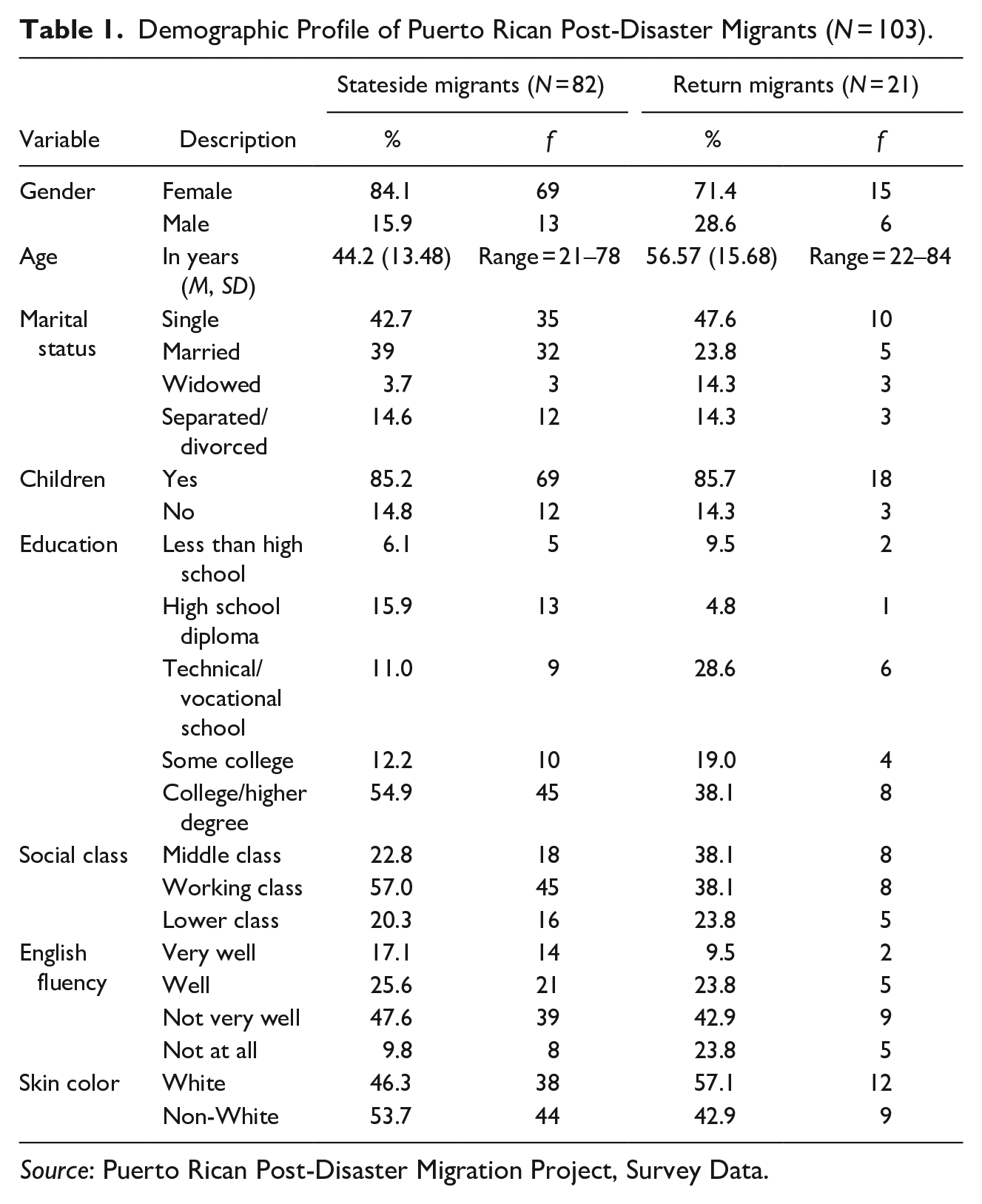
Source: Puerto Rican Post-Disaster Migration Project, Survey Data.
Measures
Subjective Well-Being
Self-Reported Mental Health
Measures of subjective well-being are frequently employed to evaluate self-reported mental health (e.g., Beiser & Hou, 2017; John et al., 2012). To examine the subjective well-being of our sample, a one-item measure of mental health was employed. Specifically, respondents were asked “Would you say your mental health was excellent, good, average, or poor?” As a retrospective study, responses were collected at one point in time and measure their self-reported mental health before migration, after migration (and return migration for returnees) but before the COVID-19 pandemic, and during the pandemic. Respondents were provided with a 4-point ordinal scale where 1 = poor, 2 = average, 3 = good, and 4 = excellent. Therefore, lower values indicate worse mental health. Similar assessments of self-reported mental health post-disaster have been used in other studies (see Muir et al., 2019) and represents a cognitive assessment of one’s subjective well-being.
Positive and Negative Affect
While prior studies provide insight into the worsening mental health of Puerto Rican post-disaster migrants (Salas-Wright et al., 2023; Scaramutti et al., 2019), little is known about the emotional dimension of subjective well-being (Diener, 1994). To examine potential differences in emotional states between post-disaster migrants who remained stateside and those who returned we employ positive and negative affect scales. As specified by prior research (Mroczek, 2004), we maintain that positive and negative emotions are indicative of distinct states and should be examined separately (Mroczek & Kolarz, 1998; Vaquera & Aranda, 2017). Subjective well-being scholars have indeed argued that positive and negative emotions are not mutually exclusive and thus should be studied concurrently (Bradburn, 1969; Diener, 1994). Moreover, given that migrants may find it difficult to identify with Western conceptions of mental health (Pumariega et al., 2005), asking questions about the incidence of certain emotions allows us to measure the prevalence of positive and negative affect among migrants without confounding these with mental health terminology.
Specifically, the positive affect scale consists of six items taken from the MIDUS 1 survey (Brim et al., 2020), where higher values indicate the presence of more positive emotions. Respondents were asked to what extent (if at all) they felt, in the past 30 days, (1) animated or cheerful, (2) in a good mood; (3) extremely happy, (4) calm and at peace, (5) satisfied, and (6) full of life. Response options included none of the time, some of the time, most of the time, and all of the time. All six items had strong loadings on a single factor, between 0.73 and 0.89 and a Cronbach’s alpha of .89. This measure of internal consistency is similar to prior studies that employ the same positive affect scale (Walen & Lachman, 2000 [.91]).
The negative emotions scale also consisted of six items taken from the MIDUS 1 survey (Brim et al., 2020). Respondents were asked to what extent (if at all) they felt, in the past 30 days, (1) so sad that nothing could cheer you up, (2) nervous, (3) worried or restless, (4) hopeless, (5) that everything you do requires extra effort, and (6) worthless. Response options included none of the time, a little of the time, some of the time, most of the time, and all of the time. Therefore, higher values indicate the presence of more negative emotions. All six items had strong loadings on a single factor, between 0.75 and 0.85 and a Cronbach’s alpha of .88. This measure of internal consistency is consistent with studies that employ the same negative affect scale (Grzywacz, 2000 [.85]; Walen & Lachman, 2000 [.86]).
Analytic Techniques
To examine potential shifts in the self-reported mental health of Puerto Rican post-disaster migrants and return migrants before migration (prior to the hurricanes), after migration/return migration, and during the pandemic, we employed the Wilcoxon Signed-Rank Test. This non-parametric test is a suitable alternative when data does not meet the requirements of the paired t-test, violating the rules of normality and having a dependent variable measured at the ordinal level. Moreover, the Wilcoxon Signed-Rank test is ideal when dealing with small sample sizes, as is the case with the present study. The Wilcoxon Signed-Rank Test offers insight into whether the self-reported mental health of Puerto Rican migrants and return migrants increased, decreased, or stayed the same prior to the hurricanes, after migration and return migration, and during the COVID-19 lockdown, and if differences emerge between stateside and return migrants. Last, we employed the independent sample t-test to examine a variety of positive and negative emotions among migrants, and to evaluate if differences exist between samples.
Results
Self-Reported Mental Health of Puerto Rican Stateside and Return Migrants
Table 2 reveals that, on average, stateside migrants reported good mental health before the hurricanes and before migrating (M = 3.21; SD = 0.90), stayed relatively the same after migration (M = 3.07; SD = 0.87), and decreased during the pandemic, with the average being fair (M = 2.62; SD = 0.91). For those who returned to Puerto Rico, their average self-reported mental health before the hurricanes and migration was good (M = 3.05; SD = 1.12) and decreased to fair after migrating stateside, then returning to Puerto Rico (M = 2.67; SD = 0.91). The average self-reported mental health of return migrants further worsened during the pandemic (M = 2.10; SD = 1.09). These preliminary findings suggest that return migrants may experience worse mental health as they grapple with the trauma of the hurricanes, challenges upon migration, and the conditions in Puerto Rico upon their return.
Average Self-Reported Mental Health of Puerto Rican Post-Disaster Migrants.

Source: Puerto Rican Post-Disaster Migration Project, Survey Data.
Note. The measure for mental health ranges from 1 to 4.
Pre-migration and prior to the hurricanes.
After migration but before the COVID-19 pandemic.
To examine if these declines in self-reported mental health were significant, a series of Wilcoxon Signed Rank tests were employed. Table 3 shows no significant decline in self-reported mental health for stateside migrants before migration (prior to the hurricanes) to post-migration (Z = −1.38, p = .167). For return migrants, seven reported worse mental health after migration and returning to Puerto Rico, three reported better mental health, and 11 reported no change to their mental health (Z = −1.79, p = .07). This finding approaches statistical significance at α = .10.
Wilcoxon Signed-Rank: Mental Health of Puerto Rican Post-Disaster Migrants.

Source: Puerto Rican Post-Disaster Migration Project, Survey Data.
p < .10. **p < .01. ***p < .001.
In addition, both stateside and return migrants experience a decline in mental health from post-migration/return (prior to COVID-19 pandemic) to during the pandemic. Among post-disaster migrants who remained stateside, 33 reported worse mental health, four reported better mental health, and 45 reported no change to their mental health during the pandemic (Z = −4.68; p < .001). Similarly, return migrants experienced a decline in self-reported mental health, where 12 reported worse mental health, two reported better mental health, and seven reported no change in their mental health from post-migration and return to the archipelago, to during the pandemic (Z = −2.68; p = .007). While both stateside and return migrants report significant declines in their mental health from post-migration/return to during the pandemic, more than half of those who returned experienced worsening mental health.
Positive and Negative Affect of Puerto Rican Stateside and Return Migrants
To examine the emotional component of subjective well-being—positive and negative affect—and differences among samples of post-disaster migrants and return migrants, we employed two independent sample t-tests. Table 4 reveals that post-disaster migrants who returned to Puerto Rico present with more negative emotions (M = 14.00, SD = 5.38) than migrants who remained stateside (M = 10.17, SD = 3.19), t(23.73) = 3.13, p < .001. 3 Moreover, stateside migrants reported more positive emotions (M = 15.43, SD = 3.48) than those who returned to the archipelago (M = 12.80, SD = 5.46), t(22.90) = −2.05, p = .03.
T-Tests: Positive and Negative Emotions of Puerto Rican Post-Disaster Migrants.
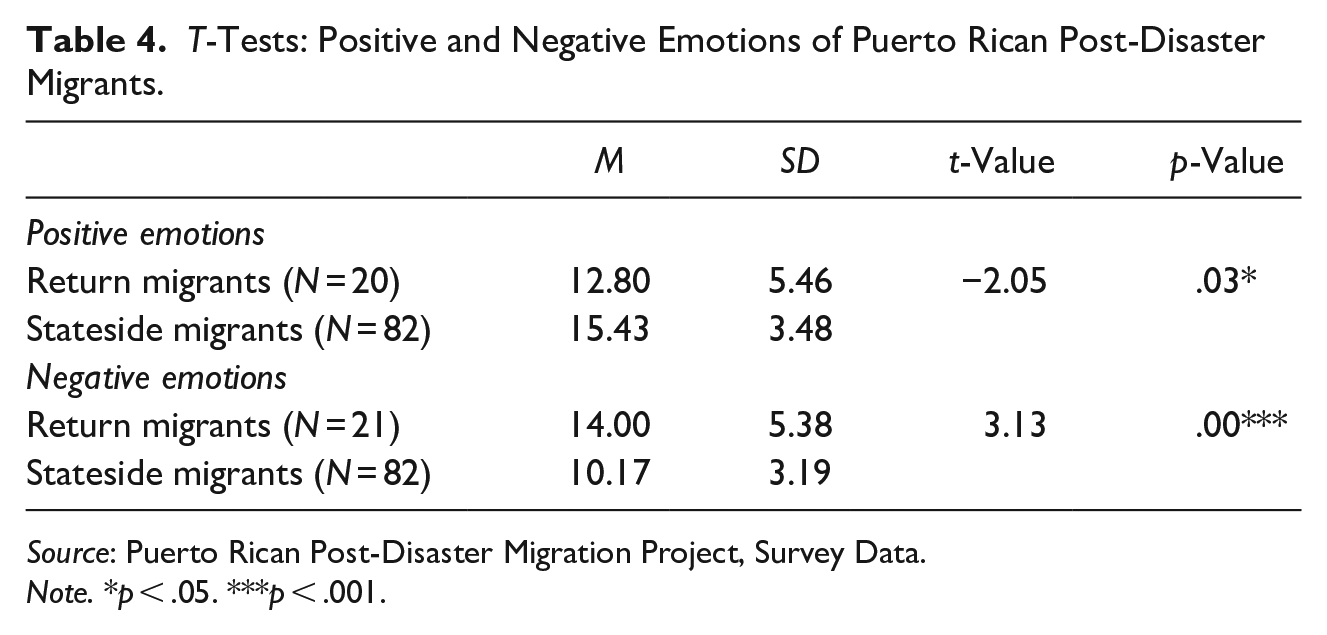
Source: Puerto Rican Post-Disaster Migration Project, Survey Data.
Note. *p < .05. ***p < .001.
Discussion and Conclusion
Our findings contribute to the broader literature on the subjective well-being of Puerto Rican post-disaster migrants to the United States and return migrants to Puerto Rico. Specifically, this study reveals that Puerto Rican post-disaster migrants who remained stateside experienced worsening subjective well-being during the COVID-19 pandemic and return migrants faced worsening well-being after returning to the archipelago and during the pandemic. Coupled with the previous trauma of experiencing the hurricanes which resulted in the loss of valuable and essential resources (e.g., housing, electricity, food, and water) and social networks, post-disaster migrants also face the insecurities that the COVID-19 pandemic brings (Clark et al., 2020; Rothman et al., 2020). These findings are consistent with disaster studies scholarship (Goldmann & Galea, 2014; Morganstein & Ursano, 2020) as exposure to, and the compounding effects of, both the hurricane and the COVID-19 pandemic are likely contributors to changes in self-reported mental health and overall subjective well-being of this population.
We found partial support for Hypothesis 1a, where return migrants experienced poorer mental health after migration (and upon return to the archipelago) than those who remained stateside. 4 In addition, we found support for Hypothesis 1b, that while stateside and return migrants both experienced declines in self-reported mental health, return migrants reported poorer mental health than those who remained stateside. Moreover, support is found for both hypotheses 2a and 2b. These findings suggest that Puerto Rican post-disaster migrants who returned to the archipelago reported more negative emotions, while those who remained stateside reported more positive emotions. Residents of Puerto Rico confront various insecurities such as poverty and economic challenges, housing issues, and inadequate health care, and these conditions have worsened due to the disasters related to hazards such as the hurricane, earthquakes, and more recently the COVID-19 virus (García et al., 2021). It is possible that return migrants confronted conditions upon return that were not much better than when they left and thus experienced a decline in subjective well-being given the lack of progress they saw.
Importantly, our study offers much needed insight into the subjective well-being of return migrants, illustrating that their self-reported mental health is worse, the prevalence of negative emotions is higher, and the presence of positive emotions is lower than stateside post-disaster migrants. These contributions raise questions about the conditions under which return migrants make decisions to repatriate and whether it is their experiences in the destination country, the origin country, or both that lead to comparatively worse subjective well-being. More research is needed on return migrants after post-disaster migration to answer these questions.
Despite this study’s contributions, there are several methodological limitations. First, this study is cross-sectional and retrospective. Therefore, our data do not allow us to know if both disasters’ effects are compounded and experienced jointly at the level of the individual. In addition, it is possible that issues with memory recall affected the self-reported mental health of migrants. Future research should examine longitudinal data to observe if disasters, both independently and cumulatively, predict decreases in self-reported mental health among Puerto Rican post-disaster migrants and returnees. Second, the sample size of post-disaster migrants was small, with 103 respondents, and only 21 migrants who returned to the archipelago. This prevented us from utilizing multivariate analyses that would account for the influence of other factors (i.e., disaster exposure, economic instability, acculturation, sociodemographic) on their emotional states. Future studies should examine if, and to what extent, disaster related, economic, cultural, and socio-demographic factors (among others) are associated with subjective well-being among migrants, and specifically among those who return to their origin countries.
Moreover, the difference in sample sizes between return migrants and those who remained stateside affected the statistical power, making it difficult to compare groups. As a result, caution must be exercised in interpreting these findings. Future studies should aim to employ larger sample sizes, as well as equal groups of both migrants and return migrants, to examine the influence of disasters on their subjective well-being. Last, the one-item measure of self-reported mental health captures a limited view of the cognitive component of subjective well-being over the course of Puerto Ricans’ migration journeys. Future studies should employ multiple measures of this aspect of well-being.
In sum, this study advances scholarship on the subjective well-being of Puerto Ricans who experience migration and return migration during particularly trying times. While prior research explores the impact of disasters, particularly Hurricane Maria, on the health and life outcomes of Puerto Ricans (Macias et al., 2021; Scaramutti et al., 2019), there remains a dearth of research exploring what happens to post-disaster migrants who remain in the continental U.S. compared to those who return to Puerto Rico. Our study begins to fill this gap. As an unincorporated territory of the United States, Puerto Rico lacks the aid and resources needed to combat the lingering effects of the hurricane and the COVID-19 public health crisis (García et al., 2021). Therefore, it is possible that Puerto Rican post-disaster return migrants face not only the challenges associated with migration but also reincorporating back into a society that was not well-equipped financially to handle the COVID-19 pandemic. Future work should focus more on return migrants and the conditions under which both settlers and returnees can thrive.
Footnotes
Acknowledgements
The authors would like to thank Nancy Hernandez, Maritza Novoa-Hadley, and Rebecca Blackwell for providing valuable assistance with this project. They are also appreciative of Elizabeth Vaquera for her insightful feedback on several iterations of this paper.
Declaration of Conflicting Interests
The author(s) declared no potential conflicts of interest with respect to the research, authorship, and/or publication of this article.
Funding
The author(s) disclosed receipt of the following financial support for the research, authorship, and/or publication of this article: This study was supported by the National Science Foundation, Grant Number 1918241.
