






Abstract
Moment to moment, a writer faces a host of potential problems. How does the writer’s mind coordinate this problem solving? In the original Hayes and Flower model, the authors posited a distinct process to manage this coordinating—that is, the “monitor.” The monitor became responsible for executive function in writing. In two experiments, the current authors investigated monitor function by examining the coordination of two common writing tasks—editing (i.e., correcting an error) and sentence composing—in the presence or absence of an error and with a low or high memory load for the writer. In the first experiment, participants could approach the editing and composing task in either order. On most trials (88%), they finished the sentence first, and less frequently (12%), they corrected the error first. The error-first approach occurred significantly more often under the low-load condition than the high-load condition. For the second experiment, participants were asked to adopt the less-used, error-first approach. Success in completing the assigned task order was affected by both memory load and error type. These results suggest that the monitor depends on the relative availability of working memory resources and coordinates subtasks to mitigate direct competition over those resources.
The act of writing is often described as “complex.” Of course, complexity can mean a variety of things. Some see writing as socially complex, while others view writing as cognitively complex. Within these two broad perspectives, there is a further divergence of opinions. On the cognitive side, writing theorists have generally held that complexity pertained to problem solving. Hayes and Flower’s (1980) original model provided a useful way of thinking about that complexity, as a system of cognitive processes employed for solving the various types of problems particular to writing.
When writing, one continually faces a myriad of potential problems (e.g., “Is this the right word?” “How do I spell ‘recommend’?” “Is that word spelled correctly? No? Should I correct it now or later?”). In any given moment, a writer may engage one problem, defer another, or remain ignorant of others. Seemingly, the ideal might be for this problem solving to unfold in an orderly series of tasks. However, the act of writing often appears messy. The writer stops to plan the next sentence, drafts a clause, notices a spelling error, fixes it, plans the next clause, and so forth. Typically, writing proceeds in “fits and starts.”
Rather than solving problems in an orderly sequence, Hayes and Flower (1980; for a discussion, see also Chenoweth & Hayes, 2003; Hayes, 1996) observed that competent writers seemingly “juggle” problem solving. That is, they typically move from solving one problem to another, in a seemingly haphazard fashion. To handle this juggling, the authors posited the existence of a “monitor” that controls how (a) editing and generating may “interrupt” other processes, (b) the writer’s goals guide the coordination of processes, and (c) individual differences in goal setting give rise to different writing profiles. Some educational studies have investigated the suspected role of monitor function by experimentally restricting transitions between writing subprocesses, through the use of checklists or outlines (for a brief review, see Klein & Leacock, 2012, p. 145).
Hayes and Flower’s (1980) model became highly influential in the field of writing research. In the original model, little is said about the monitor, apart from being a production system with a set of simple production rules. Subsequently, the authors explicitly tied their original model to the conception of working memory (WM; Baddeley & Hitch, 1974). In the process of this integration, the role of the monitor is not explicated. Presumably, it becomes a function of WM, but in what way? In their model of WM, Baddeley and Hitch (1974; subsequently updated, Baddeley, 2000) posited processes for handling visual information (visuospatial sketchpad), language information (phonological loop), and coordinating the system (central executive), as well as an interface between WM and long-term memory (episodic buffer). The central executive became responsible for the regulation and coordination of disparate cognitive processes (see also Baddeley, 2007). To some extent, the role of the monitor (as originally conceived) coincides with the role of the central executive.
However, there are problems with comparing the monitor to the central executive. Critics of Baddeley and Hitch’s model of WM (see Olive, 2012, for a critical review) often targeted this central executive, referring to it dismissively as a “homunculus,” a “little man” in the mind. If a particular cognitive process controls the function of all other cognitive processes, then one cannot understand the function of the latter without first understanding the former. For these critics, there can be no homunculus. Hayes and Flower’s monitor could become vulnerable to the same critique.
The central executive posed a host of challenges to cognitive researchers. They have searched avidly for a helpful alternative, in the form of a more tractable construct. Baddeley (1996) considered the central executive “certainly the most important component in terms of its general impact on cognition” (p. 5). At the same time, he admitted that the original conception was rather vague, a “ragbag into which could be stuffed all the complex strategy selection, planning, and retrieval checking that clearly goes on when subjects perform even the apparently simply digit span task.”
This close affinity with WM theory was not a coincidence. Both the original models (Baddeley & Hitch, 1974; Hayes & Flower, 1980) conformed to the information-processing approach, in which cognitive functioning is conceptualized as a system for processing information, with an interconnection of distinct subprocesses. Flower and Hayes (1981) formalized this affinity by grounding their model in WM theory.
For many people, writing is an everyday activity. Nevertheless, the act of writing often requires coping with complexity. For these reasons, cognitive researchers have been intrigued by the act of writing. Importantly, if writing involves complex cognitive processing, then it should tax limited WM resources. Many studies have implicated the importance of WM in writing (for instance, Bourdin & Fayol, 2000; Gathercole & Alloway, 2008; Kellogg, 1996, 1999, 2001; McCutchen, 1994; McCutchen, Covill, Hoyne, & Mildes, 1994; Piolat, Olive, & Kellogg, 2005; Piolat, Roussey, Olive, & Farioli, 1996; Ransdell & Levy, 1996). In his review of this research, Olive (2012, . 485) concludes that “the relationship between WM and writing is now well documented.” Collectively, the results of these studies suggest that cognitive processing—that is, the interaction of cognitive processes—is constrained by the availability of WM resources. Somehow these interactions are coordinated in some effective, goal-oriented way. Seemingly, the conceptual framework of WM requires executive functioning to provide a complete picture of cognition. However, in these writing studies, there is scarcely a mention of the specific function of the “monitor” or the “central executive.”
From the researcher’s perspective, there are sound reasons for avoiding the homunculus problem. Foremost, our understanding of executive function remains sketchy. In his conception of the central executive, Baddeley (1986) emphasized the role of attentional control, suggesting parallels to Norman and Shallice’s model (1986) of the supervisory attentional system. In their model, they
assumed that external stimuli automatically activate well-learned action schemas. When several schemas compete for selection, a so-called contention-scheduling mechanism resolves this conflict. However, in situations in which a goal-specific schema must be selected against strong competition, contention scheduling is not sufficient, and voluntary or endogenous control is necessary. It is assumed that this type of control is exerted by a supervisory attentional system (SAS) that affects the selection of schemas indirectly by biasing their activation. (as summarized in Hübner, Futterer, & Steinhauser, 2001, p. 640)
Norman and Shallice point out that the supervisory attentional system addresses the routine activation associated with coordinating subtasks but leaves unexplained other functions attributed to the central executive, such as planning, decision making, and the solving of novel problems. These latter functions are often involved in the act of writing.
Outside the domain of writing, executive function has been receiving some research attention. For example, Miyake, Friedman, Emerson, Witzki, and Howerter (2000) investigated the unity/diversity of executive function. In their study, undergraduates completed a battery of assessments, including five common measures of executive function, as well as nine measures targeting suspected aspects. Confirmatory factor analysis revealed that a three-factor model best fit the data, with a moderate correlation between factors. The three factors were interpreted as aspects of executive function: mental set shifting (or “task switching”), information updating, and inhibition. Each of these aspects of executive function has a clear relevance to writing.
Task Switching
Hayes and Flower (1980) observed writers in the act of composing while verbalizing their thoughts. From these observations, the authors concluded that proofreading and text correction (e.g., of typographical errors) often “interrupt” the continuity of text production. Subsequent studies, often by other researchers, have found similar results (Allal, Chanquoy, & Largy, 2004; Chenoweth & Hayes, 2001; Hayes, 1996; Leijten, Van Waes, & Janssen, 2010) and have led to an updated model of text production with four processes: a proposer, which generates ideas; a translator, which converts the proposed idea into linguistic strings; a transcriber, which converts them to strings; and an evaluator/reviser, which evaluates proposed and written language (Hayes & Chenoweth, 2006). The frequency and rapidity of task switching reported in the latter research—and operationalized as the length of R-bursts (i.e., language bursts that are terminated by a revision)—suggests that it may be relatively automatized.
The results of several studies suggest that switching between tasks draws some WM resources, as measured by task latency and accuracy (e.g., Jersild, 1927; Spector & Biederman, 1976). Although this “cognitive cost” may apply in other domains (e.g., Liefooghe, Barrouillet, Vandierendonck, & Camos, 2008), writing researchers have not examined whether or not it applies to their domain. However, it follows that certain high-load writing tasks might effectively minimize this cost, by limiting task switching (McCutchen, 1996). If so, this account of task switching would tend to support Bereiter and Scardamalia’s (1987) concepts of novice and expert writers, in terms of the knowledge-telling and knowledge-transforming approaches. That is, the cost of task switching may serve to constrain the relative recursiveness of writing, limiting him or her to a knowledge-telling approach. In contrast, a highly recursive approach to writing may somewhat depend on the availability of sufficient WM resources, which may in turn somewhat depend on automatized writing processes.
Updating Information
Updating information requires dynamically manipulating information (Lehto, 1996; Morris & Jones, 1990). It includes monitoring and coding incoming information, as well as using this new information to revise old information. Writing involves much of this type of processing, in both constructing and evaluating mental representations of language. In his review of the research literature, Kellogg (2008) concludes that highly skilled writers are capable of “representing and manipulating three different representations in WM. They do so by means of a complex interactions among planning, generation, and reviewing that must be coordinated through executive attentional control” (p. 11).
When writing, the writer synthesizes new information as she or he attempts to map written language onto ideas, choosing between alternative words and phrasing, organizing segments of text, and so on. The writer must also evaluate language representations, by reading the “text produced so far” (TPSF) (Hayes, 2012, p. 15; Kaufer, Hayes, & Flower, 1986). More experienced writers are in constant visual contact with their own text because attending the TPSF can provide a bases for building internal coherence, generating ideas, and/or visualizing possible revisions. Updating information is thought to depend heavily on available WM resources (Jonides & Smith, 1997; Lehto, 1996), which can help explain the high cognitive demands of writing.
Inhibition
Hedden and Yoon (2006) describe inhibition as the “suppression of unwanted or irrelevant representations, goals, and responses” (p. 512). At any given moment, a writer faces a host of possible problems in need of solving (e.g., “This idea or that idea?” “This phrasing or that phrasing?” “Did I spell that word correctly?”). If writers possessed a superabundance of WM resources, they might solve all these problems at once. However, WM resources are limited, and so the extent of problem solving is severely constrained. To channel limited resources to solving one problem, executive function must inhibit responses to other problems.
For example, suppose that a writer is completing a sentence, then suddenly notices an obvious typographical error. If she stops to correct the error, she may forget the phrase that she holds in WM, which she just formulated for completing the sentence. However, if she inhibits the correction response, she can complete the sentence, then correct the error afterward. Thus, by inhibiting the correction response, executive function simultaneously achieves two positive ends. First, it keeps the two types of problem solving from directly competing for resources, thereby mitigating the debilitating effects of interference. Second, it channels scarce resources to solving one problem at a time.
Editing/Proofreading: An Attention-Demanding Task
In their first observations of competent writers, Hayes and Flower (1980) observed that transcription might often be interrupted by editing. They defined editing as the process responsible for finding and correcting errors in the TPSF. It is a common activity for writers, since errors often occur during text production, whether via handwriting or keyboarding. In their original framework, Hayes and Flower (1980) characterized editing as a process responsible for error detecting, which is triggered automatically, interrupting other writing processes.
Some studies suggest that editing can operate any time (Chenoweth & Hayes, 2001; Hayes, 1996; Hayes, Flower, Schriver, Stratman, & Carey, 1987; Kellogg, 1996; Van Waes & Schellens, 2003). However, in contrast, Cohen and Poldrack (2008) found that “the ability to inhibit a motor response does not decrease with automaticity, suggesting that some aspects of automatic behavior are not ballistic” (p. 108). Thus, executive function may at times inhibit the function of other processes, even relatively automated ones, such as editing.
Before the writer corrects an error, one must identify it. Thus, editing involves both error detection and error correction. The former (proofreading) involves the application of reading skills to the problem of detecting errors. Investigations of proofreading have found it to be an attention-demanding task (Dampuré, Ros, Rouet, & Vibert, 2011; Pilotti, Maxwell, & Chodorow, 2006).
In previous studies, evidence was found that error correction may be inhibited when limited cognitive resources are available (Leijten, Ransdell, & Van Waes, 2010; Van Waes, Leijten, & Quinlan, 2010). In this line of inquiry, we employed a particular experimental paradigm in which participants were obliged to juggle two subtasks: completing a sentence and correcting a possible error in the TPSF. In the present studies, Experiments 1 and 2, we utilize this same experimental paradigm to examine the function of the monitor (i.e., executive function).
Research Studies: General Method
In two experiments, we examined the coordination of two common writing tasks: proofreading and sentence completion. We tested the hypothesis that strategies that “funnel central capacity to one or two processes, rather than many, should improve their functioning with regard to both effectiveness and rate” (Kellogg, 1996, p. 67). Participants were presented with items consisting of a partial sentence, some of which included a single error. Participants were asked to (a) complete the sentence (using given target words) and (b) correct the error embedded in the partial sentence, if present. According to Hayes and Flower’s (1980) model, completion of these subtasks should largely involve, respectively, (a) transcription (via keyboarding) and (b) editing. A dependent variable of particular interest was the order in which participants completed these subtasks, which we assumed reflected an important aspect of monitor function.
In Experiment 1, we examined the order in which participants completed the tasks, as a function of the relative difficulty of sentence completion and proofreading. In Experiment 2, we assigned a specific task order to the participants (i.e., first proofreading, then sentence completion) to examine whether this imposed “strategy” affected either proofreading or sentence completion.
In earlier investigations of proofreading and editing (cf. supra), researchers have introduced errors into participants’ previously written texts, then directed participants to find and correct those errors. While such an approach can provide evidence of participants’ abilities to edit, it does not reveal how writers coordinate editing with other writing processes. We were particularly interested in how error detection and correction might influence sentence formulation, and vice versa.
Method
Design and materials
In both experiments, participants first heard a partial sentence read to them and were then presented with one or three target words, which they had to keep in mind. Next, they were presented the dictated partial sentence, which they had to complete using the presented target words. The partial sentence could either contain an error or not, which had to be corrected.
Partial sentences were constructed of 9 to 12 words, containing the first clause of a complex sentence, plus a connector. Partial sentences contained sufficient local context to identify the error. Since domain knowledge has been shown to influence composing (McCutchen, 1986; Voss, Vesonder, & Spilich, 1980), partial sentences refer to relatively common experiences (for both men and women) with no rare or specialized vocabulary.
Under normal conditions, writers are familiar with their own text, which is the product of their own planning and formulating. To simulate this familiarity, we used auditory priming. By hearing the partial sentence read aloud, participants could begin to form a semantic and syntactic representation of the sentence, prior to seeing the target words. We assessed the efficacy of this auditory priming in a pilot study (see below).
To vary the cognitive demands of the sentence-composing task, participants were presented with either one or three target words and were asked to use these words to complete the sentence. We hypothesized that sentence-composing difficulty increases with the number of words that have to be integrated. Also, we hypothesized that maintaining three words in memory occupies executive control more than maintaining one word. If executive control is also needed for error detection and correction, then we expect a larger interference of the sentence-composing task with error correction in case of a three-word load compared to a one-word load (Olive, 2004; Olive, Favart, Beauvais, & Beauvais, 2009; Piolat, Roussey, Olive, & Amada, 2004). The target words were topically related to the partial sentence and were intended to provide content, to minimize the need to generate ideas in the sentence-composing task (see Table 1).
Sample Items Consisting of Partial Sentences and Corresponding Target Words
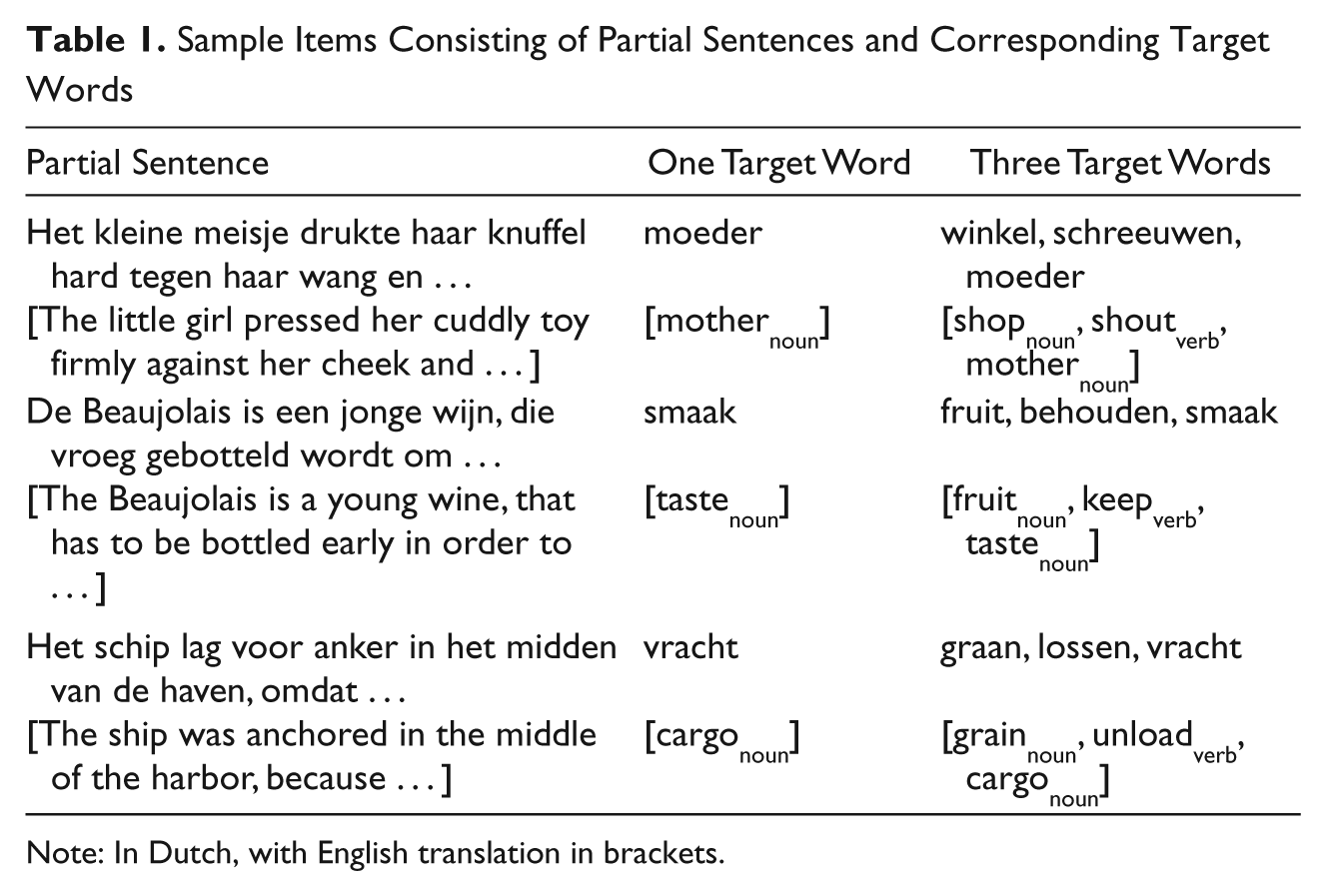
Note: In Dutch, with English translation in brackets.
Error type was manipulated within sentences and within participants. Each partial sentence contained a single word position that was occupied by one of three possible error types: the correct word (no error), an orthographic near-neighbor error of the correct word (near error), or an orthographic far-neighbor error of the correct word (far error). We opted to only include real-word errors (see Table 2). For example, a writer might confuse the word forms “there” and “their.” In this example, both forms are orthographically correct. Near and far errors were constructed in relation to the correct word, sharing the same word class, number of syllables (two or three), and a comparable word frequency. Errors deviated from correct words according to internal graphemes in the onset of the unstressed syllable: with near errors deviating only one phoneme and one or two graphemes and with far errors deviating by two phonemes and more than two graphemes. According to this definition, the above example (“there” vs. “their”) would be considered a near error. Within the partial sentence, errors were located internally, never as the first or last words, and equally distributed between nouns and verbs. Thus, errors filled the same syntactic role as the correct words while being semantically at odds with the context of the partial sentence (Hacker, 1994, 1997).
Sample Partial Sentences With Error Word in Three Positions
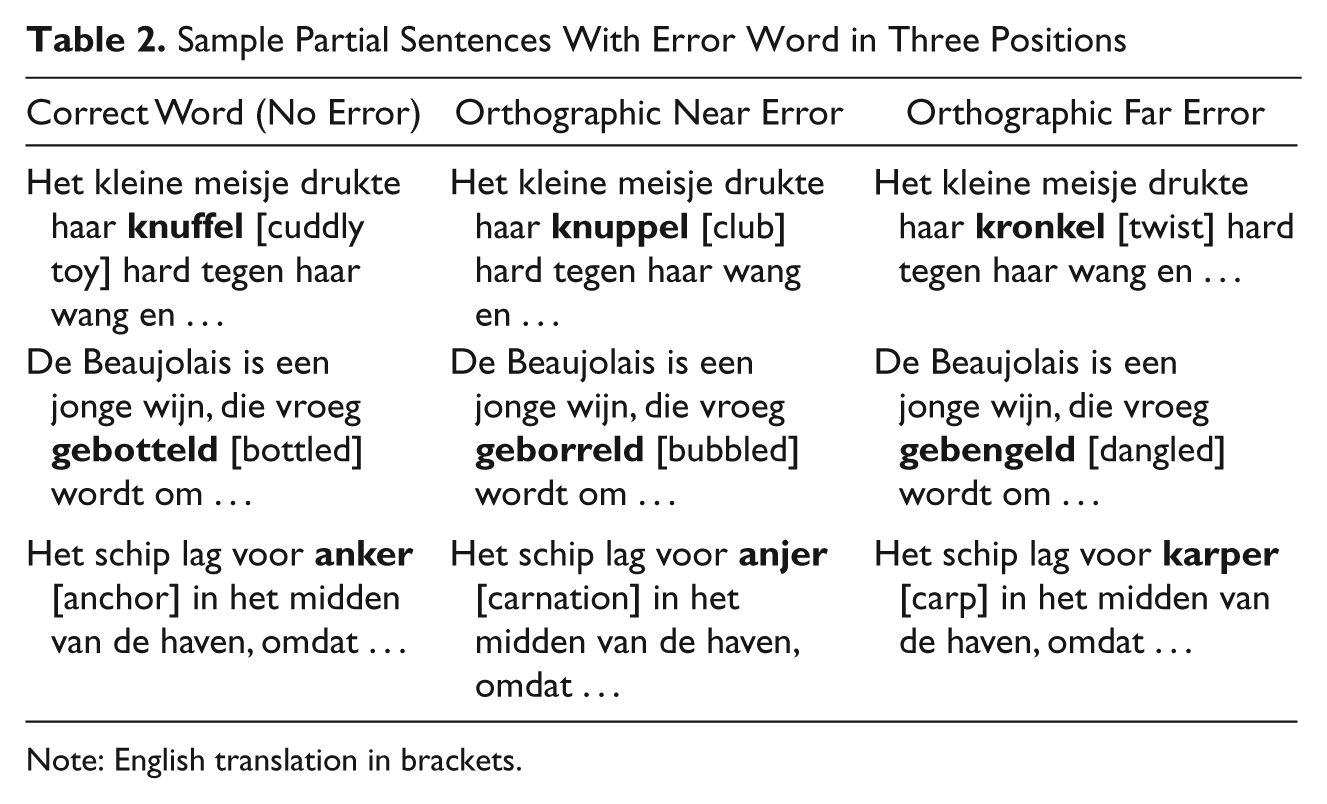
Note: English translation in brackets.
In distributing errors across the items, we wanted to approximate proofreading. For experienced writers, most errors occur unexpectedly. Sometimes a finger slips during typing; other times the writer mentally selects one word but types another. We did not want to bias participants’ expectations about the likelihood of encountering an error, either one way or the other. A 50% probability of encountering an error seemed appropriate. Consequently, approximately 50% of partial sentences held a correct word, while the other 50% held either a near or far error. All participants encountered the partial sentences in the same order; however, the two independent variables (number of target words and type of error) were counterbalanced across participants.
Apparatus and procedure
Data were collected from each participant individually in a single session of approximately 1 hour. All materials were presented in Dutch. Throughout the session, the participant wore audio headphones.
Trials were administered by computer via a custom-designed program. Keystroke, mouse movements, and clicks were logged with Inputlog (Leijten & Van Waes, 2006). The items were designed to simulate actual conditions under which writers coordinate two aspects of writing: sentence completion and error detection/correction. Participants encountered the partial sentences in the same order, while the condition in which the sentence was presented (number of context words and type of error) was counterbalanced across participants.
Each task consisted of four screens, presented sequentially:
Screen 1: An opening screen, which the participant had to click to begin the item.
Screen 2: A blank screen, during which the partial sentence was read aloud by the system (auditory priming), twice, in succession.
Screen 3: One or three target words were displayed (in a line, separated by commas) at the bottom of the screen (for 1 and 3 seconds, respectively). Participants were instructed to memorize these words.
Screen 4: The text version of the partial sentence (as read aloud in Screen 2) was displayed on the screen, which might have contained an embedded error. Participants were directed to use the keyboard and mouse to do the following two tasks: (a) correct the error (if present) and (b) complete the sentence using the one target word or all three target words displayed on Screen 3.
Upon completing an item, the participant clicked “ok.” Note that in Experiment 1, participants were allowed to complete Tasks 4a and 4b in either order, whereas in Experiment 2, they were asked to correct the error first Screen 4: “Task a” and “Task b”
In preparation for the experimental items, participants viewed a short (30-second) video demonstrating an experimental item, along with instructions. After completing four practice items, the participants began the 42 experimental items. Participants were directed to work quickly and accurately.
To evaluate whether audio priming actually facilitated both sentence composing and error correction, we pilot-tested the experimental items, apparatus, and procedures on 28 undergraduate students. The items were presented to the participants according to the procedure described above, with one alteration: Half (21 items) were presented with audio priming and the other half (21 items) without. The results showed that auditory priming significantly improved participants’ overall performance on the items, in terms of successfully completing the sentences (using the target words), successfully correcting errors, and reducing the average time on each item. The results of this pilot test suggest that this audio priming provided the desired facilitating effect and so could serve to simulate the familiarity that writers might have in composing their own text.
Experiment 1
When two writing subtasks compete for selection, how does executive function resolve the conflict? In Experiment 1, we examined executive function in terms of task scheduling, the order in which writers coordinate two common writing tasks (editing and sentence completion). In this experiment, participants were free to complete the two tasks in either order. Given the load associated with holding target words in WM, we hypothesized (a) that participants would tend to complete the sentence first (to discharge the load from WM), then proceed to correct the error, and (b) that this tendency is more stronger when they have to correct a far error as opposed to a near error.
Method
Participants
Forty-one undergraduate and graduate students (16 male, 23 female) participated in the study. Their mean age was 21.8 (SD = 4.1). All participants were native Dutch speakers who received €7.50 for participating.
Apparatus and procedure
This experiment followed the procedure described above but with one exception: Participants were instructed to complete the two subtasks in either order, according to personal preference.
Measures
Foremost, to capture how executive function coordinates problem solving, we recorded the order in which participants completed the subtasks. “Task order” indicated the location of the participants’ first action: a mouse click either (a) at the end of the partial sentence, to signify the start of sentence completion, or (b) within the error, to signify editing.
To capture the accuracy and speed of participants completing the items, we collected a variety of measures. As a measure of sentence completion, “target word score” was calculated as the percentage of responses that used the target word or all the target words to produce a grammatical sentence. As a measure of error correction, an “error score” was calculated as the percentage of responses in which the error was corrected successfully.
To measure time on task for each item, the system automatically captured the latency (in seconds) for two phases of task completion, before and during. “Start time” was recorded as the duration between the display of the text of the partial sentence (the end of Step 3 of the item) and the participant’s first keystroke. “Production time” was calculated as the duration between the participants’ first mouse click/keystroke and clicking “ok” to close Screen 4.
Results and Discussion
We used a repeated measures analysis of variance to evaluate the effects of the factors (error type and memory load) on the dependent measures. A summary of the results is presented in Table 3.
Mean Performance by Memory Load and Error Type (with Standard Deviations in Parentheses)
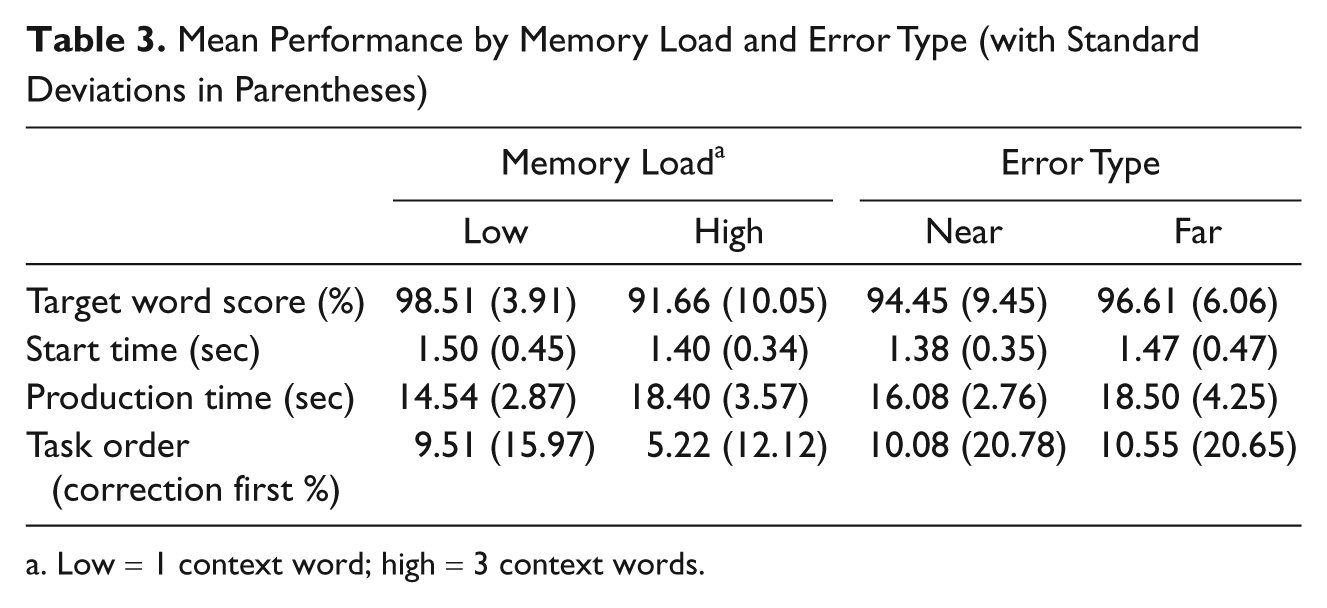
Low = 1 context word; high = 3 context words.
Target word score
A main effect revealed that participants were significantly more successful in the integration of one target word (M = 98.51) than three target words (M = 91.66) in the sentence completion, F(1, 31) = 10.95, p < .01, ηp2 = .261. No effect on the target word score was found for the type of error (M = 94.45 vs. M = 96.61; p = .234, ηp2 = .045).
Start time
A marginally significant main effect for start time, F(1, 31) = 3.97, p = .055, ηp2 = .114, suggests that participants spent longer prewriting time when integrating one target word (M = 1.50 seconds) than three target words (M = 1.40 seconds). There was no effect for error type.
Production time
As expected, participants spent significantly longer when integrating three target words (M = 18.40 seconds) relative to one target word (M = 14.54 seconds) in the sentence, F(1, 31) = 1.41, p < .001, ηp2 = .820). Sentence completion was thus harder with three target words than with one target word. Also, error type influenced the overall time to complete the task, F(2, 30) = 22.96, p < .001, ηp2 = .328. The post hoc analysis indicated that production time was significantly longer when it involved correcting an orthographic far-neighbor error (M = 18.50) than a near-neighbor error (M = 16.08, p < .001), which in turn took longer than no error (M = 14.76, p < .001). No interaction effect was found (see Figure 1).
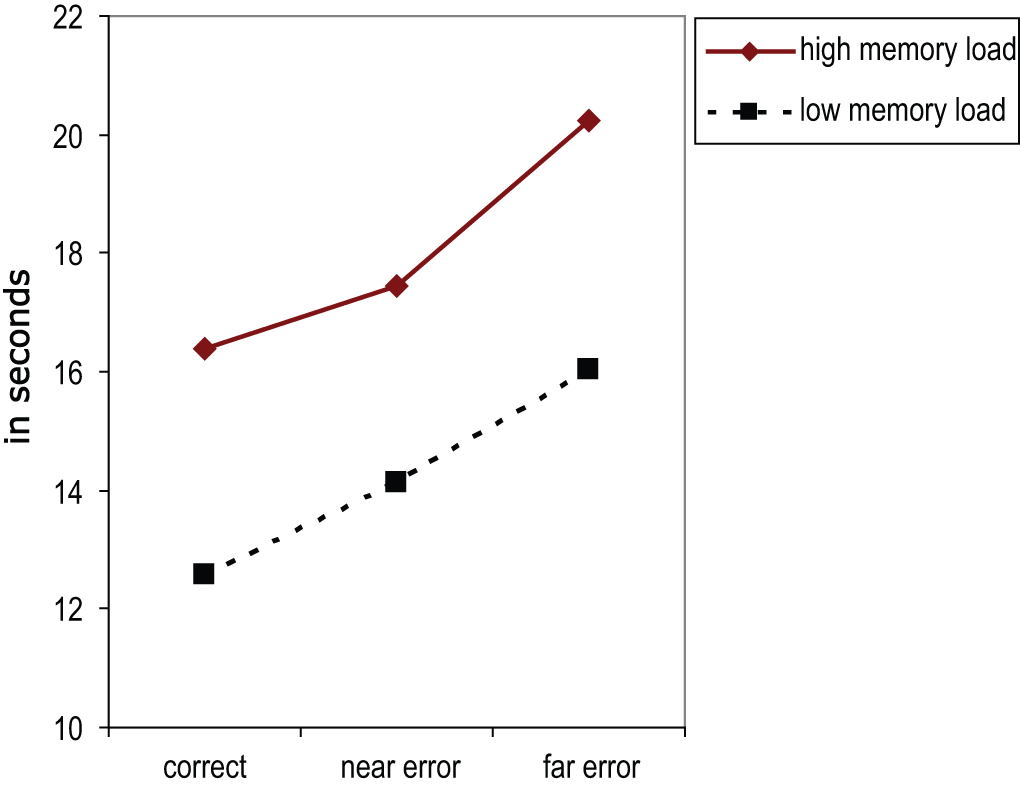
Production time in relation with memory load and error type
Task order
In the present experiment, participants were free to choose the order in which they completed the tasks of error correction and sentence completion. For most trials, participants finished the sentence first and less frequently corrected the error first. By completing the sentence first, participants freed themselves from the load of keeping the target words active in WM, which allowed them to proceed to error correction unencumbered. However, participants sometimes opted to correct the error first. A main effect for memory load indicated that participants more frequently opted to correct the error first when asked to use one target word (M = 9.51%) relative to three target words (M = 5.22%), F(1, 31) = 10.14, p < .01, ηp2 = .260. There was no effect of error type on task order (M = 10.08 vs. M = 10.55; p = .771, ηp2 = .003).
Participants most often chose to finish the sentence before correcting the error. This should be a more efficient approach, in at least two ways. First, completing the sentence (i.e., putting the target words into a clause or phrase) immediately relieves the load on WM, freeing resources, and minimizes the chance of forgetting the target word or words. Once the sentence is complete, the participant may search for the error, unencumbered by the other task. Second, in the process of completing the sentence, the participant will have visual contact with the partial sentence, which may yield detection of an error.
Participants rarely adopted the error-first approach. However, when they did, it occurred significantly more often when the load of sentence completion was low (i.e., one target word). This result suggests that a low load during sentence composing leaves sufficient WM resources available for doing other things, such as detecting and correcting errors.
Participants were generally able to successfully carry out the two subtasks. Notably, error type did not appear to affect participants’ ability to complete the sentences, nor did the complexity of the sentence-composing task influence their success in correcting errors. Only production time increased with the complexity of the error. It is possible that the observed task order reflected executive function scheduling of the two subtasks, to manage the cognitive demands of each.
Experiment 2
In Experiment 1, participants were more likely to correct the error first when the demands of sentence composing were low. This result leaves open the possibility that deferring error correction may serve to help manage the cognitive demands of completing the two subtasks. This possibility gave rise to a new research question. What might happen to performance if participants were required to adopt the less-used, presumably less-efficient approach?
In Experiment 2, we examined this question by asking a new set of participants to adopt the less-used approach in Experiment 1—that is, finding and correcting errors before completing the sentence. This error-first approach would require participants to search for and detect an error, which may or may not be present, and then correct it while maintaining the target word or words activated in WM. In so doing, they would be at risk of forgetting the target words, which would render them incapable of accurately completing the sentence. We hypothesized that imposing this less-used approach would degrade the accuracy of sentence completion and/or error correction.
Method
Participants
Twenty native speakers of Dutch (11 female, 9 male), all of them students, took part in the experiment. Their mean age was 21.75 (SD = 1.80). Participants received a gift vouchers worth €5.
Apparatus and procedure
This experiment followed the same procedure as Experiment 1, with one important change: Participants were asked to first correct the error (if present), then complete the sentence. The stimuli program in combination with Inputlog automatically recorded participant performance, including the order of subtasks.
Results and Discussion
The procedures of Experiments 1 and 2 were exactly alike, except for one detail. In Experiment 2, participants were asked to correct the error first before completing the sentence. This assigned task order became an important dimension of performance on the experiment items. Accordingly, task order became a new criterion for scoring participants’ success in completing an item. Apart from this new measure, we analyzed the same set of dependent measures as in the previous experiment.
As in Experiment 1, we used a repeated measures analysis of variance to evaluate the effects of the factors (memory load and error type) on the dependent measures. A summary of the results is presented in Table 4.
Mean Performance by Memory Load and Error Type (with Standard Deviations in Parentheses)
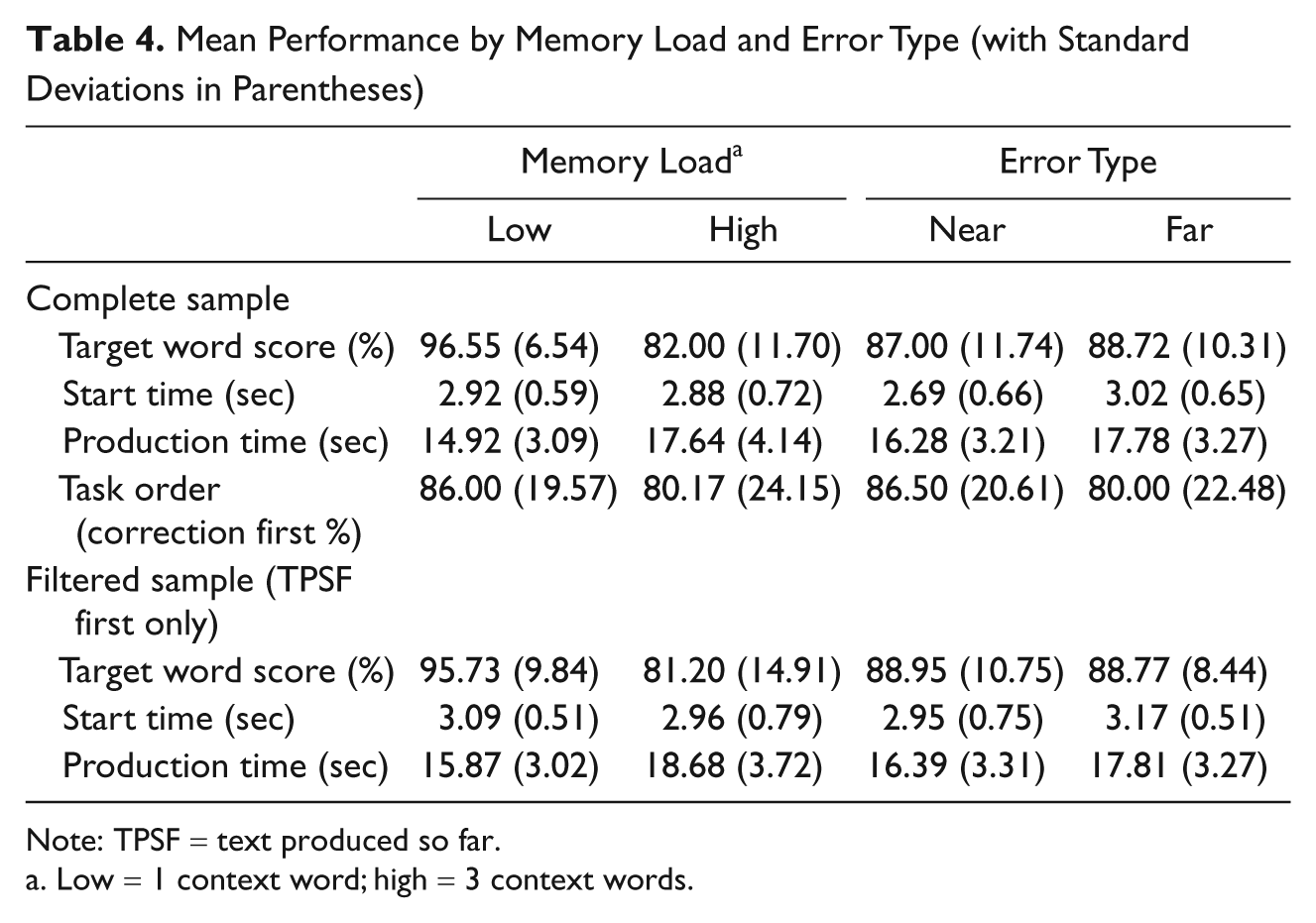
Note: TPSF = text produced so far.
Low = 1 context word; high = 3 context words.
Target word score
In the integration of target words into their sentences, participants were significantly more successful with one word (M = 96.55) than three words (M = 82.00), F(1, 19) = 25.43, p < .001, ηp2 = .572. This finding agrees with analogous analysis in Experiment 1; however, the results for the high memory load condition decreased with more than 10% due to the imposed task order. We did not observe a degradation in performance with respect to the type of error (M = 87.00 vs. M = 88.72; p = .591, ηp2 = .015).
Start time
The start time was not significantly affected by memory load. However, when far-neighbor errors in the TPSF are encountered relative to near-neighbor errors, the time needed to begin the item increased significantly (M = 2.69 seconds vs. M = 3.02; p < .01, ηp2 = .395).
Production time
As in Experiment 1, participants spent significantly longer when integrating three target words (M = 17.64 seconds) relative to one target word (M = 14.92), F(1, 19) = 20.49, p < .001, ηp2 = .519. Moreover, the type of error influenced the overall time to complete the task, F(2, 18) = 16.10, p < .001, ηp2 = .373. The post hoc analysis indicated that completing and correcting sentences with orthographic far-neighbor errors took significantly longer than near-neighbor errors (M = 17.78 vs. M = 16.28, p < .01), with both conditions taking longer than the no-error condition (M = 14.77, p < .05).
Task order
In Experiment 2, we asked participants to adopt the less-used approach (in Experiment 1)—that is, finding and correcting the error before finishing the sentence. However, in a limited number of cases, some participants failed to complete the subtasks in the required (error-first) order. Two main effects indicated that success in following the assigned task order was influenced by the number of target words and error type: target words, F(1, 19) = 5.01, p < .05, ηp2 = .216, and error type, F(1, 19) = 5.62, p < .05, ηp2 = .299. Thus, participants were more successful in following the assigned task order when either subtask was less cognitively demanding, namely (a) juggling fewer target words (one vs. three words) or (b) facing a more obvious error (far- vs. near-neighbor error). We did not observe a significant degradation in performance in terms of either target word score or error score.
These results suggest that the coordination of writing subtasks depends on the relative demands of those subtasks vis-à-vis the availability of cognitive resources. For this result, there are at least two plausible explanations. First, it is possible that participants read the sentence, failed to detect the error on the first scan, proceeded to complete the sentence—and only then detected the error, which they subsequently corrected. Or, second, it is possible that the error was detected (either fully or partially) after the first scan but executive function inhibited an immediate correction response. Participants were more successful in adopting the less-preferred error-first approach when the cognitive demands were less, whether for sentence completion or error correction.
To not confuse the data analysis with the cases in which participants did not follow the task instruction, we reanalyzed the data excluding these observations (see Table 4, second part). All the results reported above were confirmed (and reinforced) except for one minor difference: the effect of starting time for the near- versus far-error condition presented (M = 2.95 seconds vs. M = 3.17; p = .207, ηp2 = .083).
General Discussion
To investigate how the monitor coordinates the solving of disparate types of problems, the present investigation focused on the coordination of two common writing subtasks: a sentence-completion task and an error-correction (editing) task. In Experiment 1, participants were instructed to complete the two subtasks in either order. On 88% of the items, participants completed the sentence first, before correcting the error. On a minority of items, participants adopted the opposite approach, correcting the error first. They adopted this error-first approach significantly more often when the cognitive load for sentence completion was low relative to the high-load condition. In Experiment 2, participants were instructed to correct the error first (if present), before completing the sentence. On a majority of items, participants succeeded in following this assigned approach. However, on a minority of items, participants failed to correct the error first (as instructed). This type of failure occurred significantly more often when either the error was more difficult to detect or the load of sentence completion was high. Thus, in both experiments, the relative complexity of the two subtasks affected the order of task completion. Neither of the two main factors significantly affected the speed or accuracy of participants’ responses. The results of Experiments 1 and 2 indicate that aspects of the writing task may influence the coordination of writing subtasks.
The results of Experiments 1 and 2 suggest that the coordination of writing subtasks depends on the relative availability of WM resources. When task demands were high, the monitor more often shifted toward the efficient approach (Experiment 1); when participants were asked to adopt a less efficient approach, we still often observed a shift toward a more efficient approach, particularly when the demands of sentence completion were high (Experiment 2). As an aspect of monitor function, these results suggest that the coordination of subtasks may depend on the relative availability of cognitive resources. Furthermore, one role of the monitor may be to bias the scheduling of writing subtasks to better manage limited WM resources. This conclusion is in line with the findings about language bursts in Chenoweth and Hayes (2003) and Hayes and Chenoweth (2006, 2007). These studies found that “bursts occur because of limitations in the resources available to the translator” (Hayes & Chenoweth, 2007, p. 284), and suggested that the translator can process only a limited amount of input to produce a language string. These limitations could also be affected by activities of the evaluator/reviser component, as triggered by errors in the TPSF, for example, leading to an evaluation of proposed and written language.
One way to increase efficiency is to minimize direct competition over limited WM resources. Some writing tasks may be processing intensive (e.g., finding a subtle error may require processing semantic, syntactic, and lexical information), while others may be more time sensitive (e.g., when writers have certain ideas or words “in their head,” they must write them down before they forget them). The monitor must somehow coordinate these disparate tasks, presumably in some goal-oriented way. Toward this end, the monitor may minimize the occasions of one subtask hindering (or interfering with) the performance of another.
Beyond providing insights into writing cognition, these results have implications for instruction. The deferring of editing is consistent with two divergent approaches to writing instruction: the process approach and the dual-draft approach. In the process approach to writing instruction (see Graham & Perin, 2007, for a review), students learn to structure the overall task of writing into distinct phases of planning, drafting, revising, and editing. Although the process approach recognizes the recursiveness of these phases, in the classroom editing typically becomes the final phase in the writing process. In Elbow’s (1973, 1981) dual-draft approach, Elbow advocates fluent, unfettered drafting, followed by extensive revising and editing. Both approaches provide a way to manage the complexity of the overall writing project. Although appearing superficially quite different, they both rely on a similar principle: organize the act of writing to mitigate the need for frequent shifts between producing and evaluating. Albeit in somewhat different ways, both approaches effectively channel limited cognitive resources toward a particular type of problem solving.
The results of the present investigation have some limitations. First, to examine the coordination of sentence completion and editing, we employed a simplified writing task. Thus, our results may or may not generalize to more “authentic” instances of writing (e.g., composing an e-mail or an academic essay). Second, our sample included university undergraduates (i.e., more-skilled writers). Thus, it remains unclear how the results of this investigation might generalize to other populations, such as novice or struggling writers. If the coordination of writing subprocesses depends on the relative availability of cognitive resources, future research could investigate the extent to which deficiencies in this coordination might help account for writing difficulties in these populations.
Footnotes
Declaration of Conflicting Interests
The author(s) declared no potential conflicts of interest with respect to the research, authorship, and/or publication of this article.
Funding
The author(s) received no financial support for the research, authorship, and/or publication of this article.