







Abstract
Most of the literature on the assignment traditionally called the research paper focusses on first-year students, and often centers on what they don’t know or can’t do. This article seeks to expand the conversation to one about the skills and knowledge displayed by senior students, and about their perceptions of the universe of academic research and their place in it. It does so by means of a qualitative study of 13 senior students at the University of Calgary. Through interviews, I probe their understanding of their own research processes, how they think they learned to do what they do, and, most important, their understanding of what it means to conduct academic research.
Despite rumors of its death in 1982, when Larson declared it a “non-form of writing,” the research paper in one form or another remains an extremely common assignment in postsecondary education, and the conversation about exactly what it is, why it is or is not useful to assign it, and how or whether students should be taught how to do it, continues unabated.
Most of the literature on this form of writing focuses on first-year students, their understanding of research processes, and (often) how their transition to university-level research-based writing can be made least traumatic. The difficulties that students experience while making this transition are many. Yet somehow, by the time they have reached their senior year, at least some undergraduates have become reasonably proficient, though generally far from expert, at constructing papers based on sources. In this article, I seek to extend the conversation beyond first year to look at the skills and knowledge displayed by senior students in a variety of disciplines, and their perceptions of how they acquired these skills and knowledge. In addition, I look beyond their skill sets to investigate what these senior students understand by the role of research itself in the larger realm of academic life, not just for students but for academics in general.
I do so by means of a qualitative study of 13 senior students at the University of Calgary, a larger western Canadian research university. 1 Although I ask questions about what they seem to know about research and what strategies they employ in their own research writing, I do not do so primarily to identify what they do and don’t know about research in order to develop pedagogies to help them get better. Pedagogical improvement is always a useful outcome of any research, but I am wary of the deficit model that starts by identifying problems and gaps in order to fix them. Rather, I seek to use their own perceptions of their research processes to deepen our picture of what such students think of the research community in which they are immersed, and their own identities within it.
Related Research
Although exact figures vary considerably, as does the definition of the research paper, surveys spanning many decades show that some form of writing that involves finding and using secondary sources has been and continues to be a very common assignment in both writing courses (Ford & Perry, 1982; Hood, 2010; Manning, 1961) and in a wide variety of disciplinary settings (Bridgeman & Carlson, 1984; Melzer, 2009). Although most of the earlier studies don’t clearly define the research paper, evidently considering this definition more or less self-evident, later studies such as Hood’s and Melzer’s distinguish more carefully between what Hood calls the traditional research paper, and alternative forms of research-based assignments. Hood defines the former as “an informative/explanatory piece of writing, written in an objective voice, using library resources (including online databases)” (n.p.). Alternative assignments include researched arguments, proposals, ethnographies, action plans, and many other forms that require students to find out things, at least partly but not exclusively from secondary sources, and do something with them besides weave quotations and paraphrases into overviews of the already-known. In fact, in Hood’s sample, the traditional research paper accounted for only 6% of assignments in first-year composition. Melzer is less numerically exact, but he also reports that relatively few assignments in his cross-disciplinary survey fit the model that he calls, borrowing from borrowing from Davis and Shadle (2000), the modernist research paper. Many more are alternative assignments that value the creation of new knowledge.
It’s not completely clear why this form—in either its traditional or alternative manifestations—is so resilient. One argument for introducing the research paper in first year composition is that teaching the research paper gives students tools that they will use in later courses. This traditional stance is hard to sustain given the increasing belief in the situated nature of writing and in the futility of what Russell (1995) has labeled General Writing Skills Instruction—skills sufficiently general that they can be transferred to the vast range of specific contexts and expectations represented by the disciplines. It also doesn’t account for the emphasis on research writing in the disciplines themselves. Why do instructors in disciplines as disparate as engineering, psychology, and nursing feel it necessary to require students to use various combinations of primary and secondary materials to produce written texts, particularly when so few undergraduate students are likely to go on to graduate school and ultimately academic careers?
One possible justification is that a university education ought to be instilling a research habit of mind in students who may go on to a wide variety of professions outside the academy, producing graduates who, when faced with a question, turn instinctively to some form of research (empirical or otherwise) to answer it. Another, somewhat related argument is that assigning various kinds of research writing is a way to enlist students as apprentices, or legitimate peripheral participants as Lave and Wenger (1991) call them, in the knowledge-generating community that is the research university. An important, or perhaps the most important, feature of the academic environment is its cultivation of a spirit of inquiry and the sense that an academic discipline is a fluid edifice built on conversations among a vast range of texts, both competing and complementary in various ways, representing a continual building and reshaping of the collective knowledge of the discipline. It is therefore important to help students understand and experience the lifeblood of this academic enterprise. Schwegler and Shamoon capture this motive in their 1982 article “The Aims and Processes of the Research Paper”: “College instructors view the research paper as a means to accomplish one of the primary goals of college instruction: to get students to think in the same critical, analytical, inquiring mode as instructors do” (p. 821).
I have reviewed, and added to, these arguments in detail elsewhere (Brent, 2013), and I won’t rehearse them here. But it seems clear that we need to know as much as we can about a practice as ubiquitous as research writing. Over the past 30 years or so, a wide variety of methodological lenses have been brought to bear on the question of what students do when they write from sources and how they learn to do so. One rich vein of research is the cognitive process approach of Flower, Nelson and Hayes, and a number of others primarily associated with the Center for the Study of Writing at Berkeley and Carnegie Mellon. It is this group of researchers that suggested replacing the term research paper, with its implication that it is the product that somehow defines the genre, with the term writing from sources, which emphasizes what students do rather than what they produce at the end of the process.
More recent approaches move beyond the apparatus of cognitive process theories, with their tendency to work from the assumption that General Writing Skills Instruction is possible or desirable, to investigate the role of discipline-specific genre expectations in the construction of research papers. A paradigmatic case is Bazerman’s (1988) groundbreaking Shaping Written Knowledge, which redirected attention to what specific kinds of situated research-based writing, particularly in the sciences and social sciences, actually do, and away from the traditional standardized forms frequently found in first-year composition classes.
Studies of this sort have transformed our understanding of writing from sources. However, a significant limitation of much of this work, particularly that which springs from the composition studies tradition, is its almost exclusive focus on first-year, or at most sophomore, students. This limitation is found in an overwhelming number of studies right up to the most recent cluster of studies associated with Rebecca Moore Howard and the Citation Project (e.g., Howard, Rodrigue, & Serviss, 2010).
This focus is understandable given that students at the boundary of the academy are the most likely to present with difficulties adjusting to the new educational landscape into which they have been thrust. However, this focus on students at the boundary threatens to obscure the fact that learning to write from sources, like learning any of the practices of the academy, is at least a four-year process of gradual acculturation, a process that continues through graduate school if a student takes that direction, and arguably can continue over the span of an entire career.
When I teach an advanced course, I still notice a broad range of ability to approximate academic discourse. However, I also notice that students who are beginning to work toward an approximation of the expert research model start to outnumber the ones who are still floundering. Not only do they seem to have more efficient research strategies, but more important, some reveal a deeper understanding of and respect for academic inquiry—in whatever form is appropriate to their respective disciplines—as a means of knowing. How did those students get where they are?
In addition, it is important to know more about how they think academic research actually works. If an important purpose of requiring students to write from sources is to engage them in the meaning-making practices of the university, then important questions include to what extent they have become acculturated to those practices, the extent to which they feel a part of them, and how they think they got to that understanding. As noted earlier, my central research question is not “What do these students know about research?” I ask this question only as a means of getting at what I believe to be a deeper question: How do they conceptualize the academic research community, and what do they think of their role in it? In short, I am asking questions about their still-developing identities, and about the forces that they identify as critical in shaping those identities.
Theory and Method
This inquiry uses the epistemological lens of Academic Literacies and its close analog Information Literacies. Drawing explicitly on Rhetorical Genre Studies as represented by writers such as Bazerman, and Berenkotter and Huckin (Lea & Street, 2006, p. 369), the Academic Literacies perspective builds on, but seeks to move past, the assumption that students need to be acculturated into the discourse practices of their respective disciplines (Russell, Lea, Parker, Street, & Donahue, 2009, p. 400). Academic Literacies sees discourse practices as inseparably linked to epistemology. To learn new discourse practices is to learn a new way of making meaning from the world, a new epistemology and to some extent a new identity, not just a new set of skills (Lea & Street, 1998, p. 159). Hutchins, Fister, and MacPherson (2002) write that the ultimate aim of this process is to create conditions that enable students to perceive themselves as active players in the production of knowledge and to understand how, in fact, knowledge is produced so that they can continue active participation in it beyond their college years. (p. 15)
It is important to note the plural in the word Academic Literacies. This school of thought seeks to avoid giving the impression that there is a unitary academic literacy, just as composition theorists have largely rejected the notion of General Writing Skills Instruction. Writers in the Academic Literacies tradition take account of the fact that students must continually code-switch as they move between sets of disciplinary conventions in various courses, and even from one instructor to another. Learning to navigate these boundaries is not just key to becoming a successful student; it is also key to engaging with a diverse set of epistemological stances as instantiated in those varying conventions. This interpretive flexibility is, I would argue, one of the chief goals of a liberal education.
From a methodological perspective, Academic Literacies insists that we look past students’ written texts and pay attention to students’ own ways of making meaning as seen through their experience of academic practices. Lea (1998) positions her Academic Literacies work in the phenomenographic tradition, which she describes as being focused not so much on what students do in any objective sense, but rather on how they understand and describe what they do, and how they conceive of learning itself (p. 157).
In keeping with these perspectives, I used semistructured interviews with students as a way of understanding what they perceive their own research practices to be, what they understand as the discourse practices of the academy in general, and the degree to which they appear to be approximating some form of match between the two. Many other methods have been used to get a more fine-grained look at what students do when writing from sources, including detailed process logs (Nelson, 1995), think-aloud protocols (Kantz, 1989), textual analyses, often with detailed coding schemes (Howard et al., 2010), and even screen-capture technology that leaves a moment-by-moment record of students’ research processes (Silva, 2011). All of these methods potentially offer a more accurate picture of what students “really” do when they are writing from sources, relatively unburdened by lapses of memory, incomplete self-knowledge, and possibly a desire to look competent in the eyes of the interviewer. However, asking students to report on their own processes and understandings is more in line with the goals set out by Lea’s phenomenographic method, concerned less with what students can be observed doing and more with how they themselves describe and understand learning tasks.
I drew my sample from arts students in their final year of study at the University of Calgary, which is typical of a larger university in what in Canada is called the medical-doctoral category, meaning one that has an explicit research-oriented agenda that seeps from the graduate level down, in attenuated form, to undergraduate education. My call for volunteers yielded 13 participants from a wide range of disciplines in the Faculty of Arts, including communications studies, anthropology, psychology, film, development studies, general studies and education. By limiting my sample to students in the University of Calgary’s sprawling Faculty of Arts, I left open the possibility that students in other areas such as science, engineering, and other professional faculties may well have a very different sense of what research means. I did this consciously to limit the range of the study and to avoid taking on the important but very different question of the meaning of research and the processes appropriate to it outside the liberal arts.
Within arts, I have made no attempt to parse results by discipline. With Ns of one or two, any attempt to see patterns grouped by discipline would be folly. A thorough investigation of disciplinary genre conventions is the province of studies that focus on a much deeper investigation of a much more limited range of disciplines. I designed this study to capture broader patterns.
Not all of the students had studied exclusively at the University of Calgary, many having transferred from other institutions such as community colleges or other universities for the usual wide variety of reasons. I do not consider this diversity a liability; in fact, I welcome it, as part of my intention is to create a description of the wide variety of paths that got these students to the intellectual place they currently stood in. I did not attempt to bias the sample in the direction of more or less successful students as I wanted to capture the range of understandings that might be found among senior students at any level of ability.
One other feature of the University of Calgary is important to this study. Like many Canadian universities, for historical reasons too complicated to discuss here, it has no explicit, universal composition program in the first or any other year, nor does it have any developed form of Writing Across the Curriculum/Writing in the Disciplines (WAC/WID) program, although students in various disciplines may encounter instruction in writing in various discipline-specific settings. It therefore provides a good environment for studying the wide range of ways in which students may become acculturated into research practices in disciplinary settings, even though, as mentioned earlier, I make no attempt to associate particular practices with this or that discipline.
My relatively small sample reflects the trade-off that must often be made in qualitative research: the decision to go deeply into a smaller number of subjects versus the greater generalizability possible with a larger number of subjects and a more easily analyzed methodology such as a survey. My goal was not to be exhaustive or even to guarantee that my participant pool was truly representative of the general population of senior students across all disciplines. Rather, it was to capture a range of personal experiences and perceptions in students’ own voices, attempting to put something of a human face on the varied experience of growing into the academic research community. The conclusions I take from this inquiry are therefore intended to be suggestive rather than definitive, providing a sense of what might be going on in the minds of students as they grow at least some way into identities as legitimate peripheral participants in the academic community.
I allotted about 40 minutes to each interview, although I allowed some to run over time if students seemed especially interested in talking to me about research. Each interview was audio-recorded and transcribed for analysis.
After asking the students a few demographic questions, I began to probe their understanding of academic discourse. I asked what they thought was the purpose of professors spending much of their time conducting research and publishing in journals, and prompted them to think not just of personal reasons (prestige, promotion) but also larger social purposes. I followed up this discussion by asking about the purpose of the citations they had noticed in academic journals.
To get a sense of their personal research processes, I asked them first to tell me in general how they went about finding material and constructing a paper based on it, and then to think of a specific recent research assignment and to walk me through the steps they followed. As noted earlier, this form of prompted recall can easily distort what students actually did. However, I was more interested in what they reported doing, which gave me a sense of their current identities as researchers. As part of uncovering this identity, I asked them whether they liked research, and, more important, why or why not.
Finally, I asked how they thought they had learned what they now knew about research. For many of them, this was a remarkably difficult question—a difficulty that in itself suggests that their processes were already becoming internalized, tacit, rather than remaining as fresh overt knowledge. Whenever a student gave a brief or vague answer, I usually followed up with a prompt along the lines of “Can you tell me more about that?” in an attempt to draw out more specific stories about experiences that they considered important formative moments—what Flanagan (1954) might call critical incidents, although I want to make it clear that I did not attempt to adhere to the specifics of critical incident methodology as developed for psychology and other disciplines. When given an opportunity to think themselves into an answer, most could tell me some experience or experiences that stood out for them as having helped them learn to perform the identity of researcher.
In keeping with my goal of providing a diverse picture of students’ research identities using as far as possible their own words, I elected not to use a highly rigorous coding scheme that would run the risk of reducing students’ rich sense of identity to sets of numbers. Using NVivo to bring together blocks of text from across multiple transcripts, I first gathered together text segments according to which of my specific questions were being answered. This often drew together segments from areas of the transcript other than ones in which students were explicitly answering a specific prompt: Frequently a discussion of a different point would veer into a segment that provided additional detail on a quite different question, as frequently happens when participants are prompted to tell stories, and I included such segments with those that more explicitly answered a particular question.
The second level of coding was my one concession to counting. I grouped answers to questions such as “What is the purpose of citations?” and “Where did you learn to do that?” into broad groups that are represented by the tables in the Larger Patterns section that follows. I provide these tables for the sake of illustrating the range and diversity of many of the students’ answers. However, I attempt to illustrate some of the more interesting results with representative selections from students’ own words. This process was necessarily somewhat impressionistic, as it required me to sort through approximately 500 hours of transcript to select a few examples that I felt best illustrated each category of response. I was willing to accept this methodological trade-off as a necessary price of attempting to provide a rich sense of who these people were, or thought they were.
Results
Two Vignettes
I will begin this discussion of results with a detailed account of two representative examples, selected because they provide a detailed description of a student at each end of what proved, not surprisingly, to be a continuum of understanding of and engagement in the research community. One, whom I call Estelle, was the sort of student most instructors would love to work with—bright, articulate, highly engaged, and with a relatively clear sense of who she is and who she might want to be. The other, Laura, was the opposite—still open to learning but not terribly excited by it, willing to do research if asked and possessing some reasonably expedient strategies for getting it done, but with little sense of why she was doing it or of how the research community operates.
Having provided these two portraits in some detail, I will tease some common threads out of the larger body of material and suggest broader patterns in the data and their implications.
Laura
Like many students, Laura made a few false starts before settling on an academic path, trying first computer science, then education, and finally communications studies with a management minor. She described this route as “the fastest way I could finish my degree with what I already had.” Now she was anxious just to be finished so she could start work in the oil and gas sector, an industry in which she had experience from summer and part-time jobs.
For Laura, as for a number of students in my study, the most important purpose of academic research was for faculty members to keep up to date in order to be good teachers: I haven’t honestly thought about that. To make the professors better teachers at what they do and more knowledgeable in what they do? I guess that’s my answer. I never really thought about it.
The fact that she was taken so off guard by the question suggests that Laura didn’t feel particularly part of any sort of larger knowledge-making conversation. Not that she felt estranged from it—she just had never thought about it.
She was more ready with an answer when asked why journal articles are full of citations: To not copy someone’s work without giving them credit, because somebody else did the research and did that work and you shouldn’t be taking it as your own words.
She was able to tell me, after some prompting, that in her own research she sometimes follows references within an article to find others related to it. However, she didn’t relate her own experience of being able to follow citations to one of the primary reasons for their existence in academic writing: to allow a reader to see the place of the article in a larger academic conversation. It is perhaps not surprising that she viewed citation practices this way, given that her exposure to them was through writing college research papers in which intellectual honesty is the main and frequently the only articulated reason for using citations at all. But if the goal of a liberal education is at least partly to welcome students some way into the community of academic discourse, Laura demonstrated that she has not made it very far in understanding how this community works.
Her own research process seemed serviceable but somewhat unsophisticated. She was aware that she should be using scholarly articles for school projects, and that Google is not a very reliable way of finding them. She understood that scholarly articles are ones that have been peer reviewed, although she had only a hazy idea of what peer review means. She seldom used databases other than the unified search box on the library home page, and she had no idea of how she might find other articles more recent than one that she had in hand, except for looking for others using the same key words. She knew nothing of using cited by and related articles links to search forward in time, nor of Google Scholar and other powerful search tools.
Laura couldn’t articulate a reason for the university to ask her to write papers based on sources other than that it “makes you a more well-rounded person” and helps you create a sound argument. Yet she reported enjoying writing research papers: I feel that it makes me a smarter person every time I do it. Because it—the process is just—it can be daunting when you haven’t even started it. But it first of all requires time management which is good for everybody to have mastered.
Her enjoyment of writing research papers quickly moved from intrinsic—“it makes me a smarter person”—to extrinsic, something that teaches skills such as time management that are good for you.
Laura anchors one end of a wide spectrum of engagement with research. She had found a relatively simple way of finding the sources she needed to get by, had learned to trust that the library won’t lead her to inappropriate sources, and had worked out a process of turning her sources into workmanlike prose: I try to look for as many points as I can toward supporting my thesis. And then obviously you have to make it well rounded. I’ll write my ideas down in pros and cons in a way. I start from just jotting my ideas down and trying to make it balanced.
Beyond balance, however, she didn’t have much sense of discovery in her own research, and didn’t have much sense that she was participating in a larger knowledge-making enterprise. Laura’s research process was commensurate with her whole instrumental reason for being in university: to get the job done and move on.
Estelle
Like Laura, Estelle had cast about a bit before settling on a major, switching from English to psychology and finally settling on development studies. Once she settled on her major, she never looked back: “I love it. It’s my passion.” In fact, she used forms of the word “passion” five times in the 40-minute interview. She might consider an MA in a related field, but hadn’t yet made up her mind.
In contrast to Laura, most of her answers were ready, assured, and thorough, suggesting that she had previously thought, at least in passing, about the purpose of both faculty members’ and students’ research, and that she had a much richer vocabulary for talking about these matters. When asked why faculty members spend so much time researching and publishing, she saw the activity through a complex sense of mission: As humans we’re trying to figure out the social world around us or even the scientific world. So research is kind of a way to constantly be advancing our knowledge and, especially with conferences and things like that, sharing with other people. . . . That way, it just contributes to a way bigger knowledge base, I guess.
For Estelle, as for Laura, citations were partly matters of intellectual honesty, but they were also the markers of earlier turns in the conversation. When I asked her to name all the purposes of a citation, her answer reflects this awareness: OK in the first two years that I had to do citations, I was like “Ah this is the biggest pain in the butt, who wants to do this.” And it’s like “Well you do it because your professor wants it.” But I think now at this point, I can acknowledge that it’s also about, if you’re trying to contribute some piece of knowledge to something, you need to also acknowledge who has also done work in that area. So if I’m looking something up, sometimes citations are the best way for me to find out more about that. So an article might be about something general, but the citations point to the specifics that make up that article.
She slipped easily from discussing the purpose of citations in general to the ways she used them herself. For Estelle, scholars’ writing and her own were versions of the same process.
When she described her own research processes, she revealed a varied and flexible process built on considerable knowledge about how sources work. Like most students, she usually started with the library’s unified search box, but she could also name other discipline-specific databases such as Science Direct, SocINDEX, and PsycINFO, in addition to more general-purpose databases such as Google Scholar.
When asked how she would use one helpful source to find others like it, she described a range of strategies: My general thing would be to use the reference list in that article. And then I would also try to take key words from that article. So, you know, sometimes, even within our recommendation report, like you’ll be reading something on, they’ll call it “interfaith” and I’ll be like, “Oh, I never thought to call it that.” So I’ll take a key word that they use and use that in my future searches.
When asked how she would find later articles related to her source article, she floundered a bit. However, when I showed her how to use the “Cited by” and “Related articles” links in Google Scholar and other databases, it turned out that she had been doing something similar without realizing exactly what she was doing: I didn’t know that it was actually “cited by,” but I’ve read ones, and then they’ll have a pop-up window that says “similar to this article” and they’ll list some and I’ll follow them. . . . Sometimes I’ve found, my paper uses four articles just from link hopping just from that one site.
As a digital native, Estelle was aware of the possibilities of link hopping, something that she likely does every day when using Facebook and Twitter. She just didn’t have the official terms for it. This is an excellent illustration of Purdy and Walker’s (2012) point that student researchers are already equipped with some of the research practices that they will need to repurpose, but not discard, in order to navigate in academic cyberspace: Far from being empty vessels, many of these students are brimming over with knowledge about how to find things (e.g., articles, people, information, products) through the use of various online resources. Students often know how to do digital searching—better than we as instructors do. . . . We therefore contend that academic research practices need to be connected to students’ existing practices rather than set up as wholly separate from (and better than) them. (p. 12)
It should come as no surprise that Estelle reported enjoying research more for the thrill of the hunt than Laura did: I actually want to throw up saying I do [like research], because I never thought I would. But, like I said, now that I’m doing things I’m interested in, it is more about getting to know about that subject matter, not just fulfilling an assignment—especially with being term papers, you get to choose something that interests you. And if you have the time, which is always the biggest factor, it is fun to read all of their references or to go link searching and see—to learn as much as you can about it. Some of my best papers I’ve ever written have been—like one that I’m thinking of was for—it was an Environment and Development course and I had never taken any courses related to the environment, so you go in completely fresh. You’re not sure what you’re researching or what you’re doing, and I did—it was on Bio Piracy, the commodification of life basically. And I didn’t know anything to do with that and it was one of my most interesting topics, because you start from square one and go from there and you read all of these things. It just felt cool to learn so much about it from nothing. I would say I really enjoy it now, as long as I have the time—student stress, you know.
I have quoted Estelle at such length because there is so much going on in this passage. First, she mentioned, twice in one response, that her ability to enjoy research simply for the sake of finding out about things was directly proportional to the amount of time she had available—a relationship that was mentioned in one way or another by most of the students in my sample.
The second striking feature of this response is how clearly Estelle’s intellectual curiosity shone through. For her, research was not just a means to an end. Seeing knowledge take shape from nothing was actually fun.
Third, Estelle repeated forcefully another pattern I noted in many of my participants. She described both her understanding of research processes and her enjoyment of those processes as a relatively recent development. This underscores the importance of investigating the research identities of senior students who have had time to grow slowly into new research identities.
Larger Patterns
Laura and Estelle represent opposite ends of a continuum of interest in and knowledge of faculty research processes, their own research processes, and general research savvy. But what lies between these extremes? Are there any useful patterns in the experiences of the 13 students that can tell us anything about what senior students have learned and how they have learned it?
Most students in my sample seemed to have worked their way, one way or another, toward a reasonably workable way of producing research papers as required, and few—to hear them tell it, at least—resorted to the expedient but often shallow tactics reported by some studies of first-year students (e.g., Howard et al., 2010). Although they expressed various levels of concern about the difficulty of writing from sources, especially under time pressure, most seemed to find some level of satisfaction in performing research, and none reported the desperate levels of anxiety noted by many researchers. On the other hand, I noted a distinct range of complexity in research strategies and in students’ understanding of the nature of research itself.
Purpose of Research
Students’ understanding of the larger social purpose of faculty members’ research was mixed (Table 1). (Most of the tables in this article don’t add up to 13 because many students gave a variety of answers.) Six of the 13 saw it as a way of creating and sharing new knowledge: Topics in certain areas of study don’t really exist unless you’re doing research on them. And, you know, constantly growing the topic and the ideas within that sort of area. And also to kind of share ideas with other people, especially within the world we live in now.
Answers to the Question, “What Is the Purpose of Faculty Members’ Research?”
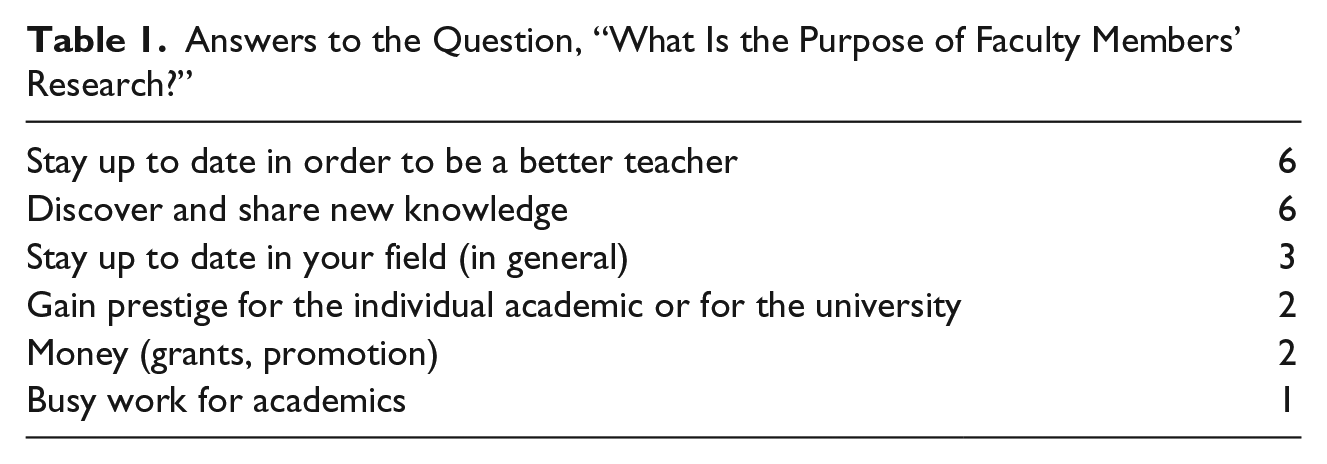
Others were more concerned with the relation between research and teaching: I think it’s good because it provides students with someone who actually knows stuff about what they’re doing—like they’re actively doing the research in what they’re teaching about.
A number of students cited both purposes. Others, like Laura, seemed to be caught off guard by the question itself. And of course, a few saw research primarily in terms of self-interest, gaining academic prestige, power, and money. The number of students who saw faculty members’ research only in terms of improving their teaching, without being able to articulate any larger sense of its role in producing new knowledge, suggests that instructors have not always been very successful in communicating their motives for doing what they do.
Purpose of Citations
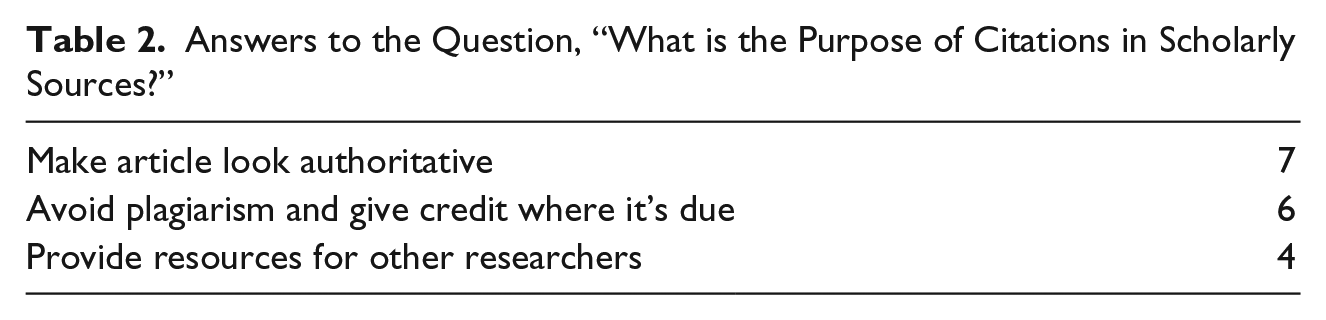
Another trend in the data was the disconnect between some students’ knowledge of their own research processes and their sense of the larger research community. Although all students reported following citations to find more sources, when asked the purpose of citations, 9 of the 13 could answer only “avoiding plagiarism” or “lending authority” (Table 2). This finding suggests that these students did have a sort of tacit understanding of research papers as part of an academic conversation, but when put on the spot, could not articulate this understanding in the abstract; they only applied it to their own experience of finding sources, without seeming to understand that aiding other researchers is a key purpose of using citations.
Answers to the Question, “What is the Purpose of Citations in Scholarly Sources?”
Locating Scholarly Sources
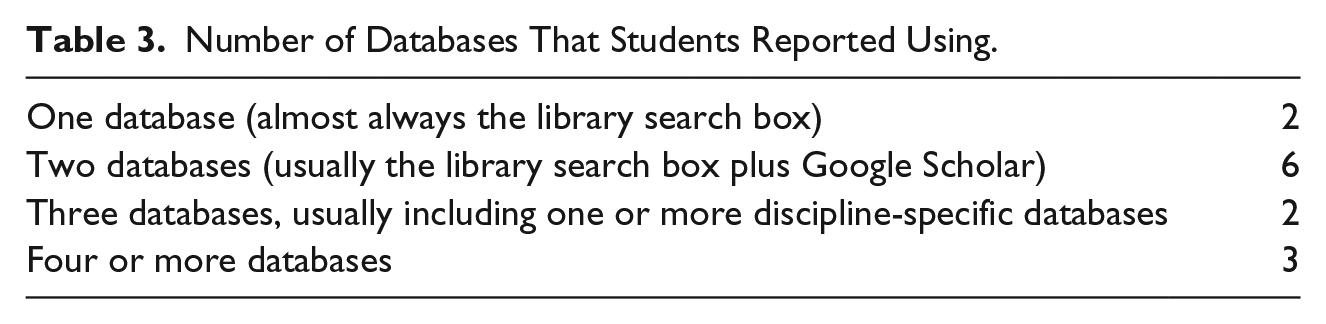
All could name at least one research database appropriate for finding scholarly articles (counting the search box on the library home page as a database), but the total number of databases that each student could name varied considerably (Table 3).
Number of Databases That Students Reported Using.
All of the students were aware that they should use scholarly sources for school research projects, and knew that plain Google was not a very reliable way of finding them. One student listed several databases and then added, “And then, if even that fails, I’ll try Google, even sometimes try Wikipedia, look at their references and try to find those articles.” This student has learned to use Google and Wikipedia thoughtfully and in combination with other sources of information, and is principally interested in the additional references that these tools can sometimes turn up.
Fanning Out from a Source
I asked students to imagine that they had found one really good source and to describe how they might go about finding others like it. All could describe some system of doing so, but some had much more sophisticated systems than others. Table 4 shows the variety of strategies that students reported using.
Ways That Students Reported Using to Find Related Sources.
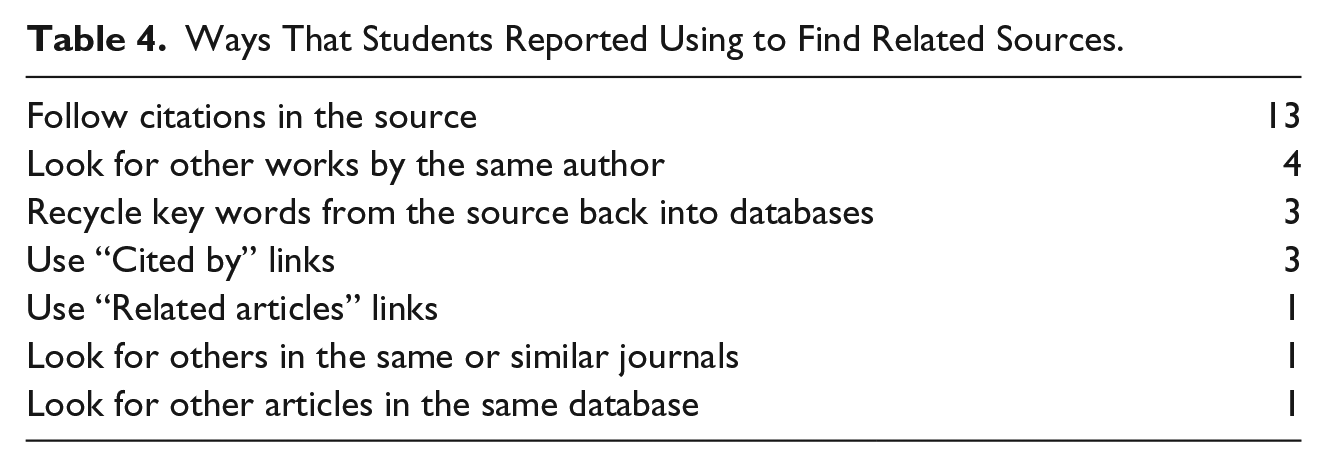
Although they all knew how to use citations in their sources to find additional sources, the senior students for the most part still had a relatively narrow range of strategies for fanning out from a given useful source. In particular, few knew the powerful strategy of following cited by and related articles links in Google Scholar and other databases. This may be related to their difficulty in picturing the ways in which citations knit sources together. Without that knowledge, they evidently had never thought to look at the cited by link and ask themselves, “I wonder what this thing does?”
How Did They Learn What They Knew?
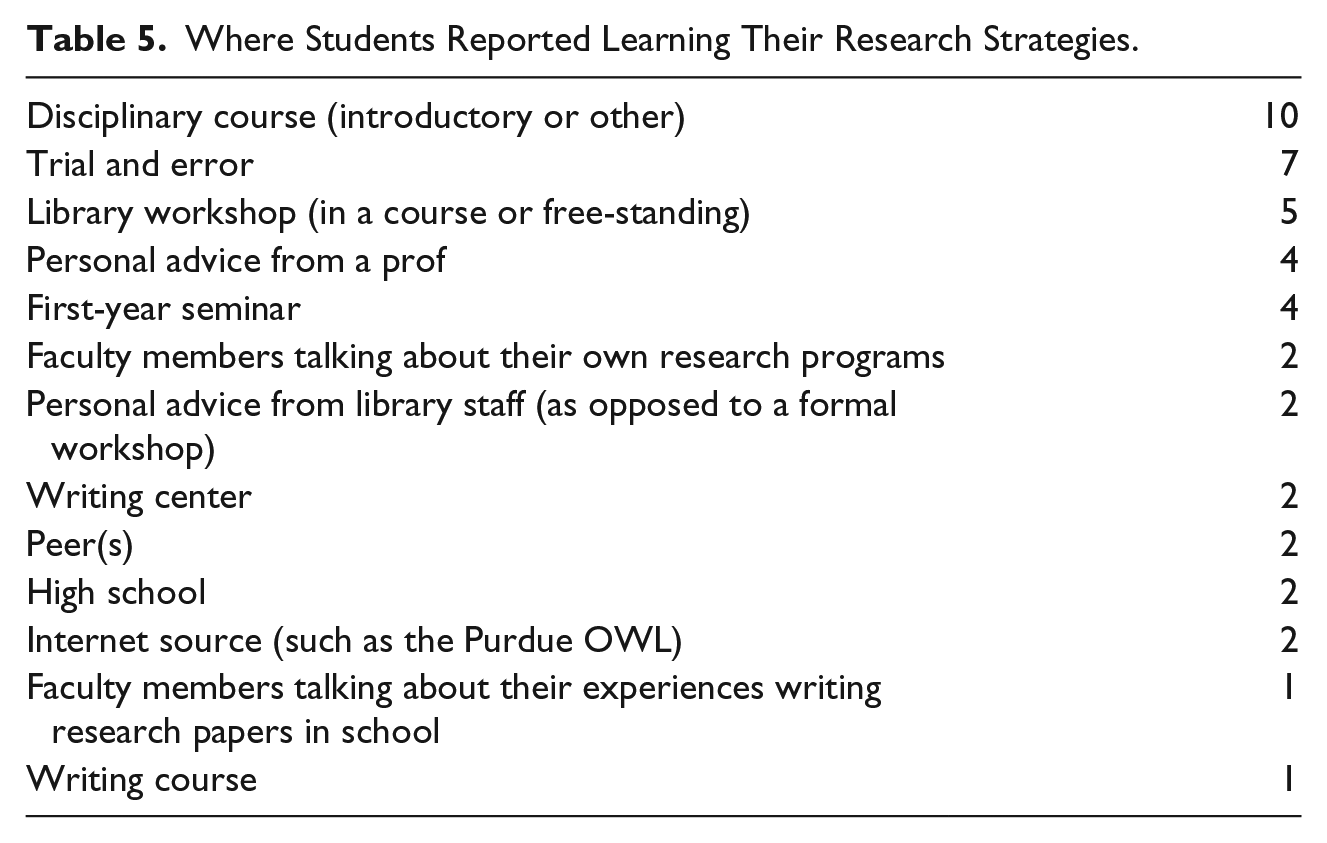
Perhaps the most difficult question I asked was, “How did you learn the strategies you have been telling me about?” As noted above, students had a lot of trouble answering this question. However, with a bit of patience, most students came up with a reasonably broad range of answers (Table 5). I will highlight a few of the most revealing responses.
Where Students Reported Learning Their Research Strategies.
High school
I didn’t expect students to tell me that they had learned a lot about research at high school, but I was surprised at how vehemently they denied having done so. With the exception of two students who had attended International Baccalaureate programs, the students unanimously declared that what had passed for research in high school was more or less a joke: My high school research was awful. We must have had to source in some way, shape or form, but honestly, I had never—and I had some friends that knew sourcing and knew how to do Chicago or whatever, but the high school I went to—when I came in, I had never heard of APA, I’d never heard of Chicago, MLA, any of that. . . . Quotes, I would usually use a quote as in, this famous guy said this, quote it, but no citation. Adam Smith said blah blah blah. . . . We had to do research, but I wouldn’t say it was academic. I mean, I’m sure I used Wikipedia.
It’s unfortunate that this student equates “research” largely with citation. However, this passage reflects the ways in which many students felt that their definition of “research” had greatly matured at university. Clearly, even the less able students in my sample felt that they had come a very long way in the years since high school.
Courses
Disciplinary courses were mentioned by 10 out of 13 students in the sample. One student, when I asked how she had come to be familiar with the PsycINFO database, replied, “They drill it into our brains in Intro to Psyc.” Of the five students who remembered having one or more introductions to research from a library staff member, most noted that the workshop had been attached to a course, usually an introductory course, in a specific discipline. For these students, a library staff member had been an important early introduction to research resources, and a disciplinary course had been an important introduction to the library faculty member.
Specific faculty members
While many students could name specific courses in which they had been introduced to research, far fewer could remember a particular faculty member who was especially helpful or who served as a role model. Faculty members were sometimes mentioned generically as having given useful feedback on assignments, but only two students remembered a faculty member discussing his or her own research. One of these students, while not aspiring to become a professional academic herself, reported a moment of revelation when she came to understand how the research world functions: I think that a lot of students, when they think of research, they think of like going into old archives and things like that, and picking through stuff that’s from years and years ago. Whereas, when you actually think about it, the more recent stuff is what you want to be looking at, because it’s the most recent ideas and things that are our knowledge now in our time. So I think by having teachers discuss that they’re actually doing research currently, brings the students back to the idea that this is a process that people work towards now.
Peers
Only two students explicitly mentioned a specific peer as a source of information on research strategies, but again, those two mentions reflect how influential a knowledgeable peer can be—especially if the peer is more advanced in his or her studies: I had a friend who was in history—she was two years older than me in terms of her degree, and I think in history you have to do a whole ton of research, so she was helpful as a mentor too, to kind of sit down with me and say like “if you want to find something, here’s how to do it,” and show me different techniques.
Trial and Error
Seven of the 13 students reported that personal experience and trial and error loomed large in their memories of how they learned to do research: For the first few years of my university, I always took a lot of history classes. And in history, you always write at least one big paper. Instead of a midterm, you usually have a big paper. So, just in doing those classes alone, I definitely got better and more efficient at writing papers, because you just get in this mode—you find ways that work and you find how you work, and you just figure these things out as you go.
In one way, I suppose, this can be thought of as bad news. Educators naturally like to think of themselves as playing an active role as midwives to students’ skill sets rather than waiting for them to pick them up somehow along the way. Yet Lave and Wenger (1991) point out that learning by doing and learning by observing are vital factors in legitimate peripheral participation, and are often more productive than direct instruction. Moreover, the categories in Table 5 aren’t mutually exclusive, so in many cases trial and error is combined with experiences such as library workshops and personal guidance to provide starting points and useful tips. Trial and error was seldom the only way that students reported learning to navigate the maze of writing from sources.
Conclusions and Implications
This study obviously can’t be generalized to all instructional settings. The sample size was small and limited to a single institution that may not reflect the environment at other institutions. The students were self-selected, leaving open the possibility that they were more interested in research and more aware of their own processes than the average student. In addition, I studied only arts students. Students in other disciplines, especially science and engineering, may well have a very different relationship with academic inquiry.
Nonetheless, with the inevitable hedges, there are a number of lessons we can take from these students’ experiences that tell us, if not what they objectively do when writing from sources, at least what they perceive themselves as doing.
This study suggests that even in the almost complete absence of a composition program or a formal WAC/WID program, students are sufficiently resourceful that they can learn the basics of research from a wide variety of overlapping sources—disciplinary courses, library visits, first year seminars, peers, their prior knowledge of what Estelle called link hopping, and even, to some extent, trial and error. Students painted a picture of a combination of explicit instruction in disciplinary courses and sometimes in library workshops, combined with a wide variety of less explicit methods by which they picked up various academic research strategies. This is not an astonishing revelation, but it does confirm that a knowledge of research tends to come about as a bricolage of various resources and experiences. Students varied greatly in their apparent proficiency, but even the least proficient of them had, by this final year, developed workable strategies to get the job done. For me, this is (guarded) good news.
Some of the more striking results are the less common ones. Although peers were mentioned by only two students, these students seemed to have been heavily influenced by more knowledgeable, often senior, peers. Similarly, only two mentioned that professors had talked (privately or in class) about their own research and how they went about it. In both cases, however, the incidents seemed striking, giving the students an entirely new appreciation of what goes on in the academic world in which they were legitimate peripheral participants.
This last finding is especially important in terms of the larger question addressed by this study: students’ perceptions of the universe of academic discourse that they are sampling at the edges. Here the variation is especially marked. Many students who had developed reasonably efficient, if not always sophisticated, strategies for performing in the context of a student research paper failed to see the research community as a conversation in which knowledge is produced and refined in a universe of interconnected texts—citation being one of the most important means of revealing this interconnection. Others did have a reasonable sense of how academic discourse works, and saw themselves as performing at least some of the same sorts of work—Estelle is the paradigm case, but she was not alone. The premise of the Academic Literacies movement and of this article is that an important part of a liberal education is precisely to participate in and understand this knowledge-making system, at least at a novice level. It is perhaps not surprising, but certainly a bit disappointing, that uptake is somewhat spotty.
Earlier I declared that it was not my main intention to search out pedagogical interventions, but only to create as full a picture as I could of how senior students see themselves as researchers. Regardless, it seems remiss not to close with at least some general speculation on how the academic environment might be structured to take maximum advantage of the acculturation processes observed in this study.
One possible pedagogical lesson stems from the fact that, as noted above, it can be a revelation to students to hear about how academic research works by hearing instructors discuss their own research experiences. Whether or not students decide on academic life as a career choice, legitimate peripheral participation requires visibility: Lave and Wenger (1991) point out that “apprentices get a great deal out of observing and being observed” (p. 78). Students apprenticing as researchers are certainly observed, but how often do they get to observe us, even vicariously? Instructors could do well to let their masks slip from time to time and let students in on what it’s like to be not just a teacher but also a researcher.
A second lesson can be taken from the fact that this study suggests that, in the academic world as in life, trial and error is an important learning strategy. Although this factor may seem to be out of instructors’ hands, it is important to note that the students who reported learning through trial and error also reported being in a learning environment rich in research opportunities and therefore rich in opportunities for trials. They also frequently remember receiving copious constructive feedback on errors.
A third pedagogical lesson relates to time on task. A number of studies have shown how, when they feel rushed, students turn to expedient but low-level strategies to churn out research papers (Leckie, 1996; Nelson, 1992; Nelson & Hayes, 1988). Many of these studies focus on ways to structure instruction in ways that encourage (or force) students to work through the research process in stages, with guidance at each step. The present study not only underlines these findings but expands them. Time pressure not only affects the kind of strategies students use, but also affects their ability to experience the full richness of the research environment, including the pleasure of discovery for its own sake. Estelle was only the most articulate of the many students who made it clear that intellectual curiosity was a luxury that time pressure could easily make unaffordable.
Perhaps the most general takeaway from this study is the one that I describe above as “(guarded) good news”: the observation that many senior students perceive themselves as having come a long way in their ability to do research and to understand how the academic environment works, and that they have made this progress through a wide variety of avenues. Legitimate peripheral participation is a slow and incremental process, but this study suggests that it happens, perhaps more often than we realize. Sometimes the most carefully crafted pedagogies produce only tortured and citation-averse students who would do almost anything to avoid writing a research paper. But if instructors recognize that becoming a researcher is a complex process that requires time and a combination of explicit instruction and opportunities to try a wide variety of strategies and identities, they can provide an environment in which potential Estelles will have the maximum opportunity to succeed.
Footnotes
Declaration of Conflicting Interests
The author declared no potential conflicts of interest with respect to the research, authorship, and/or publication of this article.
Funding
The author received no financial support for the research, authorship, and/or publication of this article.