






Abstract
Drawing on a text-based ethnography of digital writing in a biology laboratory, this article examines the text trajectory of a scientific manuscript and a scientific team’s related writing for public audiences, including for citizen scientists. Using data drawn from texts, observations, interviews, and related artifacts, the author examines how scientists conceptualize and adapt their multimodal writing for specialized scientific audiences as well as lay audiences interested in the work of scientific inquiry. Three concepts—meaning compression, meaning expansion, and meaning attention—were used to analyze the multimodal strategies that scientists employ when composing for different audiences. Findings suggest that while scientists often restrict their writing practices to meaning compression to maintain the values and conventions of scientific genres, they also sometimes deploy a wider range of multimodal strategies when writing for nonspecialist audiences. These findings underscore the complex rhetorical environments scientists navigate and the need to support emerging scientific writers’ development as versatile writers able to adapt varied multimodal strategies to diverse rhetorical and epistemic goals.
Keywords
Research on scientific writing has provided an increasingly complex view of the role of writing in constructing scientific knowledge. Latour and Woolgar’s (1979) well-known ethnography of a scientific laboratory and their observation that this laboratory resembled “a system of literary inscription” (p. 52) serves as one milestone among many that have underscored the extent to which scientists are writers. Research has shown that writing mediates complex semiotic and rhetorical processes in the lab and throughout the scientific process of inquiry (see, for instance, Blakeslee, 2000; Campbell, 1990; Hutto, 2003; Myers, 1990; Wickman, 2010), including in formal scientific communication (e.g., Bazerman, 1981, 1988; Berkenkotter & Huckin, 1995; Gross, 1985; Gross, Harmon, & Reidy, 2002). Science is a rhetorical practice (Ceccarelli, 2001; Fahnestock, 1986; Gross, 1990; Miller & Selzer, 1985; Prelli, 1989; Simons, 1980; Walsh, 2010), and writing plays a significant role in that practice. While scientific discourse “appears to hide itself” (Bazerman, 1988, p. 14), and while proficient scientific writers often “persuade without seeming to persuade” (Myers, 1985, p. 220), scientists use a wide range of rhetorical strategies and are frequently sophisticated and versatile writers who write for a wide range of audiences and purposes (Bazerman, 1999; Emerson, 2016; Rymer, 1988).
Amid the scholarship on scientific communication, a recent and growing strand of research has focused on the role of new media and the Internet in contemporary scientific writing and inquiry. Observing the ease with which work in this area can fall into narratives of technological determinism, Gross and Buehl (2016) note the importance of detailed empirical descriptions that can help us understand, functionally, how digital media and the Internet are “used in creating and distributing scientific knowledge,” including in writing (p. 7). Indeed, scholars have shown that contemporary communication environments in fact offer scientists an increasingly wide range of writing opportunities. Brian Trench (2008), for example, while noting that the web was developed in part to address the communication needs of physicists (p. 185), makes the case that the Internet has given scientists opportunities to “disintermediate” their work, recontextualizing their writing for diverse audiences without the traditional mediation of science journalists (p. 191). As he puts it, the contemporary communication environments afforded by the Internet are “turning science communication inside-out,” making “some of the back-stage preparation” of science “visible to the prospective spectators of the front-stage performance” (pp. 185, 187; see also Bucchi, 2013; Davies & Hara, 2017; Kelly & Autry, 2013; Luzón, 2013; Mehlenbacher, 2019). The changes Trench describes, changes with a reciprocal relationship to scientists’ writing, point to the ongoing need for analyses of scientific writing practices that account for the complex and dynamic relationships between scientists’ writing for specialized expert audiences and their writing for other audiences, including the public. This need is particularly exigent since studies of scientific writing tend to separate analyses of scientists’ communication with other scientists from their communication with nonexperts.
Alongside, and now closely interwoven with, the scholarship on new media and the Internet stands a line of research on the semiotics of scientific writing and knowledge production that researchers have been developing over the past three decades. This work is informed by the social semiotic theory of multimodality within which modes—e.g., images, sound, gesture, text—are theorized as cultural resources for making meaning (Bezemer & Kress, 2008; Hull & Nelson, 2005; Kress, 2010; Kress & van Leeuwen, 2001). While all composing processes and texts can in principle be understood as multimodal, some texts rely more or less on a combination of distinctive semiotic resources for their author’s and audience’s meaning making. A document, for example, may feature typography and white space along with linguistic text, but rely more integrally on an actor’s semiosis involving language than involving the orchestration of semiotic modes. In the case of scientific texts, Jay Lemke (1998) has made the case that scientific concepts are “semiotic hybrids,” with scientific meaning “simultaneously and essentially verbal, mathematical, visual-graphical, and actional-operational” (p. 87). He argues that scientists “combine [modes] in canonical ways” (p. 87), with those becoming canonical or routinized for a variety of reasons, including how useful these strategies are for achieving disciplinary communities’ epistemic goals. Over the past several years, scholars have continued to develop this work through exploration and analyses of textual practices in fields like mathematics (O’Halloran, 2008) and chemistry (Danielsson, 2010; Kozma, Chin, Russell, & Marx, 2000) as well as laboratory (Hanauer, 2008; Wickman, 2010) and school settings (Bezemer & Kress, 2008; Jewitt, 2005; Kress, 2001).
While digital communication and multimodality tend to be distinctive phenomena, studies of contemporary scientific writing that attend to both continue to be important as we seek to understand their complex relationships (e.g., Alac, 2011; Buehl, 2014, 2016; Wickman, 2015). The ethnographic study reported in this article combines these two lines of research, examining scientific digital writing through the text trajectory (Lillis & Maybin, 2017) of a scientific manuscript in a biology laboratory over the course of three years. The laboratory’s principal investigator was committed to public science, the term he used to describe a range of approaches for engaging nonspecialist audiences in the process of scientific inquiry. Due in part to this commitment, the team developing the manuscript was routinely engaged in writing for a wide range of audiences and purposes, both scientific and public, including contributors to the citizen science project with which the manuscript was connected. This routine engagement with the public in connection with their work on their manuscript afforded a view of scientific writing situated within a wide range of interconnected writing and communicative practices.
The aim of this article is to examine scientists’ multimodal strategies in relation to their varied writing situations and epistemic goals. Research has shown that producing scientific knowledge requires scientists to integrate inscriptions and semiotic modes in multimodal genres, such as the laboratory notebook, and communicate with the scientific community by participating in genres that are also multimodal. In this case, it also included communicating with public audiences throughout the course of their scientific inquiry and writing in a range of multimodal and digital genres. In their multimodal discourse analysis of the scientific page, Baldry and Thibault (2010) found that scientific meaning making, at least in formal communication, is enabled by a distinctive multimodal strategy they call meaning compression, which affords scientists economy and efficiency, as well as abstraction and generalizability. In their analysis, meaning compression was generally achieved through “the greater integration of visual and verbal resources” coupled with “the often concomitant process of greater abstraction in representation that brings about a collapsing of the different time scales” relevant to a scientific experiment (p. 60). Scientific tables, for example, supported meaning compression through the “principle[s] of ellipsis” and of “thematic-semantic condensation” (p. 64). Building on Baldry and Thibault’s work and extending a previous study (Reid, 2017a), I examine two additional multimodal strategies within the context of the present inquiry: meaning expansion and meaning attention. While meaning compression employs multiple modes to condense meaning, meaning expansion is characterized by elaboration, employing multiple modes to expand meaning and work against abstraction through detail. Meaning attention, on the other hand, operates reflexively to draw attention to meaning making itself. Employing these three multimodal strategies as units of analysis, I provide detailed analysis of how these strategies were employed by a scientific team during the process of developing their digital research article manuscript and communicating about it to both specialized scientific audiences and lay audiences. I specifically explore the following research questions:
Research Question 1: What multimodal strategies do scientists employ when composing texts for scientific and public audiences?
Research Question 2: How do scientists conceptualize and attach meanings or values to their use of compression, expansion, and attention in particular?
In the account that follows, I show how the scientific team in question made extensive use of meaning compression to communicate their science economically, particularly in their scientific research article. The team’s communication with nonspecialist audiences, however, revealed use of both meaning expansion and meaning attention, the former to foster identification and cultivate wonder in mixed audiences and the latter to engage those audiences with scientific inquiry over scientific findings. The processes of production and circulation in connection with these three strategies included both digital and nondigital media, but were firmly situated in the practices and rhetorical situations afforded by contemporary media environments and networked digital media in particular.
Research Context and Participants
The context for this study was a biology lab at a public research university in the Southeastern United States run by an evolutionary biologist I am calling Soren. 1 As mentioned above, Soren was committed to public science, the idea that science belongs to society as a whole and that laypeople should have access to both the process and product of scientific inquiry. As part of this commitment, Soren had written a large, multiyear National Science Foundation (NSF) grant focused on developing science lesson plans for middle and high schoolers that would allow students to contribute data produced in the classroom to professional scientific research projects. Soren’s lab was approximately one year into this grant when I began my work with them and had launched a range of citizen science projects to which anyone could contribute data, including science classes using their lesson plans. Launching and running these projects involved communicating with a range of audiences that included secondary school audiences and the general public. This communication centered on both the process of contributing to the citizen science projects and on the ongoing results of the studies, using a variety of multimodal genres that included public talks, online instructions, blog posts, and social media posts on Twitter and Facebook.
In her ethnographic study on the role of databases in scientific knowledge production, Christine Hine (2006) suggests that a scientific laboratory is “more than a physical space” (p. 273), something equally true of Soren’s lab, which included the floor of a campus science building, space in two forests owned by private universities, web space on several sites and a blog, and an extended social network that included collaborators from other institutions as well as lab alumni. In addition to their varied communication with nonspecialist audiences such as schools and citizen scientists, the lab’s distributed social network required extensive use of digital communication such as email and a lab listserv. The lab’s collaboration, which was cross-institutional and multidisciplinary, was also supported by organizing occasions such as workshops or think tanks to which collaborators could be invited to travel (see Cummings & Kiesler, 2005).
In fall 2014, I connected with the lab and began a text-based ethnography of their digital scientific writing focused on the text trajectory (Lillis & Maybin, 2017) of a manuscript. I use the term trajectory to refer to the history of this text over its production, including changes the authors made as part of their composing processes and the authors’ meaning making around the manuscript (Lillis & Maybin, 2017, pp. 409-410). Based on his knowledge of my interest in digital writing processes, Soren matched me with a lab citizen science project and corresponding manuscript still in its early stages, a project I refer to here as the Heartbeats Project. The lead author on this particular manuscript was a postdoctoral fellow in the lab, Clay, whose area of expertise was the evolution and ecological consequences of social behavior in social insects. The project had its beginnings in a popular science book Soren had written and that was scheduled to be published the following spring. Soren regularly wrote books and blog posts for nonspecialist audiences, a process that included extensive research in the scientific literature that he often delegated to members of his lab. While writing his latest popular science book, Soren had asked Clay and a research technician to locate literature related to the “billion beats rule.” The rule was based on the finding that, on average, mammals’ hearts beat one billion times per lifetime, helping account for why some species whose hearts beat fast had shorter lives, while those whose hearts beat slowly often had longer lives. Clay and his colleague traced this rule back to a 1997 article by a cardiologist named Herbert Levine who had examined the resting heart rate and life expectancy of 16 species, including human beings (Levine, 1997). In this article, Levine had noted that human beings seemed to be an exception to the rule, with a substantially higher number of beats per lifetime.
Noting the limited data in Levine’s study, Soren and his team conceived of the Heartbeats Project as a project that would enlist citizen scientists’ help in locating additional heartbeats and lifespan data to test whether the original correlation held up, and potentially to extend the research to other biological classes like birds and reptiles. A set of online instructions on the lab website invited citizen scientists to search for relevant data and submit it to the lab, providing guidance on choosing a species not yet represented in the data and then finding, reading, and evaluating relevant scientific literature that might include resting heart rate data. Members of the lab would then check the submitted data against their criteria and potentially integrate them into the study. I began following the project and its first scientific manuscript, initially titled “The Telltale Pump: Resting Heart Rate and Longevity,” as the citizen science project was being launched for the public and directly after it had been seeded with some initial data by members of the lab, a step that helped engage members of the public with provisional results as well as the process of contributing to the project (see Figure 1).

Milestones in the manuscript’s trajectory and in related public communication.
While Clay became my main contact as I followed the development of their manuscript on their mammal data set, I engaged with a number of other members of the Heartbeats Project team and the campus public information officer they consulted: Soren (principal investigator), Jada (project undergraduate researcher), Summer (research technician and later lab manager), Brendan (public information officer), and Sara (digital curator and science education specialist). I also engaged with a broader network of lab members during lab events and public events. As I traced the trajectory of the manuscript’s development, I concurrently tracked milestones in the lab’s communication with citizen scientists about the project (Figure 1). This communication included sharing provisional results before the publication of their manuscript, an order that disrupts the sequence of genres expected in the dominant model of public communication of science, in which genres related to popularization are understood to come solely after publication, and that allowed their public communication to serve an inventional role for their manuscript (Reid, 2017b). Clay’s two science café talks, for example, prompted him to push his analysis further and shaped the selection of venue where he would eventually submit the work.
Study Methods
This study was designed as a text-based ethnography focused on the text trajectory (Lillis & Maybin, 2017) of a scientific manuscript under development. Data collection and analysis took place from 2014 to 2017 and included process-related artifacts, observations, and interviews as well as ethnographic engagement in the authors’ social fields beyond their manuscript process. The study was informed by grounded theory (Glaser & Strauss, 1967), specifically the constant comparative approach of collecting and analyzing concurrently with each informing the other (Charmaz, 2003; Glaser, 1965), and as such, it was designed with the goal of producing theory about scientific digital writing accountable to its meanings and stakes for the participants. Concurrent collection and analysis allowed insights developed from existing data to inform further data collection, constructing an ethnographic field responsive to participants’ meanings and the emerging theory. Because of the distributed nature of the lab and of the team’s work on the Heartbeats Project, as well as their routine Internet-mediated communication, I employed copresence as a strategy for conceptualizing the field beyond physical spaces such as the lab, also including such mediated interaction as an “active form of ‘field-making’” (Beaulieu, 2010, p. 463). In keeping with multisited ethnography (Gupta & Ferguson, 1997) and studies of e-science (Hine, 2007a, 2007b, 2015), “location work” played an important role in ethnographic engagement, including interactions and observations in both physical and digital sites significant to the team and project that were integrated in the study through field notes, analytic memos, and artifact collection.
One of the chief challenges of text-based ethnographic studies is putting textual data and analysis in conversation with qualitative data related to the text’s context—the gap between text and context (Lillis, 2008; Schryer, 2011). Lillis (2008) suggests using indexicality in order to capture connections between text and context, defining indexicality as “the specific ways in which bits of language (speech, writing) index, or point to aspects of the social context” (p. 376). I used the concept of indexicality to operationalize active field-making that was accountable to participants’ experiences, using their talk and writing as prompts for following connections beyond the Heartbeats Project manuscript and lab in order to explore what they found significant in their sociocultural context. This led, for example, to following citational leads to particular articles, article databases, and scientific databases, as well as to attending specific citizen science events. In addition, Lillis advises “thick participation” in participants’ social worlds in order to “explore what’s significant and at stake for writers at specific sociohistorical moments” (p. 367). In this spirit, I became a participant observer in related events such as a lab think tank, several lab citizen science projects, museum-sponsored citizen science events, and #CitiSciChat Twitter events, integrating these experiences in my field-making through field notes and analytic memos. In the same spirit, I also participated in the Heartbeats Project as a citizen scientist, submitting resting heartrate data on the American bullfrog (Lithobates catesbeianus).
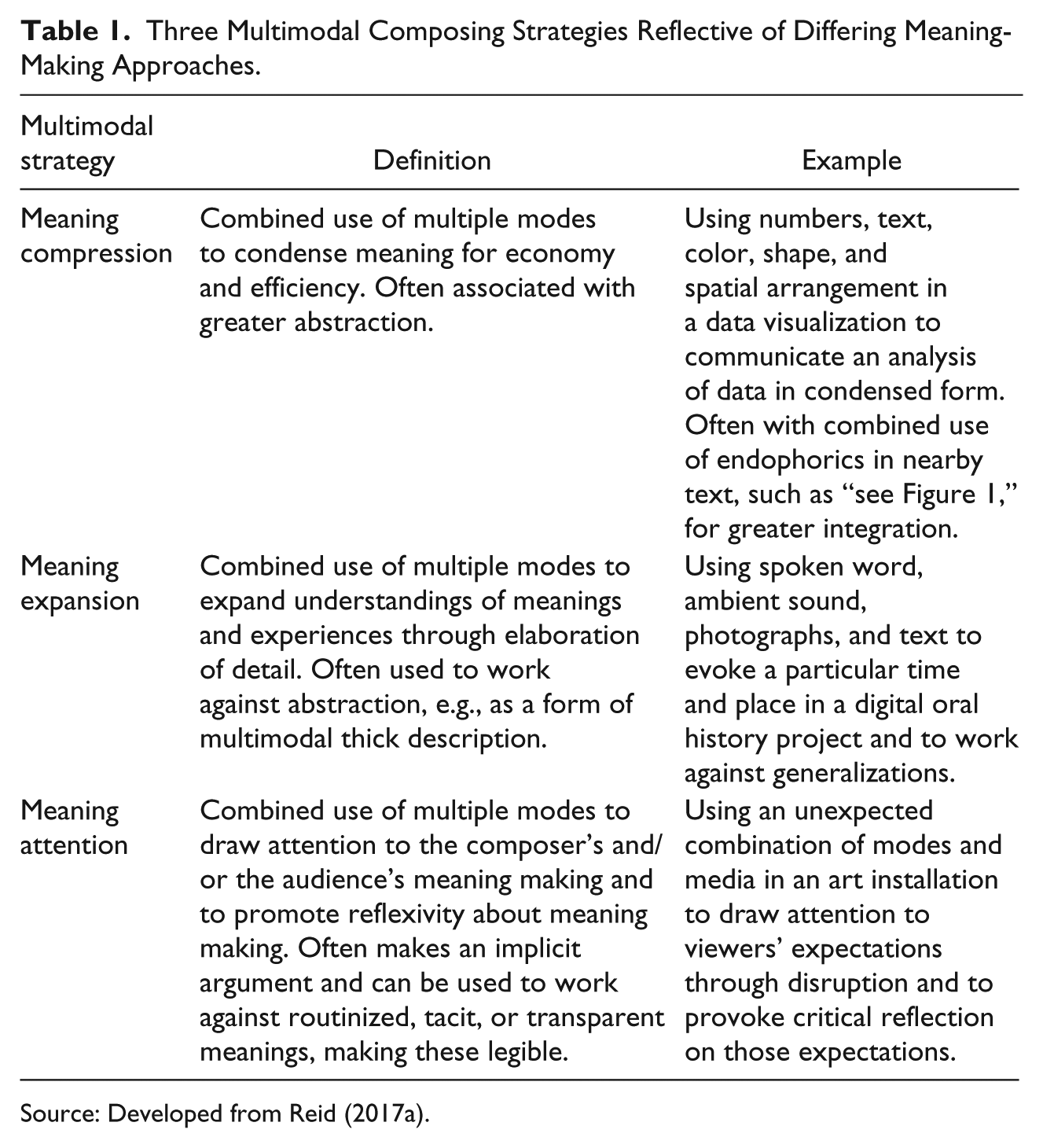
This article focuses on the team’s use of and orientation toward (Lillis, 2008, p. 376) three distinct strategies of multimodal composing: meaning compression, meaning expansion, and meaning attention. These build on Baldry and Thibault’s (2010) concept of meaning compression and were developed during a previous study of academic digital writing in a disciplinary context (rhetoric and composition) that is noted for its epistemological pluralism (Reid, 2017a). The three multimodal strategies defined in Table 1 were developed in that previous study and were applied to the Heartbeats Team’s composing by coding their texts and talk for compositional choices reflective of the strategies and of their orientation toward these strategies.
Three Multimodal Composing Strategies Reflective of Differing Meaning-Making Approaches.
Source: Developed from Reid (2017a).
While the larger ethnography included a more expansive range of data types, this study draws on interviews (16 interviews; 18 hours), observations (10 observations; 20 hours), drafts and writing samples (12 texts), project-related spreadsheets (20 spreadsheets), project-related social media posts (14 posts), citational connections (204 articles and books), project-related public talks and writing (3 instances), and analytic memos from my own participation as a citizen scientist in the Heartbeats Project (1 data submission). These were coded using the qualitative data coding software MAXQDA for both instances of and talk about meaning compression, expansion, and attention in order to explore how scientists make multimodal composing choices in relation to their varied writing situations and epistemic goals.
Analysis and Results
In the following sections, I examine moments that illustrate how the Heartbeats team conceptualized and used meaning compression, meaning expansion, and meaning attention to communicate their science, with attention to the roles of the varied audiences the team engaged with concurrently. While the team’s process of constructing scientific meaning reflected the semiotic hybridity noted by other analyses of scientific writing, it differed from those described in previous ethnographies of scientists as a function of genre. While previous ethnographies have noted the central role inscriptions of material phenomena by scientists and scientific technologies play in constructing scientific meaning (for instance, Latour & Woolgar, 1979), the Heartbeats Project manuscript was not an observational or experimental research article but rather a meta-analysis. As such, the team’s work centered on repurposed data at a remove from their original material contexts, with inscriptions of animals’ heartbeats and lifespans collected by lab members or citizen scientists from research articles or digital data repositories. These were also stored and organized differently, using shared online Dropbox folders and spreadsheets rather than a physical lab notebook to organize inscriptions of physical phenomena (e.g., heartbeats, longevity) and procedural notes (e.g., whether specific data needed rechecking), enabling a spatially and temporally distributed scientific process.
Meaning Compression
For the Heartbeats Project team, multimodal meaning compression was the most canonical and routinized way for them to construct and communicate scientific meaning. Their work in fact centered on updating a graph from Levine’s 1997 article, which will serve as the representative “moment” for examining their use of meaning compression as a strategy. Levine’s graph plotted the heart rates for 15 species plus “man [sic]” against their life expectancy (see Figure 2), condensing information from multiple sources (doubtless gathered into a spreadsheet) by integrating text, numbers, shape, size, and spatial arrangement to economically make the case that (a) these two variables are related and that (b) “man” is an outlier to a trend.
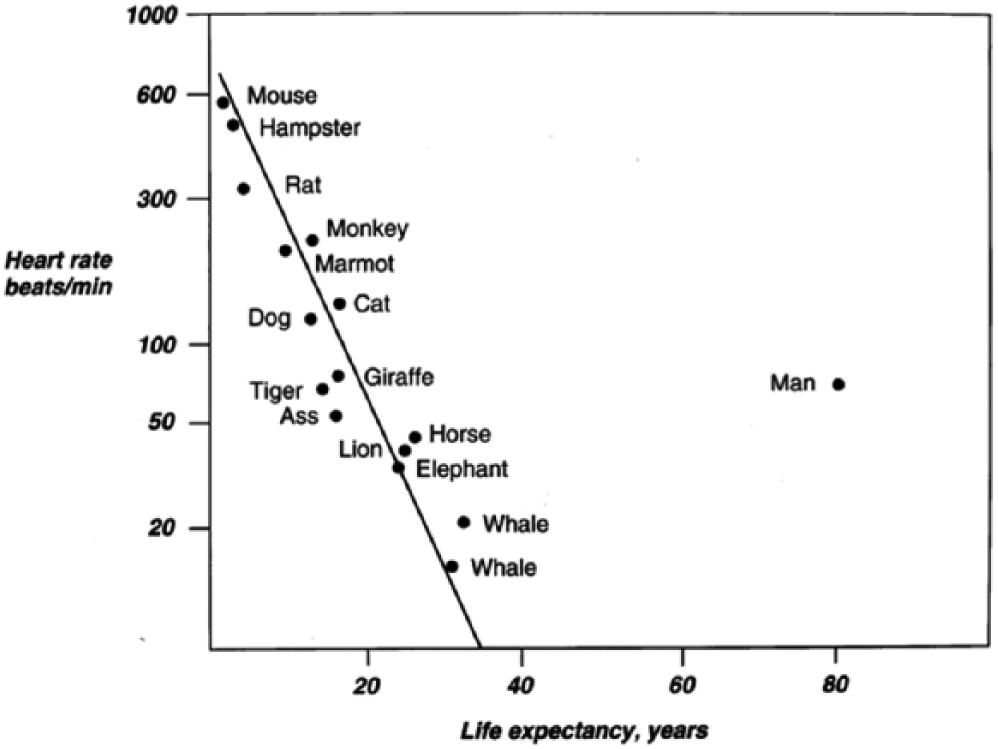
Figure from Herbert Levine’s (1997) “Rest Heart Rate and Life Expectancy.”
As part of their work on the Heartbeats Project, Clay and Jada similarly gathered data on resting heartrate and longevity into spreadsheets, but with far greater specificity and a larger number of data points than displayed in Levine’s graph, necessitating the use of multiple spreadsheets (e.g., for mammals, birds, fish, and reptiles/amphibians). Their mammals datasheet from 2016 (Figure 3), for example, tracks not only common species names, but also scientific names (e.g., coyote and Canis latrans), as well as order, family, genus, and class. In addition, the spreadsheet tracks references for both longevity data (mostly from the AnAge Database) and heartrate data, as well as the status of the team’s data vetting. The datasheet itself condenses information on 160 species from nearly that many scientific research articles and the AnAge Database of Animal Ageing and Longevity into a single table.

Mammals data sheet from 2016.
Over the course of the study, the team used their mammals datasheet to conduct a number of analyses, including analyses that examined how the trend held for various orders of mammals (e.g., carnivores, marsupials). The first draft of their manuscript included several tables, as well as a provisional figure that was not intended for the final draft of the manuscript, but that helped the coauthors communicate about their findings and make compositional decisions about their draft (see Figure 4). This figure compressed the 160 data points from their spreadsheet to a single figure that used the same semiotic resources Levine’s figure employed, but added color to help the team think and communicate about an additional dimension they were considering: phylogenies, or the evolutionary history of genetically related groups of organisms.

Figure used for internal communication among coauthors in the mammals manuscript’s first draft.
Around the same time the team developed their first draft of the manuscript—an incomplete draft that focused primarily on their results, methods, and introduction—they completed another analysis and created another figure, but this time intended for public audiences (see Figure 5). Initially, the team explored the possibility of developing an interactive figure, but for a variety of reasons opted for a static figure highlighting four species that stood out in some way: humans, gray whales, common mole-rats, and Etruscan shrews. This figure also used color, but simplified the idea it communicated by using gray points for all mammal species except the four highlighted species, which received red points instead. The figure thus communicated the relationship between heartbeats and lifespan and the notion that human beings are outliers, corroborating Levine’s findings, but did not yet attempt to make an explicit phylogenetic argument.

Mammals figure developed for public audiences on the project’s citizen science webpage.
As snapshots from the Heartbeats Project team’s work on this figure demonstrate, condensing and collapsing biological processes, scientific activities, individual features, and periods of time were necessary for them to ask, answer, and communicate their science, and employing a combination of modes allowed them to do this economically while simultaneously factoring in many dimensions and variables. Notably, the team’s recontextualization of their work for a public audience of citizen scientists (Figure 5) maintained most of the abstraction of their internal and scientist-oriented figures, but used the example, which draws attention to the individual and particular, as a rhetorical strategy for telling a more evocative scientific story. Even while highlighting individual species, however, their publicly oriented figure compressed meaning about individuals of that species into the more abstract species category. For this team at least, constructing generalizable meaning about the world seemed to require condensing the fine-grained and particular into categories and groupings, while using multimodal strategies to multiply the number of categories possible to consider and communicate about at a time. This, in fact, is in keeping with Lemke’s (1998) observation in his analysis of visual and verbal semiotics in scientific texts that combining distinct semiotic channels multiplies the number of meanings possible.
Meaning Expansion
Scholars have theorized meaning compression as a multimodal strategy in the sciences (Baldry & Thibault, 2010), and it was thus perhaps not surprising to see it employed within the Heartbeats Project team’s composing processes. As the Heartbeats Project team’s work on the central figure for their manuscript described in the previous section illustrates, their inquiry and writing abstracted and compressed the distinctiveness of individual animals in part by placing animals in the larger categories of their species (it is no longer “Spot,” but rather Canis lupus familiaris). The momentary rhythm and pace of particular beating hearts were similarly compressed to individual numbers inscribed in a spreadsheet, with the gray complexity of each moment shed through its numerical representation. Clay had pointed out to me, for example, how complex “resting” heartrate could be to define since “sleep is not even well defined for a lot of organisms.” Those numbers, together, were analyzed using a variety of modes and were represented as abstract, visual patterns of heartbeats and lifespans for large groups of animals—species, orders, classes. All the while, the meaning made about individual animals in individual moments receded, compressed by the layers of abstraction afforded by scientific practices around categories, numbers, language, and visuals. The statement that humans and primates as a group are outliers among mammals’ heartrate-lifespan relationships could not be made without compressing scientific meaning through many layers and steps, using a variety of modes.
Meaning expansion, on the other hand, with its logic of elaborating details about the individual and particular, was rarely present in the team’s composing, with a few moments standing out as revelatory. One of these came during a discourse-based interview (Odell, Goswami, & Herrington, 1983) with Clay during which I inquired about whether sound could be used productively as part of the team’s digital manuscript. This question briefly stumped Clay, before he recalled an NPR Radio Lab episode that used the sound of footsteps to share a study’s findings that “the walking pace of people in cities . . . correlates with how big the city is and how many people live in the city.” He felt “the heart rate thing would be [similarly] interesting,” but that it would be more suitable to radio for public audiences than to scientific communication (i.e., the digital version of their manuscript). In his view, the scientific meaning from the study was predicated on aggregating and compressing meaning, with nothing gained scientifically by disaggregating data through the inclusion of sound files of each individual species’ heartrate. This would amount to using multimodality in service of meaning expansion, expanding on details about individuals related to other aspects of heartbeats than their rates in a manner that could be counterproductive for communicating the specific claim the manuscript was constructing to scientific audiences. Expanding on variables beyond those relevant to the team’s inquiry would amount to noise that got in the way of effective communication. For public audiences, however, Clay felt this could be effective as a means to engage them and make the science less intimidating, since it would include a familiar sound (the human heartbeat) and give members of the public an entry point for identifying with other species through comparison of human heartbeats with other heartbeats. This was in harmony with the lab’s goals for citizen science and outreach, which included “getting people outside” and showing people “how little of the world we actually know,” including the world in their own homes, backyards, and bodies. The lab’s citizen science work in many ways appealed to and built on biophilia, seeking to evoke wonder about the natural world and science in a way reminiscent of the “appeal to wonder” Jeanne Fahnestock (1986) found among journalists’ popularizations of science. For Clay, expanding the scientific meanings represented through other modes by adding indexical sound was more fitting to a broad appeal to the wonder of their object of study rather than to the precise scientific argument he and his coauthors were making in their manuscript.
Clay’s science café talk in 2015 (see Figure 1) serves as another useful moment for analyzing the team’s deployment of meaning expansion as a strategy. Science cafés are events that give members of the general public an opportunity to hear a scientist talk about their work and then interact with them in a casual setting, such as in a bar or restaurant. In December of that year, Clay had been invited to speak at a café sponsored by a nearby university on a topic of his choice. Clay chose the Heartbeats Project as both a project that would be accessible and engaging to a broad audience, and as an active citizen science project that would give members of the audience an opportunity to engage beyond the science café by later contributing data as citizen scientists. The talk was also an opportunity to engage with citizen scientists who had already contributed, since they might be drawn to the talk as a way to learn about the provisional results the team had drawn from the data they had contributed. Clay explained that one of the rhetorical challenges of this type of event was that the audience consisted of both members of the public—in his experience, often a dedicated “cohort of retirees”—and scientists. As a rhetorical situation, the science café included laypeople, as well as scientific specialists from both his discipline and other scientific disciplines.
Clay’s writing for this mixed audience was explicitly narrative, telling the human story of the original research the Heartbeats Project was updating before telling the provisional phylogenetic story of their findings to date. While Clay used the word “story” to talk about his scientific manuscript and shared that he thought of research articles this way, in his science café talk, he was freer to expand on that story and tell it the way he liked without factoring in the preferences of editors or reviewers. One of the ways he did this was to recontextualize several versions of the figure the team had created for the project’s website (Figure 5), highlighting trend lines for different orders of species on each version in a sequence of slides (see Figure 6). This allowed Clay to tell the evolutionary story the team saw emerging from the data, while maintaining the logic of meaning compression—the graphs were economical and remained at a high level of abstraction by integrating a combination of semiotic modes (e.g., text, numbers, shape, size, spatial arrangement, and color). In Clay’s estimation, while still deploying the economy of a scientific figure, this sequencing would be questioned by editors of a journal article as creating redundancy (through duplication) and therefore violating the scientific value of economy.

Figure from Clay’s science café talk.
Clay deviated more explicitly from this value and from meaning compression, however, during several moments in his talk when he drew attention to individuals within species and studies through his choice of visuals. While setting up the exigence for the Heartbeats Project, for example, Clay drew attention to the data point for elephant in Levine’s original figure (Figure 2), which he orally questioned as imprecise—was this a Lexodonta Africana or an Elephas maximus? An African elephant or an Asian elephant? He then projected a black-and-white photograph of a circus elephant exiting a train, sharing that Levine’s elephant data point turned out to be the resting heartrate of a circus elephant with no documentation of its species. Similarly, Clay questioned the two whale data points on Levine’s graph, which also omitted their species. Projecting a grainy black-and-white photograph of a beached whale with a man—presumably a whaler—standing on top of it (Figure 7), Clay shared that one of those two data points turned out to be the resting heartrate of a beached whale, which seemed to better fit the definition of an animal in distress than at rest. These vivid examples helped Clay set up a gap for the Heartbeats Project and create anticipation in his audience about their updated results. In contrast, the treatment of Levine’s study in the team’s first draft of their scientific manuscript, while also creating a gap, was succinct: The most comprehensive study of the relationship between heart rate and longevity of which we are aware considered just 16 species (Levine 1997).

Beached whale example from Clay’s science cafe talk.
This brevity was in direct contrast with Clay’s elaboration on several of these 16 species through his combination of talk, text, and photographs. Rather than using a combination of modes to create abstract, aggregated meaning that omitted dimensions of their original material context deemed irrelevant to the phenomenon under study, here Clay used a combination of modes to evoke the multidimensionality of that material context, making it salient to his audience. Dimensions of context that might be deemed “noise” in scientific communication, such as the social contexts of the circus and of whaling, were made relevant during Clay’s presentation. Expanding his meaning making to include the materiality of individual animals in specific contexts allowed him, in this context, to make the science and scientific objects of study (animals) relatable to his public audience. Some of these examples, particularly those connected with the Heartbeats Project’s findings rather than Levine’s, seemed designed to evoke wonder in the natural world, but others, like the beached whale, were more likely to evoke wonder at the process of doing science, as well as to inject a little macabre humor at a clearly human (and therefore fallible) endeavor.
Meaning Attention
While Clay’s use of meaning expansion made salient the multidimensionality and material contexts of their objects and methods of study for his public audience, the attention he drew to the process of constructing scientific knowledge reflects the strategy of meaning attention. Meaning attention refers, here, to the combined use of multiple modes to draw attention to meaning making itself. This strategy is highly reflexive in that it is used to draw attention to the composer’s and/or the audience’s meaning making in order to heighten audience members’ consciousness of how their routine meaning making is colored by convention, habit, or ideology. This strategy is also seemingly at odds with the conventions of contemporary scientific writing, which over its history has tilted toward emphasizing scientific objects of study or theories while “the scientists have vanished to the footnotes” (Bazerman, 1984, p. 178). Over time, the “objects and processes of the natural world, the methods and materials of the laboratory, and abstract nouns have increasingly occupied the subject position” (Gross et al., 2002, p. 166), reflecting and supporting scientific social values such as falsifiability and cooperation (Ding, 2002). In general, a focus on the scientist is seen to be at odds with an enterprise that should be “independent of any particular individuals” and within which results “may simply be observed, and every qualified working scientist may obtain the same result by following the described procedure” (Ding, 2002, p. 149). How to avoid attention to scientists and their language, however, is an open, evolving question, with the Heartbeats team choosing to employ active voice and first person in the linguistic portions of their methods section, most likely in service of linguistic economy (e.g., “we test the relationships between heart rate and longevity” and “we fit linear models of maximum life span . . .”). The plural first person “we” also emphasized the collaborative nature of their work.
One particular compositional moment stands out as illustrative of the team’s orientation toward meaning attention in their writing for scientific audiences. Because the coauthors were writing a digital scientific article, the question of possible digital “enrichments” regularly came up during our interactions, such as those developed as part of Elsevier’s Article of the Future project (Elsevier, 2011; Pérez-Llantada, 2013). During a discourse-based interview, Clay and I discussed one of these possible enrichments for their manuscript: author videos. Clay admitted to some discomfort with author videos, which were videos attached to some digital scientific articles that featured authors “explain[ing] their research in their own words” (Elsevier, 2018). For Clay, the mismatch in quality between scientists’ research articles and their author videos was problematic. He explained how in his field “people design theirs mostly like a PowerPoint presentation—there’s a couple slides, there’s a disembodied voice speaking.” A recurring theme in interviews with Clay and the rest of the team was the intense labor involved in developing scientific expertise and how this was in conflict with the labor investment needed to also develop expertise in skills like video production or graphic design. On the subject of author videos, Clay explained how “people with no video skills make them” because those people have invested their time in becoming expert scientific communicators: “They’re already published . . . and they’re doing real research, and they don’t have time to do a video without those resources being given to them.” For Clay, this particular enrichment did not contribute to the scientific work accomplished by scientific research articles and potentially conflicted with the scientific ethos necessary to work effectively as a scientist.
Soren, however, articulated a larger conflict created by author videos: the attention drawn to the scientist. In his words, an author video often “becomes about the scientist and the work” and is “not giving you that many” scientific benefits. Even though, in Soren’s words, “approaches to science are now pretty relativistic,” the logic governing scientific communication is not, maintaining a commitment to objectivity that emphasizes the phenomenon under study and deemphasizes the people studying it. According to this logic, the people discovering scientific phenomena should be irrelevant to the scientific accounts of those discoveries. Considering author videos, Soren felt that these often broke with that logic: What the video does is, the human part comes in. And the journals, for the most part have not responded to that. Which is interesting, because historically they did it a little bit more. . . . You know, when relativism hit anthropology, there were all those journals that had this great part at the end where you had the story of the person and why that bears on what has been discovered? . . . It should be here too. But we won’t do that. Maybe ecology will do it, but you won’t get any further in.
Soren here refers to anthropology journal articles’ ethnographic positionality statements, reflexive statements meant to acknowledge and analyze the ethnographer’s role in the research. In context of the natural and physical sciences, however, Soren’s view was that this sort of attention to the researcher deviated too far from the conventions of their research genres. For the team’s mammals manuscript, creating an author video was not a compositional option they were considering.
The lab’s communication with citizen scientists, however, adds further complexity to this picture, demonstrating the wide range of rhetorical strategies its members employed. The lab’s website, for example, featured a blog series of interviews with lab scientists about their lives before becoming scientists. These interviews included a combination of text and images (e.g., photographs of the scientists as children) that humanized scientists, fostering identification with them and, by extension, rendering their scientific inquiry relatable and accessible. Soren’s popular science writing was also highly biographical and narrative, with the similar effect of bringing scientists into focus as interesting, inspiring, but also fallible human beings. These stories humanized scientists and the process of doing science, conveying their excitement and wonder—the “delight” Richard Harris (2017) has recently argued is so critical to good science. By drawing attention to the human being doing the science, however, they also drew attention to scientific inquiry itself, framing it as a human enterprise driven by curiosity, passion, and sometimes luck.
The lab’s citizen science operated in a similar way, creating the effect of drawing attention to scientific meaning making and rendering it accessible and human. Much like the Heartbeats Project, the text at the center of each of these projects was a set of online scientific instructions, sometimes in the form of a lesson plan and sometimes (like with Heartbeats) a simple project webpage (see Figure 8). These allowed citizen scientists to harmonize their scientific activity with the scientists and with each other in order to produce reliable data (Galloway, Tudor, & Vander Haegen, 2006; Ratnieks et al., 2016).

Screenshot from the online instructions for the Heartbeats Project (red text denotes hyperlinks).
In addition, however, these instructions drew attention to scientific inquiry over scientific results and made the implicit argument that scientific meaning making was accessible to all. Clay expressed that this was part of their goal in engaging the public to participate in science: This is, kind of, a different way to get people involved and maybe break the cycle of, “Oh, here’s a cool discovery,” and people see it, and then kind of move on. Versus, like, “Here’s an interesting idea,” which is really what scientists are interested in. It’s more the idea phase than the, sort of, finished product.
Clay preferred that members of the public engage with the ideas and process of “doing science,” which he saw as a deeper sort of engagement, than with the results of science, which he saw as a fleeting and superficial engagement—results were, after all, small, provisional contributions to what he saw as an incremental, cumulative enterprise. The public, in his estimation, too often missed the provisionality of scientific meaning making, overlooking the fact that results might be falsified or refined by other scientists down the road. Citizen scientists’ own engagement in projects like the Heartbeats Project, which might entail returning to the project periodically either to submit more data or to learn about ongoing (provisional) analyses of project data, made powerful arguments about the provisionality, recursiveness, and accessibility of scientific inquiry. In addition, Clay hoped participants would come away realizing, about data on species heartrates, that, Oh, god, it’s harder to find! This is hard to find. This is surprising. We don’t know things like that. And I think that has a positive spin, because it’s like, things you think are really basic, aren’t known. And if you do get into science, even some of the biggest questions have barely been investigated.
In some ways, then, the citizen science dimension of the project, with its dynamic, interactive assemblage of texts and numbers, worked within the logic of meaning attention, prompting critical reflection on their assumptions and schemas about what it means to “do science,” including who can participate in doing science. If the team were successful, citizen scientists would come away seeing scientific inquiry as more challenging, exciting, accessible, even wondrous than they might have beforehand. They might also better understand the provisional, collaborative, and cumulative aspects of scientific meaning making, perhaps interpreting popularized scientific findings they were likely to encounter with a more critical eye. This implicit argument operates squarely within the “inside-out” media environment Brian Trench (2008) has identified, rendering “some of the back-stage preparation” of science “visible to the prospective spectators of the front-stage performance” (p. 187), a state of affairs that can present challenges to members of the public who must be “capable and willing to handle such uncertainty” thereby made visible (p. 196). Regardless of the potential consequences, however, the team’s writing for citizen scientists demonstrates their versatility as writers and the wide range of multimodal strategies they found productive to deploy as part of their work.
Conclusions and Implications
In this article, I have focused on a scientific team’s multimodal composing strategies within a wide range of interconnected writing situations, including for scientific audiences and lay audiences, with the aim of exploring how scientists might adapt their strategies for varied rhetorical and epistemic goals. Specifically, I have sought to address how and under what circumstances scientists use multimodal meaning compression, expansion, and attention as well as how they conceptualize and attach meanings or values to their use of these strategies. While the Heartbeats team primarily employed multimodal meaning compression (Baldry & Thibault, 2010) to communicate their science economically in their scientific research article manuscript, I found evidence of meaning expansion and meaning attention in their related writing for lay audiences. The team’s use of meaning expansion situated their objects of analysis in fuller, multidimensional contexts and seemed designed to foster identification and cultivate wonder in mixed audiences that included lay people as well as scientists from other disciplines. Although the additional dimensions rendered salient by this expanded account were deemed extraneous to the scientific account communicated in their research article manuscript, in this broader context these functioned to make the phenomenon under study and the study itself concrete and relatable for those not part of a specialized conversation. It is possible that meaning expansion, in these mixed audience situations, also served to invoke a role for scientists in the audience that differed from their role in expert scientific genres, emphasizing their own wonder for science and nature over other aspects of a scientific disposition, such as skepticism. The team’s use of meaning attention as a strategy, which drew reflexive attention to scientific meaning making itself, was accomplished in their public writing by drawing attention to the human actors who conduct scientific inquiry, using combinations of photographs and written and spoken biographical narrative. The implicit argument made by the team’s citizen science instructions and communication drew similar attention to scientific inquiry with the potential for prompting critical reflection on participants’ assumptions about what it means to “do science” and who can do it.
These findings underscore the complex rhetorical environments and goals scientists navigate and the need to support emerging scientists’ development as flexible writers, including in their use of diverse semiotic resources. Writing as a scientist means assembling multimodal arguments (Buehl, 2016), and it also means deploying a repertoire of multimodal strategies according to rhetorical situation and epistemic goals. Soren’s mentorship of Clay and the other members of the Heartbeats team did not solely include coauthorship on their scientific manuscript; it also included mentorship on writing for a number of connected public rhetorical situations using a range of strategies using new and repurposed multimodal elements. This mentorship across rhetorical situations suggests that, for some scientists at least, being able to accommodate a range of audiences that includes experts within and across disciplines, science students, and lay people is an important part of working effectively as a scientist and that this requires an expansive, flexible repertoire of multimodal writing strategies. This study contributes additional vocabulary for explicit talk and teaching around multimodal strategies that may otherwise remain implicitly acquired rhetorical knowledge.
While the use of modes to promote economy or elaboration was an important dimension of the strategies I examined, another key factor in distinguishing between the strategies was the use of multiple modes to vary the writer’s rhetorical stance. The strategies I’ve examined, for example, positioned the writers differently toward their objects and methods of study, toward their audiences, as well as toward others in the scientific conversation on the same subject (e.g., Levine). These three strategies also conveyed varying attitudes toward the salience of several dimensions of their inquiry, such as human actors and material contexts, foregrounding or backgrounding these as deemed fitting for their rhetorical situations. The flexibility Soren and Clay exhibited suggests that the development of a disciplinary stance in order to create disciplinarily valued meanings may, for certain scientists, be only one milestone in their rhetorical development, with the development of related but distinct stances for other purposes and audiences another such milestone. This analysis also underscores the fact that stance is not purely a linguistic construction, but is also constructed in other modes and in the orchestration of modes. Further research into these and other distinct multimodal strategies found in scientific communication can continue to shed light on this dimension of scientific rhetorical and semiotic practice.
The team was engaged in composing a manuscript for an online journal—the target journal changed several times, but these were all online journals. While therefore an example of digital writing, the drafts of the manuscript and various compositional decisions did not differ substantially from what one would expect for a contemporary print scientific journal. In contemporary media environments, composing processes tend to be mediated by digital tools and media whether the resulting texts are digital or print and this was no less the case for the Heartbeats team. While the team anticipated an online article, their multimodal strategies in the text did not deviate substantially from those in print-based research articles, though they anticipated integrating elements of “enhanced PDFs” such as hyperlinks, supplementary data, and downloadable figures. This seems to support the notion that the genre of the scientific research article has maintained a high degree of stability through what Owen (2007) calls “encapsulation” in journals (p. 216). The team also engaged in multimodal genres such as presentations that at first glance did not seem distinct to communication in contemporary media environments. The relationships between these genres, however, were firmly grounded in networked digital media environments, deviating from the traditional chain of genres between expert scientific writing and recontextualization for public audiences (Reid, 2017b). Soren, in fact, was quite deliberate in both responding to and creating novel situations that allowed for scientist-public interaction about their work at numerous points in its trajectory of production, something he achieved through the people and projects he selected for his lab, the invention practices he cultivated, and the constellation of genres he and his lab produced. While Owen (2007) found stability in scientific research articles, he also found change in the systems and activities around this genre, writing that “digitization has resulted in an increase in genres, actors and communication modes, with multiple trajectories through which scientific information can flow, and multiple access points for users to acquire that information” (p. 90, italics added). Casper (2016) makes a related point in arguing that consideration of changes to genres and writing in new media environments should “take into account the ‘ecosystem’ of genres in which it operates,” with changes likely to center as much “on a genre’s role in its textual ecosystem than on any changes in its ‘anatomical’ form” (p. 78). Through this lens, the Heartbeats team’s multimodal practices can be seen as part of a larger, agentic communicative strategy that includes complexly interrelated genres and actively seeks to expand the rhetorical and semiotic repertoires available to both scientists and members of the public in communicating about science.
Chief among the genres made possible by new media environments were the genres and multimodal strategies the team used for communicating with citizen scientists. Kelly and Miller (2016) have offered the notion of “parascientific genres” to help understand genres, such as those employed as part of citizen science, that work “alongside science and outside the formal authorizing and gatekeeping institutions of science” (p. 241). These often borrow “scientific authority and knowledge structures” without “the whole complex of features upon which the epistemic authority of science depends” (p. 231). In their analysis, these did not accommodate public audiences by “appealing to ‘wonder,’” instead focusing on “the collection, arrangement, or application of scientific knowledge in contexts formally external to but somehow involved with the scientific community” (p. 231). Their analysis, however, was based on communication connected with the Fukushima Daiichi nuclear disaster, which may have influenced the appeals and accommodations seen as fitting to participants. The Heartbeats Project suggests that a broader range of strategies and appeals may exist in these rhetorical situations, reflecting a range of substantive and relational variations among citizen science projects: Bonney et al. (2009), for example, distinguish between “contributory,” “collaborative,” and “co-created” projects, depending on the relative roles of scientists and citizens. The present analysis suggests that the genres employed as part of citizen science include a number of multimodal genres and that further research is merited into how altered exigences and roles in these situations impact scientific rhetorical and semiotic practices.
Finally, this study has methodological implications for writing research, demonstrating the value of taking an emergent, responsive approach to field making that actively seeks to be accountable to participants’ meanings and that avoids a priori delimiting of writing as an object of study. In this case, using indexicality and orientation to guide field making expanded that field to include varied communication around the trajectory of the team’s research article manuscript, enriching my view of their scientific writing as I traced the team’s recontextualization of their writing across audiences and purposes. Attending to the team’s writing through a multimodal lens rather than a purely linguistic one also gave me a more holistic view of their meaning making and rhetorical practice, shedding light on writing as linked to and part of broader multimodal strategies that both extend and deviate from the logics of scientific linguistic conventions. This approach has the potential to provide useful perspective on scientific written communication, including its multidimensionality and complex relationships with other forms of scientific communication in the construction of scientific knowledge.
Footnotes
Acknowledgements
I would like to thank Clay, Soren, and the other members of the Heartbeats Project team for their generosity in providing me with an inside look at their writing. I am also indebted to Carolyn Miller and Chris Anson for their comments on earlier versions of this analysis. Finally, I am grateful for Written Communication editor Chad Wickman’s incisive critiques and suggestions, as well as for the two anonymous reviewers who pushed my thinking.
Declaration of Conflicting Interests
The author declared no potential conflicts of interest with respect to the research, authorship, and/or publication of this article.
Funding
The author received no financial support for the research, authorship, and/or publication of this article.
Notes
Author Biography
Gwendolynne Reid is an assistant professor and the director of the writing program at Oxford College of Emory University. Her qualitative research examines digital and multimodal writing in the disciplines. Her research interests include writing across the curriculum, scientific writing, genre studies, and writing program administration. Her writing can be found in Across the Disciplines, Science and Engineering Ethics, and WPA-CompPile Research Bibliographies, as well as several edited collections, including Composition, Rhetoric, and Disciplinarity (Utah State UP, 2018) and Scientific Communication: Practices, Theories, and Pedagogies (Routledge, 2018).