






Abstract
Despite students’ growing interest in entrepreneurship education (EE), the small body of research exploring rhetorical strategies for proposing new business ventures has focused only on the argument strategies that startup entrepreneurs use when delivering oral pitches to investors. This study, by contrast, explores the topoi, or lines of argument, that small business entrepreneurs use in written business plans created for bank lenders. Small business entrepreneurs use nine topoi in order to accomplish two rhetorical goals: justifying their ventures, via the creation of stability-focused value propositions, and establishing their entrepreneurial credibility. Ultimately, I argue that small business entrepreneurs use these topoi to frame their ventures as low-risk and stable, which contrasts with startup entrepreneurs’ arguments that their ventures are innovative and disruptive. In addition to learning strategies for highlighting innovation and disruption, EE students would likely benefit from learning rhetorical strategies for minimizing risk and emphasizing stability.
Introduction
In today’s universities, students from a wide range of academic disciplines are increasingly interested in learning how to leverage their knowledge for entrepreneurial ends. Responding to the forces of technological innovation and globalization, today’s students recognize that, unlike their parents, they may not be able to rely on steady employment at established corporations and may instead need to carve out their own market niche in order to thrive economically (Yi & Duval-Couetil, 2021, p. 101). As a result, the interdisciplinary field of entrepreneurship education (EE) is growing rapidly (Katz et al., 2013; Kuratko, 2005; Neck & Corbett, 2018; Winkler et al., 2021; Yi & Duval-Couetil, 2021).
EE seems especially primed to support students who hope to start their own business ventures. In a study of 10-year enrollment trends in one university’s EE program, Yi and Duval-Couetil (2021) found that almost half of students were motivated to enroll in the program because they had a specific business or product idea in mind, and students’ postgraduation career plans often involved starting a business. And research suggests that EE can help students achieve these goals since, in addition to building basic entrepreneurial competencies, EE increases the pace at which students create startups (Charney & Libecap, 2000; Menzies & Paradi, 2003) and improves students’ abilities to identify new business opportunities (DeTienne & Chandler, 2004). Given its benefits for students interested in starting new businesses, EE may be poised to grow even more rapidly in the coming years, since early evidence suggests that the COVID-19 pandemic has accelerated the rates at which people are starting new business ventures (Altun, 2021; Casselman, 2021).
Rhetorical Strategies for Proposing New Business Ventures
In addition to helping students plan new businesses, EE programs typically teach students how to propose their business ideas to others to marshal support, including funding. Generally, formal proposals for new business ventures take two forms: the business pitch and the business plan. The two genres share some similarities: Both map a nascent company’s mission, goals, market niche, products or services, growth strategies, and financial outlook, and both are used for fundraising purposes. But the genres’ forms and audiences differ in several important ways. The business pitch is an oral presentation (often accompanied by a visual aid like a slide deck) that is typically delivered to investors in the hopes of receiving investment funding. Investment funding is attractive to budding entrepreneurs because unlike a traditional bank loan, which must be repaid within a fixed period, an investment does not have to be repaid. Instead, investors claim a stake in the company’s ownership and a percentage of its future profits. Therefore, if the startup fails, the entrepreneur is not responsible for repaying the investor (Zider, 1998). The business plan, by contrast, is a foundational document that, historically, entrepreneurs have written to formalize their business ideas and turn them into concrete goals and actions. Business plans are often required components of business loan applications, so many entrepreneurs submit them to loan officers when seeking bank financing.
As proposing a new business, whether in pitch or plan form, is a fundamentally rhetorical endeavor, a small body of scholarship has explored the argument strategies that entrepreneurs use in oral business pitches delivered to potential investors (Belinsky & Gogan, 2016; Daly & Davy, 2016; Fernández-Vázquez & Álvarez-Delgado, 2019; Moreau, 2018; Spinuzzi, 2017; Spinuzzi et al., 2014, 2015, 2018; van Werven et al., 2019). Specifically, this scholarship has analyzed innovative (often technology-focused) startup pitches. In terms of its context, much of this research explores pitches delivered at university business competitions or on business pitch television shows like Shark Tank and Dragon’s Den.
Because business pitch arguments are important rhetorical tools for legitimizing new startup ventures and garnering support, this rhetorical scholarship offers helpful insights into the kinds of arguments that characterize effective startup entrepreneurship. To begin, this research suggests that entrepreneurs use a variety of arguments to justify why their proposed ventures are needed. For instance, entrepreneurs often use data about industry and market conditions to show that there is demand for their ventures (Fernández-Vázquez & Álvarez-Delgado, 2019; van Werven et al., 2019), often due to prevailing industry problems or the failure of competitor products to adequately meet customers’ needs (Moreau, 2018). One common demand-related argument is the value proposition, in which a startup entrepreneur argues that a proposed venture will solve a problem and benefit customers (Spinuzzi, 2017; Spinuzzi et al., 2014, 2015, 2018; van Werven et al., 2019). Entrepreneurs also justify their proposed ventures by signaling their competitive advantage and showing how the venture will succeed in a competitive business landscape (Daly & Davy, 2016; Fernández-Vázquez & Álvarez-Delgado, 2019).
In addition to justifying the need for their proposed ventures, startup entrepreneurs who are pitching to investors also argue for their own credibility as business founders. To do so, entrepreneurs typically make strong claims about their achievements and professional experience (Daly & Davy, 2016; Fernández-Vázquez & Álvarez-Delgado, 2019; van Werven et al., 2019). They also establish their credibility by making well-researched, data-driven claims throughout their pitches, thereby showcasing their meticulous research and planning, and they highlight the time and money they have already invested in preparing to launch their ventures (Daly & Davy, 2016; Fernández-Vázquez & Álvarez-Delgado, 2019; van Werven et al., 2019). Finally, entrepreneurs sometimes build credibility by telling their own stories, narrating the journeys that have brought them to this point in their entrepreneurial careers and expressing personal enthusiasm for their proposed ventures (Belinsky & Gogan, 2016; Fernández-Vázquez & Álvarez-Delgado, 2019).
In the field of management, other scholars have analyzed the extent to which a startup entrepreneur’s pitch delivery—their body language, facial expressions, vocal variety, etc.—influence investors’ perceptions (Cardon et al., 2009; Chen et al., 2009; Clark, 2008; Galbraith et al., 2014; Lucas et al., 2016; Pollack et al., 2012). This scholarship suggests that investors perceive impassioned, enthusiastic delivery as evidence of an entrepreneur’s passion for the venture; this passion, in turn, can increase an investor’s confidence in the entrepreneur. Clark (2008) also suggests that entrepreneurs with strong presentation skills receive more favorable assessments and larger investments from angel investors than entrepreneurs whose delivery is lacking. Thus, this body of scholarship suggests that in addition to strong arguments, the business pitch also requires skilled delivery to succeed.
However, although these findings about the business pitch are useful, they may not be widely applicable. While many people associate entrepreneurship with the kind of exciting, high stakes investment scenarios that this scholarship analyzes, in reality, less than 10% of entrepreneurs who need outside funding pursue such investments. Instead, when entrepreneurs need outside funding, survey data suggest that more than 60% of them pursue small business loans (“Pulse survey financing,” 2016). 1 Small business entrepreneurs in particular are far more likely to seek a business loan than an investment, since, unlike startups, traditional small businesses are not lucrative, high-growth ventures and so are not typically attractive to investors.
This distinction between startup and traditional small business entrepreneurship is an important one. While these two business types are often conflated and treated synonymously, they differ in important ways. For instance, startups and traditional small businesses engage industries and markets differently: Startups often disrupt existing industries by creating innovative solutions to newly defined problems, while small businesses leverage the strength of existing industries and build on established, stable markets. In addition, startups and traditional small businesses have different goals for growth: Startups typically seek rapid growth and expansion that culminates in a lucrative acquisition or initial public offer (IPO), while small businesses generally seek steady, long-term growth over many years. Finally, while startups strive for scalable growth and broad reach, traditional small business ventures are rooted in local communities and generally stay small (Kriss, 2020; Sullivan, 2o23).
When a small business entrepreneur seeks loan funding, they will not face the same high stakes pitch scenario that a startup entrepreneur faces when seeking an investment. In fact, loan officers rarely require formal business pitches (Shaw, n.d.). Instead, entrepreneurs applying for loans typically have to submit a written business plan (Mason & Stark, 2004). Therefore, given the fact that far more entrepreneurs seek loans than investments when they need outside funding, the business plan may be a more ubiquitous genre of entrepreneurship than the business pitch. Perhaps recognizing this, many scholars have explored the effects and outcomes of writing a business plan. While some have been skeptical about the extent to which formal business planning is useful for starting profitable ventures that stand the test of time (e.g., Honig & Karlsson, 2004; Lange et al., 2007), others have found that writing a business plan helps entrepreneurs strengthen their initial business idea and clarify their ventures’ goals and future trajectories (Chwolka & Raith, 2012; Doheny-Farina, 1986, 1991) and improves entrepreneurs’ decision-making and planning abilities in ways that may help the entrepreneur improvise in response to future constraints (Burke et al., 2010; Delmar & Shane, 2003).
However, while these studies provide helpful insights into the extent to which formal business planning is correlated with launching a successful venture, they offer little information about the granular rhetorical strategies that small business entrepreneurs use to craft effective arguments in written business plans. This is particularly true in comparison with the more robust insights that scholars have generated in studies of startup pitches. Only a small handful of peer-reviewed research articles offer business planning tips for academics who need to write business plans in order to start new research facilities or to transform a research project into a marketable product (Cohen, 2002; Cohn & Schwartz, 2002; Haag, 2013; Wassinger & Baxter, 2013), and these articles’ guidance is typically limited to offering general suggestions about how to develop a business model and organize a business plan. In fact, I found just two scholarly resources that explore how potential funders respond to particular arguments in entrepreneurs’ written business plans: Allison et al. (2014) found that “hardship rhetoric” (or stories of an entrepreneur’s struggles to get a business off the ground) sometimes prompted funders to commit more money to a venture, while Young (2017) observed that funders respond better to business plans that anticipate and proactively respond to their questions and potential objections.
What would be useful, then, is research that built on this academic business planning literature by offering a rhetorical analysis of traditional small business plans—an analysis that, like the small body of scholarship that has explored startup business pitches, could tease out some of the arguments that characterize the small business plan genre and, more broadly, the rhetorics of small business entrepreneurship. It is certainly possible that many of the rhetorical strategies and arguments that researchers have identified in startup business pitches are also present in business plans. On the other hand, these arguments may look different when they are used to propose a traditional small business venture. Moreover, it may be that small business plans use different arguments than startup pitches, particularly since the written plan is not as rich a medium as the oral business pitch. Therefore, a rhetorical analysis of traditional small business plans could evaluate the extent to which their common lines of argument align with those suggested in the existing startup pitch literature and potentially identify new rhetorical strategies for entrepreneurship. Such an analysis would broaden our knowledge about the rhetorics of entrepreneurship, providing us with additional strategies to offer students and thus potentially enhancing EE instruction.
Investigating the Special Topoi of the Business Plan Genre
To address this need, this study offers a qualitative analysis of 22 business plans. These are real plans created by entrepreneurs from across the country, and all propose small, service-oriented businesses, the most common type of traditional small business in the United States (“Service annual survey latest data: 2019,” 2021). Like scholars who study the rhetorical strategies of the pitch genre, I also took a rhetorical approach in this analysis. Specifically, I chose to take an argument-focused approach because I wanted to compare the kinds of arguments that small business entrepreneurs made about value, customer benefits, market competition, and entrepreneurial credibility to similar arguments that prior research suggests startup entrepreneurs typically make in business pitches to investors. Because I was interested in argument analysis, I chose to draw on the ancient rhetorical concept of topoi and to analyze the topoi, or lines of argument, of the business plan genre. Topoi are traditionally associated with the rhetorical canon of invention because they are the mental “places” where rhetors can go to find starting points for creating persuasive arguments (Aristotle, 2004). When used effectively, topoi work because they draw on an audience’s preferred modes of reasoning, connecting their commonly held but tacit warrants and premises to their shared values (Perelman & Olbrechts-Tyteca, 1969; Toulmin et al., 1979). The common, or general, topoi reflect broad inferential patterns of reasoning and can be deployed in any context, whereas special topoi work only in particular rhetorical contexts. Therefore, using special topoi as a lens for analysis can highlight a specialized audience’s values and patterns of reasoning. In the case of this study, a topoi-based approach to analysis provided a way to compare bank lenders’ and investors’ values and preferred modes of reasoning by way of examining the arguments that small business entrepreneurs use in their written business plans versus those that prior research has shown startup entrepreneurs offer to investors in business pitches.
In addition to helping me identify lines of arguments in small business plans, this study’s topoi-based approach to analysis is similar to approaches taken by other scholars of Writing Studies and thus situates this research in a small but useful body of pedagogical scholarship—a helpful positioning, given my interest in expanding the research-based curricular resources available to EE instructors. This prior topoi-focused scholarship has been interested in the topoi of specific academic genres such as literary criticism (Fahnestock & Secor, 1991; Wilder, 2005) and STEM writing (Carter, 2021; Walsh, 2010) as well as the common topoi of academic discourse (Birkenstein & Graff, 2018; Thonney, 2011; Wolfe et al., 2014). This scholarship has shown that topoi-based analyses are useful ways to unpack the kinds of arguments that experts tacitly expect but may not be able to identify. For instance, research into STEM topoi has shown that scientists use a number of complex arguments to organize their analyses (Walsh, 2010) and to argue for the novelty and significance of their findings in an attempt to persuade colleagues that their research makes an important contribution (Carter, 2021). Studying these topoi, in turn, helps us better understand what disciplinary experts value when it comes to knowledge-making. For example, research into topoi of literary criticism has shown that these topoi point to literary critics’ shared appreciation of textual complexity (Fahnestock & Secor, 1991; Wilder, 2005).
In this analysis, I take a similar approach to these scholars, but I aim to identify the special topoi that small business entrepreneurs use when writing business plans. Specifically, I seek to answer the following questions:
What topoi do small business entrepreneurs use to justify their proposed ventures and establish their own credibility? How do these topoi align with or depart from the arguments that startup entrepreneurs typically use?
What do these topoi suggest about the values that bank lenders (who typically fund small business ventures) hold? How do these values align with or depart from those held by investors?
In seeking answers to these questions, my overall goal is to suggest ways we may need to update our EE pedagogy in order to ensure that we present students with an array of rhetorical strategies for meeting different kinds of entrepreneurship challenges.
Methods
To address these questions, I used both textual analysis and interview methods. First, I qualitatively coded a corpus of 22 real business plans (57,837 total words) that propose traditional small business ventures, using starter codes drawn from published scholarship on business pitches and then refining my coding scheme to better account for the kinds of persuasive arguments I found in the small business plan corpus. Next, after coding was complete, I interviewed four experts with entrepreneurship experience to provide context for my textual findings. While the interview data did not shape my initial coding scheme, interviewees did provide valuable insights into why particular arguments might be more salient for small business funders than they would be for startup investors. The interview data also added to insights drawn from the published scholarship on startup pitches and so facilitated closer comparisons between the topoi of small business plans and startup pitches.
Business Plan Corpus
This study analyzes the topoi of 22 small business plans. While this corpus is small, it is larger than those used in studies that analyze business pitches. Moreover, research has shown that small, specialized corpora are useful for studying genre-specific patterns of specialist writing (Flowerdew, 2004). These 22 business plans were drawn from a larger research corpus of proposals collected from different professional activity systems. 2 Because that larger corpus was designed to facilitate cross-comparison between different kinds of proposal writing, it is topically controlled: Its proposals all deal with projects situated in the health, wellness, and human services fields. Therefore, the 22 business plans analyzed in this study are topically controlled, too: All propose new ventures in the health and wellness industries. While this smaller corpus’s topical focus is a byproduct of its being drawn from a larger body of topically controlled texts and was not crucial to this study’s research design, its emphasis on health and wellness does mirror market trends. Research suggests that the health and wellness industries are rapidly growing and lucrative, making them attractive industries for budding entrepreneurs (Gough, 2021). Moreover, as my analysis will show, the business plan corpus’s topical focus does not seem to have unnecessarily restricted this study’s findings. The topoi that I describe seem sufficiently broad and generalizable to be useful in plans that propose ventures in other industries.
While collecting business plans from entrepreneurs “in the wild” might seem like an ideal approach to building a small corpus, in reality, business plans (like many other genres of professional writing) are “occluded” (Swales, 1996)—they represent valuable intellectual property that entrepreneurs understandably want to keep private to maintain a competitive edge. Therefore, the 22 business plans in this study’s corpus were taken from multiple volumes of the Business Plans Handbook, a longstanding collection of real business plans created by U.S.-based entrepreneurs seeking funding for their small business ventures. Because this resource offers real samples of an occluded genre, it is a popular reference series and is often included in university libraries’ lists of business planning resources (for instance, the University of Minnesota, Princeton University, Temple University, and University of Chicago libraries all recommend this series) as well as the Library of Congress’s entrepreneur reference guide (“Entrepreneur’s reference guide to small business information,” n.d.). Entrepreneurs who contribute business plans to this series are not asked to verify the success of their plans, but individuals generally submit their best and most successful business plans, so it is unlikely that an unsuccessful plan would be both submitted and accepted to this series (D. Craft, personal communication, December 1, 2020). Seventeen of the 22 plans I analyzed were written by professional writers, while five were written by entrepreneurs themselves. Although composition instructors may balk at the idea of outsourcing writing labor, research suggests that writing on behalf of others (often called “ghostwriting”) is a common practice in professional settings (Brandt, 2005).
Coding Procedures
I began identifying the business plans’ topoi by reviewing existing academic literature—in this case, the startup pitch deck scholarship—allowing it to suggest possible codes. I used this review of research as the basis for forming an initial set of 15 broad, descriptive starter codes (Geisler & Swarts, 2019; Saldanã, 2009). My initial coding scheme is shown in Table 1. I applied this coding scheme to the full corpus of 22 business plans, making notes as I went about the initial scheme’s strengths and weaknesses.
Initial Coding Scheme.
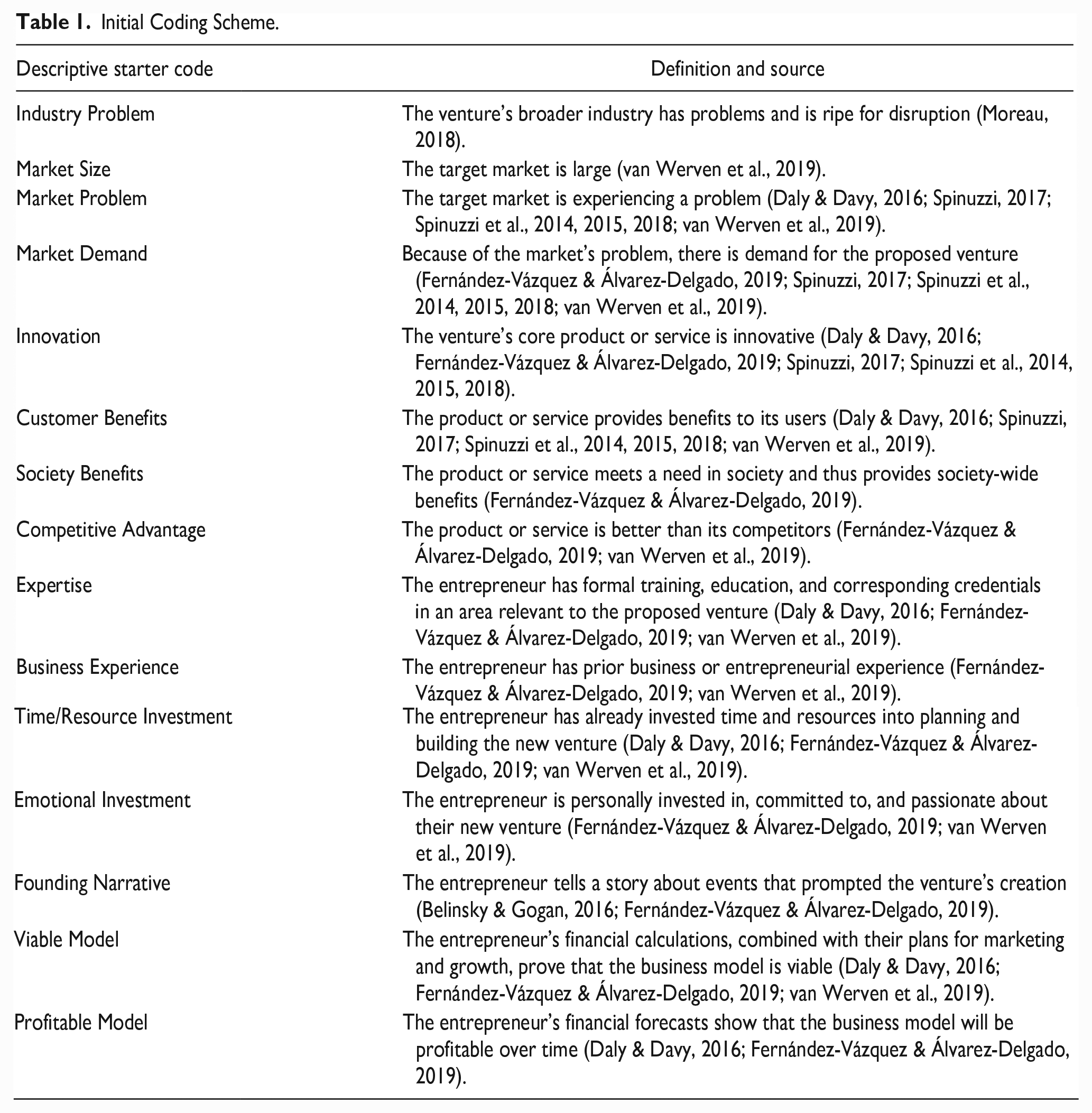
After applying my initial coding scheme to the business plan corpus, I revised it by deleting, adding, and collapsing codes as well as revising some codes’ definitions (Geisler & Swarts, 2019). This revision produced the final coding scheme shown in Table 2. To begin, I deleted the Industry Problem and Market Problem codes because, as I will show, the business plans I analyzed for this study make surprisingly few references to problems. I also deleted the Innovation and Business Experience codes, as they generally proved irrelevant in my initial round of coding. Finally, while I deleted the Society Benefits code, it did suggest another line of argument—benefits to local communities—that proved useful in helping me create the Entrepreneurial Calling code.
Final Coding Scheme Showing Nine Topoi of Small Business Entrepreneurship.
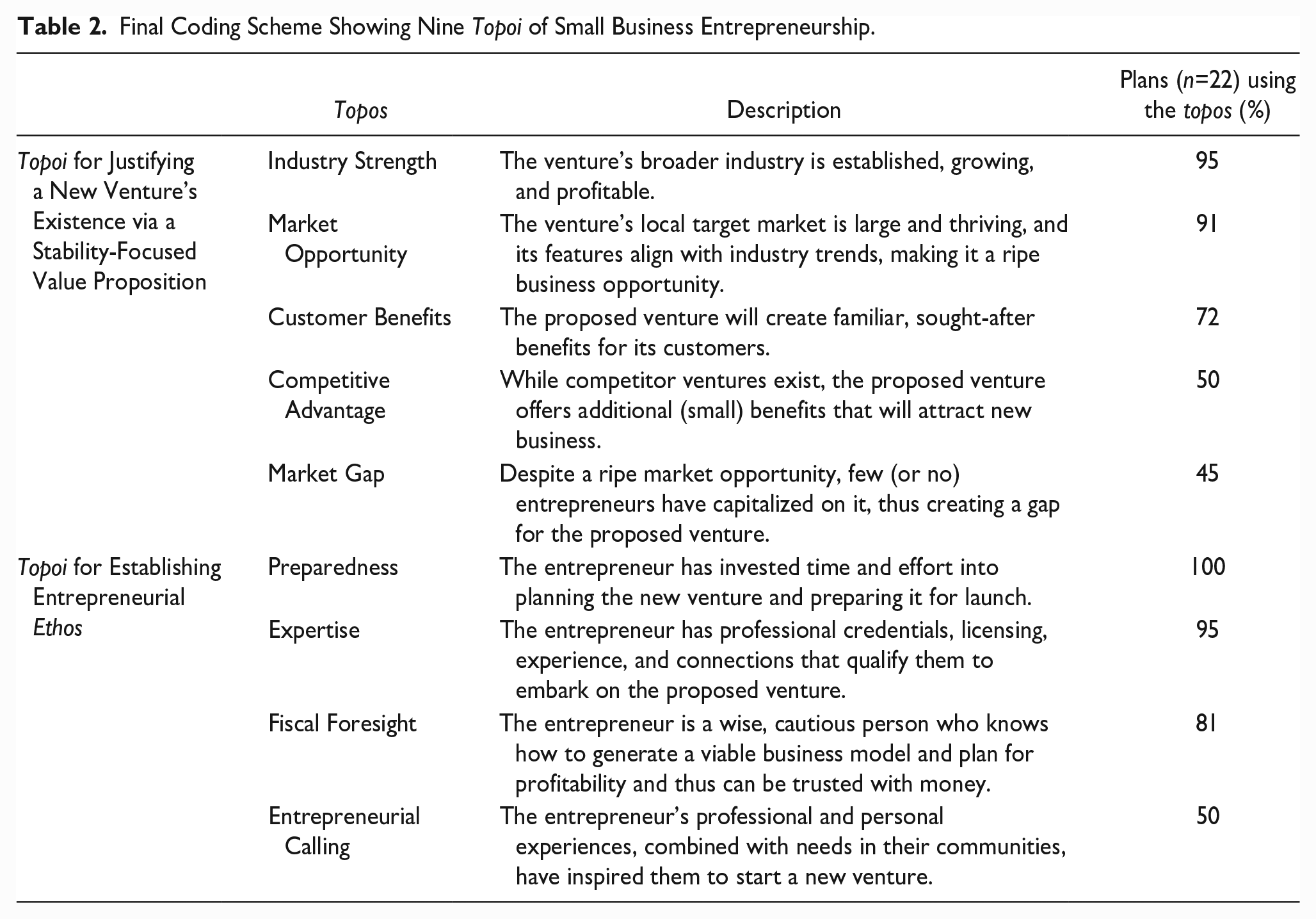
I also added several new codes—Industry Strength, Market Opportunity, Market Gap, Preparedness, Fiscal Foresight, and Entrepreneurial Calling—to better account for arguments that I found in my first round of coding but could not fully account for with my initial coding scheme. Two of these codes—Industry Strength and Market Gap—were new descriptive codes not suggested by existing literature that corresponded to the business plans’ numerous arguments about the size, growth, credibility, and profitability of their ventures’ broader industries (in the case of Industry Strength) and their arguments that while a lucrative local market opportunity existed, few other entrepreneurs were capitalizing on it (in the case of Market Gap). While the initial coding scheme’s descriptive codes were created via a top-down approach that drew on existing themes in the research literature, the creation of these new descriptive codes resulted from a bottom-up coding approach: The business plans’ own arguments and lines of reasoning about industry strength (including statistical data about size, growth, and profitability) and market gaps (including use of gap-highlighting language such as however, yet, few, and none) suggested and guided the creation of these new codes.
The remaining new codes were formed largely by collapsing codes from the initial coding scheme. First, Market Size and Market Demand were collapsed into the Market Opportunity code in the revised scheme. Similarly, the Time/Resource Investment code was collapsed into the Preparedness code. Next, the Emotional Investment and Founding Narrative codes were collapsed into the Entrepreneurial Calling code. I also expanded the definition of this code to encompass the needs of and benefits to local communities, a revision inspired by the initial scheme’s Society Benefits code. Likewise, the Viable Model and Profitable Model codes were collapsed into the Fiscal Foresight code, as I found that such arguments in the small business plan corpus were ultimately used to highlight entrepreneurs’ own careful financial planning.
Once the new codes were established and old codes had been collapsed and reorganized, I revised the definitions of the remaining codes (which at this point I began calling topoi) to better account for the findings from my initial round of coding. Again, this was a bottom-up process: I allowed the business plans themselves to suggest additional elements for which these definitions should account. As I revised the topoi codes, I simultaneously conducted axial coding to sort them into broader thematic categories (Saldanã, 2009). Ultimately, I settled on the two broad groupings shown in Table 2: topoi that justified a new venture’s existence via the creation of a stability-focused value proposition, and topoi that established entrepreneurial ethos and built credibility. As a final step, I recoded the entire business plan corpus using the coding scheme shown in Table 2. I coded plans in their entirety: If a business plan contained any topos shown in Table 2, the plan was assigned that code. In addition to defining this study’s topoi, Table 2 also shows the percentage of plans that use those topoi. Throughout this coding process, I used the software program MaxQDA (release 20.4.1).
Interviews
After coding the small business plans, I interviewed four individuals with entrepreneurship experience, shown in Table 3 (names are pseudonyms). My goal in conducting these interviews was to better understand why Table 2’s topoi might be useful in traditional small business plans—a question that my textual analysis alone could not address. Providing additional context for my textual findings seemed important, since my research goals are pedagogical: In addition to teaching students the topoi of small business plans, it would be useful to help them understand why these arguments are particularly salient and, if these topoi differ from those used in startup pitches, what contextual realities account for those differences.
Entrepreneurs Who Participated in Semistructured Interviews.
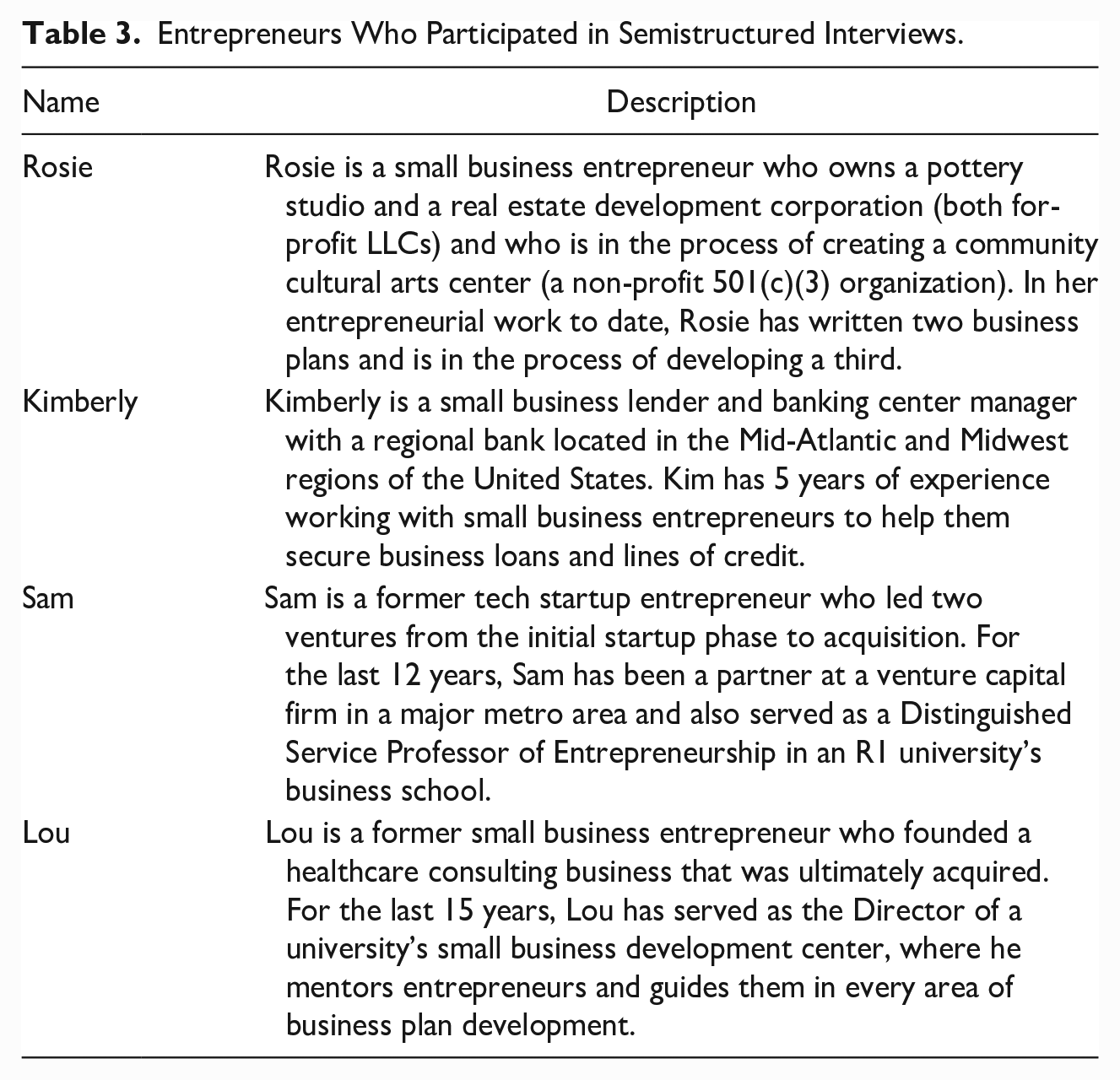
These interviews were semistructured, in that I asked each participant the same set of questions: After asking each to describe their entrepreneurship experience, I asked them first to explain the arguments they thought were most important for entrepreneurs to make in business plans and pitches. Then, I summarized each topos in Table 2 and provided examples of each, drawn from the business plan corpus. I then asked the participant (1) if they were familiar with this kind of argument, based on their entrepreneurship experience, and (2) to provide context for why entrepreneurs might choose to use the argument. Based on each interviewee’s responses, I asked a variety of follow-up probes intended to solicit additional information and, when relevant, illustrative examples (Weiss, 1995). I devised the interview protocol in collaboration with my university’s Institutional Review Board, which ultimately approved my study.
Results
As a result of these methods, I identified nine topoi that small business plans use. While most of these topoi overlap somewhat with the arguments that research suggests startup entrepreneurs use in business pitches, I found that small business entrepreneurs use these topoi differently in written business plans. As Table 2 shows, these topoi can be organized around two broad rhetorical goals: justifying a proposed new venture and establishing an entrepreneur’s ethos. In this section, I explain the nine topoi and illustrate how entrepreneurs use them to accomplish these two rhetorical goals.
Justifying a Venture’s Existence by Creating a Value Proposition
When proposing new ventures, entrepreneurs must show that those ventures are responding to market needs and thus will be welcomed by target customers. Entrepreneurs typically do this by developing a value proposition, or a statement about how a new venture will create value for its target customers by solving their problems and offering them desirable benefits (London et al., 2015).
Distinguishing disruption-focused versus stability-focused value propositions
The scholarship exploring startup pitches suggests that good value propositions define compelling problems and match them to innovative new products or services. In fact, some experts suggest that defining the right problem is one component of crafting a strong value proposition that budding startup entrepreneurs find particularly challenging (Spinuzzi, 2017; Spinuzzi et al., 2014, 2015, 2018). Given the importance of defining a compelling problem, it is not surprising that startup entrepreneurs generally favor problem–solution frameworks for organizing their pitches (Belinsky & Gogan, 2016; van Werven et al., 2019).
In a startup pitch, clearly defining a problem is often necessary because a startup’s innovative product or service may address a need that consumers do not even know they have yet. Therefore, investors (and future customers) need the problem clearly defined in order to understand and embrace the new venture. During our interview, Sam offered an example from his own experience to illustrate this point: I used to be addicted to my Blackberry, and I could have told you that it was only good for textual processing. [But] what I couldn’t have told you is that the solution was [an iPhone with] a single pane of glass. Markets might have a sense of problems, but startup entrepreneurs are good at defining those problems and connecting them with a solution.
If entrepreneurs want to introduce innovative new products like the iPhone, says Sam, they must clearly define the problem–market space in which their product or service will fit because, prior to the pitch, that space might not exist yet.
Of course, as Sam’s iPhone example suggests, this process of defining problems and introducing innovative new solutions is inherently disruptive, in that it highlights a previously unknown area of need and thus disrupts the typical, familiar industry and market processes that have allowed that need to go unmet. In fact, this kind of innovative disruption is a hallmark characteristic of high-stakes startup entrepreneurship (Christensen, 2012). Therefore, startup value propositions are best understood as disruption-focused value propositions. When they succeed, disruption-focused value propositions can upend established markets, drive competitors out of business, and create lucrative new markets and even industries, as was the case with the iPhone. Indeed, this is the outcome investors generally want. As Sam explained in our interview, venture capitalists like him understand that while disruptive, innovative startup ventures are risky (in fact, many fail 3 ), but they stand a chance of becoming hugely profitable. In other words, investors embrace the risk inherent in a disruption-focused value proposition in favor of a chance at substantial reward.
But the story is different for small business entrepreneurs who write business plans: My analysis suggests that these entrepreneurs favor stability-focused value propositions. Stability-focused value propositions situate a new business within a familiar, stable industry and show how the venture is capitalizing on that industry’s strength by bringing consumers products, services, and benefits they already know they want. In this way, Sam points out, far from being cutting-edge and disruptive, most small businesses are what he calls “fast follower” ventures that leverage established industry trends. He notes, for instance, that “in a small business pitch, an entrepreneur might say, ‘Gourmet burger restaurants are really popular on the coasts. We should start a gourmet burger restaurant here, in [this city].’” In this kind of stability-focused value proposition, the emphasis is on creating value not by disrupting an existing industry but rather by leveraging its strength, stability, and profitability.
Traditional small business entrepreneurship undoubtedly favors stability-focused value propositions because, according to Kimberly, small business lenders like her are notoriously risk averse. Unlike investors, banks are not willing to gamble on a new, untested idea in the hope that it might produce huge dividends one day (Mason & Stark, 2004). Instead, banks value stability and certainty: They want guaranteed loan repayment by a fixed date and so will fund only those ventures they are pretty certain will be profitable and able to make payments (and as Kimberly pointed out, they will ask entrepreneurs for collateral, just to be safe).
Five topoi for creating stability-focused value propositions
Industry strength
While startup entrepreneurs adopt a problem–solution framework for creating disruption-focused value propositions, my analysis suggests that small business entrepreneurs use up to five topoi to craft stability-focused value propositions. Generally, entrepreneurs begin with an argument I am calling the industry strength topos, which argues that the venture’s broader industry is established, growing, and profitable. Virtually all of the plans (95%; n = 21) I analyzed use the industry strength topos. By contrast, none of the existing pitch research explores industry strength arguments, likely because startup entrepreneurs seek to disrupt existing industry practices.
Entrepreneurs often make industry strength arguments by invoking statistical evidence. For instance, in her plan to open a new fitness center, one entrepreneur uses detailed quantitative evidence to argue that the fitness industry is growing. These arguments are shown in bold; I have added the bolding here and throughout the rest of this analysis: Rising health consciousness has been an impetus in the fitness industry for the past several years, and it will
As the bolded text indicates, in this initial industry strength argument, the entrepreneur begins to craft a stability-focused value proposition by showing that her proposed fitness center is situated within a large, thriving industry that is only expected to grow larger over time. Totally absent from this early industry strength argument is any mention of a problem, contrary to what we might expect from a startup entrepreneur’s early value proposition arguments.
The topos of industry strength seems particularly useful for minimizing a venture’s perceived risk because it connects a new venture to a stable, established industry. For example, in one plan, an entrepreneur proposing a new industrial–organizational (I–O) psychology practice notes that while the field of I–O is relatively new, it is recognized by the American Psychological Association, and the Department of Labor predicts that I–O employment will grow 13% faster than other types of employment (“Industrial–Organizational Psychologist,” 2021). Similarly, a medical team proposing a new biofeedback center notes that while biofeedback is a relatively unfamiliar kind of medical care for many Americans, the industry took in hundreds of millions of dollars in 2019 and is projected to have a “compound annual growth of 6.2%” in coming years (Greenland, 2020b). They also note that numerous national and international organizations offer certification programs for biofeedback therapists, thereby suggesting that this industry is established and credible. In both examples, the industry strength topos minimizes risk by suggesting the ventures’ industries are credible, profitable, and growing rapidly.
Market opportunity
After beginning their stability-focused value propositions with the industry strength topos, entrepreneurs generally follow with a topos I am calling market opportunity. In using the market opportunity topos, entrepreneurs argue that their venture is justified because the local target market’s size and features, combined with the wider industry’s strength, make for a ripe market opportunity. Nearly all (91%; n = 20) of the plans I analyzed used this topos to justify their ventures. This frequency aligns with the existing business pitch research, which underscores the importance of researching one’s target market and arguing that it can support the proposed venture.
However, existing business pitch scholarship generally suggests that problem- and market-related arguments work together to create disruption-focused value propositions. By contrast, my analysis suggests that in stability-focused value propositions, the market opportunity and industry strength topoi work together to show that, given the strength, size, stability, and profitability of a proposed venture’s industry and market, the venture is low-risk and sure to succeed. For instance, in the fitness center proposal, after using the industry strength topos, the entrepreneur introduces the market opportunity topos in order to show why Lake Orion’s (the new venture’s target market) demographic features and weather patterns ensure the new gym will succeed: The city of Lake Orion had a population of 2,973 in the 2010 Census; this number increased 9.5% since that time to have a current population of 3,208. It is expected to continue to rise through 2040, when the population is predicted to be 3,881. January, February, and March are the biggest months in the fitness industry because of New Year’s resolutions,
Here, the writer shows how trends in her local target market align with larger industry trends. As the bolded text indicates, she notes that her community’s population growth is among younger people with discretionary income —a population that is eager and able to purchase gym memberships. She even connects holiday-related industry trends to weather-related opportunities in her local market, noting that the expected post–New Year’s bump in gym attendance will be enhanced by her local market’s chilly winter temperatures. In other plans, entrepreneurs similarly note that their target local markets’ features—their population demographics, location, and dominant industries—make them ripe for a proposed new venture. As this example suggests, small business entrepreneurs argue for a new venture’s value not by showing that a disruptive problem has created a lucrative new market opportunity (as a startup entrepreneur would), but rather by suggesting that a thriving local market’s features match those in an established, profitable industry and so offer a stable, low-risk market opportunity.
Market gap
In some plans, the entrepreneur complements the market opportunity topos with an argument I am calling the market gap topos, in which they point out that in spite of the industry’s strength and the corresponding local market opportunity, few other ventures are capitalizing on it. For instance, in a business plan for a childproofing service company, the writers point out that while child safety is a growing industry, and while their local community has booming rates of childbirth, particularly among first-generation Hispanic immigrants who need help navigating child safety regulations, “there are currently few certified child proofing experts in the Sacramento area with the training and experience to address the entire scope of potential dangers to children at each stage of their development” (Moore, 2019). Similarly, in a plan proposing personal training services for women, the entrepreneur notes that “there are several other [personal training] gyms in the area but none that are exclusively for women” (Fletcher, 2013). In both examples, the writers enhance the local market opportunity topos by explicitly identifying what is missing in their local market.
Prior research suggests that arguments like the market gap topos—that is, arguments about what is problematic or missing in a market—are ubiquitous in high-stakes startup pitches. However, such arguments are not as common in traditional small business plans: Slightly less than half (45%; n = 10) of the plans I analyzed use the market gap topos. This raises a question: If small business entrepreneurs do not make explicit arguments about what is problematic or missing in their target markets, how do they show that the markets can support their new ventures? After all, convincing potential funders of this is a primary rhetorical objective of a business pitch or plan.
I found that in the majority of plans (55%; n = 11), instead of making explicit arguments about market gaps, entrepreneurs make enthymematic arguments that suggest the target market is so large and thriving, it can easily accommodate the proposed venture. In other words, instead of following the market opportunity topos with an explicit market gap argument, over half of entrepreneurs use the market opportunity topos itself to suggest that the market is large and lucrative enough to support the new business idea. Entrepreneurs typically make this enthymematic argument by illustrating the size of their target customer pool. For instance, an entrepreneur pitching a legal consulting firm lists 11 different industry types with whom her proposed venture could work, including clinics, government agencies, law firms, and more. Then, the entrepreneur indicates that she will concentrate her initial marketing efforts on law firms, insurance carriers, and healthcare systems, and she provides a quantified description of how many potential customers exist in each category within her local market: “Insurance carriers (385 establishments); Legal Services (4,540 establishments); Health Services (10,596 establishments)” (Greenland, 2021). Even though this entrepreneur never uses the market gap topos, in noting that she has more than 15,000 potential clients across just 3 of the 11 industries her business could target, she makes an enthymematic argument that the local market is large enough to accommodate her new venture.
Small business entrepreneurs may prefer an enthymematic argument over a more explicit market gap argument because the market gap topos highlights a new venture’s novelty in ways that might inadvertently make it seem risky. Since bank lenders are risk averse, entrepreneurs may choose to use the market opportunity topos to make an enthymematic argument because doing so foregrounds a market’s stability and profitability and, by extension, suggests that the proposed venture is low risk. This observation adds to van Werven et al.’s (2019) findings about enthymematic arguments in business pitches. They found that startup entrepreneurs routinely used enthymematic arguments to subtly suggest that their ventures would be successful. My findings suggest an additional use for such arguments: Small business entrepreneurs can use enthymematic arguments in place of more explicit market gap or problem arguments, in order to suggest that there is ample room in an established market for their proposed ventures.
Customer benefit
Part of creating a value proposition, whether it is disruption- or stability-focused, involves showing how a new venture will benefit its customers. As Spinuzzi (2017) and Spinuzzi et al. (2014, 2015, 2018) have shown, refining a business pitch largely involves finding the most compelling argument about whom a venture will help and what benefits it will provide. Similarly, van Werven et al. (2019) suggest that some version of the claim “Our product provides benefits to customers” is standard in startup pitches and involves explaining the product’s features in terms of their affordances. Broadly speaking, existing business pitch research suggests that the topos of customer benefit is one way entrepreneurs can show potential funders exactly what kind of value a proposed venture will create for its customers. My analysis confirms that the customer benefit topos is common in small business plans: Nearly three-quarters (72%; n = 16) of the plans I analyzed use it.
Small business entrepreneurs often invoke the customer benefit topos by describing the ways in which a new venture will create a host of familiar, desirable benefits for its target customers. For instance, entrepreneurs proposing a new biofeedback therapy service assert that while biofeedback is well known as a therapy for treating stress and anxiety, it is also useful for treating a host of other ailments, including “chronic pain, headaches, chronic constipation, fibromyalgia, asthma, high blood pressure, tinnitus, irritable bowel syndrome, attention deficit/hyperactivity disorder, hypertension, [and] incontinence” and that biofeedback is “effective for enhancing sports performance” (Greenland, 2020b). Likewise, an entrepreneur pitching an aromatherapy business argues, “Essential oils are gaining widespread recognition for their health benefits. In addition to improving overall wellness, specific applications include the reduction of stress and anxiety and relief from pain, insomnia, and skin conditions” (Greenland, 2020a) In both cases, the entrepreneurs argue that their ventures will create value for target customers by providing sought-after health benefits.
Competitive advantage
Like the customer benefit topos, the competitive advantage topos allows entrepreneurs to justify their ventures by differentiating them from the competition and suggesting that those differentiating factors will set their ventures apart and make them successful. Existing business pitch research indicates that competitive advantage arguments are common in startup pitches (e.g., Daly & Davy, 2016; Fernández-Vázquez & Álvarez-Delgado, 2019). In fact, during our interview, Sam suggested that competitive advantage is a key factor that investors consider. He noted that investors want to know that even in its infancy, a proposed startup venture is being built with an eye toward having what he called an “unfair competitive advantage,” or an advantage so strong and central to the startup’s business model that it will prove difficult for other ventures to compete at all. As Sam’s response suggests, in startup pitch scenarios, competitive advantage arguments are ideally strong statements about a proposed venture’s capacity to not only disrupt but also dominate industries and markets.
However, my findings suggest that the competitive advantage topos is not standard in small business plans: Just half (50%; n = 11) of plans I analyzed used it. Moreover, when a small business entrepreneur does use this topos, they use it not to argue that their venture’s business model will create disruptive dominance but rather to show that they are adding small benefits to a familiar, established business model. For instance, in a plan proposing a healthy meal prep business, the entrepreneur notes that while her business model capitalizes on the profitable trends in the growing meal kit industry, her proposed venture offers several additional features that will distinguish it from the competition and thus bring new value to her target customers: Online meal prep businesses provide some competition, but Mealz to Go is different and will stand out by
providing hot meals that are ready to pick up and serve for dinner.
offering half portions for singles and couples.
preparing fresh keto and macro meals each week instead of using preservatives. (Fletcher, 2020)
Here, the entrepreneur uses the competitive advantage topos to note several small benefits her customers will enjoy that competitors do not provide, such as hot meals, half portions, and meals that accommodate dietary restrictions. This is not the disruptive, dominant competitive advantage argument that Sam suggests is typical in startup pitches; rather, it is a small, continuity-focused argument that suggests the entrepreneur has slightly adapted a stable, low-risk business model to make it even better.
Small business entrepreneurs who choose to forego making any competitive advantage arguments (as half of the plans in this study’s corpus do) may also be appealing to their ventures’ stable, low-risk nature: Since the competitive advantage topos, like the market gap topos, signals novelty, noting any competitive advantage may inadvertently suggest that the venture is somewhat risky, since it is taking an approach few or no other ventures have taken. As with omitting an explicit market gap argument, omitting a competitive advantage argument may help entrepreneurs avoid inadvertently signaling risk.
So far, I have shown that small business entrepreneurs create stability-focused value propositions by using the industry strength and market opportunity topoi to argue that the new venture’s industry and target market are established and thriving and thus represent a strong business opportunity industry. I have also shown that while entrepreneurs sometimes make explicit arguments about market gaps as a way to justify their business ideas, they also make enthymematic, implicit claims that the market is so big and profitable, it can easily accommodate a new venture. Finally, I have shown that some small business entrepreneurs use the customer benefit and competitive advantage topoi to describe the value their proposed ventures will create for customers.
Notably absent from this list of topoi are any arguments about industry or market problems. Indeed, my analysis suggests problem-related arguments are not common in small business plans. Over half of the plans that I analyzed never reference a problem when making arguments meant to justify their proposed ventures, and those that do (45%; n = 10) identify systemic problems that provide contextual information about a venture’s broader industry. For instance, several fitness center plans reference the obesity epidemic as a way to create context for discussing the fitness industry, and a plan for an organic farm outlines problems with traditional farming as a way to introduce the organic hydroponic farming industry (Theurer et al., 2008). In other words, when small business entrepreneurs write about problems, they do so to explain broad industry trends, not to create a specific value proposition.
While Sam and Kimberly identify business type (startup vs. small business) as a key reason why small business entrepreneurs might avoid the kind of problem-driven reasoning that characterizes disruption-focused value propositions, Rosie suggests another reason: In her experience, entrepreneurs are optimistic by nature and so prefer the kind of positive, growth-and-opportunity arguments that characterize stability-focused value propositions. As she puts it, “I think maybe, as entrepreneurs, we’re wired to see opportunities. Like, we tend to be on the optimistic end of things, always saying, ‘Wow, this is going to be great!’” Moreover, small business entrepreneurs typically have strong roots in a local community and so may find it more natural to focus on a local market’s opportunities rather than its problems. This certainly describes Rosie, whose businesses operate in the same underresourced, marginalized community where she lives: She avoids problem-focused arguments because, in her words, “I don’t want to look at my community that way.” Instead, she prefers to focus on “all the amazing things” her ventures can provide for community members. Moreover, she has found that this emphasis on positive opportunities resonates well with local funders and community partners—perhaps because these funders and partners, like Rosie, are also invested in her local community.
Four Topoi for Establishing Entrepreneurial Ethos
In addition to justifying a new venture by creating a compelling value proposition, an entrepreneur must also establish their own ethos by proving that they are a credible, competent person who is qualified to tackle a new venture. My analysis suggests that small business entrepreneurs do this in part by using 2 topoi that have been well-explored in existing business pitch research: the topoi of expertise and preparedness. But I also found that the topos small business entrepreneurs use to show their passion—which I am calling the topos of entrepreneurial calling—looks different in small business plans than it does in startup pitches. Moreover, my analysis suggests that while arguments about a small business entrepreneur’s fiscal caution and foresight are fairly standard in small business plans, they may be less typical in startup pitches.
Expertise
Unsurprisingly, the most common way entrepreneurs establish their credibility is via the topos of expertise, in which entrepreneurs cite their relevant professional experience, formal credentials and licenses, industry connections, and awards or honors. Existing business pitch research suggests that appeals to professional experience and formal credentials are standard moves in startup pitches. My findings concur: Virtually all of the plans I analyzed (95%; n = 21) use the topos of expertise to establish the entrepreneur’s credibility as a potential new business founder.
Entrepreneurial calling
In addition to highlighting their expertise, research suggests that startup entrepreneurs also establish their ethos by displaying passion and enthusiasm for their proposed ventures. In pitch scenarios, entrepreneurs display passion via extra-textual resources like energetic body language, eye contact, animated facial expressions, and varied vocal tone (Cardon et al., 2009; Chen et al., 2009). Such physical performances not only build excitement, but they may also build trust: While funders are ultimately more persuaded by the content of an entrepreneur’s pitch than any displays of passionate emotion (Chen et al., 2009), studies suggest that when entrepreneurs come across as passionate, investors feel more confident in the business venture (Cardon et al., 2009).
But when it comes to conveying entrepreneurial passion in a written business plan, physical performances such as gestures and facial expressions are obviously not useful strategies. However, my findings suggest an argument strategy, which I am calling the topos of entrepreneurial calling, that can convey entrepreneurial passion. Entrepreneurs use this topos to explain how their professional skills, credentials, and prior work experience intersect with their personal experiences and their community’s needs in ways that have motivated them to embark on a new venture. This topos frames the new venture as an inevitable step that arises not from an entrepreneur’s own ambition but from intrinsic and social forces that, together, almost compel the entrepreneur to start a new business. Half (n = 11) of the plans I analyzed use the entrepreneurial calling topos.
This topos often uses language associated with the notion of a religious calling, such as the words “inspired” and “moved.”
4
In addition to conveying an emotional commitment to the new venture, the entrepreneurial calling topos also helps entrepreneurs explain how their professional expertise, personal history, and current circumstances have converged in ways that have driven them to pursue new business ventures. For instance, in a plan pitching a legal nursing consulting business, the writer uses the entrepreneurial calling topos to note that while she is formally trained as a nurse and spent most of her career working in a hospital, and while healthcare “is her passion,” the fact that her father was an attorney also made her interested in law. Then, “after reading a brochure from the AALNC about the legal nurse consulting profession, Shriver was
Other entrepreneurs note that their entrepreneurial calling arises in part from the needs they see in their own communities. For instance, in a plan pitching a childproofing service company, the entrepreneur notes that in his experience as a law enforcement officer, he “saw many instances of child injury in the home” and that these experiences “
During my interview with Rosie, she confirmed that this topos is particularly useful for helping readers understand why an entrepreneur’s personal experiences and commitment to their community qualify them to start a venture, even if their formal credentials might not. As Rosie tells it, her story of entrepreneurial calling is the real story of why she has started a pottery studio, a real estate development company, and a cultural arts center in an under-resourced community: [My story] is not that I went to [this college] and got a Psych degree and this [new venture] would be a good fit. It’s not [a good fit], you know? [Laughing.] It doesn’t really make sense . . . so you kind of have to make those bridges [for readers], right? Like, “This is why I think I can do this, using my pottery hobby and [the fact that] I’ve always been interested in business and community development and people on the margins and the fact that I have a creative streak.” So it kind of does make sense that way, you know? And I live in this community that has all this need, so all these things sort of came together. That’s the story. Not where I went to school.
According to Rosie, she uses the entrepreneurial calling topos often in her written business planning because it allows her to bring together the seemingly unrelated threads of her education, professional experience, personal interests, and deep community loyalty in ways that help funders understand why she is a credible entrepreneur.
In fact, the entrepreneurial calling topos may be a particularly useful rhetorical resource for female entrepreneurs like Rosie. Women are far less likely than men to start new business ventures, and research has shown that gender stereotypes are at least partly to blame (Kirk et al., 2020). Put simply, men are stereotypically considered ambitious and self-reliant and thus more suited to excel in competitive professional environments, while women are stereotyped as being caring and interdependent and thus better suited to caregiving roles. Studies have shown that when women violate gender stereotypes in professional settings and behave in “male” ways, they may incur negative backlash (Rudman, 1998; Rudman & Phelan, 2008). The same appears true in new venture funding: Studies have shown that women who behave “entrepreneurially” (i.e., like men) raise less funding and incur more skeptical, resistant questions than women who act less entrepreneurially (Kanze et al., 2018; Malmström, Voitkane, et al., 2020).
While this phenomenon is obviously unjust, research also indicates that female entrepreneurs who want to succeed must learn to work within this inherently biased framework, at least for now (Malmström, Voitkane, et al., 2020; Malmström, Wesemann, & Wincent, 2020). The entrepreneurial calling topos may provide a means for women to do that. The topos reduces an entrepreneur’s agency somewhat by painting a new venture as a calling that stems partly from extrinsic forces (not the entrepreneur’s own ambition), and it positions a new venture as responding to a community’s needs, thereby framing the entrepreneur partly as a community-minded caregiver. Therefore, the topos of entrepreneurial calling could serve as a rhetorical resource for women who want to avoid gendered backlash when proposing a new business venture.
While the topos can be used to avoid gendered backlash, Kimberly and Lou suggest that it can also signal an entrepreneur’s commitment and willingness to stick with a new venture. According to Kimberly, If I don’t hear [the entrepreneurial calling topos], I get somewhat concerned that there’s a lack of connection. It’s like, “Why do really you want to do this? Are you just bored at work, or sick of your boss, and so you want to go do this thing on your own and then you’re going to back out in like two years?” If someone doesn’t really want to do something, then they won’t end up doing it.
Kimberly’s observation suggests that bank lenders see the entrepreneurial calling topos as a sign of commitment. Investors may, too: Cardon et al.’s (2009) findings suggest that angel investors see entrepreneurial passion as a sign that a startup entrepreneur is likely to stick with a business idea and not give up in the face of obstacles.
In fact, Sam noted during our interview that startup entrepreneurs often use a version of the entrepreneurial calling topos in business pitches. But startup entrepreneurs frame this topos differently: Their narratives of entrepreneurial calling are not typically stories of community-minded individuals being called to serve and help others, but rather stories of ambitious founders with single-minded (even obsessive) passions for their business ideas. In other words, while a small business entrepreneur’s story is one of being called by external forces (usually needs in their own communities), a startup entrepreneur’s story is one of internal calling: The entrepreneur feels called by their own innovative vision for a disruptive, scalable product or service that, while risky, has the potential to quickly grow into a lucrative national or global venture (O’Connor, 2002, pp. 42–45). 5 Telling this story of internal calling to a disruptive, innovative vision is one way startup entrepreneurs can appeal to an investor’s desire to back a risky, disruptive, and potentially lucrative business idea. The story is different, of course, for a small business entrepreneur: Telling the story of their external calling to meet a widespread, established need in their community via a proven business model is one way they can appeal to a bank lender’s desire to fund low-risk, stable ventures.
Preparedness
In addition to citing their expertise and demonstrating their entrepreneurial passion, an entrepreneur can also establish their credibility by showing that they are well-prepared to launch the new venture. Existing research suggests that in general, entrepreneurs invoke what I am calling the topos of preparedness by offering substantive, well-researched, and organized business pitches (Chen et al., 2009) and that entrepreneurs who seem prepared are more likely to receive funding (Cardon et al., 2009; Chen et al., 2009; Pollack et al., 2012). Similarly, business pitch studies have shown that investors can demonstrate their preparedness by appealing to the effort and money they have already invested in the venture (Daly & Davy, 2016; Fernández-Vázquez & Álvarez-Delgado, 2019) and offering evidence and reasoning to support their claims about their industry, market, product or service, and future profitability (Fernández-Vázquez & Álvarez-Delgado, 2019; van Werven et al., 2019). Such arguments show that an entrepreneur has “done their homework,” as Lou put it in our interview, and is thus credible. All of the plans I analyzed used the topos of preparedness by either appealing to entrepreneurs’ effort and personal financial investment (72%; n = 16) or by offering evidence (usually statistical data) and reasoning to support claims (100%; N = 22).
Fiscal foresight
Along with the topoi of expertise, entrepreneurial calling, and preparedness, my analysis suggests that small business entrepreneurs also use a line of argument I am calling the topos of fiscal foresight to establish their credibility. This topos provides a means for small business entrepreneurs to show that they are wise, cautious individuals who can be trusted with money because they know how to plan for profitability. More than 80% (n = 18) of the plans I analyzed use this topos.
To begin, entrepreneurs frequently use this topos to rationalize financial choices they have already made or are planning to make, in an apparent effort to justify those costs. In some cases, entrepreneurs use the topos to show that the benefits of particular expenses outweigh the cost. For instance, in a plan pitching a commercial organic greenhouse, the entrepreneurs justify purchasing a $6,000 hydroponics system by enumerating its money- and space-saving benefits, shown in bold: The system used in our greenhouses is the Great Lakes Vertical System. The system is designed so one can stack growing pots on top of each other
Here, the entrepreneurs portray themselves as wise, responsible future business owners by arguing that, while their hydroponic system is expensive, they have carefully considered the purchase and have decided that its benefits are worth the investment. Entrepreneurs make a similar move in rationalizing location-related expenses, noting that their target locations (which often require pricey lease agreements) are located in desirable, high-traffic areas which will bring in new business.
In addition to using the fiscal foresight topos to rationalize costs, entrepreneurs also use this topos to underscore cost-saving measures they have already taken. For instance, in a plan pitching a new fitness center, the entrepreneur notes that while she will need to purchase fitness equipment, she “has found some gently used equipment that can be purchased at considerable discount” (Fletcher, 2013). Similarly, in a plan pitching a healthy meal prep business, the entrepreneur notes that while costs will increase as orders increase, she “will purchase most food in bulk, buy and serve produce that is in season, and will also partner with local farmers to keep prices low” (Fletcher, 2020). In addition, many entrepreneurs who initially plan to start their businesses from their own homes often preemptively assert that the move is a strategic one because it will keep initial overhead low. As these examples show, the fiscal foresight topos can be used to justify actual expenses and to highlight avoided expense, all in an effort to show that the entrepreneur has considered every dime and is proceeding wisely. This portrayal, in turn, further suggests that the proposed venture is low-risk and stable, since the entrepreneur is so cautious and wise with money.
While subject-matter experts Rosie, Kimberly, and Lou all confirmed that profitability-related arguments matter most in a business plan and agreed that one way an entrepreneur can demonstrate their venture’s potential profitability is to display financial foresight, Sam suggests that the situation is different for startup entrepreneurs. Because investors tolerate far more risk than lenders, startup entrepreneurs need only show that their ventures could, hypothetically, become profitable at some point. In fact, investors typically expect startup entrepreneurs to have bold visions for growth and to reinvest profits back into the company and so may be generally unconcerned if a new startup venture is not profitable (Lee, 2018). In other words, while bank lenders value financial caution and foresight as evidence that the proposed venture is low-risk, investors value boldness and risk-taking (Flint, n.d.), so it seems likely that the topos of fiscal foresight is not as exigent in startup pitches as it is in business plans.
Discussion
This analysis explores nine topoi that small business entrepreneurs use to create value propositions and establish their own entrepreneurial ethos. My findings suggest that in many cases, small business entrepreneurs use these topoi to make considerably different arguments than those that startup entrepreneurs typically make. For instance, while startup entrepreneurs favor disruption-focused value propositions that foreground novel industry and market problems as well as disruptive solutions, small business entrepreneurs draw on five topoi to craft stability-focused value propositions. Stability-focused value propositions frame a new venture as low-risk by situating it within an established, thriving market whose features correspond to stable, profitable industry trends. Similarly, even though both startup and small business entrepreneurs use the topos of expertise to establish their credibility, they use different arguments to show their passion. While startup entrepreneurs demonstrate passion via presentation skills and narratives that show their individual calling to a scalable, visionary new business idea, small business entrepreneurs use the topos of entrepreneurial calling to demonstrate a community-, service-oriented calling. That is, they tell a story of their response not to the force of their own single-minded ambition but rather to exigent needs in their own communities—needs which align with their expertise in ways that inspire, move, and compel them to start new ventures. Finally, while both startup and small business entrepreneurs use the topos of preparedness to show that they are well suited to start a new business, small business entrepreneurs also use the topos of fiscal foresight to show that they are cautious with money—a trait bank lenders appear to value more than investors.
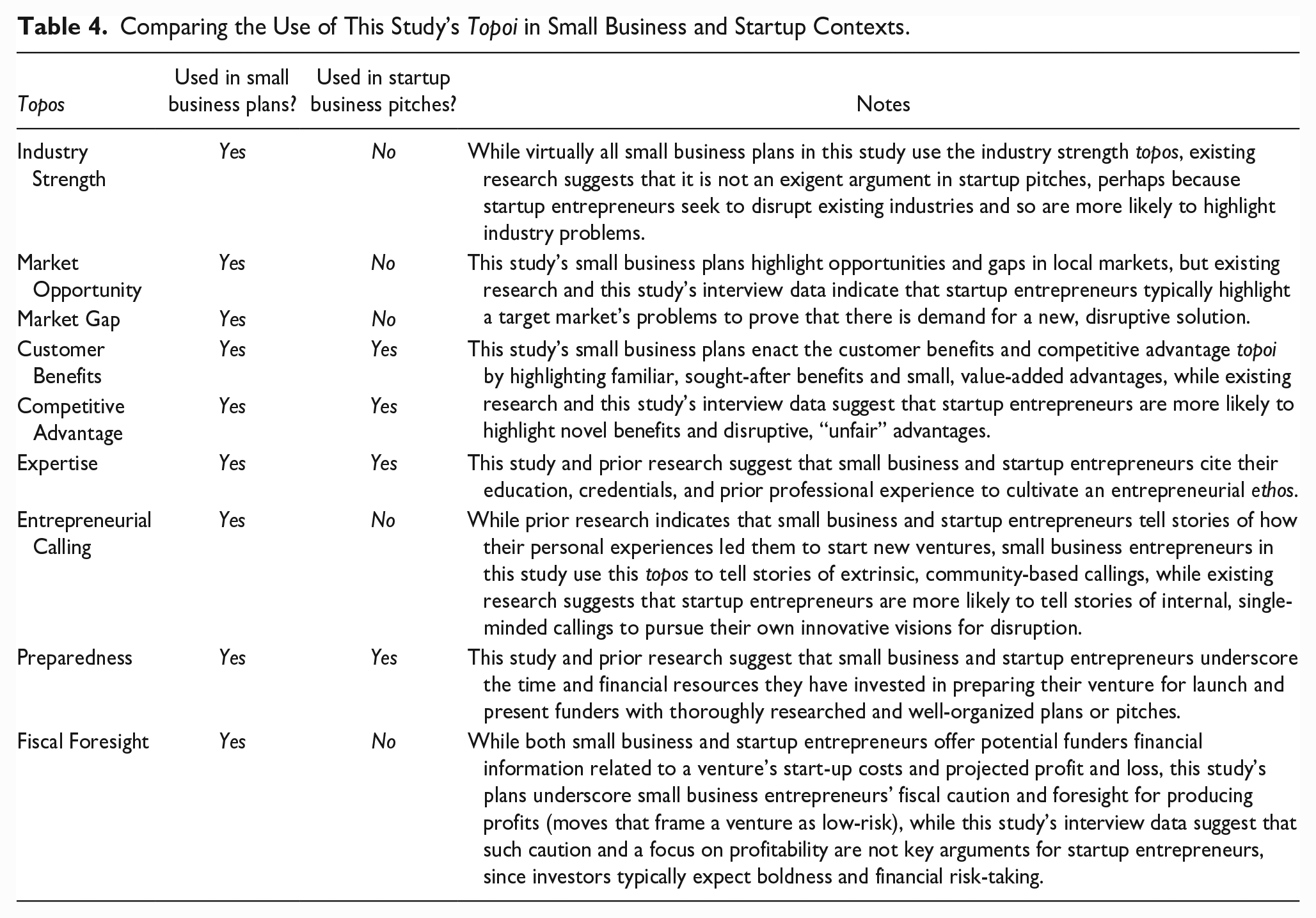
Table 4 summarizes major similarities and differences in the ways that small business plans in this study’s corpus used these topoi, compared to the way that existing business pitch research suggests startup entrepreneurs use them (or some version of them) in business pitches. While a side-by-side comparison is difficult, since this study does not directly compare small business plans and business pitches but instead relies on prior business pitch research and interview data to make comparisons, Table 4 offers a glossed summary that aims to clarify important distinctions in how the use of these topoi seems to vary based on business type.
Comparing the Use of This Study’s Topoi in Small Business and Startup Contexts.
As rhetorical resources, topoi like those outlined in this study are useful in part because they appeal to a discourse community’s shared values. For instance, Fahnestock and Secor (1991) suggest that the topoi of literary criticism reflect a central value of critical inquiry: that “literature is complex . . . [and] Meaning is never simple” (p. 89). Similarly, studies of the common topoi of academic discourse (e.g., Thonney, 2011; Wolfe et al., 2014) have shown that these topoi reflect what Thaiss and Zawacki (2006) suggest are values universal to academic discourse: prioritizing reason over emotion, framing analysis as disciplinary inquiry, and anticipating skeptical objections.
Similarly, my analysis suggests that this study’s topoi reflect underlying differences in the values that motivate bank lenders and investors. Put simply, investors value innovative, disruptive, scalable ventures because, while such ventures are quite risky, they are potentially lucrative. But bank lenders value stable, “fast follower” ventures that capitalize on and continue profitable industry trends and that will remain small and rooted in local communities. Banks prefer such ventures, says Kimberly, because small businesses like these are low-risk and thus less likely to default on their loans. Moreover, topoi that appeal to a venture’s rootedness in a local community may resonate with lenders because banks—even large, national chains—want to show that they use their resources to strengthen local communities. 6
Regarding pedagogical implications, my findings offer an initial look at the kinds of rhetorical strategies EE students will need to use if they wish to start traditional small business ventures. These findings complement those of existing scholarship, which has focused exclusively on analyzing high-stakes startup pitches, and illustrate the ways in which rhetorical strategies for justifying a new venture and establishing one’s entrepreneurial ethos differ based on the business type one wants to pursue. Considering these differences, EE students would likely benefit from practice using these strategies to craft different kinds of justification and ethos-building arguments. For instance, students would likely benefit from learning strategies for minimizing risk and emphasizing stability—strategies such as creating stability-focused value propositions, telling stories of community-based callings, and highlighting fiscal foresight—as well as strategies for highlighting innovation and disruption. While it is beyond the scope of this article to discuss approaches to teaching these topoi, at the very least, these findings suggest that students should be made aware of important rhetorical differences in the strategies that entrepreneurs use to persuade bank lenders and investors to grant funding.
Of course, the extent to which these findings are widely applicable is somewhat limited, given the size and scope of this study’s corpus. As it contains only 22 business plans, this study’s corpus is small, and its scope is narrow, since it focuses only on health- and wellness-related small business ventures. Future research with a larger and more varied corpus could suggest other topoi and could shed additional light on the topoi explored in this study. Moreover, while my findings indicate that business type (high-stakes startup vs. traditional small business) plays an important role in the rhetorical strategies that entrepreneurs use to solicit funding, my corpus contains only small business plans and so does not facilitate any direct comparison between the topoi of business plans and those of business pitches. More research is needed to confirm or add to these preliminary observations. Future research with a corpus of both small business and startup planning documents could further compare the extent to which rhetorical strategies for business planning differ based on business type. Such research could also explore similarities in those strategies, something that is beyond the scope of this study but deserves further scrutiny. Finally, in our interviews, subject matter experts Rosie, Kimberly, and Lou suggested that while proposing a traditional small business venture does not usually involve a formal business pitch, it often does involve conversations with lenders and community partners. Thus, future research could explore the extent to which small business entrepreneurs adapt this study’s topoi for use in business-related conversations with potential funders and partners, as well as the extent to which those conversations aid them in inventing arguments that they use in their business plans. 7 Such research could add to this study’s findings by suggesting ways in which not only business type but also oral communication medium (e.g., formal pitch vs. informal conversation) might influence the way that entrepreneurs draw on these topoi when proposing a new venture.
While this study’s findings are somewhat limited and should be considered preliminary, they shed important light on an overlooked topic—the rhetorical arguments that entrepreneurs use to propose traditional small business ventures—and suggest new lines of argument from which EE students would benefit learning.
Footnotes
Declaration of Conflicting Interests
The author declared no potential conflicts of interest with respect to the research, authorship, and/or publication of this article.
Funding
The author received no financial support for the research, authorship, and/or publication of this article.
