






Abstract
Based on a sociocultural approach to adult learning and poststructural feminist theories, this study draws on interviews with 11 married Vietnamese women to explore the higher education learning experiences of Vietnamese immigrant women in Taiwan. On the basis of their husbands’ permission and support, Vietnamese immigrant women embraced the instrumental value of education and pursued higher education to play their expected motherhood roles. During the higher education learning process, the women persevered in learning with resilience, negotiated their voices and cultural identity, and fulfilled multiple roles. Participating in and even completing higher education in Taiwan empowered these women through learning based on their bicultural competence.
Keywords
Introduction
There has been a rapid increase in transnational marriage migration in many Asian countries over the past two decades. The more than 90,360 Vietnamese women who were married to Taiwanese men by November 2014 compose an important part of the marriage migration flows in East Asia (Ministry of the Interior, 2014). These women also constitute a sizable portion of the newly arrived population in Taiwan, who are confronted with the challenges of marriage and immigration while occupying a status intertwined with issues of gender and class (Tang & Wang, 2011; Tsai, Chen, & Huang, 2011).
Because of structural discrimination in their host countries, financial needs, and a lack of marketable skills, immigrant women have represented a potentially disadvantaged group. For female immigrants, participation in learning in host countries is associated with possibilities for upward social mobility and economic advancement through participation in the labor market (Wong, Duff, & Early, 2001).
Despite some scholarship on immigrant women in education, most research has focused on the experiences of immigrant women pursuing basic adult education (e.g., Cuban & Stromquist, 2009). In the last decade, a small number of studies have explored postsecondary education among these immigrant women. These investigations, which have addressed higher education among Caribbean and Asian immigrant women in Canada and the United States, have demonstrated that although these women remained silent and marginalized in higher education classrooms due to their limited proficiency in the host country’s language and lack of familiarity with academic culture, they persisted in learning (Alfred, 2003; Mcfarlane, 2006; Sadeghi, 2008; Swaminathan, 2004). However, existing studies have focused on immigrant women in North America who migrated as single women solely to pursue further education or who migrated as dependents of their families. Little research has been conducted to understand the higher education learning experiences of Asian women who migrate to other Asian countries as transnational marriage immigrants. However, these women compose an important portion of international migration flows (Palriwala & Uberoi, 2008).
Vietnamese immigrant women, who bring the culture of their original country and early socialization in Vietnam into their experiences as adult learners in Taiwan, are potentially disadvantaged in the host country due to their complicated status. Their participation in higher education crosses social, cultural, and national boundaries (Flannery & Hayes, 2000). However, no current statistics are available regarding the numbers of these transnational marriage immigrant women in Taiwanese higher education. Although an increasing number of marriage immigrant women are receiving higher education in Taiwan, these cases may still be rare.
Over the past two decades, higher education in Taiwan has expanded rapidly. From 1994 to 2014, the number of universities and colleges in Taiwan increased dramatically, from 50 to 161; the number of college students increased from 350,000 to 1.03 million (Ministry of Education, 2014). Therefore, Taiwanese students are provided with many opportunities to further their undergraduate or graduate education in multiple ways.
Drawing on a sociocultural approach to adult learning and poststructural feminist theories, the aim of this study is to understand the learning experiences of Vietnamese immigrant women in Taiwanese higher education and the meanings that they construct regarding these experiences. That is, the study addressed the following specific questions: What are Vietnamese immigrant women’s motivations for participating in Taiwanese higher education? How do immigrant women learn in Taiwanese higher education? How does Taiwanese higher education affect immigrant women? Finally, how do culture and early socialization in Vietnam and sociocultural contexts in Taiwan influence Vietnamese immigrant women’s learning in higher education?
The Study Framework
This study applies a sociocultural approach to adult learning and poststructural feminist theories as its framework to thoughtfully examine learning in higher education among female Vietnamese women in Taiwan.
A Sociocultural Approach to Adult Learning
A sociocultural approach to adult learning is derived from Vygotskian theories of learning and combines individual and contextual perspectives, emphasizing that learning is a personal process that interacts with the context of adult life and the society in which an individual lives (Caffarella & Merriam, 2000; Merriam, Caffarella, & Baumgartner, 2007). This approach is based on the understanding that human beliefs and behaviors interact with and are shaped by social, cultural, structural, and personal factors and are mediated by symbolic systems. The interaction among these factors is the key to adult learning (John-Steiner & Mahn, 1996; Rogoff, 1995).
The social dimension of learning highlights that interactions with others can influence the learning of adults, and social considerations expand the concept of learning to include interactions within the community of learners. From a cultural–structural perspective, this approach emphasizes the interactive nature of learning. In the learning process, adult learners interact with and within contexts that involve physical space, structures, and institutions. Personal factors, such as gender, motivation, and early socialization, influence how and what adult learners learn. A sociocultural approach to adult learning also assumes that all adult learners who are members of multiple defined cultures bring numerous sociocultural values to construct their learning (Alfred, 2003; Merriam et al., 2007; Rogoff, 1995).
Poststructural Feminist Theories
Poststructural feminism is “a mode of knowledge production which uses poststructural theories of language, subjectivity, social processes and institutions to understand existing power relations and to identify areas and strategies for change” (Weedon, 1997, p. 40). Denying the existence of an essential female nature, feminist poststructuralism values multiplicity in the intersections of power, culture, social relations, and knowledge (Gavey, 1989).
The poststructural feminist framework conceptualizes gender as a system of social relations that are continuously renegotiated both at the level of micro interactions and at the level of social structures. This framework attempts to identify the sociocultural contexts that affect women’s lives and emphasizes recognizing how individual women are oppressed and privileged and how these experiences change according to context (Flannery & Hayes, 2000). This approach also focuses on the intersections of multiple systems of oppression and privilege and how an individual woman responds to her unique experiences of oppression, particularly her active agency in resisting oppressive forces and shaping her life and learning. This entails considering positionality and voice as a means of constructing reality and foregrounding the fact that women’s identities continuously shift (Tisdell, 1998). Poststructural feminist pedagogies emphasize that the positionality of participants in the classroom affects what they can understand, attend, voice, and construct as knowledge as well as how they participate in learning in social change movements (Grace & Gouthro, 2000).
When Vietnamese immigrant women enter Taiwanese postsecondary education as adult learners, they must negotiate their previous socialization in the context of the new sociocultural expectations of their host country (Sadeghi, 2008); moreover, these women may encounter oppression due to their gender and migration (Tsai et al., 2011). Therefore, the present study explores the higher education learning experiences of Vietnamese immigrant women in Taiwan according to a sociocultural perspective of adult learning and a poststructuralist female framework that intersect with one another within the gender and sociocultural contexts in which women live. Through these two frameworks, this study explores Vietnamese immigrant women’s personal higher education learning experiences by focusing on their personality and voice and connects these immigrant women’s individual learning experiences and social contexts.
Methodology
The focus of this study was the immigrant women’s learning experiences in Taiwanese higher education and the meaning they ascribed to them. Data collection thus implied that immigrant women were encouraged to reflect on the past and narratively reconstruct their learning experiences.
Participants
The participants in this study were 11 Vietnamese immigrant women who migrated to Taiwan by marrying Taiwanese men. The women had completed a formal graduate or undergraduate program at a university in Taiwan or had been enrolled in one of these programs for at least 2 years. Social workers in female immigrant settlement agencies invited the interviewees to participate in this study using snowball sampling.
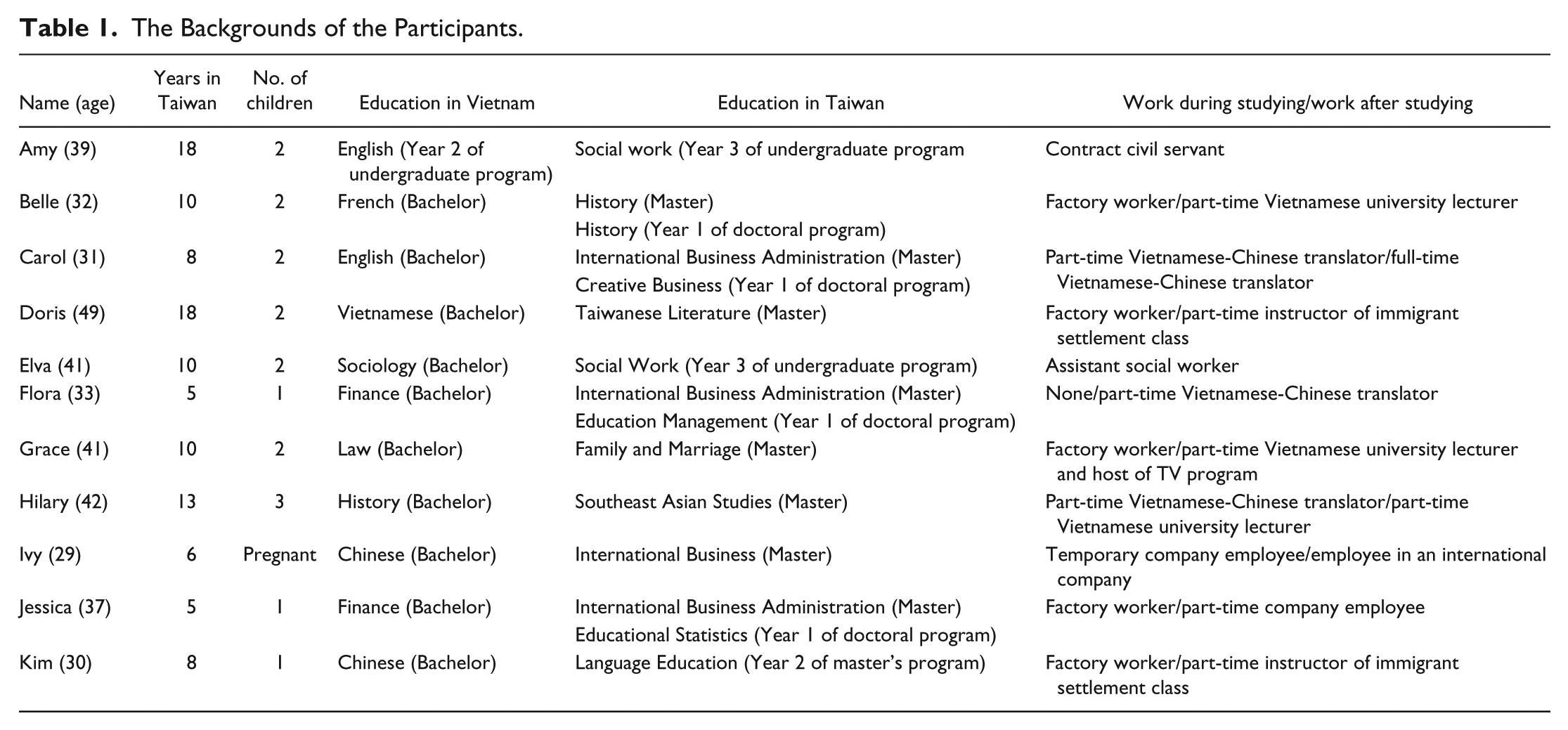
Table 1 summarizes the backgrounds of the participants. Their average age was 36.7 years. At the time of the interviews (2012), the interviewees had lived in Taiwan for an average of 10.1 years. The women began pursuing Taiwanese higher education after they had lived in Taiwan for an average of 6.2 years. All but one of the participants had completed an undergraduate education in Vietnam. Two of the participants had been pursuing bachelor’s degrees, one had been pursuing a master’s degree, four had completed Taiwanese master’s degrees, and four had been pursuing doctoral degrees after completing Taiwanese master’s degrees. All but one of the informants had not applied for Taiwanese identification documents and had resident permits. Except for one participant, all of them had at least one child. Ten of the informants held full-time or part-time jobs while studying at Taiwanese higher education institutions.
The Backgrounds of the Participants.
Data Collection and Analysis
The research methodology employed in this study was narrative inquiry. Narrative inquiry is a way of understanding and studying experience that is mediated by stories through collaboration between the researcher and participants (Xu & Connelly, 2009). By attending to the commonplaces of narrative inquiry, temporality, sociality, and place, the present research studies the complexity of the relational composition of immigrant women’s lived experiences, both inside and outside of an inquiry. The data were collected through semistructured, in-depth interviews that encouraged the women to discuss the following topics: (a) their early learning and life experiences prior to immigration, (b) the events facilitating their immigration to Taiwan and their early adaptation in Taiwan, (c) their learning in higher education in Taiwan, and (d) their reflections on their personal development. The structure of the data collection process preserved sufficient commonalities to permit a comparative analysis of the data. Two interviews, lasting 2 to 3 hours each, were conducted with each of the participants, and follow-up telephone discussions were used for clarification. All the conversations were conducted in Chinese because all the interviewees spoke fluent Chinese. Therefore, the researcher, who was Taiwanese, had ample opportunities to communicate with the interviewees to resolve potential linguistic or cultural questions during the research. All the interviews were voice-recorded, subsequently transcribed, and analyzed in Chinese. The excerpts cited in this article have been translated into English by the researcher. At the beginning of the interviews, the researcher promised the informants that the interview would be used only for research purposes. During the research, the researcher was aware that the relationship between the researcher and the informants was not equal. The research team members maintained contact with the immigrant women, and some of the women and the research team members have become friends.
In this study, within- and cross-case analyses were applied to analyze the interview transcripts (Patton, 2002). First, an assistant 1 and I separately coded each informant’s interviews as a case. We discussed our coding of the transcripts and emerging categories and properties. Second, we conducted the cross-case analysis to search for emerging patterns in the within-case analysis and to recognize common patterns across the cases. The process of member checking (Denzin & Lincoln, 2005) was used to ensure the trustworthiness of the analysis. The transcripts of the interviews in Chinese were provided to the interviewees to ensure that the meanings were originally intended.
Findings
The analysis of the participants’ interviews revealed several themes in their higher education learning experiences in Taiwan. First, on the basis of their husbands’ permission, the immigrant women furthered their higher education to improve their necessary capital. Second, during the higher education learning experience, the women continuously negotiated their space both within their families and in the classroom by persevering in learning, developing their voices and cultural identity, and struggling to fulfill their multiple roles. Finally, the women gained empowerment through learning based on their development of bicultural competence.
Higher Education in Taiwan as Necessary Capital
Influenced by their early socialization in Vietnam and their unique life experiences in Taiwan, on the basis of support from their husbands, these women embraced the instrumental value of education and participated in higher education in Taiwan to develop the necessary capital to play their expected motherhood roles.
Embracing the instrumental value of education
All the women emphasized the importance of pursuing education in Vietnamese society. Learning to value education was rooted in these women’s early socialization in their homeland. In Vietnam, because Confucian culture emphasizes learning, education has been valued as the key to individuals’ upward social mobility and symbolizes achievement in society. In the 1970s, when most of the immigrant women grew up, most people in Vietnam were economically disadvantaged and had to lift themselves out of poverty by obtaining an education. Therefore, these women’s parents typically held strong aspirations for their children to obtain as much education as possible, sometimes at great sacrifice. However, because of the central role of men as heads of the family in the patriarchal Vietnamese society, women’s education held less value within families than men’s education. As Carol noted, Like most of the Vietnamese, my parents believed that obtaining an education was the only way to find room at the top of the society. Initially, they only supported my brothers in continuing education because my family was too poor, and they preferred sons to daughters. However, my brothers quit studying, so instead my parents encouraged me to study further. To pay my university tuition, my father even sold my family’s only valuable asset, a motorcycle.
The credentialism of Taiwanese society also supported these Vietnamese women in embracing the value of education. Jessica felt that “credentialism is prevalent in Taiwanese society. The Taiwanese place excessive emphasis on individuals’ diplomas, particularly a university degree, in giving jobs.” Therefore, the overemphasis in both their homeland and their host country on the instrumental value of education, particularly a university diploma, motivated these Vietnamese immigrant women to seek continuous higher education in Taiwan.
Struggling with Taiwanese prejudice
The participants all felt that they were materialized and stigmatized in Taiwanese society because of their transnational marriages and nationality. “In Taiwan, the media usually portray immigrant women as illiterates from poor countries, victims of domestic violence, and even ‘runaway brides with their husbands’ money,’” Doris said angrily. “Some of my neighbors even forbid their children to play with my daughter. Even my child’s schoolteacher doubts my ability to raise children just because of my marriage immigrant status,” Flora noted.
Because women within Vietnamese families receive the same encouragement as men to seek employment to support the household economy (Tang & Wang, 2011) and because a shortage of income within their Taiwanese families was highly stressful, most of the women pursued jobs after migrating to Taiwan. However, most of them felt discriminated against in Taiwanese workplaces. Due to the social stigma against marriage immigrants and the lack of recognition of immigrant womens foreign credentials, these highly educated, skilled female immigrants often found low-paying, entry-level jobs with exploitative remuneration. Carol noted, Despite having been a high school teacher in Vietnam with a Vietnamese bachelor’s degree, in Taiwan, I could only work as a factory worker or a breakfast stand assistant, with long working hours and a poor salary. In workplaces, both employers and coworkers treated me in unfair ways. . . . Once, one employer lost a wallet, and he directly asked me to go to the police office to confess stealing the wallet without searching for any evidence just because I was the only foreign worker in the factory.
Thus, like other participants, Graced noted, I decided to pursue continuous higher education in Taiwan and then obtained academic degrees as a means of avoiding being a target of discrimination in daily life and the workplace and further altering the negative perceptions of Taiwanese toward immigrant women.
Playing expected motherhood roles
Both Vietnamese and Taiwanese societies expect married women to be able to provide their children with good care, which is usually evaluated by the children’s educational and occupational achievement. Higher education in Taiwan could give these women the socially acceptable status of a “highly educated” person, which would legitimize them in the eyes of their children and reduce their feelings of inadequacy (Flannery, 2000). As Amy noted, I worried that I could not educate my children in Taiwan well with my limited Taiwanese literacy. . . . I hope my children will feel proud of me rather than being ashamed of me because of my marriage immigrant status.
Therefore, these immigrant women decided to pursue Taiwanese higher education to develop the cultural capital to fulfill the expected role of a good mother.
Permission or support from husbands
In Taiwanese society, the socioculturally expected role for marriage with immigrant women from countries with less-developed economies than Taiwan includes being a subservient wife and responsible mother (Tsai et al., 2011); many Taiwanese husbands tend to limit immigrant brides to certain social contacts and disapprove of immigrant women’s further learning. Both Carol’s and Kim’s less-educated husbands held stereotyped beliefs regarding immigrant women’s learning, and initially, they strongly opposed their wives’ furthering of their learning. Carol noted, However, with my persistence in learning and negotiation with my husband, finally, he reluctantly permitted my enrollment in a graduate school based on my promise to manage the household well, take good care of the family, and contribute to the household economy while studying.
However, the other immigrant women reported that their motivation for enrolling in Taiwanese undergraduate or graduate study primarily originated from their husbands’ support and promise to take on household and childcare responsibilities. As Grace noted, “I’m so lucky! My husband, unlike other Taiwanese husbands, was less patriarchal and respected my decision to further my learning and expected me to become more integrated into Taiwanese society by obtaining an advanced education.”
Negotiating Space in Taiwanese Higher Education and the Family
In the higher education classroom, these immigrant women consistently studied diligently and negotiated their voices and cultural identities. Additionally, they struggled to fulfill their expected family and learning responsibilities.
Studying more diligently to demonstrate competence with resilience at the margins of the classroom
Initially, the intensive, advanced curriculum in higher education and its extensive terminology made it difficult for the participants, who had only basic Chinese proficiency, to understand the instruction and meet the professors’ requirements for assignments. Thus, I studied different versions of textbooks I prepared for myself. . . . Regarding the assignments, initially, I always typed the reports helplessly because I really did not know how to start, even though I had read lots of documents. However, I just tried my best to type one word after another through my tears. To keep up with my peers and to maintain the status of the academic elite in which I had been situated in Vietnam, I studied so hard. (Grace)
Some of their classmates even deprecated these women’s academic capabilities and disapproved of the professors’ praise for their achievements.
A small number of graduate classmates discriminated against me, as an immigrant woman, and did not want to be in groups with me lest I would encumber their study. They believed that immigrant women from poor countries could not be as good as Taiwanese. (Ivy)
Thus, most of these women felt that as immigrant women, they had to continually study much more diligently than their Taiwanese counterparts to prove themselves competent to survive in Taiwanese higher education classrooms and maintain the academic elite status they had held in Vietnam.
Most of these women felt that few of the professors were sensitive to their particular living experiences and the delivery of instruction did not consider their cultural differences. Generally, these women received minimal support, receiving only verbal encouragement from the faculty. Most of the professors neither integrated the issues relevant to these women’s homeland or cultures into the curriculum nor invited these women to share their life experiences relative to the curriculum. Elva noted, “The professors in my department seldom explained special events in Taiwan to me. They seemed to think that I, as an immigrant in Taiwan, should have been familiar with everything in Taiwan.”
However, almost none of the participants felt marginalized by their instruction, and they accepted as a given that higher education instruction devoted little attention to their different experiences because they believed that they were competent to manage their learning and were resilient to the stressful experience of learning at the margins. As Doris emphasized, Once we are admitted to a graduate program, we should be qualified to study without any special assistance regardless of our nationality. As graduate students, we should be competent and independent enough to handle the learning. I did not need others’ sympathy or support due to my immigrant status while learning. If professors had given me more support, I would have felt discriminated against.
Like most of the women, Hilary noted, “Sometimes in the margins, without professors’ excessive attention, I could find some resilience, and find a space to understand what was happening in class.”
Negotiating voice and identity
All the participants agreed that accommodating themselves to the class critiques and discussion was initially one of the greatest challenges in Taiwanese higher education institutions because of their different accent, their early schooling, their unfamiliarity with Taiwanese classroom culture, and their lack of understanding of professional instruction. Thus, in the beginning, the immigrant women were silent learners. Ivy noted, “Initially, I was reluctant to articulate my thoughts in class because my Vietnamese accent made it difficult for my peers and professors to understand my words, and it caused them to pay more attention to my immigrant woman status.” Additionally, these women’s early schooling experiences made them unlikely to consider speaking in class a vehicle for learning and led them to be passive learners in Taiwanese higher education classrooms, where active participation in discussion is usually valued.
In the Vietnamese university class, there was little teacher-student interaction. Teachers always emphasized students’ silently absorbing knowledge without speaking, which was viewed as a challenge to teachers’ authority. However, in Taiwanese graduate classes, the professors usually encourage the students to express their own opinions. (Jessica)
As Carol said, Because initially I did not understand the new class culture of Taiwanese higher education, I tended to use silence as a strategy to protect myself. Writing papers became an important survival strategy for struggling in a classroom that privileged dialogue.
Thus, the participants used silence to work out nonverbal cues to negotiate the implicit culture and unstated norms of Taiwanese higher education classrooms.
However, as these participants improved their Chinese proficiency, gained knowledge regarding the atmosphere of Taiwanese higher education classes, and acquired professional learning and as the Taiwanese media began to praise some of these women’s pursuit of higher education in Taiwan, their self-confidence and self-identity improved. These participants increasingly realized that their silence in class often caused them to be ignored in the learning process. Because of the power of voice in the demonstration of knowledge and competence, based on their stronger self-identity that was facilitated gradually, most of the participants continually drove themselves to negotiate the concept of voicing opinions in public to improve their visibility in class. As Belle noted, In the learning process, the Taiwanese governor summoned me and commended me for furthering my graduate studies, and the mass media also reported on it, which made me feel honored and confident. . . . Although keeping silent in class made me less stressed, I realized that silence hampered my full participation in Taiwanese graduate study. Thus, I learned how to speak out in class so that I would be known by others and would know others more fully.
Additionally, some of the participants purposefully took courses or made presentations that were relevant to their transnational backgrounds and shared their experiences in class to facilitate the positive visibility of immigrant women and their home country. In turn, this process enhanced the immigrant women’s understanding of their homeland and enriched their cultural identity.
After getting used to the culture of Taiwanese graduate study, I became more confident and expected people to understand immigrant women and my homeland more. Thus, I made use of opportunities to present reports concerning my immigration experiences. . . . I intentionally took courses in which my background as an immigrant woman could be used as a reference point for discussion. For example, I took “Family and Marriage,” in which I shared my family experiences of transnational marriage, which were different from what the Taiwanese media portrayed. (Grace)
Struggling to play multiple, intensified roles
Most of the women believed that the support of their husbands facilitated their persistence in continuing their higher education. As Ivy noted, “Unlike chauvinistic Taiwanese men, my husband proactively provided support for me during my busy learning, including sharing the household and childcare responsibilities. He even encouraged me to concentrate more on studying.”
However, Carol and Kim were not so fortunate. Their husbands opposed their wives’ participation in graduate study because they worried that their wives would leave after becoming highly educated. As Carol noted, Although my less-educated husband allowed me to apply for enrollment in graduate study, he became emotionally insecure and afraid that I would leave him because he thought that I became more independent and critical after working on a master’s degree. Thus, in addition to preparing for studying and maintaining the household, I had to continuously comfort my husband, which made me psychologically exhausted.
Regardless of their husbands’ support, during their participation in higher education in Taiwan, the participants all struggled to play well their socioculturally defined roles as good mothers, wives, learners, and workers according to their early socialization and schooling in Vietnam, their cultural identity, and their need for intellectual growth. Both Vietnamese and Taiwanese societies expect married women to care for their families as their primary responsibility. In Taiwan, marrying immigrant women from less economically developed countries is viewed as being destined to take good care of their families. Additionally, most of the participants felt obligated to take primary responsibility for domestic chores to repay their husbands’ support for their educational aspirations.
From what my mom did for the family, I have learned that a married woman had to take good care of the family and to be a subservient wife. . . . Despite being supported by my husband in furthering my education, my neighbors and Taiwanese friends usually reminded me to play the role of a responsible mother and good wife rather than a graduate student because I was an immigrant woman. (Amy)
The multiple, intensified roles of these women as wives, mothers, higher education learners, and workers created great distress for some of them. Most of the participants sacrificed their free time and, often, their health to fulfill their dual workday responsibilities inside and outside of the home. As Kim noted, I felt like a candle burned at both ends. I always felt fatigued after a full day of work at home, school, and the workplace. Sometimes I felt guilty about being a mother and a graduate student because I did not meet the demands of both my family and graduate school.
To resolve the conflict between family obligations and educational aspirations, these women emphasized connecting or separating family and education. Because of their husbands’ support for their learning, some of the Vietnamese women, such as Belle and Grace, made connections by discussing their learning with their husbands, seeking further support from their husbands in the form of domestic tasks and emotional comfort, and incorporating their personal experiences into their academic learning. Because of their husbands’ or in-laws’ disapproval of their pursuit of further education, some of the women, such as Carol and Kim, created separation by ensuring that their education influenced their family life as little as possible. They fulfilled domestic responsibilities and avoided discussing their learning with their families.
It is notable that when these immigrant women were confronted with the stress of their learning and family life, they seldom discussed their problems with other members of the Vietnamese community in Taiwan. Most of the women were too busy to maintain contact with their ethnic community, and most of their Vietnamese friends could not understand their motivation for pursuing education. As Flora noted, “Most of my Vietnamese friends thought that immigrant women had to concentrate on working to earn money instead of furthering their education. They only cared about my salary rather than my learning.”
Gaining Self-Empowerment by Developing Bicultural Competency
Persevering in completing higher education programs, winning scholarships, or even obtaining Taiwanese master’s degrees were significant achievements for these Vietnamese women. Additionally, receiving Taiwanese higher education and obtaining a diploma substantially facilitated most of these female immigrants’ efforts to obtain jobs with better salaries, which benefitted their household finances. Furthermore, most of the women gained additional confidence in their parenting ability because they received further education in Taiwan, gained a greater understanding of the Taiwanese educational system, and developed professional competency. These women also became increasingly settled in Taiwanese society. Based on their bicultural competency, these achievements contributed to the participants’ self-empowerment, including positive feelings of self-worth and economic independence.
As Amy noted, “Successfully completing Taiwanese graduate study, overcoming difficulties, and enhancing my ability to think critically facilitated my self-confidence and self-identity. This proved that we immigrant women would not be less competent than Taiwanese.” Belle confidently said, With the Taiwanese master’s degree, I could be offered more employment choices with better pay. Now, I am a part-time lecturer at some universities, and I am sometimes invited to give presentations to school students, which contributes to my economic independence from my husband.
Like most of the participants with children, Hilary noted, “My children are proud of my perseverance in learning, which may set a good example for them . . . With more literacy, I feel more confident in raising my children.”
Participating in Taiwanese higher education and obtaining academic degrees also contributed to these immigrant women’s integration into Taiwanese society and their development of bicultural competence. Most of the women gained a strong voice that encouraged their husbands and in-laws to listen to their opinions regarding family affairs due to their increasing contributions to the family’s finances. As Ivy noted, “After completing Taiwanese graduate study and then getting a better job with more income, the relationship between my mother-in-law and me improved. My husband often asks for my opinions about family affairs.” Additionally, most of the women adapted to, understood, and identified with Taiwanese culture to a greater extent as they participated in Taiwanese higher education. They gradually developed bicultural competence, which, in turn, helped them navigate Taiwanese society. As Elva reported, “I am both Vietnamese and Taiwanese. I have to preserve the culture of my homeland and support the culture of Taiwan, where I have started my new life with my husband and children.”
It is noteworthy that although most of the participants acquired an improved status in their families after receiving higher education in Taiwan, a small number of them, whose husbands originally opposed their pursuit of higher education, experienced greater family tension than before. As Kim noted, Initially, my husband disagreed with my continuing with higher education because of our poor family finances and his inferiority resulting from his low educational level. After I participated in graduate study, my husband did not feel secure about our relationship. Therefore, my husband argued with me more, even though I had tried my best to fulfill all of the expected responsibilities.
Discussion
The Vietnamese women in this study participated in Taiwanese higher education that did not consider these women’s cultural needs. However, most of them regarded the type of delivery in Taiwanese higher education classrooms, which did not consider their life experiences as a given. Instead of perceiving themselves as situated at the boundary, they viewed the margins as a space of comfort. The findings reflect these women’s positive marginality. That is, remaining at the margins of the classroom could sometimes provide hope and safety for immigrant women seeking to uplift themselves through higher education (hooks, 1990). Therefore, these Vietnamese women initially adopted a silent position in the classroom because of their early schooling. Indeed, women initially use silence as a means of self-protection to avoid the threats to relationships that may result from voicing unacceptable thoughts (Hayes, 2000). However, after a period of time, based on their positive marginality, these women gained resilience and renegotiated their identity and the cultural value of silence and then promoted the visibility of Vietnamese issues in the classroom (Flannery & Hayes, 2000). This result echoes poststructural pedagogies, which claim that female adult learners’ identities always shift according to the social contexts and necessarily affect what occurs in their learning environment (Tisdell, 1998).
This study found that a positive self-identity and strong cultural identity with their homeland not only motivated these immigrant women to continue higher education in their host country but also allowed them to persevere in learning and promote the visibility of issues related to immigrant women and their homeland in the classroom. The findings of this study suggest that self-identity and cultural identity play a vital role in the higher education learning experiences of immigrant women. A strong cultural identity with the home country, which may provide individuals with a sense of belonging and security, is an important component of self-recognition and bicultural competence (Alfred, 2001). Thus, these immigrant women may have a cultural identity with their homeland and bicultural competence, which can enable ethnic minority groups to float in and out of their various life situations and can develop their ability to negotiate the dual context of the dominant culture and their own minority group culture (McAfee, 2000).
Ethnic communities may represent a source of both support and stress in immigrant women’s learning. Strong ties among the members of an ethnic group seem to discourage immigrant women from expanding their horizons and may even work against their psychological well-being, whereas a high-density network of ethnic groups is associated with rapid and ready assistance (Kuo & Tsai, 1986). In the present study, despite their strong cultural identity with their original country, most of the immigrant women had poor contact with the Vietnamese community because their ethnic group did not empathize with their motivation for furthering their education and tended to emphasize their income in Taiwan. Therefore, these immigrant women preferred to maintain little contact their Vietnamese community.
Additionally, it was found that the immigrant women’s learning opportunities were affected by conflicting demands on their time and energy in different contexts. The women responded to conflicts between family responsibilities and school requirements by connecting or separating family and education based on their husbands’ responses to their pursuit of further education. However, neither connection nor separation is an obviously better solution to family and school conflicts (Edwards, 1993). Making connections may involve additional potential changes in relationships, regarding women’s expectations of their partners’ domestic roles and their appreciation of their new self-identity (Hayes, 2000). The immigrant women struggled to fulfill expectations and meet their families’ needs, while higher education demanded that they concentrate on intellectual activities. Although it seems impossible to meet the needs of both institutions simultaneously, this was the position in which these immigrant women found themselves.
Despite having greater employment opportunities with better benefits after attending or completing Taiwanese higher education, the immigrant women in this study were nevertheless employed in lower-level occupations with lower salaries than their Taiwanese counterparts in the Taiwanese labor market. It seems that although attending Taiwanese higher education programs may help orient immigrant women toward Taiwanese workplaces, these women may still be required to conform to oppressive conditions in the Taiwanese labor market. The findings suggest that these highly educated immigrant women, who obtained higher education in the receiving country, may still be viewed as deskilled in the host society (Cuban, 2013) and that higher education may not necessarily contribute to their full empowerment in labor market participation. Thus, for these immigrant women, receiving higher education in the host country may be one type of symbolic violence, which is the imposition of perception on the dominated who then take the social order as granted.
Although the family status of several of the immigrant women began to improve after their pursuit of Taiwanese higher education and employment, some of the women experienced greater conflict and tension with their husbands. This result suggests that women’s pursuit of further education can be a deliberate attempt to gain additional independence and, as such, may be a threat to power relationships at home (Hayes, 2000). This phenomenon may be explained by the fact that the new identities and renegotiation of power among these female immigrants, due to their learning or financial independence, may threaten patriarchal conventions and the traditional roles assigned to these women within their families (Menjivar & Salcido, 2002).
Notably, even as a disadvantaged group in the host country, these Vietnamese immigrant women were not merely passive victims of the host social culture. They exercised their agency to achieve different meanings for themselves. By pursuing higher education, they became empowered through their learning and labor market participation. Thus, these findings may expand the feminist perspective from a focus on the negative aspects of transnational marriages (Palriwala & Uberoi, 2008) toward a focus on the autonomy of immigrant women in facilitating their lives through participating in higher education in their host countries.
Conclusion and Implications
On the basis of their Taiwanese husbands’ permission and support, the Vietnamese immigrant women in this study embraced the instrumental value of education and pursued higher education to develop the necessary capital to play their expected motherhood roles. During their higher education learning experiences, the women persevered in learning with resilience, negotiated their voices and cultural identities, and fulfilled their multiple, intensified roles. Participating in and completing higher education in Taiwan empowered the women based on their development of bicultural competence.
The aim of continuous adult education is to empower adult students (Caffarella & Merriam, 2000). Therefore, it is necessary for the continuous higher education system to provide female adult immigrant students with multicultural education programs. Specifically, educators need to have knowledge of and appreciation for female immigrant students’ cultures and life experiences and cultivate cultural competencies regarding the value of higher education for female immigrants. Curricula may be delivered in ways that recognize and integrate the issues related to immigrant women and their homelands to facilitate the visibility of their original culture in the classroom. It is necessary to create supportive learning environments to encourage female immigrant students to interact with learning community members to share how they manage the conflicts between family responsibilities and school requirements. Additionally, a classroom space that offers safety and comfort is needed to support immigrant women’s resilience.
Footnotes
Authors’ Note
Portions of this article were presented at the INTE 2013 International Conference on New Horizons in Education in Rome, June 23, 2013.
Declaration of Conflicting Interests
The author(s) declared no potential conflicts of interest with respect to the research, authorship, and/or publication of this article.
Funding
The author(s) received no financial support for the research, authorship, and/or publication of this article.