







Abstract
Despite increasing demand in distance education, relatively little is known about the demographic and socioeconomic characteristics as well as basic skill levels of adult distance education participants at the national level in the US. This study analyzed the US data from the 2012/2014 and 2017 Program for International Assessment of Adult Competencies (PIAAC) to identify baseline determinants of nonformal (i.e., not for a formal credential or degree) distance education among adults aged between 25 and 65 years old. Results showed that higher educational attainment, employment, literacy skills, and digital problem-solving skills were positively associated with nonformal distance education participation. As recent distance education is provided predominantly through the internet and digital device, digital skills may be of particular concern. These identified determinants should be reflected in policy interventions to close education gaps. Additionally, the findings of this study are useful for future research that focuses on psychological and behavioral factors.
Introduction
Distance Education for Adult Learners
Distance education is “all forms of teaching and learning where the student and instructor are separated geographically and temporally” (Finch & Jacobs, 2012, p. 546). Whereas the idea of distance education originated in the 1800s, distance education has been progressively conducted in online environments due to the internet that became widely available in the early 1990s in the US (Sun & Chen, 2016). Online education/training is “a form of distance education where technology mediates the learning process; teaching is delivered completely using the internet” (Siemens et al., 2015, p. 100). Combinations of different education delivery modes (e.g., online and face-to-face) are often called hybrid or blended learning (Littenberg-Tobias & Reich, 2020). Although other names such as e-learning and computer-mediated learning are commonly used to describe online education, and massive open online courses are becoming popular, distance education is an umbrella term (Park & Shea, 2020). The concept of distance education is useful because it captures an increasingly diverse mode of adult education, learning, and training in the technology-rich societies today. If, for example, online learning is strictly defined, essential forms of learning such as hybrid learning may be overlooked.
Distance education arguably is more inclusive than traditional face-to-face adult education. Although depending on the type and delivery of distance education, time and space limitations are of less concern (Gorard et al., 2003; Kara et al., 2019). As such, adults with limited mobility and/or lack of resources (e.g., time and transportation) due to a variety of reasons such as advanced age, disability, health problems, and geographic isolation, may have greater access to educational opportunities (Hansen et al., 2020). On a relevant note, distance education could be particularly beneficial for continuing education activities during a public health crisis such as the coronavirus disease 2019 (COVID-19) pandemic, which discourages face-to-face interactions. Also, distance education could extend the broader benefits of adult education and training (AET) or lifelong learning to underserved populations with limited educational opportunities. Specifically, learning activities are linked to a wide range of benefits such as empowerment, well-being, greater productivity, higher quality of life, and more active social participation (Boeren, 2017; Carr et al., 2018; Gorard et al., 2003). Furthermore, distance education, which is relatively less costly and more inclusive, provides an opportunity to reduce education inequalities by sociodemographic (e.g., age, gender, and race) and socioeconomic (e.g., income) characteristics (Desjardins & Rubenson, 2013; Sun & Chen, 2016).
Although research has shown that distance education can be as effective as conventional face-to-face or in-class settings (Simonson et al., 2011), distance education is not free of limitations. First, more systematic instructional approaches (e.g., andragogy and heutagogy) are yet to be developed in distance education (Carr et al., 2018; Vareberg et al., 2020). That is, compared to the conventional in-class education, systematic curriculum design and educational practices are still comparatively uncommon in distance education in general. As such, the structure and practice of distance education courses may heavily depend on individual programs and instructors, and not on the learning objectives. For example, students’ engagement in synchronous and asynchronous discussions, and interactions with the instructors and other participants in distance education needs more research to identify the best practice that is in alignment with learning objectives as well as students’ need (Vareberg et al., 2020).
Second, given participants in more inclusive distance education are likely more diverse in demographic, socioeconomic, educational (e.g., basic knowledge and readiness for advanced learning), and technology (e.g., computer skills) backgrounds, than traditional students; levels (e.g., introduction, intermediate, or advanced) and formats (e.g., lecture, discussion) of some distance education are necessarily pragmatically and culturally mismatched (Kara et al., 2019). For example, any adults from any culture, country, or region could participate in distance education, and the gaps in foundational knowledge and basic skills, as well as prior learning experience or conventional education practice may significantly vary. Third, while access to educational opportunities could be improved, distance education does not completely address known barriers (e.g., the lack of interest and time due to work and family responsibility), and even faces unique barriers (e.g., the lack of the internet, digital devices, and computer skills/knowledge) to AET participation (Grotlüschen et al., 2016; Kauffman, 2015).
Types of Distance Education and Participation Rates
Analogous to the conventional in-class settings, distance AET can be classified into formal, nonformal, and informal education (e.g., Werquin, 2010). Formal AET takes place at the educational/training institutions and leads to formalized credentials or diplomas. Nonformal AET takes place at the educational/training institution but does not lead to a formalized credential. Informal AET may include any intentional or unintentional learning activities regardless of settings (Commission of the European Communities, 2000). However, in the context of distance education, place is not relevant, and the focus should be on whether the AET program is organized by educational/training institutions or not. This study focused on nonformal distance AET to better understand voluntary AET participation in the context of lifelong learning following initial formal education in earlier life stages.
In the US, less than half of adult populations participate in any AET (Desjardins, 2011). Interestingly, about 65% of adults who are employed report participation in job-related education and training, although the education delivery mode is unclear (Pew Research Center, 2016). Recent data show that 16% of adults take any online course in the past 12 months (Pew Research Center, 2016). Yet, the use of distance education has been rapidly increasing in the formal settings. In 2018, nearly 7 million or 35% of students took at least one distance education course in the postsecondary education institutions in the US (National Center for Education Statistics, 2020b). Growth of distance education participation is anticipated in the adult populations as well due to the technological advancements (e.g., online education and meeting platform) and virtual work settings due to the 2020 COVID-19 pandemic (Boeren et al., 2020). Data on distance education participation are somewhat limited outside of the formal education institutions, and different data sources have specific distance education measures. However, it should be noted that the majority (84%) of adults may not have interest in or experience with participating in organized distance AET courses in the US (Pew Research Center, 2016). Given formal education may require additional resources (e.g., tuition fees, long-term commitment, and strict curriculum), nonformal education could be a more accessible entry point to distance education.
Conceptual Framework
This study is designed based on the AET participation theoretical model (Boeren, 2017; Boeren et al., 2010), and the resource and appropriation theory (van Dijk, 2013). The AET participation model depicts a series of individual characteristics and social environments in relation to general AET participation, although it is not specific to distance education (Boeren et al., 2010). Considering the focus of this study and readily available distance education delivery mode—the internet—the resource and appropriation theory that describes differing processes of access and usage of information and communication technology, and illustrates the roles of personal (e.g., demographic) and positional (e.g., socioeconomic) characteristics as well as basic digital skills is suitable (van Dijk, 2013). The resource and appropriation theory applies to a variety of distance learning settings and is not limited to online education. For instance, if education is delivered via postal services, one still needs to have appropriate resources, knowledge, and skills to navigate through the system. Based on these two theoretical models, this study was designed and is visually summarized in Figure 1.
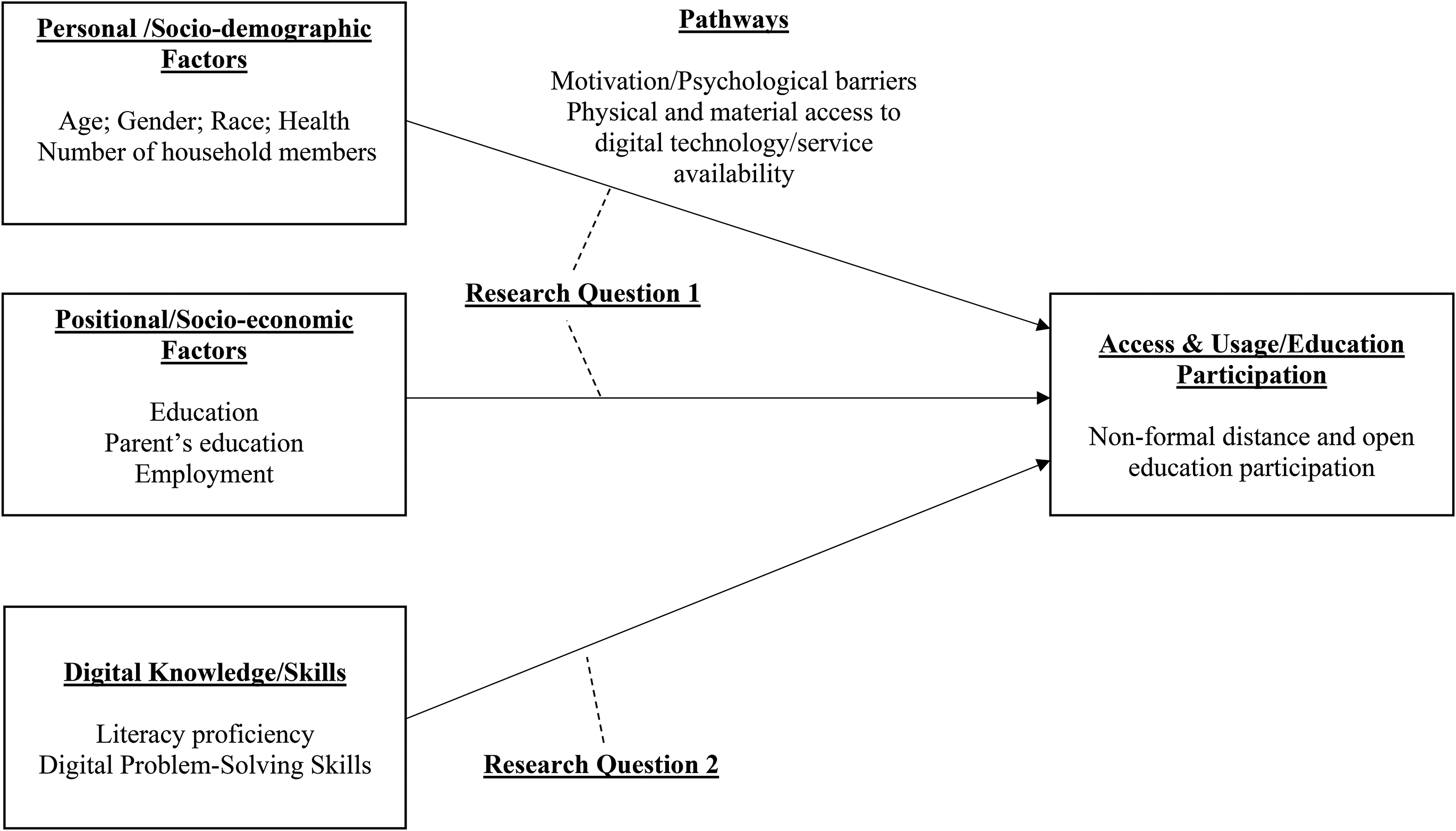
Operationalized conceptual model of distance learning participation.
The determinants of distance learning participation were organized into three categories, including personal/sociodemographic factors, positional/socioeconomic factors, and digital knowledge/skills. Although the theoretical models by Boeren et al. (2010) and van Dijk (2013) cover psychological and behavioral factors, as well as social environments, the current study focused on the baseline individual characteristics and skills to establish the foundation in this line of inquiry for nonformal distance AET. Indeed, in view of the widely known Maslow's hierarchy of needs theory, the personal and positional factors can be considered basic needs and security in the society, and therefore, are the prerequisites for psychological (e.g., motivation and intention for learning) and behavioral factors to be formulated in the context of AET participation (Boeren, 2017; McLeod, 2018).
In terms of personal factors, younger age, gender (women), racial/ethnic majority, good health, and a fewer number of household members are considered promoters of distance education participation (Boeren et al., 2010; Desjardins, 2011; Hansen et al., 2020; Kara et al., 2019). These sets of measures represent individual capacity (age and health), social position (gender and race/ethnicity), and social responsibilities (household members). Educational attainment, parent's/guardian's educational attainment, and employment status were considered as the positional factors that represent the socioeconomic status and social position. The personal factors and positional factors may be indications of underlying resource availability (e.g., time and money), mobility (e.g., disability), social responsibility (e.g., caregiving), as well as psychological (e.g., interest and motivation) and behavioral characteristics (Boeren, 2017). Finally, basic literacy skills and digital skills were considered as digital knowledge and skills, which are linked to nonformal distance learning participation (Desjardins, 2011; van Dijk, 2013). Basic literacy skills and digital skills can be considered not only approximations of one's readiness to learn but also potential barriers (e.g., lack of information about educational opportunities) to distance education participation (Grotlüschen et al., 2016; Kara et al., 2019). It should be noted that literacy skills, which indicate general information processing ability, are critical to acquiring more specific skillsets—digital skills—to the information and technology domains (Xiao et al., 2019). On a related note, considering the relatively understudied distance education as the main focus, relevancy at the crossover of two theoretical models, the analytic principle of parsimony, and data availability, we focused on the smaller set of selected factors to develop an operationalized conceptual model (Figure 1) in this study.
Gaps in the Literature
There are several gaps in the literature on nonformal distance education participation among adults. First, the literature that is specifically about nonformal distance education participation in general adult populations is scant (Gorard et al., 2003). Compared to the volume of research on general AET participation (AUTHOR 2, 2019; Boeren, 2017; Desjardins, 2011, 2015; Hansen et al., 2020), little is known about the characteristics of adult distance education participants at the national level. Recent data show the rapid growth of distance education in the formal educational institutions (National Center for Education Statistics, 2020b). Yet, data on any adult distance education participation in communities are limited (Pew Research Center, 2016). As such, distance education has been understudied outside of formal education settings (see Desjardins, 2015; Neroni et al., 2018). Also, to date, relevant empirical studies mainly addressed learning outcomes and satisfaction of students in formal educational institutions in the context of distance education (Baber, 2020; Kauffman, 2015), and as such, distance education participation is clearly understudied in recent years.
In addition to the AET participation determinants, distance education in general and online courses, in particular, may require basic digital skills. However, little research has specifically examined associations between basic skills, including both literacy and digital problem-solving skills, and nonformal distance education participation. These gaps in the literature pose a potential issue with designing functional education and policy intervention to promote distance learning and address the unequal access to distance learning access among demographically and socioeconomically diverse adult populations with different basic skill levels.
Given the critical needs for distance education in the knowledge societies today, and gaps in the relevant literature, as well as different characteristics of adult learners from conventional school-age learners (e.g., preferring to face-to-face courses; see Grotlüschen et al., 2016; Hansen et al., 2020; Kara et al., 2019; Simonson et al., 2011), a baseline analysis of national data on adult nonformal distance education participants is warranted to set a foundation for future research and practice.
Research Questions
This study addressed two main research questions (see Figure 1) to address the gap in the literature.
What are the sociodemographic and socioeconomic characteristics of adult nonformal distance education participants? Are basic skills, including literacy and digital skills, associated with nonformal distance learning education participation?
It is hypothesized that the adult education participation determinants (e.g., younger age, higher educational attainment, etc.) in the formal education settings are applicable in adult nonformal distance learning education participation. Also, literacy and digital skills are hypothesized to be positively associated with nonformal adult distance education participation.
Methods
Data Sources
Two sets of data were obtained from the 2012/2014 and 2017 PIAAC public use files (PUF). PIAAC is an ongoing international assessment of basic skills including literacy, numeracy, and digital problem-solving skills across 39 nations and is one of the few studies that allow researchers to examine systematically assessed basic skills at the population level. PIAAC also provides extensive background information such as sociodemographic and socioeconomic characteristics as well as learning behaviors (e.g., education participation and skill use). On a relevant note, the second cycle of PIAAC is scheduled for 2023. Findings from this study with 2012 to 2017 data could be useful to evaluate the impact of the COVID-19 pandemic in 2020 when data become available.
We analyzed the data from the 2012/2014 and 2017 US PIAAC data. Considering one of the common working-age definitions (age 25–65 years old), age 16–24 and 66–74 groups were excluded from the analysis. In view of the national statistics (National Center for Education Statistics, 2020a), the age 16–24 group was considered to be either still in secondary and postsecondary education, or in the transition to the workforce. Whereas there is no universal retirement age in the US, the characteristics of older workers and retirees, as well as their education participation patterns and learning intentions (e.g., nonjob-related) are somewhat different (Hansen et al., 2020) from the typical working-age population, which was considered to be of age 25–65 years in this study. In the 2012/2014 data, the final sample size was 5,447 (all eligible respondents [n = 5,752]—cases missing values [n = 305 or 5.3%]). In the 2017 data, the final sample size was 2,510 (all eligible respondents [n = 2,655]—cases missing values [n = 145 or 5.5%]). Given the small percentage of missing values and no appreciable missing patterns, the final models excluded all cases with missing values. It should be noted that the models with digital problem-solving skills had lower final sample sizes (n = 4,503 and 2,103, in 2012/2014 and 2017, respectively) due to the missingness by design (i.e., the screening process for the basic computer use).
Measures
Outcome Variable
Distance education participation (1 = yes, 0 = no) indicates whether the respondent participated in organized open and/or distance education activities in the past 12 months preceding the survey or not. In PIAAC, distance education includes educational courses through postal services and electronic media, and instructors and learners are not in the same room. These distance education courses are not for a formal qualification (OECD, 2019), and as such, they are considered nonformal distance education in this study.
Predictor Variables
Five personal/sociodemographic factors were included. Age was recorded in eight groups with 5-year increments (25–29, 30–34, 35–39, 40–44, 45–49, 50–54, 55–59, and 60–65). Continuous age was not available in the PIAAC PUF. Gender is a dichotomous measure of female and male (reference group). Race/ethnicity was a series of four dichotomous measures, including White (reference group), Black, Hispanic, and Others. The number of household members was top-coded to seven in PIAAC. Self-rated health was categorized into good health (excellent, very good, and good) versus fair/poor health due to the skewed distributions.
Three positional/socioeconomic factors were included. Educational attainment was dichotomized into a college degree (associate, bachelor, or graduate degree) and less than a college degree (high school diploma or less), given the available information in PIAAC, and the importance of postsecondary educational attainment in the context of adult education participation. Parent's/guardian's educational attainment indicated whether at least one of the parents/guardians had a college degree (associate, bachelor, or graduate degree) or less than a college degree (high school diploma or less). Employment status was a dichotomous measure of employed (including full- and part-time) and not employed (unemployed and out of the labor force).
Two skill proficiency measures were included. Literacy skills were measured based on the set of 10 statistically plausible values in PIAAC. In each plausible value, the score ranges from 0 to 500. In PIAAC, literacy skills represent “the ability to identify, understand, interpret, create, communicate, and compare, using printed and written materials associated with varying contexts” (PIAAC Literacy Expert Group, 2009, p. 7). Digital problem-solving skills were measured based on the set of 10 statistically estimated plausible values in PIAAC. The score ranges from 0 to 500. In PIAAC, digital problem-solving skills represent a set of abilities to utilize digital and communication technology/devices, and computer applications to solve common everyday tasks (PIAAC Expert Group in Problem Solving in Technology-Rich Environments, 2009). In PIAAC, both literacy and digital problem-solving skills were assessed using the computer-adaptive testing approach. Participants completed relevant reading and/or computer application tasks with different levels of difficulty. For example, a participant was asked to sort messages based on the event participation in a simulated email application environment. Based on the respondent's performance, the statistical model (i.e., item response theory) returned plausible values from the estimated skill-level distributions. More detailed descriptions of assessment methodology have been published elsewhere (OECD, 2016).
Data Analyses
A weighted descriptive summary was estimated for all variables of interest by distance education participation, and bivariate tests were conducted (participants vs. nonparticipants) both in 2012/2014 and 2017 data. Using the binary logistic regression model (Allison, 2012), the dichotomous measure of distance education participation was modeled as the function of personal/sociodemographic factors, positional/socioeconomic factors, and digital knowledge/skills. Due to the high correlations (survey-weighted Pearson's r > 0.84) between literacy skills and digital problem-solving skills and their conceptual relationship (foundational skills and specific skillsets), these measures were evaluated in separate models (models 1 and 2 for literacy and models 1b and 2b for digital problem-solving skills). Models 1/1b and 2/2b were estimated with 2012/2014 data and 2017 data, respectively. The estimated coefficients (i.e., log-odds) were exponentiated and converted to the odds ratios for interpretations in the final models.
In addition to the conventional evaluation with the p-values, this study used two comparable datasets with different sample sizes to cross-validate findings for each predictor variable that was selected based on the theoretical relevance (Boeren et al., 2010; van Dijk, 2013) and specific research questions in this study. Moreover, given the different sample sizes (e.g., fewer participants in digital problem-solving skills assessment) across the models, a series of Monte Carlo simulations were conducted to assess the statistical power (Muthén & Muthén, 2002). Population parameters including means, variances, and estimated coefficients were derived from the preliminary data analyses. Using the Monte Carlo function in Mplus version 8 (Muthén & Muthén, 1998–2017), the number of replication was set to 5,000. In these simulations, the models were estimated 5,000 times and the proportion of the simulated data sets with the final models correctly identifying significant predictors of the distance education participation. In other words, among all simulated data, the proportion of the models that correctly rejected the null hypothesis (i.e., estimated parameter = 0 for the statistically significant predictor in the final model) was recorded. That is, the simulated models that did not detect the significant parameters indicated a false negative or Type II error (a.k.a., Beta). In this study, the conventionally accepted statistical power (1-Beta) of 0.80 was referenced.
Therefore, four criteria including (1) agreement with the theoretical proposition (i.e., direction of the association), (2) acceptable Type 1 error rate (i.e., p < .05), (3) consistency across two datasets, and (4) sufficient statistical power were used to evaluate the findings. The model's predictive accuracy was assessed based on the area under the receiver operating characteristics (ROC) curve. The ROC curve is a graphical representation of the model sensitivity (i.e., true positive rate) and 1-specificity (i.e., true negative rate), and the area under the ROC curve (ranges from 0 to 1) represents the summary of predictive accuracy (Hosmer & Lemeshow, 2013). As per the existing guidelines (Swets, 1988), the area under the ROC curve 0.50 and <0.70; ≥0.70 and <0.90; and ≥0.90 were considered low, moderate, and high accuracy.
The final sampling weight (SPFWT0) and replicate weights (SPFWT1–SPFWT80) were applied in all analyses to generate nationally representative figures. SAS macro programs were produced in the International Database (IDB) Analyzer application by the International Association for the Evaluation of Educational Achievement (2017). The IDB Analyzer incorporates all sets of plausible values, sampling weights, and replicate weights to estimate weighted descriptive statistics and generalized linear models. All the estimations and regression analyses were conducted using SAS version 9.4 (© 2013, SAS Institute Inc.).
Results
The weighted descriptive summary is presented in Table 1. Overall, in 2012/2014 and 2017, respectively, 16% and 18% (both percentages are weighted) of the adults participated in distance education. With regard to sociodemographic factors, the proportions of each age group, as well as gender, are fairly equally distributed in both time periods. About two-thirds of the adults (about 67% and 65% in 2012/2014 and 2017) were White, followed by Black (about 12% and 13%), Hispanic (13% and 14%), and other race (7% and 9%). Most adults reported good health (about 83% and 82%). The average number of household members was about 3. With regard to socioeconomic factors, about 41% and 46% of adults had a college degree or higher and 37% and 44% of parents/guardians had a college degree or higher in 2012/2014 and 2017, respectively. Most (77% and 79%) of the adults were employed. With regard to digital knowledge and skills, the average literacy and digital problem-solving skills scores were around 272 and 271 (out of 500), both in 2012/2014 and 2017, respectively. When comparing the distance learning status, the participants were more likely to be female and employed, and have good health, college or higher degree, parents or guardians with a college degree or higher, and higher literacy, and digital problem-solving skills (see Table 1 for the specific numbers) in both 2012/2014 and 2017. The distribution of age groups was different between the distance education participants and nonparticipants in 2012/2014 but no significant difference was observed in 2017.
Weighted Descriptive Summary by Year and Distance Learning Participation.
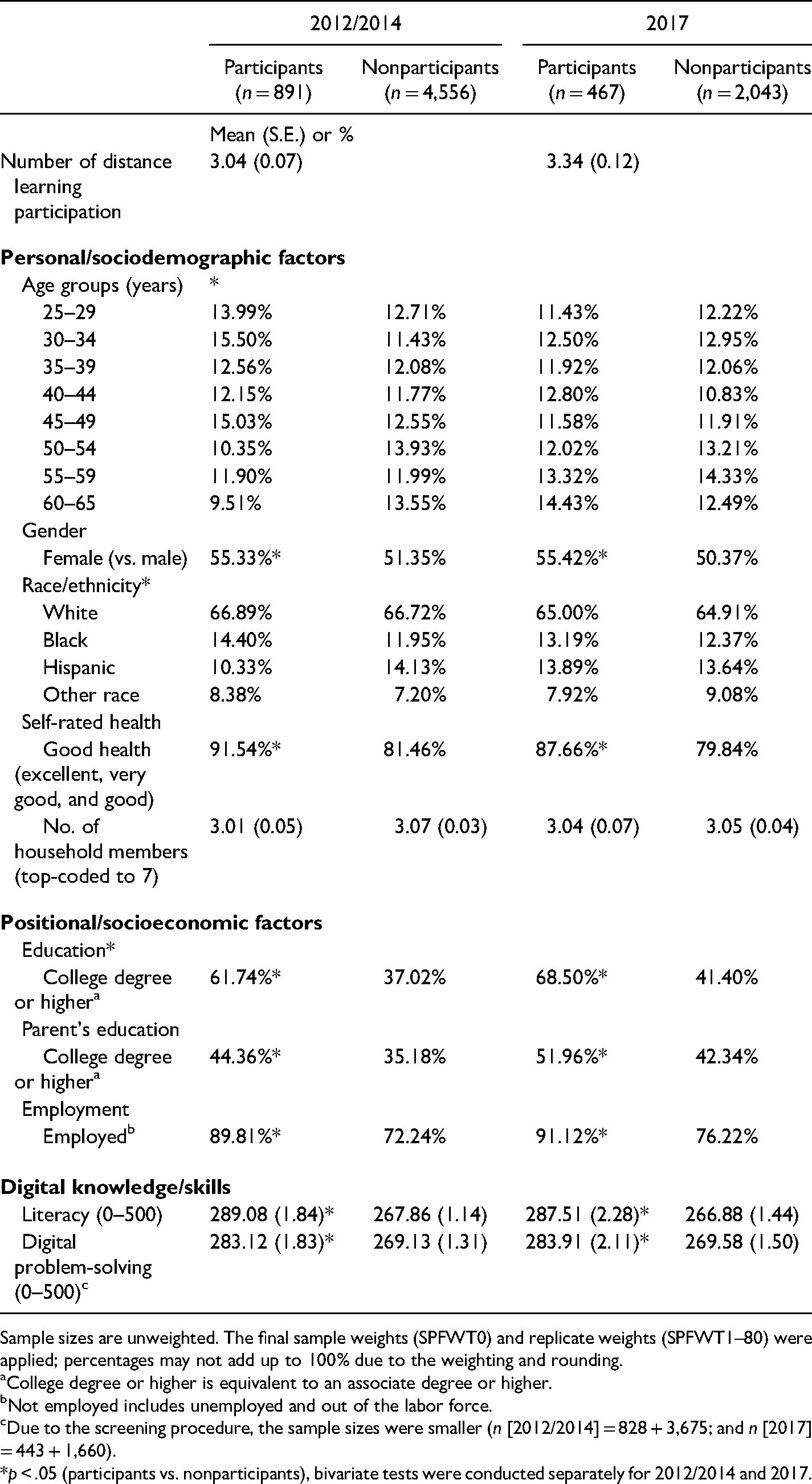
Sample sizes are unweighted. The final sample weights (SPFWT0) and replicate weights (SPFWT1–80) were applied; percentages may not add up to 100% due to the weighting and rounding.
College degree or higher is equivalent to an associate degree or higher.
Not employed includes unemployed and out of the labor force.
Due to the screening procedure, the sample sizes were smaller (n [2012/2014] = 828 + 3,675; and n [2017] = 443 + 1,660).
p < .05 (participants vs. nonparticipants), bivariate tests were conducted separately for 2012/2014 and 2017.
The estimated odds ratios in all models are reported in Table 2. Overall, educational attainment (college or higher), employment status (employed), greater literacy skills, and greater digital problem-solving skills were positively associated with distance education participation in all models. Age, gender, and race (Black vs. White) were statistically significant in some models. However, results from the Monte Carlo simulations showed that age, gender, and race had insufficient statistical power—age in model 2b (0.13), Black in model 1 (0.78), and model 1b (0.74), and gender in models 2 (0.24) and 2b (0.24). At the same time, education, employment, literacy, and digital problem-solving skills had sufficient statistical power (>0.81). Based on the four evaluation criteria in this study, education, employment, literacy, and digital problem-solving skills were considered to be associated with distance education participation. Age, Black (vs. White), and gender were not considered as statistically significant findings, although they had the p-values <.05, in some models. Also, we did not examine the power for any nonsignificant variables in the models.
Estimated Odds Ratios From the Weighted Logistic Regressions.
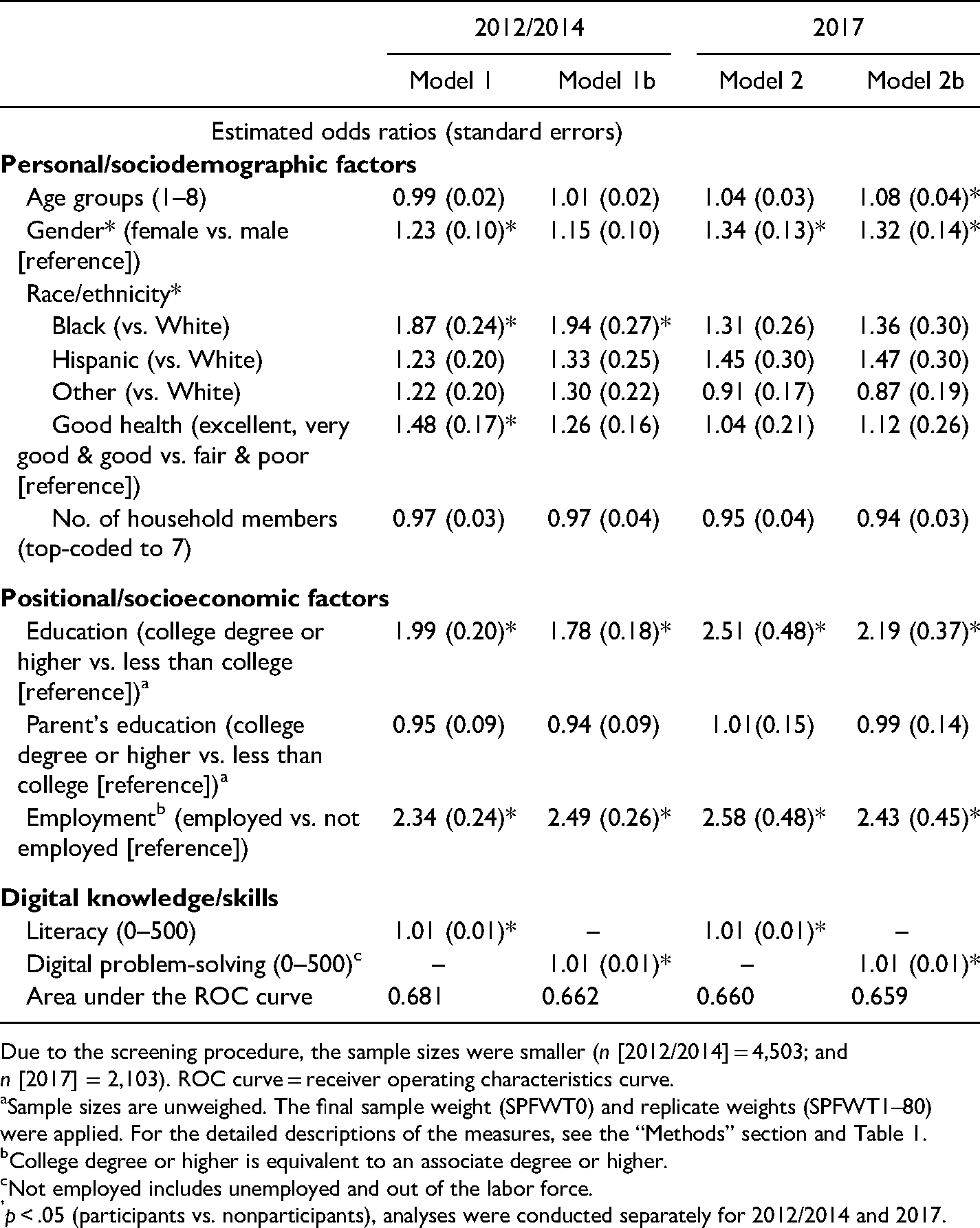
Due to the screening procedure, the sample sizes were smaller (n [2012/2014] = 4,503; and n [2017] = 2,103). ROC curve = receiver operating characteristics curve.
Sample sizes are unweighed. The final sample weight (SPFWT0) and replicate weights (SPFWT1–80) were applied. For the detailed descriptions of the measures, see the “Methods” section and Table 1.
College degree or higher is equivalent to an associate degree or higher.
Not employed includes unemployed and out of the labor force.
p < .05 (participants vs. nonparticipants), analyses were conducted separately for 2012/2014 and 2017.
The estimated odds ratios of educational attainment ranged from 1.78 to 2.51 (p < .05). Adults with a college education and higher had 1.78 times (or greater) the odds of participating in distance education compared to their counterparts. By the same token, those who were employed had 2.34 to 2.58 times the odds of participating in distance education compared to their counterparts. Finally, a one-point increase in literacy skills and digital problem-solving skills was associated with 1.01 times the odds of participating in distance education. Although the odds ratio of 1.01 seems to be a small effect, given the range of possible scores (0–500), changes, for example, a 10-point increase in literacy scores, could make an appreciable difference in distance education participation. Overall, all models showed the area under the ROC curve of 0.66 or higher. Although, as per the existing guideline, the model predictive accuracy was slightly below the moderate level, the values are closer to 0.70 and we concluded that our theoretically formed models and results were useful for the purpose of this study.
Discussion
This study used the two sets of nationally representative data of adult populations aged 25 and 65 years old to identify the sociodemographic, socioeconomic, and digital competency predictors of nonformal distance education participation in the US. A series of weighted logistic regression analyses showed that greater educational attainment, employment (employed), as well as higher literacy skills, and digital skills were associated with a greater likelihood of distance education participation. This study adopted the methodologically stricter evaluation criteria, including the cross-validation and simulation-based power analysis, than the conventional p-value-based decision-making, and therefore, the findings are arguably more robust.
Findings of educational attainment are consistent with the rich literature and data on general AET participation (Boeren, 2017; Boeren et al., 2010; Desjardins, 2011; Pew Research Center, 2016). Although adults with higher educational attainment may have different attitudes toward AET in general than those without, obtaining formal credentials and/or degrees is an indicator of successful completion of the education programs in earlier life. Such positive experiences (e.g., academic success and program completion) enhance motivation for further AET participation (Boeren et al., 2010). Additionally, those with higher educational attainment tend to have greater self-efficacy or confidence in their abilities to be successful in subsequent educational activities (Hammond & Feinstein, 2005). Moreover, higher educational attainment may reflect levels of resources and resource management skills (e.g., financial and time management), which differentiate distance education participation (Boeren et al., 2010).
The identified associations between employment and distance learning participation were not surprising. Although employees may have a variety of reasons and motivations for participation (e.g., required by their current jobs; career advancement), employment status is a good indicator of economic well-being (Jenkins & Mostafa, 2015). As such, employment status most likely makes differences in educational needs, training opportunities, and economic barriers (e.g., tuition and internet/technology access) in the context of distance education participation. Given the dynamic labor market in the knowledge societies today, adult populations in general, and the workforce in particular need to constantly upgrade their knowledge and skills in their occupations over the course of their career (Boeren, 2017; Cummins et al., 2021). Indeed, specific industries such as service and sales face a higher risk of being replaced by the job automation technology, and science, technology, engineering, and mathematics occupations often require timely and frequent skill-upgrading to stay competitive (Yamashita and Cummins, 2021). Better access to distance education has potential to accommodate workers’ needs for re-skilling and up-skilling. Also, employees may have better access to AET and distance education opportunities, which are provided or compensated by their employers, although availability may vary depending on occupations, qualifications of employees, and career stages (Kyndt & Baert, 2013; Kyndt et al., 2013).
These findings of literacy and digital skills in relation to distance education participation were one of the first with empirical evidence at the national level in the US. In view of the AET participation model (Boeren et al., 2010) and resource and appropriation theory (van Dijk, 2013), the roles of basic skills such as literacy and digital skills seem to be multifaceted. As basic skills can be improved by practicing them in everyday life as well as at work (see the practice engagement theory in Reder et al., 2020), higher literacy and digital skills may be the outcome of higher educational attainment and skill-use-intensive employment (e.g., reading, writing, and using computer applications). Additionally, once adults have access to the necessary technology (e.g., the internet and digital skills), the basic skills are that which make differences in usage of technology, which in this case, for distance education (van Dijk, 2013). Therefore, literacy and digital skills might have been the second set of barriers. Overall, literacy and digital skills likely played multiple roles, such as in access to and the usage of necessary technology and educational opportunities in an adult distance education environment.
Future Research and Practice Implications
Given the baseline findings on socioeconomic characteristics, basic skills, and distance education participation, there are five critical areas for future research. First, as Boeren (2017) suggests, psychological (e.g., motivation) and behavioral (e.g., decision-making) factors, as well as contextual (e.g., local community and societal-level characteristics) factors need to be incorporated into distance education participation research. This study focused solely on individual-level demographic and socioeconomic characteristics, and basic skills to establish baseline associations. The inclusion of psychological and behavioral factors may lead to theoretical explanations of distance education participation (Boeren, 2017; Desjardins, 2011). On a relevant note, another available skill measure in PIAAC—numeracy could be an interesting area for further inquiry although a specific theoretical framework that explains how numeracy may be related to distance education, needs to be developed. Second, formal and informal education should be examined in the context of distance education. The current study only examined nonformal distance education to capture distance education participation among general adult populations. Third, somewhat related to the second point, an expansion of distance education measures would be beneficial. For example, distance education measures may address types (formal, nonformal, and informal), as well as specific technology use (e.g., the internet, phone, and postal service). Fourth, despite the advantages of distance education, some adults may not have sufficient resources for participation and/or prefer face-to-face interaction for their educational activities. Future research needs to investigate possible education inequality due to the increased use of a distance education platform (Fischer et al., 2020; Kauffman, 2015). Finally, future research should adopt a life course approach and examine younger students in formal education institutions, as well as older adults. In this way, distance education participation can be contextualized in the continuum of life stages, and the direction of the relationship between nonformal distance learning and basic skills (e.g., digital problem-solving skills) can be clarified (Kim, 2020).
In addition to the future research area, from the practice and policy standpoint, enhancing the inclusiveness in distance education is critical to close the AET participation gap (Fischer et al., 2020). In particular, more efforts are needed to promote AET for adults with lower levels of education and basic skills (Grotlüschen et al., 2016). In view of the existing literature, three major suggestions are worth noting. First, given the current development of distance education, a more theoretical approach with established frameworks is warranted. Specifically, building on the face-to-face instructions of formal education programs, use of andragogical (theory of self-directed learning) and heutagogical (theory of self-determined learning) approaches should be incorporated because distance education places more responsibility on learners (Carr et al., 2018; Kauffman, 2015). Also, the widely adopted community of inquiry framework, which emphasizes the importance of teaching, social and cognitive presence (see Garrison et al., 2010 for the detailed descriptions) should be considered in the design of distance education programs. Second, taking advantage of flexible design, blended learning should be encouraged to promote participation by meeting demands (e.g., flexible schedule while maintaining traditional face-to-face approaches) as well as learning outcomes among adult learners (Littenberg-Tobias & Reich, 2020). Finally, existing and future distance education programs may need to incorporate evidence-based strategies to address the known limitations and to enhance the quality. For example, individualized learning approaches and contents, rather than the one-size-fits-all approach (Amemado & Manca, 2017); and timely technology-mediated (e.g., email) communication to provide feedback and encouragement (Kauffman, 2015; Vareberg et al., 2020) are more likely missing in distance education than in face-to-face courses but are certainly malleable.
Limitations
Several limitations of this study should be noted. Omitted variable bias cannot be ruled out. Specifically, common demographic and socioeconomic characteristics such as marital status and income (only available for the respondents who were employed at the time of the PIAAC survey) were not available for this study. Also, the findings from this study are strictly for nonformal open and distance education as defined by PIAAC. As such, external validity and comparability to existing research on formal and informal education participation are somewhat limited. Although the well-accepted theoretical models frame the relationships between distance education and relevant factors, any causal inference was beyond the scope of this study. Finally, considering the area under the ROC curve, the predictive accuracy of the statistical models needs improvement. Presumably, adding psychological (e.g., motivation), behavioral, and contextual factors to models in future research would improve the quality of statistical inference.
Contributions and Strengths
Despite the limitations, this study made several contributions. The findings from this study filled a gap in the literature on nonformal distance education participation among adult populations. Also, this study with a focus on demographic, socioeconomic characteristics, and basic skills sets a foundation for future research. As per Maslow's hierarchy of needs theory, research on psychological and behavioral factors is challenging without sufficient understanding of basic needs in educational applications (McLeod, 2018). Our results on educational attainment, employment, and basic skills supported the hierarchy of needs theory. Additionally, a combination of two theoretical models including Boeren et al.’s (2010) AET participation model and van Dijk’s (2013) digital divide model showed that the nonformal distance learning is the intersection of adult education and technology access/usage. Indeed, this study showed that both individual characteristics as well as basic skills are important predictors of distance education participation. Moreover, this study adopted the methodologically stricter evaluation criteria in the statistical analysis. Specifically, besides the p-value-based decision-making, cross-validation with two comparable datasets, and advanced statistical power analysis were employed. Thus, the findings of educational attainment, employment, literacy, and digital skills are robust. Yet, the strict evaluation was not intended to exclude potentially important factors such as gender, race/ethnicity, and health. Future research should not negate theoretically relevant factors. Finally, findings from this study, which are pre-COVID-19, can be compared to post-COVID-19 information to assess the impact of public health issues in distance education participation when data become available. Although there was no drastic change in the distance education participation in the study period between 2012/2014 and 2017, the rapidly increasing use of distance education in the time of COVID-19 pandemic warrants continuing research.
Conclusion
In conclusion, greater educational attainment, employment, higher literacy, and digital skills are associated with nonformal distance education participation among working-age adult populations in the US. Distance education participation is still uncommon. However, there is an increasing need for technology-mediated learning platforms for adult and continuing education. In this respect, the findings from this study provide preliminary propositions that should be reflected in the development of interventions and education policies to promote distance education participation over the adult life course (Desjardins & Rubenson, 2013). Distance education research is still limited, and significantly more is yet to be accomplished. Given the potential to alleviate education inequality and relevant consequences, more research on nonformal distance education is warranted.
Footnotes
Acknowledgments
The opinions expressed are those of the authors and do not represent the views of the institute or the U.S. Department of Education.
Declaration of Conflicting Interests
The author(s) declared no potential conflicts of interest with respect to the research, authorship, and/or publication of this article.
Funding
The authors disclosed receipt of the following financial support for the research, authorship, and/or publication of this article: This research was partially supported by the Institute of Education Sciences, U.S. Department of Education, through Grant R305A170183 to Miami University and University of Maryland, Baltimore County.

Author Biography
Takashi Yamashita, PhD, MPH, MA is an associate professor of sociology at the University of Maryland, Baltimore County. His primary areas of research are social determinants of health and well-being over the life course, wider benefits of lifelong learning, health literacy, and gerontology education. Jing Zhang, PhD, is an associate professor of statistics at Miami University. Her primary areas of research are Bayesian statistics, environmental and ecological statistics. Na Sun, MGS, MA, is a Ph.D. candidate of social gerontology at Miami University. Her primary areas of research include social determinants of health, healthy aging, information and communication technology use, and quantitative research methods. Phyllis A. Cummins, PhD is a senior research scholar at Scripps Gerontology Center, Miami University. Her research foci are workforce issues for older workers, including examination of the benefits of ongoing training and workforce development and the role publicly sponsored training programs and community colleges play in facilitating work at older ages.