






Abstract
Adult education has long sought to foster democratic engagement across difference, yet transformative learning theory lacks a phenomenological account of how respect emerges in intersubjective encounters. This article addresses that gap by introducing “genuine encountering”: a micro-level experience in which another's dignity is directly and immediately perceived, suspending habitual conceptual processing. We identify its phenomenological core—“wit(h)nessing dignity of the other”—as four converging elements: unselfing, heightened awareness, compelled recognition, and unintentional co-creation. Through four case studies, we demonstrate how these experiences vary along a spectrum from respect-intensifying to respect-initiating encounters. This phenomenological description refines transformative learning's conceptual apparatus: all genuine encounters are phenomenologically critical, while only those conflicting with existing frames generate disorienting dilemmas on the cognitive level. By grounding intersubjectivity in lived experience, the study offers educators a precise vocabulary for recognizing the micro-moments where respect is engendered and on which democratic learning depends.
Keywords
Introduction
Throughout the twentieth century, adult education evolved as a political and emancipatory project, framed as a means for socio-political liberation and decolonization (Fanon, 1963; Freire, 1972), anchored in the conviction that critical thinking fosters democratic resistance (Brookfield, 2023). Here, critical thinking served collective emancipation, targeting both consciousness and existing social conditions. Other theorists turned critical thinking toward more personal dimensions of development. Mezirow (1978) redefined learning as a transformative process through individual reflection, framing critical thinking as the engine of personal meaning-making, which he viewed as an inherent impetus for social change. Subsequent scholars refined and expanded Mezirow's transformative learning theory by adding emotional, spiritual, and identity-related dimensions (Boyd & Myers, 1988; Clark & Wilson, 1991; Illeris, 2014; Merriam, 2004; Taylor, 1998; Tisdell, 2020). More recently, Fleming (2016, 2022), drawing on Honneth's (1995, 2001) normative and social-psychological account of recognition, has established intersubjectivity and recognition as the structural precondition for critical thinking. Fleming asks how patterns of recognition and misrecognition shape identity and motivate learning. His concern is with the relational and biographical conditions that make critical thinking possible; with what recognition does to the person recognized, and how that enables transformative learning.
Rather than asking what recognition does for the recognized person at the social level, we turn attention to the person who recognizes. We examine how respect—understood not as legal-political recognition but as the lived, phenomenological manifestation of dignity—emerges in the intersubjective encounter. Transformative learning lacks any such account. To address this gap, we focus on a single micro-experience, hereafter called genuine encountering. Its relevance has been fully described in phenomenological terms by Emmanuel Levinas (1961/1969). Levinas introduces this intersubjective encounter in ethical terms: while we always understand a person through categories, in some encounters the other's face breaks through this image, commanding a response—the self responds with responsibility. For educational-transformative purposes, what matters is the structure his insights disclose. In this experience, the other's presence interrupts habitual perception and conceptual categorization. What Levinas calls the face breaking through is here reframed heuristically as dignity breaking through, with respect emerging as an unavoidable response. To fully grasp its complexity, we distinguish between wit(h)nessing (a simultaneous coming closer and being held at a distance in the experience) and the manifestation of respect across a spectrum of contexts. A theoretical explanation is followed by an examination of four cases—drawn from lived experience and documented history—that range from encounters deepening existing bonds to those that, under extreme conditions, expose both the power and the limits of such recognition
While highly specific, genuine encountering is by no means external to transformative learning. Rather, it can be situated within the conceptual family of disorienting dilemmas (Mezirow, 1978) and critical incidents (Brookfield, 1990). Through the experience of genuine encountering, moreover, these concepts can be phenomenologically refined—a contribution we develop below.
The ability to understand the structure of genuine encountering—of how respect emerges—has concrete consequences for education. At the most basic level, it allows educators to attend to the human tendency to reduce others to categories, functions, or threats. But the stakes go further. Polarization or radicalization operates through learned discourse: a fixed image of the other (Brandsma, 2017). A moment of genuine encountering ruptures precisely that foreclosure—not through argument, but at the level where the actual other exceeds the learned image. By theorizing and naming this experience, educators gain a precise vocabulary for recognizing such moments and using them as entry points for dialogue.
Positioning Genuine Encountering within Transformative Learning
Honneth (2001) identifies a phenomenological dimension within his normative structure of recognition: recognition operates at an intuitive, perceptual level before it is ever codified. We take this observation as our starting point. Where Fleming (2016) asks how recognition functions as a social-theoretical category, we examine its micro-structure: the intersubjective encounter as lived from within the person who recognizes. We use phenomenology as a method, which, unlike a scientific approach, does not function in terms of causality. In other words, the description of the structure, though necessarily linear in form (writing is linear), does not entail that one element causes the other. Rather, what is brought to the fore are elements that constitute the experience. As will be explained below, wit(h)nessing dignity has four constitutive elements, and this does not have respect as a cause; rather wit(h)nessing dignity manifests itself as respect.
Genuine encountering already has a place within transformative learning's micro-level triggers, as it is very closely related to disorienting dilemmas (Mezirow, 1978) and critical incidents (Brookfield, 1990). While often used interchangeably, they are conceptually distinct: a disorienting dilemma is inherently disruptive, provoking internal conflict (Mezirow, 1978), while a critical incident is defined as a “vividly remembered event which is unplanned and unanticipated” (Brookfield, 1990, p. 84) that becomes critical through reflection. Previous literature has mostly focused on the effects and triggers of critical incidents (Dunne et al., 2022; Harrison & Lee, 2011; Stork et al., 2023; Truly & Hanna, 1995), but what happens within the person during such moments—the phenomenological structure that makes it transformative—remains underexplored. We propose genuine encountering as a particular type of critical incident—intrinsically critical not because of external reflection but because it transforms perception in the immediacy of the experience. All moments of genuine encountering are vividly remembered events, unplanned and unanticipated. What makes them critical is their respect-transformative nature: wit(h)nessing dignity recalibrates how we perceive the other. In this phenomenological sense, they are inherently critical incidents, becoming critical in Brookfield's (1990) sense only upon later reflection. Whether they generate a disorienting dilemma as an immediate and integral part of the experience depends on the context, as the spectrum below indicates.
Finally, this study focuses on informal learning—spontaneous, everyday encounters that catch individual’s off-guard, as the four cases illustrate. While these experiences are often powerfully felt in the moment, they can be difficult to articulate or follow up on without a conceptual vocabulary to name their significance. We argue that these encounters therefore merit greater attention in educational research and practice.
Genuine Encountering
What makes an encounter genuine is that one meets the other's dignity—a meeting that is at once the engendering of respect, the quality of which depends on the context. To theorize its respect-transformative structure, we separate these two moments and reformulate them in phenomenological language. First, we use the sharper and more complete term wit(h)nessing of dignity: a simultaneous coming close to dignity (being with that dignity) and maintaining distance (being a witness to it), both dimensions together manifesting as respect. Second, we employ the phrasing manifestation as respect experienced within a context. These two moments, though analytically distinct, are lived as a single passive event.
To describe wit(h)nessing dignity manifesting as respect—loosely drawing on Levinas (1961/1969) —we identify four invariant constitutive elements that converge simultaneously. These four elements are not causes but constitutive structures: they are the phenomenological fabric of wit(h)nessing, not underlying mechanisms that produce it. These elements are Murdoch's (1970) unselfing (described by Levinas as the distancing of the ego), heightened awareness of the moment's salience, the other's compelling demand for recognition, and unintentional co-creation. Meeting the dignity in the encounter inherently manifests as respect. However, how this respect is experienced—its experiential quality—will depend on the context. We conceptualize this variation along a spectrum. At one end lie respect-intensifying encounters, where respect already exists tacitly within established relationships. Here, the encounter brings latent respect into explicit, embodied awareness, deepening the relational bond. At the other end lie respect-initiating encounters, where one's prior stance toward the other is framed by limiting categories—stranger, adversary, or stigmatized role. Between these ends lies a continuum of experiences in which respect-recognition involves varying degrees of transformation.
To ground this theoretical framework, four cases are examined: one respect-intensifying encounter, one respect-initiating encounter, and two middle-range cases. For each, we identify the constitutive elements while signaling where it falls on the spectrum. In doing so, we further refine the distinction between critical incidents and disorienting dilemmas. Figure 1 represents the phenomenological structure of genuine encountering. Any visual representation risks implying sequence; the constitutive elements are simultaneous and mutually enabling, not successive stages.
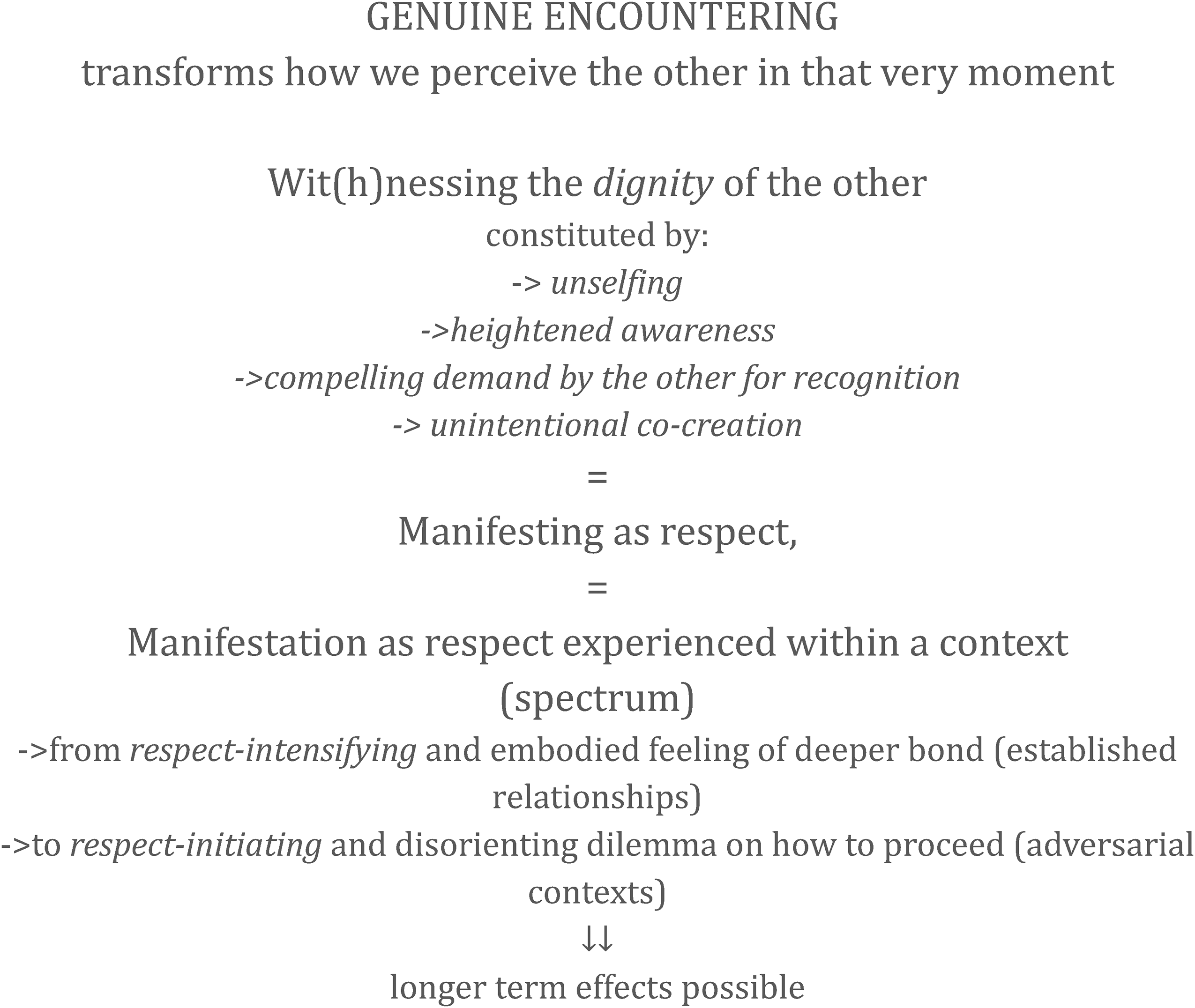
Wit(h)nessing dignity manifests as respect along a spectrum from respect-intensifying to respect-initiating.
Wit(h)nessing Dignity
We now turn to the possibility of wit(h)nessing dignity in the encounter. This phenomenon rests on four elements that form a singular experience: unselfing, heightened awareness of the moment's salience, the other's compelling demand for recognition, and unintentional co-creation. A fundamental difficulty arises in explaining them because these elements resist ordinary conceptual grasp; they must be evoked to be understood. We therefore begin not with definitions, but by rendering their presence through an example. Only then can Levinas's phenomenological vocabulary illuminate what has already begun to take shape. What happens in genuine encountering is that the other person's presence makes a claim—not through words or intention, but through the sheer fact of their appearing as a human being whose dignity cannot be unseen once perceived. That claim is not a force in the physical sense, but it is real: it arrives uninvited and cannot simply be ignored; one responds passively. One's habitual way of reading the situation momentarily fail to contain what is given. Genuine encountering, then, is constituted through wit(h)nessing.
The Four Constitutive Elements: An Example
An example from the legal scholar McCrudden (2016) is instructive here. While the field of law typically concerns itself with theoretical principles, McCrudden (2016) seeks to demonstrate that dignity can be experienced rather than deduced rationally. Engaging extensively with human rights, he turns to the artworks of Velázquez to evoke the experience of perceiving, or wit(h)nessing, dignity. He observes that perceiving the dignity of others requires the suspension of one's ego. To describe this transcendence of personal prejudices, McCrudden draws on Murdoch's term unselfing (McCrudden, 2016, p. 21). He further suggests that certain figures, such as the enslaved man in Velázquez's Juan de Pareja, radiate their humanity despite conditions of servitude, inequality, or low social standing. He contends that this sense arises through a close interaction between the figures and the spectator. The viewer gains the distinct impression of being seen from within the picture, which in turn compels an acknowledgment of this state of being seen. In other words, these figures appear to gaze back. Their gaze requests a response, demanding that the spectator interact with them as equals, with their eyes meeting on the same level (McCrudden, 2016, p. 12). For McCrudden, these moments are value-constitutive (2016, p. 14).
McCrudden's observations are distinctive; he advances claims that few scholars would venture. Nevertheless, he partially describes a phenomenon of which Levinas (1961/1969) also makes us aware: the recognition of dignity resides neither solely within the individual nor is it unilaterally bestowed upon the other. It is a more subtle and complex process in which the four elements are intrinsically interwoven: (1) the figure's compelling demand for recognition—the gaze that requests equitable interaction—meets (2) the viewer's unselfing—the suspended ego that enables receptivity. Within this relational space, (3) a heightened awareness of the moment's profound salience emerges, and (4) the entire encounter is revealed as an unintentional co-creation, a value-constitutive event engendering respect, willed by neither party alone.
The Four Constitutive Elements: A Phenomenological Description
We now examine this example more closely. Crucially, the elements occur simultaneously, constituting the micro-experience. Though we must describe them successively, each element continuously calls forth and enables the others. They form not a sequence but a singular, indivisible experience.
What Murdoch (1970) terms unselfing resonates with Levinas's description of the ego that remains “at the threshold of the relationship” (1961/1969, p. 33). How are we to grasp such a description? Philosophically, the ego refers both to an autonomous, moral entity and to a being that invariably uses concepts to understand the world. In genuine encountering, this ego, with its conceptual apparatus, remains at the threshold. This means it does not actively participate in the moment; it is as it were excluded and can only bear witness from that standpoint. As in McCrudden's example of being struck by a gaze, we are thrust into an instance that defies categorization, including moral ones. Yet this very exclusion enables another faculty to come to the fore. Levinas refers to his faculty as “extreme attention” (1961/1969, p. 178) or a “surplus of consciousness” (1961/1969, p. 178), a lucidity to perceive the dignity and understand the value of this. It is a transformed mode of seeing. It is a drawing near to the other's dignity. In Nancy's (1993/1997) view, following Levinas, this moment is both a touching and being touched (by this dignity). As this heightened awareness transcends conceptual grasp, we term it non-conceptual rather than pre-conceptual. Upon return to the conceptual order, the moment's significance proves ineffable, resisting logical legitimation.
Heightened awareness exists “inside” this relationship. It is created within a space in between, an interstice formed by the ego's position at the threshold on one side, and on the other's resistance to being reduced to a conceptual category (“a slave”) on the other. This resistance emanates from the other's bodily presence, thus enabling—indeed, compelling—dignity to be seen (through an altered state, though not by ordinary sight) and recognized. To recognize the other's dignity—to see it—is to recognize the other: to esteem or respect them. This recognition is opened by the other's demand, yet the dynamic as a whole is an unintentional co-creation; neither party consciously initiates it.
The asymmetry of the demand and the co-emergence of the event are not in tension. It is precisely because the other's demand is non-reciprocal and unintended, and the response equally undeliberate, that something arises between the parties that neither authored. Asymmetry is the condition that makes genuine co-emergence possible.
Wit(h)nessing Dignity: The Phenomenological Core
These four elements together constitute a single phenomenological state, wit(h)nessing dignity in the encounter. The neologism “wit(h)nessing” helps to crystallize how these elements combine while preventing a unity of both parties involved. The “with-ness” signifies the movement of unselfed engagement: the closeness and direct perception of dignity manifesting as respect, made possible by heightened attention. The “wit-nessing” signifies the constitutive distance intrinsic in that very perception: the ego steps back from its habitual position, and it is in that very stepping back that the other's dignity becomes perceptible through heightened attention as inviolable and separate. These are not two acts but one: the recession of the ego and the appearance of dignity, manifesting as respect, are two faces of the same moment.
This transformation of perception is the phenomenological core of our cases. The structure's nature may seem elaborate, but its essence is simple: to truly encounter another, one must get “out of one's own way.” Crucially, one cannot initiate such a situation oneself; it is an undeliberate co-creation. When this occurs, what is revealed commands respect.
Manifestation as Respect Experienced within a Context: A Spectrum
Wit(h)nessing dignity inherently manifests as respect. What varies, however, is the experiential quality of the respect that appears. This varies along a spectrum between what we have termed respect-intensifying and respect-initiating encounters.
When an encounter is respect-intensifying, some measure of recognition already inhabits the relationship, typically in implicit form. Wit(h)nessing the other's dignity directly brings this latent respect into sharper, more explicit awareness. The genuine encountering is typically experienced as a deepening of the relational bond, which effect is generally enduring.
At the other end lie respect-initiating encounters, where the other is initially encountered through limiting frames—stranger, adversary, or stigmatized role. Here, the wit(h)nessing of dignity initiates a respect that was previously absent. In genuine encountering, the individual is compelled to recognize the other's dignity; there is no cognitive or emotional recourse to avoid it. The manifestation of respect creates a state of cognitive dissonance, as it conflicts with the individual's pre-existing beliefs or the contextual demands of the situation.
Between these ends stretches a continuum of experiences in which respect-recognition involves varying degrees of perceptual reorientation. Most genuine encountering occupies the middle of this spectrum, where elements of both intensification and initiation are present.
This distinction may help clarify the relationship between critical incidents and disorienting dilemmas within genuine encountering. All moments of genuine encountering are critical incidents in our phenomenological sense, that is, they transform how we see the other in wit(h)nessing dignity. At the respect-intensifying end of the spectrum, encounters remain at this level: they are transformative but do not generate cognitive conflict, though they remain available for later pedagogical reflection as Brookfield (1990) emphasizes. In respect-initiating encounters, the wit(h)nessed dignity and respect manifesting, collide with the individual's pre-existing conceptual framework (beliefs, prejudices, contextual roles). This collision generates the disorienting dilemma, an inherently rational and conceptual struggle to reconcile contradiction.
The four case studies provided below illustrate the spectrum. Case 1, a paradigmatic respect-intensifying encounter, is a critical incident without a subsequent dilemma, as the deepened respect integrates smoothly into the ongoing relationship. Cases 2 and 3 occupy the middle range: case 2 leans toward the respect-intensifying pole but involves a mild corrective element through rationalization, while case 3 demonstrates a restoration of respect after habituation. Case 4 presents a clear respect-initiating encounter including a disorienting dilemma: the newly initiated respect directly challenges the individual's existing worldview.
The longer-term effects of such a disorienting dilemma cannot always be foreseen. In the first three cases, the outcome is desirable; in the last, the outcome is tragic. One might argue that genuine encountering in the latter case holds no value, but the reality is more nuanced. In essence, respect for others has been experienced. As such, these moments represent the origin of transformative learning: the precise instant when the potential for transformation first erupts into lived experience, with context determining whether the potential will become an actuality.
Four Case Studies
The four cases that follow are presented without rigid categorical labels to emphasize the fluid continuum they represent. Rather than constituting fixed types, the distinctions we outline reflect varying degrees of tension between the transformative experience of recognition and the conceptual frameworks that preceded it. To illustrate this range, the first three cases are drawn from the authors’ lived experiences, and the fourth is based on a journalistic account of the 2008 Mumbai attacks.
Case 1: Sister's Resilience
Some years ago, I witnessed the tragic death of my sister's son. In the aftermath, we spent long hours in introspective conversations about our experiences, our youth, but most of all, the meaning of a son dying. During these discussions, I observed how my sister struggled with overwhelming waves of sorrow. Yet, amidst her grief, I suddenly and only momentarily recognized her remarkable resilience, which revealed her dignity, however small and steadfast it was. It demanded reverence and respect, bringing me closer to her than I had ever felt.
Analysis
Time seemed to suspend for a moment as I became fully absorbed in wit(h)nessing my sister's sorrow. This absorption can be understood as a form of unselfing: the usual lens through which I saw her grief gave way. There was a sense of heightened awareness, as if the ego had remained at the threshold of the relationship, opening space for a deeper seeing. Through this heightened awareness, her dignity became visible to me. Her dignity presented itself directly, insisting, without words, on recognition. It felt less like something I did than something that happened between us, an unintentional co-creation of attention to her and undeliberate showing of her dignity. I did not infer her strength; rather, in that instant, my perception of her shifted: the resilience I might previously have named abstractly became phenomenologically vivid and unavoidable, manifesting as deepened respect.
The significance of such cases lies in how an ostensibly self-evident bond can undergo a subtle transformation, where heightened awareness of dignity enriches the relationship. Note that even long-standing connections require periodic re-encountering to maintain their qualitative integrity—the closeness we assume can dull into routine without moments that restore vivid awareness of the other's particular presence and dignity. This was a respect-intensifying and respect-transformative encounter, yet without a disorienting dilemma. Nothing in our relationship fundamentally altered course; instead, what had been tacit came forward, embodied and explicit.
Case 2: Friend's Birthday
My closest friend invited me to her child's birthday celebration. Being childless myself, I find such gatherings less appealing and had resolved, for my own well-being, to decline. I sent a message explaining that while I was available that weekend, I had chosen a camping trip instead. When she replied only after a day's delay, I immediately sensed disappointment—informed by my intimate knowledge of her. This brief moment of recognition prompted me to reconsider. I realized that while self-care was legitimate, it could not be prioritized to the exclusion of the friendship's claims. After reflecting and consulting a trusted third party, I reached out to explore what my presence meant to her, and together we arrived at a mutually satisfactory resolution.
Analysis
My initial prioritization of personal needs—conceived neutrally as legitimate self-care—gave way when my friend's response interrupted my settled perspective. This shift exemplifies unselfing: my comfortable stance was questioned by her subtle reaction. Though content with my decision, something changed in that moment of reading her message. I experienced heightened awareness—a sudden sensing of her dignity in her disappointment, while next realizing I had not sufficiently considered what mattered to her. Her disappointment was not visible physically but presented itself through her delayed response and careful wording, making a compelling demand for recognition. Crucially, this was not something I orchestrated and nor did she orchestrate it; it emerged unintentionally between us, co-created through her indirect communication and my receptivity to it.
What distinguishes this case is its placement on the spectrum. Recognition and respect already existed in our friendship, yet the moment revealed I had been honoring my own needs in a way that inadequately honored the relationship. This created a mild dilemma—how to balance competing considerations—prompting deliberation and consultation. Unlike Case 1, where deepened respect simply enriched an existing bond without tension, this encounter had a corrective dimension: it initiated a recalibration of how I respected her within the relationship. The transformation was neither exclusively respect-intensifying (something was amiss) nor fully respect-initiating (respect already existed) but rather involved correcting how respect was enacted within the relationship. The subsequent dialogue and resolution occurred within an already-safe relational space yet required negotiation—placing this encounter in the middle of the spectrum, partaking of both respect-intensifying and mildly disorienting dynamics.
Case 3: Shop Saleswoman
Several years ago, we relocated from the Flemish to the Francophone region of Belgium. With my anthropological background, I'm attuned to cultural nuances. While generalizations are risky, I observed a subtle vigilance in Walloon culture against objectifying others, a tendency less prevalent in Flemish culture. A strong inheritance in Flemish culture is purposefulness and efficiency—a propensity for planning. Consequently, my days are consistently well-populated, engendering a perpetual sense of haste. With such a disposition, I entered a shop one day. Unable to immediately locate my item, I approached a saleswoman: “Excuse me, where can I find this product?” I expected a direct answer. Instead, she kindly replied, “Good afternoon.” In that moment, I felt subtly corrected. Though polite, I had positioned her solely within an instrumental relationship—I had objectified her. Her greeting reminded me: she was addressing me as a person before perceiving me as a customer.
Analysis
This encounter reveals how all constitutive elements converge to transform perception, with respect manifesting. The saleswoman's response prompted immediate unselfing: my task-oriented focus receded as I became suddenly aware that I had reduced her to a function. There was heightened awareness—not just of my error, but of her dignity as a person standing before me, separate from her role. Her greeting functioned as a compelling demand: “Good afternoon” gently but firmly insisted on recognition of her personhood, correcting my instrumental approach. This correction was unintentionally co-created—she likely did not intend to teach me a lesson, nor did I seek one, yet the dynamic between her cultural practice and my hurried approach generated the transformative moment.
This case occupies the spectrum's middle ground yet differs significantly from Case 2. Where Case 2 involved rebalancing respect within an established relationship (respect existed but became imbalanced through competing priorities), this encounter involves awakening dormant respect in a functional relationship. The saleswoman's dignity was not absent from my awareness in any absolute sense—there was no ideological denial of her humanity. Yet through habitual instrumental relating, recognition had become so backgrounded as to be functionally absent. The moment of wit(h)nessing her dignity restored respect that had atrophied through routine. It generated mild corrective tension—a brief sense of being admonished and subsequent behavioral adjustment—placing it closer to the respect-initiating end than case 2, though far less destabilizing than encounters where respect fundamentally conflicts with worldview or context.
Case 4: The Mumbai Attack
We turn now to the most extreme end of the spectrum—where genuine encountering occurs under conditions of violence and ideological pressure. This case, unlike the previous three, is not drawn from direct experience but from documented evidence: recorded phone conversations during the 2008 Mumbai attacks (Sanders, 2014). It illustrates why phenomenological recognition, however powerful, does not guarantee transformed action.
In November 2008, 10 operatives affiliated with Lashkar-e-Taiba carried out coordinated attacks across Mumbai. The assault lasted multiple days and resulted in extensive casualties—hundreds killed and wounded. A British documentary analyzed intercepted phone calls revealing how militant leaders maintained constant contact with the operatives, urging maximum losses and framing the violence as religious duty. These young men, mostly from rural backgrounds, showed no discernible remorse, their conduct was shaped by intense indoctrination.
A pivotal incident occurred during the siege at Nariman House. Two operatives had taken hostages, initially intending to use them for exchange. When negotiations stalled, their handler, “brother Wasi,” ordered their execution. The recorded conversation unfolded over more than an hour:
Wasi orders them to shoot the hostages immediately. The gunman responds, “God willing. Although it's quiet here at the moment.” Wasi insists, “No, don't wait… I'll stay on the line. Do it.” When the gunman asks for confirmation—“What, shoot them?”—Wasi is explicit: “Yes, do it. Sit them up and shoot them in the back of the head.”
But then the gunman hesitates: “The thing is, Umer is asleep right now. He hasn't been feeling too well.” Wasi agrees to call back in half an hour.
For an hour, the gunman delays. When Wasi calls again, his patience has run out. The gunman offers another excuse: “I had to move things around a bit.” Finally, under sustained pressure and with Wasi listening on the line, the gunman shoots the hostages.
Analysis
What happened in that hour of hesitation? The documentary journalist suggests the gunman's logistical excuses may mask something deeper: a moment when the hostages’ humanity broke through his conditioning. We can identify the phenomenological structure from this hesitation: unselfing likely occurred through his militant identity momentarily receding—his task-oriented focus was interrupted by something he encountered. Heightened awareness arose: perhaps the sight of the hostages’ eyes, their physical presence as persons rather than abstractions. Their dignity made a compelling demand—wordlessly insisting on recognition despite the ideological framework that had positioned them as legitimate targets. This was unintentionally co-created: neither the gunman nor the hostages orchestrated this moment; it opened in the unbearable space between them.
This represents a respect-initiating encounter at its most extreme: respect emerged where ideology had entirely foreclosed it. The gunman could not abstain from encountering their dignity in that charged proximity—the recognition imposed itself despite his training and intent. Yet the contextual forces proved overwhelming.
Unlike the previous cases, this encounter generated a full disorienting dilemma—the defining characteristic of respect-initiating encounters at the far end of the spectrum. The gunman faced profound conflict: his direct experience of the hostages’ dignity clashed with the worldview positioning them as enemies, while overwhelming pressures—institutional authority, peer dynamics, and Wasi's voice demanding compliance—pushed him toward action incompatible with his recognition. The dilemma was “resolved” not through integrating the new recognition, but through suppressing it in favor of pre-existing frameworks and immediate situational demands.
This case reveals the most troubling dimension of genuine encountering: the undecidability it creates can be resolved by betraying the recognition itself. Yet even in this tragic outcome, the encounter remains significant. Without this crack in the armor there would be no possibility for the dilemma to emerge, no opening for reflection. As such, the respect-transformative nature of the moment is a precondition for actual transformation, but not its guarantee. The phenomenological encounter can interrupt one's worldview, but cannot determine what follows. This case thus exposes both the power and the profound limits of genuine encountering in the face of structural violence and ideological control.
Contribution to Transformative Learning Theory and Praxis
Taken together, the four cases show how genuine encountering operates as a micro-level, transformative critical event grounded in recognition, whose effects range from deepening existing bonds to generating profound disorienting dilemmas. In what follows, we draw out the theoretical, methodological, and practical implications of this perspective for transformative learning theory and praxis.
Theoretical Implications
This article contributes to four theoretical refinements: the phenomenological emergence of respect, expanding what counts as transformative, clarifying the temporal sequence and the role of reflection, and showing transformation's limits.
First, while transformative learning has increasingly engaged with recognition—particularly through Honneth's (1995) critical theory as developed by Fleming (2016, 2022) —less attention has been paid to its micro-phenomenological structure. Fleming's account operates at a social-theoretical level: he considers how patterns of recognition shape identity over time. This leaves unexamined the momentary structure of recognition itself—what it feels like from within, how it interrupts perception, and how it generates respect before reflection occurs. Our analysis brings this specificity into view: respect is not first a moral category or reflective judgment. In lived experience, it emerges phenomenologically through the convergence of unselfing, heightened awareness, the other's compelling demand, and unintentional co-creation. In this emergence, dignity manifests as respect. Respect, at this level, is an event in perception—not yet a stable disposition or norm—and only subsequently becomes available to reflection, moral deliberation, or action, where it may be integrated, resisted, or expanded.
Second, classical formulations of transformative learning, especially those influenced by Mezirow (1978), foreground rupture, crisis and disorientation. Our spectrum model broadens this understanding. Respect-intensifying encounters demonstrate that transformation need not always arise from frame-breaking conflict. Some transformations occur through perceptual deepening rather than cognitive rupture. In such cases, no prior frame is overturned; rather, what was backgrounded becomes vividly present.
What makes genuine encountering transformative is this: in ordinary experience, the ego constitutes meaning—we categorize, interpret, and make sense of the world. In genuine encountering, this order reverses. The ego recedes for a moment; it does not constitute the experience yet does not vanish. It remains as a kind of witnessing capacity, involuntarily open to being changed by what exceeds it. This reversal, from constitution to reception, is the transformative core. Transformation, therefore, should be defined not solely by the magnitude of disruption but by the irreversibility of reorientation in how one relates to another. Both respect-initiating and respect-intensifying encounters meet this criterion, though through different phenomenological pathways: the first through rupture, the second through deepening. In both, however, the ego has been momentarily displaced as the source of meaning, opened to what it could not produce itself.
Third, our findings refine the temporal sequence of transformative learning. We show that the phenomenological moment of wit(h)nessing dignity can interrupt cognitive reflection. In contrast to Mezirow's emphasis on the disorienting dilemma as the initial catalyst, our analysis demonstrates that a non-conceptual perceptual transformation is already underway before reflective work begins. We elaborate Brookfield's (1990) notion of critical incidents by distinguishing between phenomenologically critical incidents (which transform perception immediately) and pedagogically critical incidents (which become critical through subsequent reflection). Those that also trigger existing frameworks—whether mildly or strongly—become additionally pedagogically critical by generating a disorienting dilemma, as the spectrum indicates. Reflection on the moment of genuine encountering remains essential to fully grasp their significance.
Fourth, the Mumbai case illustrates that phenomenological transformation does not guarantee behavioral change. Even when respect is genuinely initiated through encounter with dignity, overwhelming contextual pressures—ideological commitments, institutional demands, power dynamics—can lead to suppression of that respect. These moments represent a necessary but insufficient condition for social transformation: they provide the experiential foundation, but sustained change requires reflection, dialogue, and enabling structural conditions.
Practical Implications
These theoretical refinements carry concrete implications for educational practice.
First, phenomenological attentiveness deserves greater methodological space in transformative learning research. Micro-analytic description of lived experience can complement established approaches such as narrative inquiry and survey-based research.
Second, educators cannot manufacture respect through instruction. What they can do is cultivate attentiveness: helping learners recognize moments of genuine encountering, understand their structure, reflect on tensions between experiential recognition and existing assumptions, and explore how such moments might inform more just forms of action. Education, in this view, does not create respect ex nihilo. It works with experiences in which respect has already appeared.
Limitations and Future Research
This study has focused on the micro-phenomenological structure of genuine encountering in informal, interpersonal settings. Three limitations suggest directions for future inquiry.
First, we argue that wit(h)nessing dignity possesses a universal phenomenological core—the constitutive elements that must be present for the experience to be what it is. This is a structural, not an empirical, claim. How such encounters are interpreted, narrated, and responded to may vary across cultural, historical, and political contexts. Future research might examine how context shapes the aftermath of genuine encountering, even if the encounter itself transcends contextual determination.
Second, the bridge from micro-encounter to macro-level democratic engagement remains theoretical. One pathway might operate through narrative: when individuals articulate their experience of wit(h)nessing dignity to others, the encounter becomes shareable, potentially resonating beyond the original dyad. Another pathway could involve cumulative effects: as several cases illustrate, individuals often articulate genuine encounters to others—consulting friends, engaging in introspective conversation, or simply recounting what happened. When such narratives circulate within a community, they can invite vicarious participation in the encounter.
This question carries particular urgency in contexts of social polarization. By continuously reinforcing categorical frameworks—friend/enemy, us/them—algorithmic environments may pressure individuals to suppress or dismiss the recognition they may have experienced. This is much like the ideological and institutional pressures discussed in the Mumbai case. The interruption of genuine encountering is real, but its transformative potential depends on whether it can be narrated, reflected upon, and integrated. Pedagogical spaces—classrooms, and potentially families and community settings—become more crucial than ever. They can function as counter-environments where learners develop the attentiveness to recognize genuine encounters when they occur, where they are invited to testify to these experiences, and where they cultivate the reflective capacity to resist the pull toward polarized abstraction. In such spaces, the memory of having once seen otherwise can be shared and strengthened against the forces that would suppress it.
Future research might investigate: Under what conditions do individual encounters catalyze collective reflection? What reflective practices amplify their effect? How do narratives of genuine encountering circulate and gain traction within groups? And which institutional settings—classrooms, community organizations—prove especially conducive to this scaling process? These questions move beyond phenomenology into social and political theory, where our analysis cedes the floor.
Conclusion
By providing a phenomenological account of respect-transformative moments in interpersonal relations, this study contributes to transformative learning theory's ongoing movement toward more intersubjective and embodied understandings of adult learning. Our aim has been twofold: to clarify the structure of genuine encountering and to demonstrate its significance for transformative learning.
We began with a question often assumed but rarely examined: how respect emerges in lived experience? Rather than approaching respect as a moral principle or social achievement, we analyzed it as a perceptual event. In genuine encountering, the other's dignity is wit(h)nessed through the convergence of unselfing, heightened awareness, compelled recognition, and unintentional co-creation. Respect does not originate in isolated subjectivity; it co-emerges within the relational space between self and other.
From this structural analysis, we introduced a spectrum model. While the meeting of dignity manifests as respect, this respect is continuously shaped by its relational context—manifesting as respect-intensifying in some encounters and respect-initiating in others. The four cases illustrate this continuum and expose both the promise and the limits of such moments. A shift in perception does not guarantee transformed action. Structural forces, ideology, and power may override experiential recognition.
Nonetheless, these moments are the experiential ground from which transformation arises, not as a linear precursor but as a recurring possibility within ordinary relational life. Genuine encountering does not introduce something foreign into transformative learning theory; it makes visible a dimension long implicit within concepts such as the critical incident and the disorienting dilemma. What has been lacking is a vocabulary precise enough to render the micro-phenomenological structure of these events. By bringing that structure into view, we illuminate the fragile yet decisive occasions in which perception shifts and respect manifest together. It is within this relational co-emergence of respect—simultaneously perceptual and open to reflection—that the possibility of democratic learning takes root.
Footnotes

Funding
The authors received no financial support for the research, authorship, and/or publication of this article.
Declaration of Conflicting Interests
The authors declared no potential conflicts of interest with respect to the research, authorship, and/or publication of this article.
Data Availability
This manuscript analyzes four illustrative cases. The first three cases are drawn from the authors’ lived experiences, and the fourth is based on a journalistic account of the 2008 Mumbai attacks.