







Abstract
Calls for interventions in early childhood that best prepare children with autism spectrum disorder (ASD) to have inclusive school experiences have been numerous. Although there is a developing literature on the efficacy of interactive book reading (IBR) for this population, it is still unclear which aspects of IBR benefit these children and in what way. To address this gap, we reanalyzed data from a recently completed experiment comparing IBR with other early literacy instruction for preschoolers with ASD. Our results showed that frequency of tutors’ use of completion prompts used during IBR was uniquely predictive of better gains in phonological awareness. In addition, tutors’ frequency using open-ended prompts was associated with increased gains in print knowledge. Furthermore, both findings held true after controlling for language gains. Results have implications for the types of structure and support that adults might provide young children with ASD during IBR.
Autism spectrum disorder (ASD) is a pervasive neurological disorder with a wide range of impacts, outcomes, and varying levels of severity (American Psychiatric Association, 2013). Children with ASD show relative strengths and equal performance compared with their typically developing (TD) peers in discrete skills such as letter naming and relative weaknesses in meaning-related skills, phonological awareness (PA), and vocabulary development (Dynia et al., 2014; Lanter et al., 2012). Development of oral language in early childhood is critical for emergent and subsequent literacy skills for both TD children and children with developmental disabilities such as ASD (Boudreau & Hedberg, 1999; Lonigan et al., 2007; Scarborough & Dobrich, 1994; Tager-Flusberg et al., 2001; Whitehurst & Lonigan, 1998).
For all children, the development of oral language begins early in life through guided practice with caregivers and interaction with other speakers (Bishop & Adams, 1990; Scarborough, 1989). The term “guided practice” has been used to describe an activity that children engage in with a partner of varying skill who provides guidance and support (Rogoff, 1993). Oral language development is strongly related to important emergent literacy skills that all children need to be successful readers and writers (Storch & Whitehurst, 2002). Extant studies have demonstrated a longitudinal relationship between oral language ability and reading proficiency in children who are TD, children with reading delays, and those with language delays (Bishop & Adams, 1990; Scarborough, 1989). Some aspects of oral language are more closely related to later literacy outcomes than others. The National Early Literacy Project (NELP) report (2008) found that aspects of oral language and listening comprehension have substantial predictive relations with later conventional reading skills. The report also found that literacy skills and oral language are strongly linked and have bidirectional ties. Children who have language and can map complex sentence structures onto corresponding meanings have an advantage over children with poorer language skills learning to read (Shanahan & Lonigan, 2010).
Intervening in oral language development holds promise for enhancing long-term reading development and future school outcomes for children with developmental disabilities such as ASD (Cain & Oakhill, 2008). Furthermore, supported acts of intentional communication where joint attention is maintained and language use is aligned with children’s area of focus also effectively support language development (Perryman et al., 2013; Siller & Sigman, 2002, 2008; Toth et al., 2006). Shared picture book reading during early childhood serves as an ideal forum for intentional communication that can support language development.
Interactive Book Reading
Shared picture book reading is a common way children are introduced to many emergent literacy skills such as new vocabulary words (Rosenquest, 2002). Unfortunately, children with disabilities have historically had little exposure to shared book reading for many reasons, including caregivers’ lack of knowledge of what is effective, belief that shared book reading is not a worthwhile activity for this population, and active resistance by children themselves (Koppenhaver et al., 2001; Light et al., 1994; Light & Smith, 1993; Marvin & Mirenda, 1993; Scarborough & Dobrich, 1994). Taken together, these issues can lead to lower levels of engagement and interaction, and may explain some of the variance in children’s emergent literacy outcomes in early childhood (Tsybina & Eriks-Brophy, 2010; Warren & Yoder, 1996).
Interactive Book Reading (IBR) was designed as a shared picture book reading intervention that teachers, parents, and other school personnel could use to promote oral language development (Whitehurst et al., 1988). In Dialogic Reading (DR), a form of IBR, adult caregivers employ a set of language prompts to engage children in oral language practice during picture book reading experiences. Research shows that DR can foster vocabulary and oral language development in TD children as well as populations such as low-income children and children of immigrants, thereby improving emergent literacy skills (Chow & McBride-Chang, 2003; Storch & Whitehurst, 2002).
IBR for Children With ASD
Research on IBR for children with ASD is a relatively new endeavor. Nevertheless, recent work has shown that IBR is effective for increased verbal participation and lengthened engagement with book reading (Fleury et al., 2014), increased book-specific vocabulary (Fleury & Schwartz, 2017; Towson et al., 2016), expressive vocabulary and listening comprehension (Hudson et al., 2017), story comprehension and engagement (Mucchetti, 2013), vocabulary (Rahn et al., 2016), and correct spontaneous responding during reading (Whalon et al., 2015).
The aim of IBR for young children with ASD follows the same logic as applications with TD children (Lonigan et al., 1999; Whitehurst et al., 1994; Whitehurst et al., 1988) to engage children in literacy activities that demand the kind of joint attention supportive of oral language and vocabulary development. Data from Hudson et al. (2017) provide the basis for the current inquiry. In that study, preschool children with ASD were randomly assigned to three conditions: IBR, phonological awareness (PA), and business as usual (BAU) control. Hudson et al. (2017) found that, immediately after intervention, children in the IBR group had greater growth in expressive vocabulary and listening comprehension in comparison with the PA condition or BAU. However, 1 year after intervention, 82% of the original sample was tested (N = 109), and the follow-up results showed that the PA intervention group had significantly better vocabulary and listening comprehension than the other interventions (average approximate d = 0.63) (Hudson et al., 2019). These conflicting findings showing better outcomes for the IBR treatment in the short-term and better outcomes for PA in the long-term warrant further scrutiny. In particular, the present study aims to identify which elements of the IBR adult–child language interaction might better facilitate language and emergent literacy skill development for children with ASD.
Adult Prompting During IBR
Previous scholarship has demonstrated a link between adult behavior and active engagement during IBR for both TD children and those with a language disorder (Kang et al., 2009; Luo & Tamis-LeMonda, 2017; McGinty et al., 2012). In addition, parents’ use of meaning-related prompts has been found to be associated with growth in children’s vocabulary (both expressive and receptive) as well as other print-related behavior and alphabet knowledge (Han & Neuharth-Pritchett, 2015; Hindman et al., 2008). Tipton et al. (2017) performed a factor analysis of parent behaviors during shared book reading and found that parents of children with ASD employ a variety of strategies during shared book reading. Specifically, the parents in their study were not given explicit instruction in specific prompt use during intervention, which provided a natural opportunity to observe the frequency of specific prompt types. Results showed that parents used Wh- questions (e.g., questions that begin with Wh- such as “What happened?”) more than open-ended or simple yes/no questions.
In its design, IBR employs two sets of prompts during sessions, called Prompt, Evaluate, Expand, and Repeat (PEER) and Completion, Recall, Open-ended, Wh, and Distancing (CROWD); the first is a guideline for the adult caregiver/tutor, and the second refers to types of prompting to be used with the children (Whitehurst et al., 1988). The caregiver/tutor prompts the child (using one of the CROWD prompts), evaluates the response from the child, asks the child to expand their response, or repeats the prompt if there has been no response after appropriate wait time.
These prompts ask the child to engage with the reading and are expanded on further in the discussion section. Below we define each with an example:
Present Study
The purpose of the present study is to describe and evaluate how prompts used by tutors during IBR sessions predict language development for a cohort of young children with ASD. In school settings, children are likely to complete book reading sessions with the same tutor or tutors over the course of an academic year. A closer look at the types and amounts of prompts tutors use can help determine whether some prompts in IBR serve as active ingredients in the intervention. Active ingredients are “specific, measurable actions” a tutor performs that affect the mechanism of the intervention (Hart & Ehde, 2015). Characterizing IBR’s active ingredients for young children with ASD could lead to the development of stronger early reading interventions, thereby creating a clearer path to word reading and comprehension. Our research questions were as follows.
Method
Participants
Original study
Child participants for this study were drawn from extant data of one arm of an early literacy treatment comparison study for preschoolers with ASD (Hudson et al., 2017). Most of the children were male (77% of the sample), and ages ranged from 49 to 69 months (M = 56.22, SD = 3.78). In the original study, children with ASD were recruited each year for three consecutive years from 32 schools across eight school districts based on the following inclusion criteria: (a) had either a medical diagnosis of ASD or an educational identification; (b) had an active Individualized Education Program (IEP) and receive services for ASD; (c) were enrolled in their last year of preschool; (d) had no known co-occurring neurological or genetic disorders (e.g., Down syndrome, Fragile X); (e) exhibited functional communication such as the ability to make requests, used two- to three-word phrases, and were able to follow simple directions; and (f) a minimum standard score of 55 on the Expressive One Word Picture Vocabulary Test (Brownell, 2010).
After recruitment, children were randomized into treatment that was implemented individually by a trained tutor within the child’s classroom for 7 to 15 min per day, 3 to 4 days per week, from November to May. In the first trial, children were randomly assigned to IBR (treatment) or BAU (control) preschool literacy environment. In the second trial, a second cohort of preschoolers were randomly assigned to PA (treatment) or control conditions. In the third trial, children were randomly assigned to IBR or PA intervention. Results for the combined samples showed that IBR (n = 47) demonstrated greater gains in vocabulary and listening skills (approximate effect sizes of d* = 0.29 and 0.30), whereas PA (n = 42) had better PA gains (approximate effect size of d* = 0.39).
Present study
Data for the present study are based on N = 41 of the 47 children in the original study’s IBR arm; unfortunately, a cloud-based technology failure deleted one tutor’s videotapes before we could code it. However, when we compared the analytic sample available with the full sample from the original study, we found no significant differences between missing and non-missing children’s demographic characteristics, pretests, or pretest–posttest gains. Moreover, the one tutor who is missing from the present study was similar to the original sample of tutors (the missing tutor was White, female, had at least a 4-year degree, and had experience working with children with ASD). Descriptive statistics on child measures for our present study’s analytic sample are presented in Table 1.
Descriptive Statistics for Child Measures.
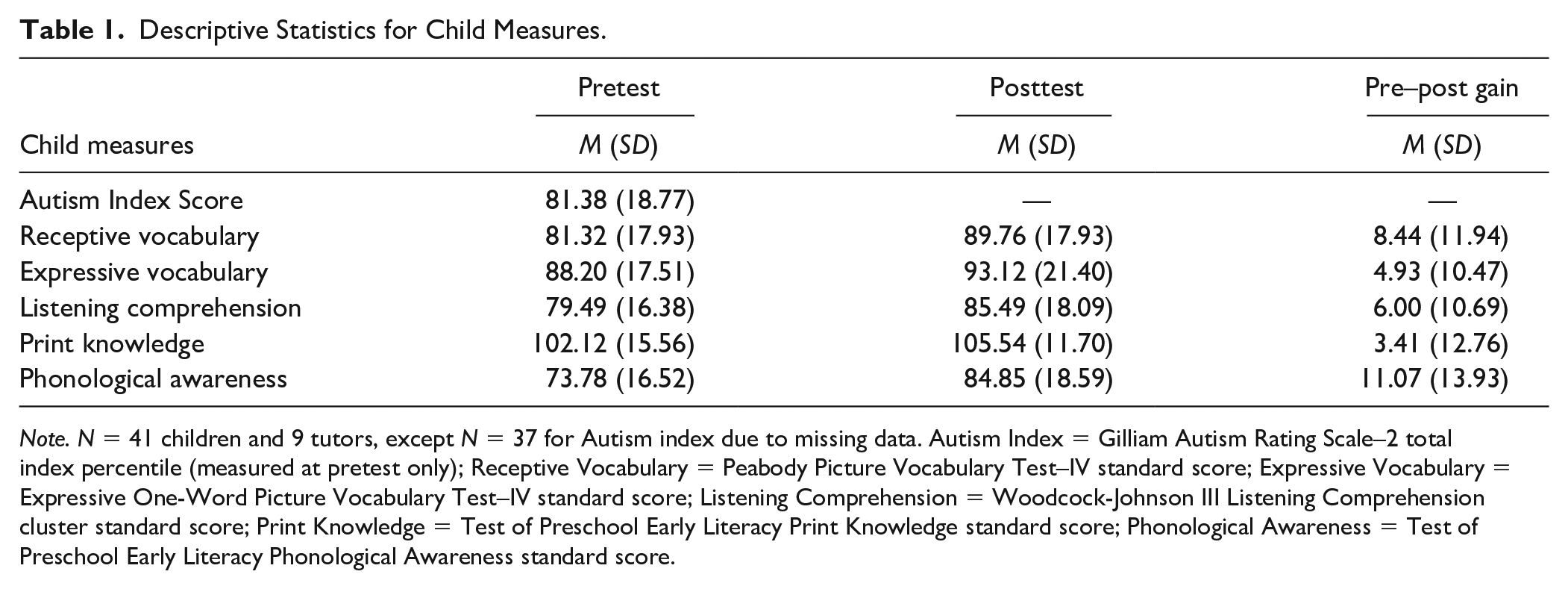
Note. N = 41 children and 9 tutors, except N = 37 for Autism index due to missing data. Autism Index = Gilliam Autism Rating Scale–2 total index percentile (measured at pretest only); Receptive Vocabulary = Peabody Picture Vocabulary Test–IV standard score; Expressive Vocabulary = Expressive One-Word Picture Vocabulary Test–IV standard score; Listening Comprehension = Woodcock-Johnson III Listening Comprehension cluster standard score; Print Knowledge = Test of Preschool Early Literacy Print Knowledge standard score; Phonological Awareness = Test of Preschool Early Literacy Phonological Awareness standard score.
IBR Intervention
The IBR intervention and prompting sequence were adapted from DR procedures (Whitehurst et al., 1988). The 20 books used in the study included both expository and narrative text structures. All children engaged with the books in the same order, which was determined using random selection. To facilitate comprehension of the books and provide a familiar structure, each book was read 3 to 4 times. During each book reading session, the tutor and child sat together in a space such as the corner of a classroom, the hallway, or a separate small room.
Tutoring sessions occurred 3 to 4 days per week, for approximately 7 to 15 min per session. Sessions were provided by a total of 11 tutors hired by the project from the local school community. All were women with at least a bachelor’s degree. Children received an average of 63 IBR sessions from fall to spring. There was no tutor attrition. The tutor provided a CROWD prompt of their choice (recall that CROWD stands for completion, recall, open-ended, wh-, and distancing; see our previous description for details), waited for a response from the child, evaluated the statement, expanded the statement by adding more words or otherwise making the language more complex, and either repeated the prompt or asked the child to repeat new vocabulary or syntax. The CROWD prompts were freely chosen by the tutors to use as they deemed appropriate.
In addition to the CROWD prompts, the tutors used supports to provide more structure to the children with ASD. The two most frequent additional supports were: (a) providing extra wait time for children to process the information and respond, and (b) repeating the prompt. Other, less frequently used supports moved from less to more support and reduced language demands: providing the initial sound of the correct completion answer (e.g., This is a k—), providing choices (e.g., Is it a key or a banana?), asking yes/no questions (e.g., Is that a key?), and modeling the right answer (e.g., Say key).
Intervention Fidelity
Fidelity and engagement were measured by coding videotaped book reading sessions. Interrater reliability was established for all fidelity coding, and no data were collected until agreement reached 80%.
Procedural fidelity was measured using a checklist of expected tutor behaviors appropriate to the intervention and a 5-point rating scale for each behavior—for example, “Adult prompts the child to respond at least one time every 2 to 3 pages” (1 = 0%–10%, 5 = 90%–100%). Graduate research assistants and the first author individually observed a videotaped session for each child 2 to 6 times during treatment (average of five per child). The number of points were added up and divided by the total possible to determine a percentage of earned points. Across observations, procedural fidelity averaged 98% (SD = 5%); for the IBR intervention-specific procedures, the average fidelity was 98% (SD = 7%).
In addition to fidelity, on-task engagement was measured to quantify the extent to which children were on-task to the intervention using a 15-s partial interval time sampling procedure on the same videotaped session used for fidelity. The five CROWD prompts and on-task engagement were coded by a member of the research team (the first, third, or fourth author), observed the first 5 min of each time sample, and, within each 15-s period, marked whether the student was actively engaged or not.
Active “on-task” engagement was defined by behaviors such as looking at the object of importance (book, blocks, or picture), pointing, speaking about the topic, looking at the tutor, or leaning toward the activity. Non-engagement (off-task) was defined by behaviors such as looking away from the activity or tutor, moving away from the activity or tutor, speaking about an unrelated topic, pushing the object away, or playing with an object unrelated to the activity at hand. Across sessions, the IBR condition averaged 86% on-task (SD = 19%).
Measures
Tutor prompting types
Video from two IBR sessions for 41 of the original study’s 47 children (in the IBR condition) was available for coding and analysis (due to a cloud storage technology failure, videos from a 10th tutor who tutored six children are missing). Because time-per-session varied, we standardized our definition of beginning- and end-of-session timing. The beginning of the session was defined as when the tutor presented the book or began asking questions about the book; the end of session was defined as when all book-related talk had concluded. Average tutoring session length at the beginning of the intervention was M = 10.28 min (SD = 2.92), and the average length at the end of intervention was M = 11.17 min (SD = 2.37); there was no significant difference between beginning and end of intervention session lengths (t test p = .372).
Interrater reliability
Prior to coding the study IBR sessions, two coders used the tutor prompting and child engagement coding definitions previously described to code non-study videotapes with a checklist adapted from Whitehurst et al. (1988) and Fleury et al. (2014). Once the coders reached 80% agreement on three out of five consecutive videos, a randomly selected 30% of IBR study sessions were coded a second time to establish interrater reliability. Reliability was calculated by dividing the number of agreements by the number of agreements plus the number of disagreements multiplied by 100. Interrater agreement was calculated for each with averages ranging from 95% to 97% (range = 80%–100%) for responses, 95% to 98% (range = 75%–100%) for verbal initiations, and 89% to 96% (range = 75%–100%) for nonverbal initiations.
Prompt per minute rate
To obtain the prompt per minute (PPM) rate used per session, the number of prompts for each CROWD category was divided by the number of minutes in the session. This was necessary because session lengths varied and a PPM rate allowed for more accurate comparison. Because we did not wish to assume that individual tutor–child pair observations were a valid measure of each tutor’s general approach to prompting, we aggregated individual prompt rates to the tutor level for use in subsequent analyses as a more robust measure of tutor prompting.
Child language skills
We used all three pretest–posttest measures of language skills from the original study, including receptive vocabulary, expressive vocabulary, and listening comprehension. Receptive vocabulary was measured using the Peabody Picture Vocabulary Test–IV (PPVT-IV; Dunn & Dunn, 1997). In this test, children point to a picture that best illustrates the meaning of an orally presented stimulus word. Internal consistencies (Cronbach’s alpha) from the original study were .98 at pretest and .96 at posttest. Expressive vocabulary was assessed using the Expressive One-Word Picture Vocabulary Test–IV (Martin & Brownell, 2011). For this test, children are presented with pictures and are asked to orally provide the names of the pictures. Sample-based internal consistencies from the original study were .95 for pretest and .96 for posttest. Listening comprehension was measured using the Oral Communication and Following Directions subtests of the Woodcock-Johnson III Tests of Achievement (WJII; Woodcock, 1997; Woodcock et al., 2007). Because the children had great difficulty following directions from an audio recording, all items were read aloud verbatim by assessors. Items were read one time and were not repeated. The Oral Communication measure consists of oral cloze statements. Sample-based internal consistencies using Cohort 1 were .86 for pretest and .89 for posttest. The Following Directions measure consists of items that ask participants to point to things on a picture after being given directions. Sample internal consistencies from the original study were .93 for pretest and .92 for posttest. Across all measures, norm-referenced standard scores (adjusted for age) were used.
Child early literacy skills
For the present study, we focus on two measures of early literacy from the original study: print knowledge and PA. Print knowledge was measured using the Test of Preschool Early Literacy (TOPEL; Lonigan et al., 2007) Print Knowledge subtest, which measures early knowledge about written language conventions and alphabet knowledge and sounds. This 36-item subtest measures early knowledge about written language conventions and alphabet knowledge and sounds. The raw score was converted to a norm-referenced standard score. Sample-based internal consistencies from the original study were .94 for pretest and .91 for posttest. Phonological awareness was measured using the TOPEL Phonological Awareness subtest, a standardized assessment used for identifying preschoolers at risk of literacy problems. Sample-based internal consistencies from the original study were .93 and .90 for pretest and posttest, respectively. Across all measures, norm-referenced standard scores (adjusted for age) were used.
Data Analysis Plan
Missing data
For brevity, participants who were missing data for the IBR intervention, or who were missing the majority of data across IBR sessions, were treated as “missing at random” and subsequently excluded from analyses. Recall that the final data used in analysis included nine tutors and their 41 children; all children received a uniform IBR intervention, but tutors were free to employ whatever tutor prompts they chose in interacting with the children.

In the model above, the pretest–posttest gain for the ith child in the jth tutor on a given measure was estimated as a function of the conditional grand mean gain across all children and tutors (γ00), plus the effect of pretest (γ10: predicted change in gain for each standard deviation increase in pretest) and prompting use rate (γ01: predicted change in gain for each standard deviation increase in prompting use rate), and the random effects, including the deviation between the child’s tutor’s mean gain and the predicted grand mean gain (U0j) and the residual error between the child’s gain and their tutor’s gain (rij). Models were implemented in R lme4 (Bates et al., 2015) with maximum likelihood and Satterthwaite df using R lmerTest (Kuznetsova et al., 2017).
Results
RQ1 and RQ2: Did Frequency and Type of Tutor Prompting Change From Beginning to End of the IBR Intervention? How Did Rates of Tutor Usage of Different Types of Prompts Correlate With Each Other?
Our first two RQs were concerned with the nature and frequency of adult prompting during IBR with children with ASD. Recall that tutors were not told which specific CROWD prompts to use with children during sessions, and as such, each prompt type (within the CROWD framework; recall that the acronym stands for completion, recall, open-ended, wh-, and distancing prompt types) was naturally occurring. A series of one-group t tests on tutor change between beginning- and end-session prompting rates (in PPM) showed no significant differences for any category (all ps > .05), although open-ended prompting showed a trend for an increase (p = .087). Given that we found no substantive differences between sessions, we computed the mean prompting rates across sessions (see Table 2) and tabulated the correlations among mean prompting rates (see Table 3). As can be seen, most prompting rates were positively related (i.e., tutors who spent more time prompting in one way tended to spend more time prompting in other ways too). That said, it appeared that wh- prompting was the least related to the other types of prompting use, which is likely related to the fact that wh- prompting was the most common type of adult talk observed during IBR.
Descriptive Statistics for Tutor Prompting Rates by CROWD Prompt Type across Sessions.
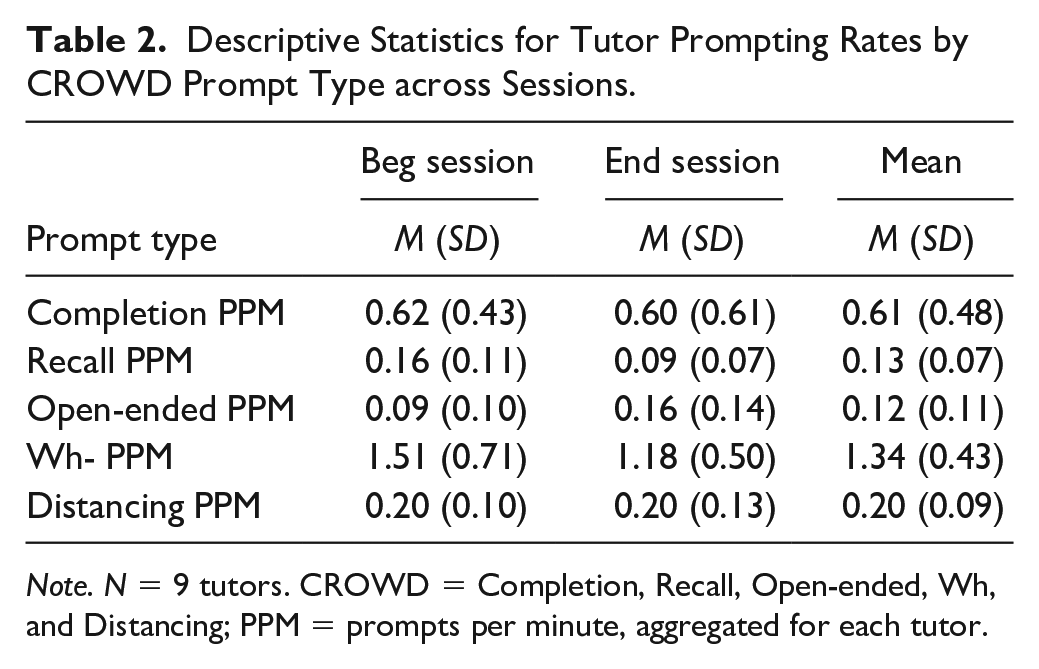
Note. N = 9 tutors. CROWD = Completion, Recall, Open-ended, Wh, and Distancing; PPM = prompts per minute, aggregated for each tutor.
Correlations Among Tutor Prompting Rates by CROWD Prompt Type.
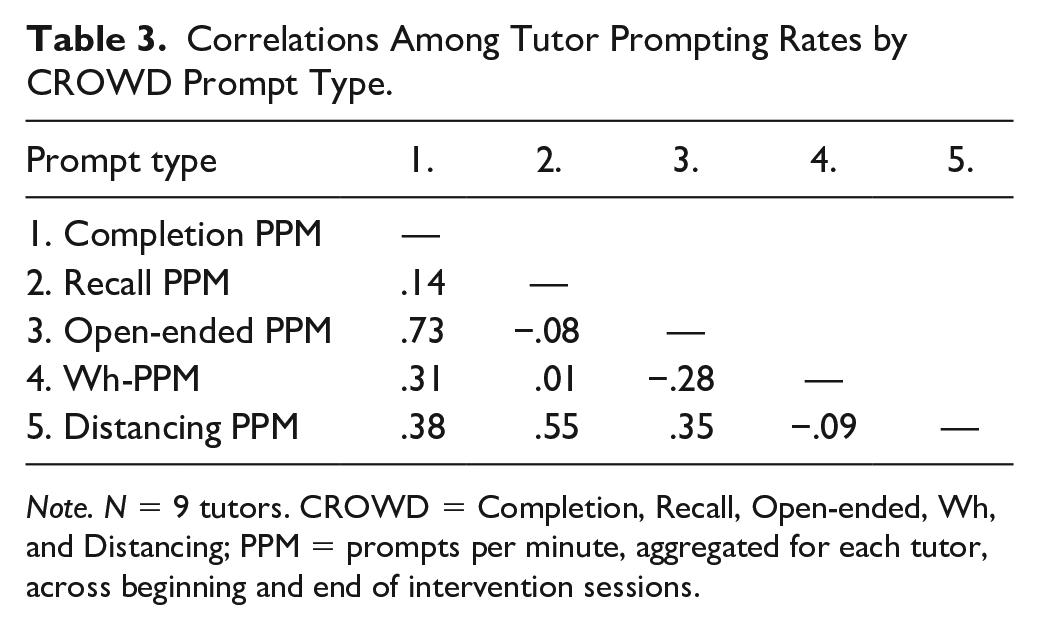
Note. N = 9 tutors. CROWD = Completion, Recall, Open-ended, Wh, and Distancing; PPM = prompts per minute, aggregated for each tutor, across beginning and end of intervention sessions.
RQ2: To What Extent Did Tutor Prompting During IBR Predict Pretest–Posttest Change in Language and Literacy Skills?
Recall that we first tested the linkage among each of the prompting rates separately, controlling for pretest, on children’s language and literacy gains (we did this to understand the direct effects of the prompt type rates because they are naturally correlated with each other and could overlap to a great extent when combined into one model together). As can be seen in Table 4, tutor use of open-ended prompting was positively related to children’s gains in print knowledge (each standard deviation increase in prompting predicted a 6.16-point increased gain from pretest to posttest, controlling for pretest), and tutor use of completion prompting was positively related to children’s gains in PA (each standard deviation increase in prompting predicted a 4.52-point increased gain from pretest to posttest, controlling for pretest). None of the other prompts was significantly predictive of gains.
Multilevel Model Results Predicting Child Language and Literacy Gains using Each Type of CROWD Tutor Prompting (Separately).
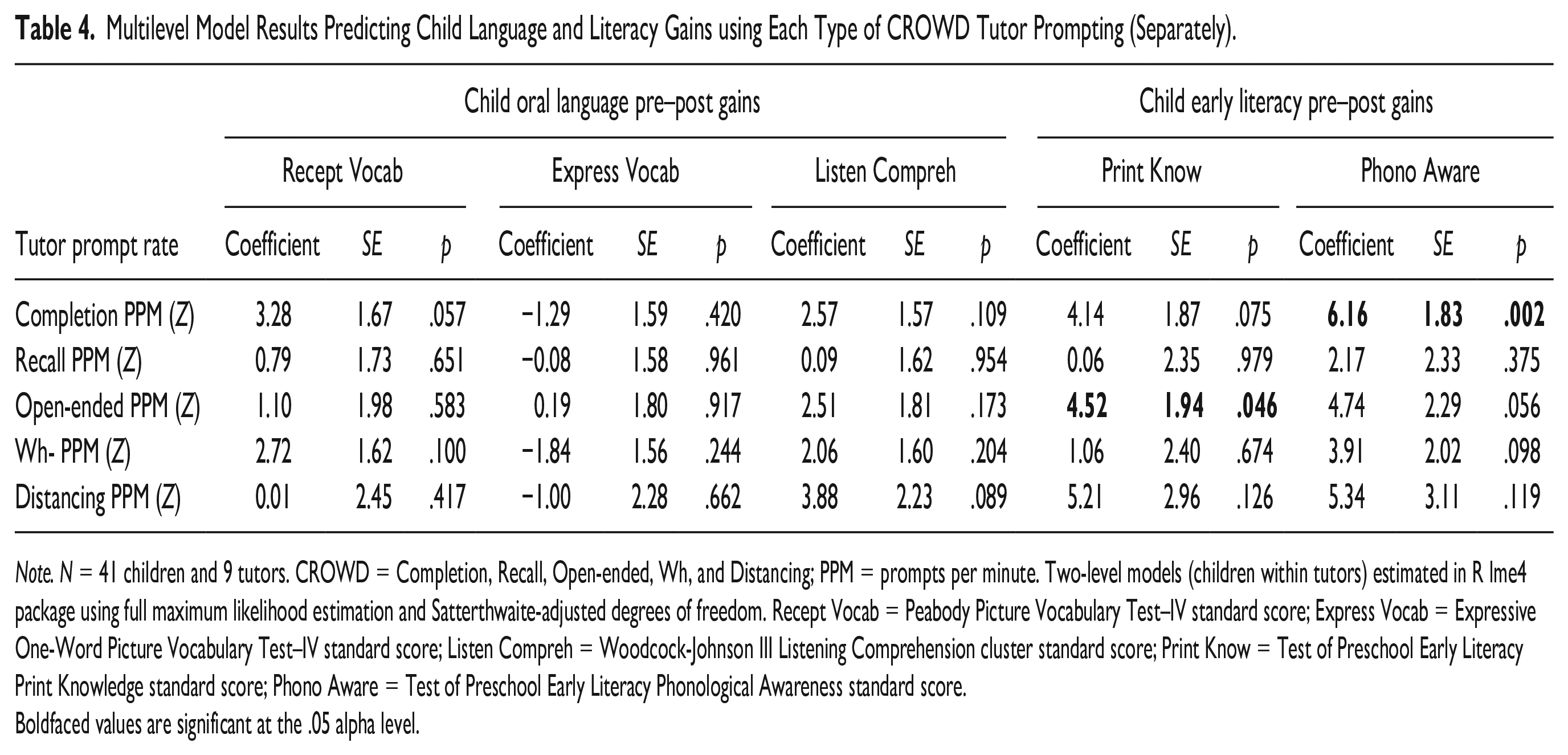
Note. N = 41 children and 9 tutors. CROWD = Completion, Recall, Open-ended, Wh, and Distancing; PPM = prompts per minute. Two-level models (children within tutors) estimated in R lme4 package using full maximum likelihood estimation and Satterthwaite-adjusted degrees of freedom. Recept Vocab = Peabody Picture Vocabulary Test–IV standard score; Express Vocab = Expressive One-Word Picture Vocabulary Test–IV standard score; Listen Compreh = Woodcock-Johnson III Listening Comprehension cluster standard score; Print Know = Test of Preschool Early Literacy Print Knowledge standard score; Phono Aware = Test of Preschool Early Literacy Phonological Awareness standard score.
Boldfaced values are significant at the .05 alpha level.
Importantly, because the IBR intervention in the original study showed significant advantages over typical preschool literacy instruction on gains in language skills but not early literacy skills, we followed up these findings to test whether the prompting effects on literacy gains observed in Table 4 would still be present after controlling for pretest–posttest language gains (in addition to pretest). In other words, do the two effects observed for completion and open-ended prompting on literacy have a unique benefit on literacy skills gains that are unrelated to language skills gains that were presumably a result of the IBR intervention?
To test this, we computed a mean composite language gain (averaging across the three language measures, then standardized as a Z-score) and added it to the previous model. As can be seen in Table 5, the prompting effects persisted even after controlling for language gains. For tutors who had relatively high open-ended prompt use, there was a 4.40-point predicted advantage over average amounts of open-ended prompt use on print knowledge gains, holding all else constant. Similarly, tutors who had relatively high completion prompt use were predicted to have children that gained 4.98 points more from pretest to posttest on PA compared with typical completion prompt use, all else being equal.
Multilevel Model Results Predicting Child Early Literacy Gains using Focal CROWD Prompting Types, Adjusted for Language Gains.
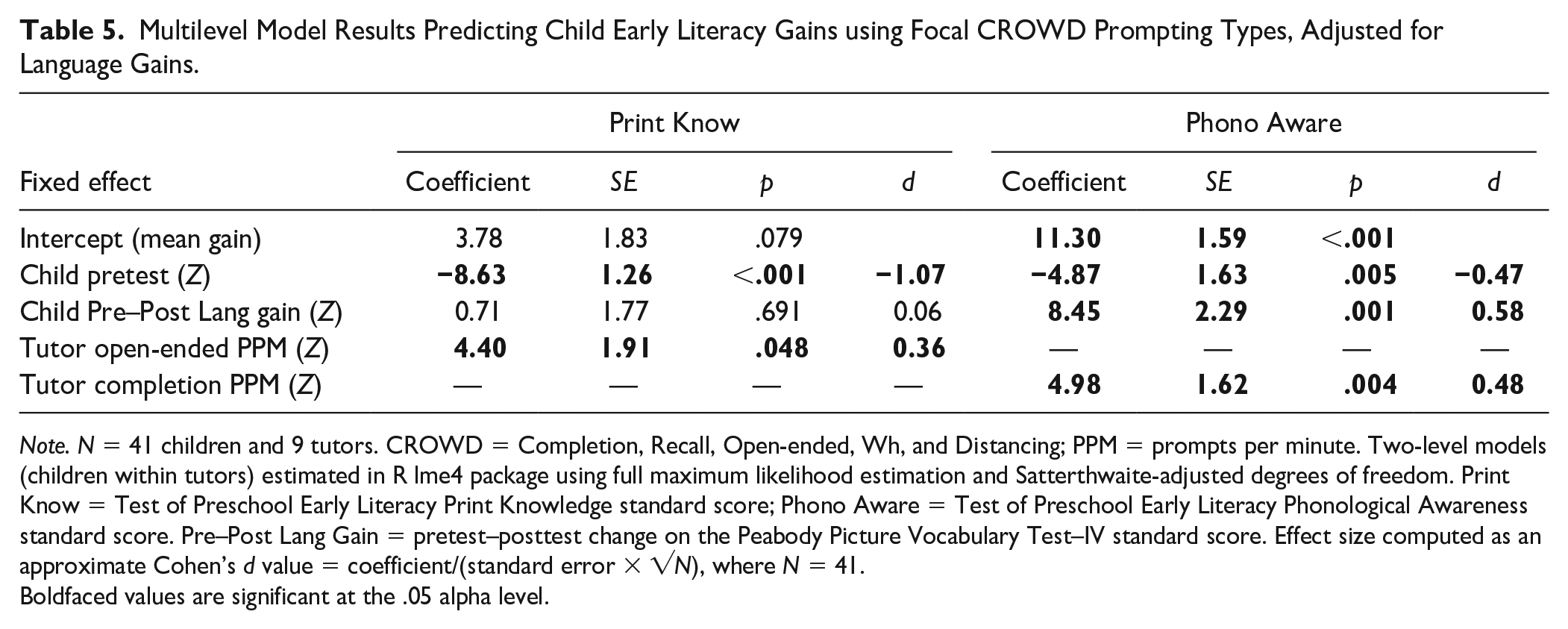
Note. N = 41 children and 9 tutors. CROWD = Completion, Recall, Open-ended, Wh, and Distancing; PPM = prompts per minute. Two-level models (children within tutors) estimated in R lme4 package using full maximum likelihood estimation and Satterthwaite-adjusted degrees of freedom. Print Know = Test of Preschool Early Literacy Print Knowledge standard score; Phono Aware = Test of Preschool Early Literacy Phonological Awareness standard score. Pre–Post Lang Gain = pretest–posttest change on the Peabody Picture Vocabulary Test–IV standard score. Effect size computed as an approximate Cohen’s d value = coefficient/(standard error × √N), where N = 41.
Boldfaced values are significant at the .05 alpha level.
Discussion
This study investigated (a) the extent to which different kinds of adult prompting took place during an IBR intervention and how prompting changed over the course of the intervention period, and (b) how prompting types were linked with changes in language and literacy skills for preschool children with ASD during the IBR intervention. Upon examination of the latter results, we also evaluated whether the prompting effects observed on children’s literacy gains were still significant after controlling for language gains. Our key findings include that tutors were fairly consistent in their use of different CROWD prompt types over the course of the intervention (recall that CROWD prompt types), with most reliance on wh- prompting, and also that variation in tutor’s use of completion and open-ended prompts showed a significant benefit on children’s emergent literacy gains, above and beyond language gains made during the intervention. Both of these findings uniquely contribute to literature around IBR intervention implementation in general, and for children with ASD in particular. This latter finding in particular is consistent with previous research on language development for children with ASD (e.g., Perryman et al., 2013).
Adult Prompting and Emergent Literacy Skills
Our results are consistent with previous research with TD children that has shown adult prompting during shared book reading is linked with targeted emergent literacy skills (Justice & Ezell, 2002; Lonigan et al., 2013; Zucker et al., 2012). In our study with children with ASD, two of the five IBR intervention CROWD prompts were significantly predictive of emergent literacy skills: specifically, completion prompts were related to positive PA skills gains, and open-ended prompts were positively related to alphabet knowledge gains. In other words, although wh- prompts were most frequently used by tutors, completion and open-ended prompts were most predictive of better literacy outcomes.
Our findings also fit into the larger story emphasizing the importance of the development of language during early childhood. Children need to develop a large enough language lexicon before they can develop sensitivity to the smaller sound units of words. The Lexical Restructuring Hypothesis (Metsala, 1997a, 1997b; Walley, 1993) posits that, before a child can detect units of speech at the phoneme level, their lexicon must reach a certain threshold. In addition, existing studies challenge the notion that differential language and emergent literacy skill development can be attributed to ASD symptomatology. For example, Lucas and Norbury (2015) found that language impairment was a better predictor of text inferencing skill than ASD symptomatology for a sample of 10-year-olds with ASD. Taken together, language development is important for literacy development, irrespective of ASD status.
Interactive shared book reading is of course an ideal way to increase a child’s exposure to oral language and receptive vocabulary. Flynn (2011) even recommends implementing IBR in a tiered approach, where tutors present the same text over multiple sessions presenting questions with increasing demand as children indicated mastery of the vocabulary and concepts in the target book. Although the nature of the IBR intervention itself (one-on-one with a tutor who provides predictable routines and repeated readings of the same storybook) could explain the significant growth we observed in children’s PA skills, the fact that completion prompts were uniquely related to PA growth in the present study could be because completion prompts initiate a “episode” of joint attention, resulting in attending to a single word.
Regarding our finding that open-ended prompts were uniquely related to print knowledge gains, it may be the case that, given no specific direction within the shared book reading task, children with ASD may default to their strengths—which include discrete, concrete capacities such as orthographic- and code-related skills (Dynia et al., 2014; Lanter et al., 2012). Furthermore, as evidenced in recent studies with similar participant groups (Dynia et al., 2019), PA skills are related to oral language skills, and broadly speaking, the IBR intervention in the original study had a positive effect on oral language growth (Hudson et al., 2019), which in turn could potentially predict PA growth.
Limitations and Future Directions
There are several limitations to this study. Due to the small tutor and child sample sizes, the effects we found should be regarded as preliminary and future research should investigate whether the results can be replicated with children with ASD as well as other populations. Second, the children included in the study had a baseline level of language at the start of intervention. This was an inclusion criterion made in the original study based on the logic that children need a minimum level of language to benefit from a reading intervention. We note this as a limitation, however, because many children with ASD present with lower or little language in early childhood, and further investigation would be needed to generalize our results to that population. Third, the present study utilized extant data from a previous study in which tutors were free to choose what type of prompt to use and when to use them—in other words, we have a convenience sample of prompt use; without randomly assigning tutors to prompt use types or use frequencies, we cannot draw causal conclusions around the linkage between rates of different prompt usage and child outcomes. Future research might take up this question using an experimental design. It is also highly possible that further refinement of the IBR intervention to promote greater child-specific prompt use and greater engagement (recall that the average on-task engagement in the present study was 86%) could potentially produce greater effects on emergent literacy outcomes.
Conclusion
Consistent with previous work with TD children (Whitehurst et al., 1988; Whitehurst & Lonigan, 1998), the current study shows that naturally occurring adult prompt use during shared book reading is positively linked with emergent literacy growth in preschoolers with ASD. More specifically, greater use of completion and open-ended prompts was found to predict greater literacy skills growth, even after controlling for language growth. We, therefore, propose that selection and timing of prompting types might be more carefully considered in connection with language-focused shared book reading interventions such as Flynn’s (2011) approach, which involves having tutors repeat readings from familiar texts while continually assessing children’s mastery of vocabulary. Using our findings and the work of others, future research can and should take up the important work of investigating how we can further strengthen IBR interventions as a universal tool in combating risk for reading failure for all children.
Footnotes
Acknowledgements
We are grateful to the intervention teachers and data collectors for their work on this project. We especially thank the children, parents, teachers, and principals in Bellevue Public Schools, Edmonds Public Schools, Issaquah Public Schools, Lake Washington Public Schools, Renton Public Schools, Seattle Public Schools, Shoreline Public Schools, and the Haring Center who made this research possible.
Declaration of Conflicting Interests
The author(s) declared no potential conflicts of interest with respect to the research, authorship, and/or publication of this article.
Funding
Research reported in this publication was supported by the Eunice Kennedy Shriver National Institute of Child Health and Human Development of the National Institutes of Health under award number 1R01HD072143-01. The content is solely the responsibility of the authors and does not necessarily represent the official views of the National Institutes of Health.